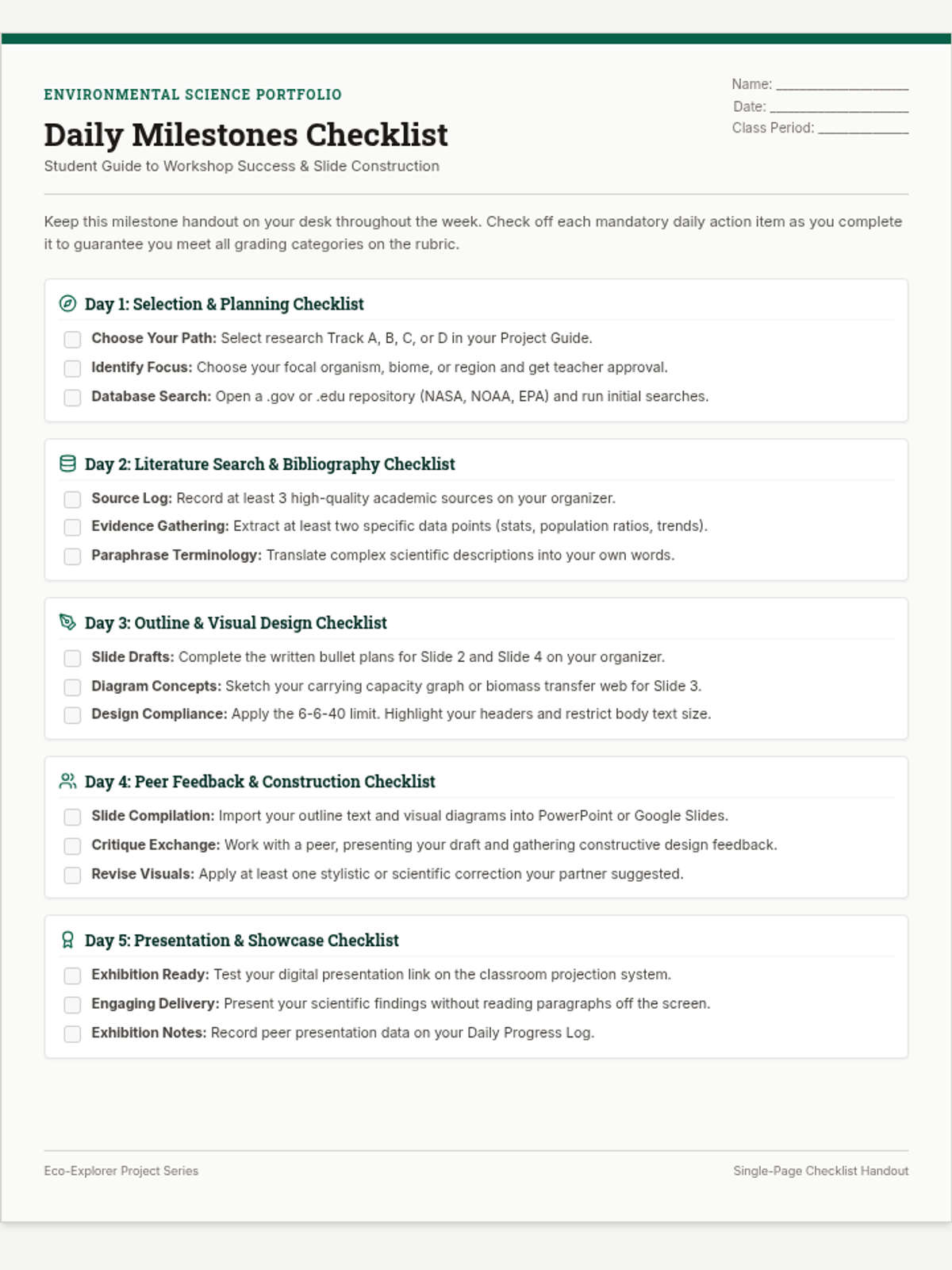
Students analyze data to describe the human role in rising global temperatures. They evaluate claims about natural resource use, the carbon cycle, and the greenhouse effect using historical evidence and climate models.
Explore the collision of air masses at cold and warm fronts and use weather data to predict the onset of storms and clear skies.
Identify and compare various air masses (maritime, continental, polar, tropical) and understand how air moves from high to low pressure systems.
A comprehensive lesson exploring why Earth has seasons, focusing on axial tilt, revolution, and the intensity of solar radiation. Students will model the Earth-Sun system to understand solstices, equinoxes, and hemispheric differences.
Explore how mass and net force determine how quickly a vehicle can stop. This lesson uses braking scenarios to provide evidence for Newton's laws of motion.
A high-energy gameshow lesson where students identify "ancient" tech artifacts and explore how they evolved into the devices we use today.
A comprehensive review of mixtures and solutions for 5th grade students, focusing on solubility, concentration, and chemical vs. physical reactions through a series of independent lab challenges.
A series of creative coding challenges designed for young learners using Scratch Jr. Students will explore basic programming concepts through open-ended, imaginative projects.
An introductory lesson on birds for first-grade students, focusing on anatomy, habitats, and common species through a visual read-along and interactive activities.
A 30-minute introductory lesson for 9th graders exploring how passive data is collected through search history, location tracking, and device information. Students will transition from a baseline diagnostic to a guided visual exploration and hands-on vocabulary application.
An introductory lesson on the history and mechanics of steam engines, adapted for 3rd-grade readers. Students will explore how heat creates movement and how this invention changed the world.
A lesson focused on the fundamental principles of motion, including key vocabulary and Newton's First Law. Students will demonstrate their understanding of forces, acceleration, and inertia.
A lab-based lesson where students determine the densities of granite and basalt to understand the differences between continental and oceanic crust.
A lesson exploring the fundamental concepts of natural selection, evolution, and reproduction through interactive vocabulary practice and visual aids.
An introductory lesson on common electrical circuit symbols, their functions, and how they are represented in schematic diagrams.
An introductory lesson on photosynthesis and cellular respiration, focusing on the flow of energy and the exchange of gases in plants. Students will identify key inputs and outputs and compare the two vital processes.
A focused practice session for calculating specific heat, heat energy, and temperature changes using the q=mc\Delta T formula.