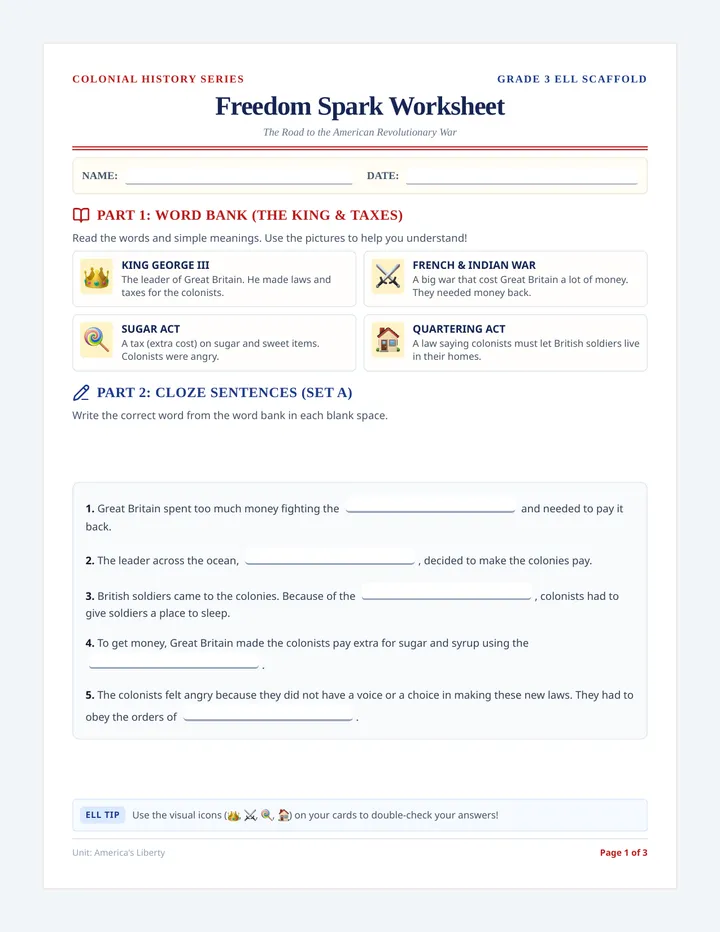
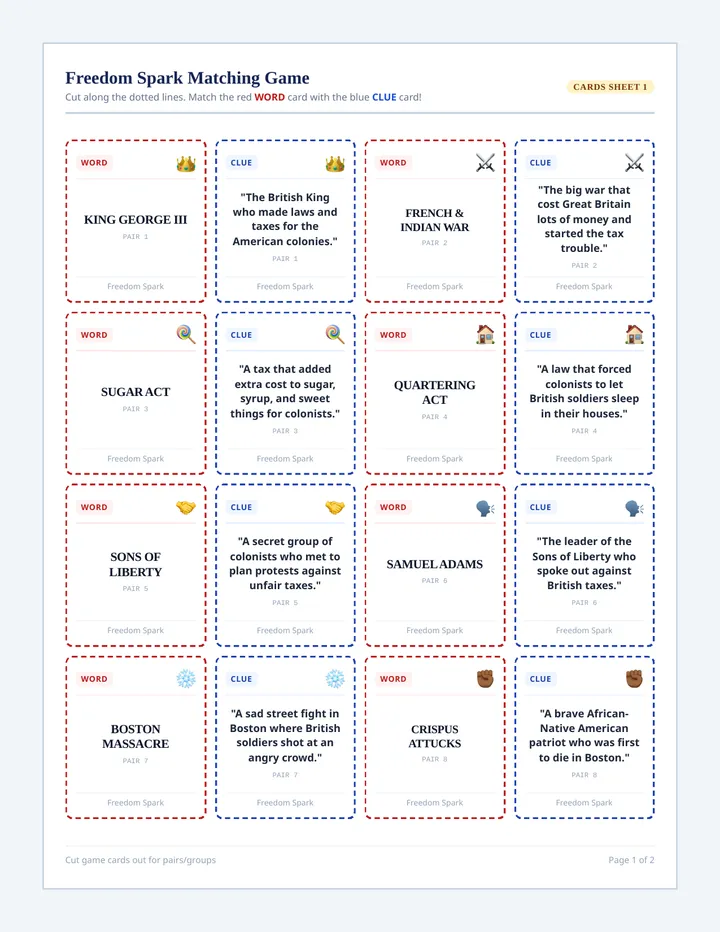
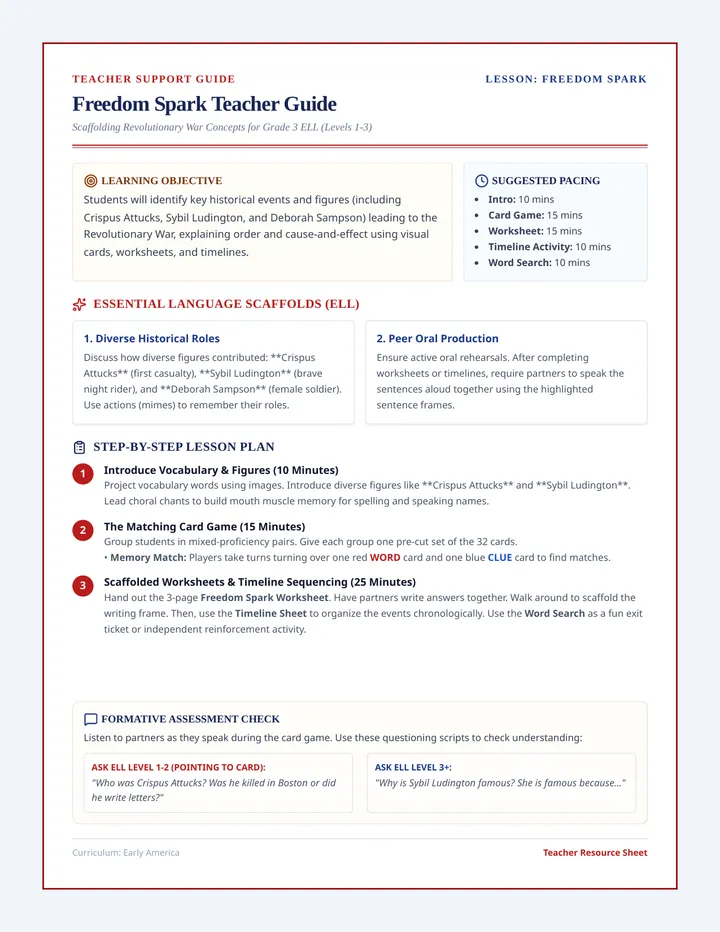
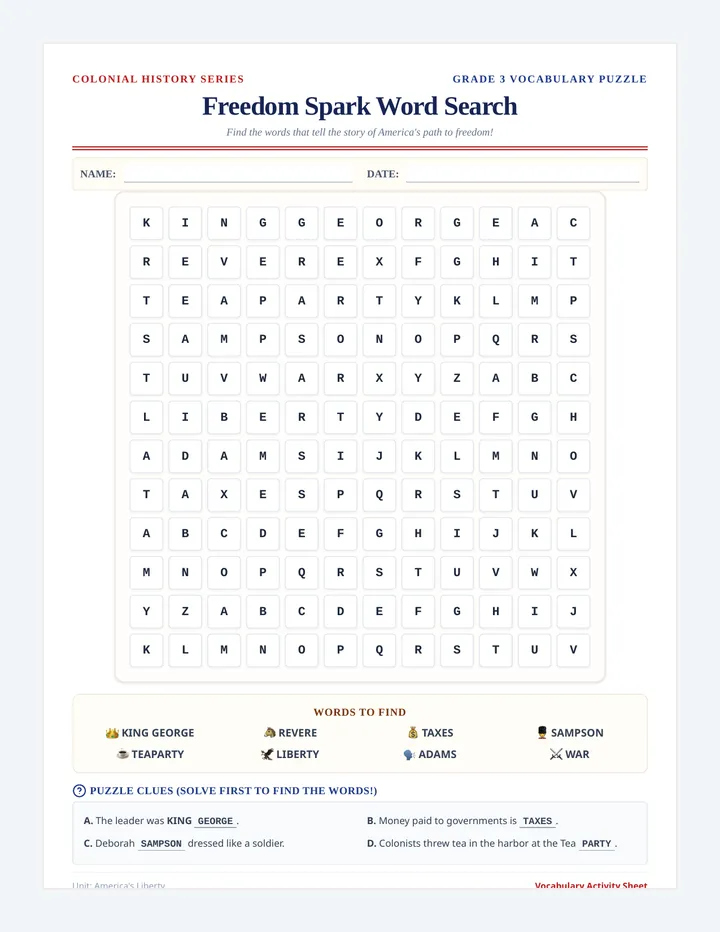
This lesson explores the profound connection between historical events and the formation of personal and collective identity, helping students see history as a living force.
An interactive simulation game where students experience the feudal hierarchy firsthand by distributing resources, paying taxes, and managing land across different social classes.
Analyze the shift from agrarian village to industrial center using the Urban Game simulation. Students will apply the CER framework to evaluate the impact of industrialization on community structure and quality of life.
A comprehensive preparation resource for the 11th Grade US History STAAR exam, featuring matching activities categorized by historical era to reinforce key vocabulary and concepts.
A comprehensive lesson plan for simulating the Constitutional Convention's debate over representation. It includes a teacher-facing facilitation script tailored for small class sizes and a student-facing strategy sheet to guide delegates through the complex negotiations between large and small states, ensuring a historically accurate deadlock and eventual Great Compromise.
A final cumulative assessment for the Foundations of Freedom remediation packet, measuring student mastery of TEKS 1 and 12B through multiple-choice questions and a comprehensive essay.
Focuses on the specific compromises made during the Constitutional Convention, including the Great Compromise and the Three-Fifths Compromise. Students cover TEKS 1E.
Analyzes the failures of the Articles of Confederation and the initial debates surrounding the creation of the Constitution. Students cover TEKS 1E.
Examines the contributions of Jay, Mason, Sherman, and Wilson, along with the definition and protection of unalienable rights. Students cover TEKS 1D and 12B.
Analyzes the political philosophies of Adams, Hamilton, Jefferson, and Madison and their impact on early American government. Students cover TEKS 1D.
Investigates the specific contributions of Moses, Blackstone, Locke, and Montesquieu to the principles of American law and institutions. Students cover TEKS 1C.
Explores the Judeo-Christian, English Common Law, and Republican traditions that informed the American founding documents. Students analyze TEKS 1B.
Focuses on the transition from the Divine Right of Kings to the Enlightenment concepts of Social Contract, Natural Law, and the right to resist illegitimate government. students explore TEKS 1A.
This lesson guides students through an analysis of Día de Muertos, focusing on the cultural significance, historical roots, and identity-affirming power of the tradition. Students will practice synthesizing information from multiple paragraphs to construct a meaningful written response about resilience and memory.
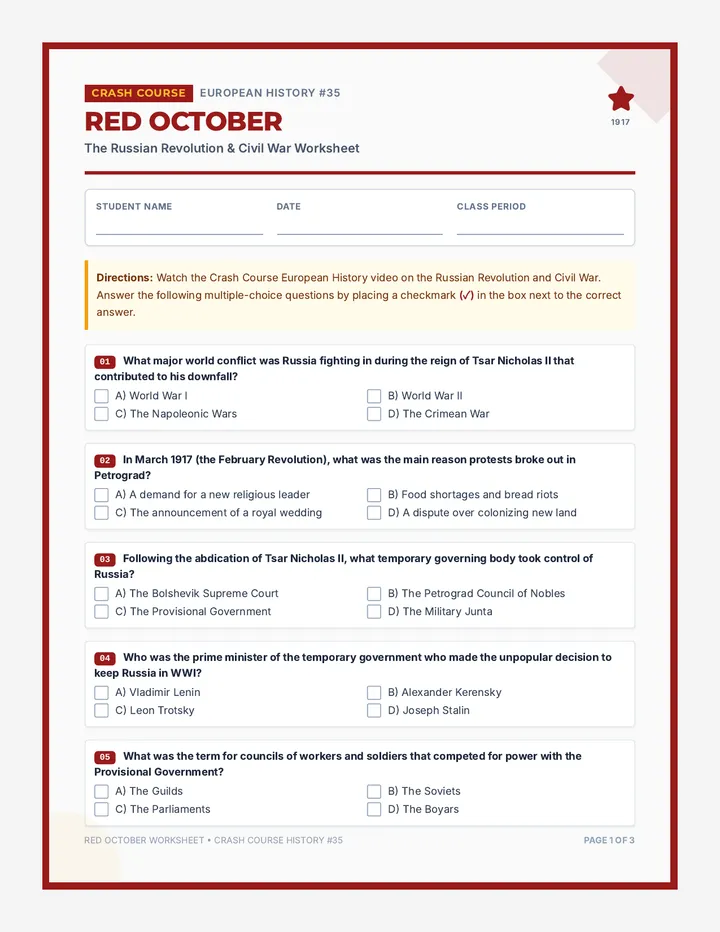
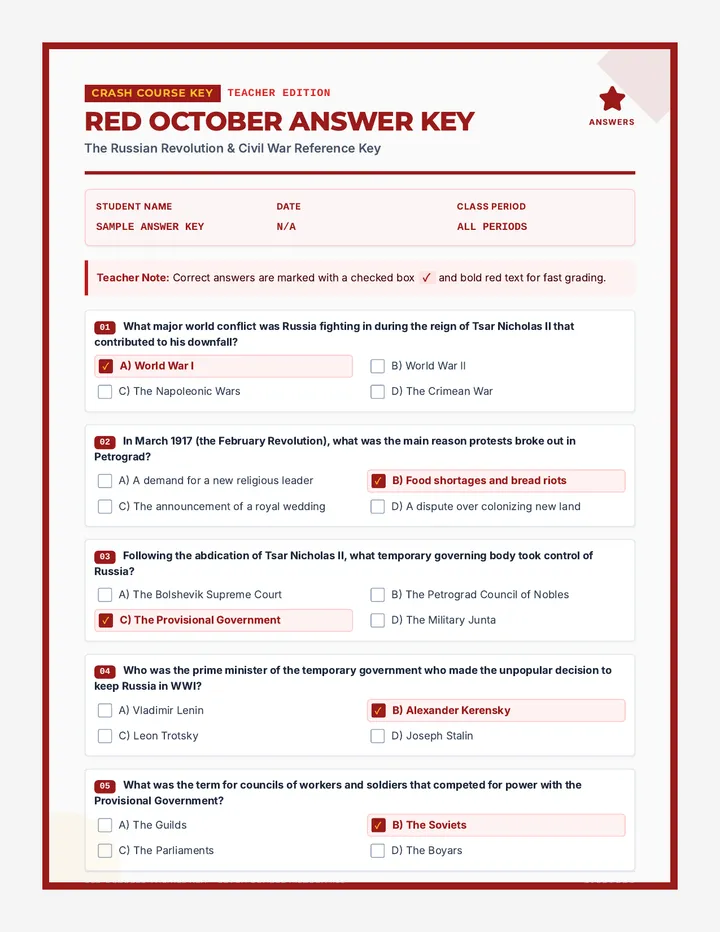
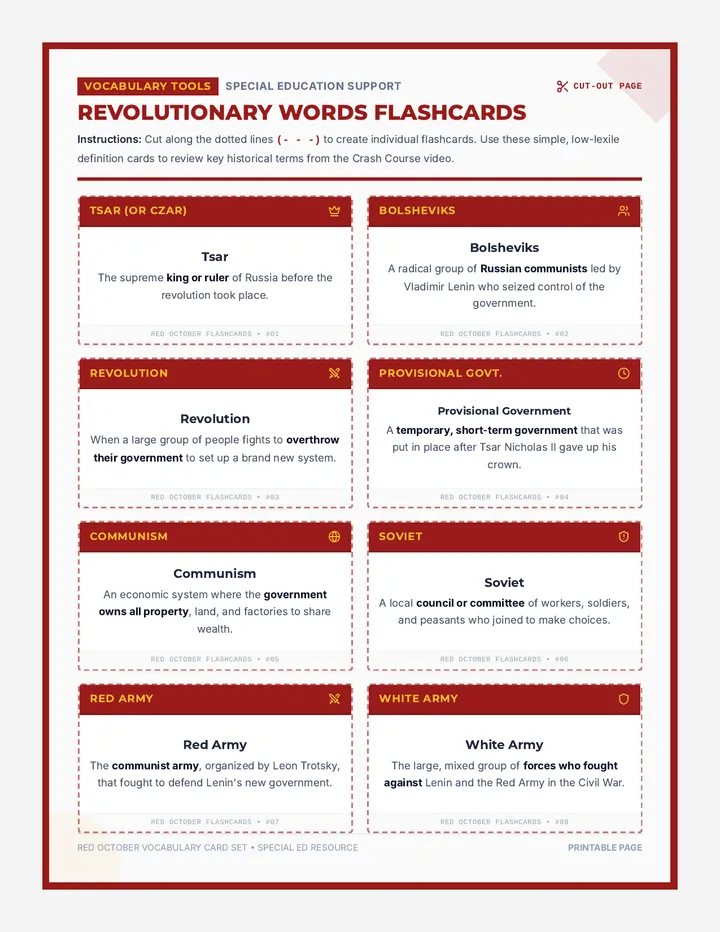
A short lesson focusing on categorization skills within major World History topics like the Scientific and Industrial Revolutions, WWI, and the Russian Revolution.
This lesson focuses on identifying and categorizing different types of government systems based on who holds power, how power is distributed geographically, and the relationship between legislative and executive branches. Students will practice applying these concepts to STAAR-style questions.
A 9th-grade EL-focused lesson combining Black history with SEL competencies. Students explore systemic racism and personal identity through the legacies of historical figures.
An introductory exploration of New Jersey v. T.L.O. (1985), focusing on the Fourth Amendment in schools, the 'Reasonable Suspicion' standard, and the balance between student privacy and school safety.
A deep dive into the emergence of England and France as unified powers, focusing on the Hundred Years' War and the centralization of royal authority.
An exploration of the unification of Spain through the Reconquista and the rise of Russia under Ivan the Great, concluding with the shared characteristics of nation-states.
A comprehensive lesson exploring the transition from feudalism to centralized monarchies in England, France, Spain, and Russia, focusing on how these powers consolidated land and authority.
A 45-minute stand-alone lesson centered on the Constitutional Convention's debate over representation and the Three-Fifths Compromise. It includes chunked reading for accessibility, a high-engagement 'Four Corners' activity, and a graphic organizer assessment designed for formal observation alignment with the Danielson Framework.
A graduate-level exploration of the landmark 1973 Supreme Court case concerning educational funding equity, focusing on the legal standards of equal protection and the long-term impact on systemic inequality.
This lesson explores the landmark California Supreme Court case Serrano v. Priest (1971), which challenged the constitutionality of using local property taxes to fund public schools. Students will analyze the legal arguments for educational equity and the long-term impact on school finance in California.
A comprehensive lesson exploring Martin Niemöller's poem through the lens of historical context, personal responsibility, and the consequences of silence during the Holocaust.
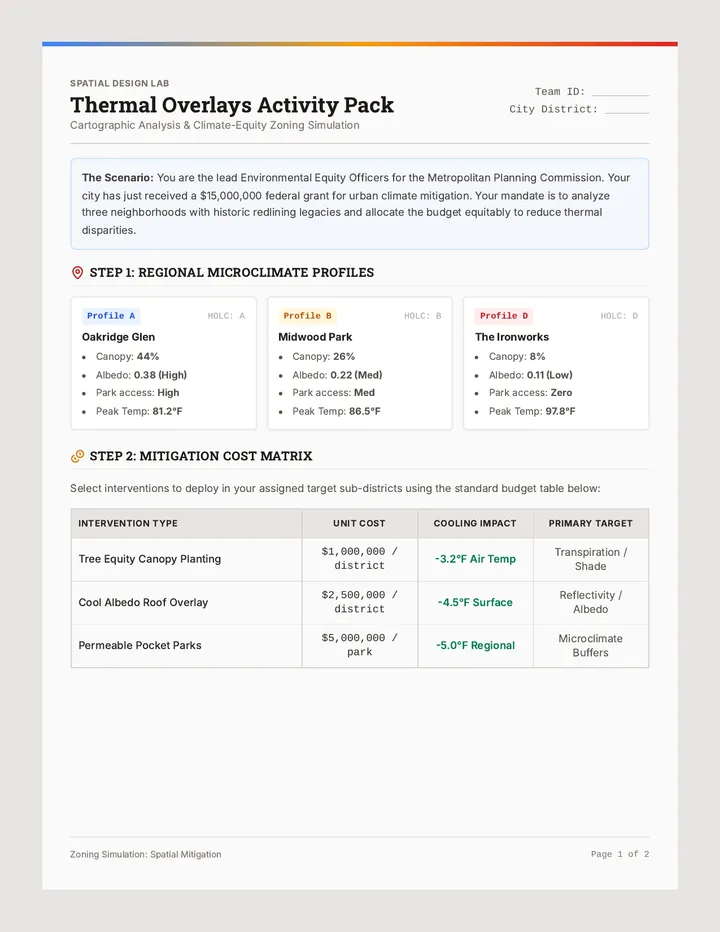
A hands-on exploration of sustainable urban design using grid-based planning. Students learn about walkability, green spaces, and efficient transit while designing their own eco-friendly neighborhood.
A comprehensive remediation packet for 11th grade US History students covering the Great Depression and World War II, designed at a 9th-grade reading level to support struggling learners.