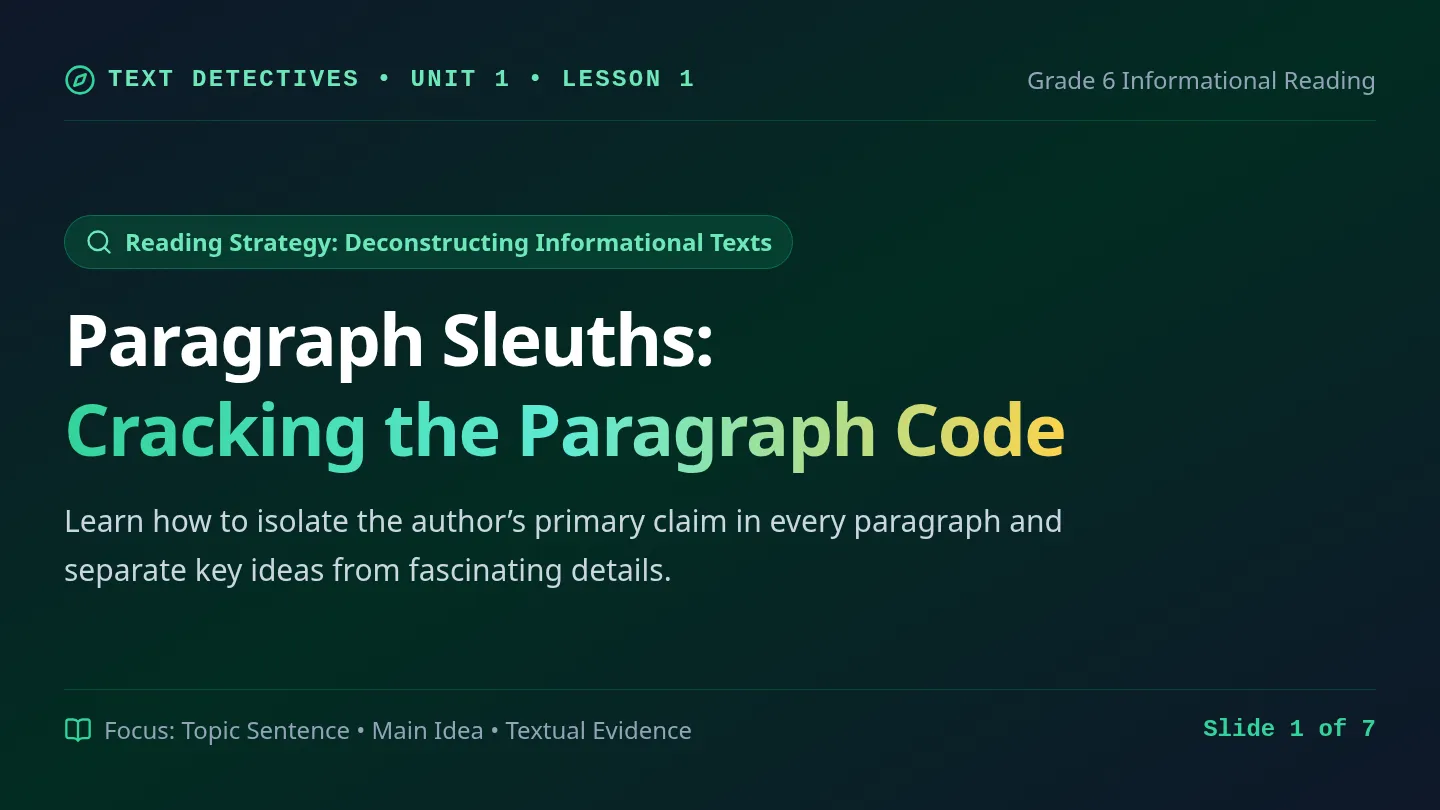
Core Clues Slides
Reading Investigation
CORE CLUES
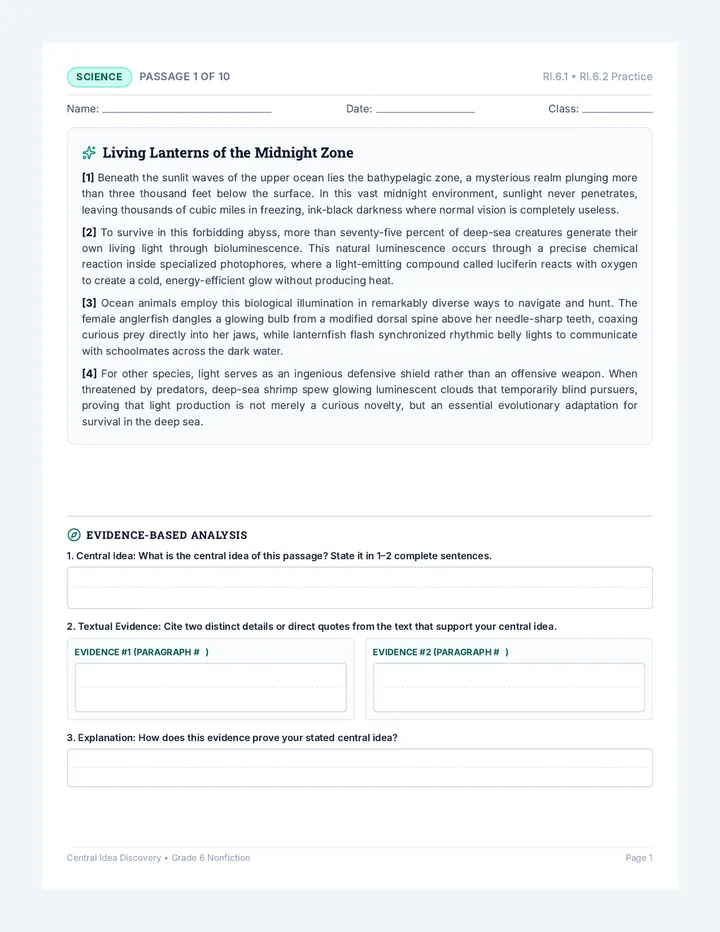
Cracking the Main Idea & Supporting Details
The Main Idea
The Main Idea is the "Big Picture." It is what the entire text is mostly about.
"If you had to summarize the whole article in just one sentence, what would you say?"
Think of it as the 'Umbrella' that covers all the other information in the text.
Supporting Details
These are the facts, examples, and evidence that prove the main idea is true.
- They provide more information.
- They answer Who, What, Where, When, and Why.
- Without them, the main idea is just an opinion!
MAIN IDEA
DETAIL 1
DETAIL 2
DETAIL 3
Detective Strategy
1 Check the Title
Titles often give away the subject or the main point of the entire text.
2 First & Last
Look at the first and last sentences of paragraphs. They often state the main claim.
3 Repeated Clues
Notice words or ideas that appear multiple times. Those are key clues!
Ready to start your investigation?
Core Clues Organizer
CASE FILE: MAIN IDEA
Top Secret Investigation Log
NAME:
DATE:
Title of Investigation (Text):
The Big Picture
The Main Idea
What is the central point the author is trying to prove? Summarize it in one sentence.
Supporting Evidence (Details)
1
Detail/Fact/Example
2
Detail/Fact/Example
3
Detail/Fact/Example
Final Briefing
Case Summary
Core Clues Guide
TEACHER GUIDE
Core Clues: Main Idea Investigation
Target Grade 6TH GRADE
Investigation Objective
Students will analyze nonfiction texts to determine the central message or main idea and identify the key supporting evidence (details) that reinforce that idea.
Key Concepts
- Main Idea: The "Big Picture" or the primary claim.
- Supporting Details: The evidence (facts, stats, examples).
- Summary: A concise synthesis of the main idea and details.
Materials Needed
- Core Clues Slides
- Core Clues Organizer (1 per student)
- Grade-level nonfiction text
Investigation Procedure
01
The Briefing (Hook)
Present the "Core Clues Slides." Use the detective metaphor to frame reading as an investigation. Explain that authors often "hide" the main idea, and details are the clues we use to find it.
02
Modeling (I Do)
Model the process using a short paragraph. Think aloud as you look at the title, the first/last sentences, and repeated keywords to identify the main idea.
03
Guided Investigation (We Do)
Distribute the "Core Clues Organizer." Read a section of text together and have students suggest possible main ideas. Vote on the most accurate one and record it in the central box.
Example Case File (Answer Key)
Topic: Honeybees
Main Idea
"Honeybees are essential to the Earth's ecosystem because they pollinate the majority of the world's food crops."
Supporting Detail 1
Bees carry pollen from flower to flower, allowing plants to reproduce.
Supporting Detail 2
One out of every three bites of food we eat is the result of bee pollination.
Supporting Detail 3
Major crops like almonds, apples, and blueberries rely almost entirely on bees.
Summary Synthesis
Because honeybees help plants grow and produce the food humans need to survive through pollination, their survival is critical for our environment.