Collision Course Slides Unit: Clash Course
The Point of Impact
Lesson 1: Deconstructing Disagreement & Identifying Clash
ENGAGE & EVOLVE
Defining "Clash"
01 // ARCHITECTURAL CORE
"Talking Past Each Other"
When two people argue about different things at the same time. There is no intersection. No engagement. No progress.
Clash
Direct engagement with an opponent's specific claim. Clash happens when you respond to the exact logic or evidence presented.
Claim A
Claim B
CLASH
Visualizing the Intersection of Ideas
Anatomy of an Internet Argument
02 // CASE STUDY
A
@LogicalLouie
"We should ban smartphones in schools because they cause distractions and lower test scores."
B
@SkepticalSally
"Oh yeah? Well, schools have bigger problems, like old textbooks and bad lunches. Why don't you talk about that instead?"
NO CLASH DETECTED
Why did Sally fail to engage Louie's argument?
The "Hinge" of Disagreement
03 // MECHANICS
The hinge is the specific premise that, if proven wrong, causes the whole argument to collapse.

How to find it:
Identify the core claim (The Conclusion)
Isolate the primary reason (The Premise)
Ask: "What must be true for this to work?"
Example Analysis
CLAIM:
We must build a sea wall to protect the city.
REASON:
Sea levels are rising 1 inch per year.
THE HINGE:
"A sea wall is the most effective way to stop 1 inch of rise."
Your Mission: Clash Detection
In the transcripts provided, you will identify three things: the Claim, the Reason, and the failed or successful Point of Clash. If clash is missing, you must construct a "Direct Response" that hits the hinge.
GET THE WORKSHEETS READY // PREPARE FOR DECONSTRUCTION
Clash Coordinator Guide The Point of Impact
Teacher Facilitation Guide // Lesson 1: Deconstructing Clash
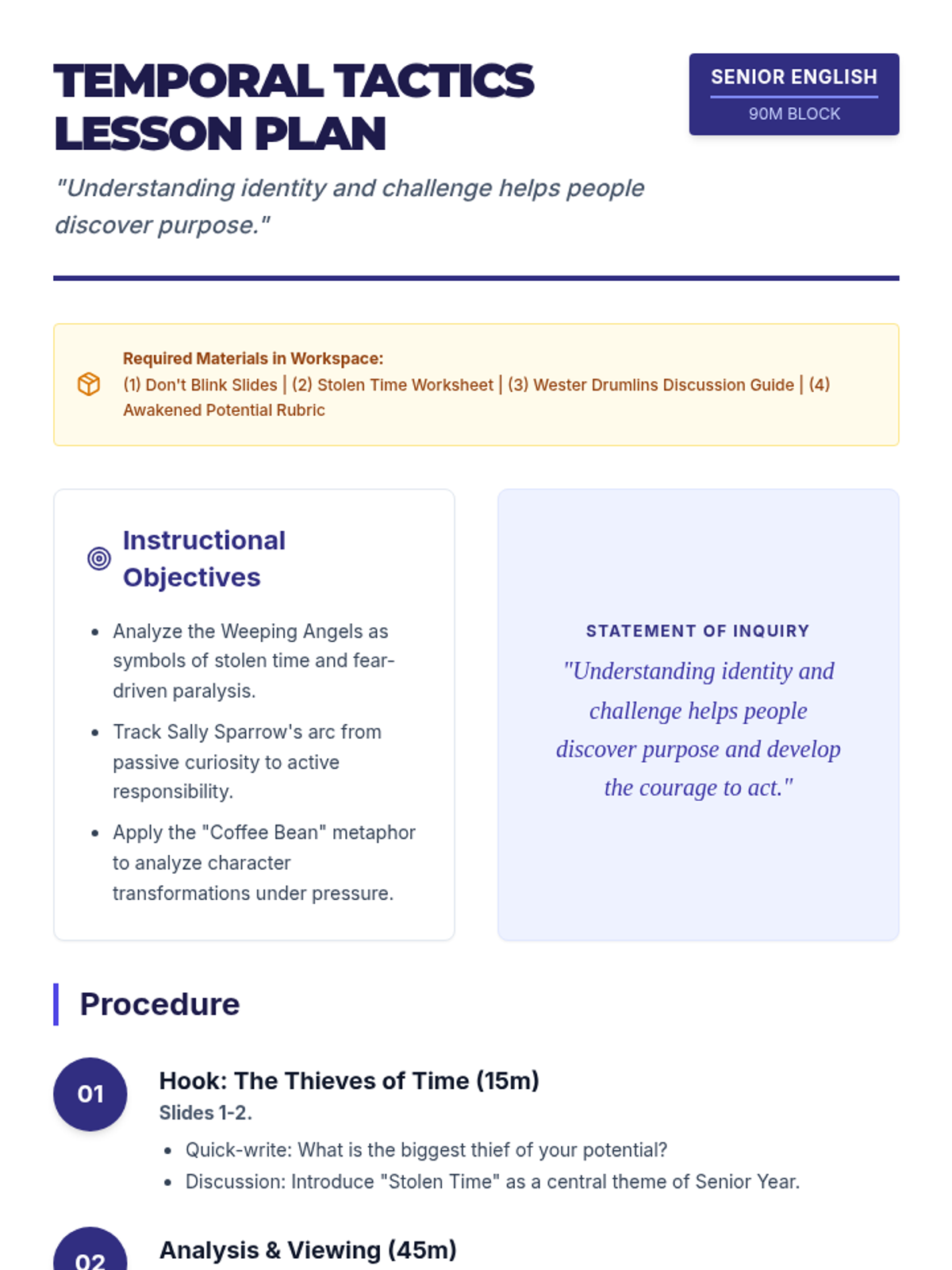
10th Grade Debate
Lesson Overview
This lesson introduces students to the concept of clash —the direct engagement of ideas. Students often confuse "disagreeing" with "clashing." The goal is to move them from generic gainsaying (saying "no" or talking about something else) to tactical engagement with an opponent's specific logic.
Key Vocabulary
• Clash
• Talking Past
• The Hinge
• Direct Engagement
• Premise vs. Conclusion
Instructional Sequence
10 MIN
The Hook: Visualizing Collisions
Use Slide 2 to discuss literal collisions. Ask: "What happens if two cars pass each other in different lanes? Do they collide?" (No). "Arguments are the same. If you argue about cost and I argue about ethics, we are in different lanes. There is no impact."
15 MIN
Case Study: The Internet Argument
Display Slide 3. Have two students read the roles of Louie and Sally. Ask the class: "Did Sally prove Louie wrong?" Most will say no. Teacher Prompt: "Sally used a Red Herring . She changed the subject to textbooks. To clash, she must stay on the subject of smartphones."
20 MIN
Guided Practice: Finding the Hinge
Use Slide 4. Explain that every argument has a "hinge"—the specific link between the reason and the claim. If you break the hinge, the door falls off. Practice with the Sea Wall example provided.
Answer Key: Clash Detector Worksheet
Scenario 1 (School Uniforms): Failed Clash. Respondent talks about "freedom of expression" while the claim was about "economic equality." They are in different lanes.
Scenario 2 (Solar Energy): Successful Clash. Respondent addresses the "reliability" premise directly by citing battery storage technology.
Scenario 3 (Homework): Accidental Clash. Respondent hits the "time management" reason but frames it poorly. Students should rewrite this to be more professional.
Clash Detector Worksheet Clash Detector
Deconstructing Arguments & Finding the Hinge
Name:
Date:
Mission: Below are transcripts of mini-debates. For each, identify the original claim and reason. Then, determine if the responder actually "clashed" with the argument. If they didn't, identify the "Hinge" and write a better response.
SCENARIO 01
The Uniform Debate
"Schools should require uniforms because they eliminate economic bullying between students."
"I disagree. Uniforms are really uncomfortable and students should have the right to express their personality through clothes."
Clash Detected?
Yes No
Identify the Reason/Premise:
Analysis: Why is this successful or failed clash?
SCENARIO 02
Renewable Energy
"We cannot rely on solar energy as our main source of power because it is too inconsistent; the sun doesn't shine at night."
"That's outdated thinking. Modern battery technology allows us to store massive amounts of energy for use at night, solving the consistency problem."
Clash Detected?
Yes No
Identify the "Hinge":
Analysis: Why is this successful or failed clash?
Repair Shop: Constructing a Direct Response
Go back to Scenario 1. Since the clash failed, write a response that stays in the same lane as the speaker by addressing "economic bullying" or the "uniform costs" directly.
Your Direct Response // Hit the Hinge
Refutation Blueprint Slides Unit: Clash Course
The Refutation Blueprint
Lesson 2: Mastering the Four-Step Model
Why Use a Blueprint?
01 // LOGIC OVER NOISE
Without a model, refutation is just shouting . With a model, refutation is precision surgery .
Eliminates confusion
Forces logical consistency
Makes you easier to follow
The Four-Step Model
02 // THE FORMULA
01
Signal
Identify exactly which argument you are responding to.
"They say..."
02
State
Clearly assert your counter-claim in one sentence.
"But I disagree..."
03
Support
Provide logic, evidence, or reasoning for your claim.
"Because..."
04
Summarize
Explain why your argument outweighs theirs.
"Therefore..."
The Translation
03 // IN ACTION
Messy Original
"I don't think soda should be banned in cafeterias. Kids are just gonna buy it elsewhere anyway, so banning it here doesn't actually stop them from drinking it. It just loses the school money."
The Refutation Blueprint
SIGNAL: They say banning soda in schools will improve student health.
STATE: But this ban is ineffective at changing habits.
SUPPORT: Because students have easy access to soda at convenience stores and home, meaning the school environment is only a small fraction of their intake.
SUMMARIZE: Therefore, the ban only hurts school revenue without achieving the health outcome.
Blueprint Build-Off
It's time to build. You will receive a series of "Messy Claims." Your job is to translate them into the perfect Four-Step Blueprint.
STRICT STRUCTURE // NO EXCEPTIONS
Formula Facilitator Guide The Refutation Blueprint
Teacher Facilitation Guide // Lesson 2: The Four-Step Model
10th Grade Debate
Instructional Sequence
10 MIN
The Hook: Speed Drills
Before introducing the formal model, give students simple assertions: "Pineapple belongs on pizza." "Video games are sports." "Summer is better than winter." Have them refute them instantly. They will likely be messy. Use this to pivot to the need for a "blueprint."
15 MIN
The Model Breakdown
Present Slide 3. Emphasize that Step 1 (Signal) is the most forgotten step. Without it, the judge/audience doesn't know what you're talking about. Explain that Step 4 (Summarize) is where the actual "impact" of the argument is weighed.
25 MIN
Workshop: Building Blueprints
Distribute the Refutation Builder Worksheet . Students should work individually or in pairs to "translate" messy claims. Teacher Tip: Walk around and ensure students aren't skipping the "Therefore" step—this is where they explain why their point matters more than the opponent's.
Common Student Pitfalls
The "I Disagree" Loop: Students just repeat their claim without "Support." Prompt: "How do we know that's true?"
Missing the Signal: Jumping straight into "Because..." without identifying the opponent's claim. Prompt: "Who are you talking to?"
Generic Summaries: Saying "Therefore I'm right" instead of explaining the logical consequence.
Evaluation Rubric
Criteria Proficient Signaling Clearly identifies specific opponent claim. Logic Reasoning directly clashes with opponent's logic. Conclusion Summary explains why the refutation matters.
Refutation Builder Worksheet Refutation Builder
From Messy Thoughts to Structured Logic
Name:
Date:
STEP 01
SIGNAL
"They say..."
STEP 02
STATE
"But I disagree..."
STEP 03
SUPPORT
"Because..."
STEP 04
SUMMARIZE
"Therefore..."
1
Messy Claim: Public Transport
"I think making buses free is a bad idea. It'll just cost the city too much money and they'll have to raise taxes for everyone. Plus, the buses will get too crowded and people who actually need to get places will be stuck."
Signal
They say free public transport is beneficial for city residents...
State
Support
Summarize
2
Messy Claim: School Year
"Going to school all year round with shorter breaks is way better. You don't forget everything over the summer, and teachers don't have to spend a whole month reviewing old stuff when we come back in September."
Signal
State
Support
Summarize
Shield and Sword Slides Unit: Clash Course
Shield and Sword
Lesson 3: Denial vs. Mitigation
The Two Defenses
01 // STRATEGIC CHOICE
Denial
"This argument is factually false ."
Example: "They say it will rain, but the weather report says 0% chance."
Mitigation
"This argument is not as bad as they say ."
Example: "It might rain, but only for 5 minutes and we have umbrellas."
The Art of Mitigation
02 // IMPACT CONTROL
Opponent Impact
The "End of the World"
CUT IT DOWN
Small Nuisance
Reality
When to Use Which?
03 // TACTICAL RULES
Use DENIAL when:
You have direct proof they are wrong.
Their logic is completely broken.
Use MITIGATION when:
They are technically right, but exaggerating.
The cost is tiny compared to the benefit.
Pro Tip
"Never deny something that is obviously true—you lose credibility. Mitigate instead."
Defense Strategy Guide Shield and Sword
Teacher Facilitation Guide // Lesson 3: Denial & Mitigation
10th Grade Debate
Instructional Sequence
10 MIN
The Hook: Levels of Defense
Present a hyperbolic accusation: "You forgot to take out the trash, and now the entire neighborhood is going to be overrun by giant, mutant rats!" Ask students: "Is it easier to prove you didn't forget (Denial) or that giant mutant rats aren't real (Mitigation)?" Discuss why "denying" the rats is actually the stronger move than denying the trash.
15 MIN
Denial vs. Mitigation Instruction
Use Slides 2 and 3. Most students default to Denial ("No, you're wrong!" ). Teacher Point: Mitigation is actually more powerful in high-level debate because it allows you to grant that your opponent might be right while still winning the point on impact.
25 MIN
The Damage Control Workshop
Students complete the Damage Control Worksheet . The focus here is strategic choice . If they choose Denial for a claim that is obviously true, they lose "Credibility Points" in the simulation. Push them to find "Even If" logic ("Even if their point is true, the impact is minimal because..." ).
The Mitigation Script (Even If...)
Teach students this specific phrasing to help them master mitigation:
Step 1: Grant the premise
"Even if we accept their point that X might happen..."
Step 2: Shrink the impact
"...the effect will be significantly smaller than they claim because..."
Strategy Key: Damage Control Worksheet
Scenario 1 (School Lunch):
"Changing to healthy lunches will cause a student riot."
Best Choice: Mitigation. Grant that students might be annoyed, but point out that "riot" is an exaggeration and appetite adjusts.
Scenario 2 (Space Travel):
"Mars missions will bankrupt the entire world."
Best Choice: Denial. Bankrupting the "entire world" is factually impossible and the NASA budget is a tiny % of total spending.
Damage Control Worksheet Damage Control
Strategic Defense: Shield or Sword?
Name:
Option A: Denial
Claims the argument is factually incorrect. "Their point is false." Use when you have strong evidence or their logic is broken.
Option B: Mitigation
Admits a kernel of truth but shrinks the importance. "Even if true, it's not a big deal." Use to protect your credibility.
01
"If the school bans students from leaving campus for lunch, every single local business in this town will go out of business and the economy will collapse."
Tactical Choice:
DENY MITIGATE
Reasoning: Why did you pick this strategy?
Your Response (Using 4-Step Model):
They say...
But...
Because...
Therefore...
02
"Artificial Intelligence should be banned in creative writing because it means that humans will eventually lose the ability to think or use language for themselves."
Tactical Choice:
DENY MITIGATE
Reasoning: Why did you pick this strategy?
Your Response (Using 4-Step Model):
They say...
But...
Because...
Therefore...
The Logic Reversal Slides Unit: Clash Course
The Logic Reversal
Lesson 4: Turning the Argument
The Judo Move
01 // VERBAL MOMENTUM
In Judo, you don't block an opponent's push. You pull them in the direction they are already going, using their own weight to throw them.
A "Turn" does the same thing with logic.
REVERSE THE FLOW
Link vs. Impact Turns
02 // THE TWO REVERSALS
Link Turn
You prove that the opponent's action actually causes the opposite of what they claim.
"They say more police makes us safer. I say more police actually increases tension and makes us LESS safe."
Impact Turn
You prove that the "bad thing" they are warning about is actually a good thing .
"They say a trade war will hurt the global economy. I say hurting the global economy is GOOD because it stops over-consumption."
The "Double Turn" Trap
03 // FATAL ERROR
NEVER turn the Link and the Impact at the same time.
If you say "it doesn't happen" AND "it's good that it happens," you have just proven your opponent's side for them. You end up arguing that a good thing isn't happening .
PICK ONE SIDE // COMMIT TO THE REVERSAL
Momentum Master Guide The Logic Reversal
Teacher Facilitation Guide // Lesson 4: Turning the Argument
10th Grade Debate
Instructional Sequence
10 MIN
The Hook: The Judo Flip
Show a 30-second clip of a Judo match (if possible) or describe it using Slide 2. Ask: "Why is it better to pull someone who is already pushing you?" Translate this to debate: It's easier to win if you use your opponent's own logic against them than if you try to stop it entirely.
20 MIN
Link vs. Impact Turns
This is the most complex concept in the sequence. Use Slide 3 to walk through the differences.
Link Turn: "You are wrong about the cause ." (e.g., Medicine makes you sicker).
Impact Turn: "You are wrong about the effect being bad." (e.g., Being 'sicker' actually builds a stronger immune system).
20 MIN
Workshop: Turning the Table
Students work through the Turn Table Worksheet . Watch out for the "Double Turn." If a student says "X doesn't happen AND X is good," they've made a fatal error. Force them to choose one reversal path.
The Double Turn: A Warning
Explain this table to students to help them avoid proving their opponent's side.
Link Turn
Impact Turn
RESULT
"It causes the opposite"
"The effect is actually good"
You just argued that a good thing won't happen. YOU LOSE.
"Turn" Practice Prompts
Claim: "Social media causes loneliness."
• Link Turn: Social media actually creates digital communities that reduce loneliness.
• Impact Turn: Loneliness is actually good because it forces people to seek real-world connections.
The Turn Table Worksheet The Turn Table
Advanced Refutation: Reversing Logic
Name:
Mastering the Reversal
LINK TURN
Prove the action causes the opposite result.
"They say X causes bad Y. I say X causes good Z."
IMPACT TURN
Prove the result is actually beneficial .
"They say X causes bad Y. I say Y is actually good."
LINK TURN PRACTICE
"Banning plastic straws will protect marine life from pollution."
Logic Flip:
How could banning straws actually hurt marine life? (Hint: Think about the alternative materials like paper/wood or manufacturing energy).
IMPACT TURN PRACTICE
"Standardized testing causes significant stress for students."
Impact Flip:
Accept that stress happens, but argue why stress is actually a good thing for student development.
The "Double Turn" Check
Look at your responses above. Did you accidentally "Double Turn"? Check the boxes below to ensure you're safe.
In my Link Turn, I did not say the impact was good. I only said the action caused the opposite. In my Impact Turn, I did not say the effect was false. I admitted it happens but said it's good.
Hot Seat Slides Unit: Clash Course
The Hot Seat
Lesson 5: Real-Time Refutation Drills
Rules of Engagement
01 // PREPARE FOR IMPACT
The Timer
You have 15 seconds to prep and 30 seconds to speak.
The Formula
You MUST use all 4 steps: Signal, State, Support, Summarize.
The Strategy
Choose your weapon: Denial, Mitigation, or a Turn.
The Arsenal
02 // YOUR CHEAT SHEET
4-Step Structure
1. Signal: "They say..."
2. State: "But I disagree..."
3. Support: "Because..."
4. Summarize: "Therefore..."
Refutation Weapons
Denial: "That's false."
Mitigation: "Even if true, it's small."
Turn: "It causes the opposite."
"Structure Wins Battles. Strategy Wins Wars."
HOT SEAT READY
First Claim incoming in...
3... 2... 1...
Drill Master Guide Drill Master
Teacher facilitation Guide // Lesson 5: The Hot Seat Challenge
10th Grade Debate
Setup & Pacing
The goal of this lesson is mastery through repetition . Students have learned the theory; now they must perform.
Organize the class into a "Socratic Circle."
One chair in the center is the "Hot Seat."
Call students one-by-one or ask for volunteers.
The Routine
1. Draw: Teacher reads a random claim.
2. Prep: 15 seconds of silence (student preps).
3. Execute: 30 seconds for the student to deliver the 4-step refutation.
4. Verdict: Peer feedback on clarity and strategy.
The Claim Bank
"Social media should be restricted to people over 18."
"Schools should replace all textbooks with tablets."
"Voting should be mandatory for all citizens."
"The government should provide free Wi-Fi for everyone."
"Humanity should stop trying to colonize Mars."
"Competitive sports do more harm than good for kids."
Instant Feedback Rubric
Structure (40%)
Did they hit all 4 steps? (Signal, State, Support, Summarize). Was the 'Signal' clear?
Strategy (40%)
Did they choose an appropriate weapon? (Denial, Mitigation, or Turn). Did it hit the 'Hinge'?
Delivery (20%)
Was the speech fluent? Did they sound confident? Did they stay within the 30s limit?
Refutation Armor Cheat Sheet Refutation Armor
Mastery Cheat Sheet // Unit: Clash Course
I. The 4-Step Blueprint
1
Signal "They say..." (Identify the claim)
2
State "But I disagree..." (Assert your counter)
3
Support "Because..." (Provide your reasoning)
4
Summarize "Therefore..." (Show the impact)
II. Tactical Weapons
Denial
"That's just false. Here is why..."
Mitigation
"Even if true, it doesn't matter much because..."
The Turn
"Actually, your point helps MY side because..."
Pro Tip:
Watch the Hinge . If you don't engage with their reason, you're not clashing. You're just talking past them.
Always keep your armor on.