Punctuation at Work Slides Punctuation at Work
Analyzing how dashes and ellipses shape the rhythm of a story.
The Voice Test
"The door creaked open. I held my breath. Something was in the hallway. I didn't want to look. I looked anyway."
VS
"The door creaked open... I held my breath. Something was in the hallway—I didn't want to look—I looked anyway."
How does the feeling of the scene change when we add these marks?
The Tools of the Trade
—
The Em-Dash
Sudden interruption
Sharp emphasis
Change in direction
...
The Ellipsis
A trailing thought
Hesitation or doubt
The passage of time
Case Study: Building Tension
"I heard it again. A scratching sound—thin, rhythmic, and close—coming from inside the wall. I reached for the handle... my fingers trembling... but stopped."
The Dash Adds Focus
The Ellipsis Adds Dread
Today's Investigation
1
Read Excerpts
Look for the "Rhythm of the Page" worksheet.
2
Annotate
Circle the marks and describe the speed they create.
3
Discuss
Which author used silence best?
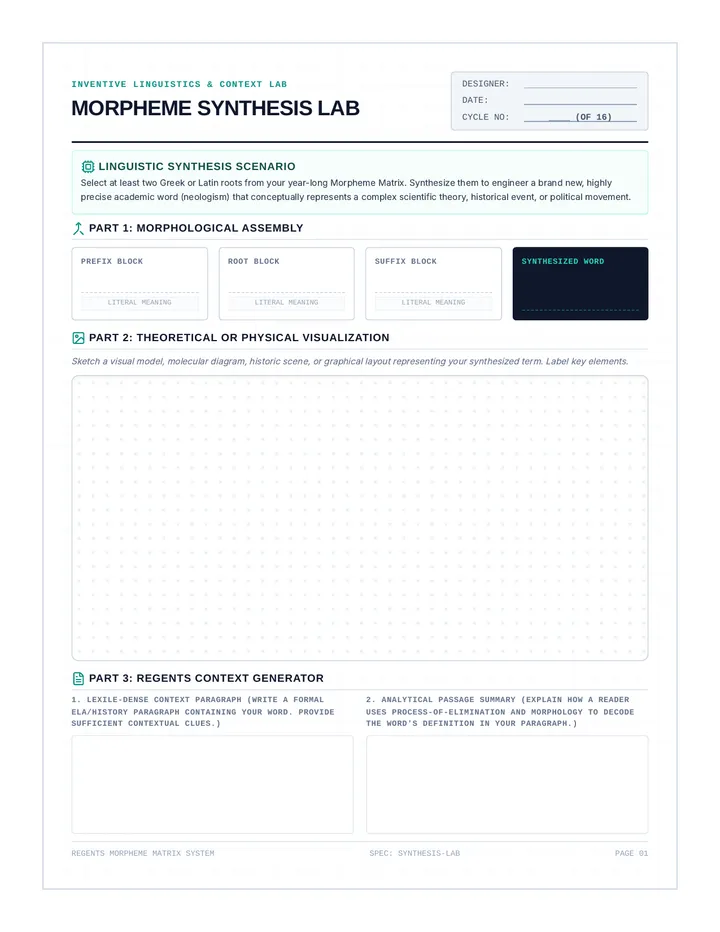
Rhythm of the Page Worksheet Rhythm of the Page
Punctuation Investigation
Name:
Date:
Mission Brief
Analyze the following excerpts. Authors don't use dashes and ellipses by accident; they use them to control how fast or slow you read. For each passage, circle the dashes and ellipses, then answer the analysis question below.
Excerpt 1 From a Narrative Thriller
"I reached for the light switch... nothing. The bulb was dead. Then I felt it—a cold breath against the back of my neck—and I knew I wasn't alone. I didn't scream. I couldn't."
How does the ellipsis (...) change the pacing of the first sentence? What does it force the reader to do?
Excerpt 2 From a Character Monologue
"I was thinking about the city—how big it is, how loud—and then I realized that I don't... I don't really fit there. It's too much. The lights, the people, the noise... it's just exhausting."
Compare the use of dashes (—) and the ellipsis (...) in this passage. Which one feels more like a "stutter" or hesitation?
Excerpt 3 From an Action Sequence
"Jump—roll—kick. He didn't think; he just moved. The laser fire was constant—blinding red bolts of energy—but he kept running. If he stopped now... well, he couldn't stop."
The dashes in the first sentence create a "staccato" effect. How would the scene change if the author used commas instead?
Final Synthesis
In your own words, what is the main difference between how a dash feels compared to an ellipsis ?
Authors often use these marks in suspense or action scenes. Why do you think that is?
Punctuation at Work Teacher Guide Teacher Facilitation Guide
Lesson 1: Punctuation at Work
Instructional Context: ELA Grade 8
Learning Objective
Students will identify em-dashes and ellipses in mentor texts and explain how these marks function rhetorically to influence narrative pacing, tone, and character voice.
Core Concepts
Rhetorical impact vs. Grammar
Narrative Pacing (Speed)
The "Weight" of Silence
The Hook: Discussion Prompts
Prompt 1: "How do you 'hear' an ellipsis in your head?"
Look for: Mentions of breathing, fading out, awkward pauses, or waiting for something to happen.
Prompt 2: "If a comma is a yellow light, what is a dash?"
Look for: A red light, a sharp turn, a sudden stop, or a crash.
Worksheet Answer Key & Analysis
Excerpt 1: Suspense
"I reached for the light switch... nothing. The bulb was dead. Then I felt it—a cold breath against the back of my neck..."
Ellipsis Impact
Creates a "pregnant pause" that builds dread. It mimics the character's hesitation and the split second of hope before realization.
Dash Impact
Forces the reader to focus on the terrifying sensory detail (the breath). It feels like a sudden shock or realization.
Excerpt 2: Monologue
"...and then I realized that I don't... I don't really fit there."
The ellipsis here functions as a hesitation marker . It shows the character struggling to find the right words or being afraid to admit the truth out loud. The repetition of "I don't" after the ellipsis confirms the stuttering quality of natural speech.
Excerpt 3: Action
"Jump—roll—kick."
The dashes create a staccato pacing . Unlike commas, which suggest a sequence or a list, the dashes make the actions feel immediate, violent, and rapid-fire. They represent the internal rhythm of the character's movement.
Differentiation & Extension
Support
Have students read the passages aloud to a partner. Hearing the physical length of the pauses helps them visualize the punctuation mark's purpose.
Challenge
Ask students to rewrite Excerpt 1 using only periods. Discuss why the horror elements lose their impact without the stylistic breathing room of the ellipsis.
The Hyphenated Image Slides The Hyphenated Image
Using compound modifiers to paint precise pictures in the reader's mind.
The Precision Challenge
"The dog had fur that looked like it was covered in mud."
BECOMES...
"The mud-caked dog."
Hyphens help us cut out the clutter and create high-impact descriptions.
When to Link?
The Modifier Rule
When two or more words act as a single adjective to describe a noun before it, they need a hyphen.
The Test
Does the description make sense if you use only one of the words? No? Use a hyphen!
Examples
A seven-story building
An ice-cold stare
A never-ending story
Not: A seven story building
Compound Creation!
We're going to build the weirdest hyphenated descriptions possible using your "Compound Creation" sheet.
pizza-flavored
gravity-defying
sleep-deprived
Compound Creation Activity Compound Creation
The Art of the Hyphenated Descriptor
Student:
Class:
Phase 1: Mix & Match
Choose one word from Column A and one from Column B to create a new compound modifier . Then, pick a noun that it could logically (or weirdly) describe.
Column A
Column B
Mark
Noun to Describe
Chocolate
Covered
-
Example: Grasshopper
High
Powered
-
Neon
Bright
-
Old
Fashioned
-
Bone
Chilling
-
Phase 2: The Triple-Threat
Sometimes we need three words to capture the perfect image. Create two original triple-word modifiers below.
-
-
→
Noun here...
-
-
→
Noun here...
Phase 3: Context is Key
Write a short, descriptive sentence for one of your compounds above. Make us see the noun.
Vivid Descriptions Practice Worksheet Vivid Descriptions
Hyphenated Imagery Practice
Student Name:
Writing Goal
Transform "clunky" and wordy descriptive phrases into sharp, elegant compound adjectives using hyphens.
Part 1: The Sharpening Tool
Example: A boy with freckles on his nose → A freckle-nosed boy.
The Clunky Version:
A cave that was filled with shadows.
The Sharp Version:
A ____________________ cave.
The Clunky Version:
A car that was painted by hand.
The Sharp Version:
A ____________________ car.
The Clunky Version:
An athlete who is known all over the world.
The Sharp Version:
A ____________________ athlete.
The Clunky Version:
A storm that breaks records.
The Sharp Version:
A ____________________ storm.
Part 2: The Art of the Triple-Word
Choose one of the settings below and write a short description that includes one triple-word compound modifier (e.g., *the state-of-the-art kitchen*).
A Haunted Mansion
A Future City
A Remote Jungle
Write Here
The Power of the Dash Slides —
The Power of the Dash
Mastering sudden breaks, sharp emphasis, and the art of interruption.
The Chaos Script
ALEX
"I didn't mean to break it, I was just trying to—"
SAM
"—to what? To ruin everything?"
Without the em-dash, the energy of this argument disappears.
The Hierarchy of Emphasis
( )
Parentheses
Whispers the information. It's an extra "by the way."
, ,
Commas
Standard delivery. Neutral and informative.
—
Em-Dashes
Shouts the information!
Demand the reader's immediate attention.
The Em-Dash Rules
1. Interruption
"Wait, I can explain—"
"No! You've said enough."
2. Emphasis
"The test results were exactly what I feared—zero."
3. Thought Shifts
"I was walking home—did I leave the oven on?—when it started raining."
Pro-Tip: Don't overdo it! One per paragraph is usually plenty.
The Interruption Lab Worksheet The Interruption Lab
Scriptwriting & Dialogue Punctuation
Student:
Task 1: The Broken Script
The following scene is a chaotic argument, but all the em-dashes (—) are missing. Rewrite the lines below, inserting dashes where characters get cut off or change their minds mid-sentence.
OFFICER BRADY:
"Ma'am, I need you to step away from the—"
Rewrite here using —
MRS. HIGGINS:
"It's my cat! I won't let you take—I won't let anyone take—"
Rewrite here using —
OFFICER BRADY:
"We aren't taking him. We're just—actually, look at that. He's already gone."
Rewrite here using —
Task 2: Write Your Own
Choose one of the scenarios below and write a 4-line dialogue exchange. You must use at least two em-dashes to show interruptions.
A student trying to explain a missing homework assignment to a very busy teacher.
Two superheroes arguing about who should have "saved the day" first.
Script Box
Task 3: The Emphasis Shift
Rewrite this neutral sentence three ways to change the "volume" of the extra information.
"The cake, which had three layers, was delicious."
Neutral (,)
Done for you above...
Whispered ( ( ) )
Shouted ( — )
Echoes and Silences Slides Echoes and Silences
Mastering the power of the ellipsis to show what isn't being said.
The Sound of Silence
Standard Speech
"I'm not sure if I can go with you today."
The Ellipsis Effect
"I'm not sure... if I can go with you... today."
What changed about the character's mood? What are they afraid to say?
The Three Faces of ...
Hesitation
"I don't... I don't know why I did it."
Shows a character searching for words or being nervous.
Trailing Off
"If only I had reached her in time..."
Shows a thought that isn't finished or a character's voice fading.
Omission
"The report stated that the... experiment was a failure."
In academic writing, shows words have been removed from a quote.
Mastering the Rhythm
The Formatting Golden Rules:
Exactly three dots. No more, no less.
Include a space after the ellipsis if it's in the middle of a sentence.
If the ellipsis ends a sentence, use four dots (ellipsis + period).
Silent Spaces Monologue Worksheet Silent Spaces
Monologue Writing with Ellipses
Student:
Task 1: Decoding the Silence
Read the two versions of this character confession. How does the meaning change between them?
Version A: No Ellipses
"I took the money. I needed it for my family. I didn't think I'd get caught. I'm sorry."
Version B: Stylistic Ellipses
"I took the money... I needed it for my family. I didn't think... I'd get caught. I'm sorry..."
In Version B, what is the character feeling that isn't present in Version A?
Task 2: Writing the Unsaid
Write a short monologue (5-8 sentences) for a character in one of the following situations. Use at least three ellipses to show hesitation, trailing thoughts, or uncertainty.
The Witness
Afraid to name the person they saw.
The Liar
Trying to make up an excuse on the spot.
The Griever
Remembering someone they lost.
"Write your monologue here... let the silences speak for you..."
Task 3: The Four-Dot Rule
Reminder: When an ellipsis ends a sentence, add a period at the end (making four dots total).
Fix this sentence: "He watched the ship sail away, disappearing into the mist..."
The Pacing Masterclass Slides The Pacing Masterclass
Final Revision Project
The Final Challenge
Mission:
"Take a boring, flat paragraph and transform it into two completely different emotional experiences."
1
The Frantic Sprint (Dashes)
2
The Eerie Crawl (Ellipses)
Your Punctuation Toolkit
Dashes (—)
Speed it up
Add shock & surprise
Cut people off
Create sudden focus
Ellipses (...)
Slow it down
Build dread & suspense
Show uncertainty
Fade into silence
Writer's Pro-Tips
Word Choice Matters
Match your words to your marks. "Sprinted" for dashes, "lurked" for ellipses.
The Compound Connection
Don't forget hyphens! Use them to create sharp, tight descriptions in both versions.
Revise.
Refine.
Rethink.
The Pacing Challenge Project Sheet The Pacing Challenge
Masterclass Revision Project
Writer:
Date:
The Base Text (Flat & Boring)
"The hallway was dark. I walked forward slowly. I heard a noise behind me. I turned around and saw a shadow. It moved closer. I tried to speak, but I was too scared. I ran toward the exit as fast as I could."
Revision 1: The Frantic Sprint
Goal: Use em-dashes (—) to make the scene feel fast-paced, urgent, and shocking. Use at least one hyphenated modifier (-) .
Frantic Revision Area
Revision 2: The Eerie Crawl
Goal: Use ellipses (...) to make the scene feel slow, suspenseful, and heavy. Use at least one hyphenated modifier (-) .
Eerie Revision Area
The Writer's Insight
Which version was harder to write? Why do you think that specific punctuation mark changed the mood so drastically for you?
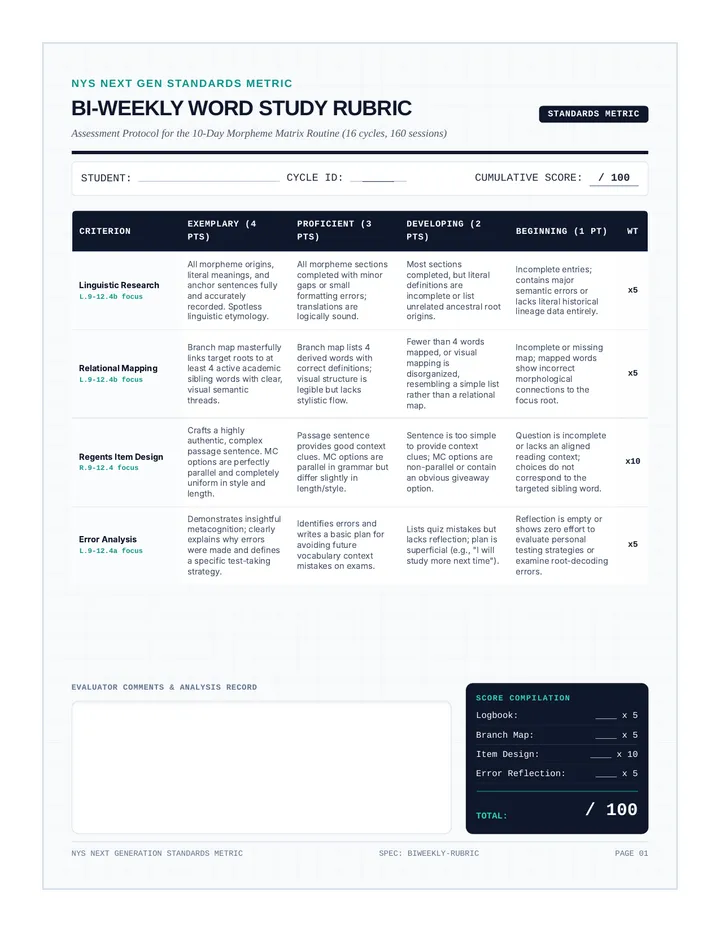
Masterclass Evaluation Rubric Pacing Project Rubric
Assessment Guide for Lesson 5
Criteria Exceptional (4) Proficient (3) Developing (1-2) Frantic Revision (Dashes) Dashes are used strategically to create high-energy interruptions and sharp focus. The paragraph feels rapid-fire and urgent. Dashes are present and correctly punctuated. The paragraph has a faster pace than the original. Dashes are used incorrectly or sparse. The pacing remains similar to the original text. Eerie Revision (Ellipses) Ellipses create powerful silences and a heavy, slow-motion feel. The suspense is palpable through the punctuation. Ellipses are used correctly to show hesitation or trailing thoughts. The pace is successfully slowed. Ellipses are used like commas or formatted incorrectly (wrong number of dots). Little stylistic impact. Hyphenated Imagery Contains multiple, creative hyphenated modifiers that enhance the visual precision of the scene. Contains at least one correct hyphenated modifier in each revision. Hyphens are missing, misused, or modifiers are standard/simple. Mechanics & Formatting Flawless formatting of em-dashes (no spaces) and ellipses (3 or 4 dot rules applied). Mostly correct formatting with minor slips. Punctuation follows standard rules. Frequent errors in punctuation length or spacing that distract from the style.
Facilitator Notes
What to Look For:
Look for students who go beyond just "inserting" marks and actually change the verb choices to match the punctuation. A student using a dash for a "heart-pounding" moment shows deeper mastery than one just putting a dash in the middle of a calm sentence.
Common Misconceptions:
Using too many dashes (it can become unreadable).
Confusing hyphens with dashes in the frantic version.
Missing the 4th dot (period) in the eerie version.