Mnemonic strategies, information chunking, and visual supports for processing and retaining classroom information. Strengthens focus on complex tasks and multi-step directions through organized note-taking and graphic organizers.
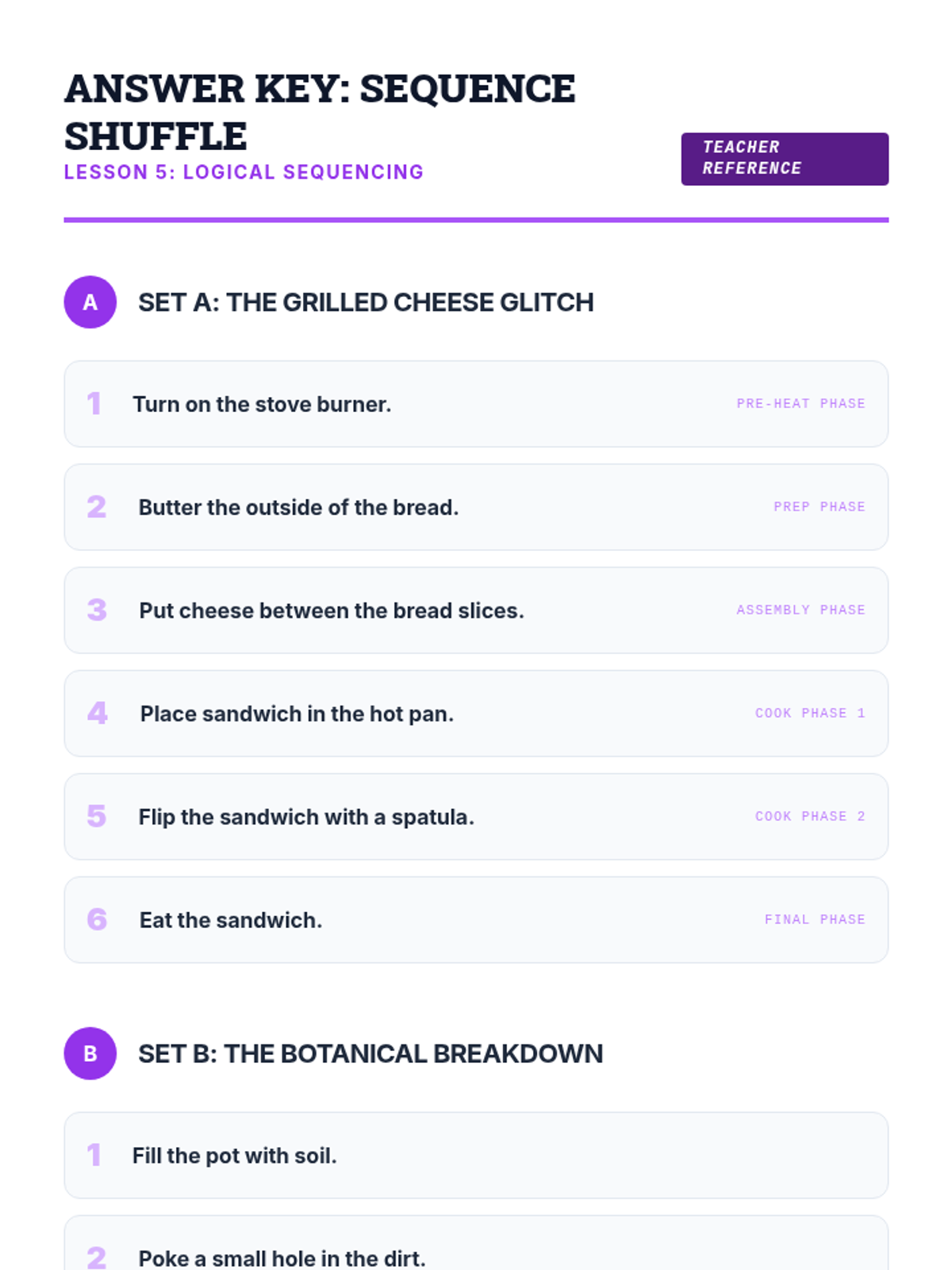
An answer key for the Sequence Shuffle Game in Lesson 5, providing the correct logical order for the task steps.
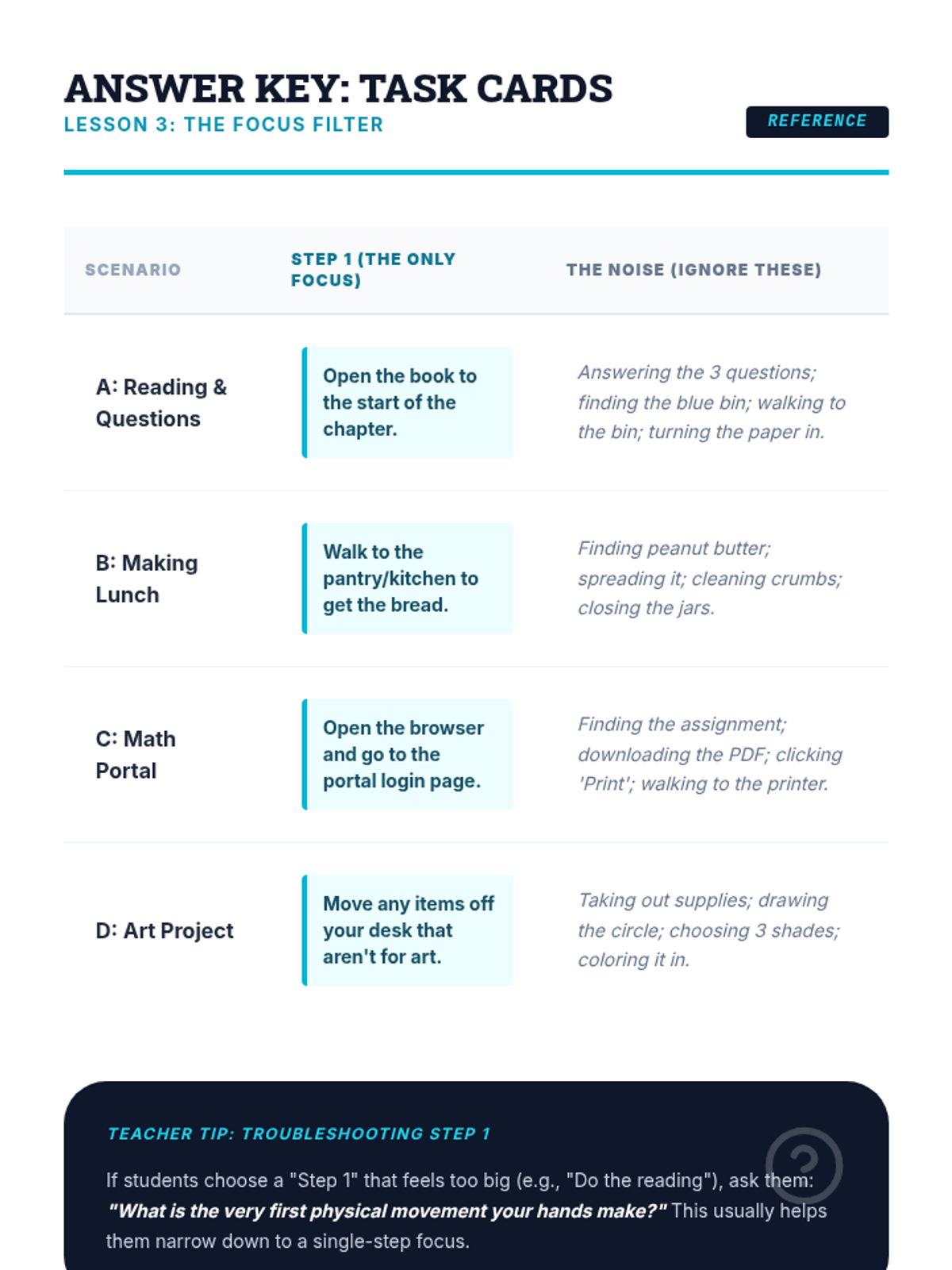
An answer key for the First Things First Task Cards in Lesson 3, identifying the correct 'Step 1' and 'Noise' for each scenario.
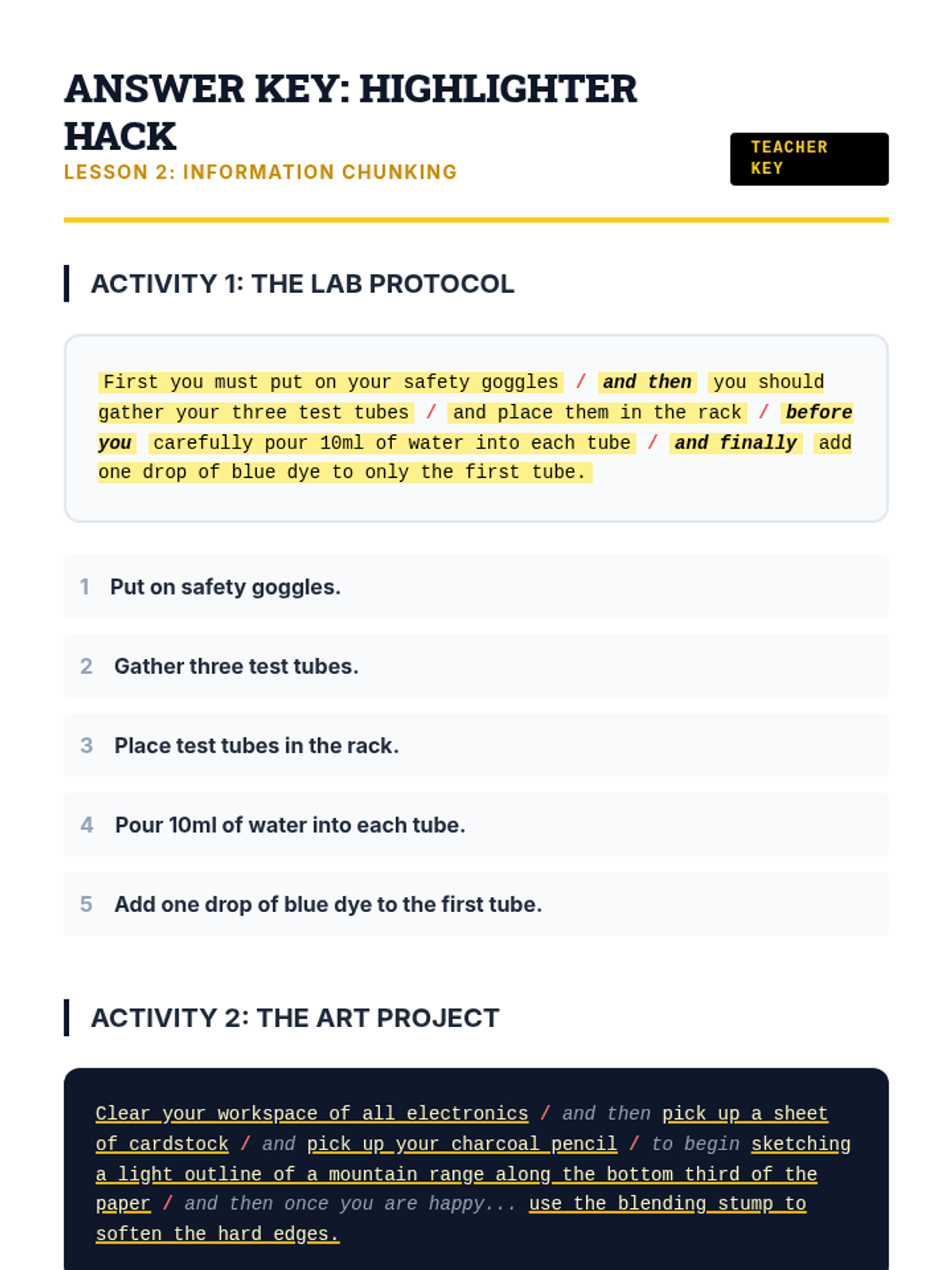
An answer key for the Highlighter Hack Worksheet in Lesson 2, showing the correct slicing points for the instructional paragraphs and the resulting single-step lists.
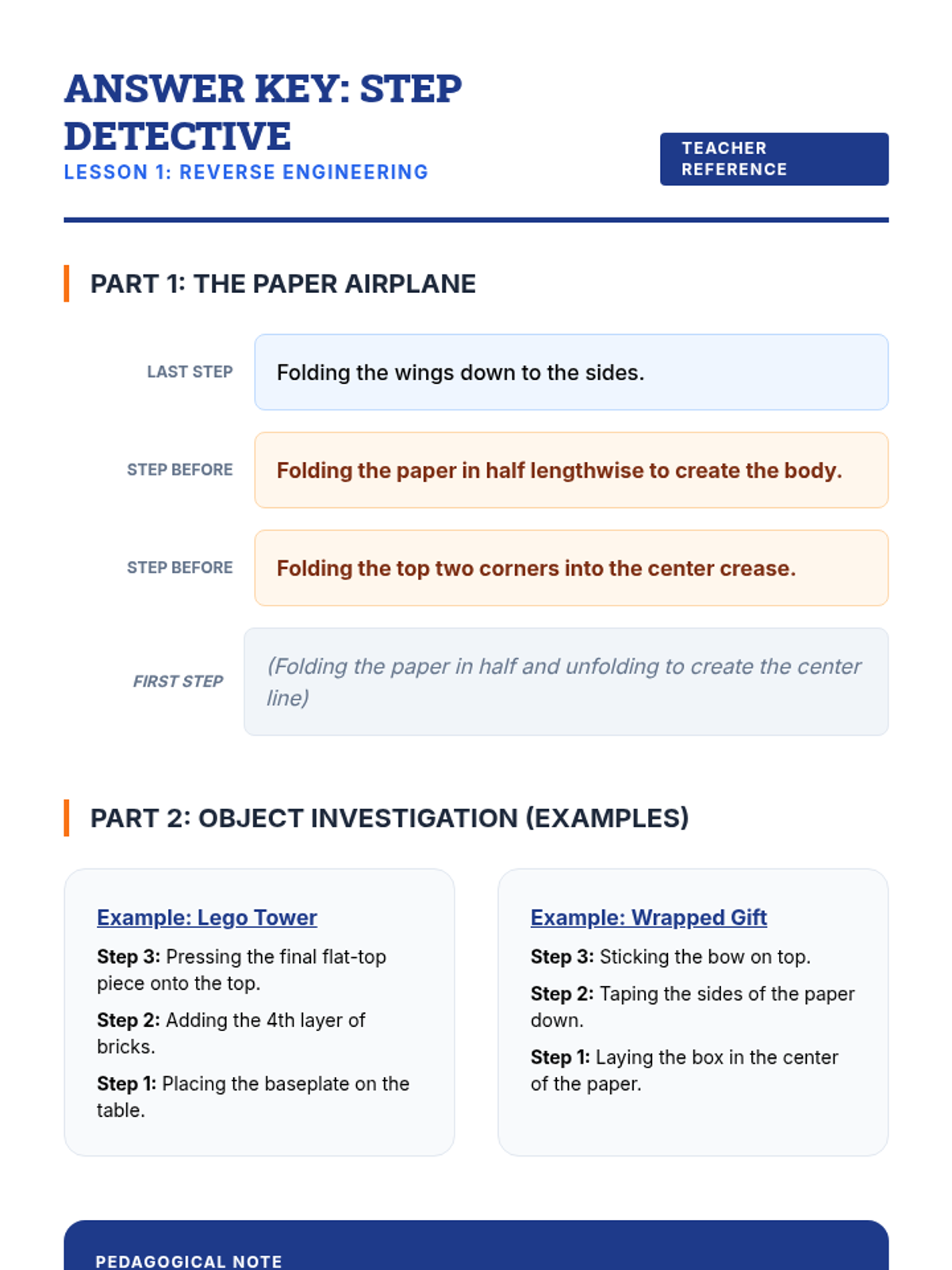
An answer key for the Step Detective Worksheet in Lesson 1, providing expected responses for the paper airplane breakdown and examples for mystery objects.
Final slide deck for the Peer Instruction simulation, guiding students through the drafting, user testing, and refinement process of single-step directions.
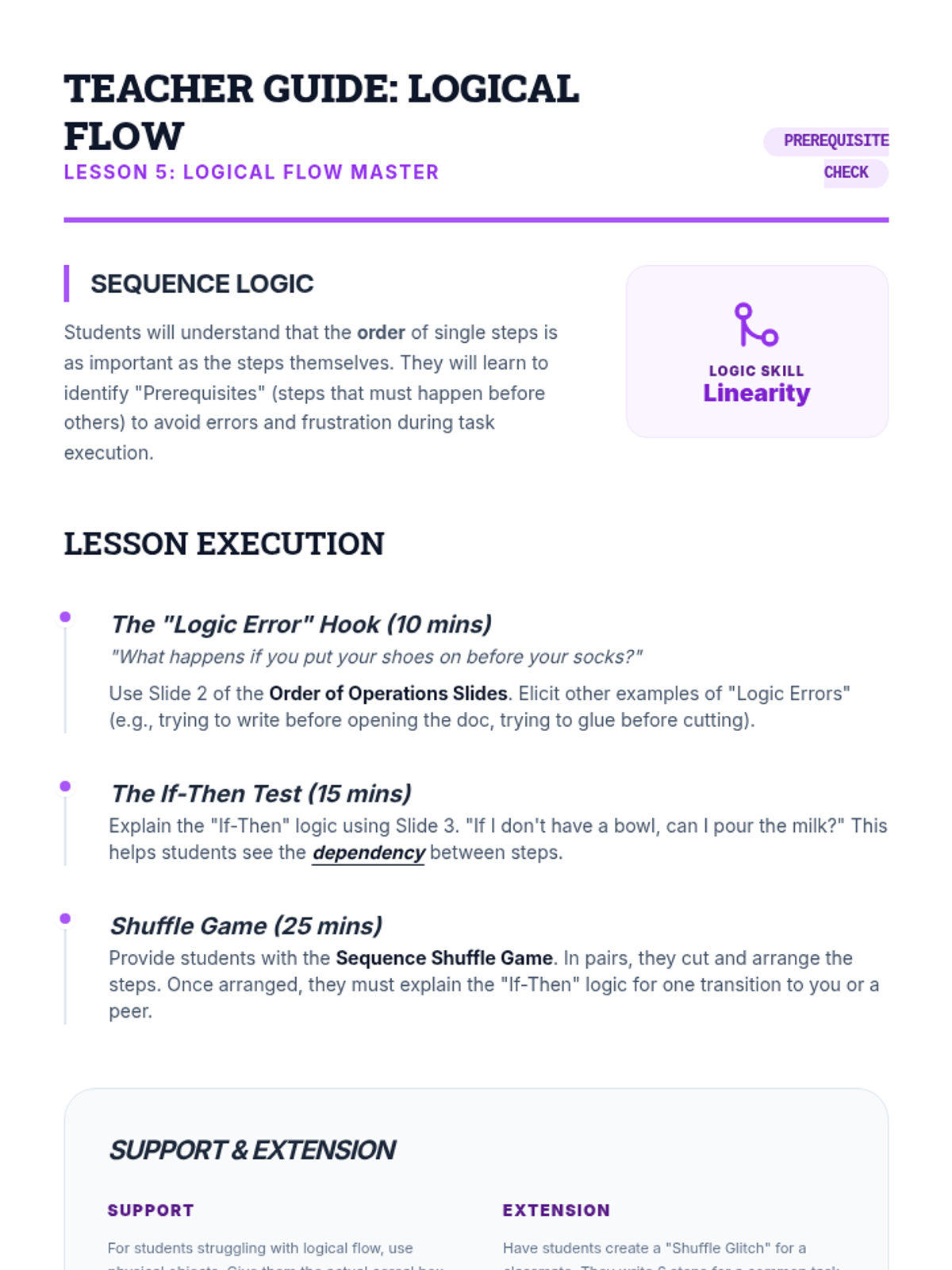
A teacher guide for Lesson 5 focusing on logical sequencing and understanding prerequisites in task completion.
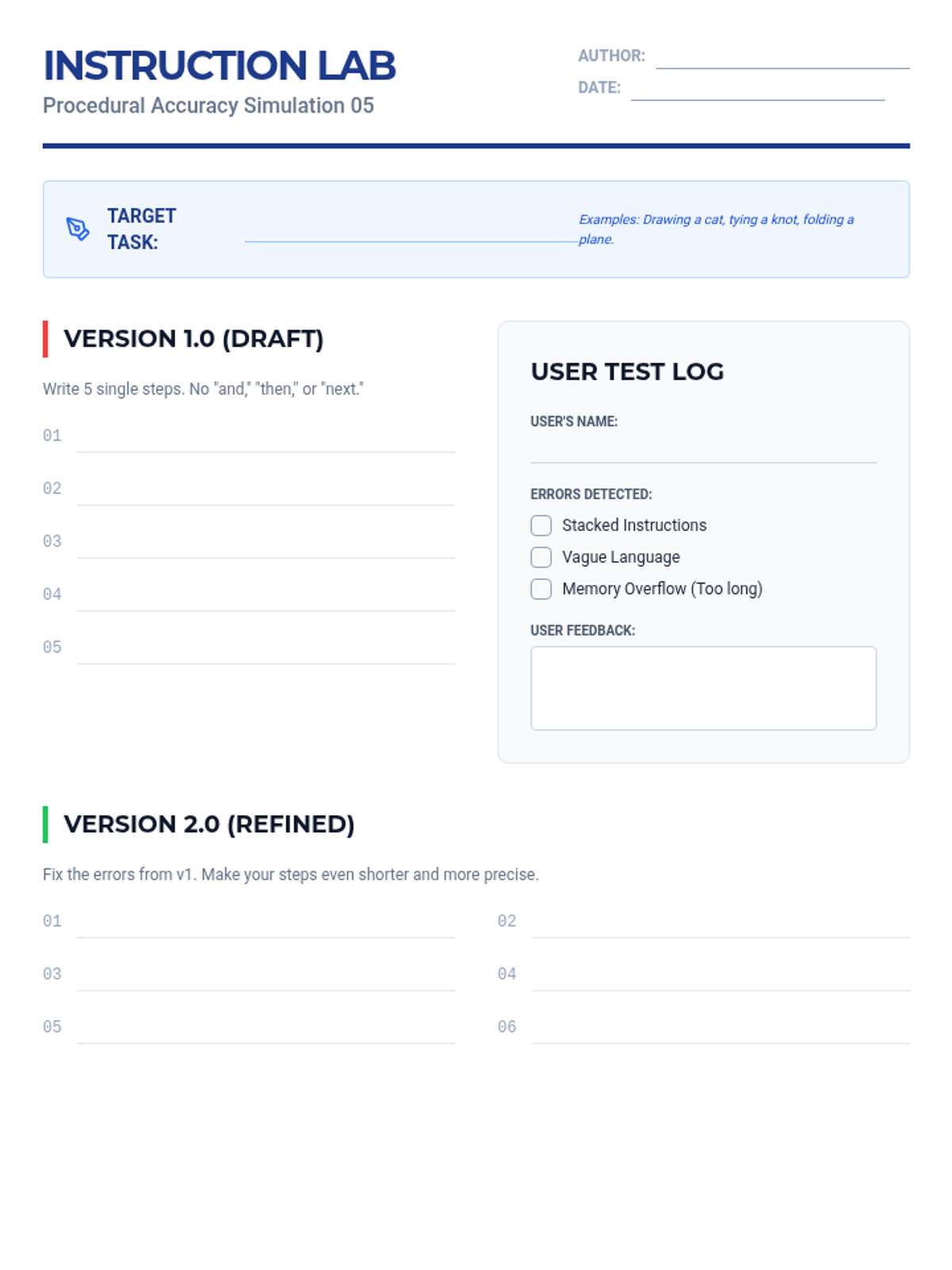
Student worksheet for drafting, testing, and refining single-step instructions, featuring areas for User Test feedback and Version 2.0 refinement.
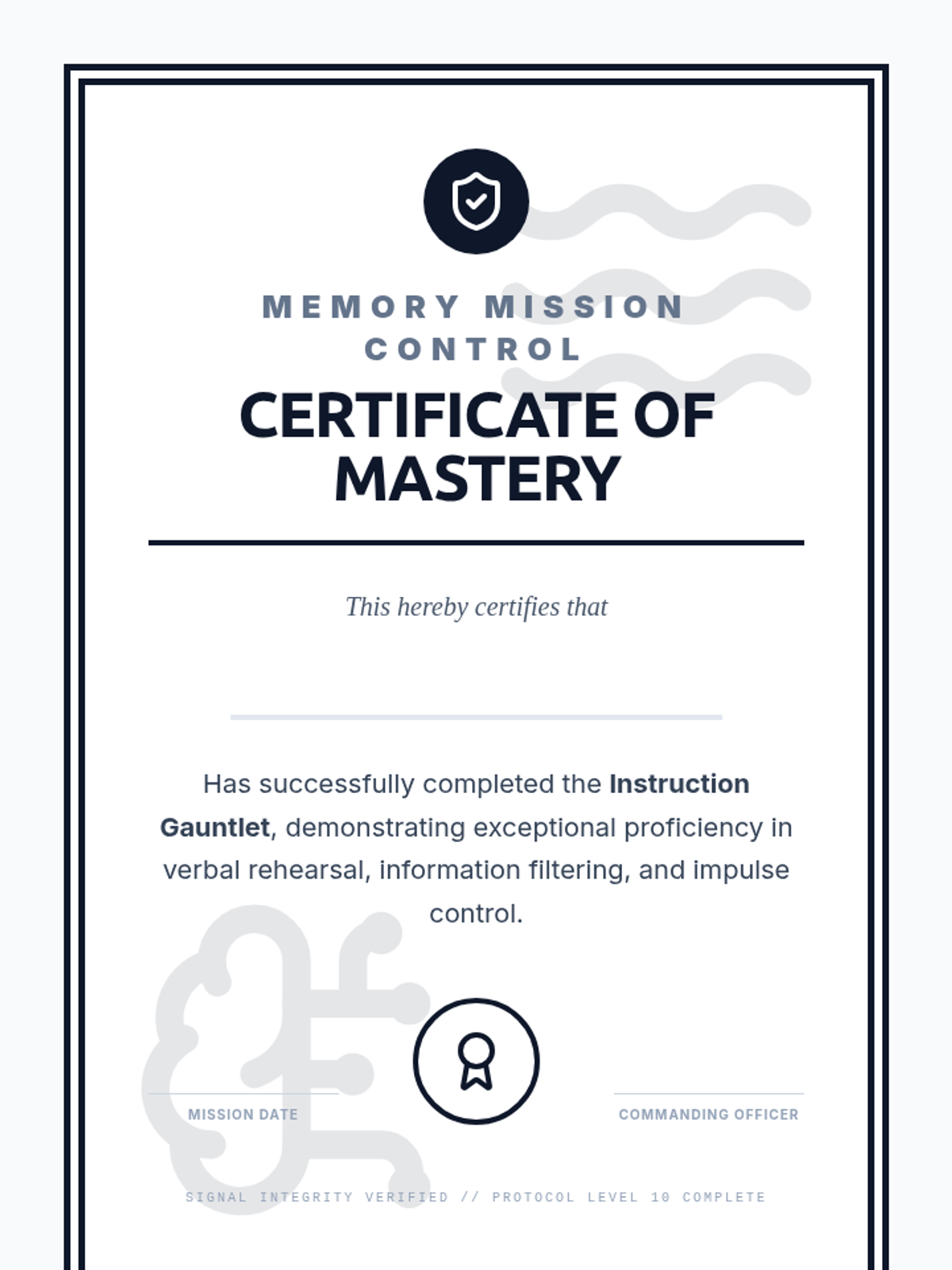
Completion certificate for students who successfully navigate the Memory Mission Control sequence and the final Gauntlet challenge.
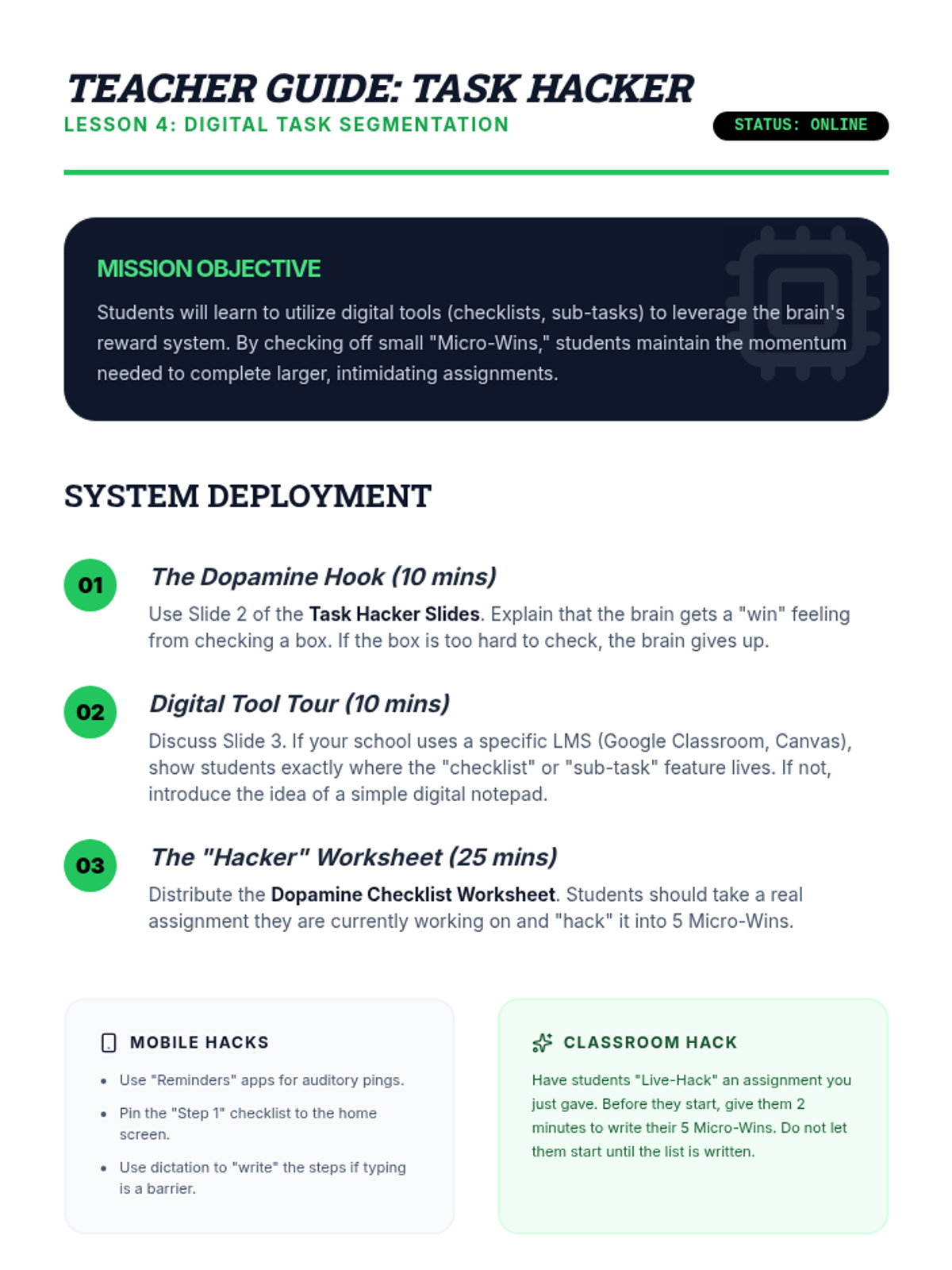
A teacher guide for Lesson 4 focusing on digital tools and the psychology of reward (dopamine) in task completion.
Final completion certificate and rapid-fire points tracker for Lesson 5, celebrating mastery of the single-step focus sequence.
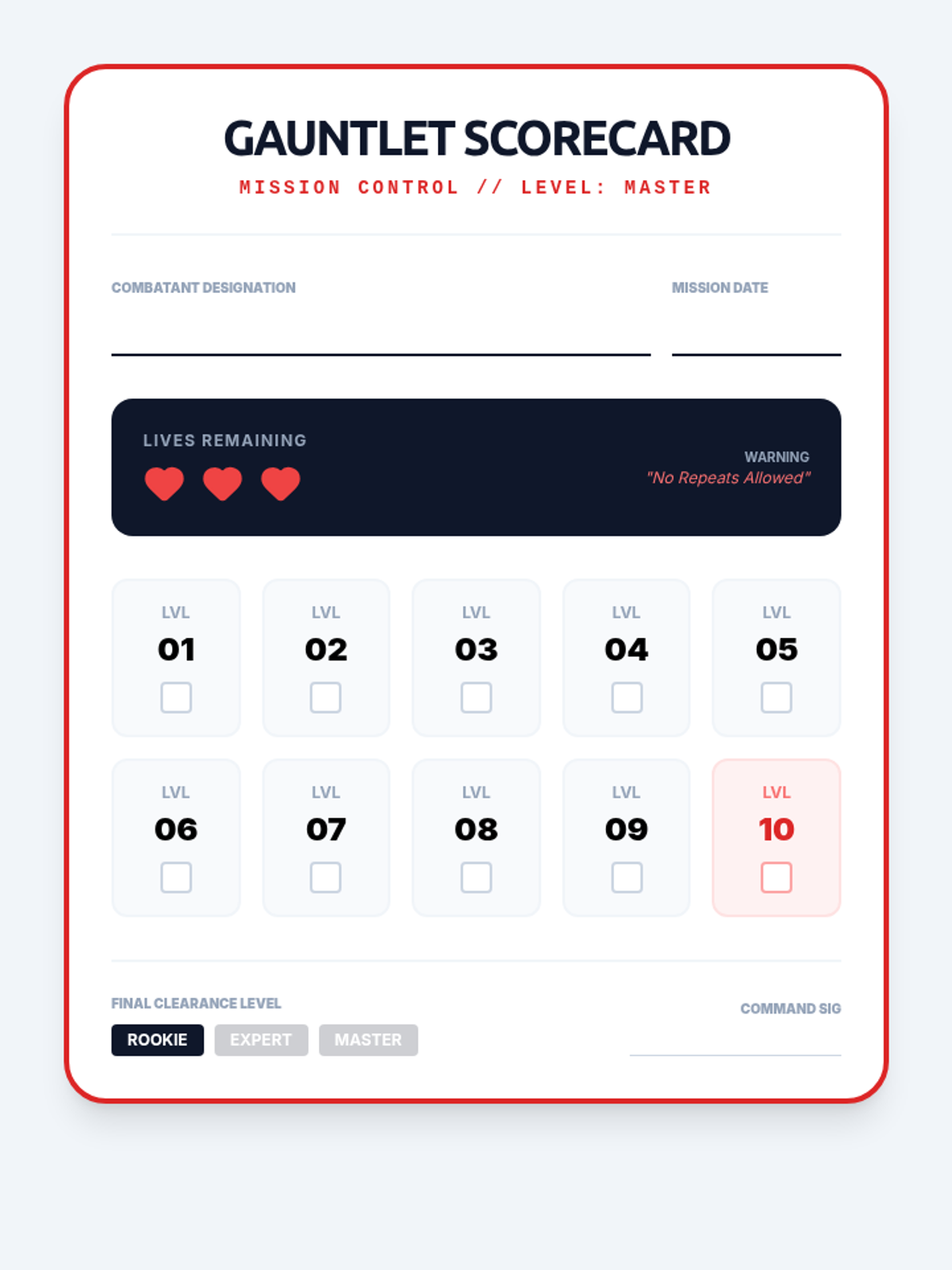
Student scorecard for tracking progress and lives during the final 10-level instruction gauntlet.
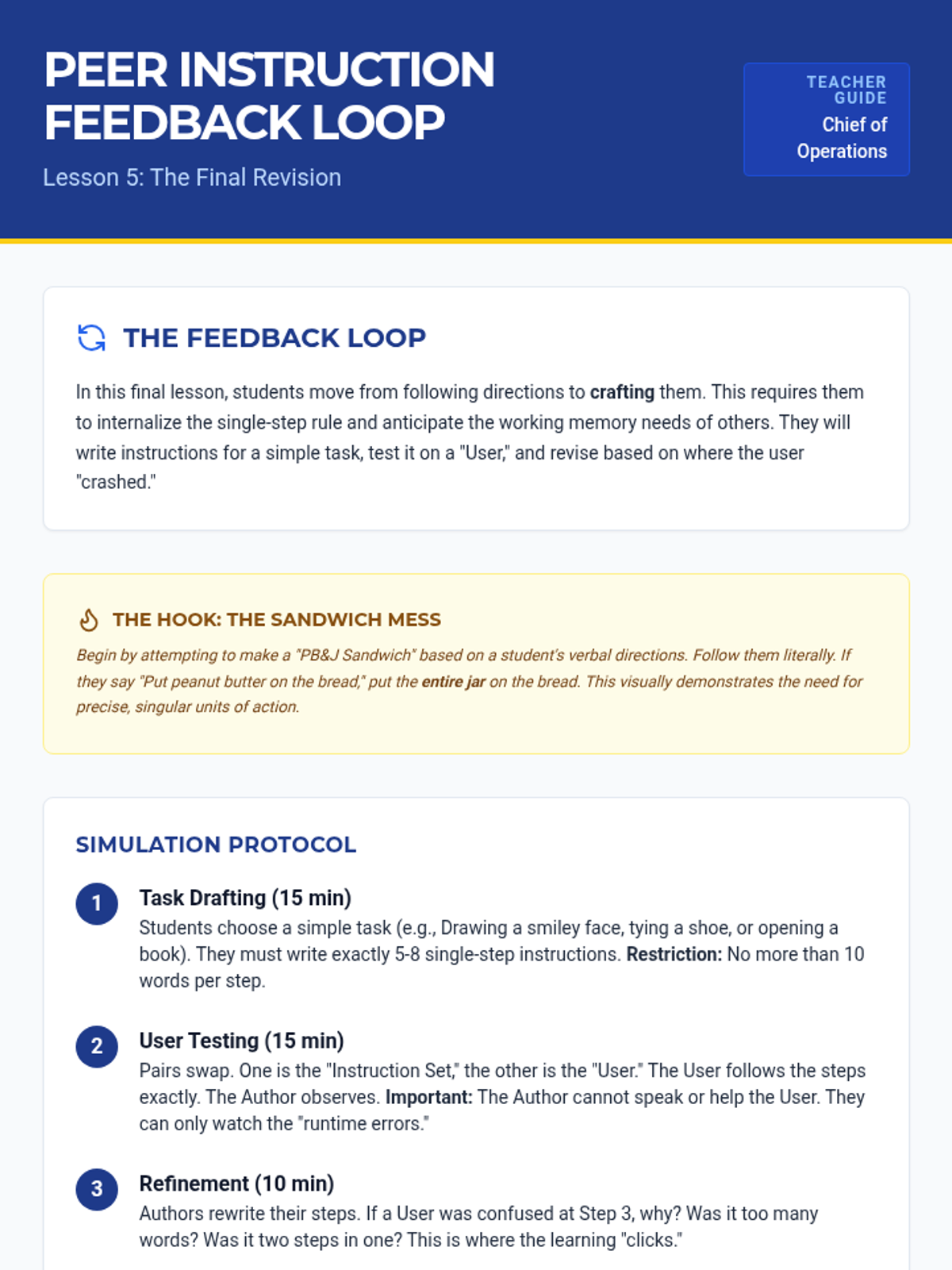
Teacher guide for the Peer Instruction Feedback Loop, including the "Sandwich Test" hook, a rubric for single-step clarity, and the protocol for user testing and refinement.
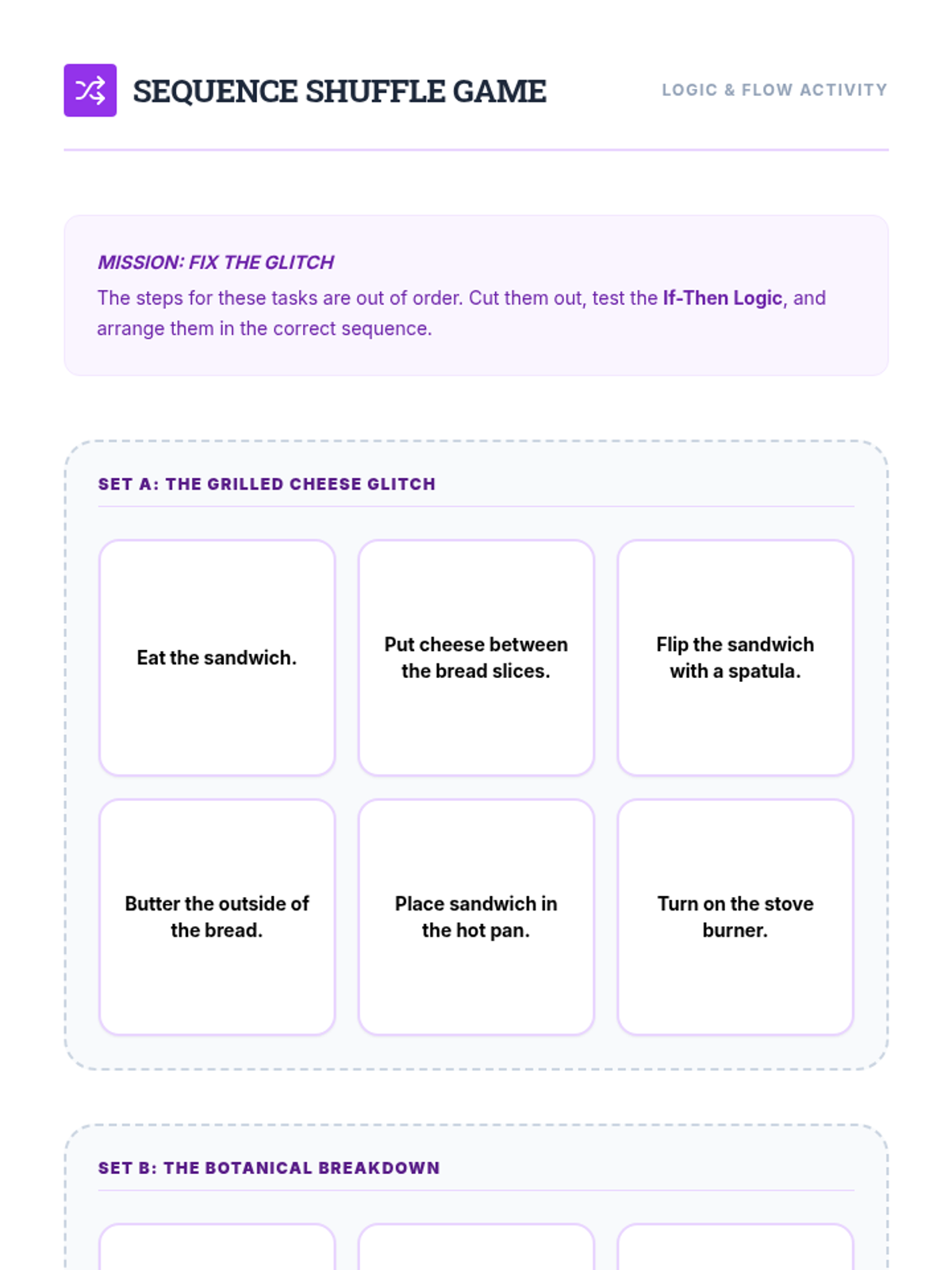
A set of printable "Step Cards" for Lesson 5 that students cut out and arrange in the correct logical sequence to solve "glitches".
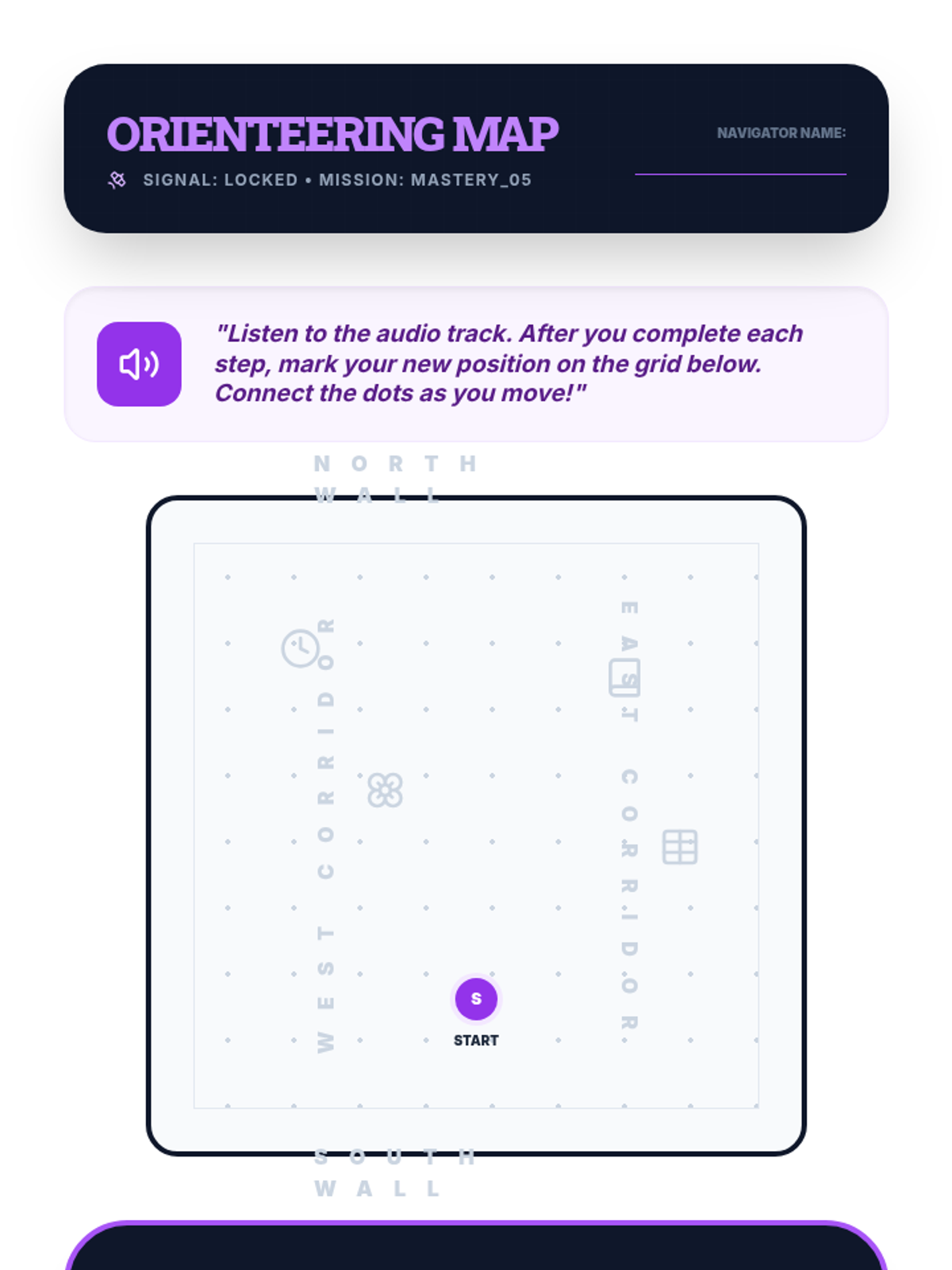
A simplified grid map of the room where students draw their path based on the audio prompts, helping visualize sequential progress and auditory pacing.
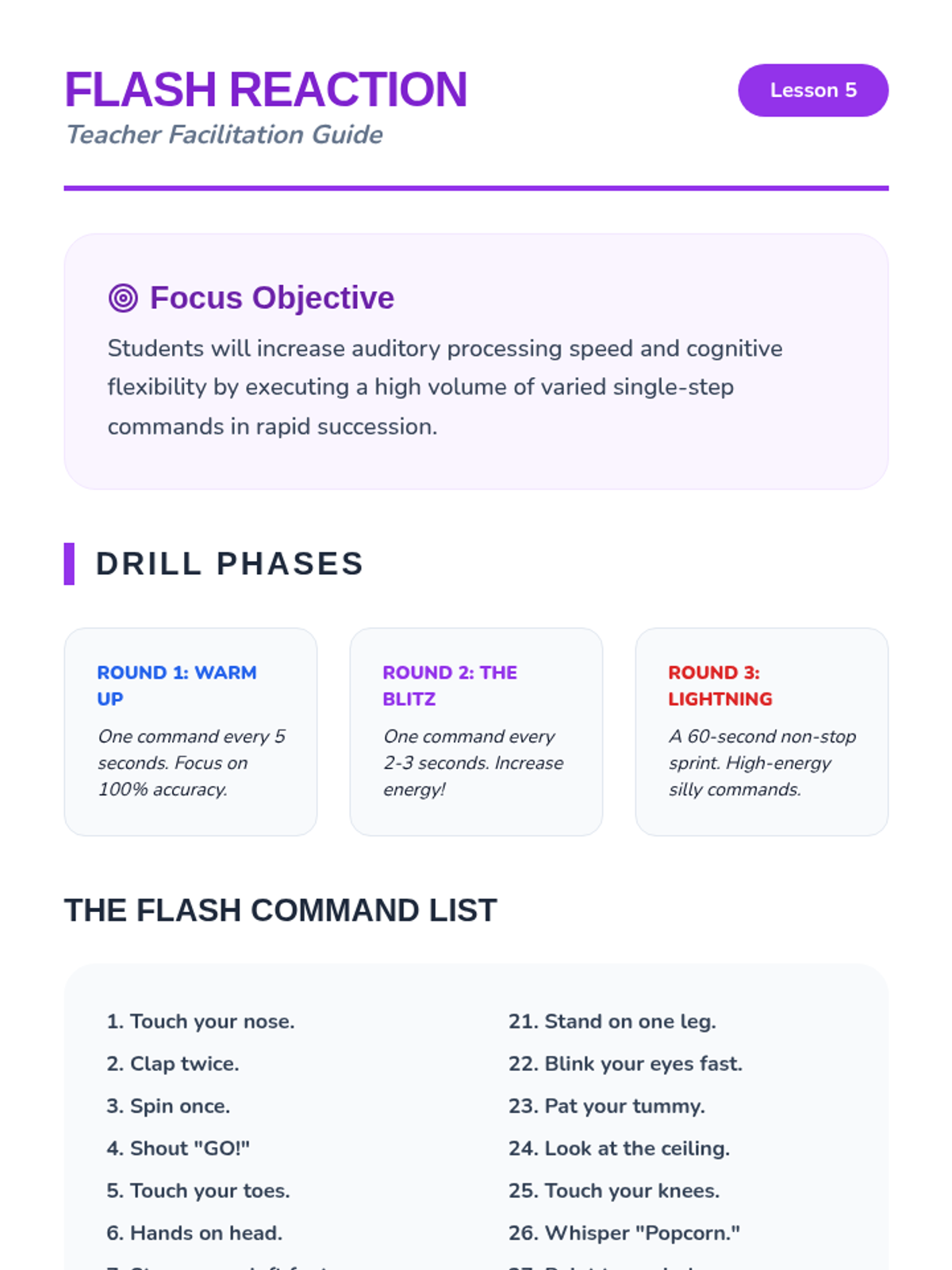
Detailed teacher guide for Lesson 5, including a comprehensive list of rapid-fire commands and facilitation phases.
Instructional slides for the final gamified challenge where students apply all learned strategies.
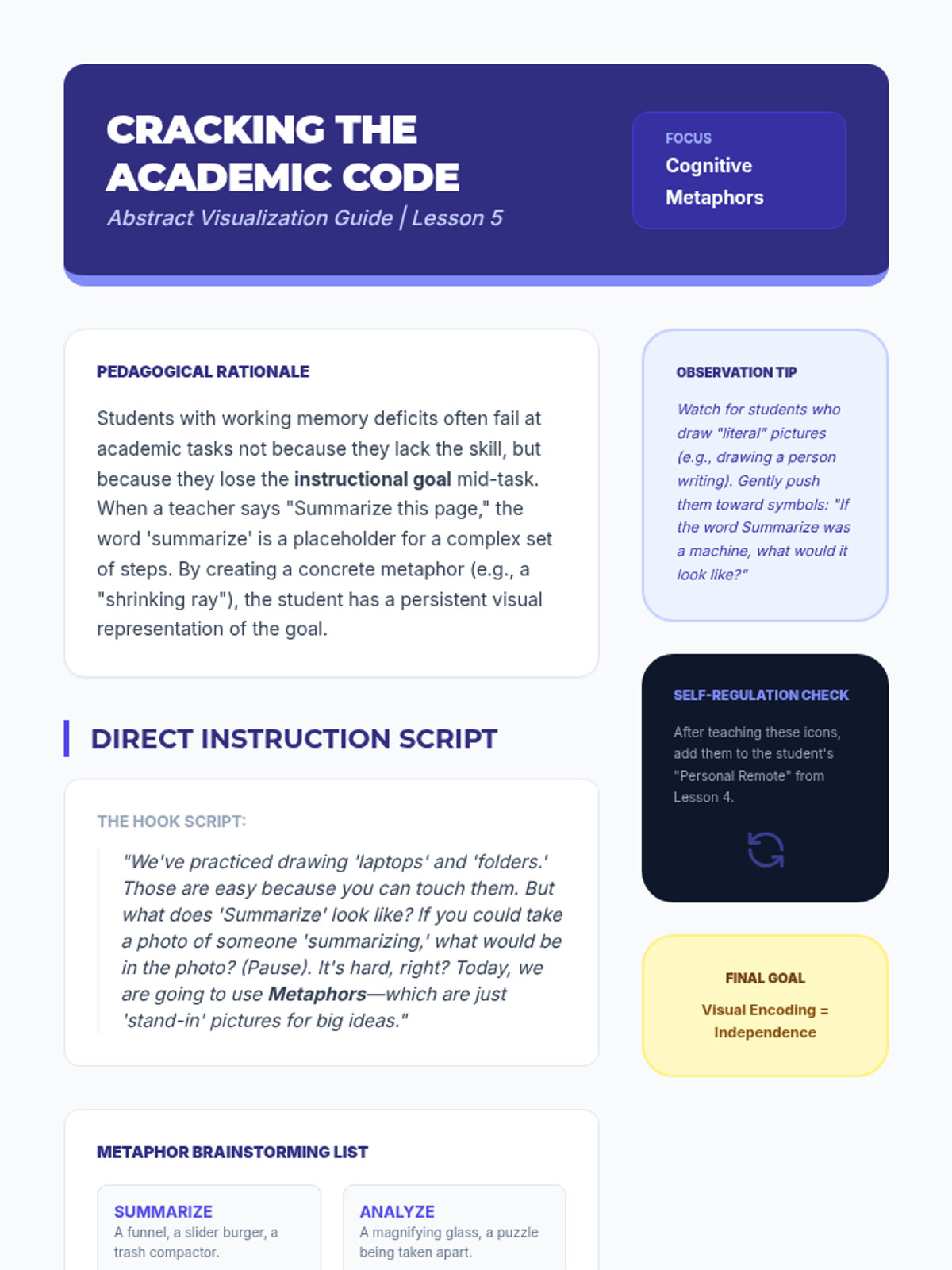
A teacher guide for Lesson 5, focusing on instructional strategies for helping students build cognitive metaphors for abstract academic tasks to improve goal-directed persistence.
A slide deck for Lesson 5 that teaches students how to use logical sequencing to order scrambled steps of a task before execution.
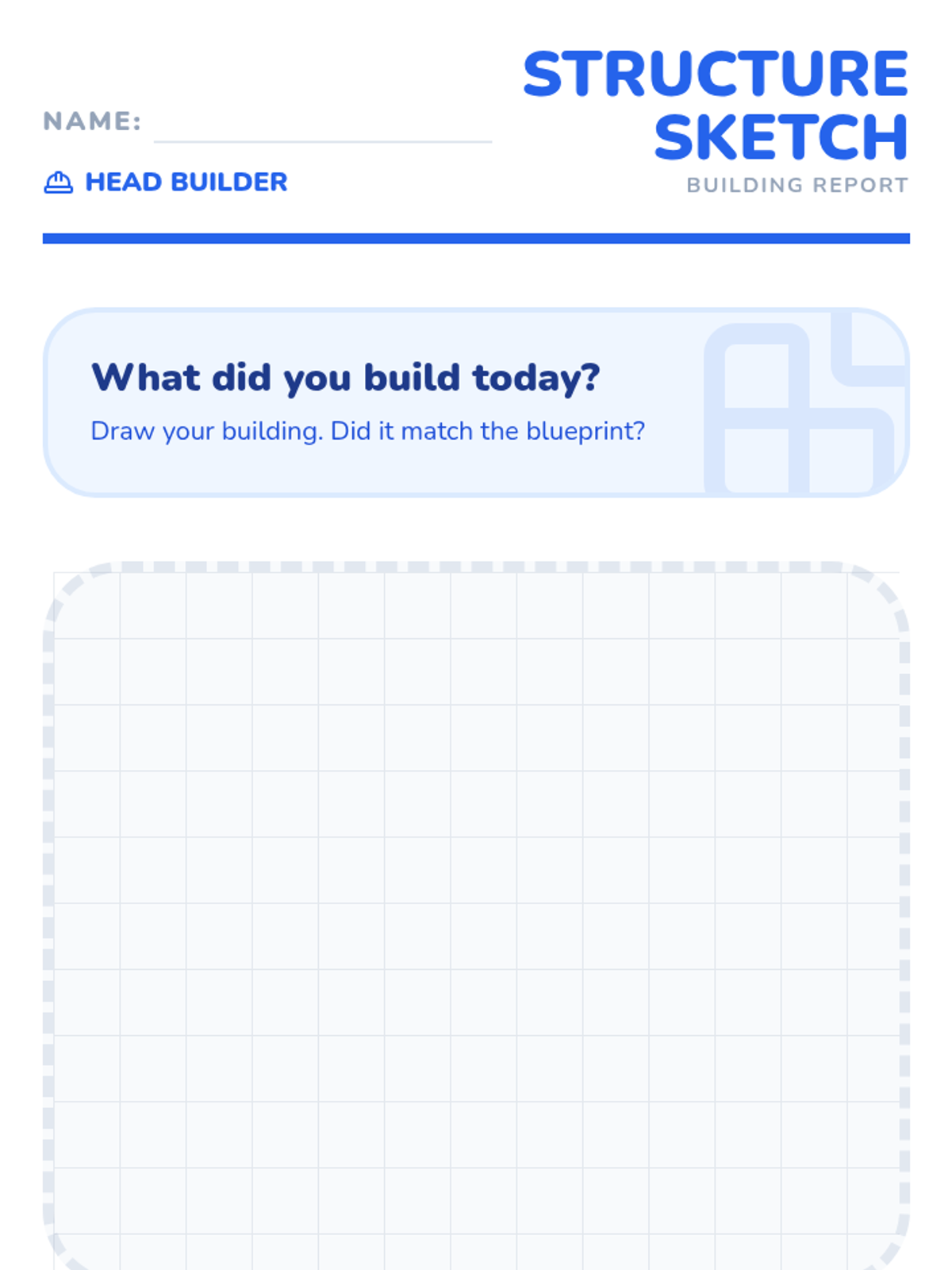
A student worksheet for the Blueprint Builders lesson where students draw the structure they built and reflect on their use of the visual plan.
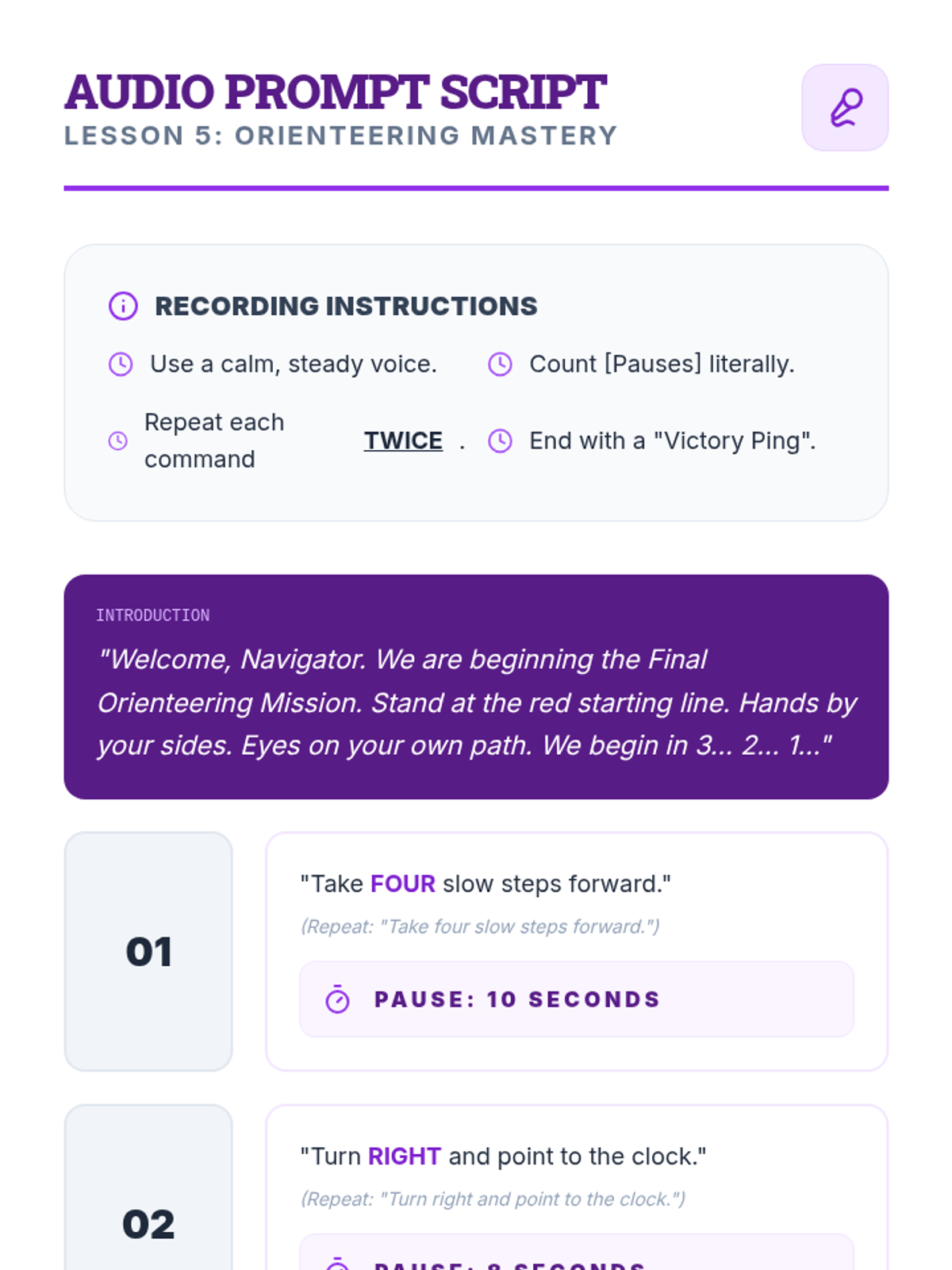
A script for the teacher to record or read live, featuring timed pauses and repeated commands to build auditory processing tolerance.
Updated visual scavenger hunt checklist for Valentine's Day focusing on physical items, including a school-spirited "Blue Devils" heart with a blue and yellow tie-dye swirl.
Updated printable sheet of heart cutouts for the Scavenger Hunt, featuring a blue and yellow tie-dye heart with a very clear heart shape created via SVG clip-path.
Updated facilitator guide for the Valentine's lesson, updated with the Blue Devils tie-dye heart scavenger hunt instructions.
Updated printable sheet of heart cutouts for the Scavenger Hunt, featuring the "Blue Devils" heart with a blue and yellow tie-dye burst pattern.
Updated visual scavenger hunt checklist for Valentine's Day focusing on physical items, including a school-spirited "Blue Devils" heart with a tie-dye swirl pattern.
Comprehensive facilitator guide for the Valentine's lesson, updated with the Blue Devils heart scavenger hunt instructions.
Updated printable sheet of heart cutouts for the Scavenger Hunt, featuring the "Blue Devils" school spirit heart with a structured yellow polka-dot pattern on a blue base.
Updated visual scavenger hunt checklist for Valentine's Day focusing on physical items, including a school-spirited "Blue Devils" heart with a clear polka-dot pattern.
Updated printable sheet of heart cutouts for the Scavenger Hunt, featuring eight different heart types with the "Tiny" heart adjusted for better visibility.
A short assessment for Wilson Reading Step 5.2, including marking practice, word/sentence dictation areas, and a teacher-led reading check.
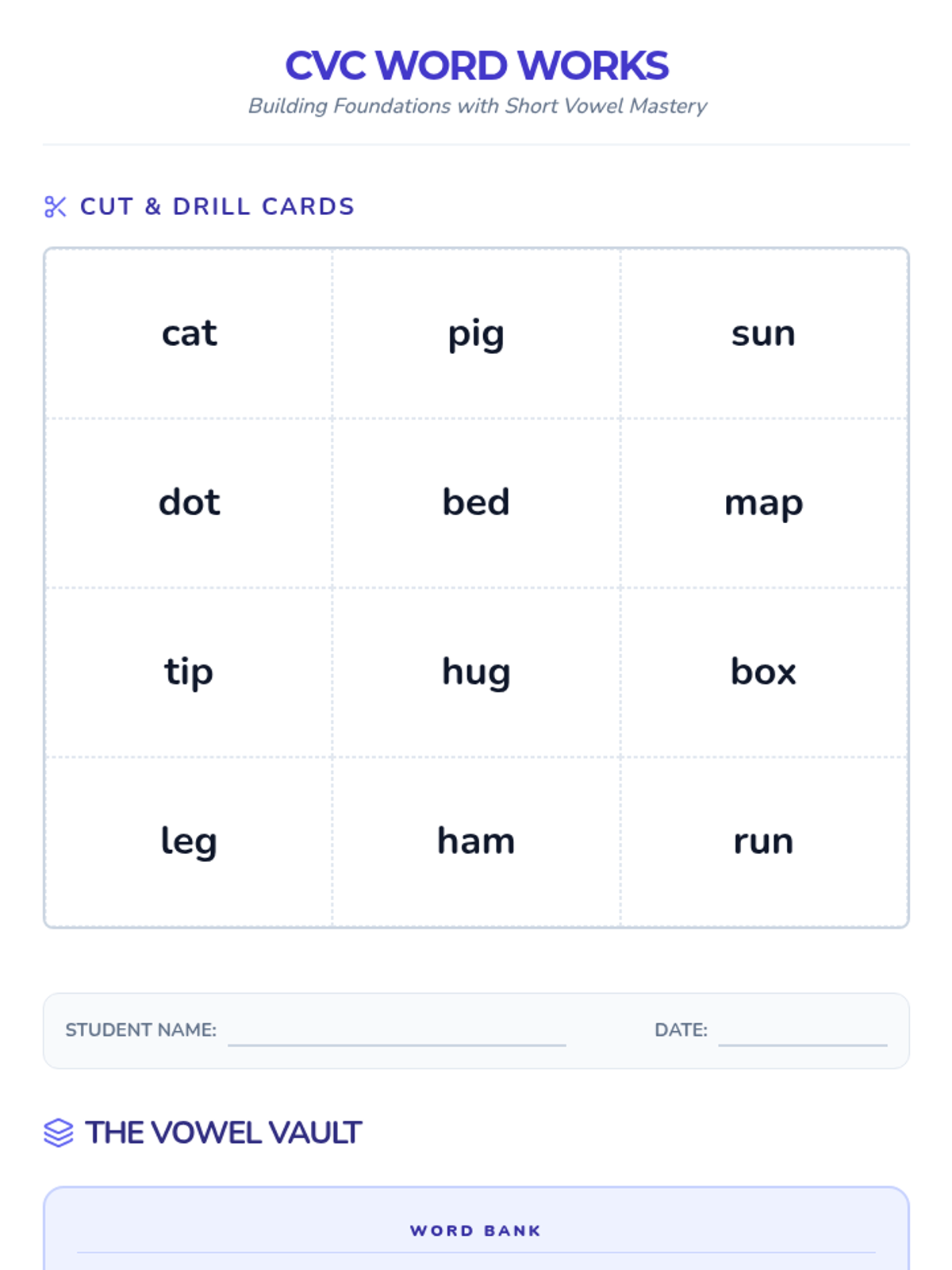
Printable sorting cards for multi-syllabic words, designed for students to categorize words by their first syllable type (Open vs. Closed). Fits Wilson Reading Step 5.2.
A student worksheet for Wilson Reading Step 5.2 focusing on scooping and dividing words with open syllables. Includes division practice, nonsense syllable identification, and sentence reading.
Instructional slides for Wilson Reading Step 5.2, featuring the detective-themed "Syllable Secrets" aesthetic. Covers the open syllable rule, v/cv division, and marking strategies.
A comprehensive week-long teacher facilitation guide for Wilson Reading Step 5.2, including daily pacing, warm-up ideas, and a master word bank.
Movement and action cards for a Valentine's Day group game, encouraging social interaction and physical movement for ELS students.
Updated visual scavenger hunt for Valentine's Day focusing on physical items (different colors, sizes, and patterns of hearts) to be found around the classroom.
Conversation starter cards for a social worker or teacher to use with ELS students to discuss feelings, friendship, and social-emotional regulation in a Valentine's context.
A visual "Kindness Bingo" board for high school life skills students, focusing on simple social-emotional actions like smiling, waving, and sharing to promote positive peer interactions.
A visual patterning worksheet for Valentine's Day where students complete heart-themed sequences, focusing on cognitive skills and visual discrimination.
Visual step-by-step instructions for decorating a Valentine's cupcake, featuring large text and kitchen-focused icons for life skills students.
A visual sorting mat for candy hearts, designed for students to practice color matching and categorization in a fun Valentine's theme.
Visual step-by-step instructions for a "Love Bug" clothespin craft, using large text and high-contrast icons for students in life skills programs.
Comprehensive facilitator guide for the Valentine's lesson, including strategies for the Heart Hunt, Sparkle Motion game, and social-emotional facilitation.
A visual assembly checklist for high school life skills students to follow while creating a Valentine's snack mix, focusing on counting, sorting, and following multi-step directions.
Visual step-by-step slide deck for a Valentine's Heart Glow Suncatcher craft, specifically designed for students in educational life skills programs with large text and clear icons.
A realistic grocery shopping simulation featuring a "Main Street Market" circular and a $40 shopping trip log. Optimized for 8.5x11 printing with clear margins and structured workspaces for students with intellectual disabilities or autism.
The final substitute teacher guide for the "Real World" Market Mission lesson. Includes timing for both the whole-number missions and the decimal-based grocery simulation, with specific guidance on calculator use and needs-vs-wants prioritization.
An updated answer key for the Market Mission activity, now including solutions and instructional strategies for the realistic "Grocery Grab" simulation. It details essential item costs, provides example totals, and introduces "Real World" teaching methods like the Dollar-Up approach.
A budgeting worksheet for young adults focusing on four scenarios: lunch ($15), groceries ($30), birthday gift ($20), and movie night ($25). Features clear visuals and structured calculation areas to support students with intellectual disabilities or autism. Updated for optimized 8.5x11 printing.
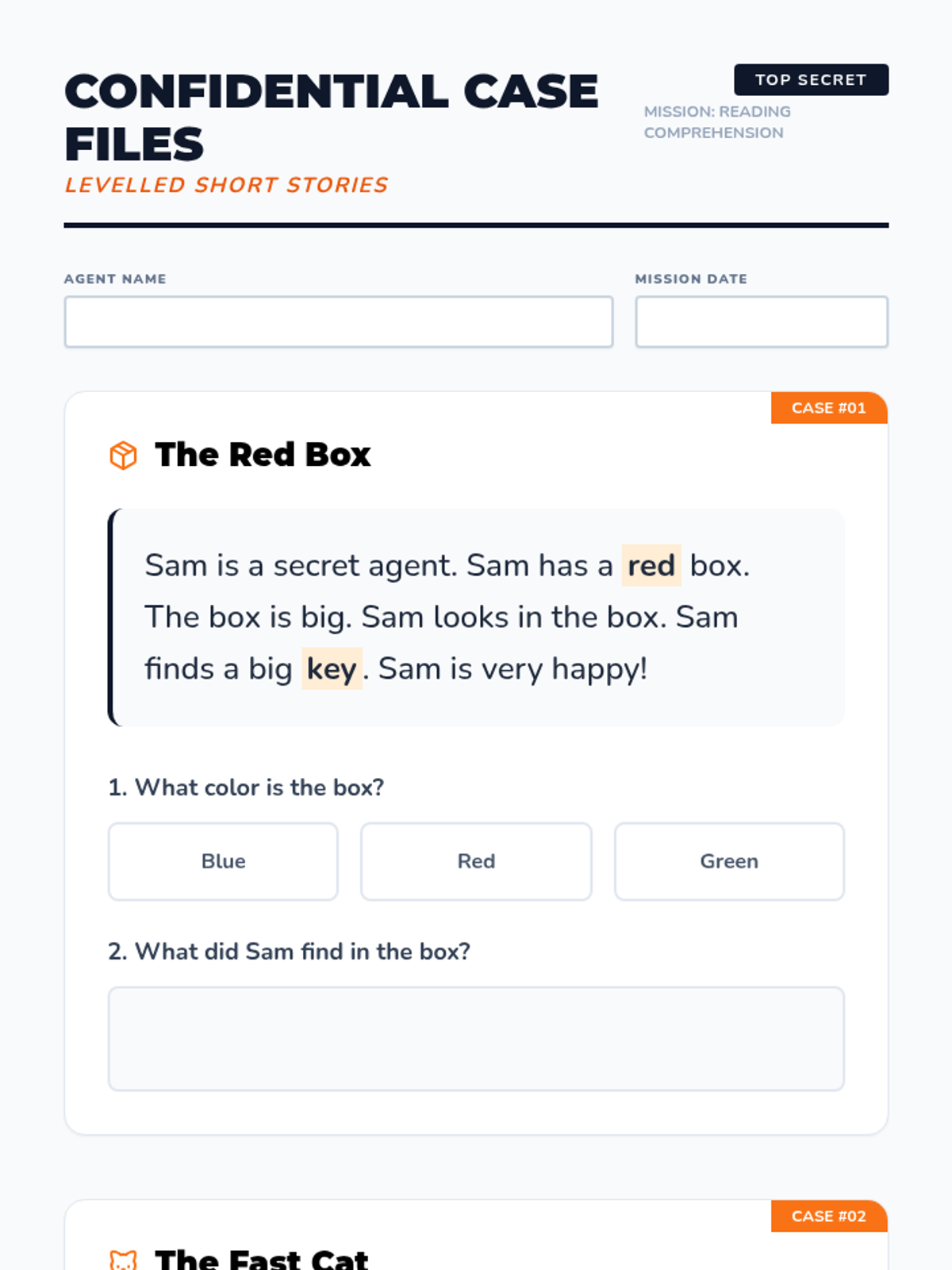
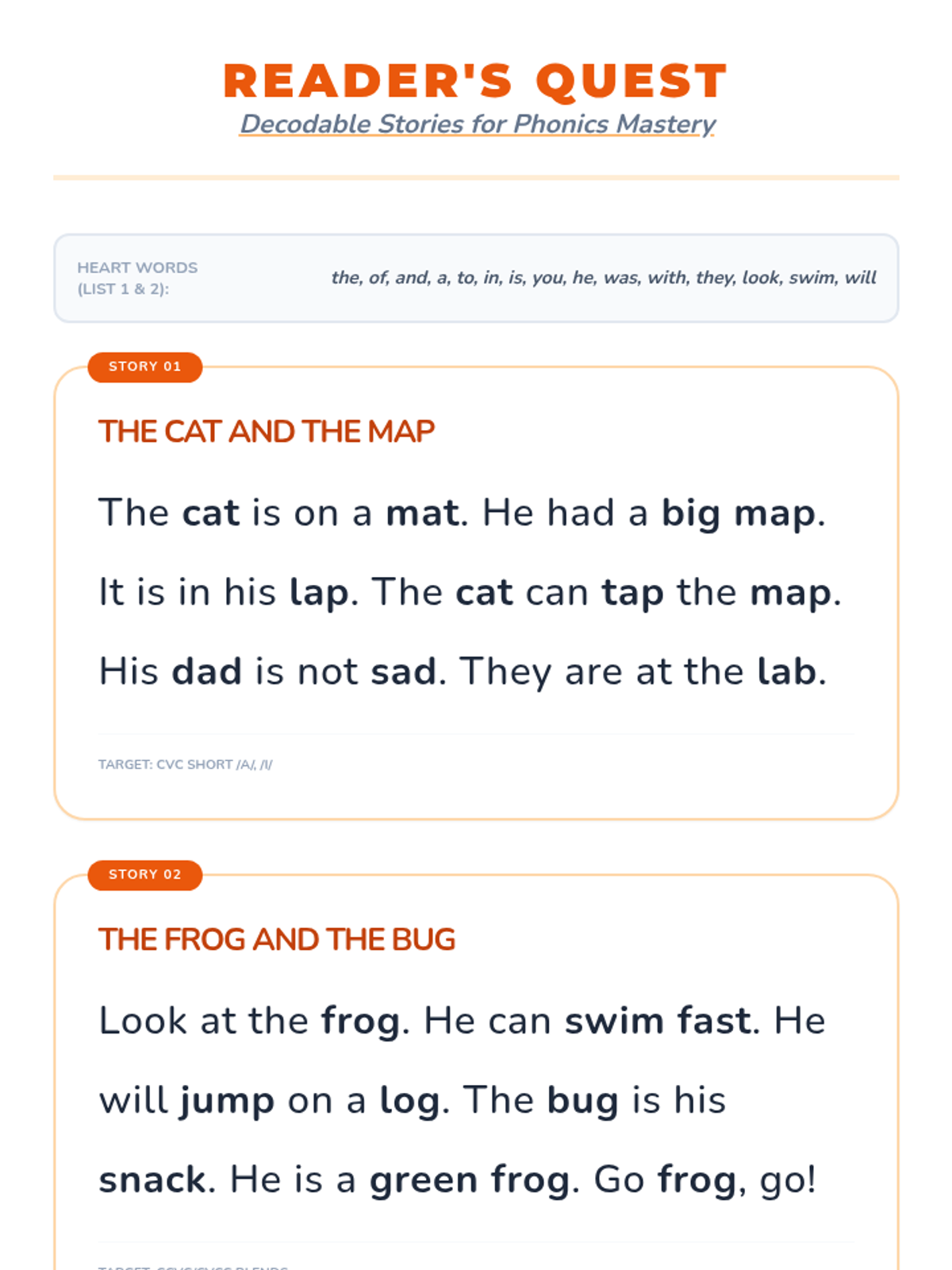
High-readability decodable passages for Grade 3 students, focusing on consonant blends and vowel patterns with built-in fluency tracking.
A comprehensive teacher guide providing multisensory strategies, error correction scripts, and fluency routines for supporting Grade 3 students with reading disabilities.
A focused practice worksheet for identifying and reading consonant blends in isolation and within sentences, designed with high readability for Grade 3 learners.
A visually engaging graphic organizer designed as a laboratory sorting activity for students to categorize words by short and long vowel sounds.
An engaging slide deck introducing short/long vowel sounds and consonant blends with high-contrast visuals and simple rules for Grade 3 reading instruction.
An updated teacher guide for the 'Arena of Expression' lesson, reflecting the new slide structure with icons and emojis to match the student materials.
A student worksheet for practicing the Expanding Expression Tool (EET) using objects and concepts from The Hunger Games, featuring designated areas for each EET 'bead' with visual icons and prompts to use Tier 2 vocabulary.
A visual slide deck that introduces the Expanding Expression Tool (EET) and applies it to objects and characters from The Hunger Games, now featuring alternating blank practice slides and answer slides for interactive instruction, with emoji visual aids for key items and consistent Lucide icons for EET categories.
A single-page standalone mini-assignment focusing on visual analysis of a chosen panel from Persepolis, featuring simplified prompts and a sketching area.
An adapted teacher guide with IEP support strategies, simplified definitions, and a low-vocabulary prompt bank to assist in teaching Persepolis visual literacy.
A scaffolded visual literacy worksheet for Persepolis with simplified instructions, a word bank, and sentence starters for students with reading difficulties.
A scaffolded slide deck with simplified vocabulary and visual aids, designed for 10th-grade students with reading difficulties to understand graphic novel elements in Persepolis.
Hands-on multiplication task cards designed for use with manipulatives, allowing students to build arrays and solve equations for 2s, 3s, 5s, and 10s.
A printable matching game featuring multiplication equations for 2s, 3s, 5s, and 10s and their corresponding visual representations (arrays and icons) for pairing activities.
Student worksheet with visual arrays and empty work spaces for practicing multiplication facts 2, 3, 5, and 10, including an integrated data tracker for IEP progress monitoring.
Visual instructional slides for teaching multiplication facts 2, 3, 5, and 10, featuring conceptual visual aids like eyes, bicycles, hands, and triangles to support multi-sensory learning.
A visual slide deck to guide students through a memory-retrieval review of Chapters 1-4 of Night. It features large text, clear visual cues, and mirrors the "Memory Path" theme of the worksheet to support students with low working memory.
Teacher answer key for the Memory Path Timeline Worksheet, including specific retrieval support strategies for students with low working memory. Covers Chapters 1-4.
A comprehensive 3-page visual timeline worksheet for Night by Elie Wiesel. It includes word banks and fill-in-the-blank summaries for Chapters 1-4, plus structured templates for the remaining chapters to support students with low working memory throughout the entire novel.
A professional instructional guide for teachers to effectively implement the Case Cracker CER system. Includes pacing suggestions, differentiation strategies for Special Education, tips for overcoming common student misconceptions, and a breakdown of how to use the various resources together.
A digital-first CER graphic organizer template presented as a slide deck. Specifically designed for 7th-grade SpEd students to type their claims, evidence, and reasoning directly into a structured, detective-themed digital format. Features large text, high contrast, and helpful sentence starters on every slide.
A comprehensive 4-page detective-themed field notes packet for deep CER practice. Provides highly scaffolded sections for each part of the framework, detailed prompts, multiple evidence gathering areas, and a final report page for paragraph construction. Perfect for 7th-grade SpEd students needing step-by-step guidance.
A polished one-page graphic organizer for CER writing with a detective theme. Features a clear visual hierarchy, color-coded steps (Claim, Evidence, Reasoning), word banks for scaffolding, and a student self-check list. Optimized for 7th-grade SpEd with increased writing space.
Teacher answer key for the Body Fuel cloze notes with additional instructional strategies for teaching the digestive system to students with intellectual disabilities.
Simple cloze notes with a word bank for high school students with intellectual disabilities, focusing on the five main digestive organs and their functions.
Simplified slides introducing the five main organs of the digestive system with clear visuals and large text for high school students with intellectual disabilities.
A comprehensive teacher facilitation guide providing step-by-step instructions on how to use the scaffolded materials for Frederick Douglass Chapter 1.
A simplified, visual reading check quiz for SPED students, focusing on the core facts of Frederick Douglass Chapter 1 with reduced answer choices.
A visual vocabulary reference sheet for SPED students, defining key terms from Chapter 1 like Irony, Identity, and Dehumanize with clear icons and examples.
A scaffolded writing assessment for SPED students with a word bank, sentence starters, and a visual self-check list to build confidence in the final response.
Chunked presentation slides for a guided seminar on Frederick Douglass Chapter 1, featuring visual explanations of irony and structured discussion prompts.
A visual graphic organizer for SPED students to map Frederick Douglass's key relationships, using simplified prompts and structured comparison tables.
Student reflection and final assessment sheet for Lesson 5, allowing students to plan strategies and evaluate their comprehension performance.
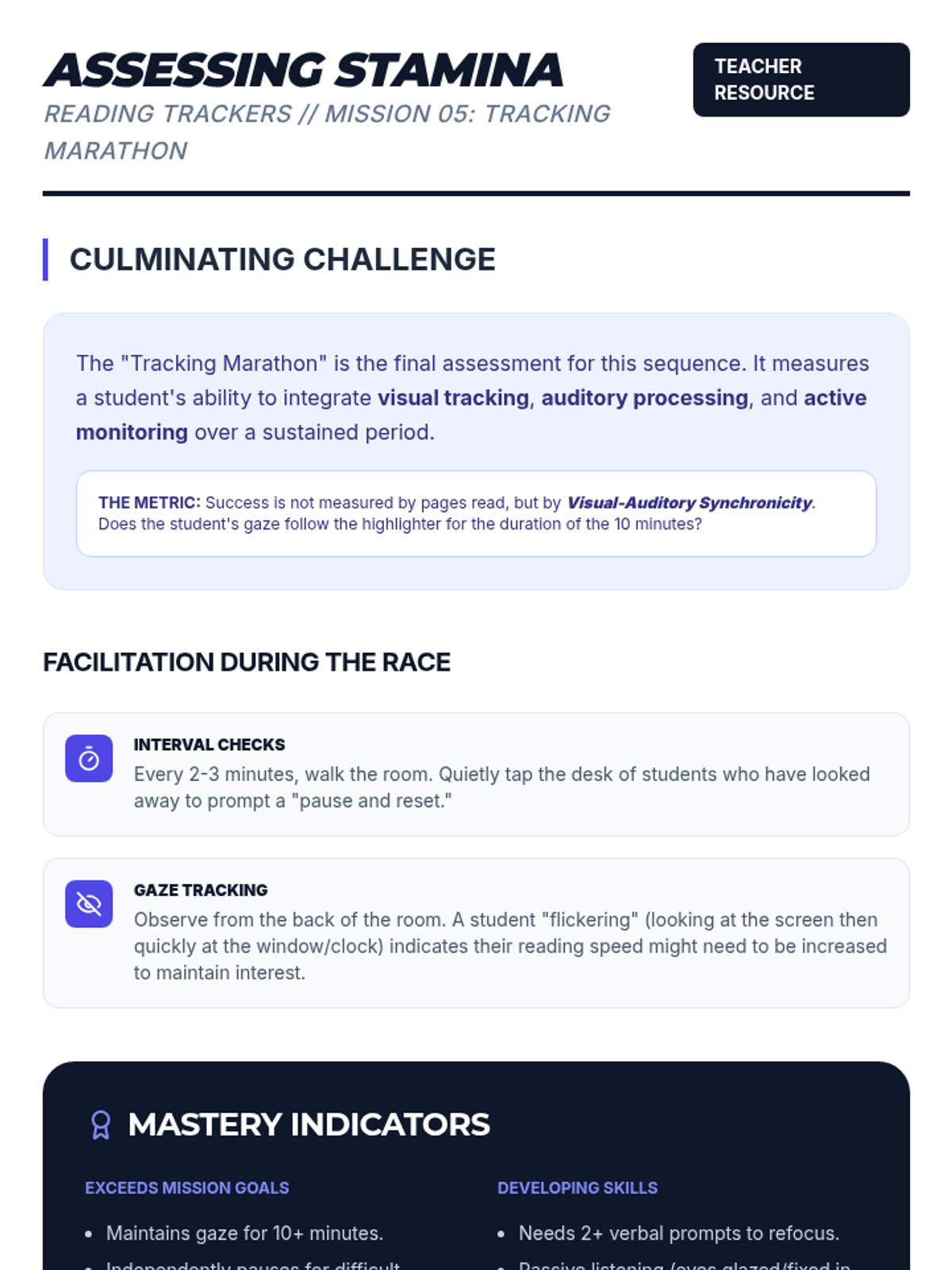
A teacher guide for Lesson 5, focusing on assessing sustained attention and visual-auditory synchronicity during the 'Tracking Marathon' challenge.
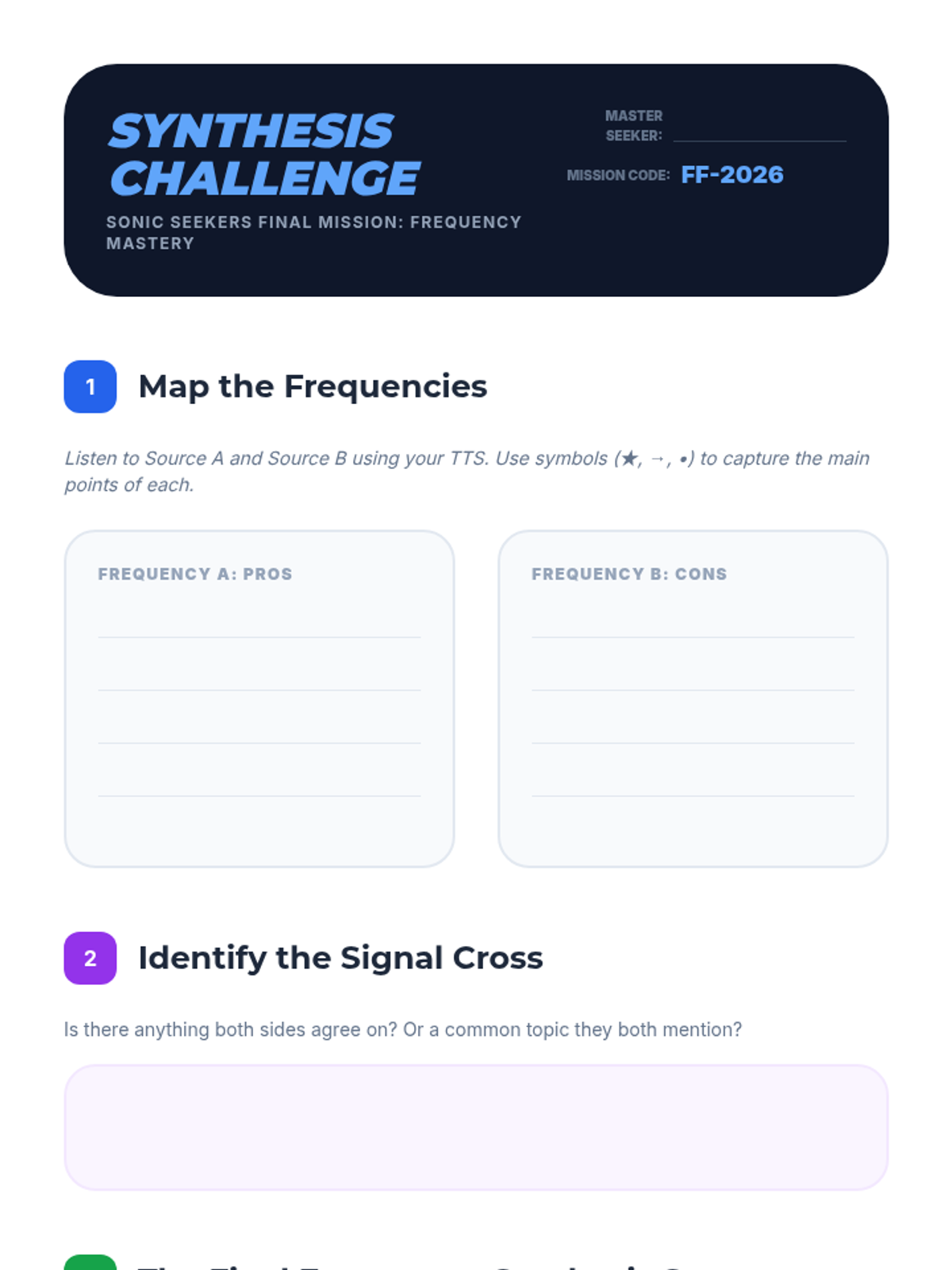
Final assessment worksheet for Lesson 5, challenging students to map two contrasting auditory viewpoints and synthesize them into a coherent written summary.
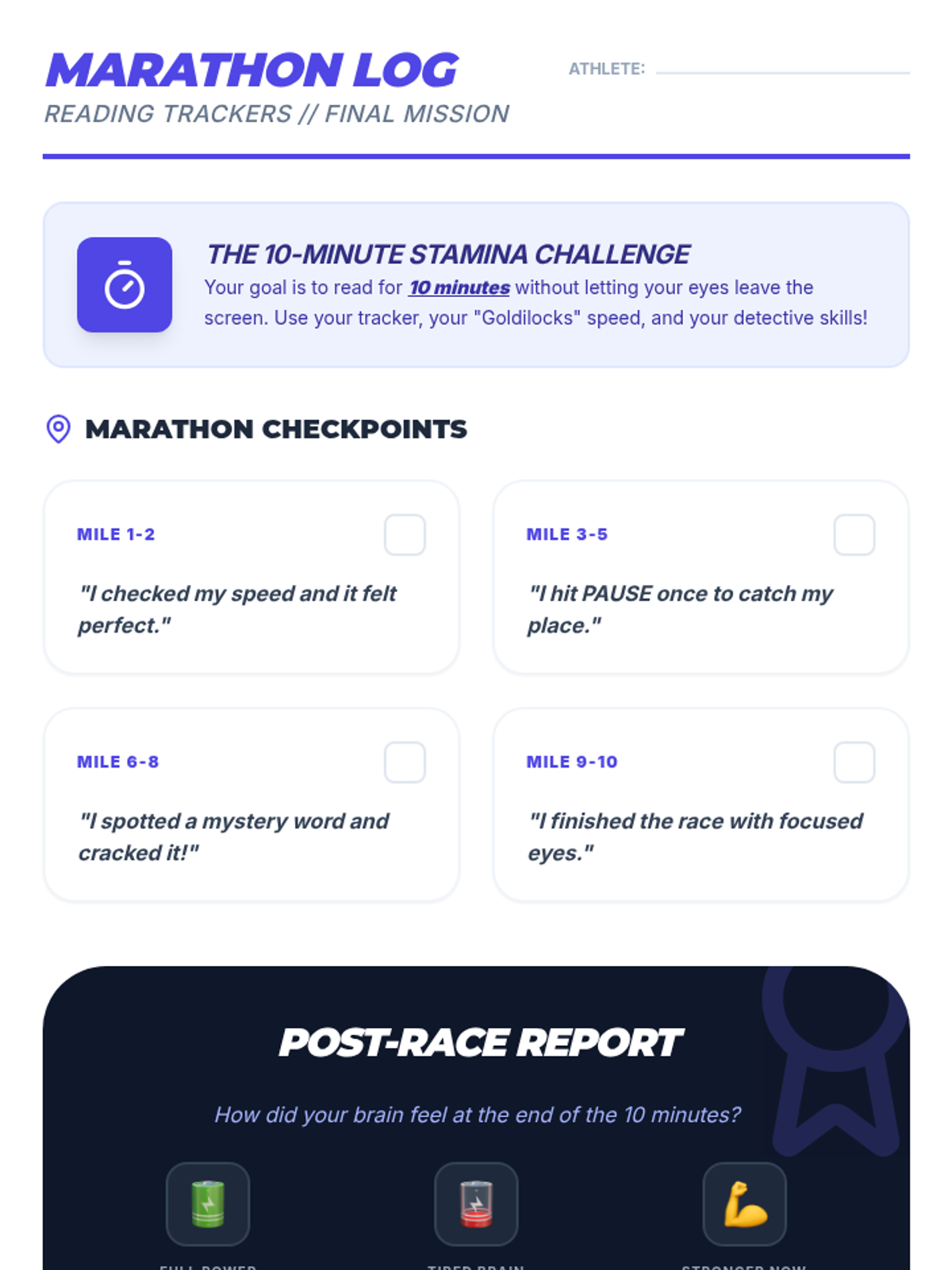
A student reflection sheet for the Lesson 5 'Tracking Marathon', where they track their focus and success across checkpoints during a sustained reading session.
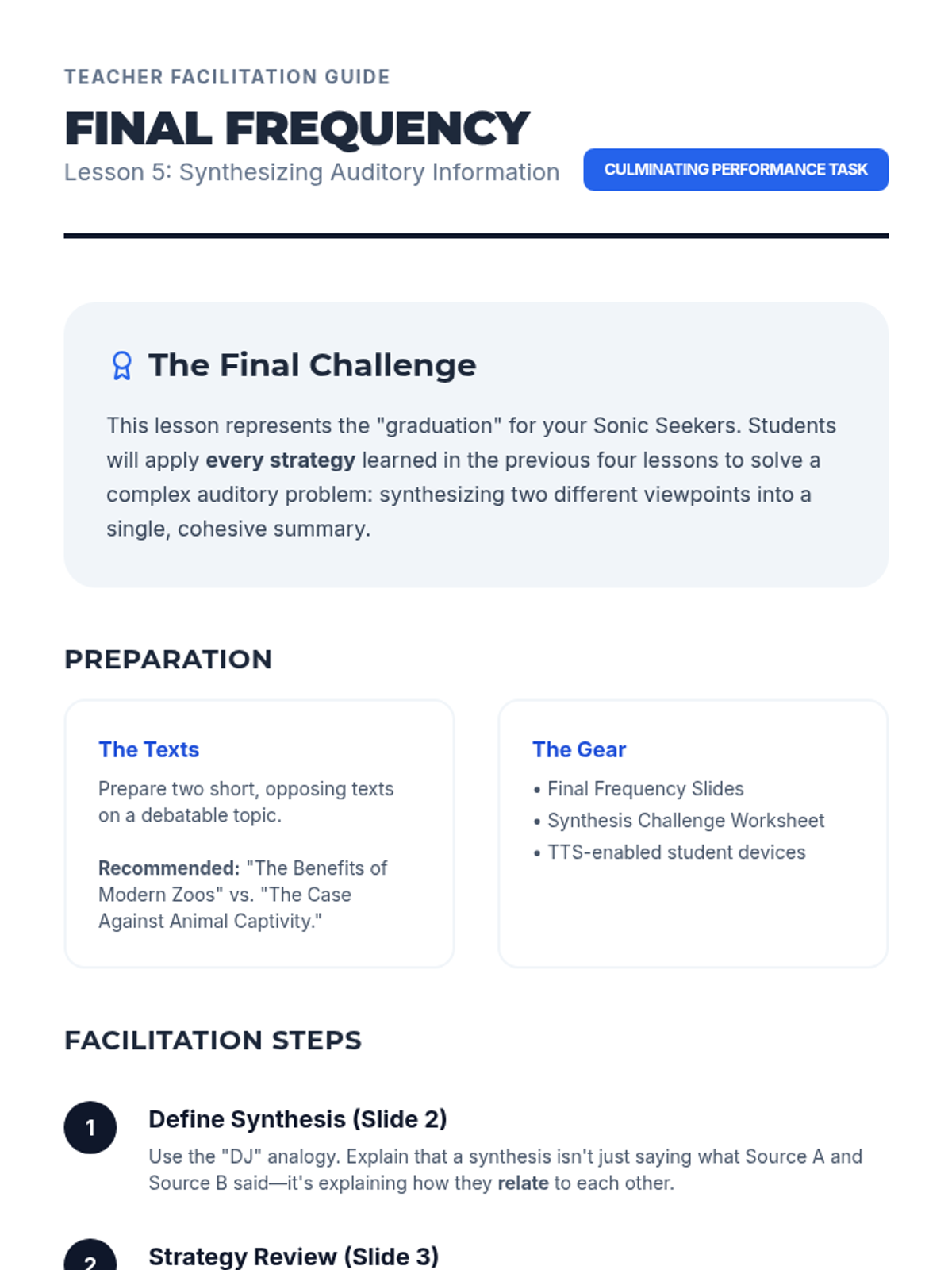
Teacher guide for Lesson 5, outlining the final synthesis task and providing a step-by-step facilitation plan for the culminating lesson.
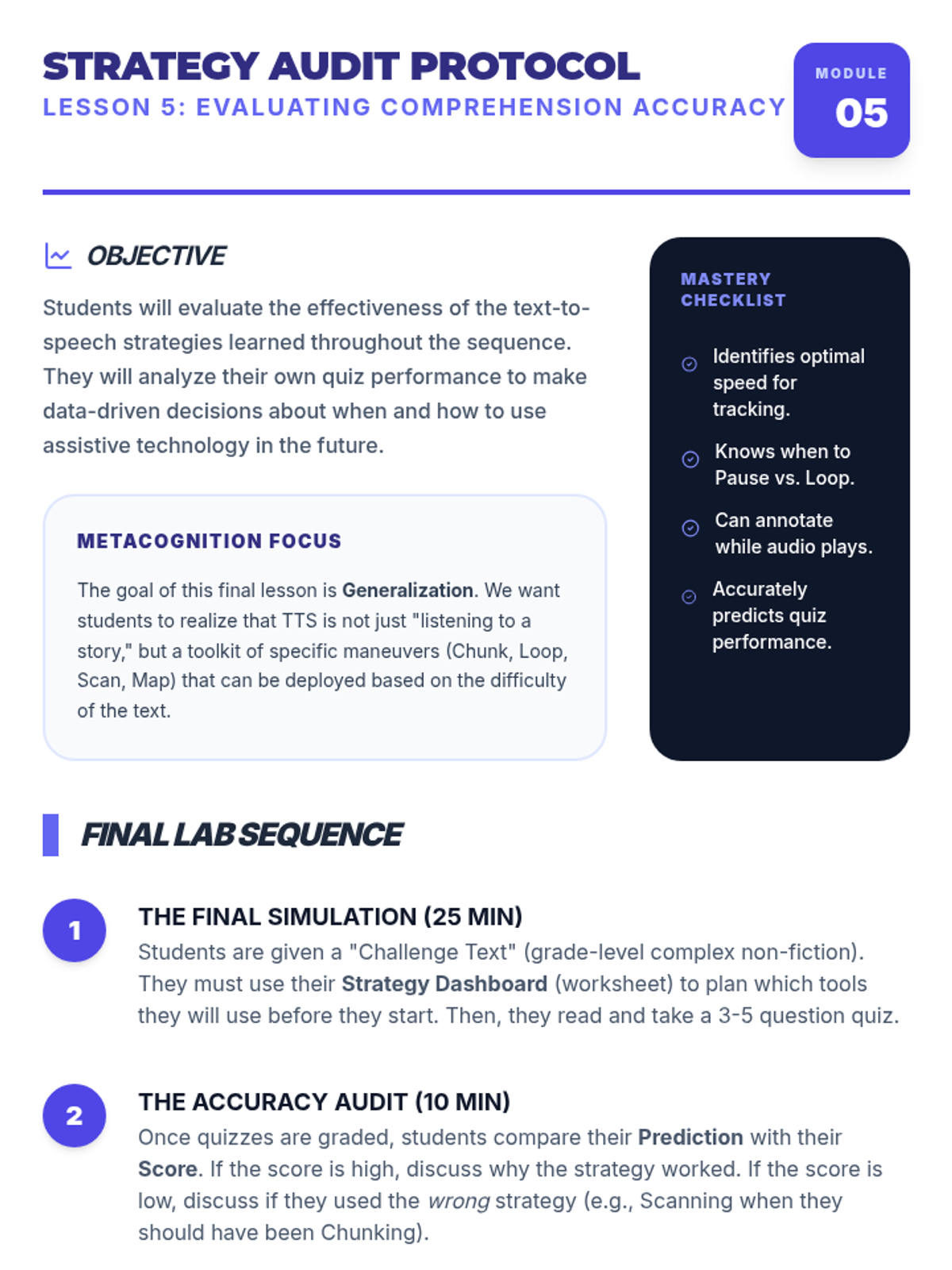
Detailed teacher guide for Lesson 5, focusing on strategy selection, metacognitive reflection, and identifying when to use TTS support versus silent reading.
Slide deck for Lesson 5: Synthesizing Auditory Information, introducing the final challenge of summarizing contrasting viewpoints using all previous auditory strategies.
Introductory slides for Lesson 5, focusing on sustained attention and applying tracking skills to longer reading passages.
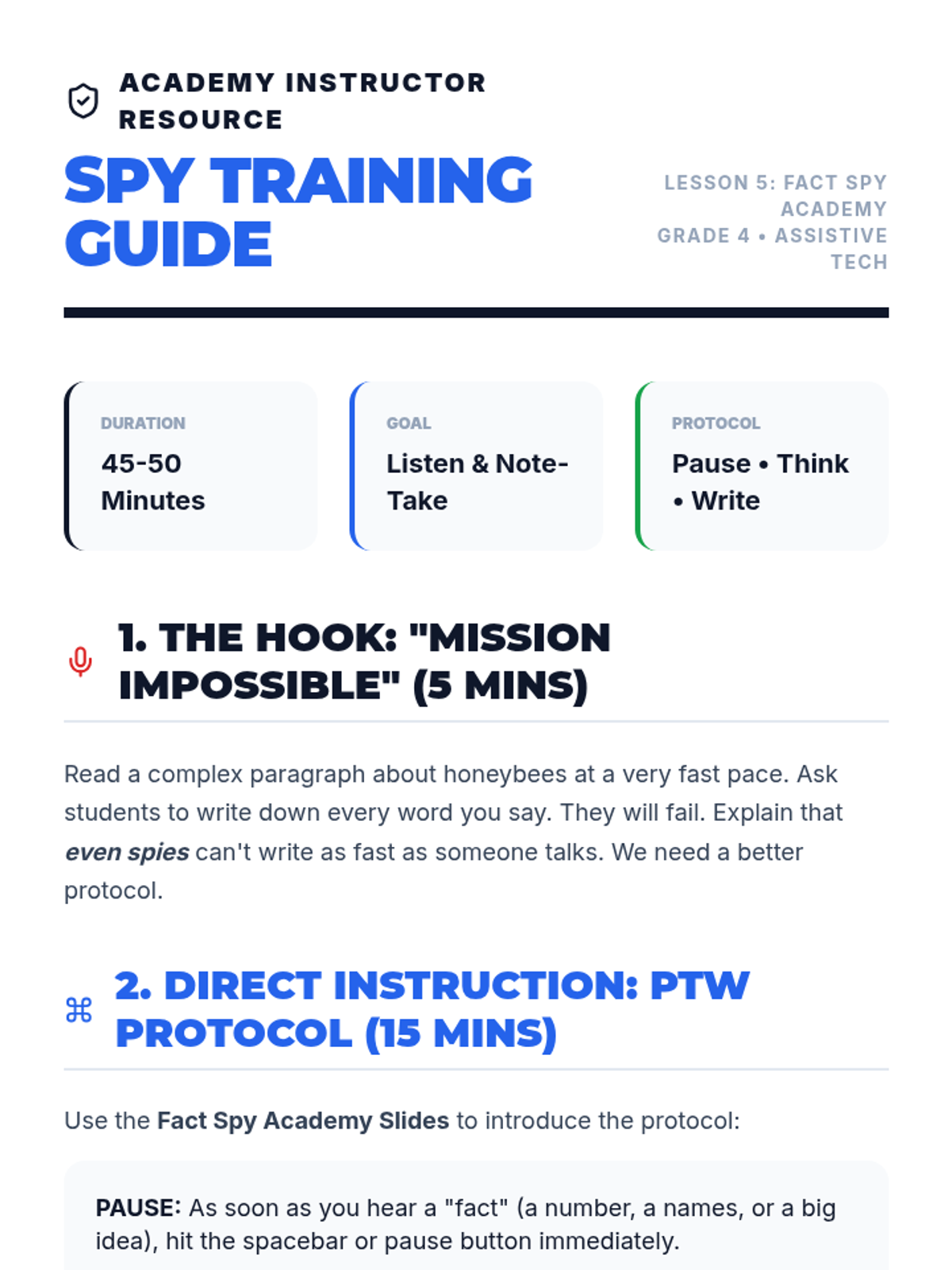
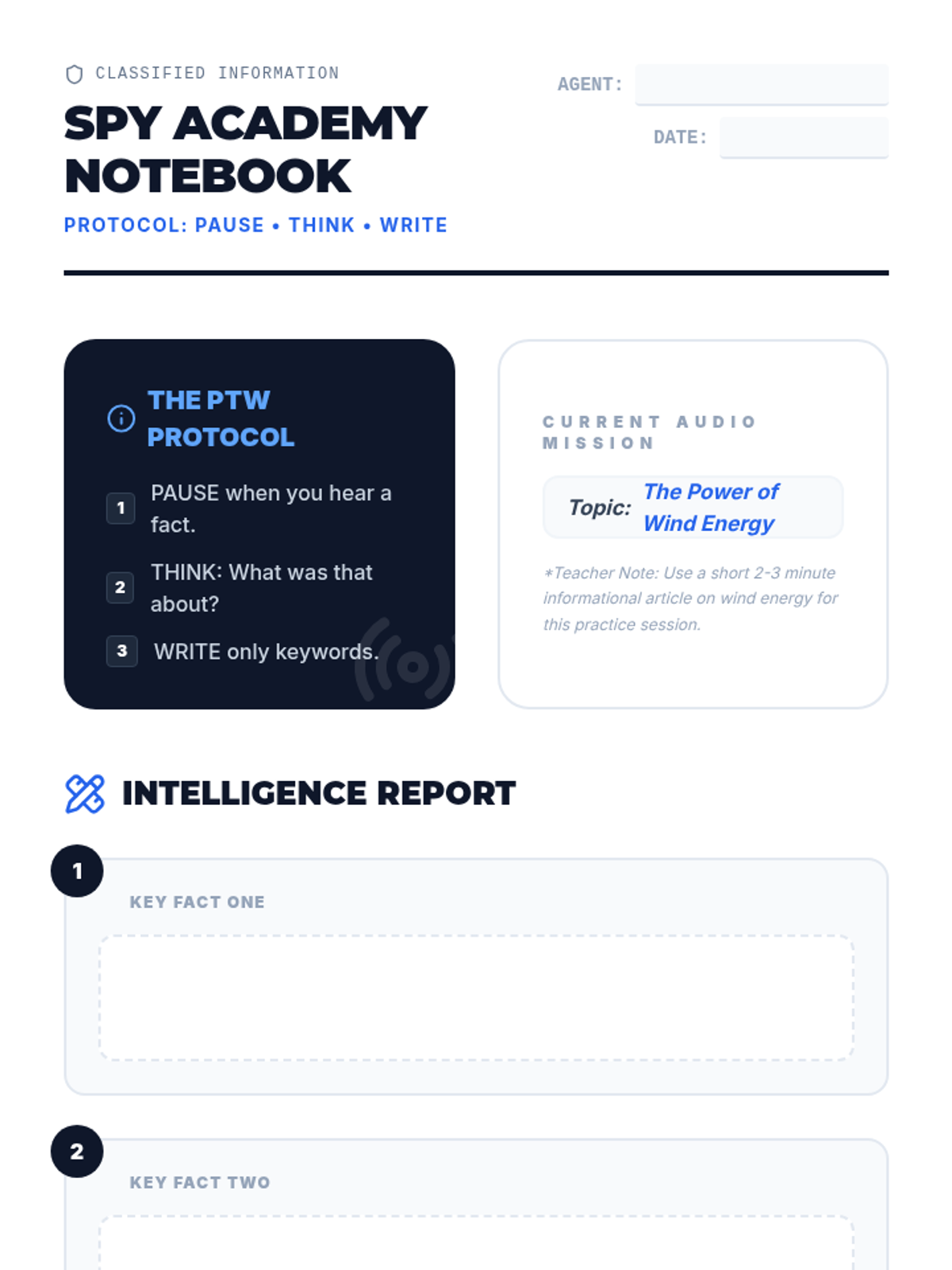
Teacher guide for the 'Fact Spy Academy' lesson, providing instructional steps, modeling scripts, and technical troubleshooting for using TTS for note-taking.
Slide deck for Lesson 5, focusing on strategy selection, metacognitive reflection, and identifying when to use TTS support versus silent reading.
Student note-taking template for the 'Fact Spy Academy' lesson. Features structured spaces for recording facts using the 'Pause-Think-Write' method.
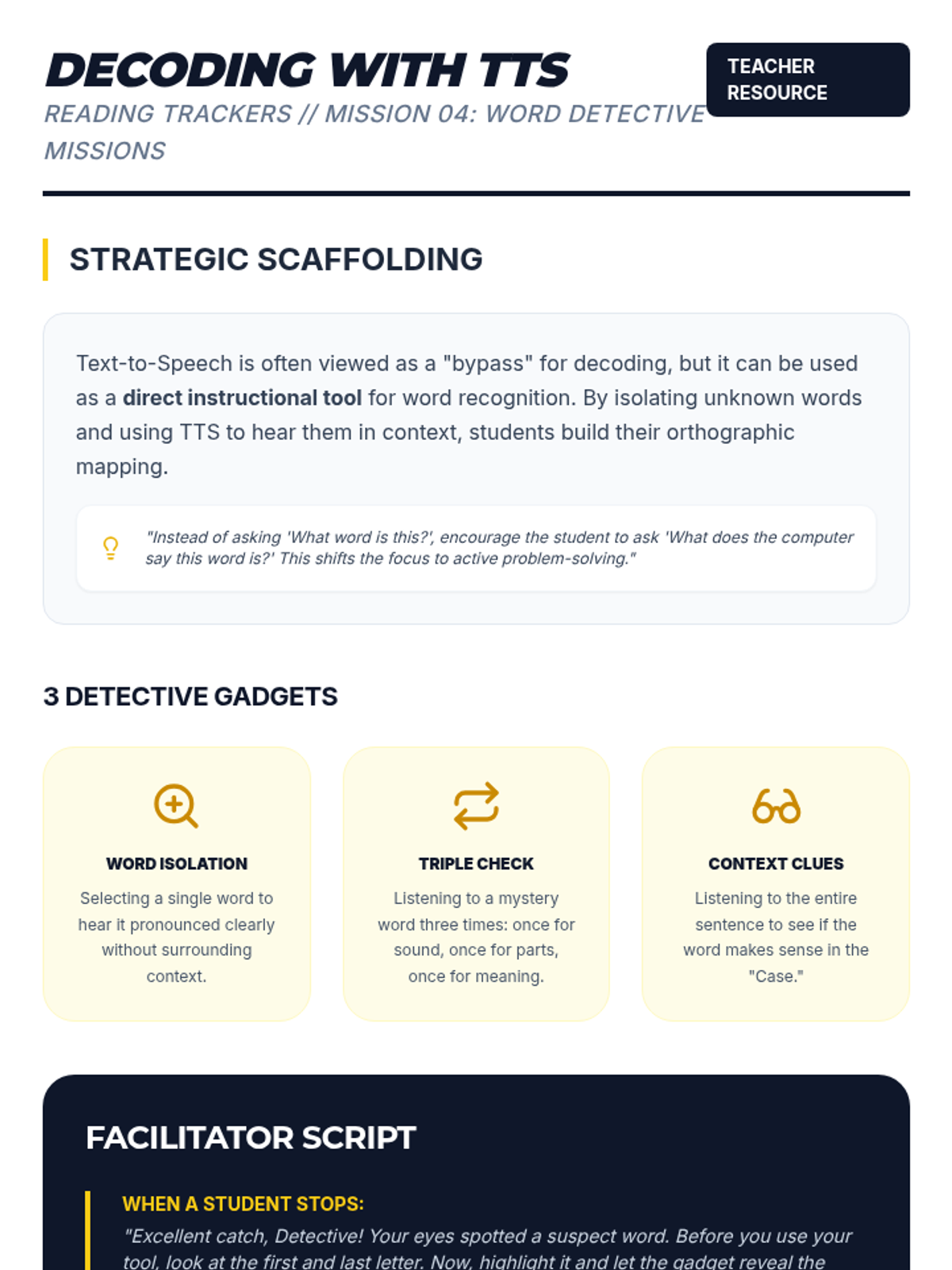
A teacher resource for Lesson 4, focusing on using TTS to support word decoding and providing specific facilitation strategies and scripts.
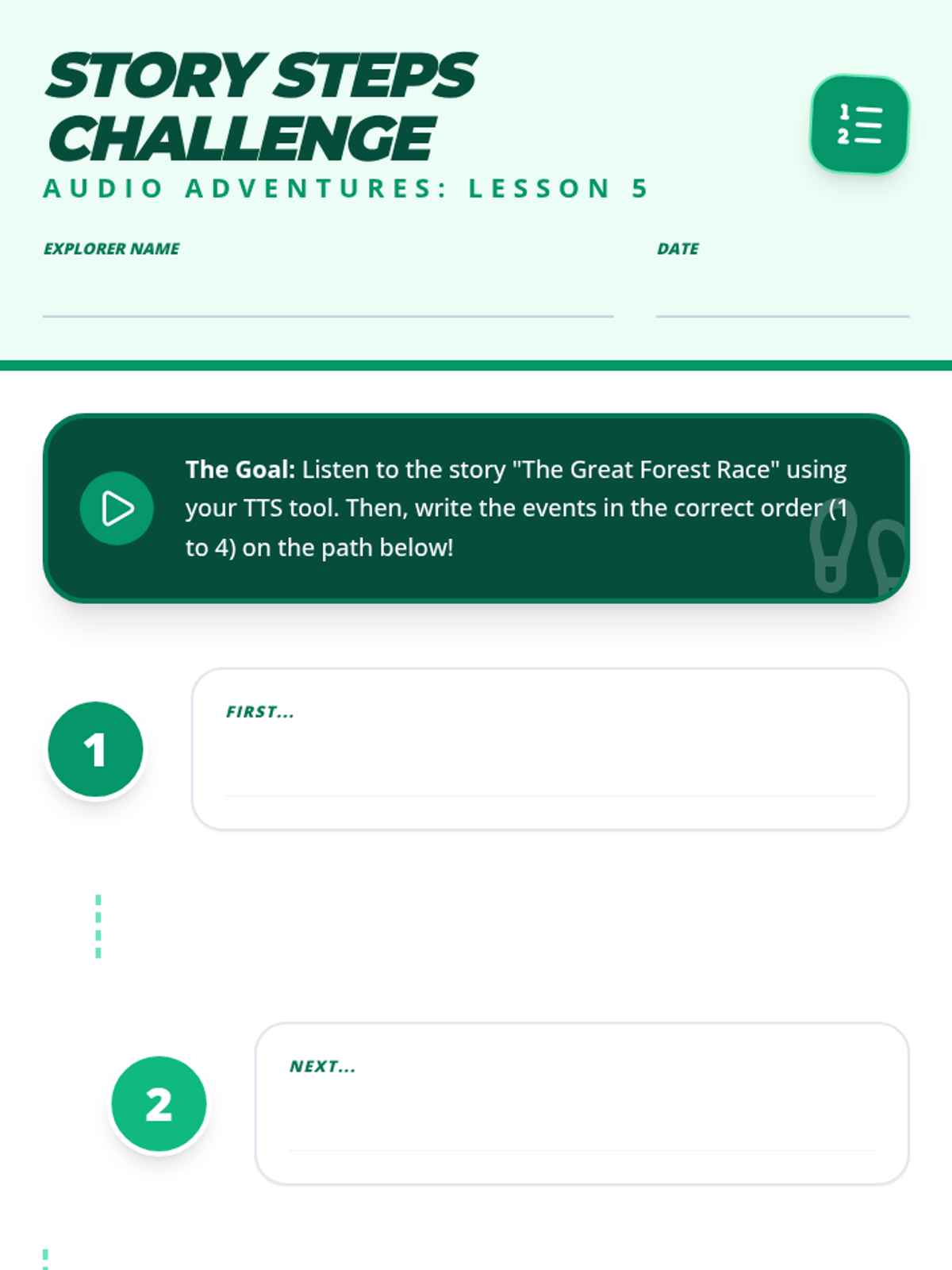
A story sequencing worksheet for Lesson 5 where students listen to a full narrative and practice putting events in the correct chronological order.
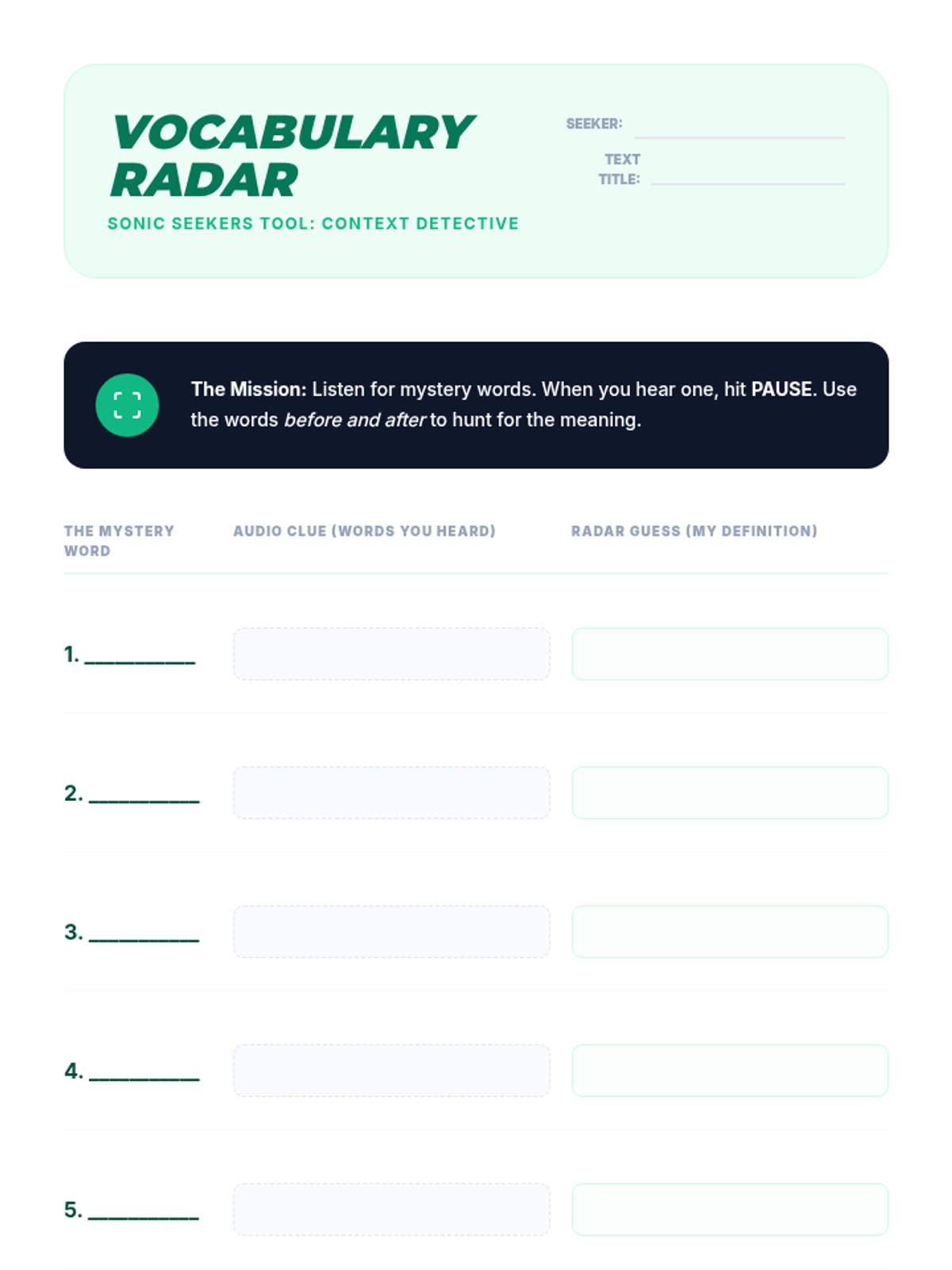
Vocabulary worksheet for Lesson 4, allowing students to record unknown words, auditory context clues, and inferred definitions while using TTS.
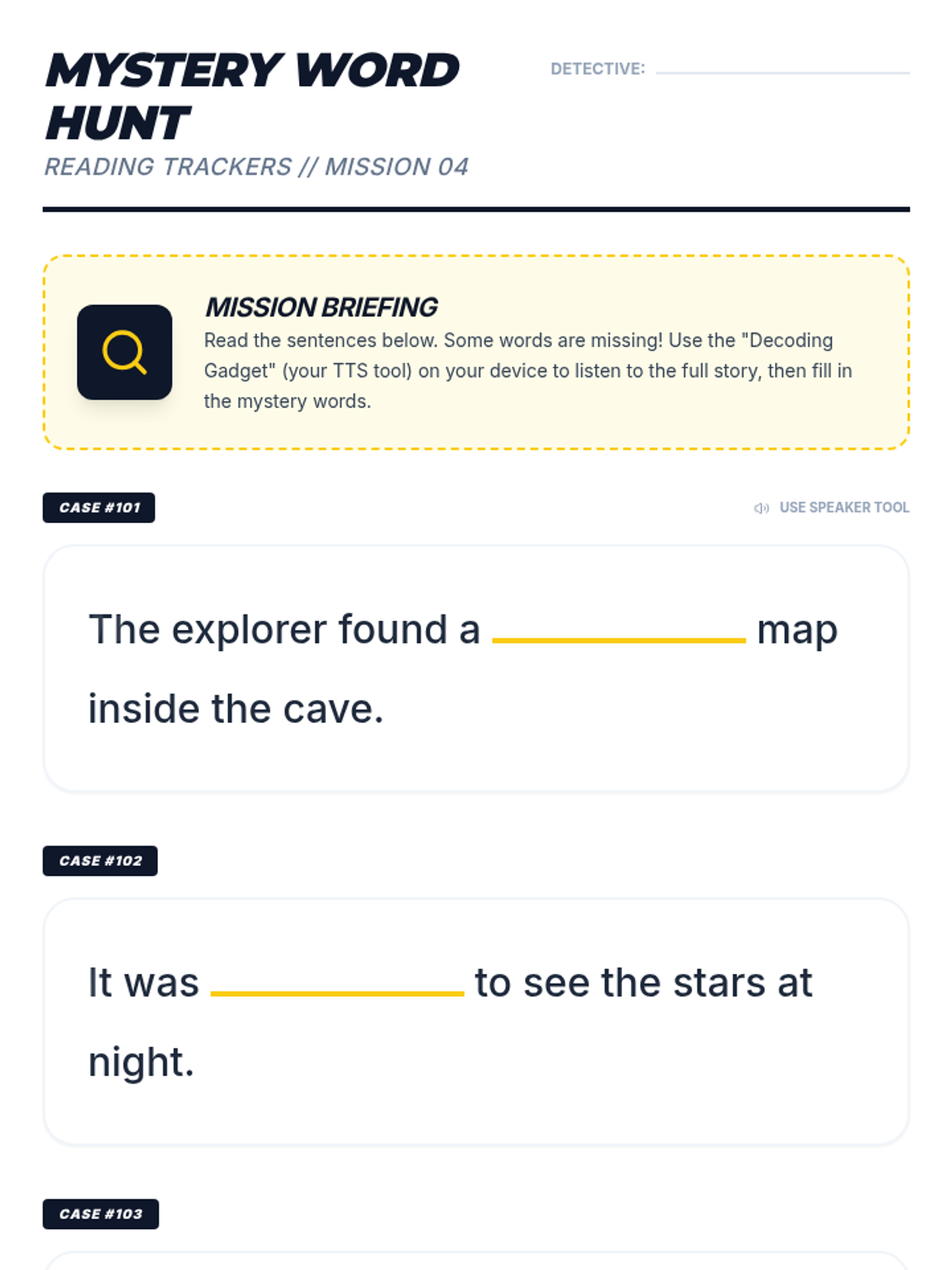
A student worksheet for Lesson 4 where they listen to sentences with missing words and use TTS to decode the 'mystery' words.
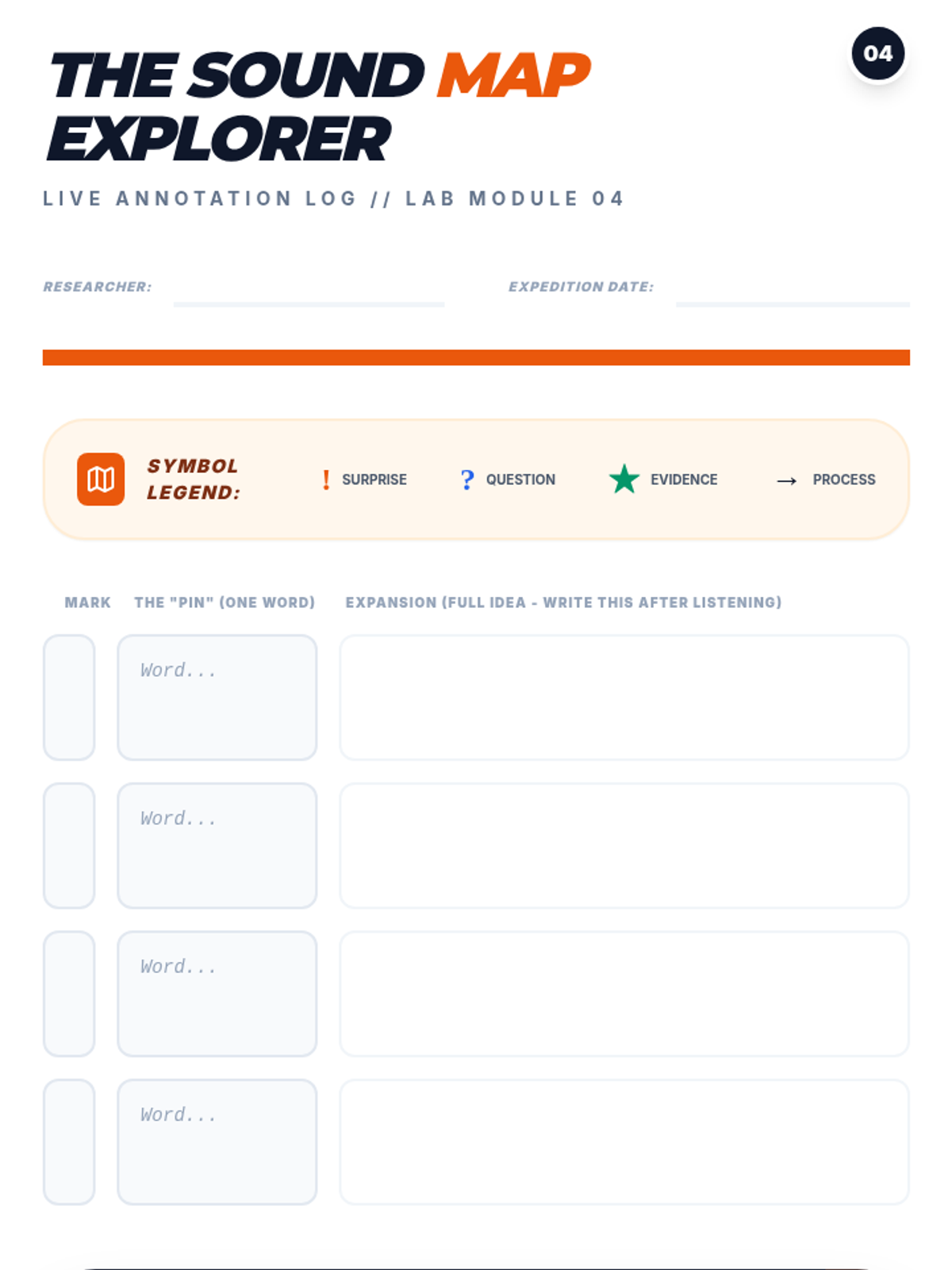
Student activity sheet for Lesson 4, featuring a symbol-based annotation log for live listening practice.
Visual presentation for the 'Fact Spy Academy' lesson, teaching students how to use the 'Pause-Think-Write' protocol for taking notes while listening to Text-to-Speech.
Slides for Lesson 5, focusing on story sequencing and using text-to-speech to follow the chronological order of events.
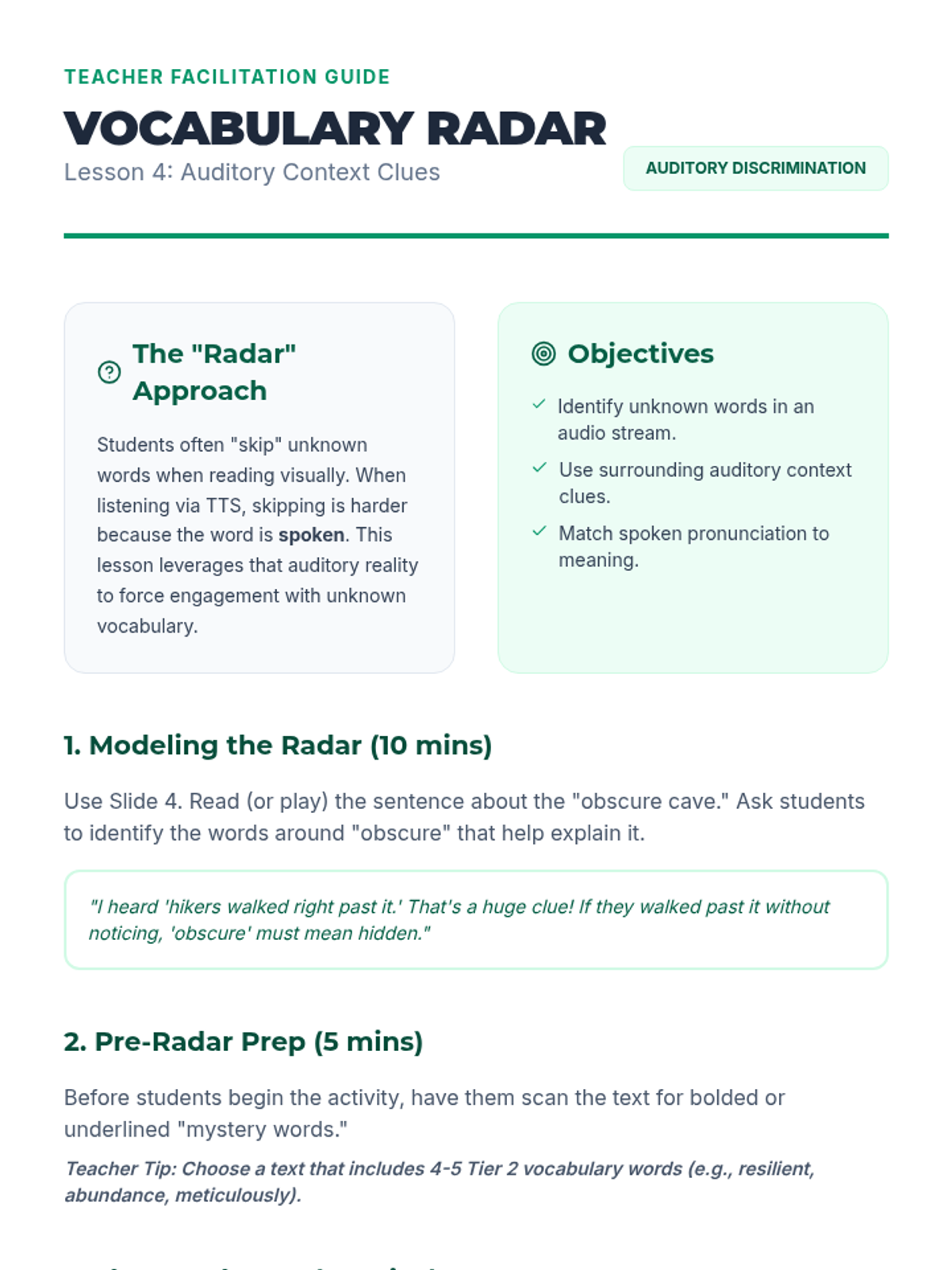
Teacher guide for Lesson 4, providing instructions on using auditory context clues and managing the "Word Hunt" activity.
Introductory slides for Lesson 4, introducing the 'Word Detective' mission where students use TTS to decode unfamiliar words.
A detailed instructional guide for teachers providing a week-long roadmap, explicit instruction scripts (I Do, We Do, You Do), and multi-sensory strategies for teaching multiplication facts 2, 3, 5, and 10.
An updated teacher answer key providing suggested responses for the expanded examples in the slideshow, including Same/Away retrieval, Context Clues, CLOF brainstorming, and EET tool applications.
A comprehensive student guide providing tricks for remembering synonyms and antonyms, tips for using context clues, and brainstorming categories for word maps.
A teacher-facing guide with a data collection tracker and scaffolding instructions to monitor student progress toward their semantic retrieval goal.
A visual reference guide for students outlining semantic strategies including the EET tool, word webs, and Venn diagrams with clear icons and instructions. updated with consistent SAME/AWAY mnemonics.
A comparative analysis worksheet focusing on settings and characters from The Hunger Games, utilizing Venn diagrams and EET descriptive strategies.
An updated student worksheet featuring EET practice with the Mockingjay Pin and retrieval exercises using the "Same" and "Away" mnemonics for synonyms and antonyms, now including a word bank for support.
A comprehensive slide presentation featuring at least 5 practice examples for each semantic strategy (Same/Away, Scout Method, CLOF Word Webs, EET Tool, and Venn Diagrams), themed around The Hunger Games. Each section includes direct instruction followed by a multi-slide sequence of individual practice examples, incorporating fading modeling for the EET tool.
A facilitation guide for teachers to deliver the Mental Juggle Hacks lesson, including activity instructions, common pitfalls, and a lesson script.
A structured reflection journal page for students to synthesize their learning about the difference between lateral and total surface area. Features large writing lines and a guiding prompt.
Facilitation guide for teachers delivering the Cylinder Skin intervention. Includes a detailed lesson flow, specific video pause timestamps with questioning prompts, and a clear answer key for the guided practice problem.
A color-coded worksheet designed for special education students to follow along with a video lesson and complete a guided practice problem. Features specific color-matched input fields for dimensions, lateral area, and total surface area.
Interactive slide deck for teaching cylinder surface area using color-coding strategies. Includes the embedded video, pause points for discussion, and step-by-step guided practice.
Detailed teacher guide for Lesson 4, focusing on the mapping theme and the live annotation technique for multitasking with TTS.
Slide deck for Lesson 4, introducing the multitasking skills, symbols for notes, and highlighting while playing for live annotation.
Student activity sheet for Lesson 3, featuring a detective case file layout for evidence collection using TTS scanning and looping strategies.
Detailed teacher guide for Lesson 3, focusing on the detective theme and the "Scan" and "Loop" techniques for finding and verifying evidence with TTS.
Slide deck for Lesson 3, introducing the detective theme, the "Scan" and "Loop" techniques for finding and verifying evidence with TTS.
Student activity sheet for Lesson 2, featuring a chunking log to practice the Play-Pause-Paraphrase strategy.
Detailed teacher guide for Lesson 2, focusing on the cookie analogy and the Play-Pause-Paraphrase strategy for auditory comprehension.
Slide deck for Lesson 2, introducing the "Cookie" analogy for text chunking and the Play-Pause-Paraphrase strategy for auditory comprehension.
Student activity sheet for Lesson 1, featuring a speed calibration checklist, a focus tracking log, and reflection questions.
Detailed teacher guide for Lesson 1, including instructional steps, modeling strategies, and differentiation tips for bi-modal reading.
Introductory slide deck for Lesson 1, focusing on bi-modal reading (seeing + hearing), visual tracking with TTS, and calibrating reading speed for different tasks.
A final project template for graduate students to design an assistive technology implementation plan for digital annotation at their school site.