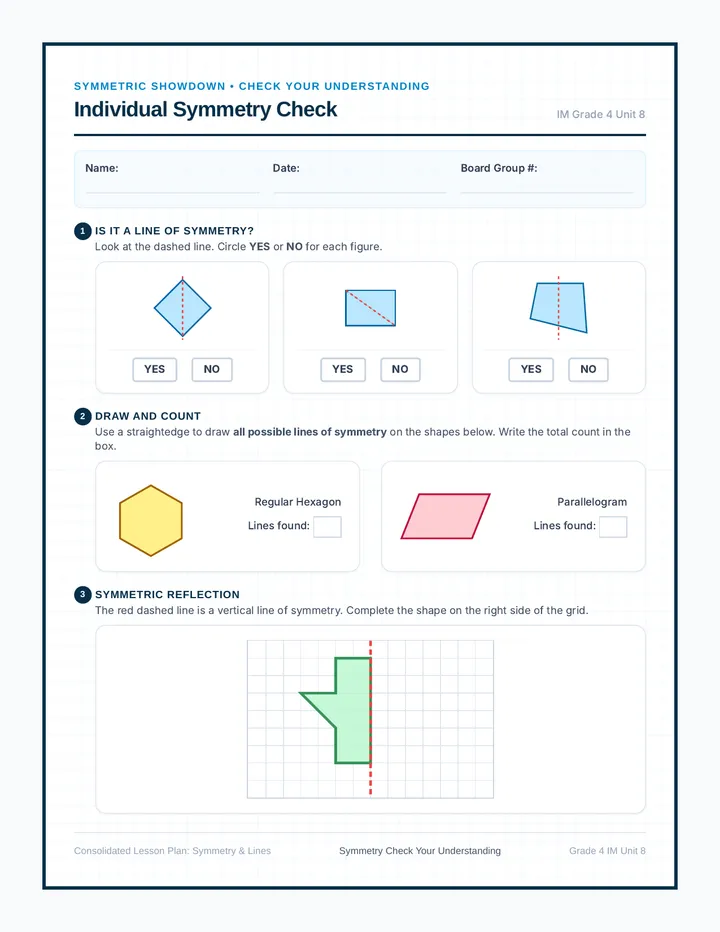
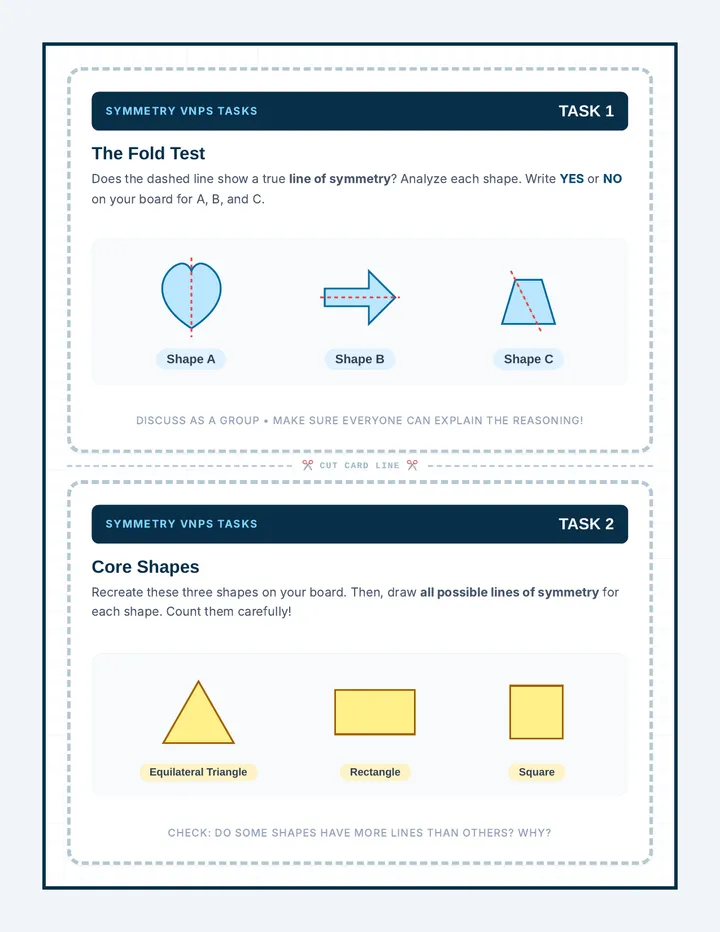
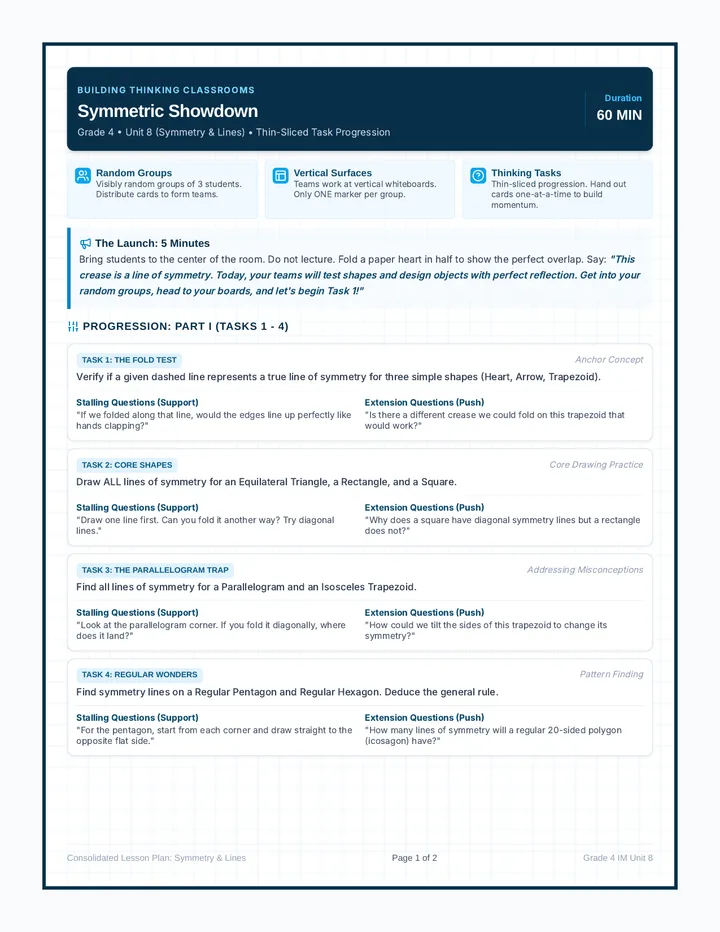
A 4-question detective-themed quiz assessing multi-step word problems and remainder interpretation. Students solve real-world scenarios requiring rounding up, discarding, or identifying the remainder.
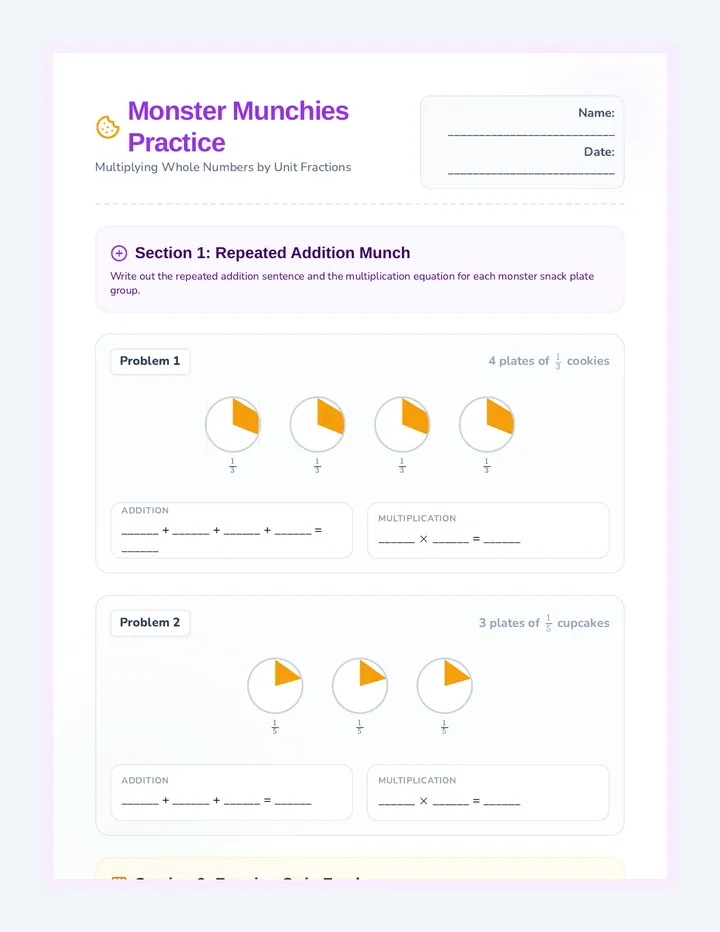
Answer key for the Fraction Matchup assessment, including visual guides and sample written responses.
A 5-question quick assessment worksheet on equivalent fractions using fraction bars and number lines, featuring a professional blueprint-style aesthetic.
A student-facing reference sheet with multiplication strategies and mental math "hacks" for facts up to 12. Designed with an arcade-inspired Level Up theme to match the lesson's high-energy aesthetic.
A teacher-facing lesson plan and instructional guide for implementing multiplication sprints. Includes pacing, procedures, and differentiation strategies.
A visual progress tracker for students to record their multiplication sprint scores over ten trials. Features a bar graph layout to encourage goal-setting and growth mindset.
A teacher-facing answer key for the Turbo Sprint Worksheet, featuring all 48 multiplication solutions in a matching layout for rapid grading.
A high-energy, timed multiplication sprint worksheet featuring 48 problems up to 12x12. Designed for a 60-second challenge with a clean arcade-inspired aesthetic.
A vibrant, arcade-themed slide deck to facilitate timed multiplication drills. Includes rules, a warm-up, a 'Go' signal, and reflection prompts to keep energy high.
A clear answer key for the Common Ground Worksheet, showing correctly built equivalent fractions and the final comparison for all five problems.
A comprehensive 1-12 multiplication chart designed as a reference tool for finding common denominators and building equivalent fractions. Styled with the Blueprint theme for visual consistency.
A teacher-facing progress monitoring tool specifically designed to track the IEP goal of comparing fractions with 80% accuracy in 4 out of 5 trials. It includes space for trial data, dates, accuracy percentages, and qualitative observation notes.
A structured worksheet for practicing comparing fractions with unlike denominators. It includes a designated "Construction Zone" for students to show their work finding equivalent fractions. Designed with a Blueprint theme and clear visual supports. Updated with 5 problems to align with IEP goal trials.
A slide deck introducing the concept of comparing fractions with unlike denominators using a "Blueprint" theme. It covers finding a common denominator using a multiplication chart, building equivalent fractions, and performing the comparison.
An answer key for the 'Evidence Log' worksheet, featuring clear solutions and mathematical reasoning for the data analysis problems.
A student worksheet featuring two 'cases' to solve. Case 1 uses a pictograph with a multi-unit key (10 units), and Case 2 uses a bar graph. Students must analyze data to solve comparison and total-sum problems.
A comprehensive teacher facilitation guide for a small group lesson on data analysis. It includes instructional steps, common misconceptions, and differentiation strategies with a "Data Detectives" theme.
A 7-slide presentation for introducing and reviewing 4th-grade fraction standards (equivalent fractions, addition, tenths/hundredths, and decimals) with visual models and guided practice.
A teacher answer key for the Fraction Frontier Worksheet, providing correct answers and brief instructional explanations for each of the 10 problems.
A 10-problem MCAS-style worksheet for 4th-grade fractions, including equivalent fractions, addition, tenths/hundredths, and decimals, featuring visual models and number lines.
The answer key for the Evidence Lock Quiz, detailing the step-by-step solutions and the reasoning behind handling remainders in each scenario.
A comprehensive teacher guide for the Operation Mystery lesson, including learning objectives, a detailed lesson flow, common misconceptions, and differentiation strategies.
A visual slide deck introducing strategies for solving multi-step word problems and interpreting remainders. Features a detective theme with clear examples of when to round up, ignore, or use the remainder as the answer.
The answer key for the Operation Mystery Worksheet, providing step-by-step solutions and explanations for interpreting remainders in each case.