A student answer sheet designed as a 'Detective Log' with sections for recording the video challenge results and data from the 12-card scavenger hunt.
A differentiated drafting worksheet where students design a single house from a front elevation view, including an example diagram and a recording table for perimeter and area calculations of windows, doors, and walls.
Answer key for the Day 10 Master Architect Exam, covering the final assessment of all math standards.
A comprehensive 10th-day cumulative exam covering fractions, area, perimeter, and two-step word problems. Revised with expanded content, vertical workspaces for project phases, fixed LaTeX rendering, and high-contrast visual styling.
Answer key for Day 9 Two-Step Detectives, outlining the multi-step reasoning required for word problems.
Day 9 Study Packet focusing on strategies for solving two-step word problems with multiple operations and unknowns (NC.3.OA.8). Revised for better page layout, clear math symbols, and darker decorative numbers.
Answer key for Day 8 Border Patrol, providing solutions for perimeter and missing side length problems.
Day 8 Study Packet teaching perimeter of polygons and how to find unknown side lengths (NC.3.MD.8). Revised with reliable SVG shapes, fixed page breaks, and a functional drawing grid.
Answer key for Day 7 Area Splitters, covering partitioned area calculations and distributive property problems.
Day 7 Study Packet focusing on partitioning rectangles to understand the distributive property and additive area (NC.3.MD.7). Revised for better page breaks, fixed text overlaps, and improved contrast.
Answer key for Day 6 Area Blueprints, providing solutions for area calculations and tiling exercises.
Day 6 Study Packet introducing area concepts through tiling and the standard multiplication formula (NC.3.MD.7). Revised for better page layout, darker grid lines, and fixed label overlaps.
Answer key for Day 5 Numerator Knockout, explaining the logic of comparing fractions by denominator size.
Day 5 Study Packet on comparing fractions with the same numerator, focusing on reasoning about denominator size (NC.3.NF.4). Revised for better page layout, darker tick marks, and improved workspace visibility.
Answer key for Day 4 Denominator Duel, reinforcing the concept of comparing fractions with like denominators.
Day 4 Study Packet focusing on comparing fractions with the same denominator using area models and symbols (NC.3.NF.4). Revised for better page layout, problem alignment, and grid contrast.
Answer key for Day 3 Equivalence Lab 2, explaining the relationship between thirds and sixths on number lines.
Day 3 Study Packet covering equivalent fractions with thirds and sixths using length models (number lines) (NC.3.NF.3). Revised for better page breaks, label offsets, and problem layout.
Answer key for Day 2 Equivalence Lab 1, detailing the connections between halves, fourths, and eighths.
Day 2 Study Packet focusing on equivalent fractions using halves, fourths, and eighths with area models (NC.3.NF.3). Revised for better page breaks, LaTeX rendering, and problem layout.
Answer key for the Day 1 study packet, providing clear solutions and explanations for parents and teachers.
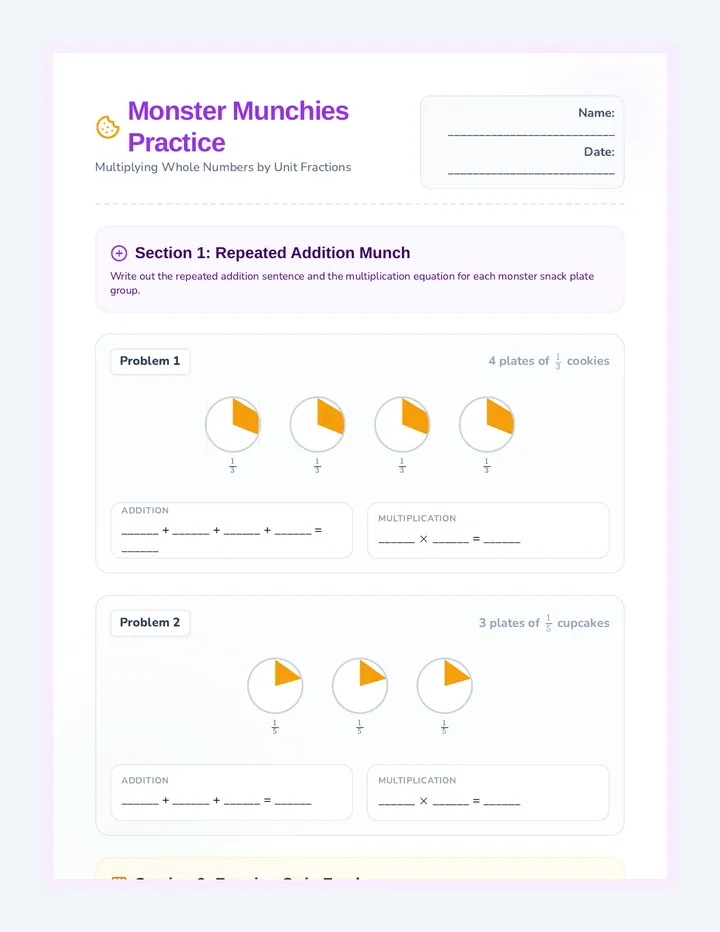
Guided notes and independent practice for Day 1 of the Math Blueprint Intensive, focusing on fractions as whole numbers and the concept of one whole (NC.3.NF.3). Revised for better page layout, math syntax, and enlarged work areas.
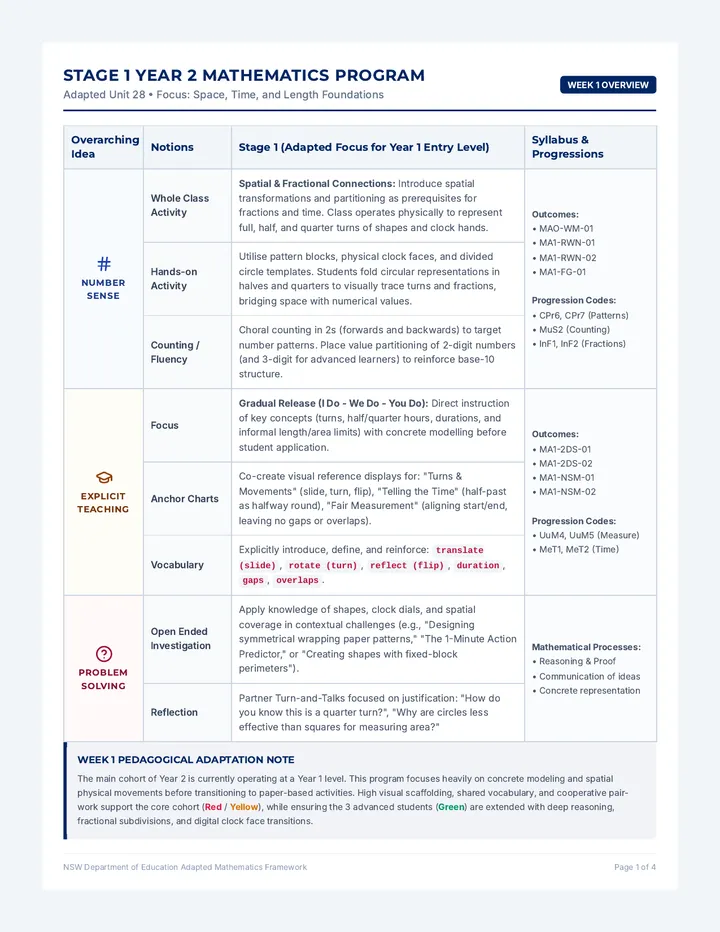
A 6-slide instructional presentation that introduces the Grid City project, defines perimeter and area, and outlines creative requirements like streets and plants.
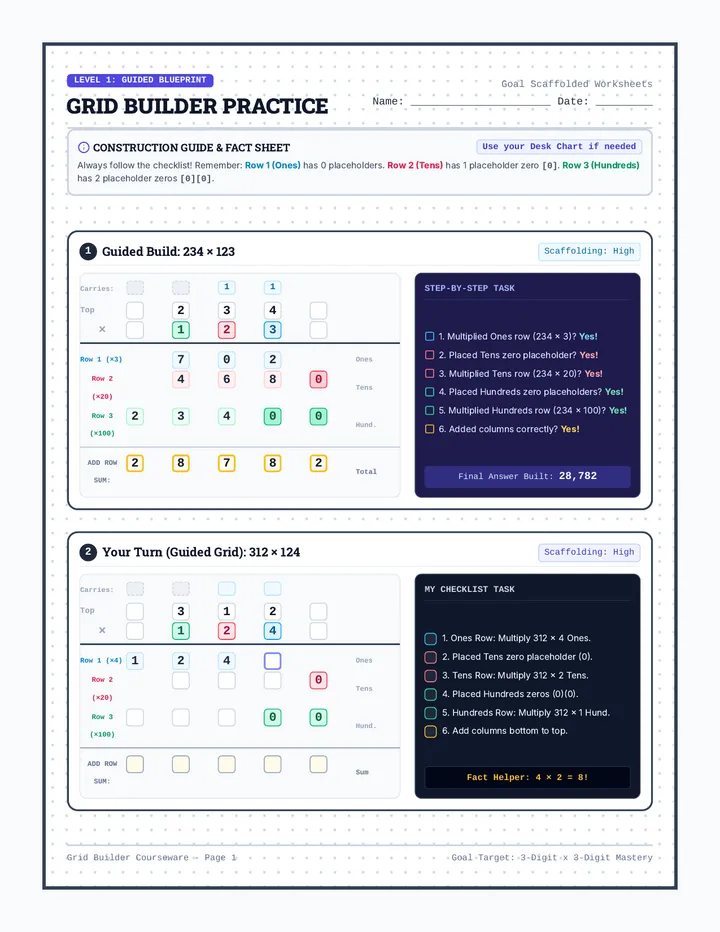
A scaffolded practice document featuring a pre-drawn town layout on a grid, allowing students to practice calculating perimeter and area before designing their own city, now featuring streets and landscaping.
A specialized worksheet featuring a large custom grid for architectural drawing and a detailed recording table for tracking perimeter and area calculations for five different buildings, now including street and landscaping requirements.
A mission briefing document for 4th-grade students, outlining project requirements for designing a town on grid paper, including specific building criteria, street and plant requirements, and a comprehensive grading rubric.