A visual reference guide for students to keep at their desks, providing clear definitions and visual examples of polygons and quadrilaterals.
A combined teacher answer key for the Treasure Hunter Practice Sheet and the Deep Dive Quiz, featuring clear solutions and grading notes.
An ocean-themed short quiz to assess student understanding of converting halves, quarters, and tenths into decimals.
An ocean-themed student practice worksheet for converting tenths, quarters, and halves into decimals.
A visually engaging anchor chart titled "Diver's Signal Map" that explains how to convert halves, quarters, and tenths into decimals using marine-themed visual models.
A detailed lesson plan for teaching fraction-to-decimal conversions using a "Deep Sea Decimals" theme, featuring instructional steps, differentiation strategies, and common misconceptions.
Teacher guide for Lesson 12: Division Finale. Provides a framework for celebrating student growth and a review routine for summarizing the sequence's key strategies.
Student practice page for Lesson 12: Division Finale. Serves as a cumulative assessment and reflection on the strategies learned throughout the Division Workshop.
Slide deck for Lesson 12: Division Finale. Reviews all strategies from the sequence (Area Models, Big 7, Scaling, Decimal Shifting) and celebrates student progress.
Teacher guide for Lesson 11: Story Solvers. Details the "Two Rooms" metaphor for problem-solving and provides annotation strategies for Tier 2 intervention.
Student practice page for Lesson 11: Story Solvers. Exercises focus on breaking down multi-step real-world problems into discrete operations.
Slide deck for Lesson 11: Story Solvers. Focuses on multi-step word problems involving division, using a "Two Rooms" framework to identify operations.
Teacher guide for Lesson 10: Decimal Dash. Focuses on equivalent expressions and the balanced shift logic for dividing decimals by decimals.
Student practice page for Lesson 10: Decimal Dash. Exercises focus on transforming decimal-by-decimal problems into equivalent whole-number problems.
Slide deck for Lesson 10: Decimal Dash. Focuses on creating equivalent expressions by multiplying both the dividend and divisor by powers of 10 to divide by a whole number.
Teacher guide for Lesson 9: Point Move. Details the money connection and spatial scaffolding techniques for dividing decimals.
Student practice page for Lesson 9: Point Move. Exercises include money-based decimal division and a guided Decimal Big 7 framework.
Slide deck for Lesson 9: Point Move. Introduces dividing decimals by whole numbers, connecting the concept back to place value and whole number division.
Teacher guide for Lesson 8: Remainder Rules. Focuses on the "Decision Tree" for interpreting remainders and provides physical scaffolding tips for Tier 2 intervention.
Student practice page for Lesson 8: Remainder Rules. Includes practice calculating remainders and choosing how to interpret them in real-world scenarios.
Slide deck for Lesson 8: Remainder Rules. Covers how to interpret remainders in real-world contexts (round up, ignore, or split) and how they appear in the Big 7 framework.
Teacher guide for Lesson 7: Double Divisor. Synthesizes the full division process and provides specific "Tier 2" strategies for managing cognitive load during 2-digit divisor problems.
Student practice page for Lesson 7: Double Divisor. Provides a scaffolded workspace for 2-digit divisor problems including a "Menu" setup and independent Big 7 practice.
Slide deck for Lesson 7: Double Divisor. Synthesizes rounding, menu-making, and Big 7 chunking to tackle division with two-digit divisors.
Teacher guide for Lesson 6: Guess Best. Explains the Round-Guess-Check loop and how to support students who struggle with two-digit multiplication.
Student practice page for Lesson 6: Guess Best. Focuses on rounding divisors and using those rounded numbers to select an appropriate first partial quotient.
Slide deck for Lesson 6: Guess Best. Introduces two-digit divisors and the strategy of rounding divisors to friendly multiples to estimate the first partial quotient.
Teacher guide for Lesson 5: Chunking Pro. Details the "Menu" scaffold to reduce cognitive load and strategies for comparing slow vs. fast chunking methods.
Student practice page for Lesson 5: Chunking Pro. Includes a guided "Menu" set-up for a specific problem and independent workspace for refining partial quotient efficiency.
A visual presentation for teaching the US standard algorithm for subtraction up to 6 digits. Includes place value concepts, regrouping rules ("More on the floor? Go next door!"), and a step-by-step walkthrough of the blueprint method.
Slide deck for Lesson 5: Chunking Pro. Focuses on increasing efficiency in partial quotients by using larger multiples of 10 and creating a fact "menu" before beginning calculations.
Teacher guide for Lesson 4: Ten Times. Emphasizes building place value shifting logic over "canceling zero" tricks and provides a money context for Tier 2 intervention.
Student practice page for Lesson 4: Ten Times. Exercises focus on place value shifting, scaling basic facts up to larger numbers, and a real-world ticket problem.
An instructional guide for teachers providing best practices, common pitfalls, and differentiation strategies for teaching the US standard algorithm for subtraction up to 6 digits.
Slide deck for Lesson 4: Ten Times. Focuses on place value patterns when dividing by multiples of 10 and 100, and how basic facts can be scaled to solve larger problems.
A blank 6-digit place value organizer designed for multi-step subtraction using the standard algorithm. Includes dedicated rows for regrouping/borrowing and clear column alignment up to the hundred thousands place.
Teacher guide for Lesson 3: Big Seven. Covers the "Friendly Chunk" concept, the "Menu" scaffolding strategy, and how to handle subtraction roadblocks.
Student practice page for Lesson 3: Big Seven. Provides a scaffolded Big 7 workspace for multi-digit division and a "Friendly List" of facts to assist with partial quotients.
Slide deck for Lesson 3: Big Seven. Introduces the partial quotients method using the visual "Big 7" framework and the concept of "Friendly Chunks".
Teacher guide for Lesson 2: Factor Flip. Includes instructional steps, scaffolding for non-fluent students, and evidence-of-learning indicators.
Student worksheet for Lesson 2: Factor Flip. Practice includes inverse fact families, missing side area models, and using friendly multiplication facts to solve division problems.
Slide deck for Lesson 2: Factor Flip. Focuses on the inverse relationship between multiplication and division, specifically using area models to find missing side lengths.
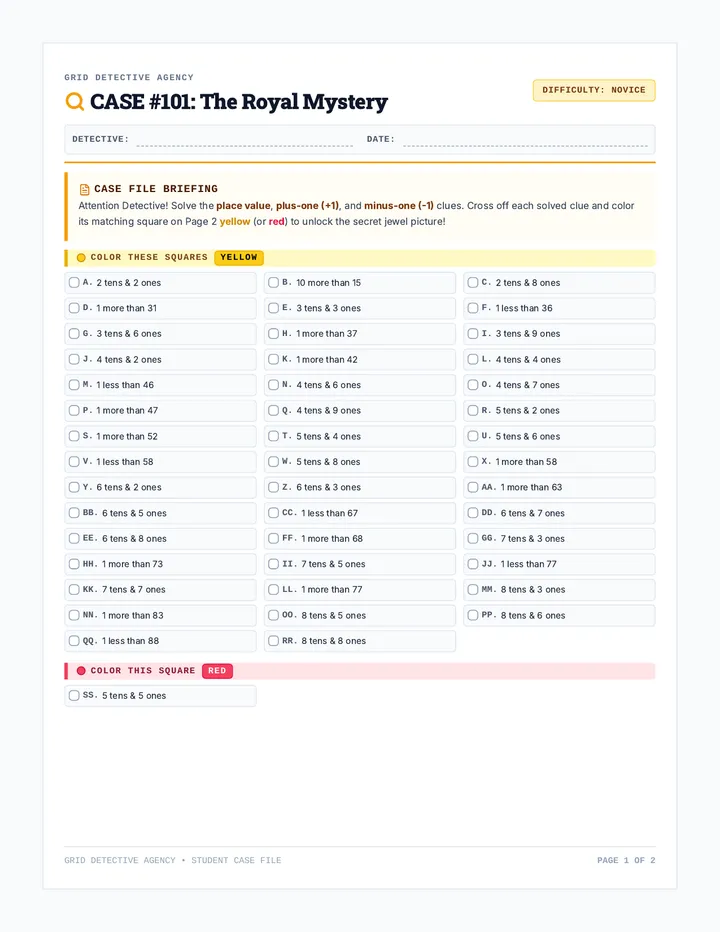
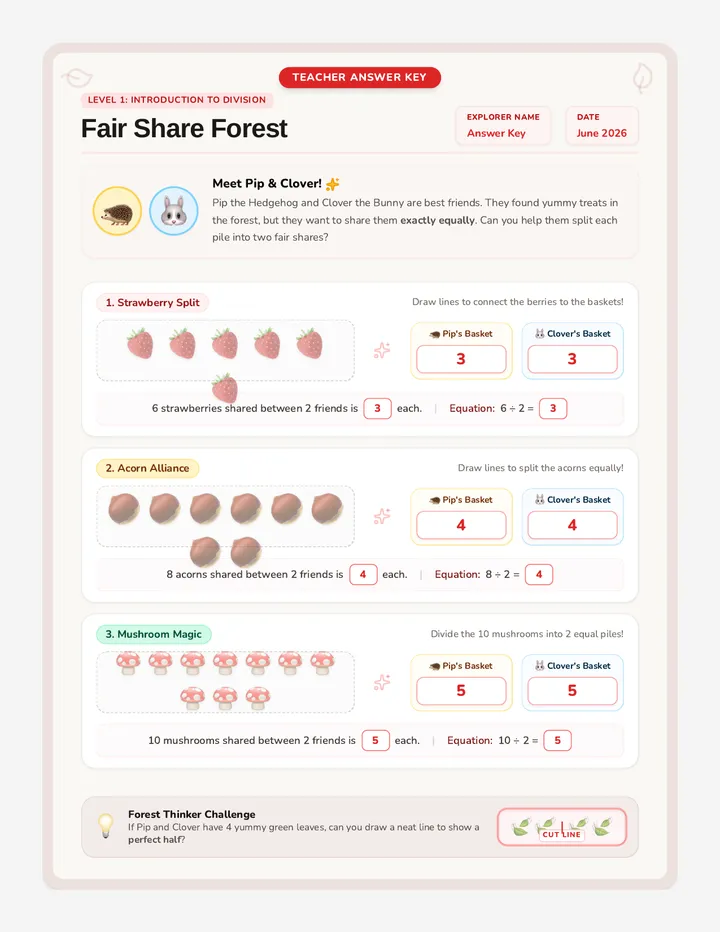
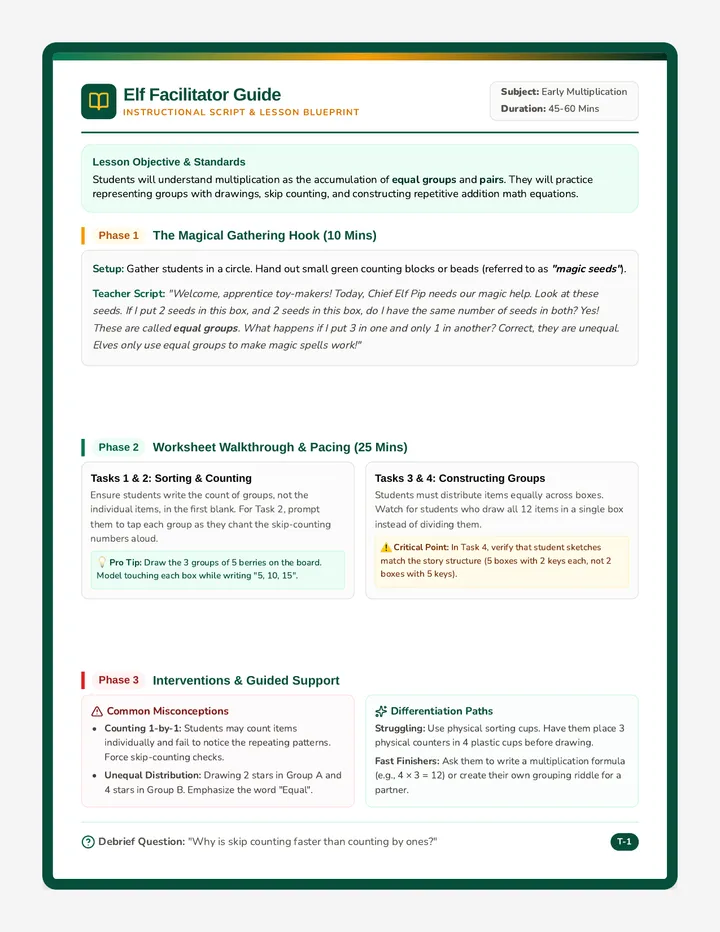
Teacher guide for Lesson 1: Fair Share. Includes pacing, objective, scaffolding tips for Tier 2 intervention, and discussion prompts.
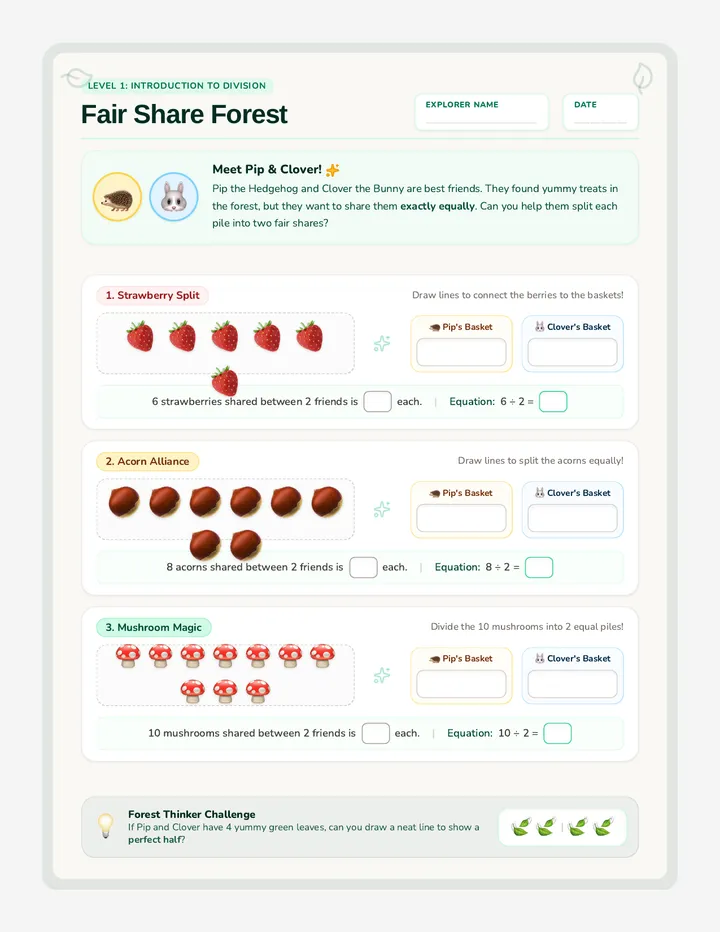
Student practice page for Lesson 1: Fair Share. Exercises focus on distinguishing between sharing and grouping, plus an introduction to the area model.
Introductory slide deck for Lesson 1: Fair Share. Covers sharing vs. grouping concepts and introduces the area model as a visual strategy for division. Includes Turn and Talk prompts.
A teacher resource providing answer keys, instructional strategies, and data collection tips for the Market Masters money unit.
A comprehensive final assessment covering coin identification, money addition, and subtraction from $20 using a calculator. Features clear sectioning and scoring areas.
A set of four printable scenario cards featuring real-world math tasks. Each card presents a situation requiring either addition of multiple items or subtraction from $20, specifically designed for calculator use.
A subtraction-focused worksheet helping students calculate change from $20 using a calculator. Includes visual prompts for calculator steps and clear answer fields.
A worksheet featuring three grocery shopping scenarios requiring students to use a calculator to add money amounts up to $20. Includes structured work areas and clear total boxes.
A matching activity worksheet for students to identify penny, nickel, dime, and quarter names and values. includes visual representations and space for value notation.