A simplified, high-focus version of the Shape Detective worksheet with task checkboxes, reduced clutter, and visual aids for a student with focusing difficulties.
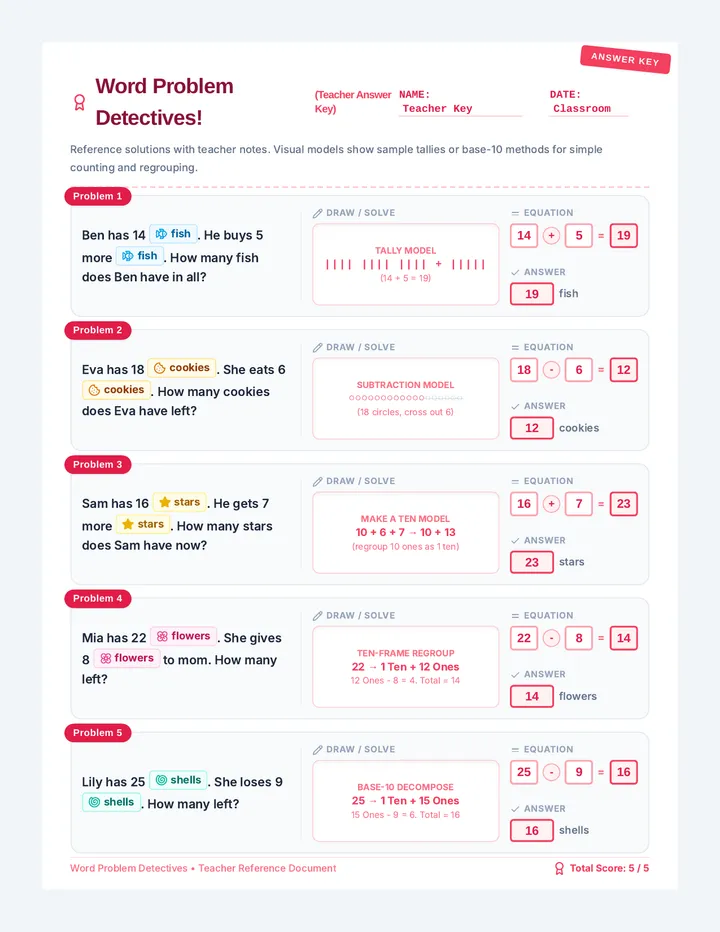
Comprehensive answer key for all six lessons in the Precision Press intervention series. Provides specific solutions for every visual, numerical, and justification problem.
Anchor chart for Lesson 4 showing the step-by-step procedural addition of tenths and hundredths. Uses a 'Power Up' metaphor for creating common denominators.
Student practice worksheet for Lesson 6. Focuses on comparing decimals using inequality symbols and ordering them from least to greatest. Includes a justification task.
Teacher facilitation guide for Lesson 6, focusing on comparing decimal fractions. Includes a 'Notice and Wonder' routine and the 'Headline Face-Off' activity.
Student practice worksheet for Lesson 5. Focuses on converting between fraction and decimal notation for tenths and hundredths, including writing word names and correcting notation errors.
Teacher facilitation guide for Lesson 5, focusing on connecting fraction notation to decimal notation. Includes a 'What's the Same?' routine and the 'Press Code' activity.
Student practice worksheet for Lesson 4. Focuses on procedural addition of tenths and hundredths by first converting tenths to hundredths numerically. Includes error correction tasks.
Teacher facilitation guide for Lesson 4, focusing on the procedural addition of tenths and hundredths. Includes a number talk routine and the 'Press Deadline' activity.
Student practice worksheet for Lesson 3. Students shade tenths and hundredths on a single grid to visualize addition and then write the numerical sum using hundredths as a common denominator.
Teacher facilitation guide for Lesson 3, focusing on visual addition of tenths and hundredths on a grid. Includes a 'Notice and Wonder' routine and the 'Press Assembly' activity.
Student practice worksheet for Lesson 2. Focuses on the numerical conversion strategy of multiplying the numerator and denominator by 10 to express tenths as hundredths.
Teacher facilitation guide for Lesson 2, focusing on the numerical conversion of tenths to hundredths using multiplication. Includes a choral counting routine and the 'Headline Switch' activity.
Student practice worksheet for Lesson 1. Includes visual shading problems on 10x10 grids to compare tenths and hundredths, along with numerical equivalence problems and a challenge question.
Anchor chart for Lesson 1 showing the visual equivalence of 1/10 and 10/100 using grid models. Features a clear side-by-side comparison and the numerical rule for equivalence.
Teacher facilitation guide for Lesson 1, focusing on visual fraction equivalence using grid models. Includes instructional routines, small group activity instructions, and key discussion questions.
Visual tools slide deck for the final lesson, reviewing the journey of skills and providing final encouragement for the performance task.
Final performance task assessment for the intervention sequence, involving wingspan measurement organization, line plot construction, and a complex multi-step analysis question.
Teacher facilitation guide for the final lesson, serving as a summative assessment through 'The Nature Museum' performance task.
Visual tools slide deck for Lesson 11, encouraging student creativity and providing a checklist for building high-quality data scenarios.
Student design worksheet for Lesson 11, where students create their own data scenario, frequency table, line plot, and a set of mystery clues for a peer to solve.
Teacher facilitation guide for Lesson 11, focusing on student-created data scenarios and peer clue solving through 'The Architect's Sketch'.
Visual tools slide deck for Lesson 10, teaching deductive strategy for rebuild data and featuring an 'error spotting' interactive slide.
Student worksheet for Lesson 10, challenging students to rebuild a line plot from a table of statistical clues including total count, min/max, and mode.
Teacher facilitation guide for Lesson 10, using deductive reasoning to solve 'Missing Link' data puzzles and working backwards from summaries to data.
Visual tools slide deck for Lesson 9, illustrating a multi-step problem solving strategy and breaking down a complex scenario into manageable pieces.
Student worksheet for Lesson 9, presenting a 'Builder's Story' that requires a three-step mathematical process (repeated addition, further addition, and subtraction) using line plot data.
Teacher facilitation guide for Lesson 9, using the 'Story Solver' activity to tackle multi-step addition and subtraction problems with data.
Visual tools slide deck for Lesson 8, providing a comparison checklist and a visual 'battle' between two data distributions.
Student worksheet for Lesson 8, comparing two line plots (Blue vs Red beads) to identify differences in max, spread, and frequency.
Teacher facilitation guide for Lesson 8, focusing on comparing two data sets through 'The Group Showdown' activity and statistical reasoning.
Visual tools slide deck for Lesson 7, explaining the subtraction 'gap' and introducing the 'counting up' strategy for finding differences.
Student worksheet for Lesson 7, focusing on finding the difference between max/min and comparing the mode to other values on a seedling height line plot.
Teacher facilitation guide for Lesson 7, focusing on subtractive reasoning and finding the 'gap' (range) between data points using 'The Distance Bridge' activity.
Visual tools slide deck for Lesson 6, reinforcing that each 'X' has a numerical value and showing how to add multiple 'X's from the same stack.
Student worksheet for Lesson 6, requiring students to perform repeated addition and fractional combinations based on a line plot of bead widths.
Teacher facilitation guide for Lesson 6, focusing on additive reasoning with fractional data through 'The Connector Challenge' and connection to multiplication.
Visual tools slide deck for Lesson 5, defining maximum, minimum, and mode through visual metaphors and an interactive identification slide.
Student worksheet for Lesson 5, featuring a leaf-length line plot and questions focused on identifying maximum, minimum, and mode values.
Teacher facilitation guide for Lesson 5, focusing on interpreting the 'landscape' of a line plot, identifying max, min, and mode through the 'Peak and Valley Hunt'.
Visual tools slide deck for Lesson 4, illustrating the data journey from raw lists to frequency tables and final line plots.
Student worksheet for Lesson 4, requiring students to count raw data, complete a frequency table, and generate a corresponding line plot.
Teacher facilitation guide for Lesson 4, focusing on converting raw fractional data into frequency tables and line plots through 'The Tally Sprint' activity.
Visual tools slide deck for Lesson 3, featuring the 'Fraction Ladder' for visualizing eighths, quarters, and halves, and an interactive counting challenge.
Differentiated student practice worksheet for Lesson 3, focusing on partitioning eighths and plotting data with equivalent fractions (1/4 and 1/2) onto an eighth-inch scale.
Teacher facilitation guide for Lesson 3, extending precision to eighths, including 'The Fraction Stack' tile activity and a 'True or False?' equivalency routine.
Visual tools slide deck for Lesson 2, featuring a fractional zoom routine and a conceptual slide on the equivalence of 1/2 and 2/4 in the context of line plots.
Differentiated student practice worksheet for Lesson 2, including identifying fourths on a ruler and creating a line plot from a pencil-length data table.
Teacher facilitation guide for Lesson 2, focusing on decomposing halves into fourths, featuring 'The Quarter Jump' floor-scale activity and a 'Which One Doesn't Belong?' routine.
Visual tools slide deck for Lesson 1, including a title slide, an anchor chart of line plot anatomy, and an interactive scale identification problem.
Differentiated student practice worksheet for Lesson 1, including ruler labeling, line plot creation from a dataset, and three levels of analysis questions.