Geometric classification, measurement of area and volume, and the study of transformations and rigid motions. Builds toward complex proofs, trigonometry for general triangles, and the algebraic representation of conic sections.
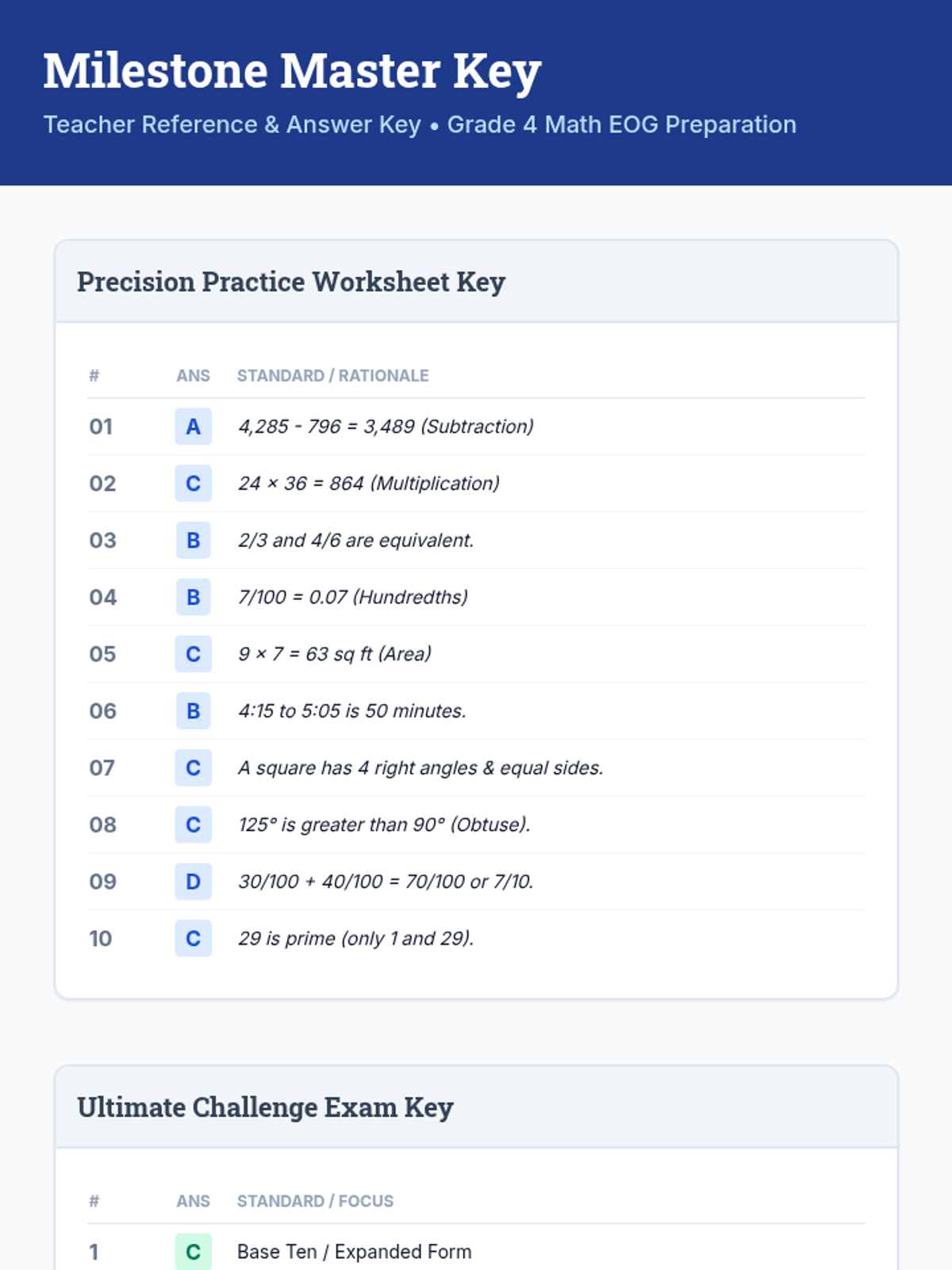
A comprehensive answer key and teacher resource for the EOG practice materials, including rationales for answers and instructional tips. Corrected layout to prevent table splitting.
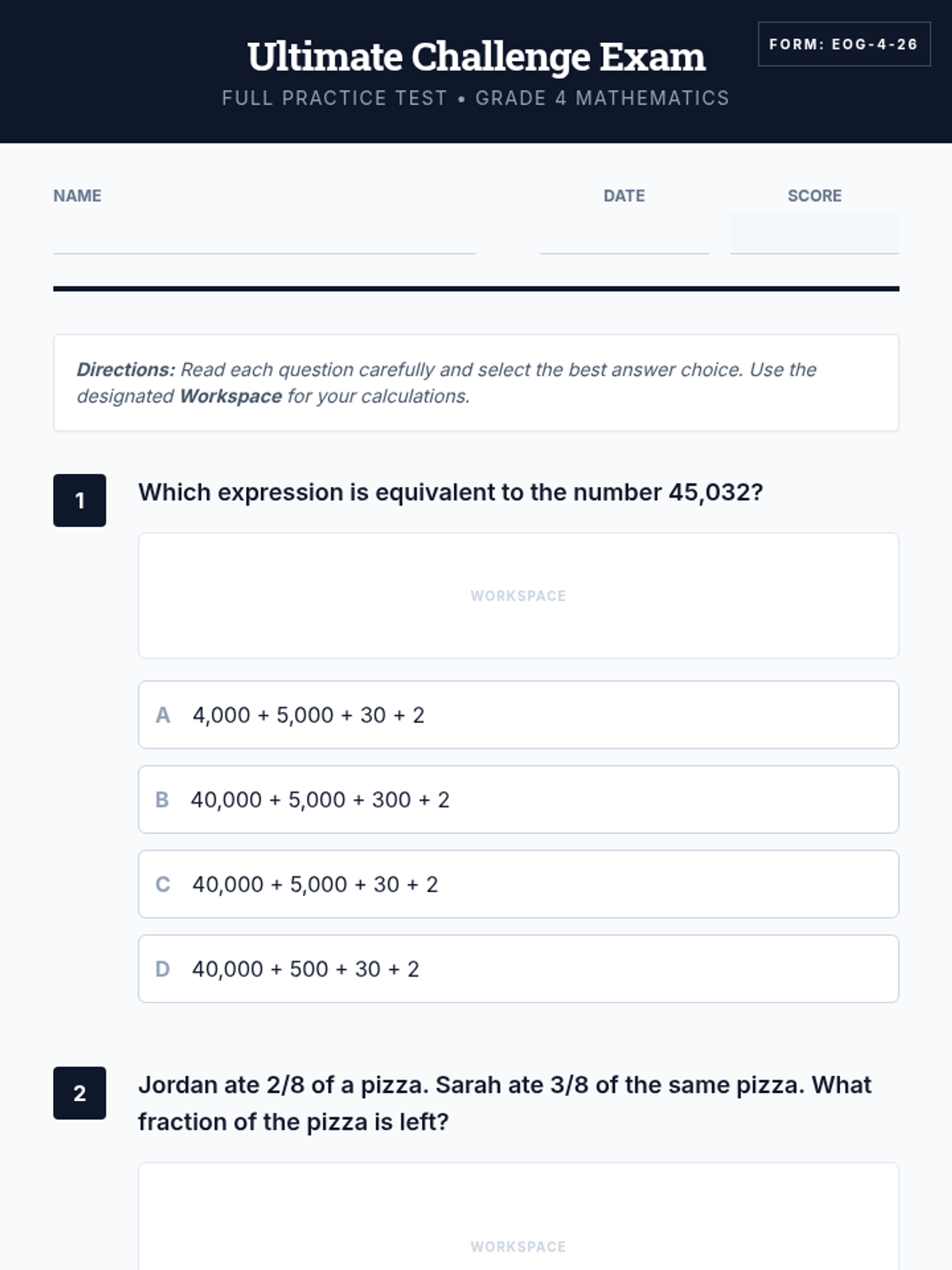
A full-length 4th Grade Math EOG practice exam featuring a professional testing format, clear typography, and a variety of standards-based questions. Includes integrated workspace and prevents awkward page breaks. Corrected math rendering using text-based fractions.
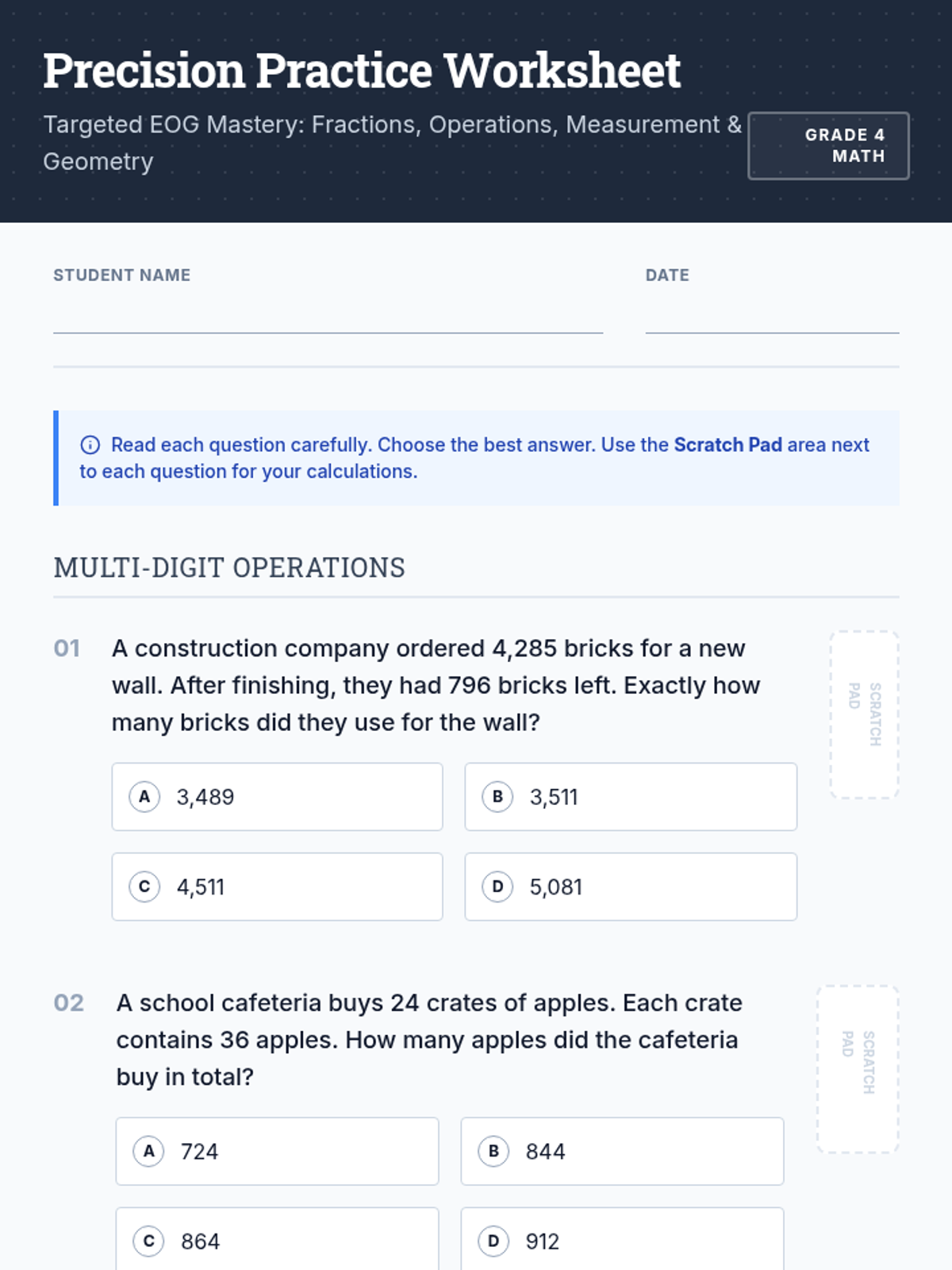
A targeted multiple-choice worksheet for 4th Grade Math EOG prep, focusing on fractions, decimals, operations, measurement, and geometry with a clean blueprint-inspired layout. Questions are properly spaced with scratch pad areas.
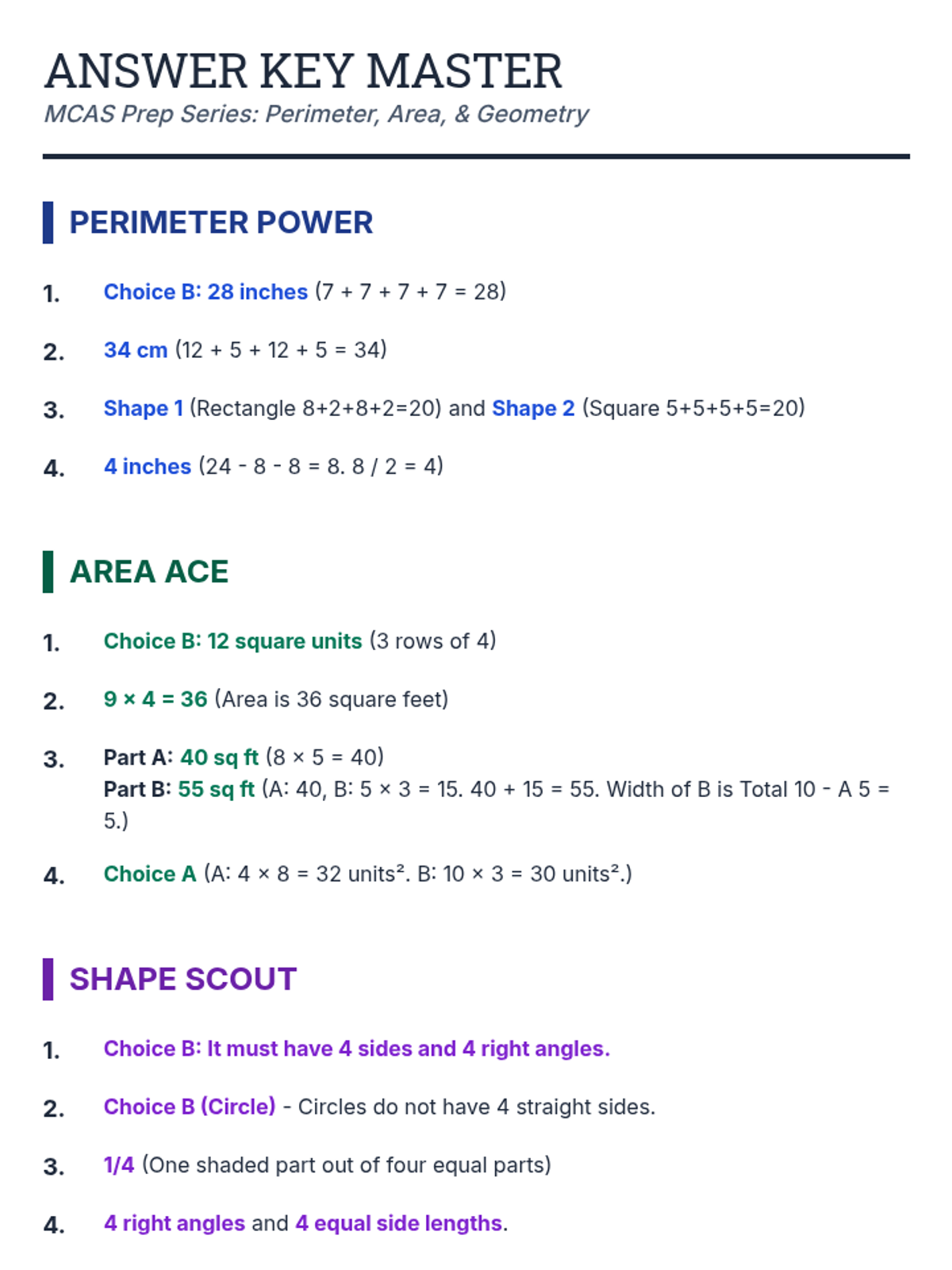
An updated comprehensive answer key for the MCAS Mastery series, now including solutions for the fourth practice problem on each worksheet: Perimeter Power, Area Ace, and Shape Scout.
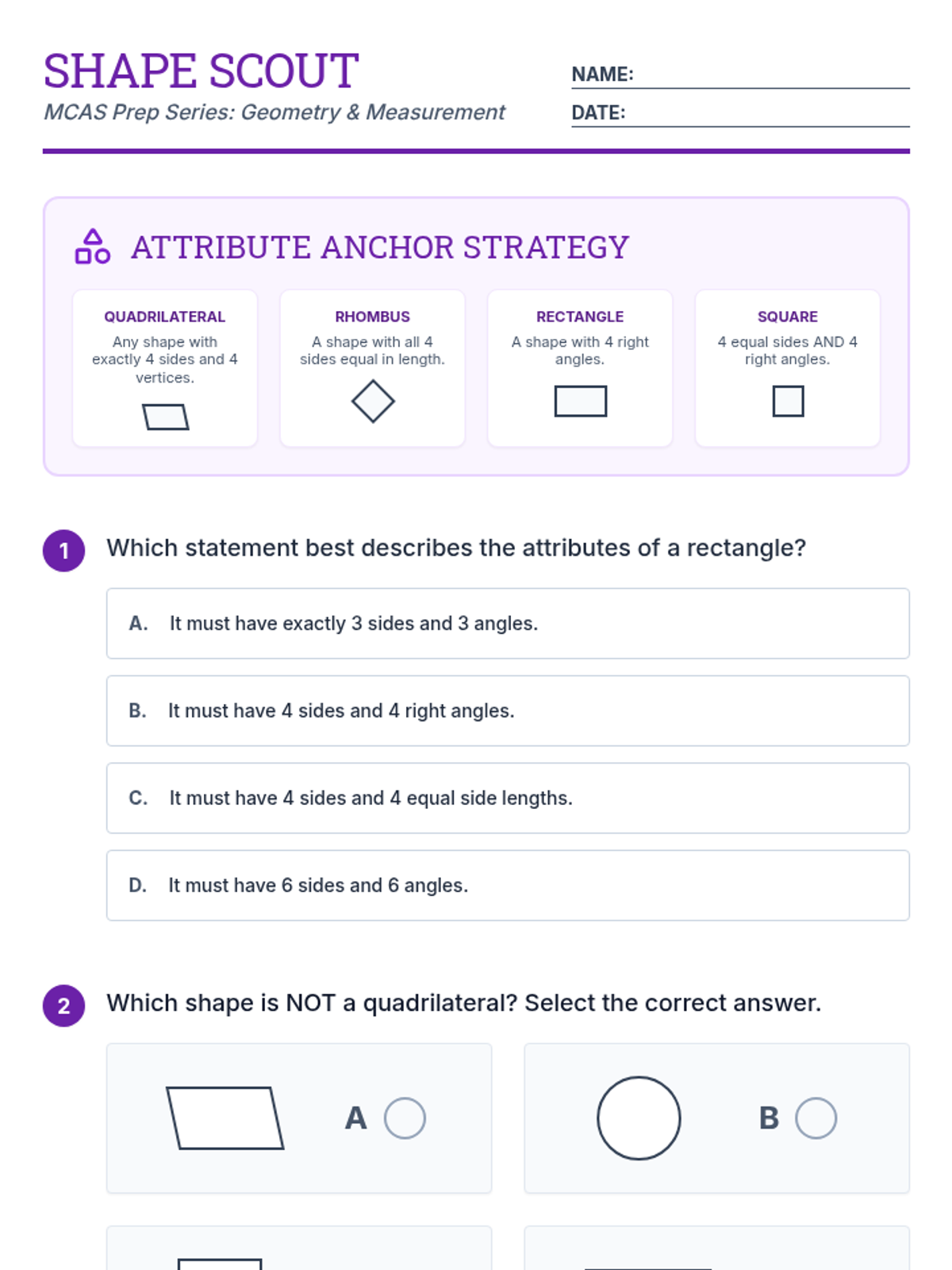
A 2-page geometry review worksheet for 3rd grade students featuring an 'Attribute Anchor' strategy organizer and MCAS-style practice problems. Layout optimized for clean page breaks and efficient space usage.
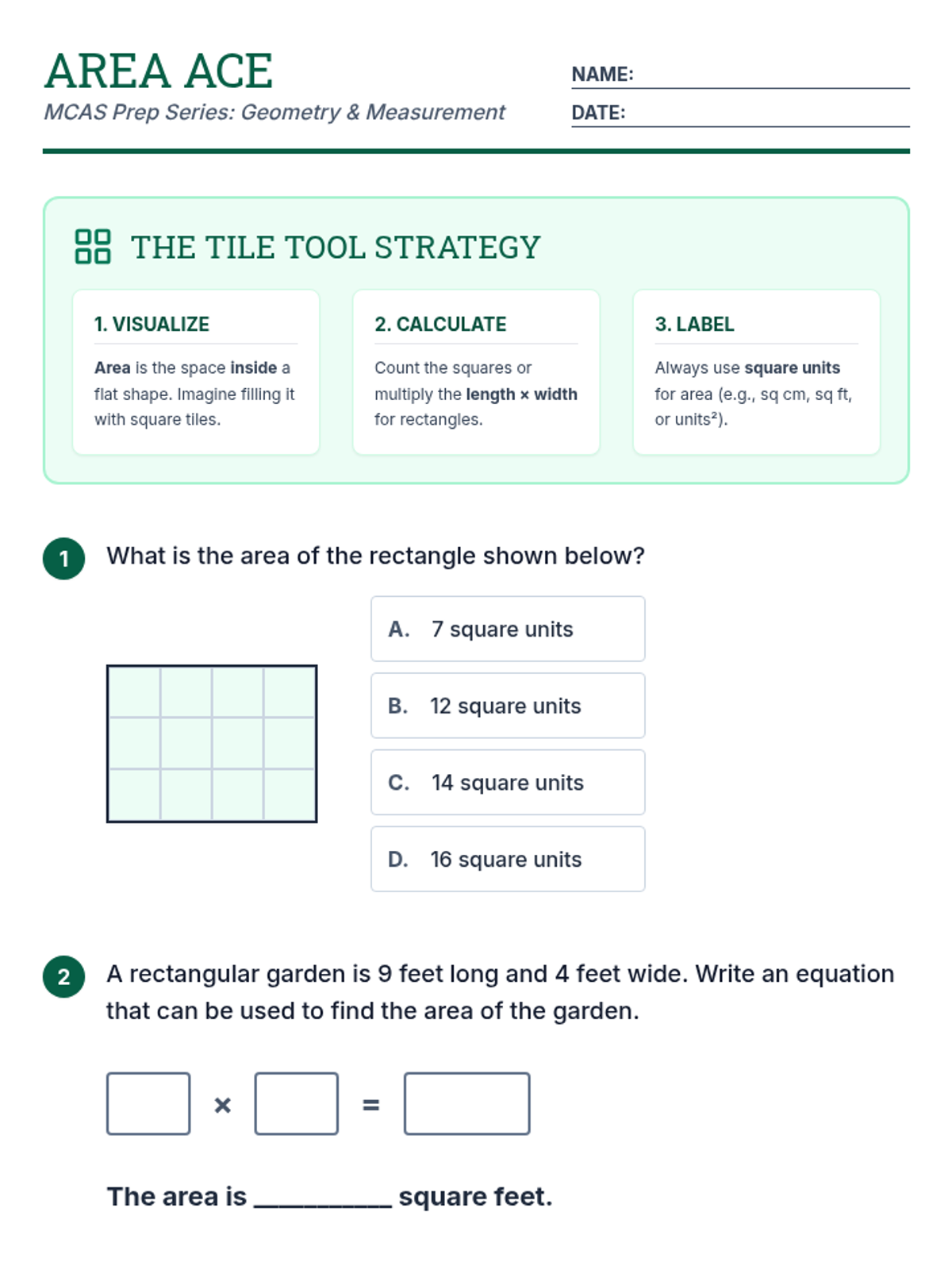
A 2-page area review worksheet for 3rd grade students featuring a 'Tile Tool' strategy organizer and MCAS-style practice problems. Layout optimized for clean page breaks and efficient space usage. Question 3 diagram is clearly labeled.
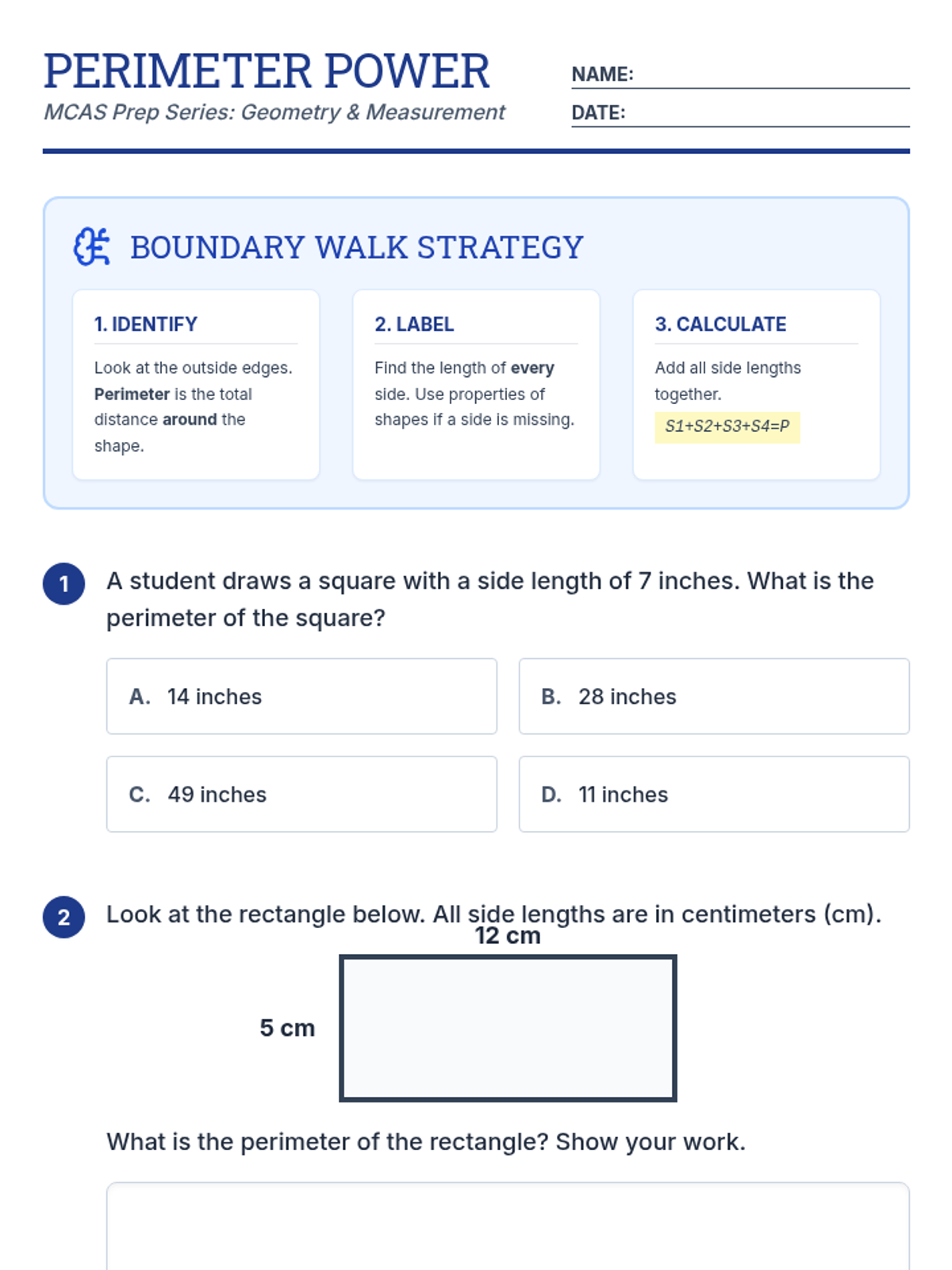
A 2-page perimeter review worksheet for 3rd grade students featuring a 'Boundary Walk' strategy organizer and MCAS-style practice problems. Layout optimized for clean page breaks and efficient space usage.
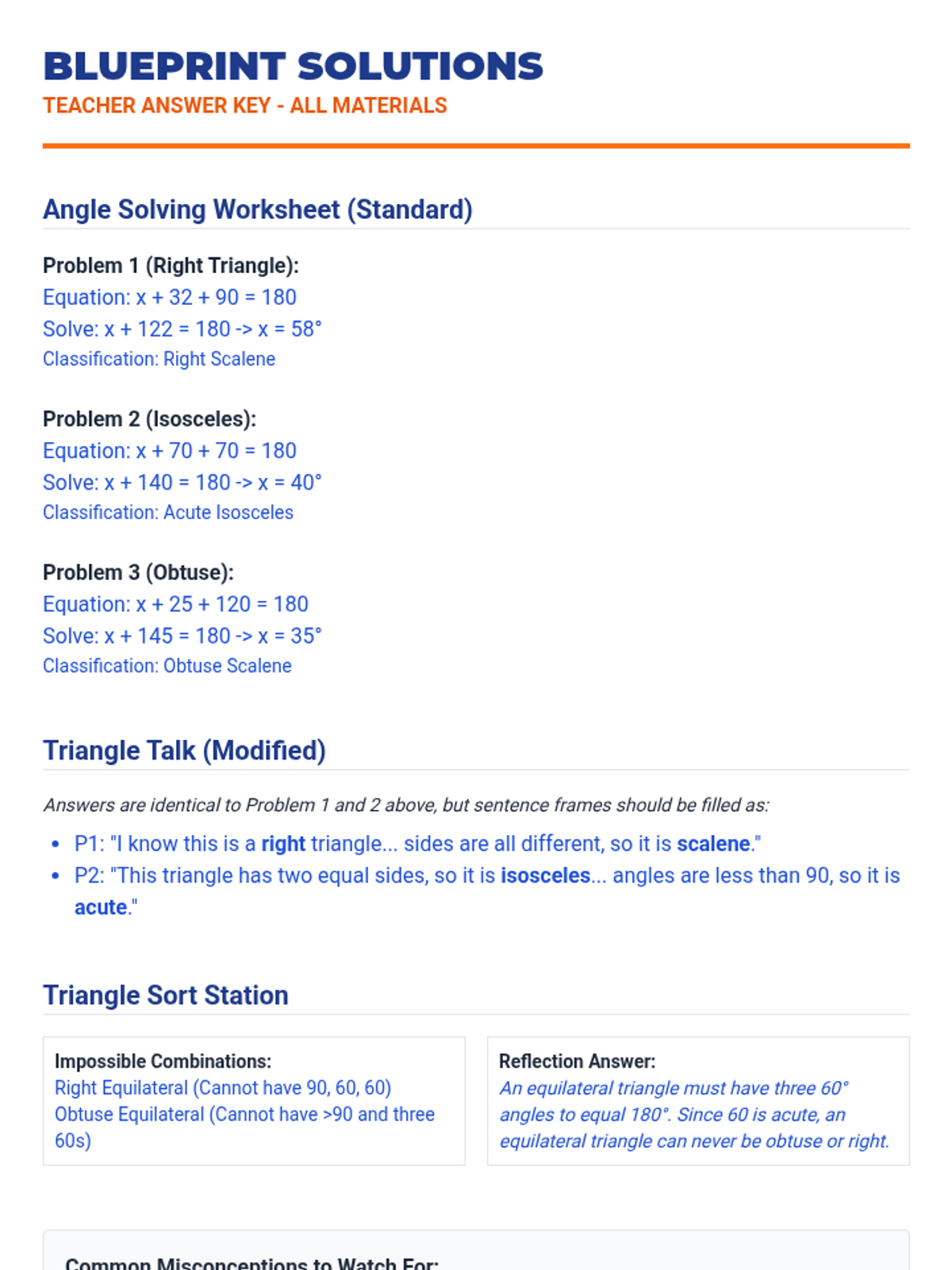
A comprehensive answer key for the teacher, covering the standard and modified worksheets as well as the center activities. Includes fully solved algebraic equations, correct classifications, and notes on common student misconceptions.
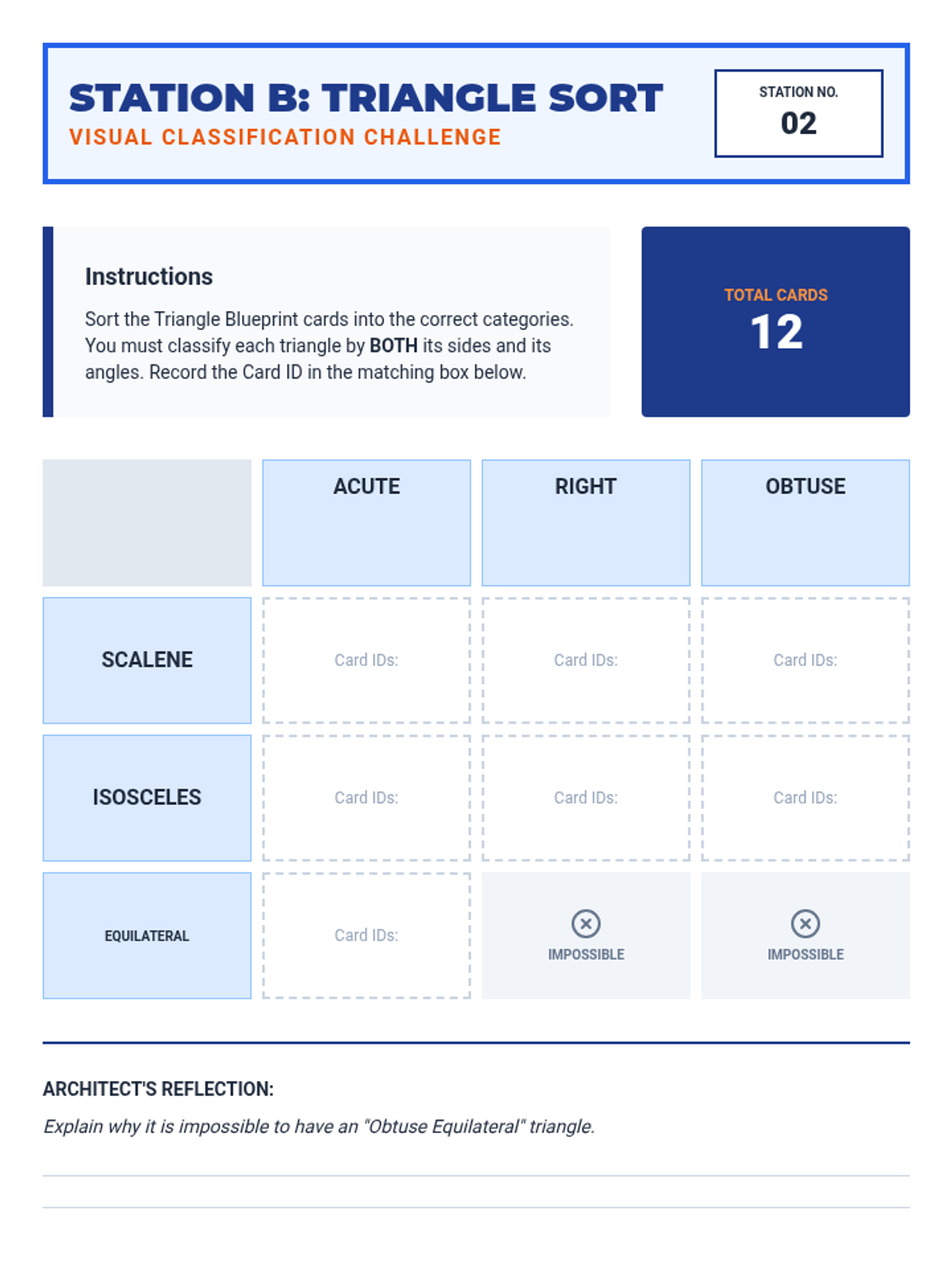
A sorting center activity where students classify triangle cards based on both their side lengths and angle measures. Includes a matrix for recording IDs and a reflection question on the geometric impossibility of certain triangle types.
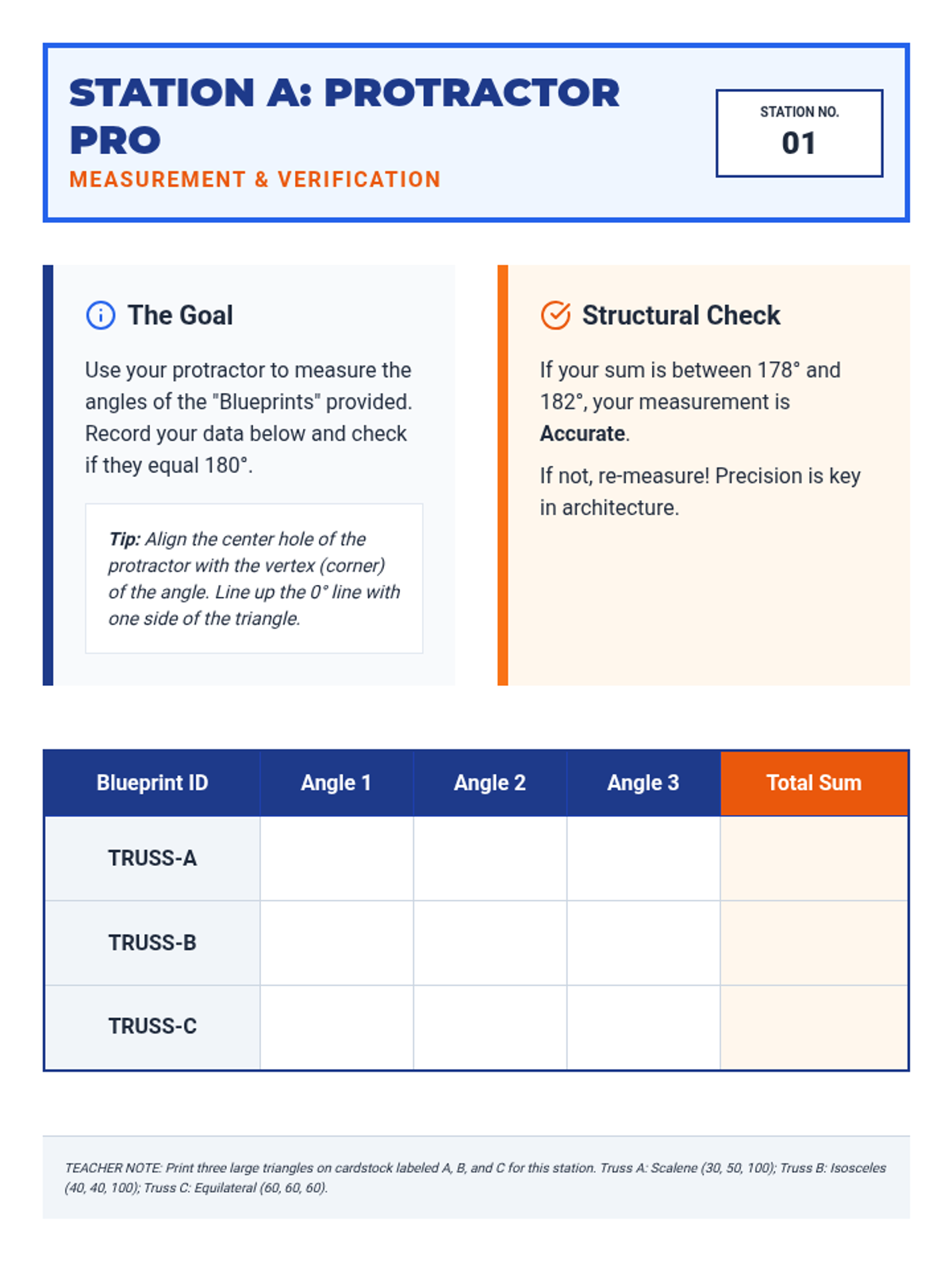
A hands-on center activity focusing on using protractors to measure angles in physical triangle models. Students record their measurements in a structural log and verify that the sum of the angles equals approximately 180 degrees.
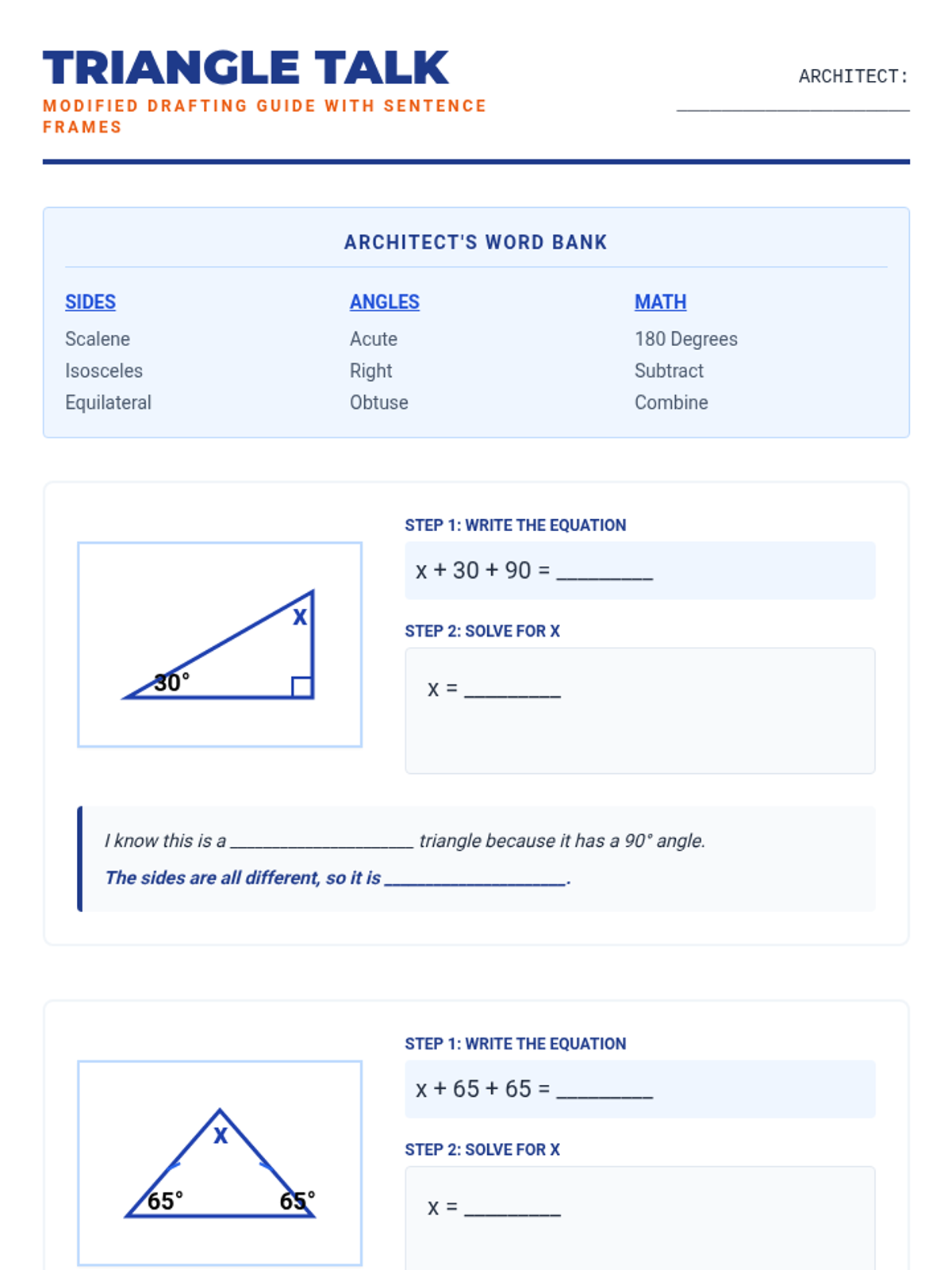
A modified version of the triangle worksheet designed for students requiring additional support. Includes a word bank, partially completed equations, and sentence frames to guide students in explaining their classification and solving process.
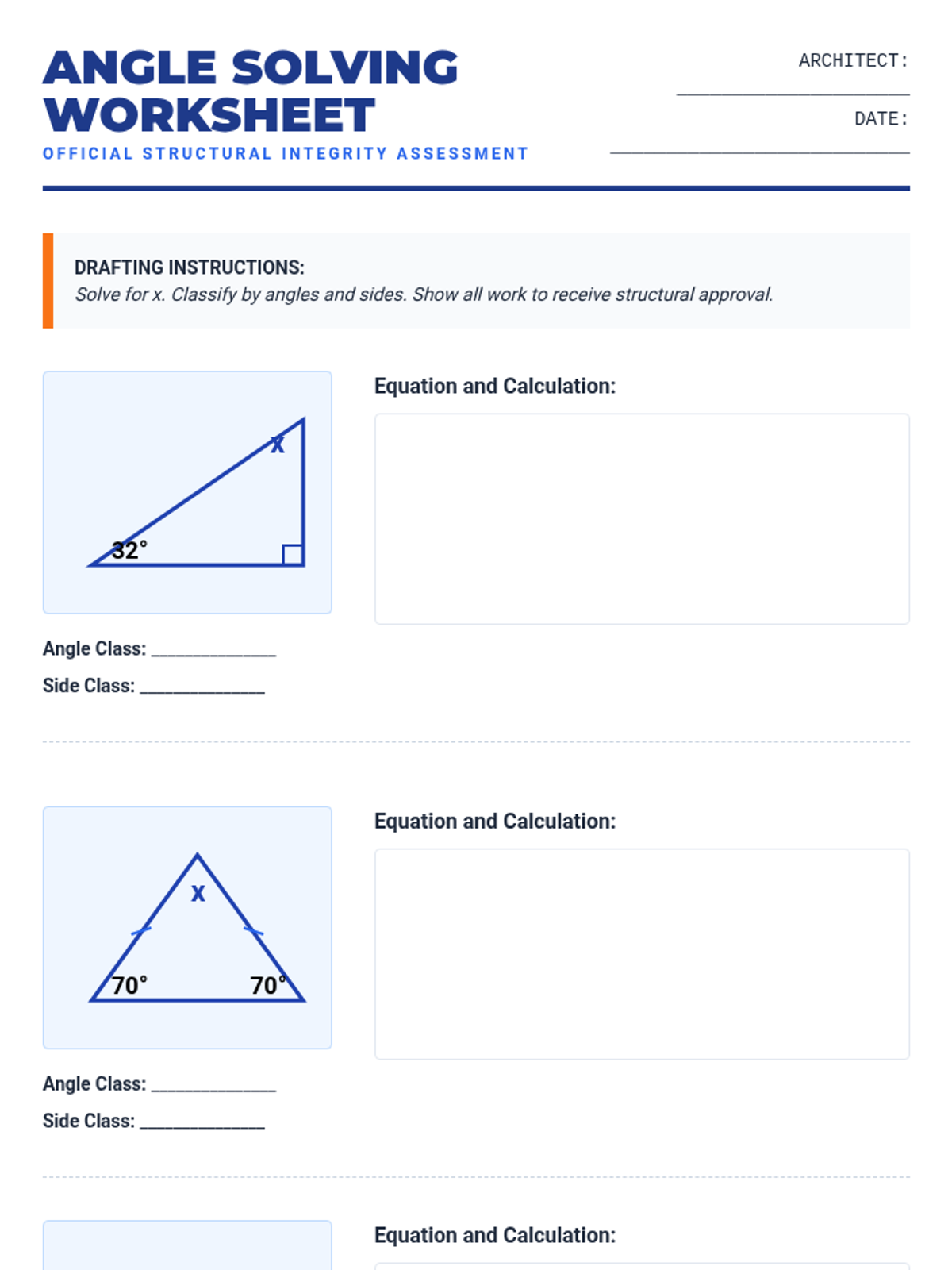
A standard 7th-grade math worksheet focused on solving for missing angles in triangles using algebraic equations. Students are required to write the equation, show their solving steps, and classify each triangle by both sides and angles.
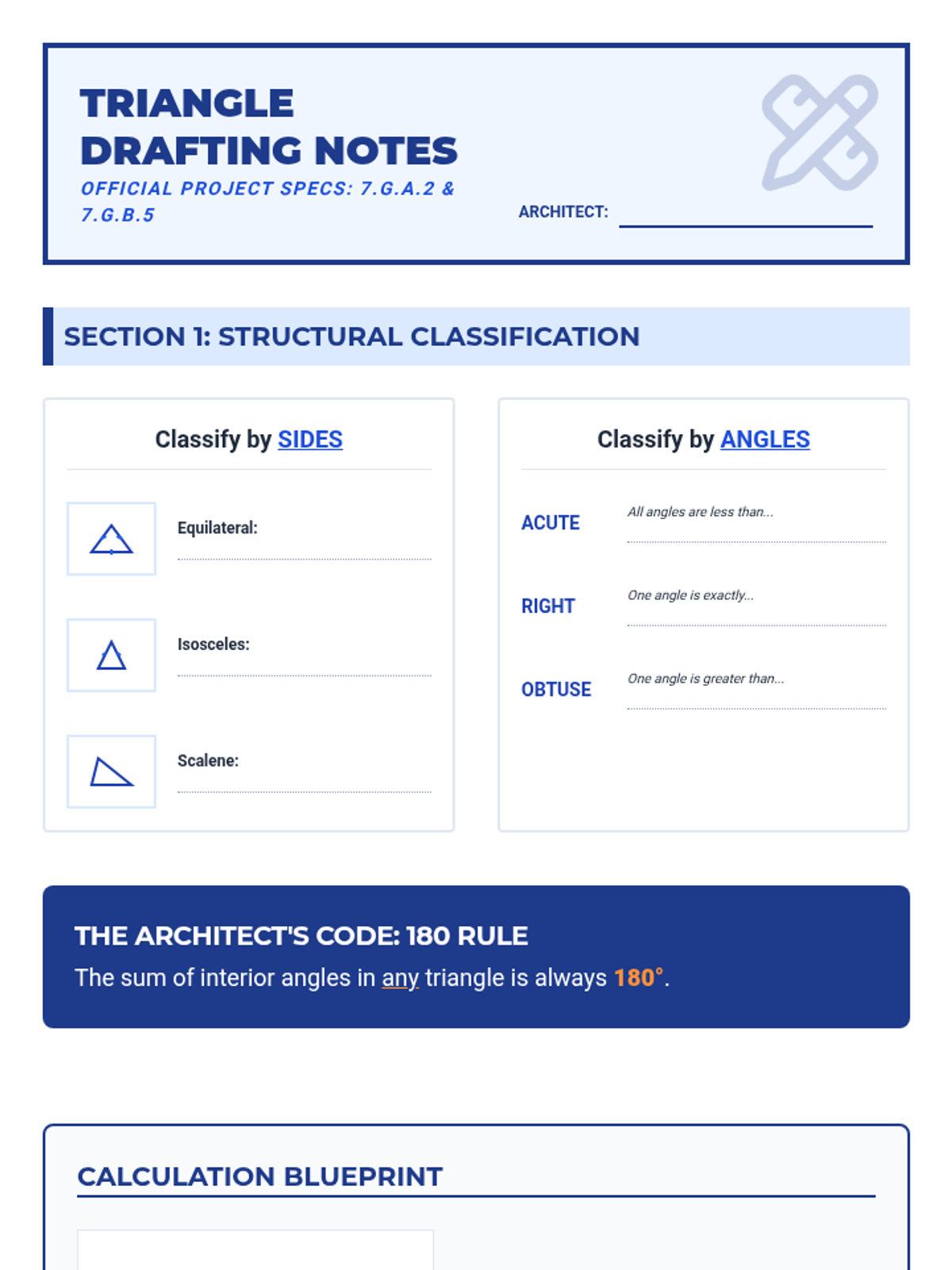
A blueprint-themed guided notes document for 7th-grade students to follow during instruction on triangle classification and the Triangle Sum Theorem. Includes fill-in-the-blank definitions, visual diagrams, and a dedicated workspace for solving algebraic equations.
An interactive slide deck for a 7th-grade geometry lesson using an architectural blueprint theme. Features visual classification aids, a step-by-step breakdown of the Triangle Sum Theorem, and clear instructions for classroom center rotations.
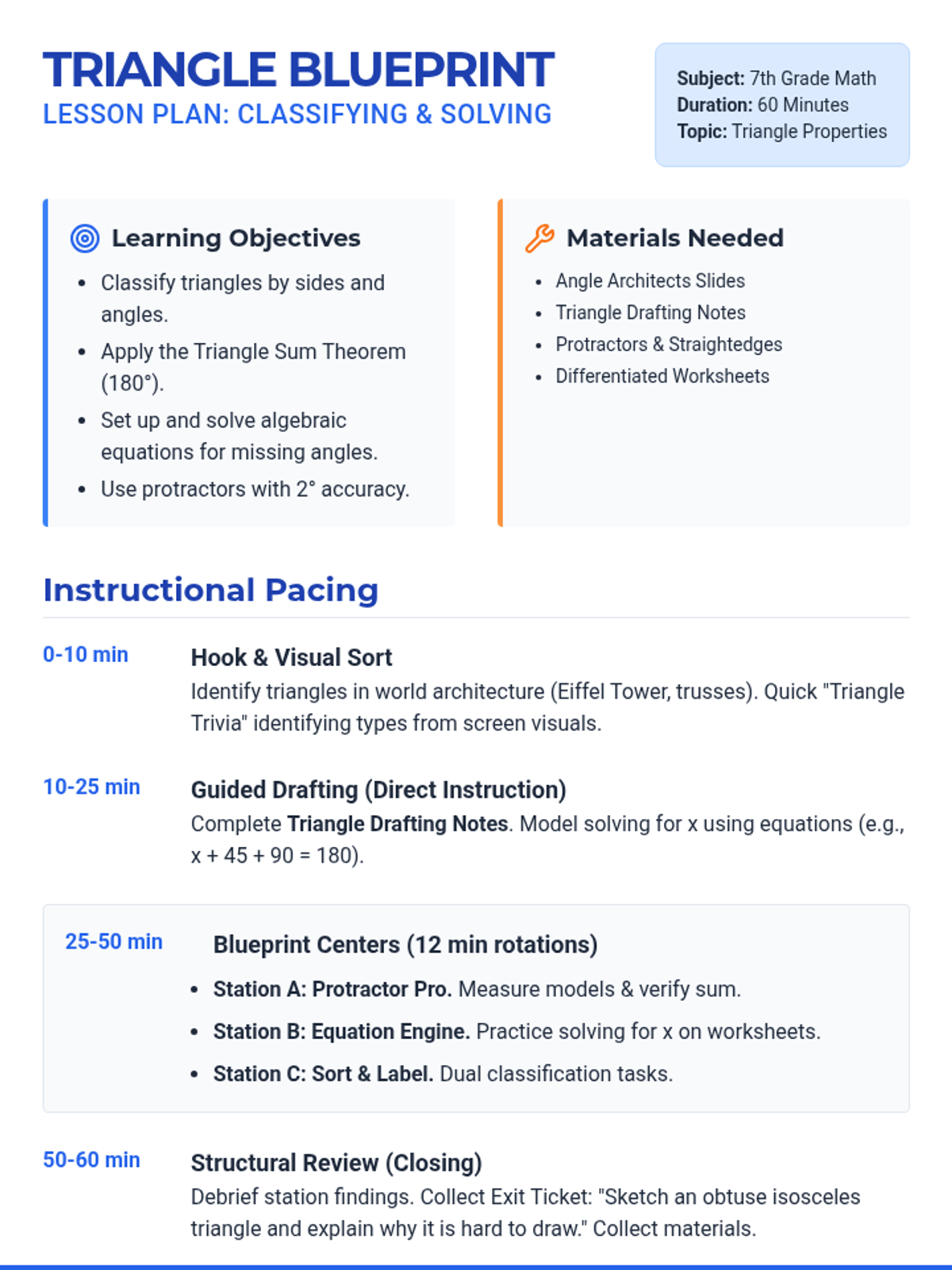
A detailed 60-minute lesson plan for teaching triangle classification and angle measures to 7th graders. Includes pacing, differentiation strategies for Tier 3 and ELL students, and key discussion prompts centered around a blueprint-inspired architectural theme.
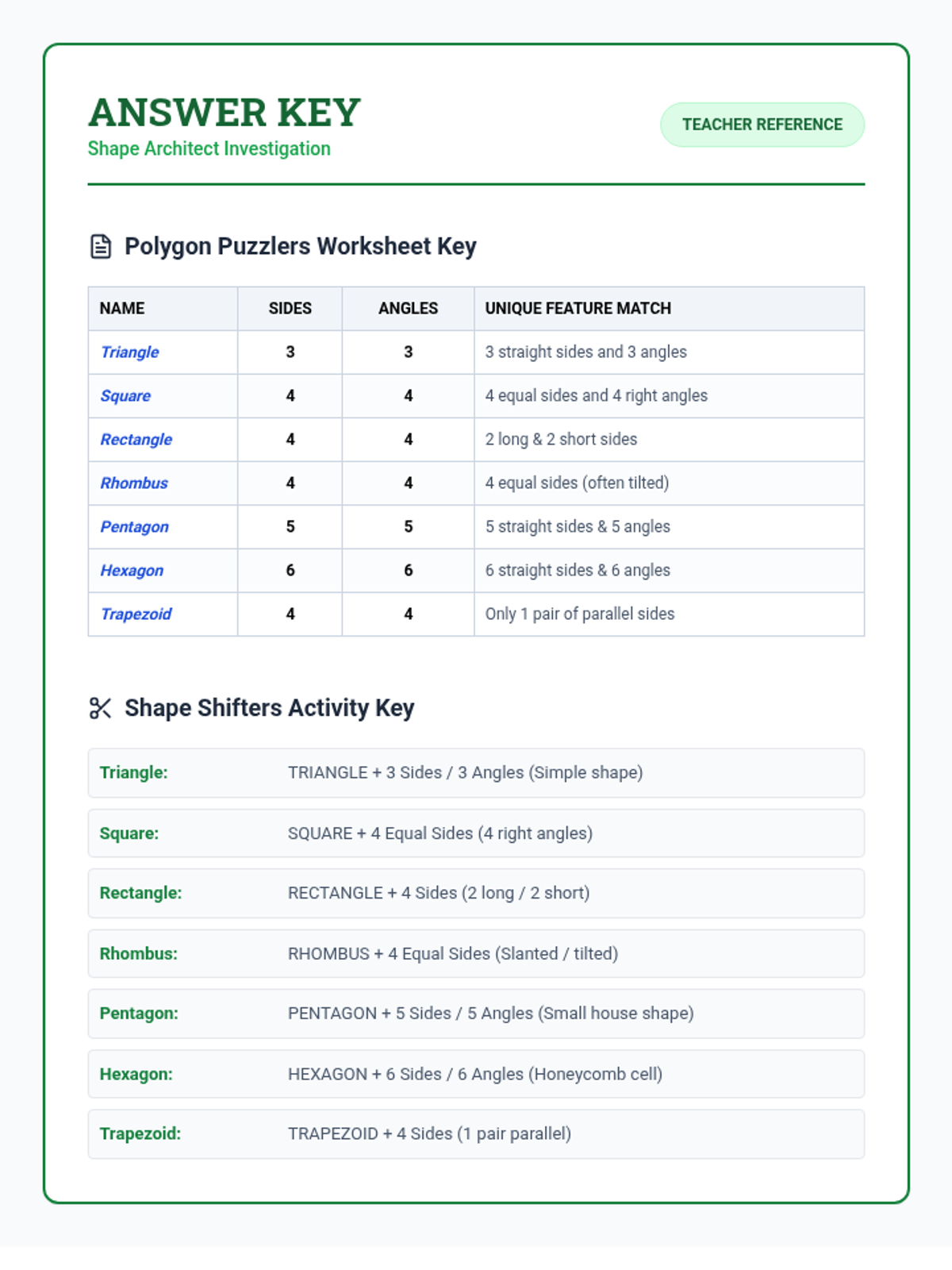
A detailed answer key for the Polygon Puzzlers Worksheet and the Shape Shifters Activity, providing correct classification, counts, and descriptions. Updated to match revised activity text.
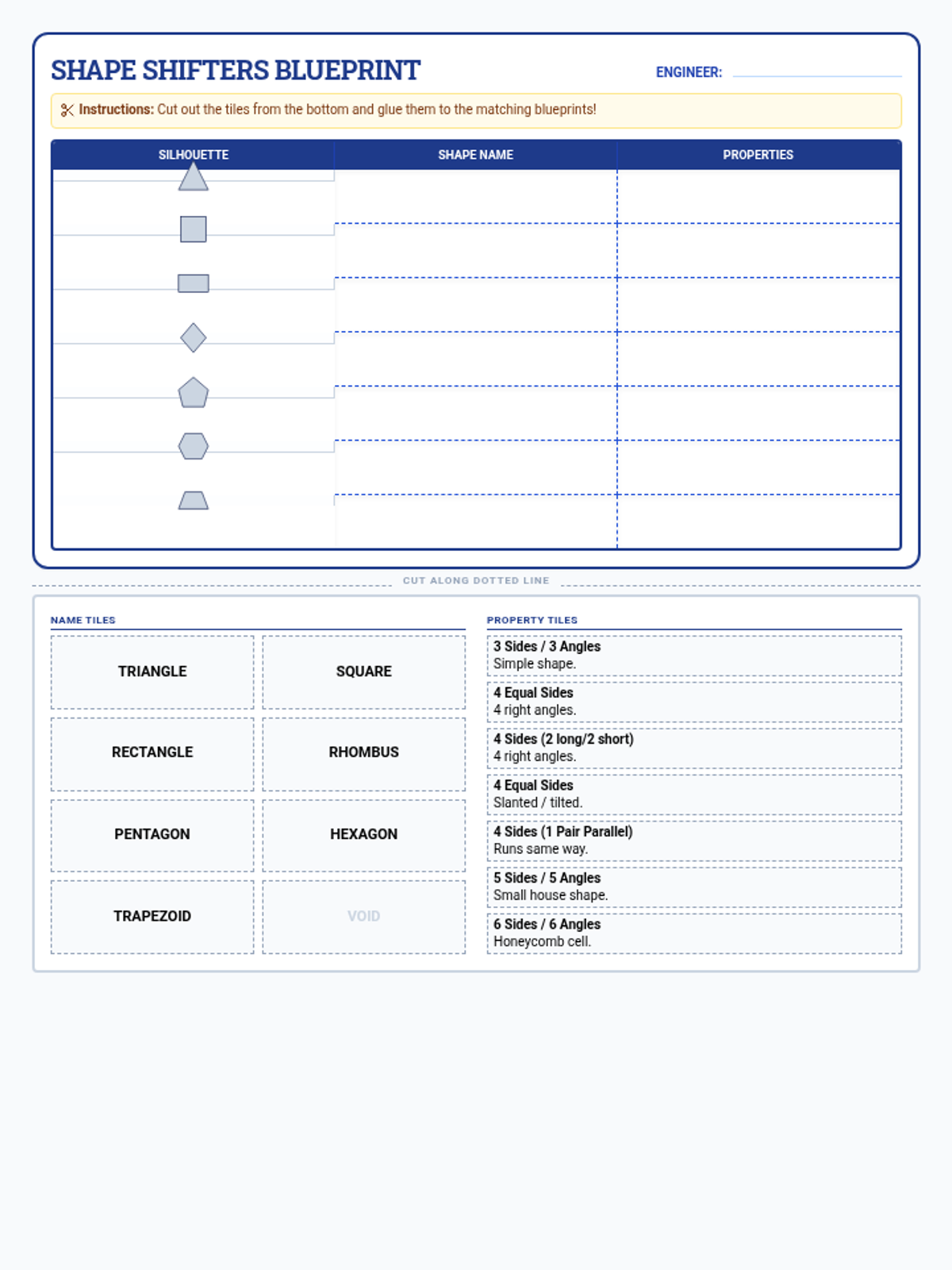
A single-page cut-and-paste activity where students match shape names and property tiles to silhouettes. Optimized for one-page fit with clear cutout sections. Updated with darker grid lines for better contrast.
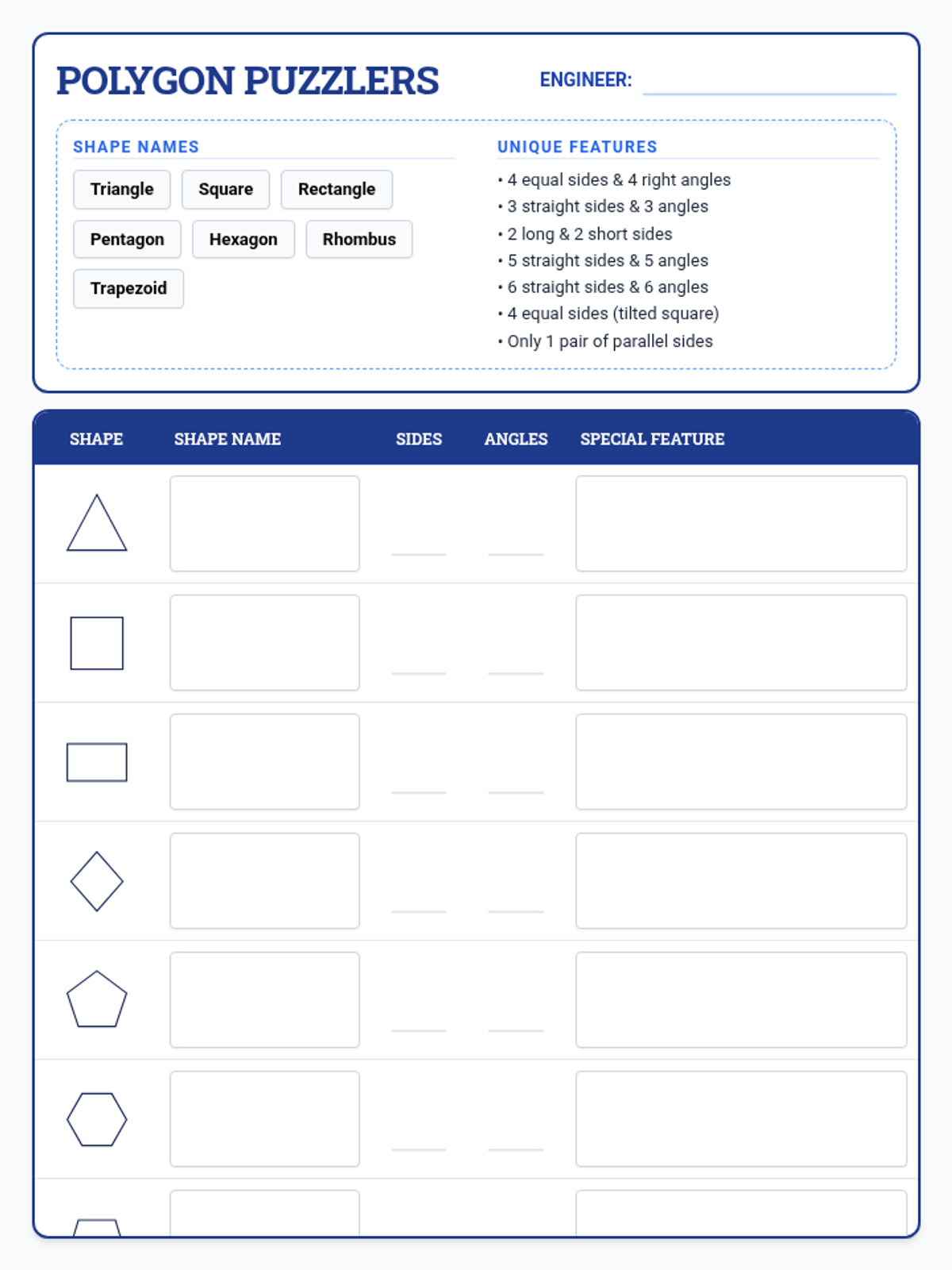
A large, blueprint-themed worksheet where students identify polygons by name, count their sides and angles, and describe features. Sized to fit exactly on one 8.5x11 page with large text and clear writing areas. Optimized row heights for one-page fit.
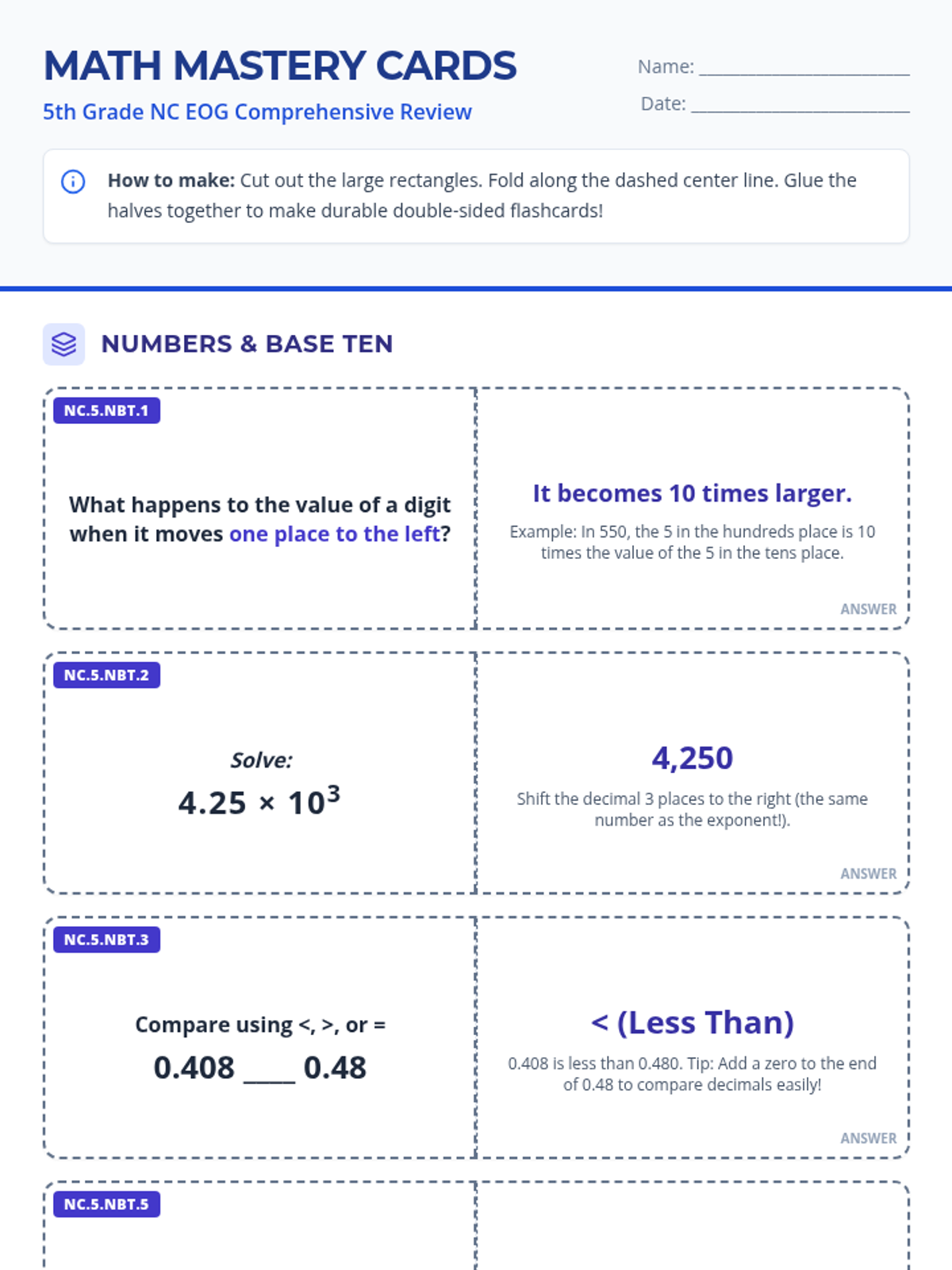
A set of printable flashcards covering all 5th-grade NC math standards (NBT, NF, OA, G, and MD) with a cut-and-fold design for student review. Revised to ensure cards do not split across pages.
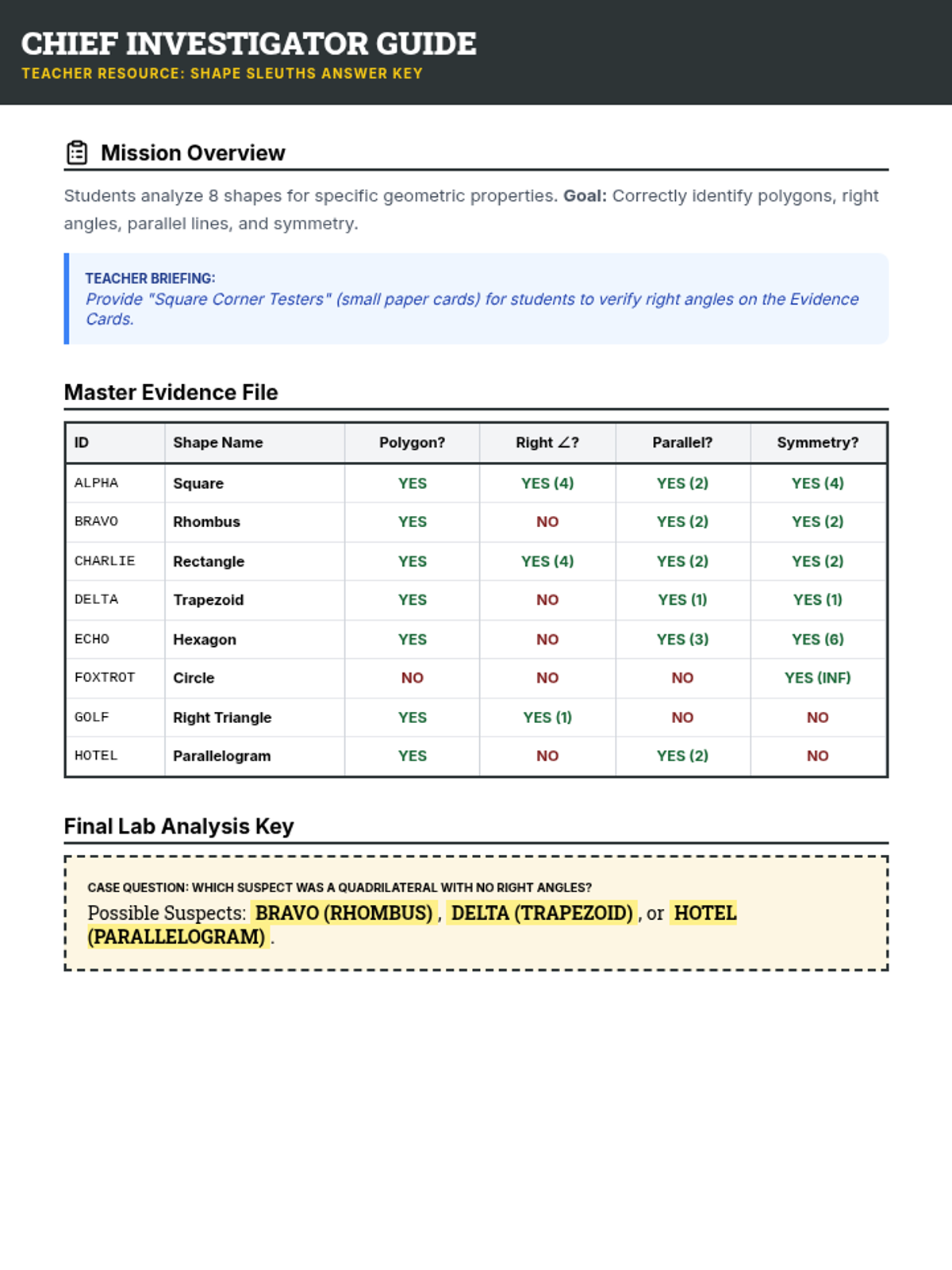
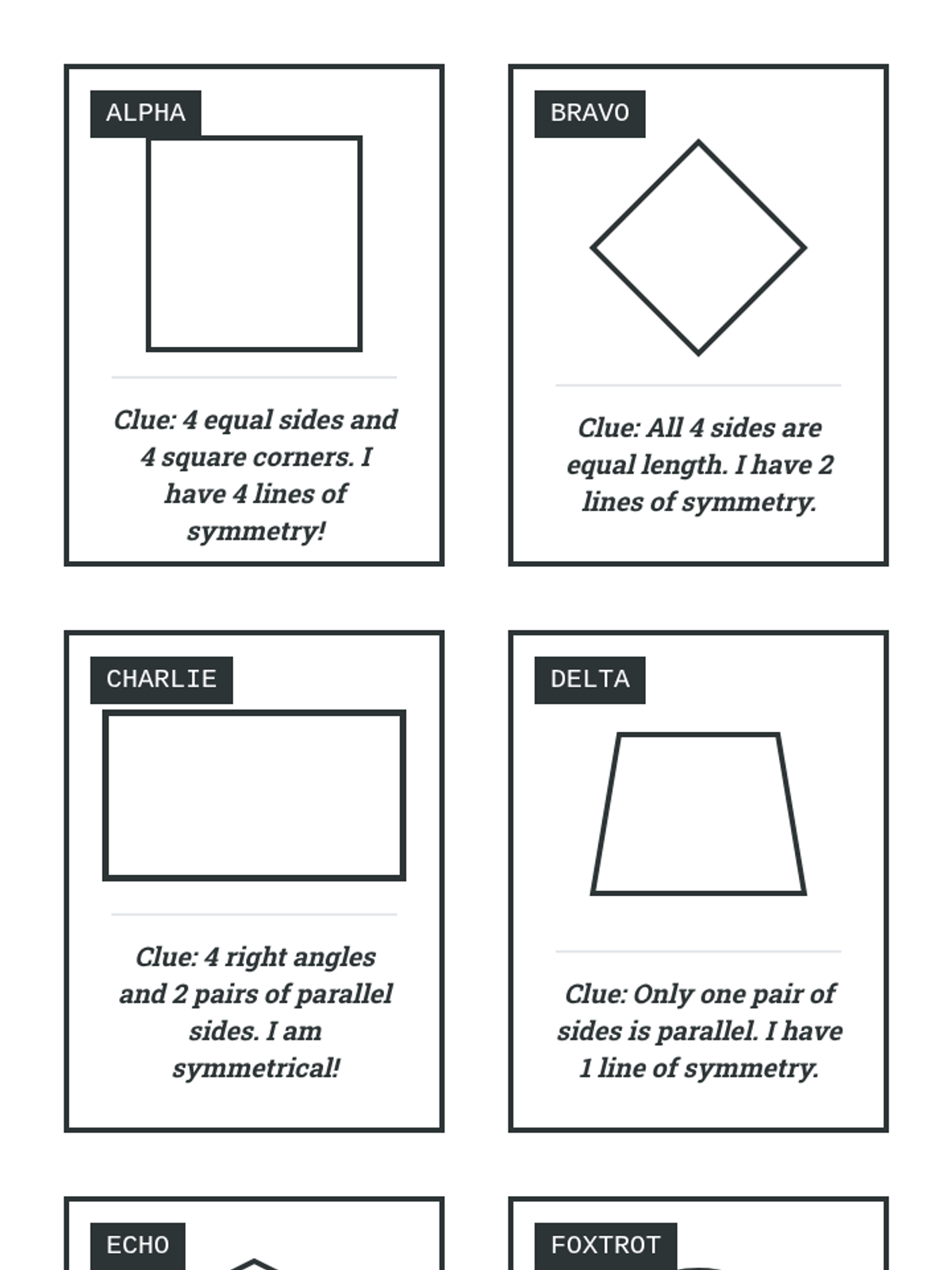
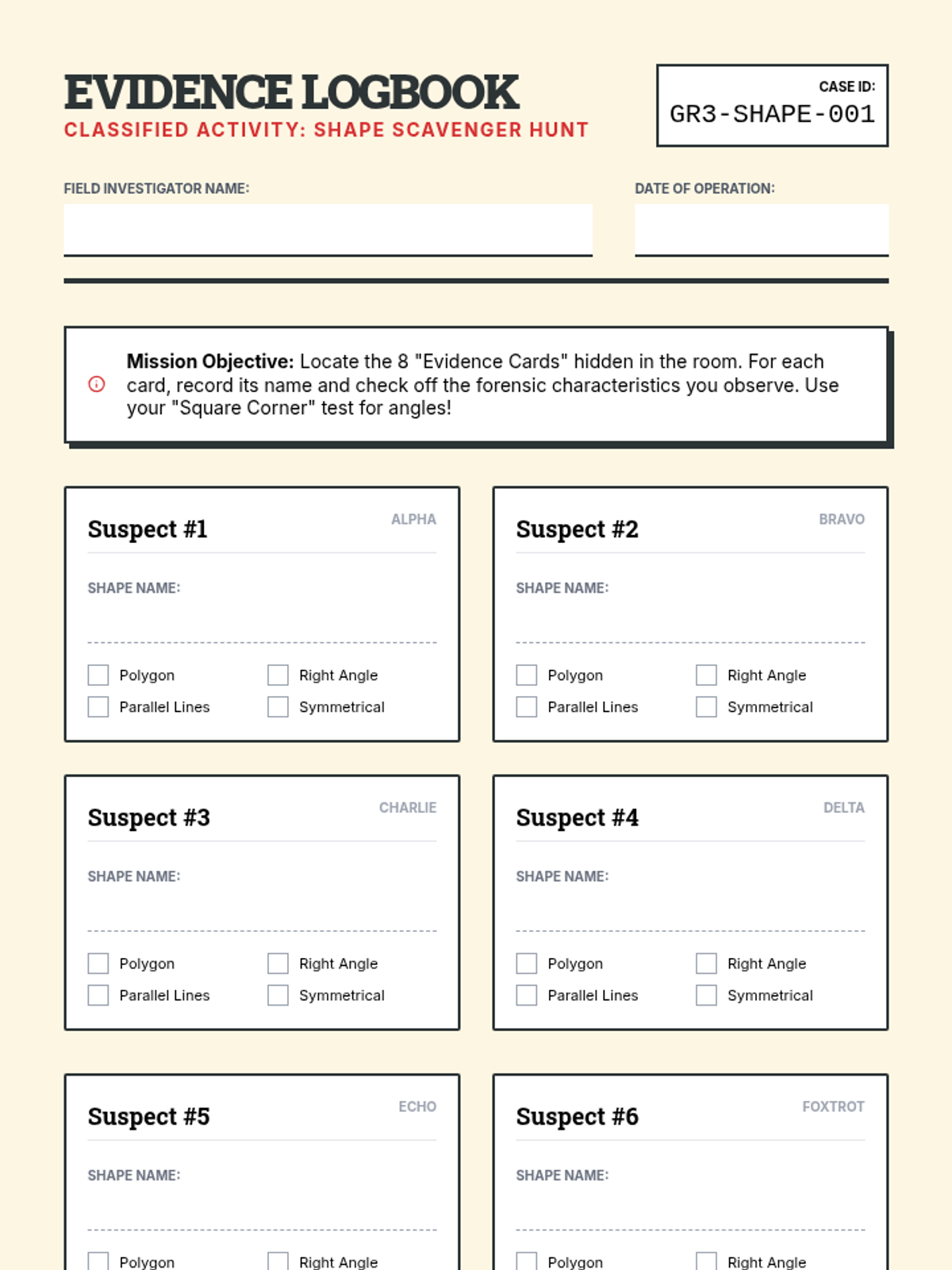
An answer key and teaching guide for the Shape Sleuths scavenger hunt, including geometric property breakdowns for all evidence cards and a final analysis key.
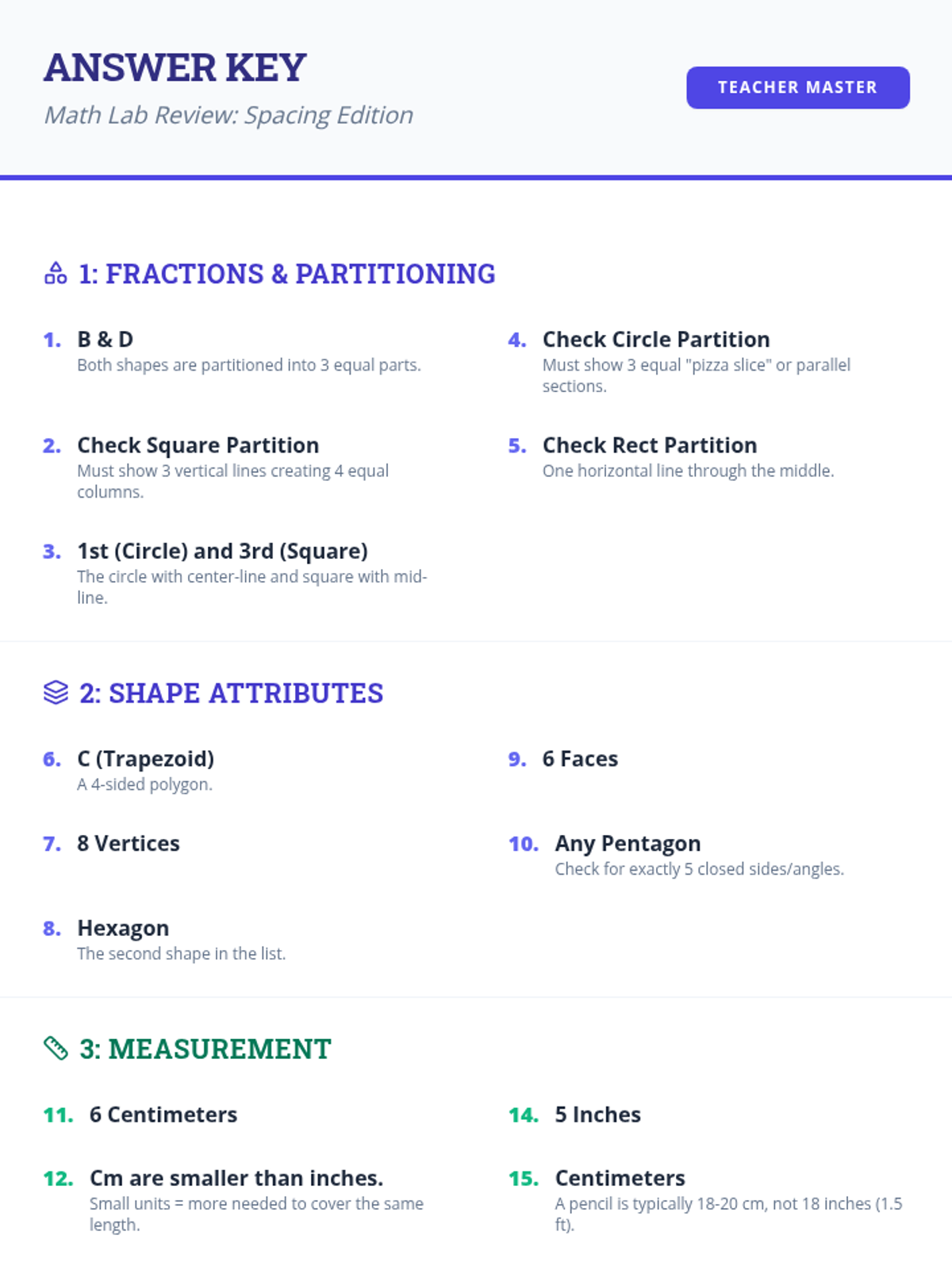
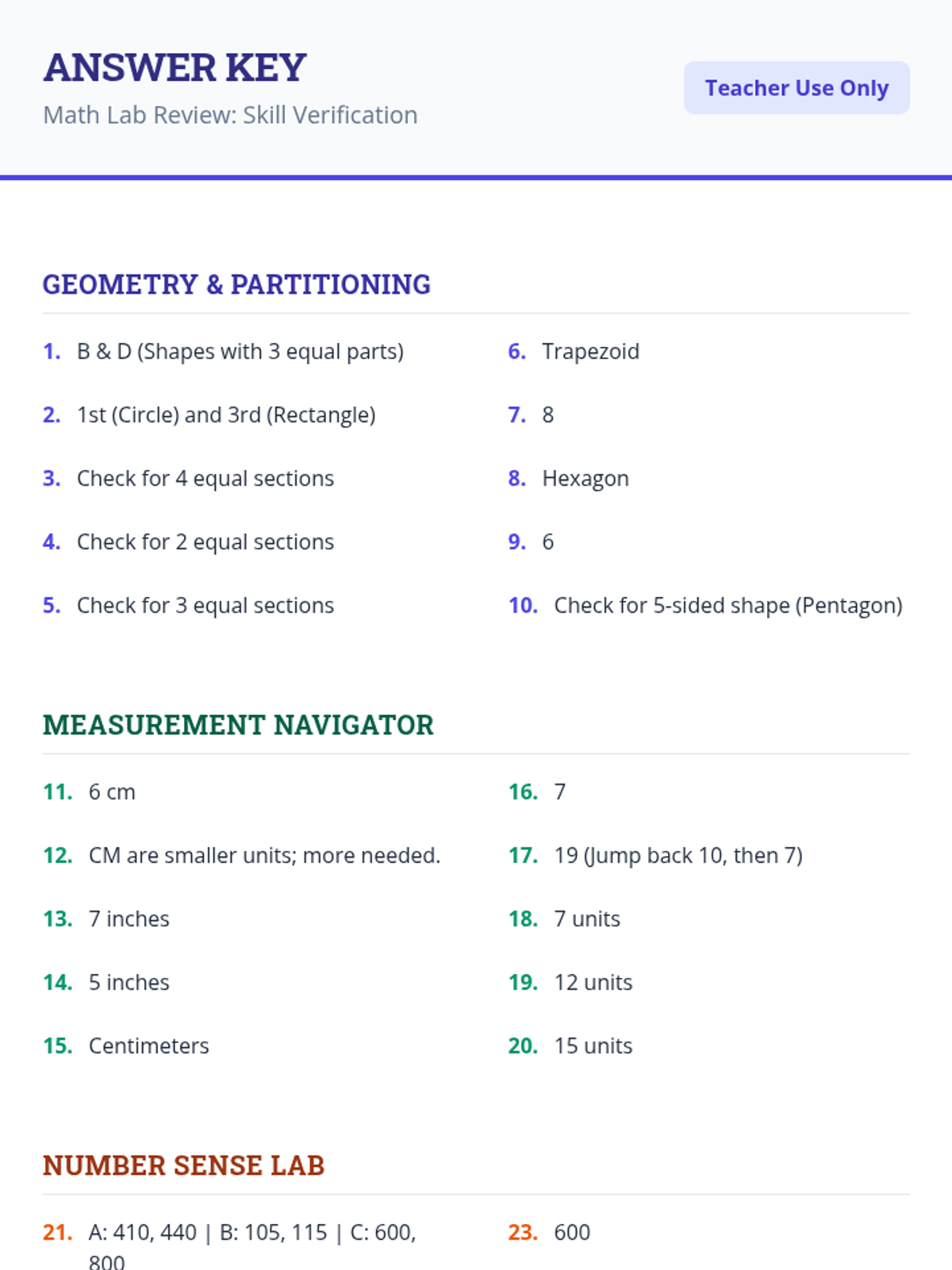
A revised answer key for the final polished version of the Math Lab Review Packet, ensuring perfect alignment with the corrected questions and strategies.
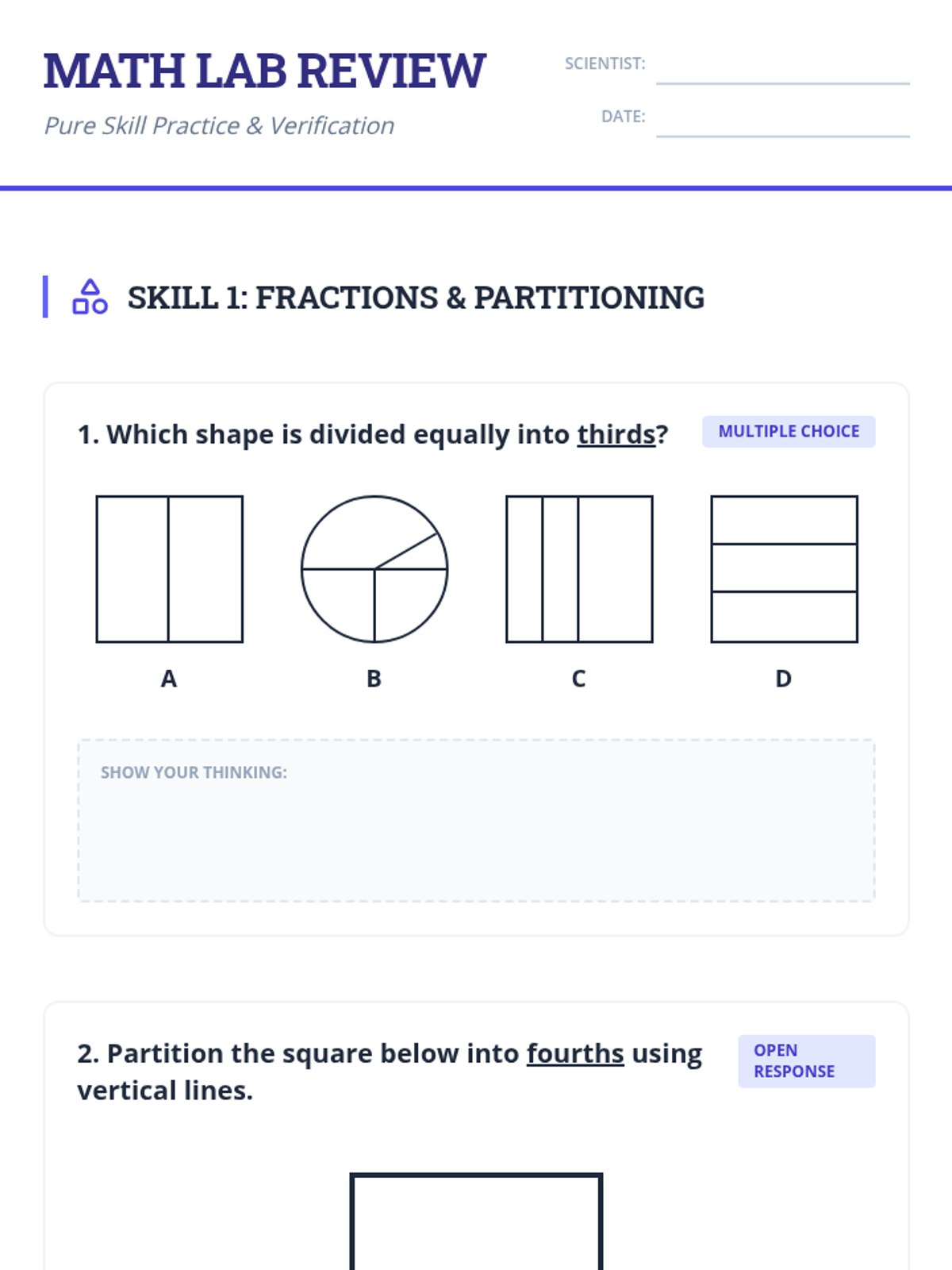
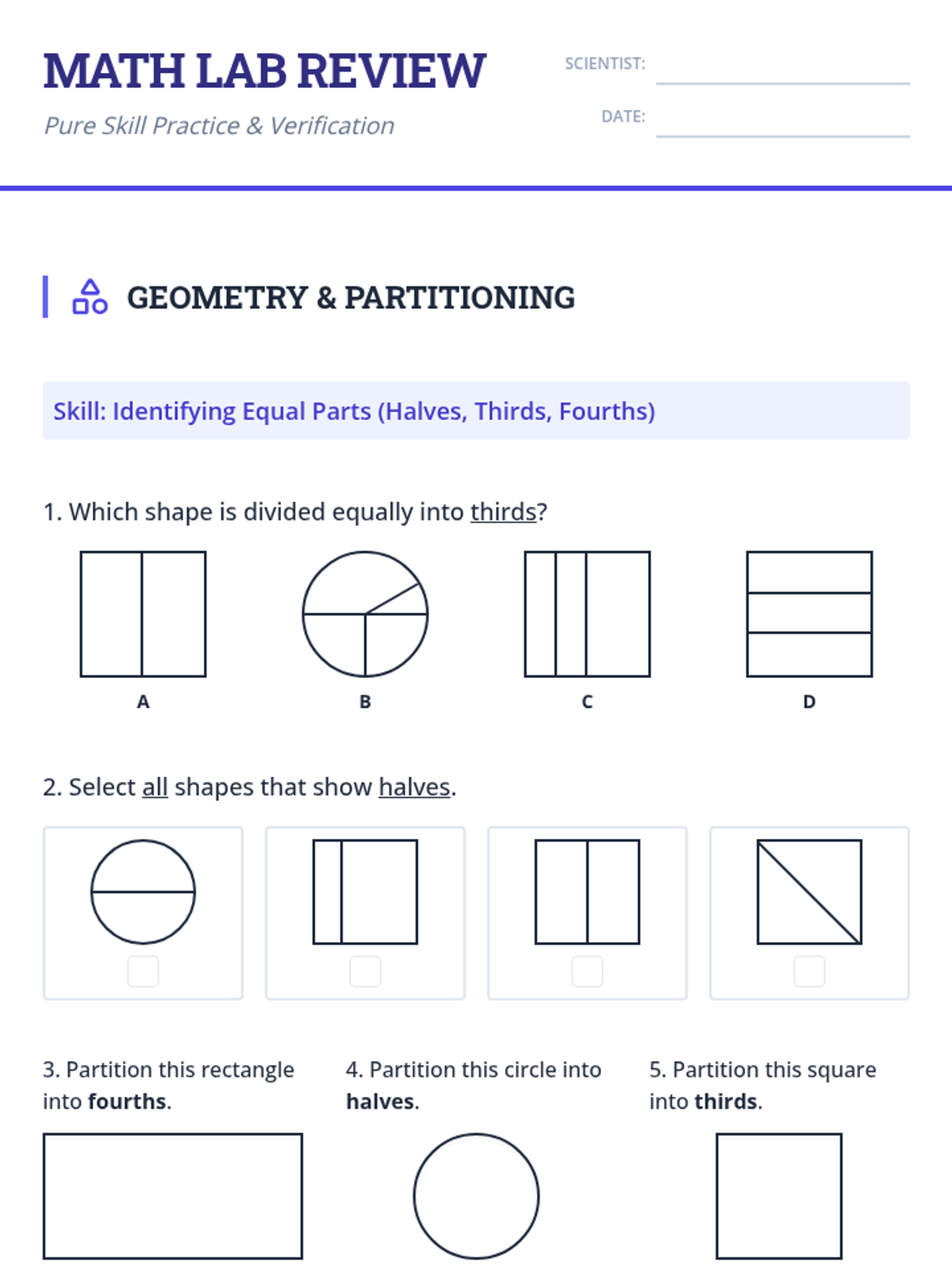
A finalized 35-question practice packet for 2nd grade math with improved mathematical accuracy, efficient layout to reduce page count, and large, dark-bordered workspace areas for clear handwriting and print quality.
An expanded 35-question practice packet for 2nd grade math, featuring dedicated workspace boxes for every problem, large geometric diagrams, and ample handwriting space for students to show their thinking.
A revised answer key for the Spacing edition of the Math Lab Review Packet, featuring detailed solution notes and strategy checks for educators.
A revised answer key for the Math Lab Review Packet with improved alignment and complete solutions.
A revised 35-question practice packet for 2nd grade math, organized by skill sets with improved visual clarity, larger answer areas, and accurate geometric diagrams.
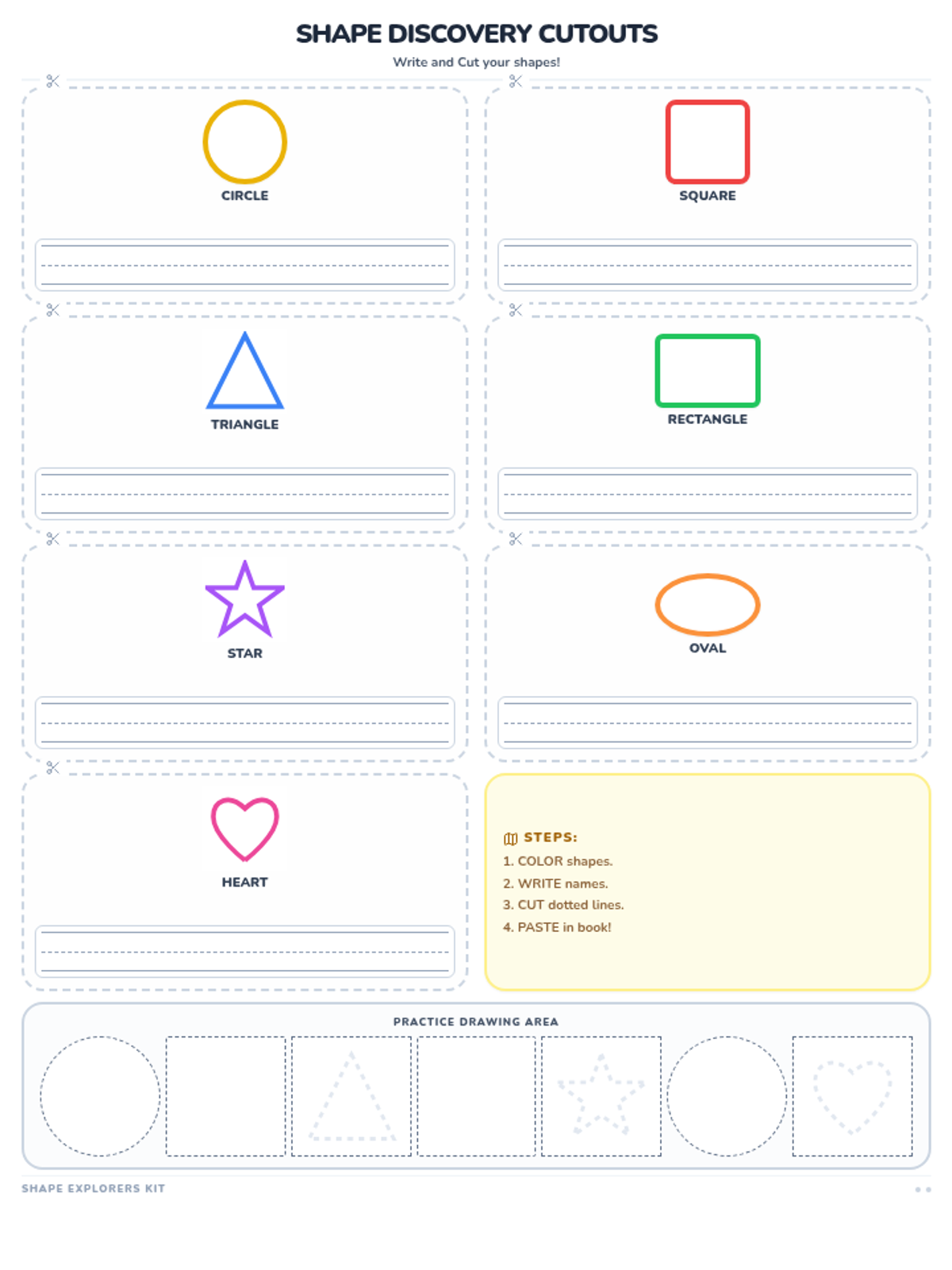
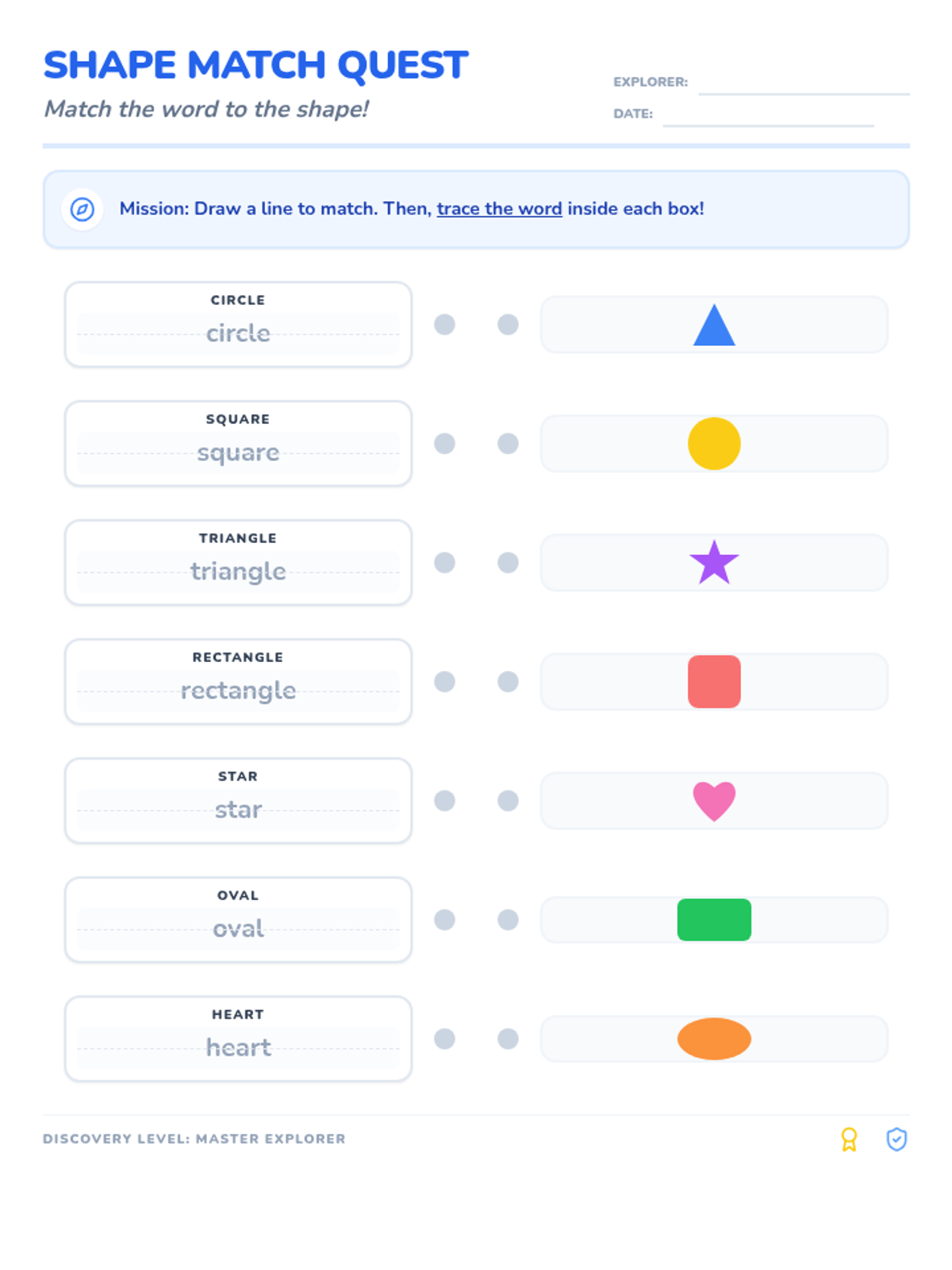
A sheet of seven colored shape cutouts (circle, square, triangle, rectangle, star, oval, heart) with handwriting lines and instructions for students to complete and paste into their books.
An eight-page booklet for young students to practice writing shape names (circle, square, triangle, rectangle, star, oval, heart) and paste the corresponding shapes. Includes a cover and individual pages for each shape with tracing support.
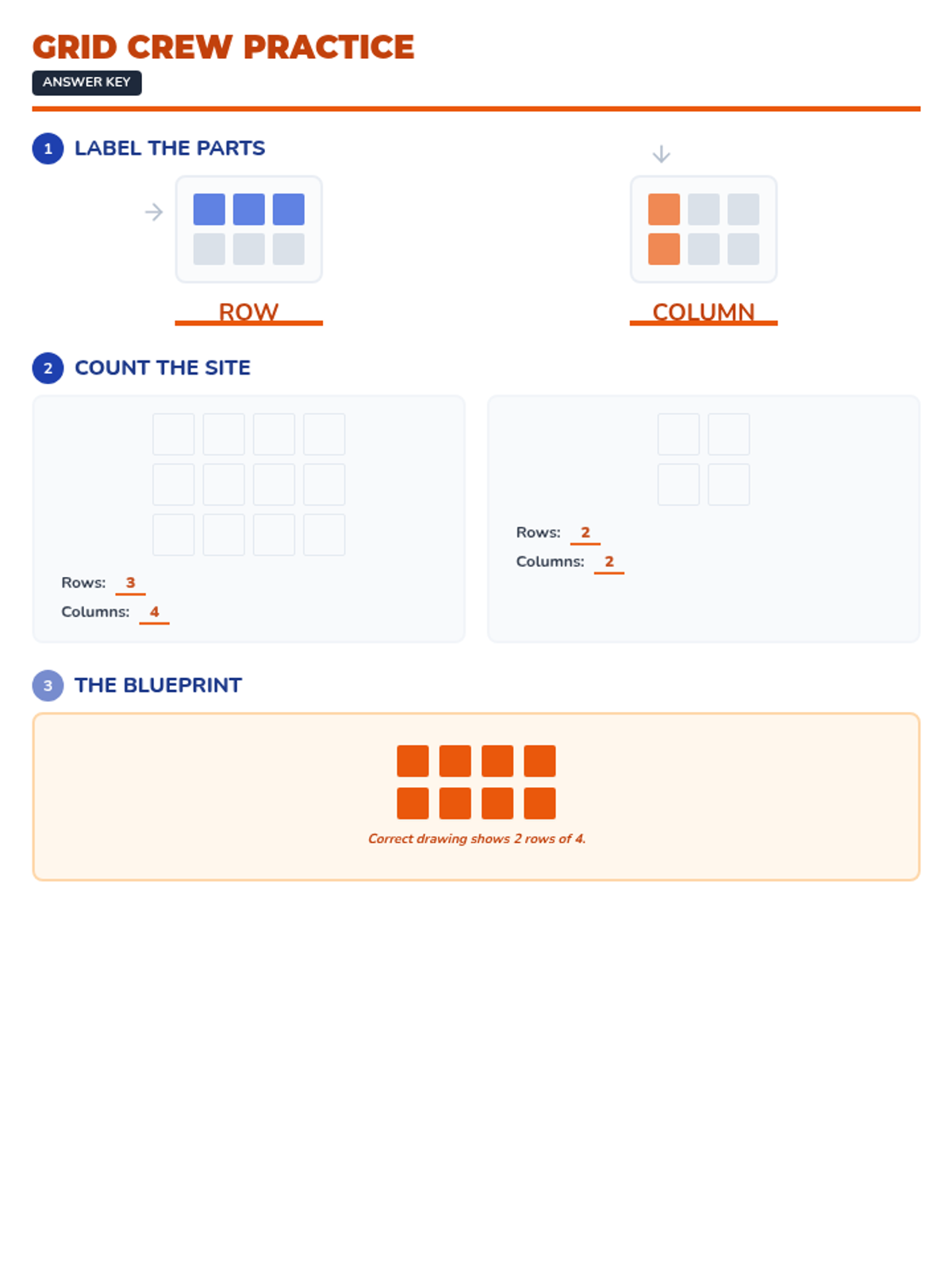
An answer key for the Grid Crew Worksheet, providing correct labels and counts for all exercises. Content is now optimized to fit on a single page.
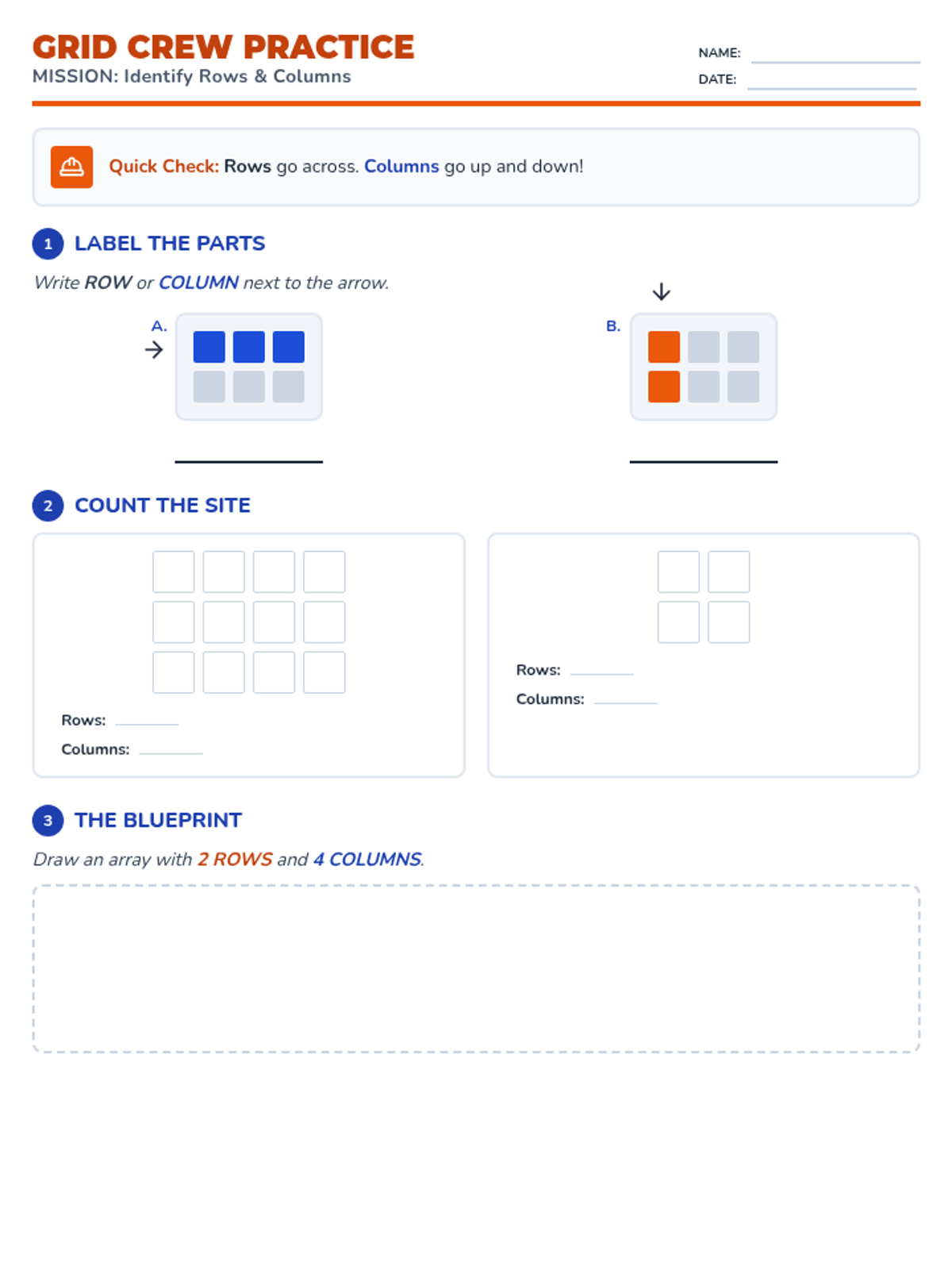
A 2nd-grade practice worksheet where students label rows and columns on grids, count them in various arrays, and draw their own array based on specific dimensions. Fixes for contrast and page breaks included.
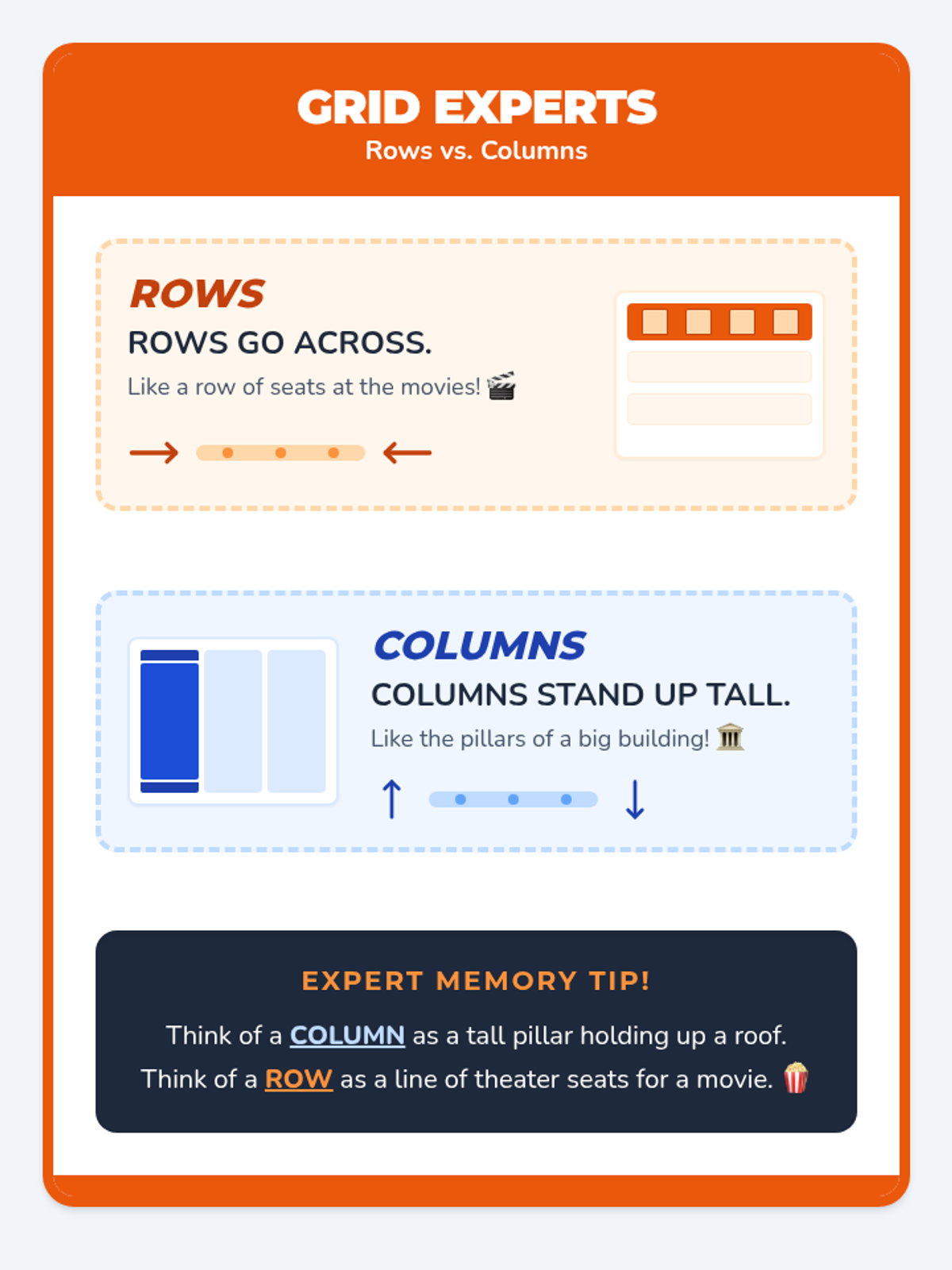
A high-contrast visual anchor chart for 2nd graders that uses theater seats for rows and pillars for columns to distinguish between horizontal and vertical orientations. Now optimized for single-page printing.
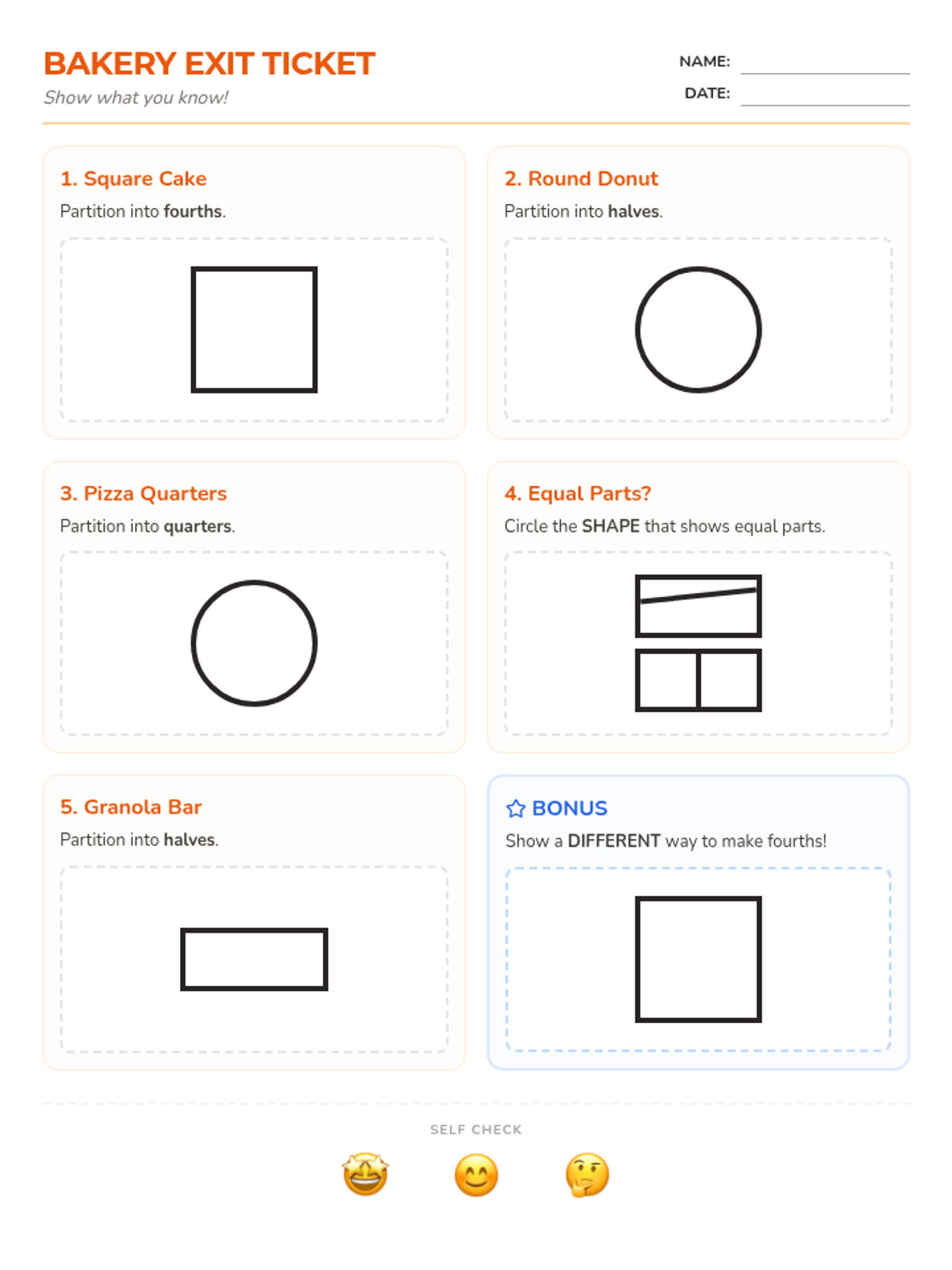
A quick exit ticket for first graders with 5 problems and a bonus to check partitioning skills. Revised for consistency and completeness.
A visual presentation for first graders explaining partitioning. Revised to include practice slides and a "Level Up" challenge slide. Fixed alignment of diagonal partitions.
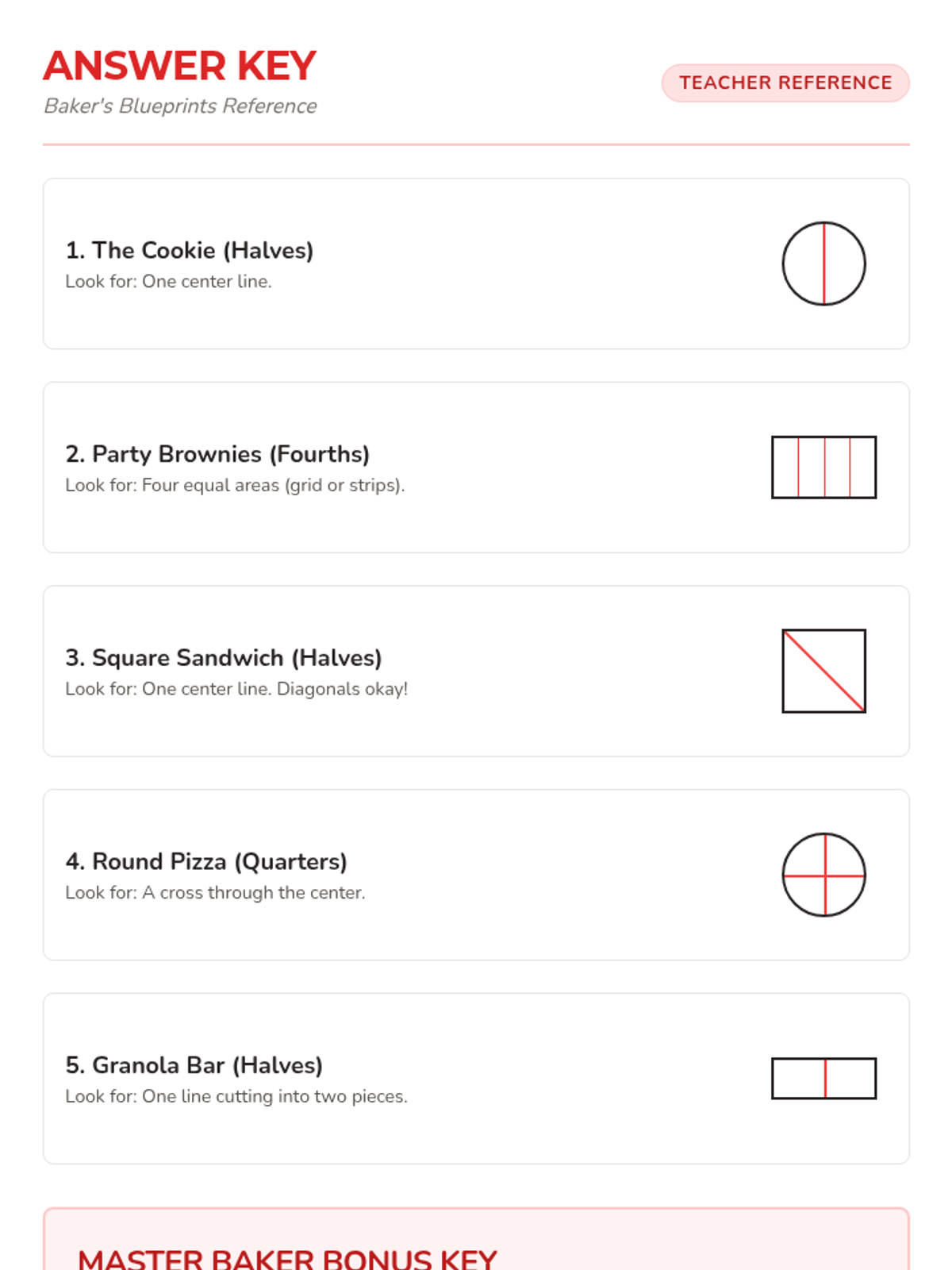
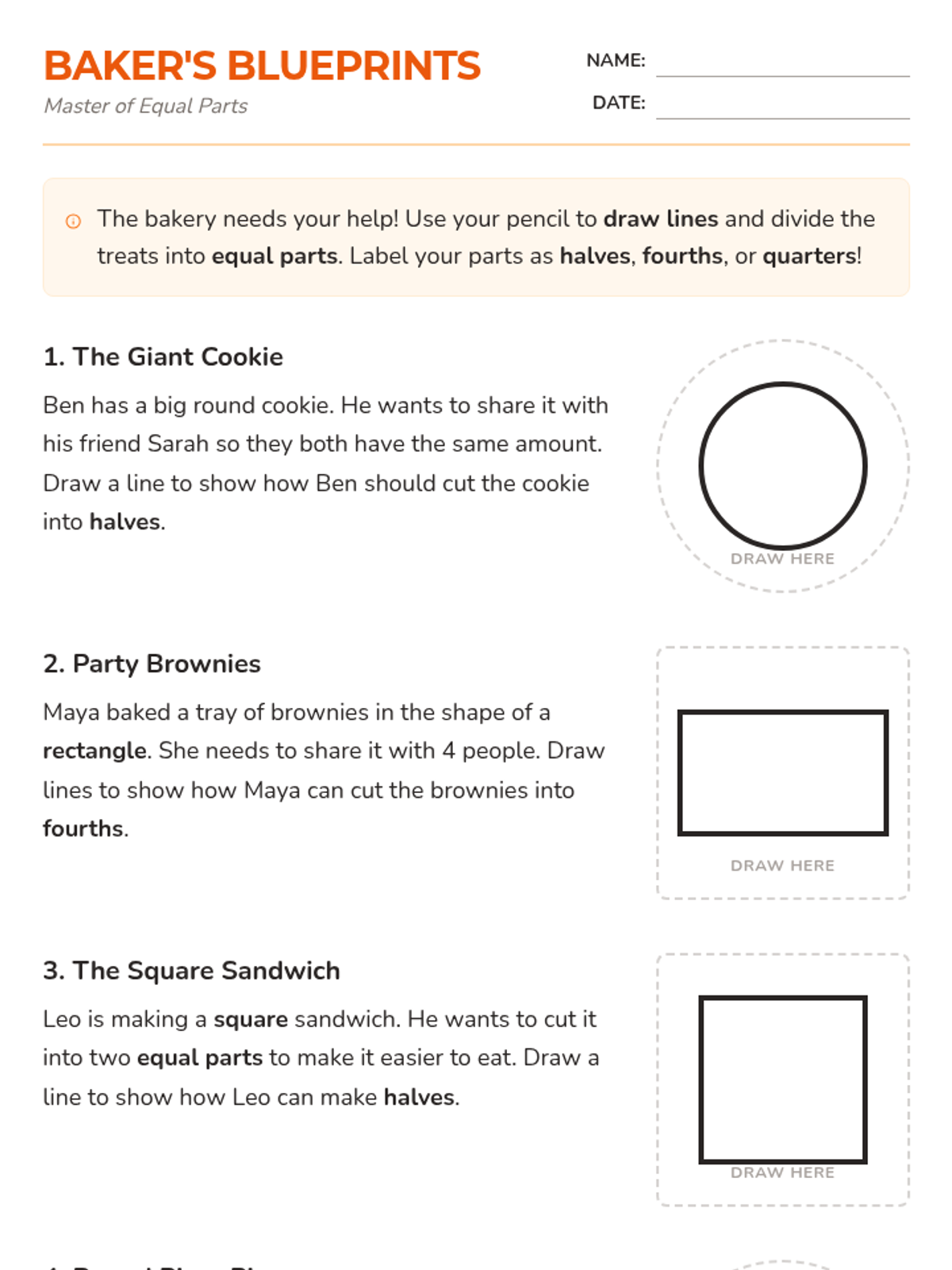
An answer key for the Baker's Blueprints worksheet, showing correct partitioning methods for circles, squares, and rectangles. Revised for diagram accuracy and page layout.
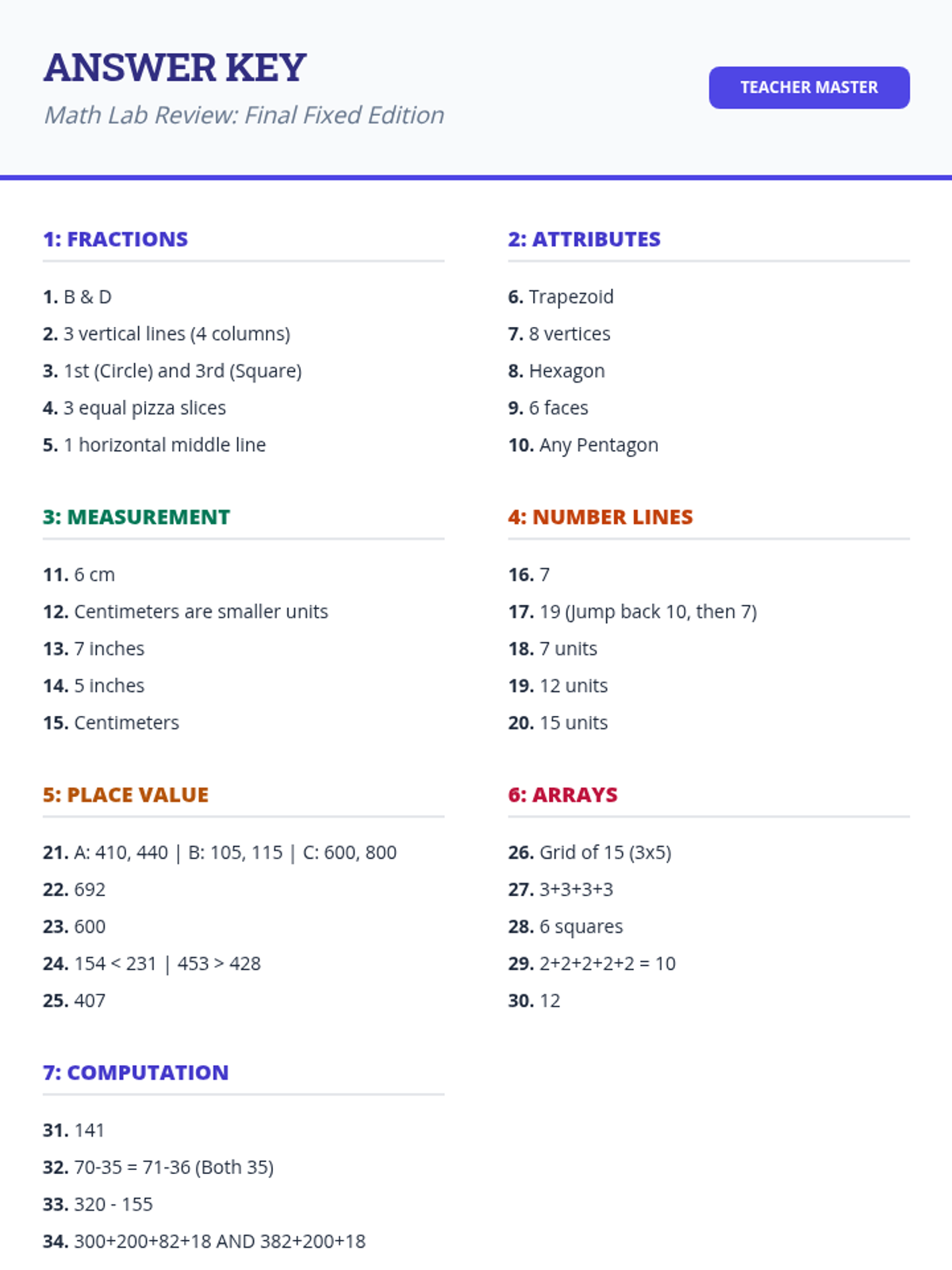
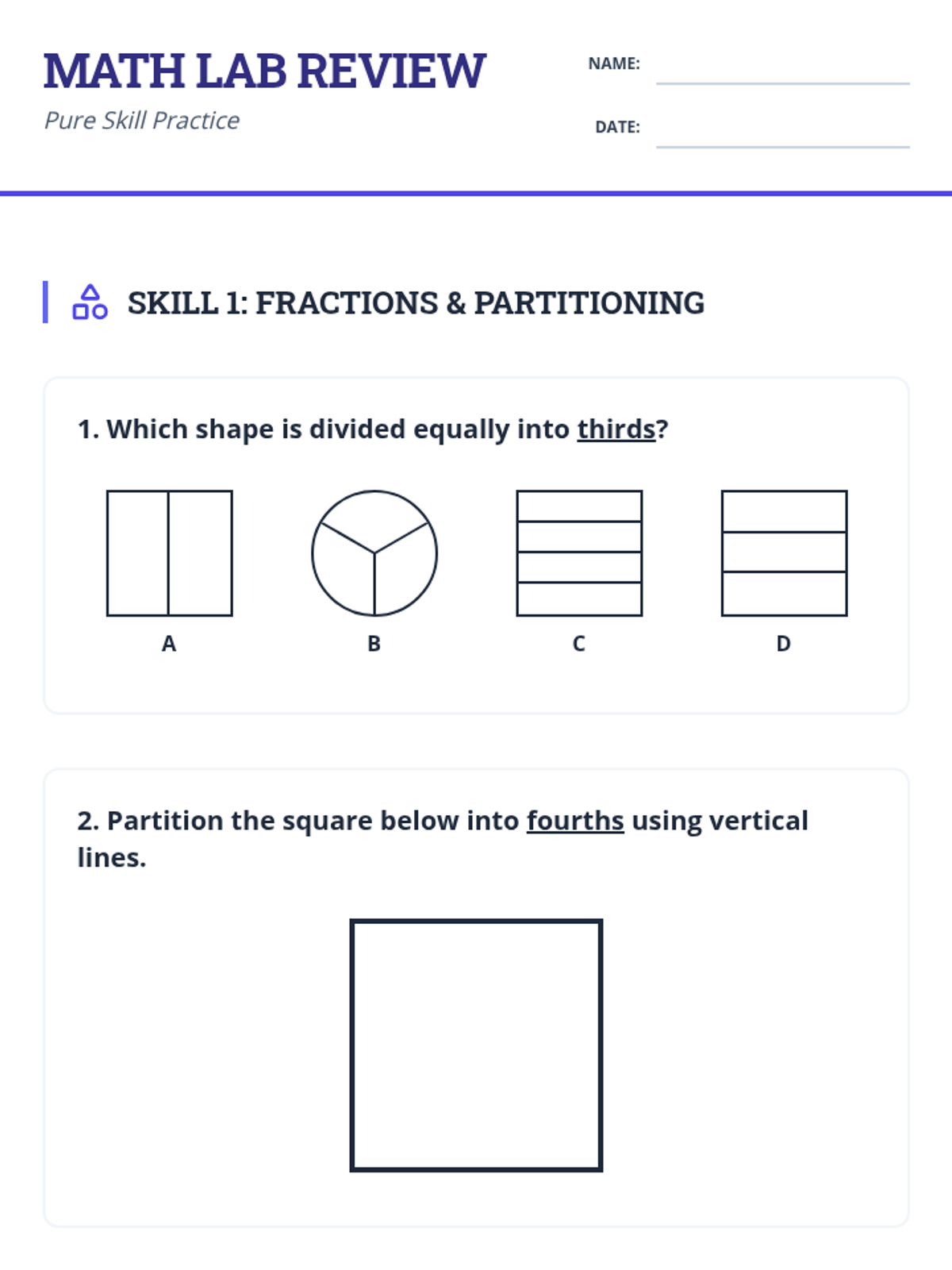
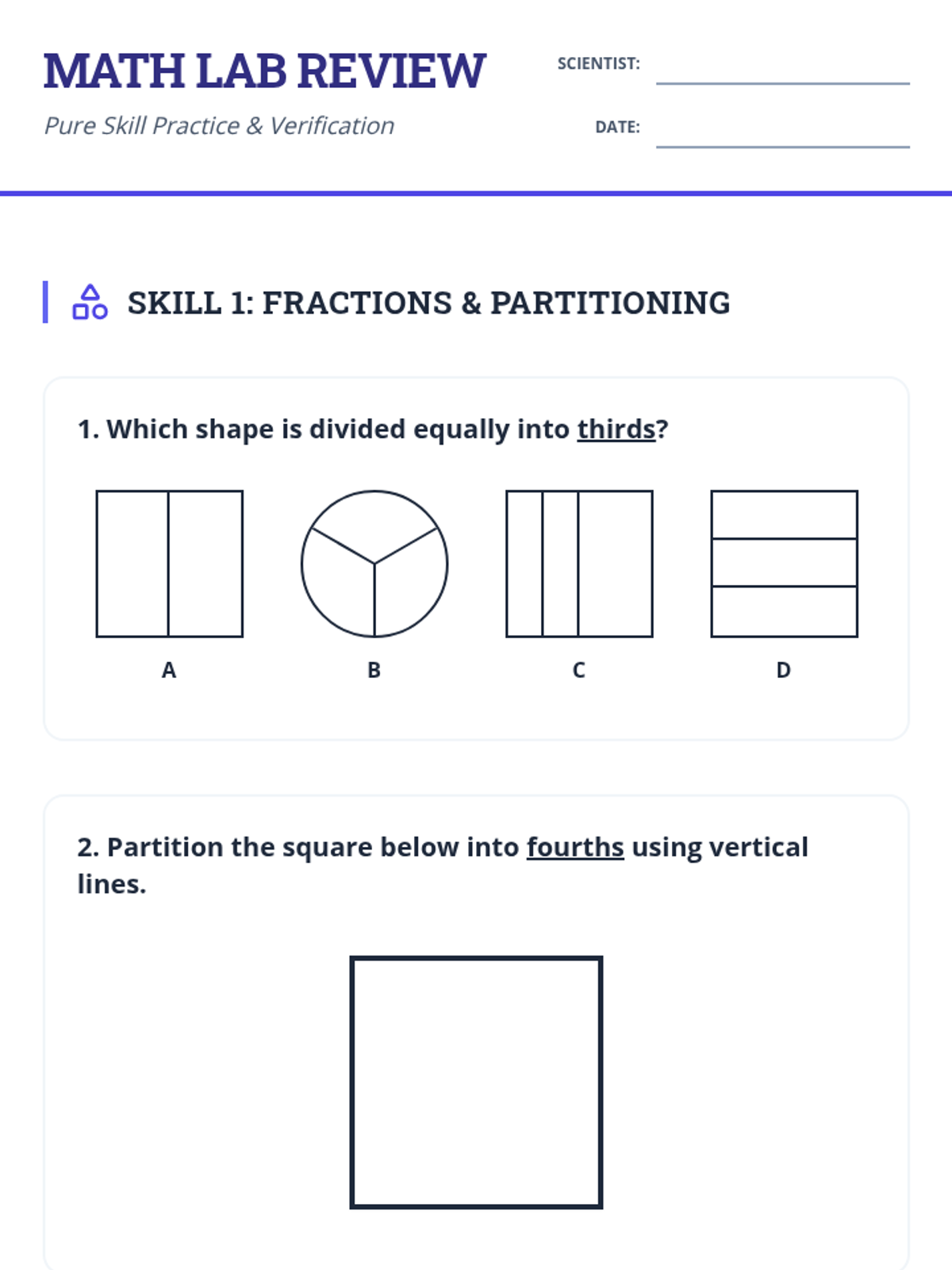
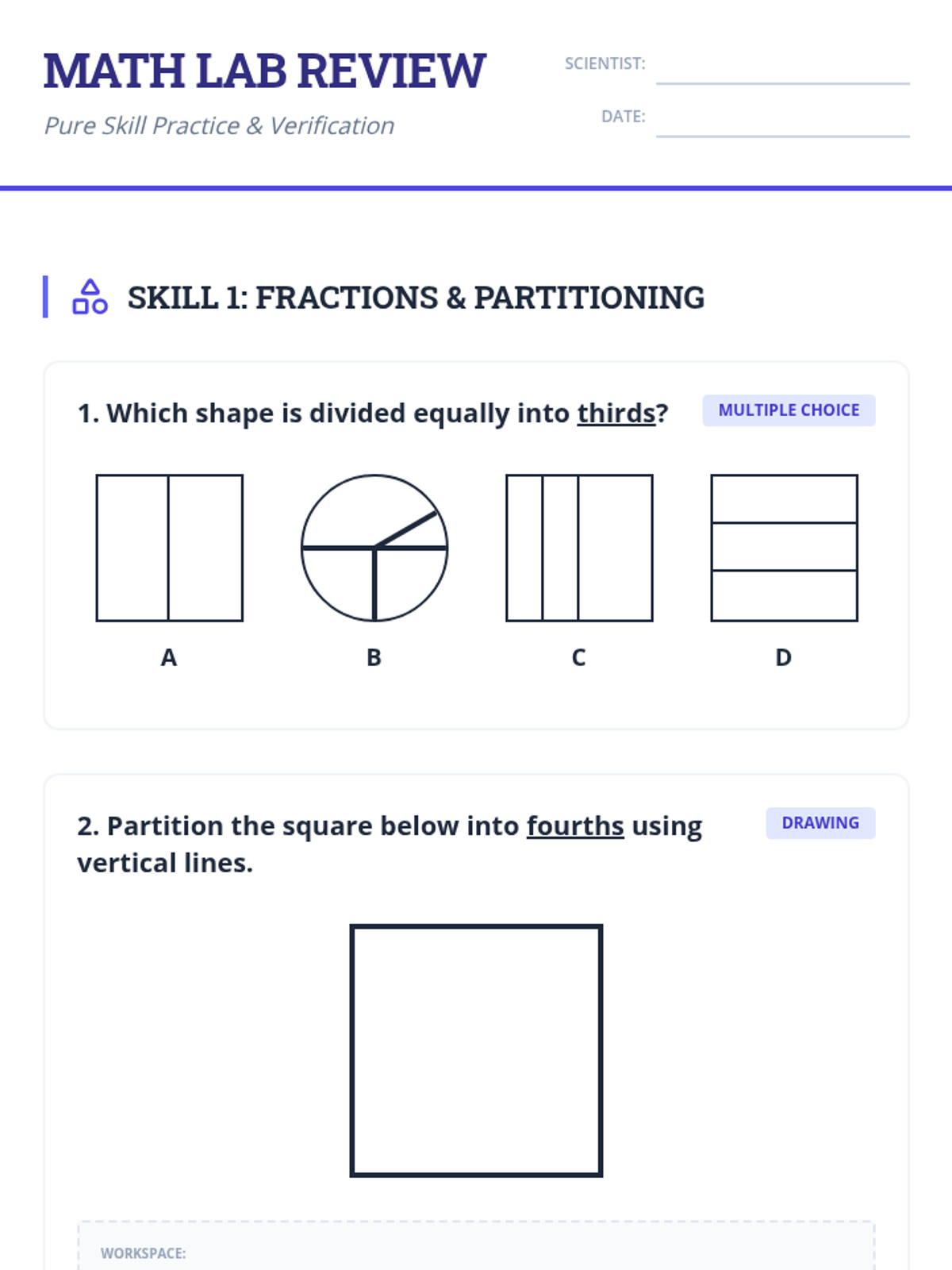
A word problem worksheet for first graders to practice partitioning shapes into halves and fourths using a bakery theme. Revised for better label spacing and consistency.
A matching worksheet where students draw lines to connect shape names with their corresponding visual shapes. Covers all seven shapes (circle, square, triangle, rectangle, star, oval, heart) with a colorful explorer theme. Includes tracing practice for each shape name.
Printable cards with 2D shapes (polygons and non-polygons) for the classroom scavenger hunt activity. Includes Alpha through Hotel labels for easy tracking.
A recording sheet for students to document findings during the classroom shape scavenger hunt, including checkboxes for polygons, right angles, parallel lines, and symmetry.
Visual presentation to introduce 2D shapes, polygons, right angles, parallel lines, and symmetry concepts before a classroom scavenger hunt.
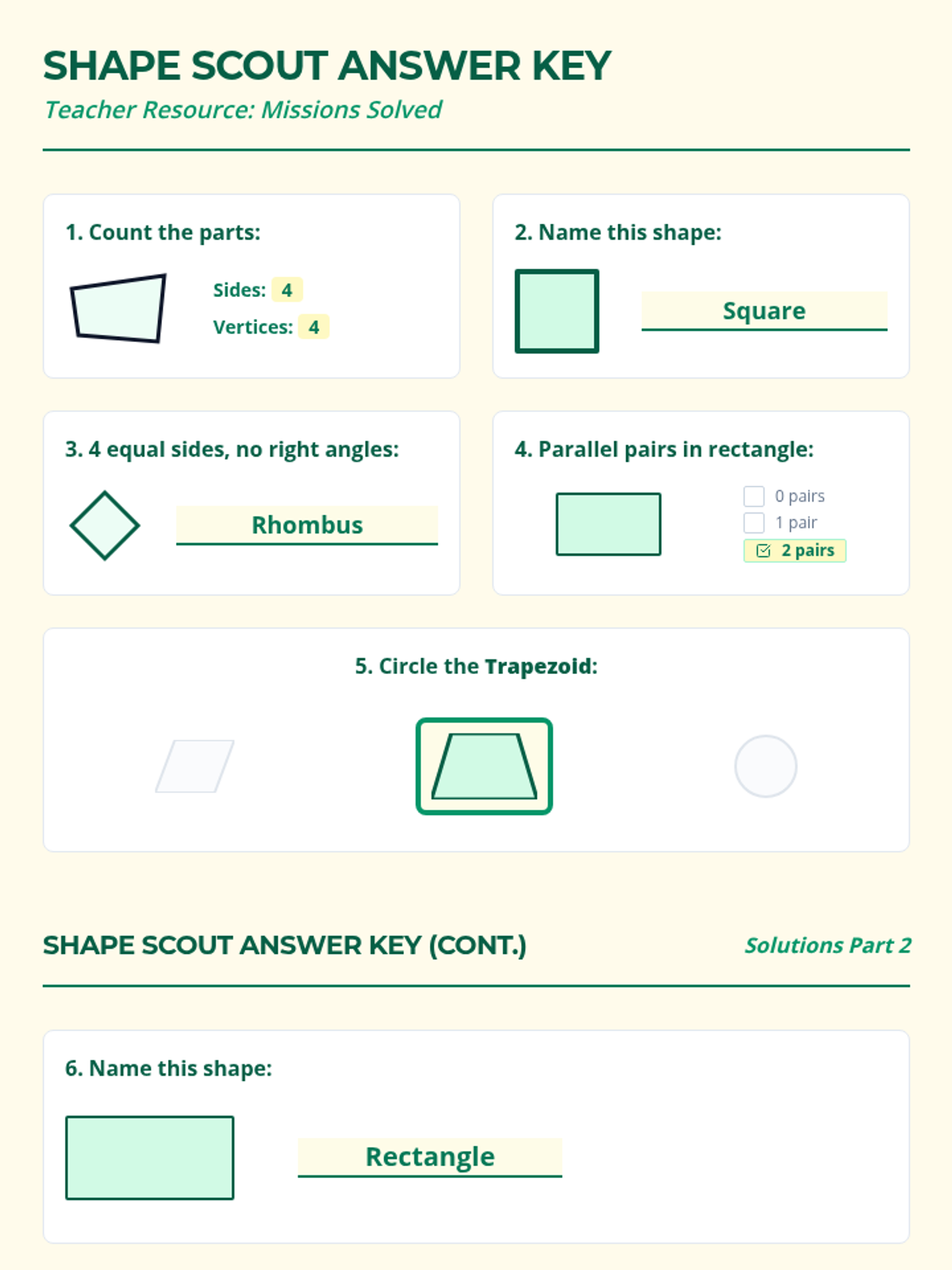
The teacher answer key for the Shape Scout Worksheet, featuring highlighted correct answers and visual solution indicators. Revised for improved page layout and contrast.
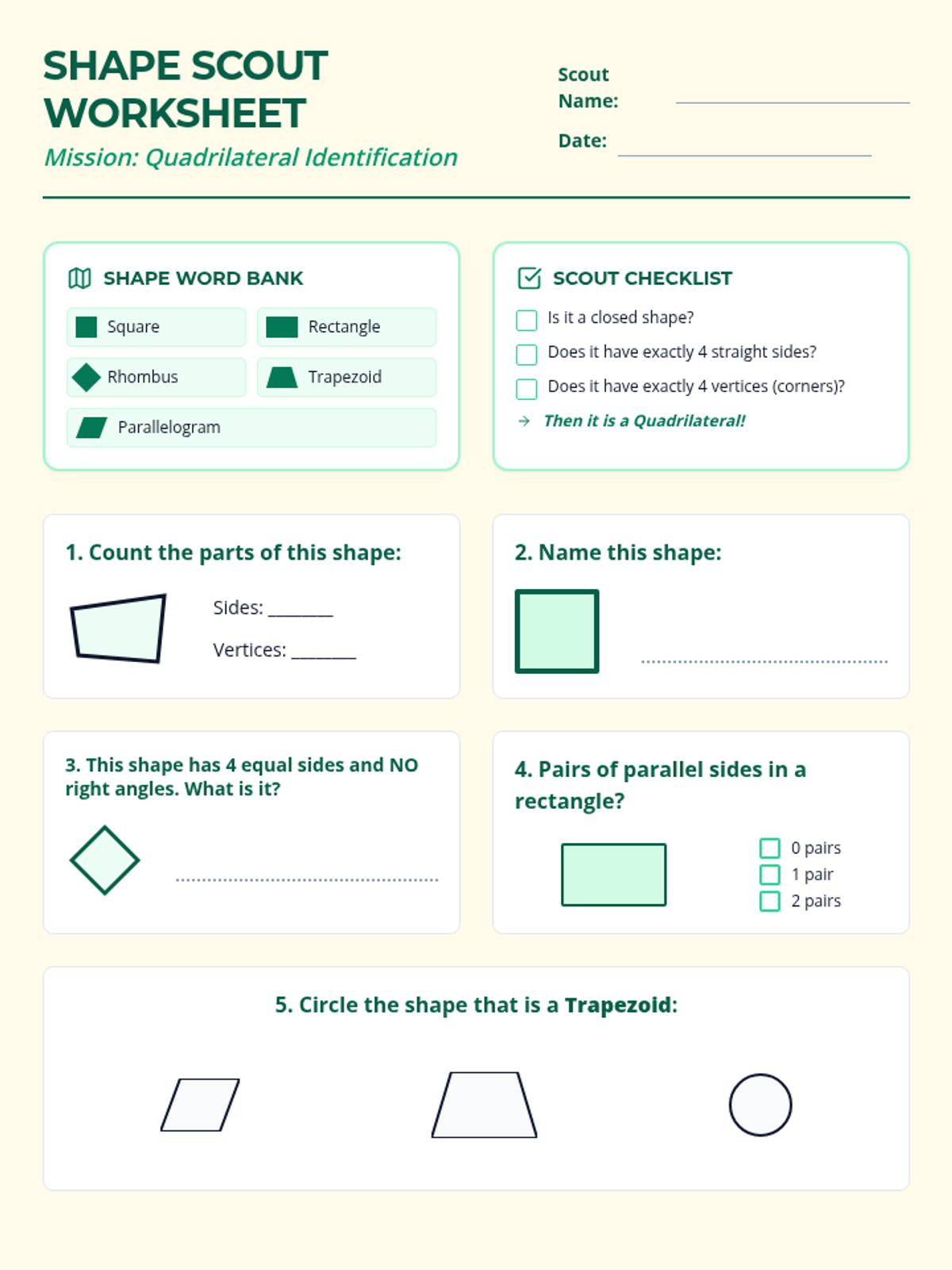
A 10-problem geometry worksheet for 3rd graders focused on identifying and classifying quadrilaterals with visual word banks and step-by-step scaffolds. Revised for improved visual clarity and drawing space.
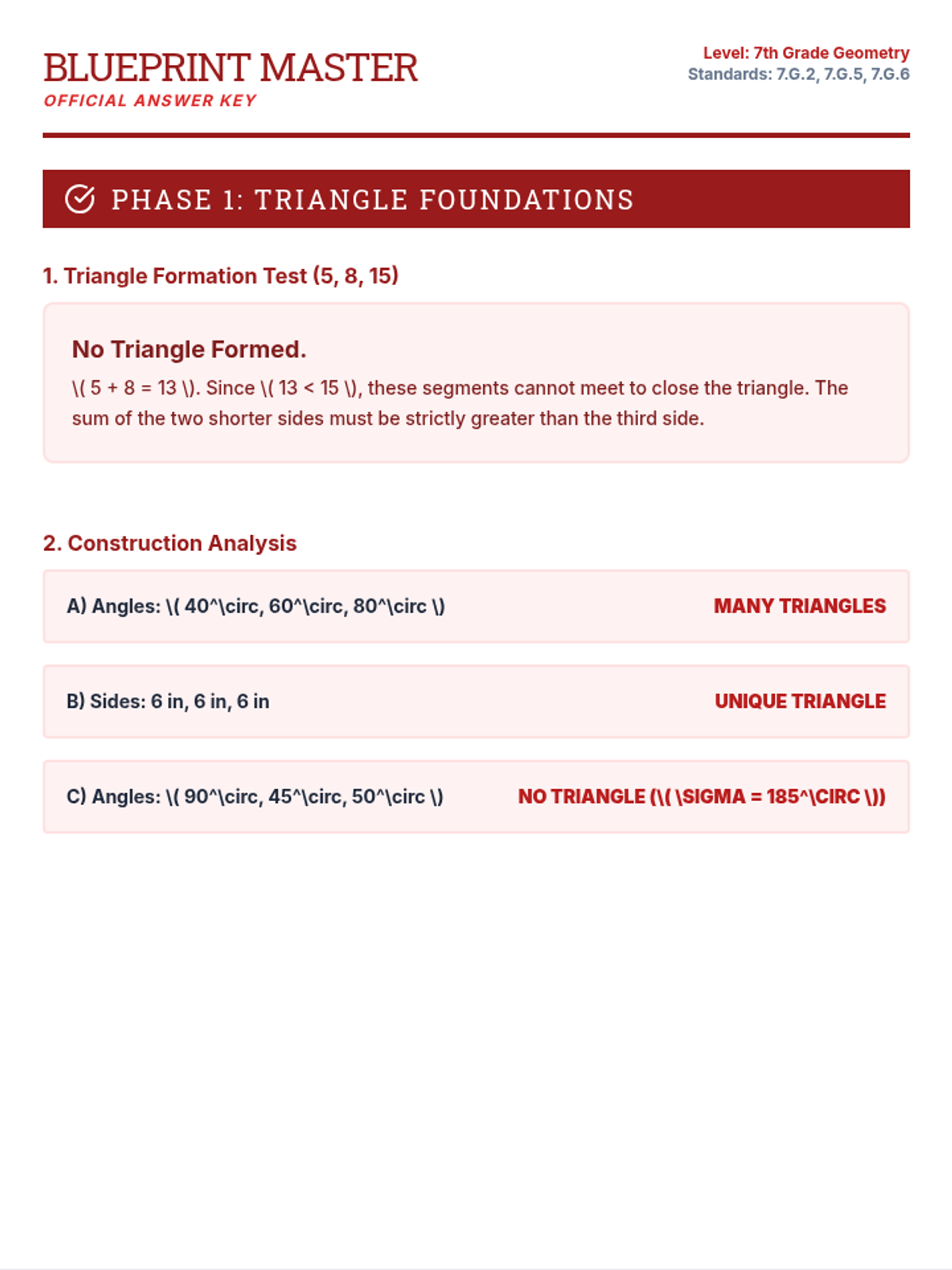
A complete teacher answer key for the Blueprint Master Study Guide, providing step-by-step solutions, equations, and mathematical explanations for all geometry problems.
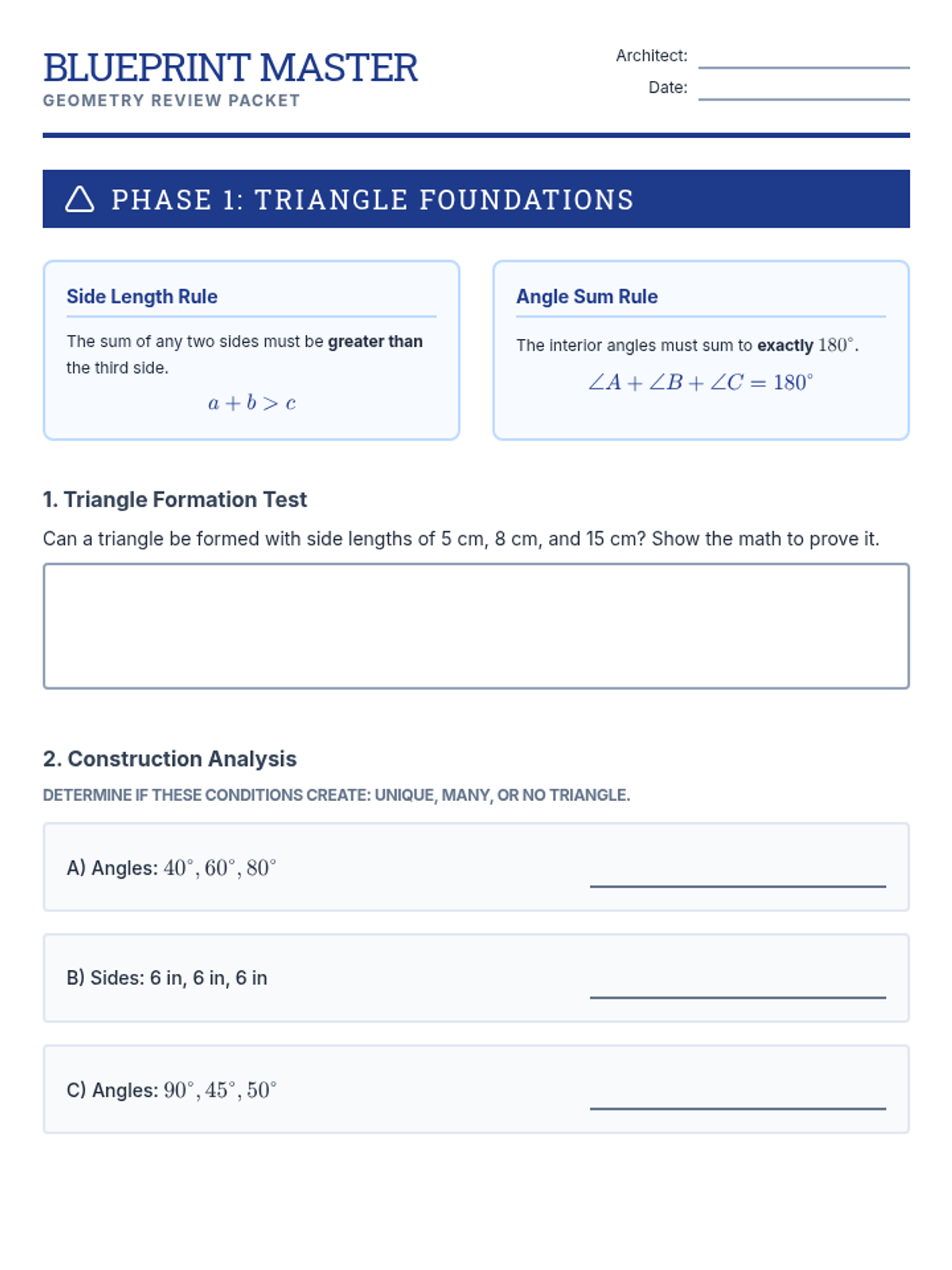
A comprehensive 4-page geometry study guide designed as an 'Architect's Blueprint'. It covers triangle construction rules, angle relationship equations, and real-world area, volume, and surface area problems aligned with 7.G.2, 7.G.5, and 7.G.6.
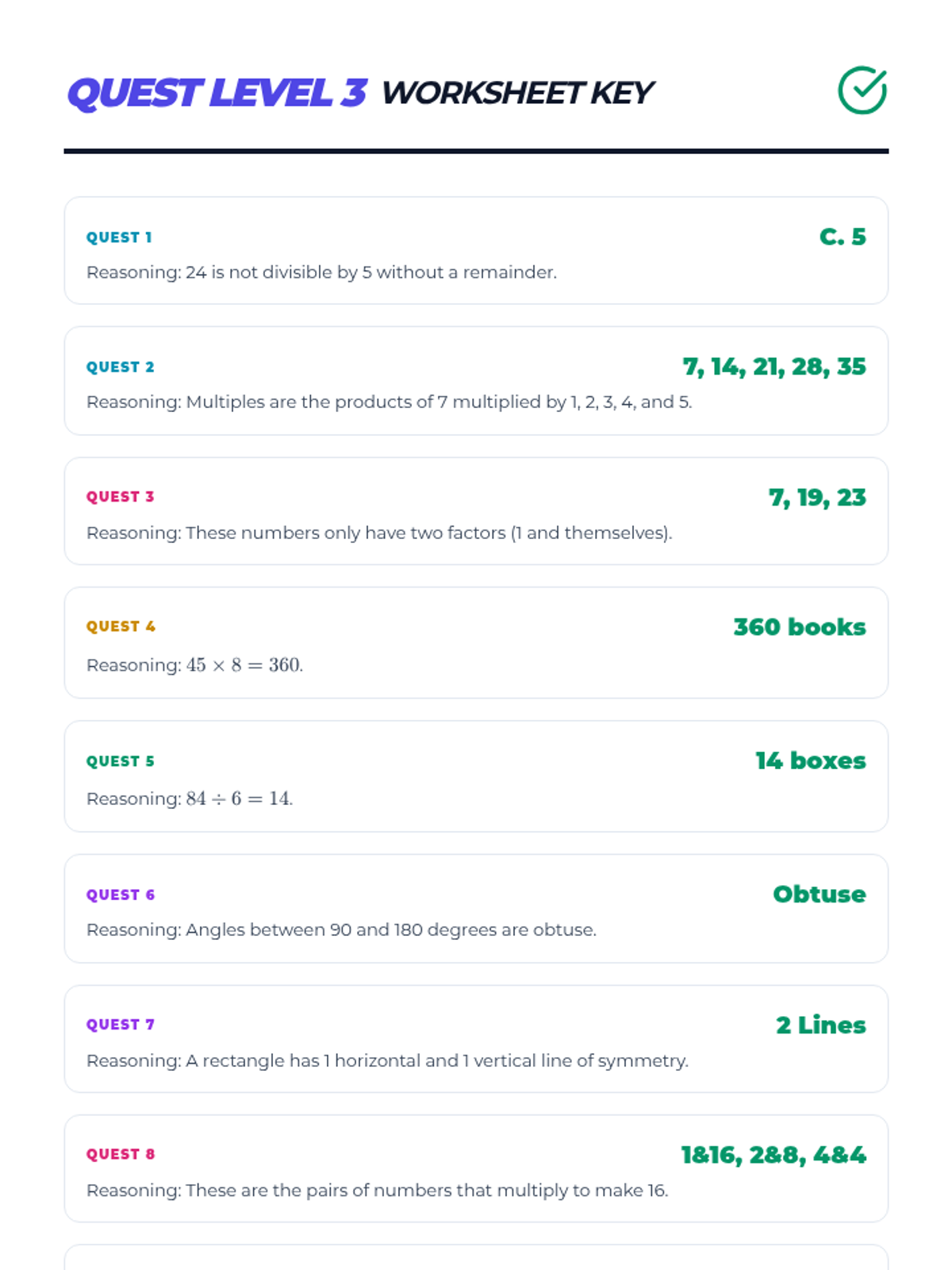
Teacher answer key for the third Math Quest worksheet. Includes correct answers and clear reasoning for factors, multiples, prime numbers, and geometry.
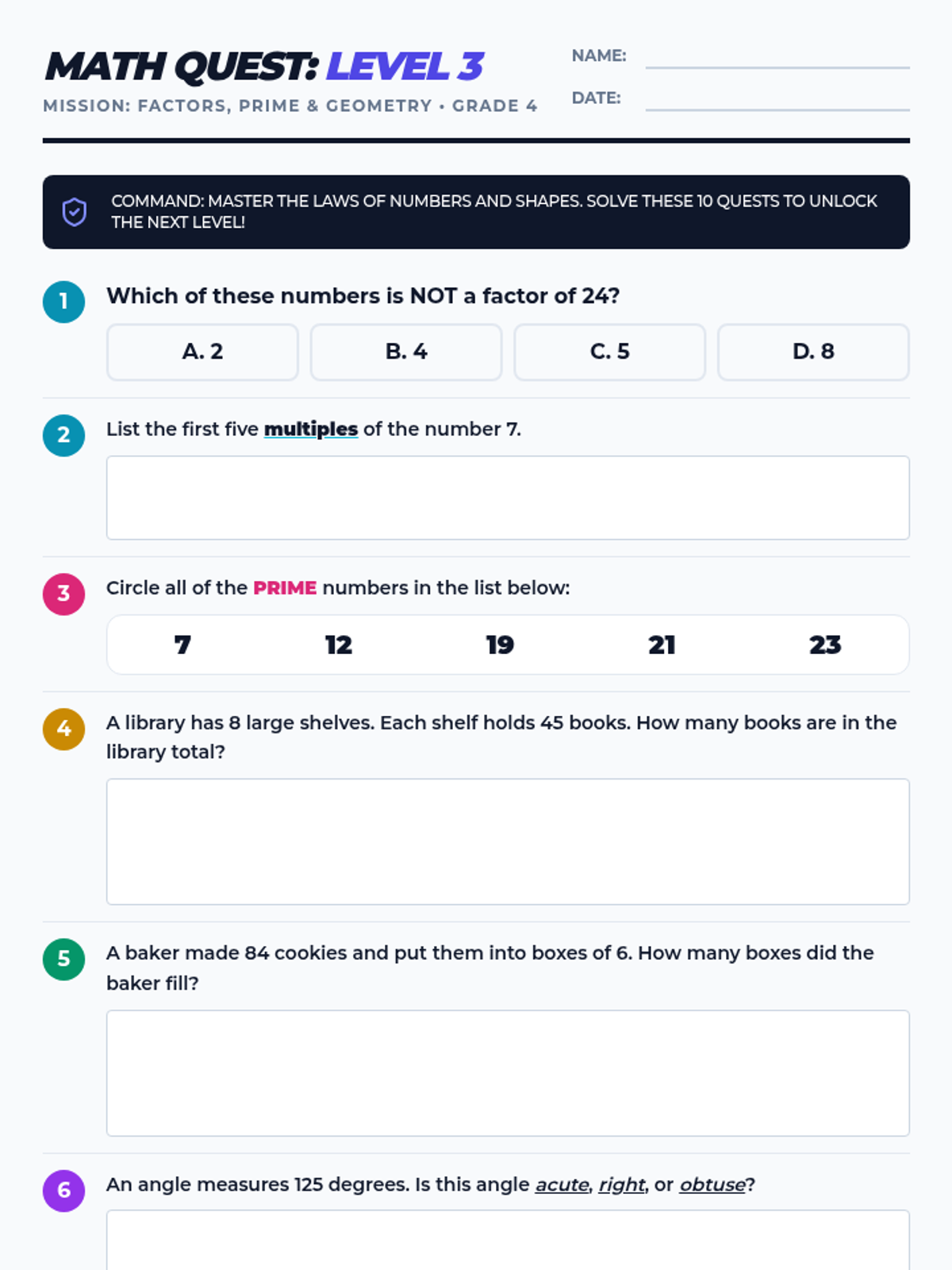
A third 10-question math worksheet focusing on factors, multiples, prime/composite numbers, and geometry (angles, symmetry, lines). It maintains the video game theme with one-step word problems.
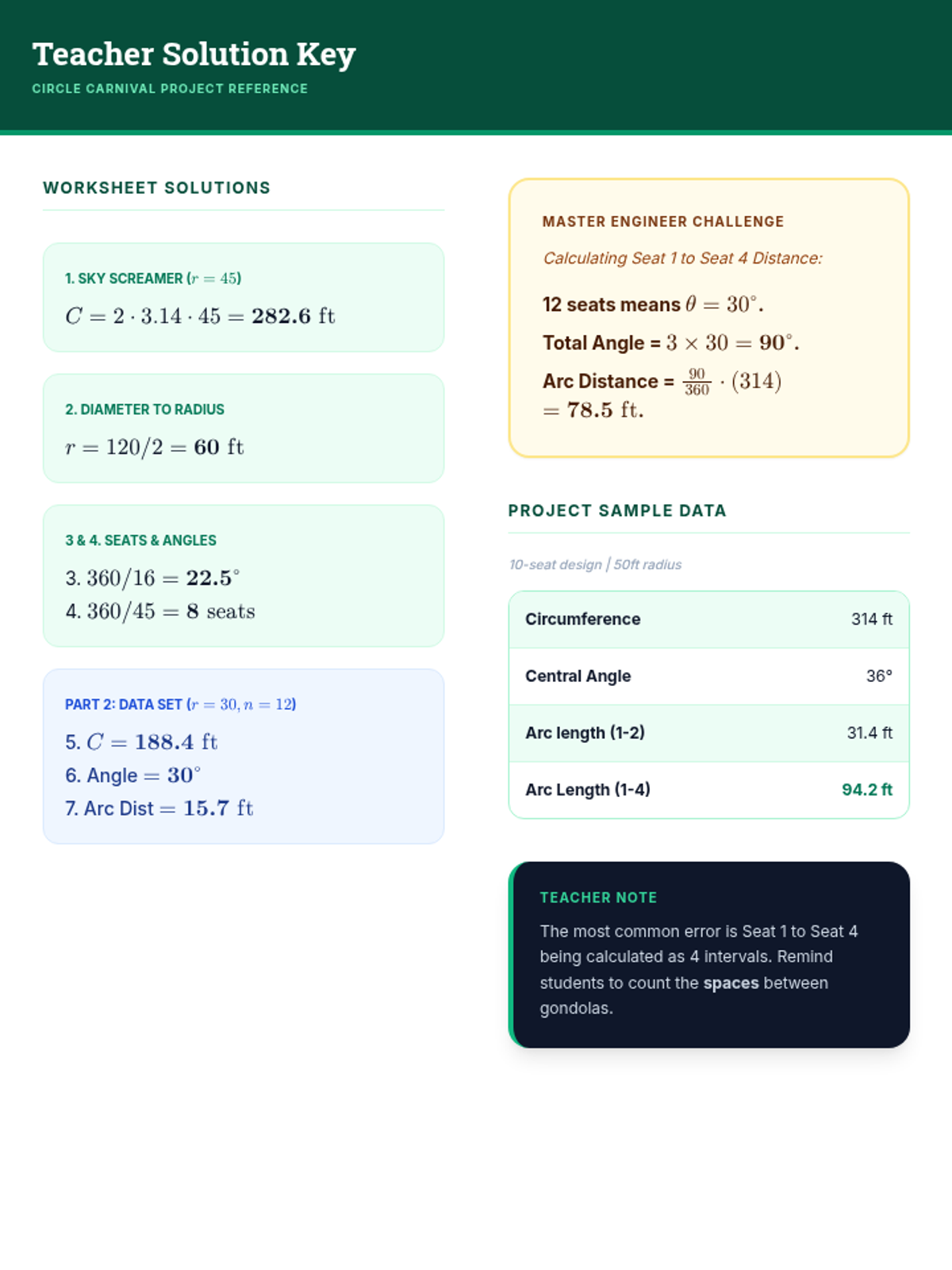
A teacher resource providing correct answers and sample data for the Ferris Wheel Physics worksheet and the design project.
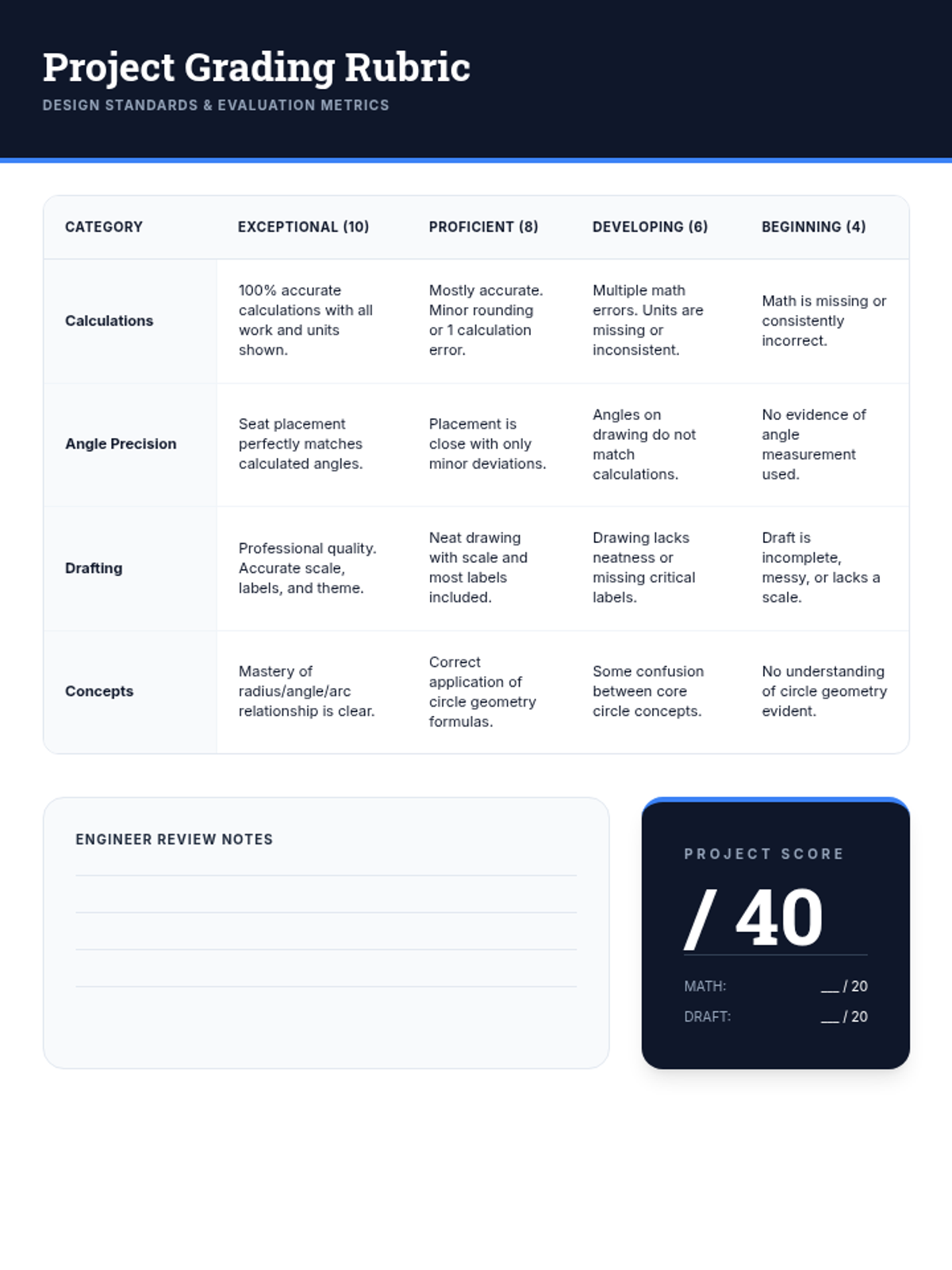
A grading rubric for the Ferris Wheel Project, assessing mathematical calculations, geometric accuracy, blueprint quality, and concept application.
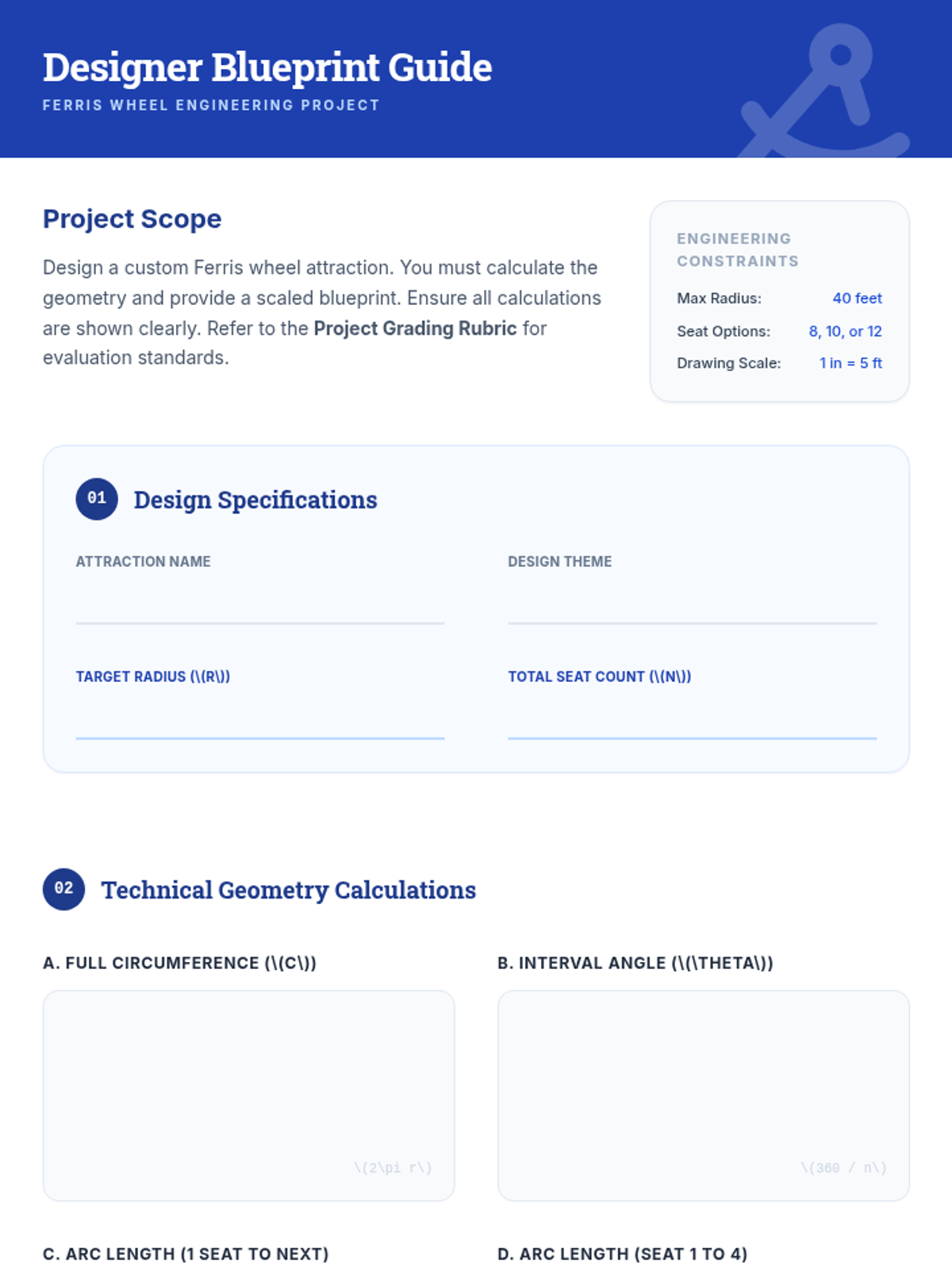
A project guide for students to design their own Ferris wheel, including space for calculations of circumference, central angles, and arc lengths, plus a drafting area.
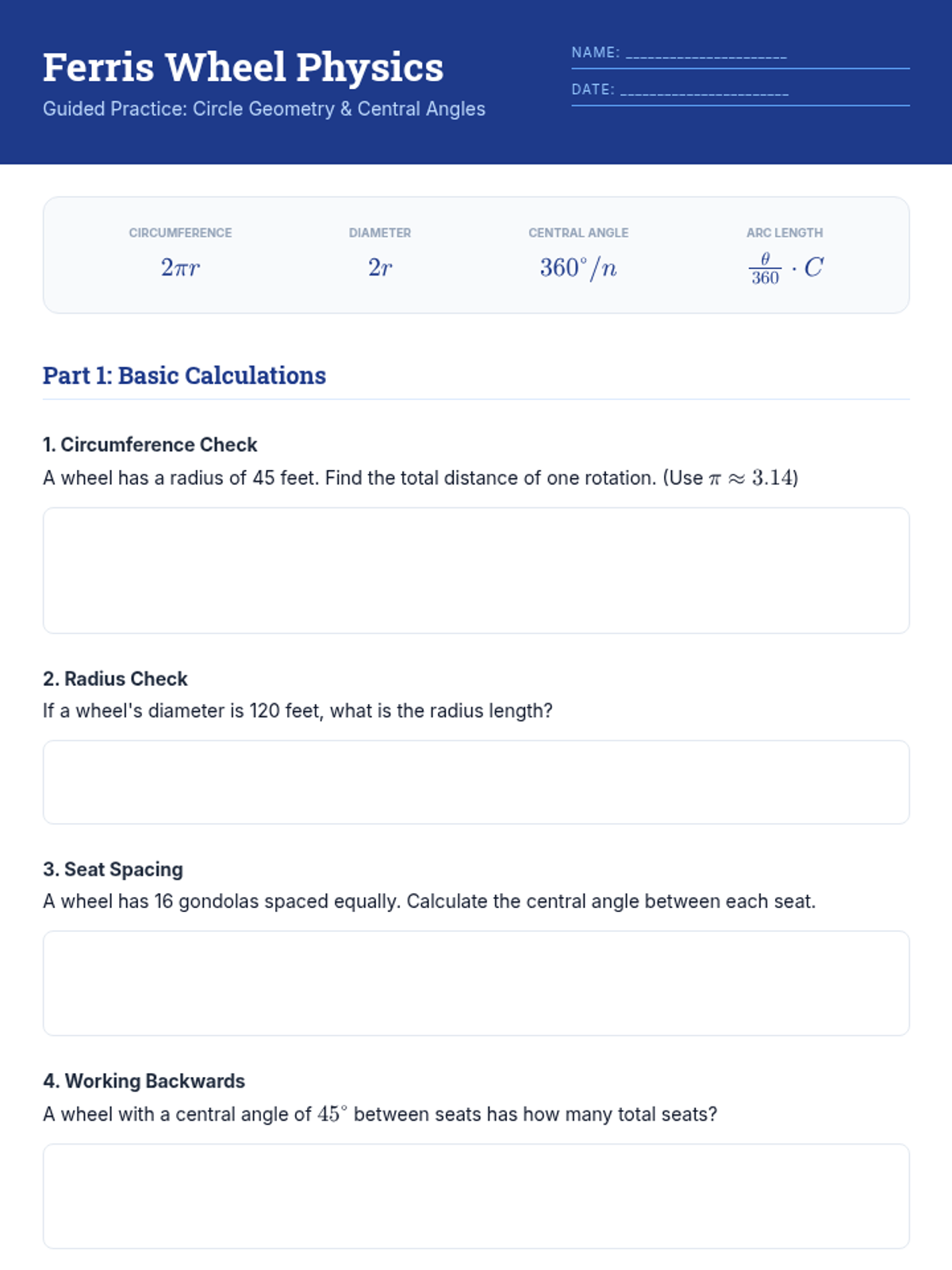
A worksheet providing guided math practice for calculating circumference, radius, central angles, and arc length in the context of Ferris wheels.
A presentation introducing the geometry of Ferris wheels, covering radius, circumference, central angles, and arc length.
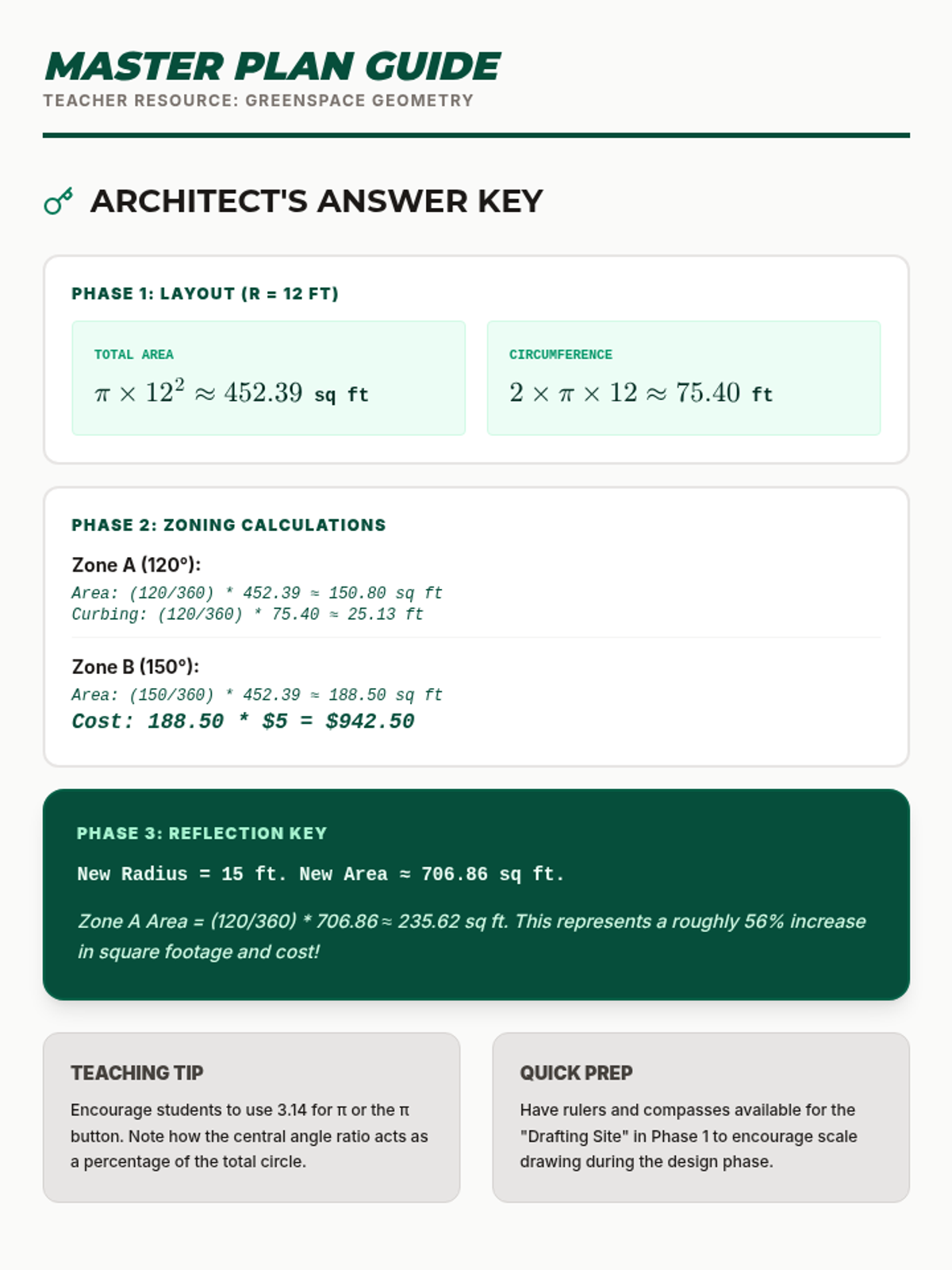
Teacher guide for the Greenspace Geometry lesson, providing detailed solutions for garden zone calculations, pricing analysis, and a conceptual guide for the final design reflection.
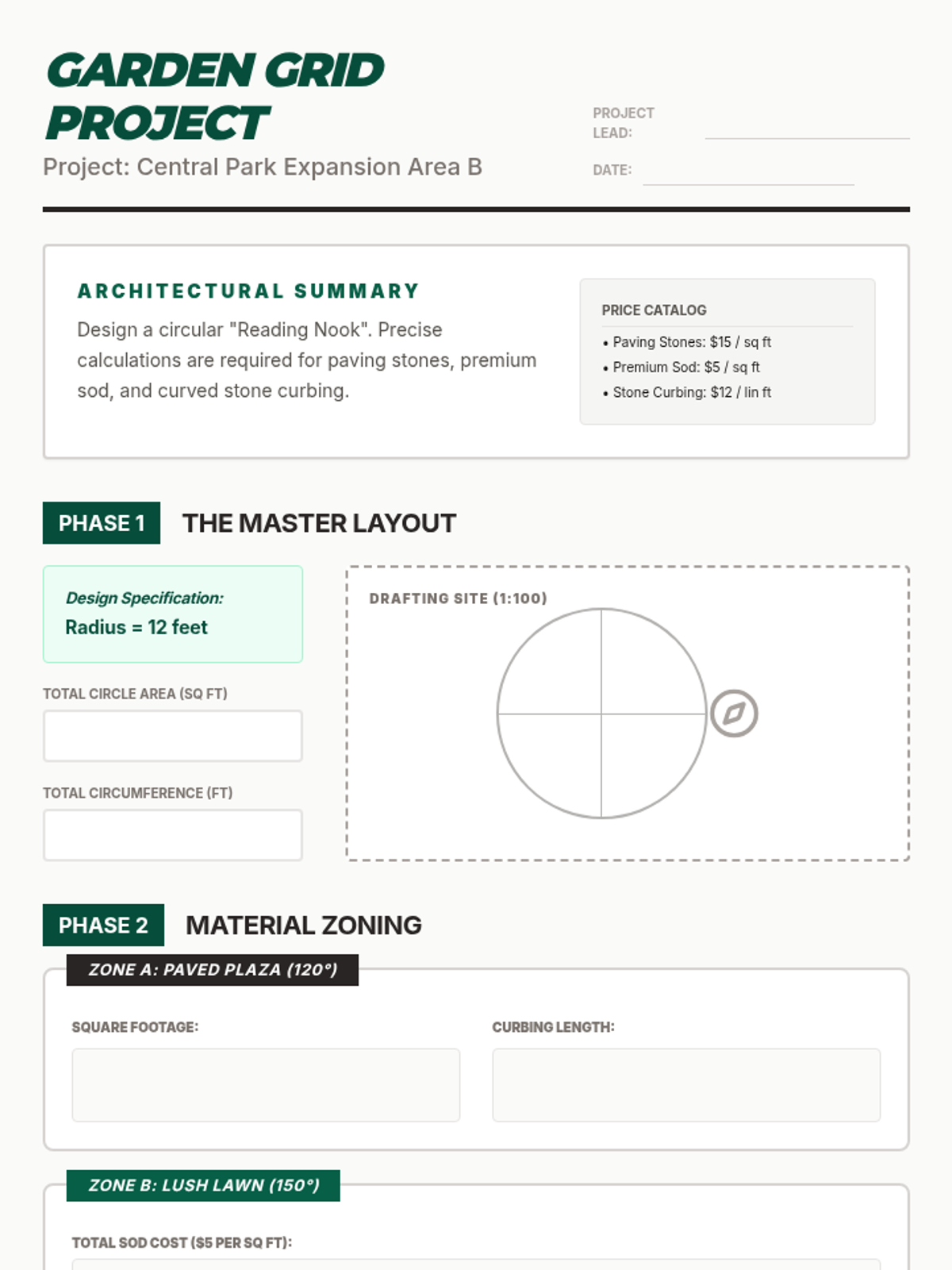
A landscape architecture project where students design a circular garden. Students calculate sector areas for sod and paving, and arc lengths for stone curbing and railings across different zones.
An instructional slide deck for landscape design geometry, teaching the application of sector area and arc length formulas in park planning and garden architecture.
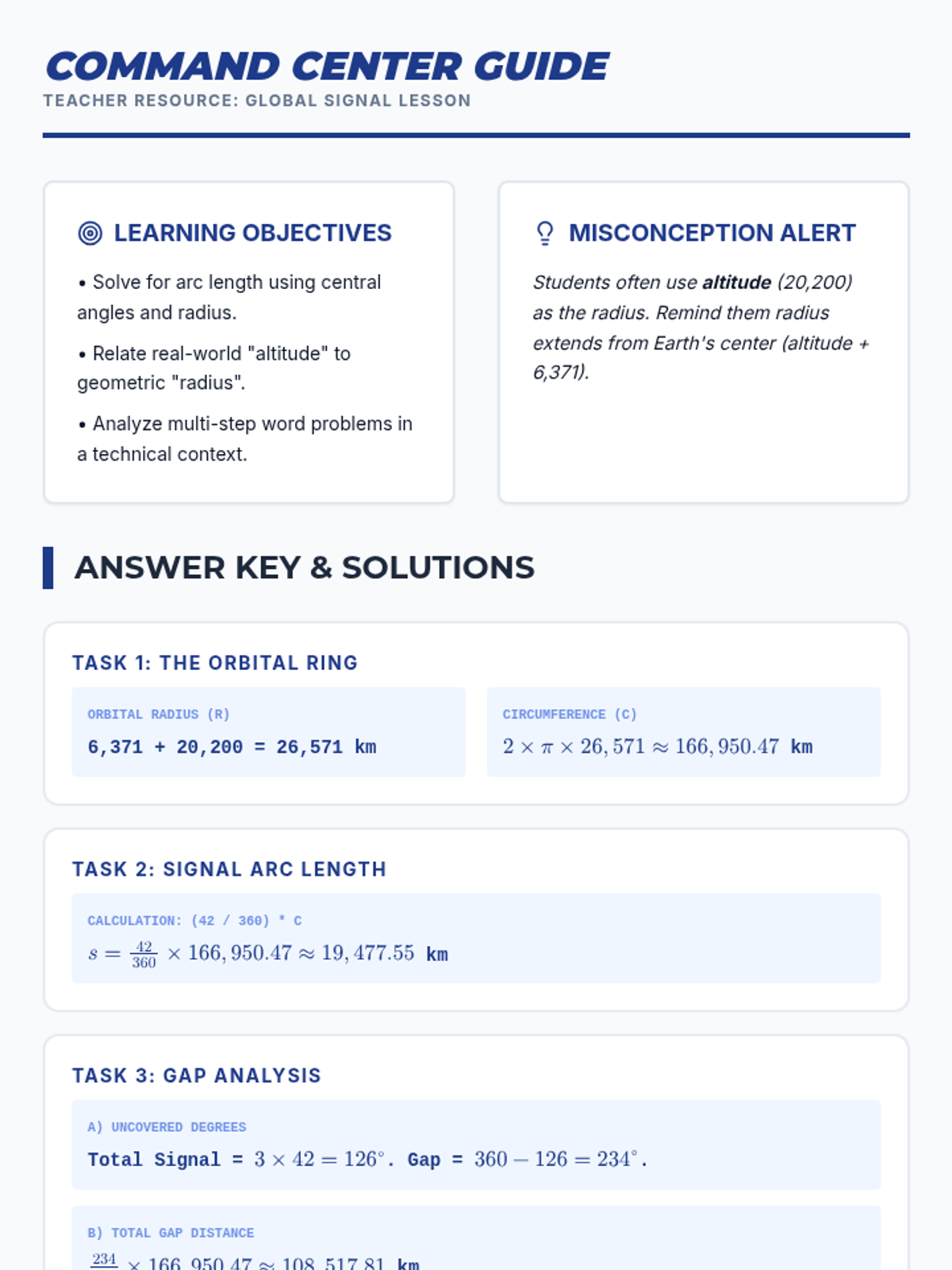
Teacher guide for the Global Signal lesson, providing learning objectives, potential misconceptions, detailed answer keys, and facilitation tips for the orbital engineering project.
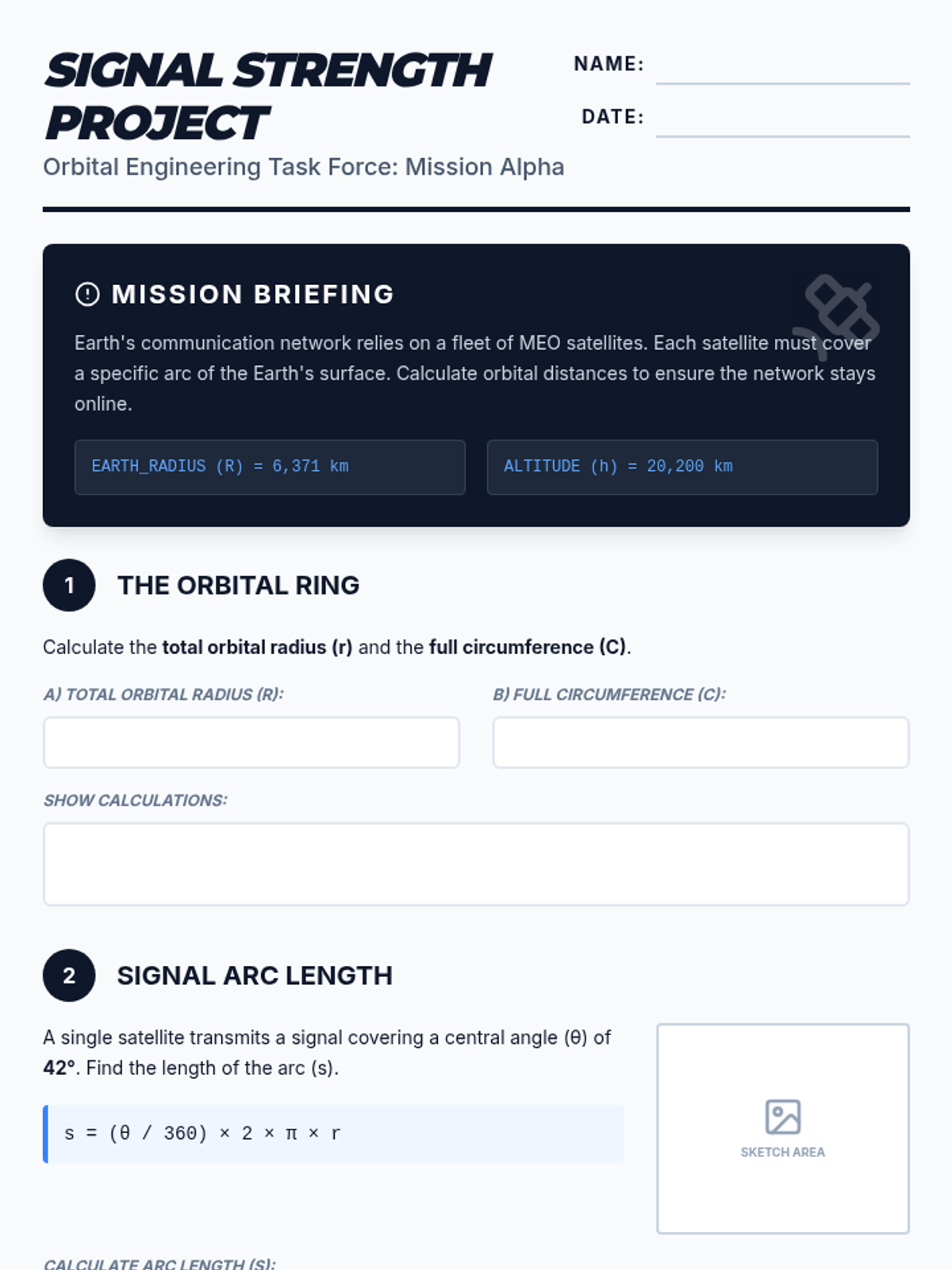
A problem-based worksheet where students apply circle geometry to satellite orbits. Tasks include calculating orbital radius, arc length for signal coverage, and identifying network gaps.
A visual introduction to orbital mechanics, focusing on the application of central angles and arc length formulas in satellite technology. The slides use a technical mission control theme to engage students in real-world geometry.
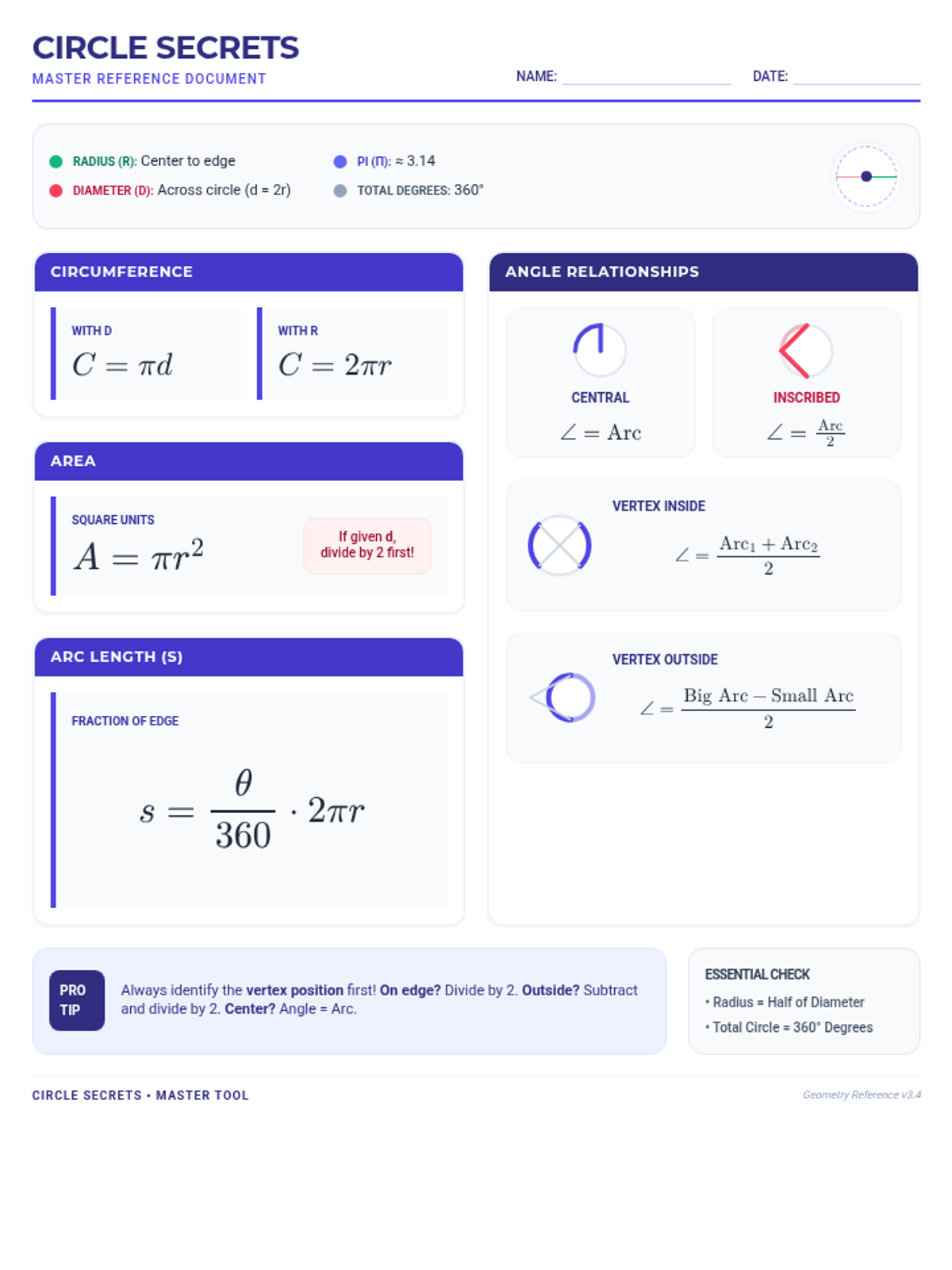
A circle geometry reference sheet with updated formula rendering and cleaner diagrams that remove redundant borders for a professional look. Diagrams are now clipped and footer text is expanded for clarity.
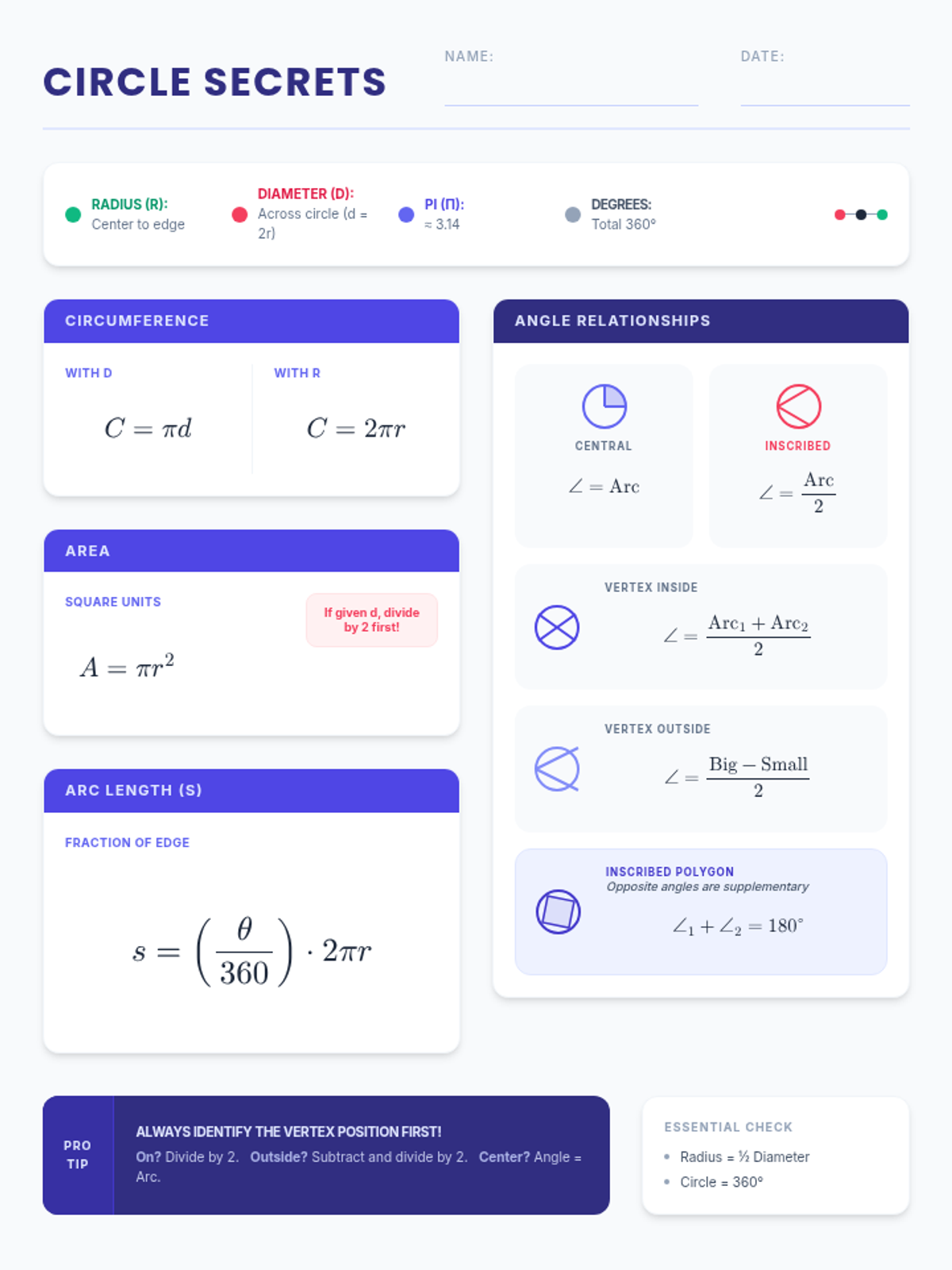
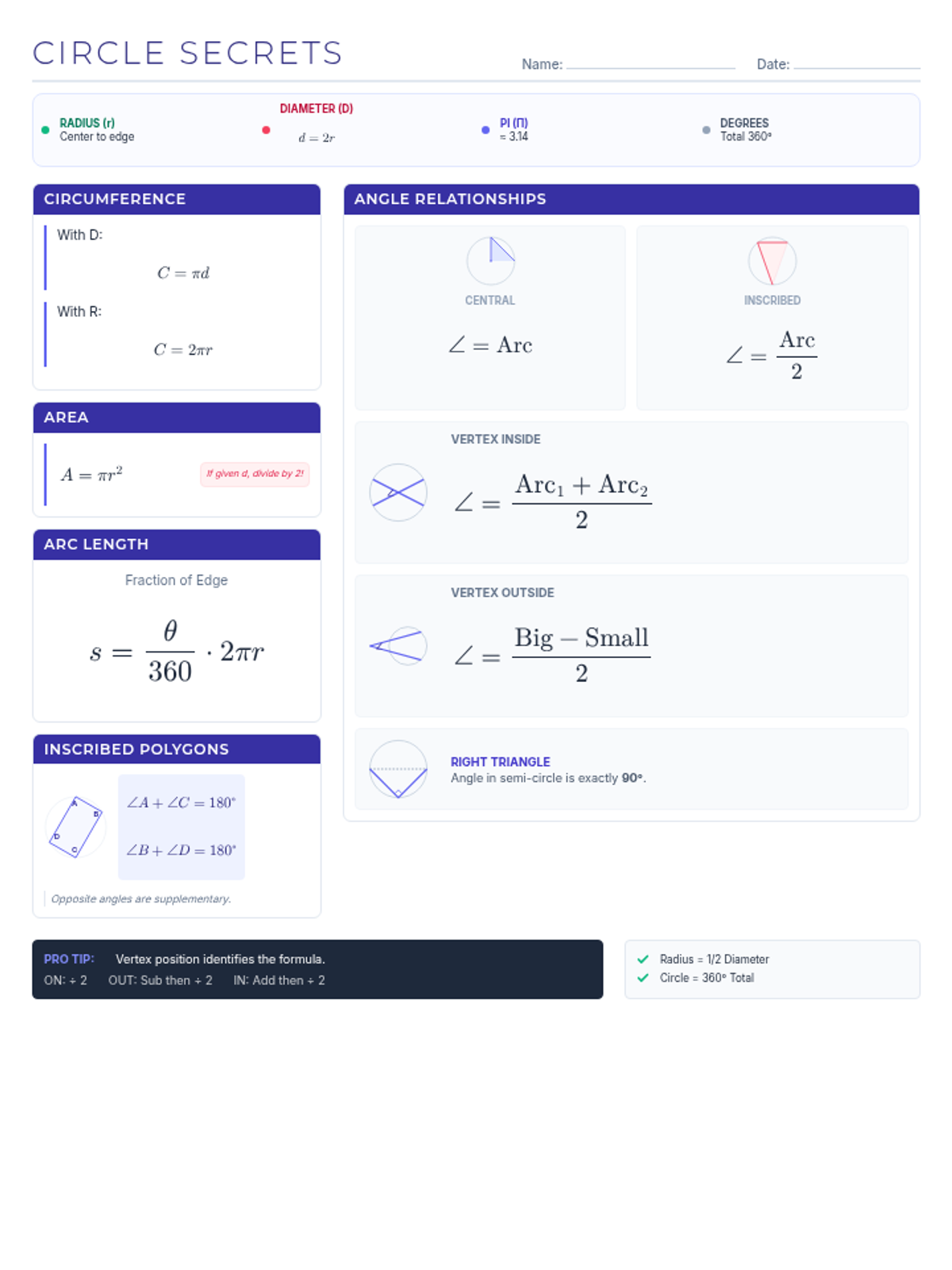
A highly condensed, single-page circle geometry reference sheet. It includes formulas for circumference, area, arc length, and angle relationships, featuring corrected inscribed polygon diagrams where vertices accurately touch the circle's edge. Layout and mathematical rendering are optimized for clarity and a strict single-page print format.
An expanded single-page reference sheet for circle geometry. Now includes boundary formulas (circumference, area, arc length) and a comprehensive section on angle relationships (central, inscribed, interior, and exterior angles) with visual aids. All fractional formulas have been updated to use division by 2 and the diagrams have been refined for clarity.
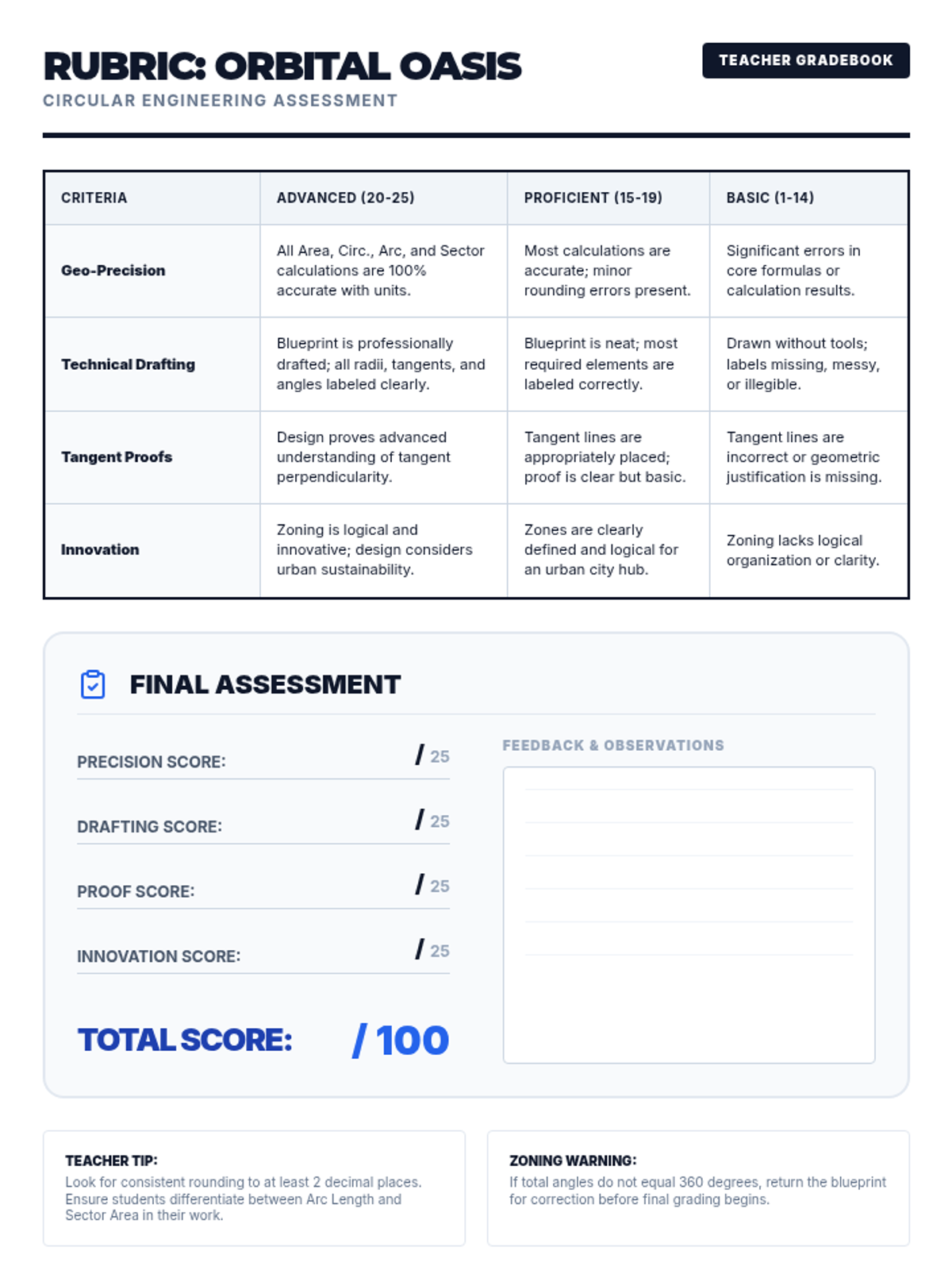
A teacher-facing grading rubric for the Orbital Oasis project, assessing mathematical precision, technical drafting, tangent proofs, and design innovation.
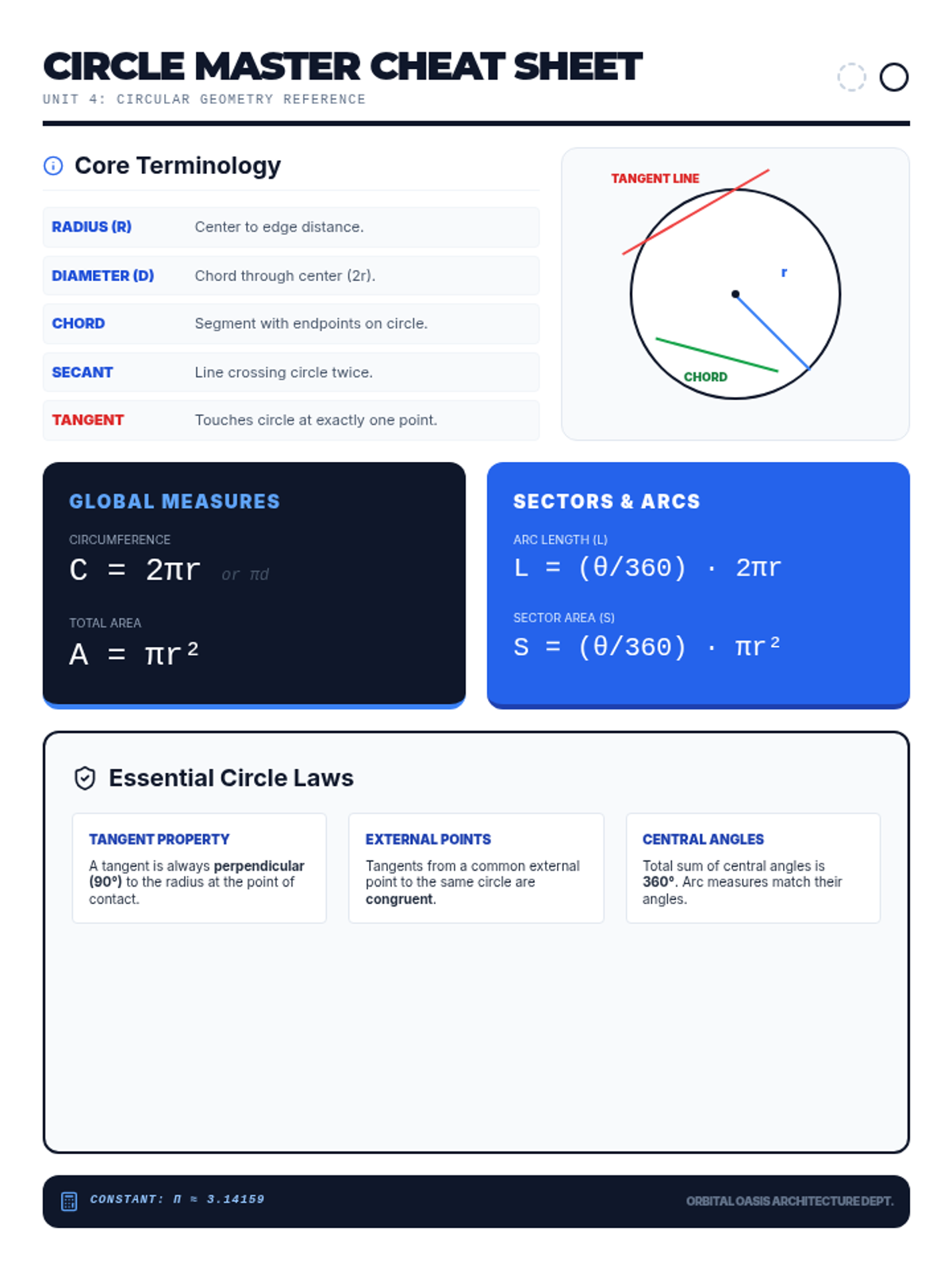
A comprehensive reference sheet for students covering circle terminology, essential formulas for area, circumference, arc length, and sector area, and key circle theorems for the Orbital Oasis project.
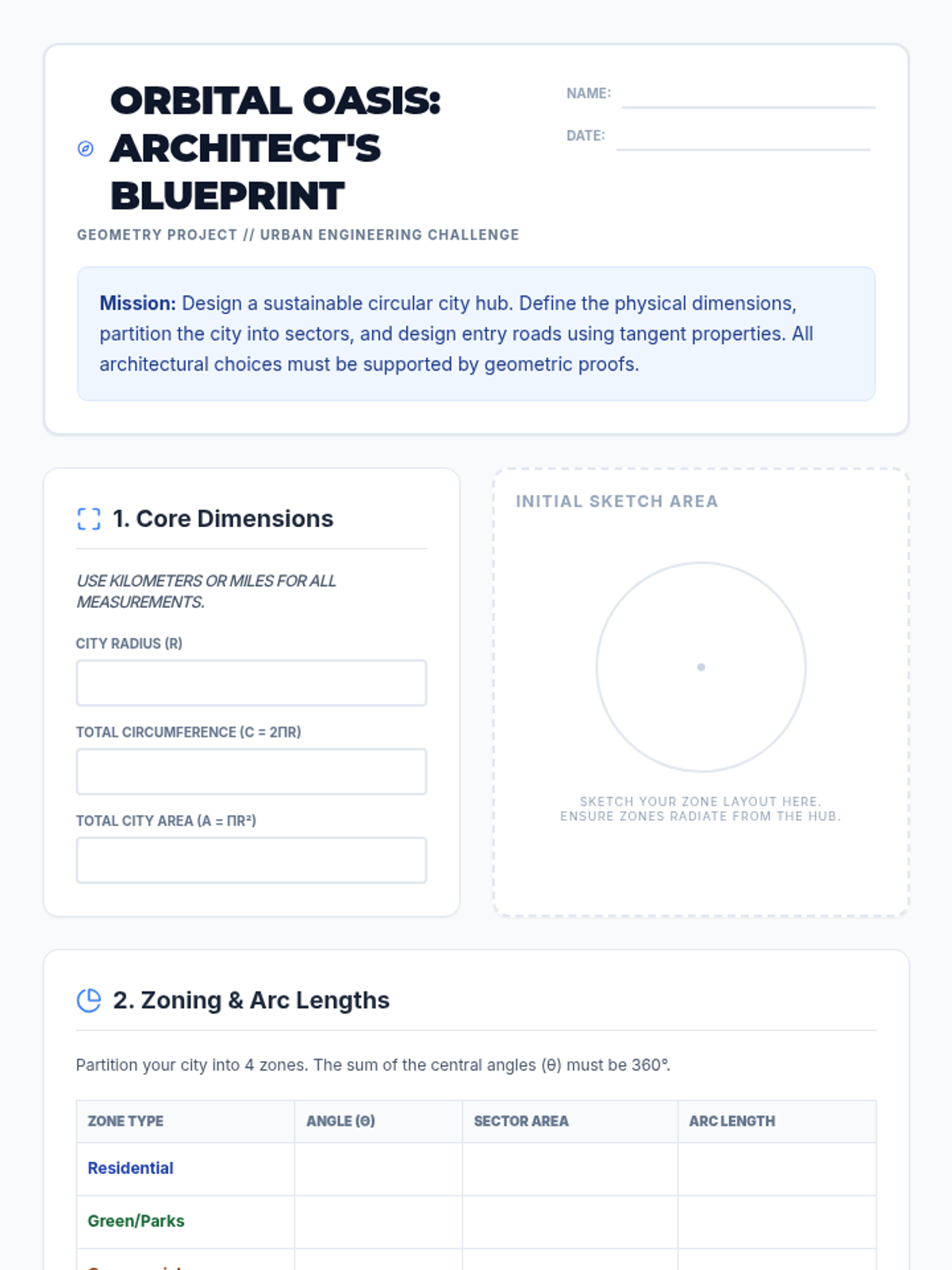
The main student-facing project guide for Orbital Oasis, where students perform calculations for area, circumference, arc length, sector area, and tangent lines, and create an architectural sketch.
Introductory slides for the Orbital Oasis project, covering the architectural advantages of circular design, historical inspiration, and project requirements for high school students.
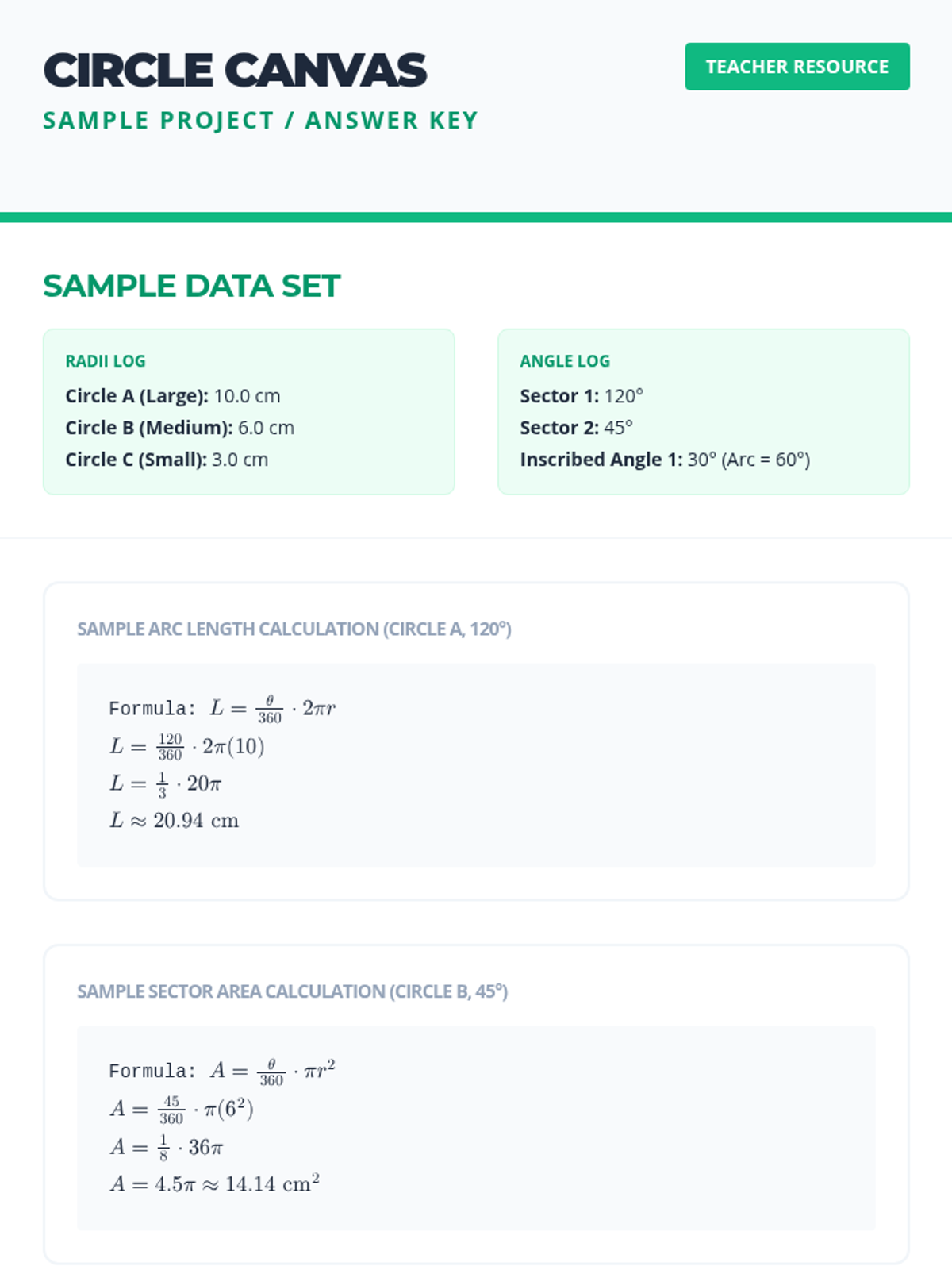
A sample project key showing completed calculations for arc length, sector area, and inscribed angles to provide teachers with a baseline for grading and feedback.
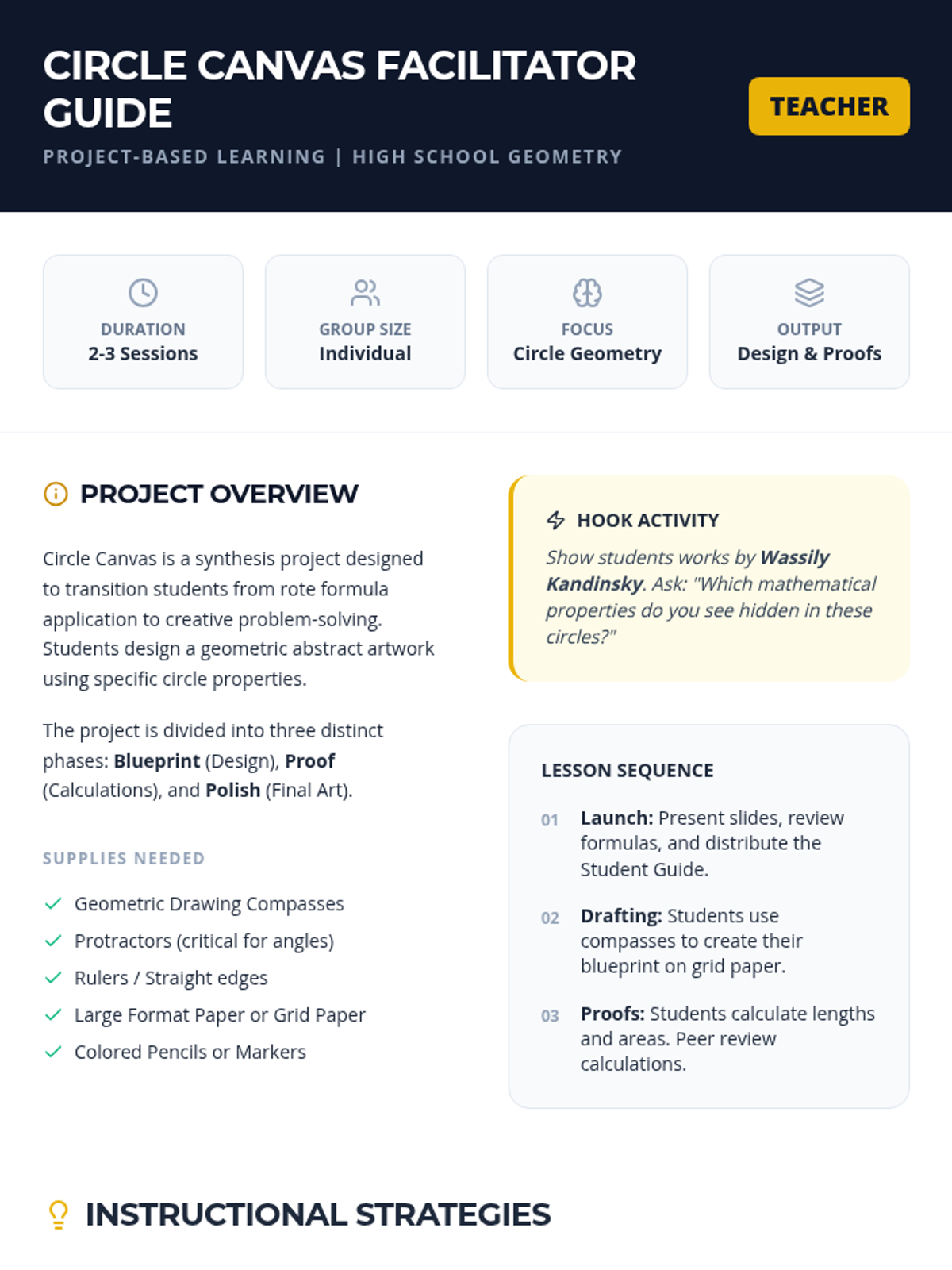
A teacher's facilitation guide for the Circle Canvas project, including lesson pacing, supply lists, common student misconceptions, and differentiation strategies.
A visual presentation for first graders explaining partitioning. Revised to include practice slides, a "Level Up" challenge slide, and a quick exit ticket. Improved contrast, visual alignment, and pedagogical accuracy.
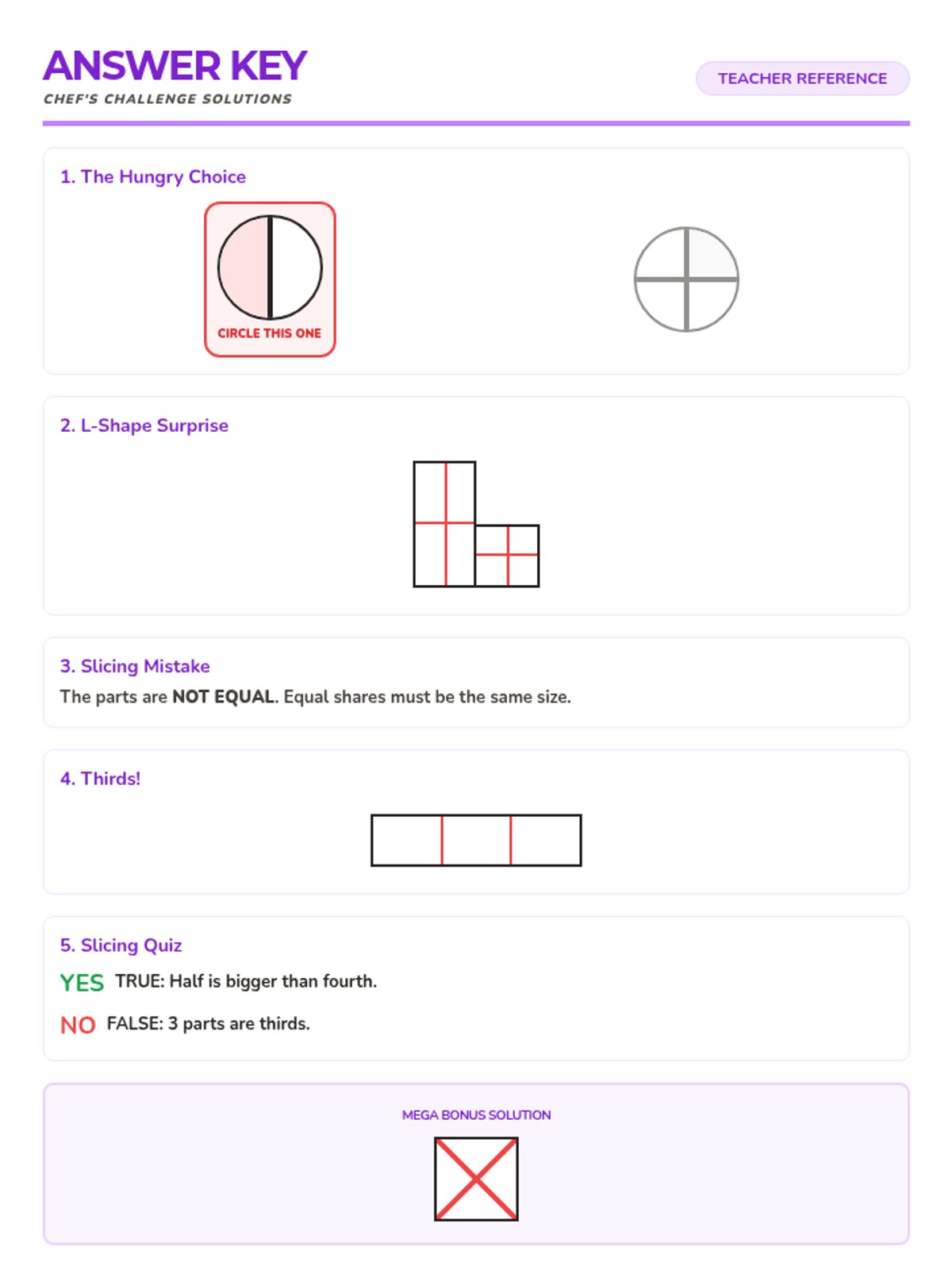
Answer key for the Chef's Challenge worksheet, providing solutions for comparison, error analysis, and thirds. Revised for better page breaks and diagram clarity.
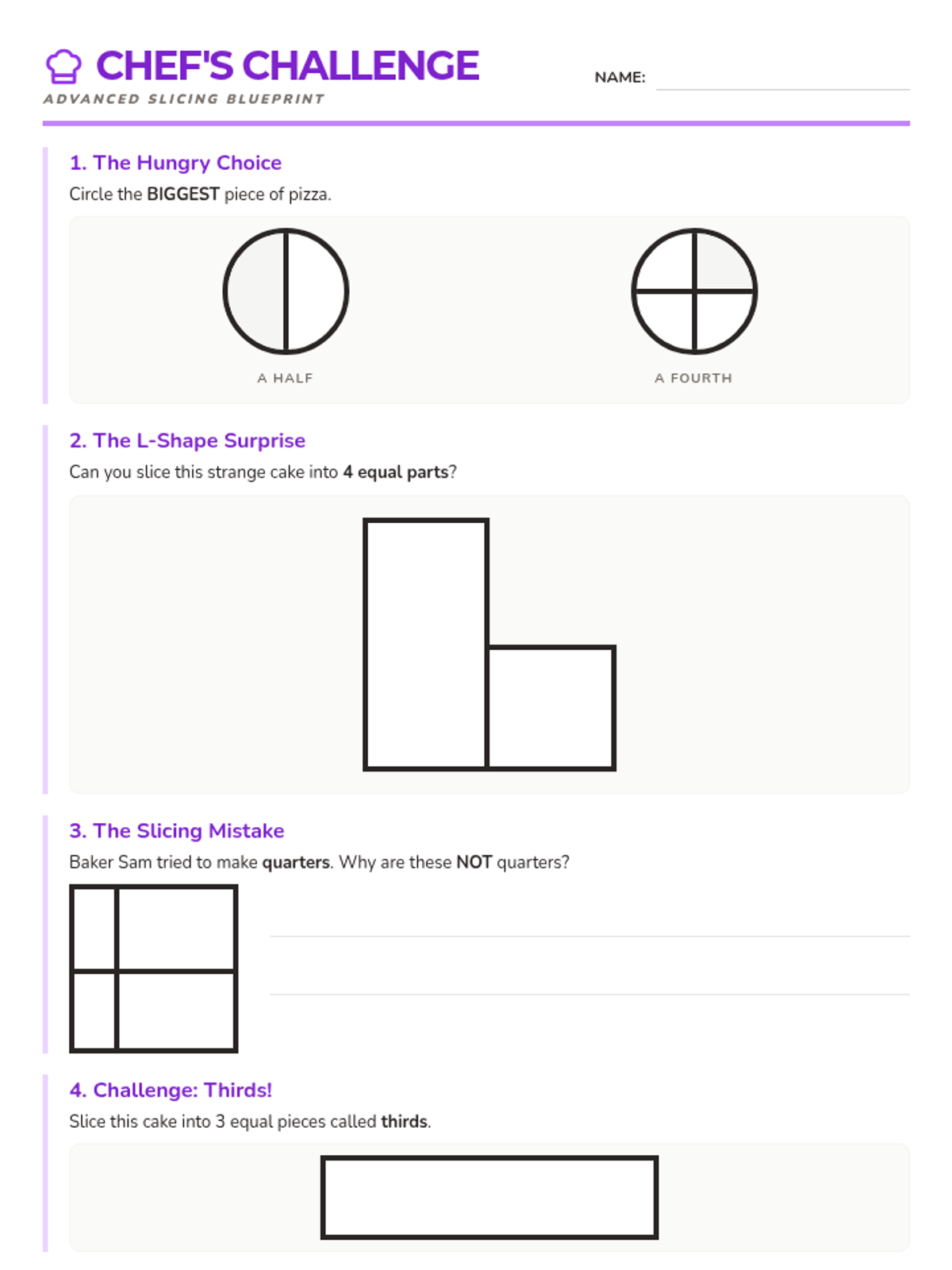
An advanced "Chef's Challenge" worksheet for 1st graders who have mastered basic partitioning. It introduces thirds, size comparison, and identifies slicing errors. Revised for better layout and geometric accuracy.
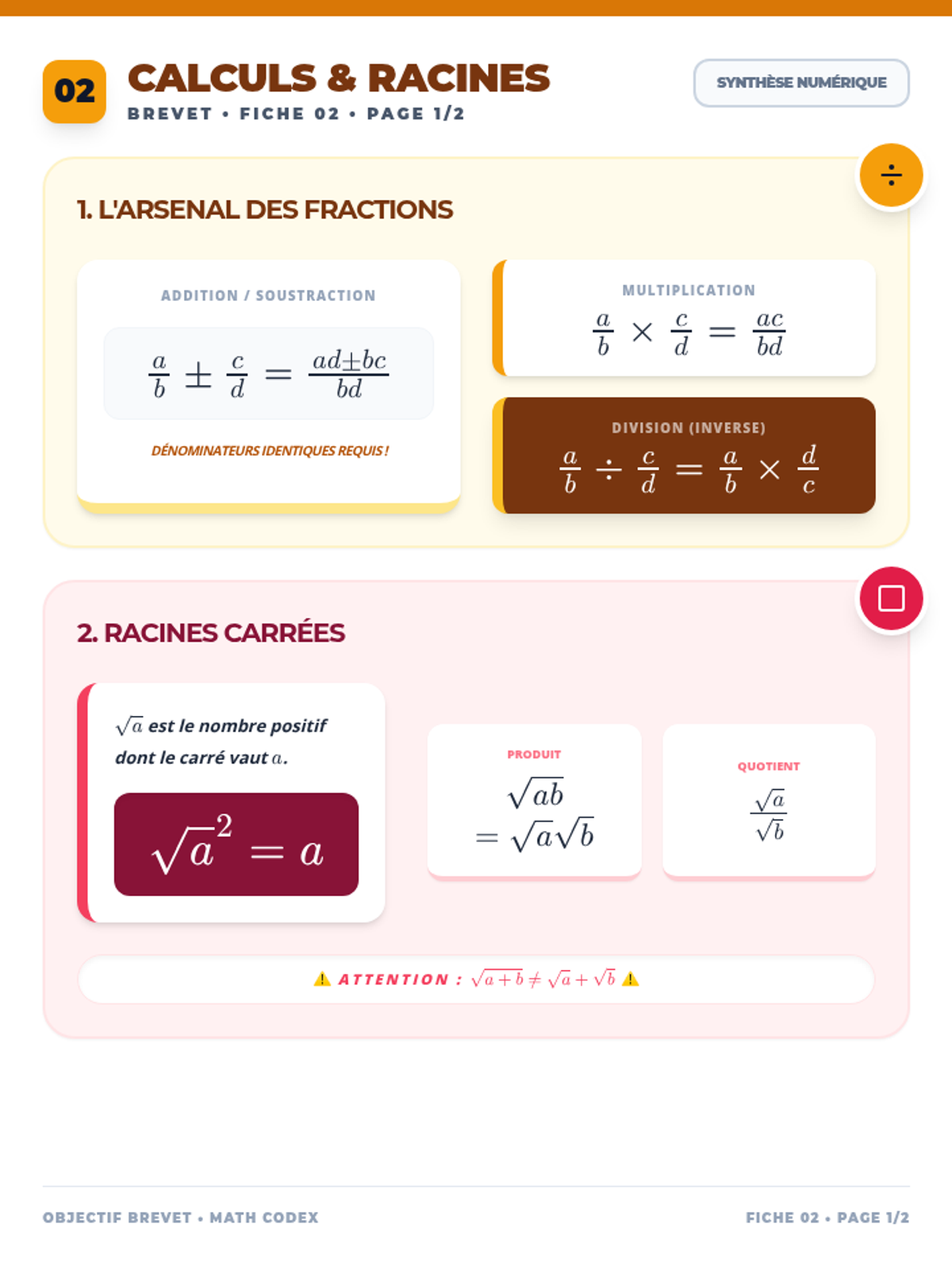
Une fiche de révision complète sur le calcul : fractions, puissances, notation scientifique et racines carrées. Regroupe les concepts des photos 1 et 4 avec une présentation aérée et détaillée sur 2 pages (cours). Synthèse pure. Correction des débordements de page.
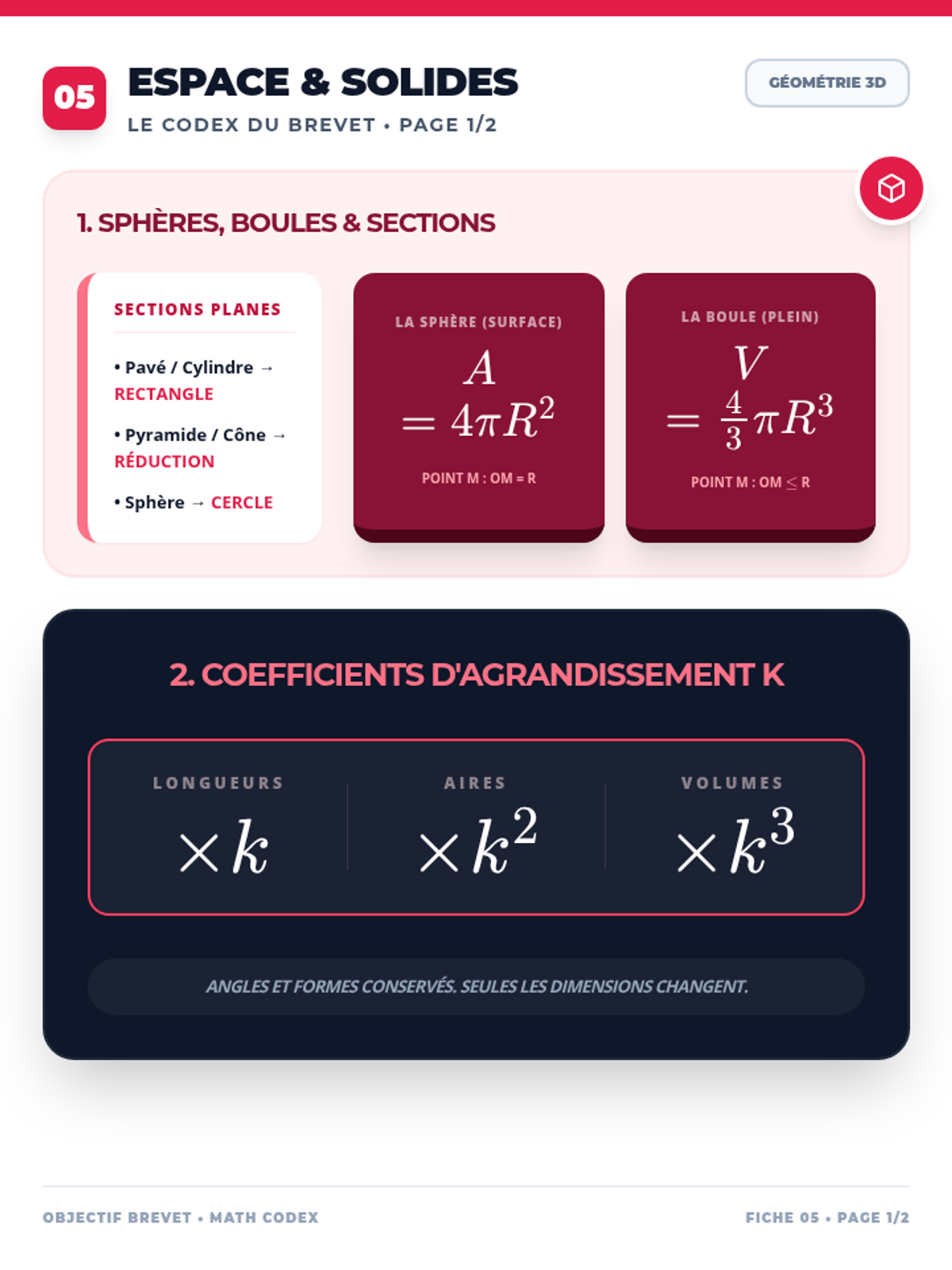
Une fiche de révision complète sur l'espace (solides, sphères, sections, agrandissements), les statistiques (n/N expliqués) et les probabilités. Regroupe les concepts des photos 6, 8, 10 et 11. Synthèse pure sans exercices sur 2 pages. Correction de la formule de la moyenne. Intègre la citation de Larson.
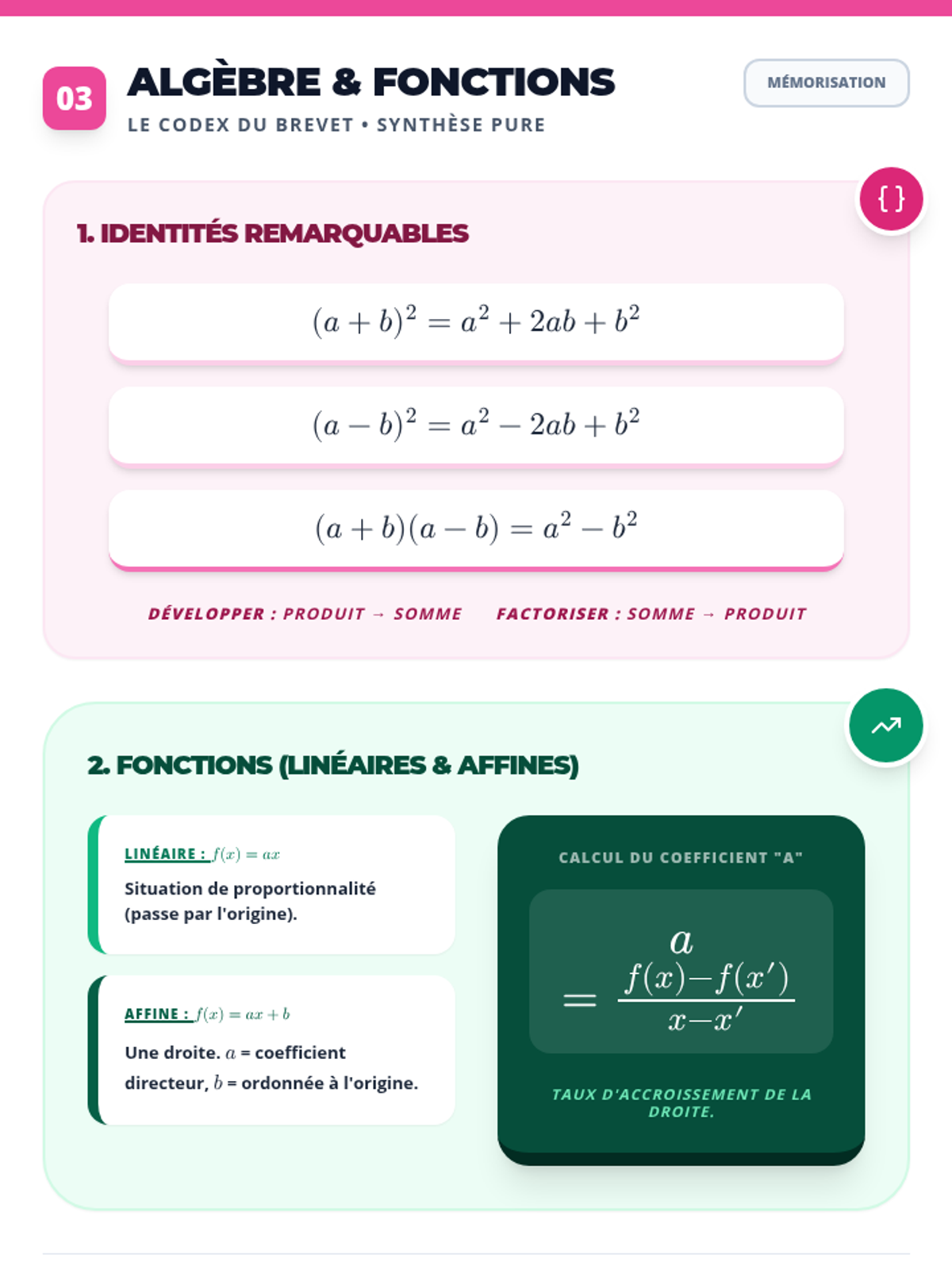
Une fiche de révision complète sur l'algèbre (identités, équations, systèmes) et les fonctions. Contient désormais une explication simplifiée des méthodes de substitution et de combinaison. Synthèse pure sans exercices sur 2 pages. Correction du débordement de page.
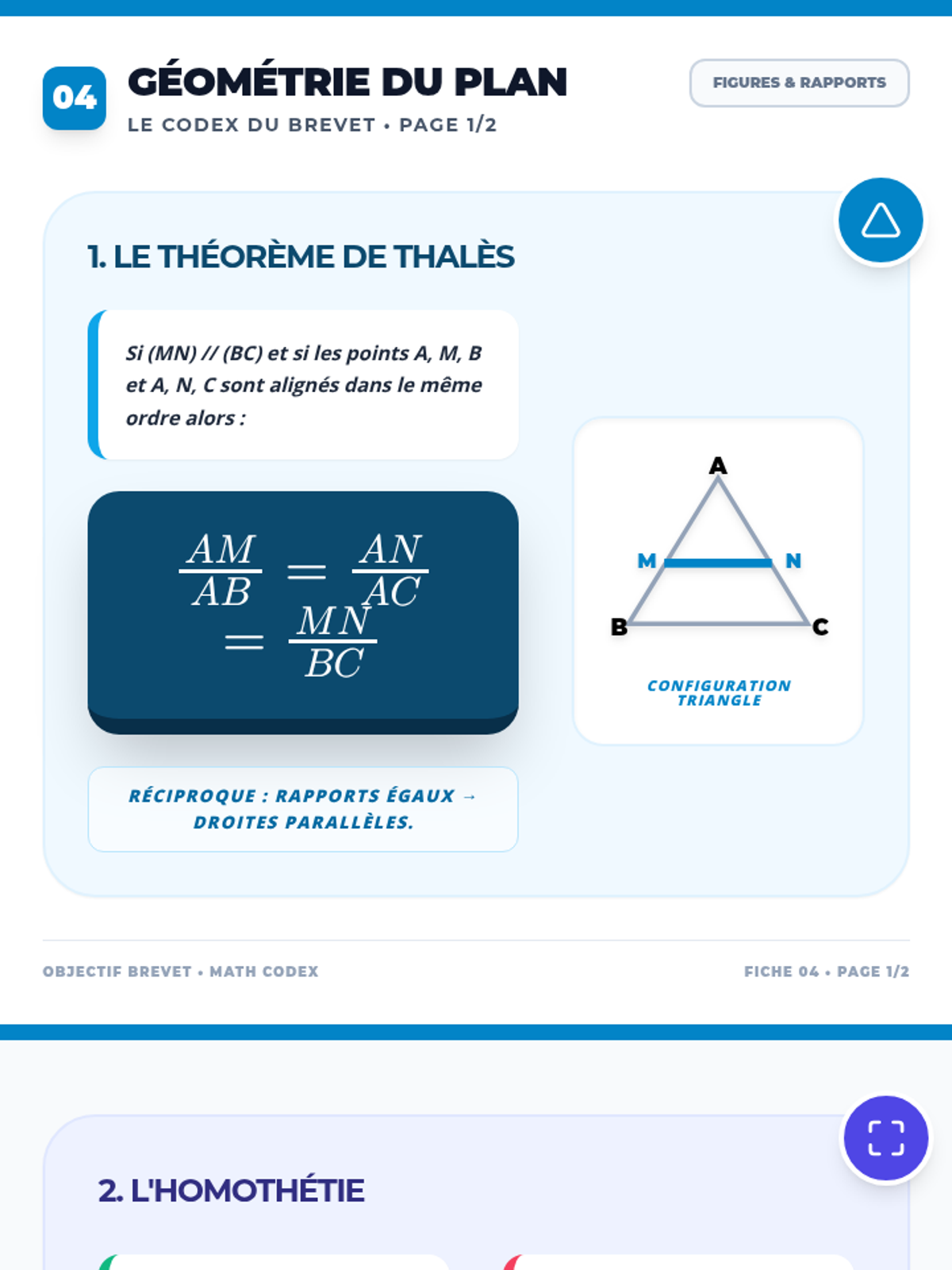
Une fiche de révision visuelle sur le théorème de Thalès, l'homothétie, les angles inscrits et les polygones réguliers pour les élèves de 3ème. Regroupe les concepts des photos 3, 5, 7 et 8. Synthèse pure sur 2 pages denses. Explique les lettres K, P, KL, KO, KS. Représentation du triangle avec les points B et C. Correction de la formule de l'homothétie et de la pagination.
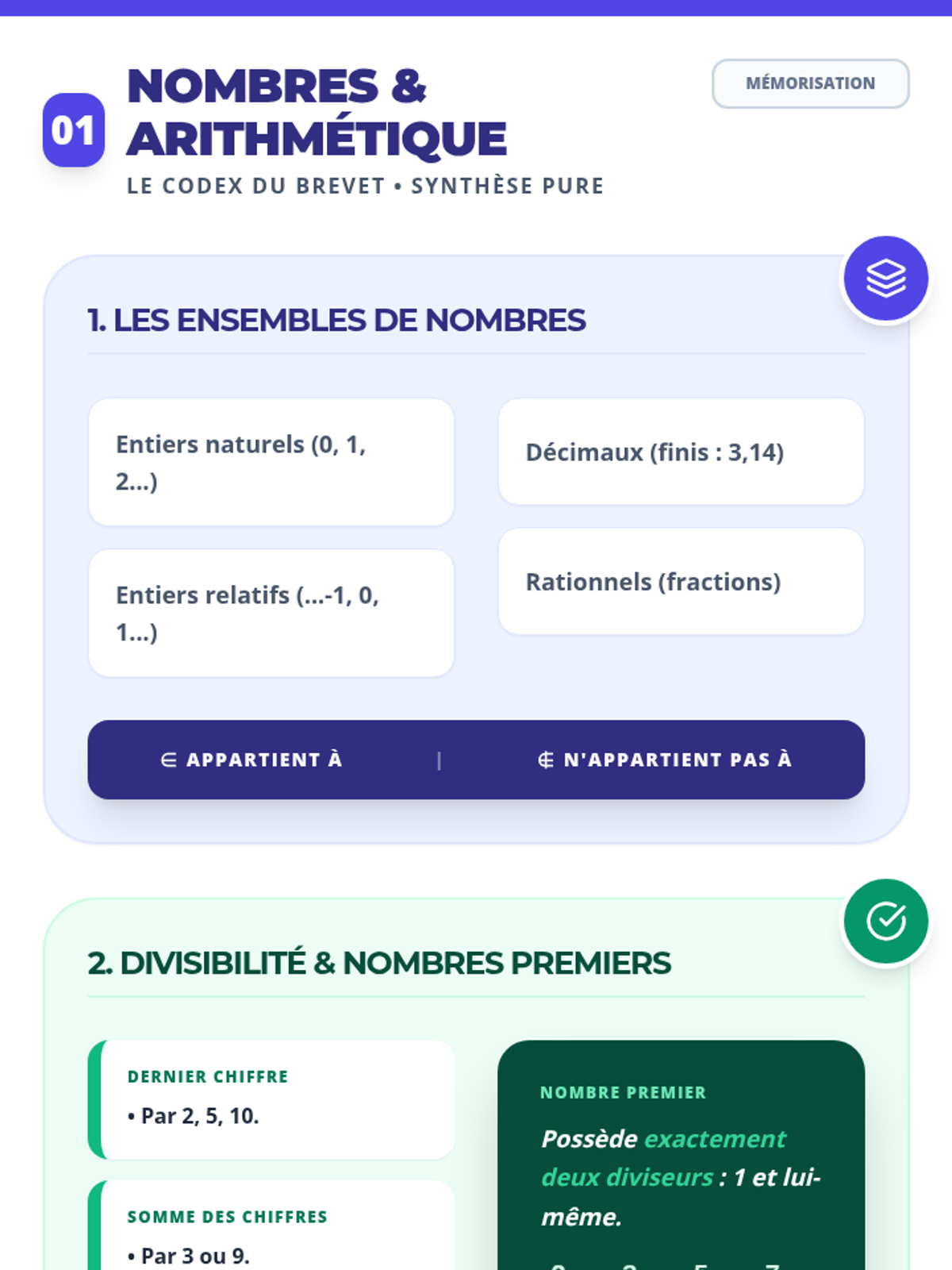
Fiche de révision 01 : Nombres et Arithmétique. Détaille l'algorithme d'Euclide et la méthode des différences pour le PGCD. Couvre les ensembles, la divisibilité et l'algorithmique. Synthèse pure. Correction des rendus de symboles et de la pagination.
Un diaporama ultra-complet et dynamique couvrant l'intégralité des 11 synthèses du programme de 3ème. La diapositive de conclusion inclut désormais la citation de Christian D. Larson. Fixation des affichages mathématiques et des espacements.
An engaging presentation for Cyclic Secrets, featuring high-contrast visuals, clear theorem definitions, and a conceptual breakdown of why these geometric properties exist.
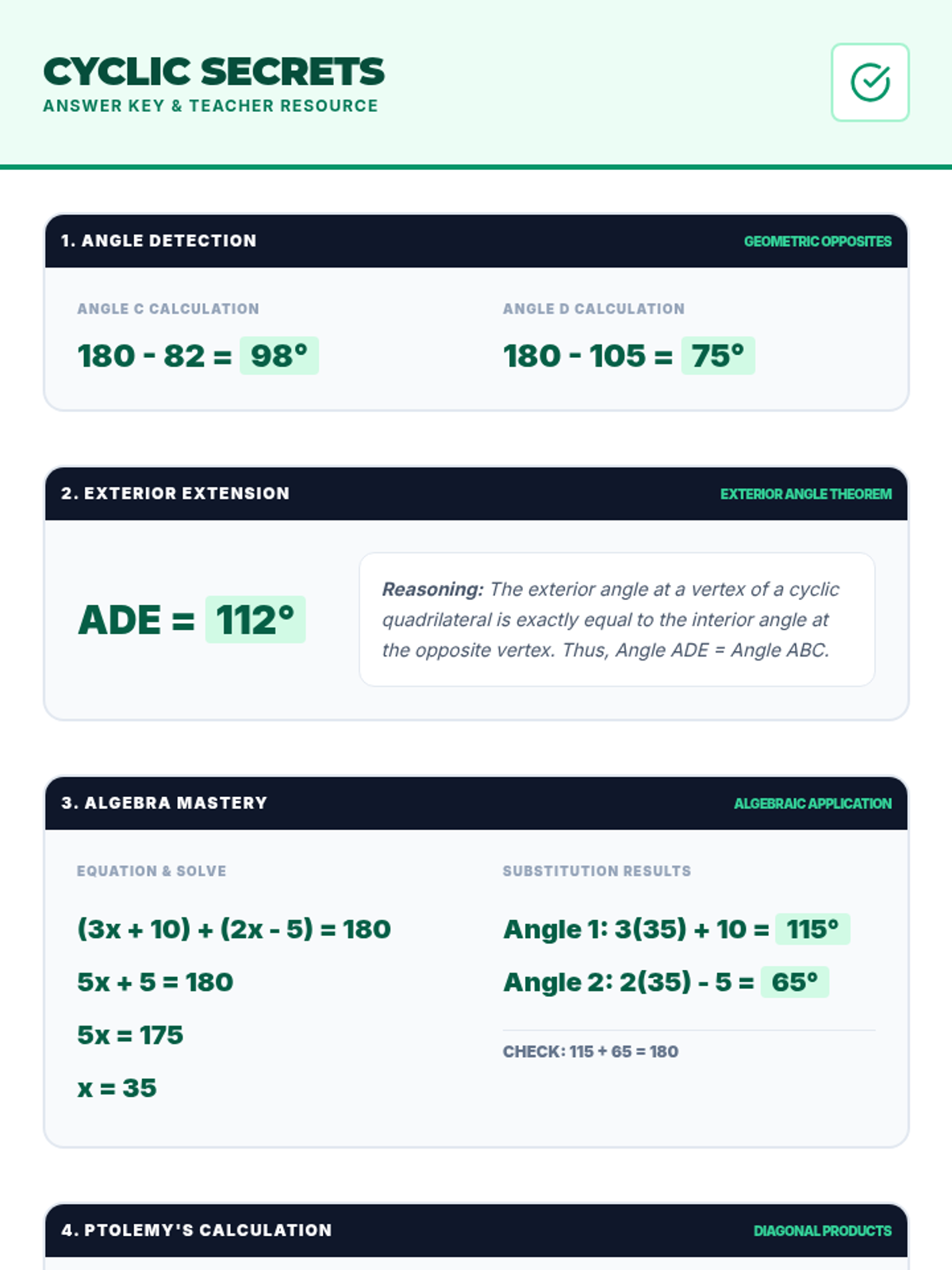
A clear and detailed answer key for the Cyclic Secrets practice worksheet, including step-by-step algebraic solutions and teaching notes on common student misconceptions.
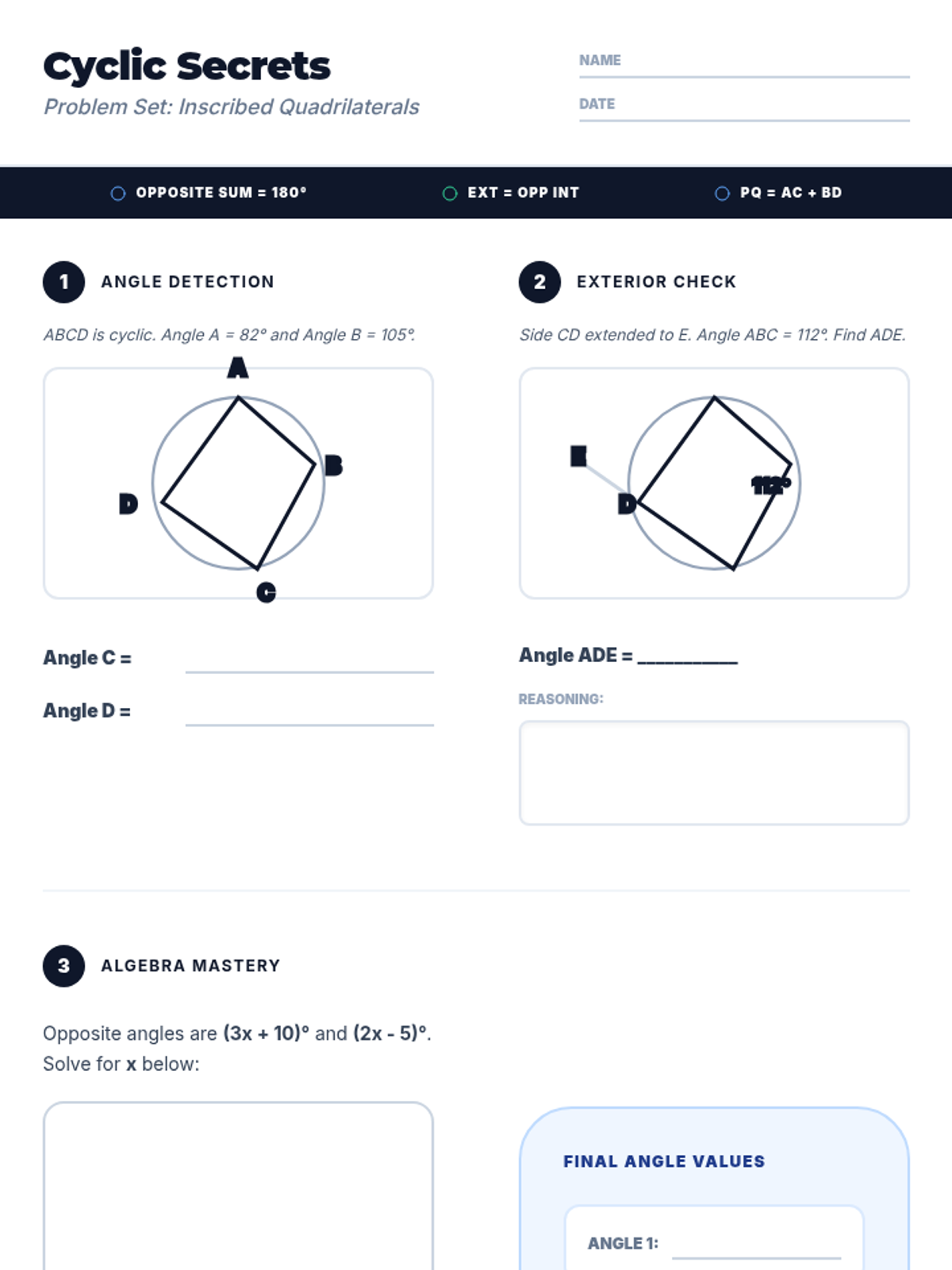
A comprehensive practice worksheet for cyclic quadrilaterals, featuring basic angle finding, exterior angle problems, algebraic applications, and a challenge problem using Ptolemy's Theorem.
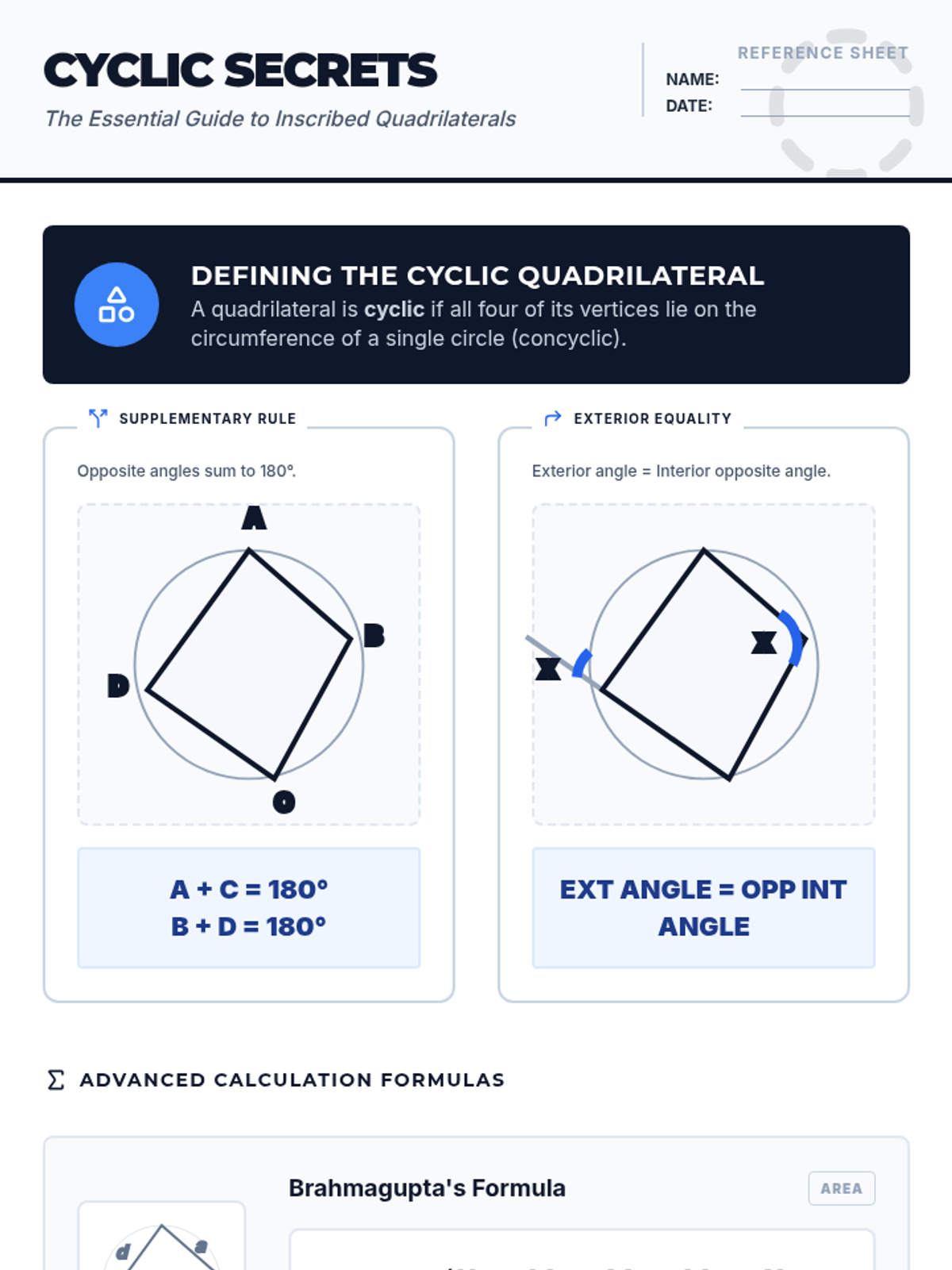
A clean, technical reference sheet for cyclic quadrilaterals featuring key theorems like supplementary opposite angles, exterior angle equality, Brahmagupta's formula, and Ptolemy's theorem.
A presentation for 'The Behemoth' lesson, reviewing key circle theorems and presenting initial given data for the challenge.
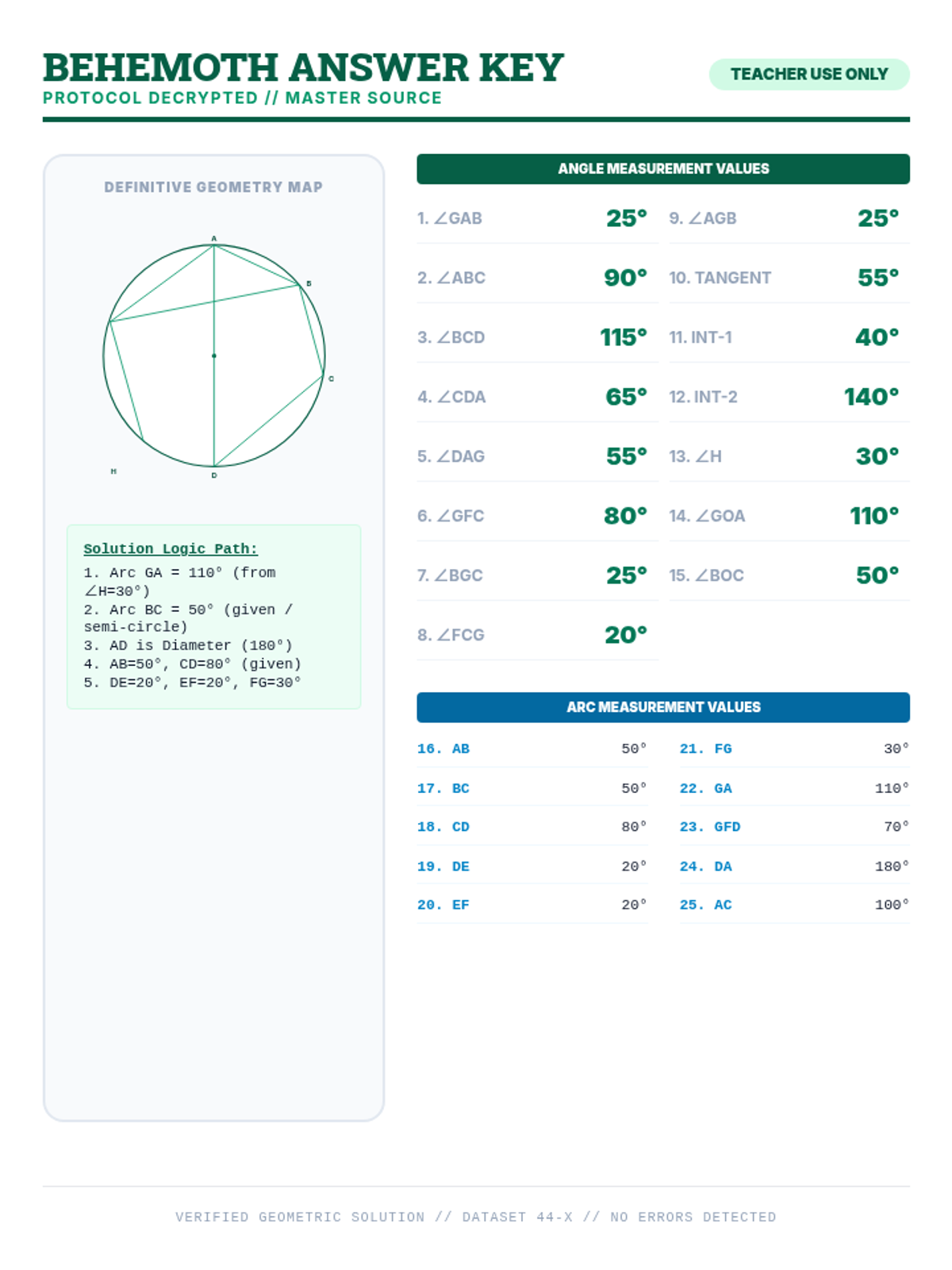
The teacher's answer key for the 'Behemoth' Monster Circle worksheet, containing all 25 solved measurements and a theoretical breakdown of the geometric logic used.
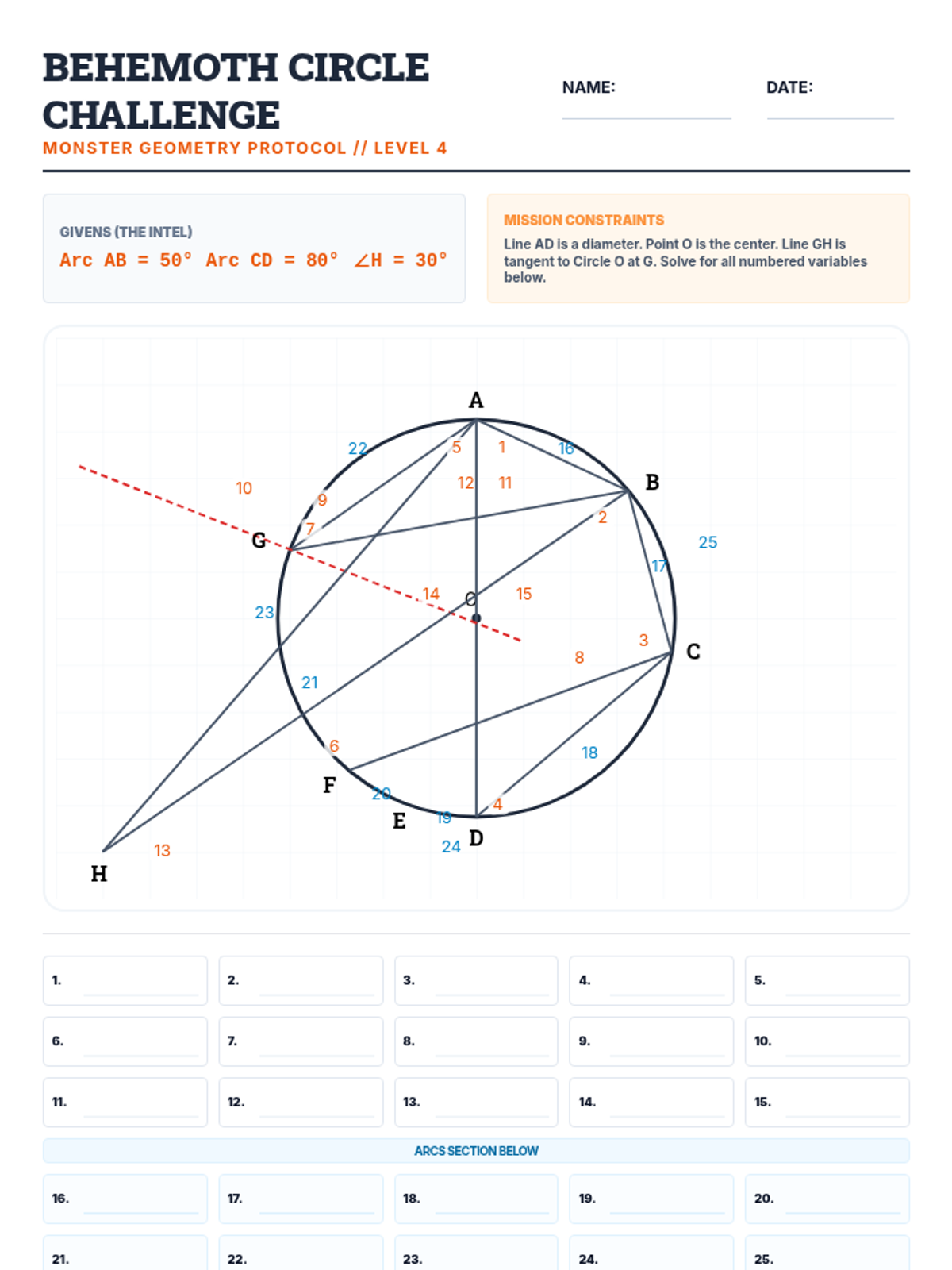
A complex 'Monster Circle' worksheet with 25 angles and arcs to solve using various circle theorems. features a large diagram and an answer grid for student work.
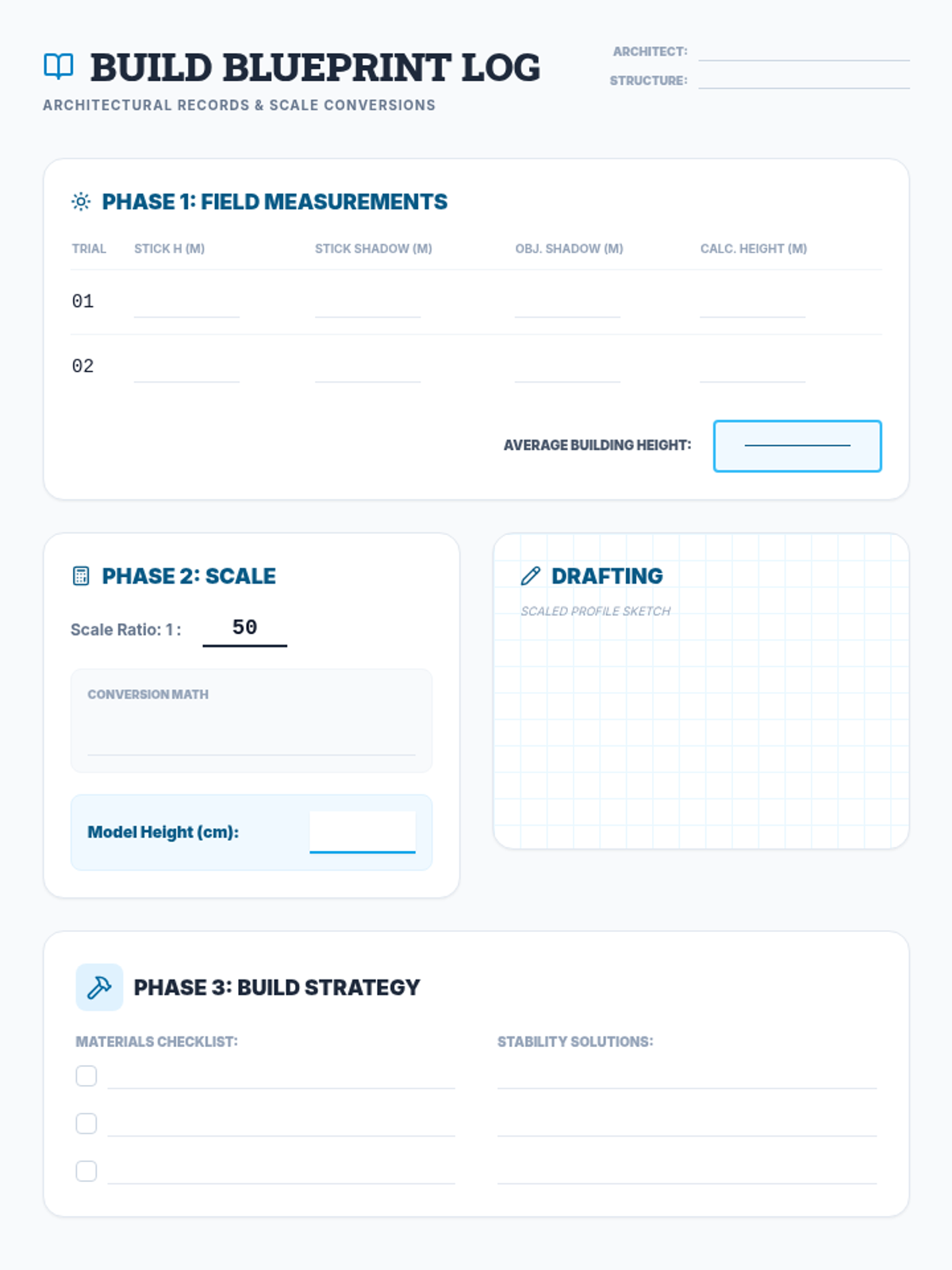
A student project log for recording field data, performing scale conversions, and sketching initial blueprints for their 3D scale model.
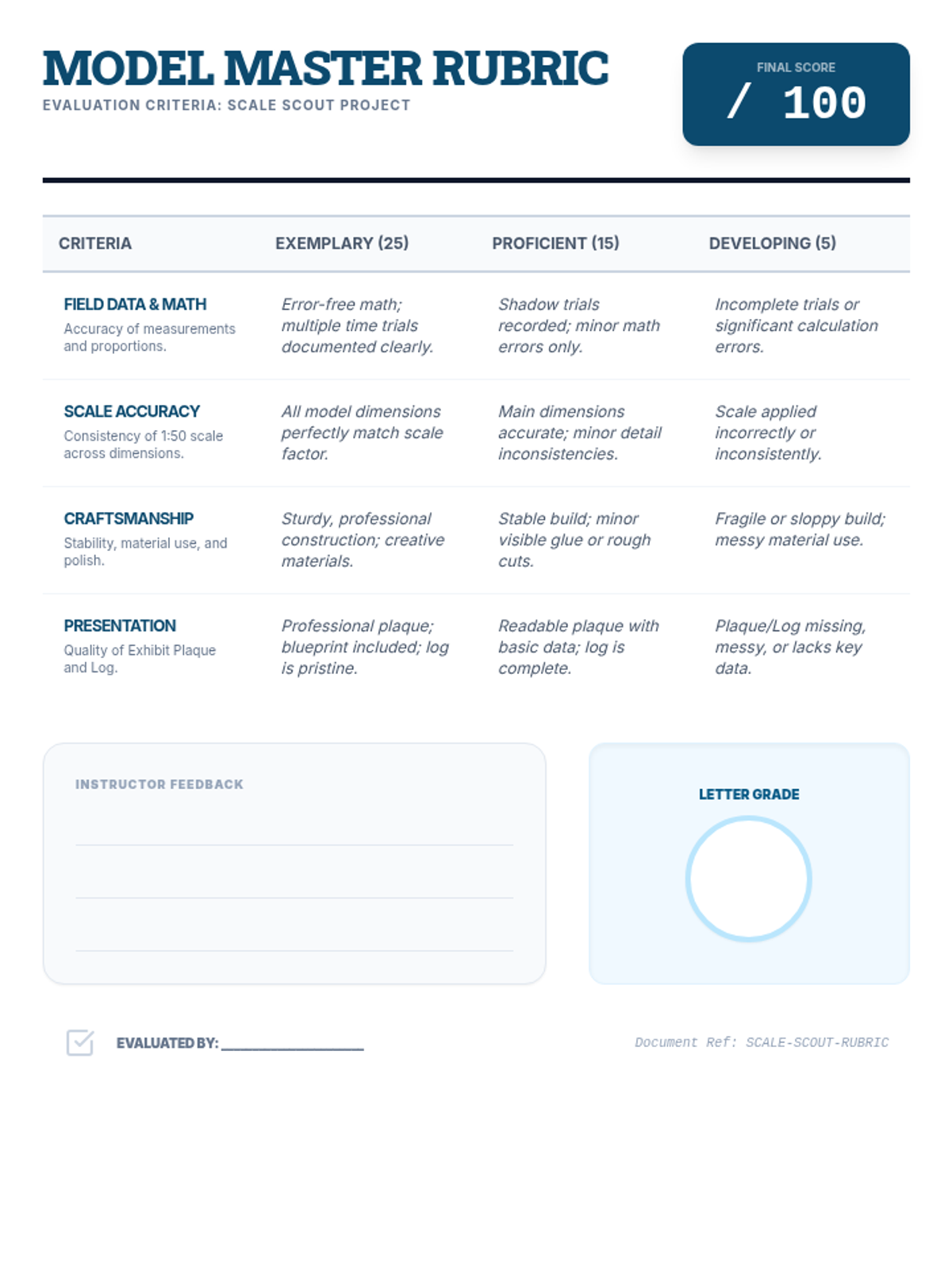
An assessment rubric for the Scale Scout Project, evaluating field data accuracy, scale precision, craftsmanship, and presentation.
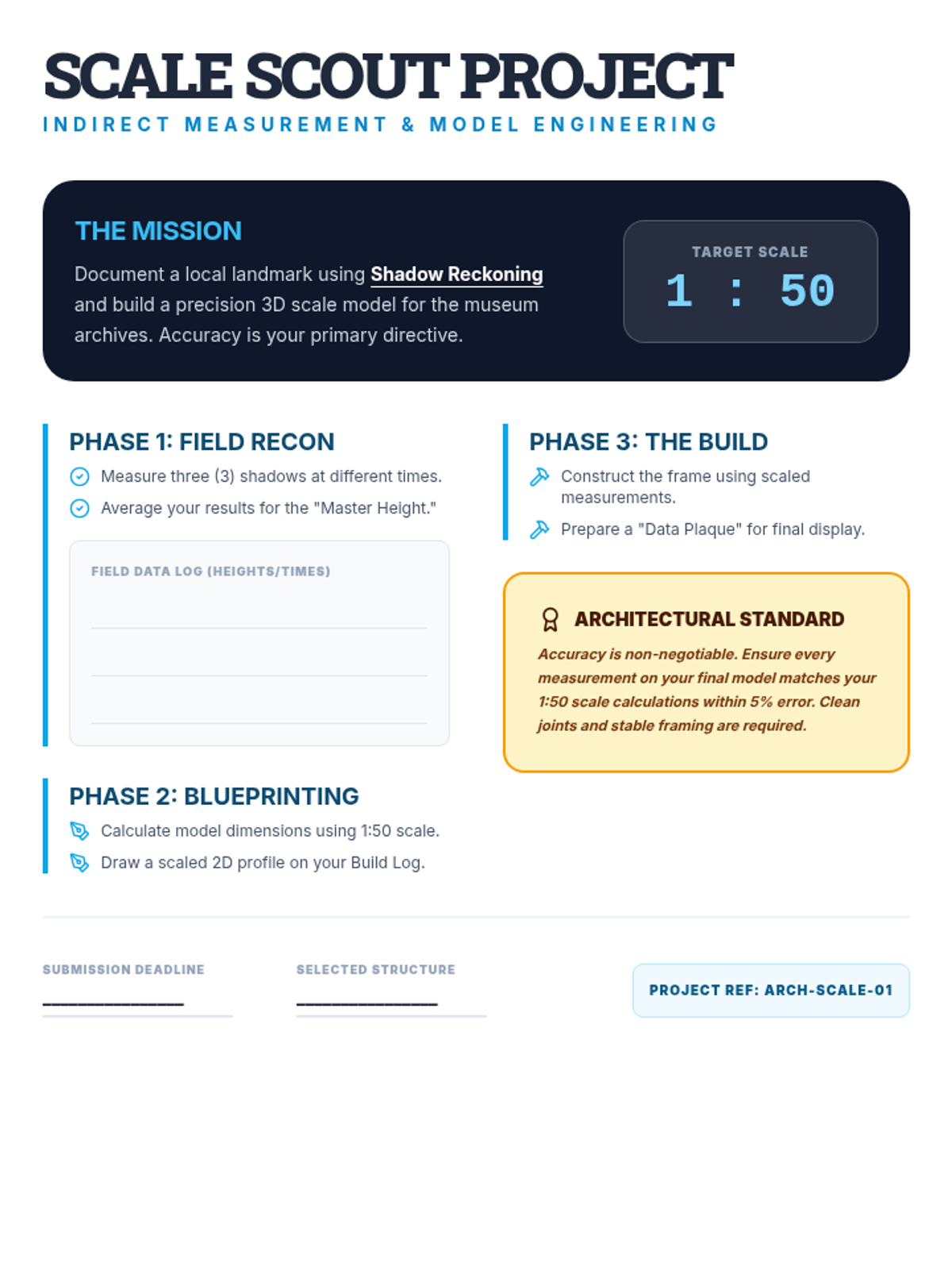
A comprehensive project guide for students, outlining the requirements for measuring a structure using shadow reckoning and building an accurate 3D scale model.
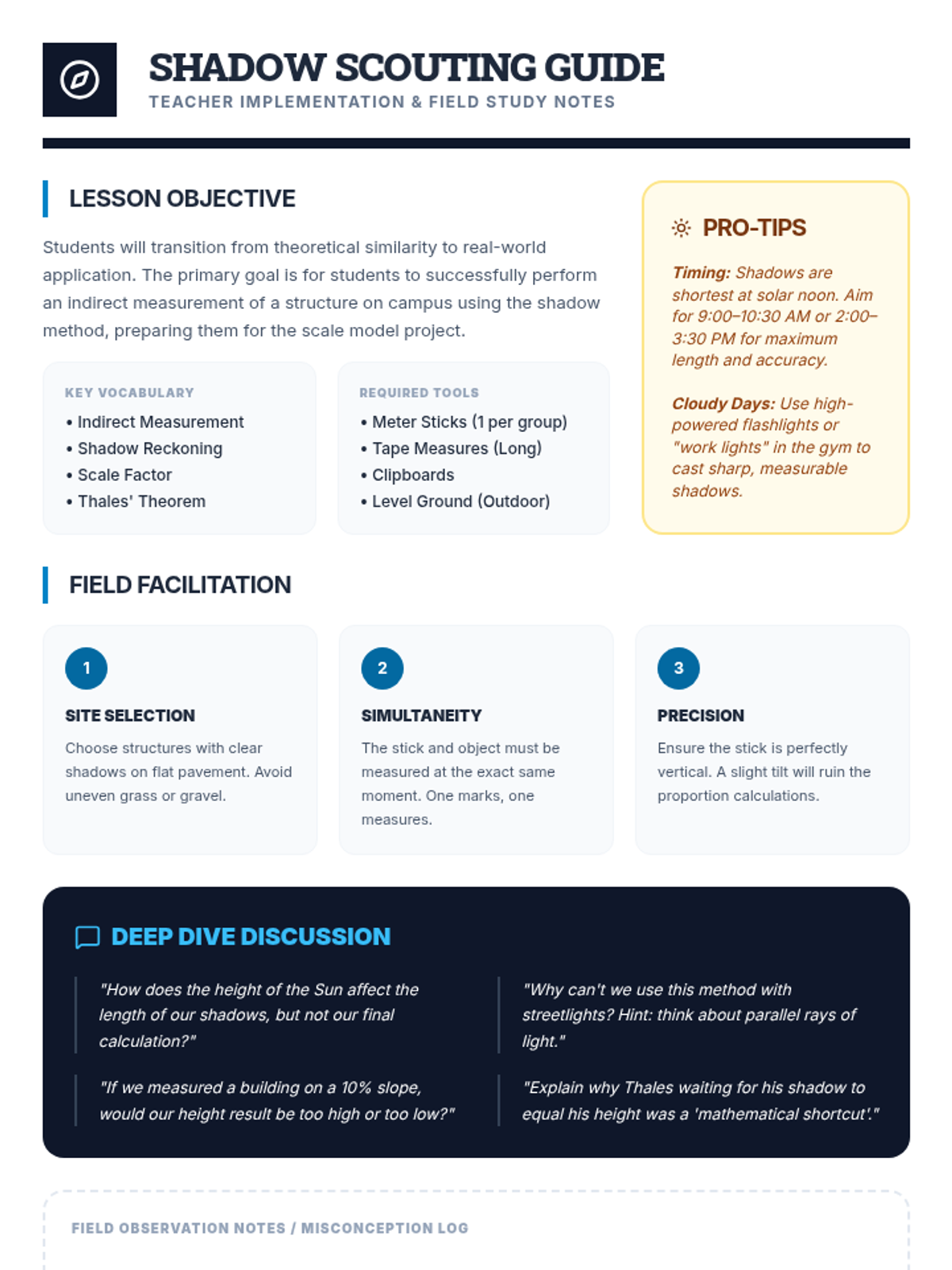
A teacher-facing guide for facilitating outdoor indirect measurement activities, including timing tips, site selection advice, and discussion prompts.
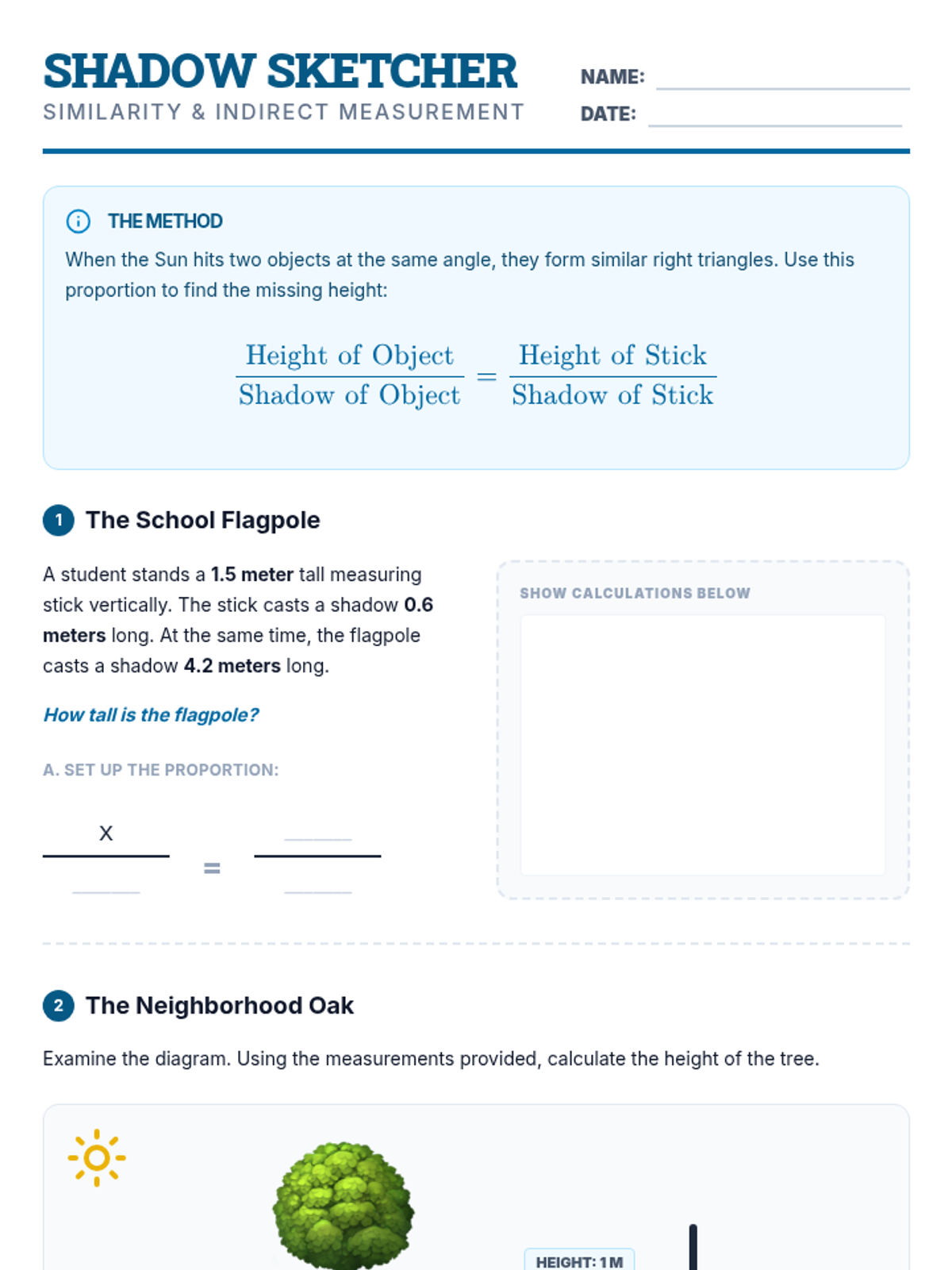
A worksheet for practicing indirect measurement calculations using shadows and similarity proportions, featuring scaffolded problems and a critical thinking challenge.
An instructional slide deck introducing the concept of similarity and the history and mathematics of the shadow reckoning method for indirect measurement.
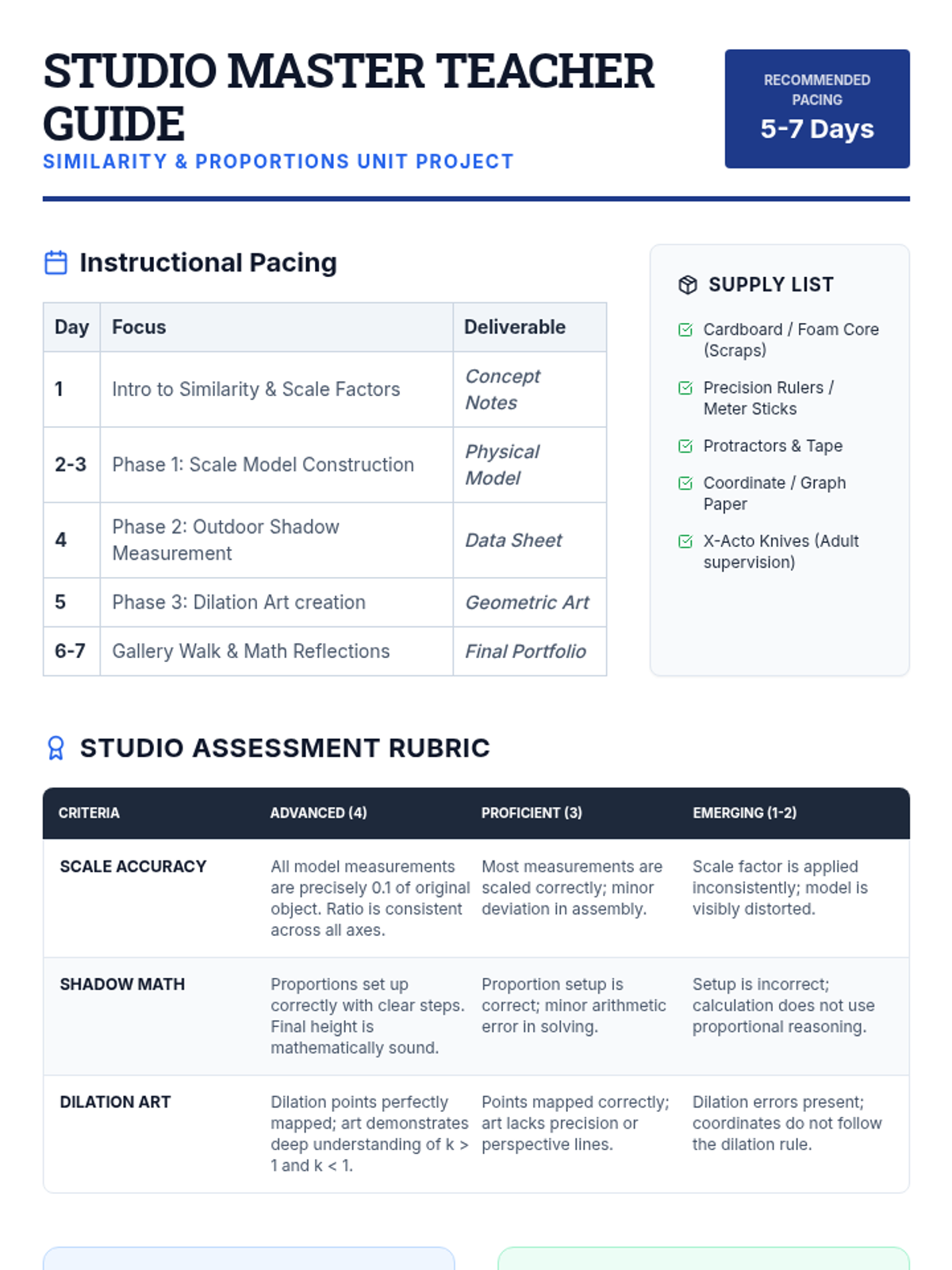
A comprehensive teacher's guide for managing the Similarity Design Studio project, including pacing suggestions, materials lists, grading rubrics, and mathematical examples.
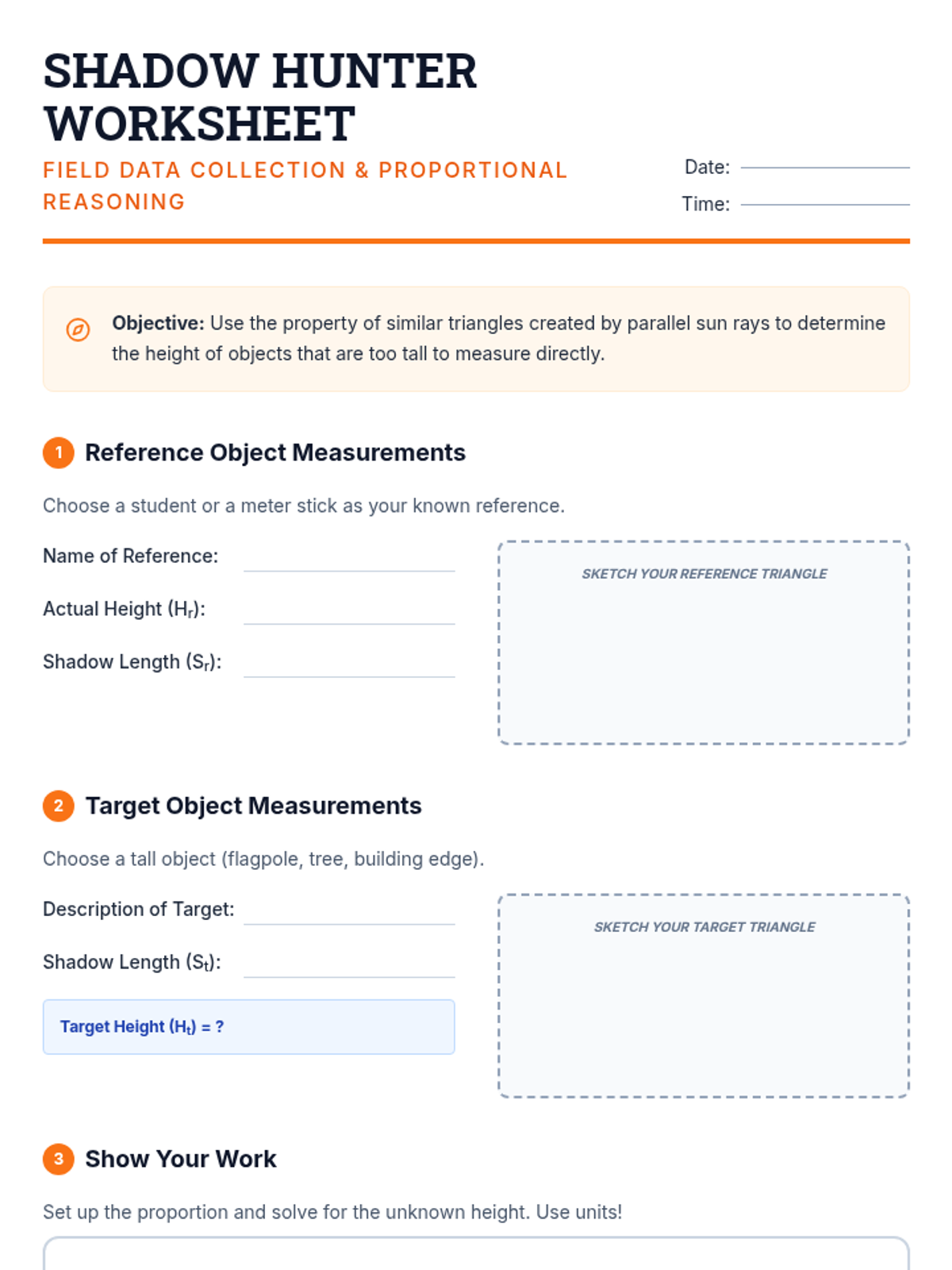
An outdoor activity worksheet for shadow measurement, guiding students through data collection, proportional calculations, and geometric reflection to find the height of tall objects using similar triangles.
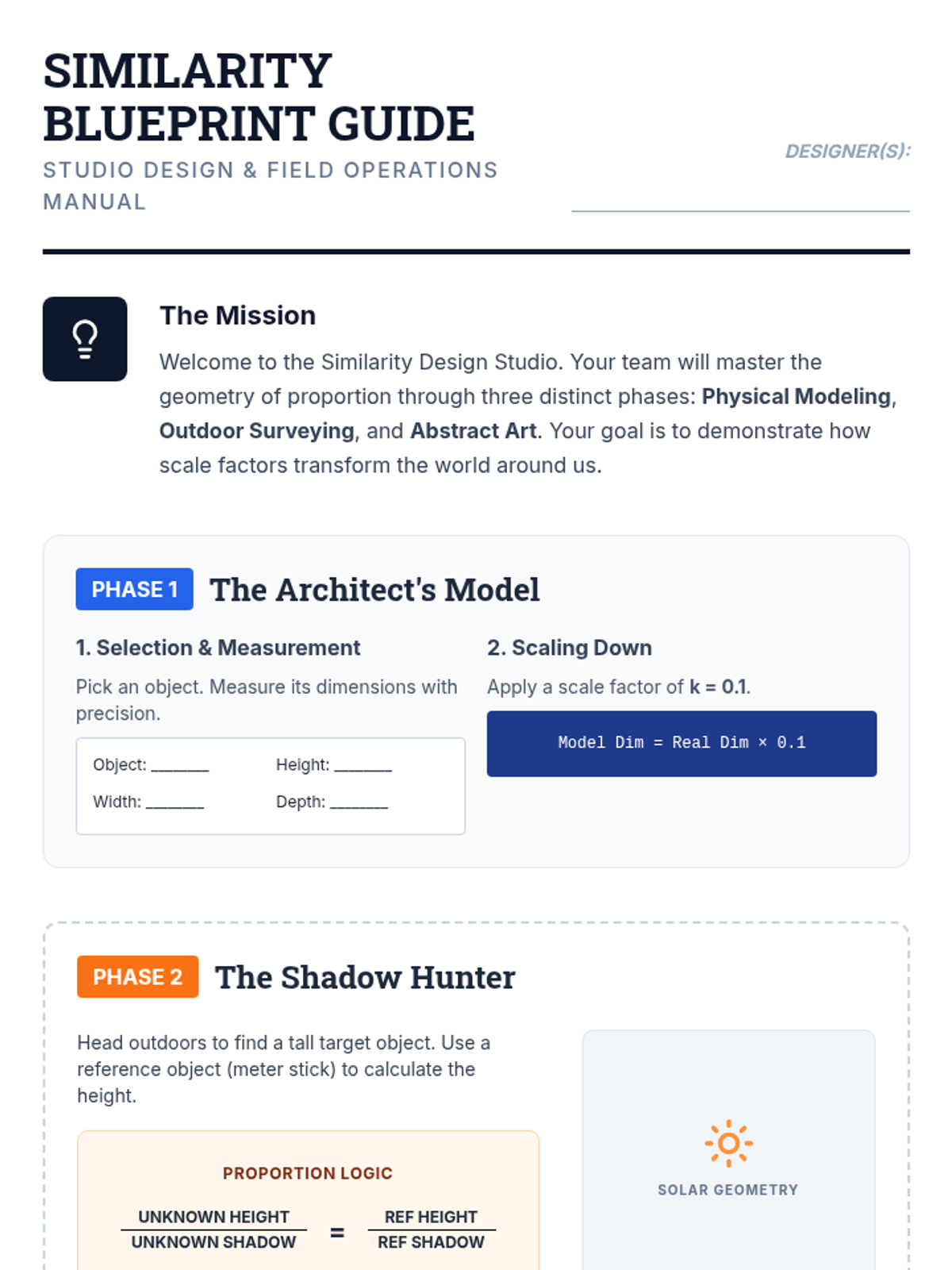
A comprehensive step-by-step student guide for the Similarity Design Studio project, detailing instructions for scale modeling, outdoor shadow measurement, and dilation art.
An introductory slide deck for the Similarity Design Studio project, covering the definition of similarity, scale modeling concepts, shadow measurement theory, and geometric dilations in art.
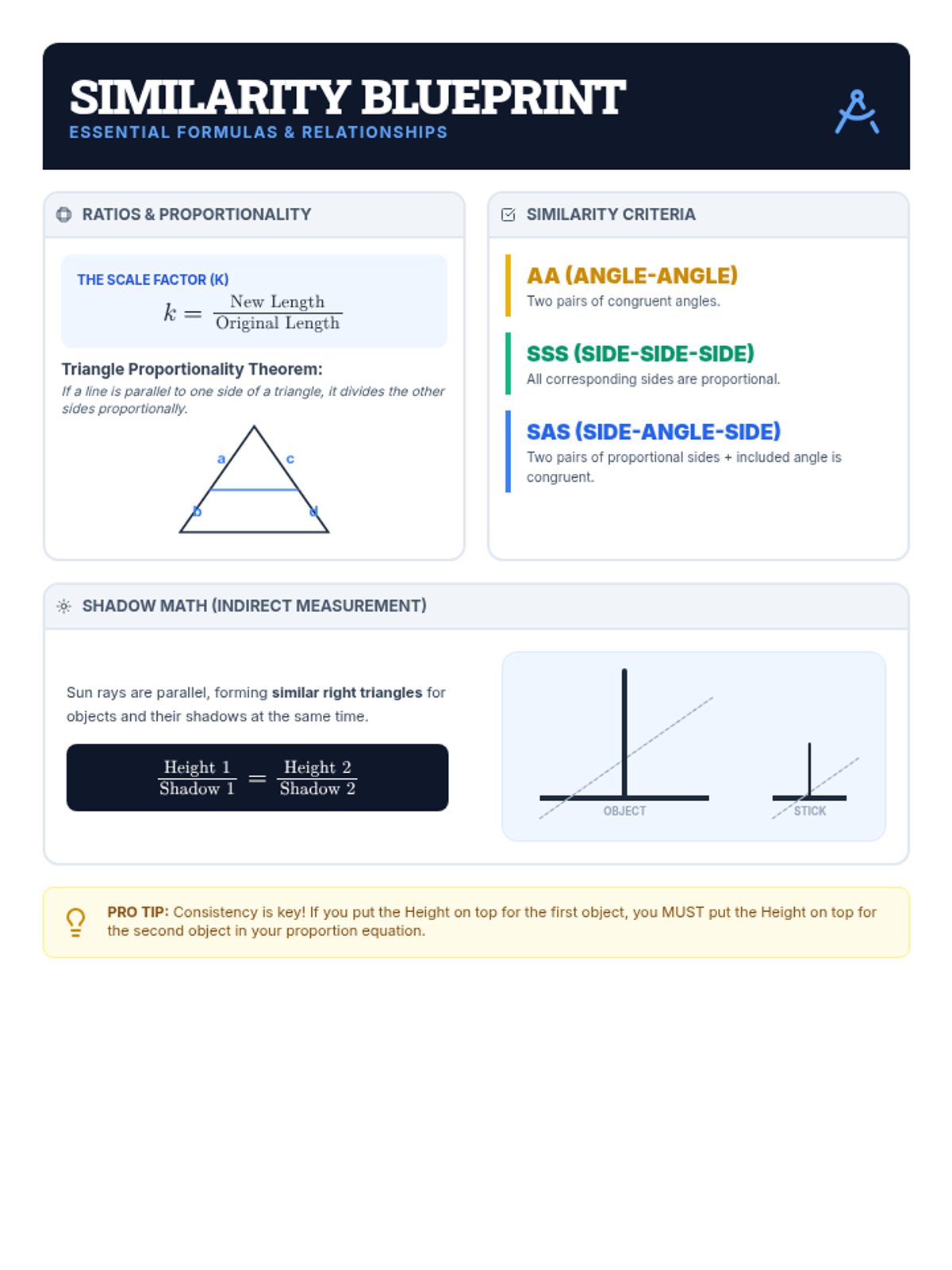
A student-friendly reference sheet for similarity concepts. Includes formulas for scale factor, similarity criteria (AAA, SSS, SAS), and a visual guide for shadow trigonometry.
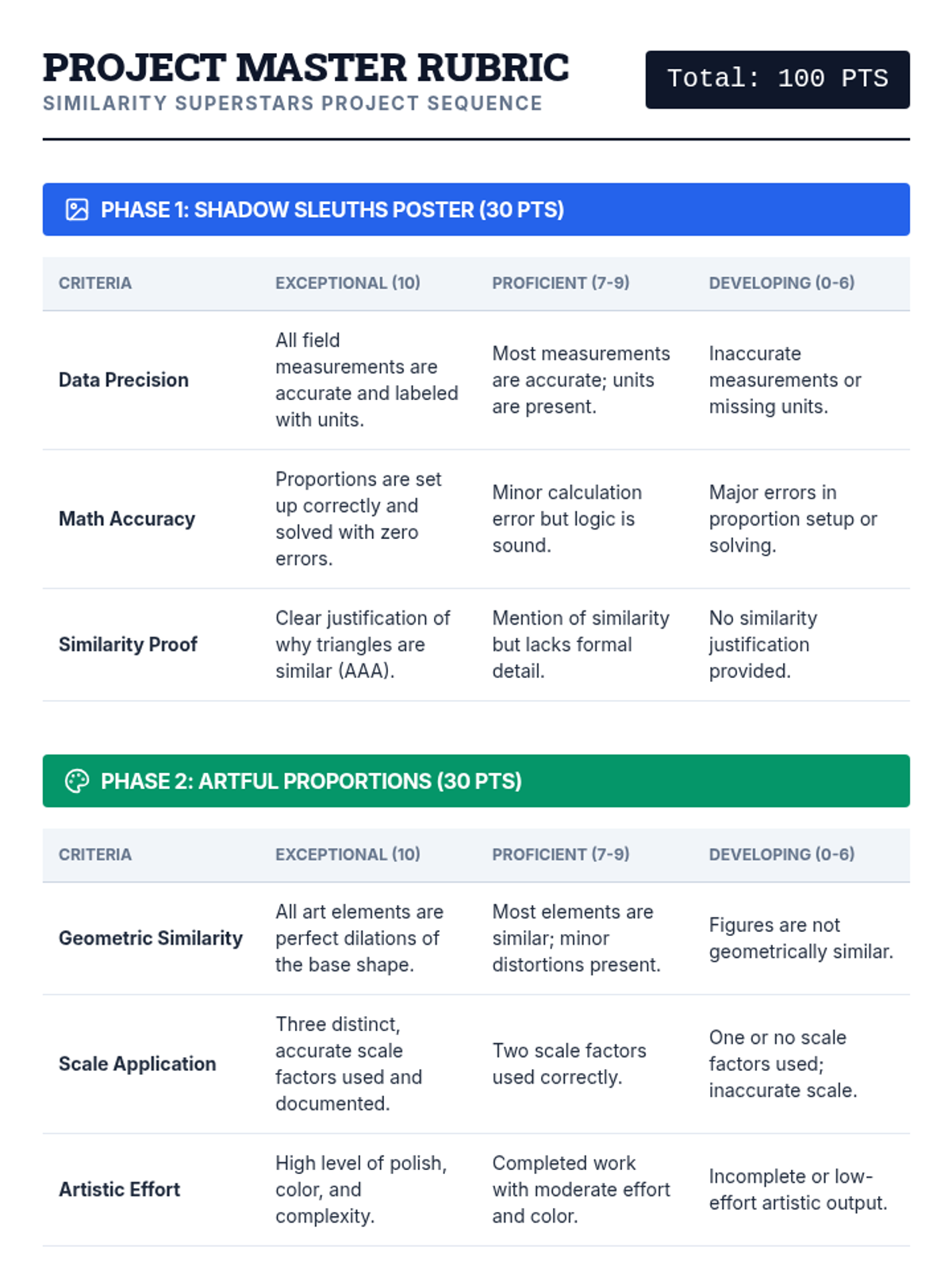
A comprehensive teacher's rubric for the Similarity Superstars project. Covers poster, art, and presentation components with specific grading criteria for data, logic, and polish.
A digital slide presentation template and guide for students. Covers similarity criteria (AAA, SAS, SSS), presentation requirements, and slide layout templates.
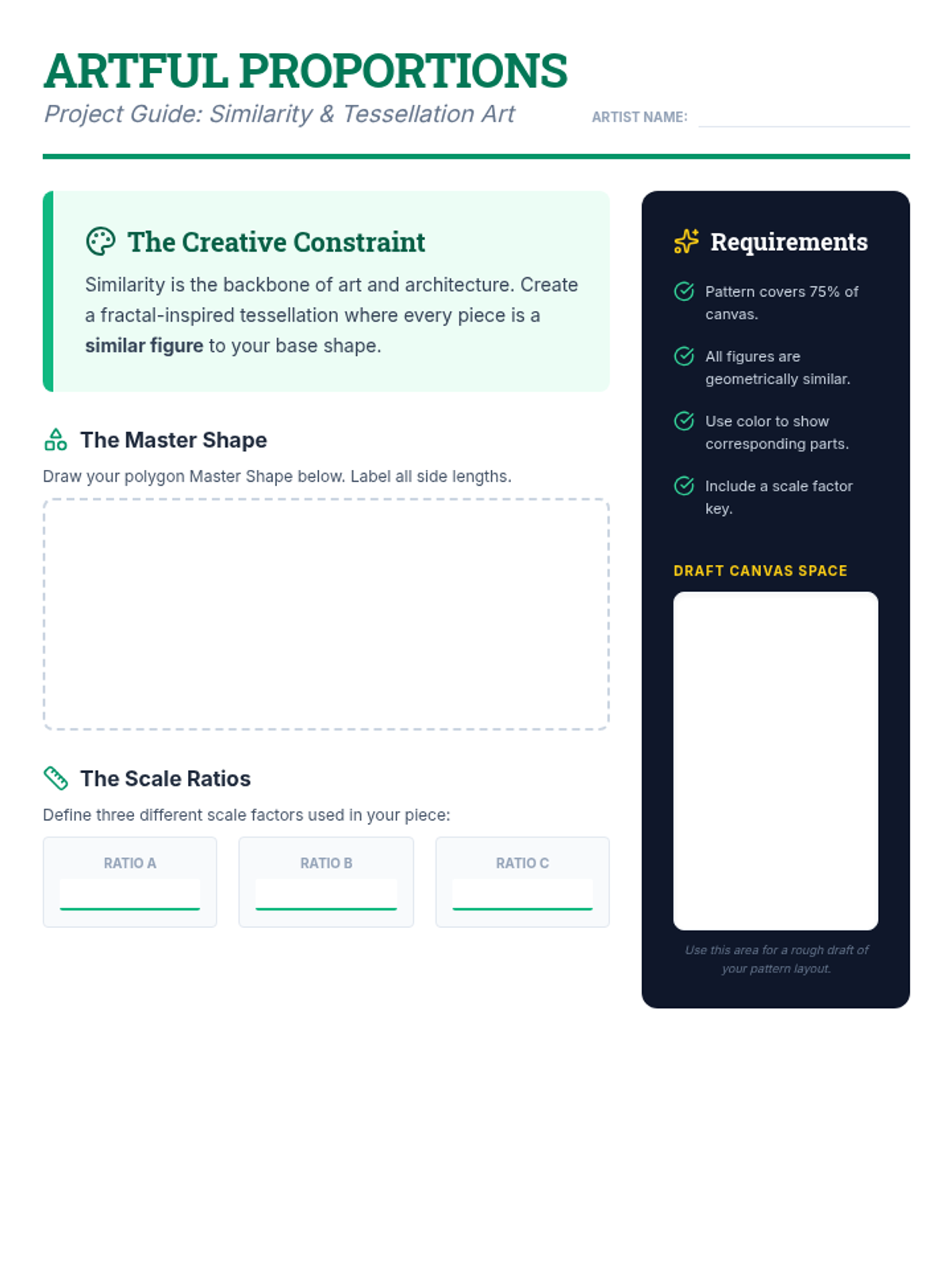
A guide for students to create similarity-based art and tessellations. Includes sections for base shape design, scale factor definitions, and artistic requirements.
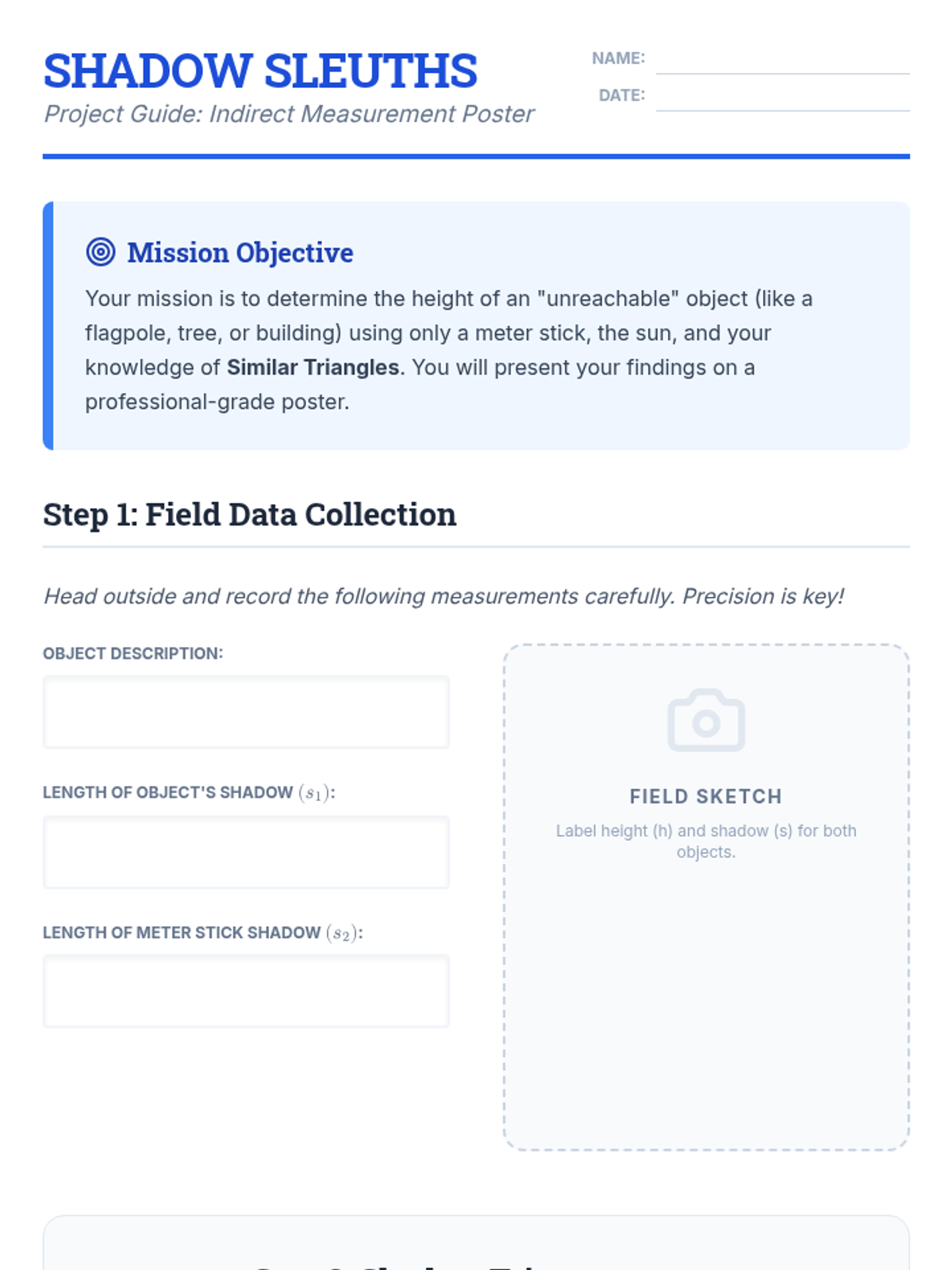
A project guide for students to conduct indirect measurement using shadows. Includes data collection tables, a ratio setup guide, and poster requirements.
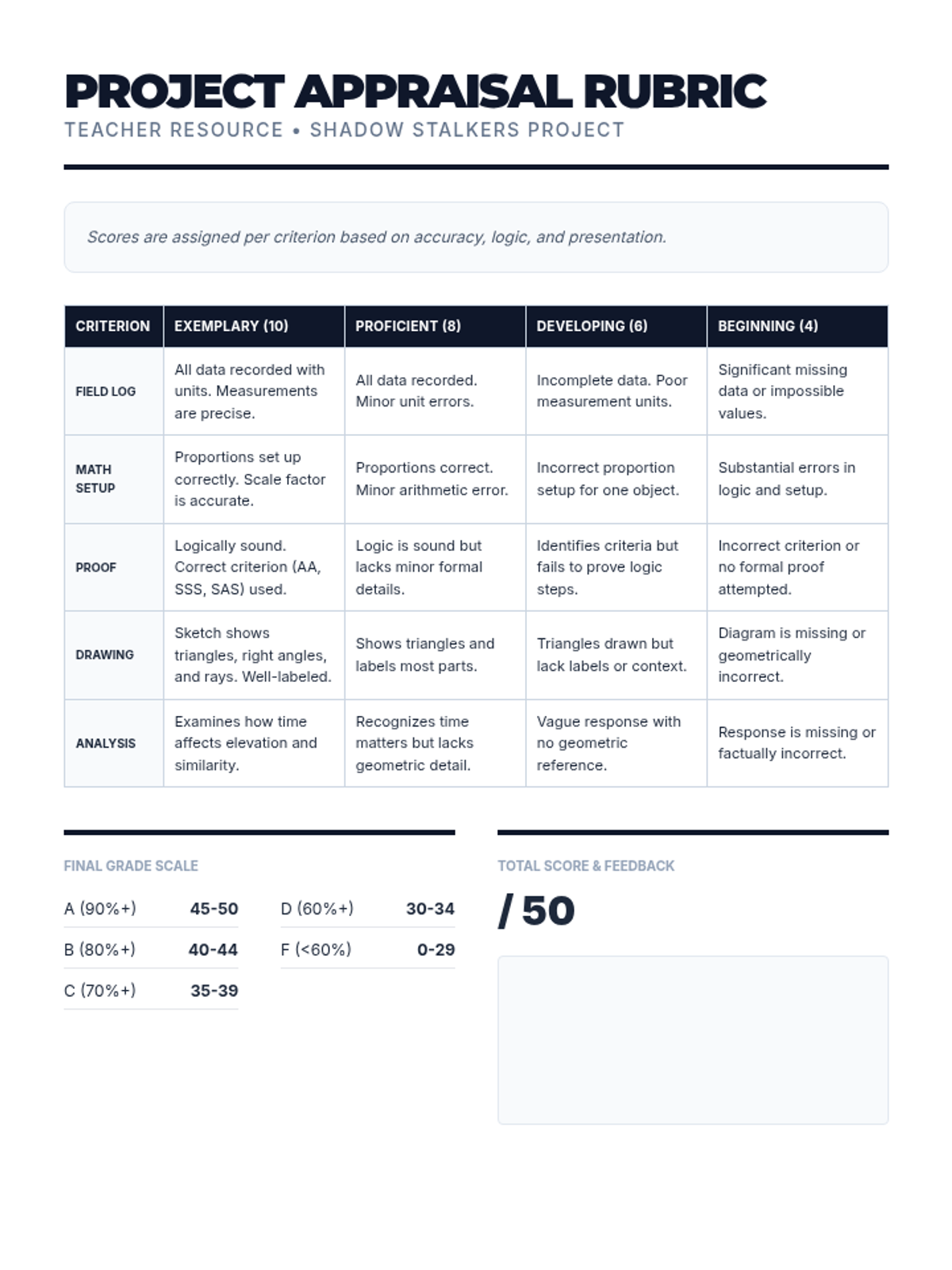
Comprehensive scoring rubric for the Shadow Stalkers project, assessing field measurements, mathematical proportions, geometric proofs, diagram accuracy, and conceptual understanding.
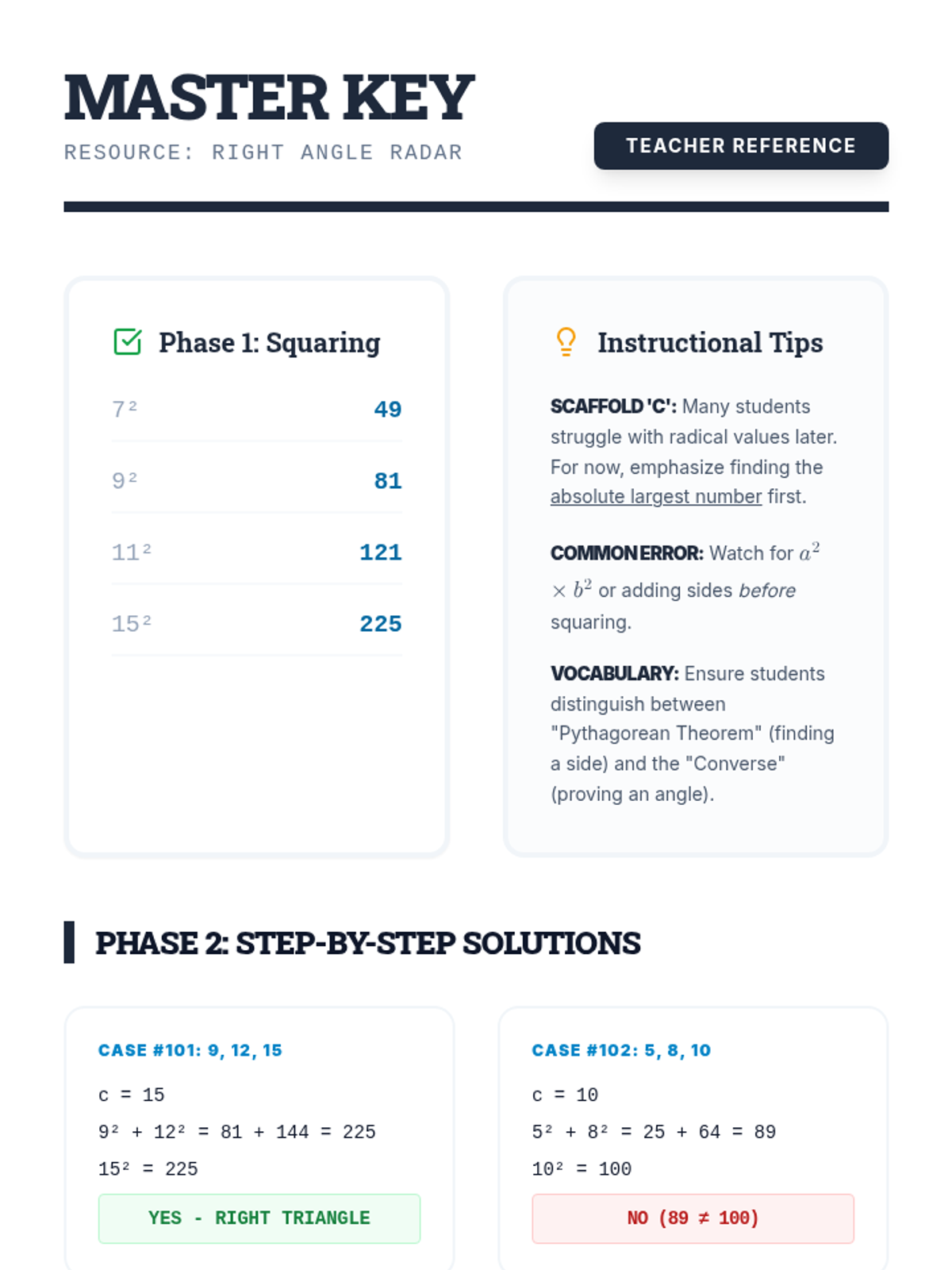
An answer key and teaching guide for the Right Angle Radar lesson, featuring full step-by-step solutions and pedagogical tips.
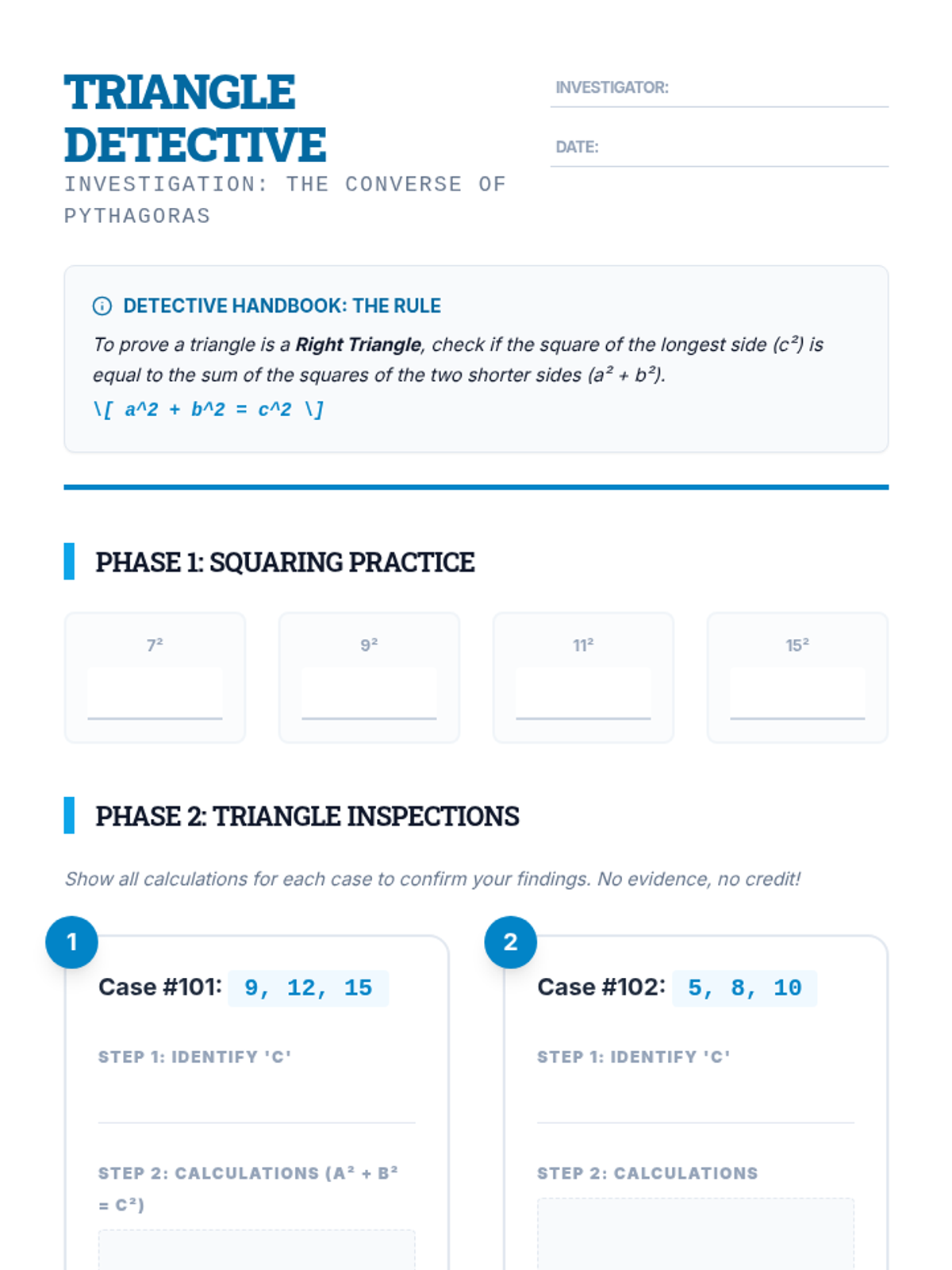
A printable student worksheet designed as an investigative field report, where students use the converse of the Pythagorean Theorem to test various triangles.
A visually engaging blueprint-themed slide deck for Grade 7 students on the Converse of the Pythagorean Theorem, featuring step-by-step instructions and worked examples.
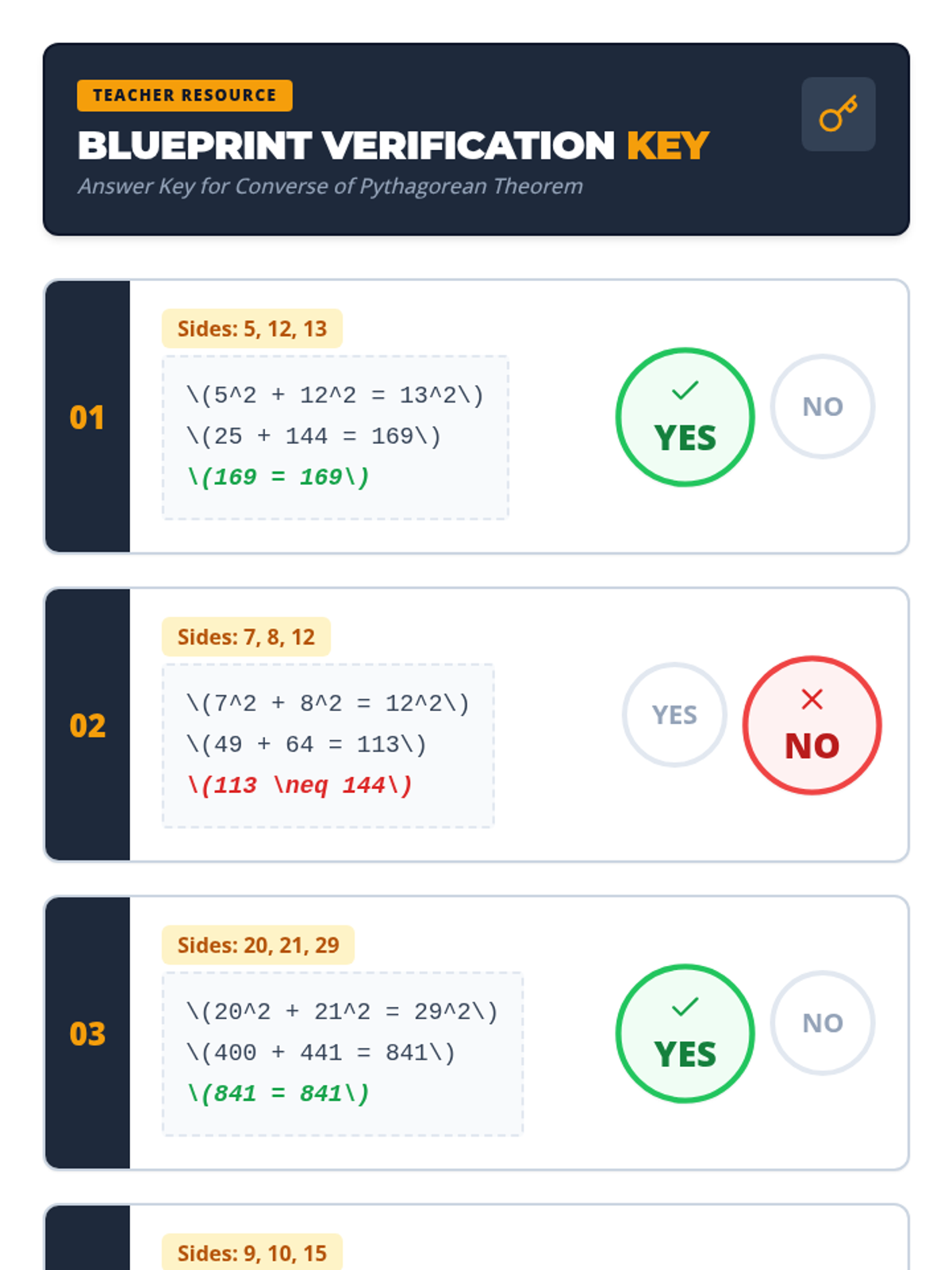
An answer key for the Blueprint Verification worksheet, providing complete calculations and clear visual indicators for the Pythagorean Converse problems. Designed for teacher reference with highlighted 'Yes/No' verdicts and improved formatting for clean printing. Final version with white background for print consistency.
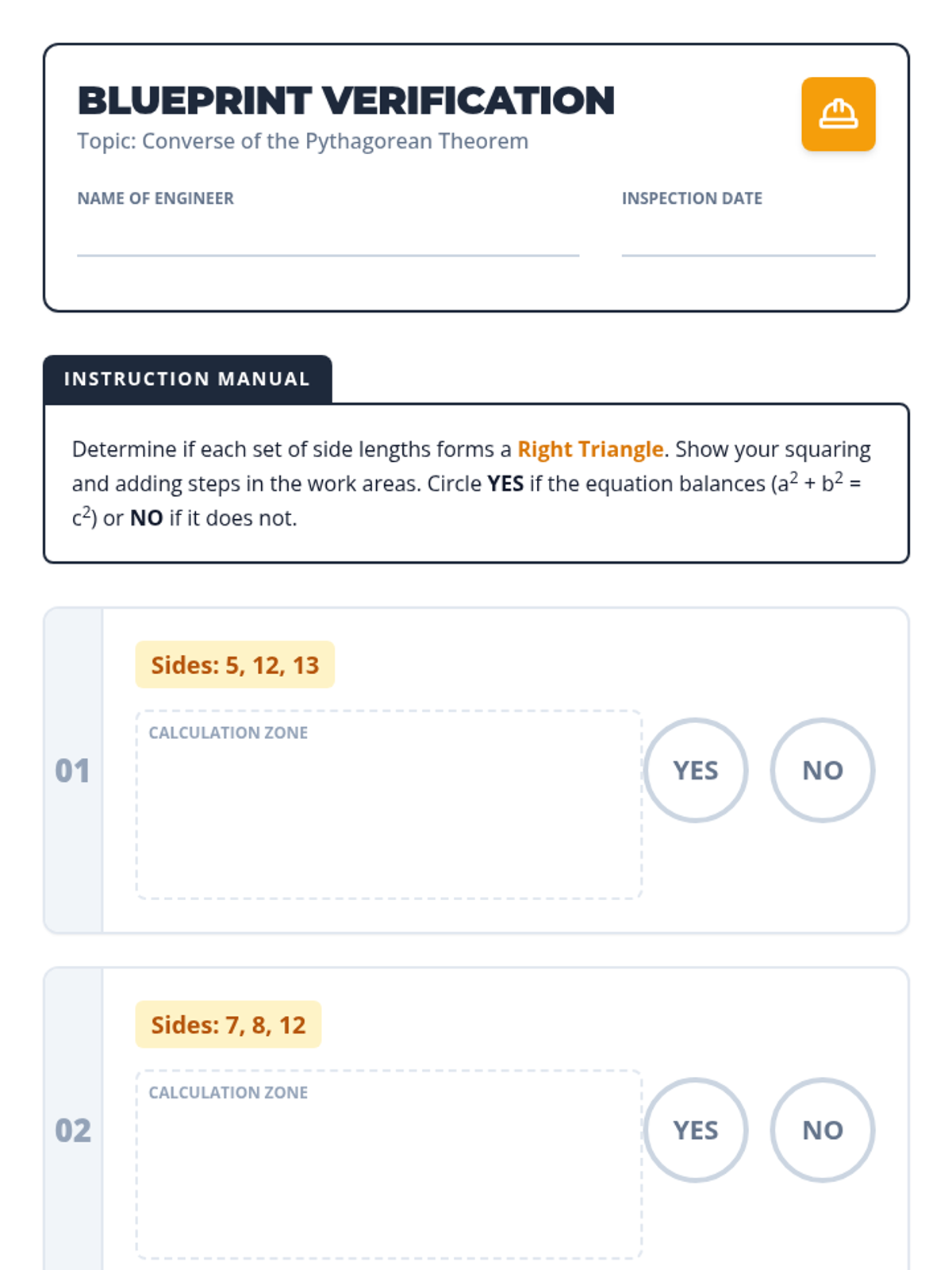
A student-facing worksheet designed as a 'Blueprint Verification' log. It provides structured space for 7th-grade students to perform squaring and addition math to prove if sets of side lengths form right triangles, including a real-world word problem. Includes break-inside-avoid classes for clean printing. Final version with improved spacing and contrast.
A vibrant, construction-themed slide deck that guides students through the step-by-step process of using the Pythagorean Converse to determine if a triangle is a right triangle. Features clear 'Yes/No' proof examples and bold visual cues suitable for 7th-grade math instruction.
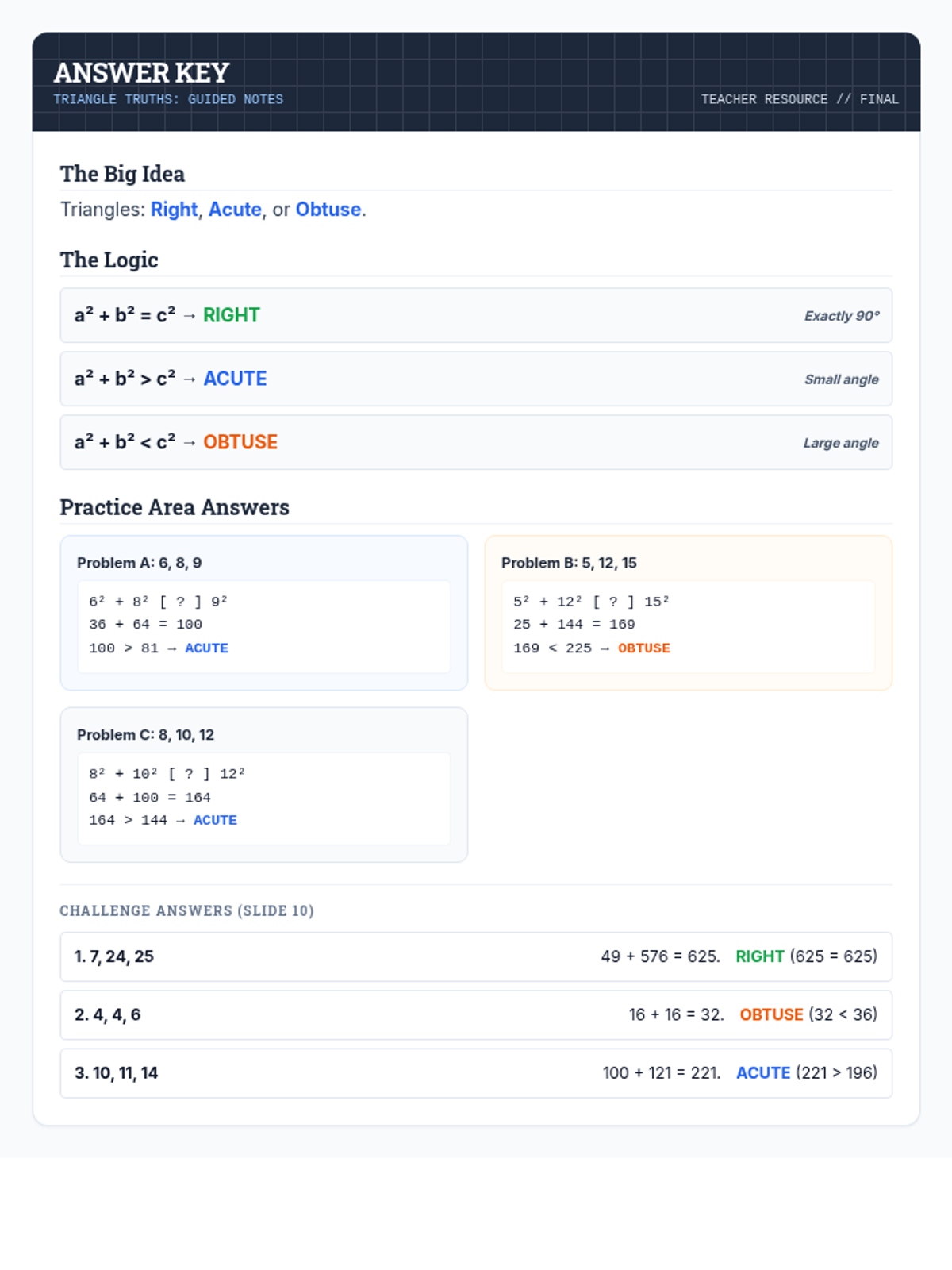
Teacher answer key for the Triangle Truths guided notes, providing completed definitions and worked solutions for all practice problems.
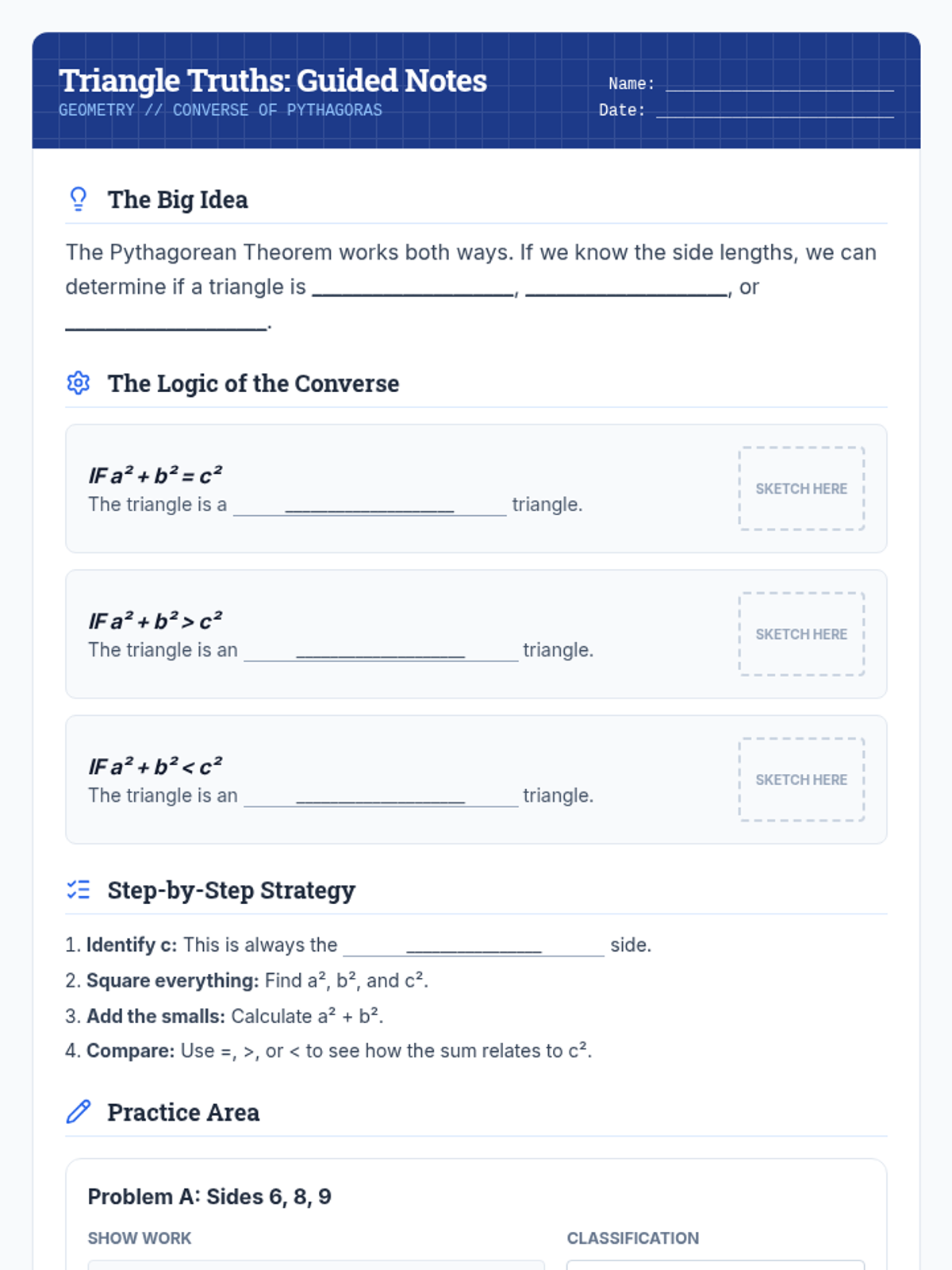
A structured guided notes handout for students to use alongside the Triangle Truths presentation, featuring space for definitions, logic rules, and practice problems.
A visual presentation explaining the Converse of the Pythagorean Theorem, using an architectural blueprint theme to teach students how to classify triangles as right, acute, or obtuse.
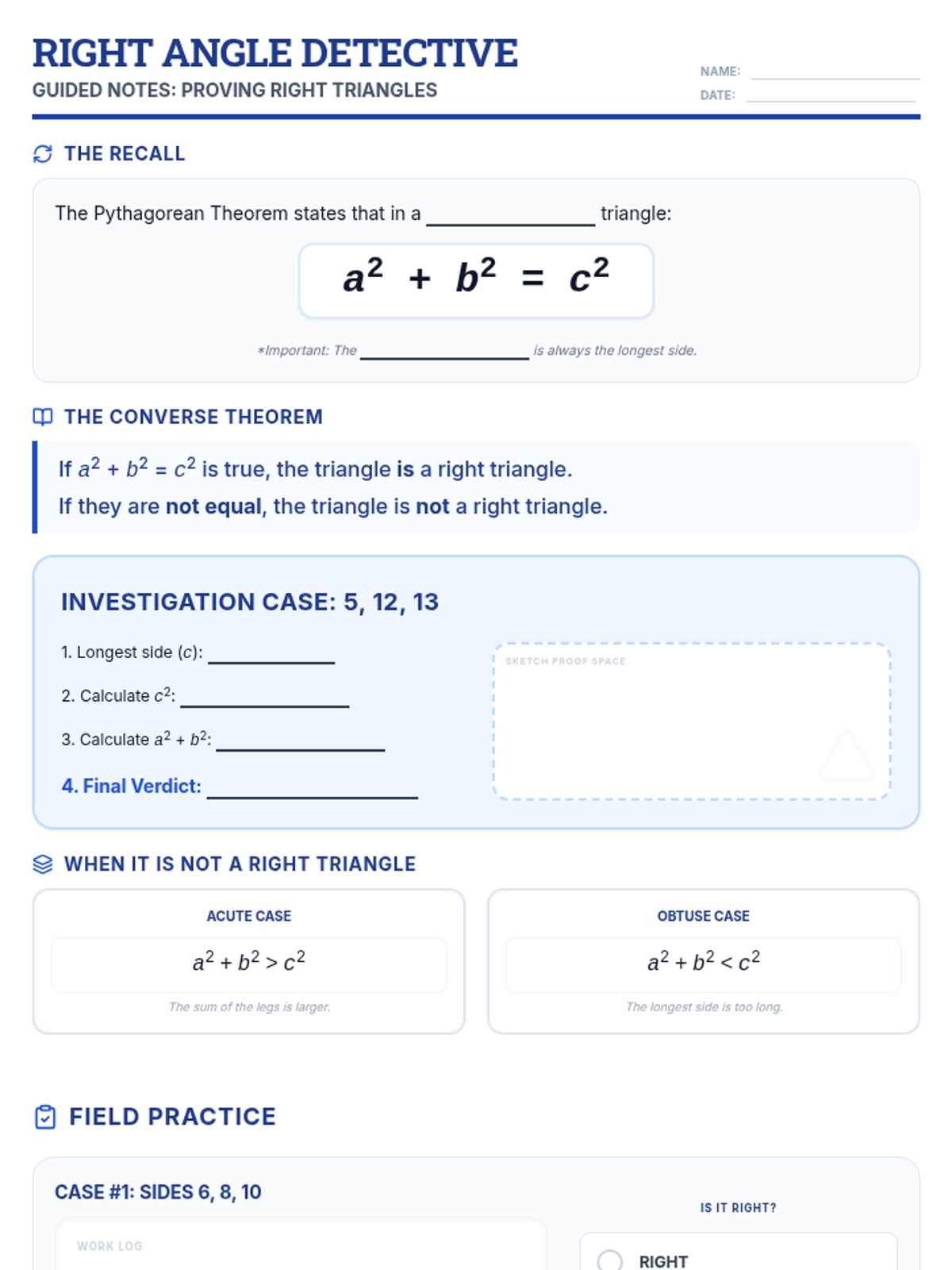
Guided notes for students to follow along with the "Right Angle Detective" lesson. Focuses specifically on proving if a triangle is a right triangle or not. Includes blanks for key definitions, structured examples, and a simplified classification chart. Condense layout to 2 pages for efficiency. Fixed contrast and rendering.
Instructional slides for the Converse of the Pythagorean Theorem, featuring a "Right Angle Detective" theme. Focuses specifically on proving if a triangle is a right triangle or not, with a secondary look at acute and obtuse classifications. Fixed Math rendering and exponent alignment.
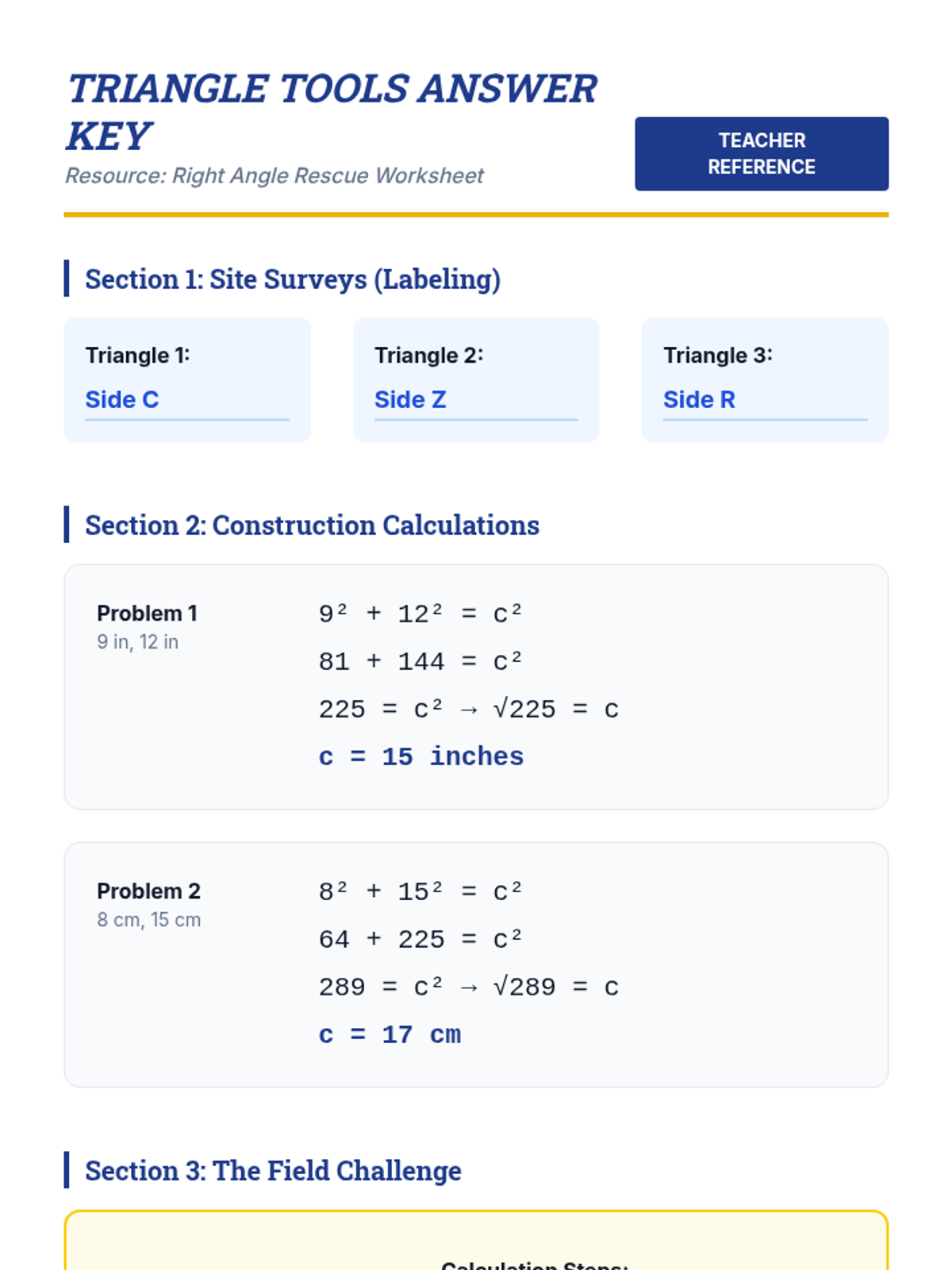
A comprehensive answer key for the 'Right Angle Rescue' worksheet. Corrected for formula visibility, label placement, and layout consistency.
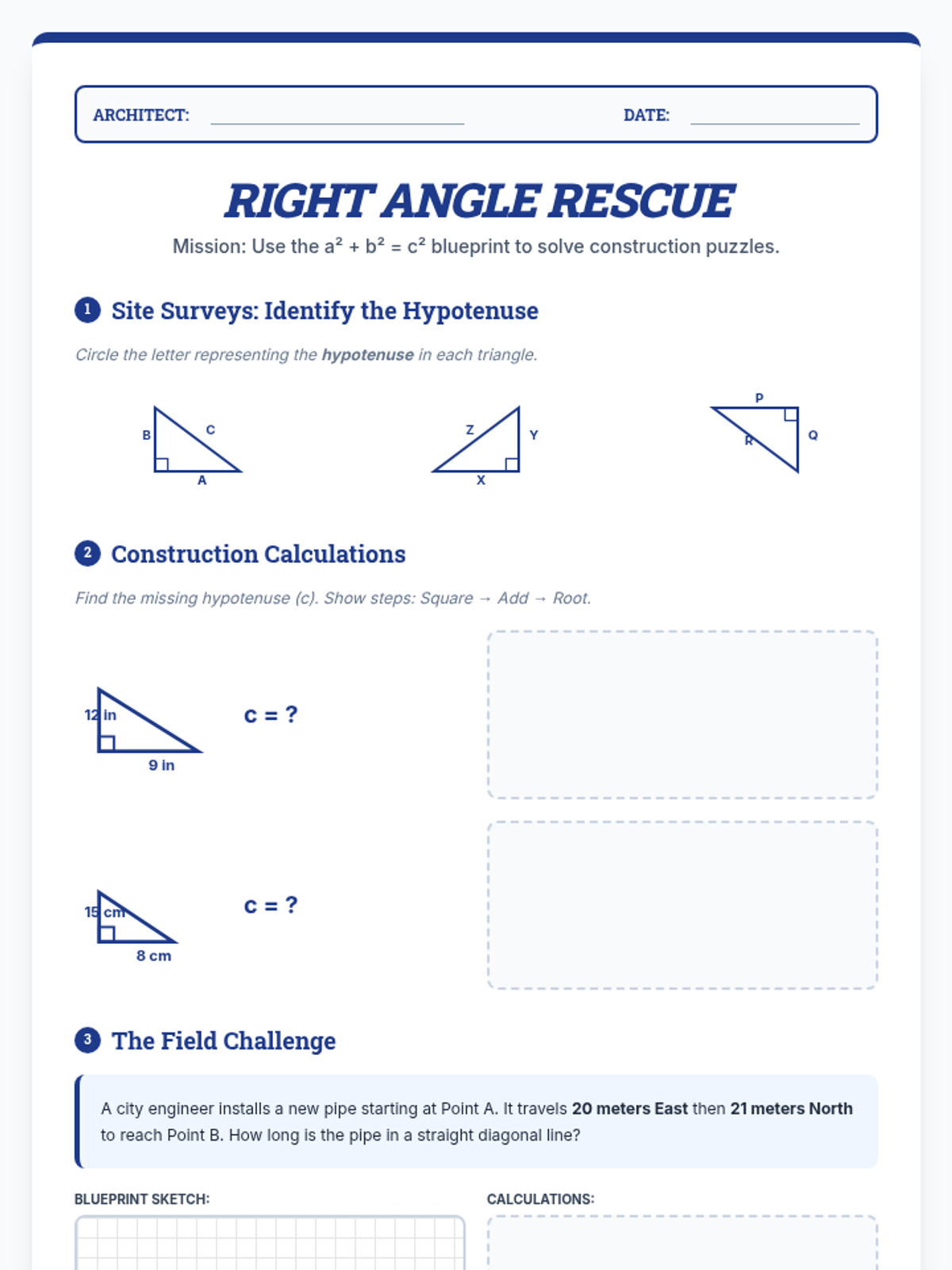
A student worksheet for practicing the Pythagorean Theorem. Corrected for geometric accuracy, formula rendering, and condensed into a single page.
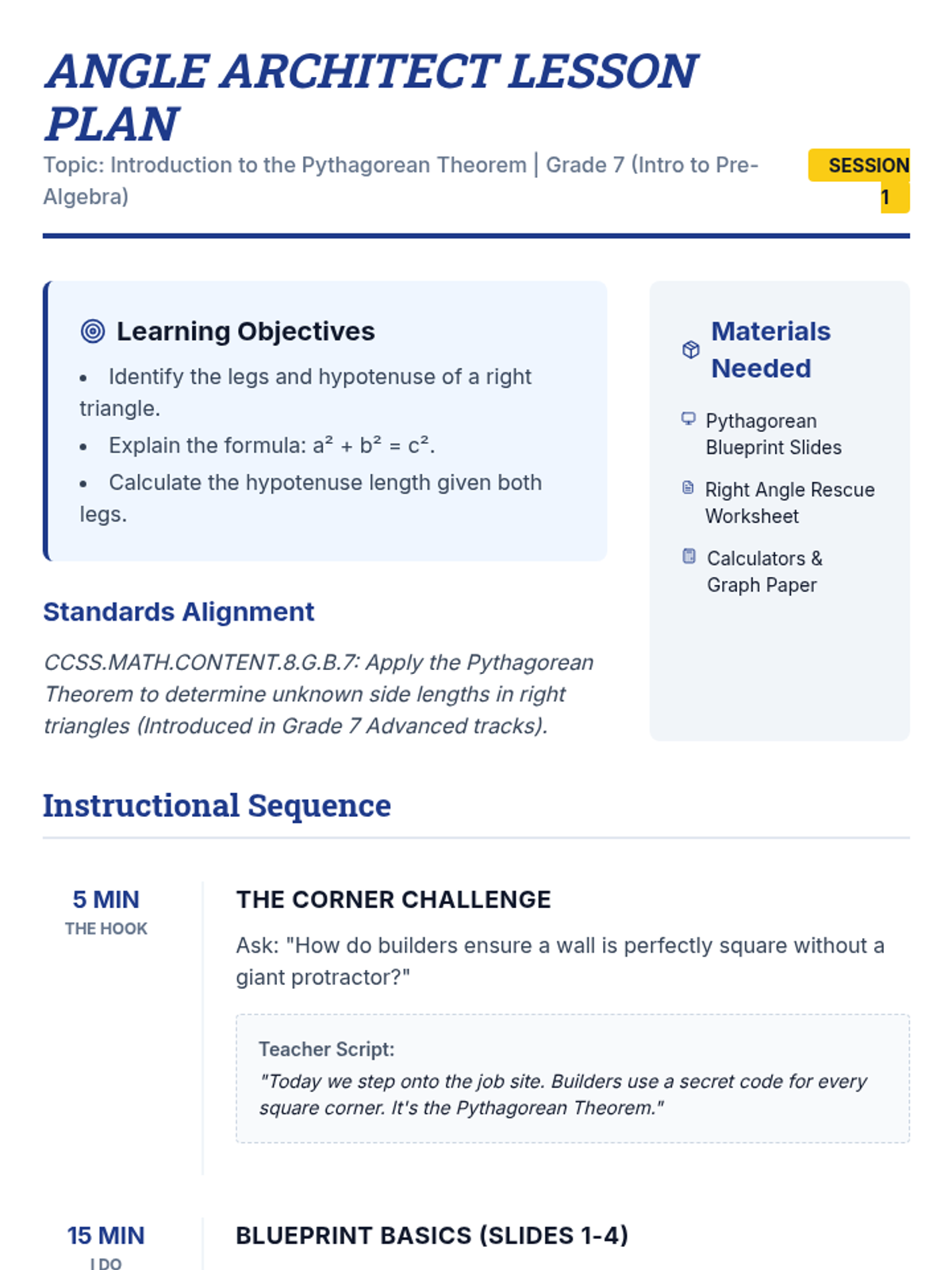
A detailed, step-by-step lesson plan for teachers introducing the Pythagorean Theorem. Corrected for page breaks and formula rendering.
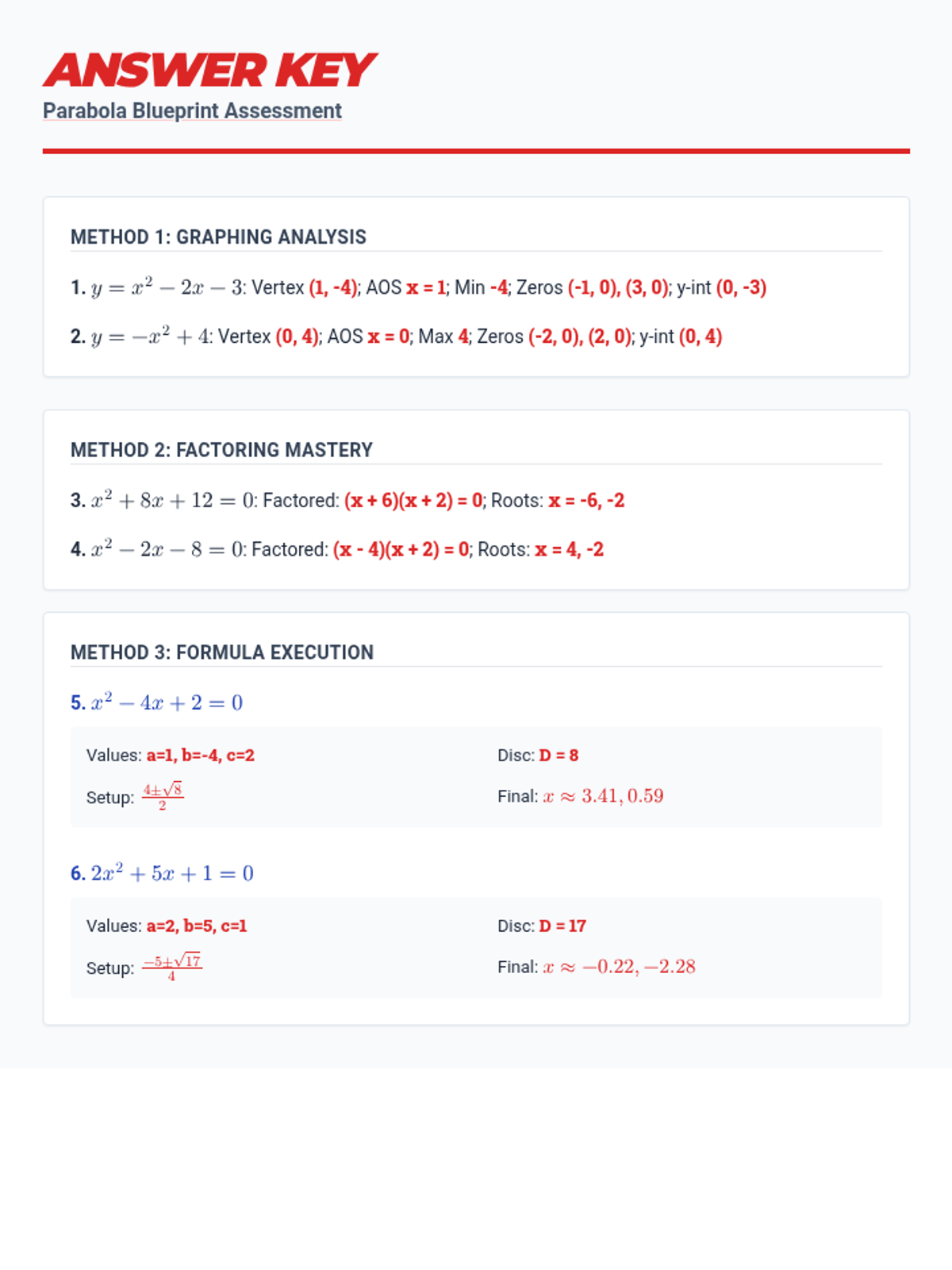
Teacher-facing answer key for the summative assessment. Refined to align with the single-column parabola analysis and updated problem layouts.
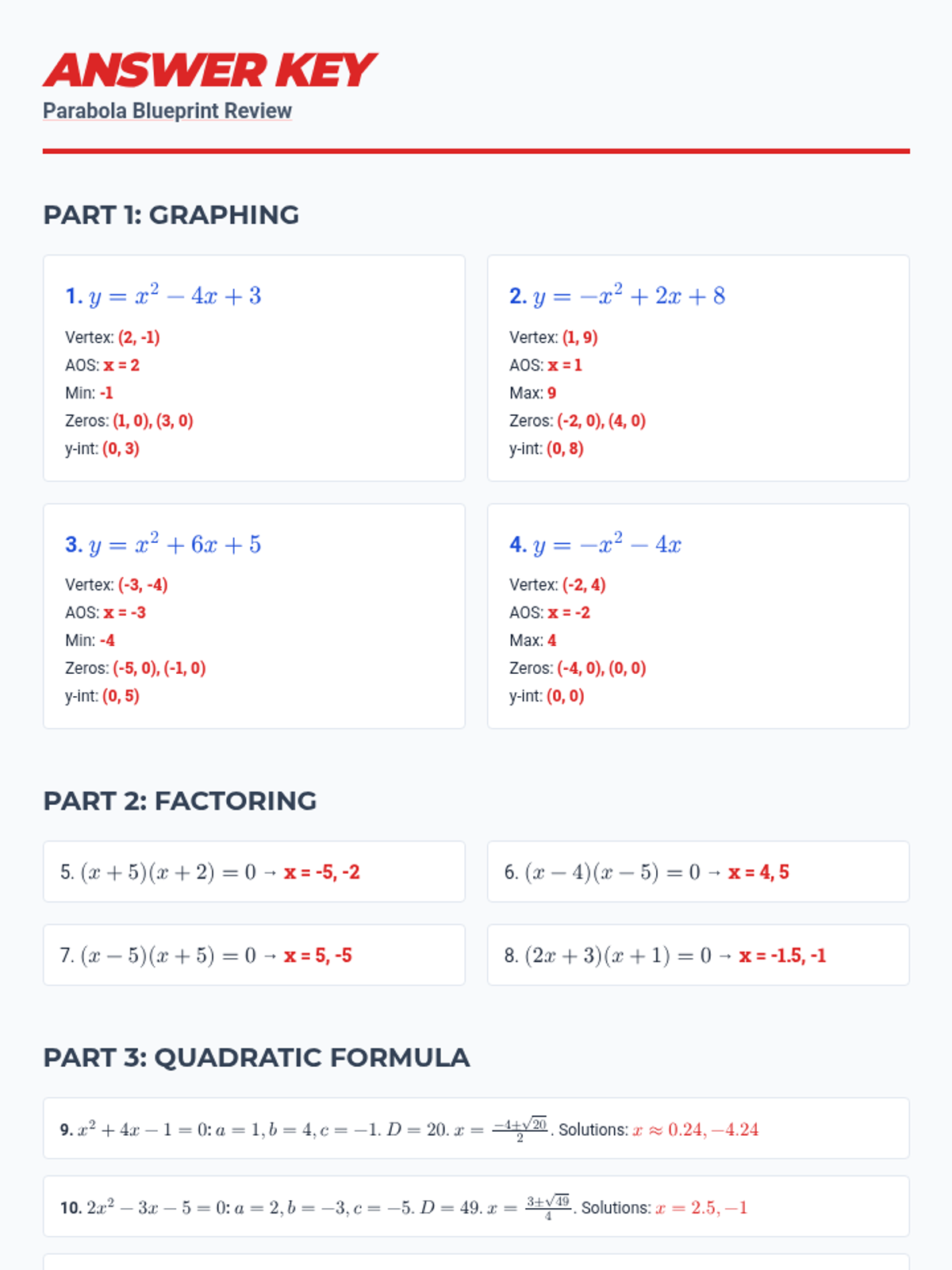
Teacher-facing answer key for the review worksheet. Updated to match the refined single-column parabola analysis items.
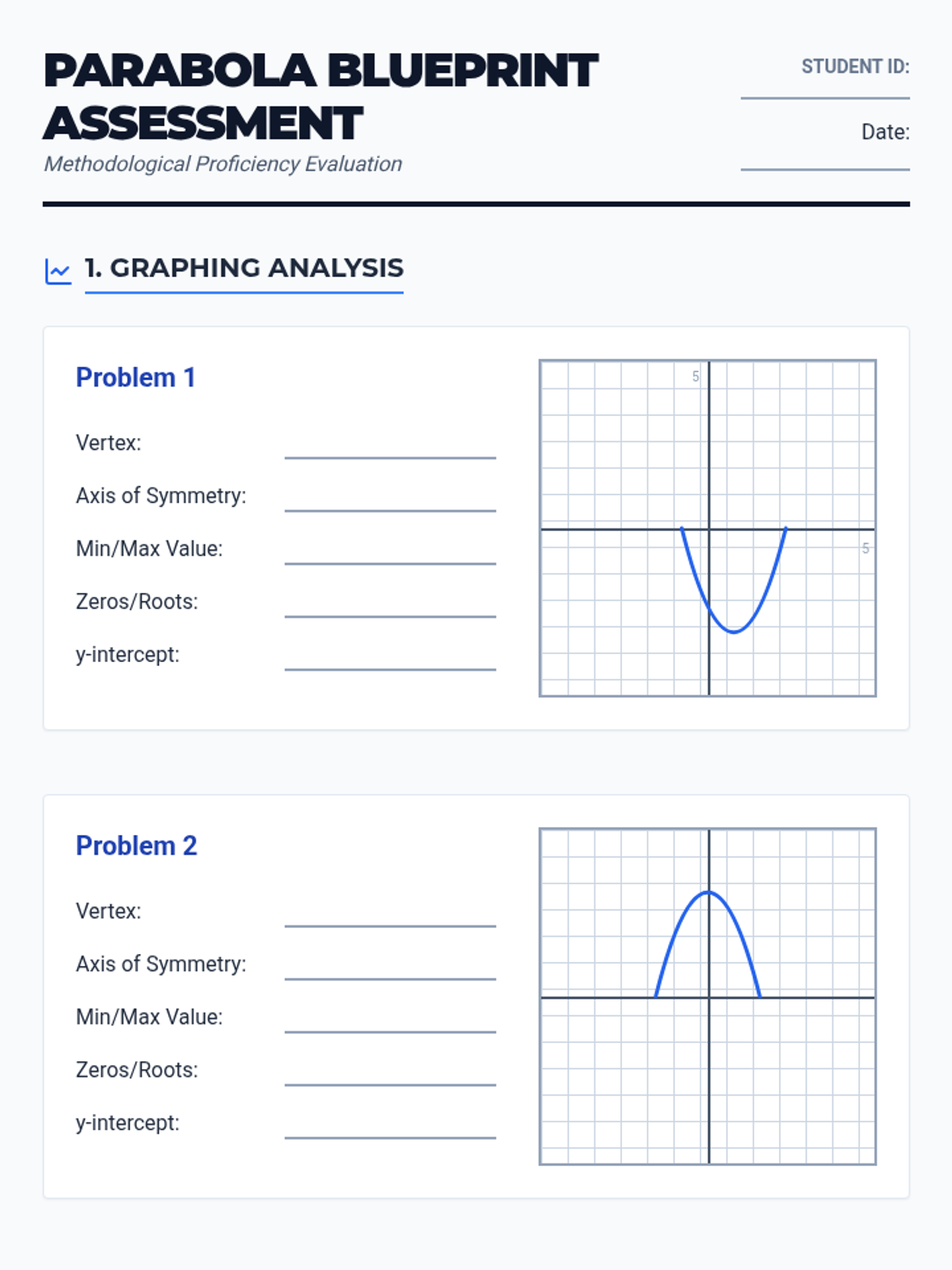
A formal summative assessment with 6 items, evaluating student proficiency in solving quadratic equations through graphing analysis, algebraic factoring, and guided quadratic formula steps. Graphing items feature single-column layouts and explicitly displayed equations. Fixes layout bugs in the formula section.
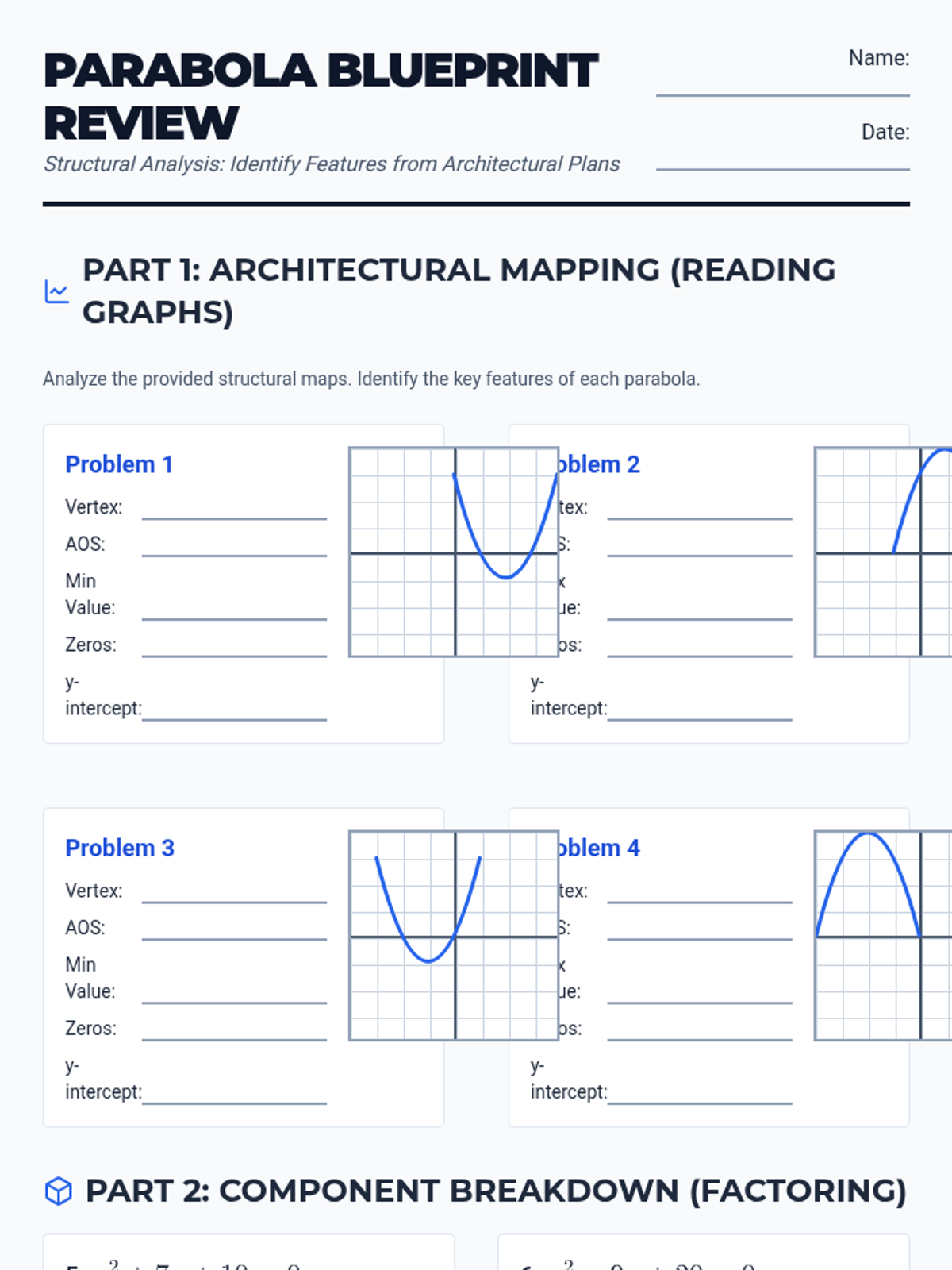
A 12-question comprehensive review worksheet covering quadratic equations via graphing, factoring, and the quadratic formula, styled with a professional 'blueprint' aesthetic. This version features single-column graph layouts, explicitly displayed equations, and refined formula templates.
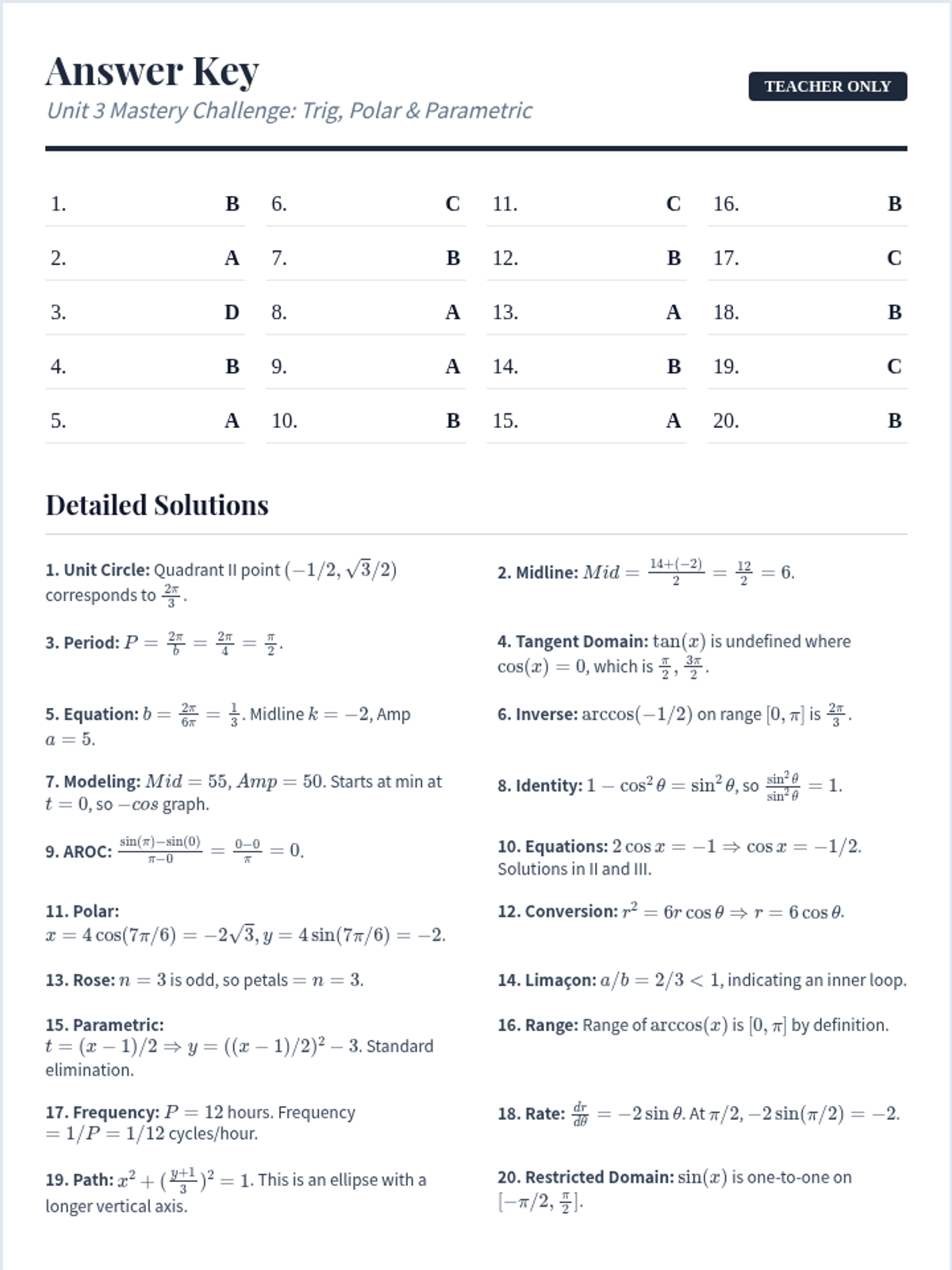
The answer key for the Unit 3 Mastery Challenge, featuring a quick-glance table and detailed explanations for all 20 questions.
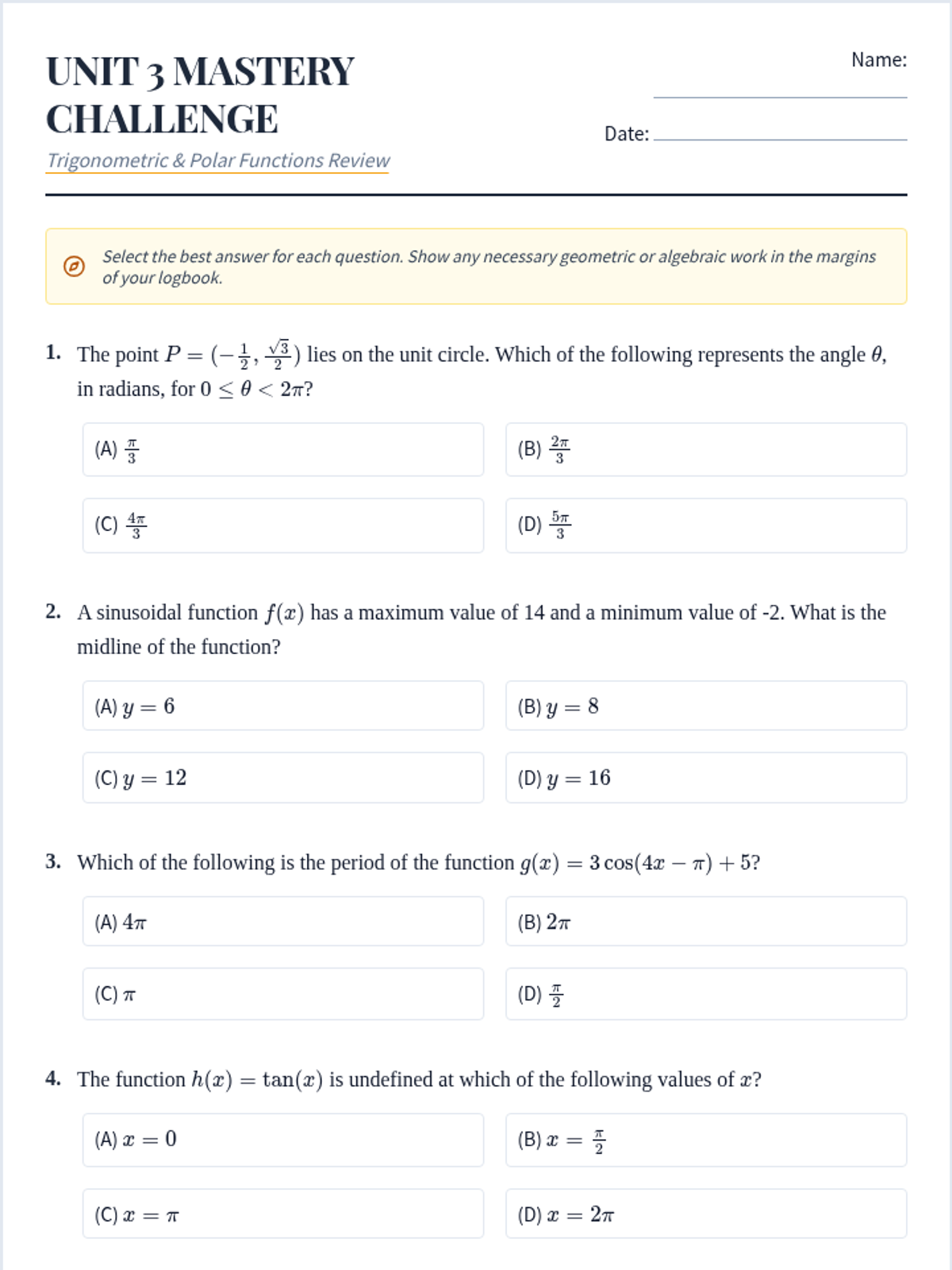
A 20-question multiple-choice assessment covering all Unit 3 topics including sinusoidal functions, inverse trigonometry, polar coordinates, and parametric functions. Designed with a nautical explorer theme and ample space for calculations.
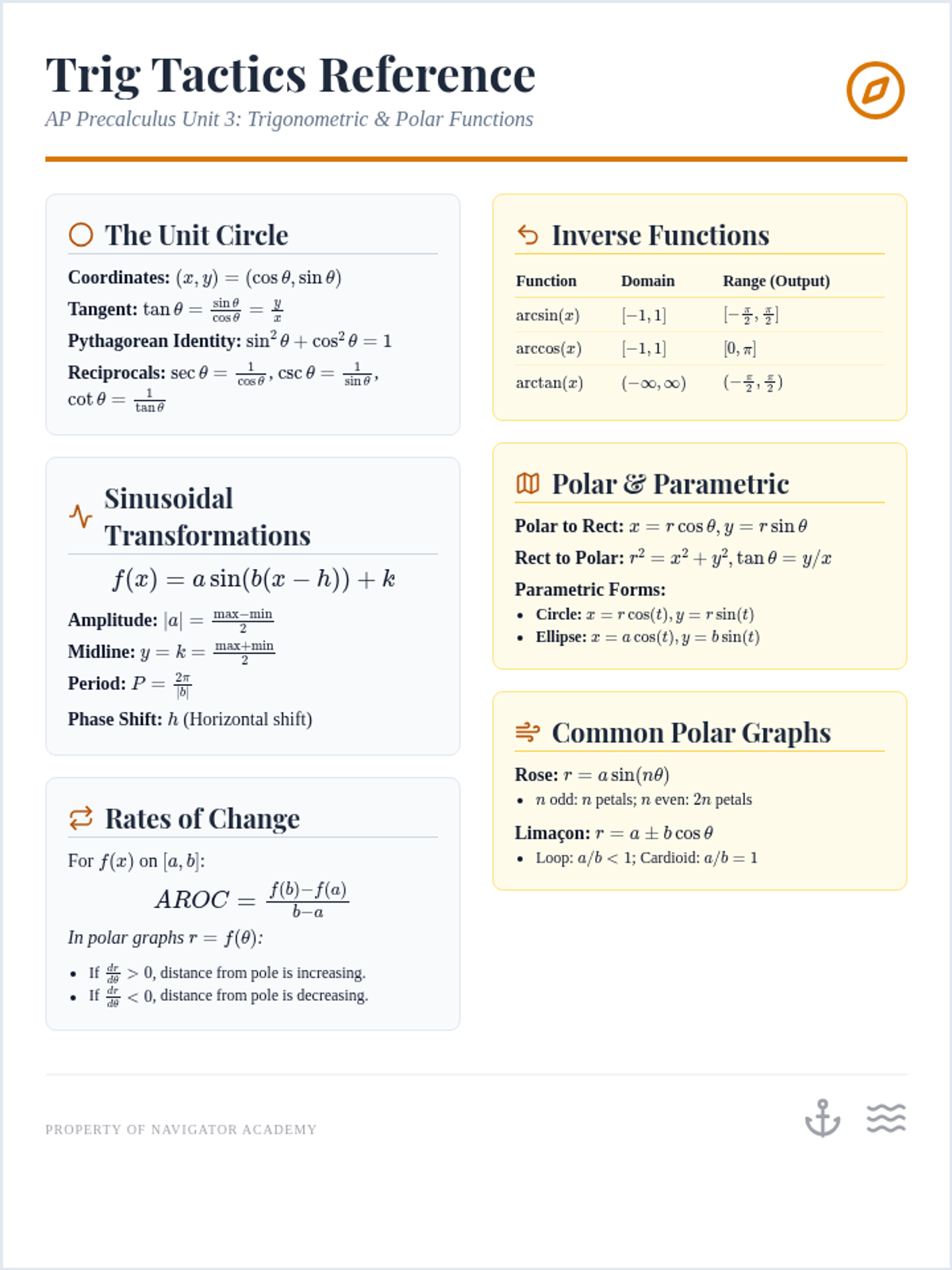
A concise one-page reference sheet covering the essential concepts of AP Precalculus Unit 3, including unit circle properties, sinusoidal transformations, inverse functions, polar coordinates, and parametric functions.
Introductory presentation for students on using the Desmos graphing calculator for the Digital SAT. Includes strategies for systems, key features of functions, statistical lists, and function transformations.
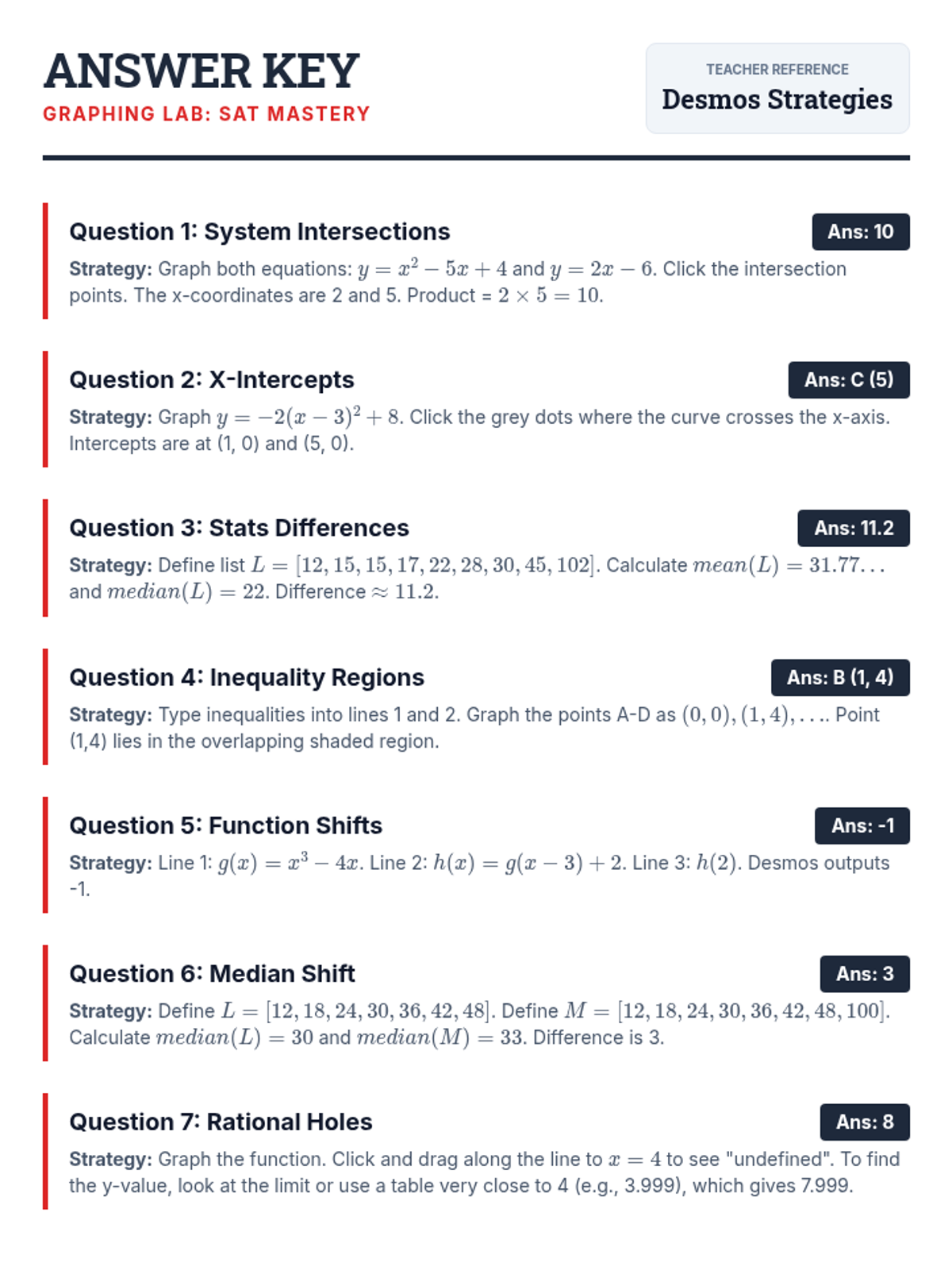
Updated Teacher answer key for the Graphing Lab Worksheet, providing both the correct answers and specific Desmos calculator strategies for the new Question 1.
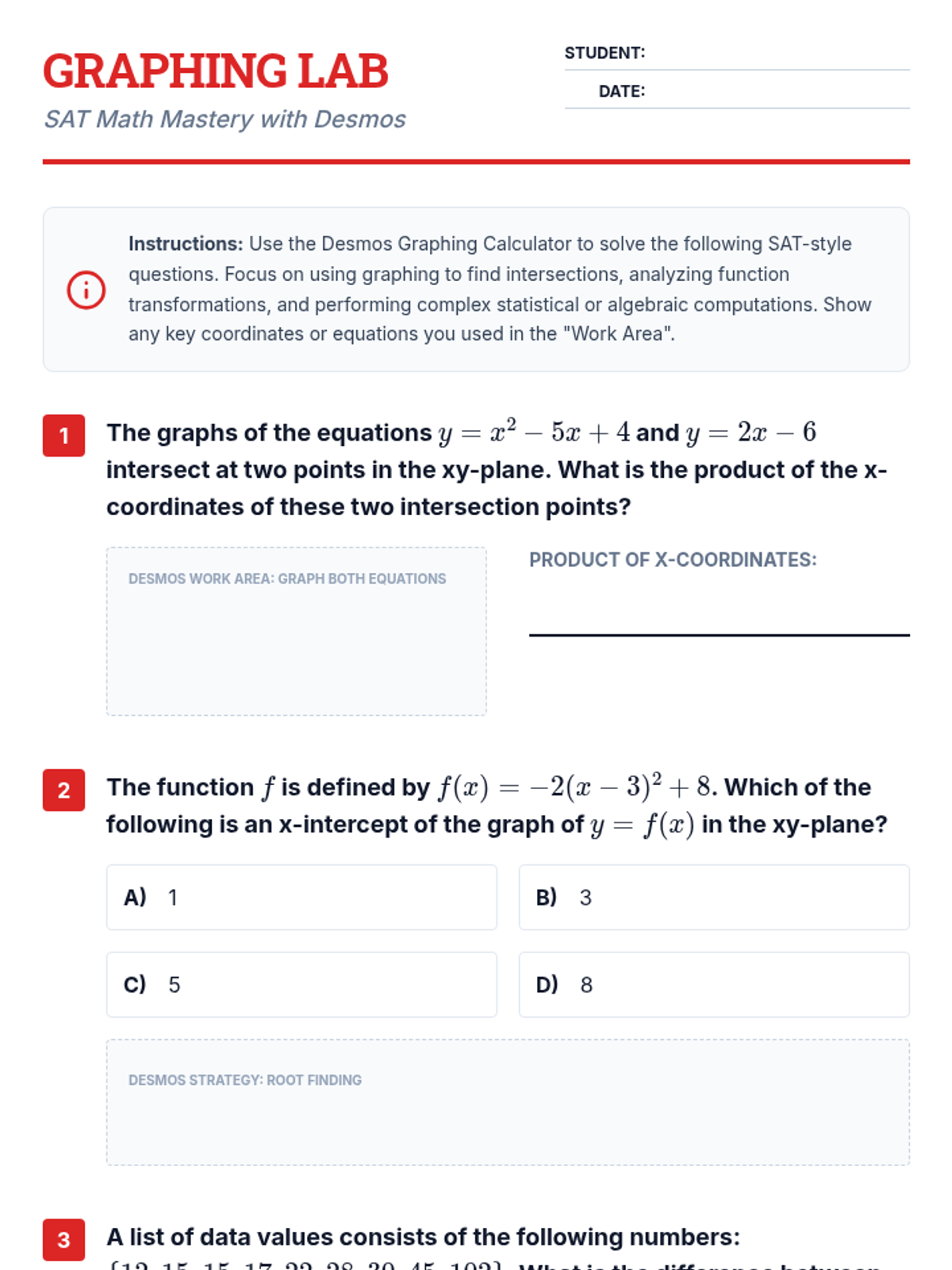
Updated 10-question SAT Math worksheet with new Question 1 focused on system intersections of parabolas and lines. Covers Heart of Algebra, Problem Solving, and Passport to Advanced Math with space for Desmos-specific work.
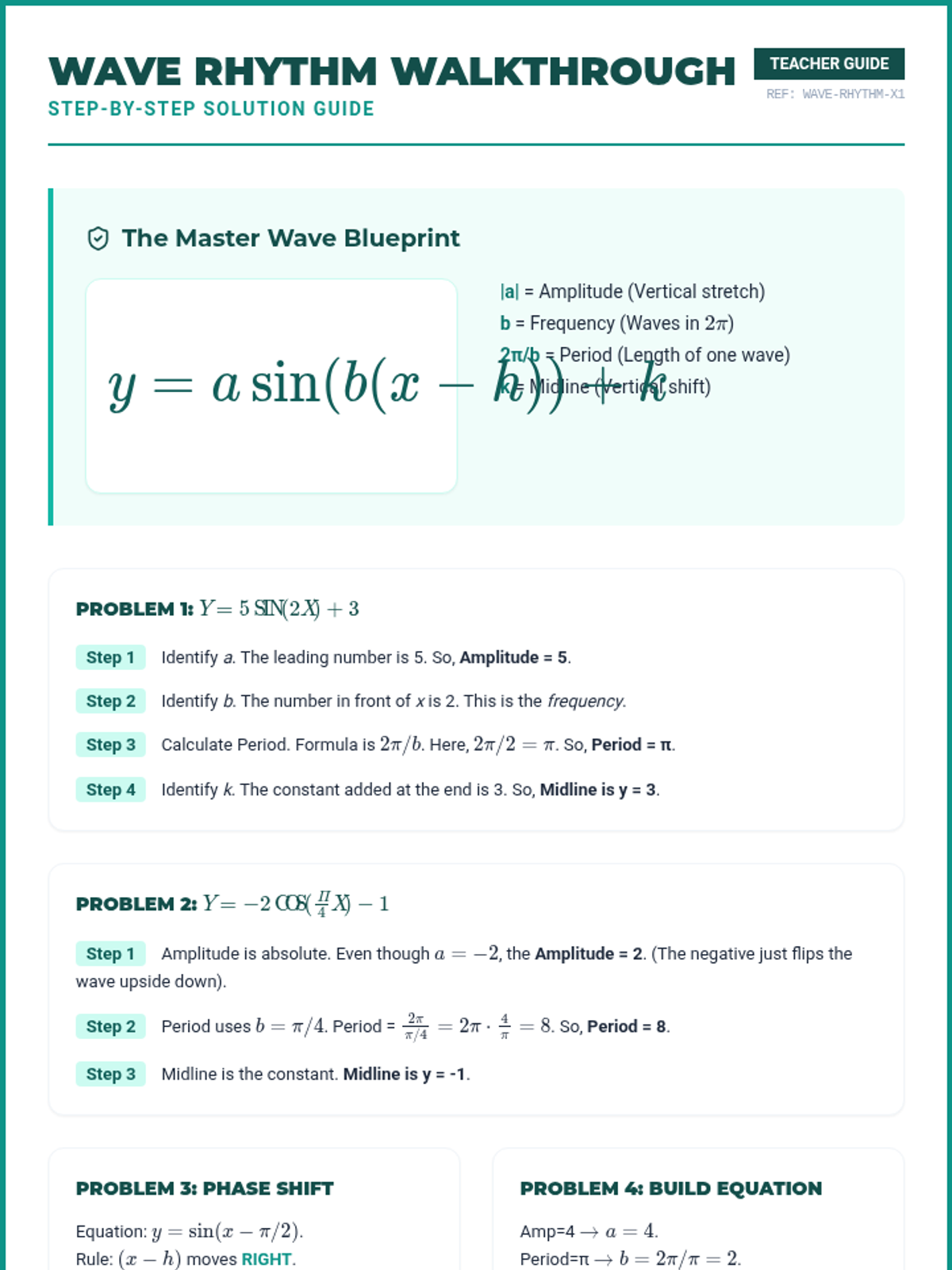
A detailed, step-by-step walkthrough of the Wave Rhythm Workout, breaking down the logic for core wave components, real-world modeling, and finding minimum values using the midline-amplitude blueprint.
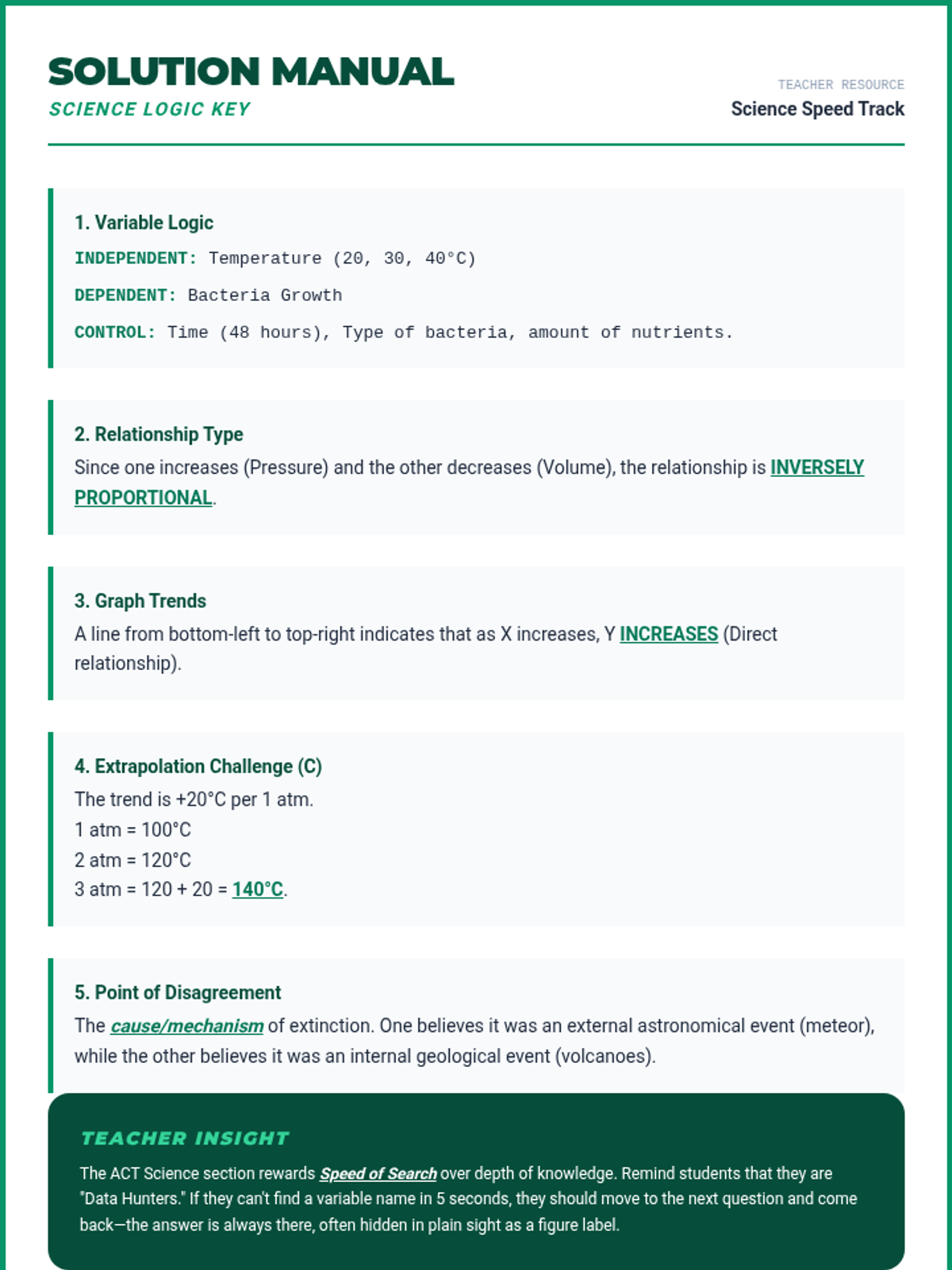
The detailed answer key for the Science Speed Logic Workout, providing explanations for variable identification, trend spotting, and scientific reasoning questions.
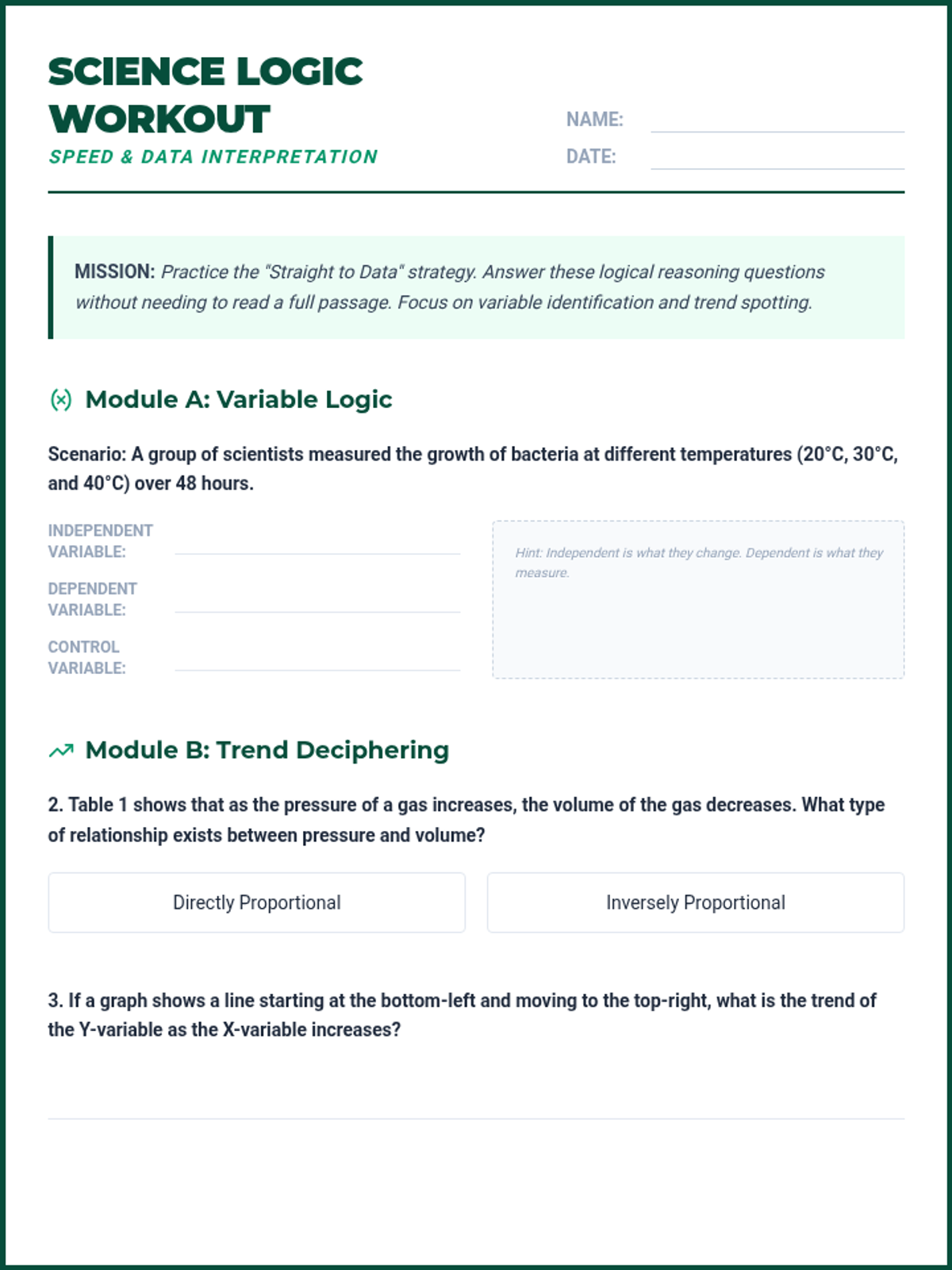
A specialized student practice worksheet for the ACT Science section, focusing on identifying independent/dependent variables, trend spotting, and basic scientific reasoning logic.
A visual slide deck covering strategic masterclass for the ACT Science section, focusing on speed-reading data sets, identifying experimental variables, and decoding scientific logic. This deck emphasizes the 'Straight to the Data' approach. Revised for font size compliance (min 24px).
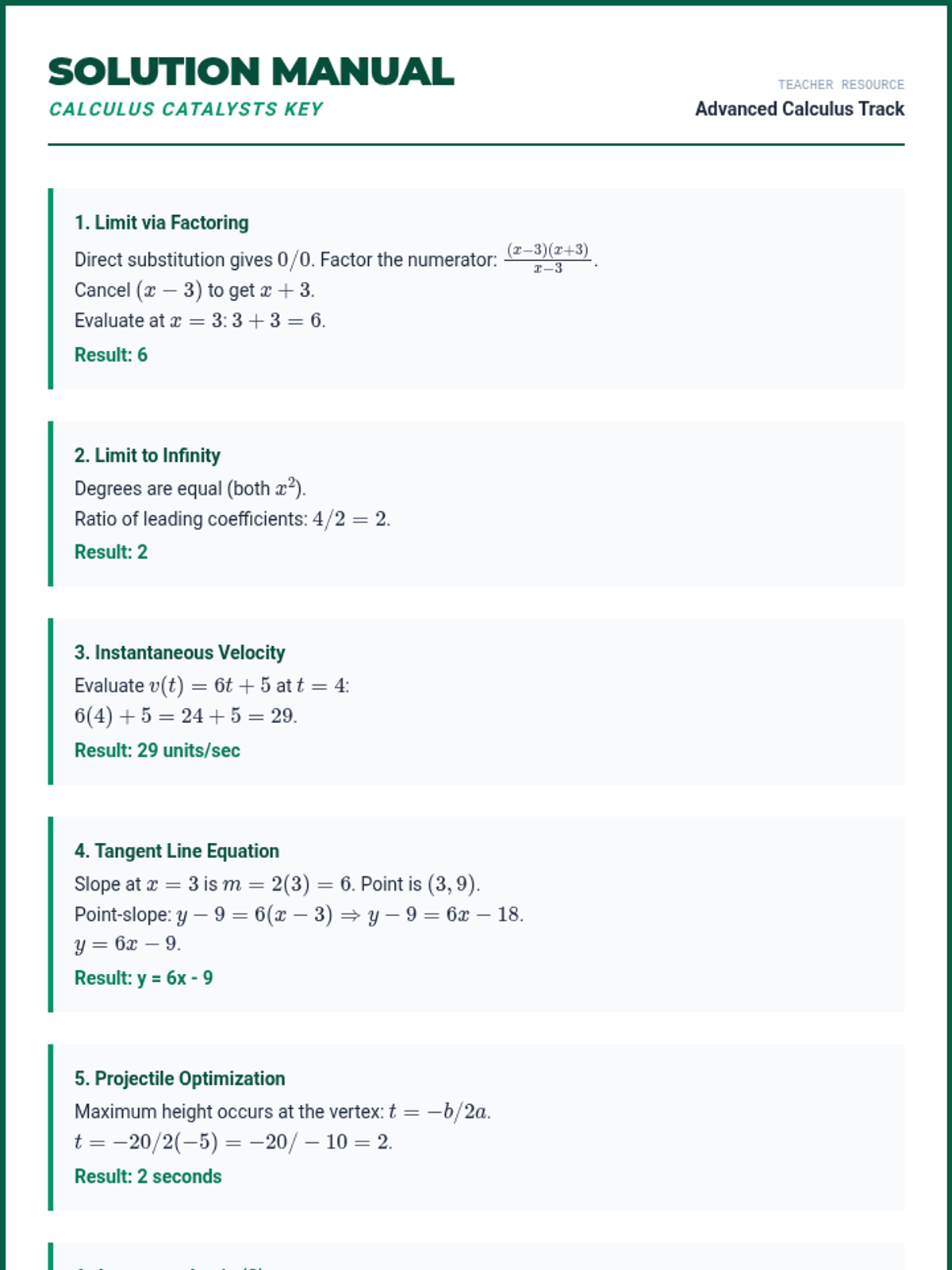
The detailed answer key for the Calculus Catalysts Workout, providing step-by-step solutions for limits, instantaneous rate of change, and basic function optimization problems.
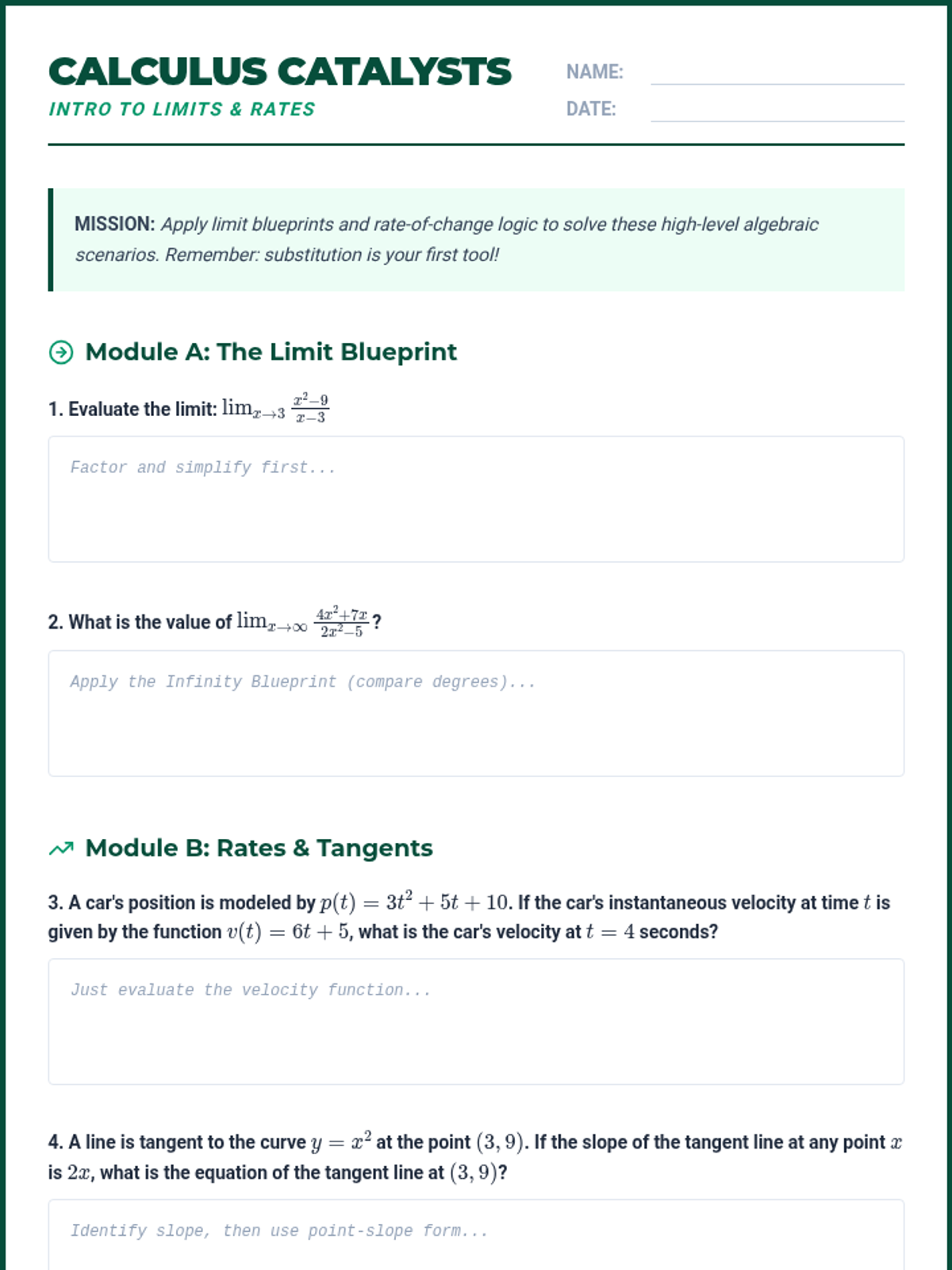
A student practice worksheet for calculus-adjacent ACT concepts, featuring limits, instantaneous rate of change logic, and function optimization problems.
A visual slide deck explaining introductory calculus concepts for the ACT, including limits, instantaneous rate of change, and basic function optimization using standard blueprints. Revised for font size compliance (min 24px).
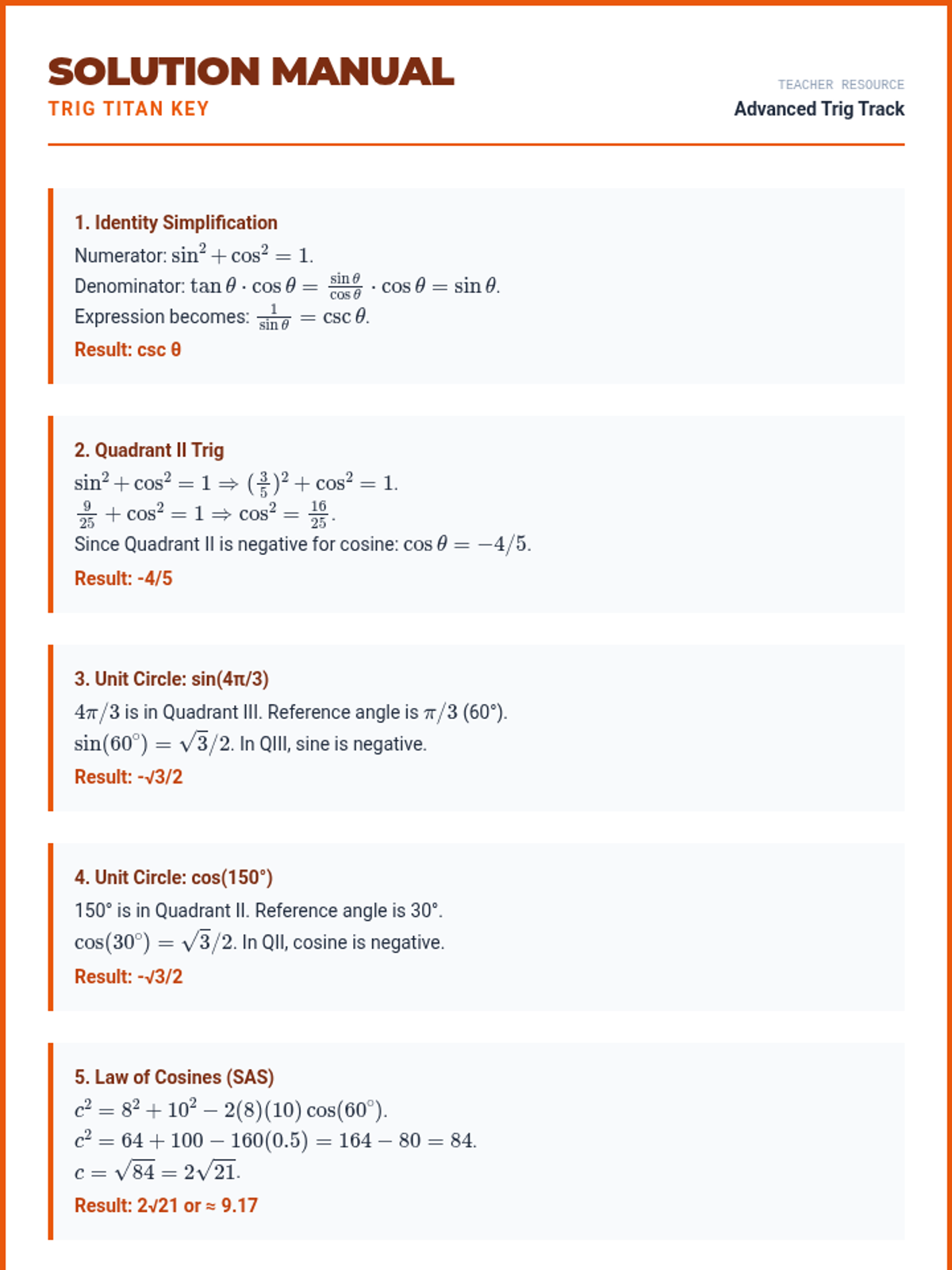
The detailed answer key for the Trig Titan Workout, including step-by-step solutions for identities, the unit circle, and non-right triangle problems.
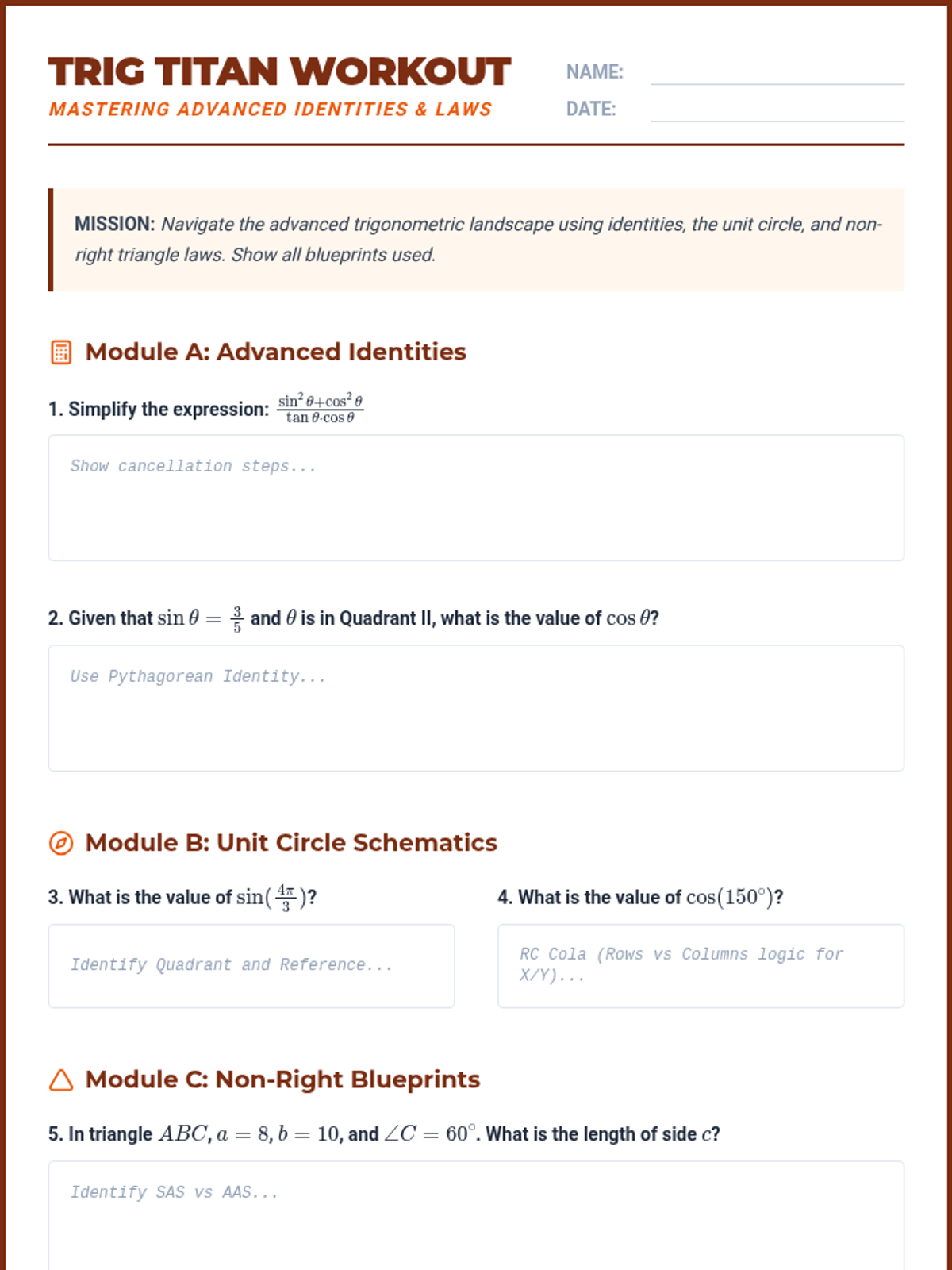
A comprehensive practice worksheet for advanced ACT trigonometry, featuring sections on identities, the unit circle, Law of Sines/Cosines, and 'Final Ten' challenge problems.
A visual slide deck covering advanced ACT trigonometry: Pythagorean identities, the unit circle, Law of Sines/Cosines, and the ambiguous SSA case. Revised for font size compliance (min 24px).
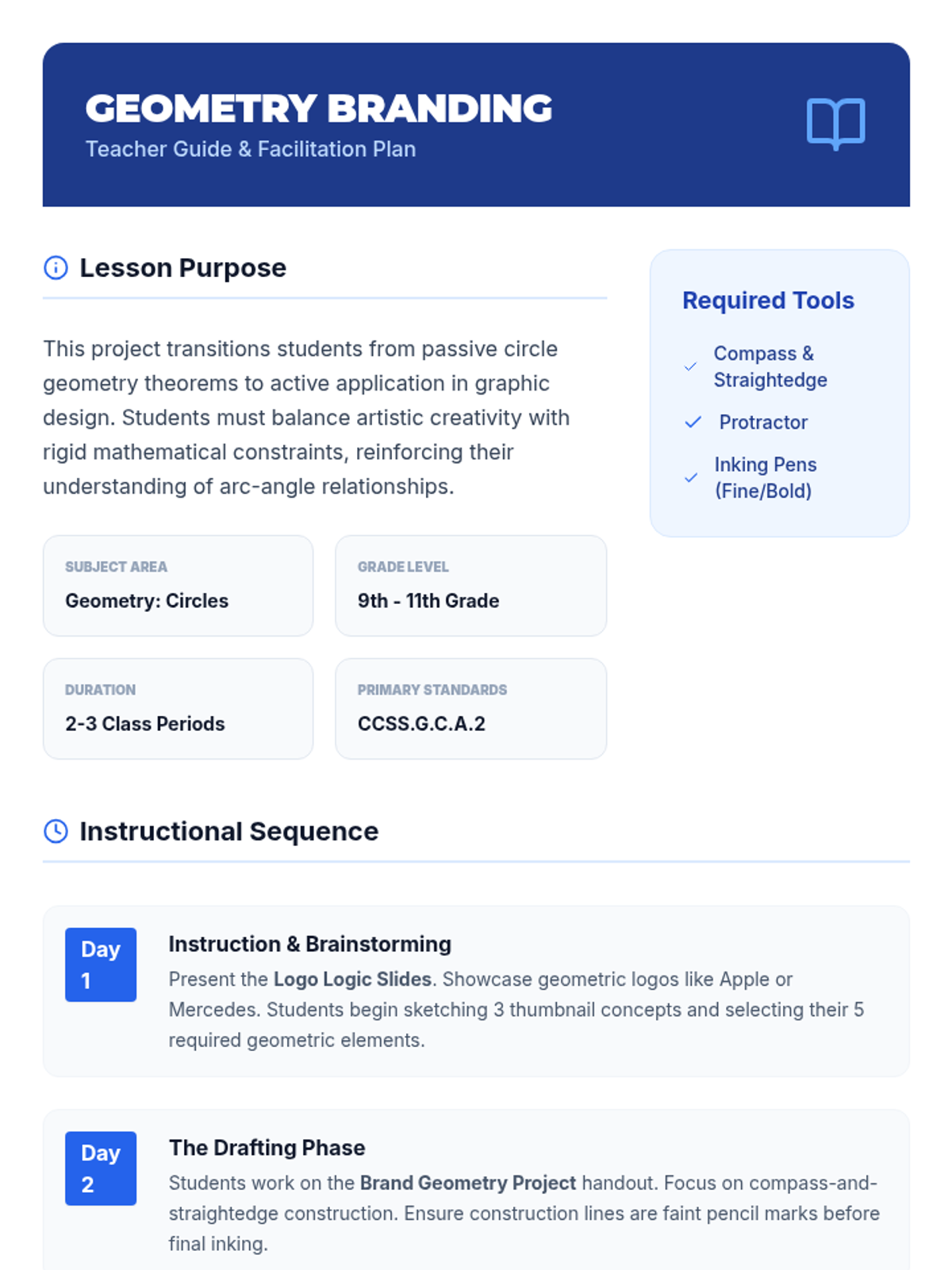
A comprehensive teacher guide for facilitating the Logo Logic project. Includes lesson pacing, a list of required materials, common student misconceptions to watch for, and strategies for differentiation.
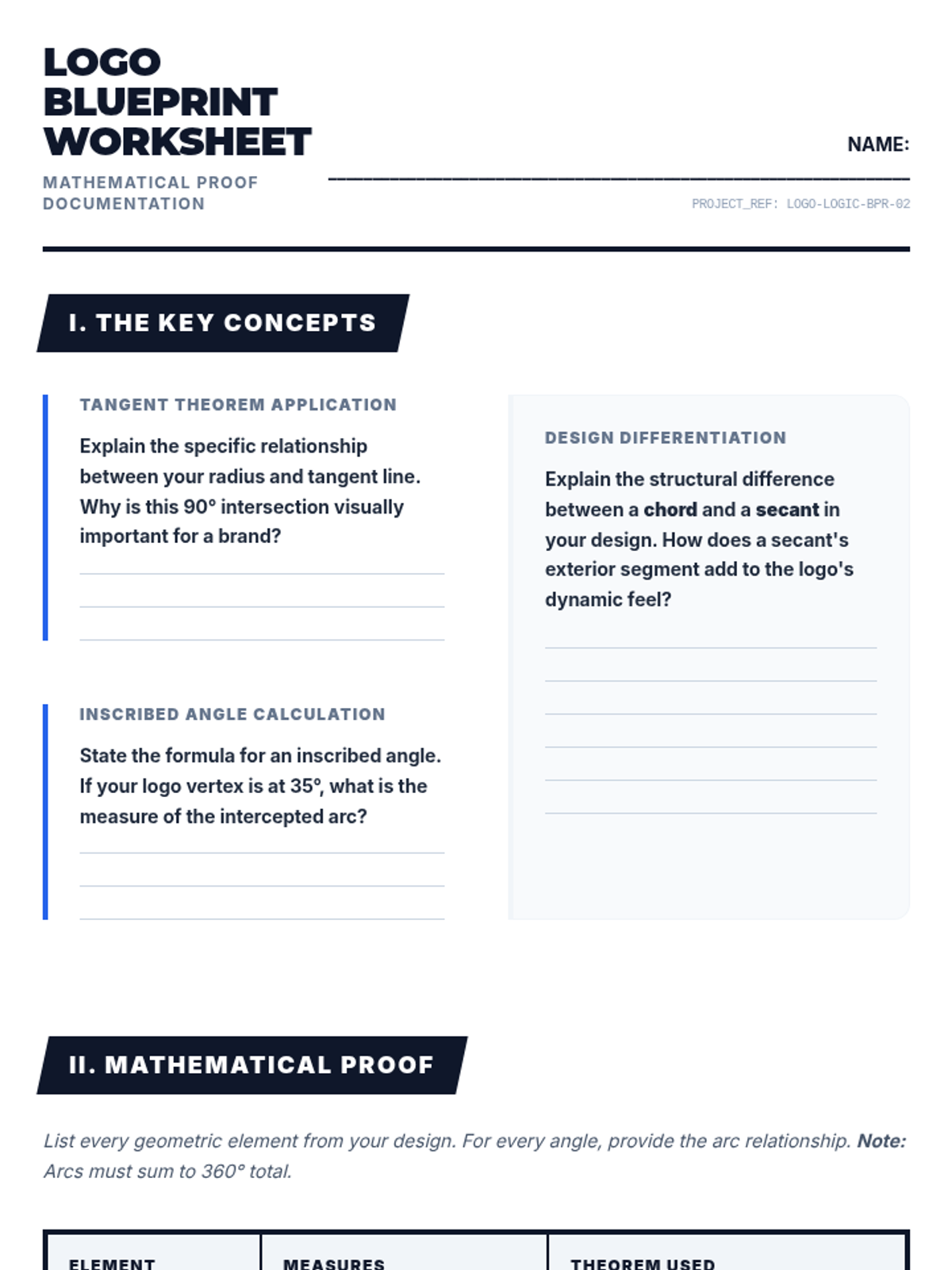
A structured worksheet for students to document the geometric proofs behind their logo design. It includes a table for recording measures of tangents, secants, and angles, plus reflection questions on the design process.
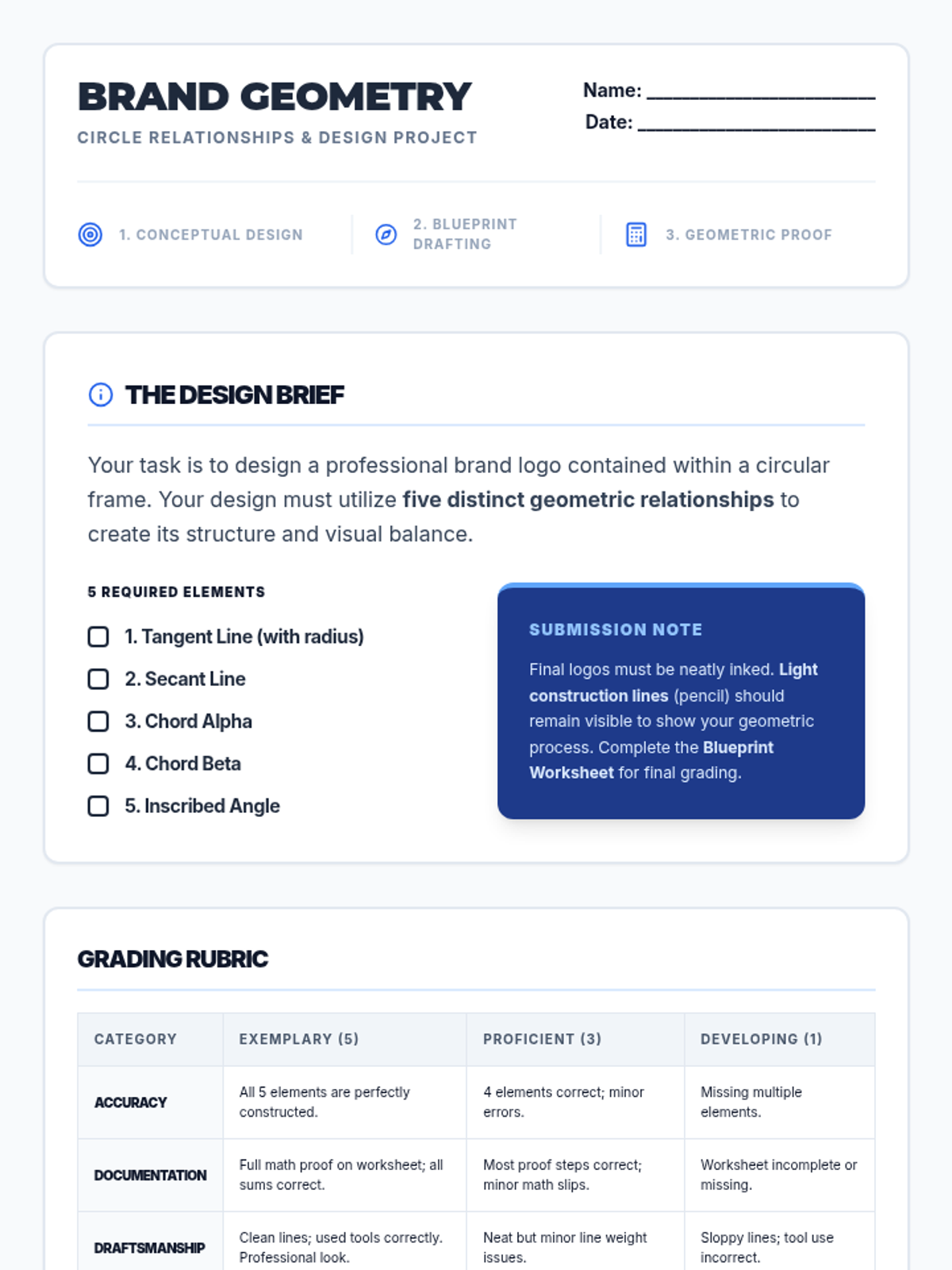
A comprehensive student project handout for the Brand Geometry project. Includes design constraints, a workspace for drafting, and a detailed grading rubric based on geometric accuracy and creative execution.
A visual presentation introducing circle geometry concepts (tangents, secants, chords, inscribed angles) through the lens of professional logo design. Includes architectural diagrams and project requirements.
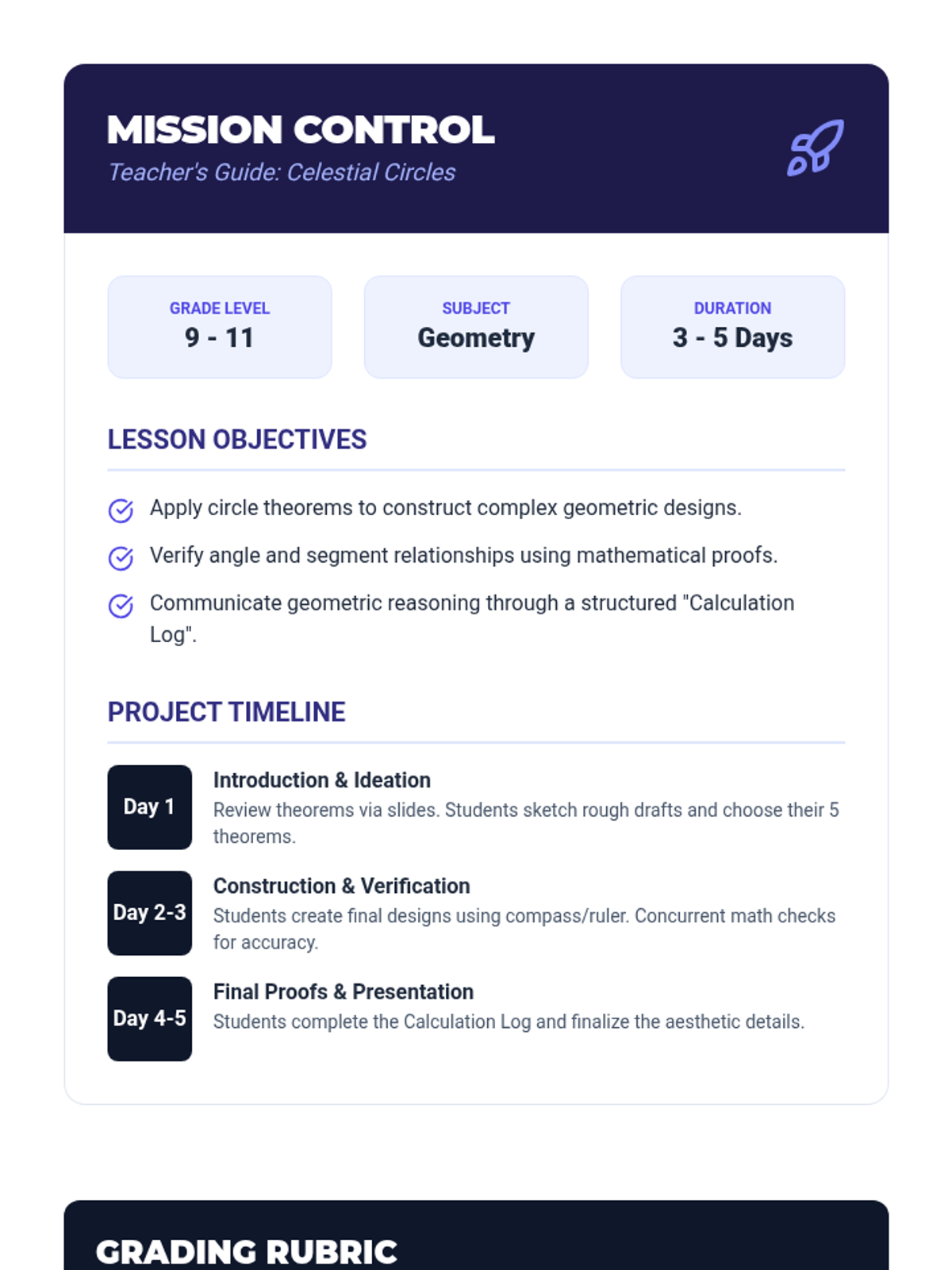
A teacher's guide for the Celestial Circles project, including lesson objectives, a daily project timeline, and a comprehensive grading rubric.
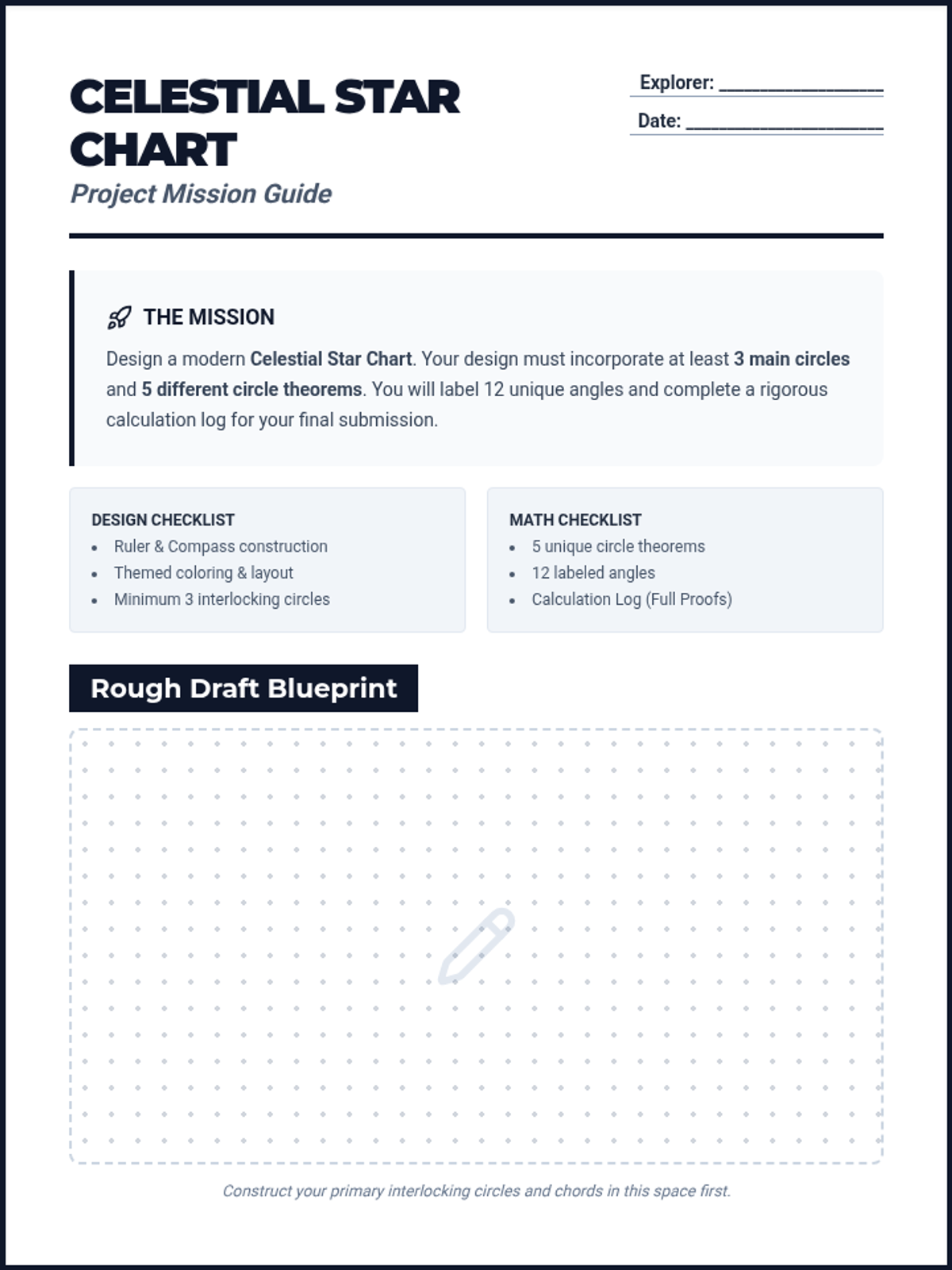
A project guide for students to design a celestial star chart using circle theorems, including design requirements, a drafting space, and a 5-entry calculation log for proofs.
A slide deck to introduce the Celestial Circles project, featuring visual reviews of core circle theorems and project requirements for a star chart design activity.
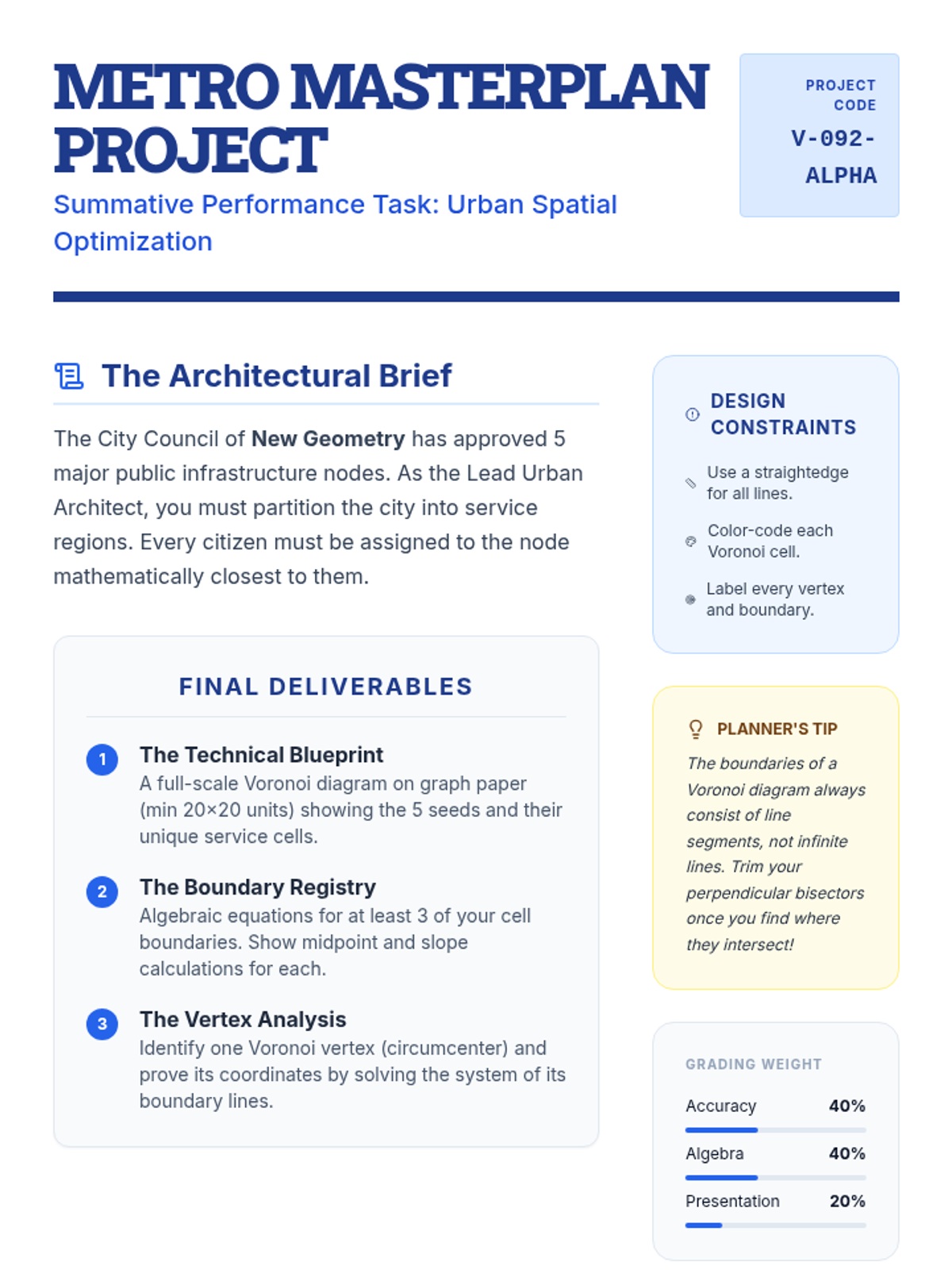
A summative project guide where students design a city's infrastructure layout, constructing a 5-seed Voronoi diagram and providing mathematical proof of its efficiency.
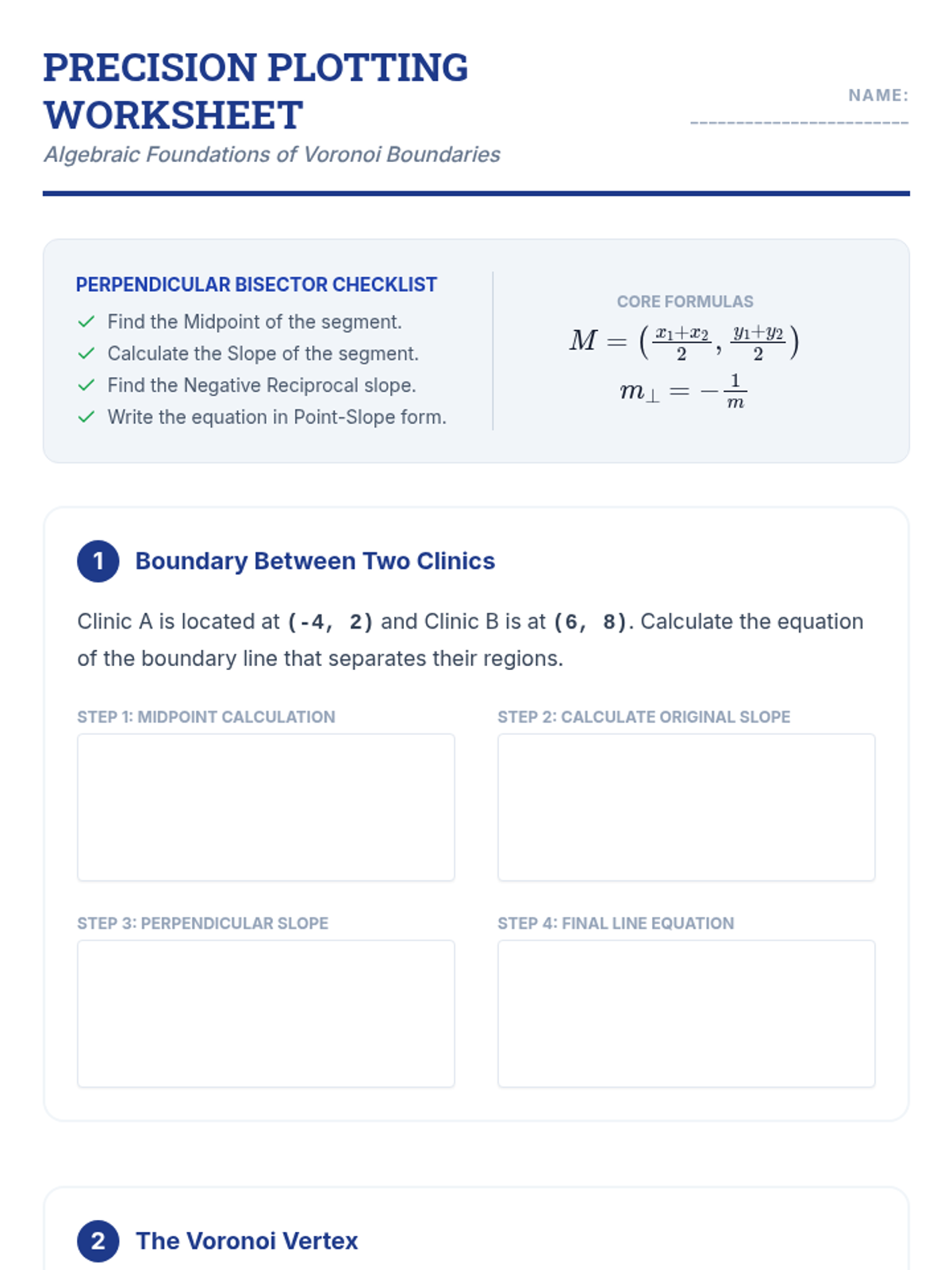
A math worksheet that combines geometry and algebra, requiring students to calculate the equations of perpendicular bisectors and find Voronoi vertices through systems of linear equations.
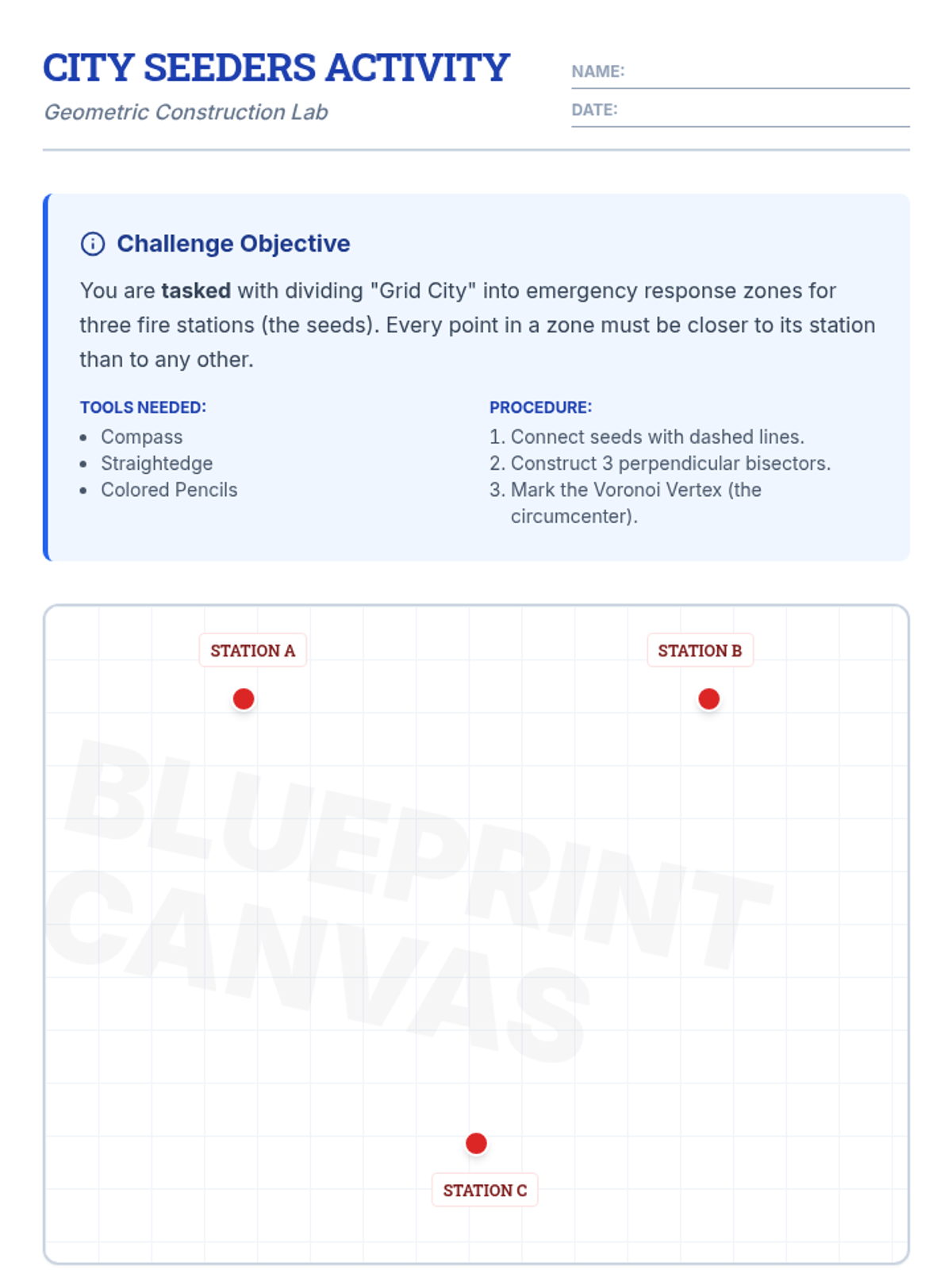
A hands-on activity sheet where students use a compass and straightedge to construct a Voronoi diagram for three "fire stations" on a grid, reinforcing the concept of the perpendicular bisector.
A visual slide deck that defines Voronoi diagrams, explains the construction algorithm using perpendicular bisectors, and shows real-world applications in urban planning and beyond.
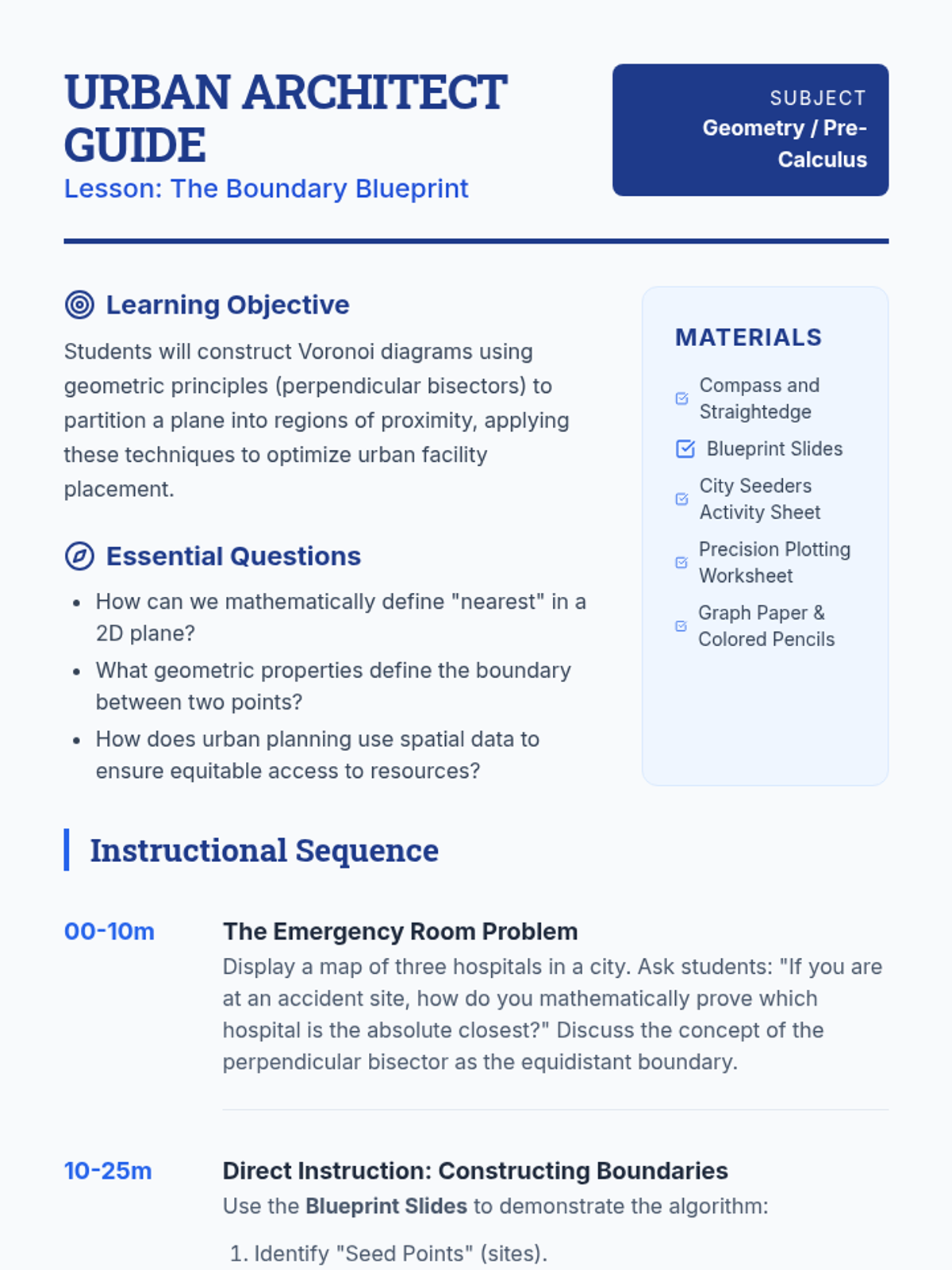
A comprehensive lesson plan for teachers, outlining the instructional sequence, learning objectives, and materials needed to teach Voronoi diagrams through an urban planning lens.
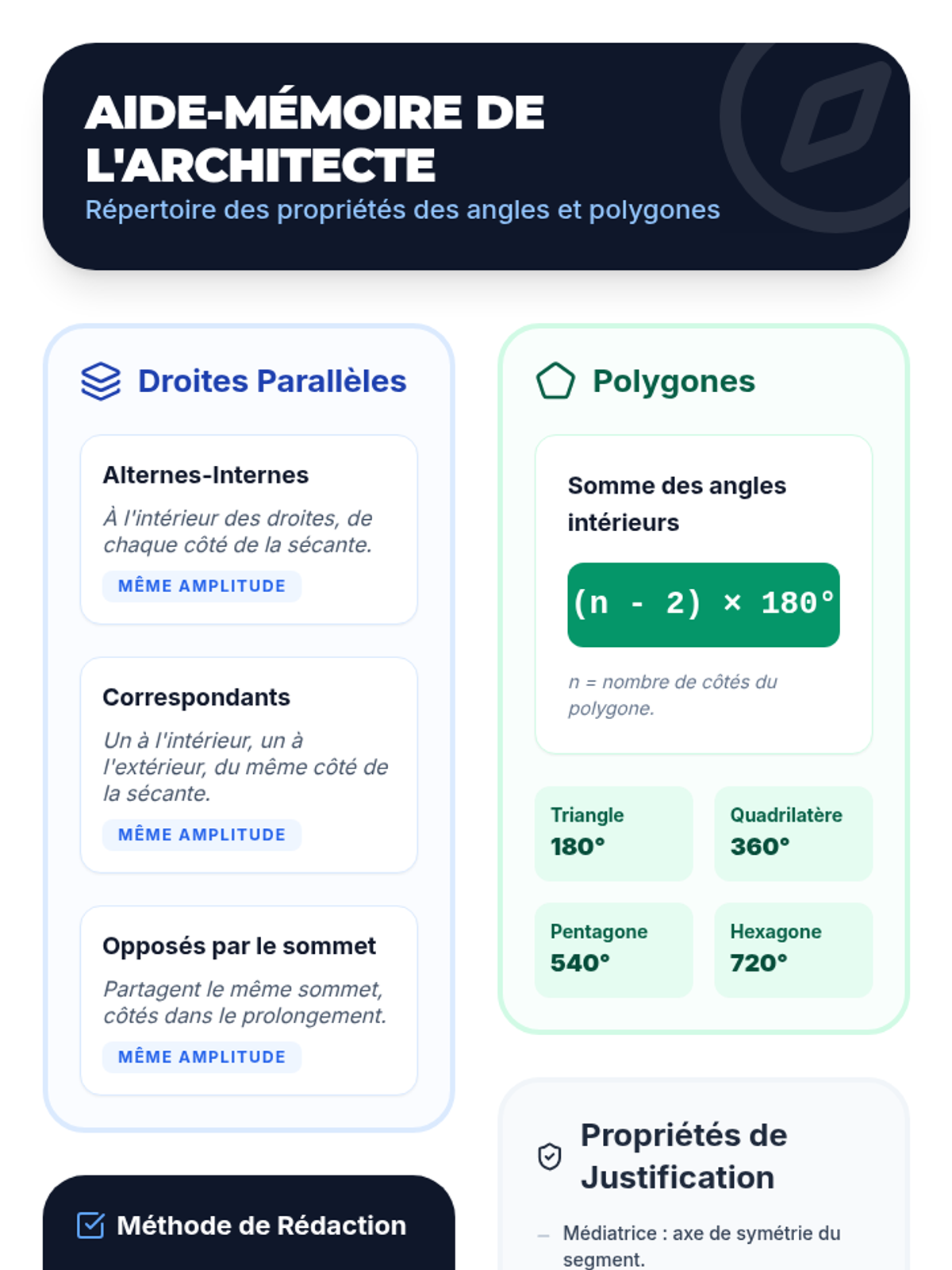
Une fiche de référence compacte résumant toutes les formules et propriétés des angles et polygones pour les élèves.
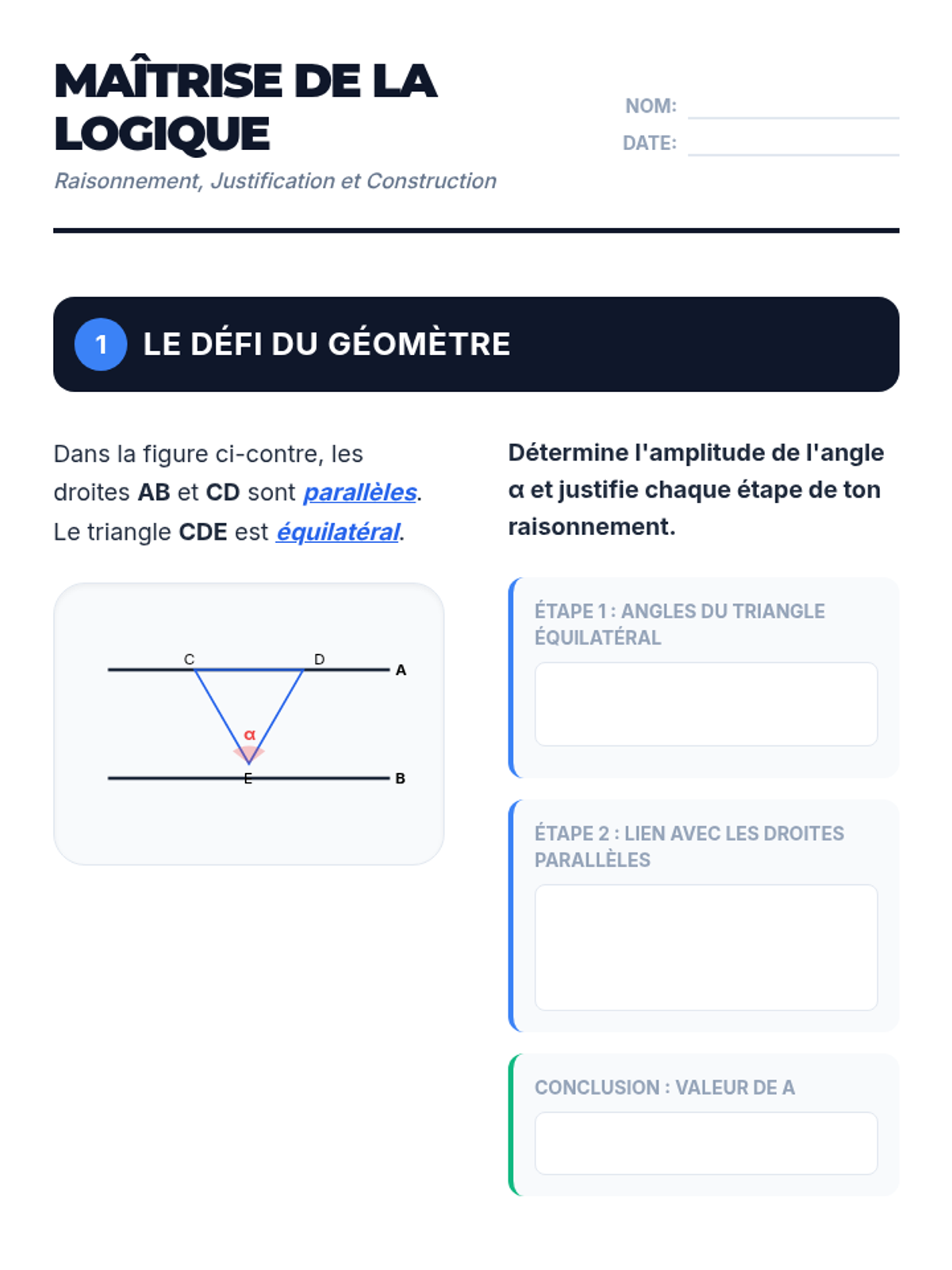
Une fiche d'exercices pour apprendre à justifier rigoureusement chaque étape d'un calcul ou d'une construction géométrique.
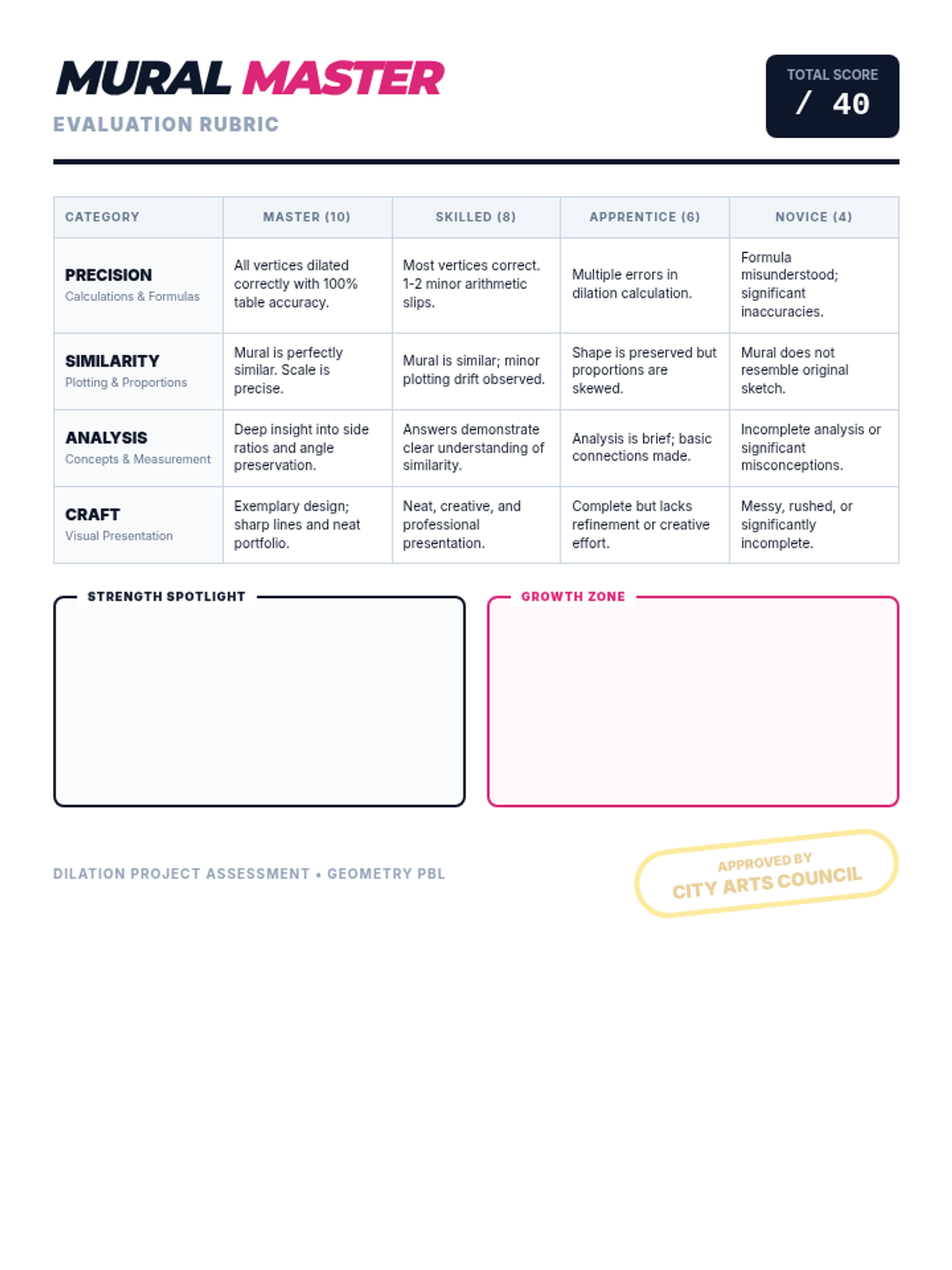
A detailed assessment rubric for the Mural Master project. It evaluates students on mathematical precision, geometric construction, conceptual analysis, and craftsmanship, with a professional and artistic aesthetic.
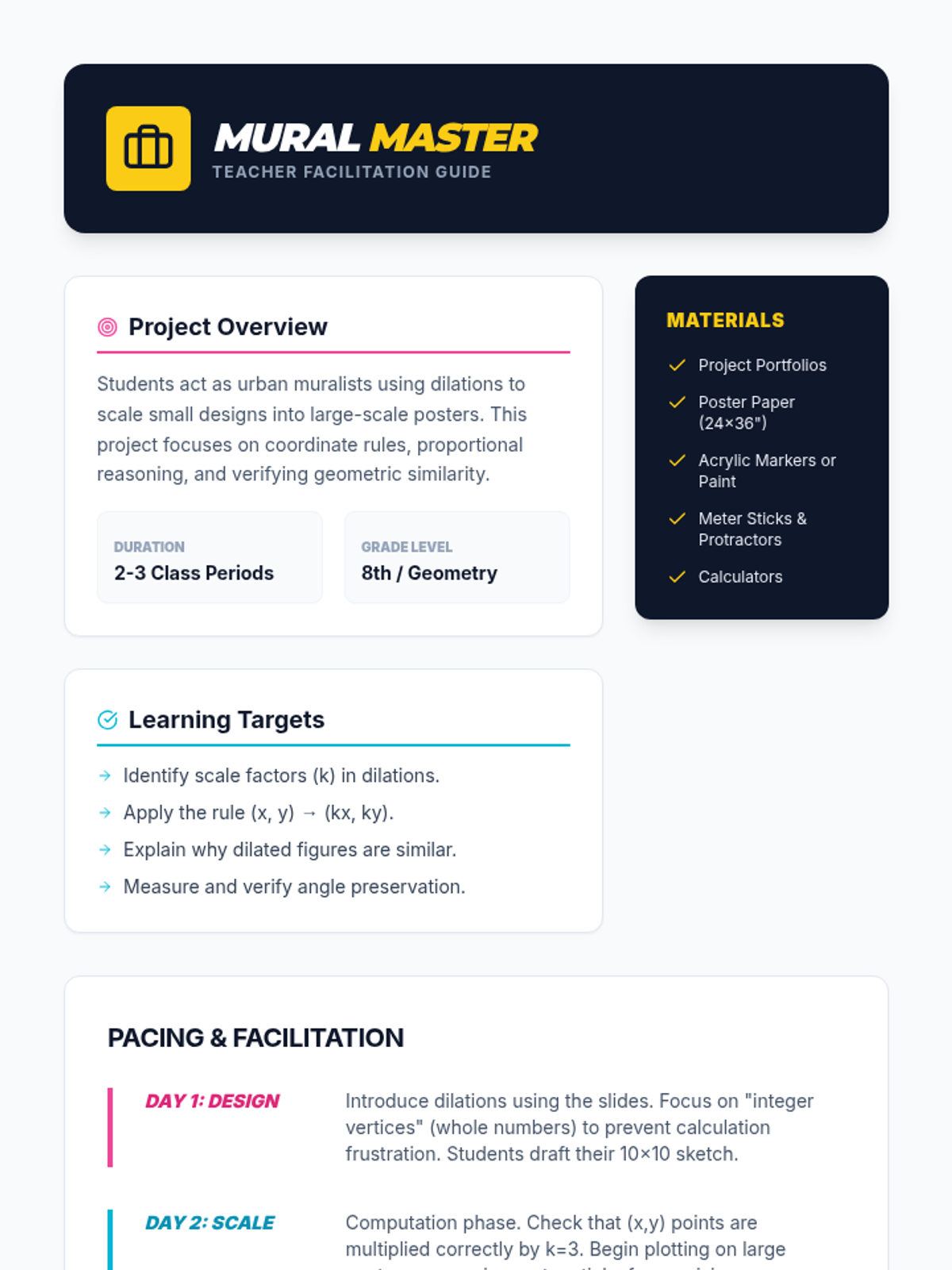
A professional teacher facilitation guide for the Mural Master project. It includes learning targets, a detailed pacing guide for a 3-day unit, differentiation strategies for support and extension, and a list of required materials.
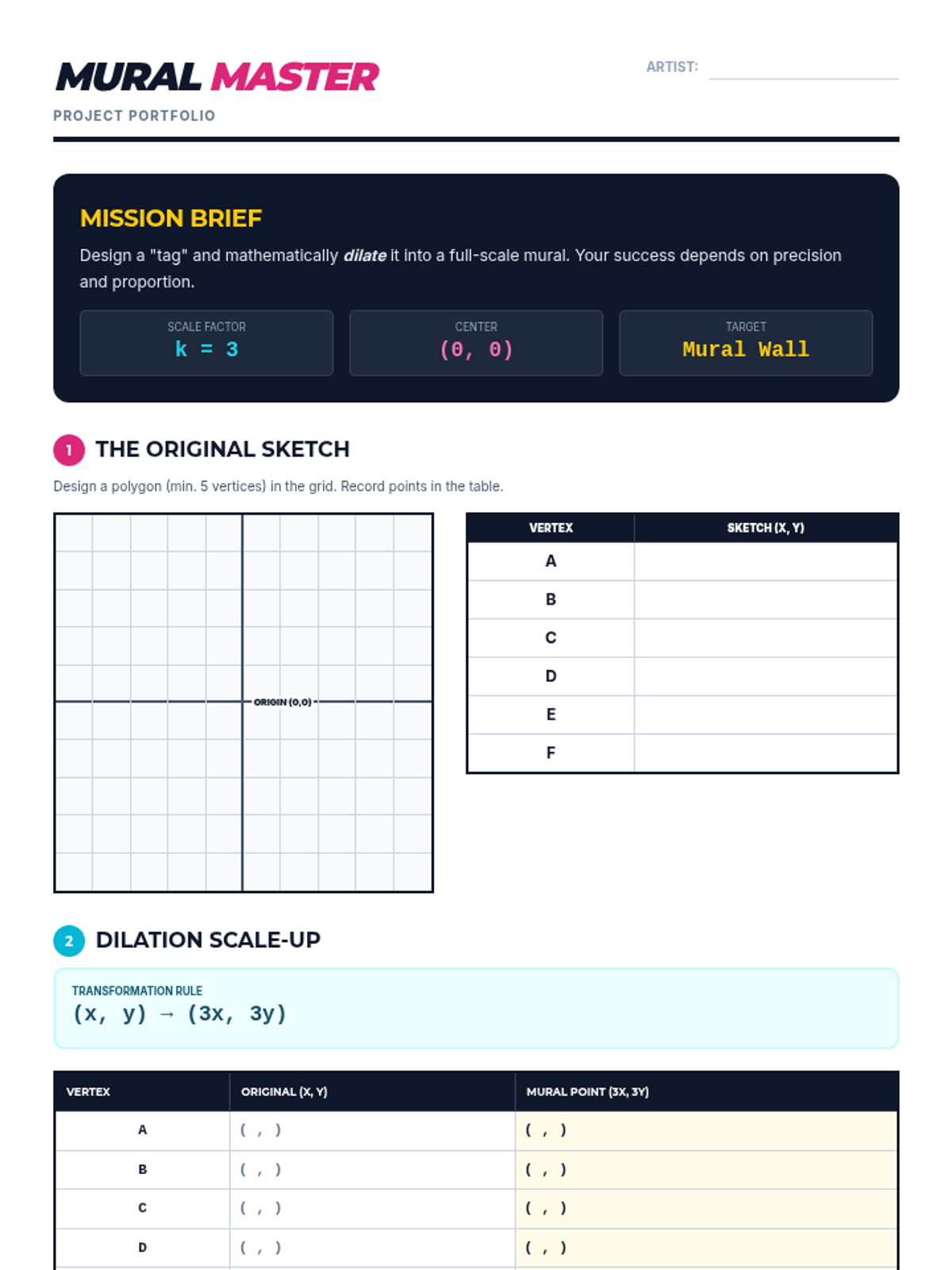
A comprehensive student project guide for the Mural Master PBL. It includes a design grid, coordinate tables for the original sketch and the dilated mural, and analysis questions to reinforce concepts of similarity and scale factor.
An engaging slide deck introducing the Mural Master PBL project. It covers the concept of dilations, scale factors (k), coordinate transformations, and the specific project phases with visual examples.
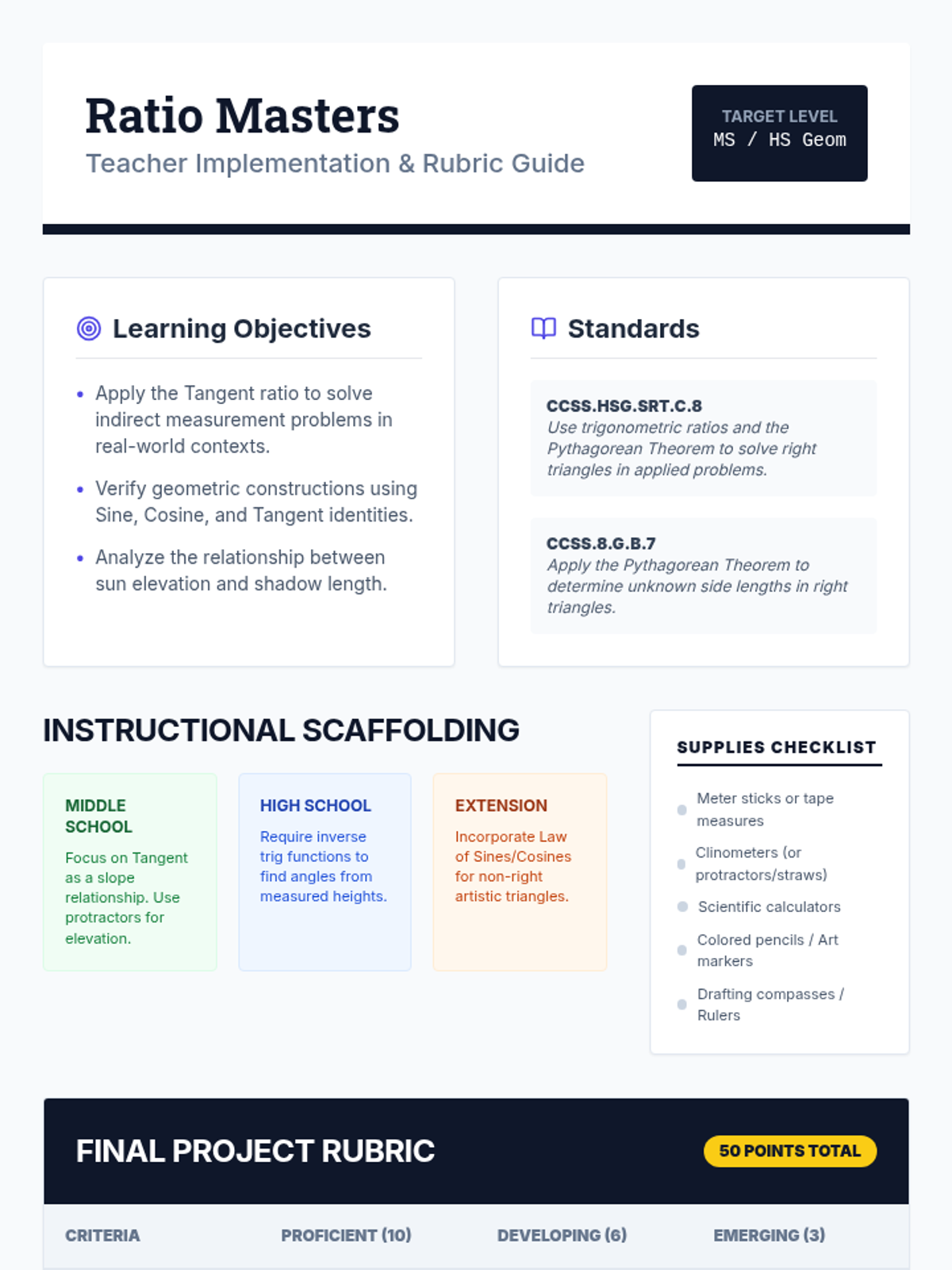
A teacher guide containing learning objectives, standards alignment, differentiation strategies for middle and high school, and a comprehensive grading rubric.
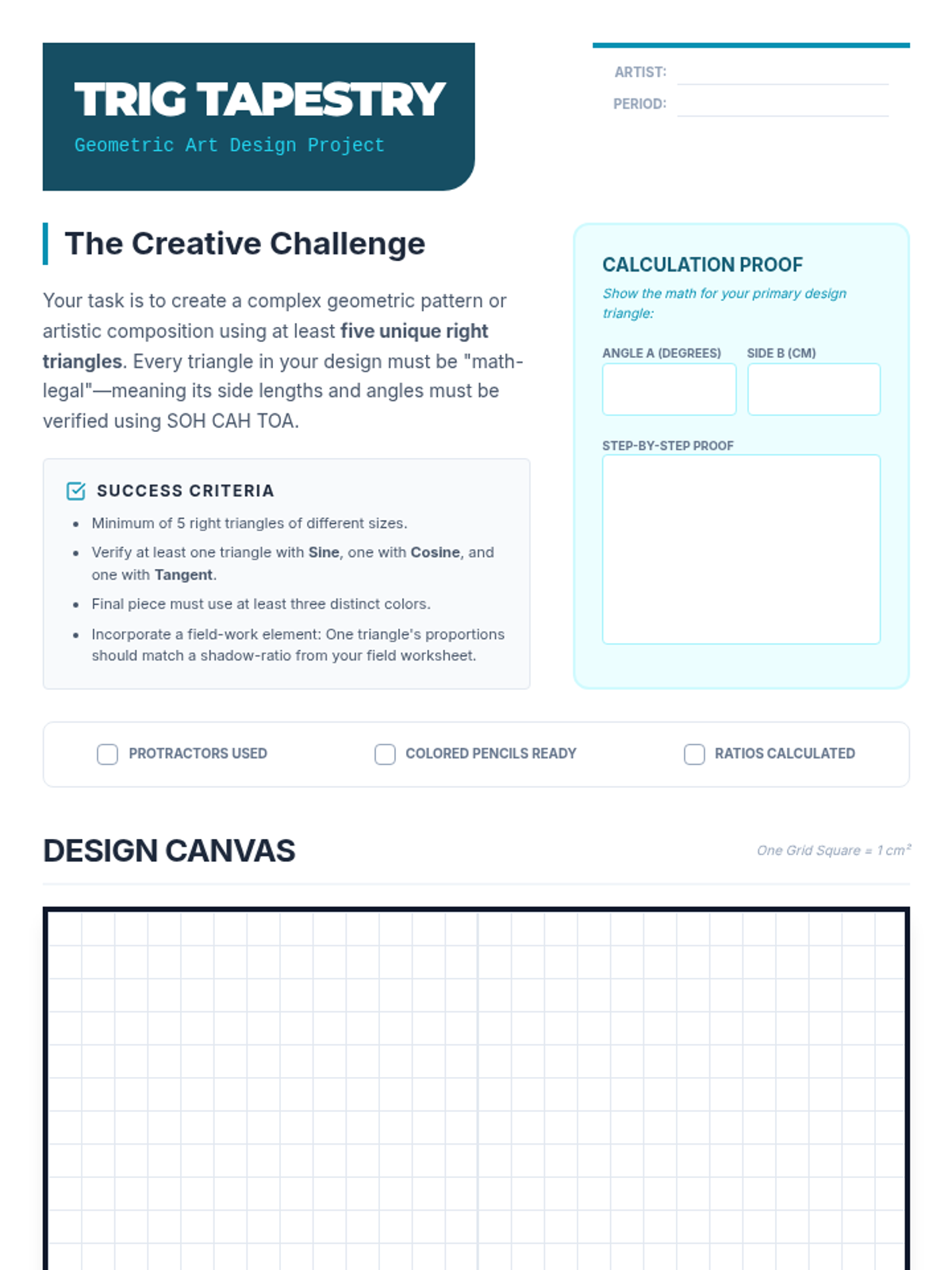
A project guide for the geometric art portion of the lesson. Students design a pattern using right triangles and prove their proportions using trigonometric ratios.
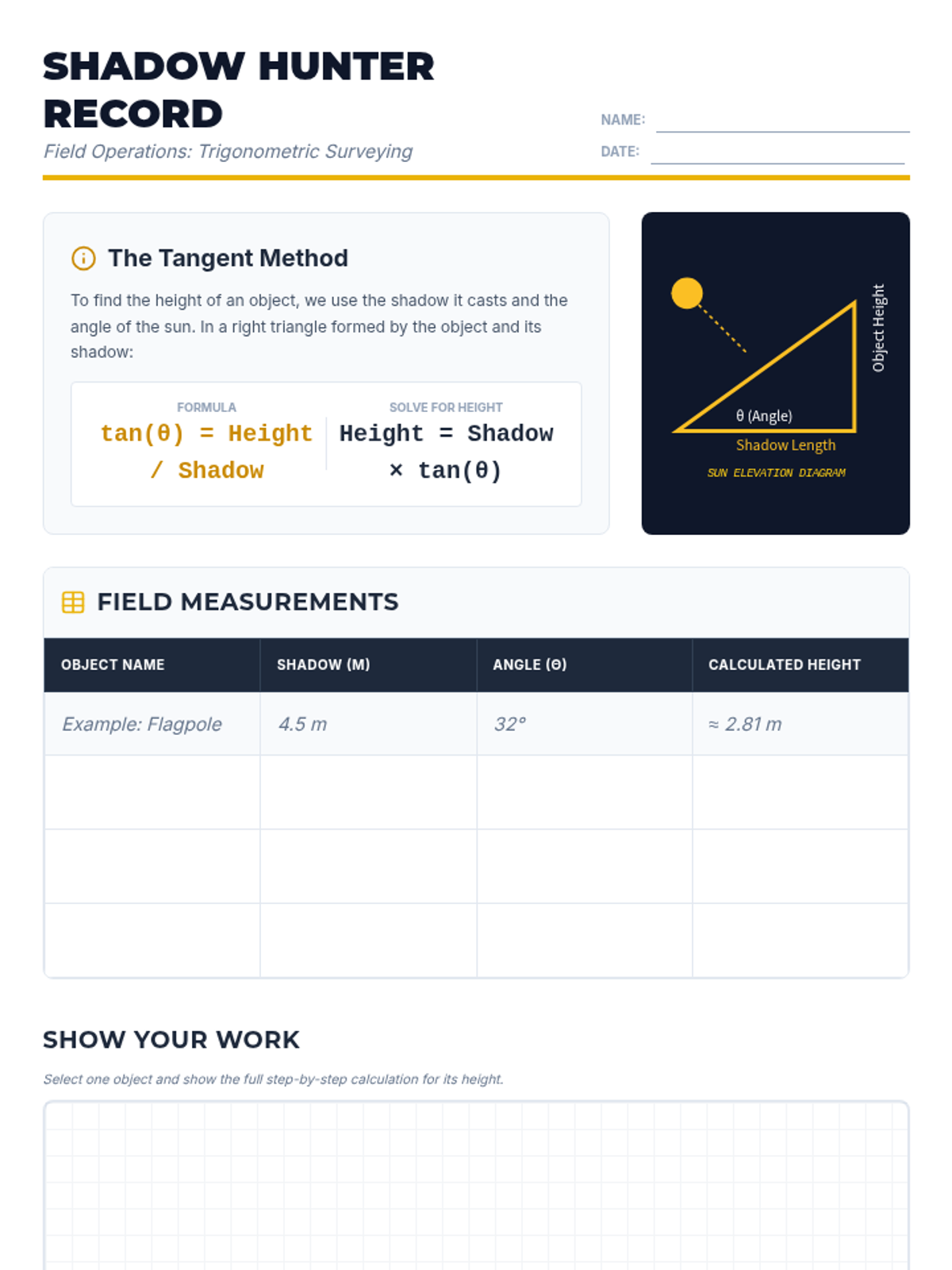
A field data collection sheet for students to record shadow lengths and calculate object heights using the tangent ratio. Includes space for work and reflection questions.
An introductory slide deck for the Shadows and Shapes project, covering trigonometric ratios, the two main project components (Shadow Hunters and Trig Tapestry), and the project timeline.
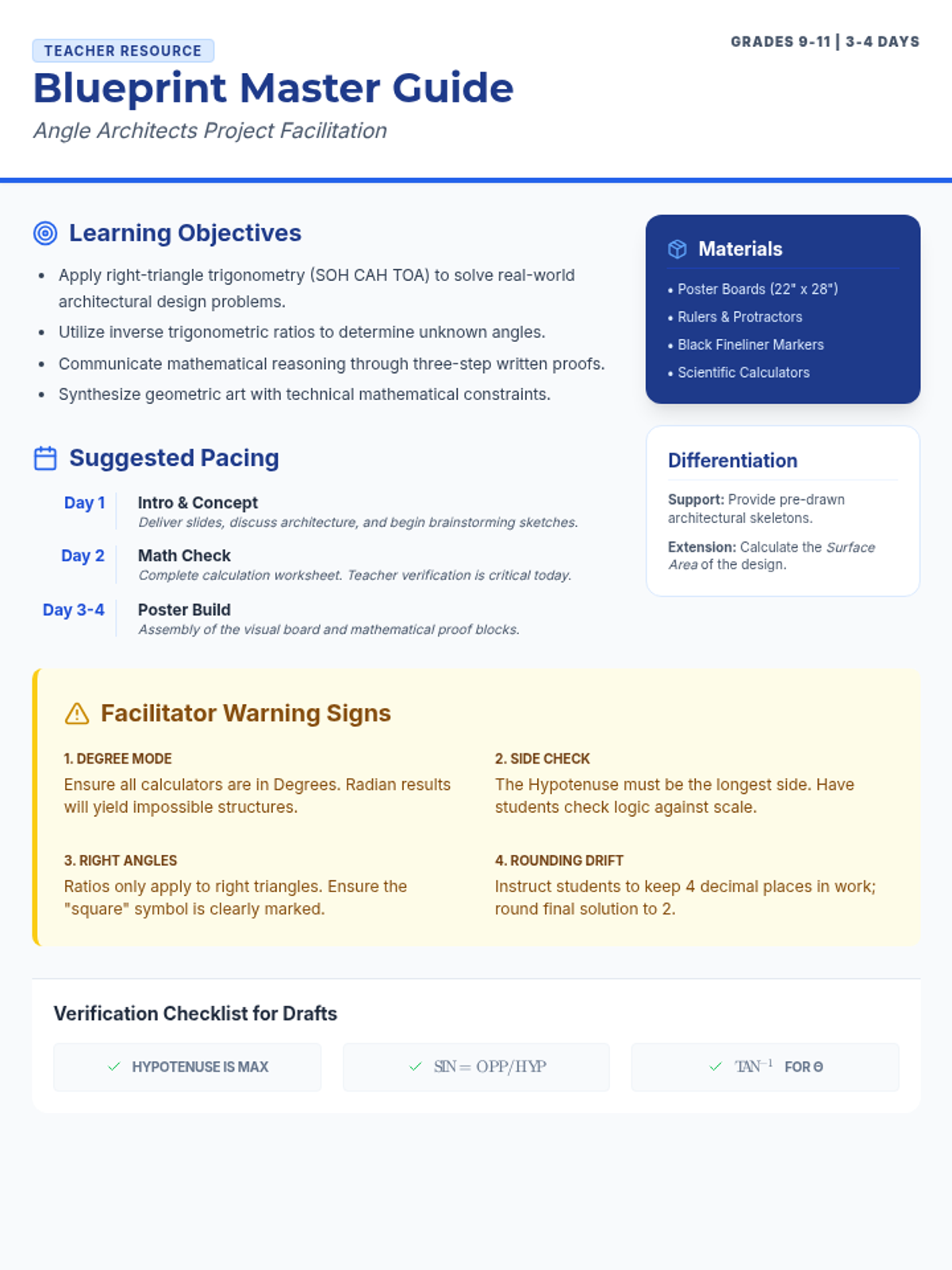
A comprehensive teacher's guide for the Angle Architects project, including pacing, materials, differentiation strategies, and common student misconceptions.
An introductory presentation for the Angle Architects project, covering real-world trig applications, SOH CAH TOA review, and project expectations.
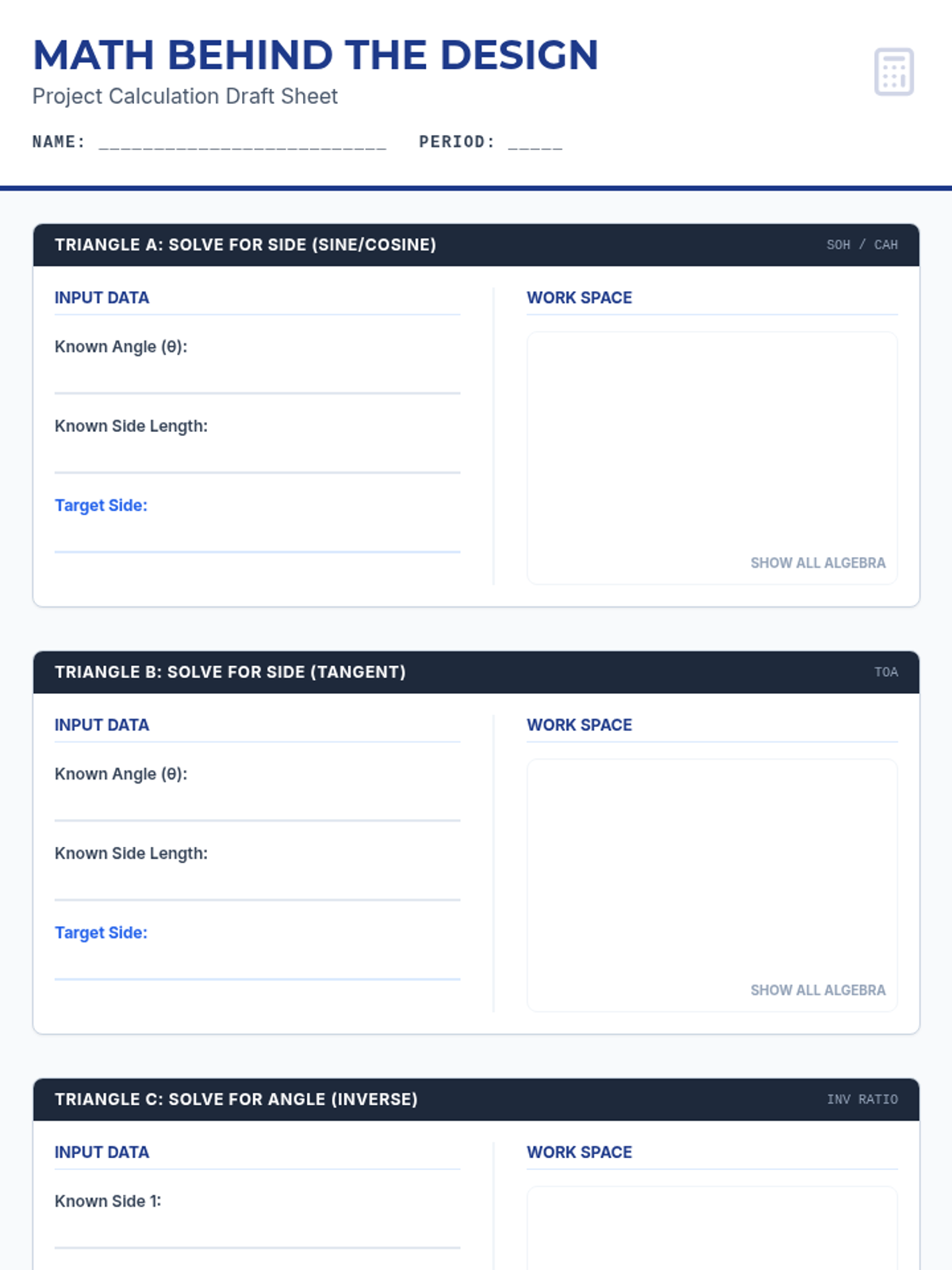
A structured worksheet for students to perform and check their step-by-step trigonometry calculations before transferring them to their final project poster.
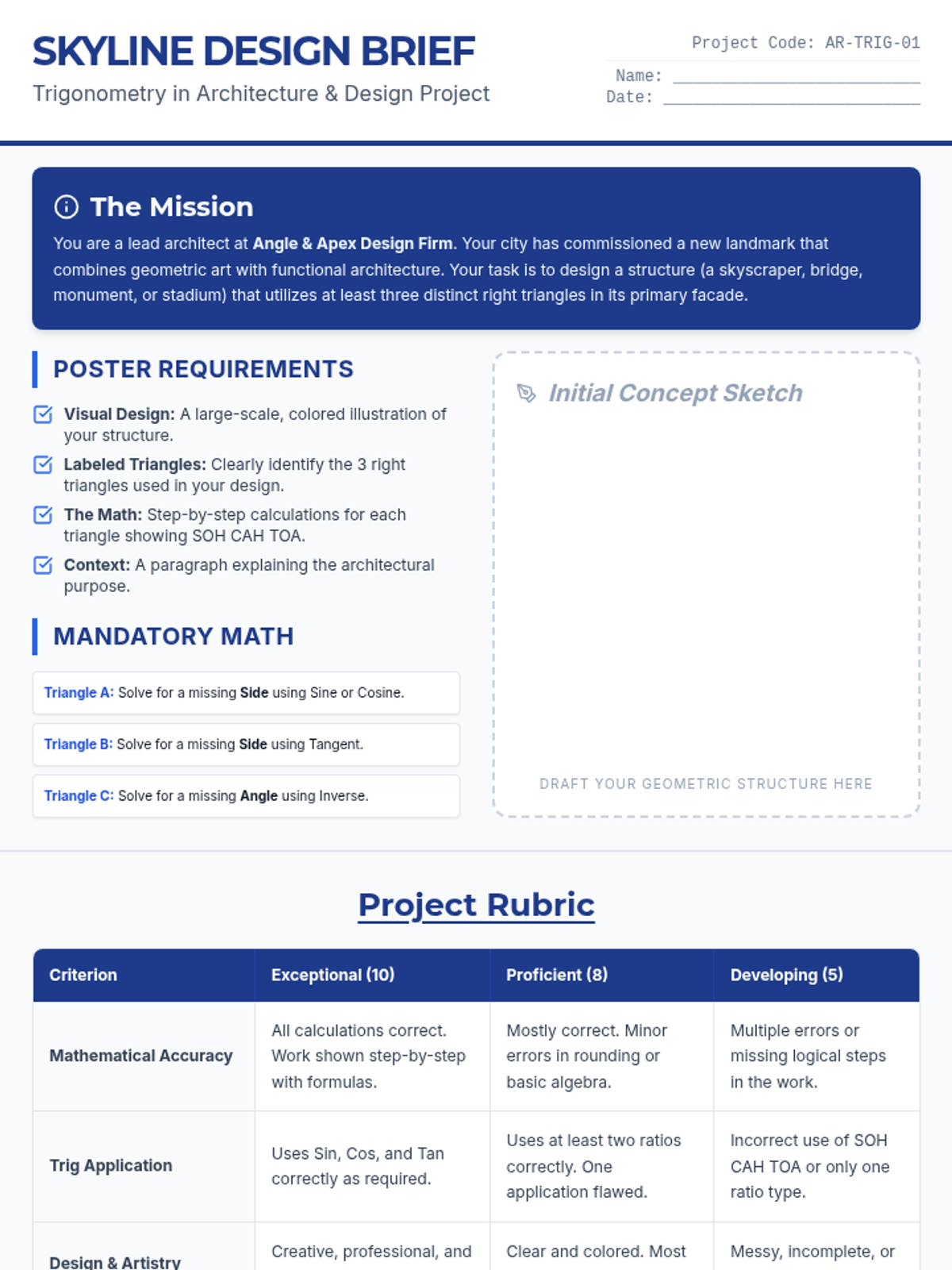
A student project brief for designing an architectural structure using trigonometry, including requirements, a sketch area, and a detailed grading rubric.
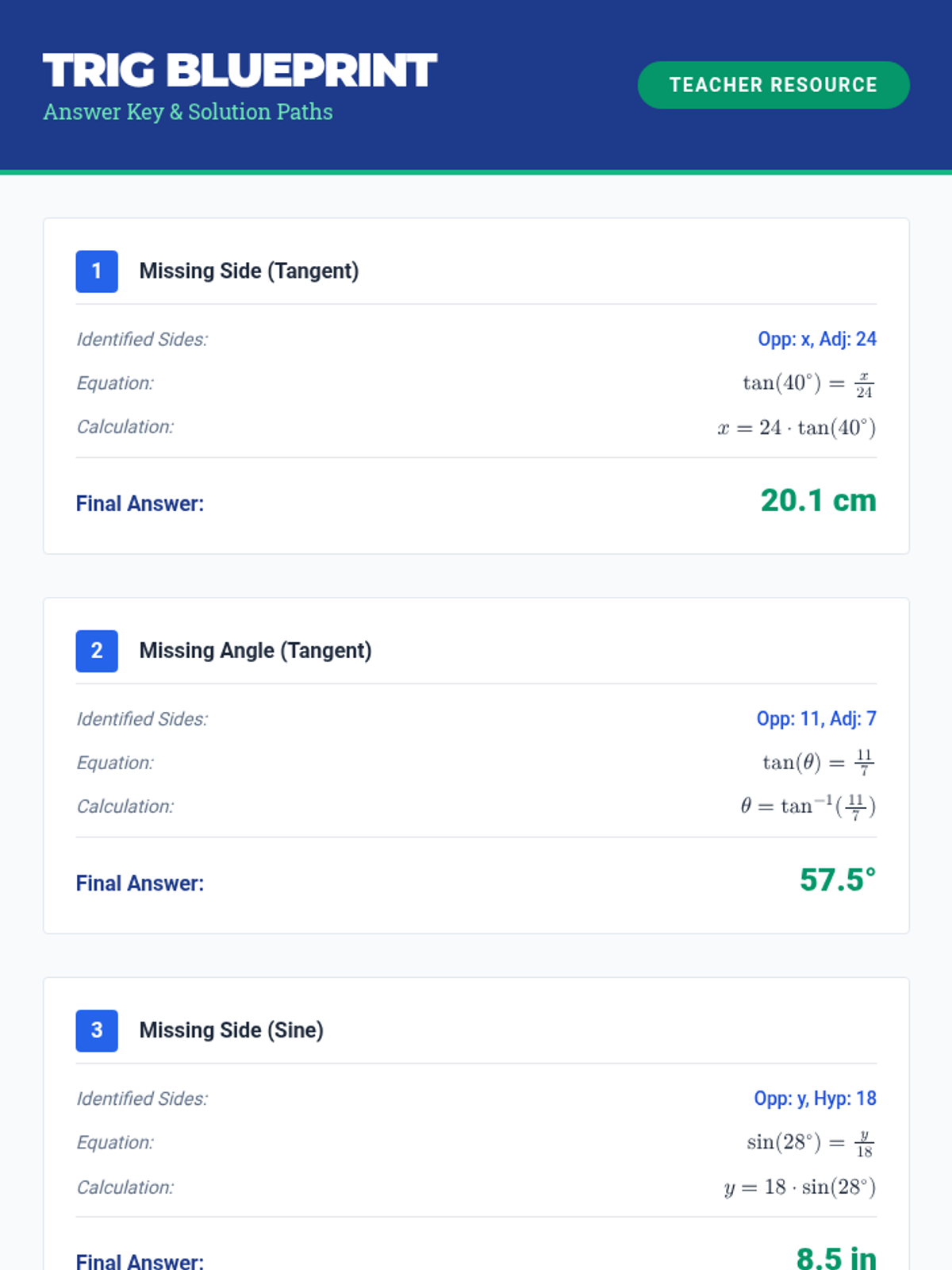
A teacher's answer key for the Trig Blueprint Worksheet, providing full step-by-step solution paths and teaching tips for each problem. Updated to include Cosine and corrected for page-flow issues.
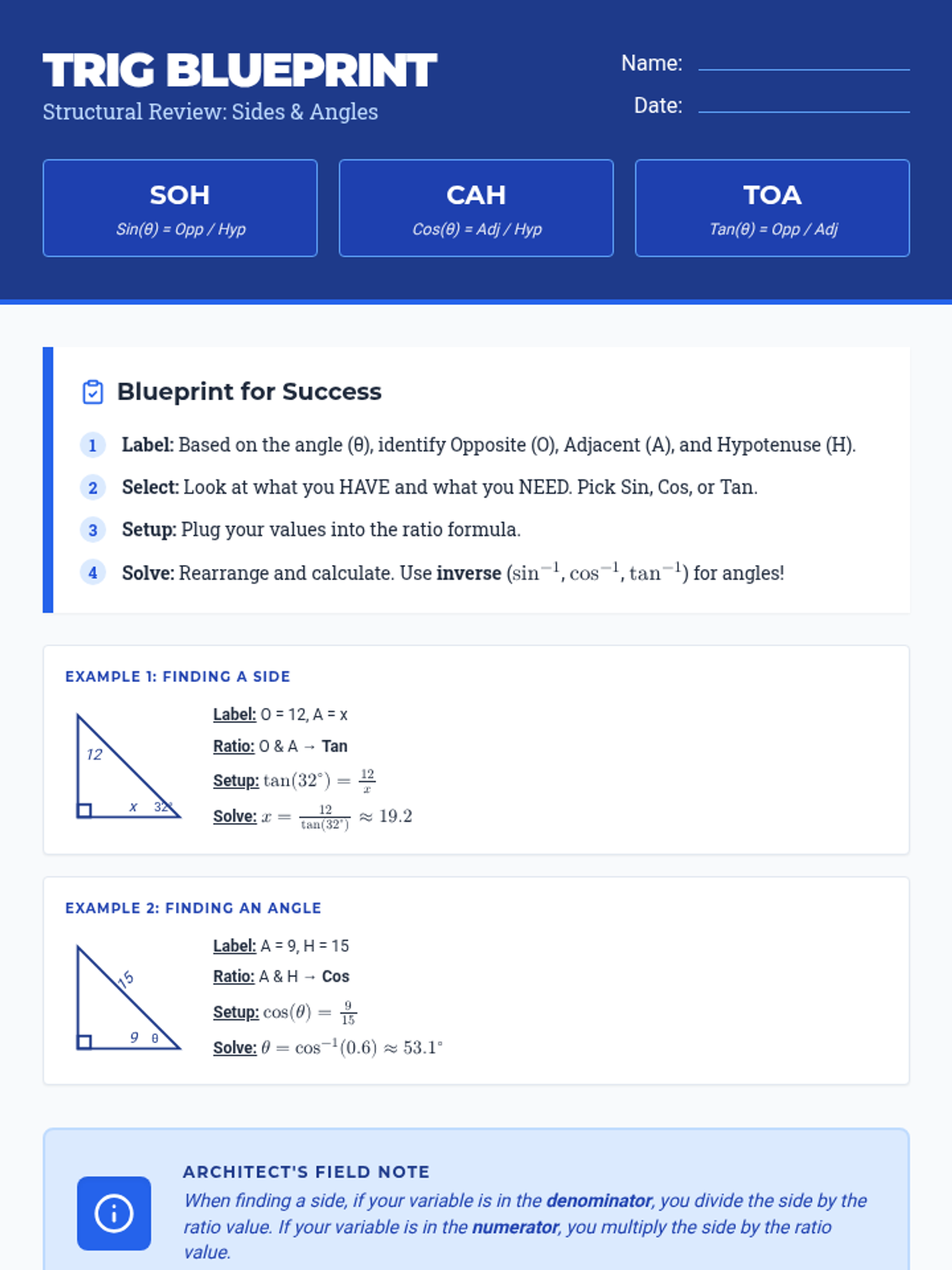
A student-facing trigonometry review sheet styled as an architectural blueprint, featuring a step-by-step checklist, worked examples for sides and angles, and four practice problems with dedicated workspace. Updated for better page flow and to include all three trig ratios.
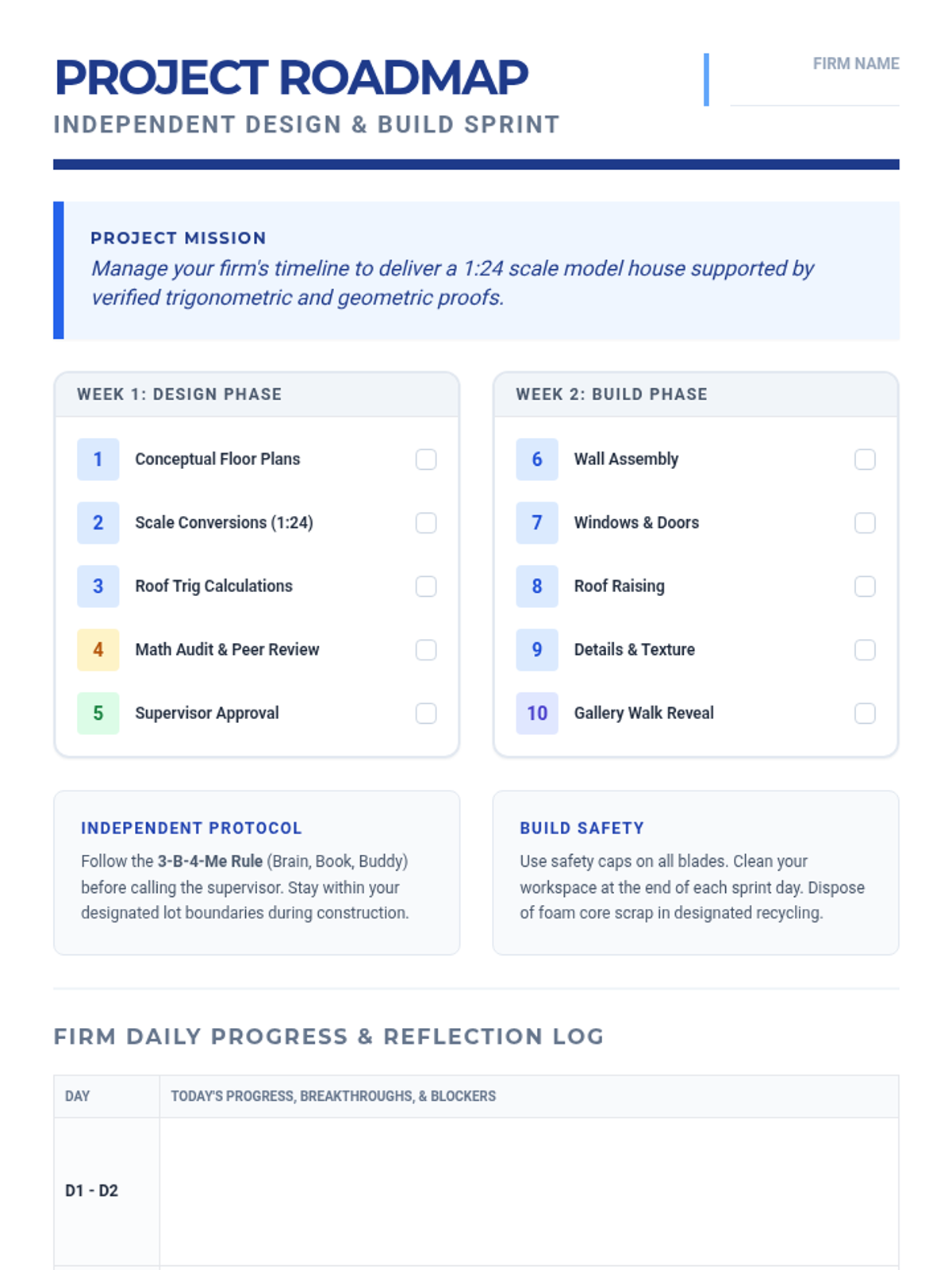
A self-paced student roadmap for the Angle Architects project, outlining daily milestones, a 10-day checklist, and independent problem-solving protocols.
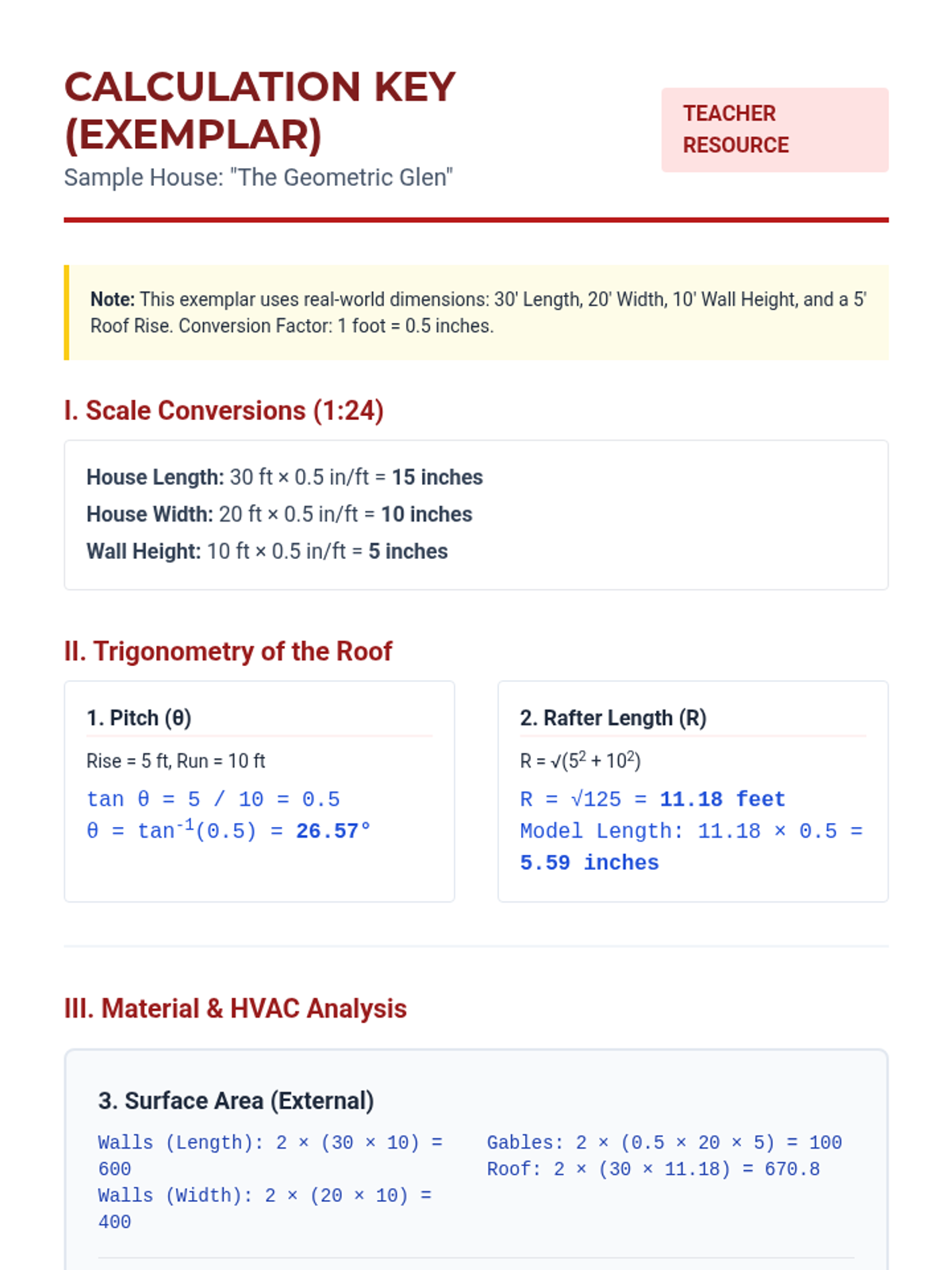
A teacher-facing answer key and calculation exemplar for the Angle Architects project, providing a concrete example of the math required for a standard house design.
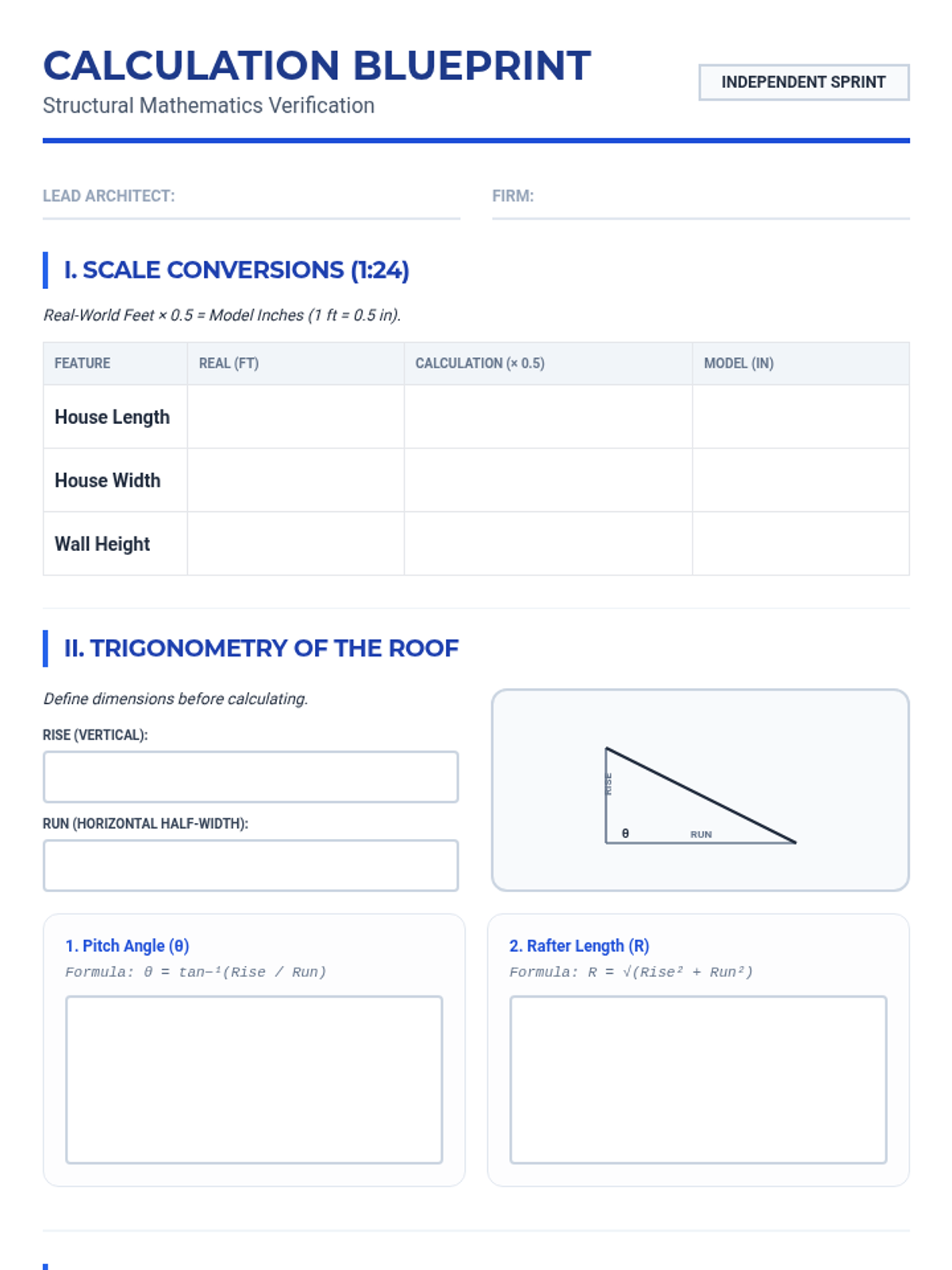
A technical worksheet for 10th-grade students to document their scale conversions, roof trigonometry (pitch and rafter length), surface area, and volume calculations.
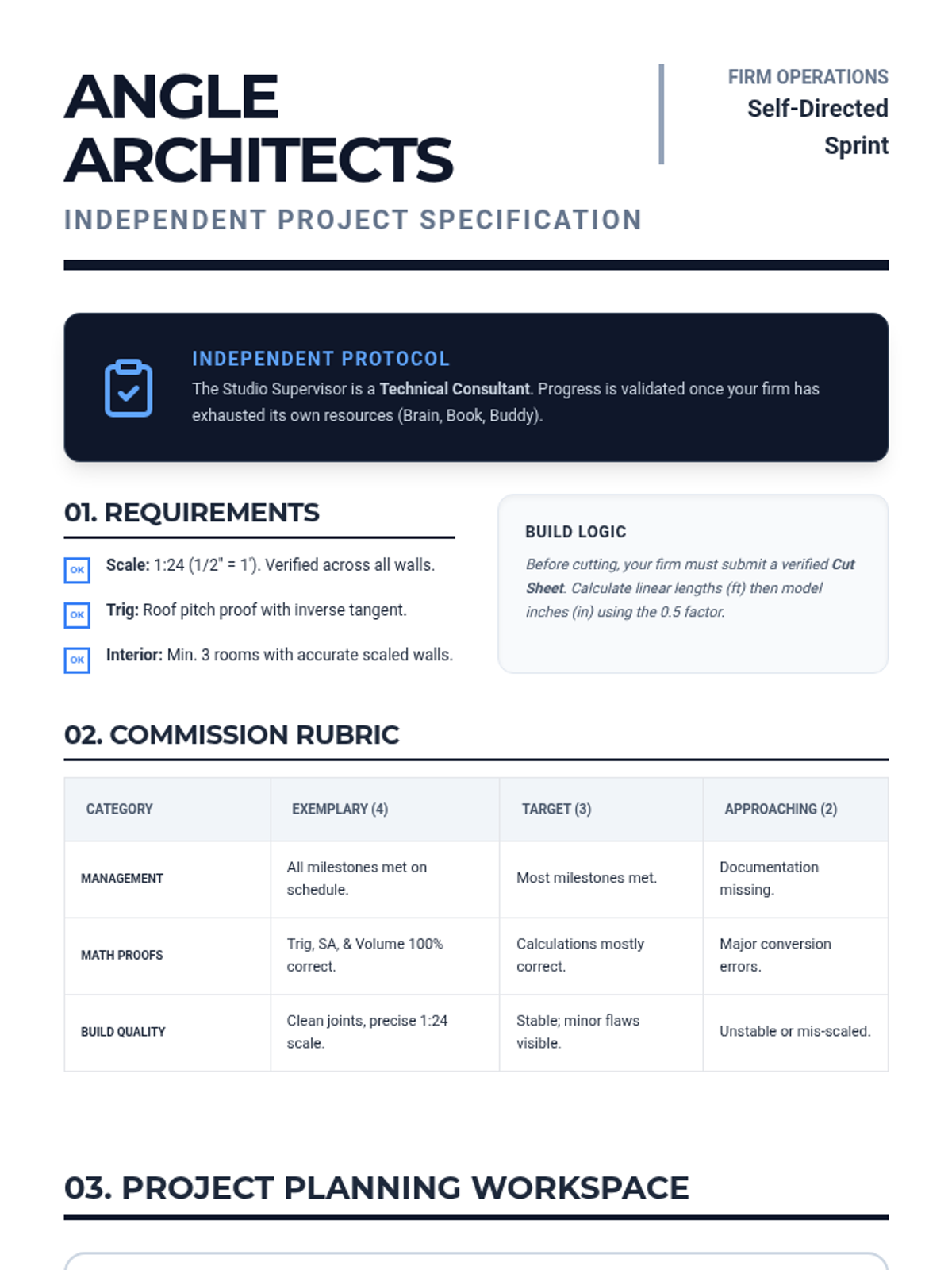
Updated project specification packet for students working independently, including project management rubrics and self-directed problem-solving guides.
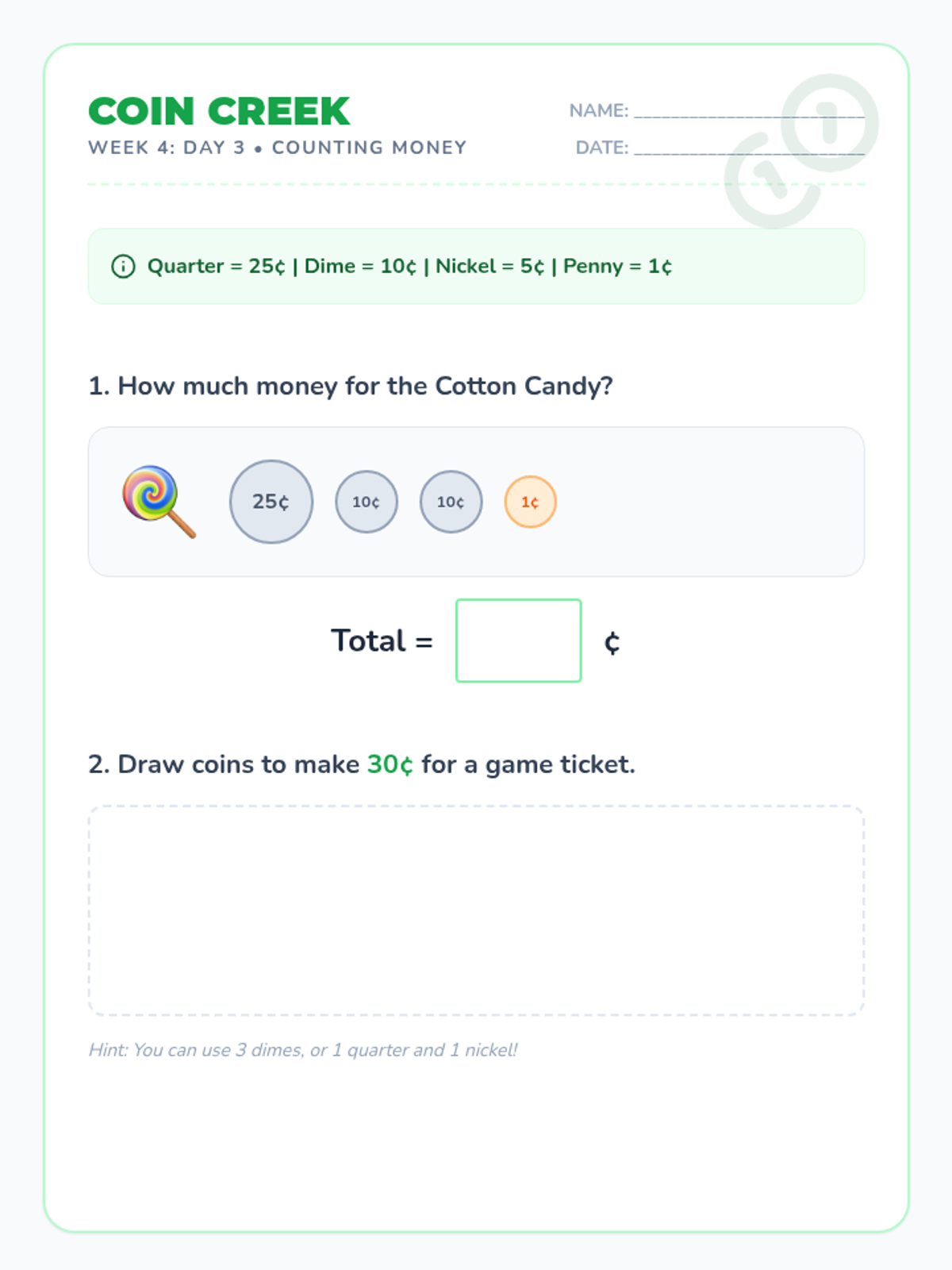
A Day 3 worksheet for the Carnival Fair unit, practicing coin counting and value representation with a cotton candy theme for IEP students.
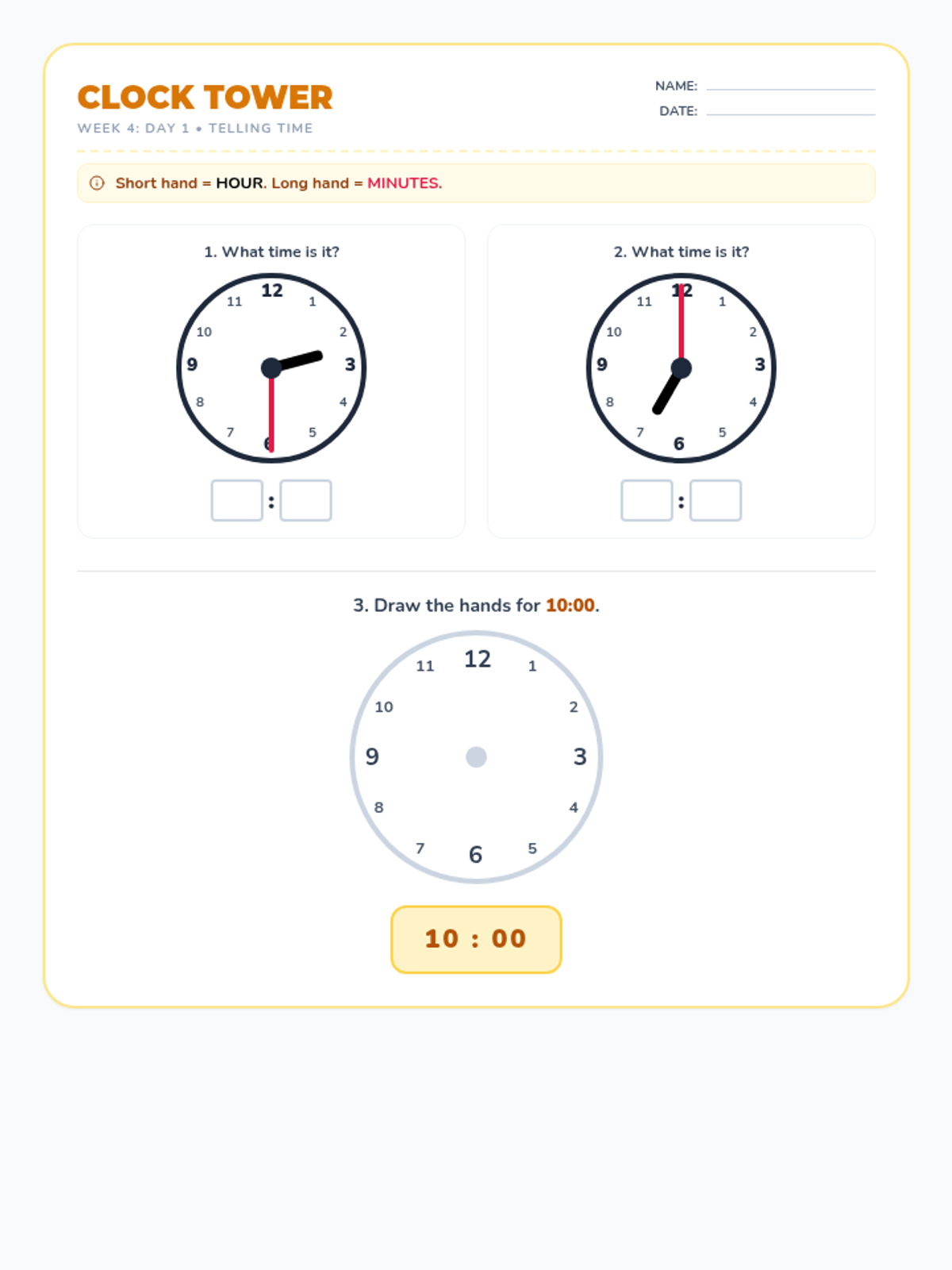
A Day 1 worksheet for the Carnival Fair unit, teaching analog time telling with large clock faces and digital conversion for IEP students.
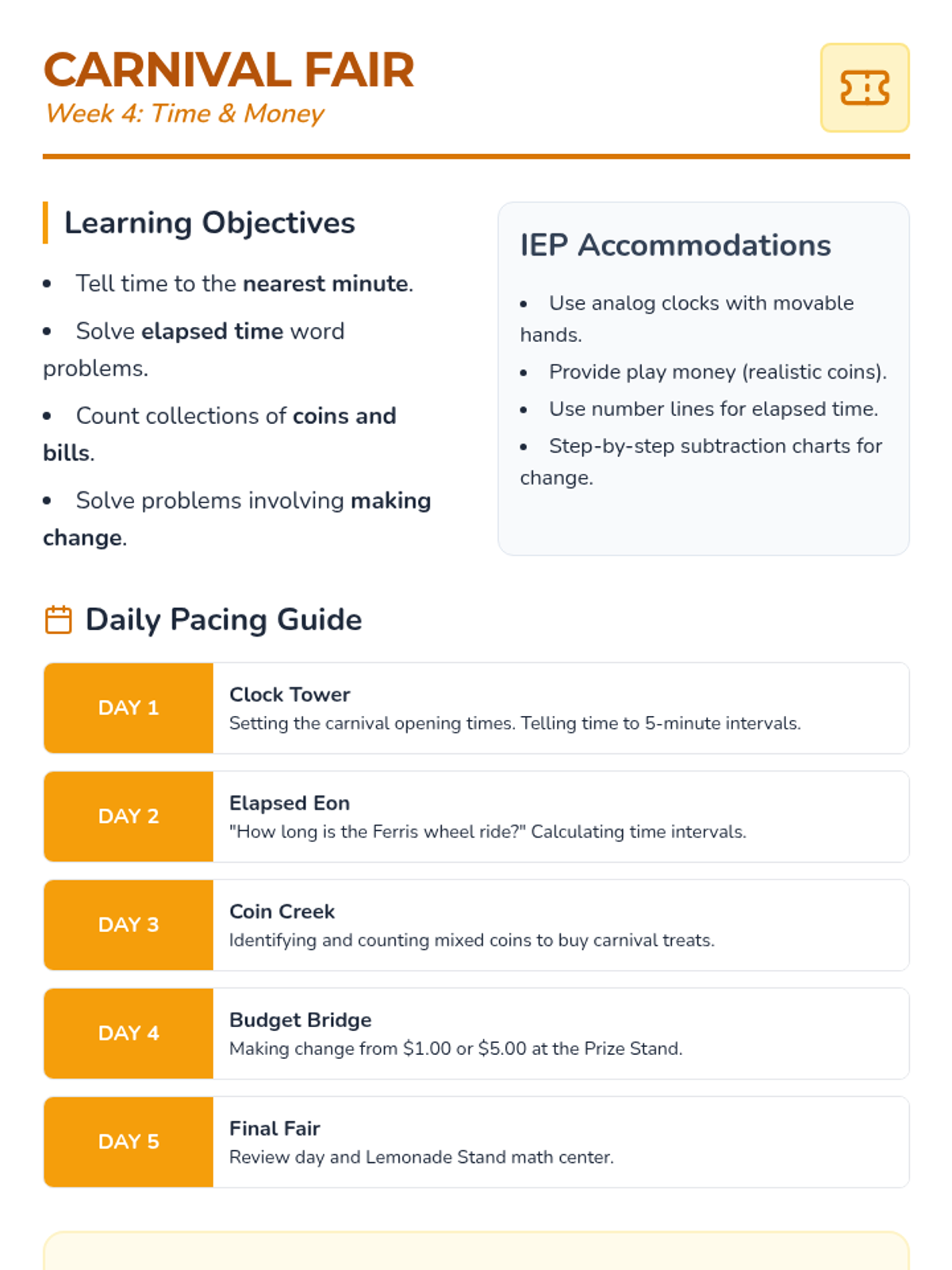
A teacher guide for Week 4 of the Summer Math Quest, focusing on carnival-themed time and money concepts for IEP students.
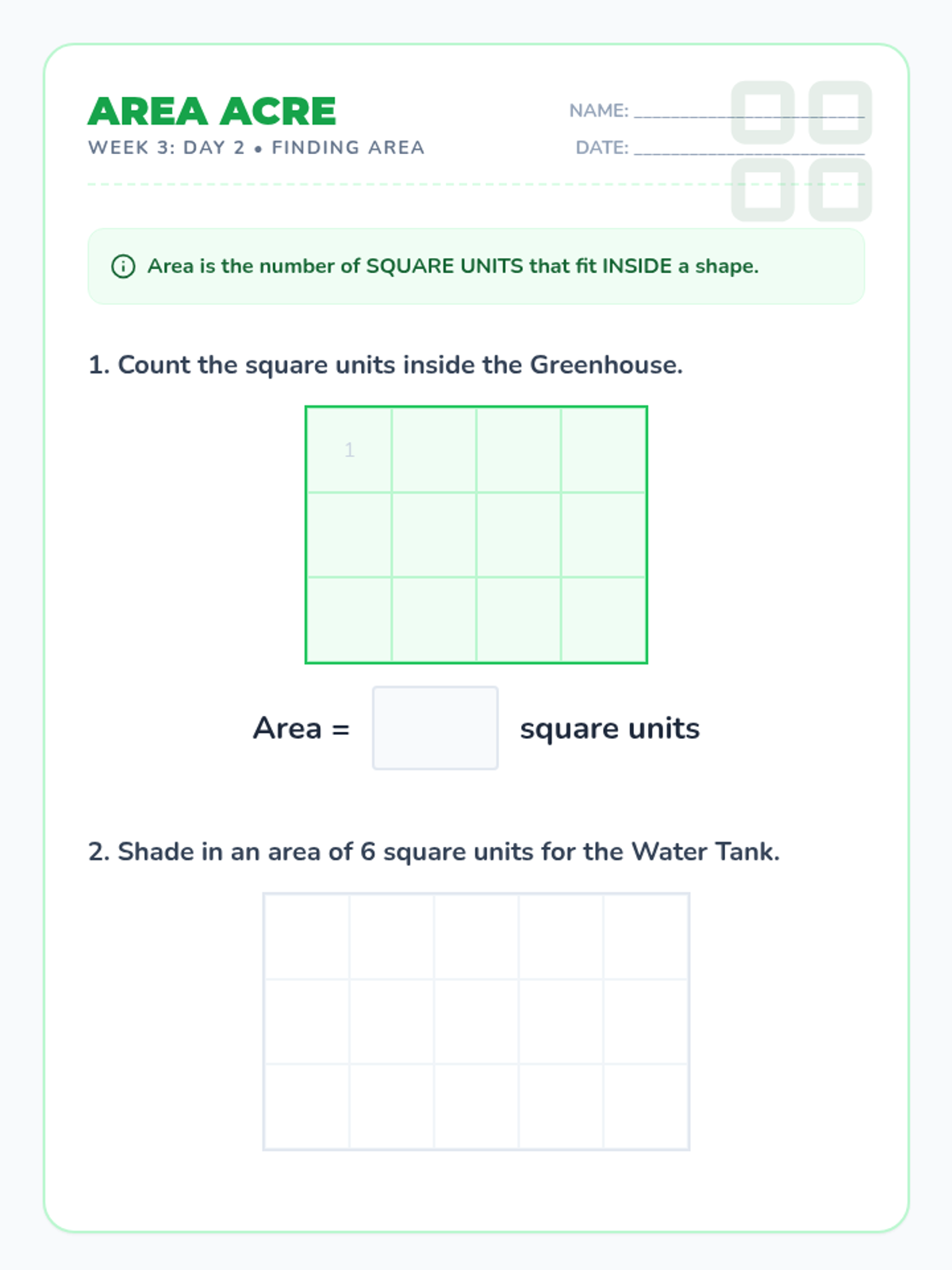
A Day 2 worksheet for the Space Colony unit, teaching area by counting and shading square units on a grid.
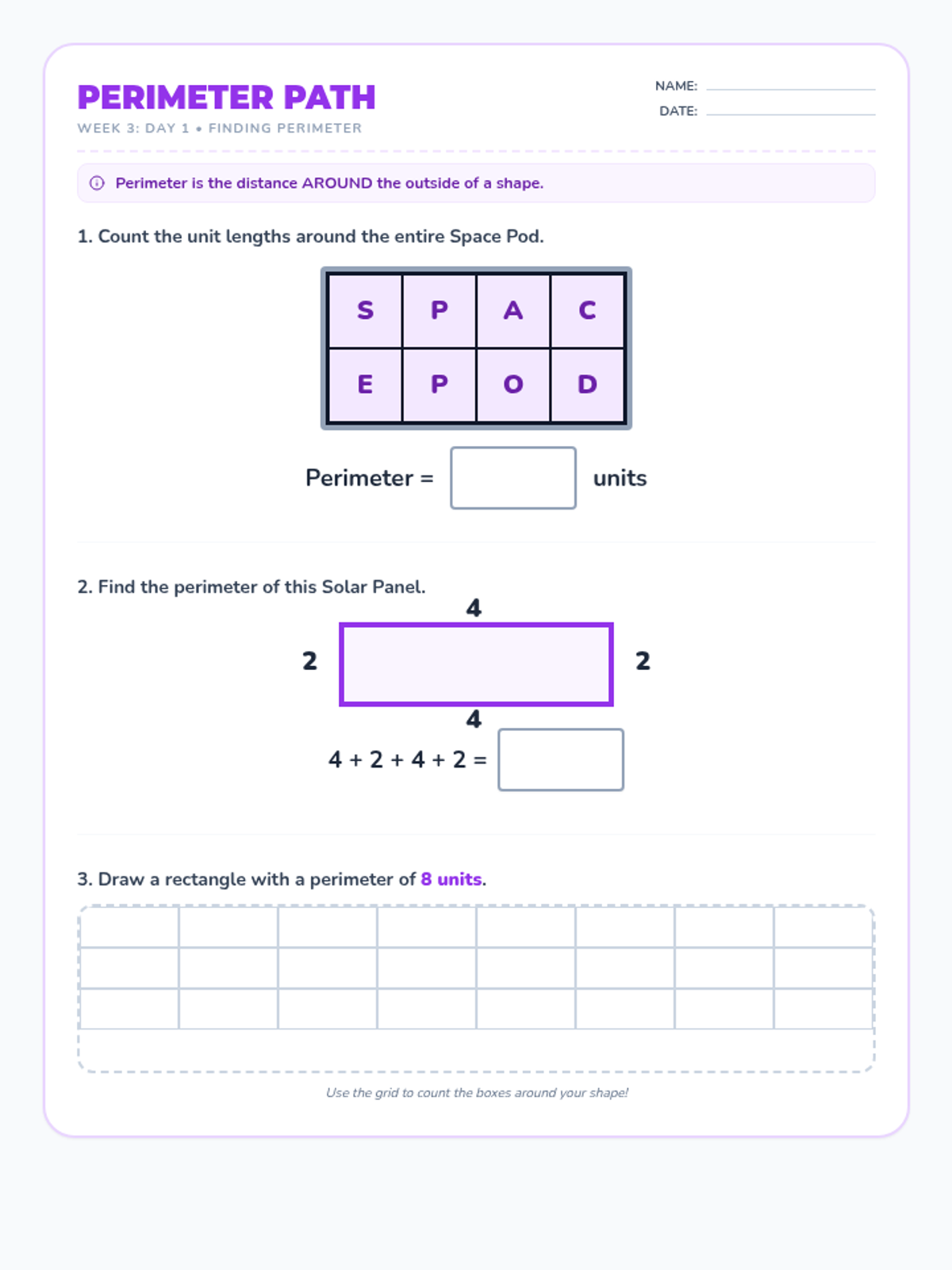
A Day 1 worksheet for the Space Colony unit, teaching perimeter through counting grid units and adding side lengths with large, clear visuals.
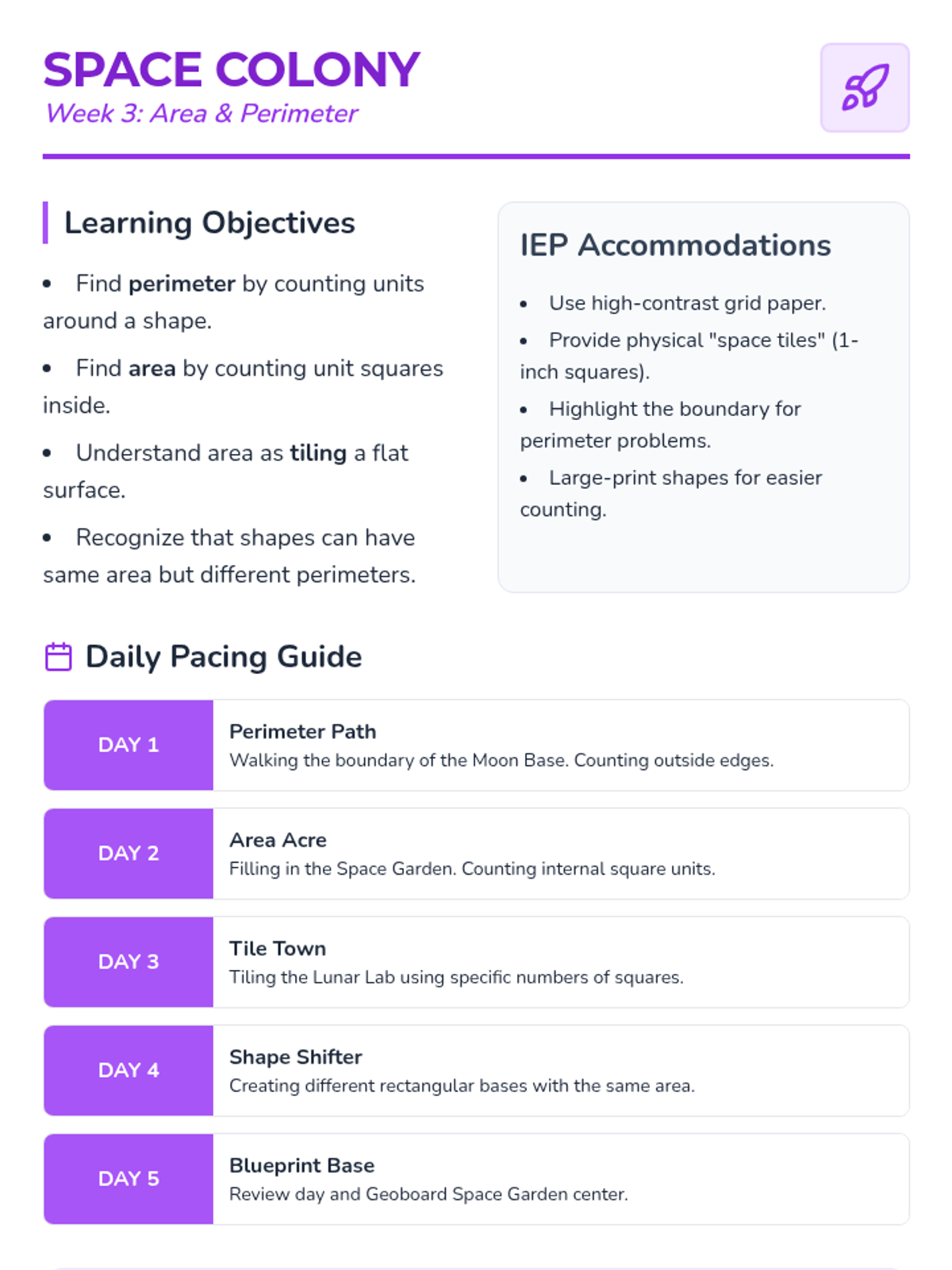
A teacher guide for Week 3 of the Summer Math Quest, focusing on space-themed area and perimeter concepts for IEP students.
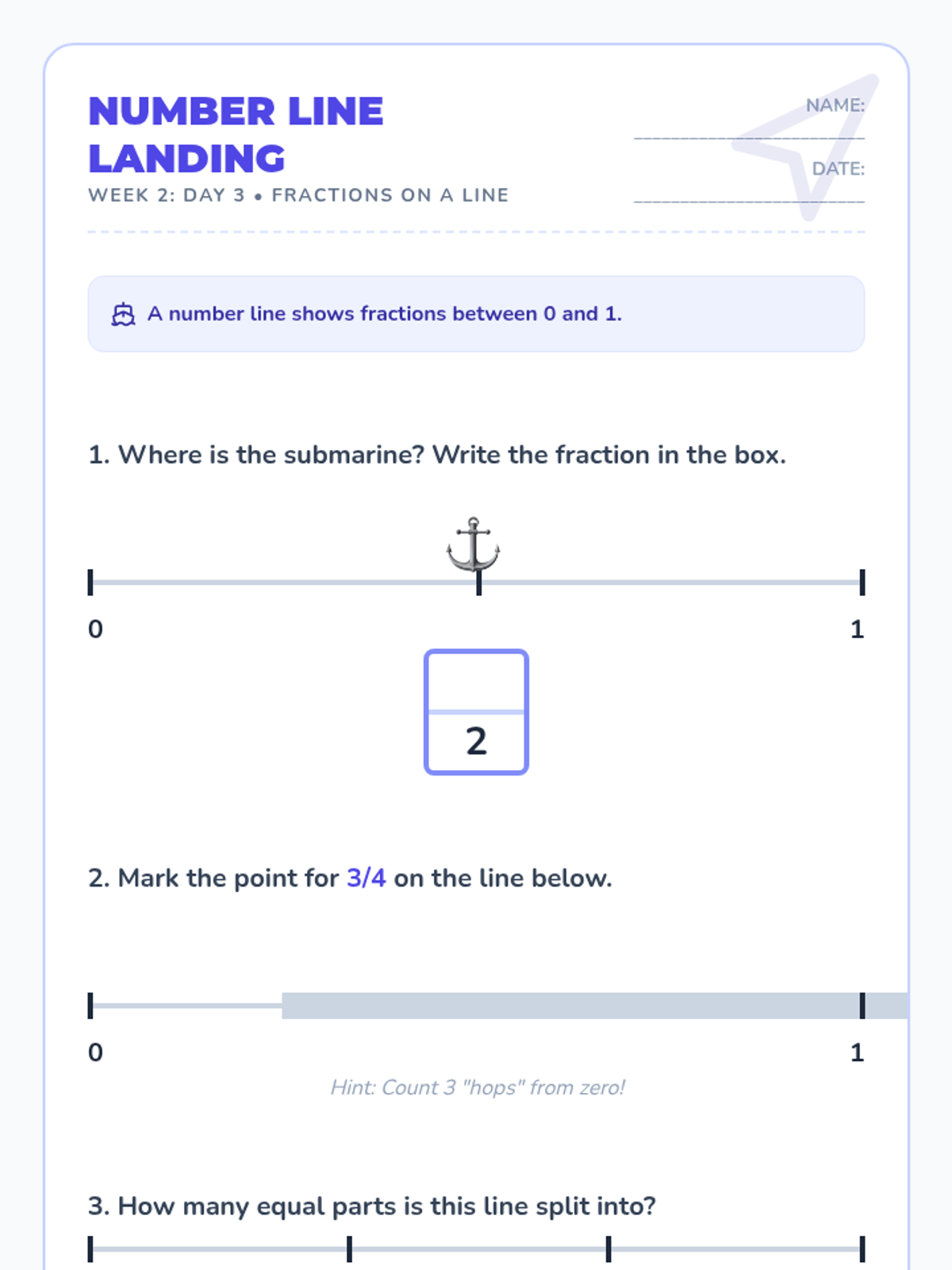
A Day 3 worksheet for the Ocean Exploration unit, helping IEP students locate and mark fractions on a number line with visual scaffolds.
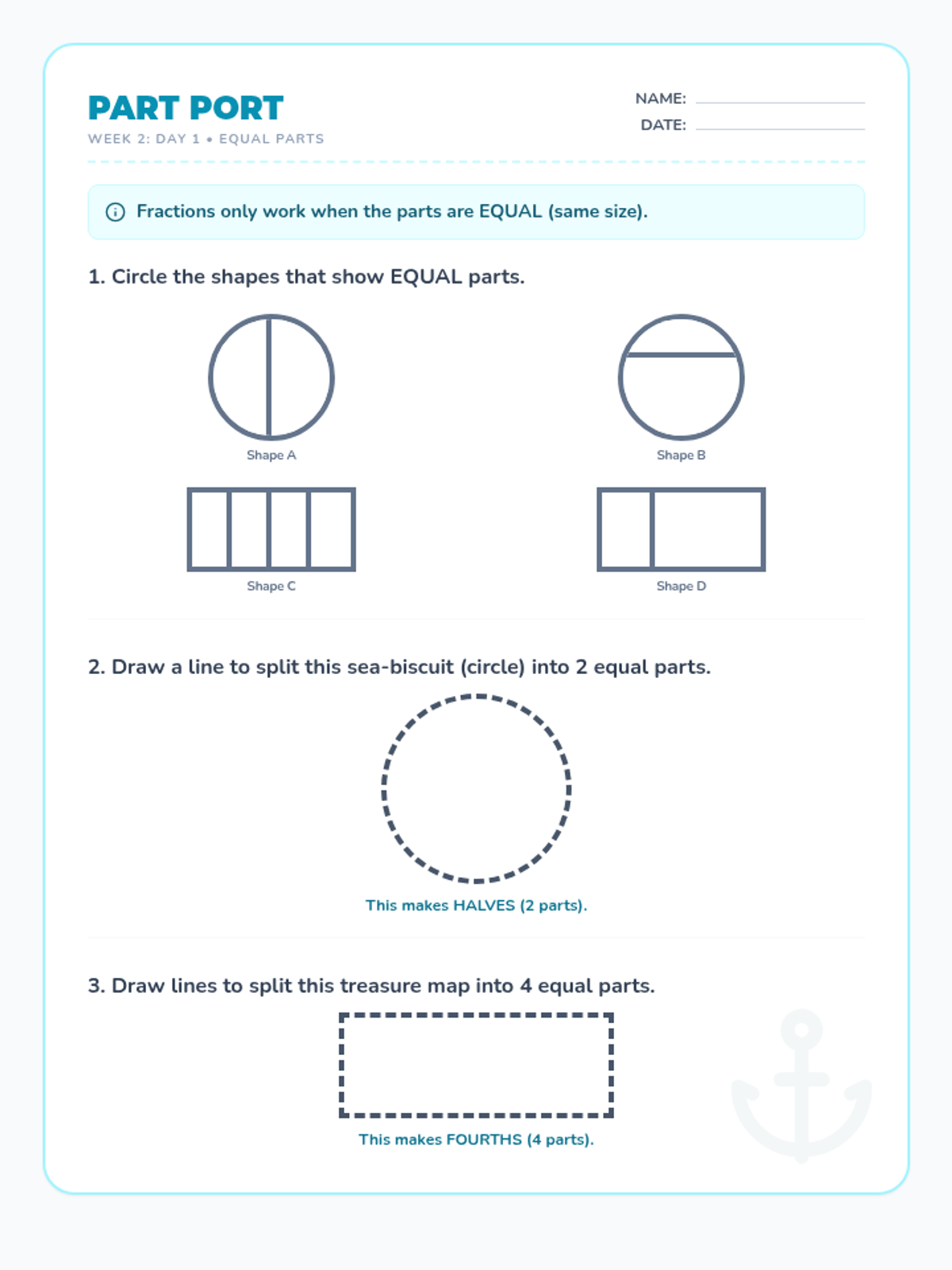
A Day 1 worksheet for the Ocean Exploration unit, focusing on identifying and creating equal parts (halves and fourths) for IEP students.
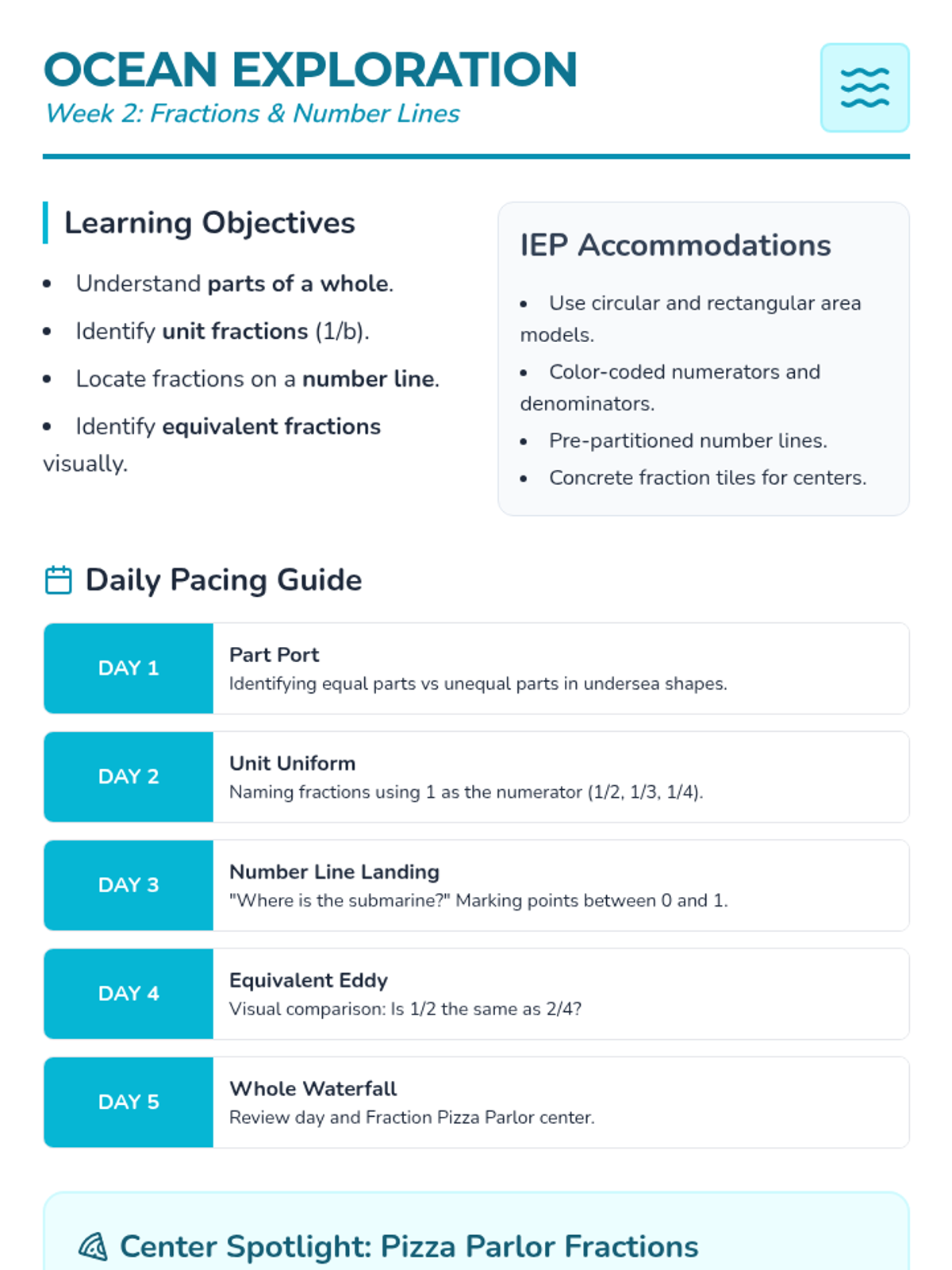
A teacher guide for Week 2 of the Summer Math Quest, focusing on ocean-themed fractions and number line instruction for IEP students.
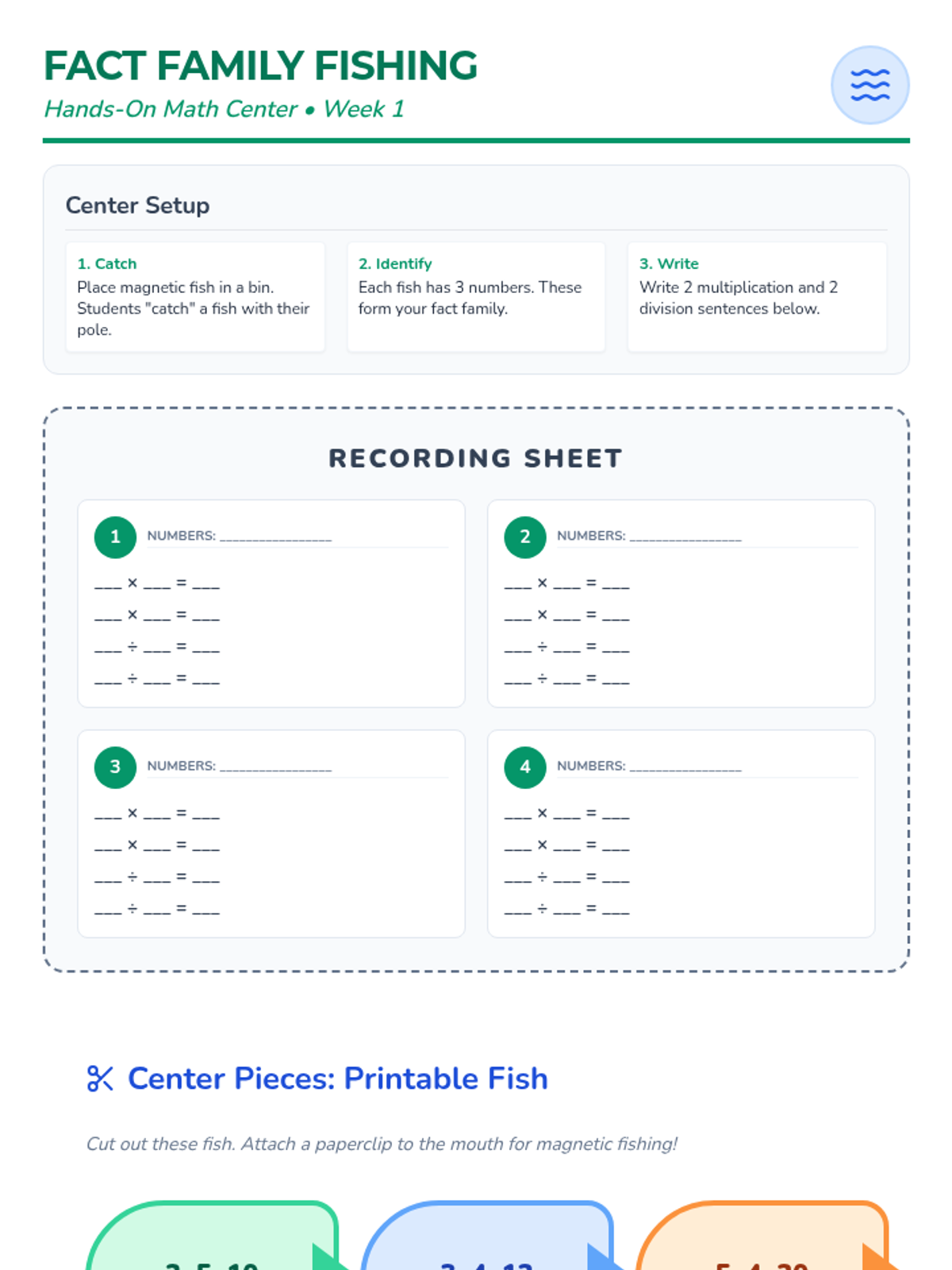
A hands-on math center activity for Week 1, providing a recording sheet and printable fish for fact family practice.
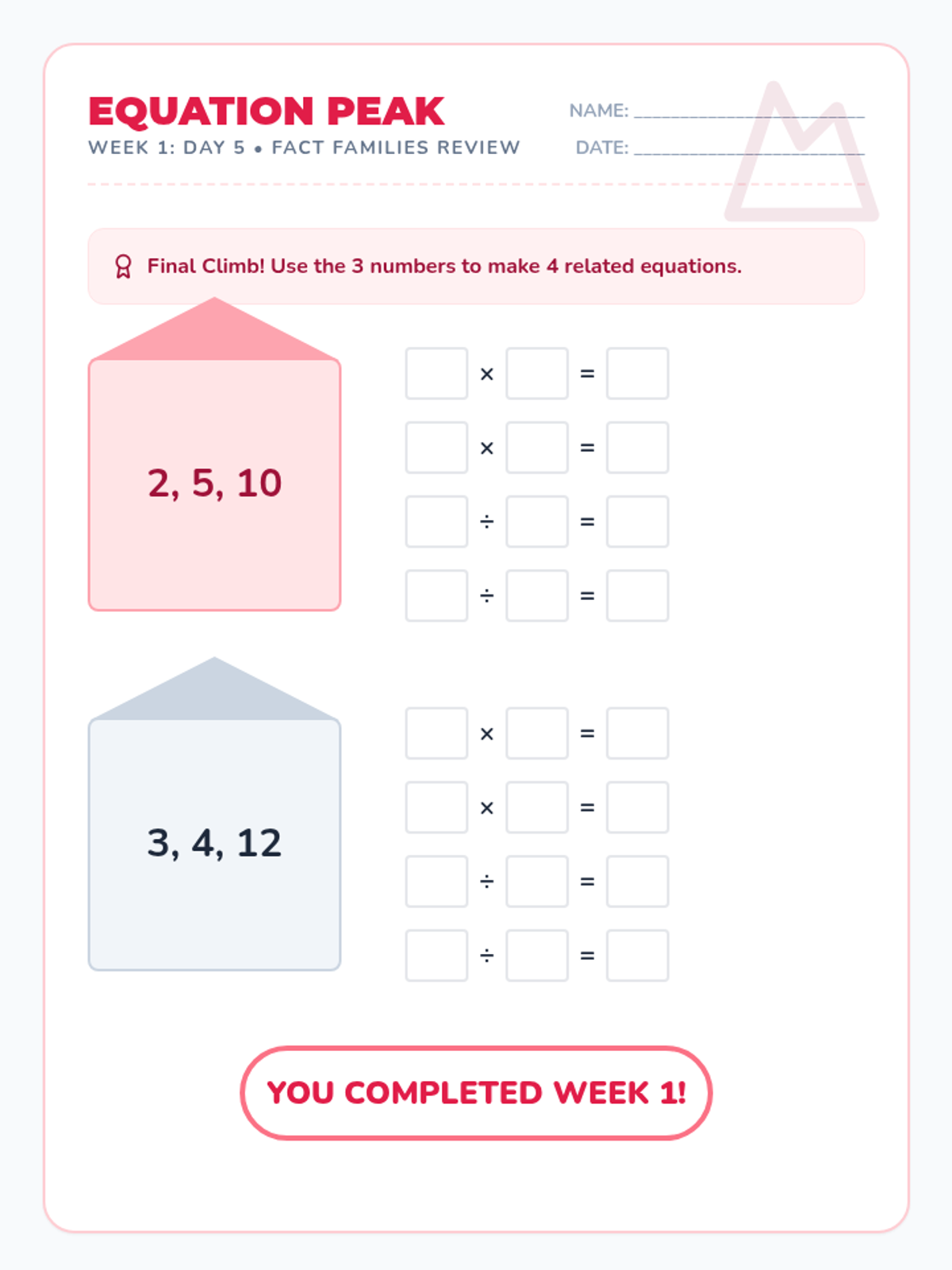
A Day 5 review worksheet for the Jungle Expedition unit, focusing on fact families and relationship between multiplication and division.
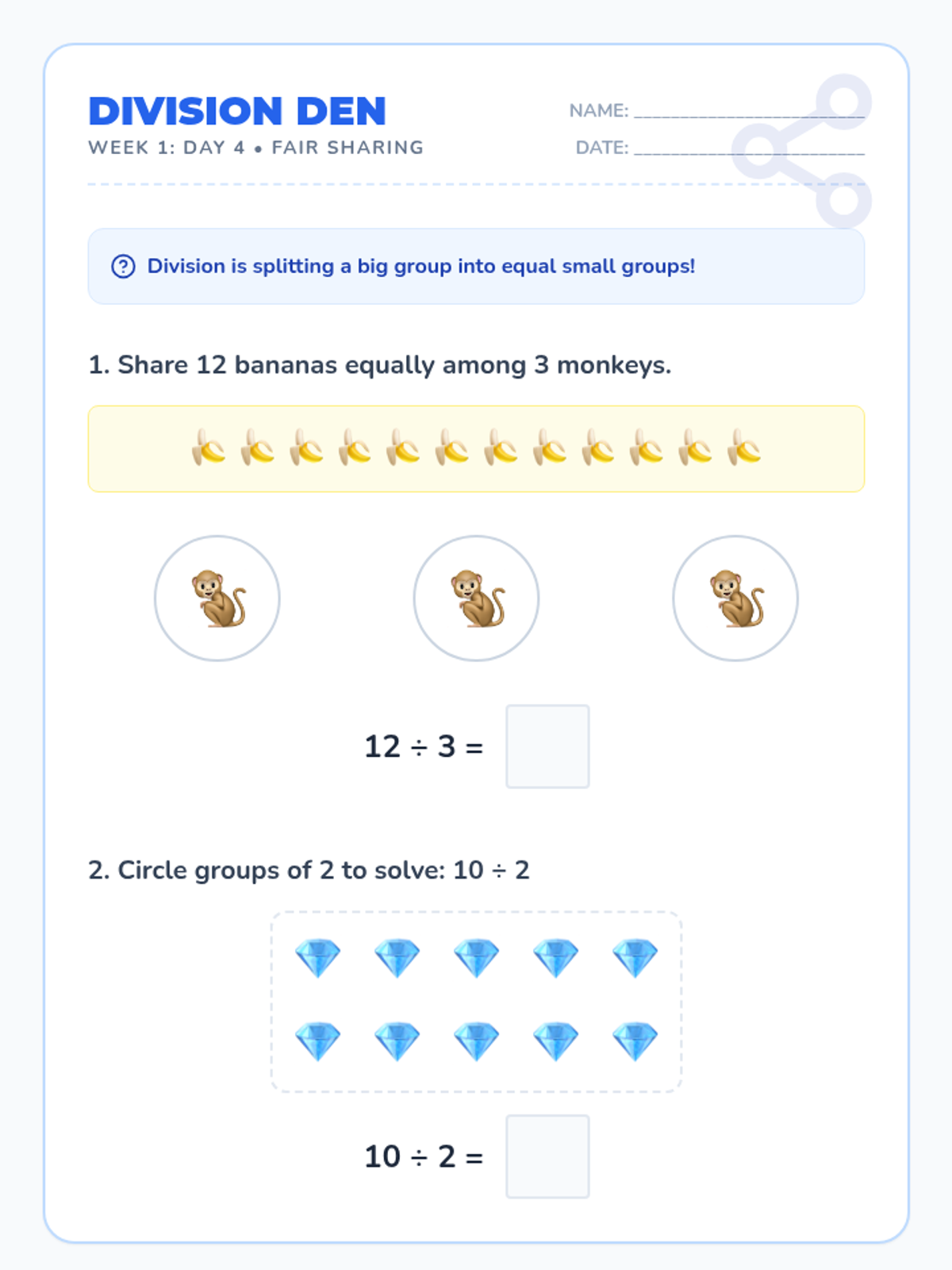
A Day 4 worksheet for the Jungle Expedition unit, introducing division as fair sharing using bananas and monkeys as a thematic visual.
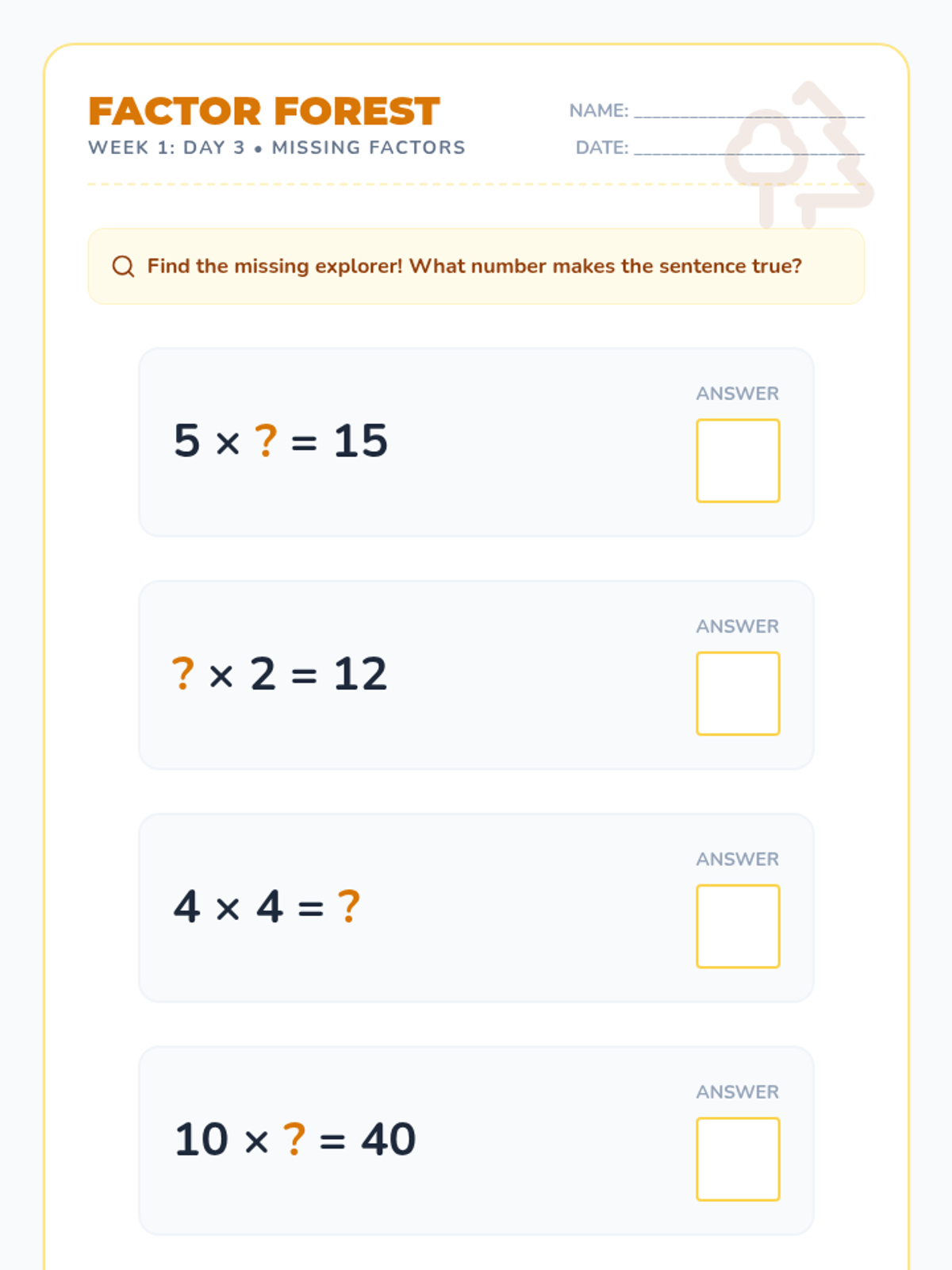
A Day 3 worksheet for the Jungle Expedition unit, focusing on finding missing factors with a clear, large-print layout for IEP students.
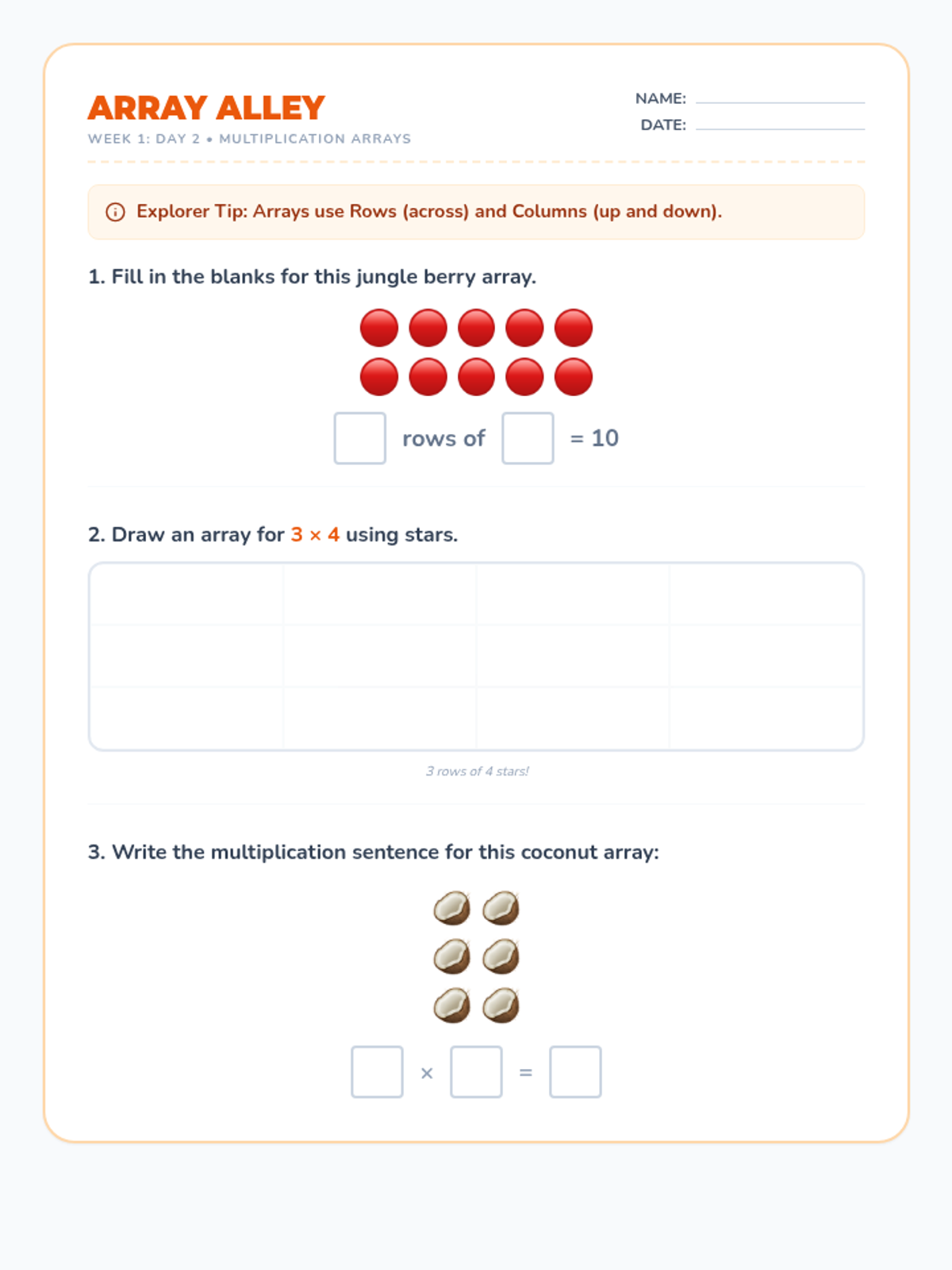
A Day 2 worksheet for the Jungle Expedition unit, teaching multiplication arrays with visual berry grids and supported drawing space.
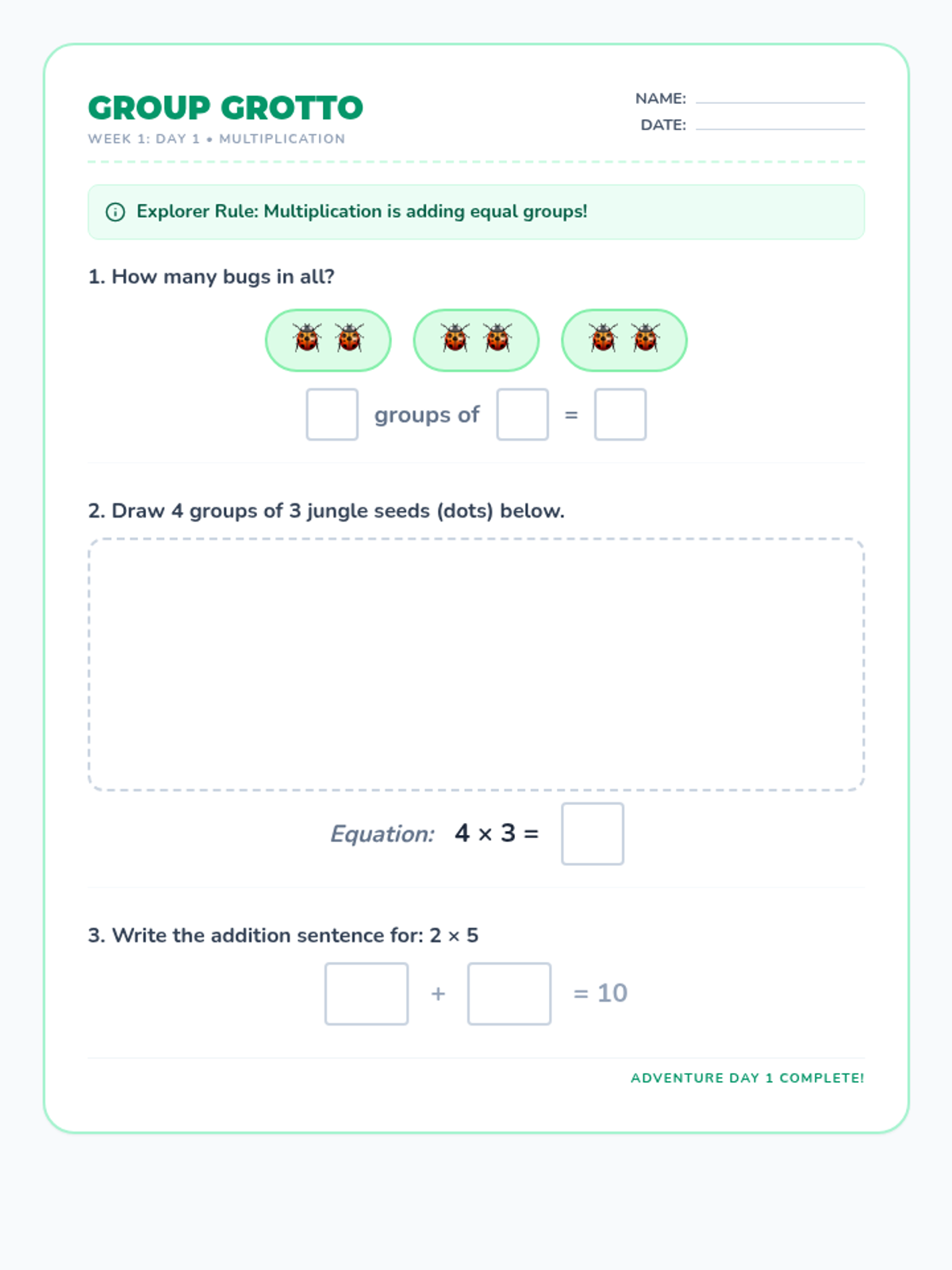
A Day 1 worksheet for the Jungle Expedition unit, introducing multiplication as equal groups with visual aids and drawing space for an IEP student.
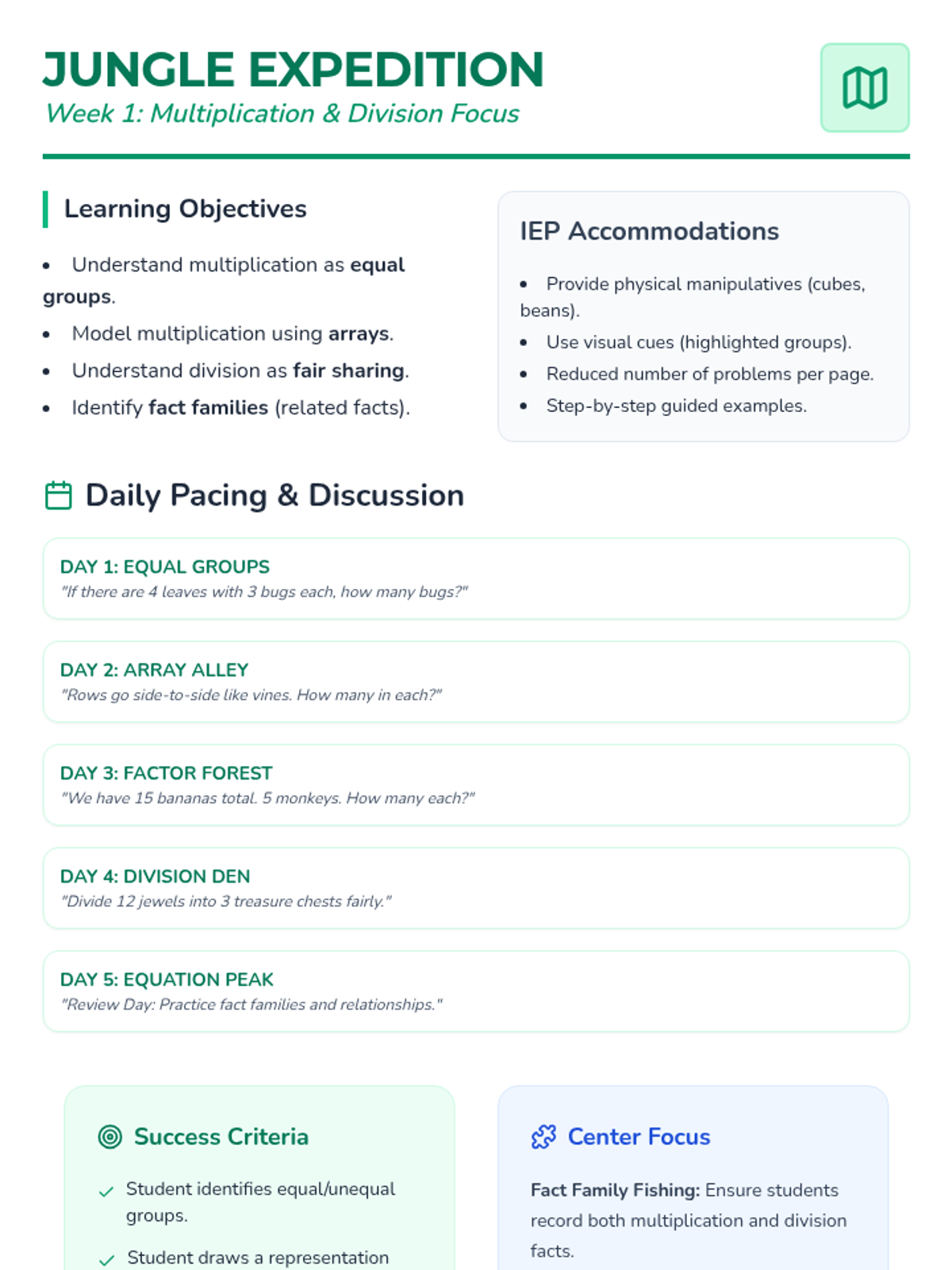
A detailed teacher facilitation guide for the first week of the Summer Math Quest, focusing on multiplication and division with thematic activities and IEP support strategies.
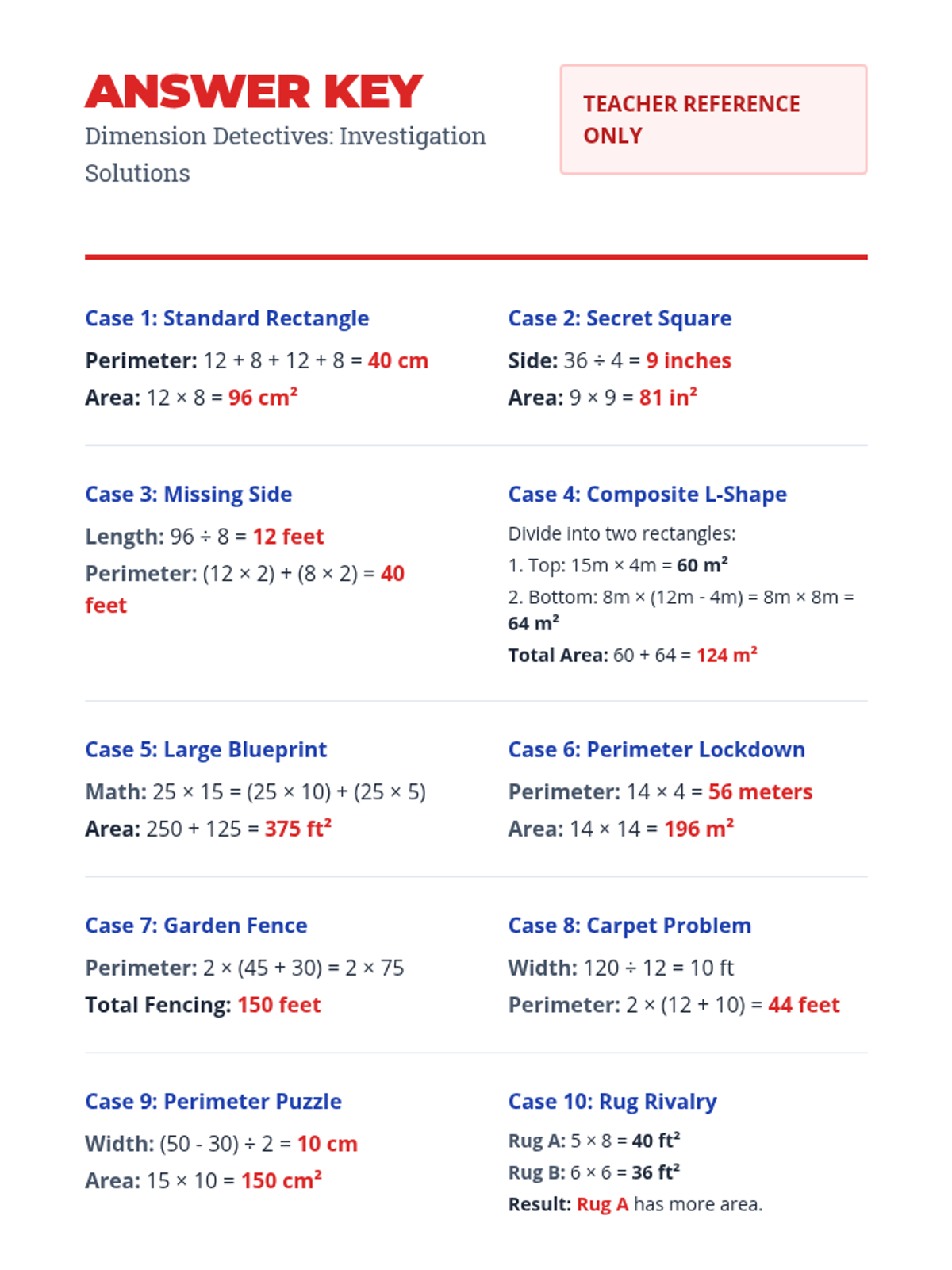
A comprehensive answer key for the Dimension Detectives worksheet, providing step-by-step solutions for all 10 area and perimeter problems.
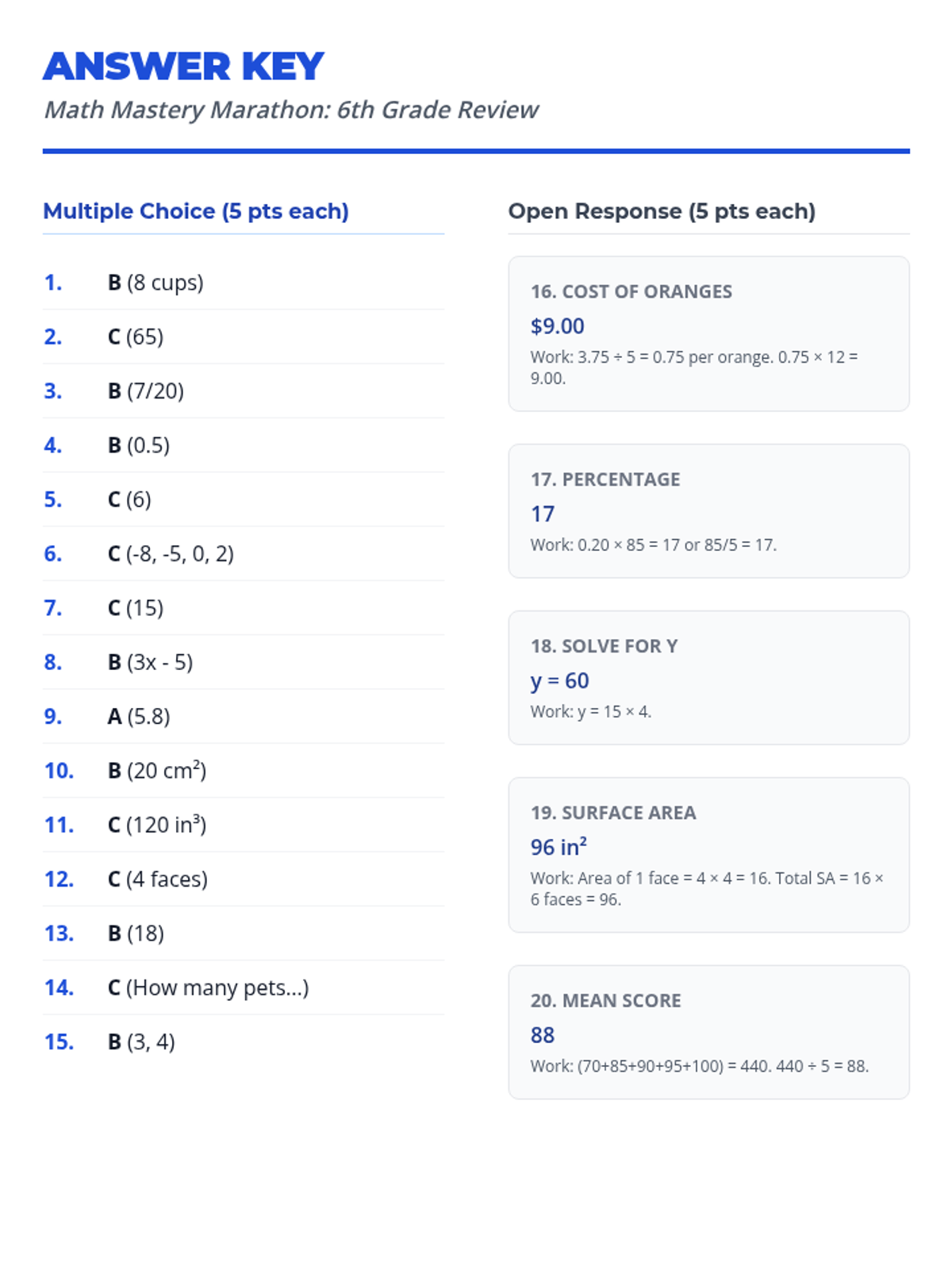
Teacher answer key for the 6th grade cumulative math review, including step-by-step solutions for open-ended questions.
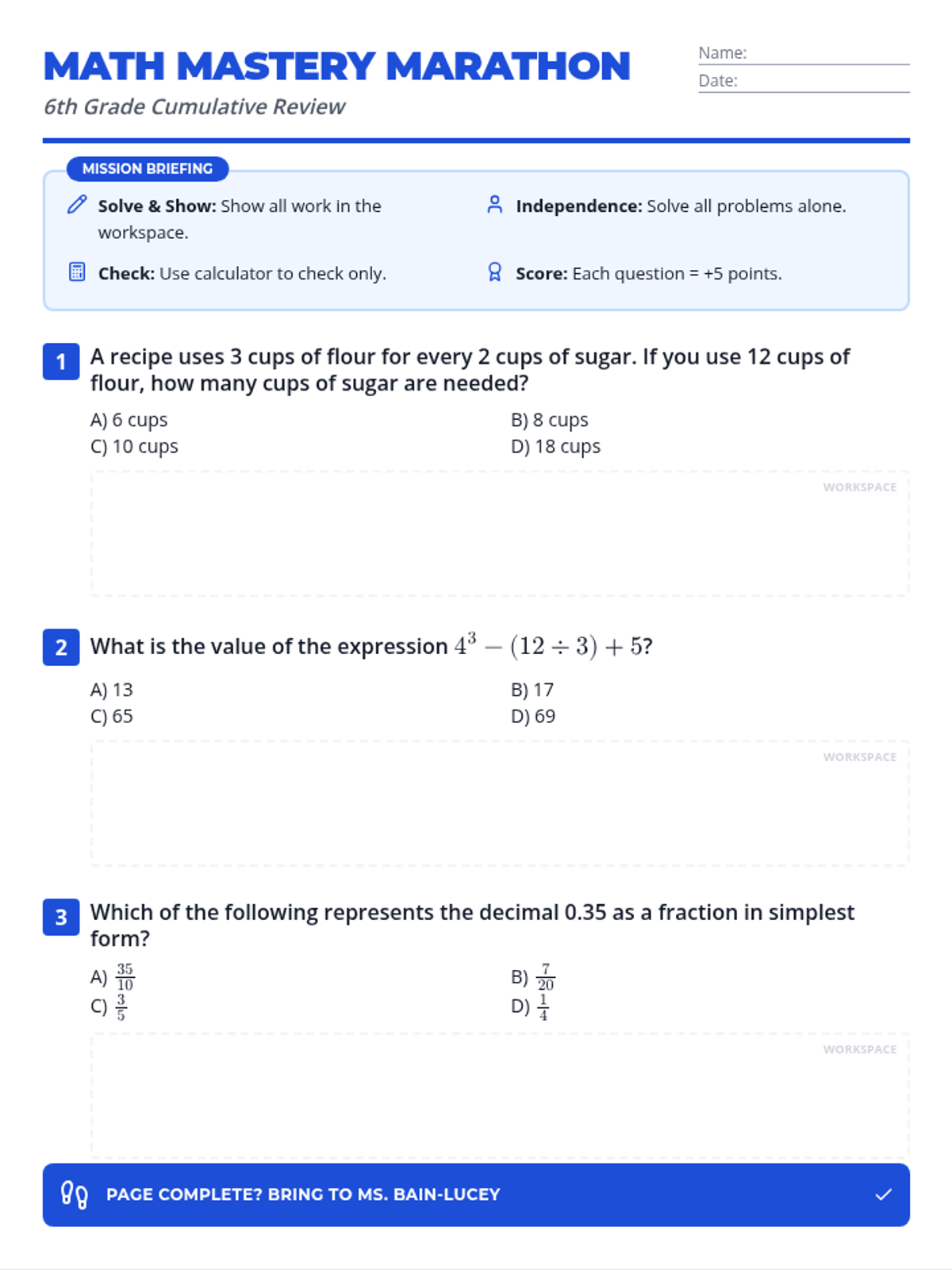
Revised 20-question cumulative math review packet for 6th grade with optimized pagination (5 pages), standardized workspace heights, and consistent multiple-choice formatting.
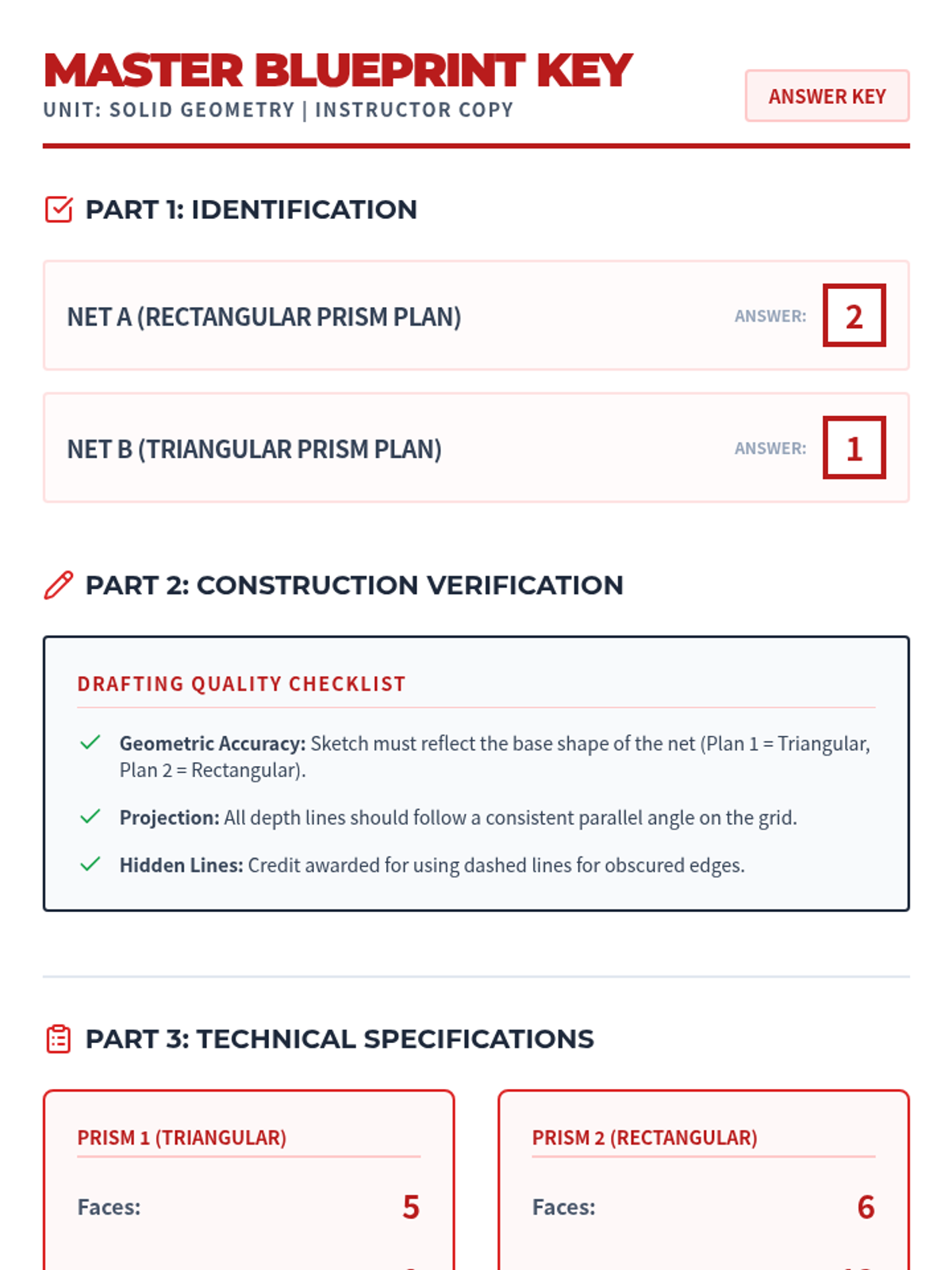
The teacher answer key for the Prism Blueprint Worksheet, featuring correct matching answers, technical specifications (faces, edges, vertices), and a grading rubric.
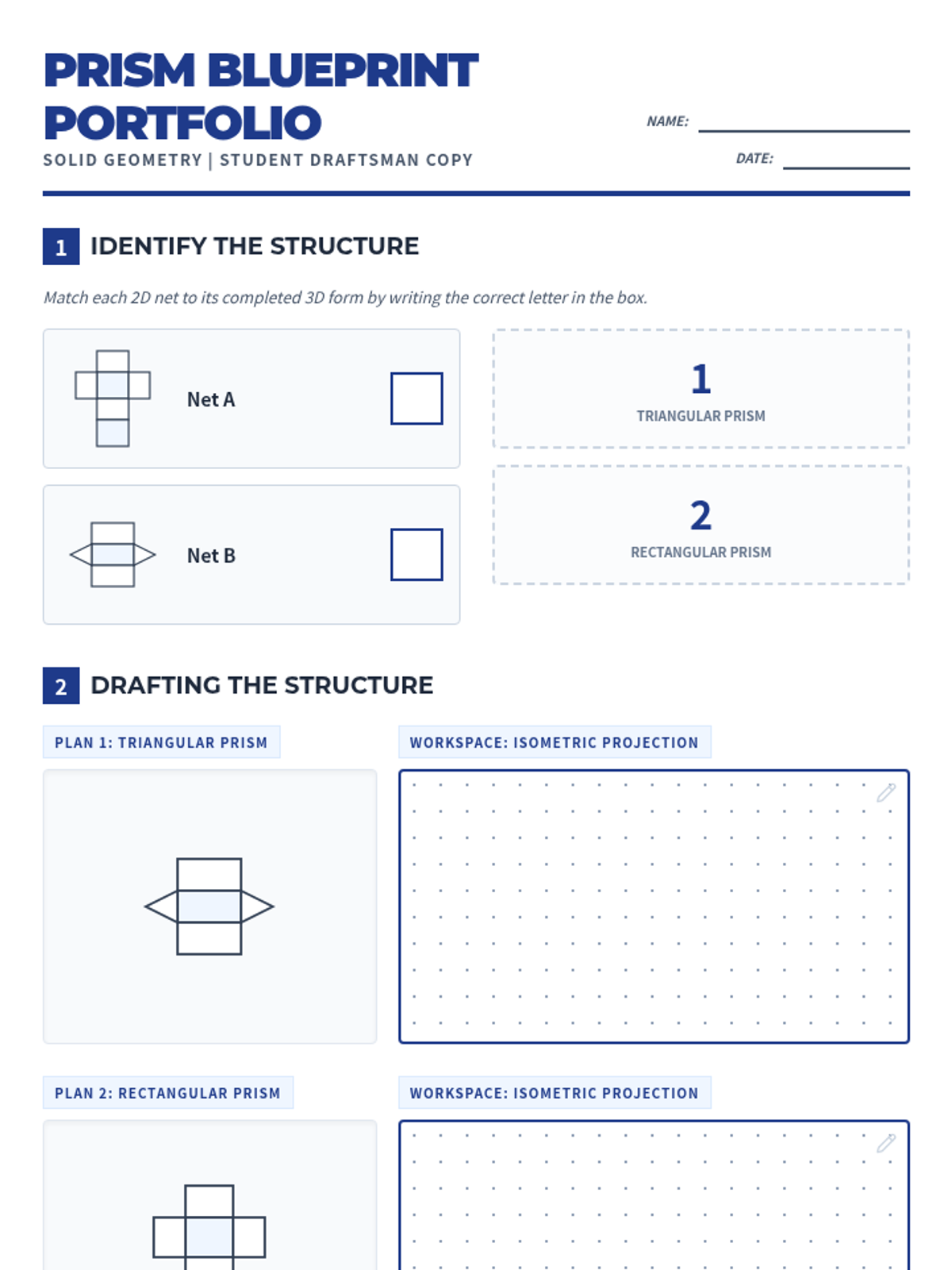
A drafting-themed student worksheet where students match 2D nets to 3D shapes, draw 3D prisms from provided nets on isometric grids, and identify the number of faces, edges, and vertices.
A set of instructional slides for teaching students how to visualize and construct rectangular and triangular prisms from 2D nets using a blueprint/drafting theme.
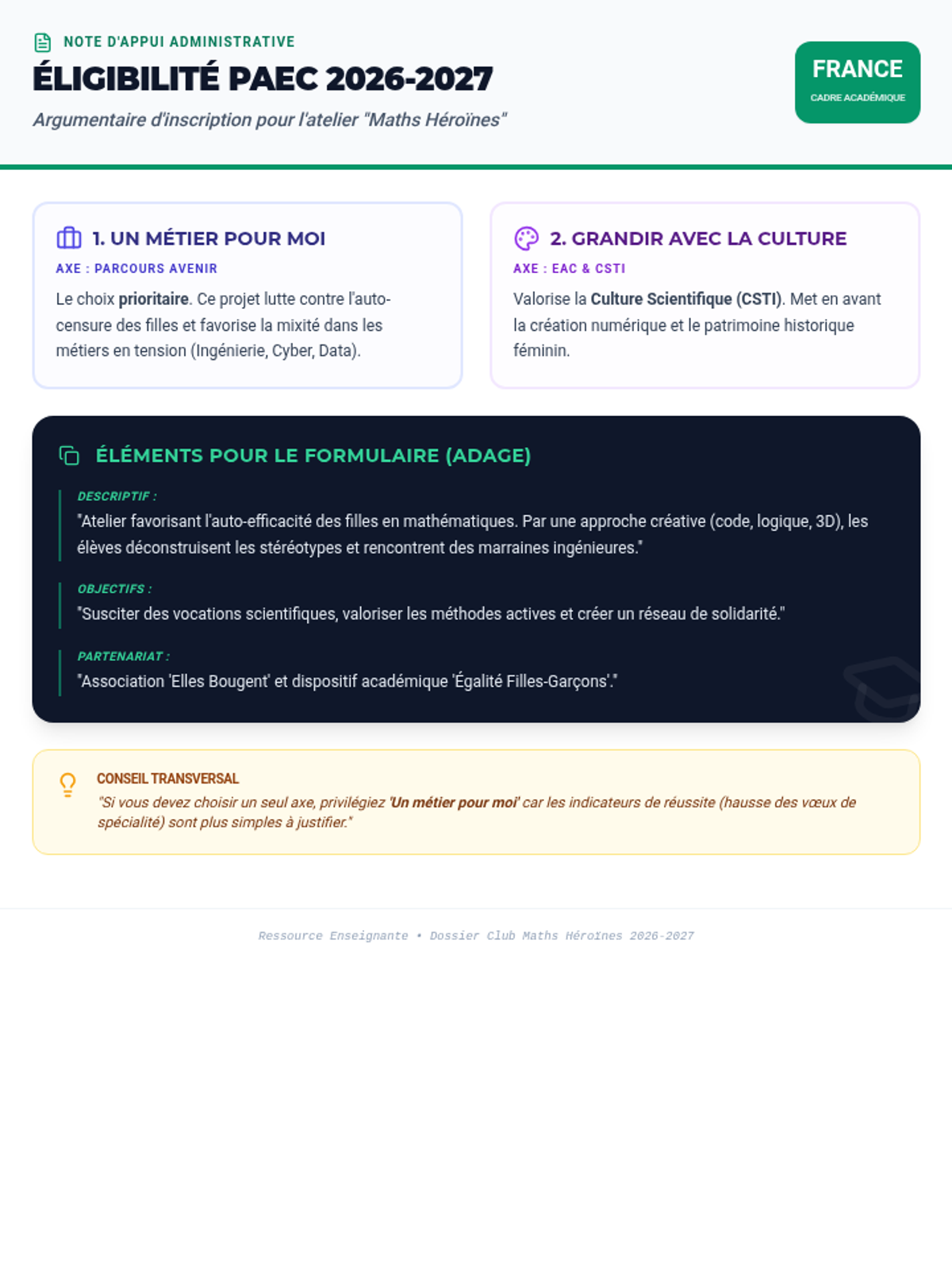
Fiche d'aide administrative pour l'inscription du projet au PAEC (ADAGE), détaillant les arguments pour les rubriques "Un métier pour moi" et "Grandir avec la culture".
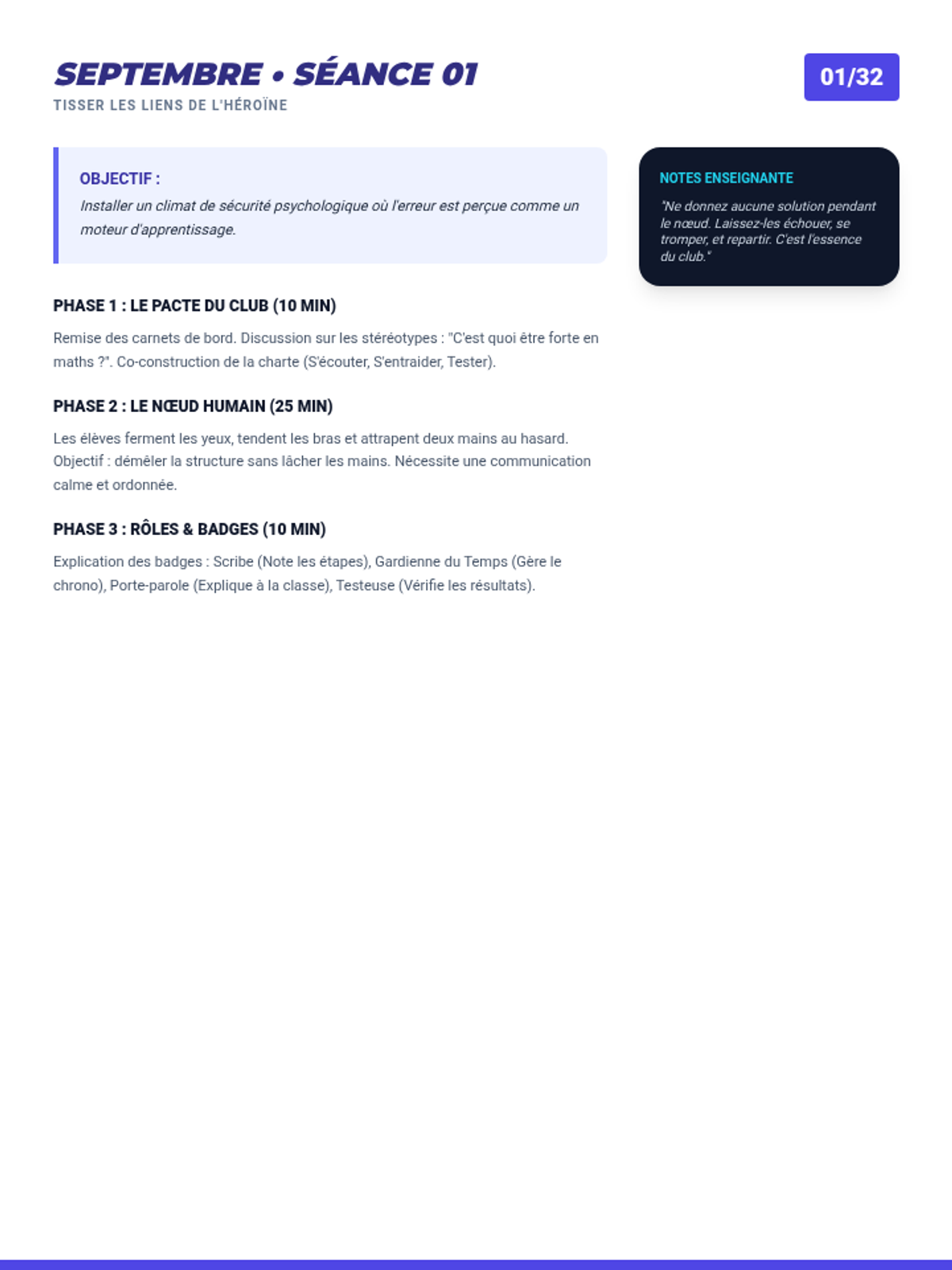
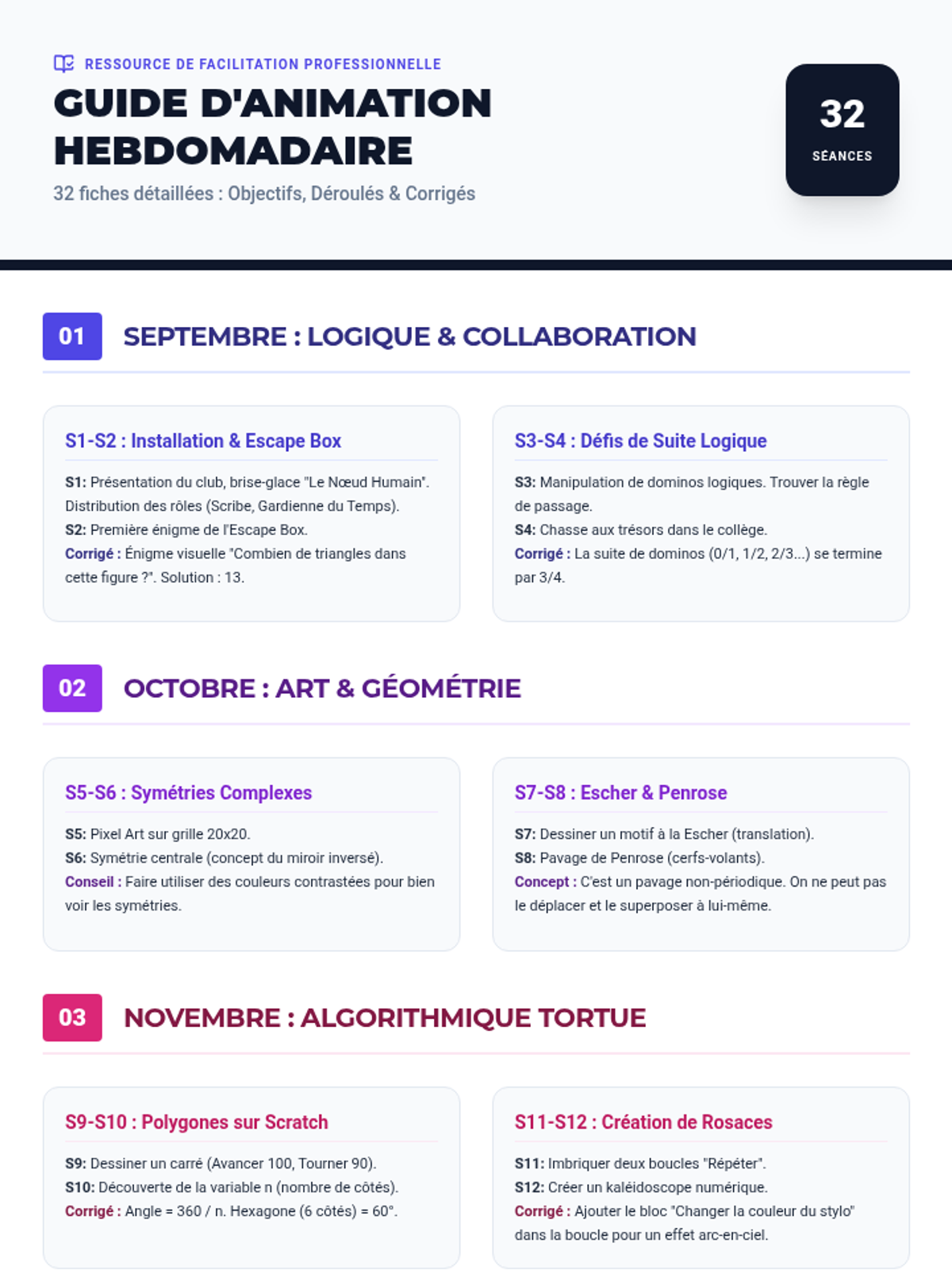
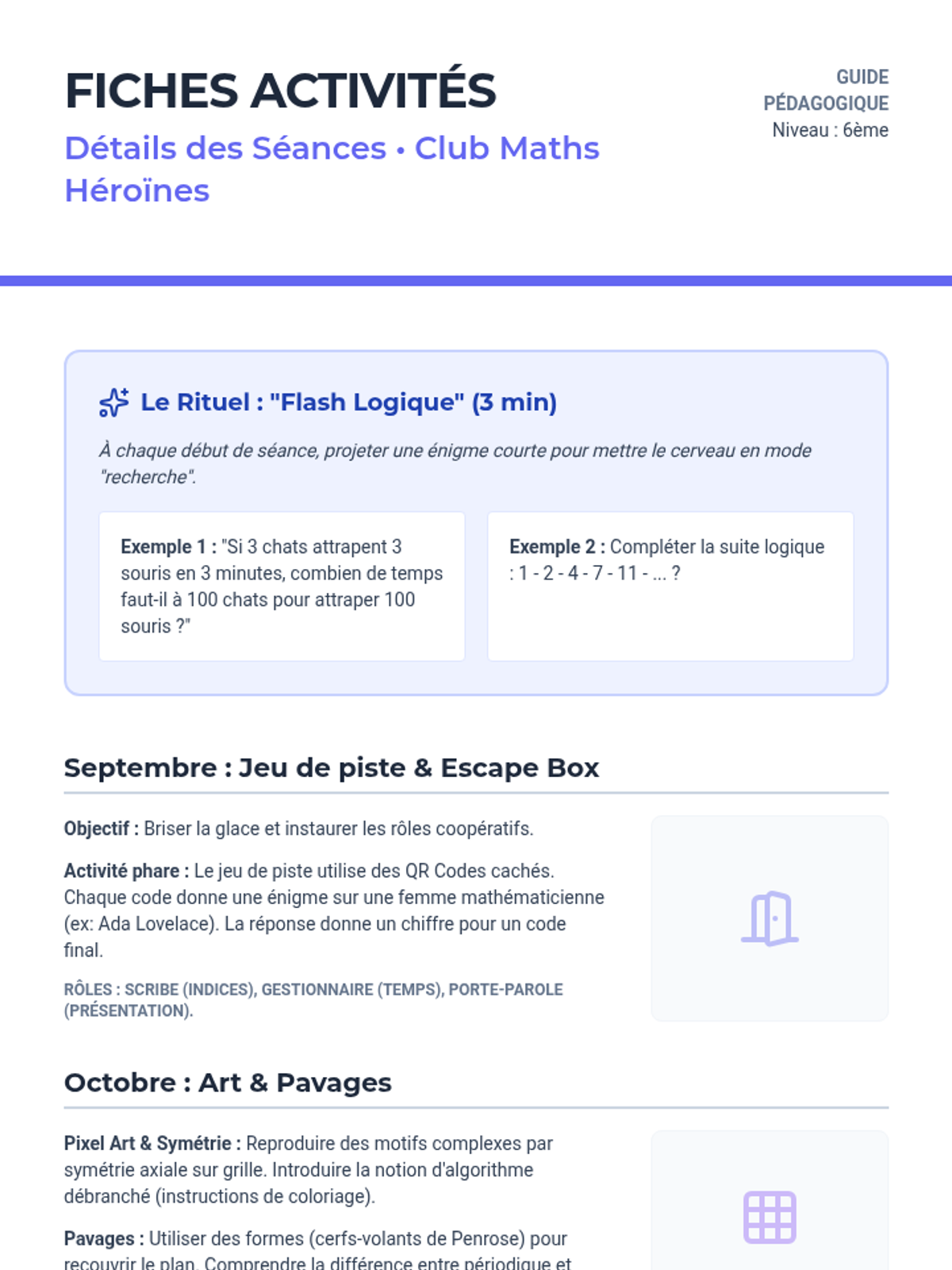
Guide d'animation complet pour l'enseignant, détaillant les 32 séances de l'année scolaire par mois, avec objectifs, durées, phases d'activités et corrigés techniques.
Carnet de bord personnel pour l'élève, incluant une couverture stylisée, un suivi de progression pour les 32 séances et un espace de prise de notes et de schémas.
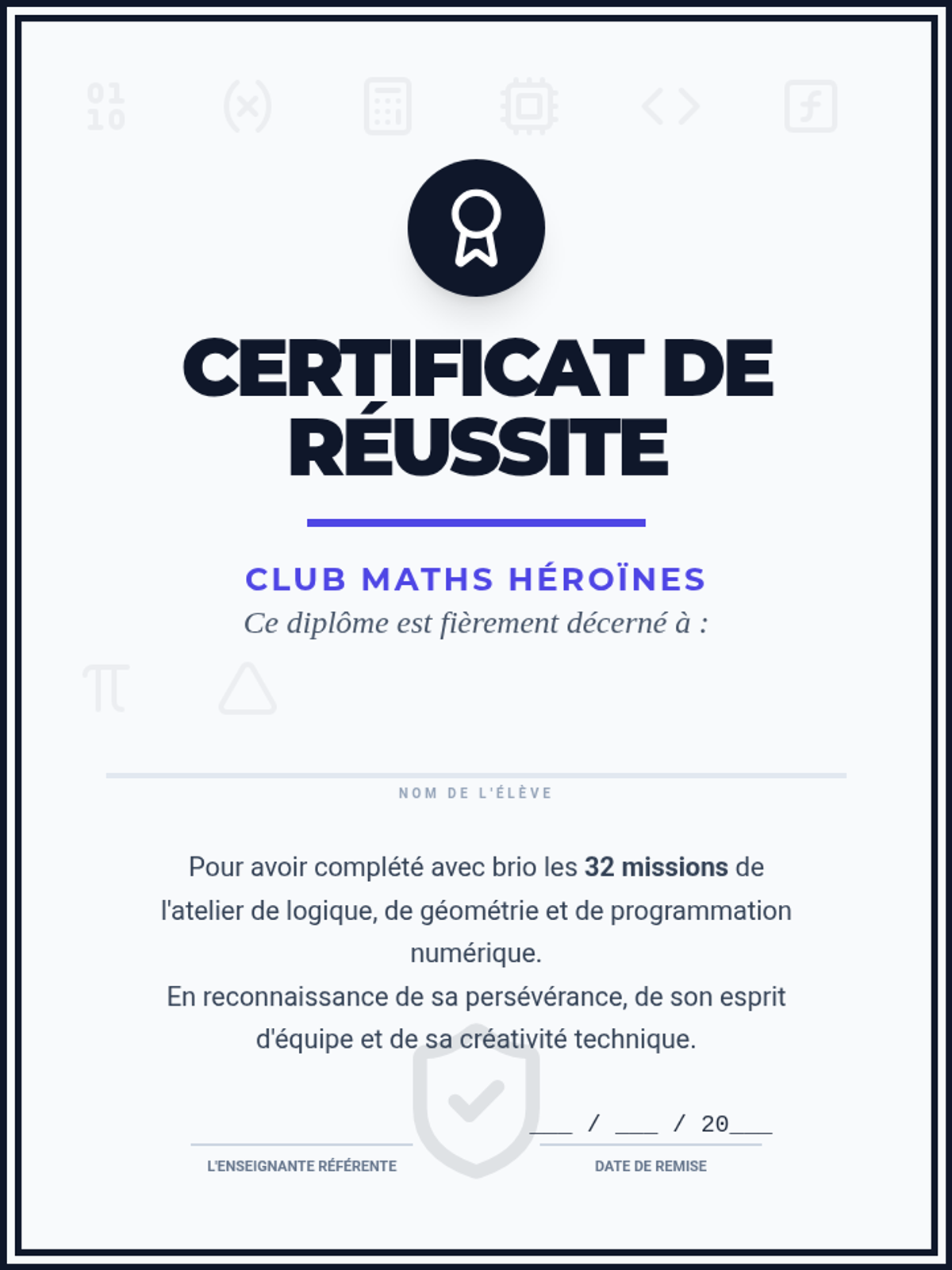
Certificat de réussite officiel pour les élèves ayant complété l'atelier Club Maths Héroïnes, avec un design élégant incluant des motifs mathématiques et des espaces de signature.
Guide pédagogique exhaustif pour l'enseignant, structuré par séance hebdomadaire, incluant les objectifs, les déroulés précis, les conseils de facilitation et les corrigés de toutes les énigmes et défis de l'année.
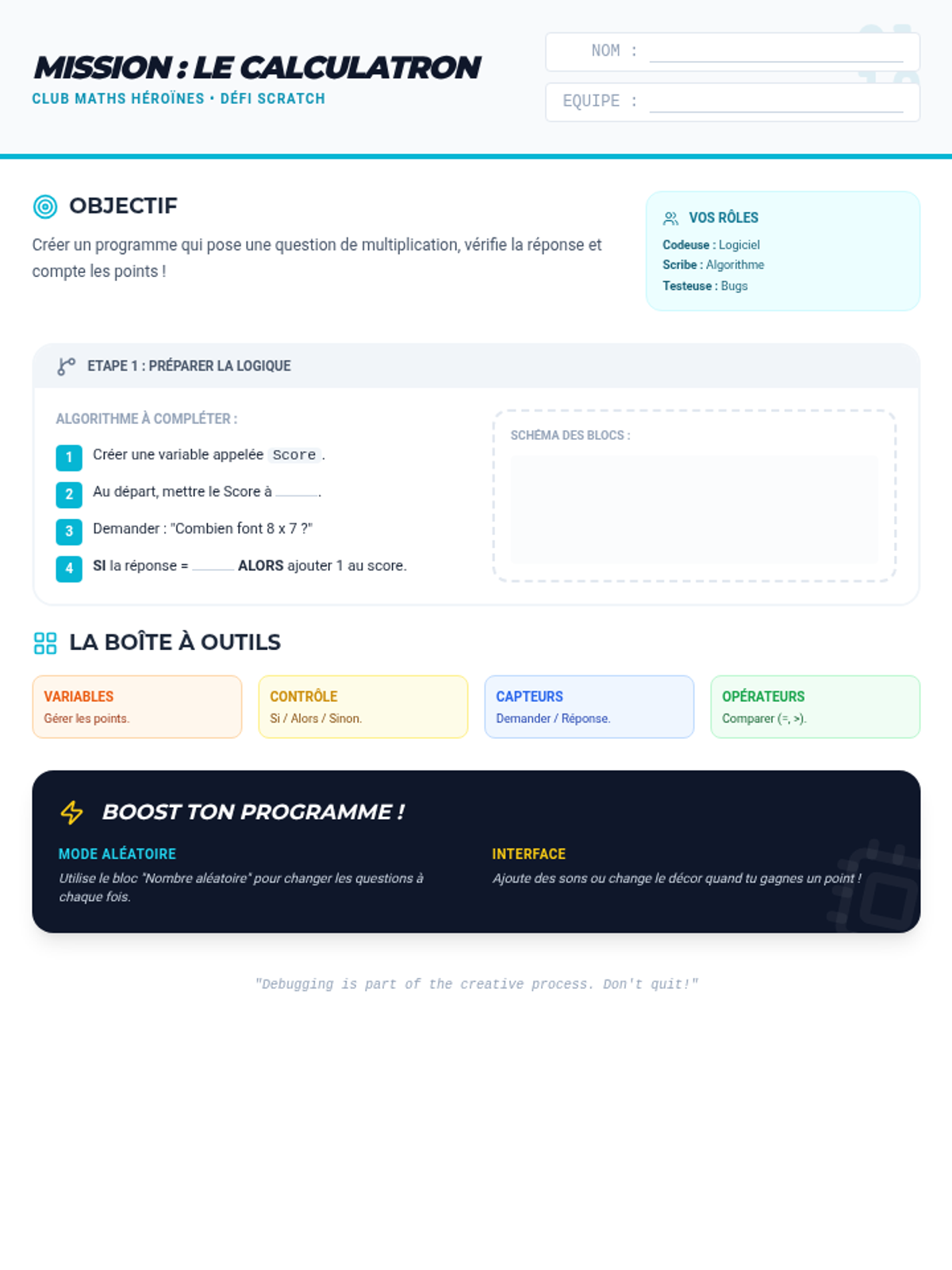
Fiche mission pour les élèves de 6ème dédiée à la création d'un quiz mathématique sur Scratch, incluant la conception de l'algorithme, la découverte des blocs et des défis d'approfondissement.
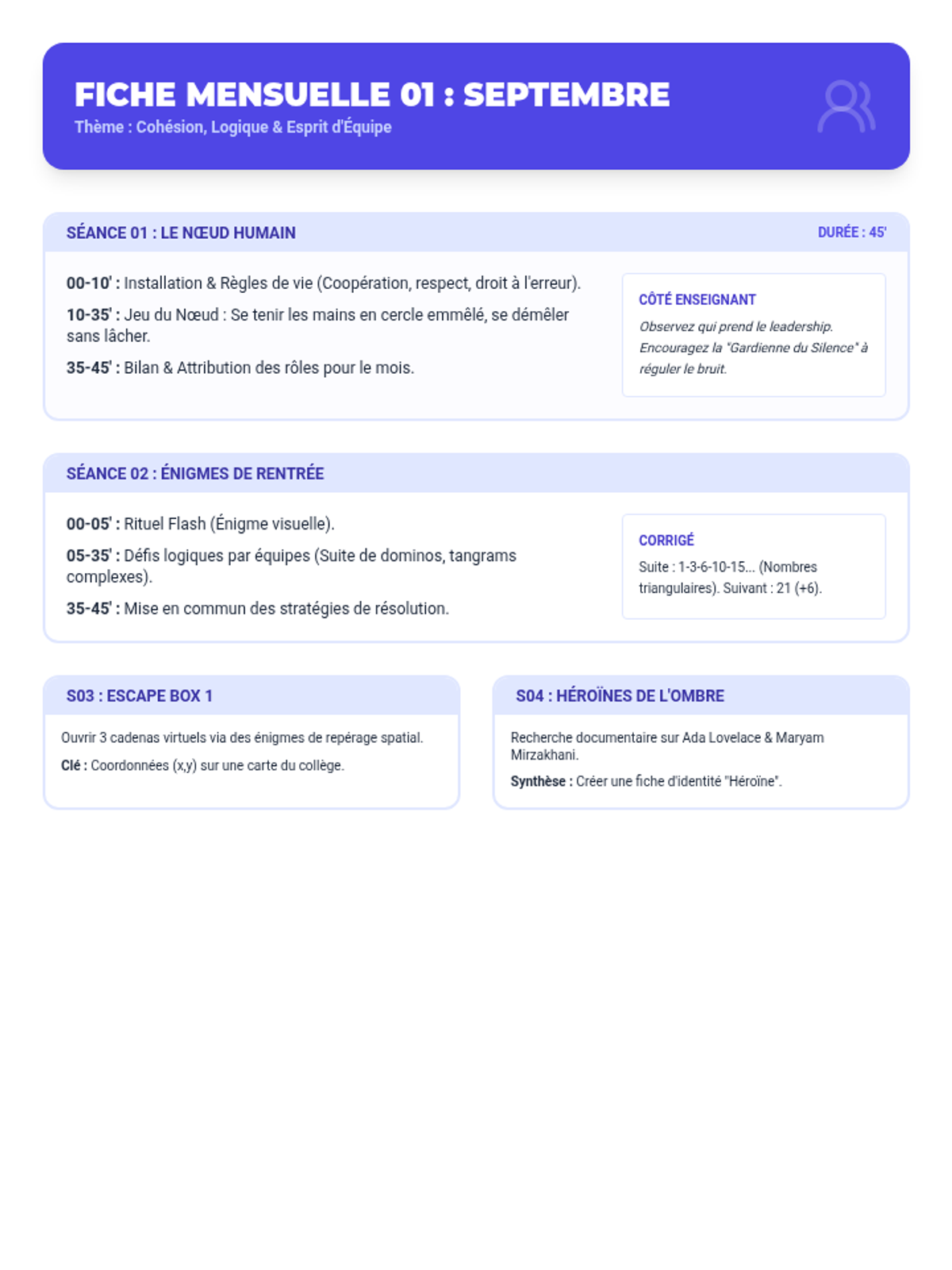
Guide pédagogique détaillé proposant le contenu précis et les modalités de mise en œuvre de chaque bloc thématique de l'atelier, incluant des exemples d'énigmes et de défis.
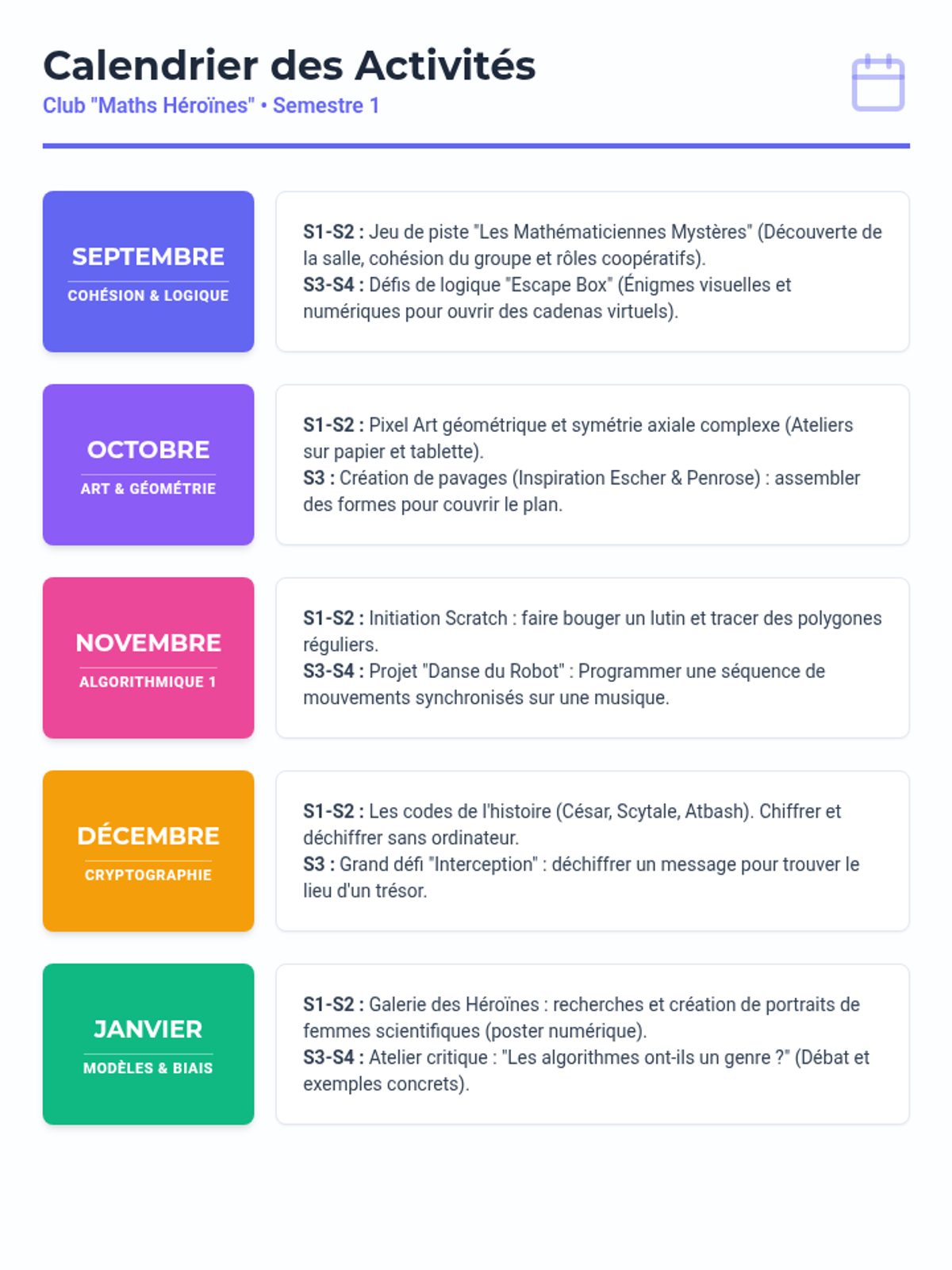
Calendrier annuel détaillé sur 10 mois (de septembre à juin) proposant des activités variées mêlant défis de logique, art géométrique, programmation et rencontres pour un atelier hebdomadaire.
A 11-slide Mission Possible themed presentation for Day 2 of NYS Math Exam prep, focusing on common mistakes, computer-based testing, and complex mixed-standard problem solving. Features detailed error analysis and strategic tips.
A 12-slide Mission Possible themed presentation for Day 1 of NYS Math Exam prep, focusing on mindset, work habits, and elimination strategies. Includes step-by-step reveals and 7th grade standard-aligned problems.
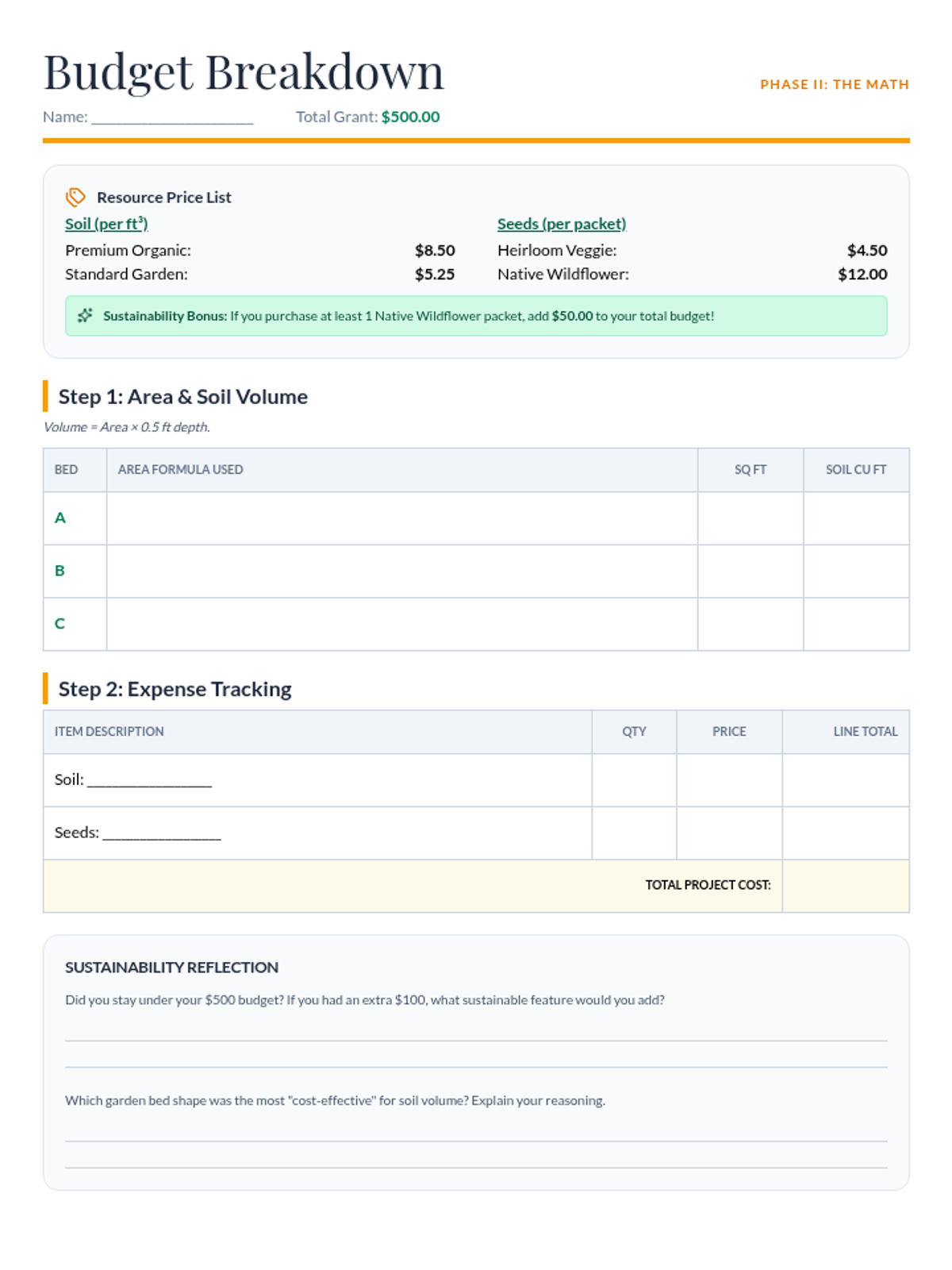
A budget tracking worksheet for students to calculate area, soil volume, and seed costs while managing a fixed project budget. Revised to fit on one page and corrected text spacing.
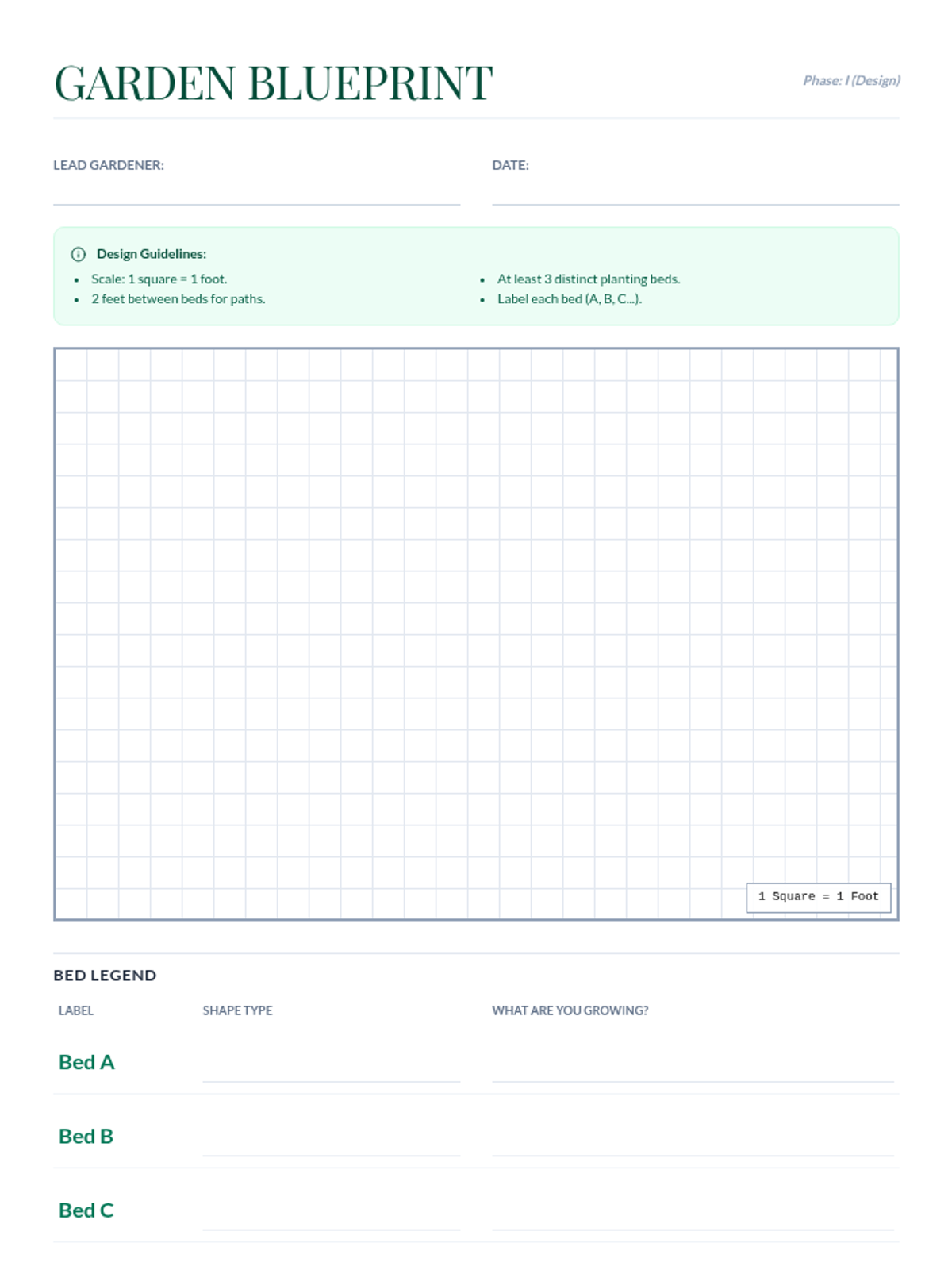
A grid-based garden design sheet for sketching layout to scale. Revised to fit entire grid on one page and corrected grid alignment.
Visual presentation slides for the Seed Money project, introducing students to the garden design mission, essential area formulas, and budgeting logic. Revised with corrected formulas and a price list slide.
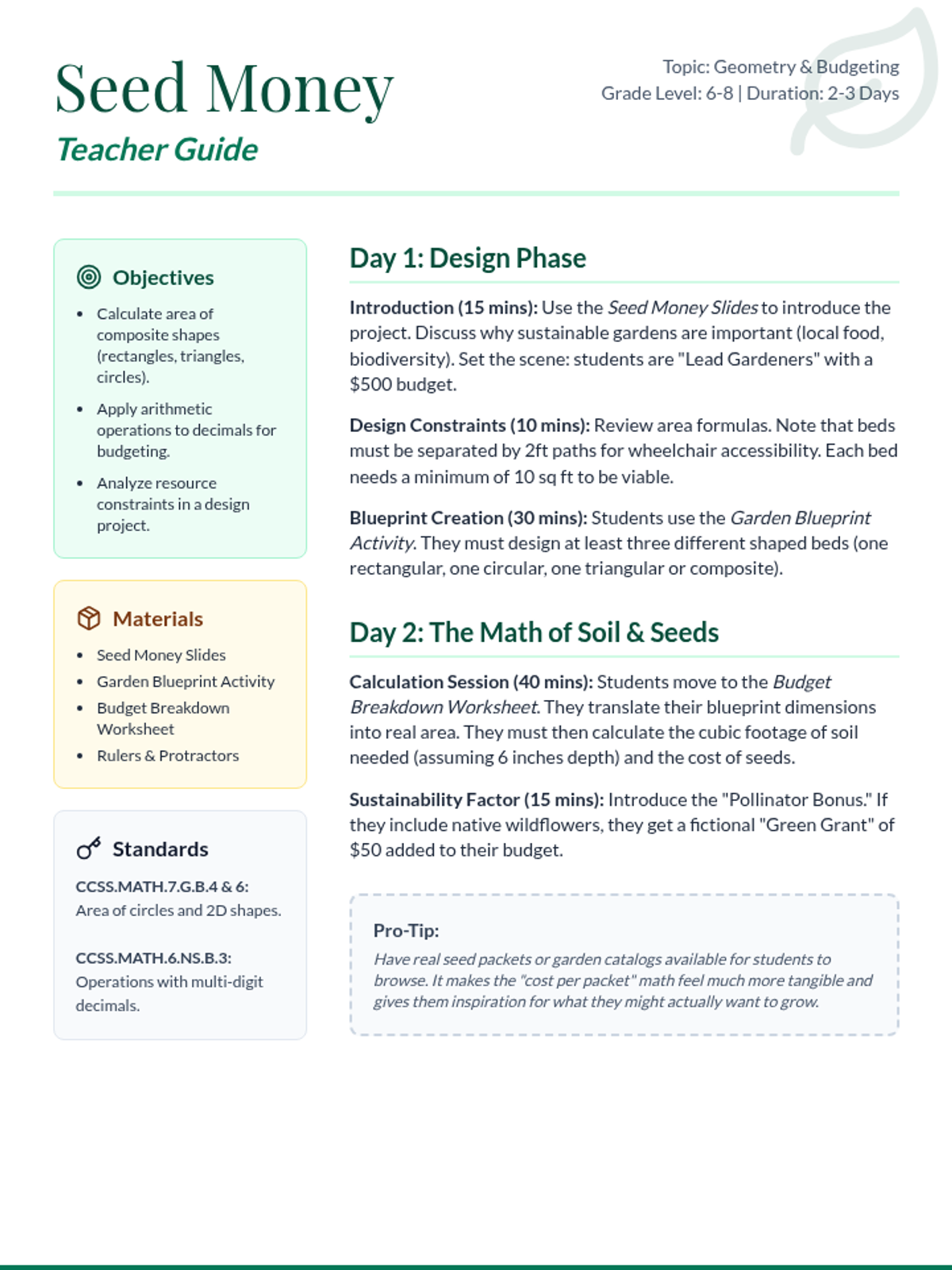
A comprehensive teacher's guide for the Seed Money project, featuring lesson objectives, a multi-day instructional flow, common misconceptions, and a grading rubric. Revised for improved page flow and consistency.
A high-impact architectural-themed slide deck for presenting MCAS-style multiplication challenges. Now includes a detailed partial product strategy slide for 2-digit by 2-digit multiplication, alongside area calculation and missing factor problems with simplified numbers for introductory mastery. Includes expert tips and reflective discussion prompts optimized for large-scale classroom display.
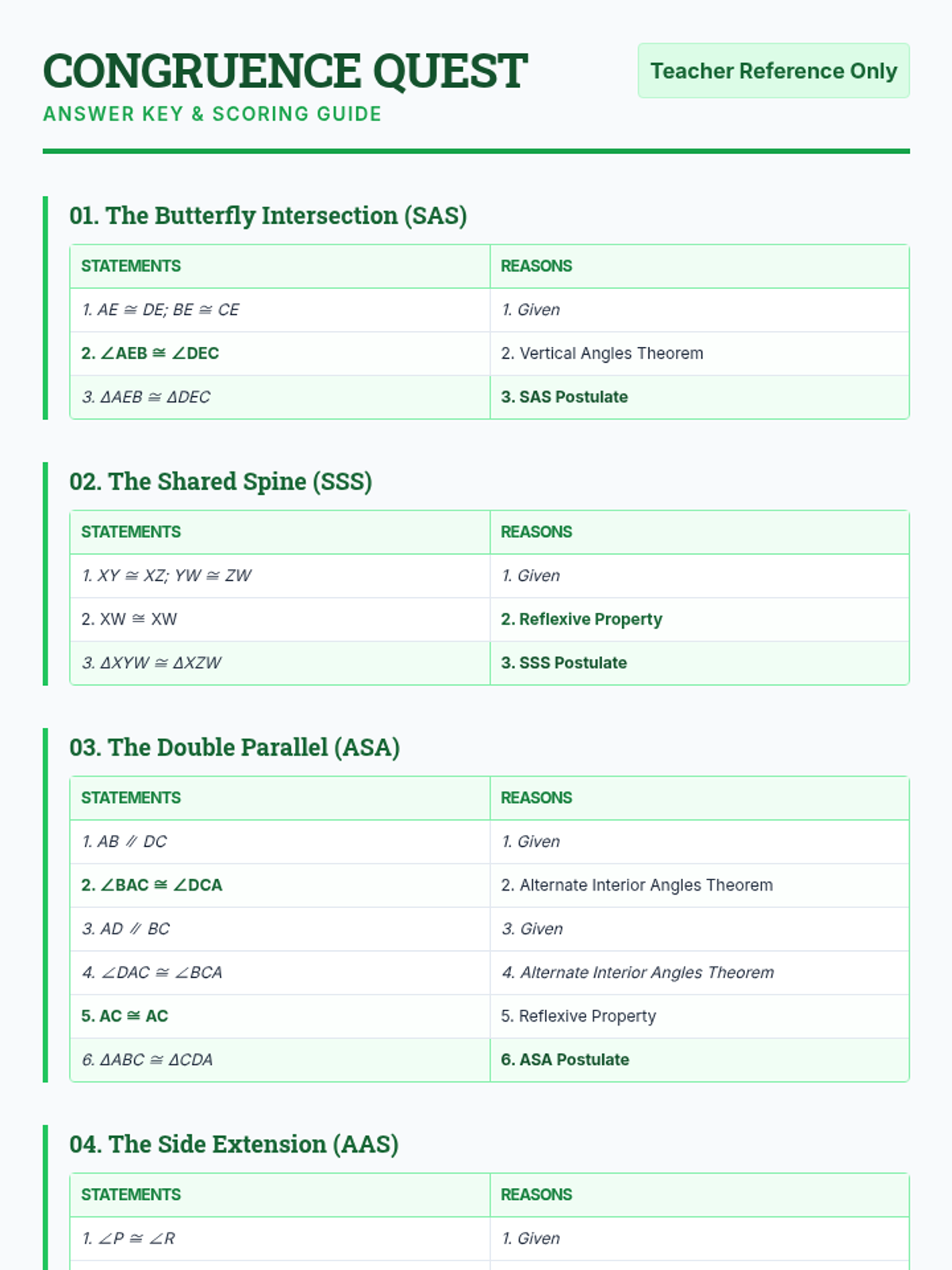
The complete answer key for the Congruence Proofs Quiz, providing all statements, reasons, and final theorems with a detailed point breakdown for teachers.
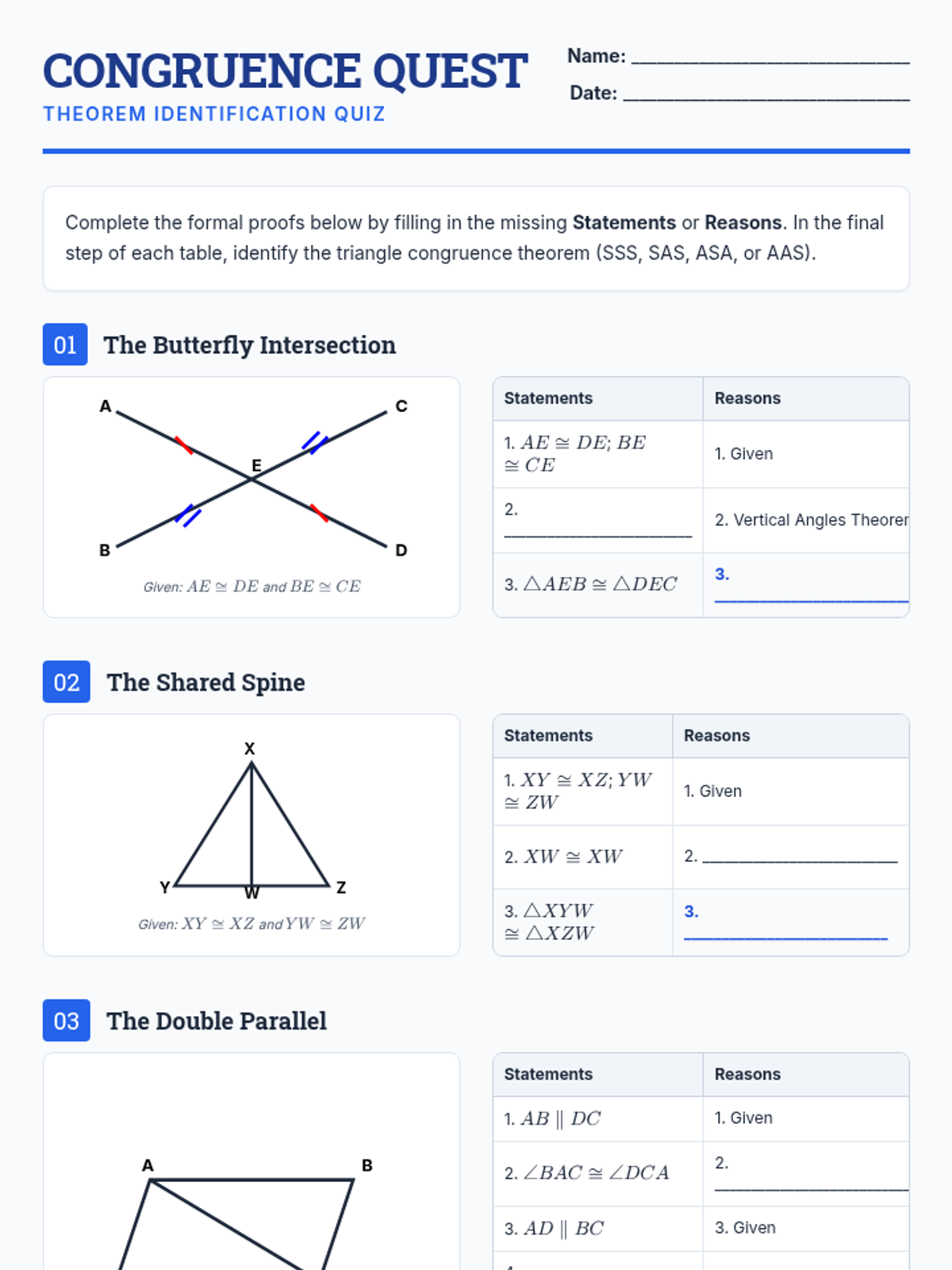
A 5-question triangle congruence quiz focusing on deep-dive formal proofs where students must identify SSS, SAS, ASA, or AAS theorems and complete Statement-Reason tables. Revised for logical consistency and layout efficiency.
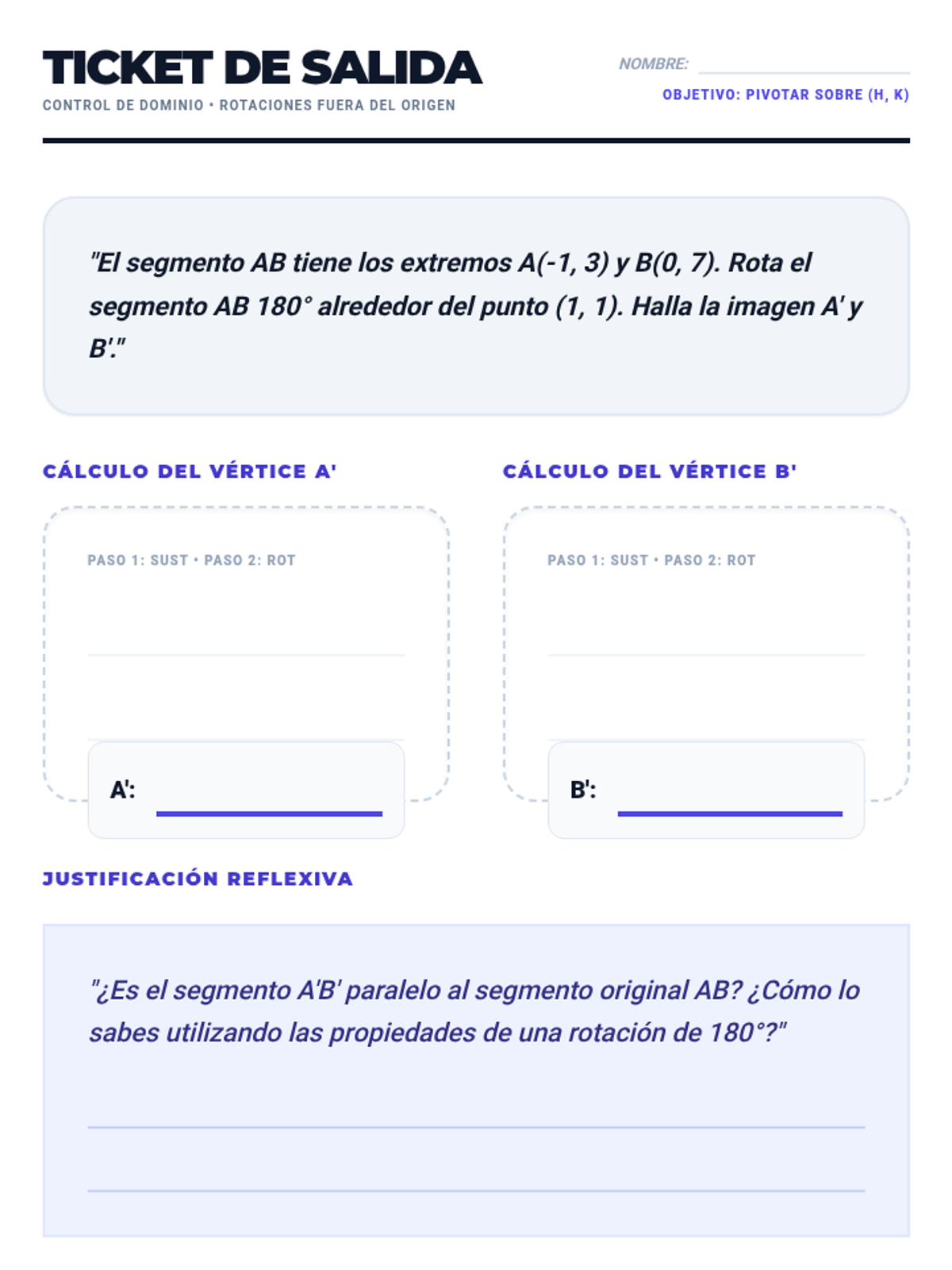
Assessment exit ticket for rotating segments about a non-origin point, with structured workspace and a property-based reflection prompt.
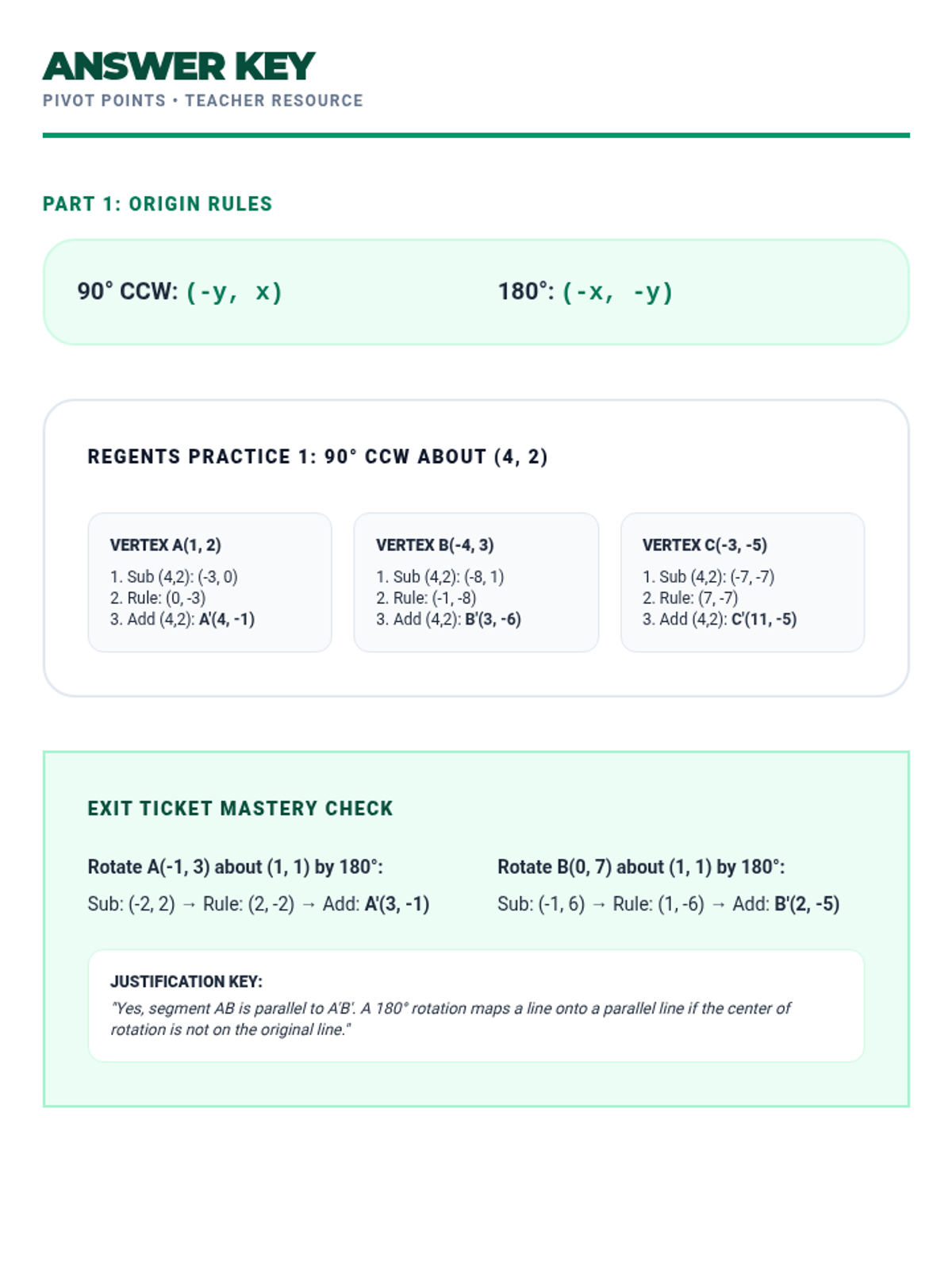
Complete answer key for the Pivot Points lesson, featuring step-by-step arithmetic for the 3-step pivot method and sample justification responses.
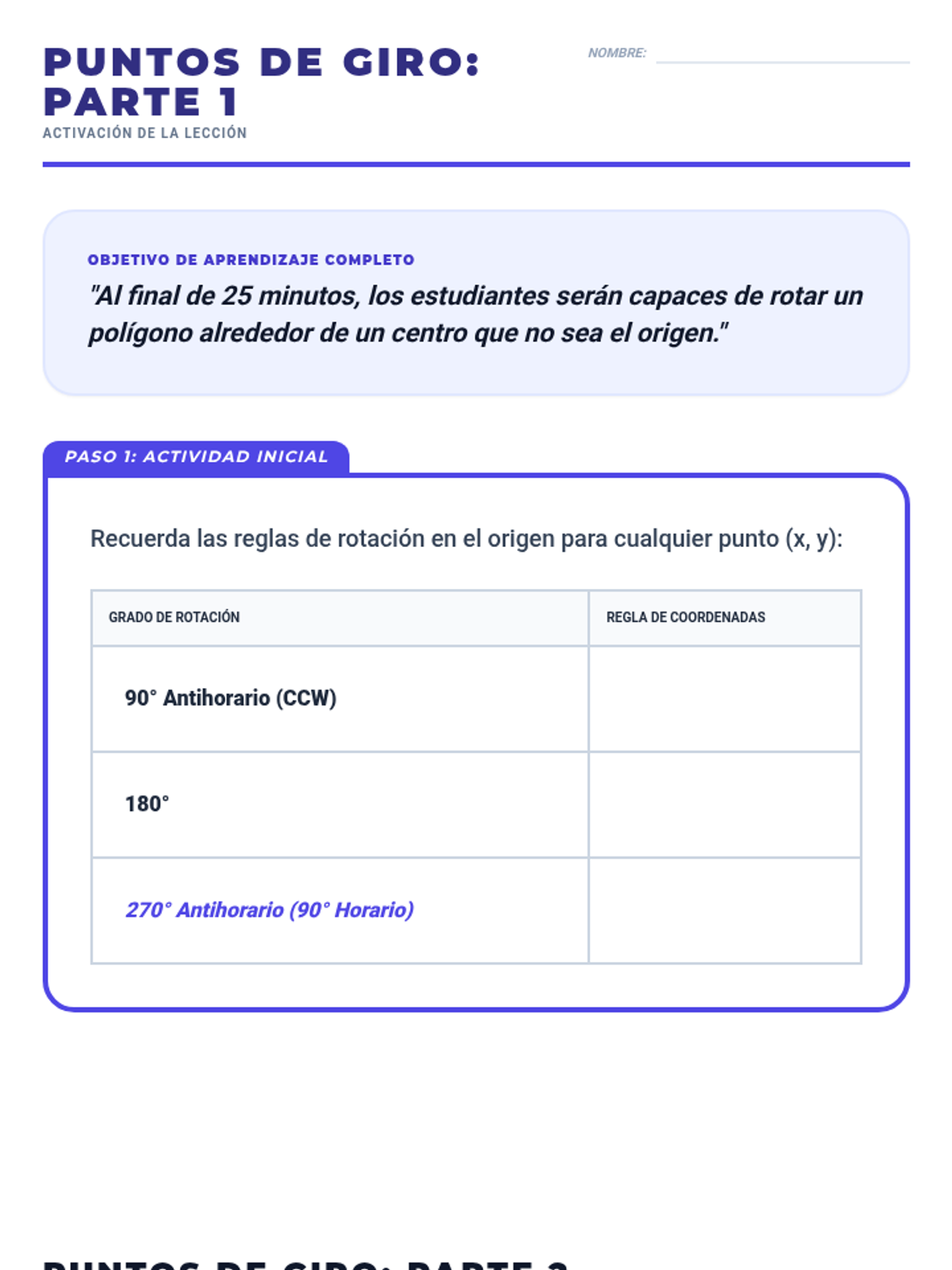
A multi-page consolidated student packet for non-origin rotations, featuring the full learning target, Do Now, Method summary, a high-precision SVG -10 to 10 coordinate grid with bolded axes, and a congruent-properties discourse prompt. Each section is placed on a separate page for clarity.
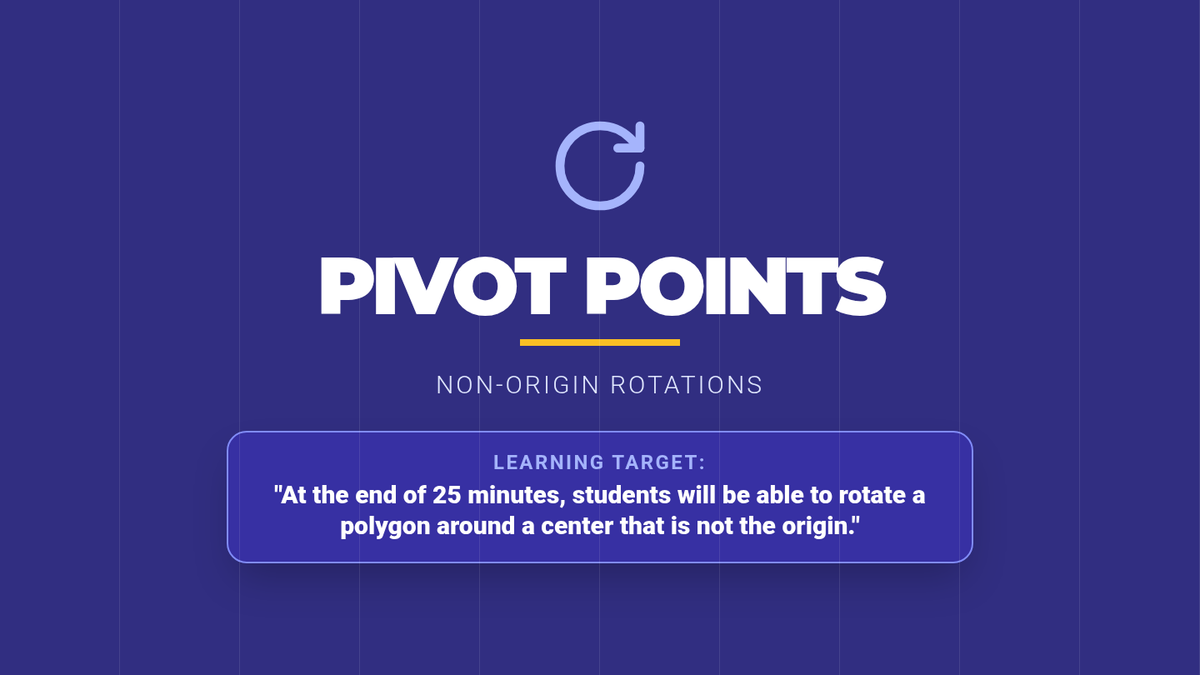
A high-impact slide deck for non-origin rotations, featuring the full learning target, a step-by-step model split across two slides (problem vs solution), and a real NYS Regents practice problem. Includes a blank recall slide for student brainstorming.
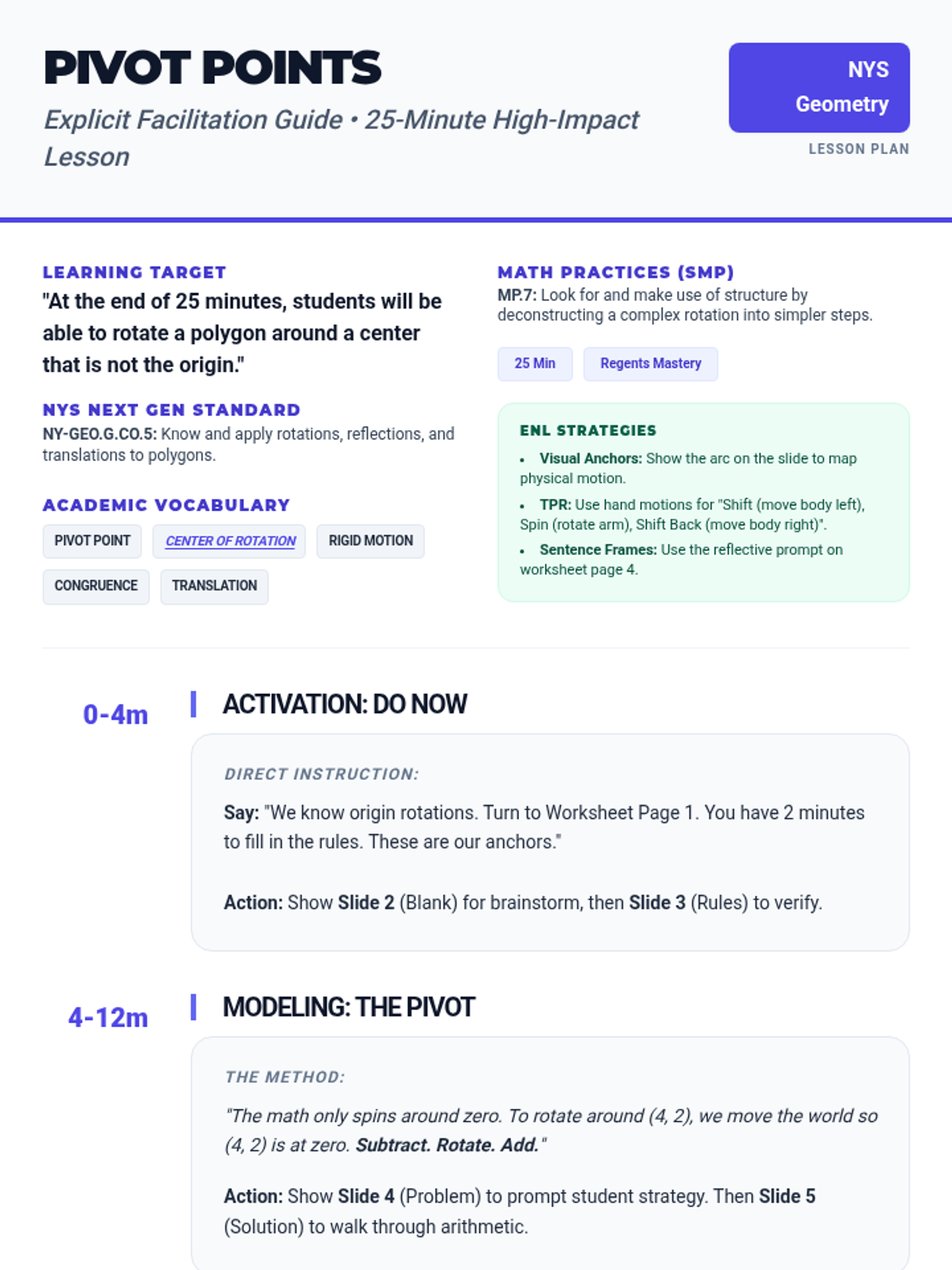
Highly explicit teacher facilitation guide for a 25-minute lesson on non-origin rotations, featuring script-like actions, NYS standards, academic vocabulary, and ENL strategies. Includes alternative scaffolding instructions.
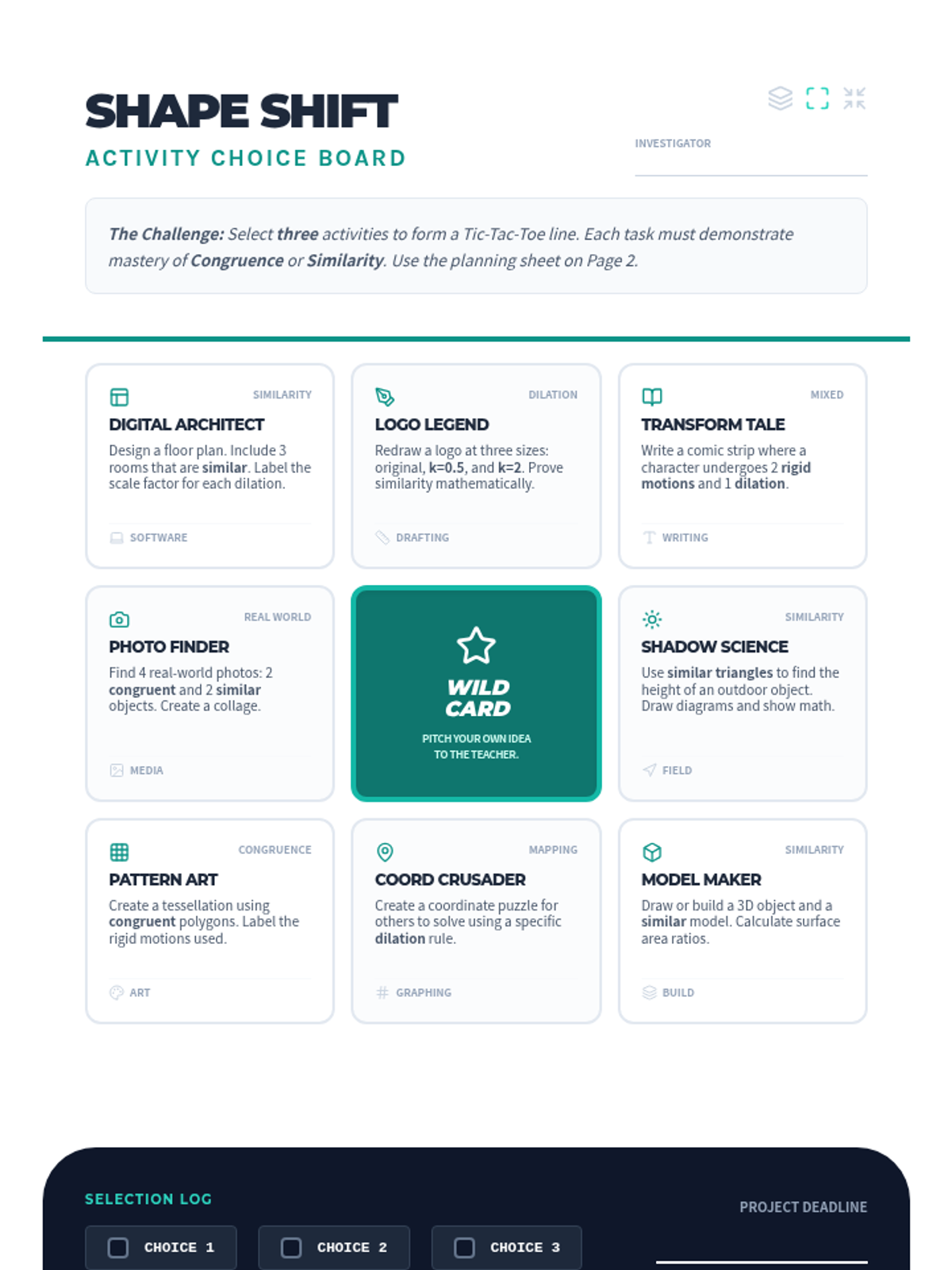
A creative choice board for Grade 8 students to demonstrate understanding of congruence and similarity through various media, including art, technology, and real-world application. Designed in a 3x3 Tic-Tac-Toe format.
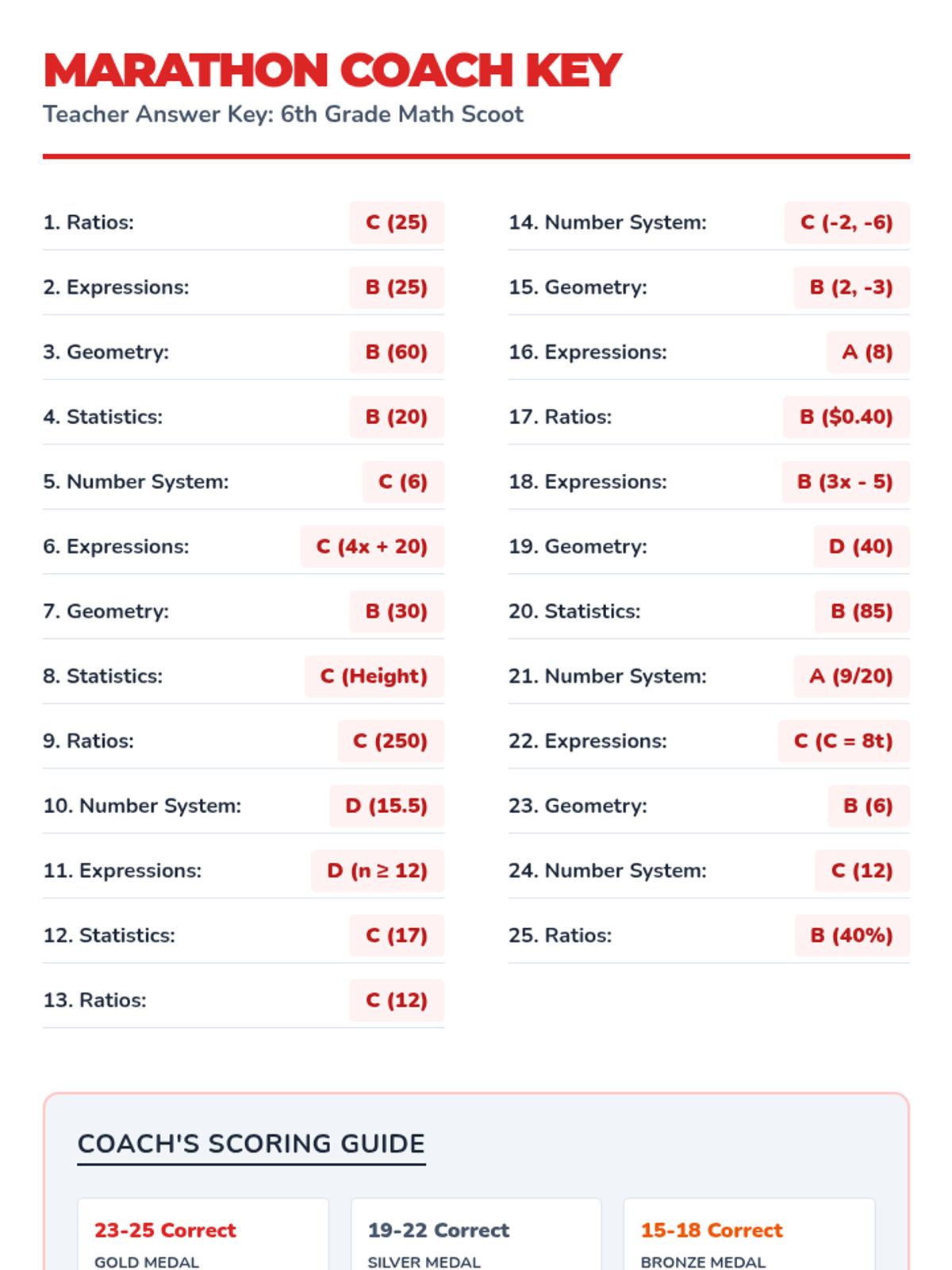
A teacher's answer key for the 6th-grade math 'Scoot' activity. Fixed item 11 character and page break for scoring guide.
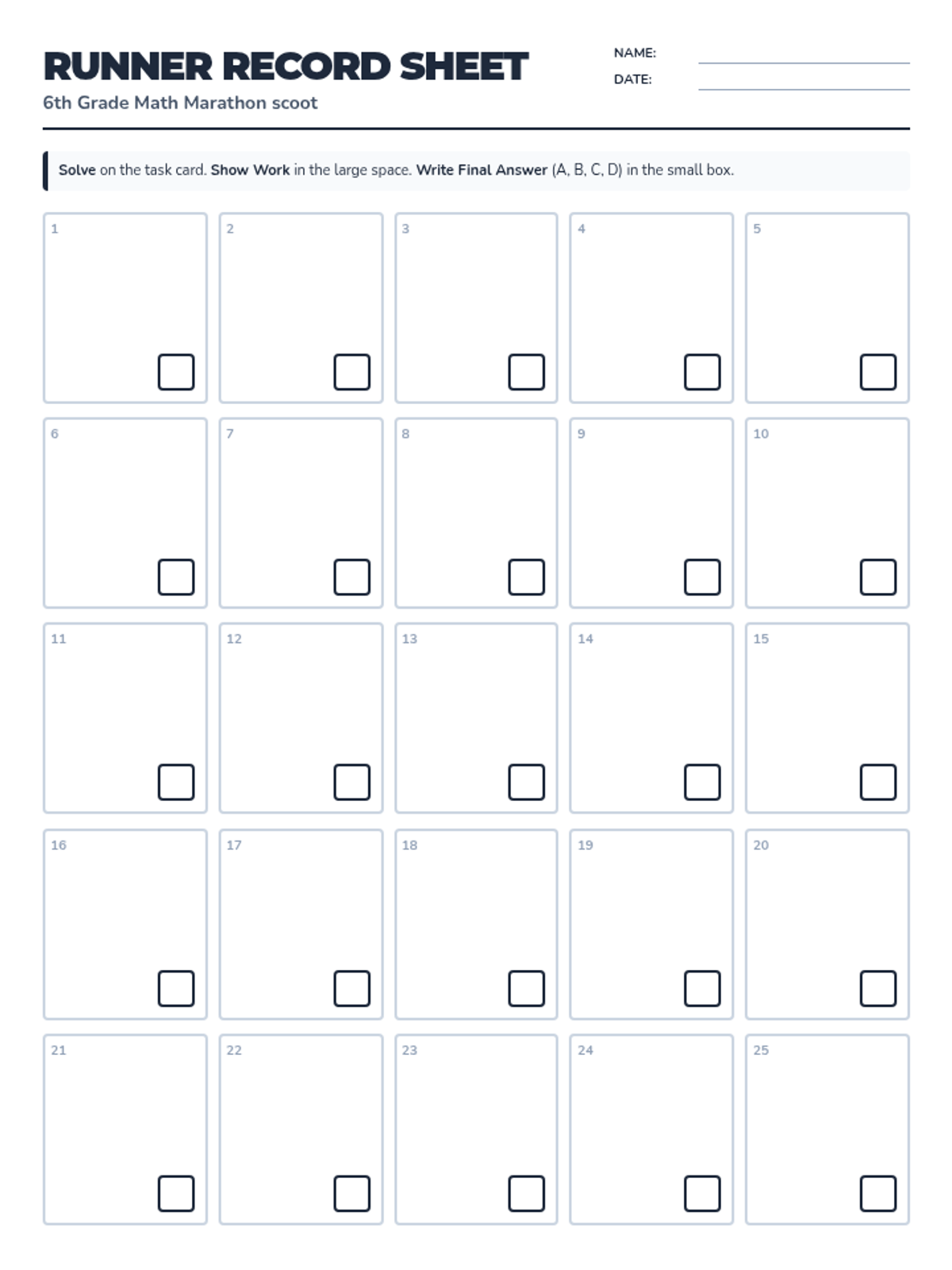
A student response sheet with 25 boxes for 'Scoot' answers, including space for showing work and a designated box for the final letter choice. Layout adjusted to fit one page.
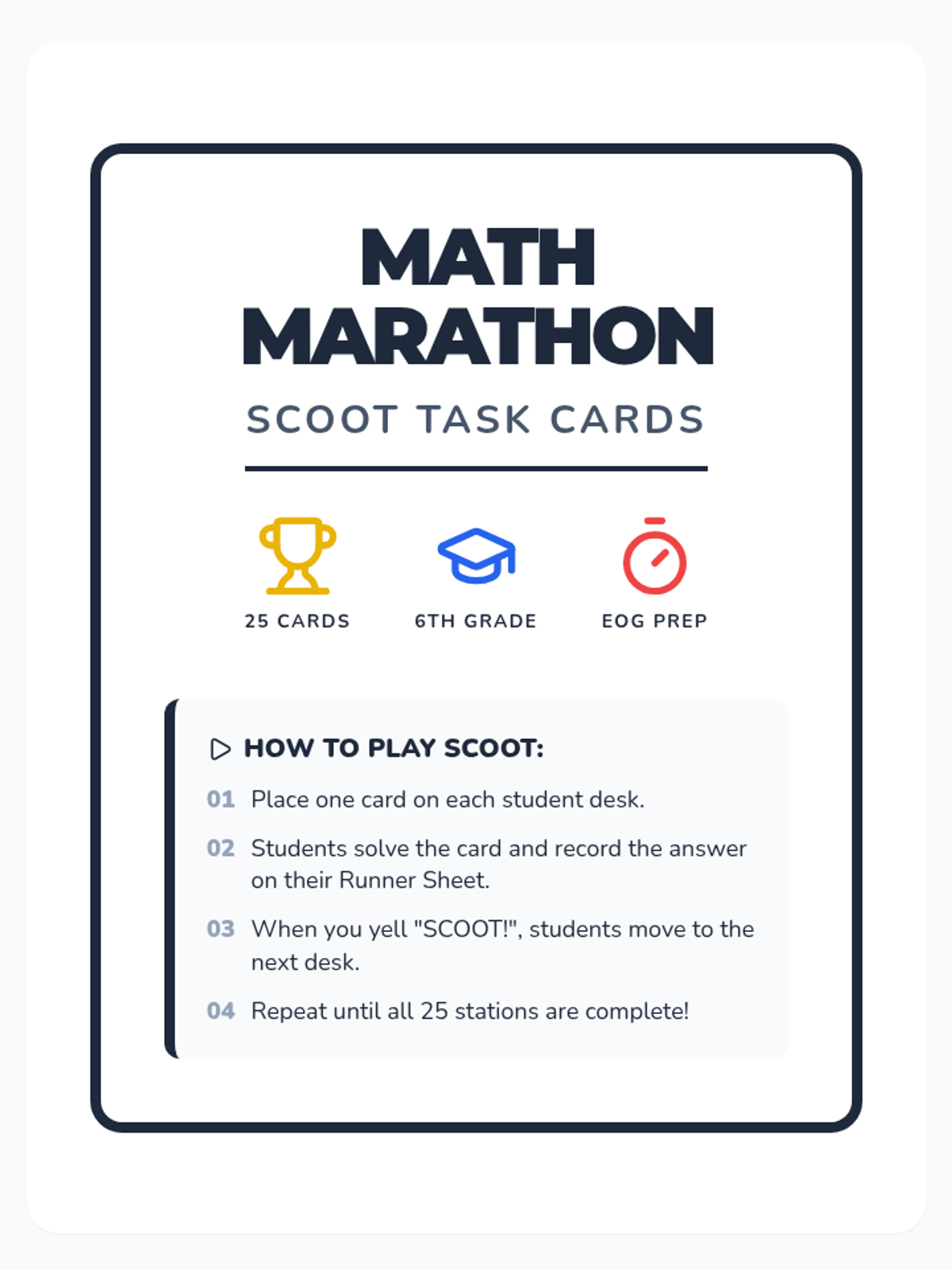
A set of 25 printable task cards for a math 'Scoot' game, covering all 6th-grade math domains with multiple-choice questions to mimic EOG formatting. Final polished version with corrected layout and uniform styling.
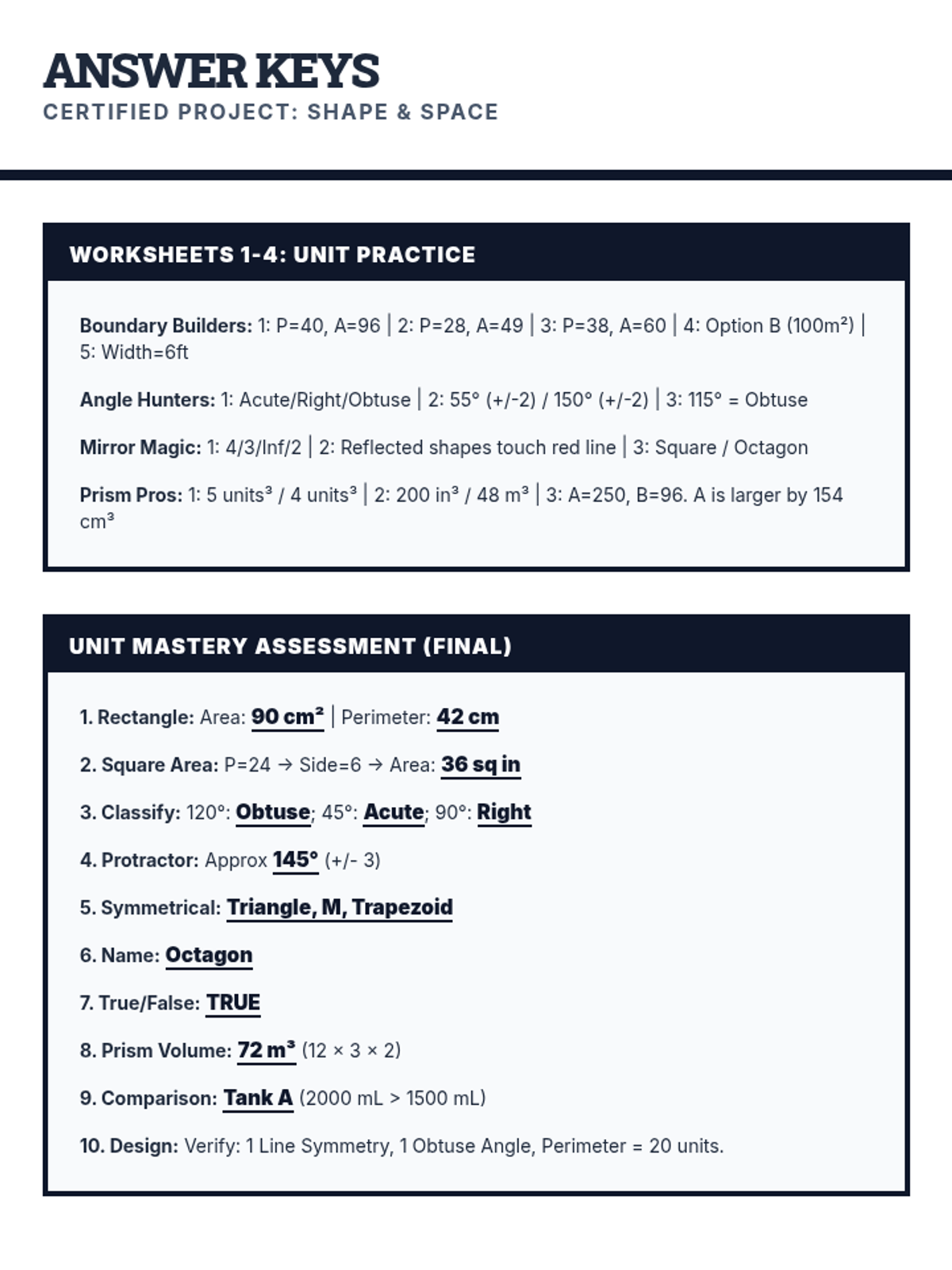
A consolidated answer key for all worksheets and the unit assessment in the Measurement and Geometry unit.
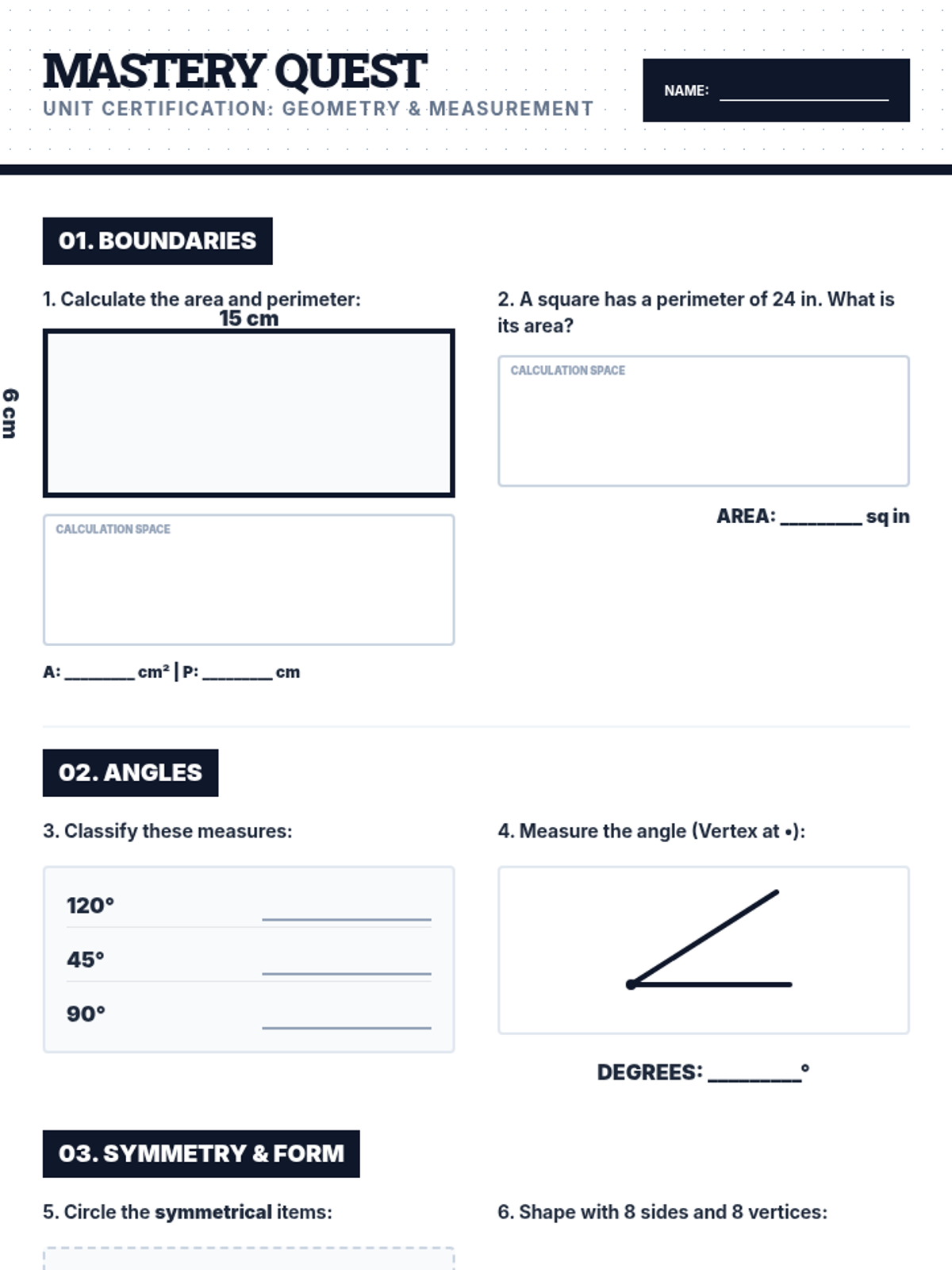
A comprehensive unit assessment for geometry and measurement, featuring sections on area/perimeter, angles, symmetry/shapes, and volume. Uses a professional drafting aesthetic.
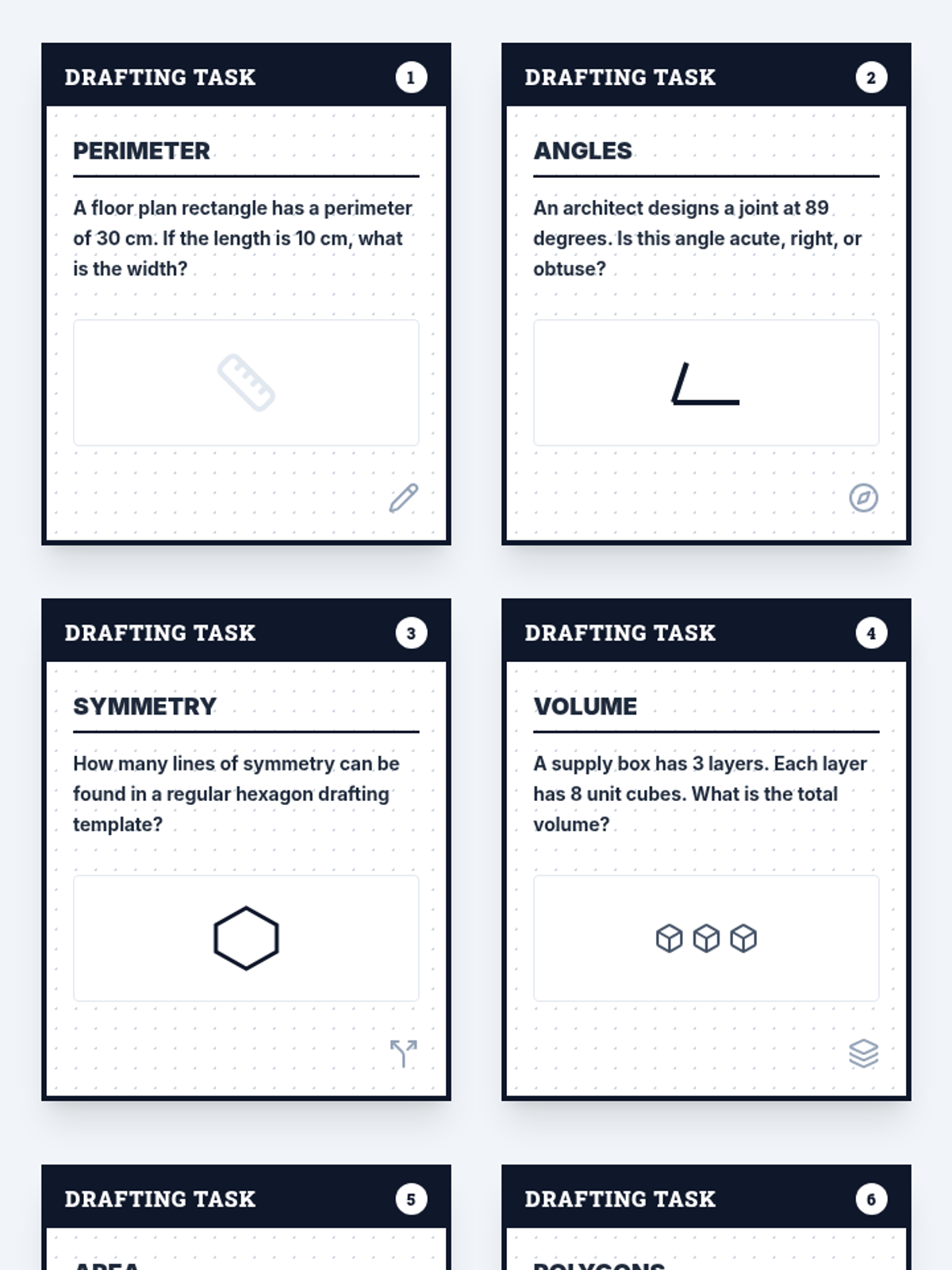
A set of 8 geometry and measurement task cards styled as blueprint drafting cards. Covers perimeter, area, angles, symmetry, and volume with a mix of visual and conceptual problems.
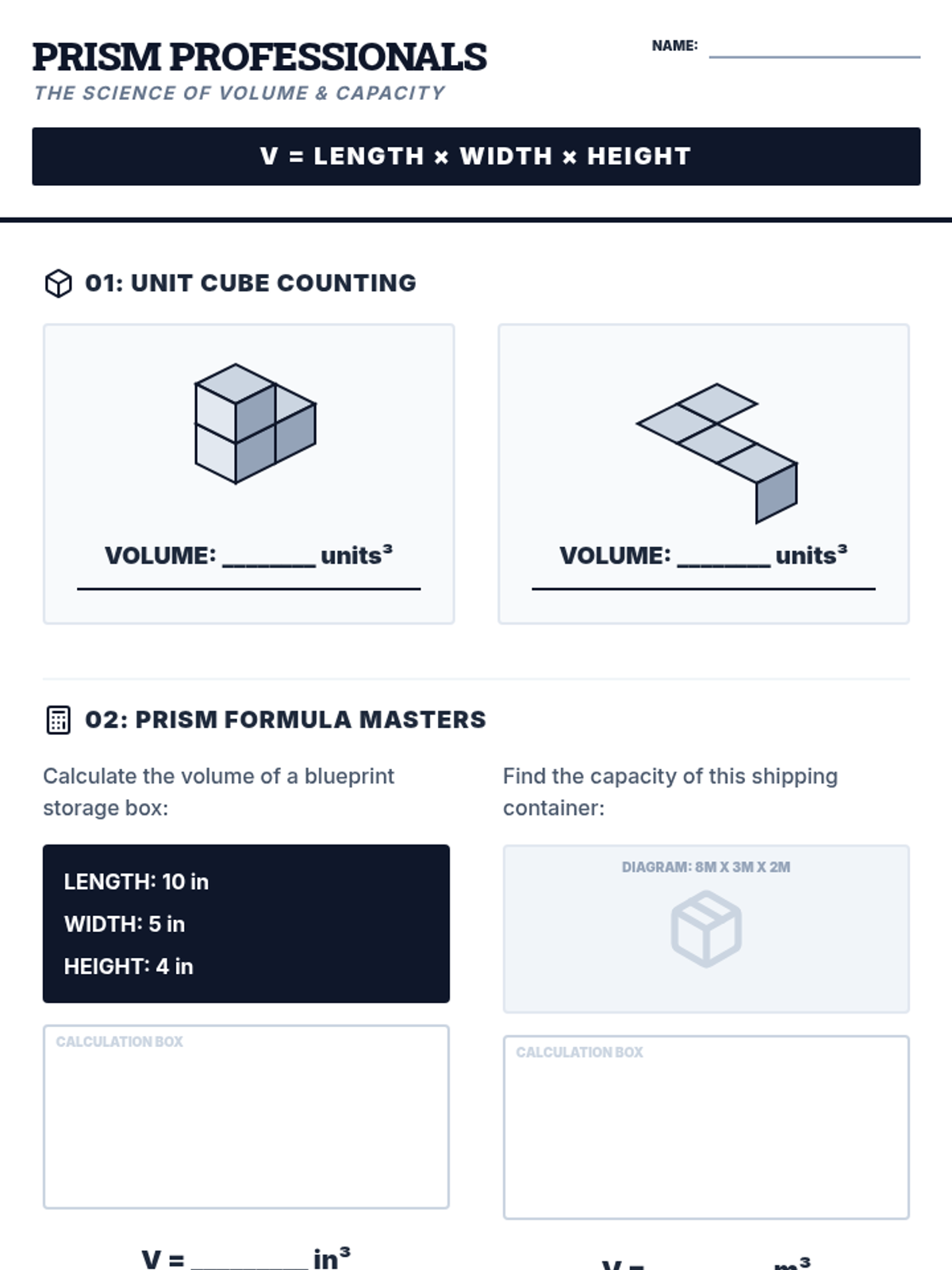
A volume and capacity worksheet that guides students through counting unit cubes, calculating prism volume using formulas, and comparing capacities of different containers.
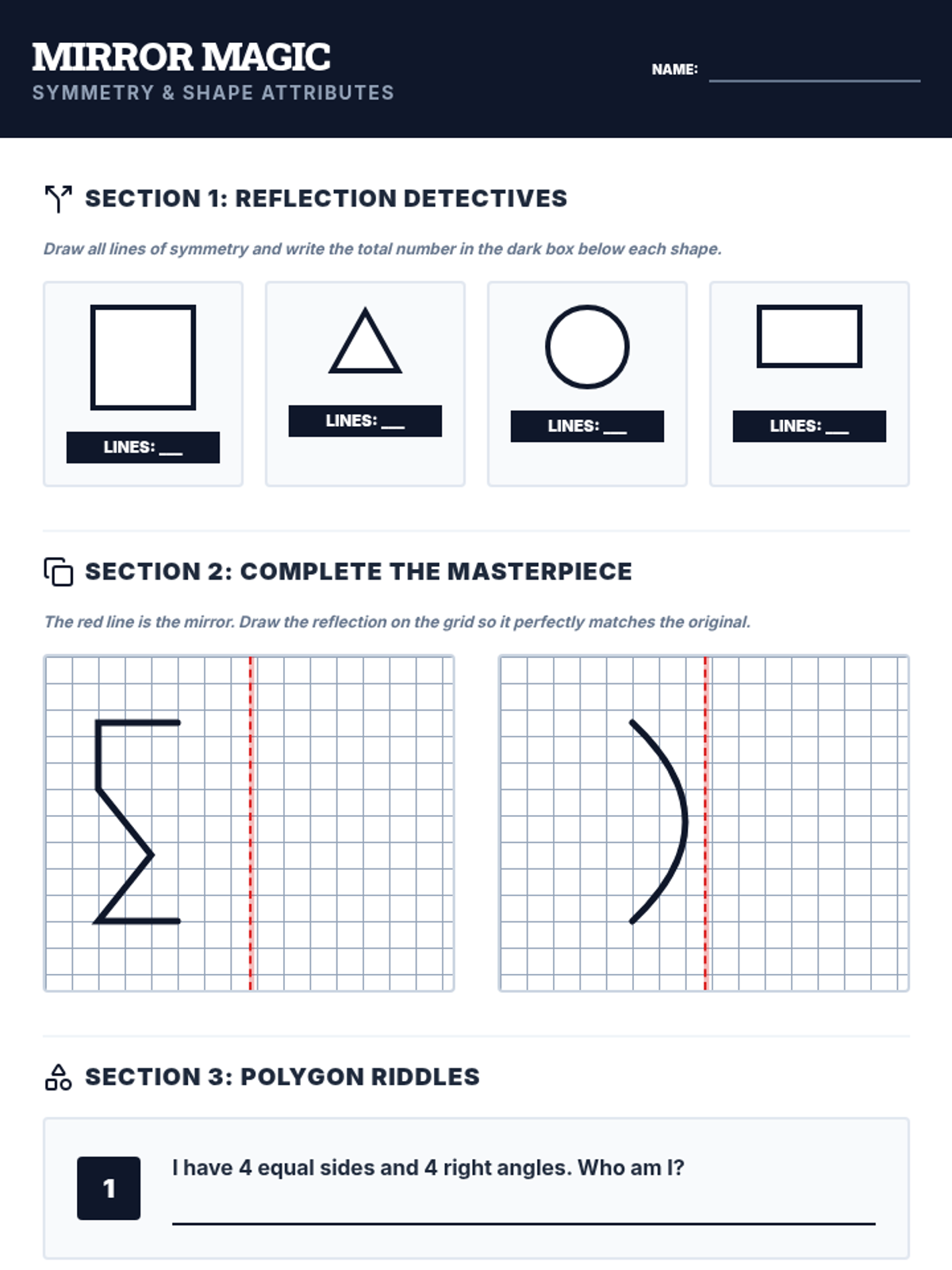
A symmetry and shapes worksheet that includes drawing lines of symmetry, completing symmetrical figures on grid paper, and identifying polygons based on clues.
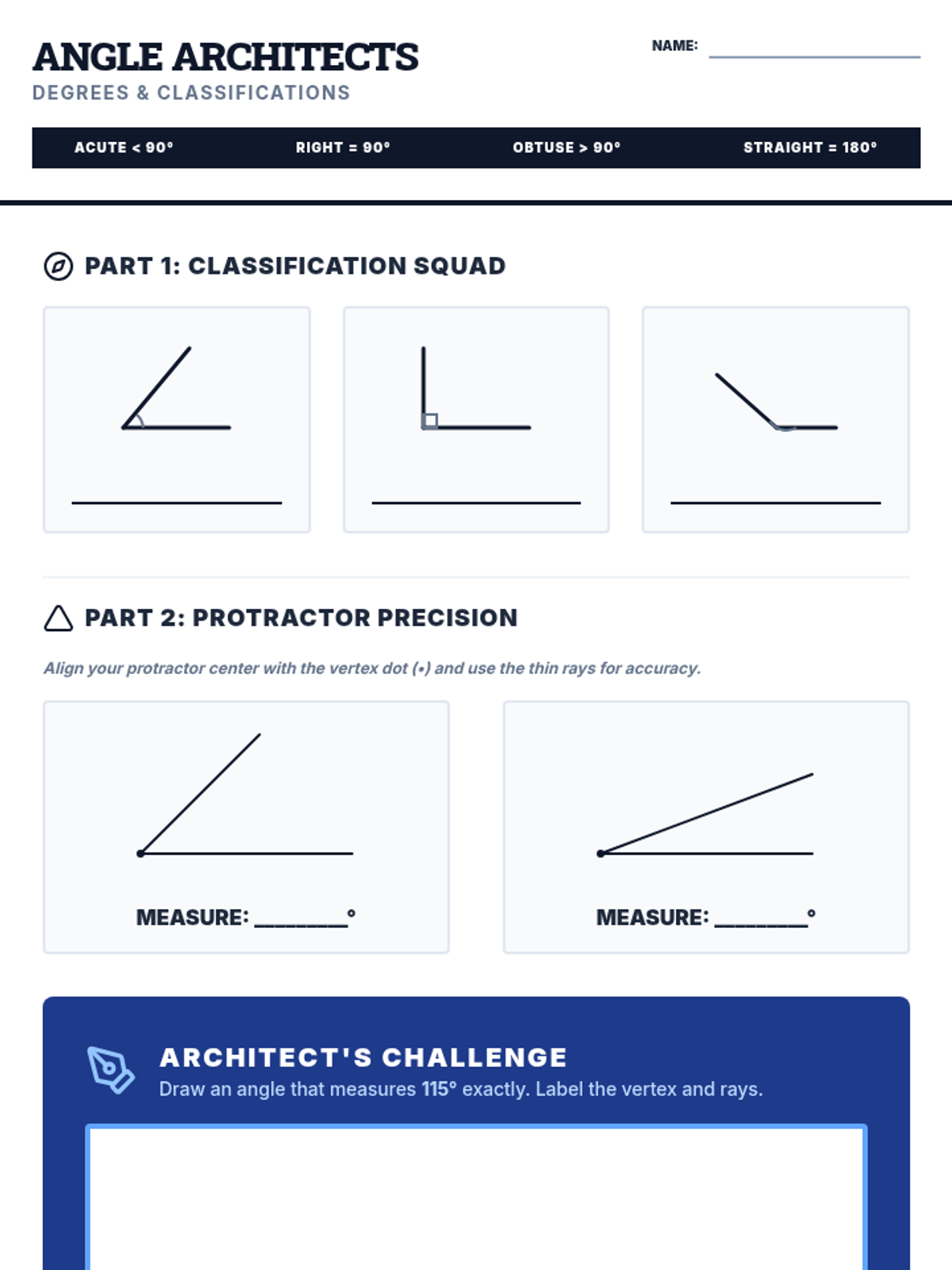
A worksheet focused on angle classification and measurement using a drafting theme. Features visual angle problems and a creative drawing challenge.
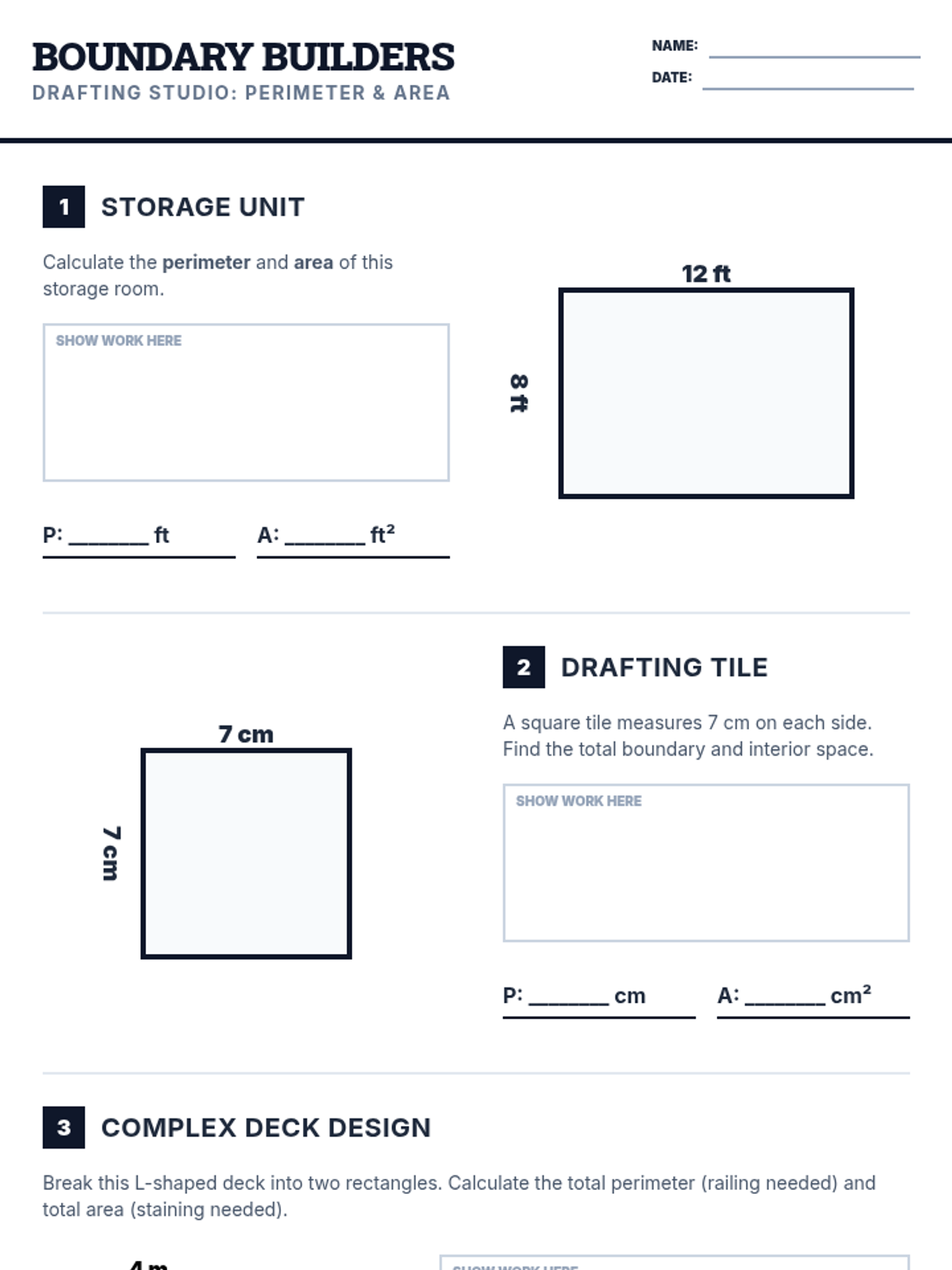
An architectural-themed practice worksheet for area and perimeter, featuring real-world word problems and complex shape calculations. Includes space for diagrams and student work.
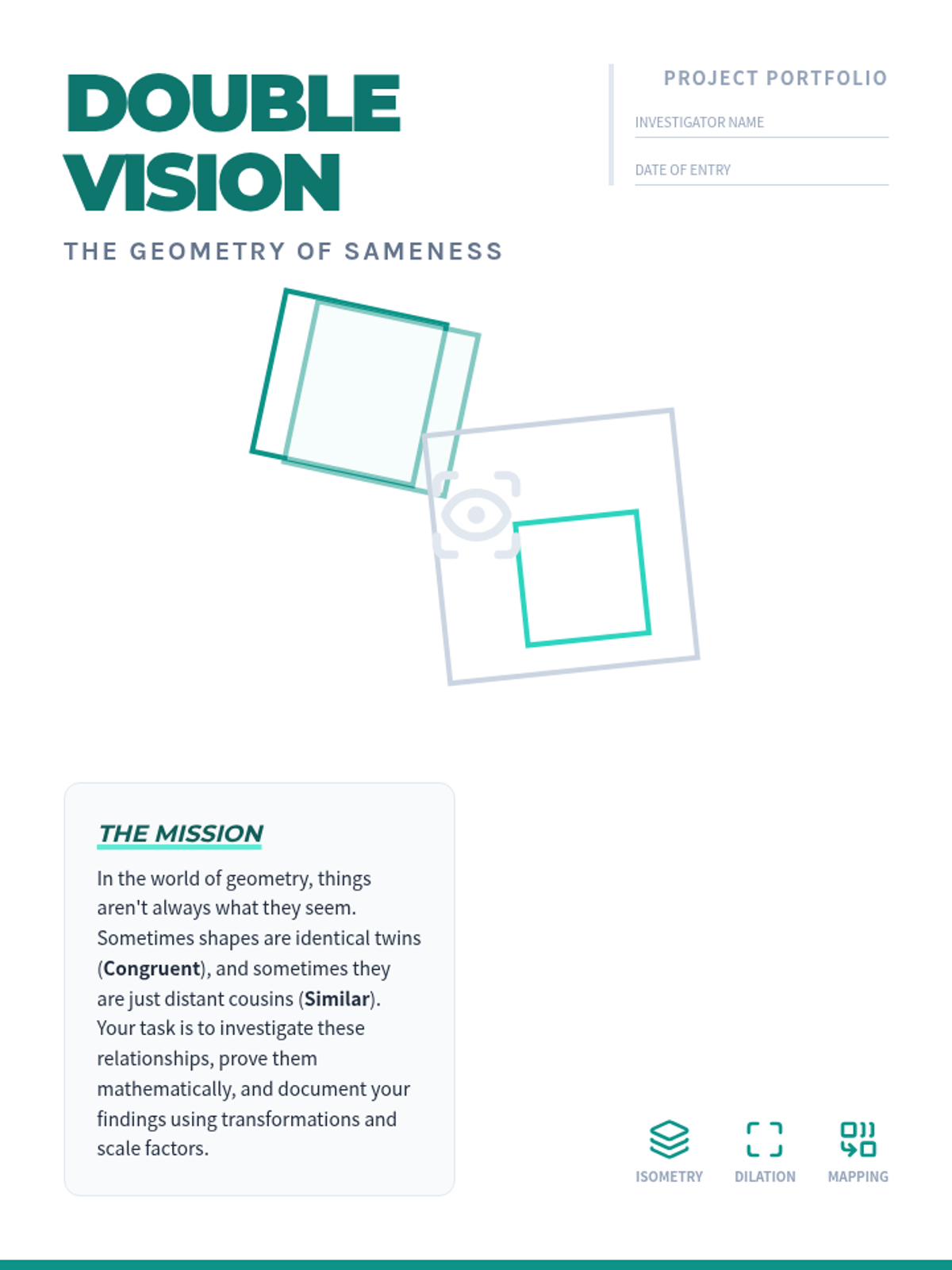
A comprehensive 8th-grade student project packet focusing on congruence and similarity through coordinate graphing, transformations, and scale factor applications. Includes guided tasks, reflective questions, and a scoring rubric.
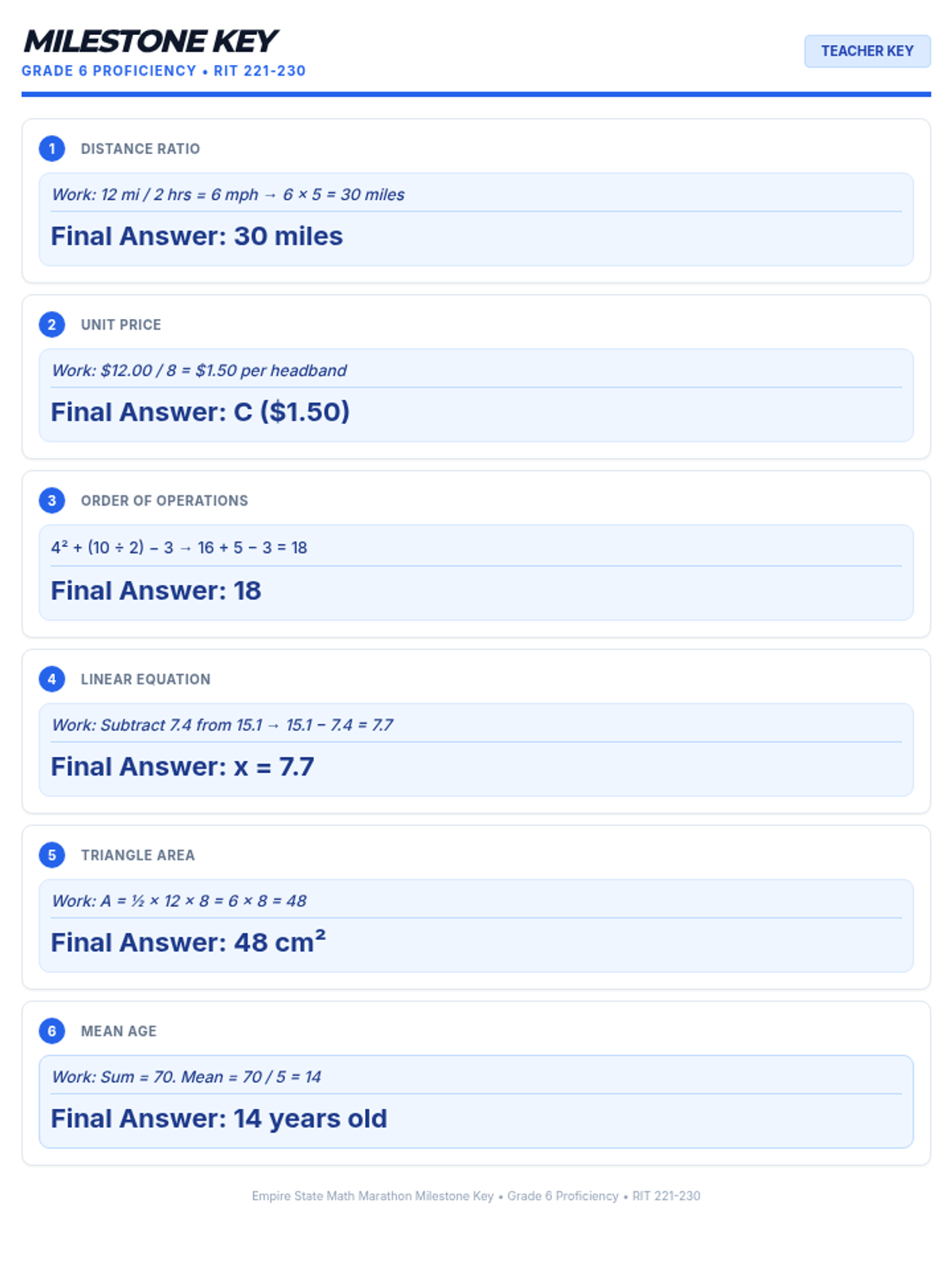
Revised 1-page answer key for the Milestone Assessment. Standardized all layouts to a stacked vertical format with border dividers. Standardized the 'Final Answer' format to text-xl across all six problems and tightened spacing to ensure all content fits on one sheet. Improved math entity rendering.
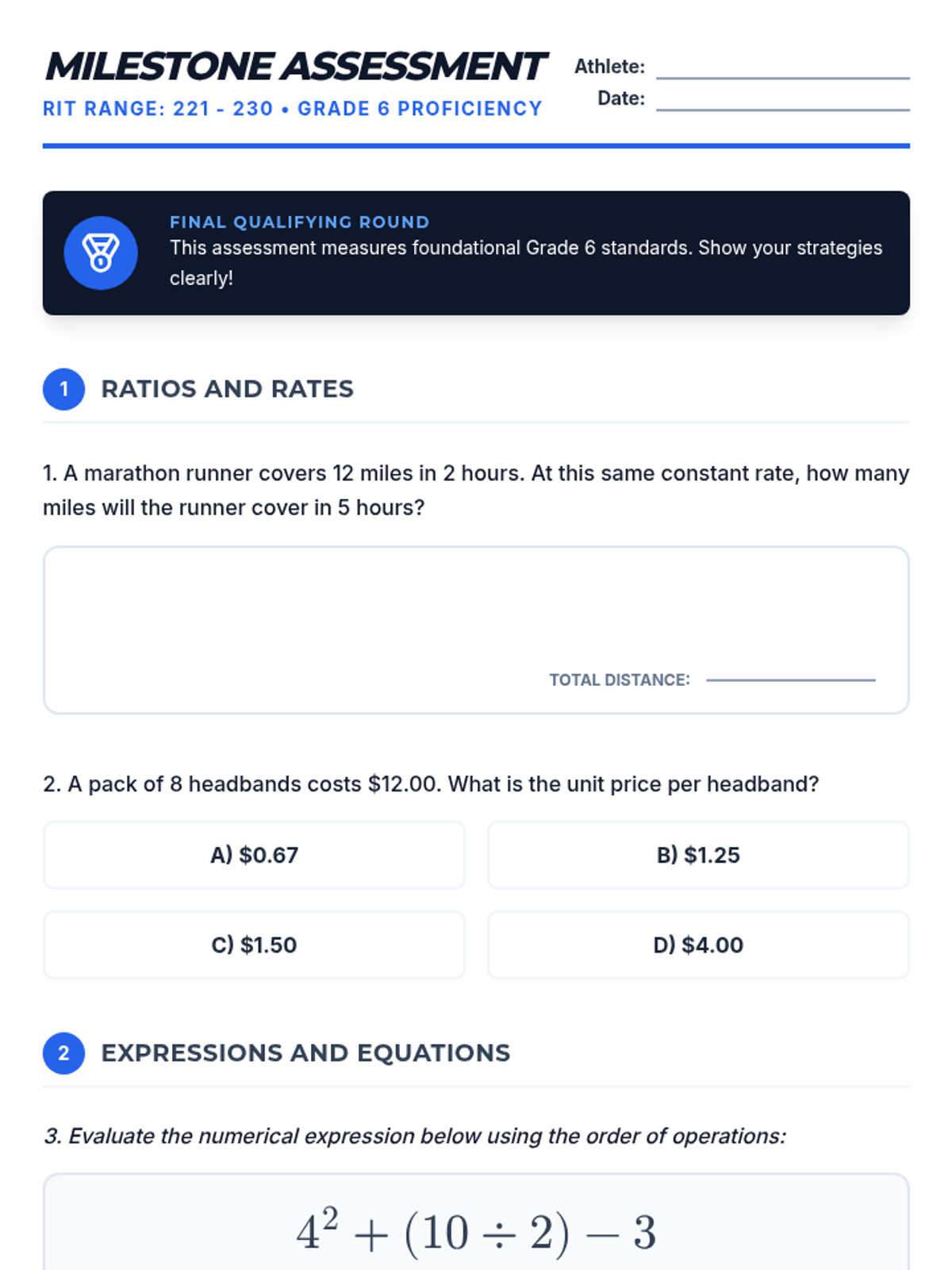
Revised Milestone Assessment with fixed page breaks (Question 3 kept together). Improved work area labels with higher contrast and better alignment. SVG for triangle area adjusted for perfect visibility. Removed decorative artifacts from work areas.
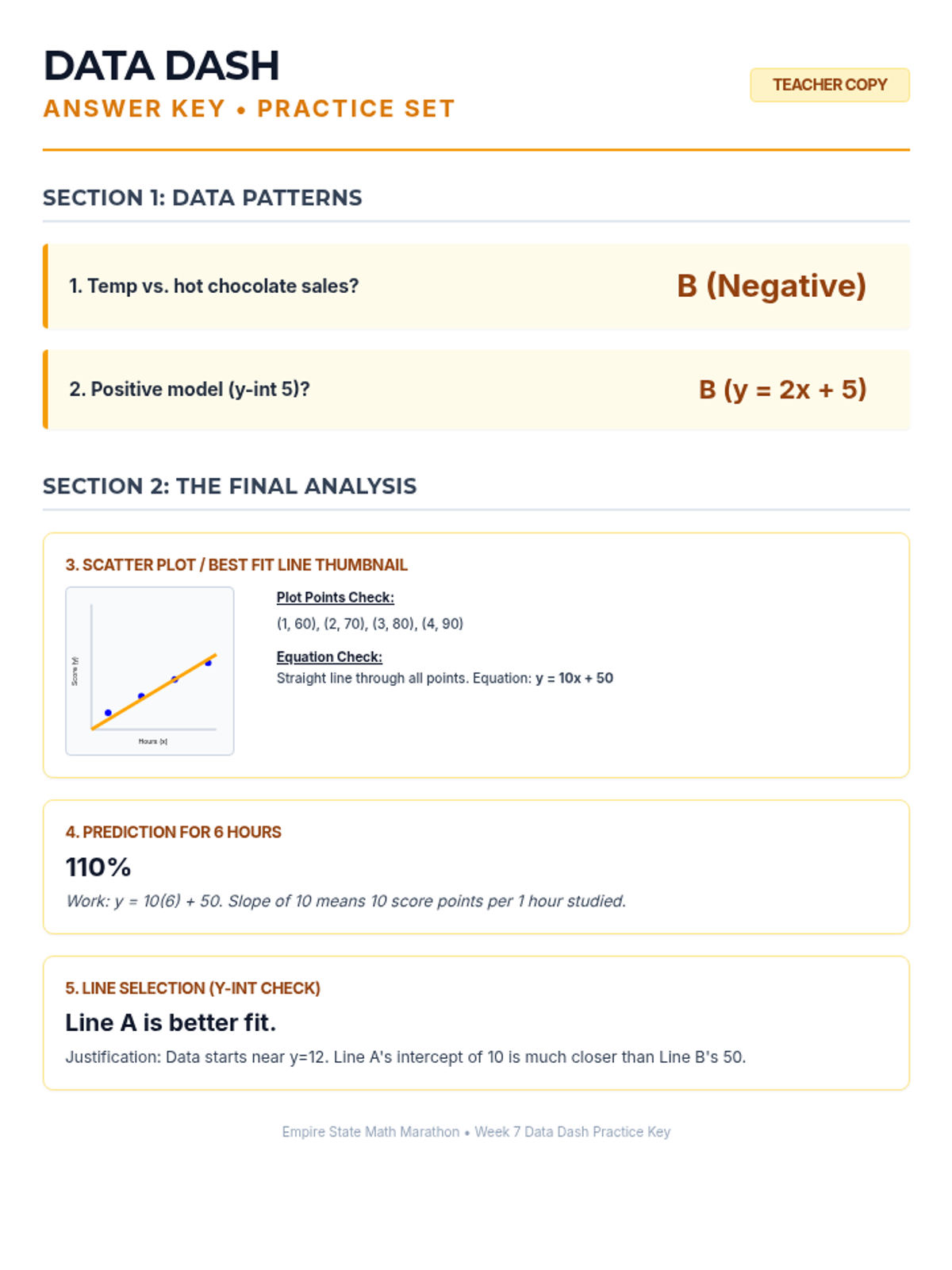
Revised 1-page answer key for Week 7 practice set. Added x/y axis labels to graph thumbnail, consolidated all content onto a single page to avoid orphaned text, and improved math rendering clarity. Badge alignment fixed.
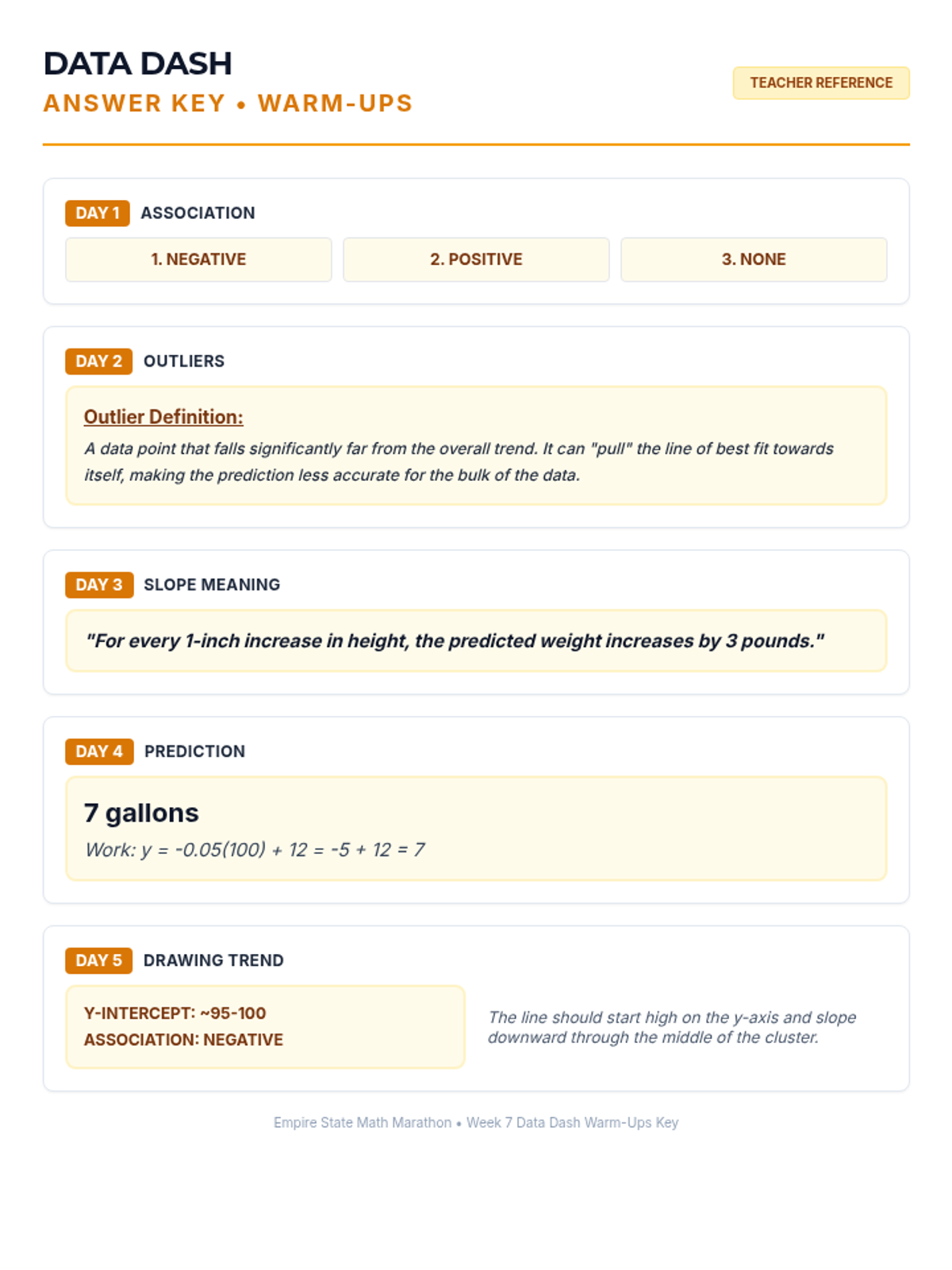
Revised 1-page answer key for Week 7 warm-ups. Standardized capitalization for mathematical terms, increased font size for calculations, and ensured all 5 days fit on one sheet with improved text contrast.
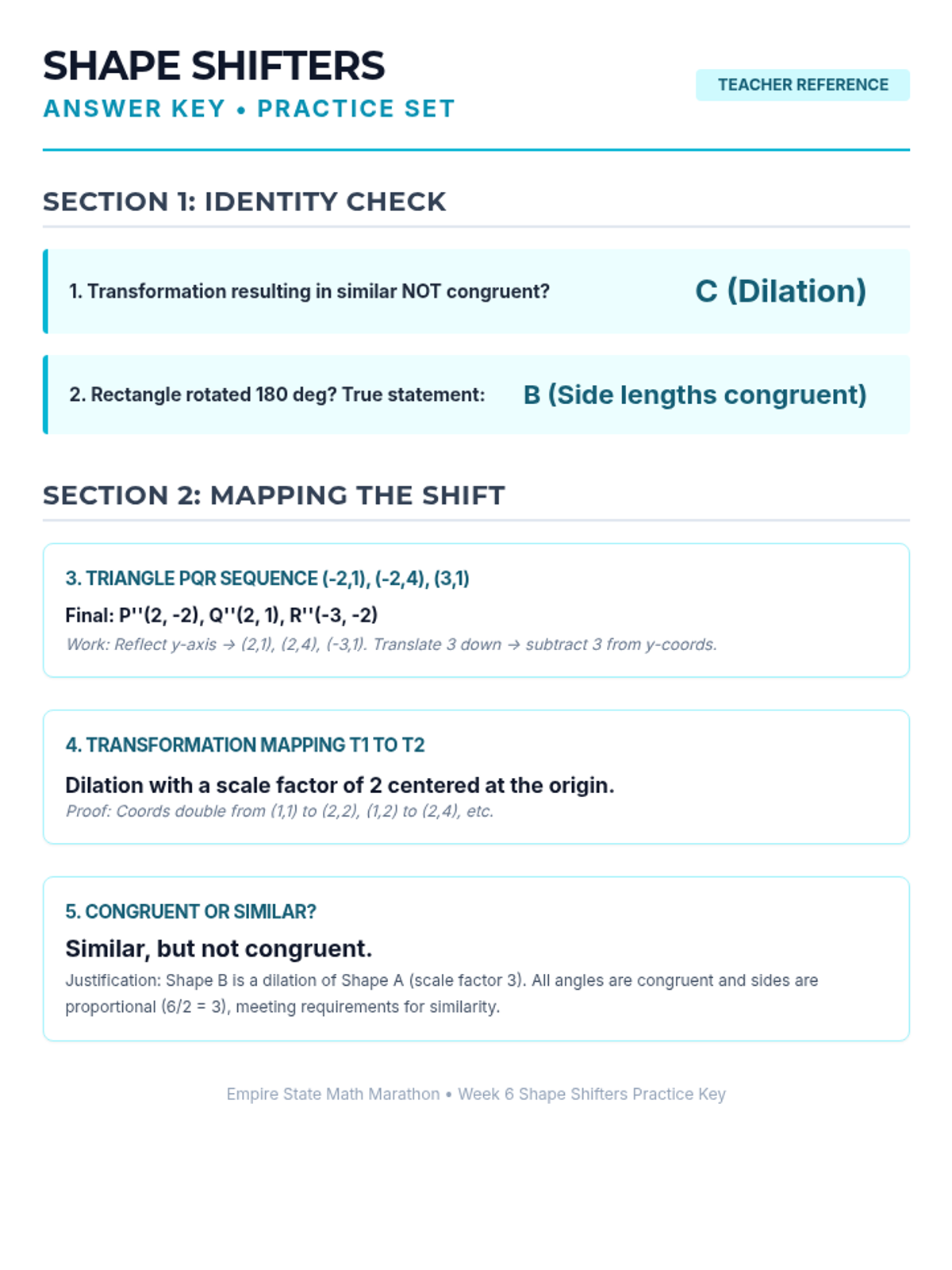
Revised 1-page answer key for Week 6 practice set. Consolidated all solutions onto a single page to avoid wasted space. Improved math notation and provided coordinate proofs for similarity vs. congruence.
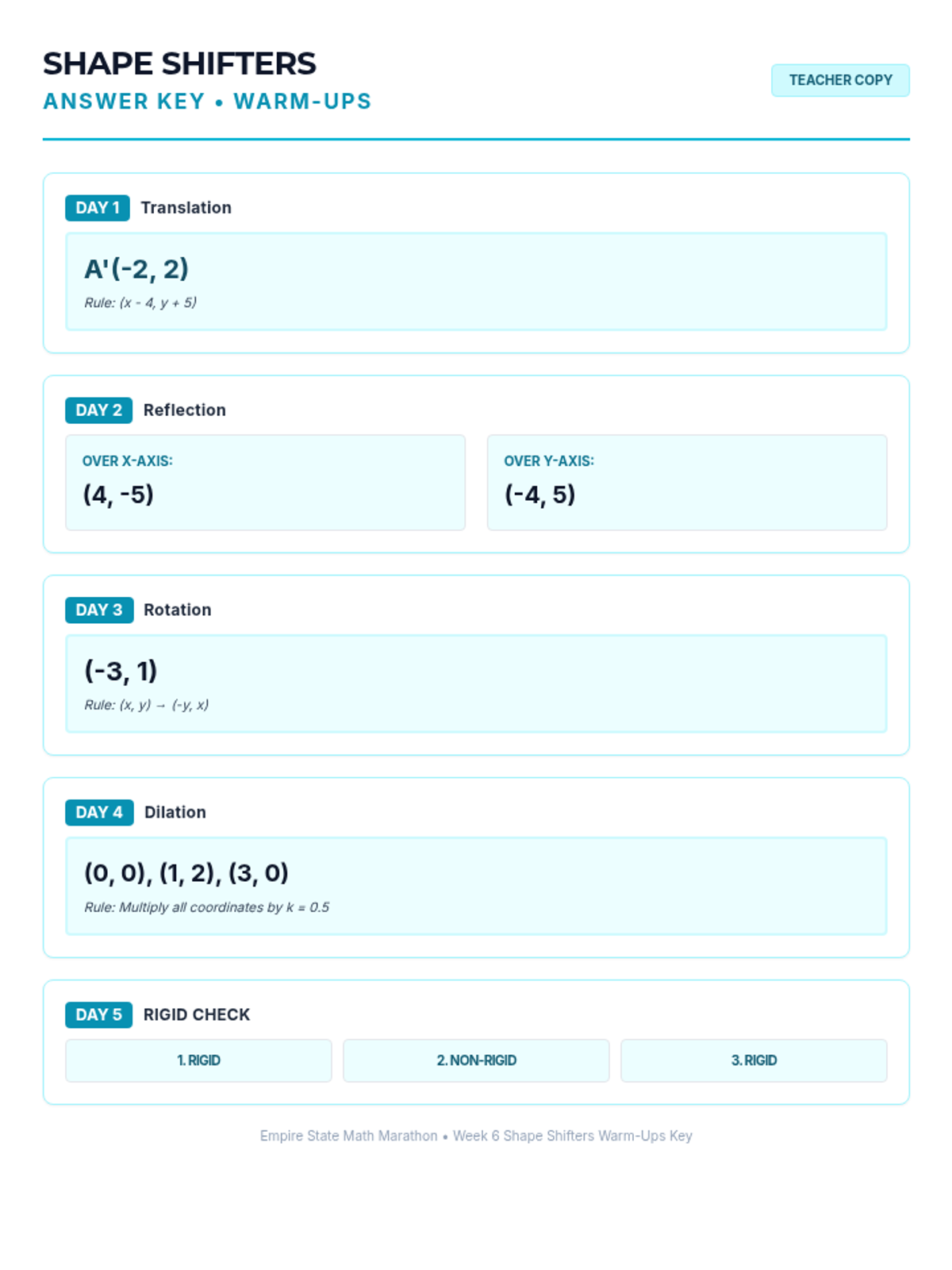
Revised 1-page answer key for Week 6 warm-ups. Standardized text for coordinate transformations to ensure clear PDF rendering and consolidated all 5 days onto a single page efficiently. Improved badge alignment.
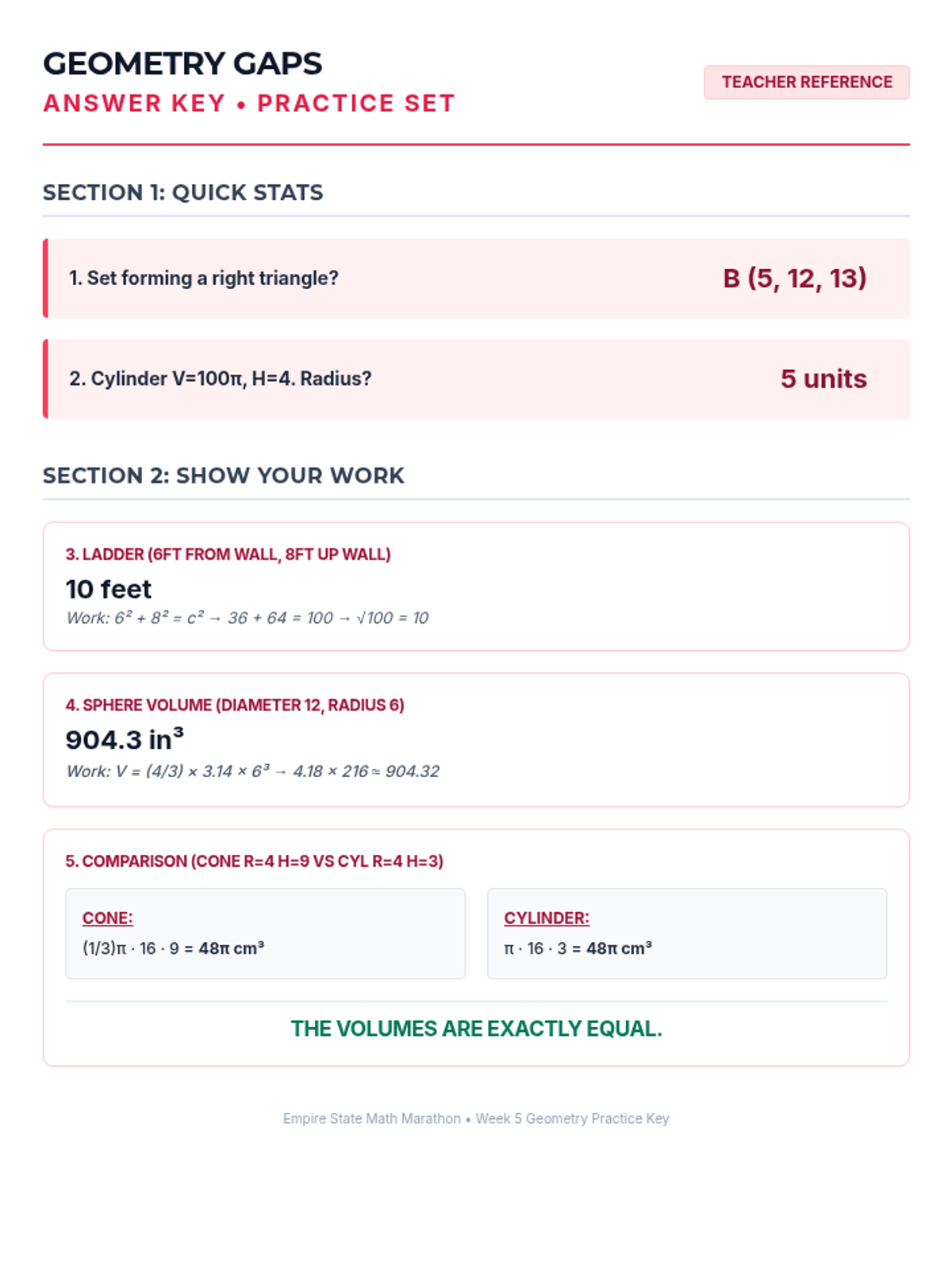
Revised 1-page answer key for Week 5 practice set. Improved math notation and increased font size for supporting work sections. Fixed bunched text spacing in the final comparison statement and ensured units are consistent.
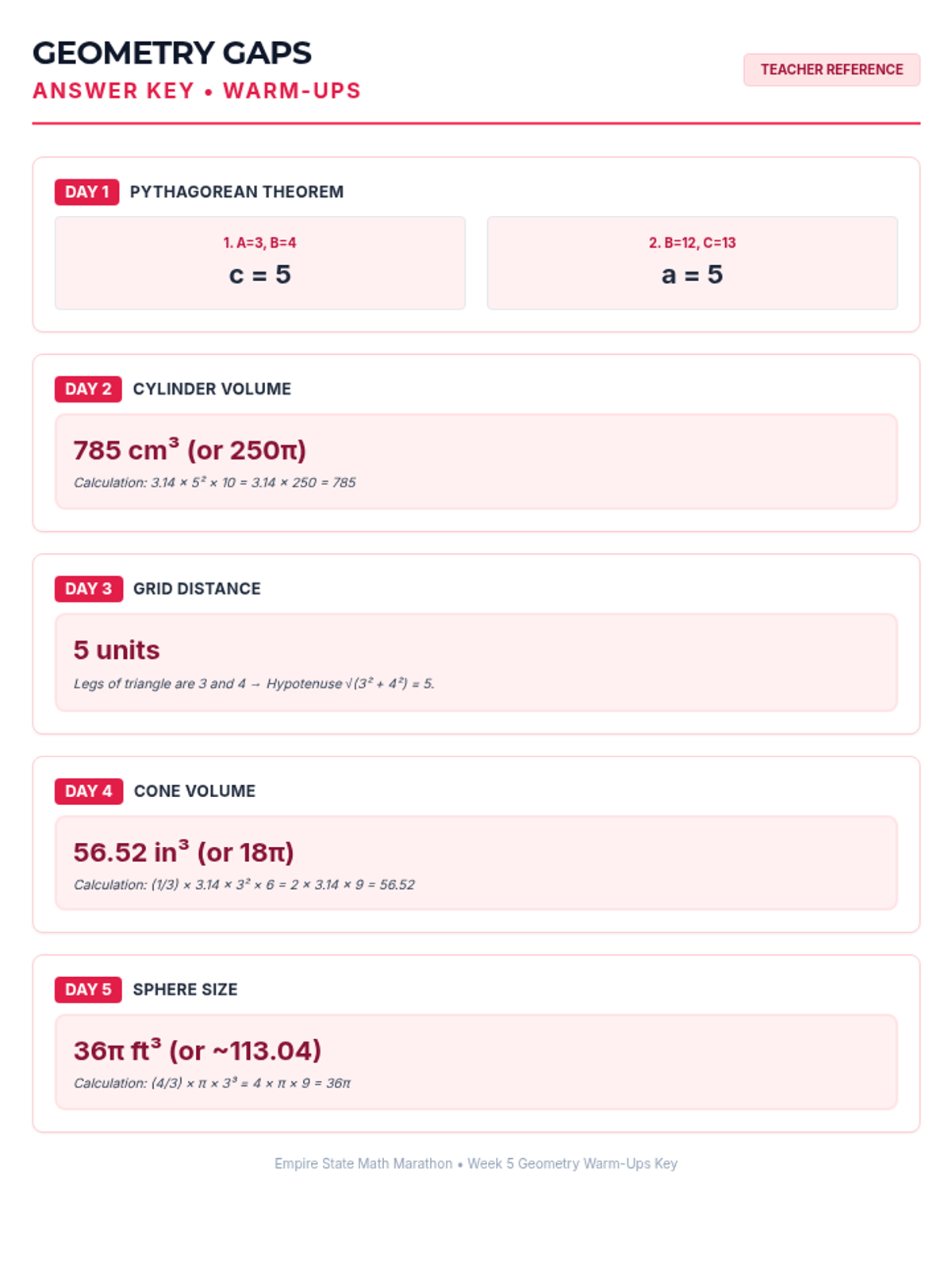
Revised 1-page answer key for Week 5 warm-ups. Standardized math symbols (HTML entities) to ensure PDF rendering, consolidated all content to fit on a single page, and cleaned up calculation strings. Improved Teacher Reference badge alignment.
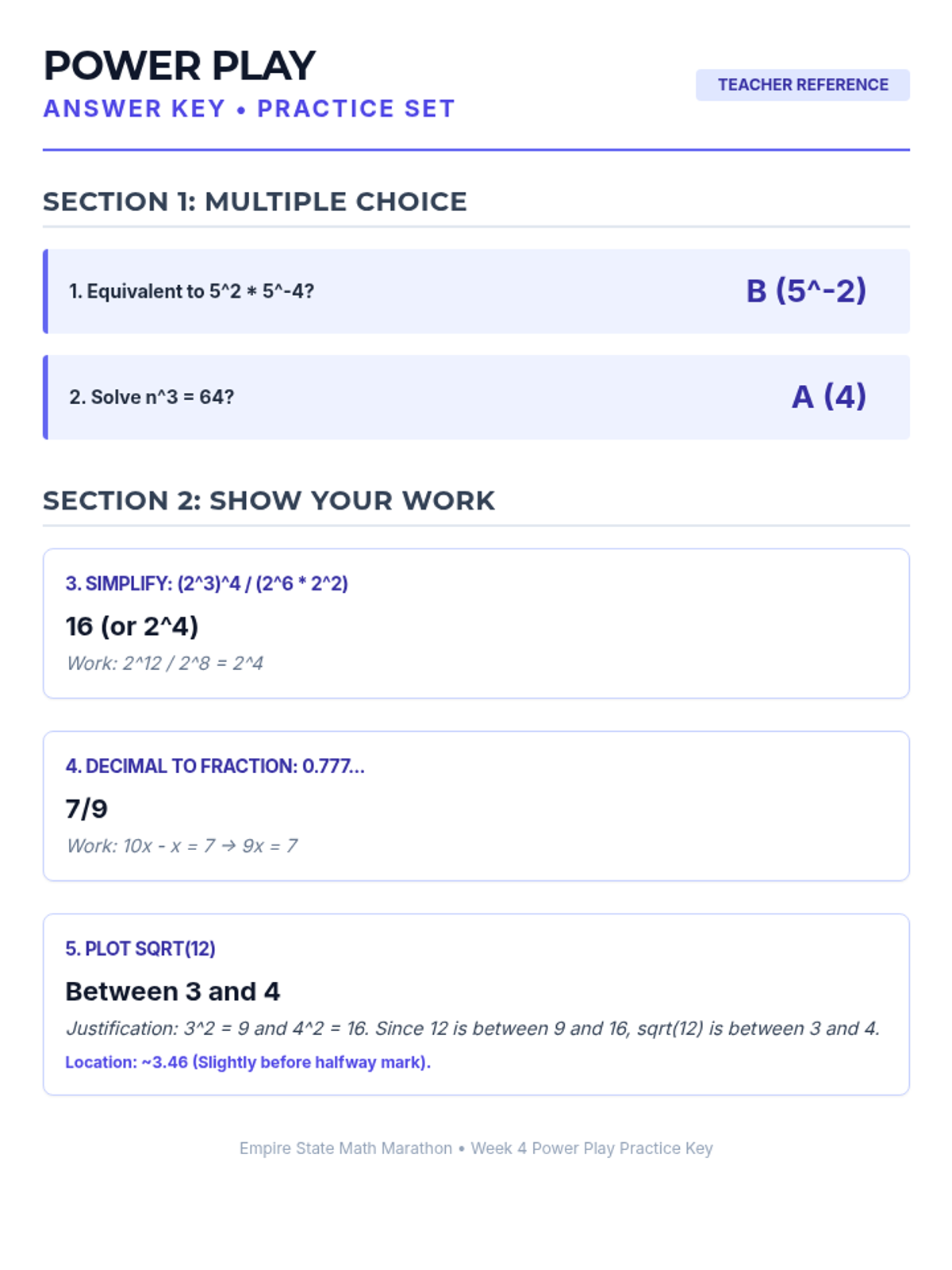
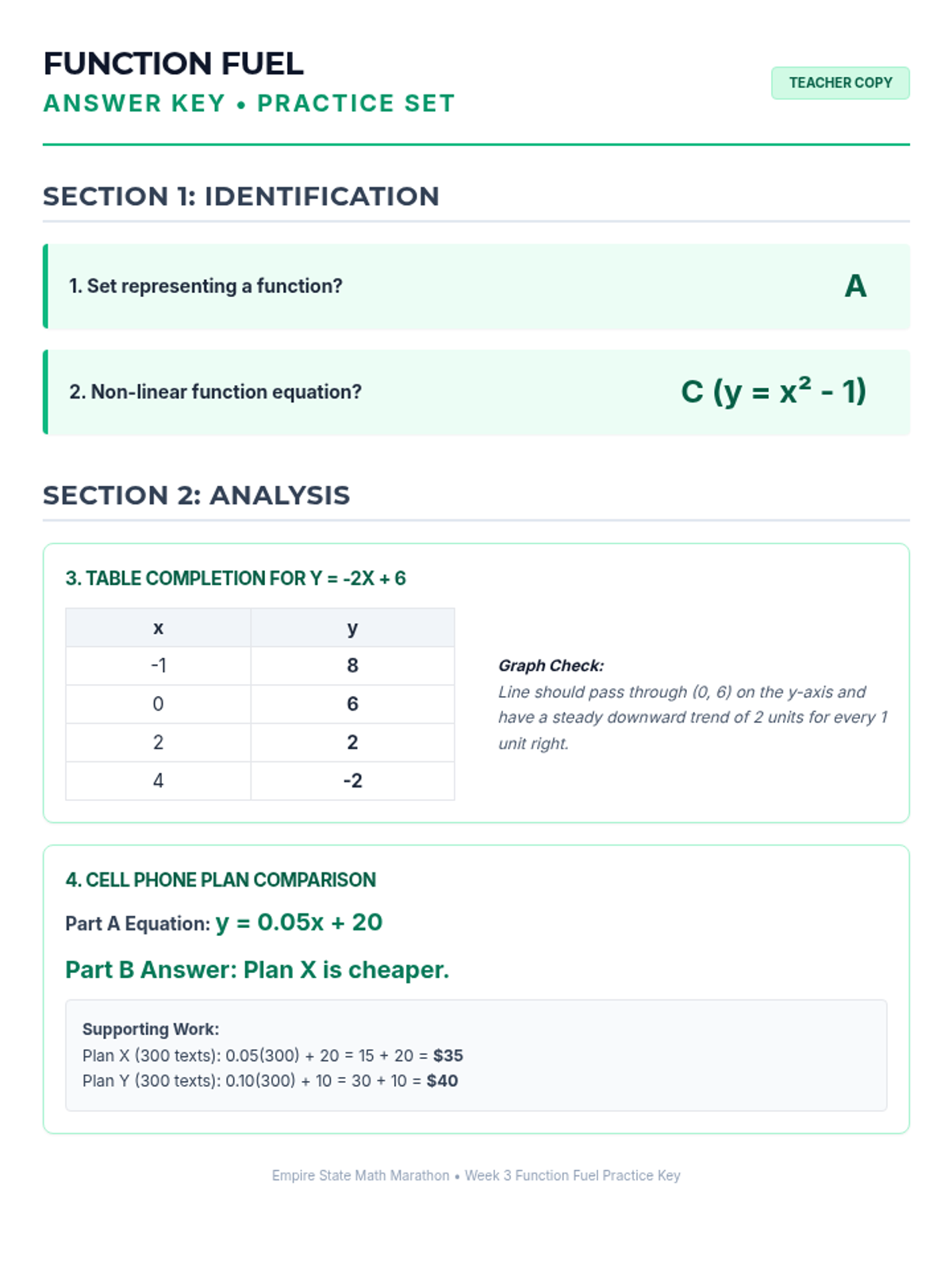
Revised 1-page answer key for Week 4 practice set. Consolidated layout to avoid orphaned items on a second page, increased work text size, and provided clear justifications for radical estimation.
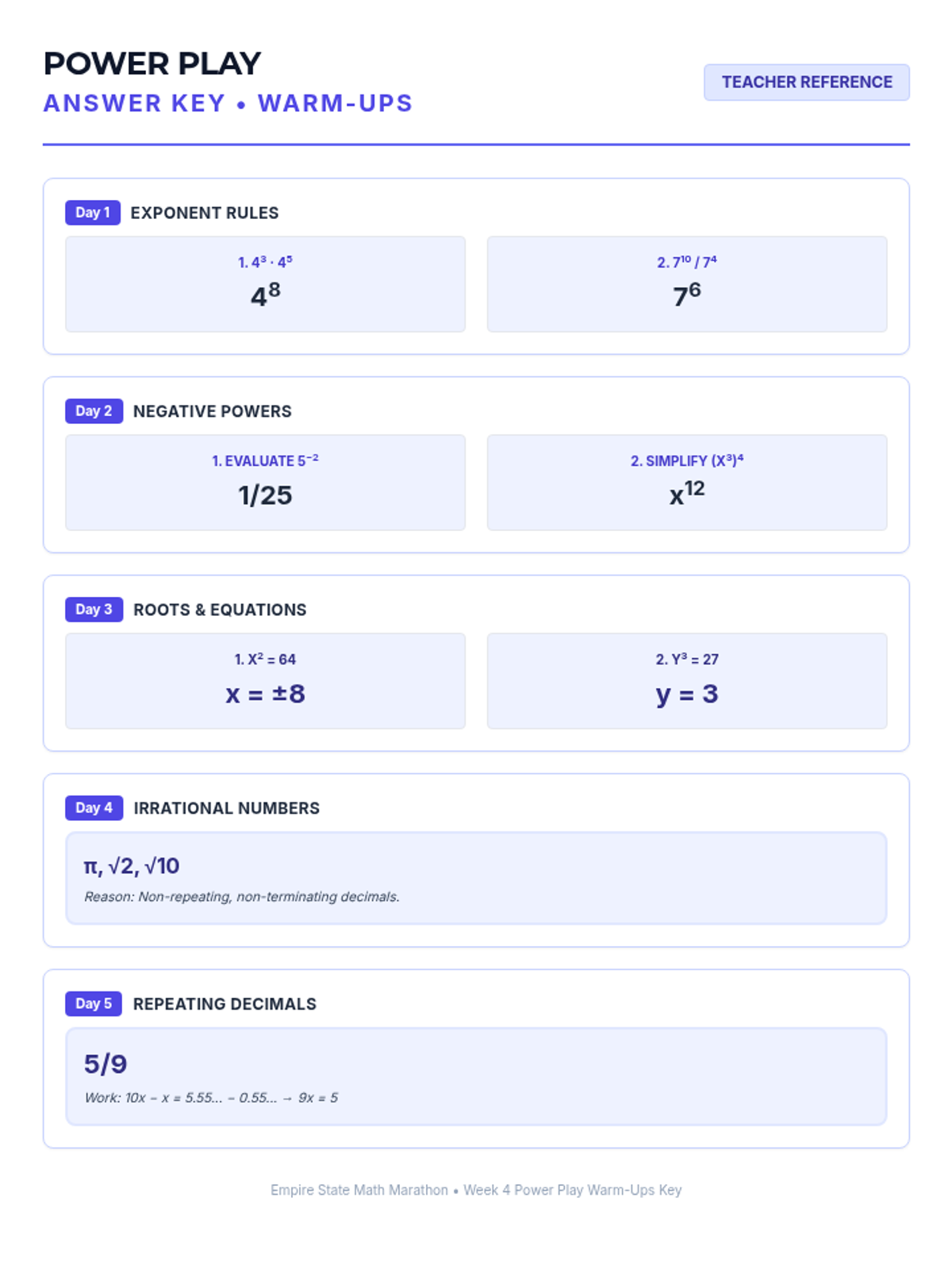
Revised 1-page answer key for Week 4 warm-ups. Replaced special font glyphs with standard HTML superscripts (<sup>) to ensure cross-system rendering. Increased Teacher Reference badge size and consolidated layout to a single page.
Revised 1-page answer key for Week 3 practice set. Removed raw markdown symbols, consolidated layout to one page, and improved math rendering clarity by avoiding overlapping LaTeX. Darkened work text for better readability.
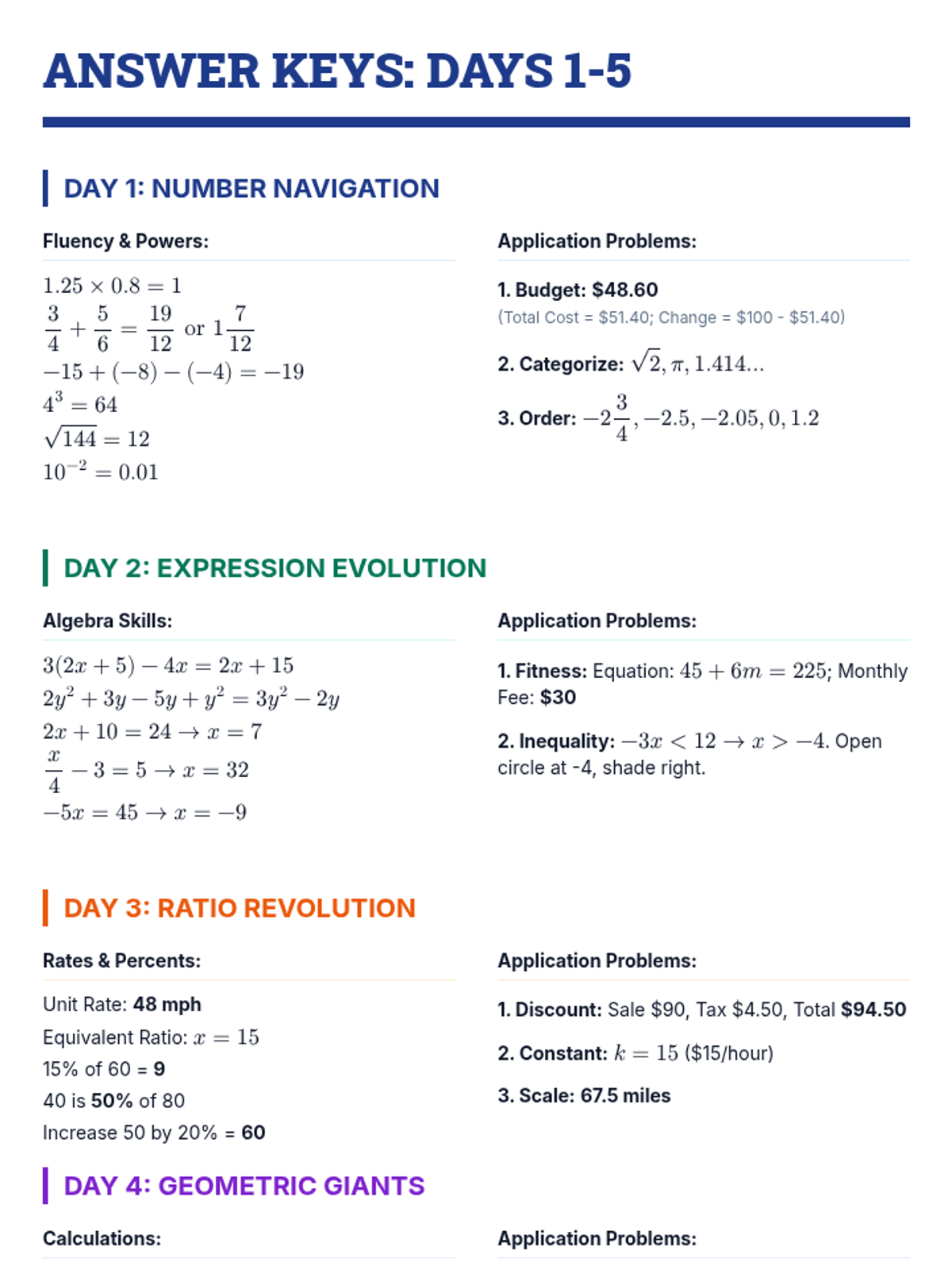
Full answer keys for the 5-day math morning work packet. Revised to fix math rendering, missing answers, and page flow.
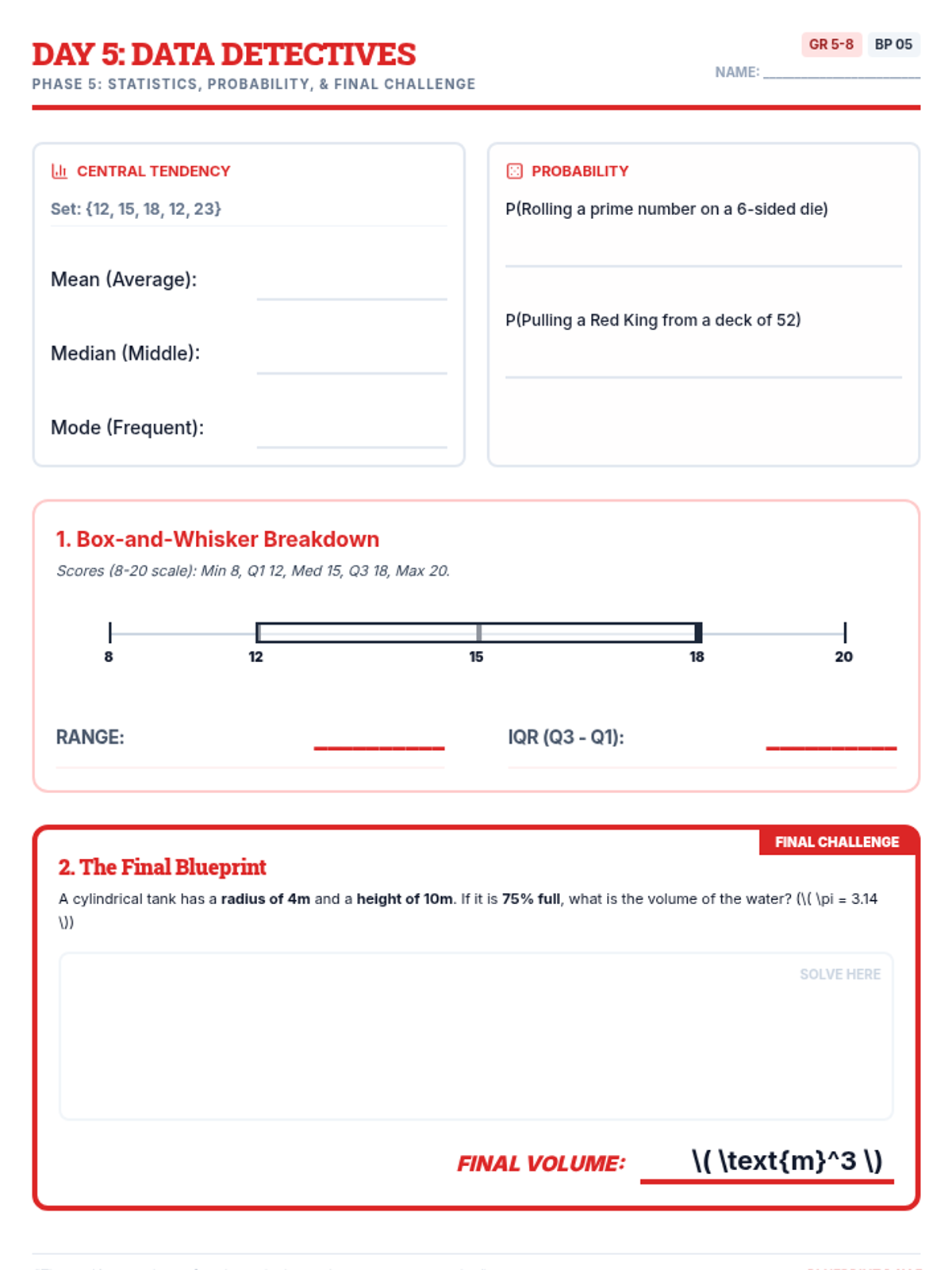
Day 5 Morning Work worksheet focusing on statistics and probability. Revised to fix math rendering, improve page breaks, and enlarge student work areas.
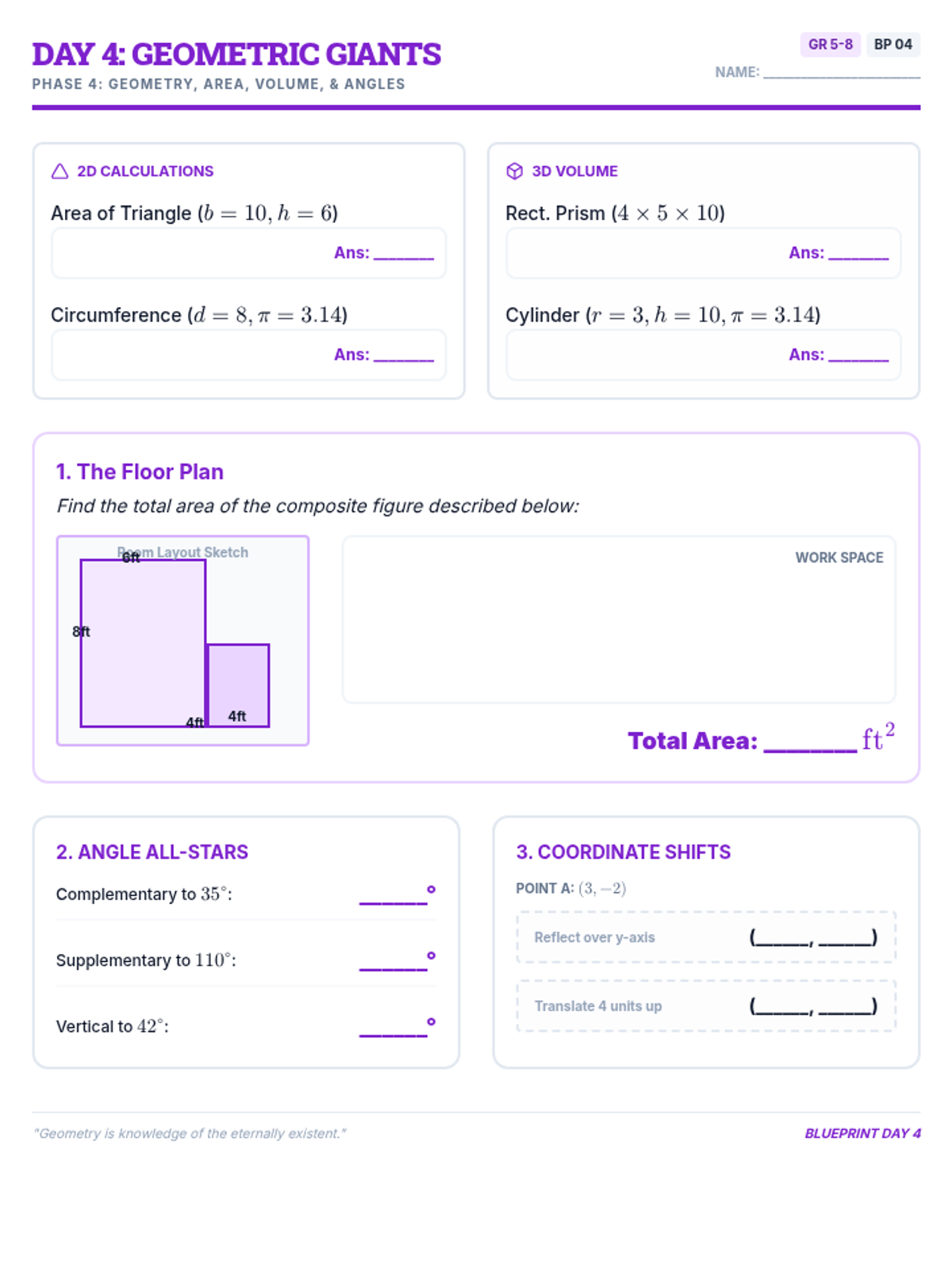
Day 4 Morning Work worksheet focusing on geometry. Revised to fix math symbol rendering, improve work space, and add a specific L-shaped room sketch.
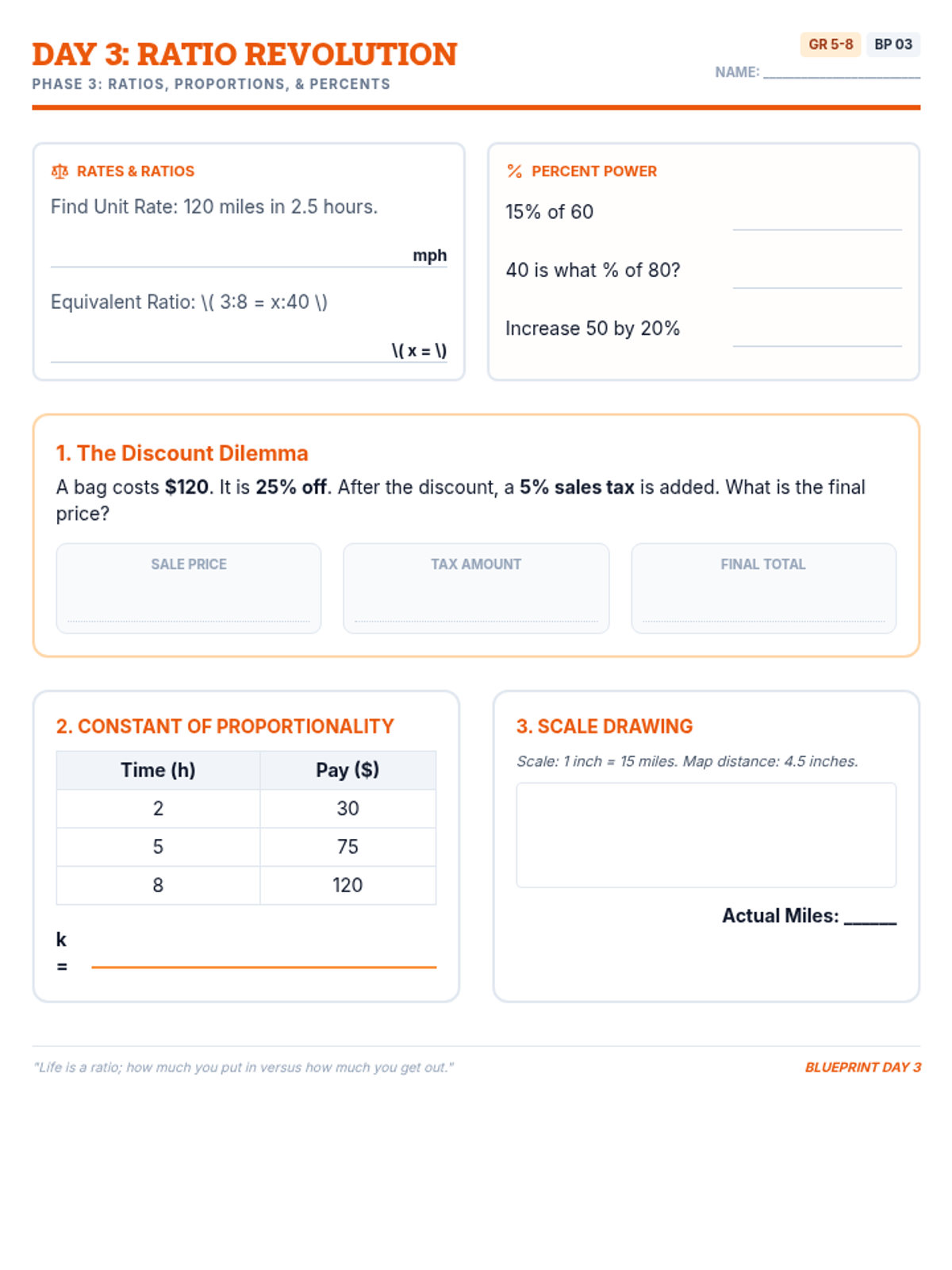
Day 3 Morning Work worksheet focusing on ratios and proportions. Revised to improve layout, fix page breaks, and ensure white backgrounds for student work.
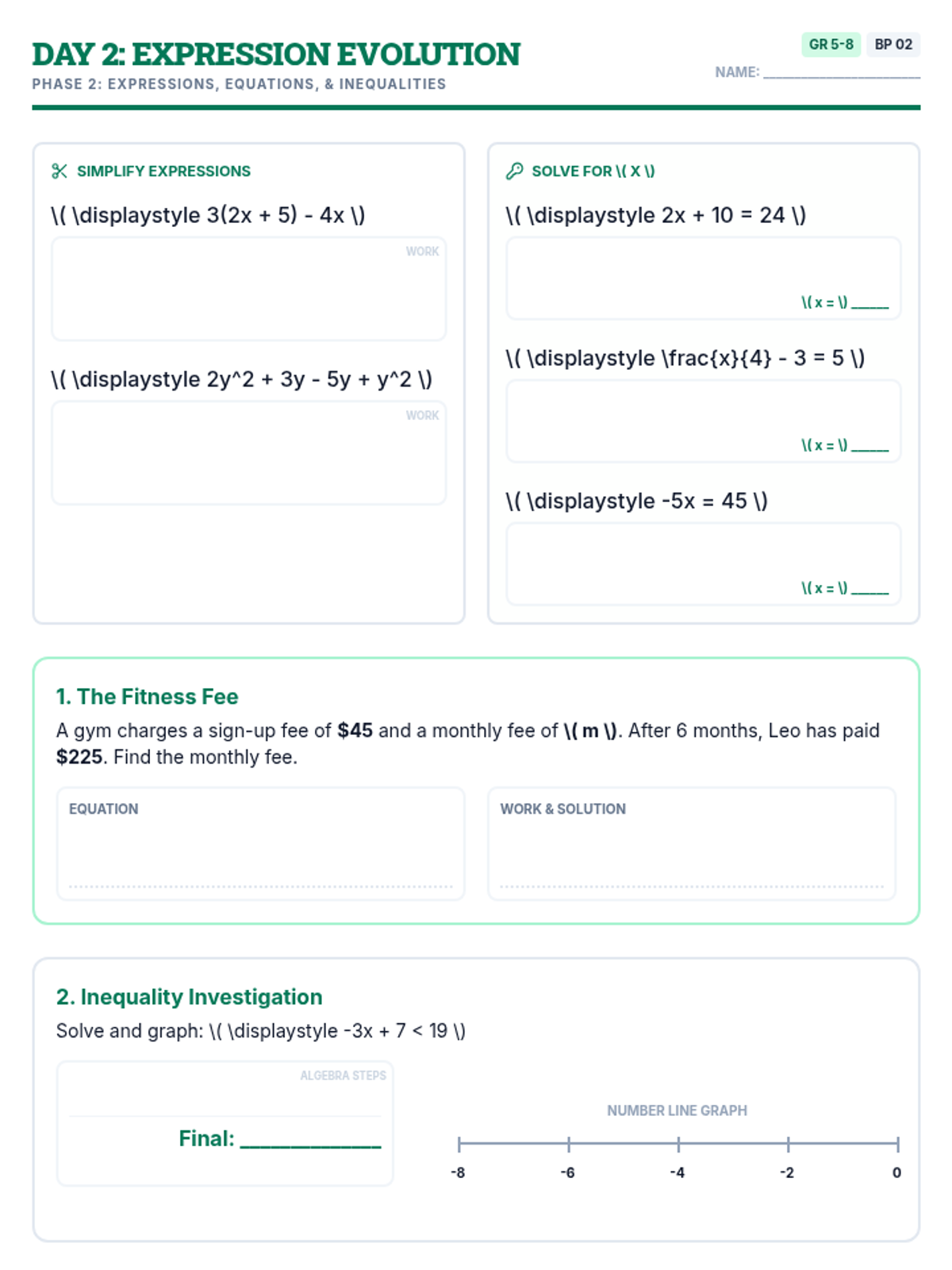
Day 2 Morning Work worksheet focusing on expressions and equations. Revised to improve work area sizing, math rendering, and section formatting.
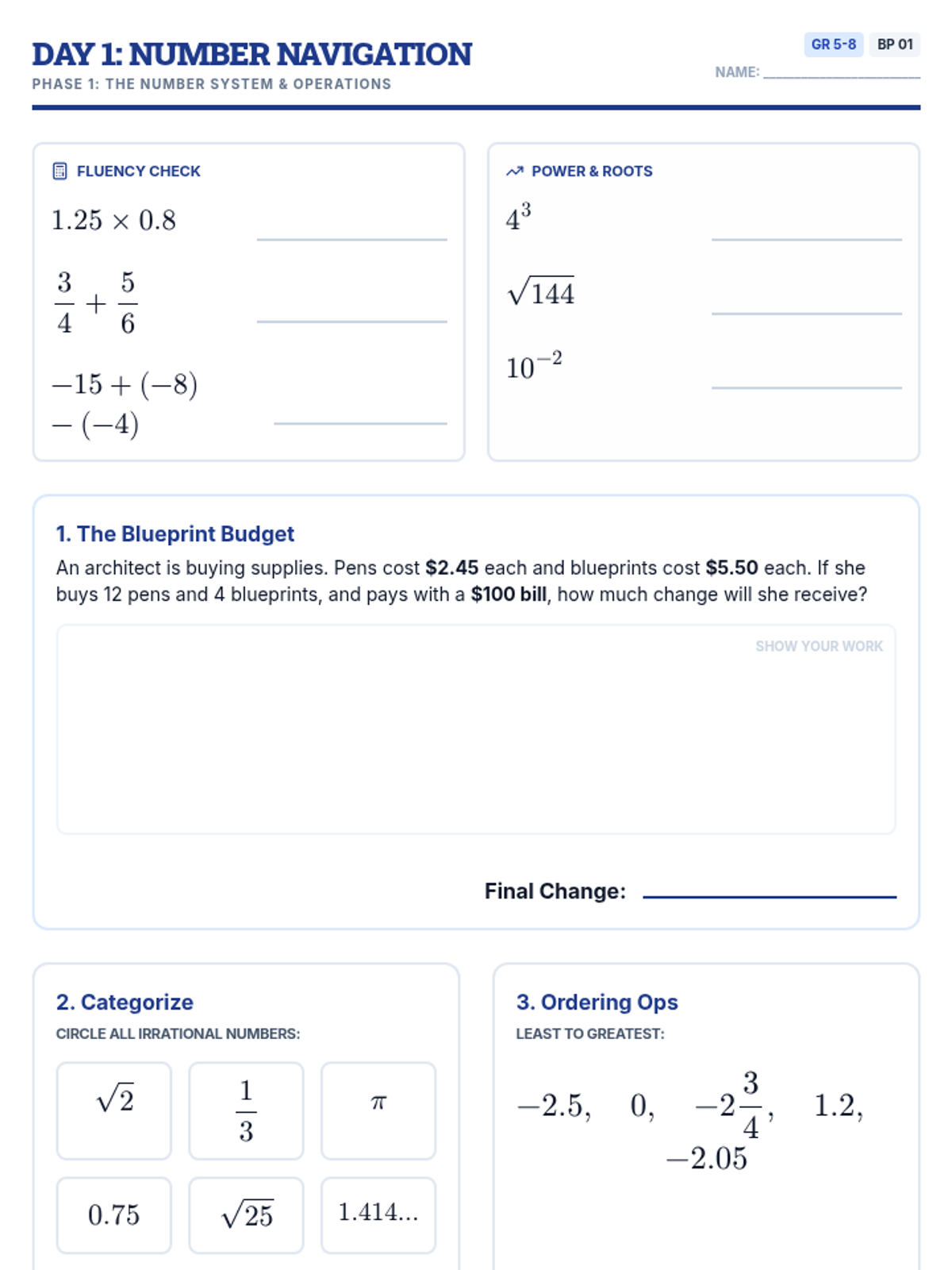
Day 1 Morning Work worksheet focusing on number systems, fractions, decimals, and basic operations. Revised to improve legibility of math, work area clarity, and formatting.
The cover page for the 5-day morning work math packet, featuring a 'Brain Blueprint' theme with space for student names.
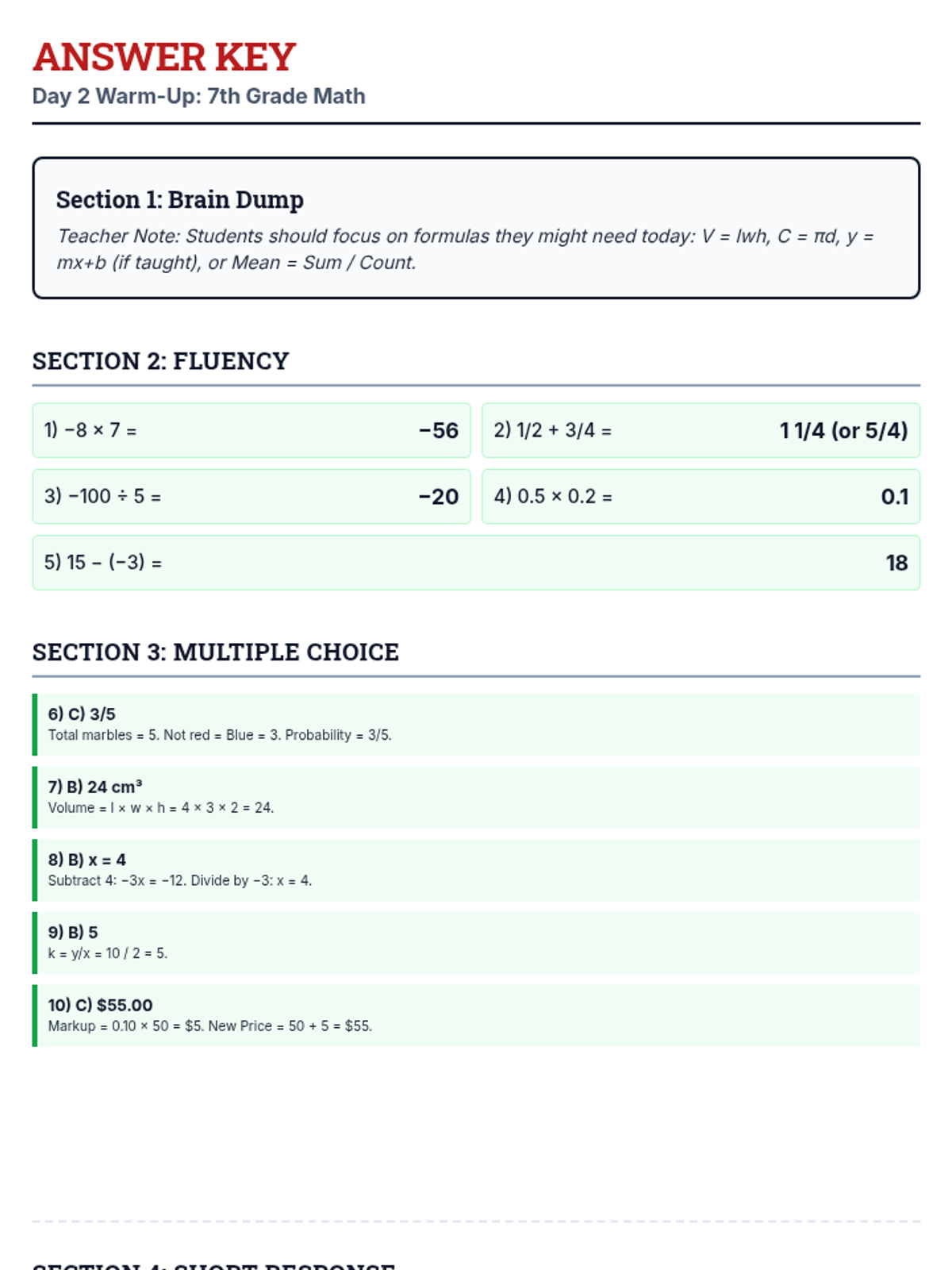
Answer key for the Day 2 Warm Up packet, including correct responses and brief teacher notes for the second day of the exam.
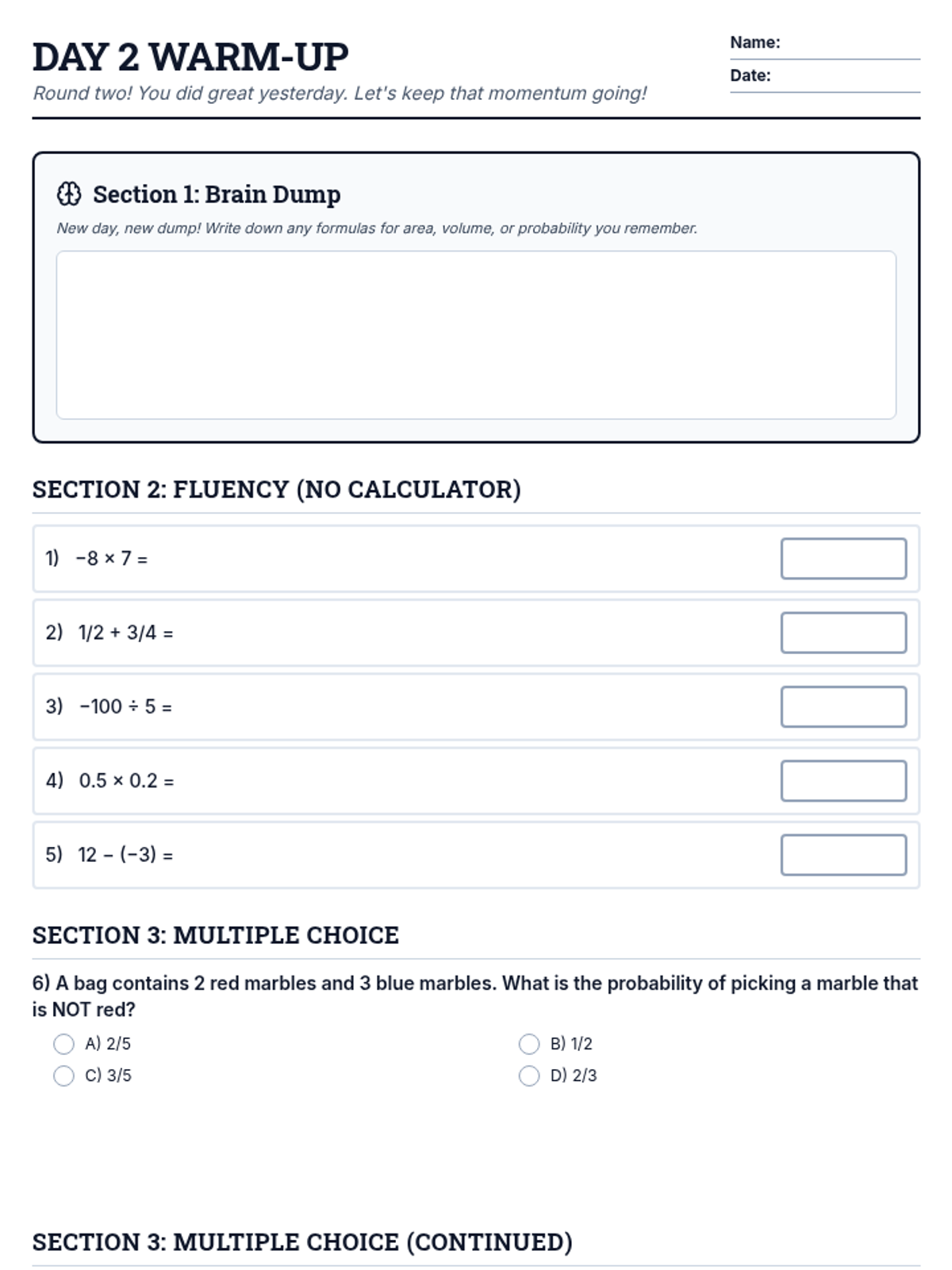
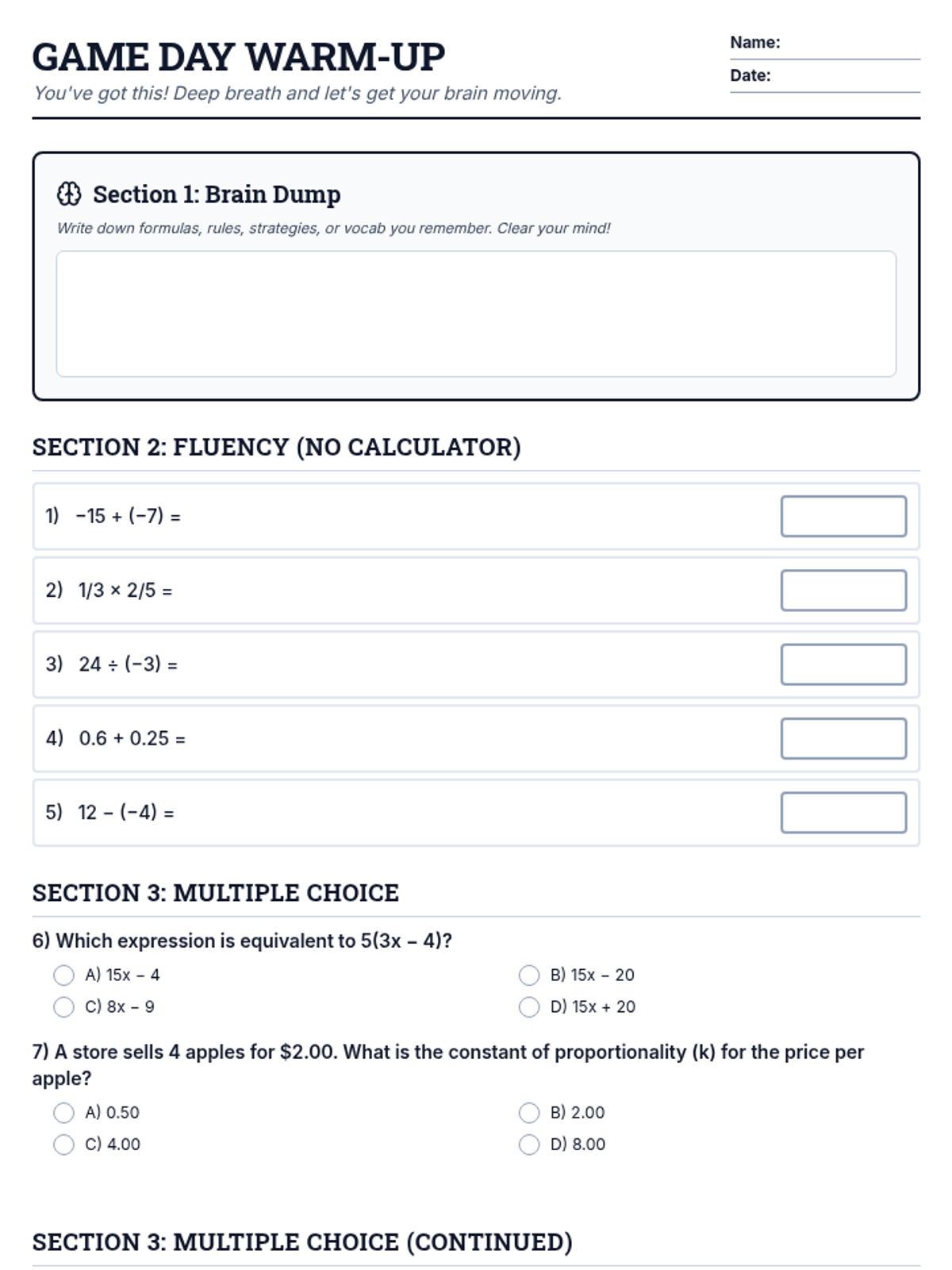
A 4-page student morning work packet for Day 2 of the 7th grade math exam, featuring fluency, multiple choice on probability and geometry, short response practice, and CBT skills. Consolidate to 4 pages. Optimized page balance and spacing.
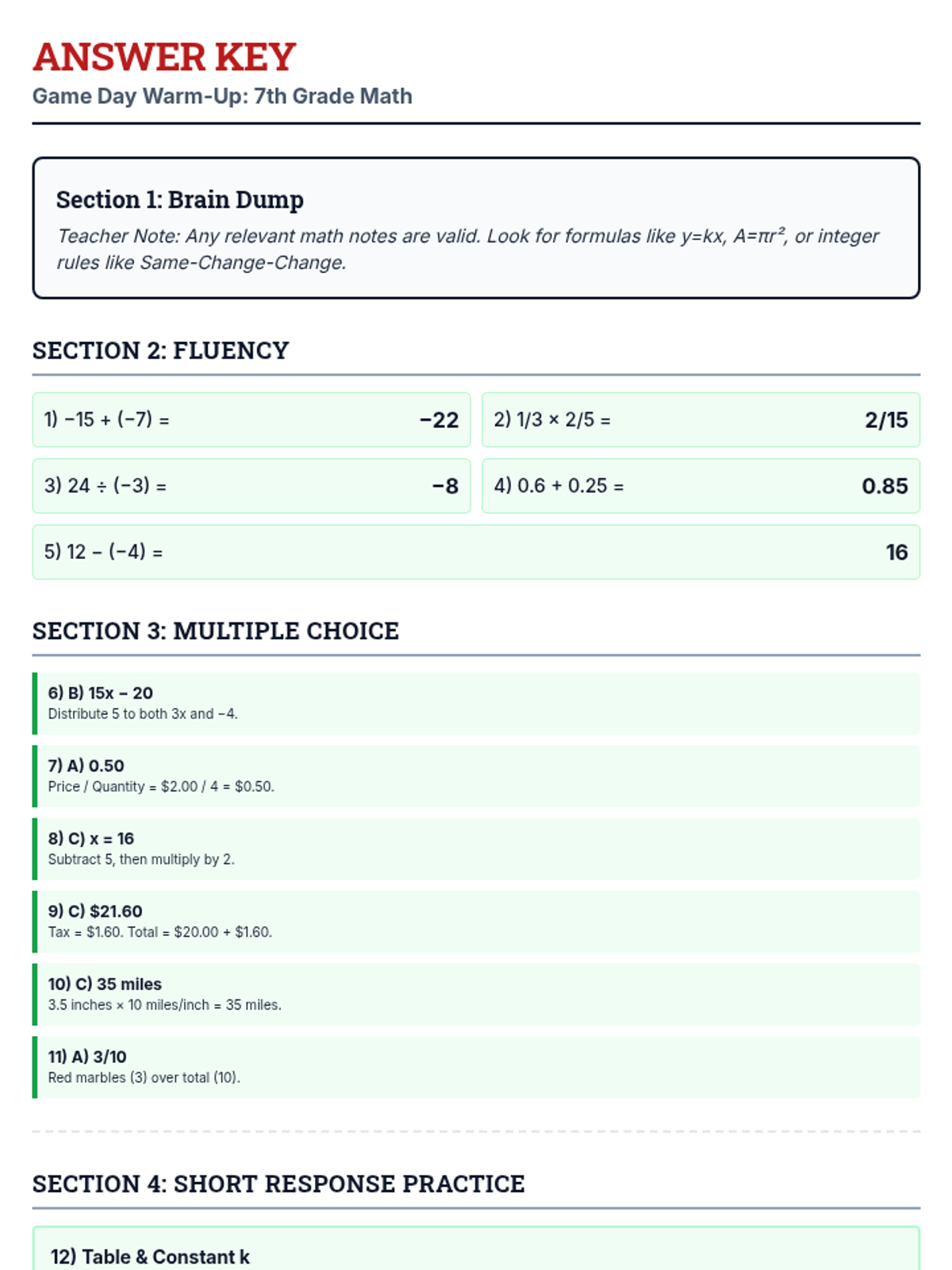
Answer key for the Game Day Warm Up packet, including correct responses and brief teacher notes for exam morning. Updated with letter choices and standardized metadata. Fixed LaTeX rendering and layout issues. Consolidate to 2 pages for efficient printing.
A 4-page student morning work packet for 7th grade math exam day, featuring fluency, extended multiple choice, short response practice, CBT skills, and reflection. Updated with letter choices and standardized metadata. Fixed LaTeX rendering and layout issues. Standardized answer boxes and headers for printing. Consolidate to 4 pages.
Introductory slide deck for the distance formula lesson, featuring a "Coordinate Cartography" explorer theme, derivation of the formula, radical simplification guide, and a worked example.
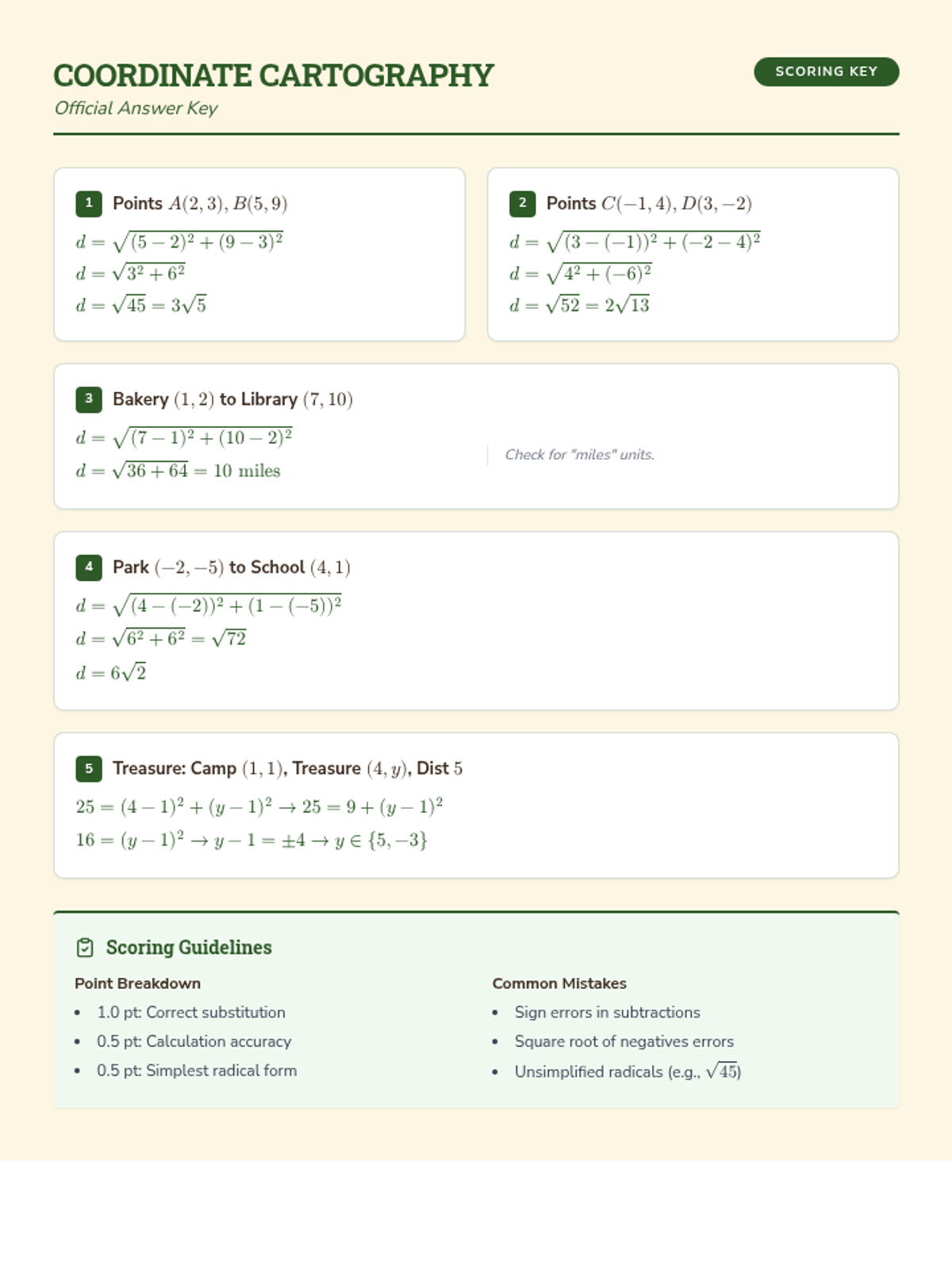
Comprehensive teacher answer key for the Coordinate Cartography quiz, including step-by-step solutions, radical simplification steps, and a grading rubric.
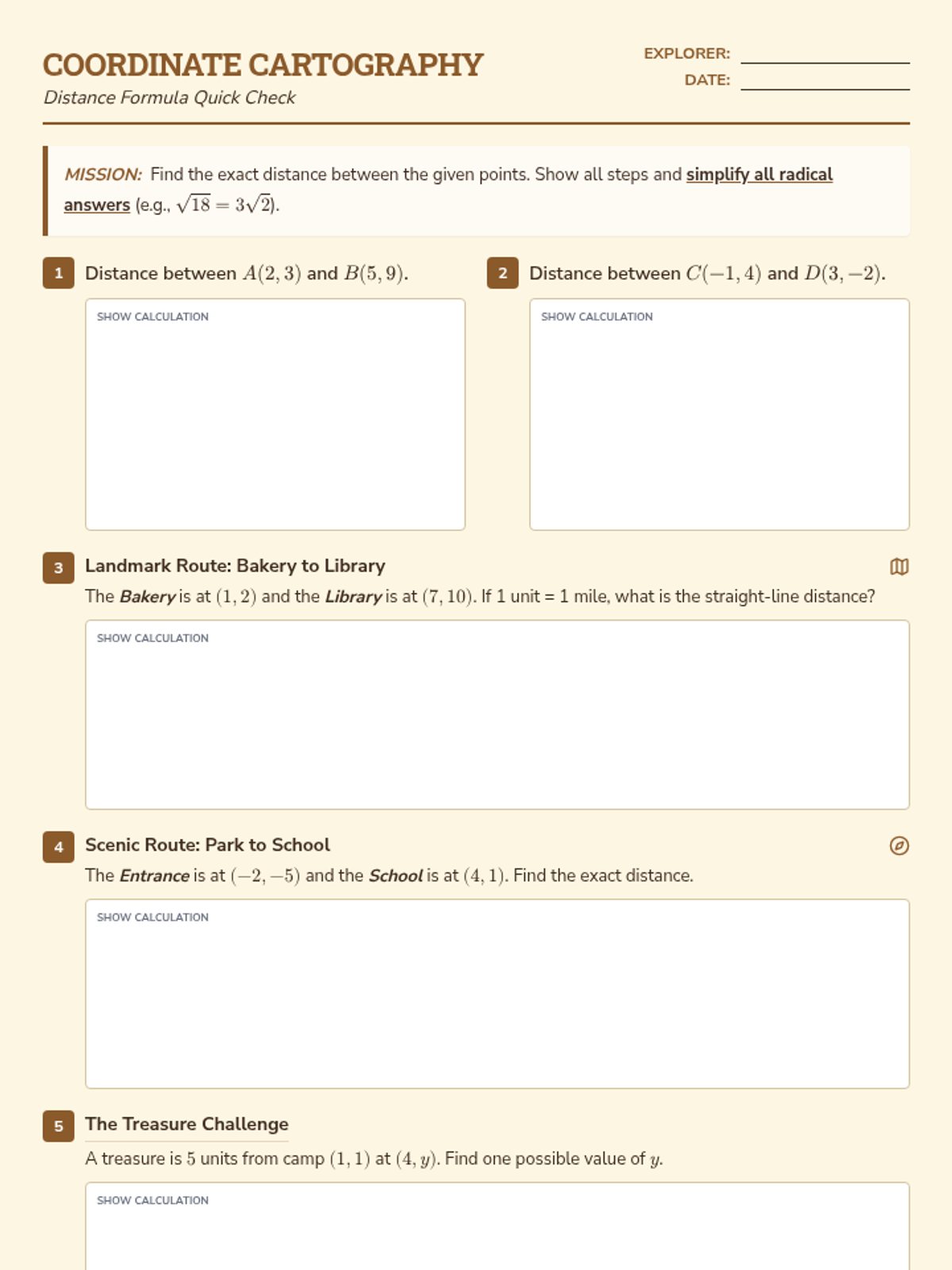
A 5-question quick check quiz on the distance formula, featuring coordinate point calculations, radical simplification, and map-themed word problems.
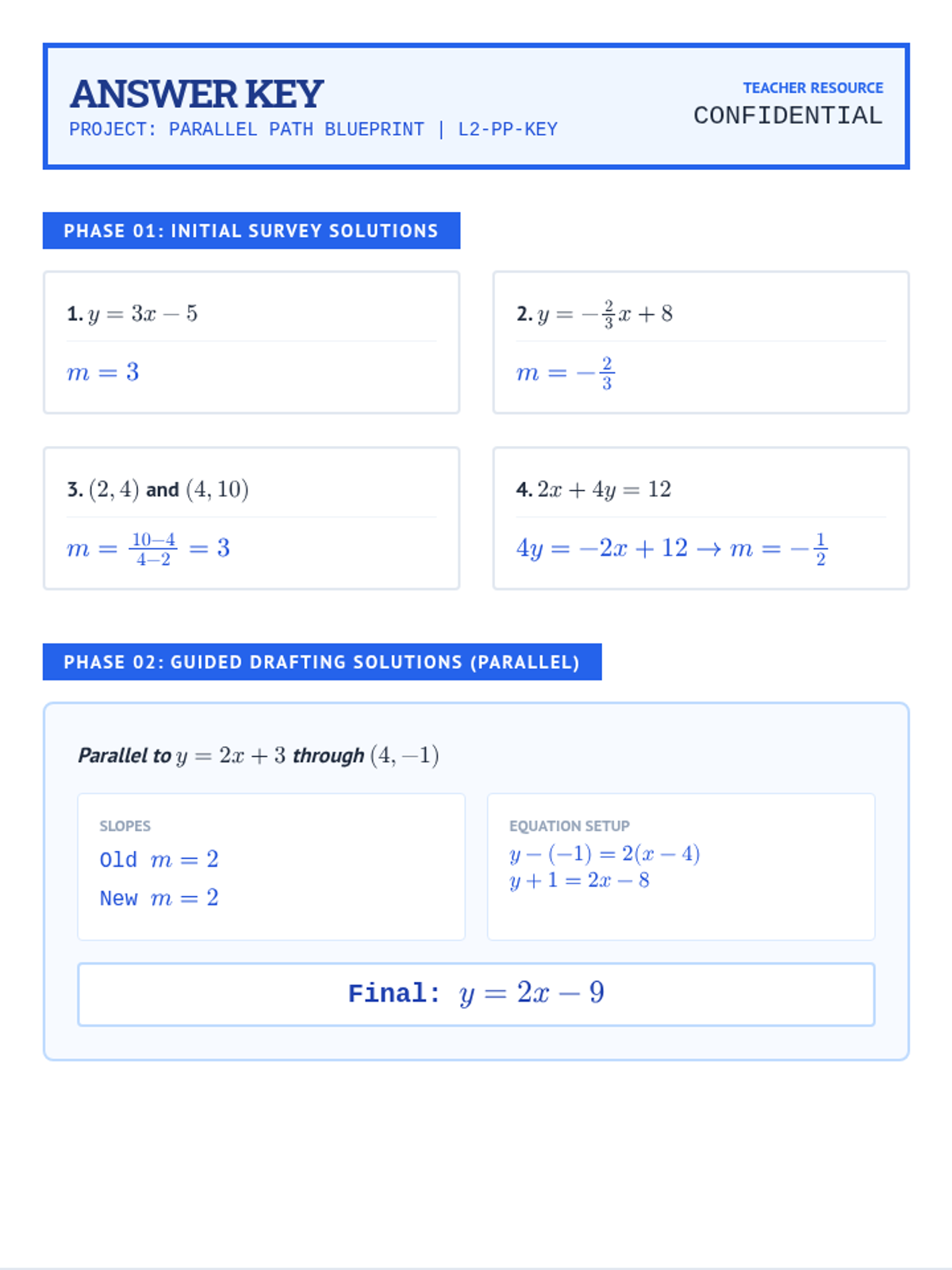
A complete answer key for the Parallel Path Blueprint lesson, with simplified headers to match the student packet and ensure a cleaner, more focused layout. Solutions are clearly presented with bolded results.
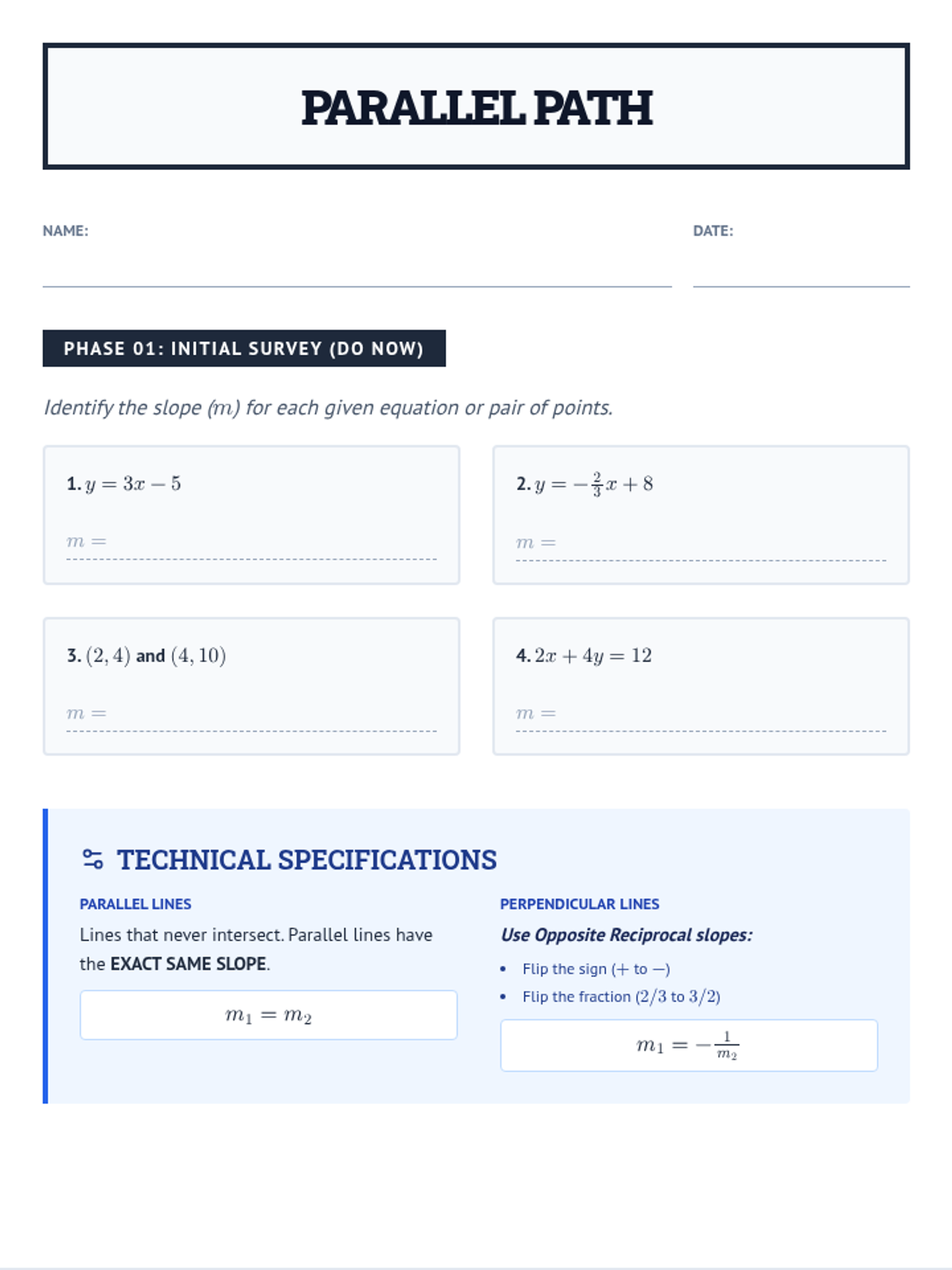
A student packet for writing equations of parallel and perpendicular lines, featuring a blueprint-themed layout with structured phases. The header has been simplified to remove metadata and technical labels as requested.
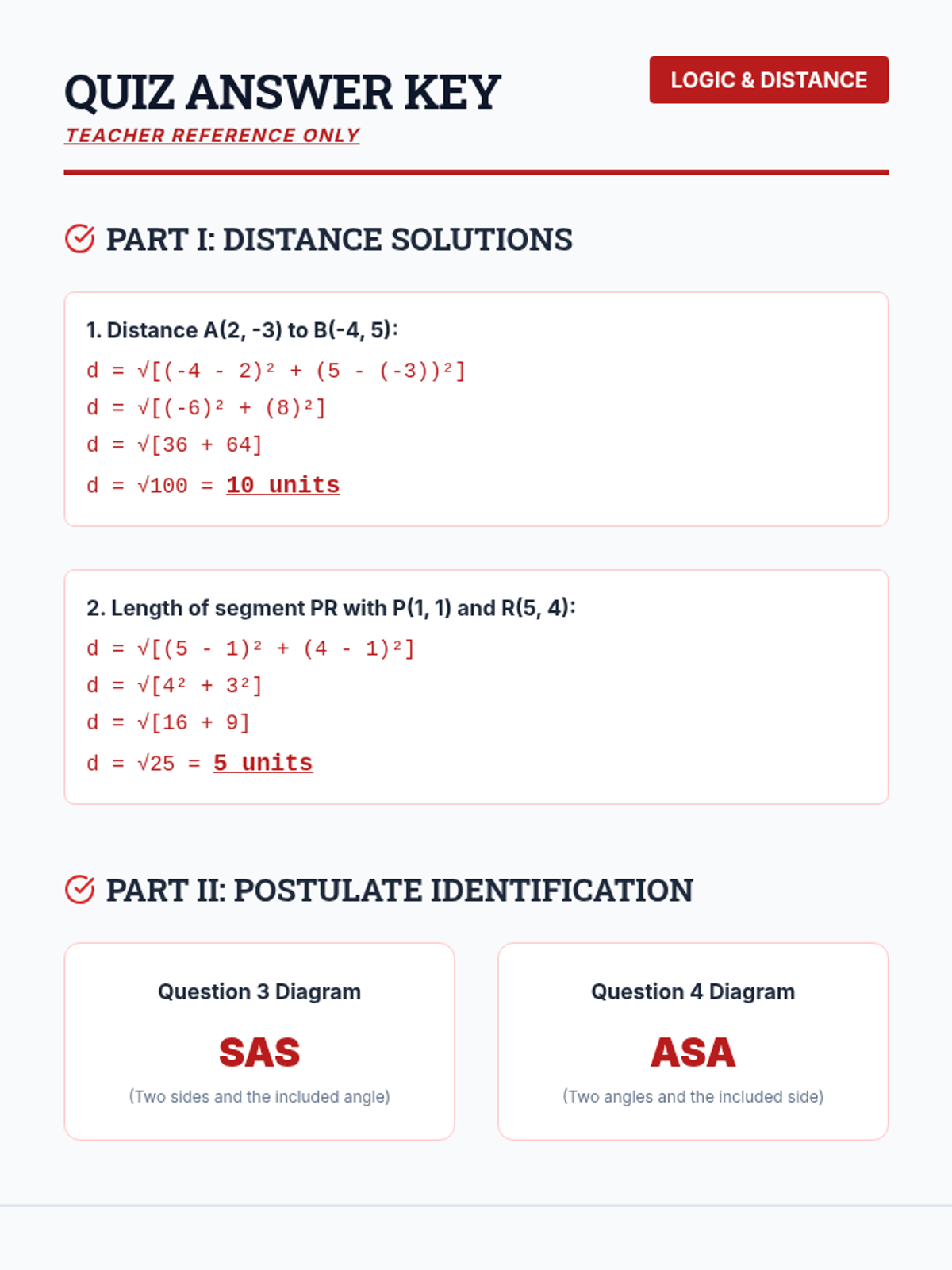
A complete answer key for the Congruence Logic Quiz, featuring step-by-step distance formula solutions using HTML/CSS for clarity, identified congruence postulates with visual references, and fully completed two-column proofs.
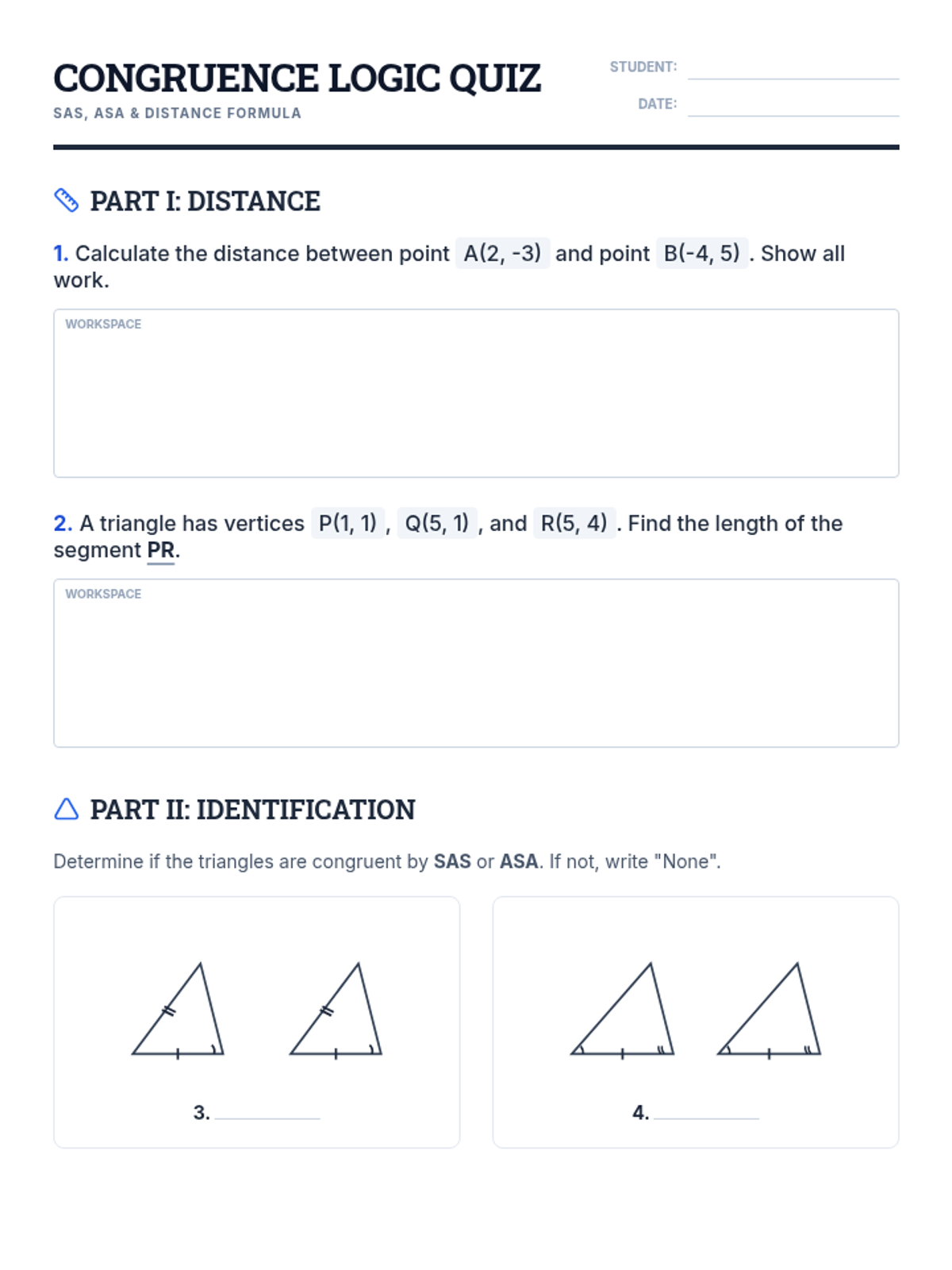
A 2-page quiz for high school geometry students covering the Distance Formula, identifying SAS and ASA congruence, and completing intermediate two-column proofs. Renumbered and refined with more workspace for distance calculations. Corrected diagrams and layout for optimal student use.
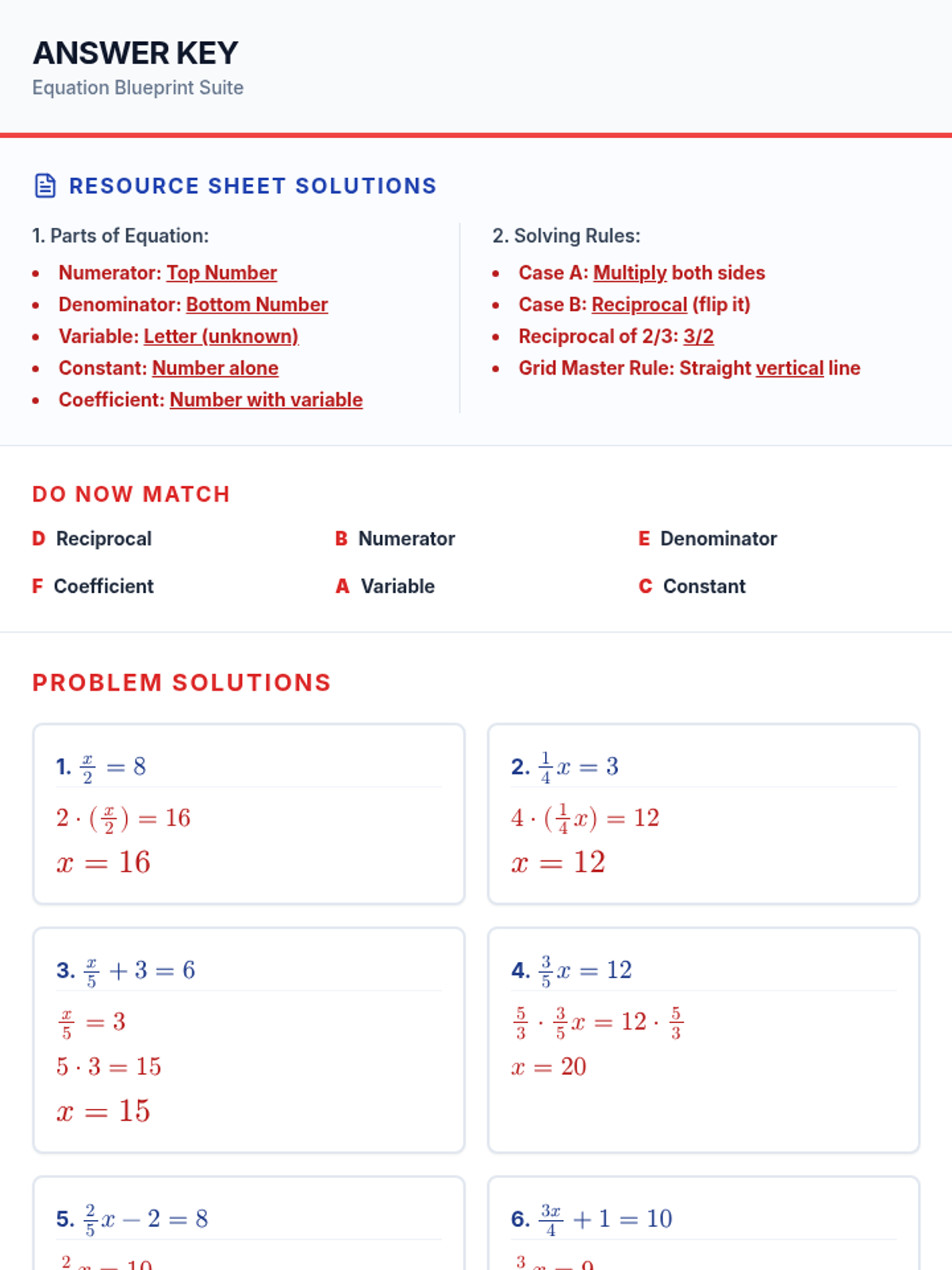
A comprehensive answer key for the Equation Blueprint lesson, providing bolded solutions for vocabulary matching, resource sheet fill-ins, independent practice problems, and the final exit ticket challenge. Improved layout prevents splitting solutions across pages. Now includes specific answers for the Resource Sheet blanks.
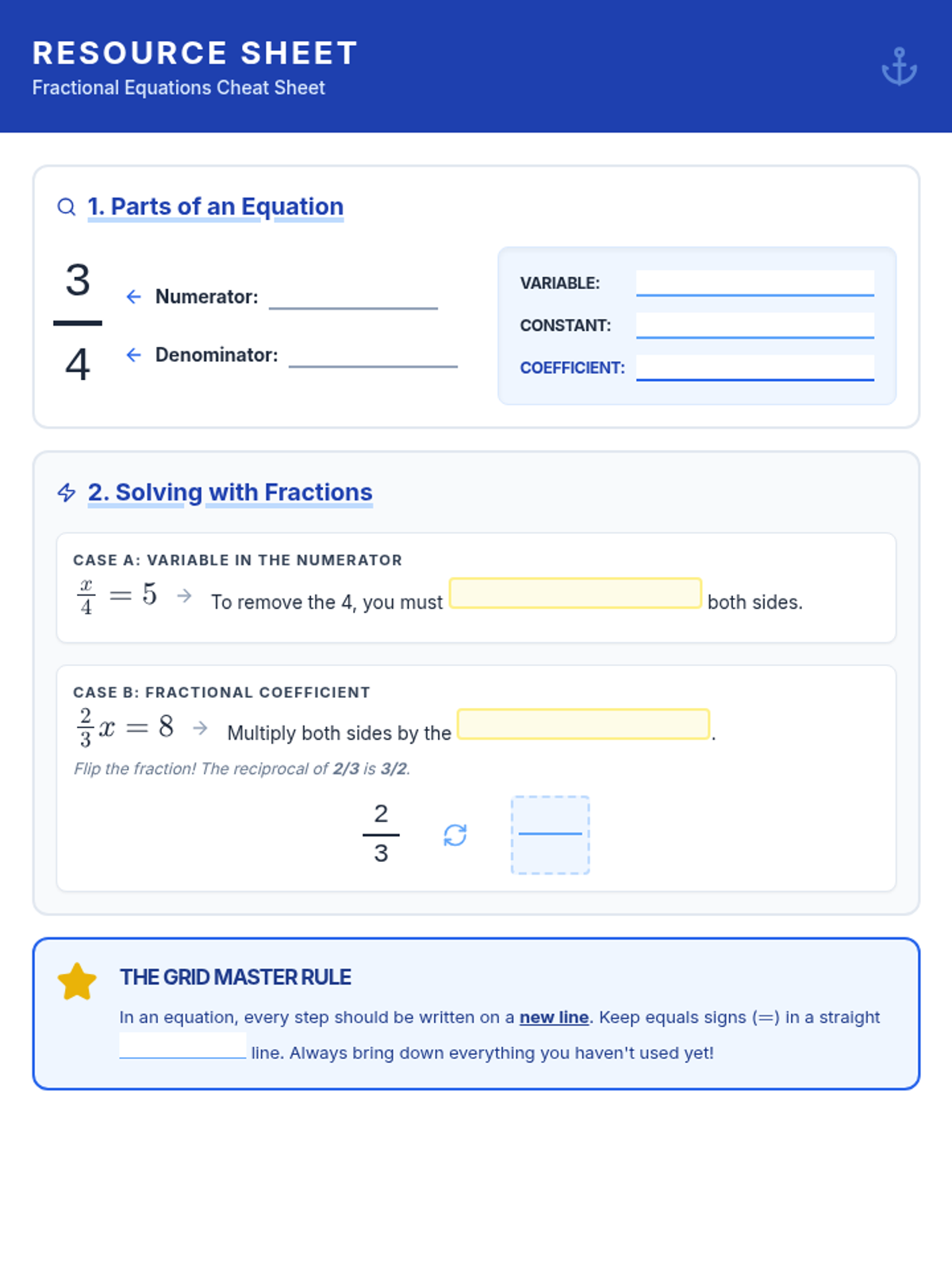
A fill-in-the-blank resource sheet for students, covering fraction anatomy, variable definitions, and step-by-step rules for solving equations with fractional components. Now optimized to fit on a single page.
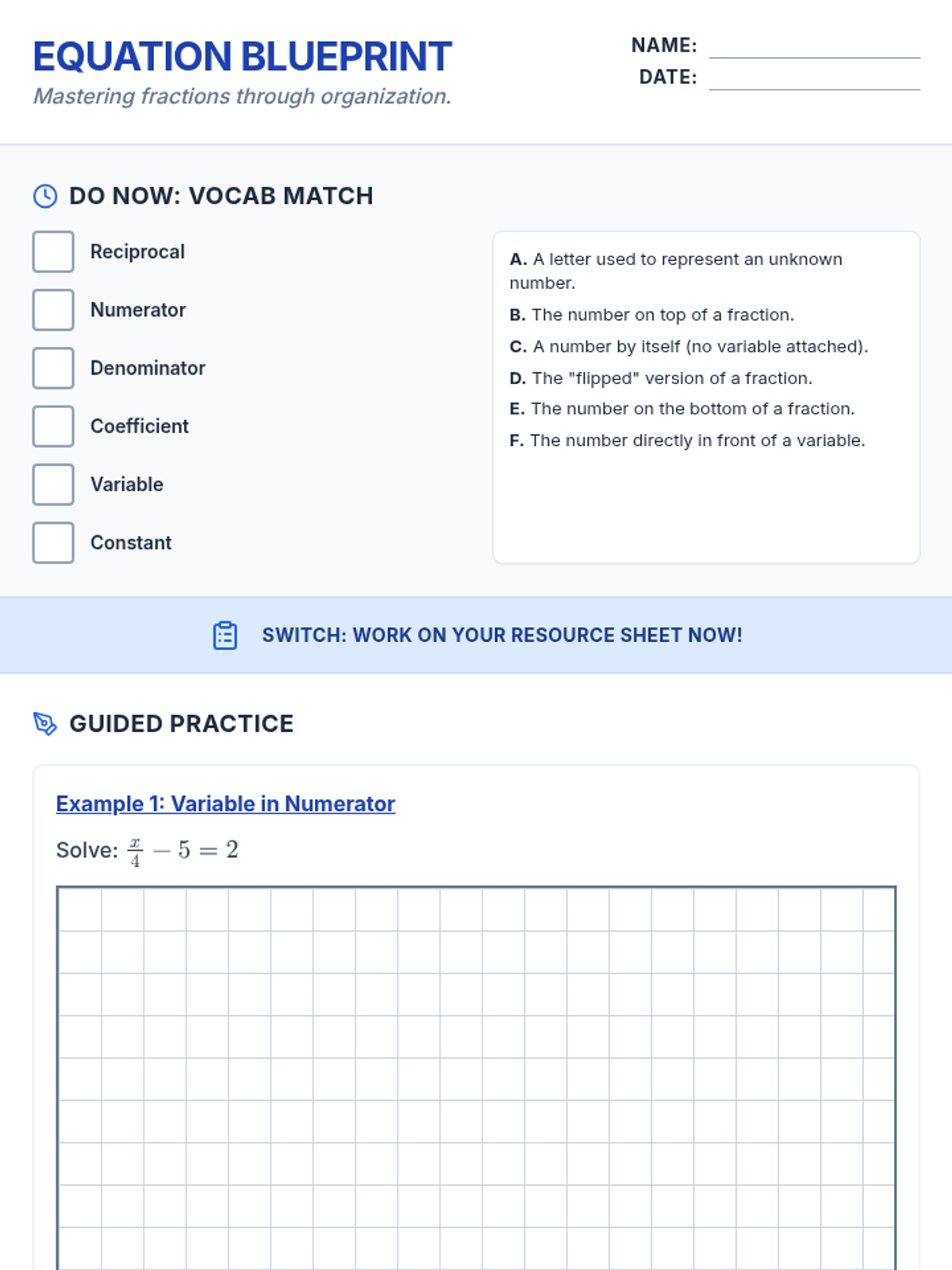
A student classwork packet for solving equations with fractions, featuring a vocabulary matching do now, grid-based workspace for guided and independent practice, and a final exit ticket challenge. Darkened grid lines and layout improvements for better printing. Grid sizes increased for more computation space.
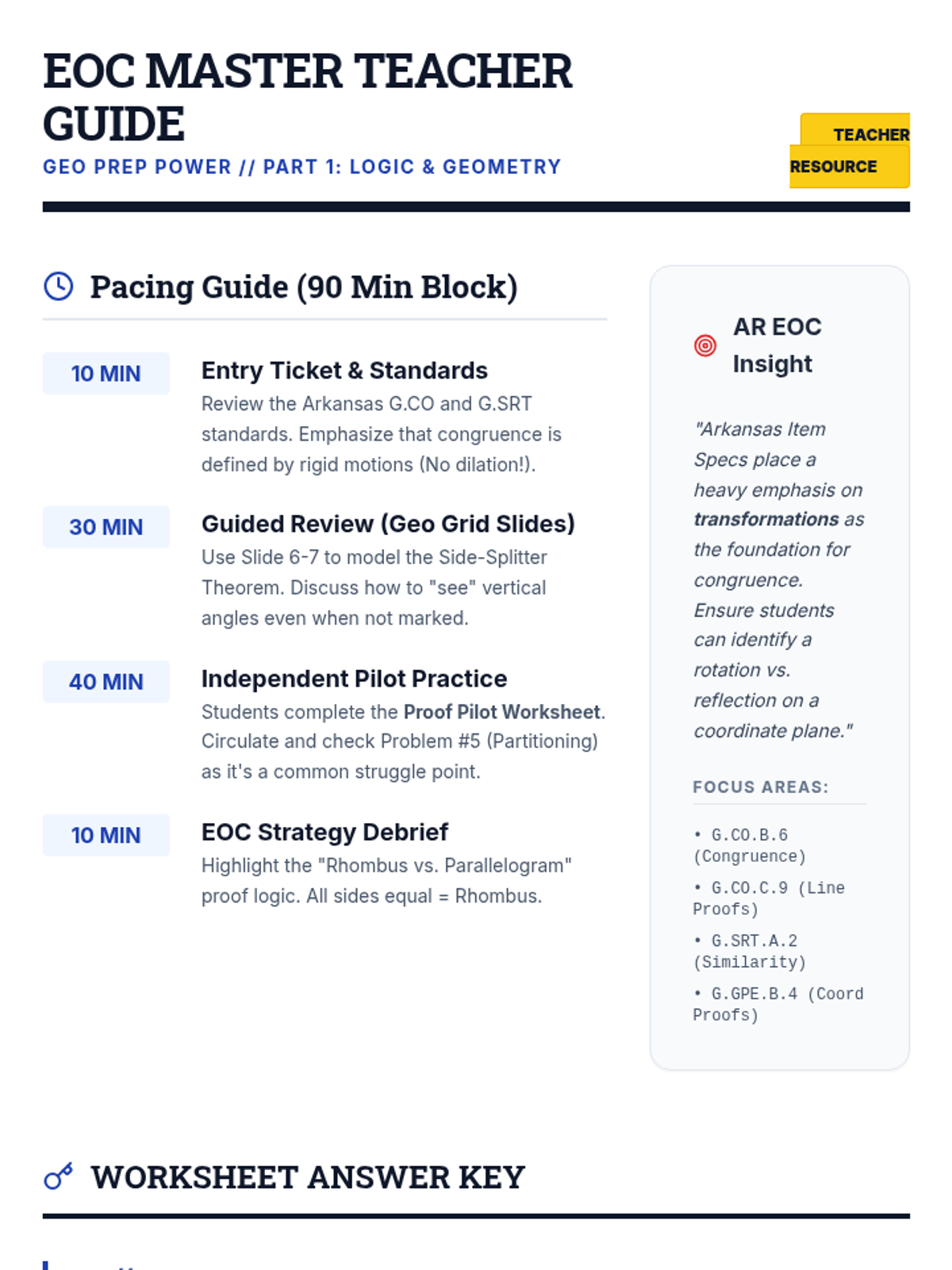
A teacher guide for the Geometry EOC Part 1 lesson, providing pacing, answer keys for the worksheet, and pedagogical tips for addressing common student misconceptions.
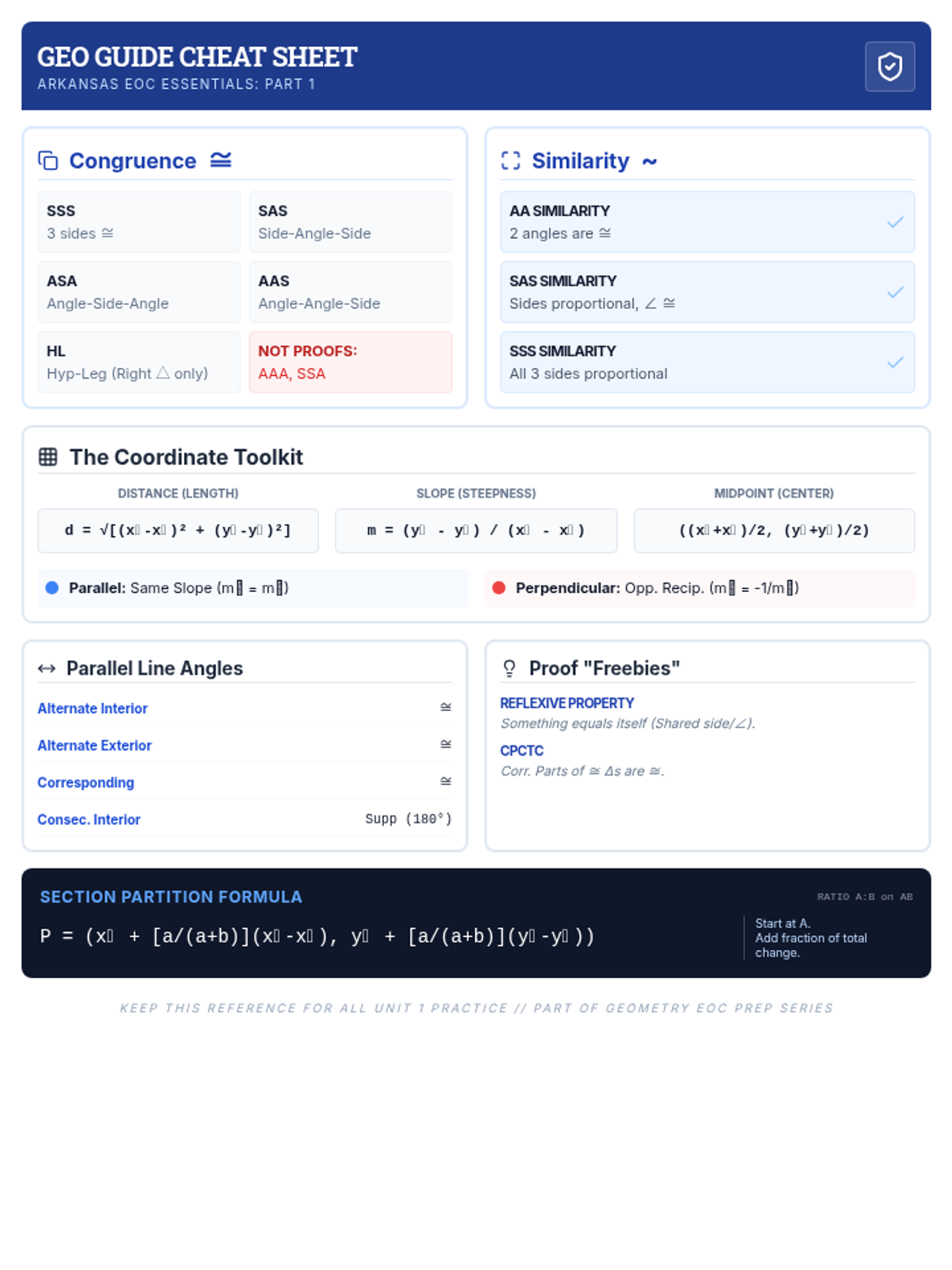
A comprehensive one-page reference sheet for Geometry students, covering congruence, similarity, coordinate formulas, and basic proof logic for EOC preparation.
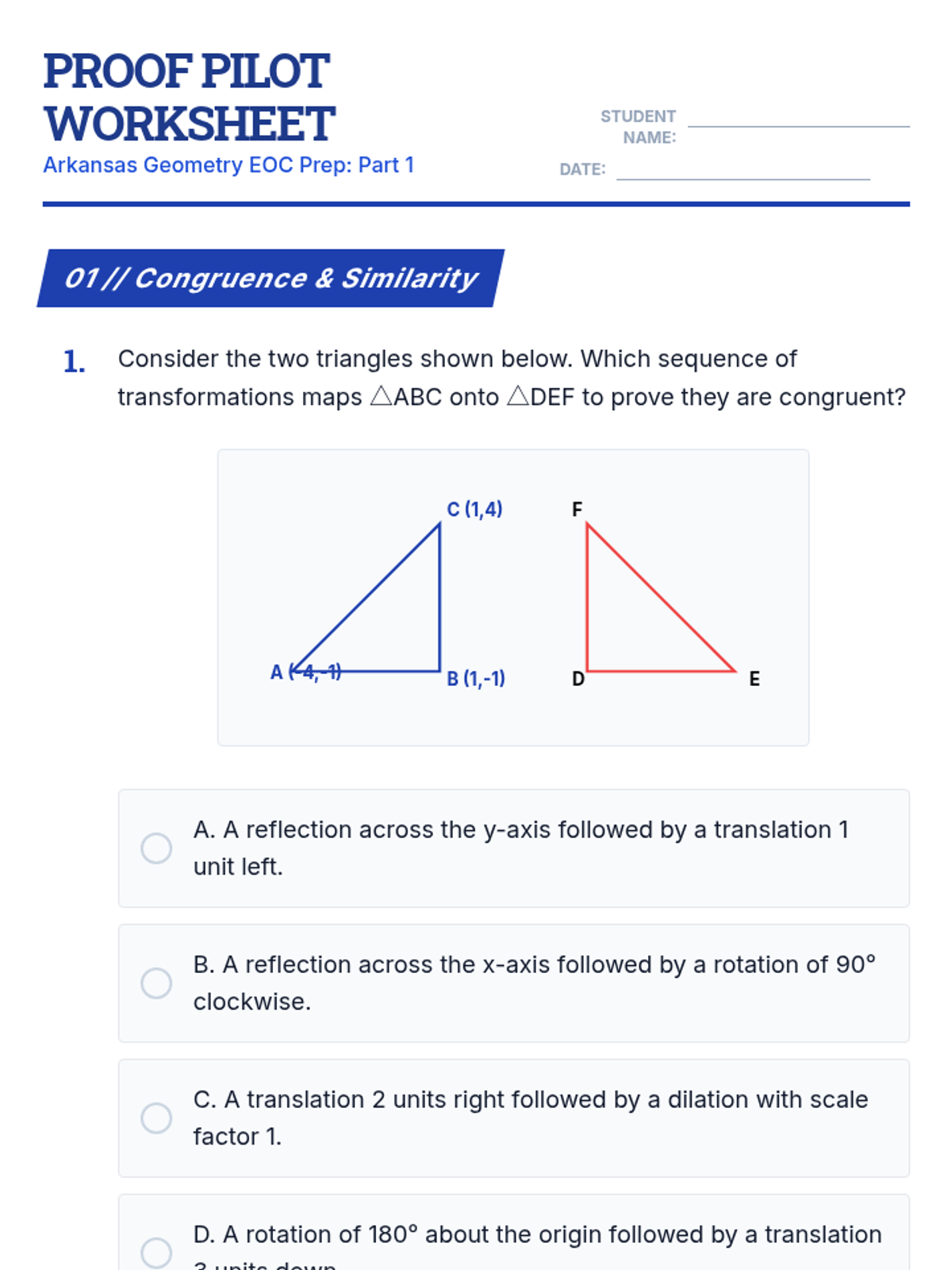
A student worksheet featuring EOC-style problems on congruence, similarity, two-column proofs, and coordinate geometry. Designed with a blueprint aesthetic and clear work areas.
A visual slide deck reviewing congruence, similarity, proofs, and coordinate geometry for the Arkansas Geometry EOC. Includes sample problems and strategic tips for high-stakes testing.
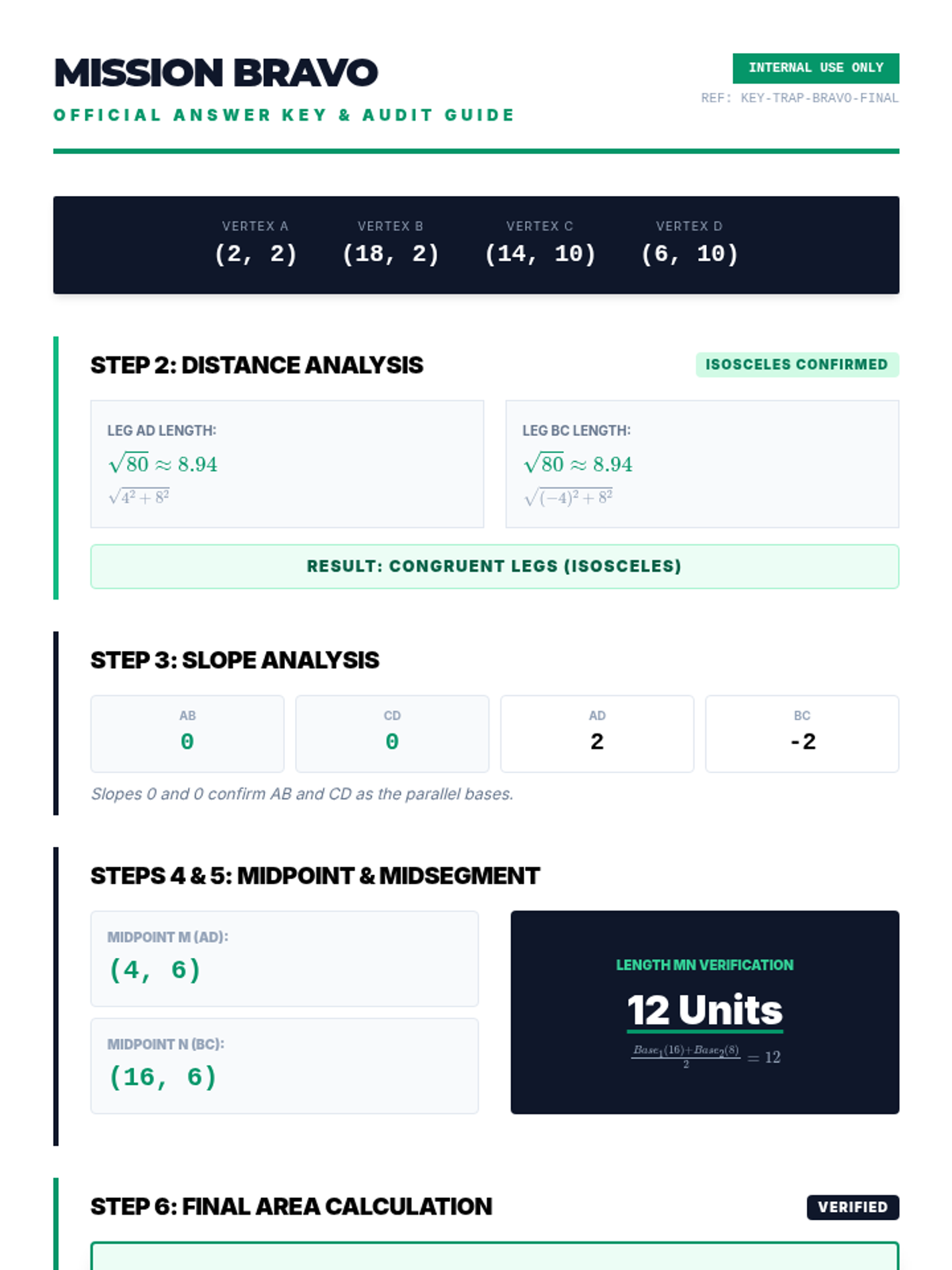
Official black-and-white printer-friendly answer key for Mission B of the Trapezoid Territory project. Features high-contrast calculations and step-by-step verification for coordinates A(2, 2), B(18, 2), C(14, 10), and D(6, 10). Confirms isosceles properties and a final area of 96 square units.
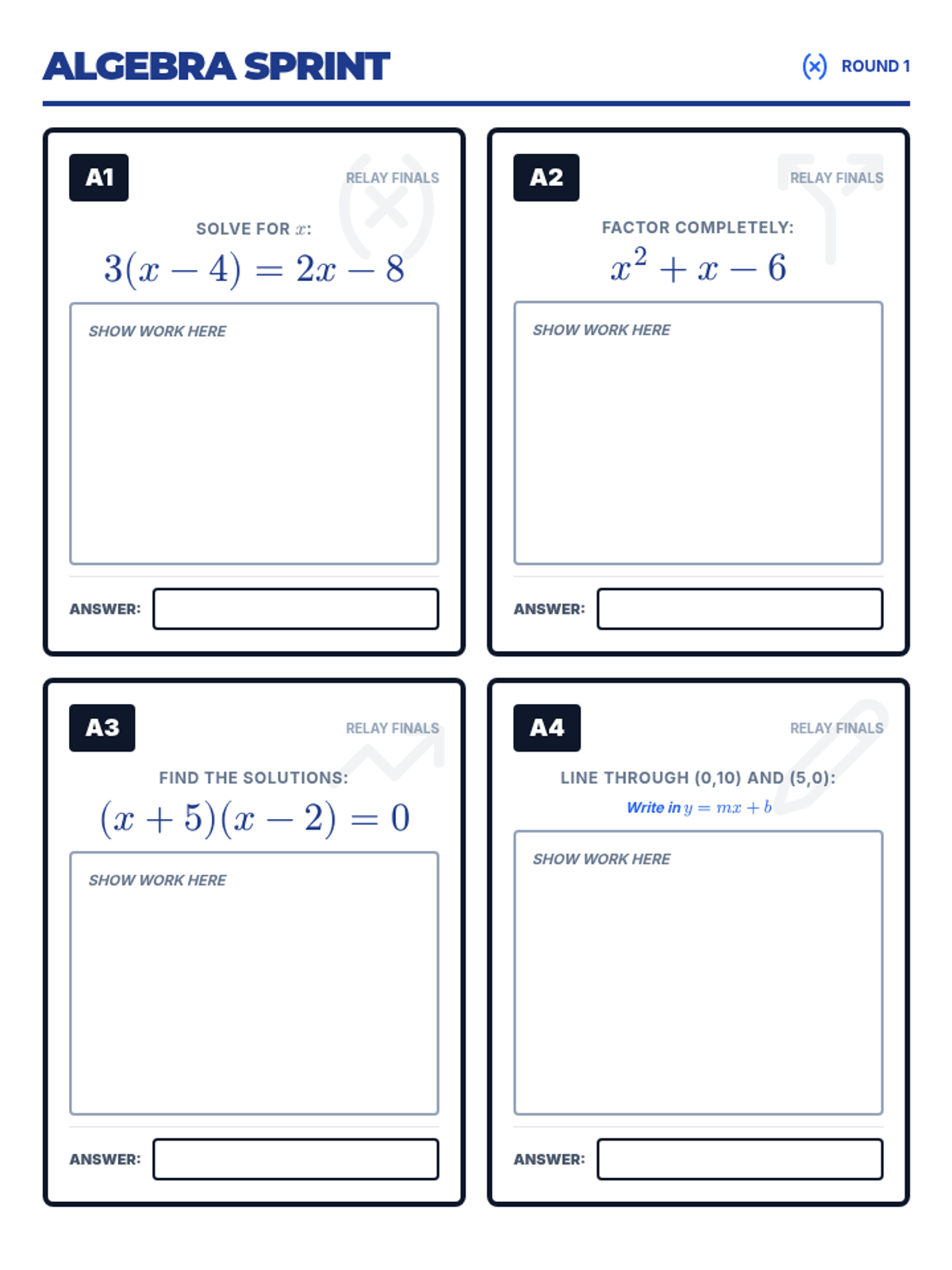
A collection of 16 formatted challenge cards across four mathematical domains, designed to be printed and used for the relay competition.
A high-energy visual guide for students outlining the rules, scoring, and expectations for the Ultimate Math Relay.
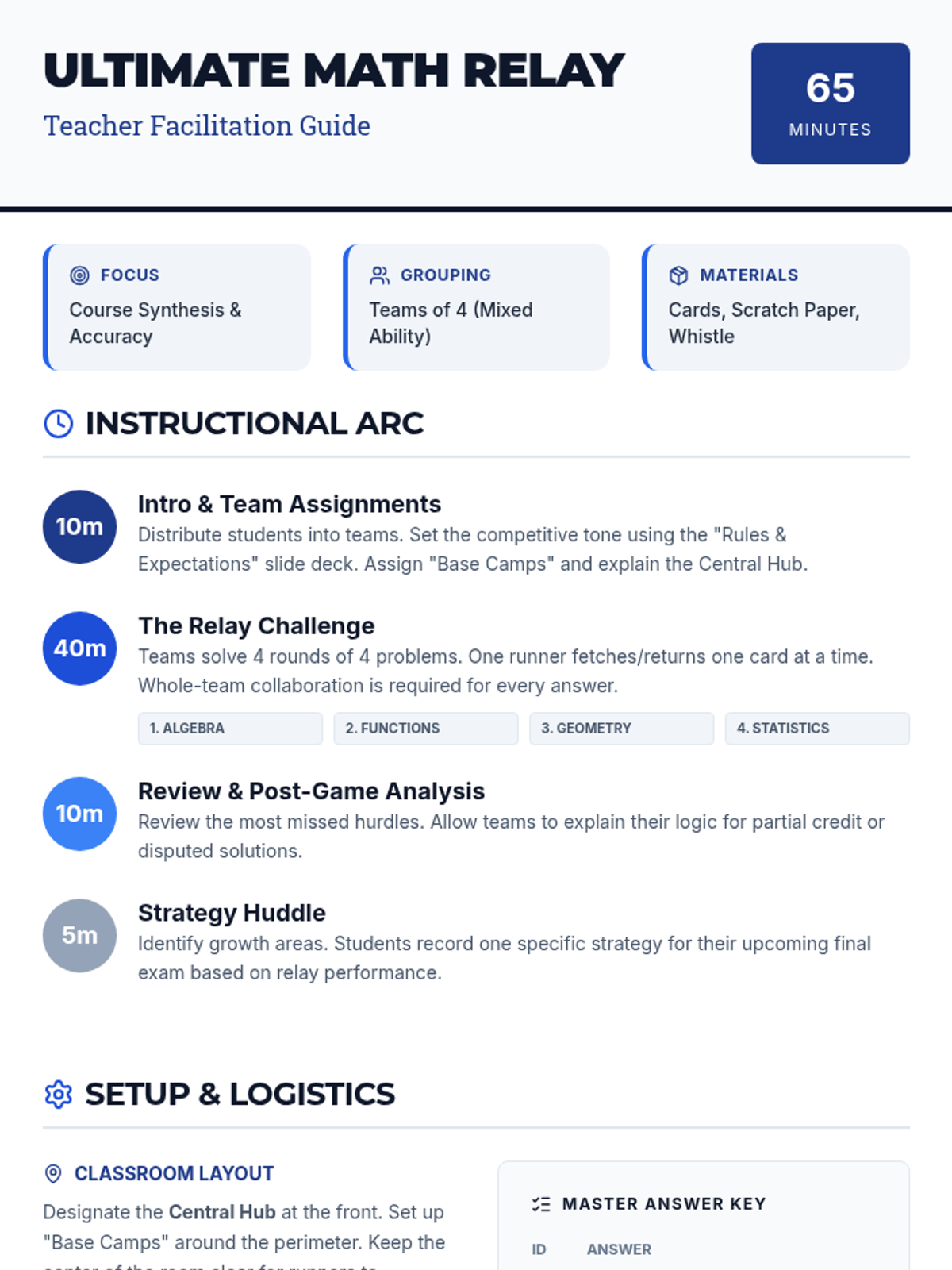
A teacher's facilitation guide for the Ultimate Math Relay, including timing, setup logistics, a master answer key, and scoring rules for the 9th-grade review competition.
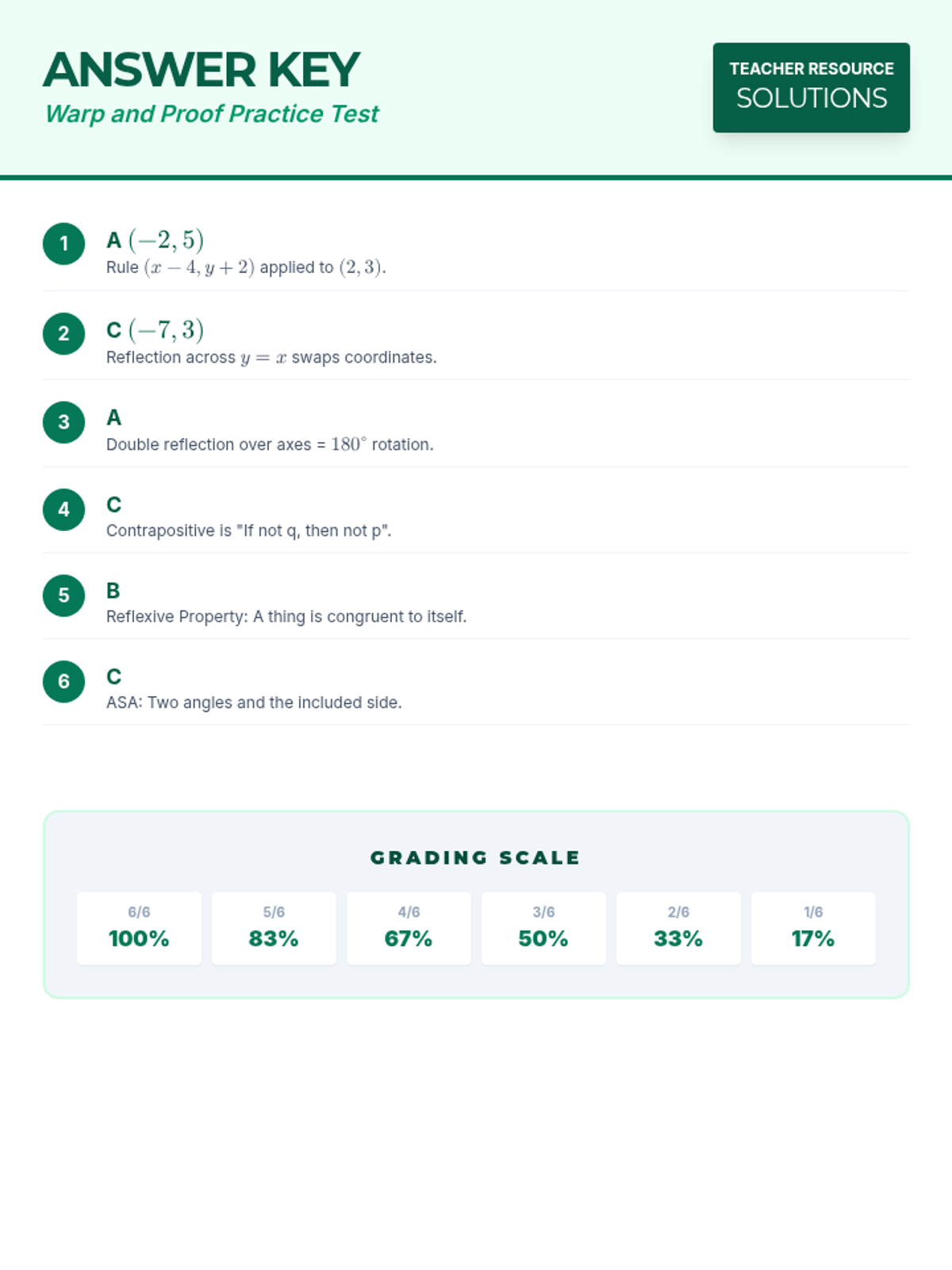
The teacher answer key for the Warp and Proof Practice Test, including correct answers and brief instructional explanations.
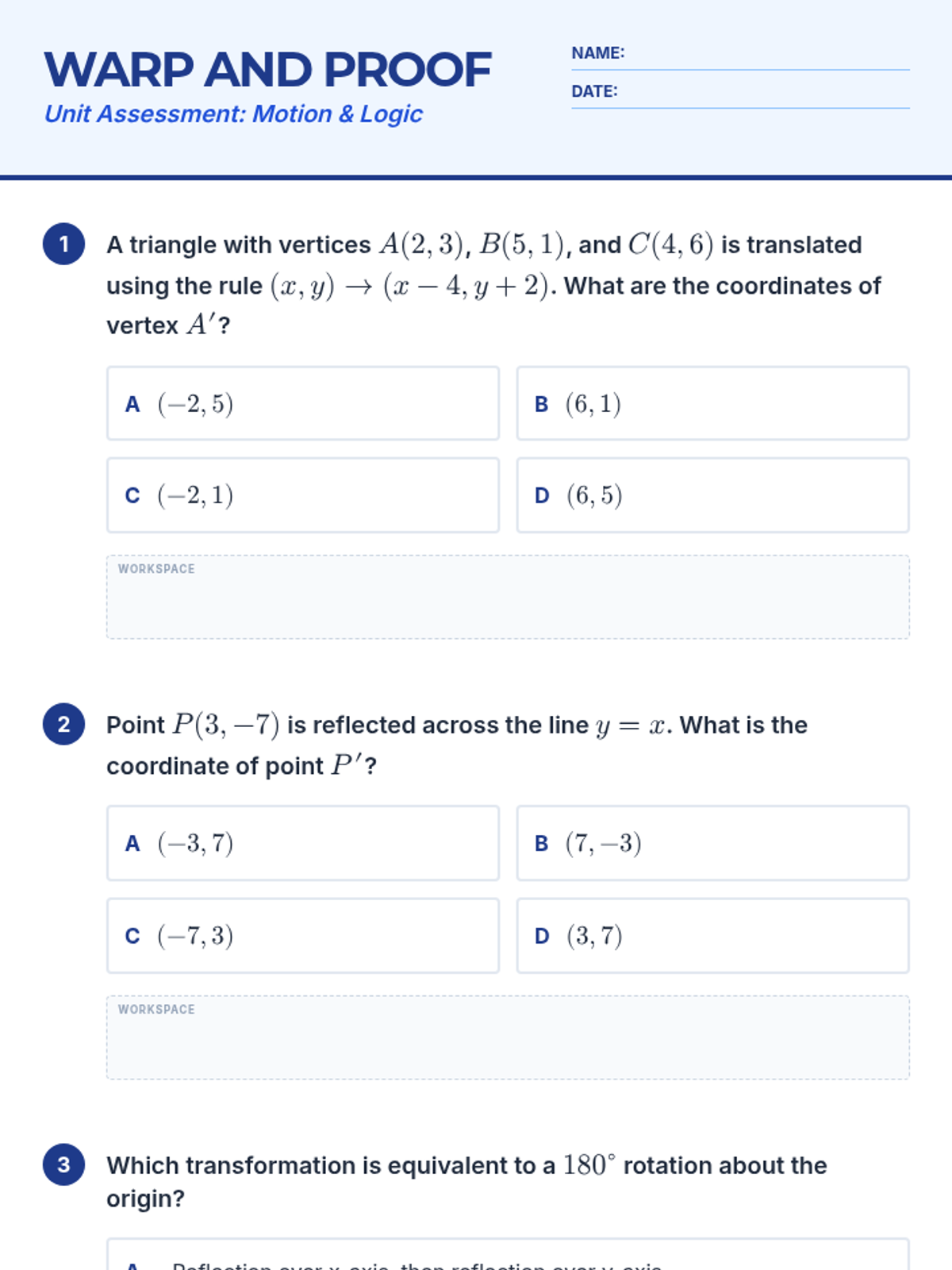
A multiple-choice practice test covering coordinate transformations (translations, reflections, rotations) and introductory geometric logic and triangle congruence proofs.
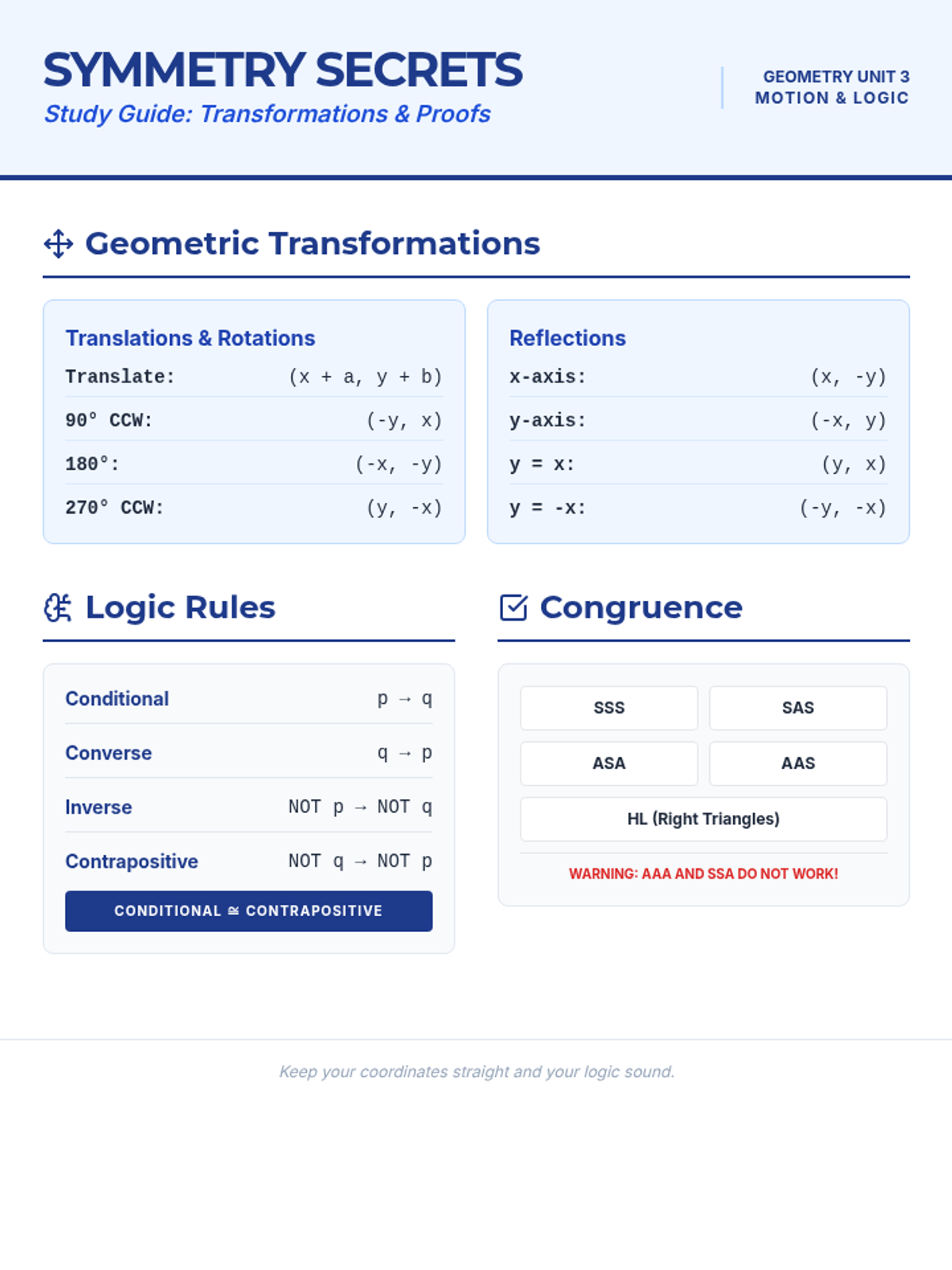
A comprehensive study guide summarizing geometric transformations (isometries and dilations) and the fundamentals of logical reasoning and triangle congruence proofs.
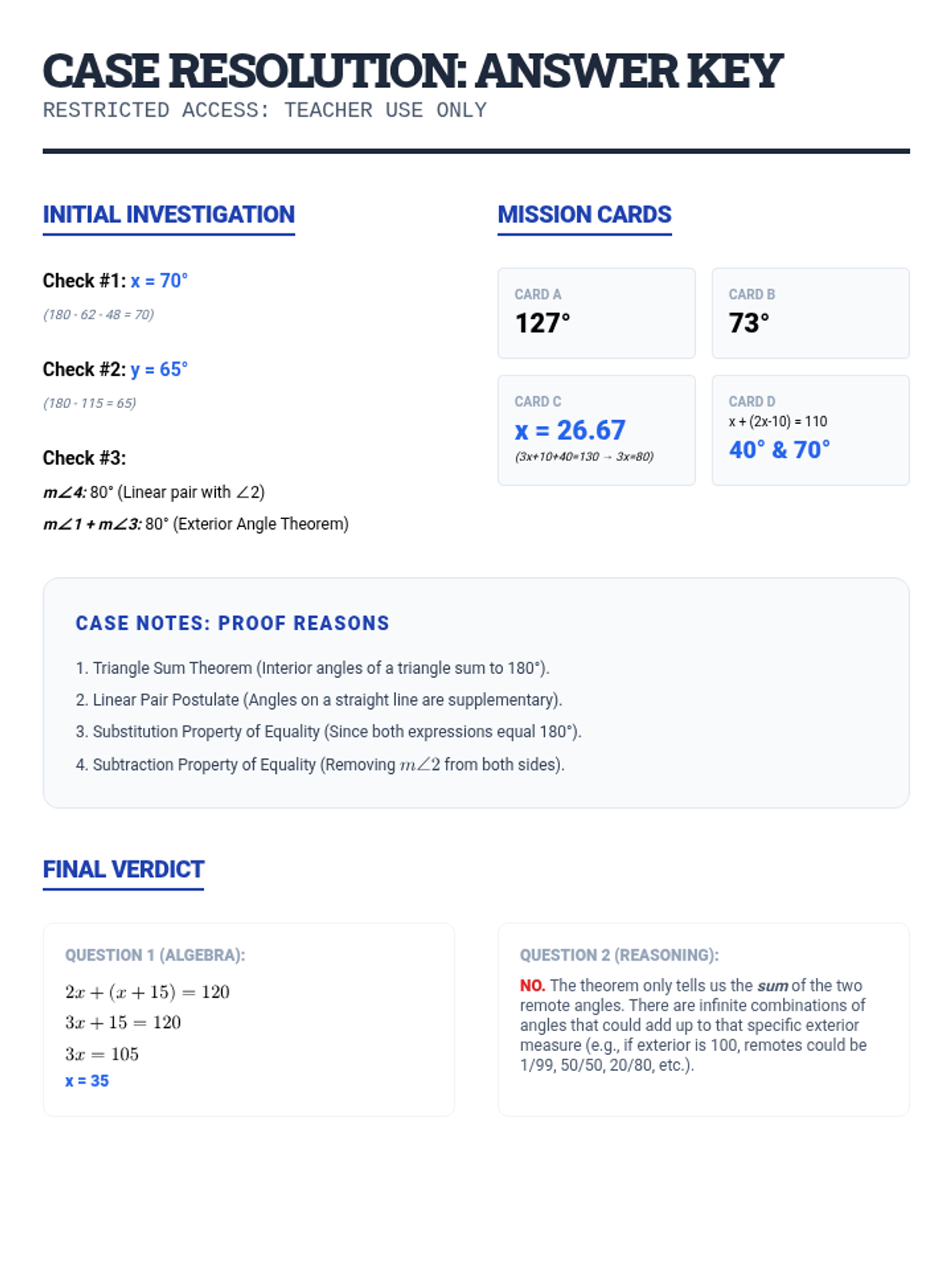
Revised answer key with increased precision for algebraic solutions, detailed proof justifications, and high-contrast formatting for teacher ease-of-use.
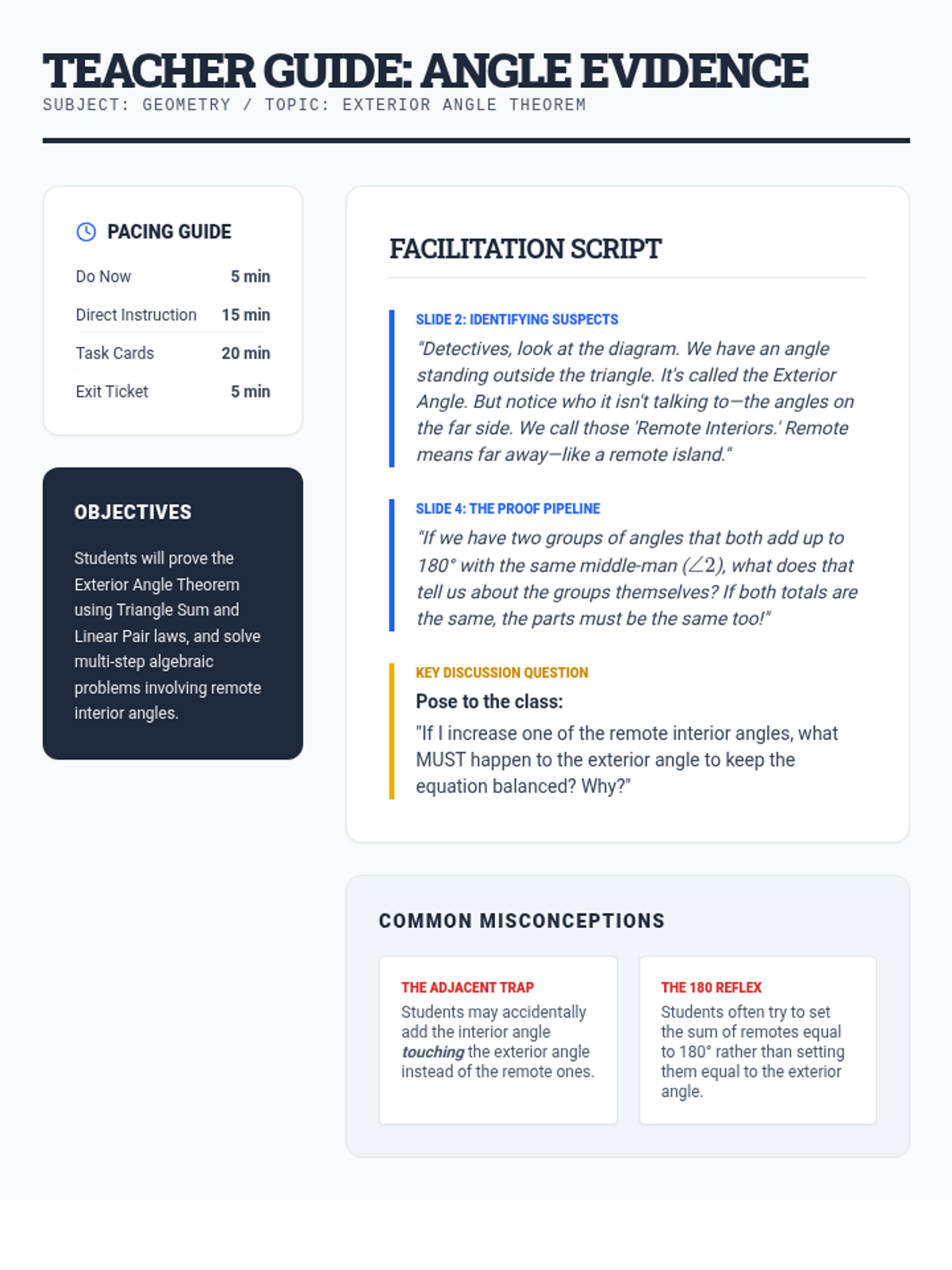
Revised teacher guide with improved layout to prevent section fragmentation, optimized pacing guides, and formatted facilitation scripts for classroom use.
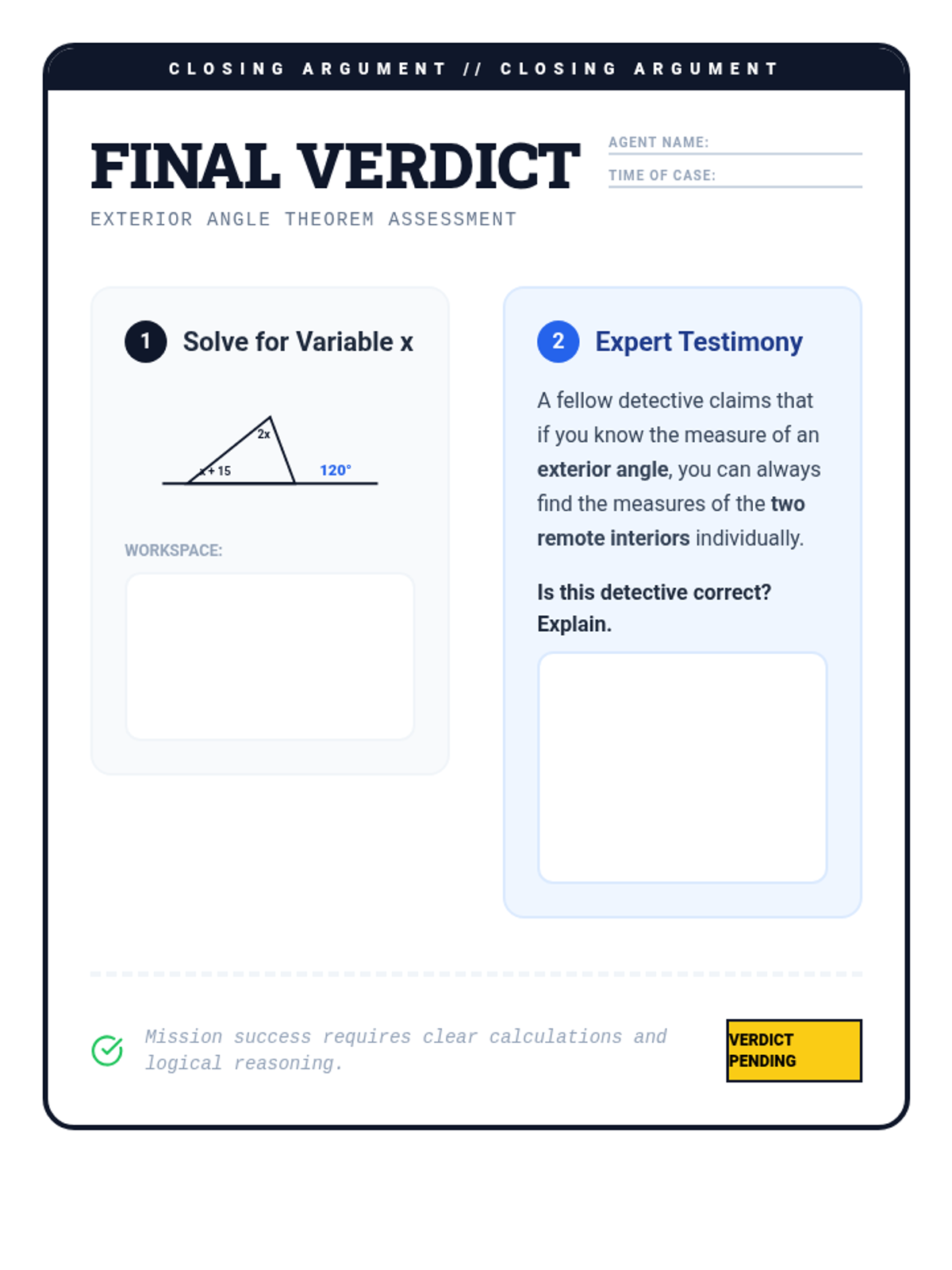
An exit ticket formatted as a 'Final Verdict' assessment. Includes one algebraic application problem and one conceptual reasoning question to check for deep understanding.
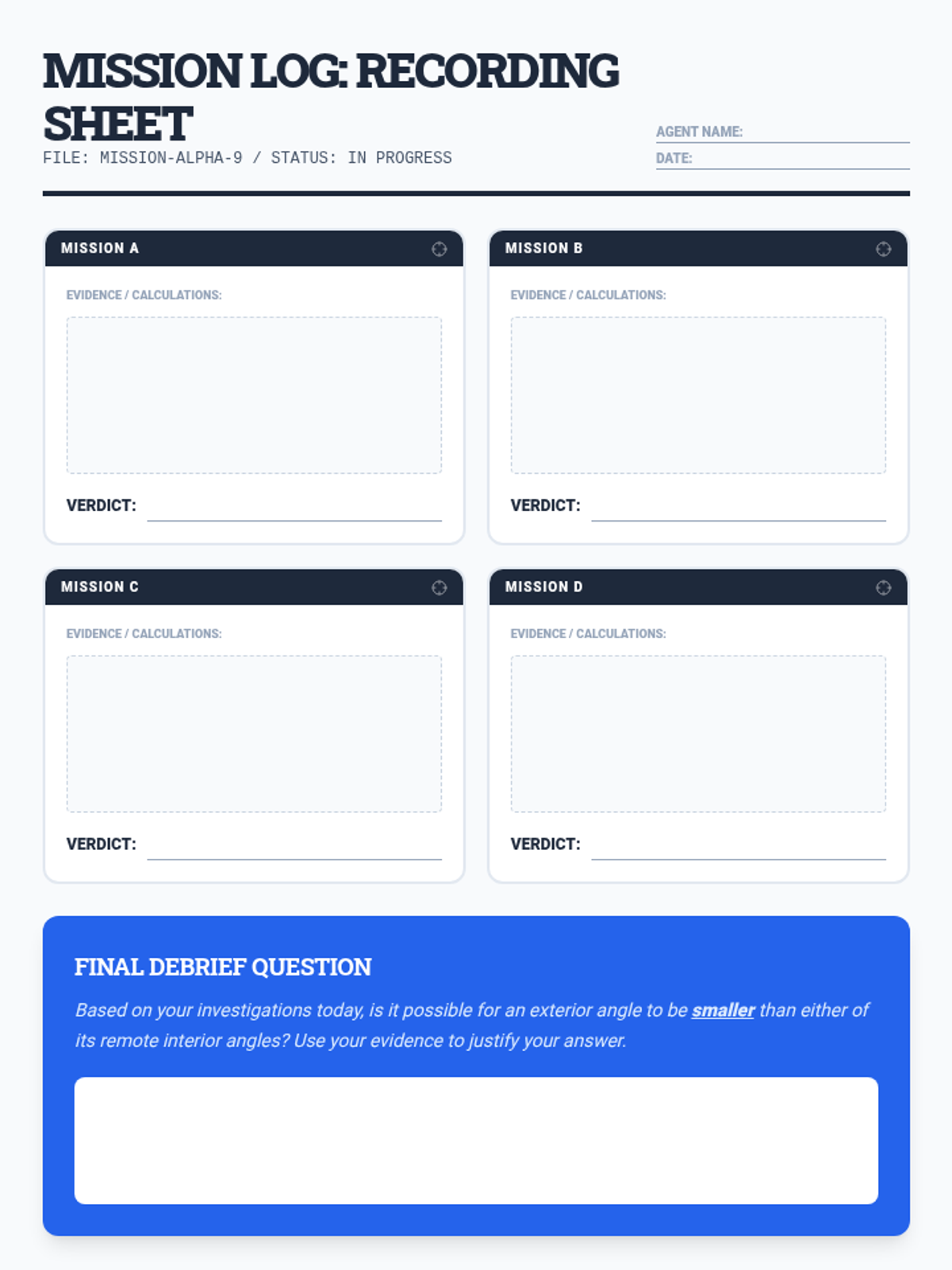
Revised mission log with condensed layouts to fit all mission boxes and the final debrief on a single page, featuring improved visibility for borders and calculation areas.
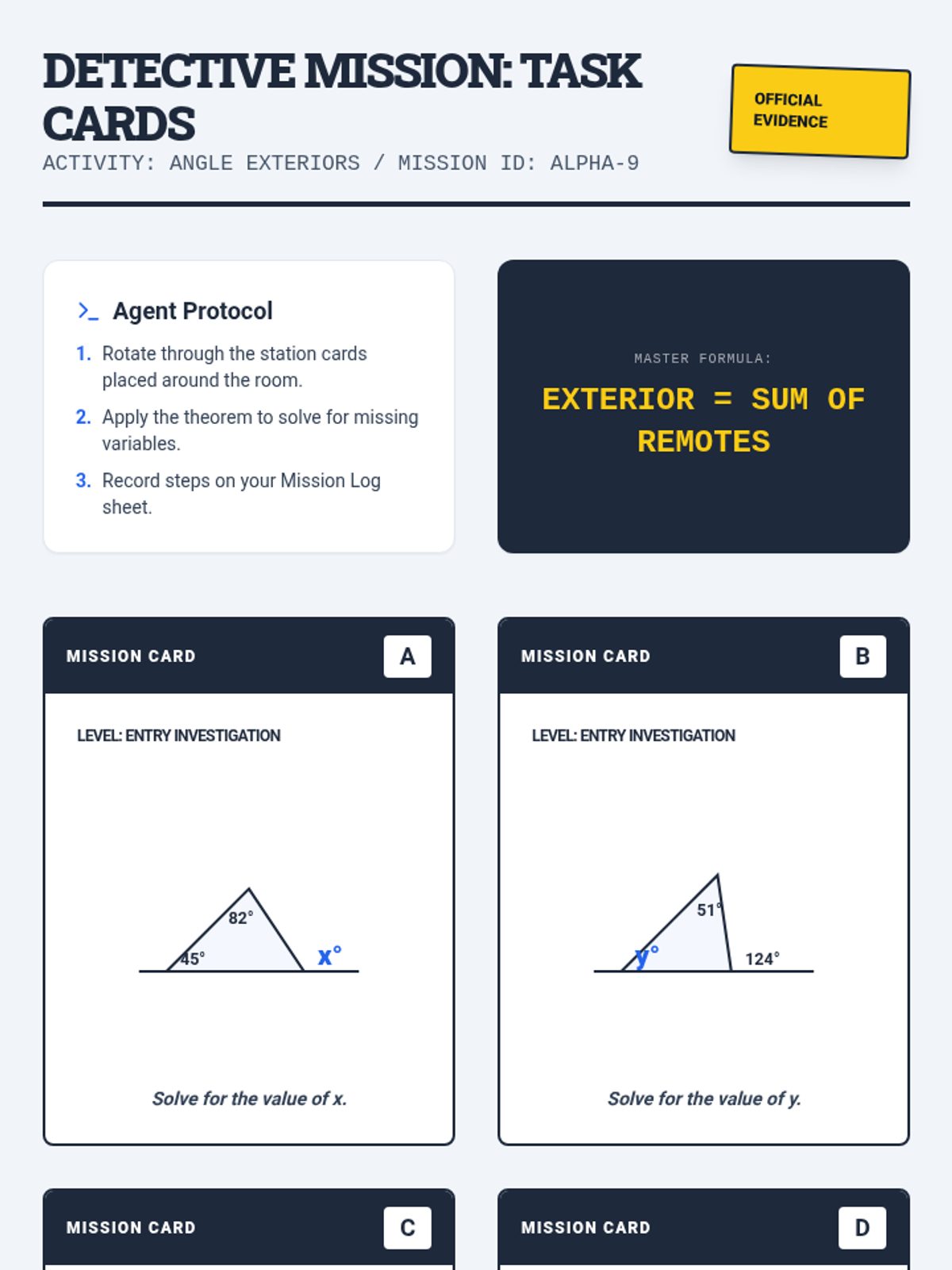
Revised task cards with corrected formula formatting, high-contrast prompts, and 'break-inside-avoid' styling to ensure cards remain cohesive when printed.
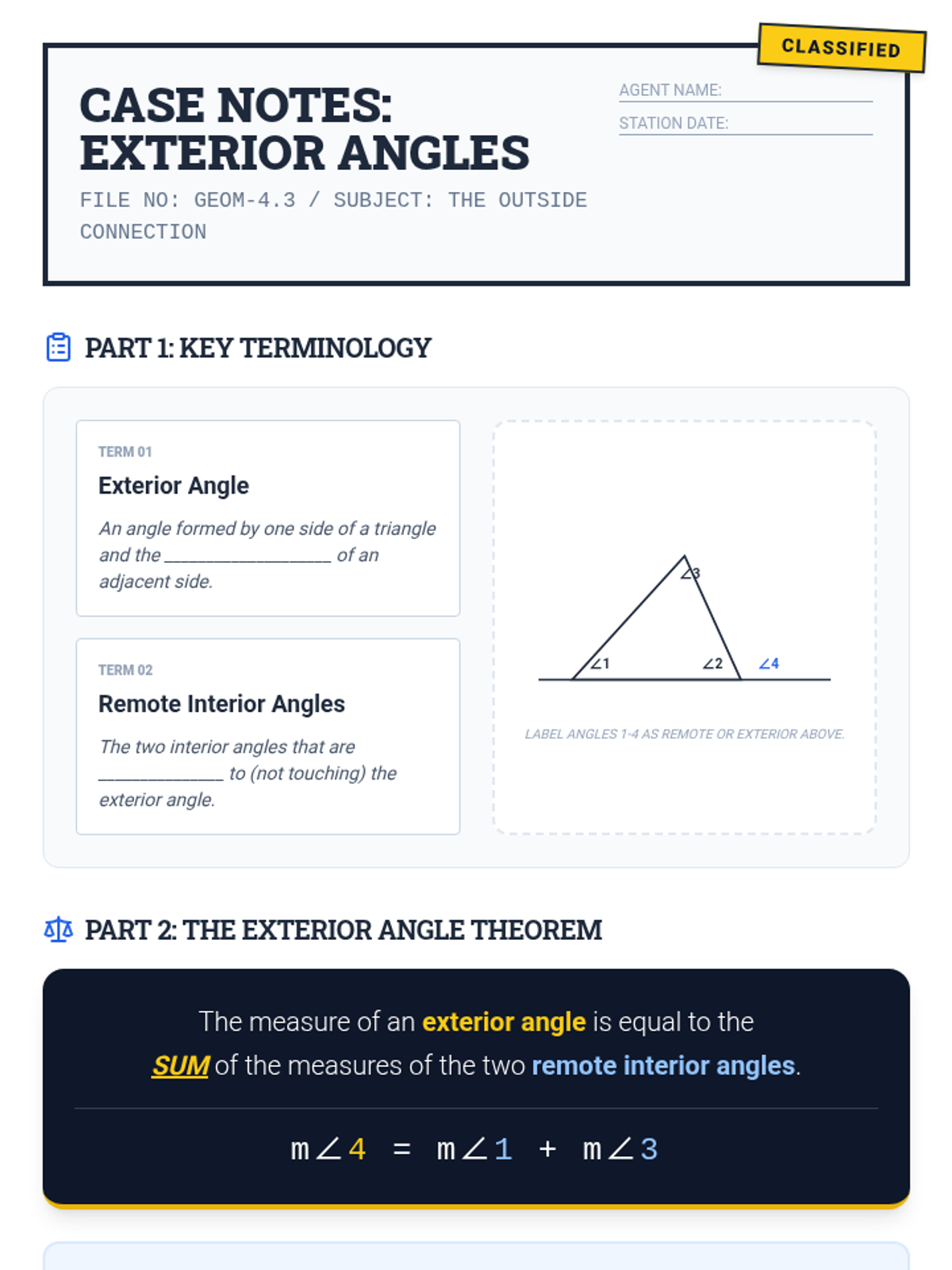
Revised guided notes with optimized page layouts to prevent awkward breaks, high-contrast theorem summaries, and significantly larger student calculation areas for algebra practice.
Revised slide deck with consistent angle notation, improved label positioning for clarity, and a hidden practice answer to facilitate classroom discussion.
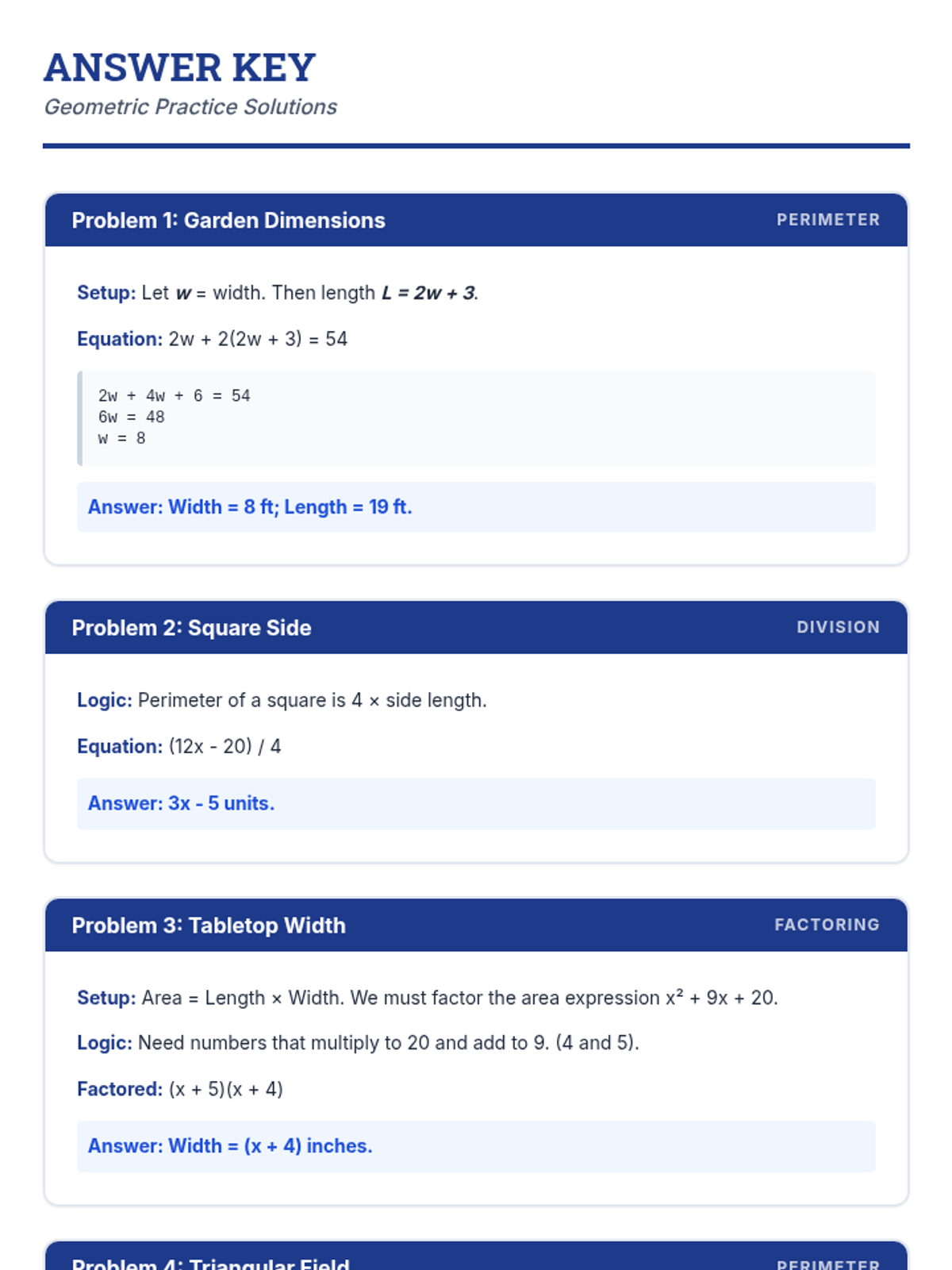
Complete teacher answer key for the summer geometry supplement. Includes equation setups, logic steps, and final solutions for all 6 word problems, presented in a high-contrast, professional format.
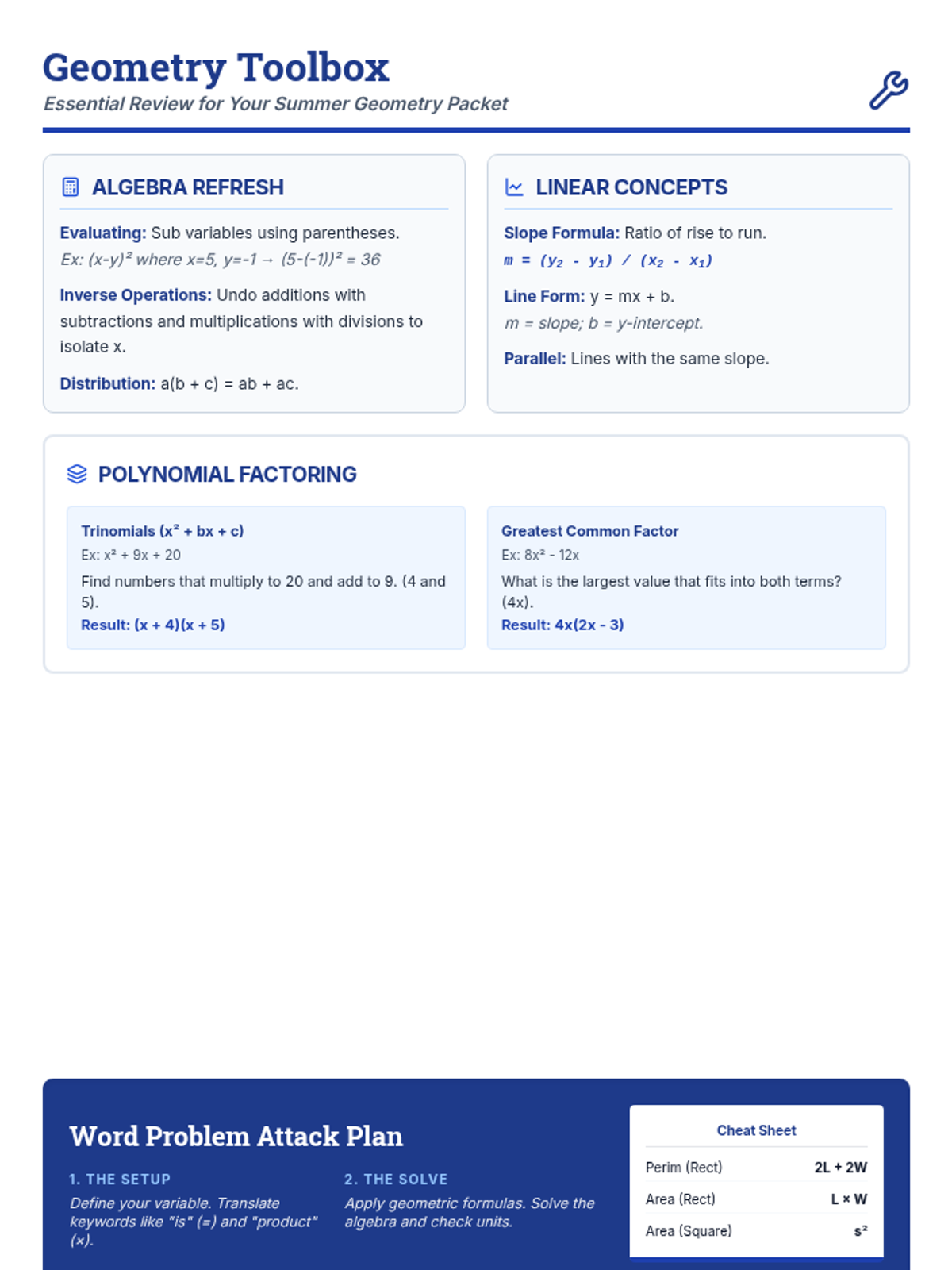
An updated summer geometry supplement featuring a toolbox with PEMDAS/GEMDAS, definitions for Area/Perimeter, and a 10x10 multiplication table. Includes 6 geometric word problems with structured workspace. Layout optimized for print across 4 pages.
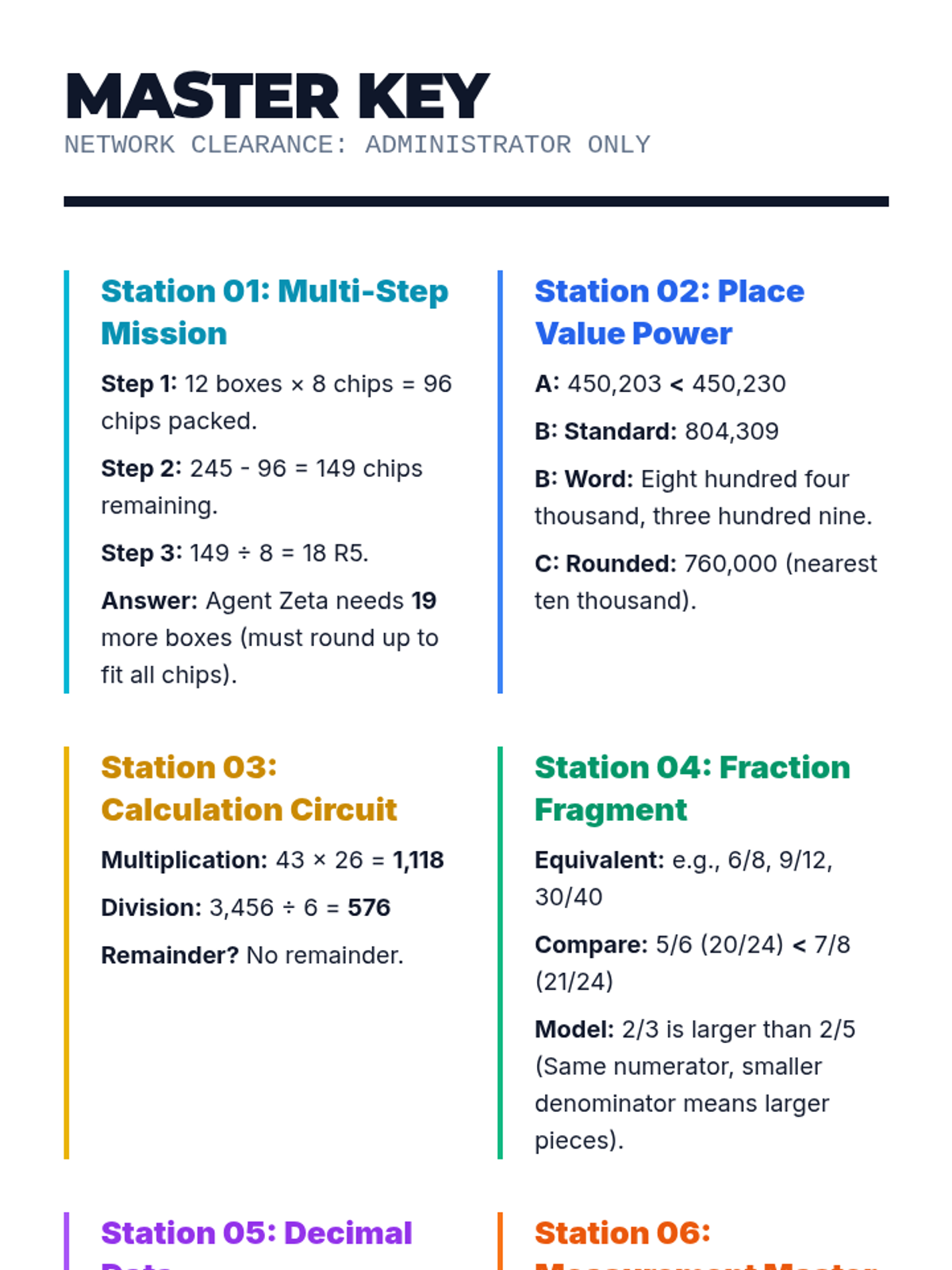
Comprehensive answer key and scoring guide for the Number Network Gallery Walk. Includes step-by-step solutions for complex problems and clear final answers for all stations.
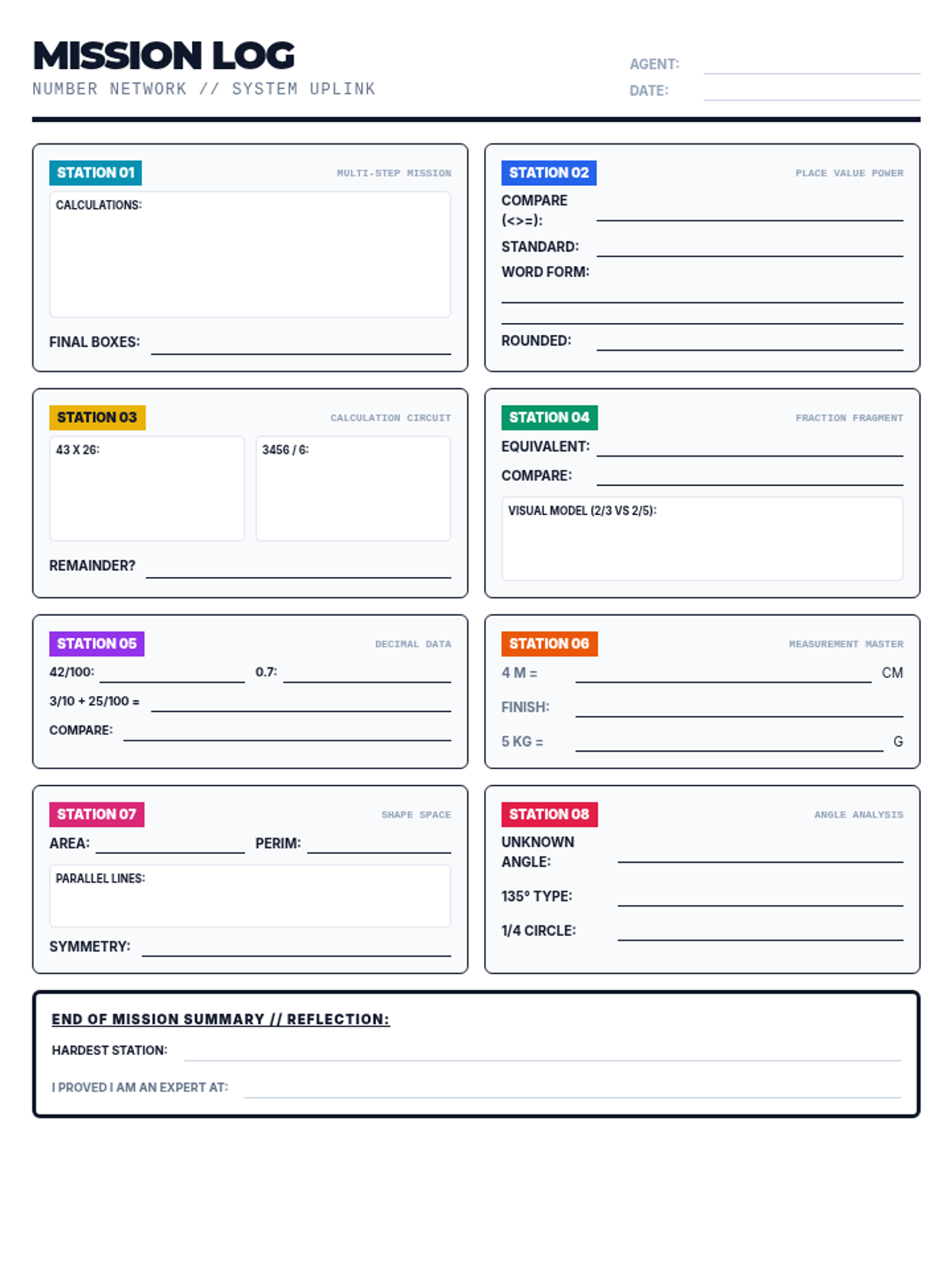
Student recording sheet for the Number Network Gallery Walk. Organized by station with specific work areas and answer slots to ensure structured data collection during the activity.
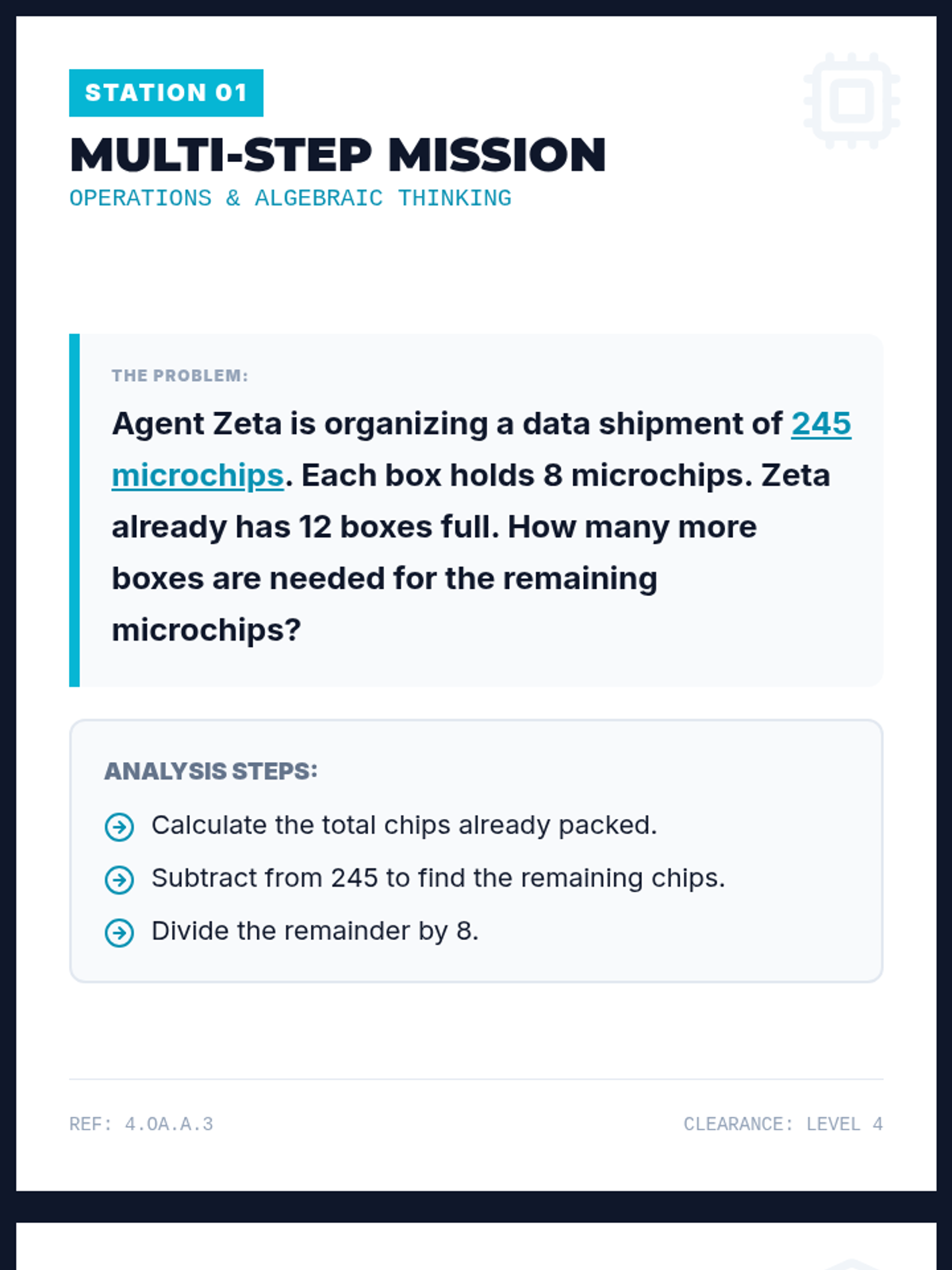
8 printable station cards for the Number Network Gallery Walk. Each card features high-contrast design, clear problem sets, and specific domain references for 4th-grade math standards.
Introductory slide deck for the Number Network Gallery Walk. Includes session objectives, rules (protocols), and a countdown/timer visual for classroom atmosphere.
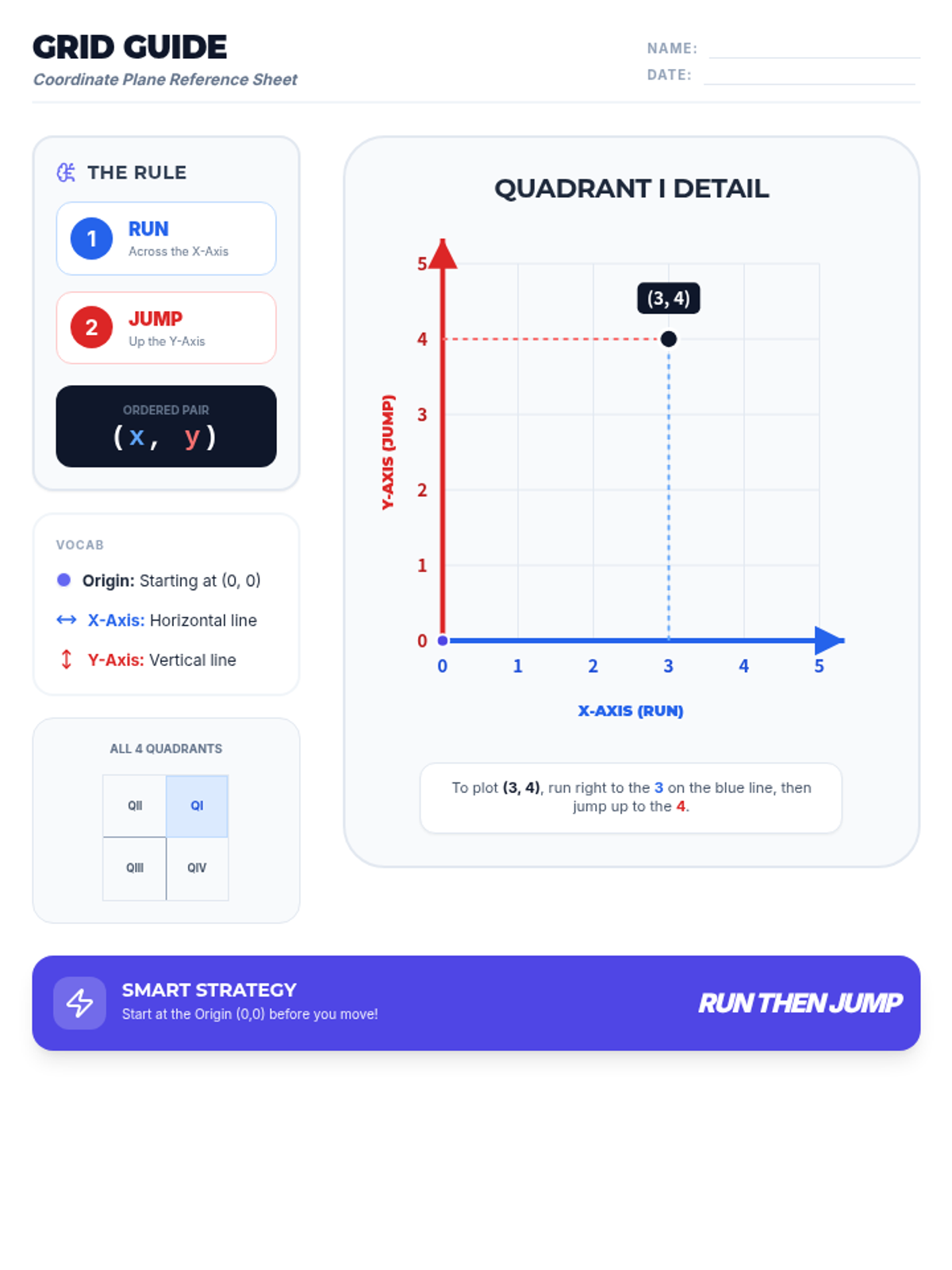
A minimalist, color-coded anchor chart for graphing on a coordinate plane, focusing on the first quadrant with a "Run then Jump" mnemonic. Includes clear labels for axes, the origin, and an example point, plus a visual for all four quadrants.
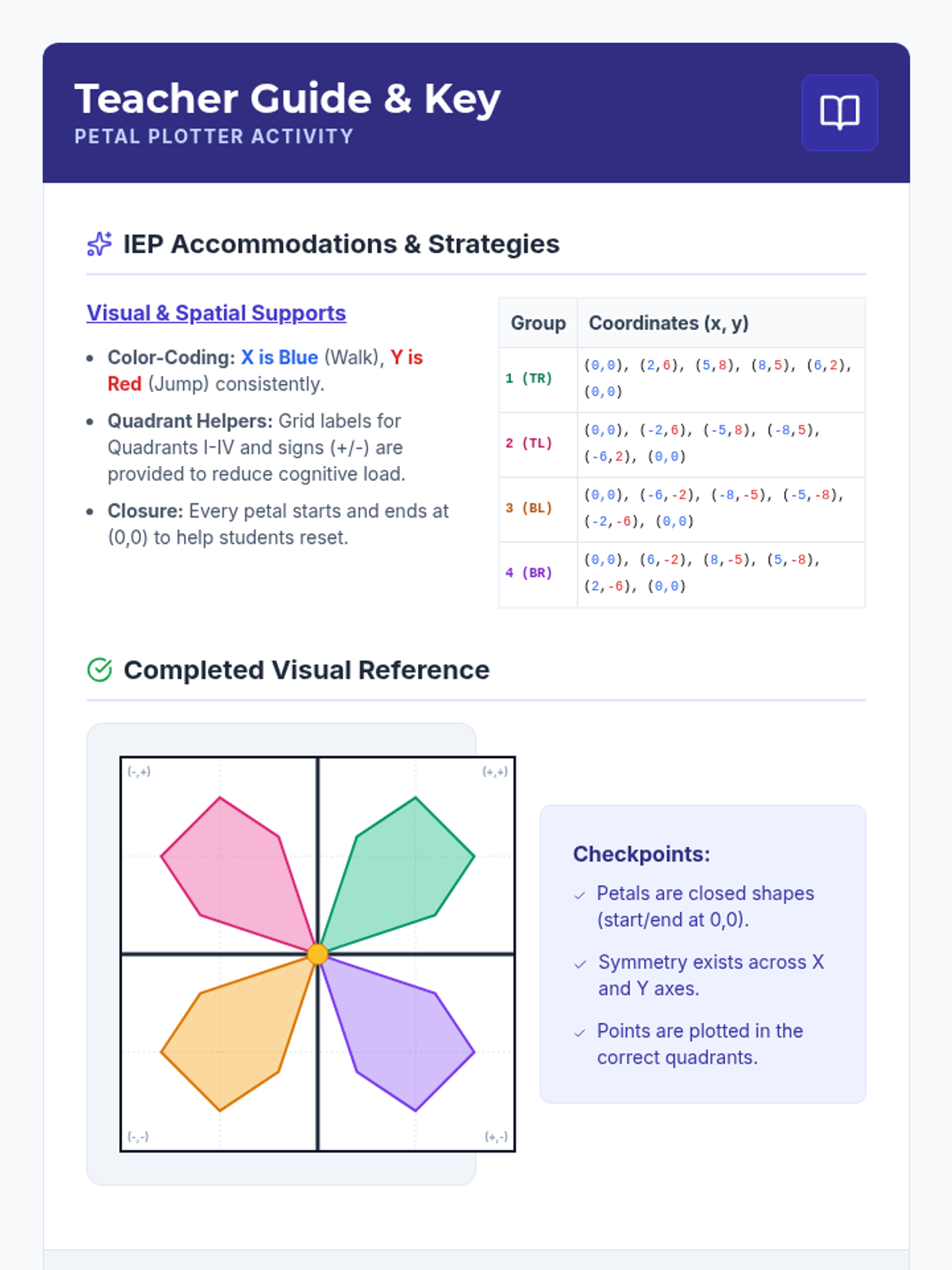
Teacher guide and answer key for the Petal Plotter activity. Includes IEP accommodation strategies, instructional tips, and a visual answer key for checking student work. Corrected coordinates and page layout.
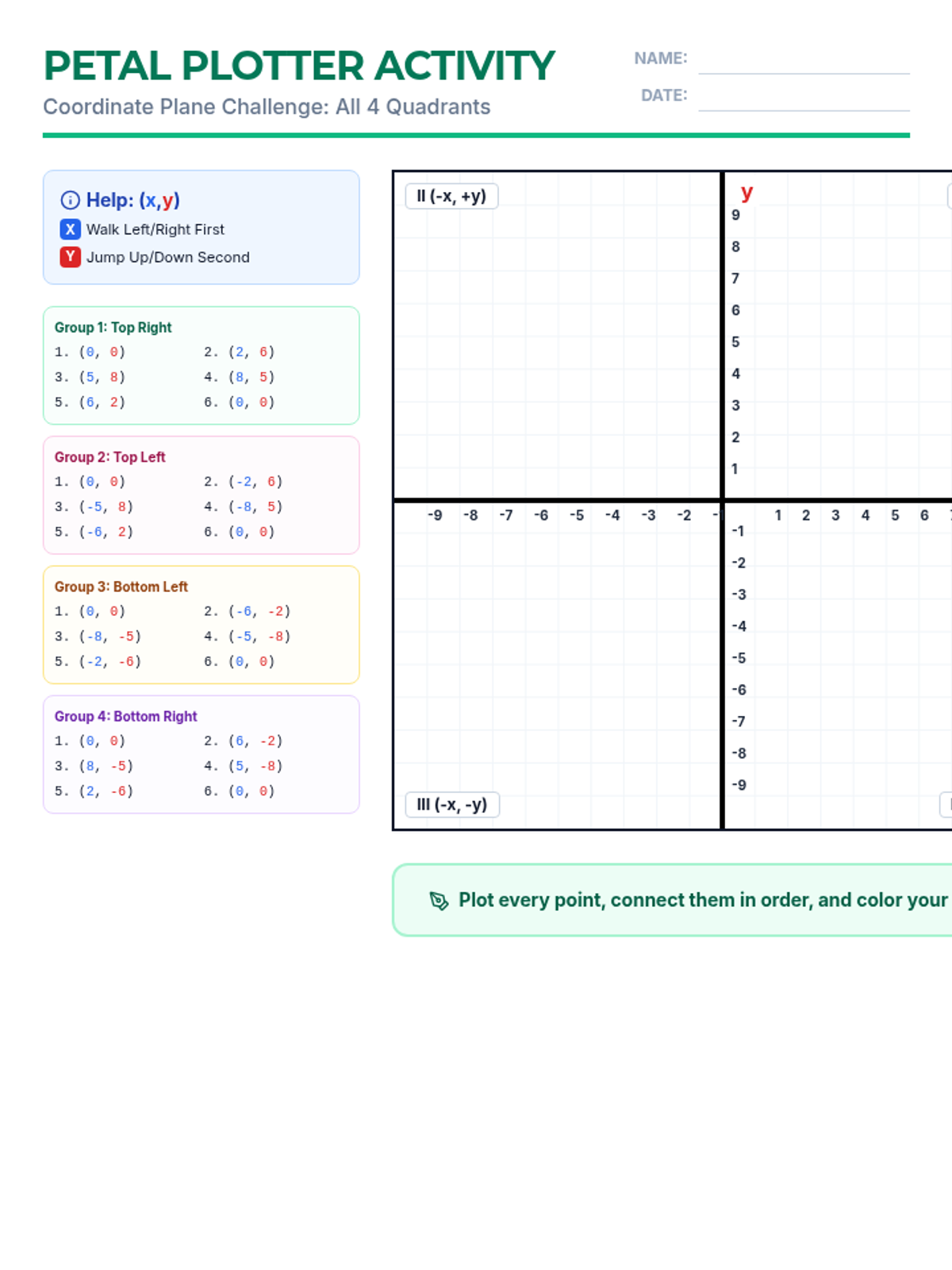
A modified 4-quadrant coordinate plane worksheet for IEP students. Features color-coded point values (x is blue, y is red), large grid space, and structured grouping of points to build a seasonal flower. Now includes full axis numbering and high-contrast quadrant labels.
Visual introduction to the 4-quadrant coordinate plane, modified for IEP students with high-contrast visuals, mnemonic devices, and step-by-step plotting guides. Now includes the actual coordinates for plotting.
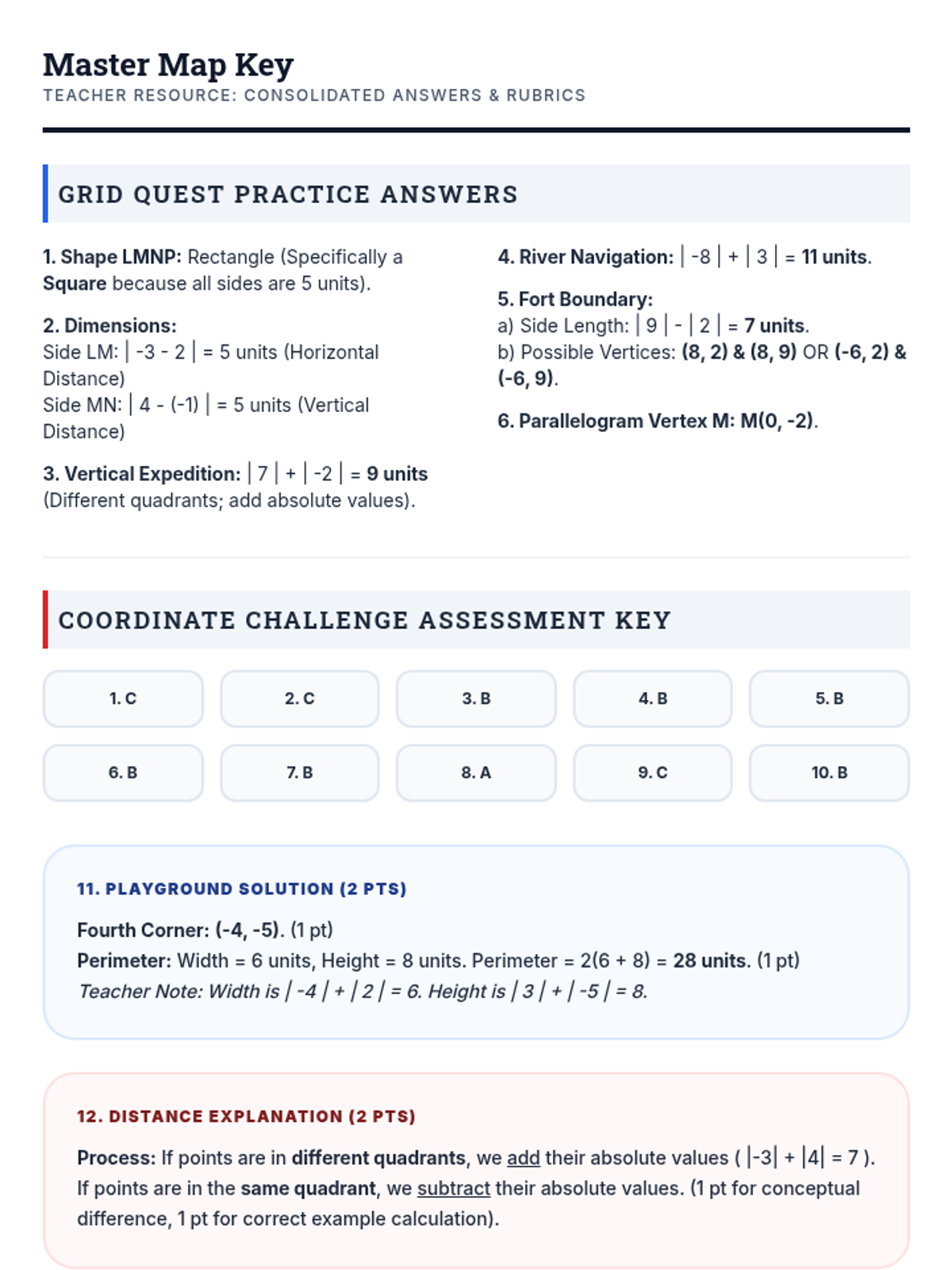
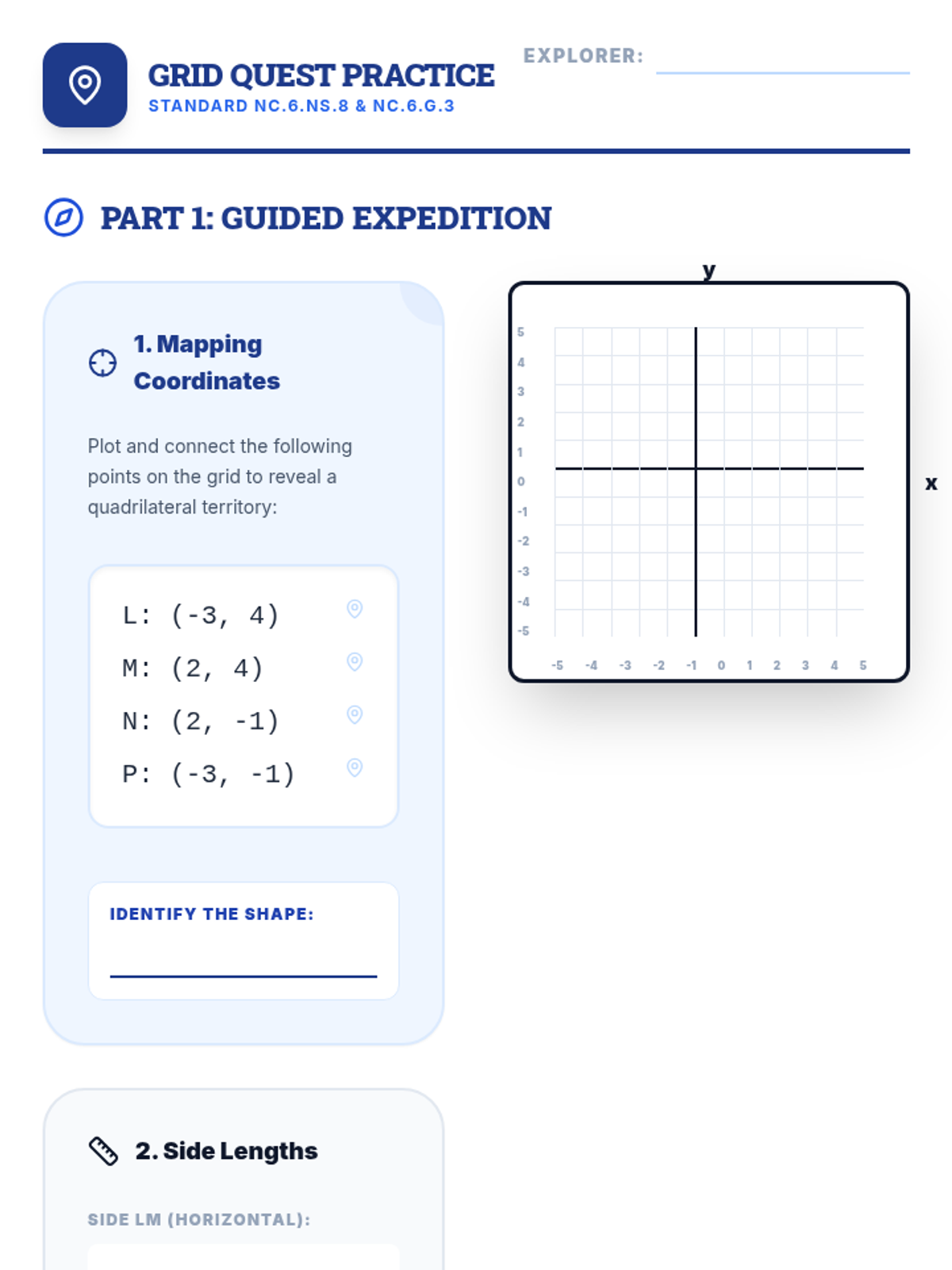
A teacher answer key for the Grid Quest Practice and Coordinate Challenge Assessment. Features consolidated single-page layout, formal pedagogical notes, and clear rubrics for open-response grading.
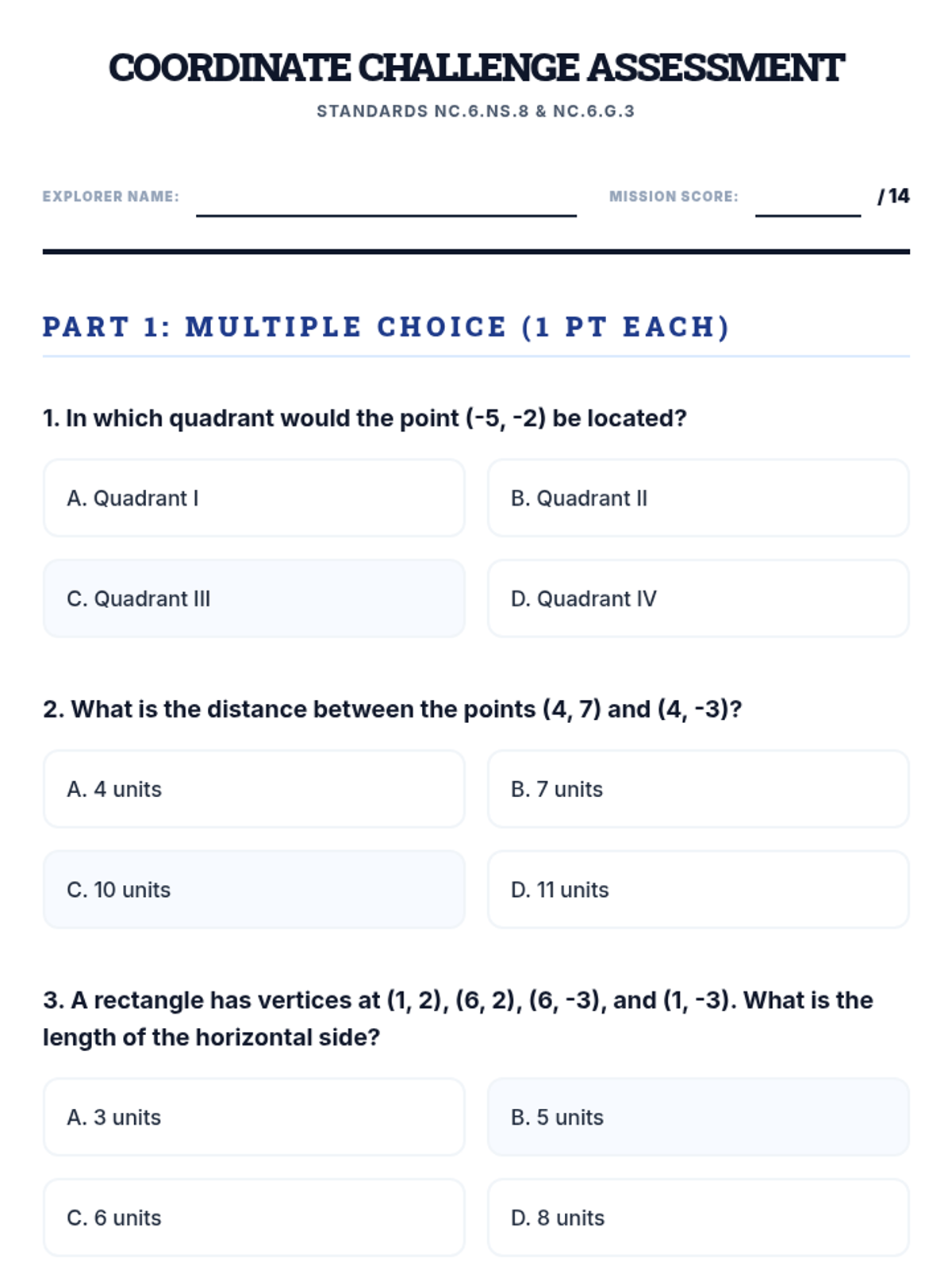
A 10-question multiple-choice assessment with 2 open-response questions focused on coordinate geometry, plotting quadrilaterals, and distance calculation. Features improved page breaks, functional grids for sketching, and a 14-point scoring system.
A dual-part practice worksheet featuring teacher-led guided problems and independent student practice. Focuses on plotting vertices of quadrilaterals and calculating distances with absolute values. Includes a functional -5 to 5 coordinate grid.
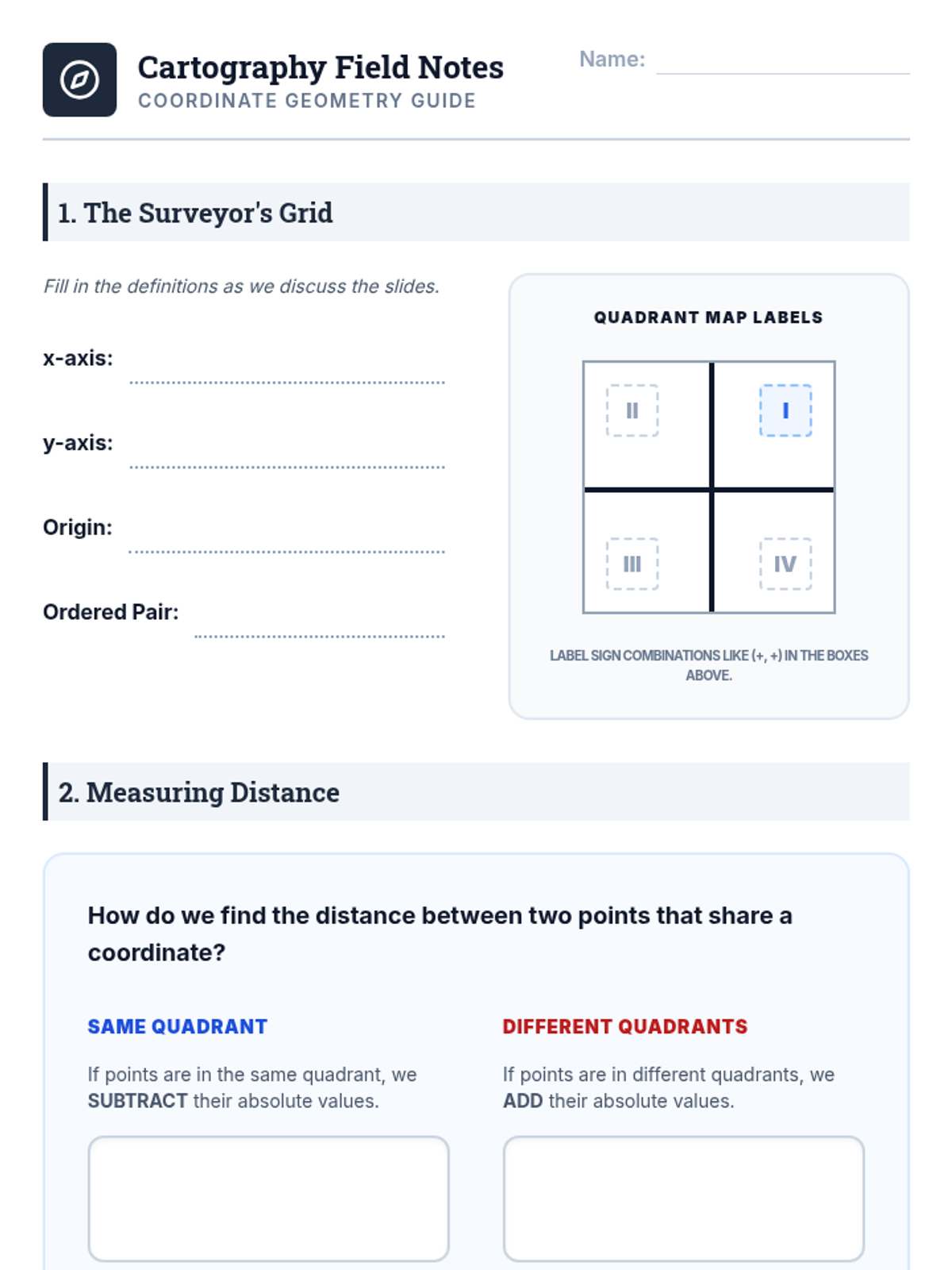
A guided notes document designed for students to follow along with the Cartography Slides. Includes fill-in-the-blank vocabulary, corrected quadrant labeling, distance formulas, and expanded work areas for calculations.
An 8-slide instructional presentation on the coordinate plane, plotting ordered pairs, finding distances, and mapping mixed quadrilaterals. Features a cartography-inspired theme with high-contrast visuals and functional grid layouts.
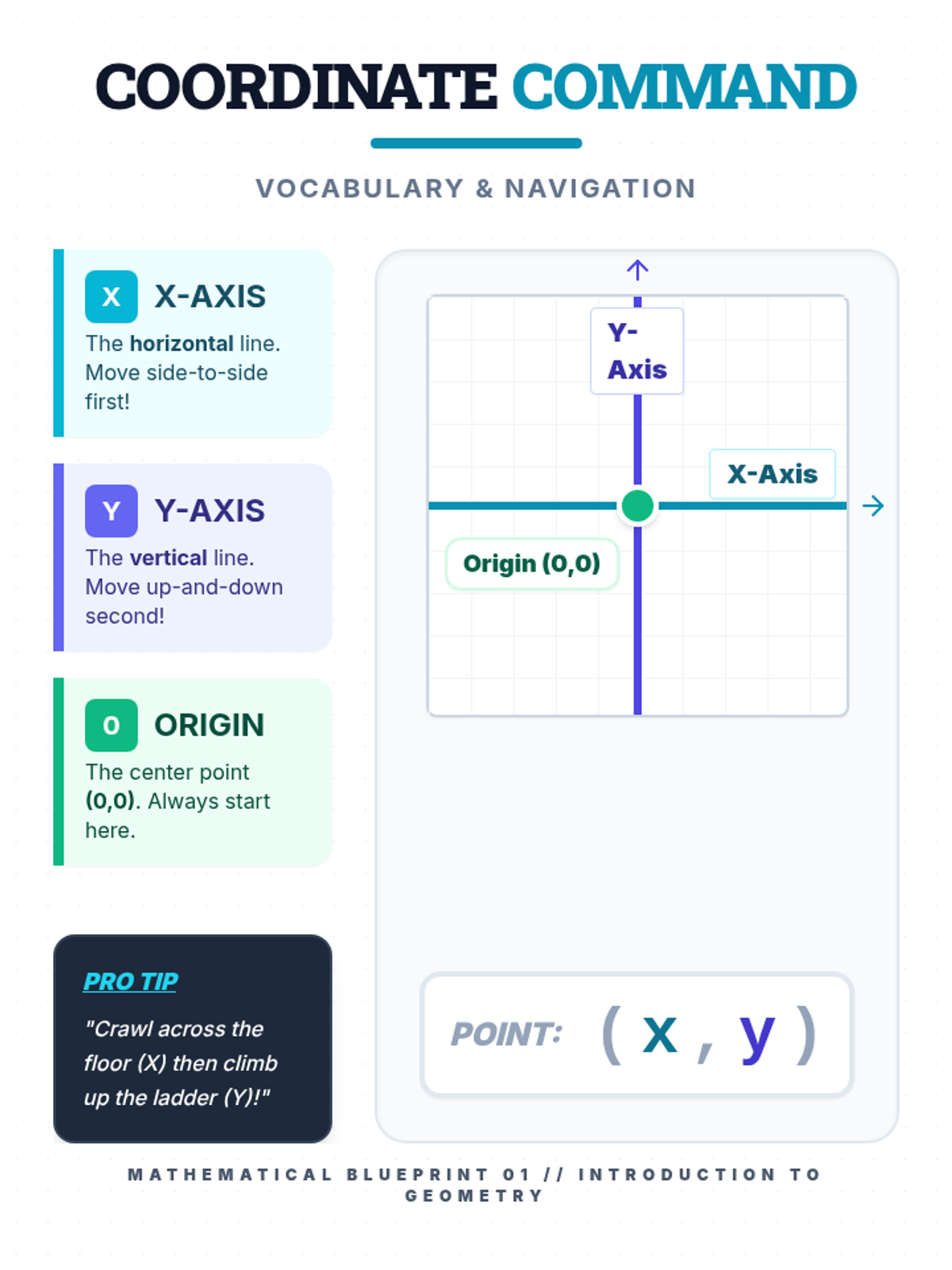
A single-page anchor chart for classroom display. Features high-contrast visuals for the x-axis, y-axis, and origin, with a clear coordinate formula and a helpful mnemonic. Designed to fit perfectly on one page.
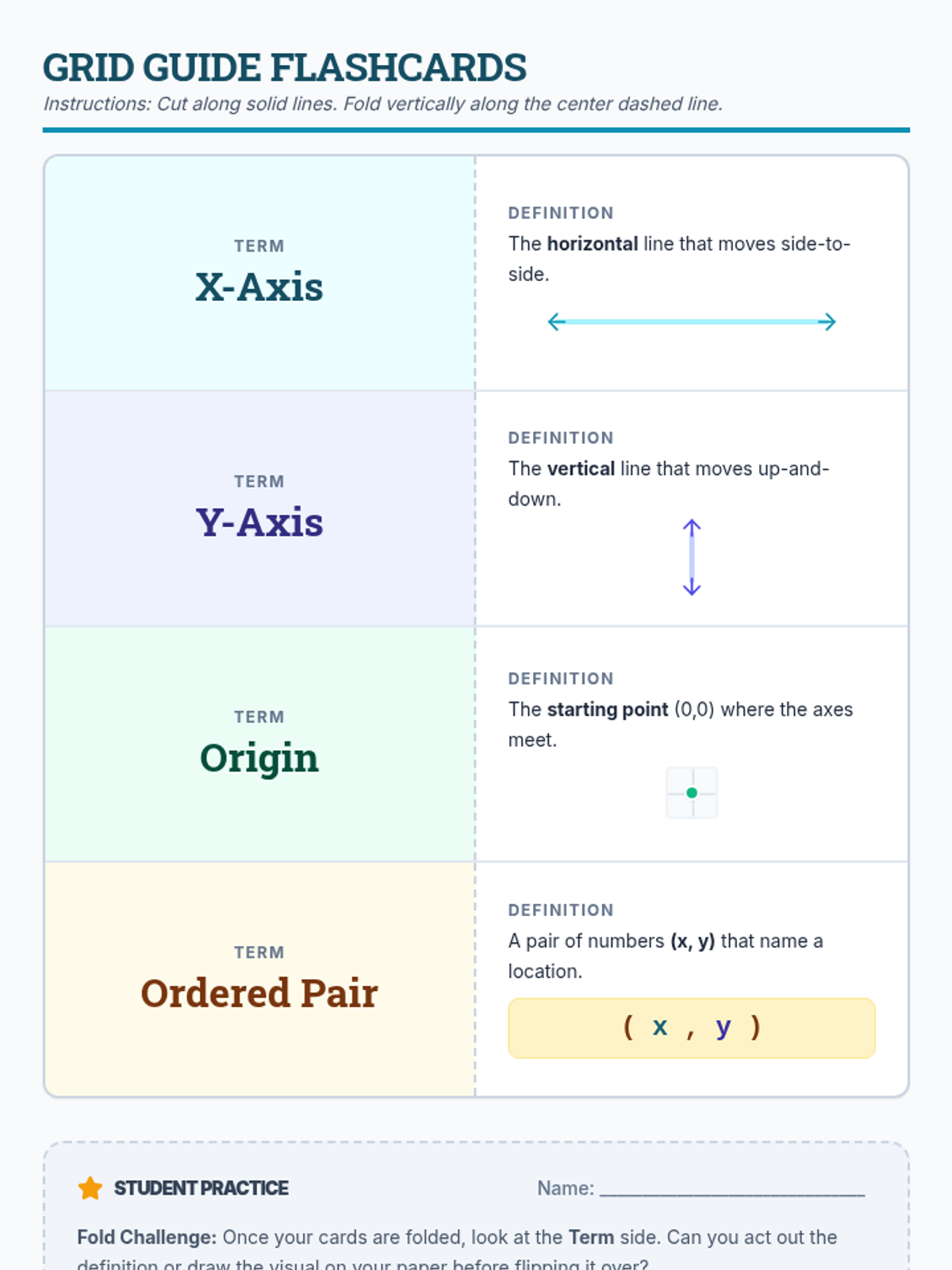
Set of vocabulary flashcards for coordinate plane basics (x-axis, y-axis, origin, and ordered pairs) with clear visual diagrams and easy-to-read definitions. Layout optimized for vertical folding and single-page printing.
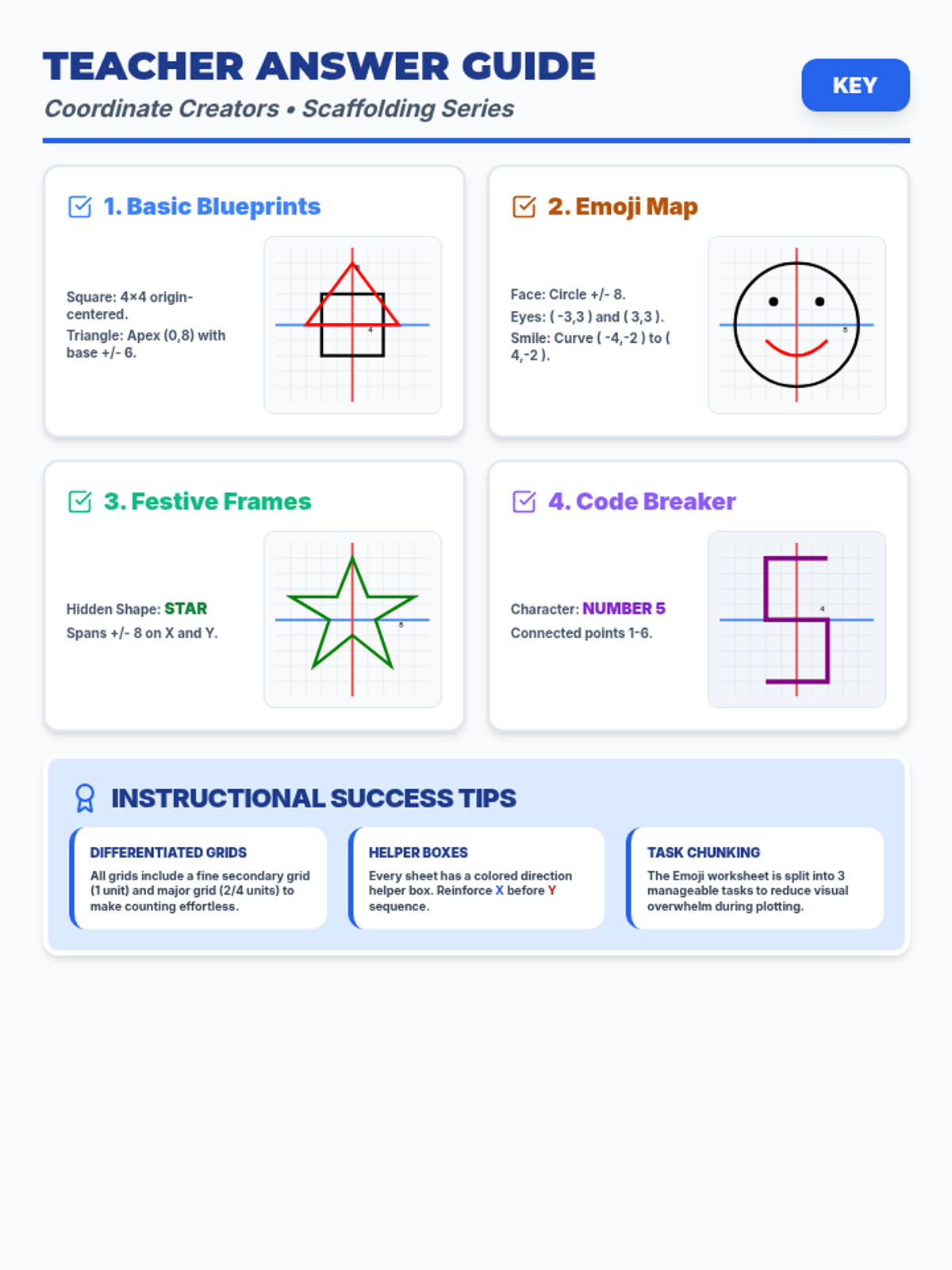
A comprehensive answer key and teacher guide for the 'Coordinate Creators' lesson. Includes visual solutions for all worksheets and specific instructional strategies for supporting IEP students.
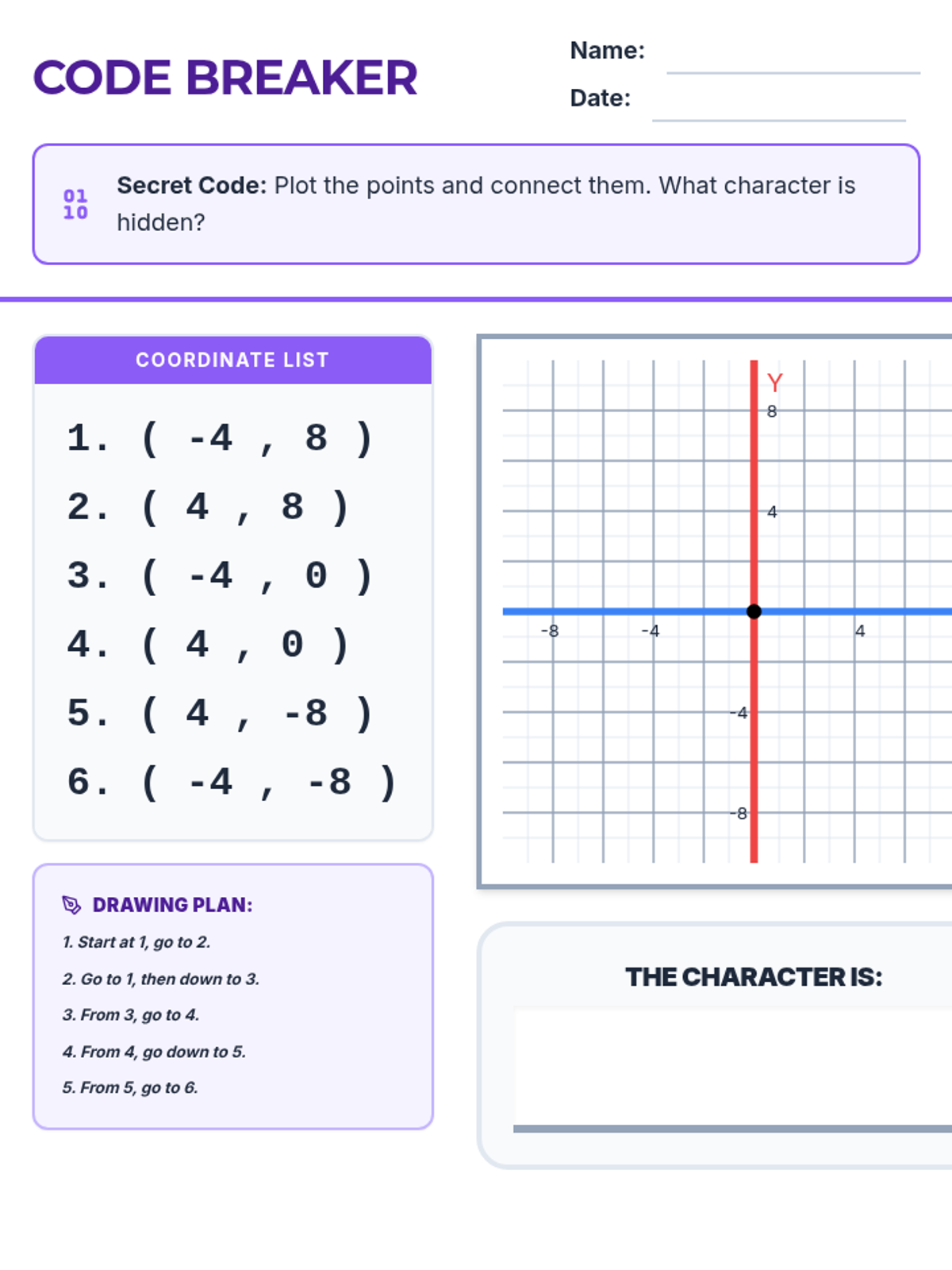
A coordinate plotting worksheet that reveals the number '5' or letter 'S' (depending on interpretation). Includes explicit pencil-lifting instructions to help students navigate complex paths.
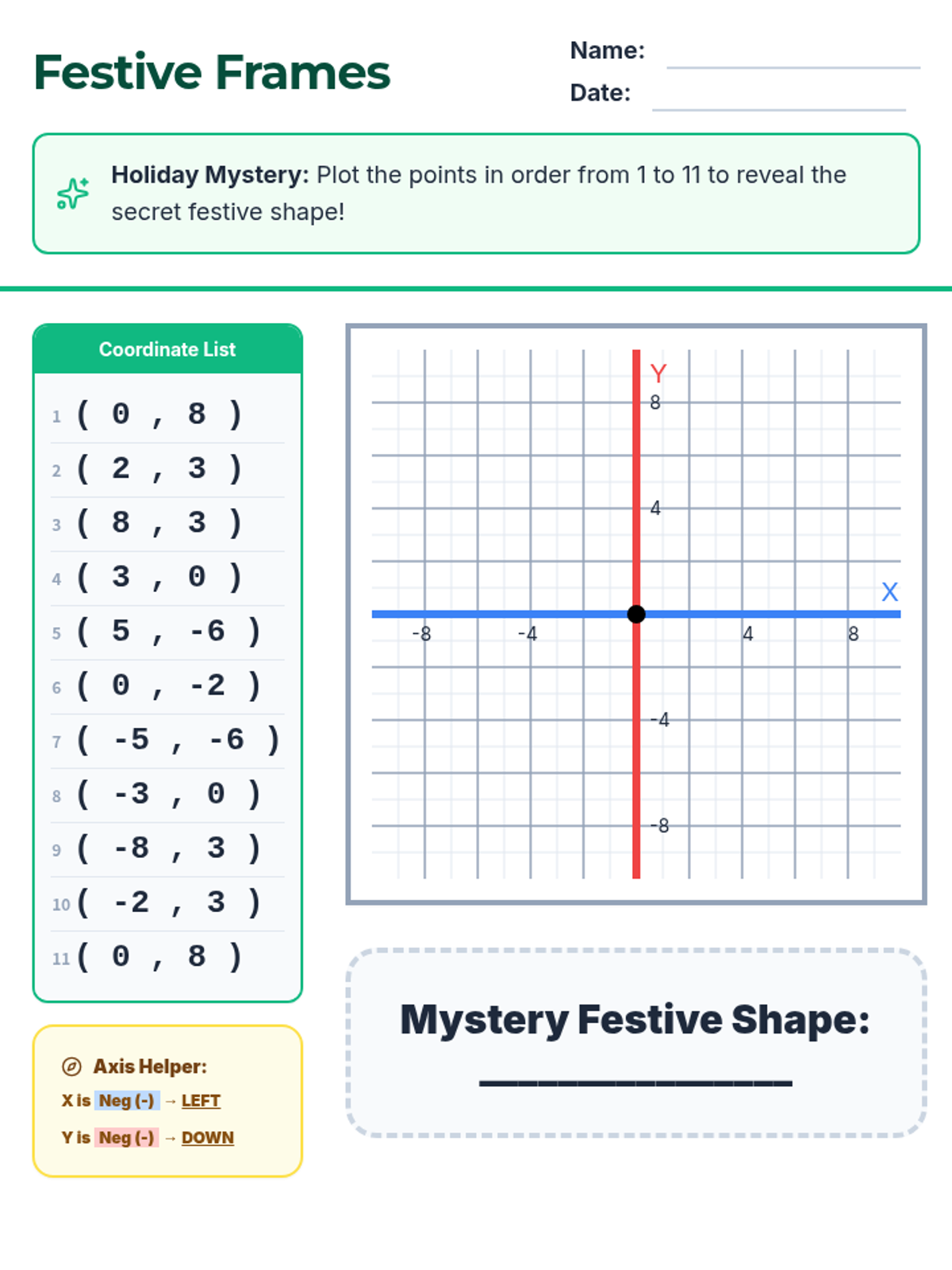
A mystery plotting activity revealing a holiday star. Designed with a clear, numbered list of coordinates and enlarged grid markers to support students with processing or visual-spatial challenges.
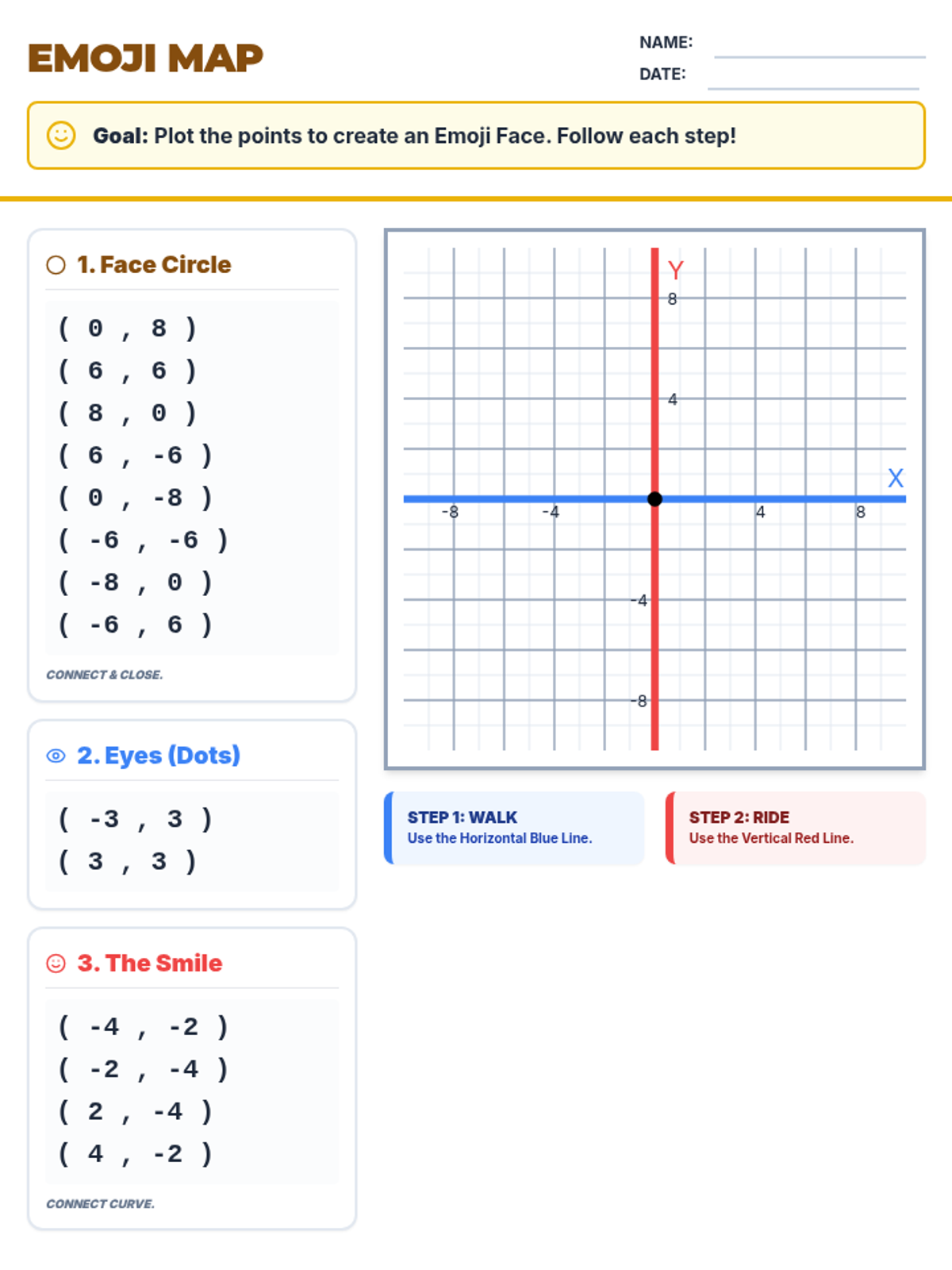
A creative coordinate plotting activity where students draw a happy face emoji. The activity is broken into three distinct parts (outline, eyes, smile) to help IEP students manage the task in smaller steps.
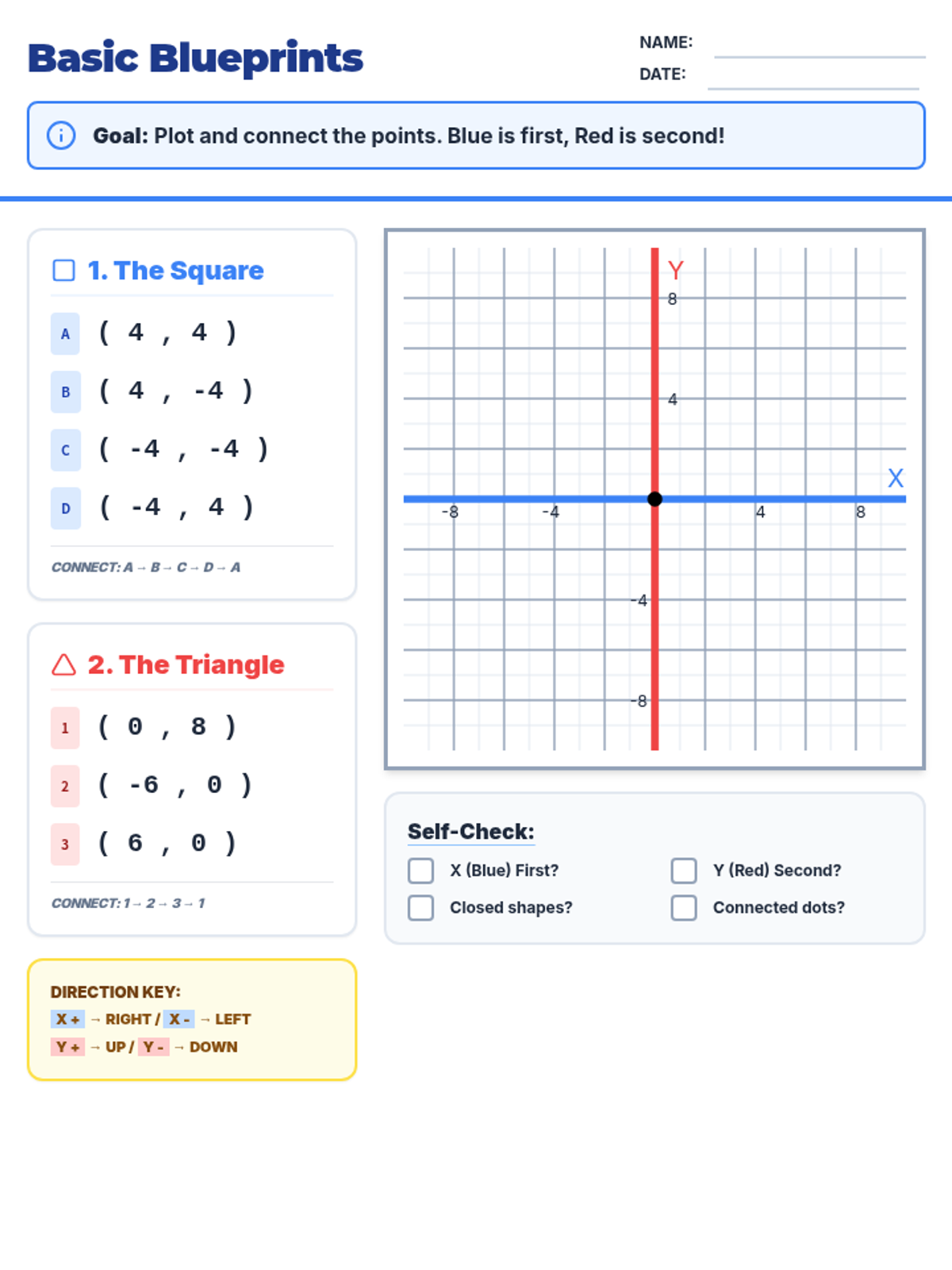
A scaffolded worksheet for plotting a square and a triangle. Features color-coded axes (blue X, red Y) and simplified instructions for IEP support.
Interactive slides introducing the 4-quadrant coordinate plane using the 'Elevator Rule' (x first, then y). Designed for IEP students with clear visual aids, color-coded axes, and large text.