Vector properties, magnitudes, and algebraic operations including addition and scalar multiplication. Introduces matrix representations, arithmetic, and computational techniques for solving linear systems.
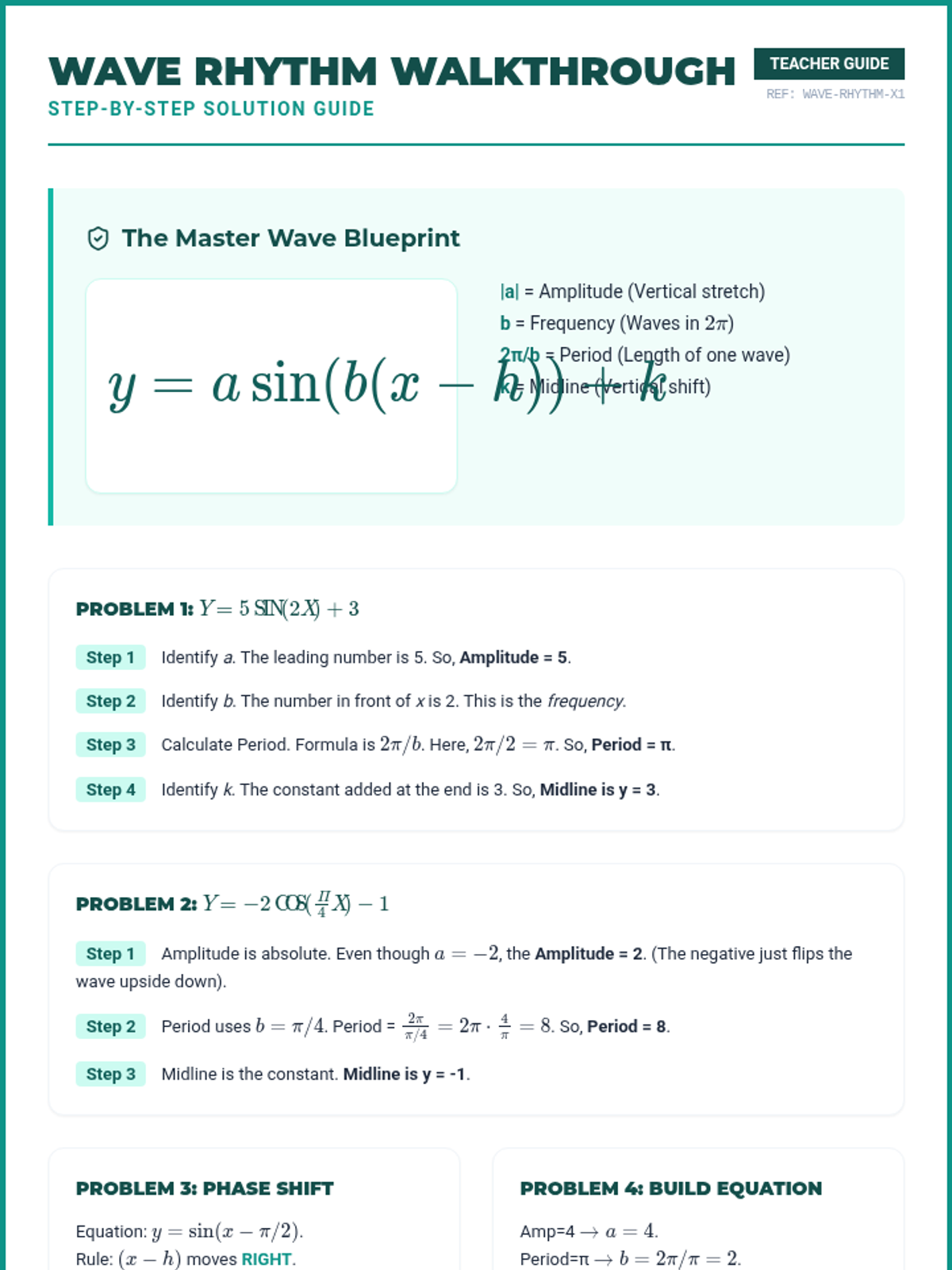
A detailed, step-by-step walkthrough of the Wave Rhythm Workout, breaking down the logic for core wave components, real-world modeling, and finding minimum values using the midline-amplitude blueprint.
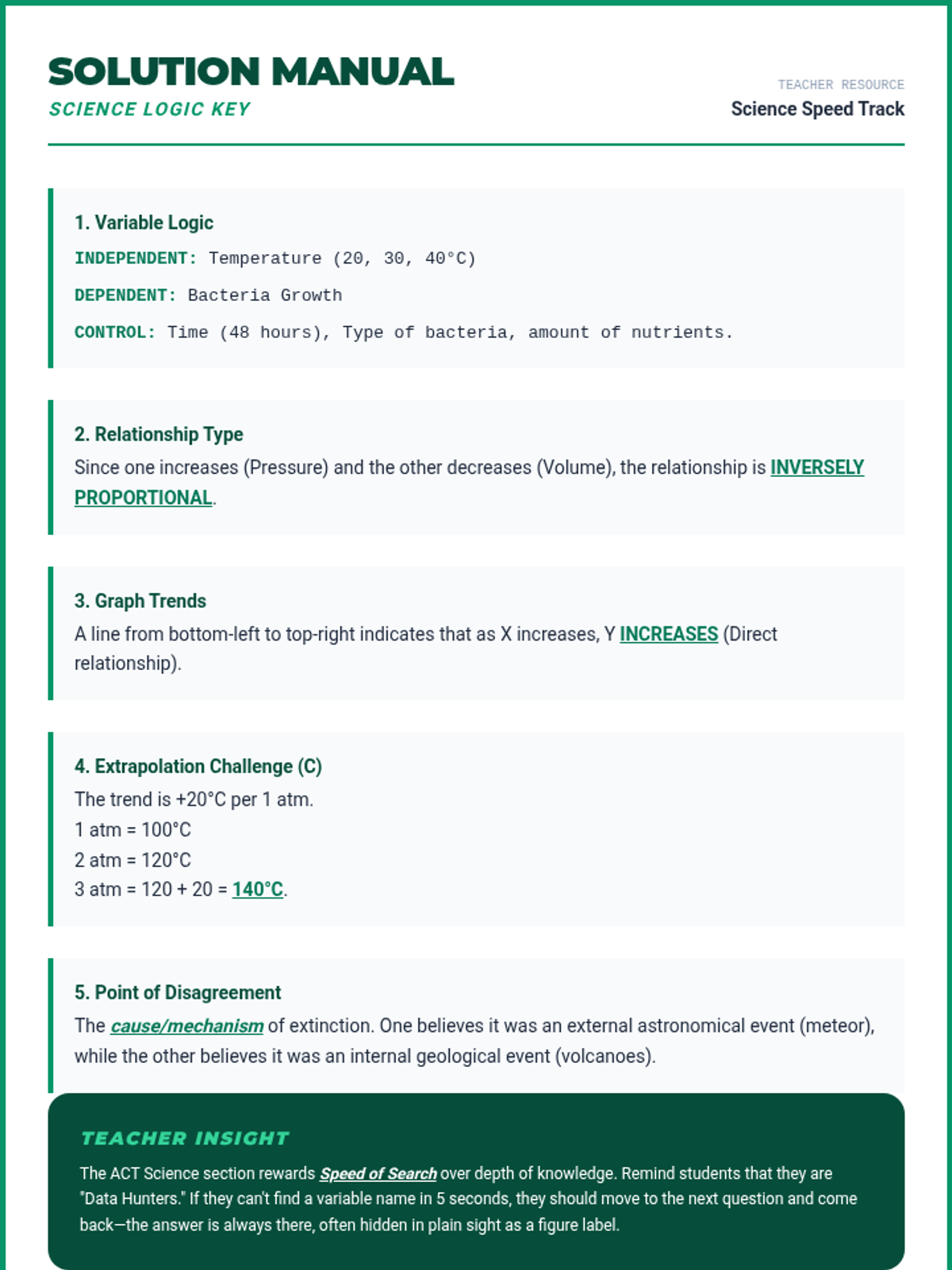
The detailed answer key for the Science Speed Logic Workout, providing explanations for variable identification, trend spotting, and scientific reasoning questions.
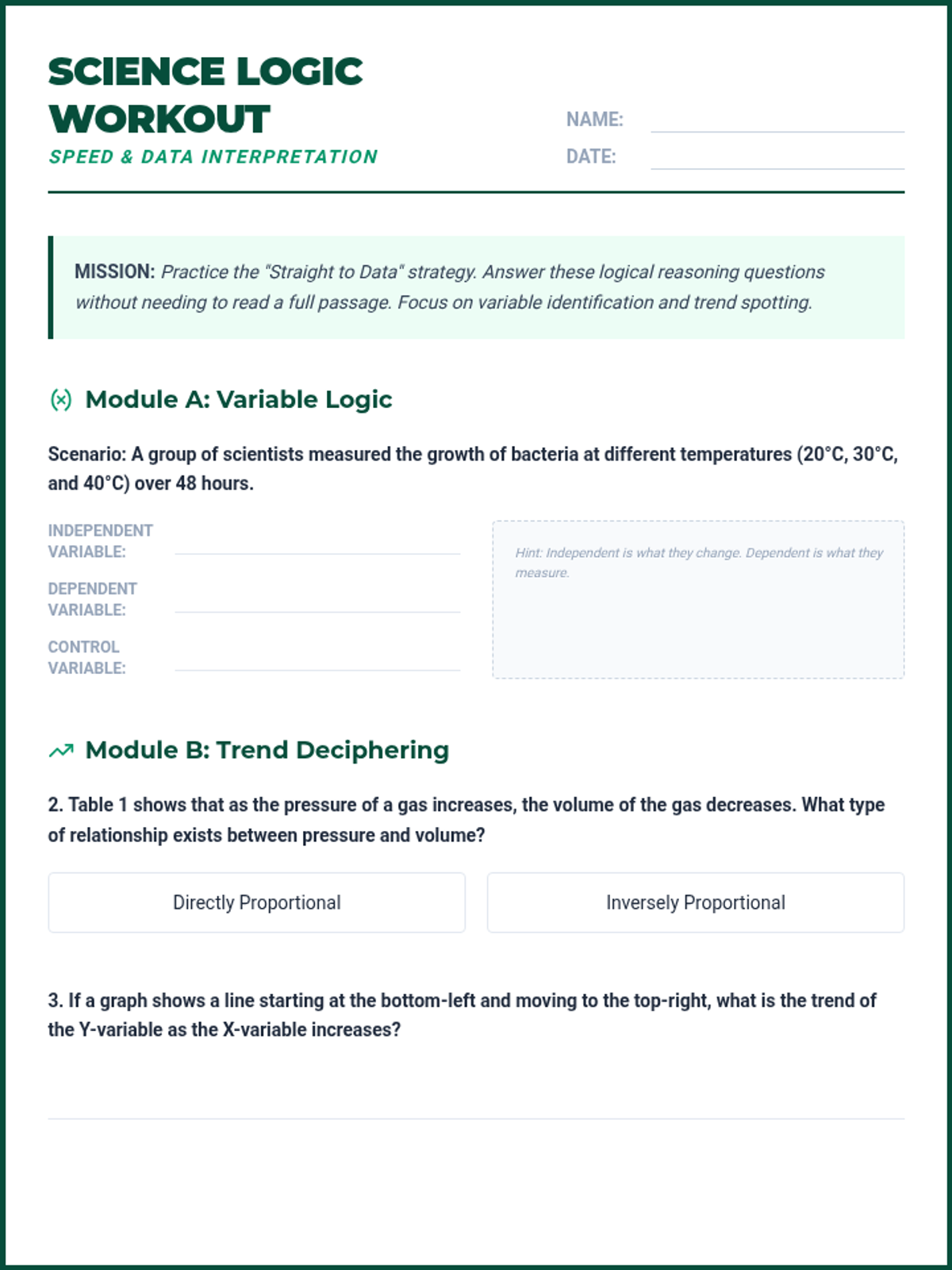
A specialized student practice worksheet for the ACT Science section, focusing on identifying independent/dependent variables, trend spotting, and basic scientific reasoning logic.
A visual slide deck covering strategic masterclass for the ACT Science section, focusing on speed-reading data sets, identifying experimental variables, and decoding scientific logic. This deck emphasizes the 'Straight to the Data' approach. Revised for font size compliance (min 24px).
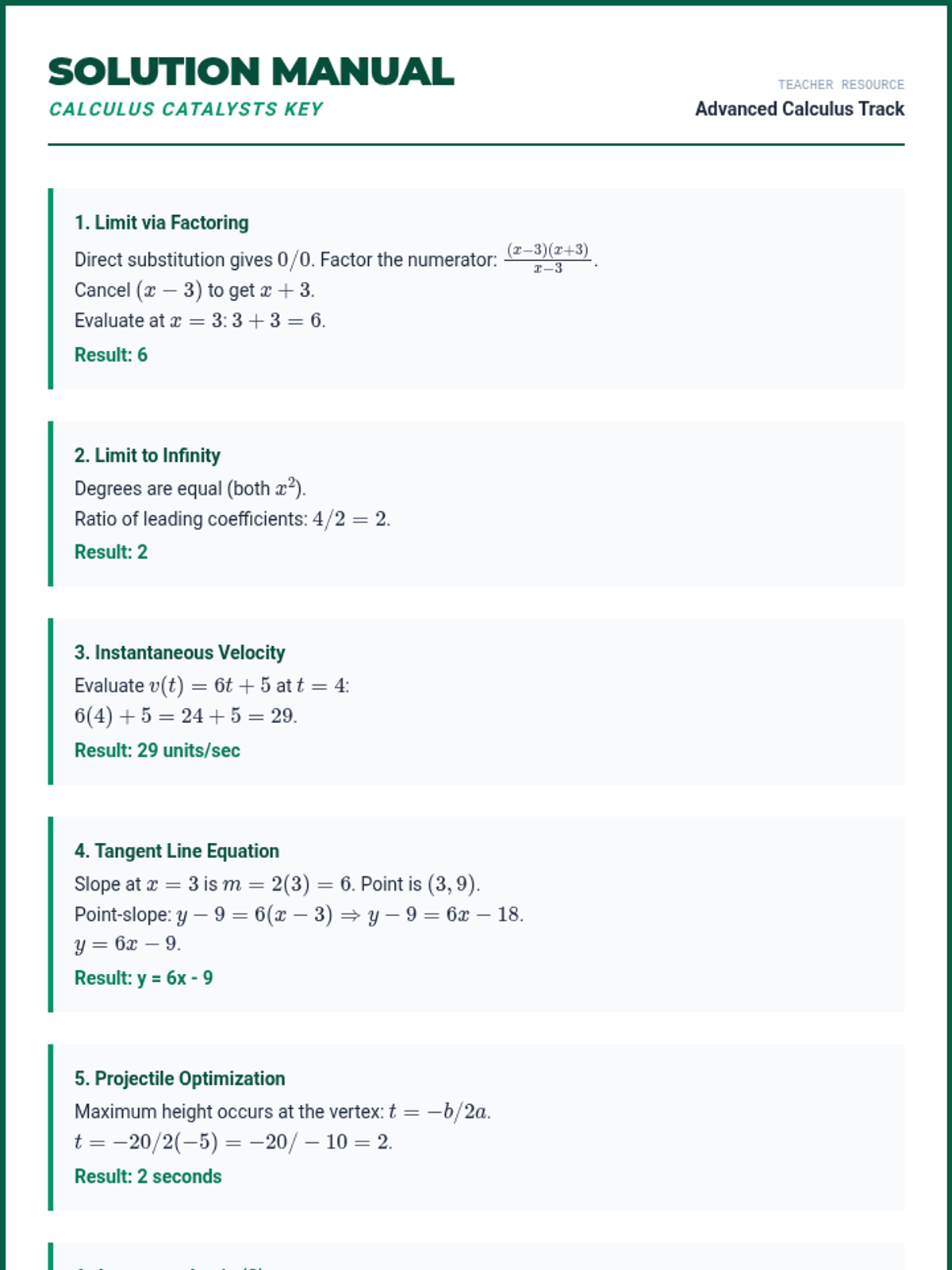
The detailed answer key for the Calculus Catalysts Workout, providing step-by-step solutions for limits, instantaneous rate of change, and basic function optimization problems.
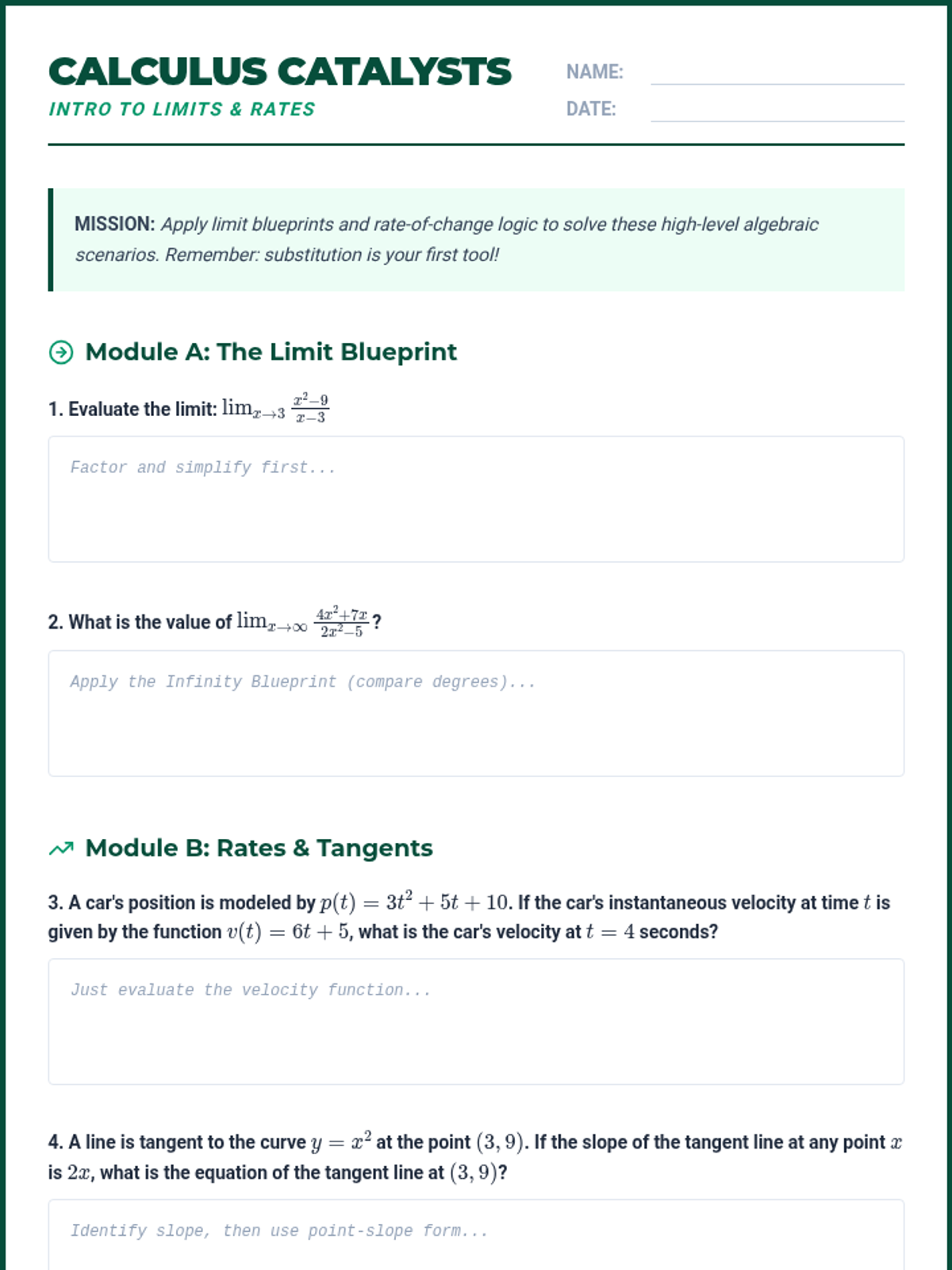
A student practice worksheet for calculus-adjacent ACT concepts, featuring limits, instantaneous rate of change logic, and function optimization problems.
A visual slide deck explaining introductory calculus concepts for the ACT, including limits, instantaneous rate of change, and basic function optimization using standard blueprints. Revised for font size compliance (min 24px).
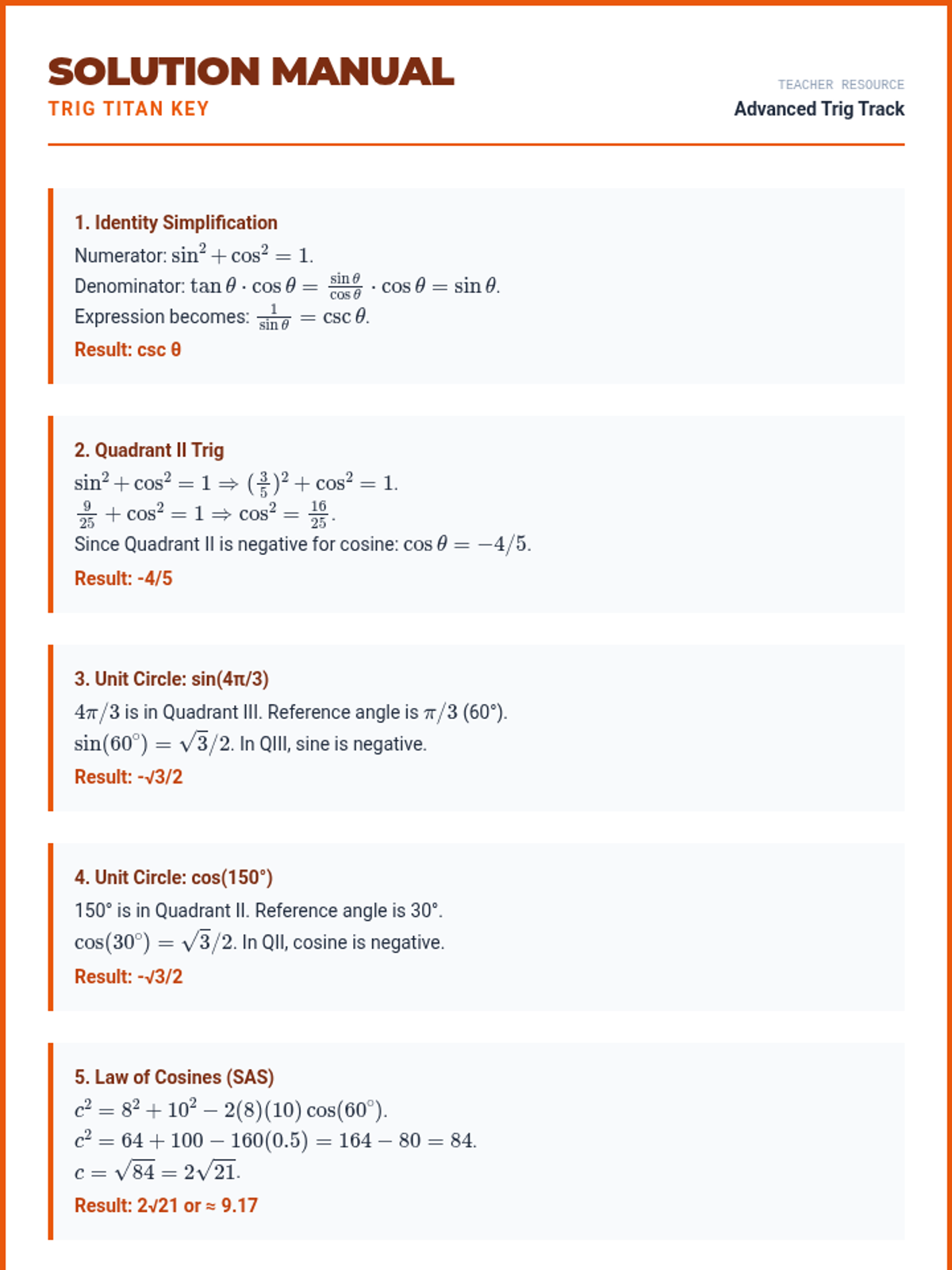
The detailed answer key for the Trig Titan Workout, including step-by-step solutions for identities, the unit circle, and non-right triangle problems.
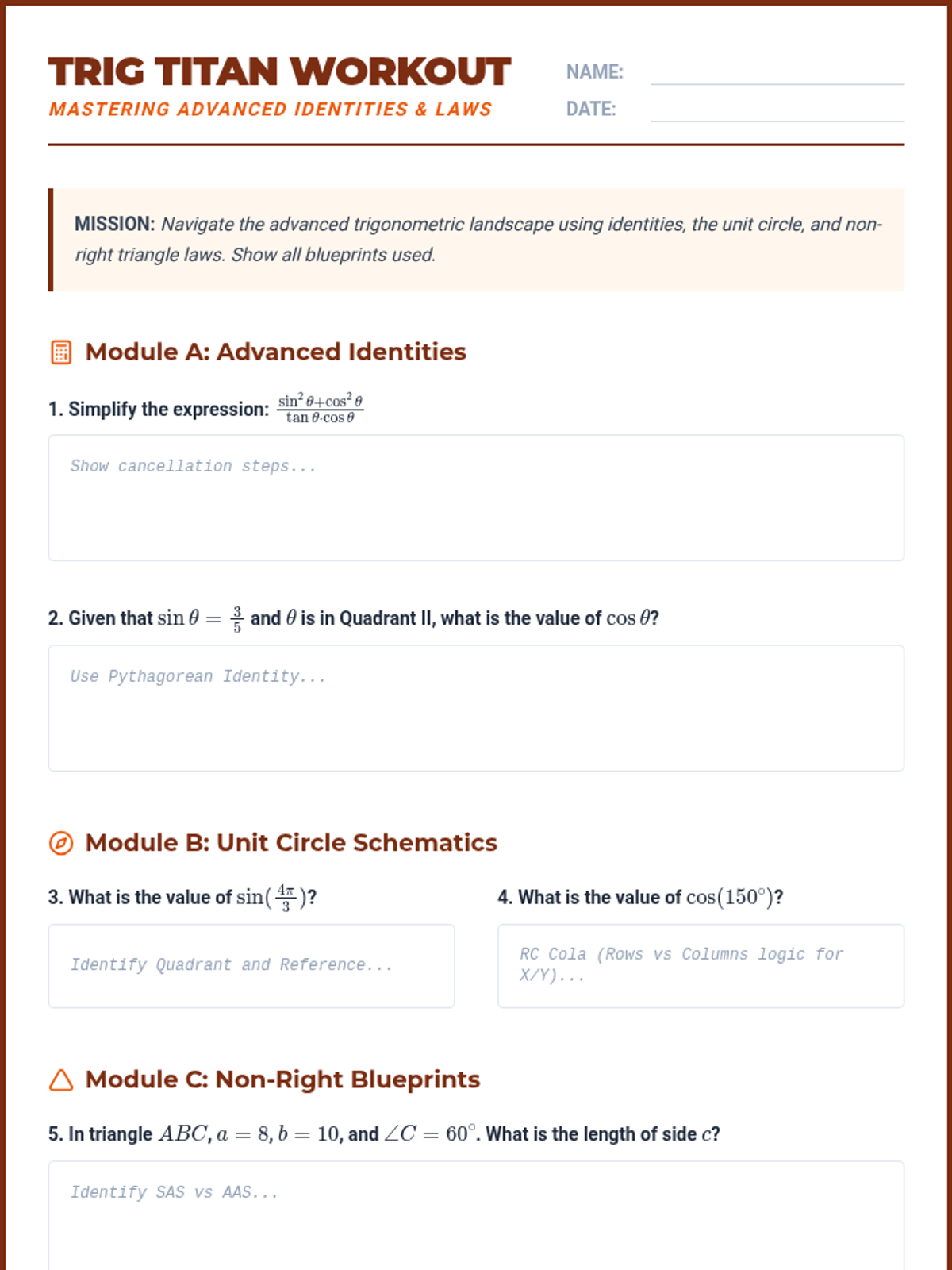
A comprehensive practice worksheet for advanced ACT trigonometry, featuring sections on identities, the unit circle, Law of Sines/Cosines, and 'Final Ten' challenge problems.
A visual slide deck covering advanced ACT trigonometry: Pythagorean identities, the unit circle, Law of Sines/Cosines, and the ambiguous SSA case. Revised for font size compliance (min 24px).
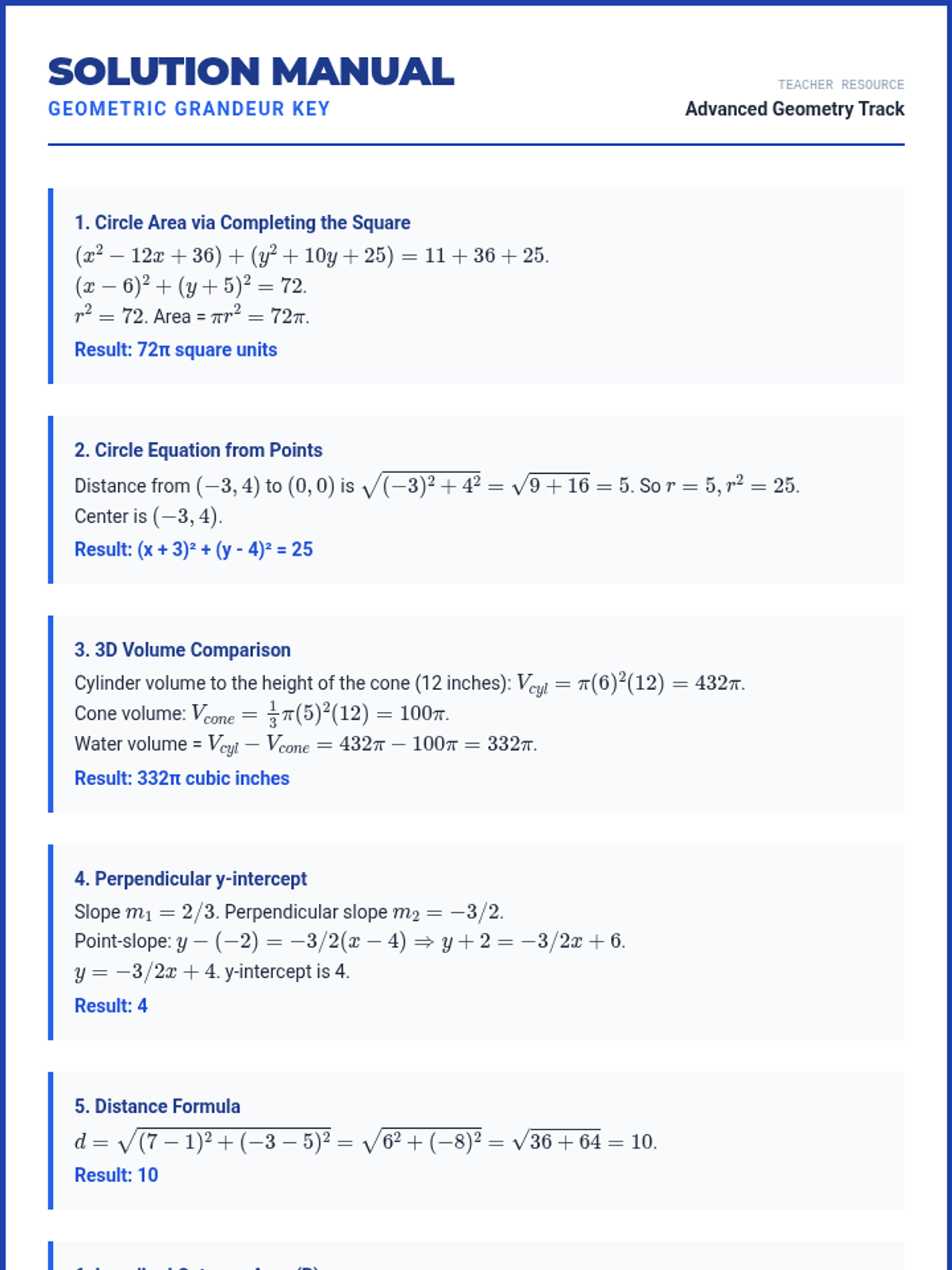
The detailed answer key for the Geometric Grandeur Workout, providing step-by-step solutions for circle equations, 3D volume, and coordinate geometry problems.
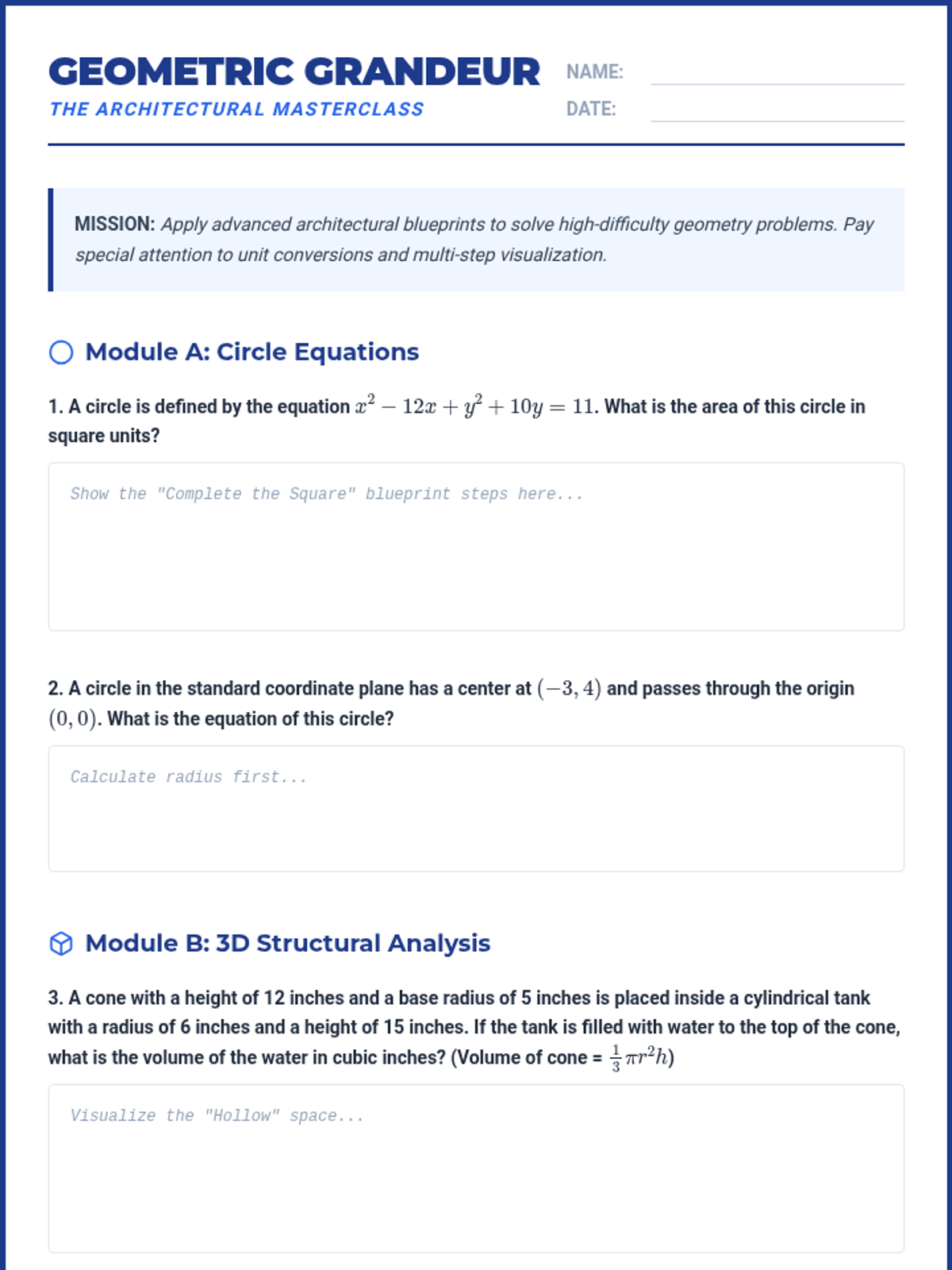
A specialized geometry workout featuring problems on circle equations, 3D volume visualization, and coordinate geometry, including advanced 'Final Ten' style challenges like inscribed octagons and 3D coordinate spheres.
A visual slide deck covering advanced ACT geometry topics: circle equations, 3D structural formulas, and coordinate geometry strategies. Revised for clarity and font size compliance.
A comprehensive 12-slide masterclass deck covering all 10 advanced subjects tested in the diagnostic quiz, including matrices, complex numbers, trig periods, circle equations, expected value, logs, remainder theorem, counting logic, vectors, and trig identities. Revised for font size compliance (min 24px).
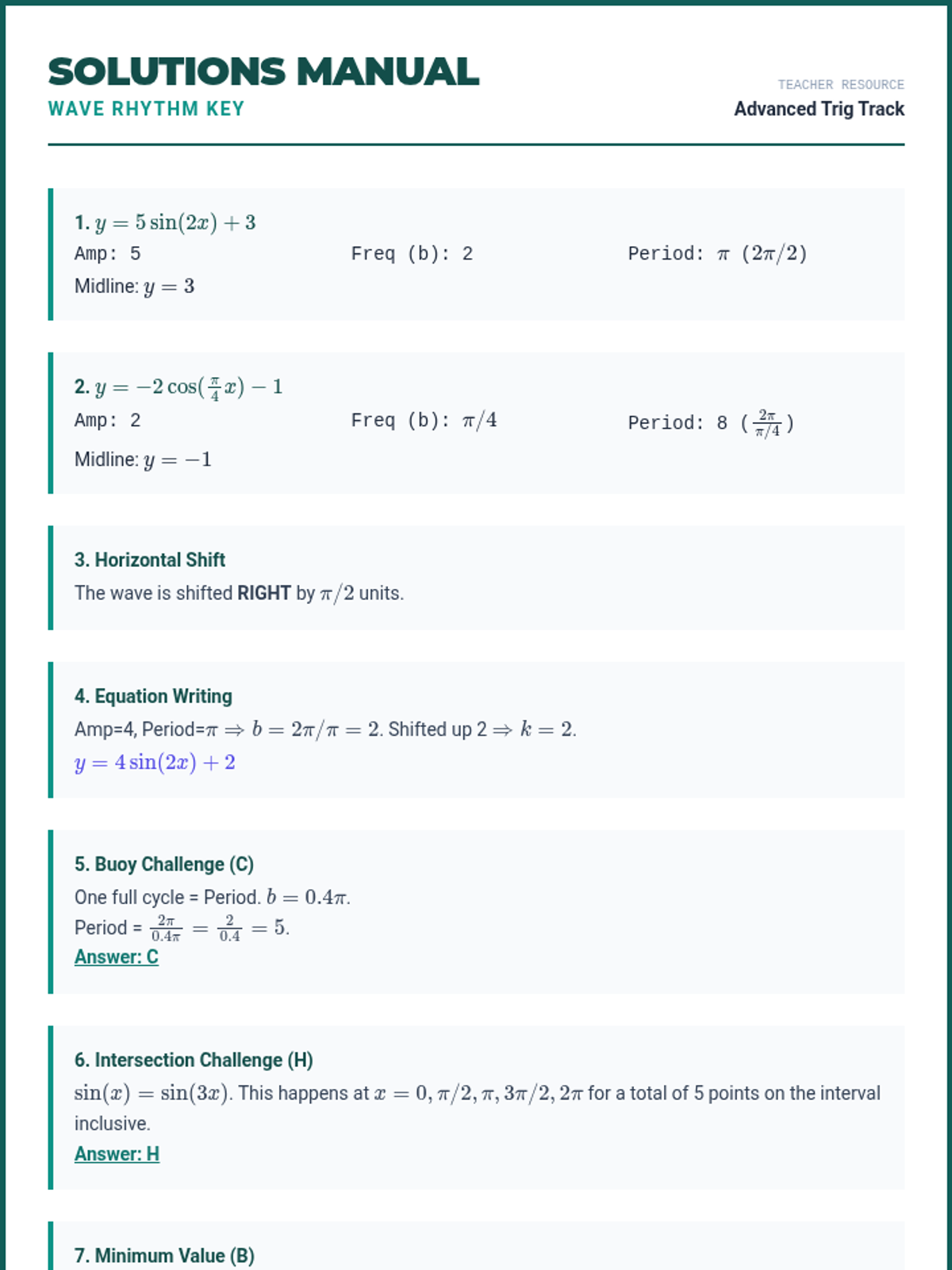
The detailed answer key for the Wave Rhythm Workout, featuring full step-by-step solutions and teacher insights for period, frequency, and wave modeling problems.
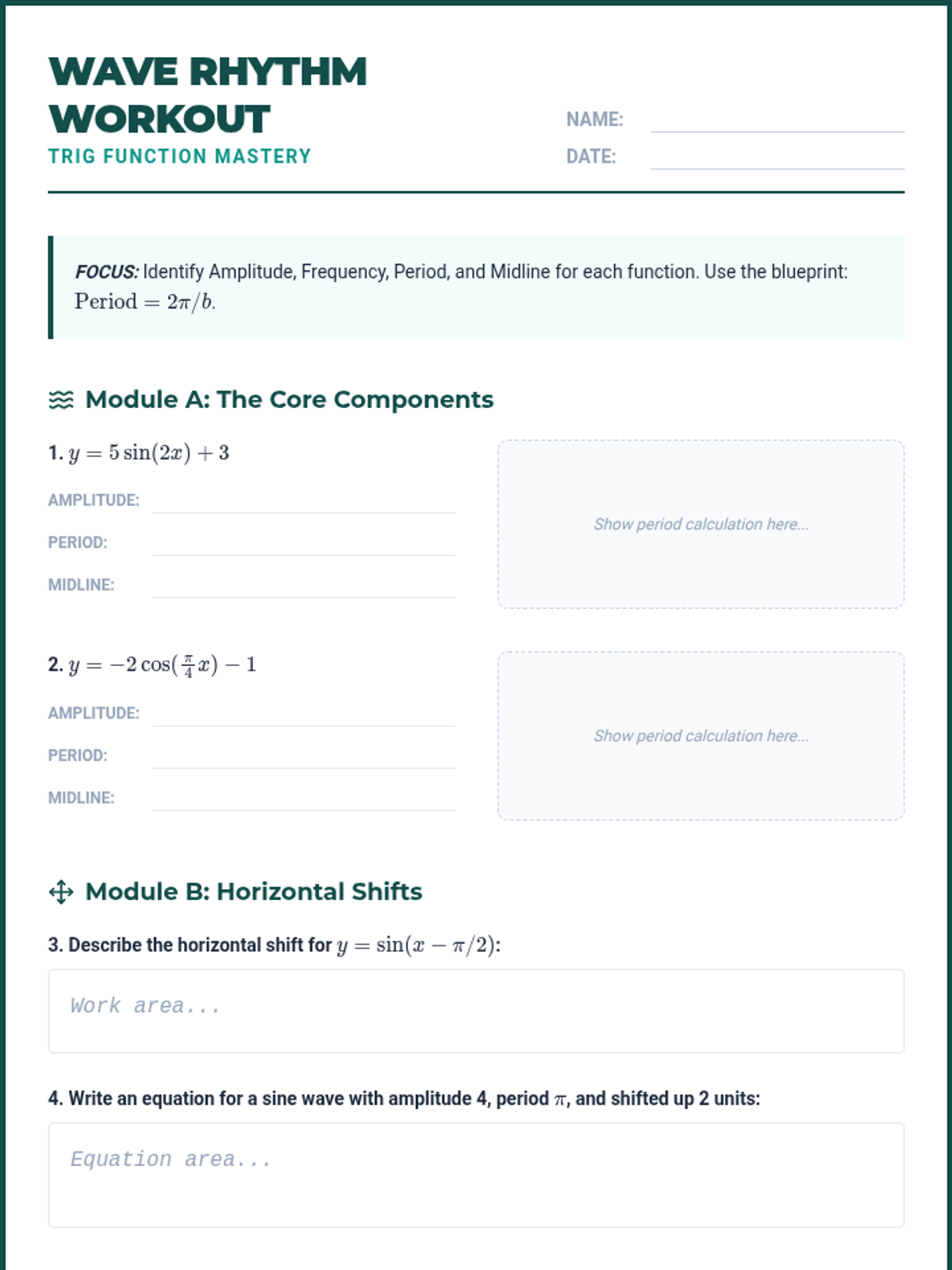
A specialized student worksheet focusing on trigonometric period, frequency, and wave components, featuring both basic identification and complex 'Final Ten' style scenario problems.
A visual slide deck explaining the components of trigonometric wave equations, with a specific focus on the 2π/b relationship for finding period from frequency. Revised for clarity and font size compliance.
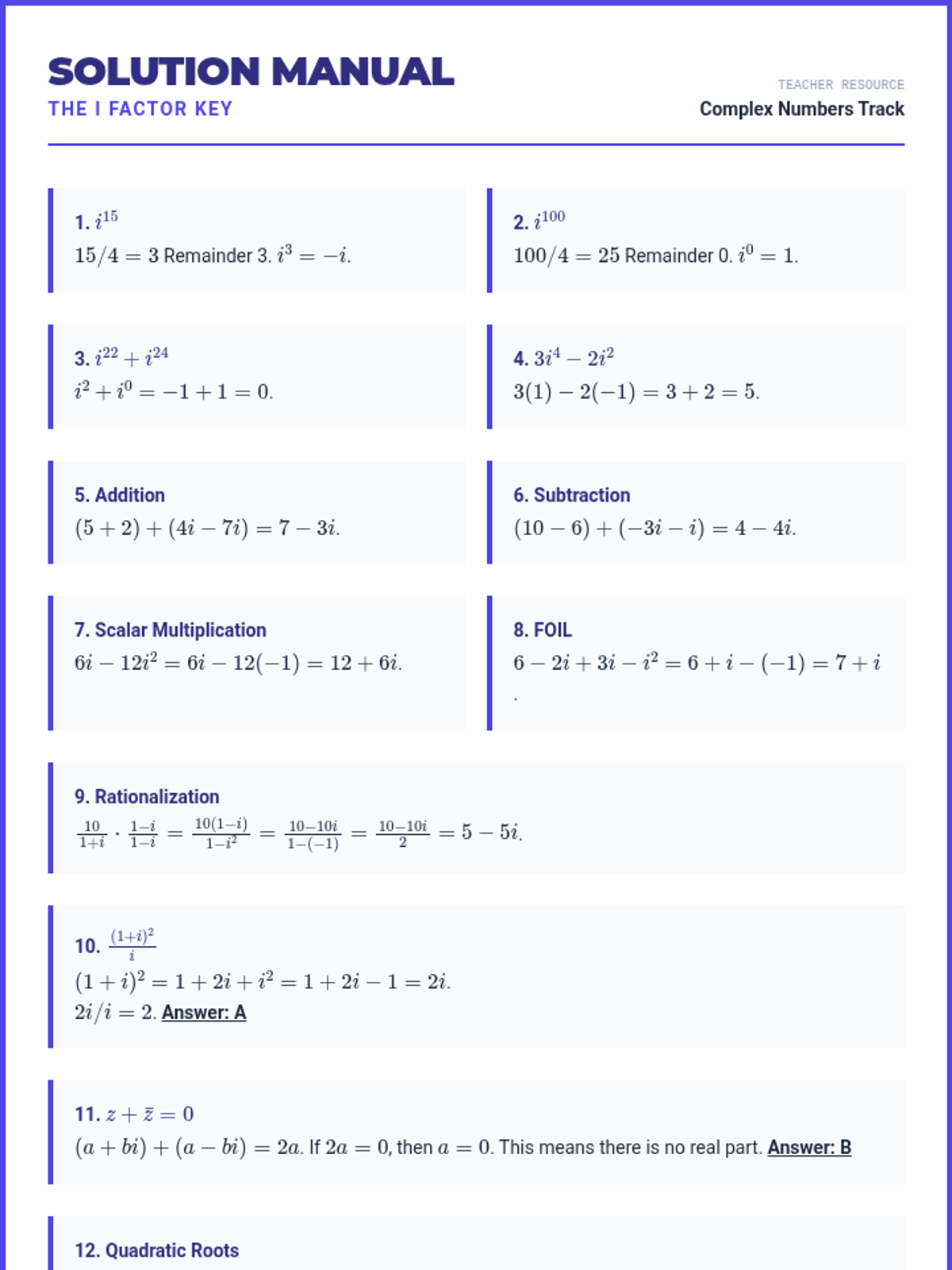
The detailed answer key for 'The i Factor Workout', featuring step-by-step solutions for powers of i, arithmetic operations, conjugates, and high-level ACT challenge problems.
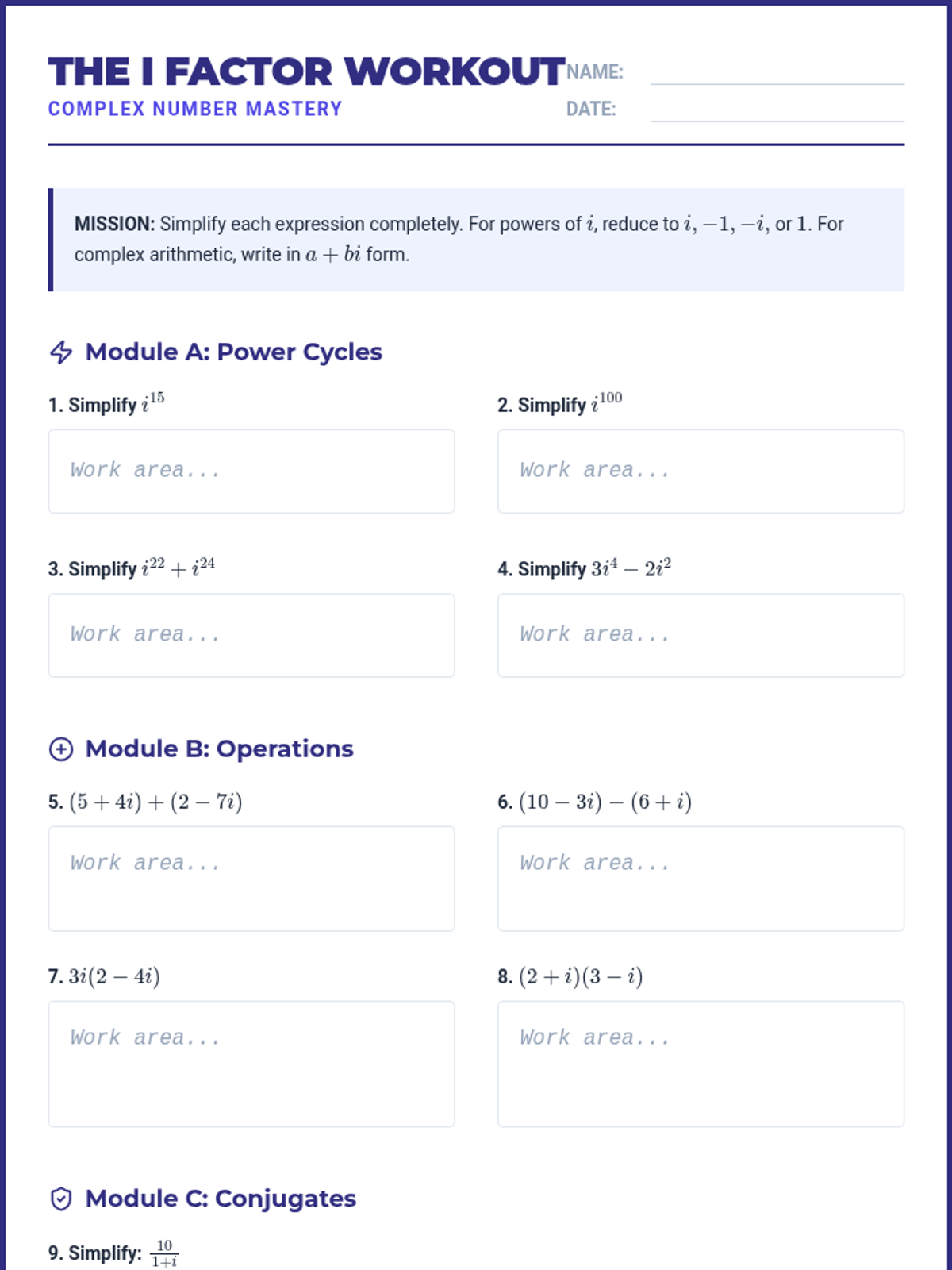
A comprehensive practice worksheet for complex numbers, featuring sections on powers of i, basic arithmetic, rationalizing with conjugates, and high-level ACT-style 'Final Ten' challenge problems.
A visual slide deck explaining imaginary and complex numbers, focusing on the definition of i, the cycle of powers, and essential arithmetic operations like multiplication and rationalizing denominators using conjugates. Revised for clarity and font size compliance.
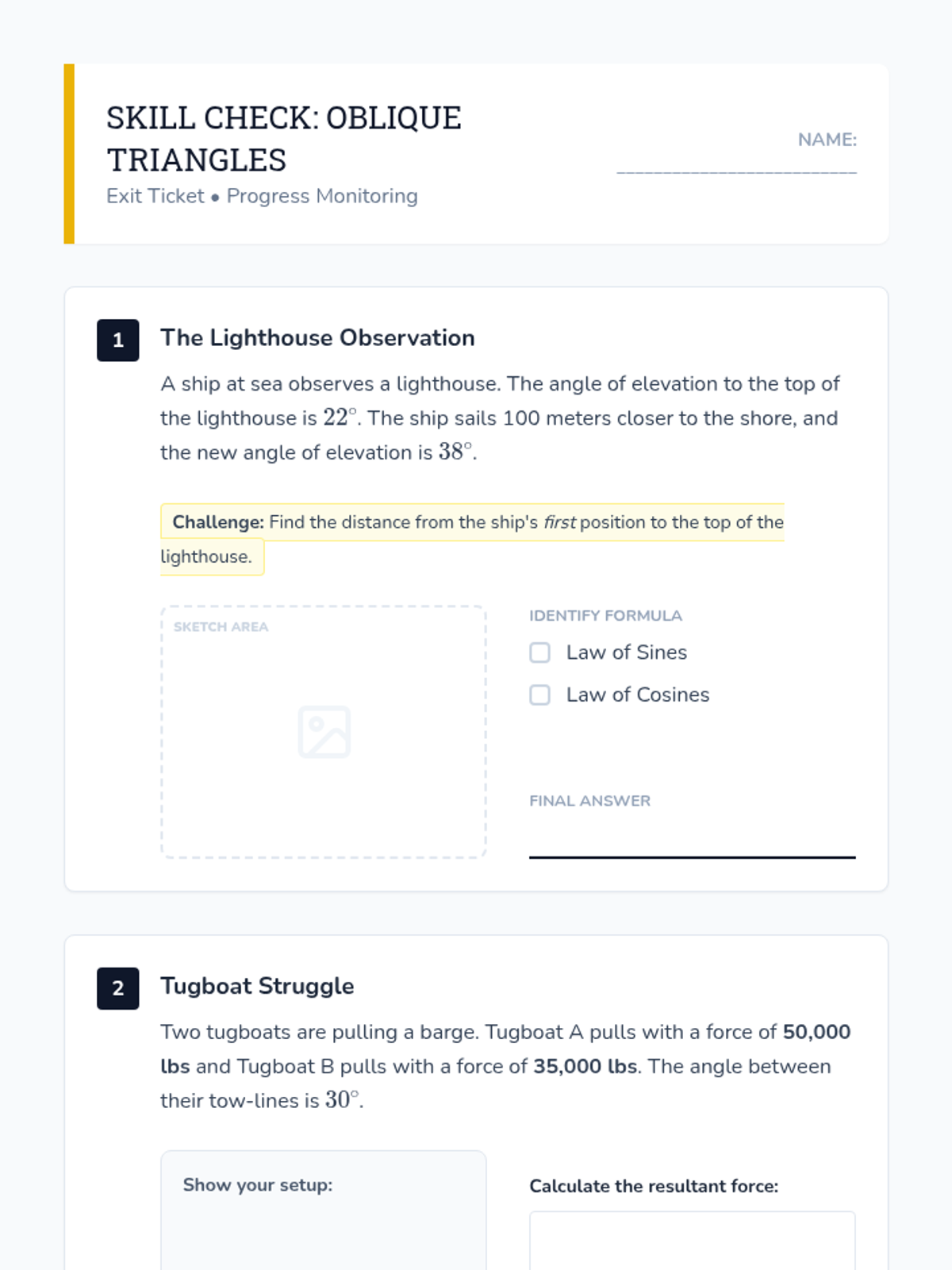
A short progress-monitoring exit ticket featuring a surveying problem and a force problem, including a student self-reflection component for Tier 2 assessment.
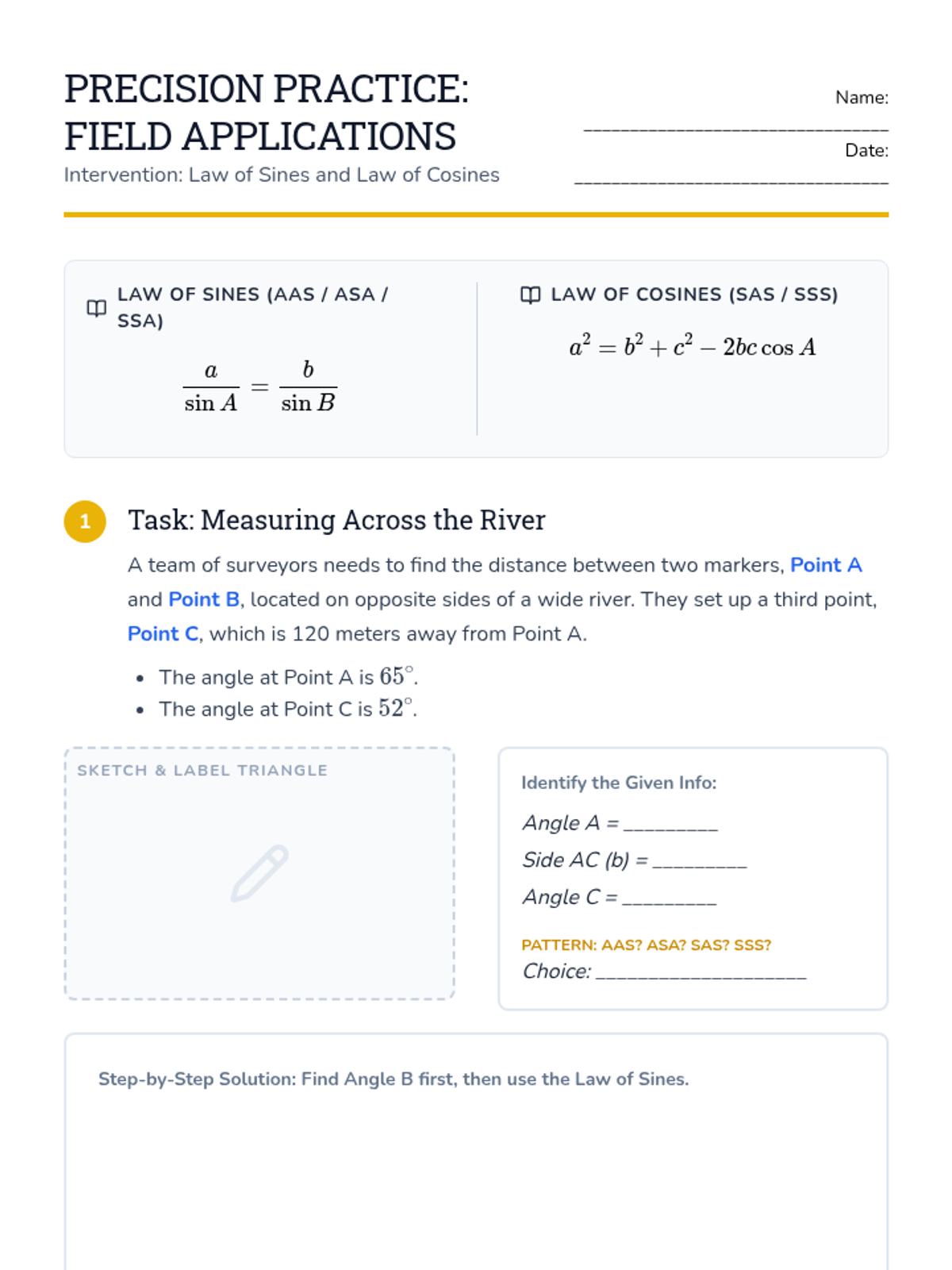
A scaffolded practice worksheet for students to apply the Laws of Sines and Cosines to real-world surveying and force problems. Includes space for sketching, identifying patterns, and step-by-step calculations.
Visual slide deck for instructing students on applying the Laws of Sines and Cosines to real-world scenarios in surveying and physics. High-contrast design with 24px+ font for visibility.
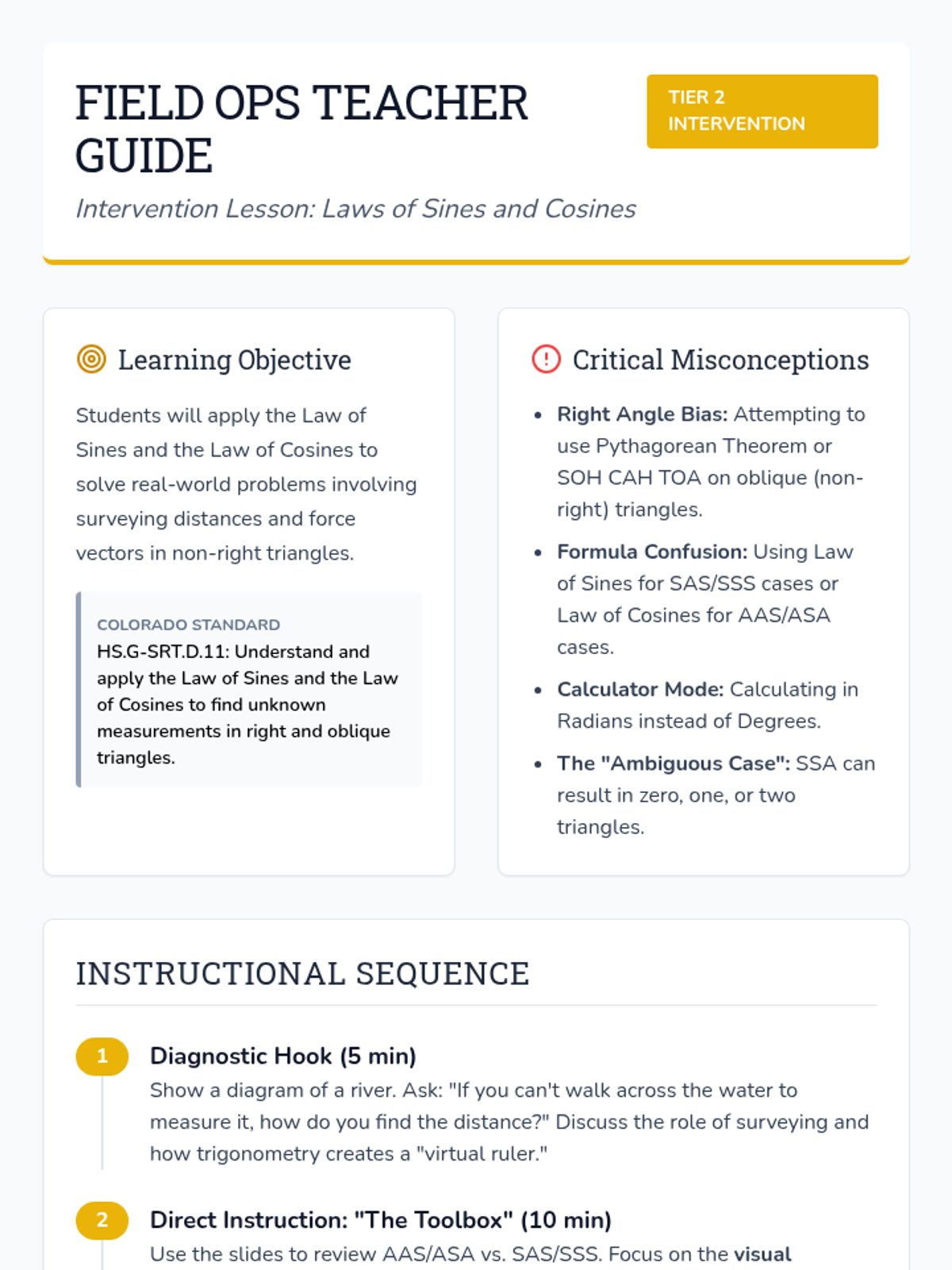
A comprehensive teacher guide for a Tier 2 intervention lesson on the Laws of Sines and Cosines, featuring learning objectives, instructional sequences, misconception alerts, and scaffolding strategies for struggling learners.
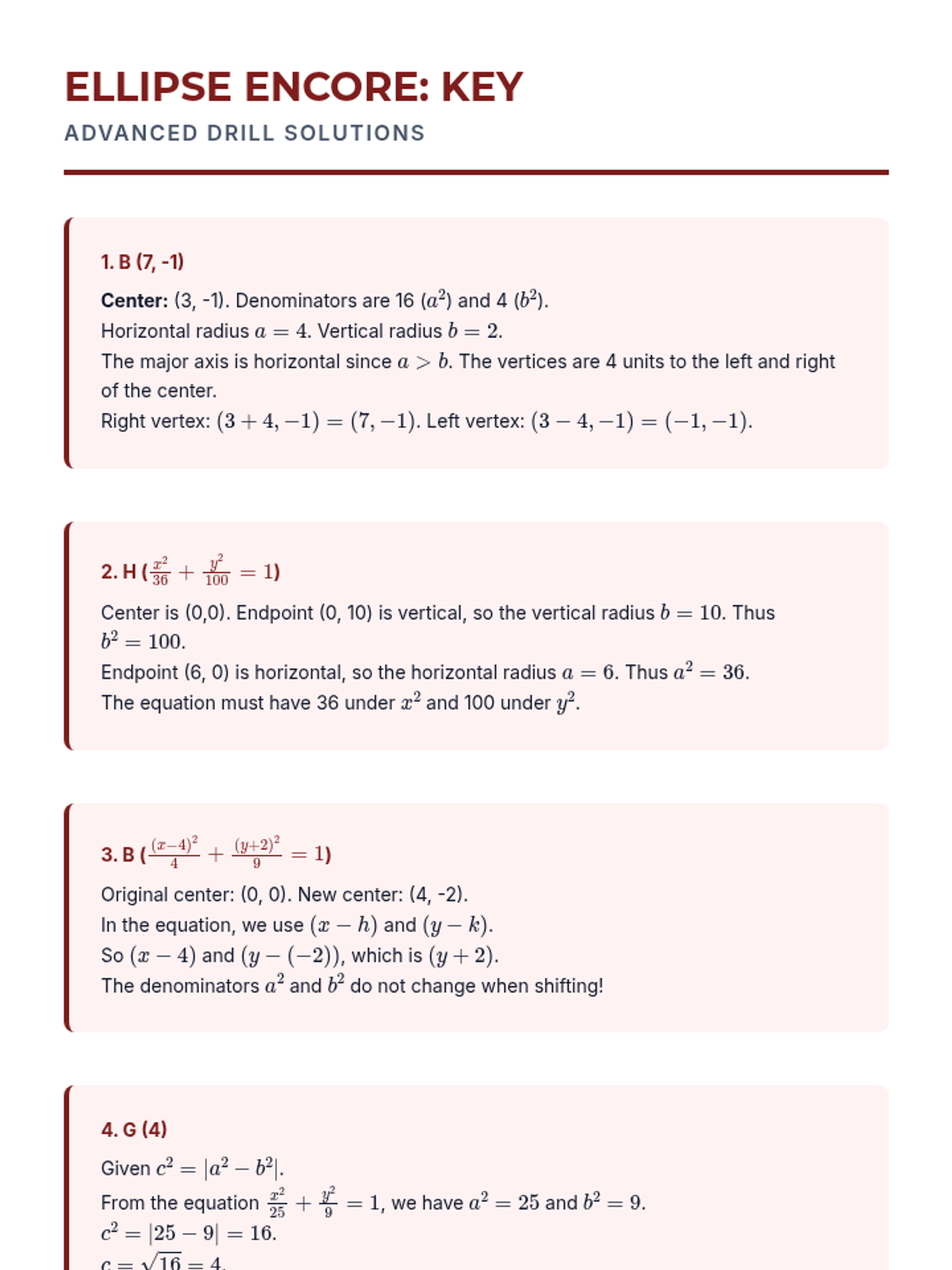
An answer key for the Ellipse Encore Drills, providing step-by-step mathematical breakdowns for advanced ellipse coordinate and focus problems.
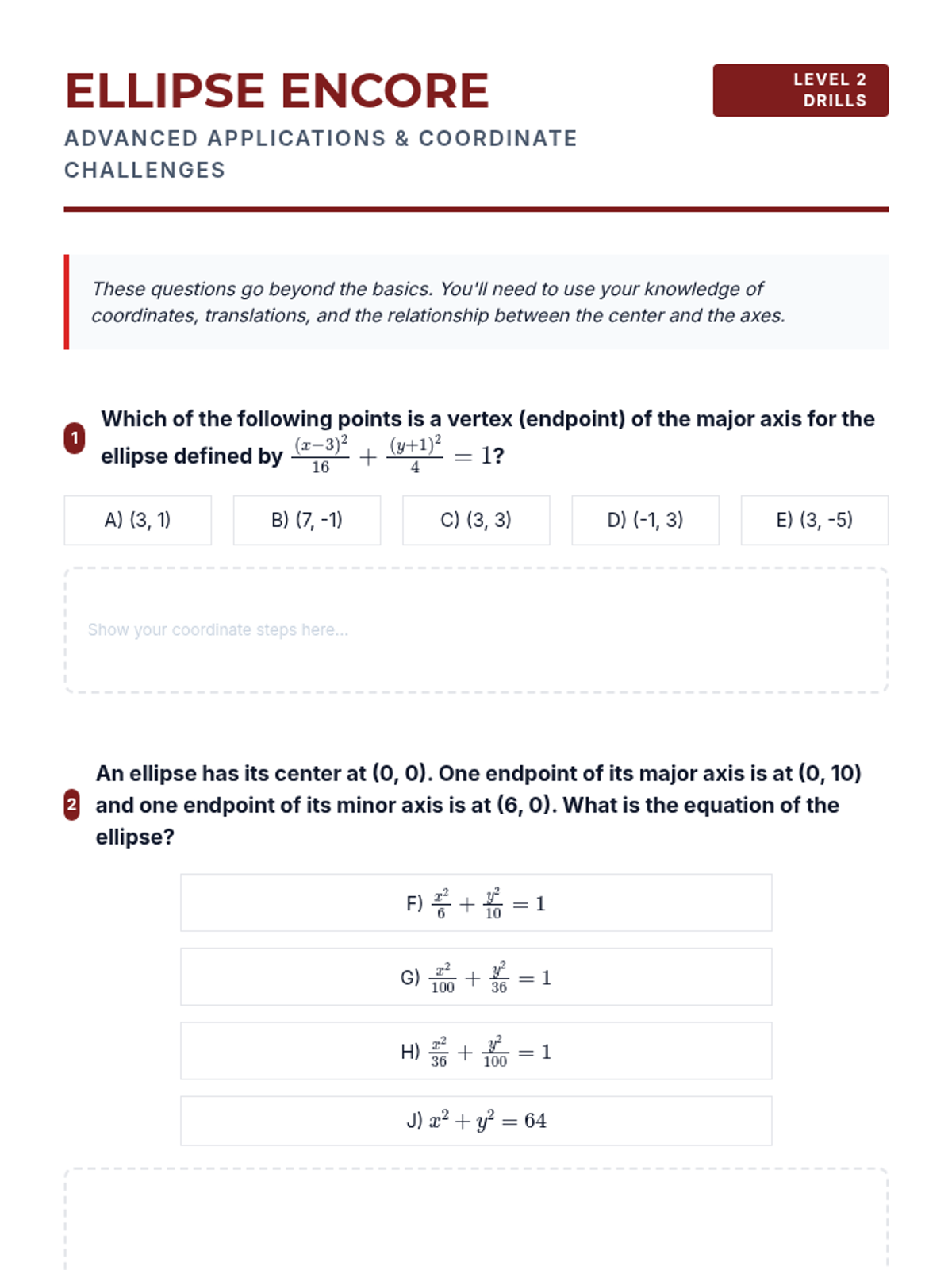
An advanced practice worksheet for ellipses, covering vertex coordinates, axis endpoints, translations, and foci calculations.
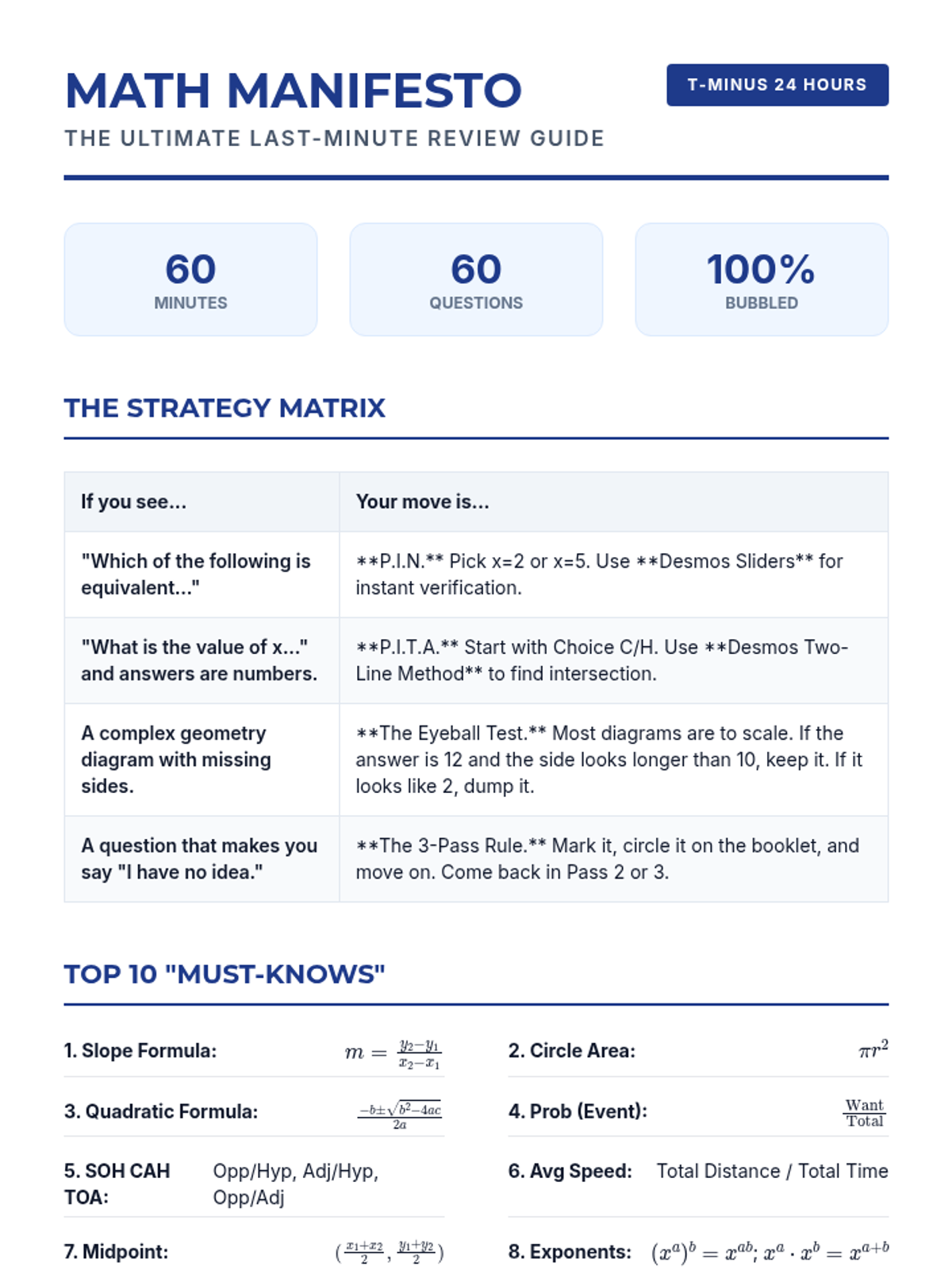
A high-density last-minute review guide for the ACT Math section, featuring a strategy matrix, common traps, top formulas, and a pre-test checklist.
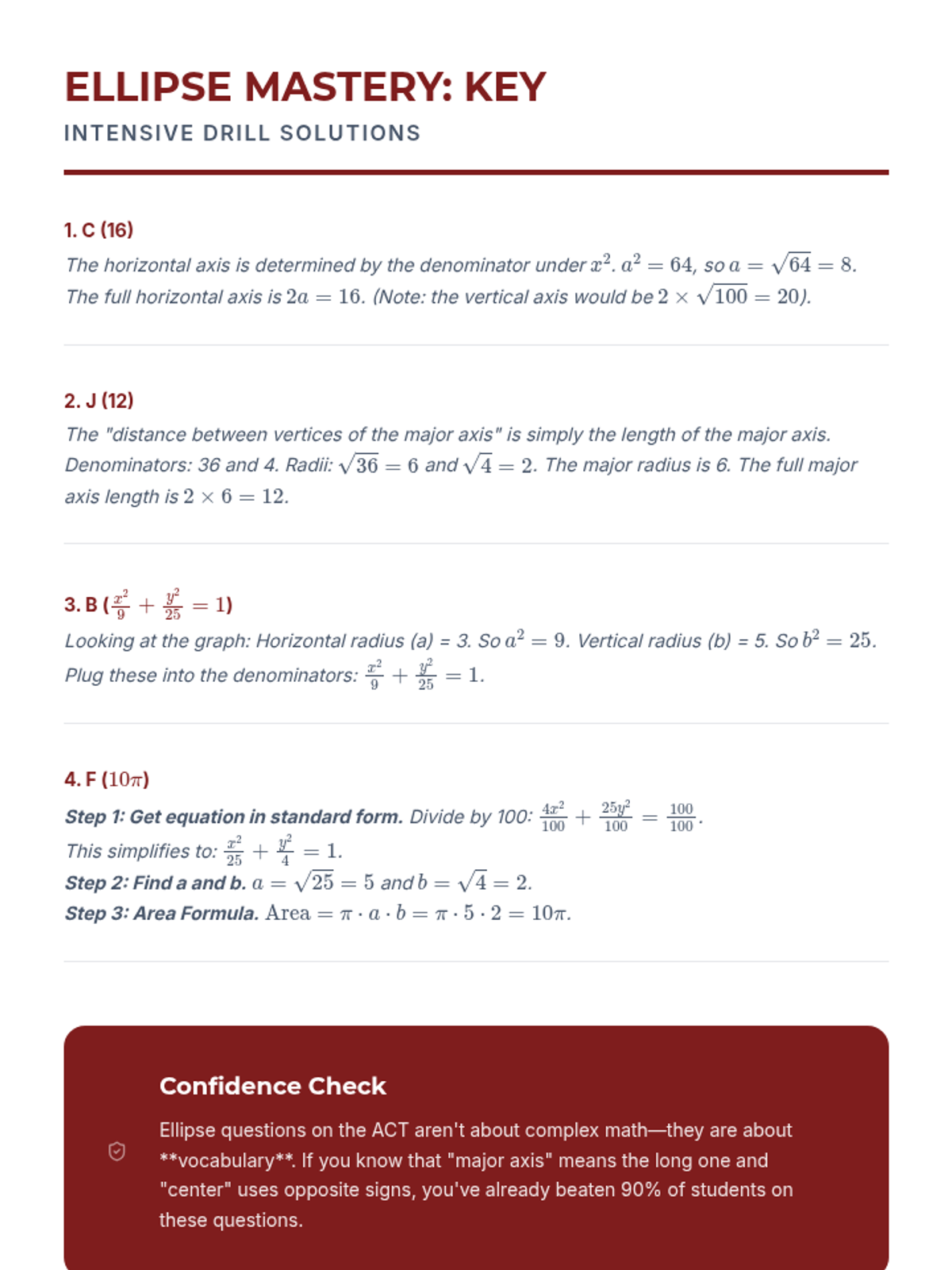
A detailed answer key for the Ellipse Mastery Drills, explaining common pitfalls and providing step-by-step solutions for advanced ellipse problems.
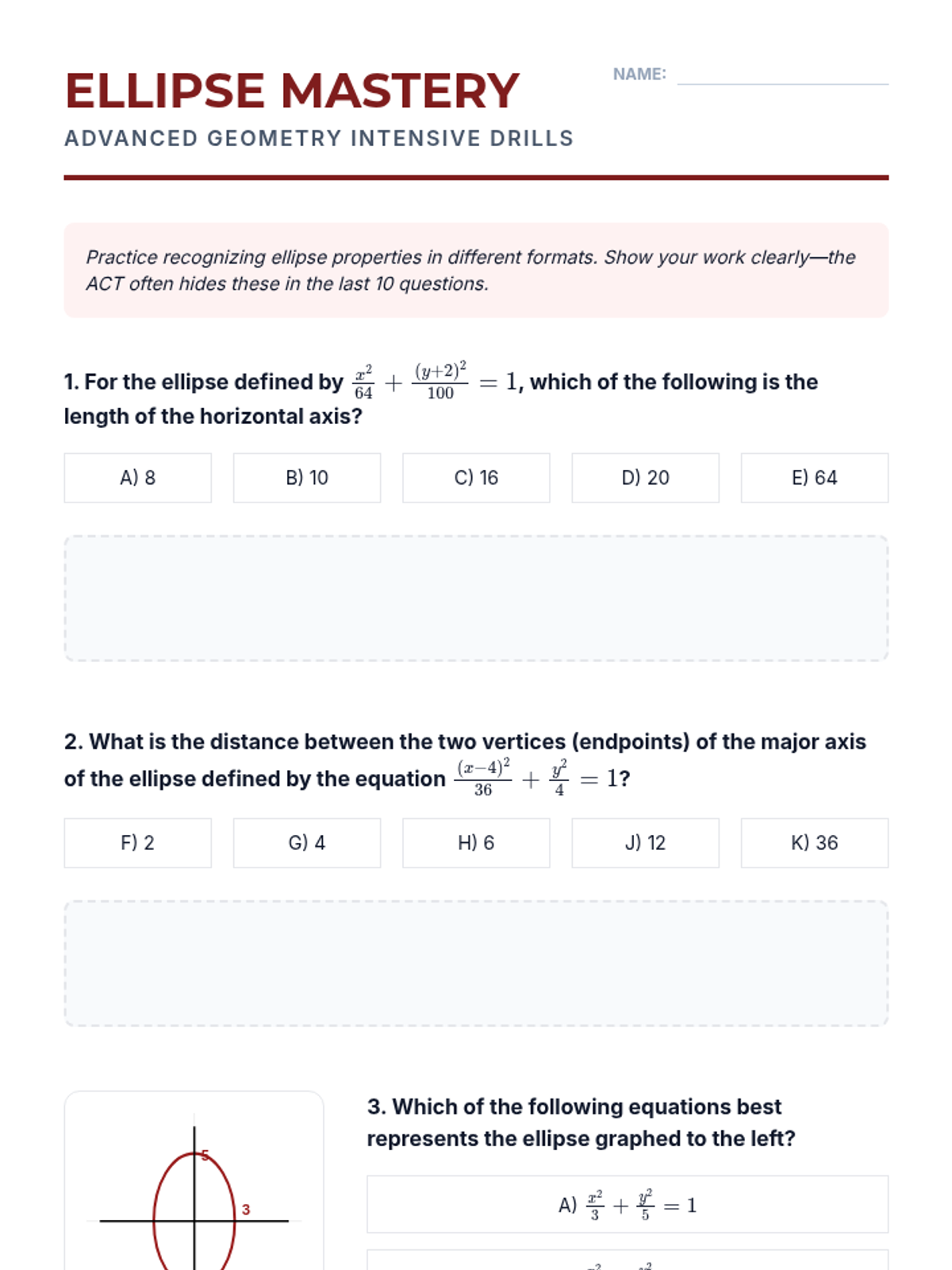
A worksheet containing intensive practice problems for ellipses, including decoding equations, graph matching, and a challenge area problem.
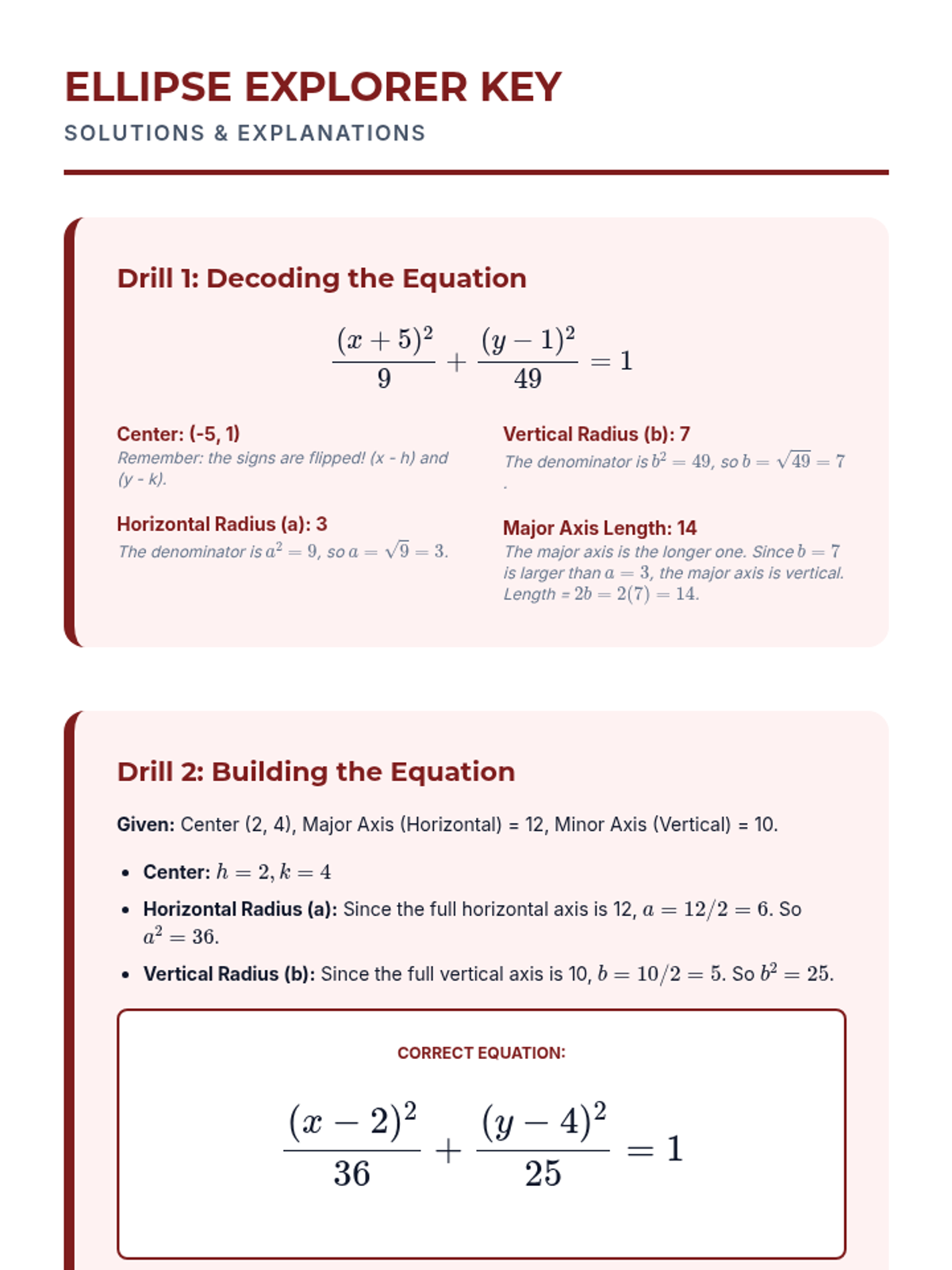
An answer key for the Ellipse Explorer activity, providing clear solutions for decoding and building ellipse equations.
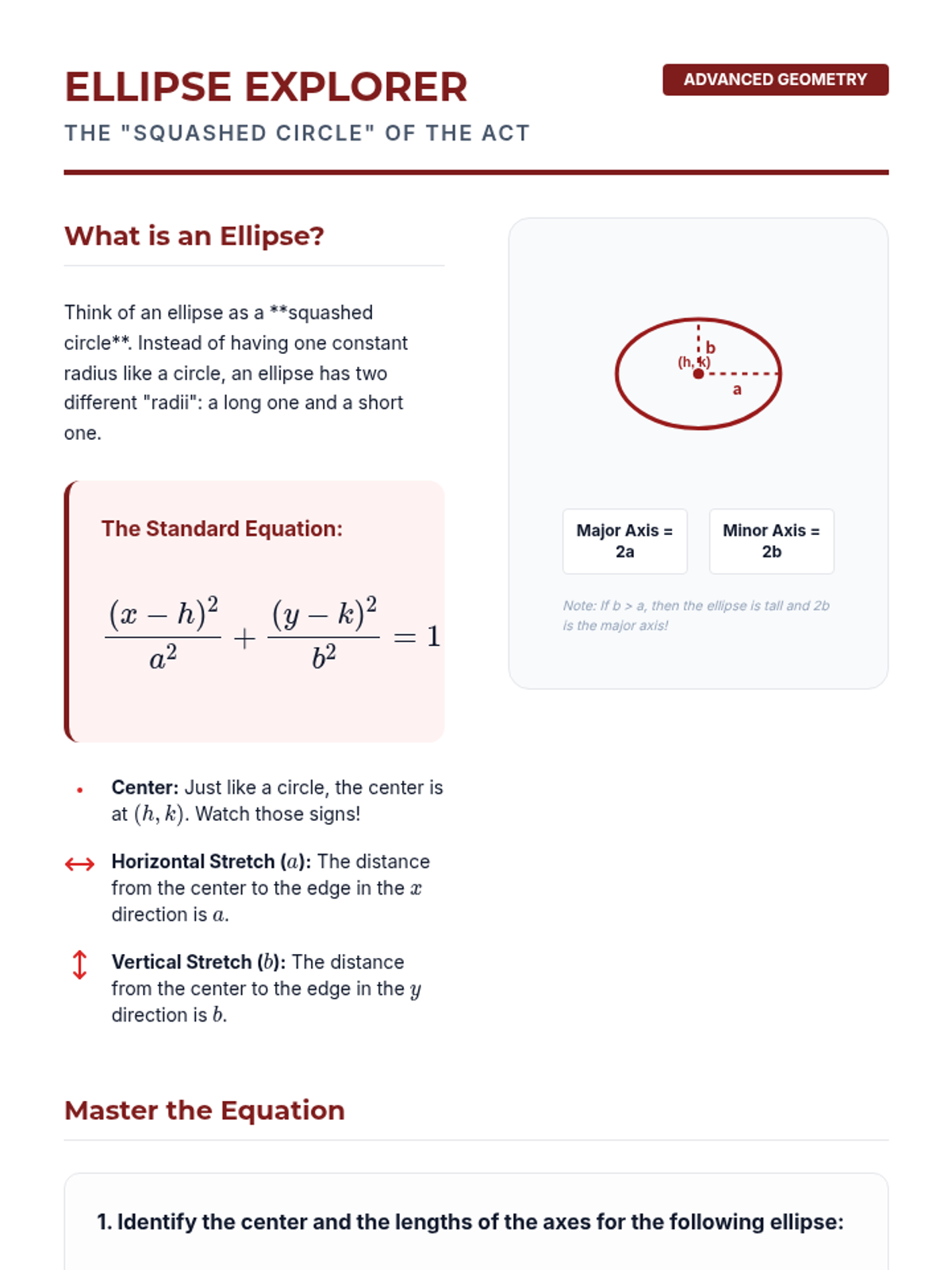
An educational handout and activity for learning the equation and properties of an ellipse, designed for the advanced geometry section of the ACT.
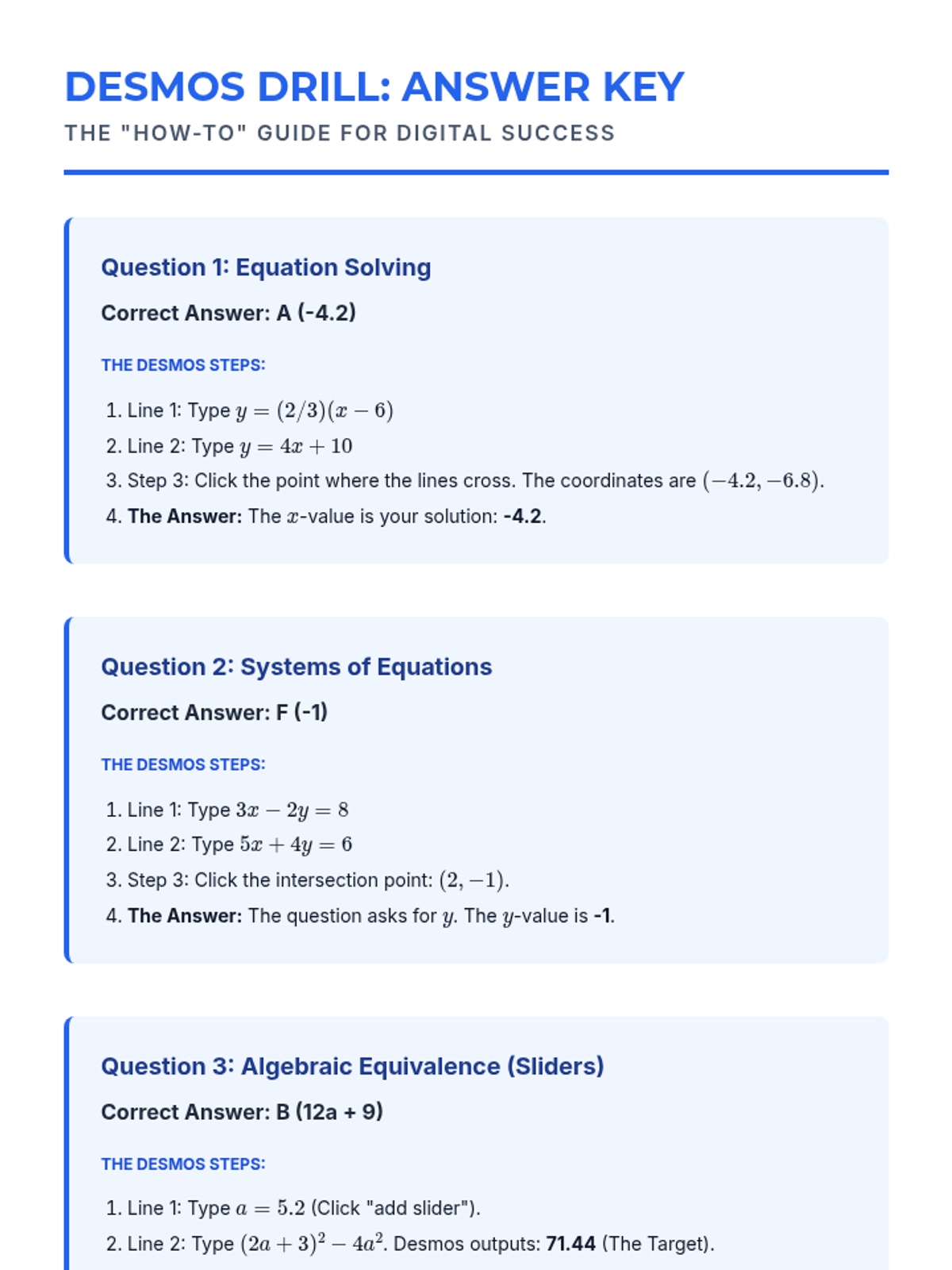
A step-by-step instructional answer key for the Desmos Drill worksheet, explaining exactly what to type into the calculator to solve each problem.
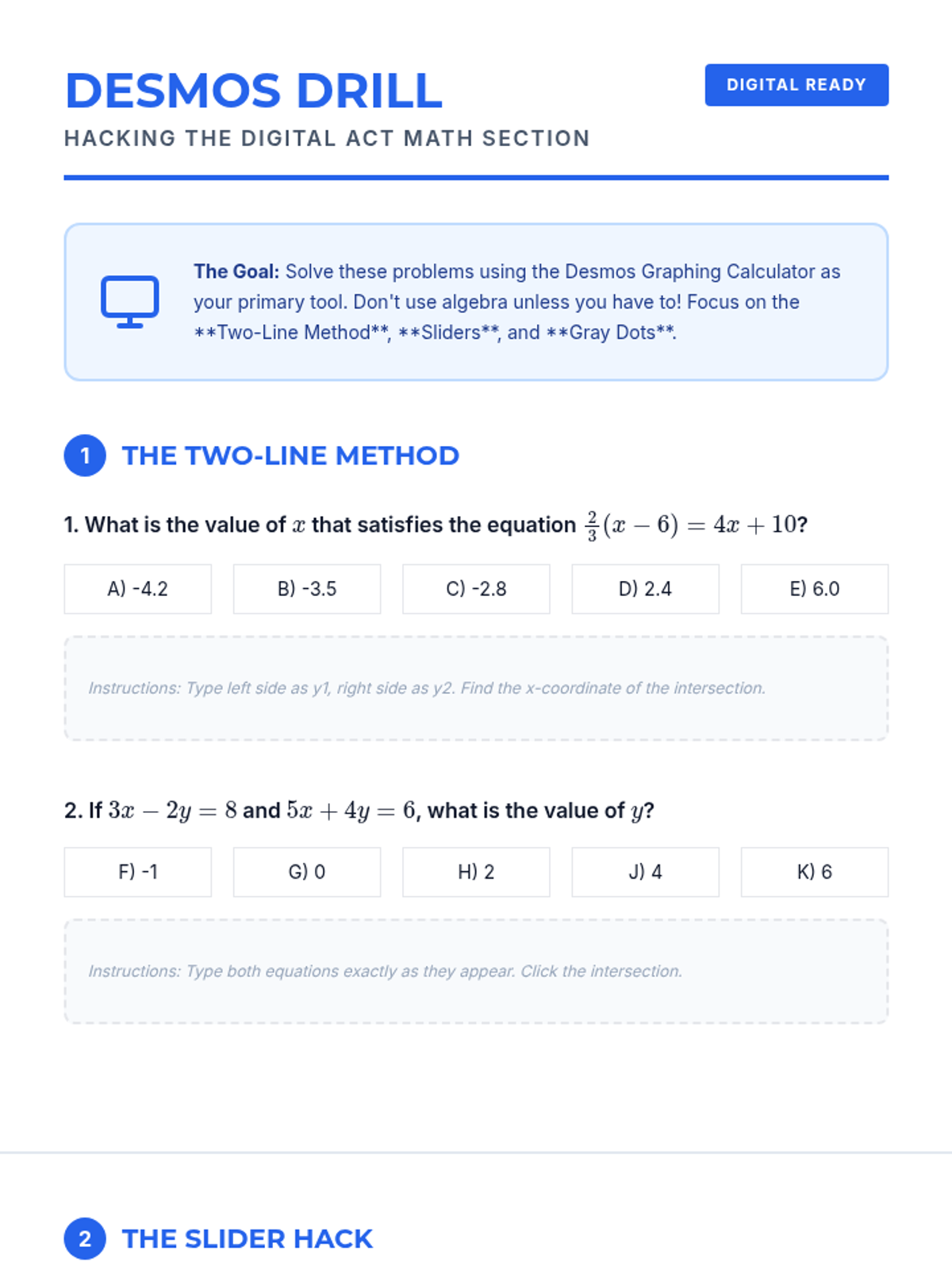
A targeted practice worksheet for the digital ACT, focusing on using Desmos for equation solving, algebraic equivalence (sliders), and finding quadratic vertices.
A comprehensive visual guide to using the Desmos calculator for the digital ACT, including graphing shortcuts, solving equations by intersection, and the slider "equivalence" hack.
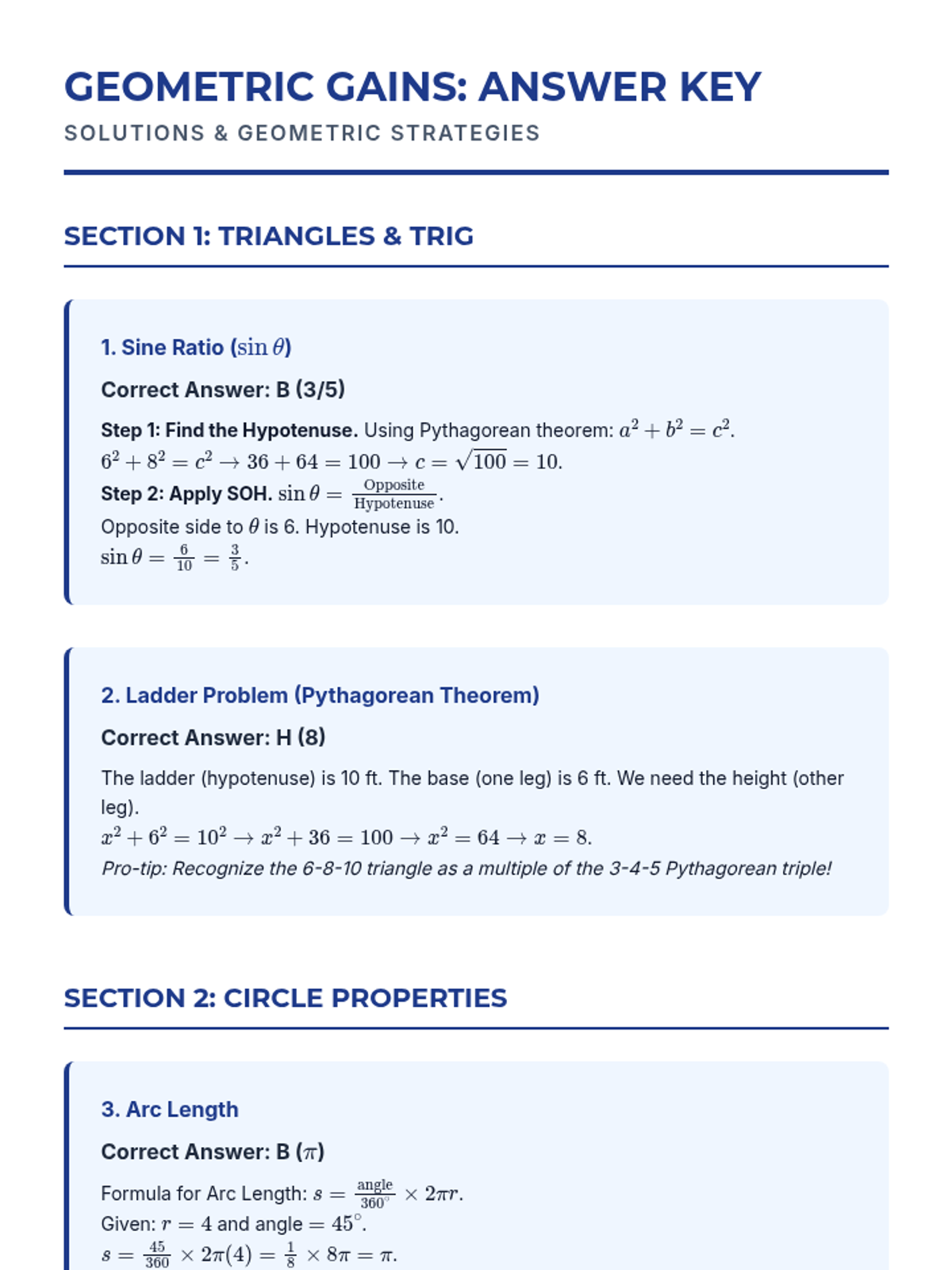
A detailed answer key for the Geometry Trig Worksheet, providing step-by-step mathematical breakdowns and strategic advice for each problem.
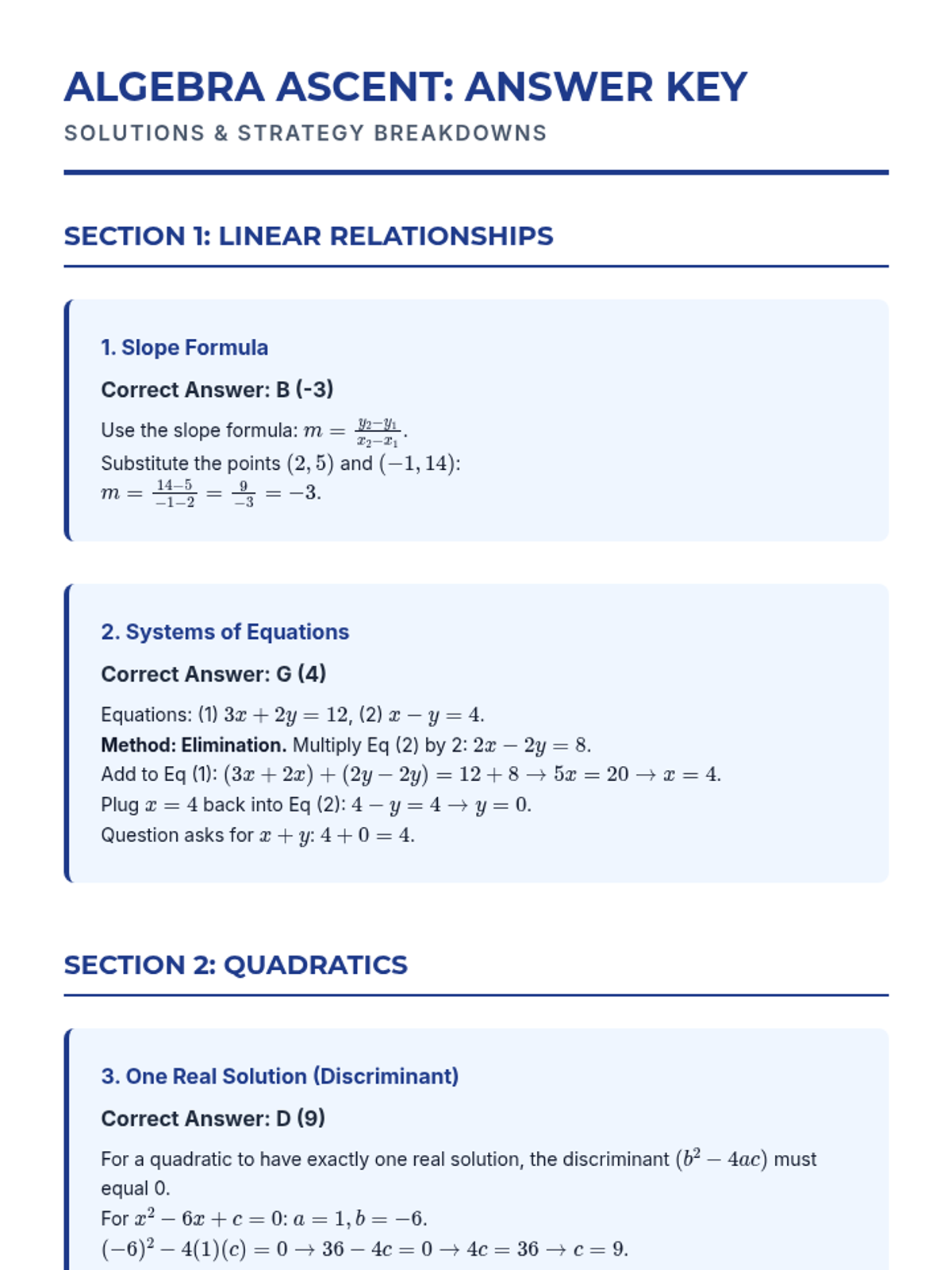
A detailed answer key for the Algebra Power Worksheet, providing step-by-step mathematical breakdowns and strategy tips for each problem.
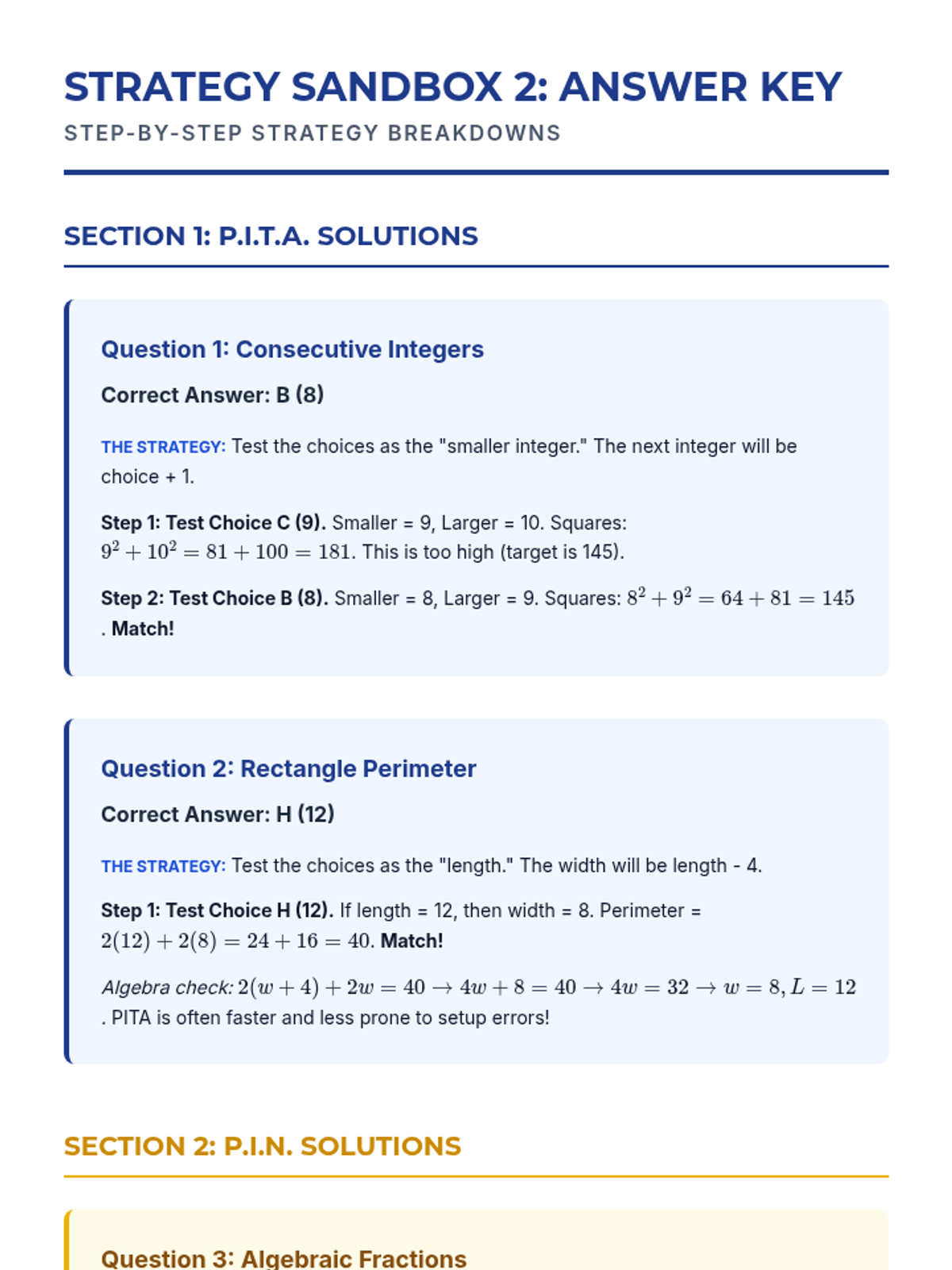
A detailed answer key for the Strategy Sandbox 2 worksheet, providing step-by-step mathematical breakdowns for PITA and PIN problems involving consecutive integers, geometry, and number properties.
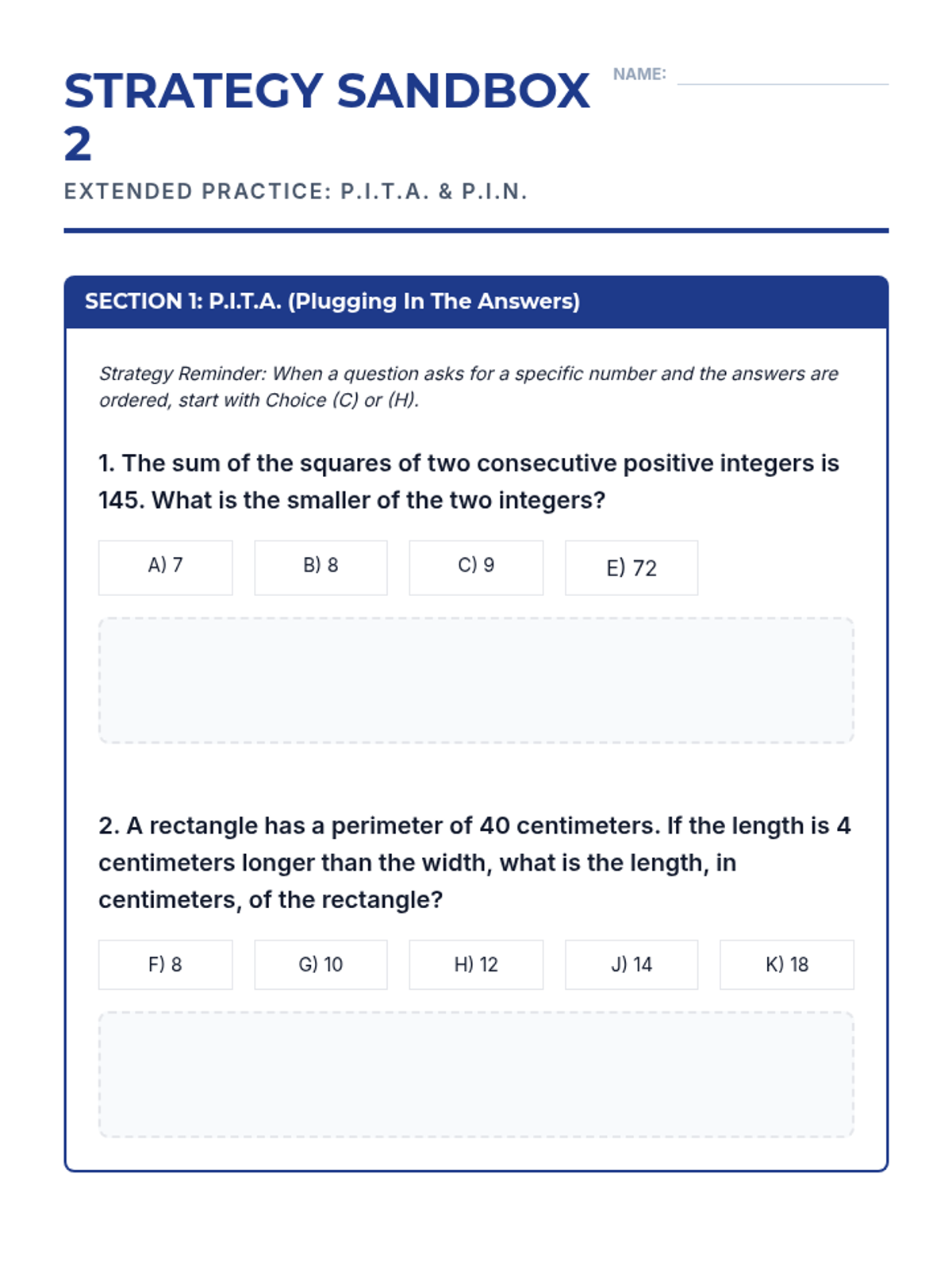
An extended practice worksheet for the PITA and PIN strategies, featuring new problems involving consecutive integers, geometry, algebraic fractions, and number properties.
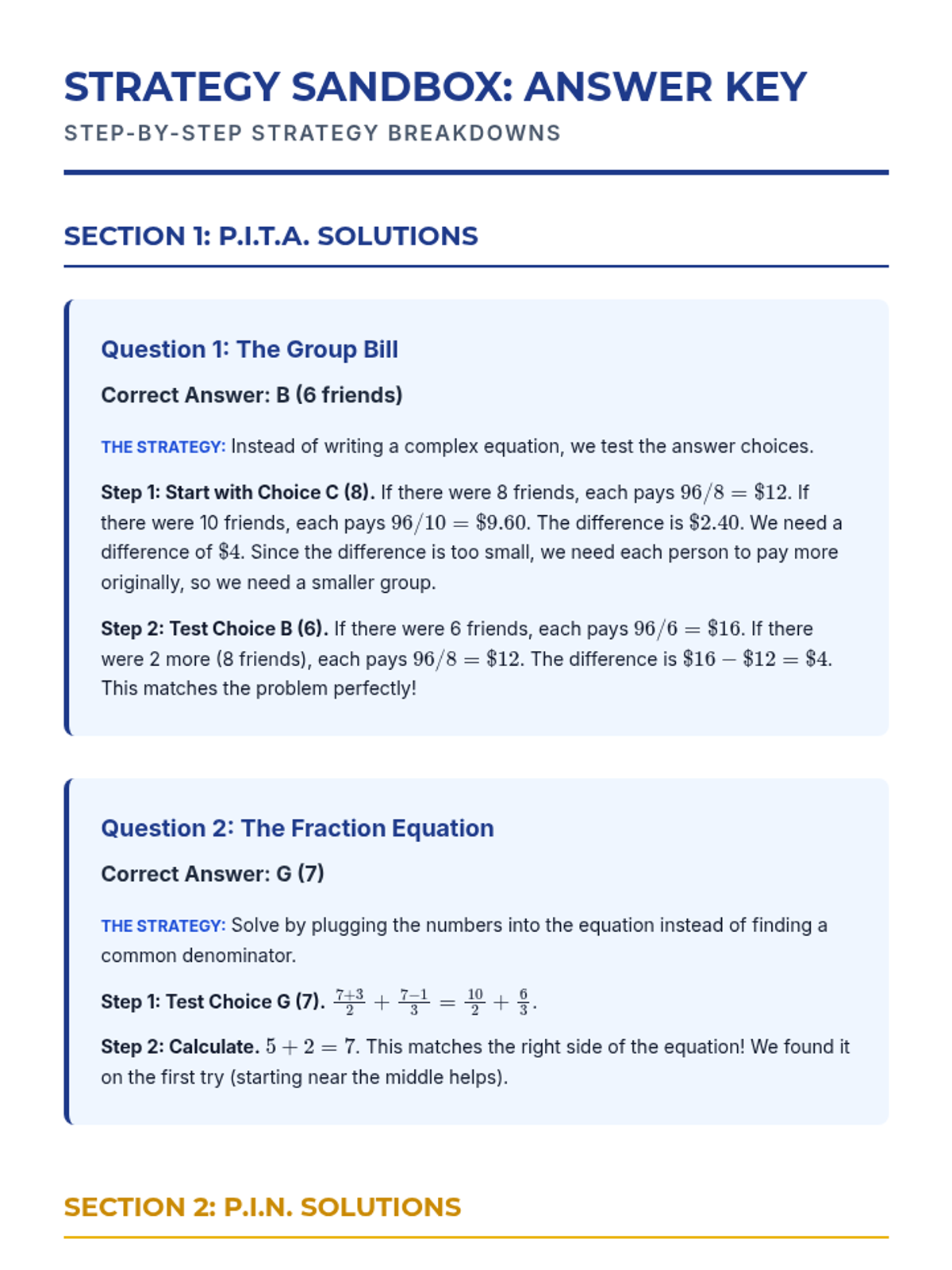
A detailed answer key for the Strategy Sandbox worksheet, providing step-by-step mathematical breakdowns and strategy explanations for each problem.
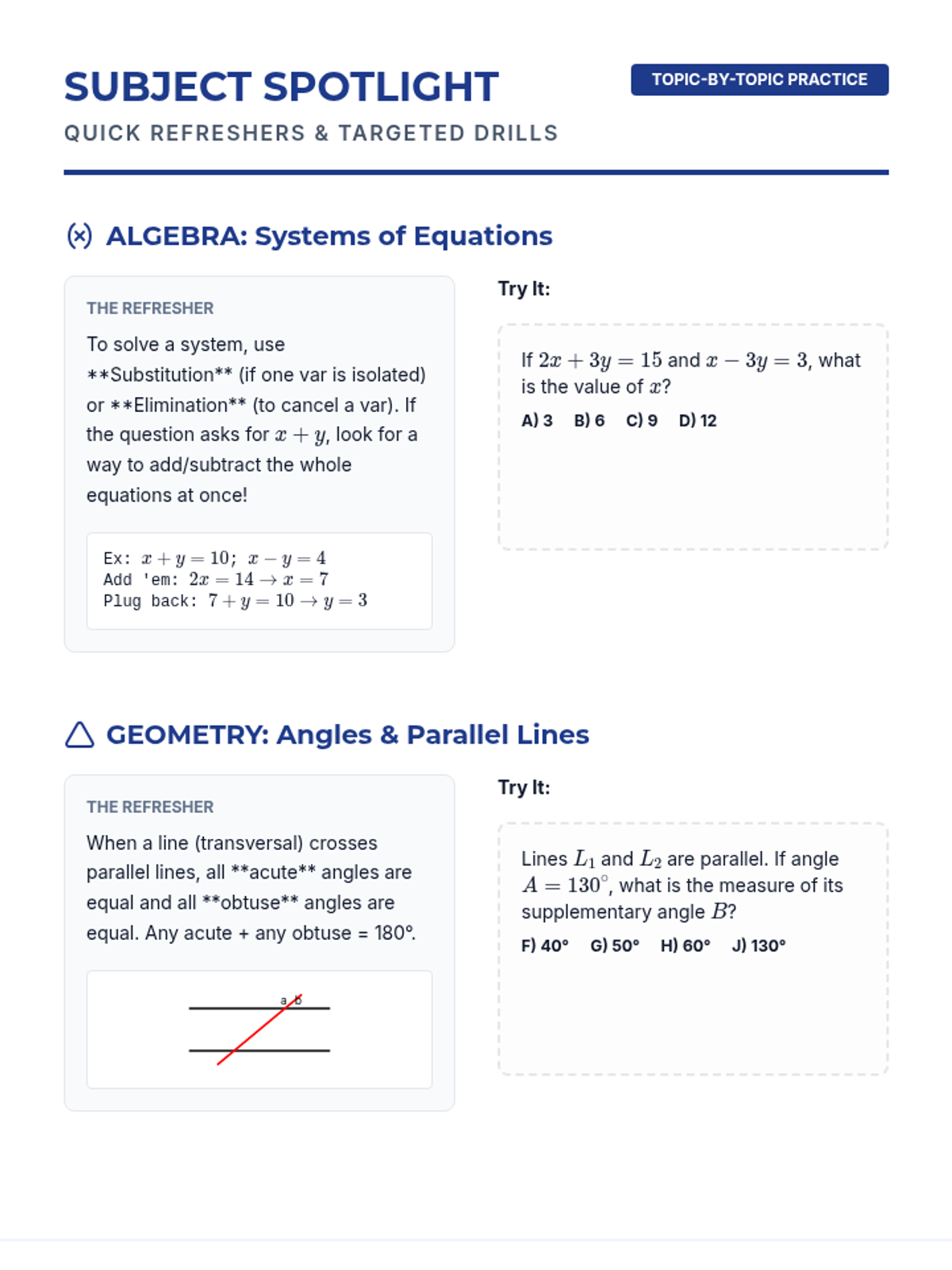
A comprehensive "Subject Spotlight" worksheet featuring high-level refreshers and immediate "Try It" practice problems for Algebra, Geometry, Trig, and Advanced topics.
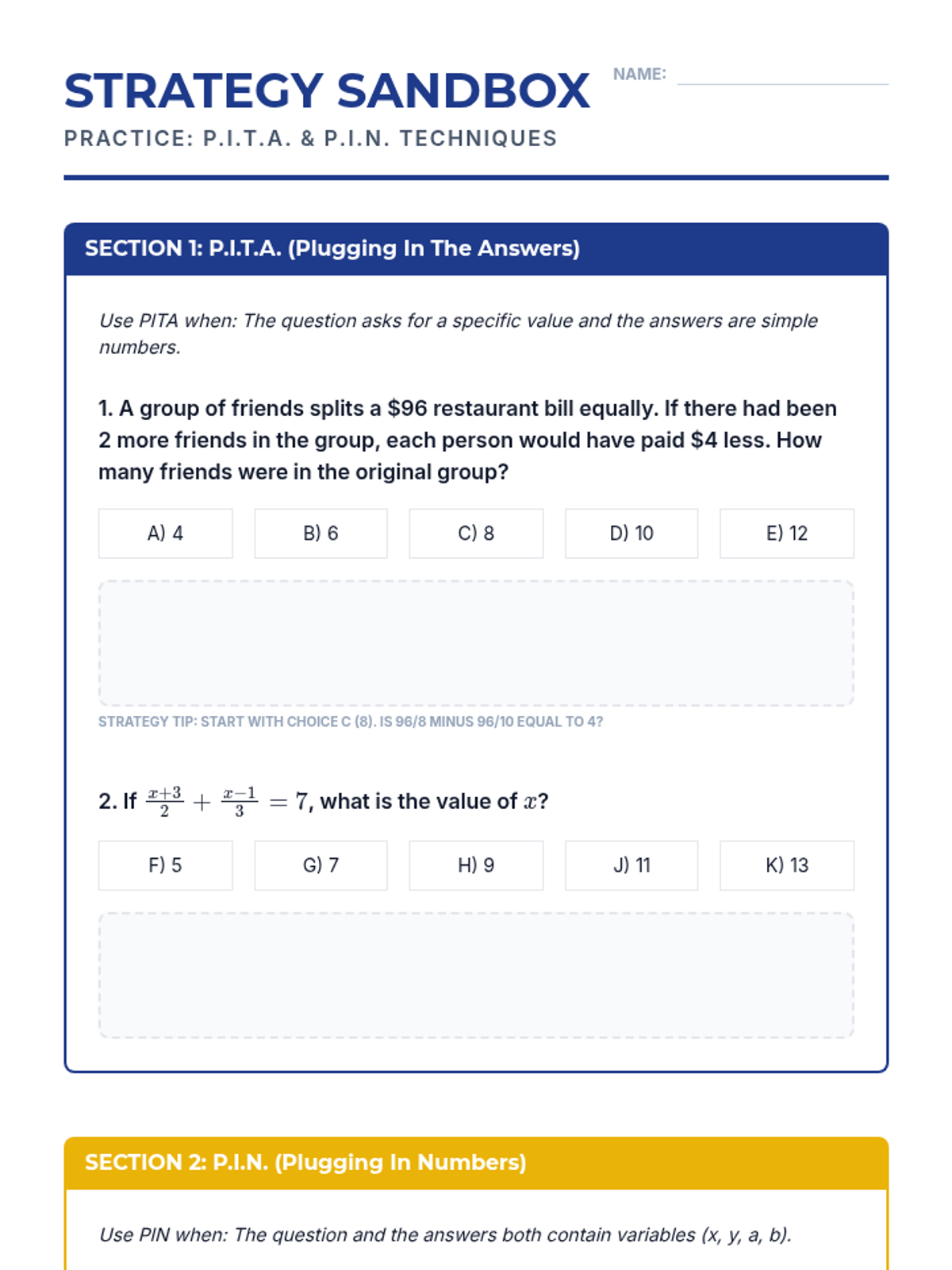
A targeted practice worksheet for the PITA (Plugging In The Answers) and PIN (Plugging In Numbers) strategies, featuring specific problem types that favor these techniques.
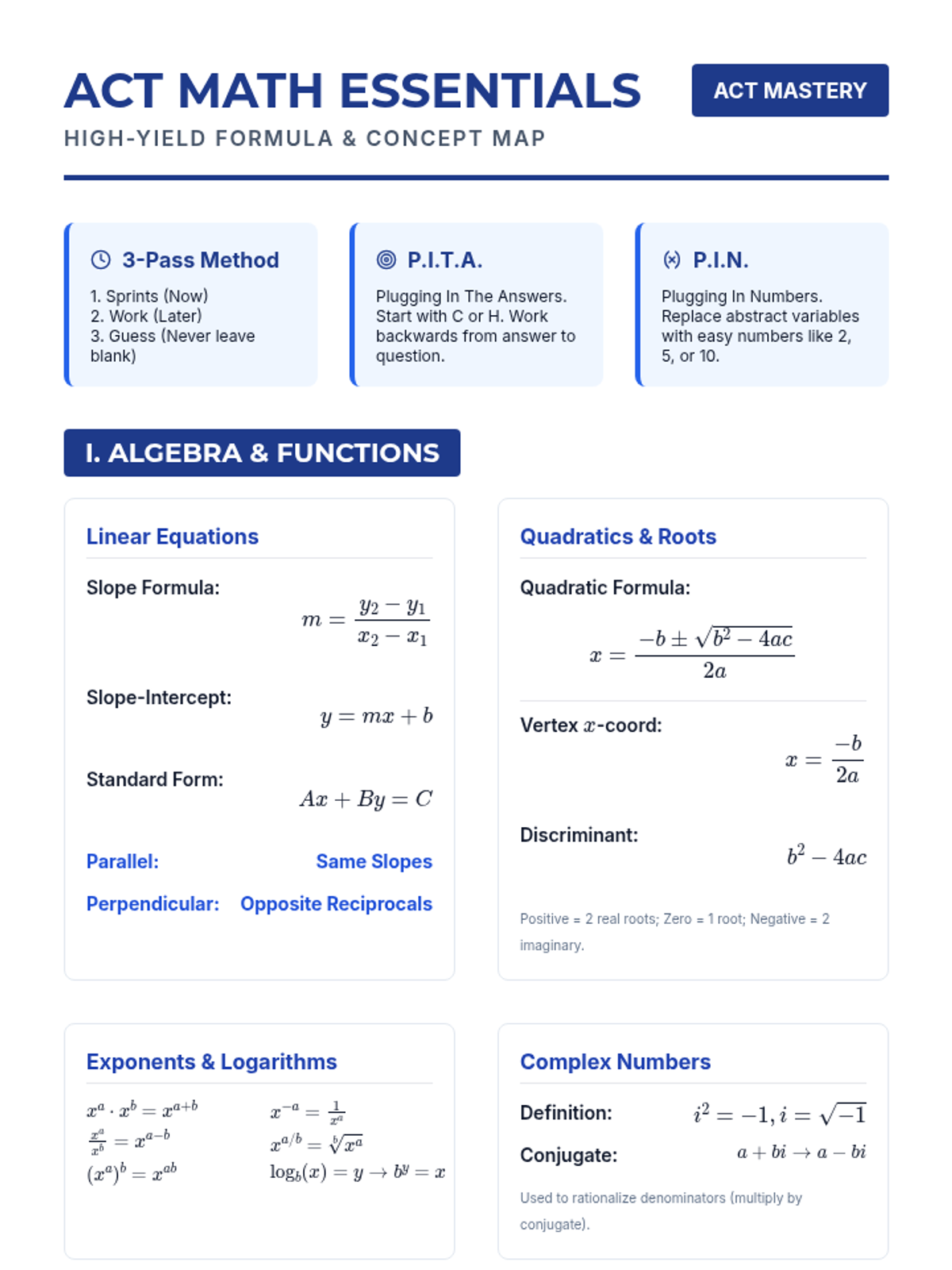
An updated high-density reference sheet for ACT Math, now including advanced topics like Matrices, Vectors, Law of Sines/Cosines, and Ellipse equations.
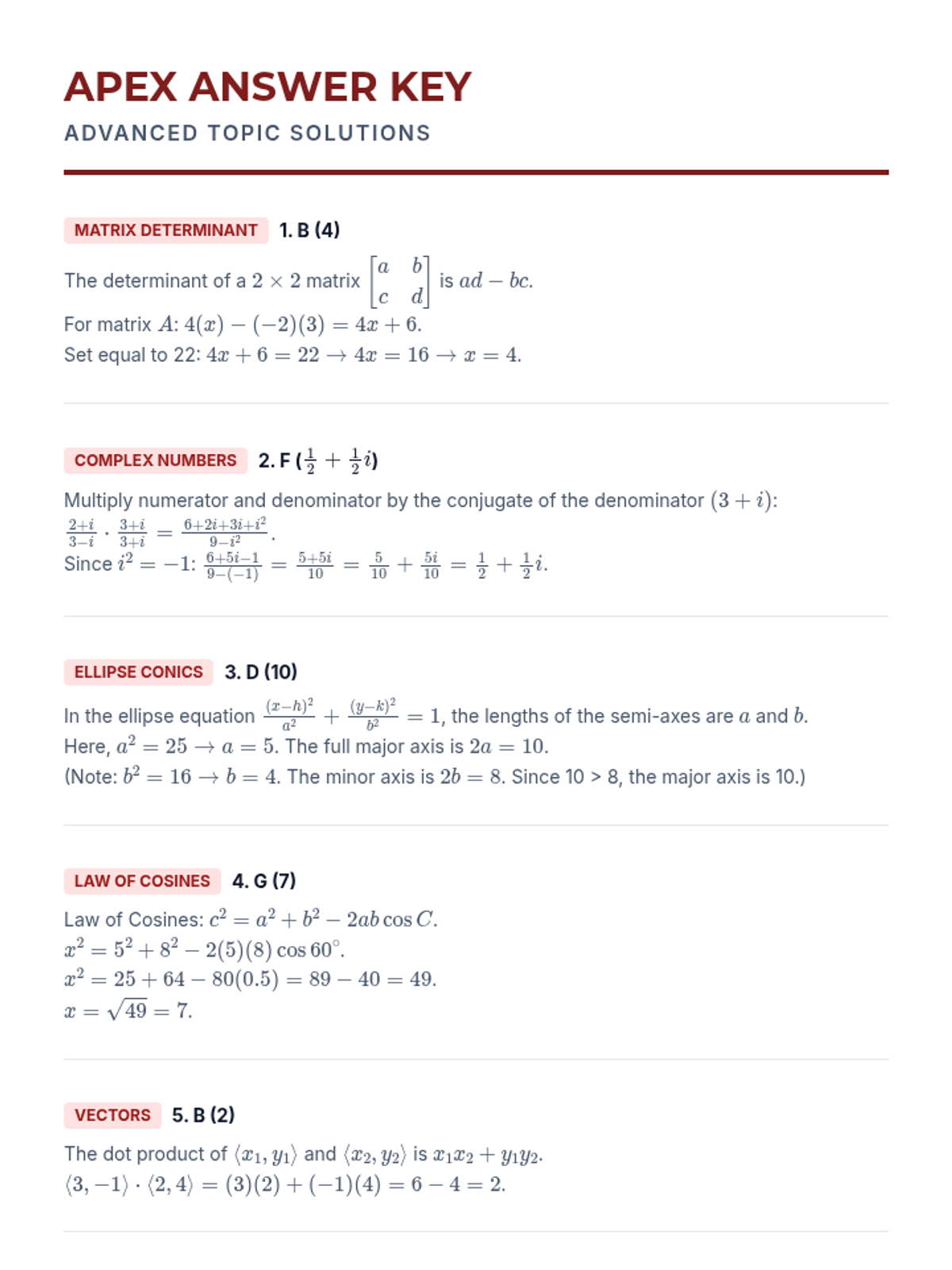
A detailed answer key for the Advanced Apex worksheet, providing step-by-step mathematical breakdowns for pre-calculus and advanced geometry problems.
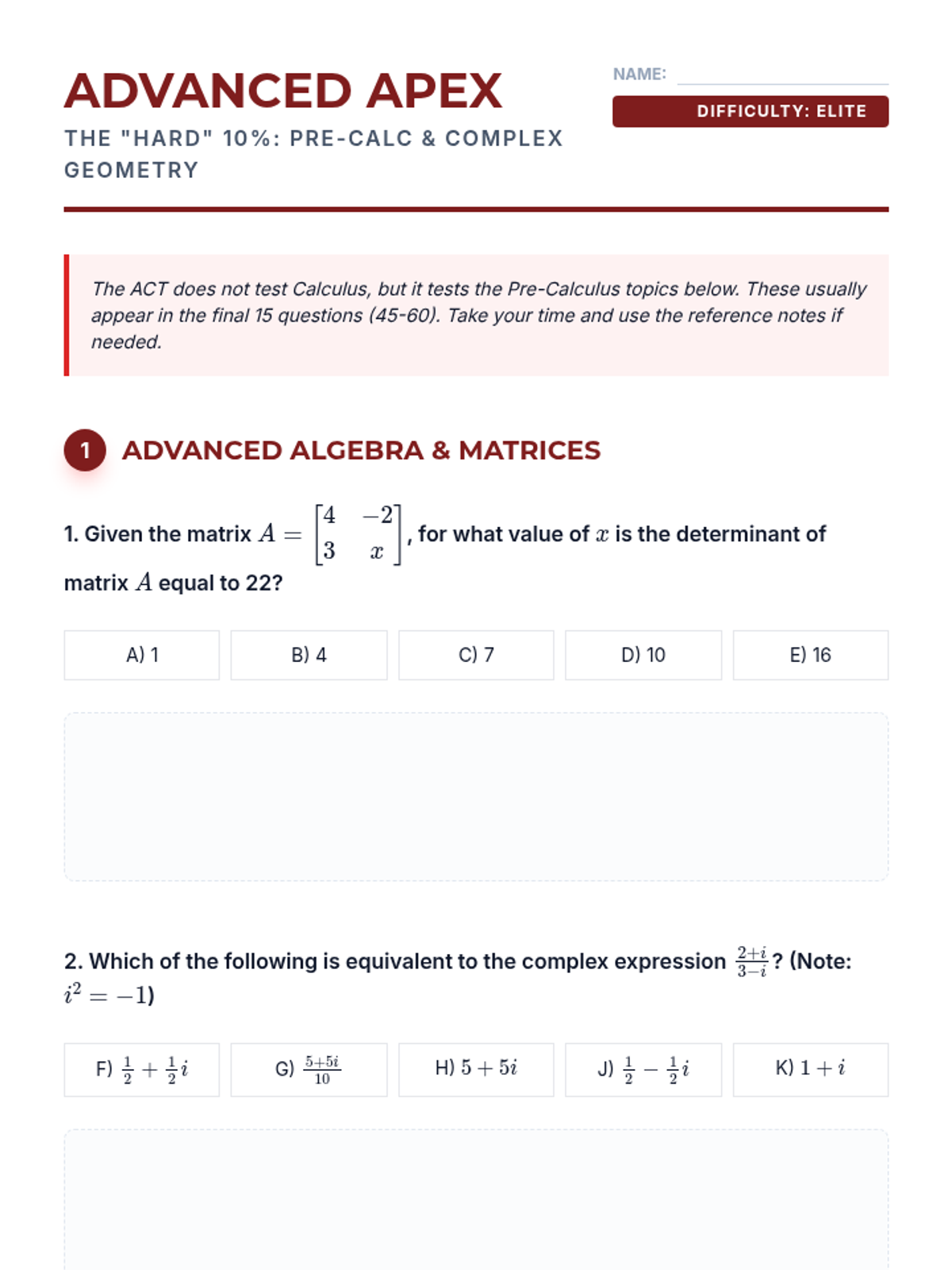
A specialized worksheet focusing on the most difficult "Pre-Calculus" and Geometry topics on the ACT, including matrices, vectors, complex numbers, and ellipses.
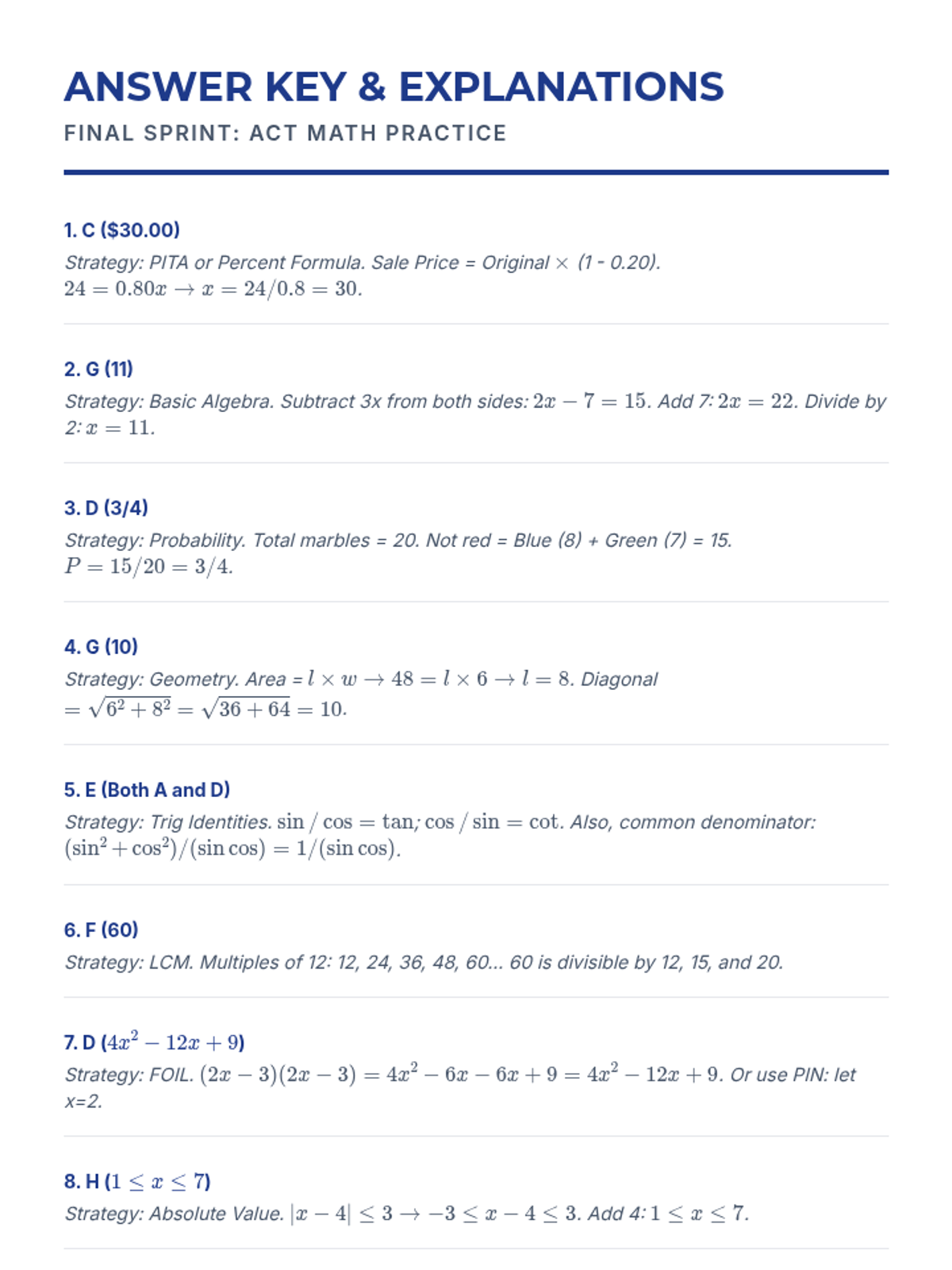
A detailed answer key for the ACT Math practice test, providing step-by-step explanations and strategy reminders for each problem.
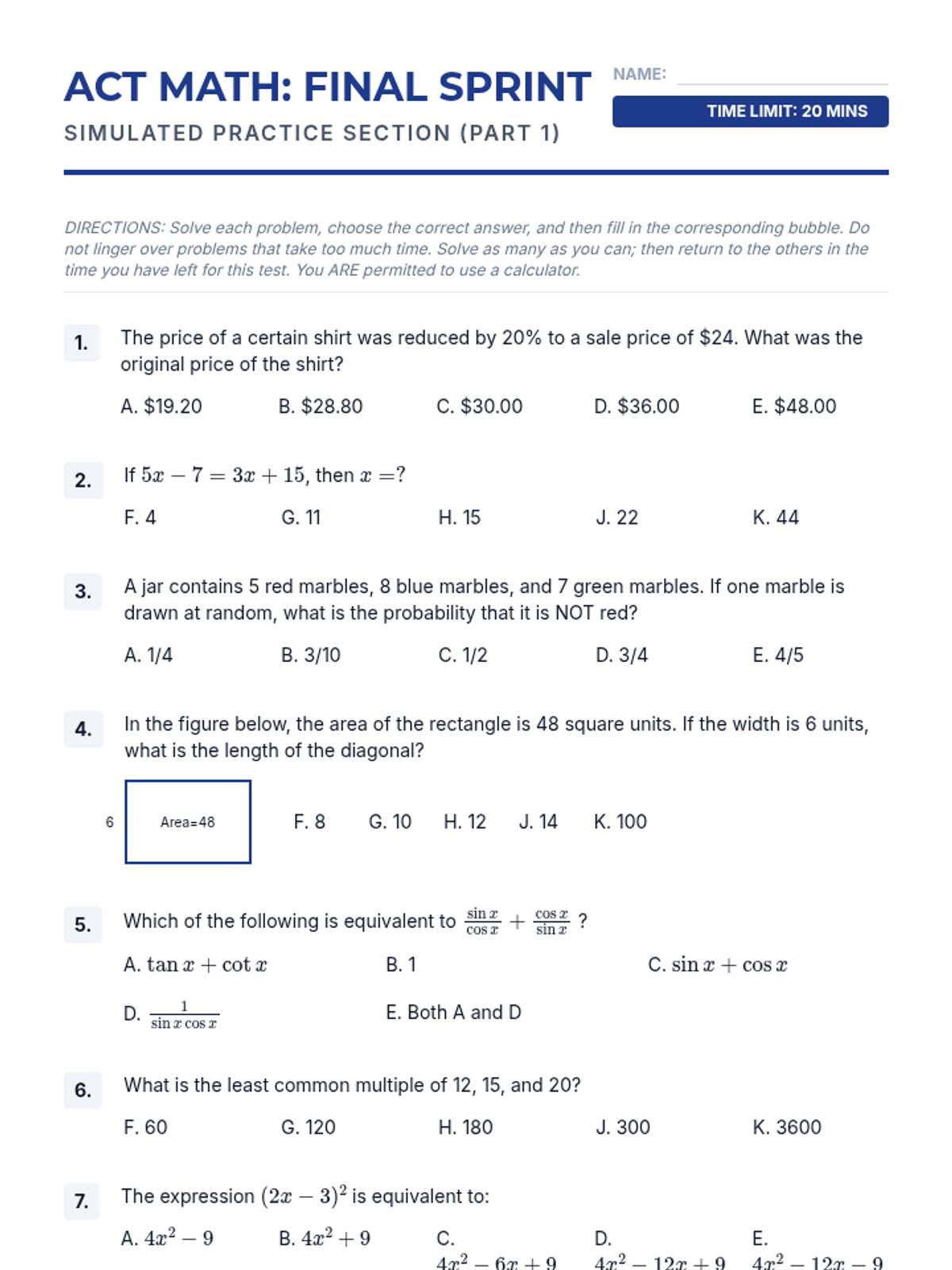
A representative 15-question ACT Math practice section covering algebra, geometry, and trigonometry, designed for a 20-minute timed sprint.