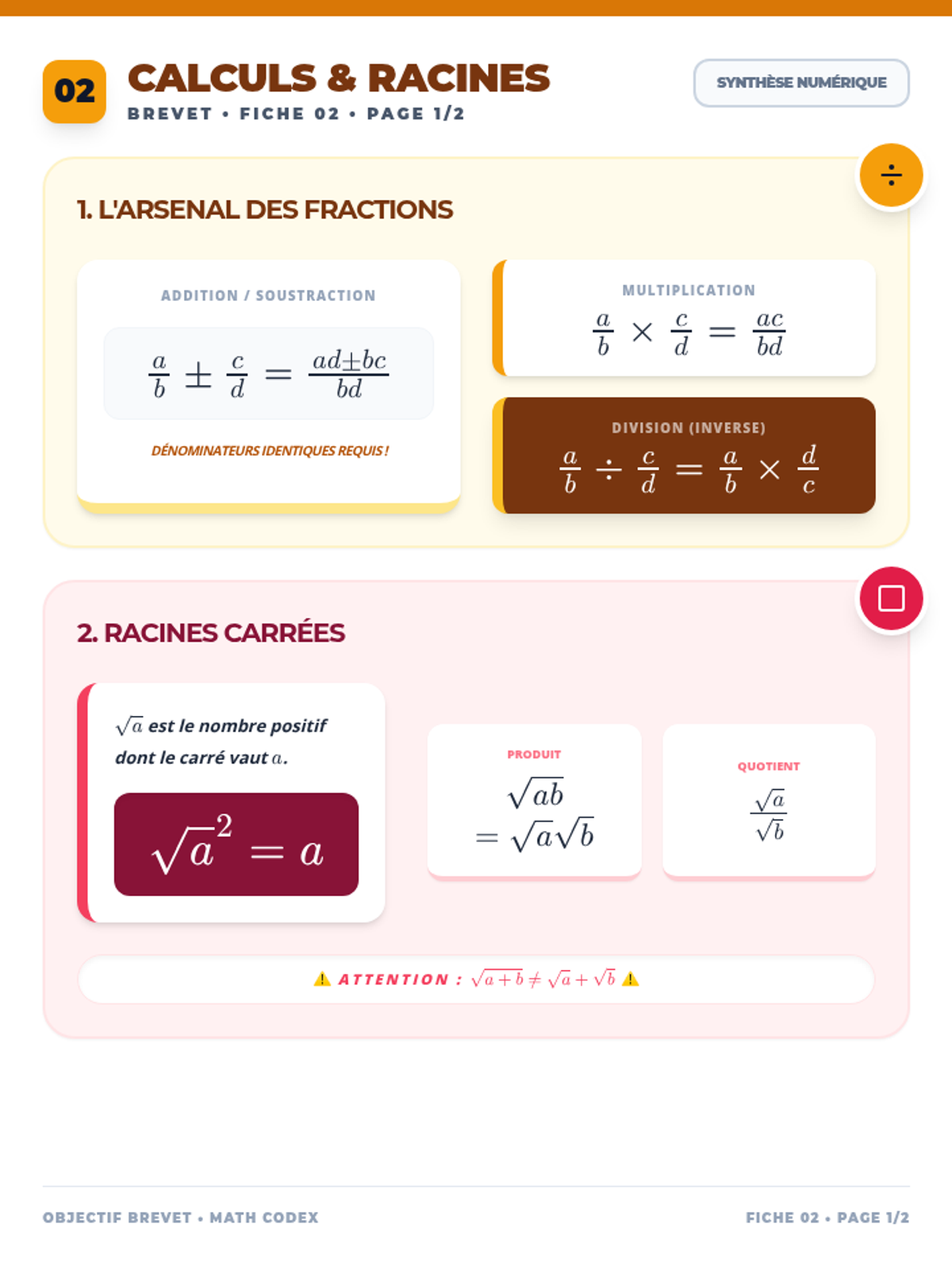
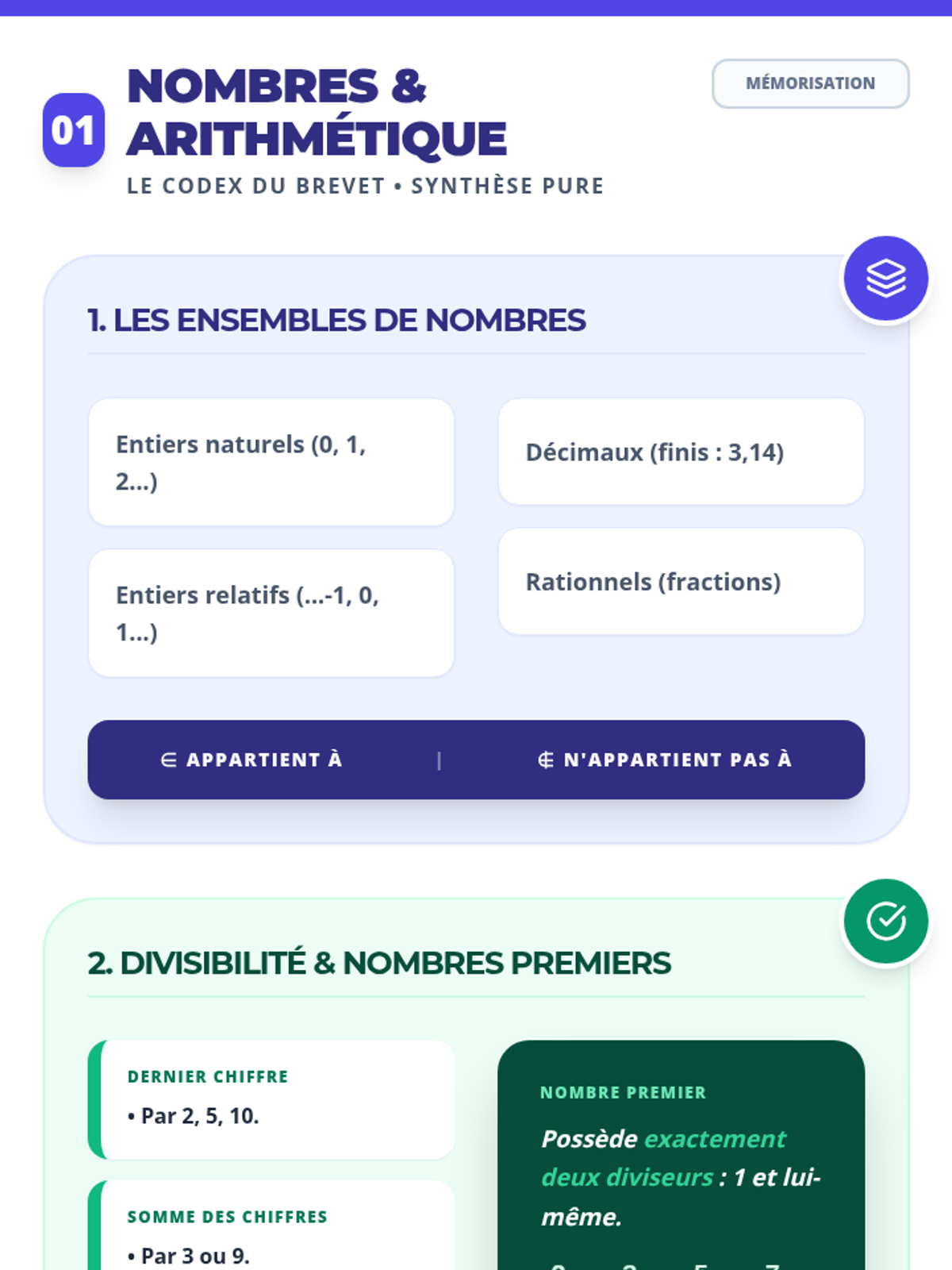
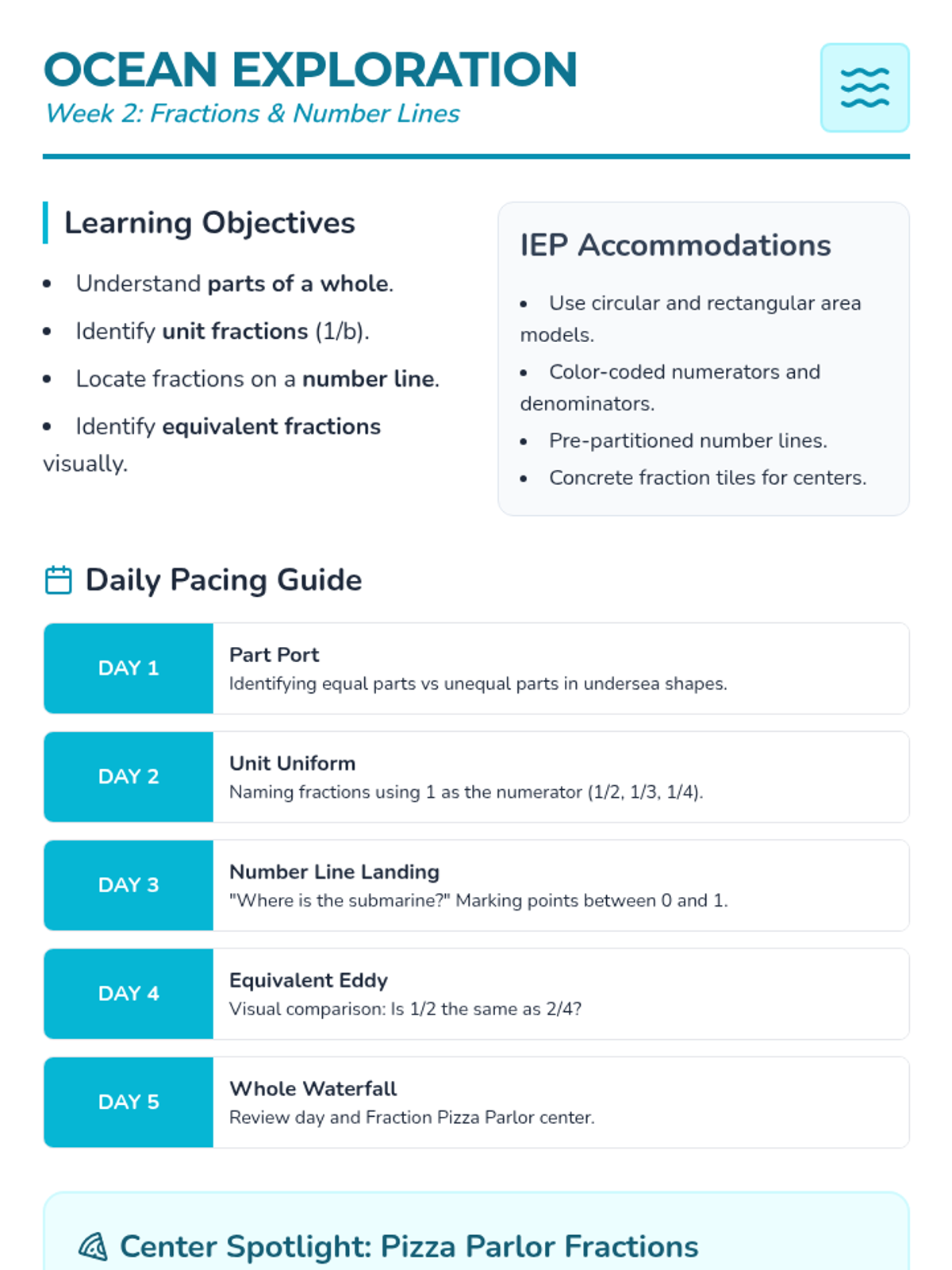
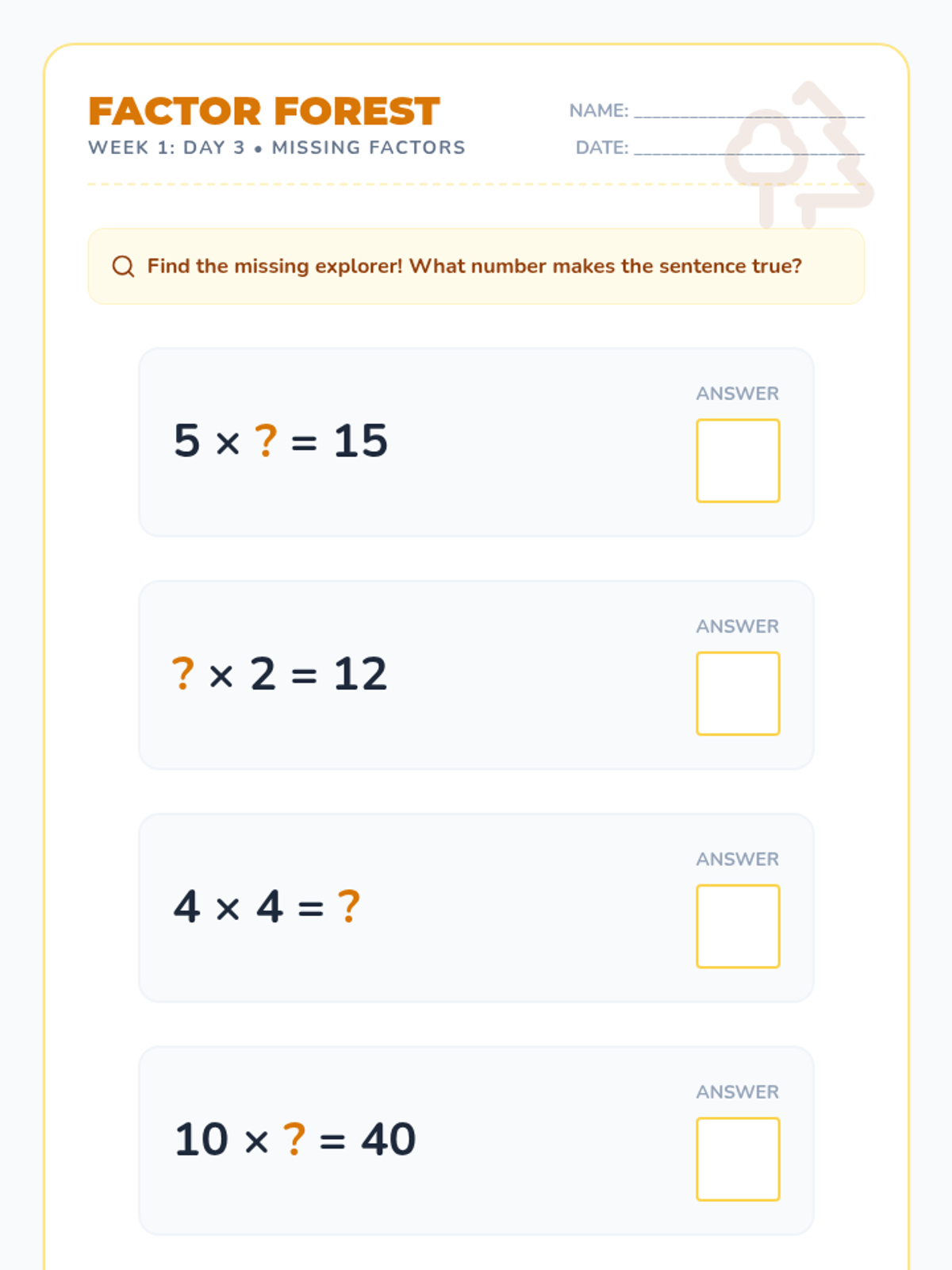
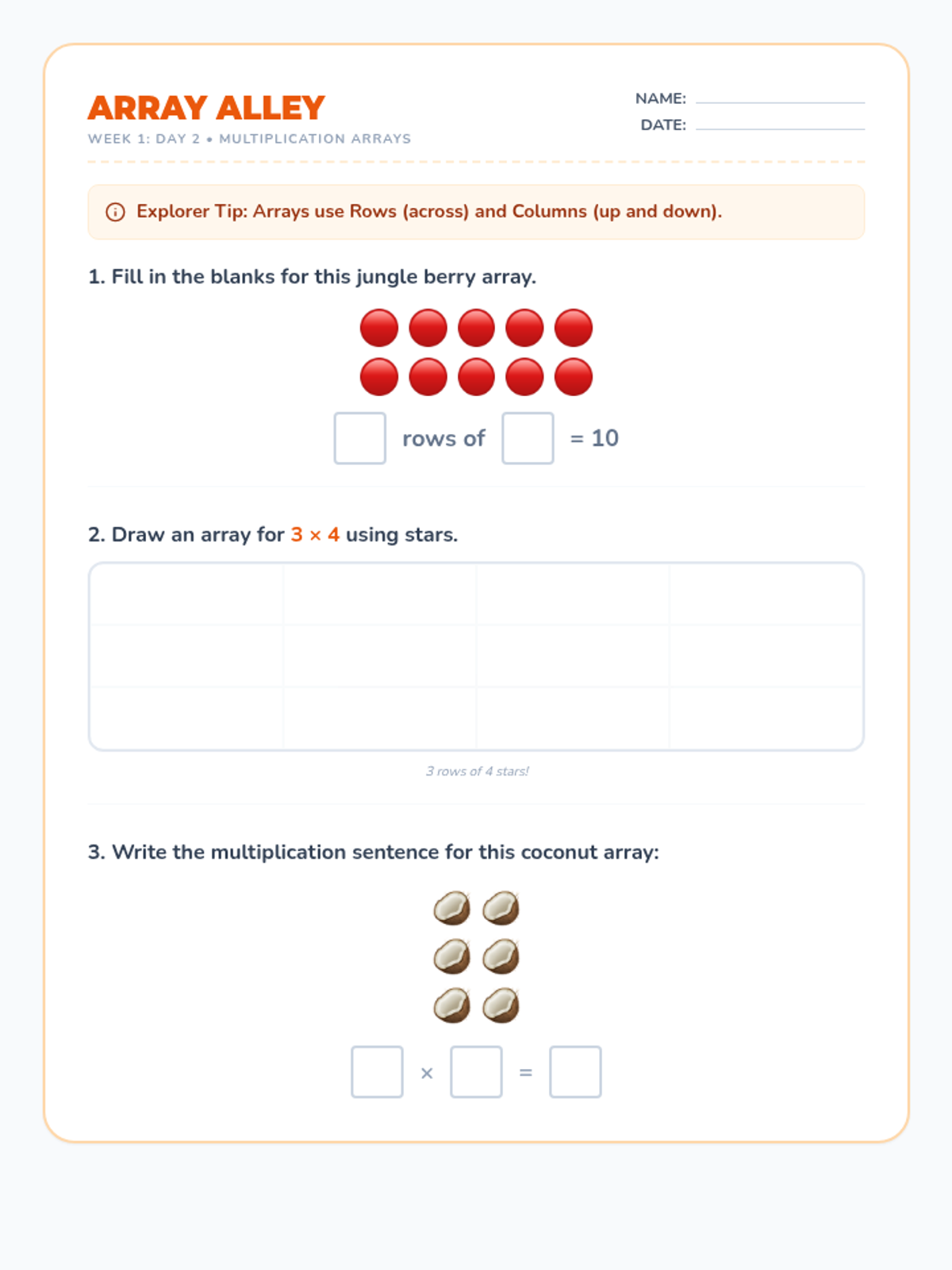
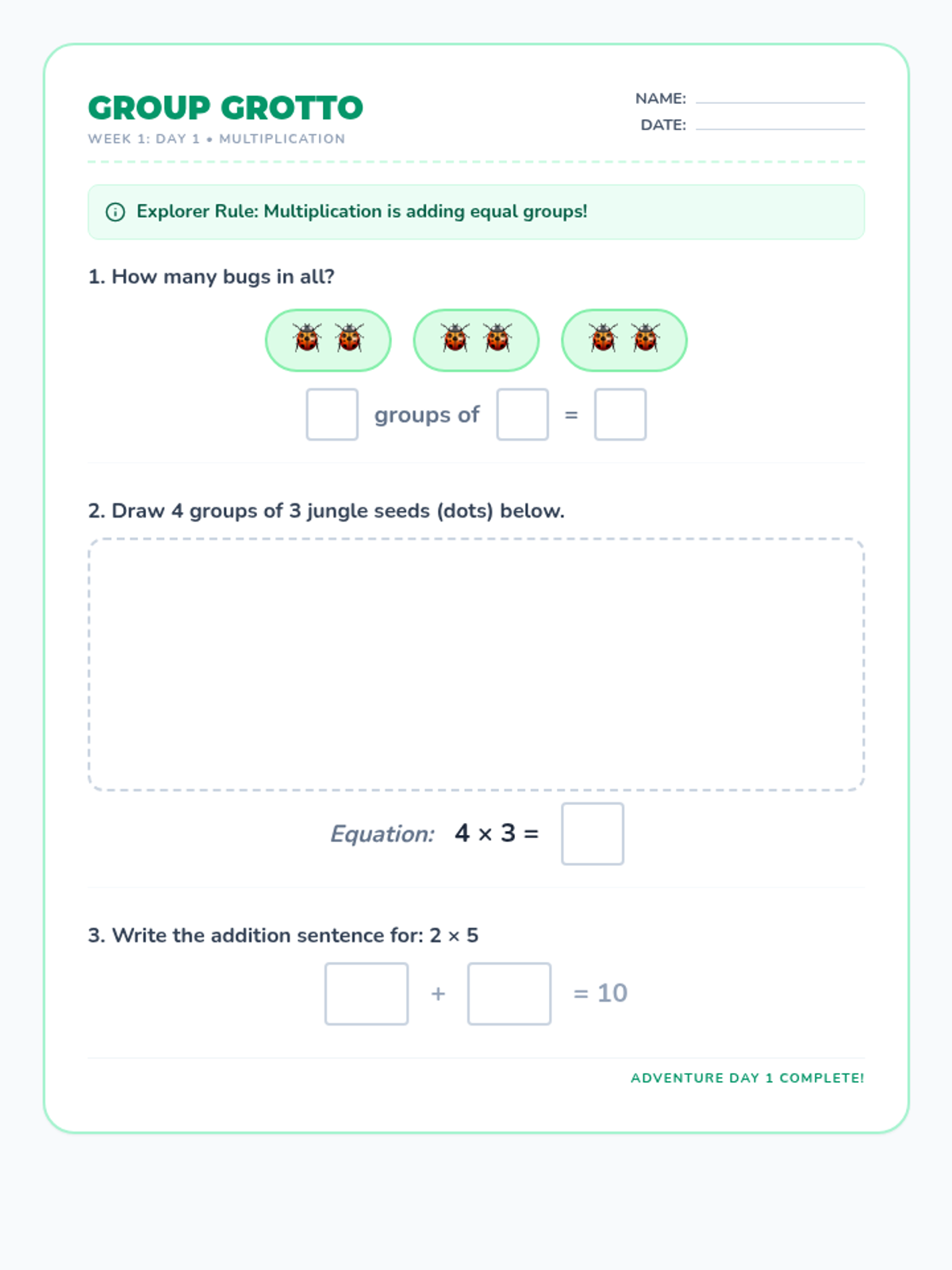
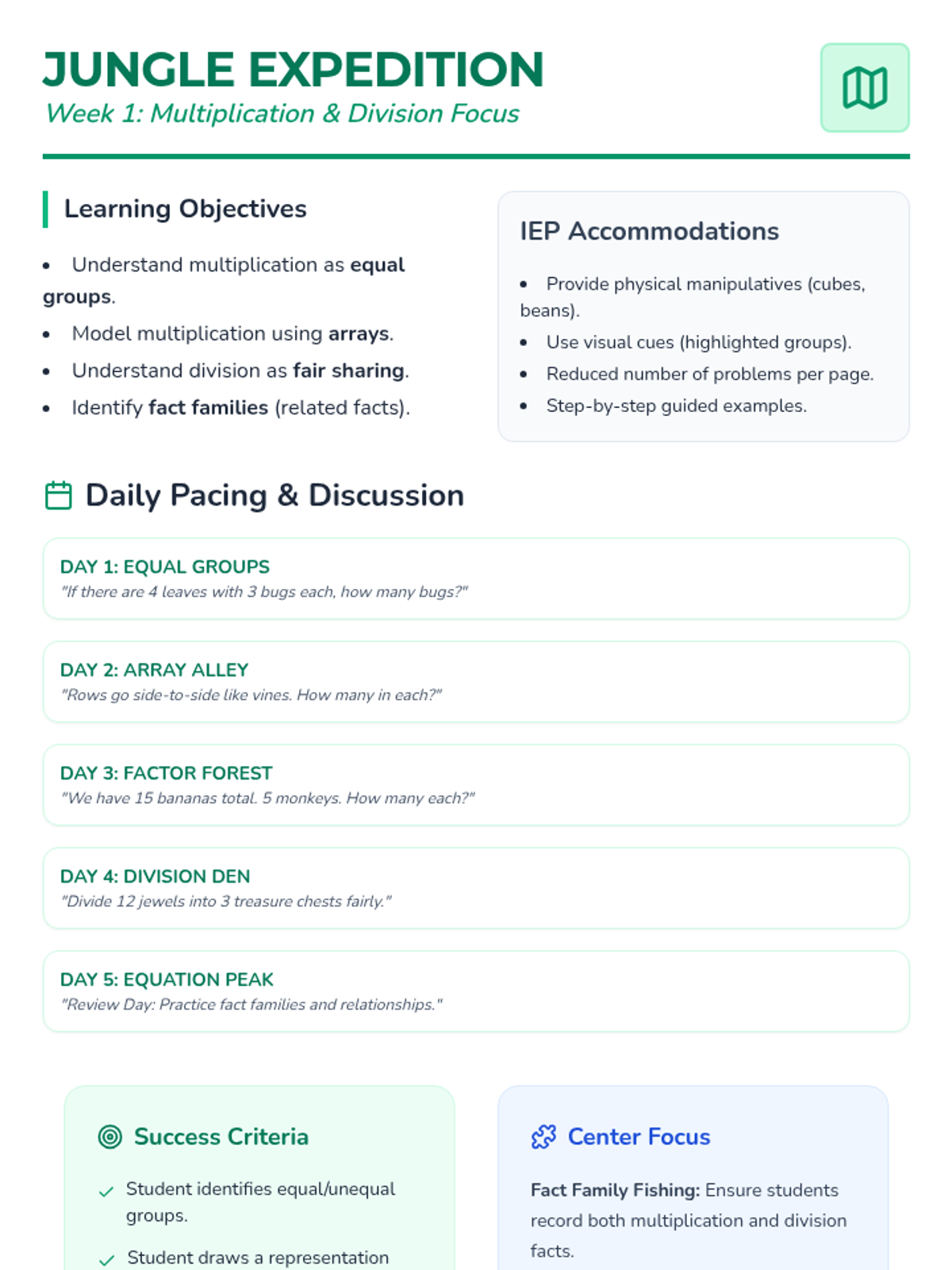
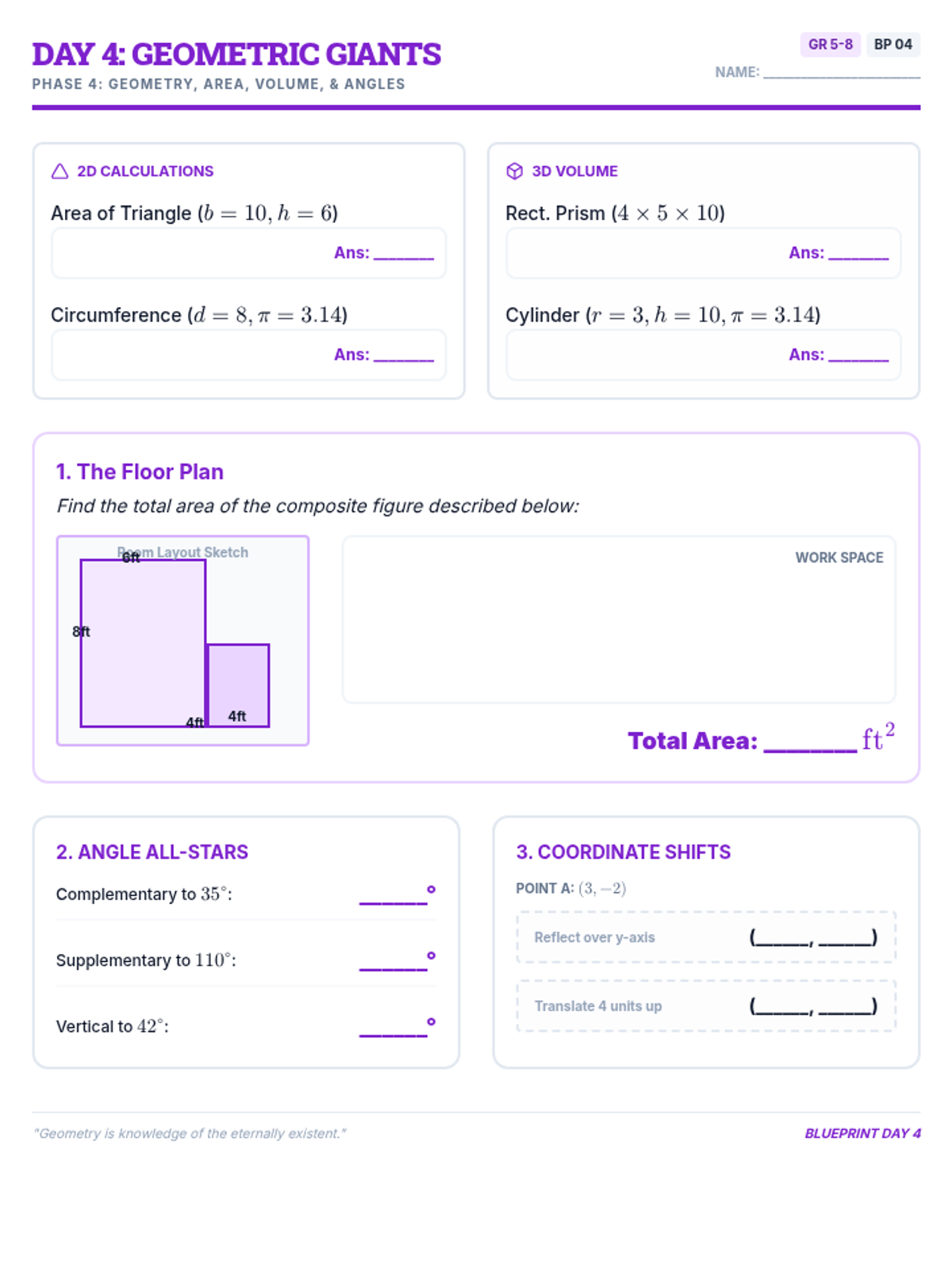
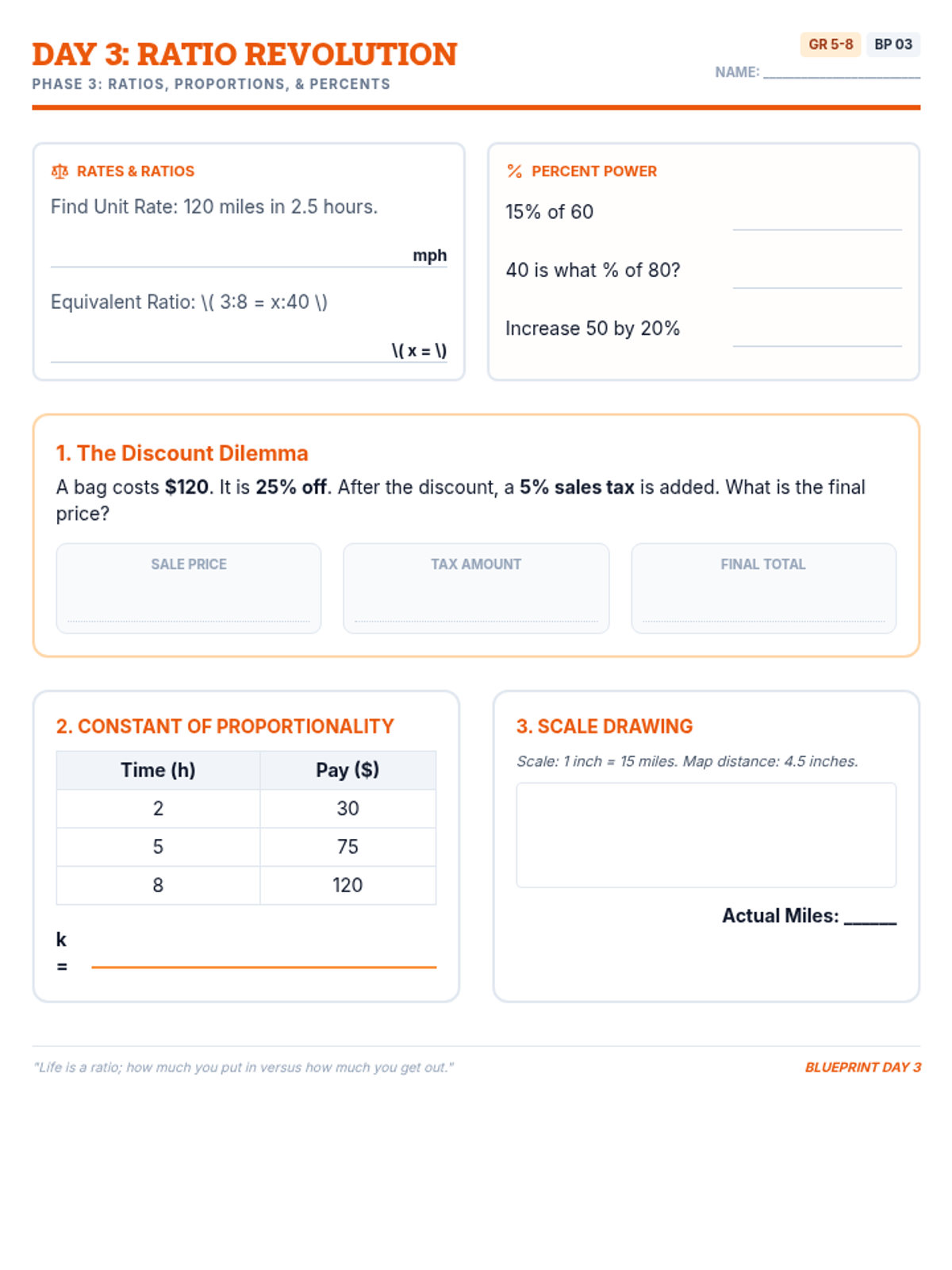
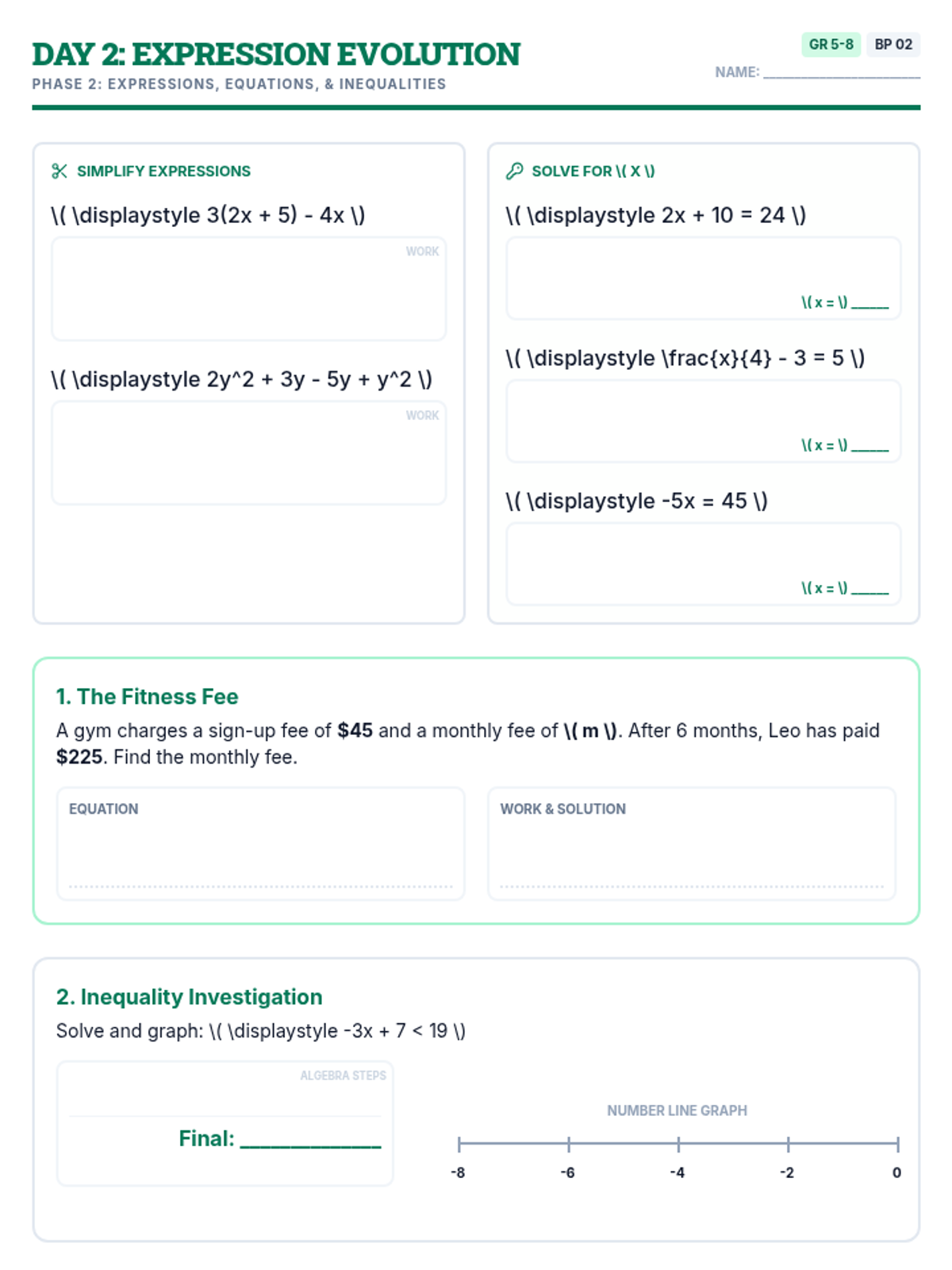
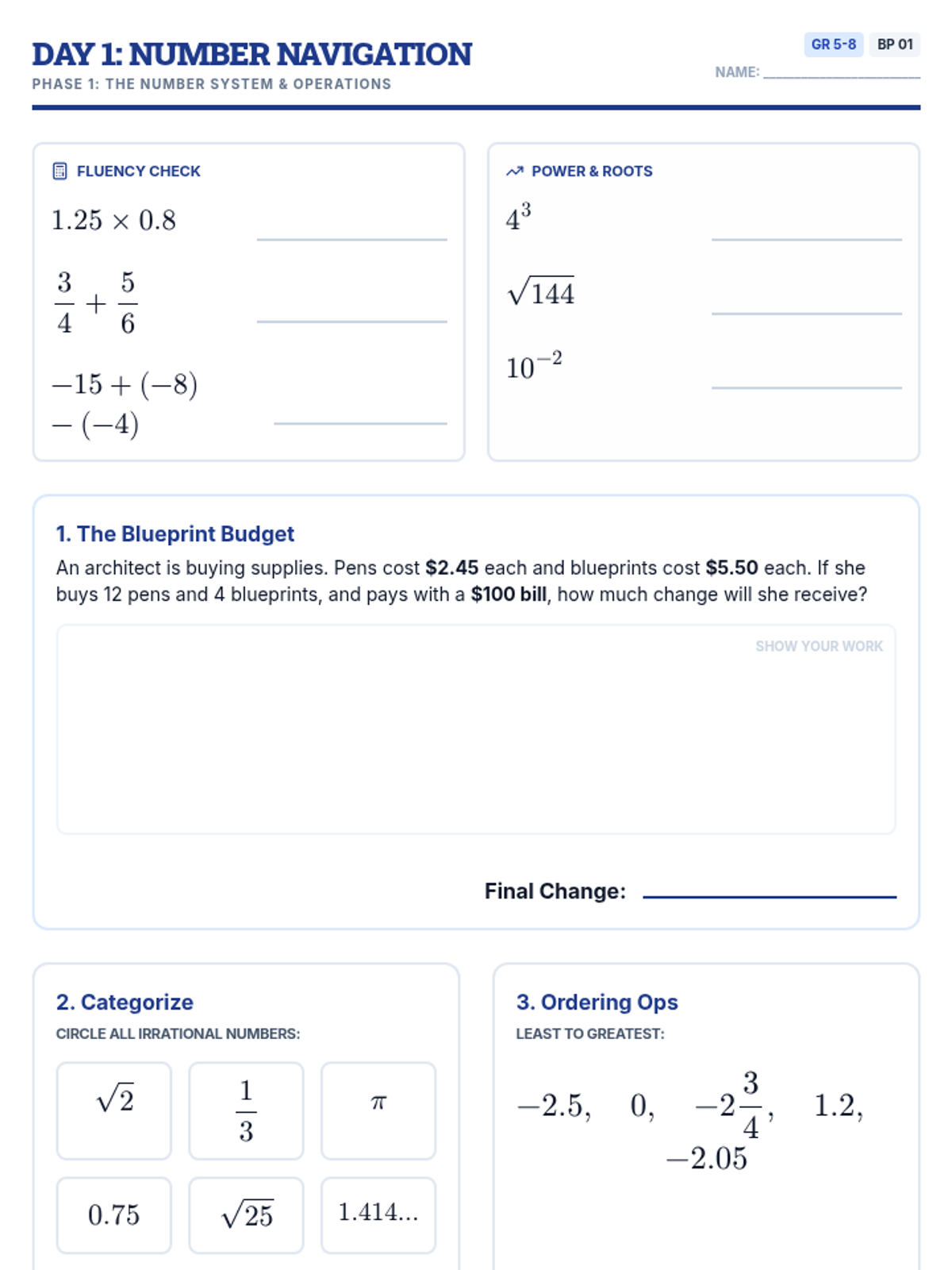
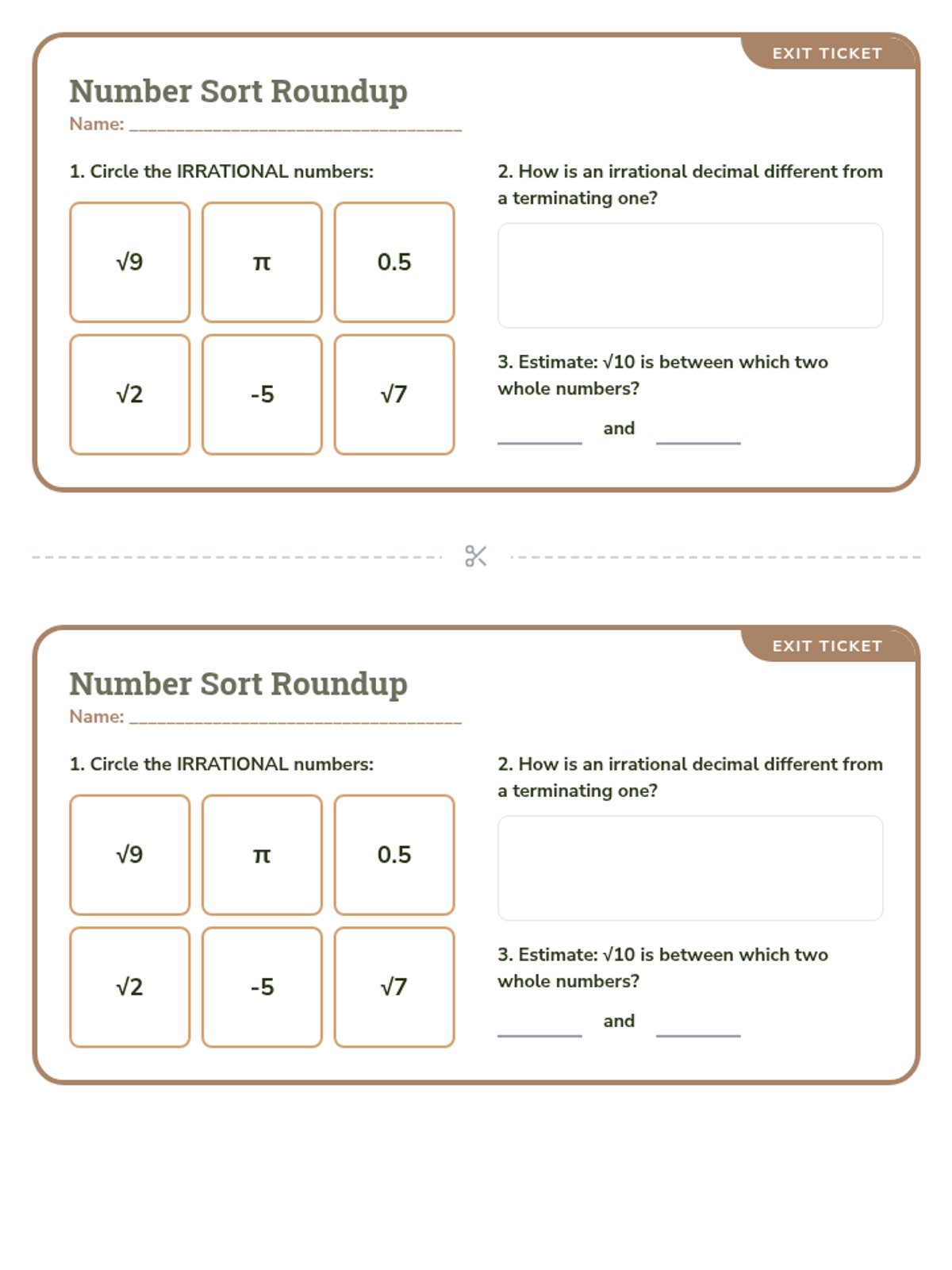
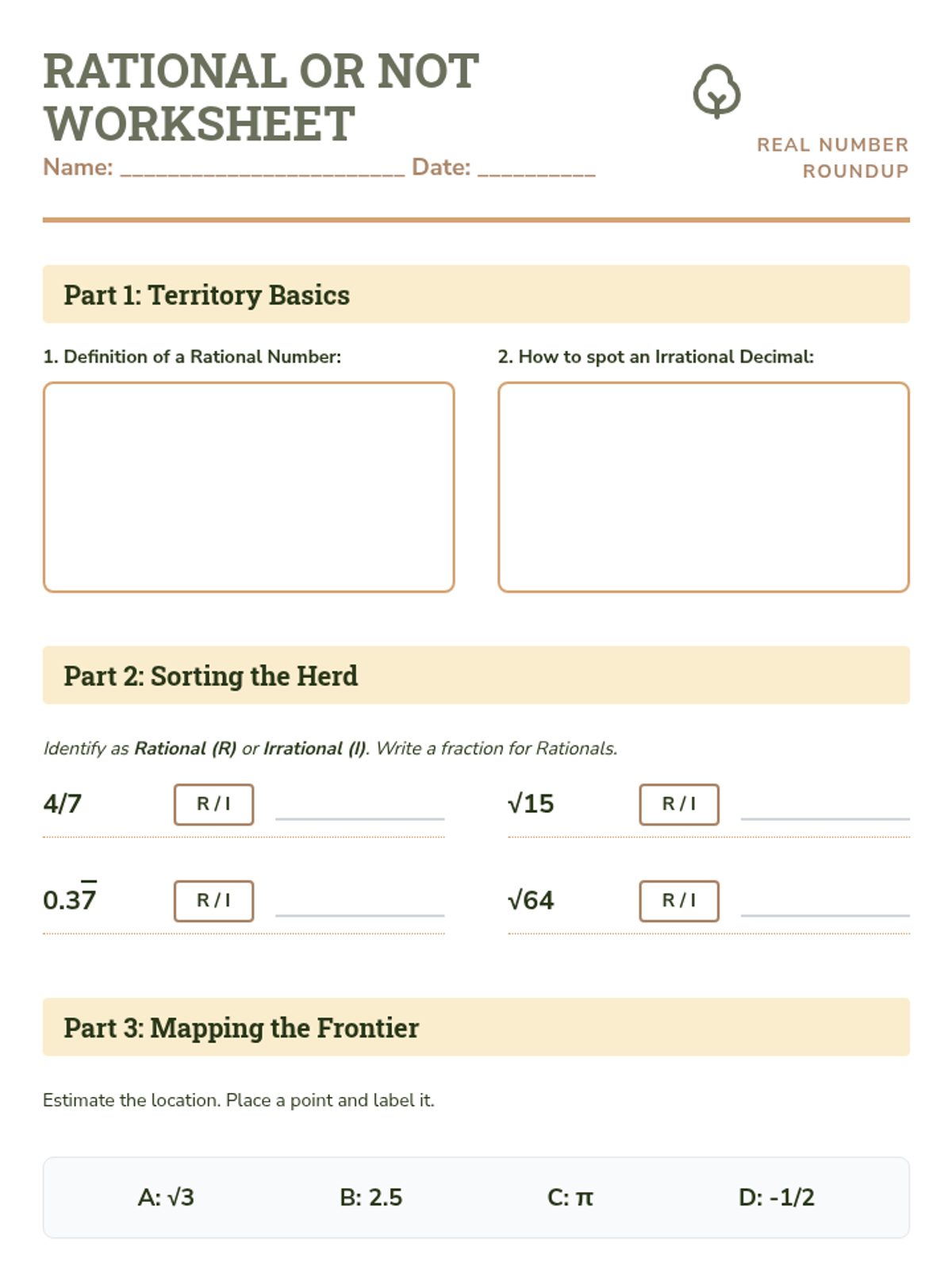
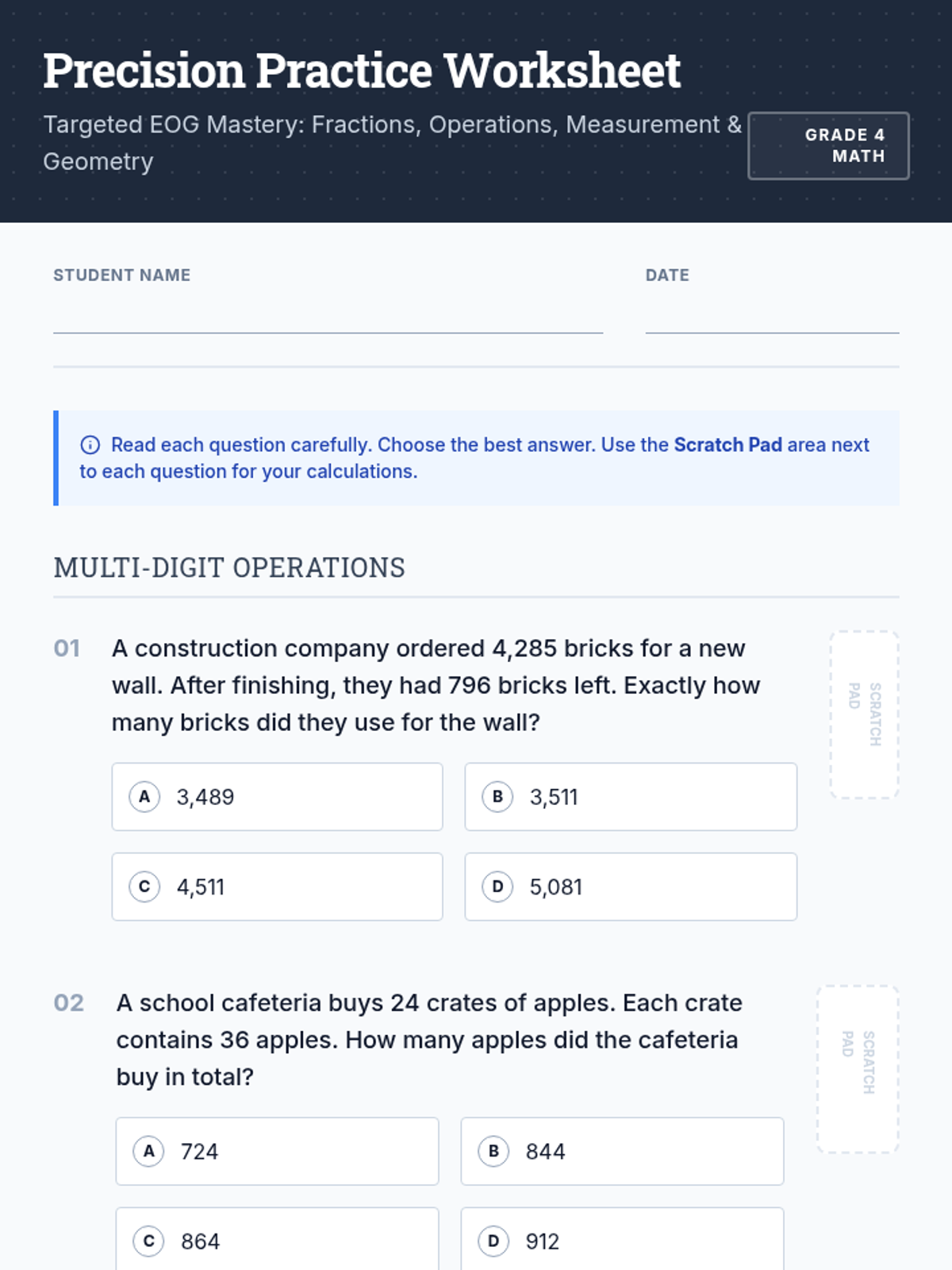
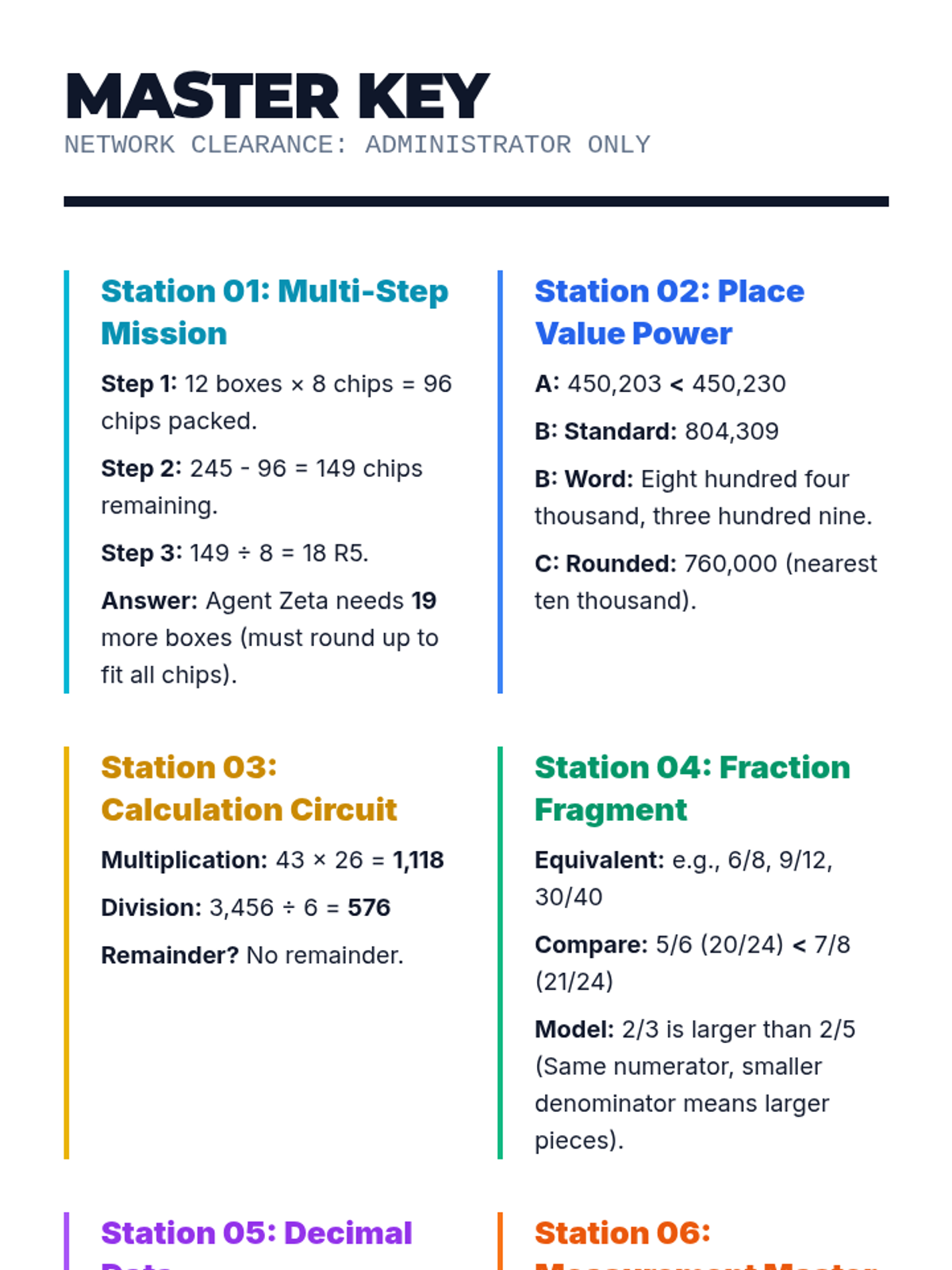
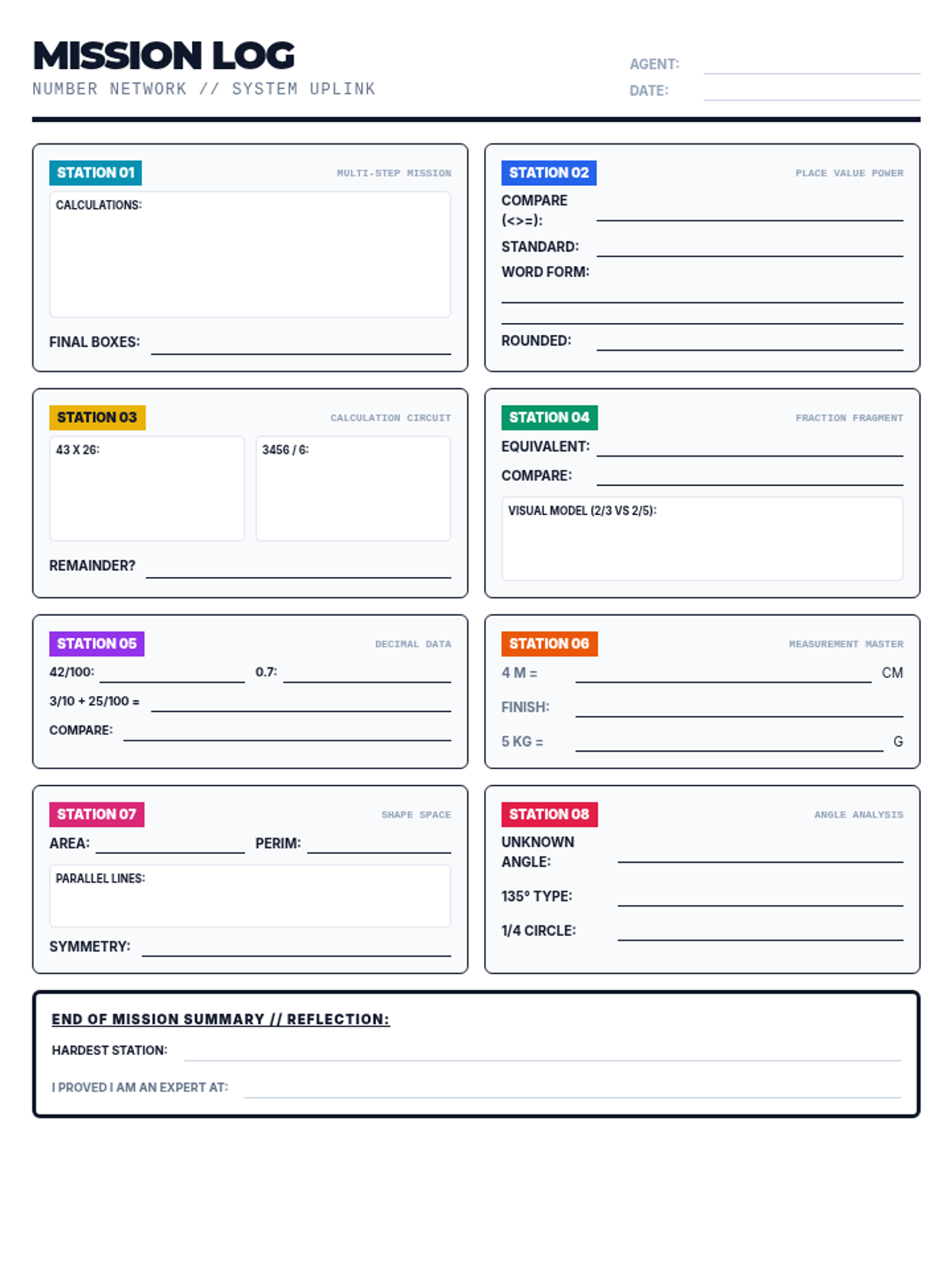
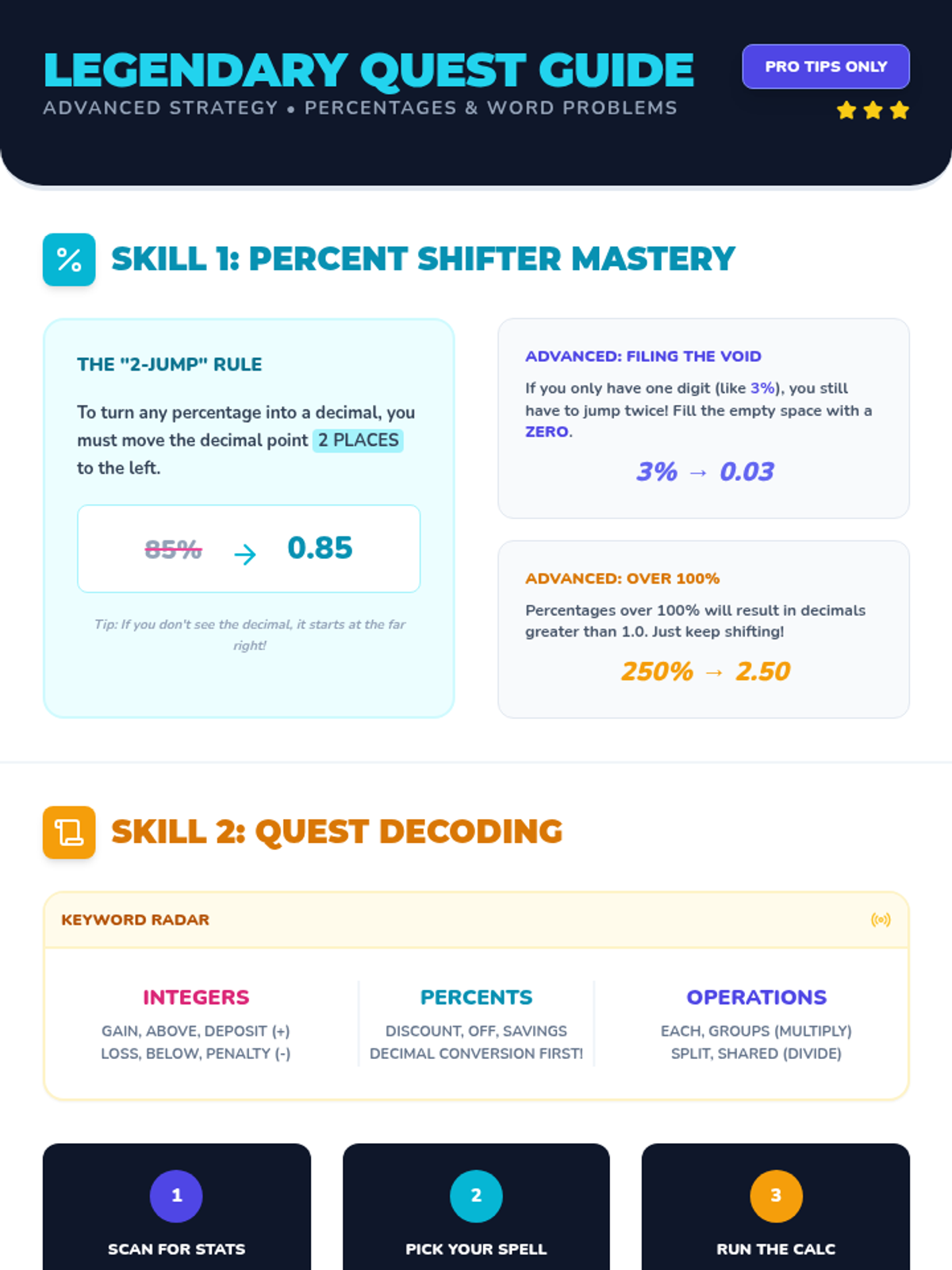
Foundational fraction equivalence, ordering, and operations across the rational number system. Addresses multi-digit computation, decimal conversions, and the distinction between rational and irrational numbers.
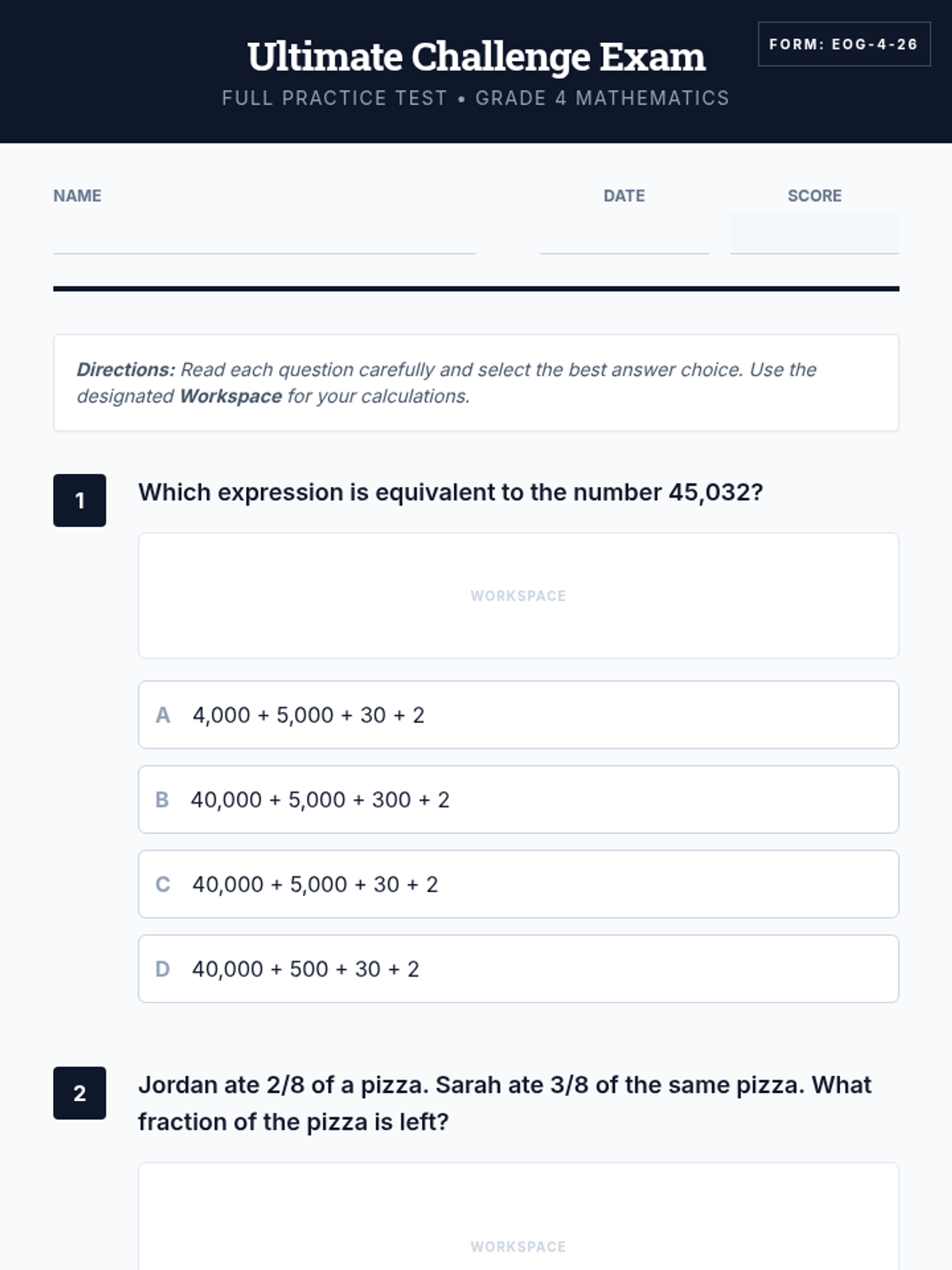
Final mastery check and performance task for Session 12. Covers modeling, estimation, algorithms, and context across the entire sequence.
Session 12 slides for the final mastery celebration and review of fraction division concepts.
Session 11 Lab Sheet. Students design their own fraction division story problems and models, then peer-review and solve a partner's challenge.
Session 11 slides challenging students to write their own story problems for given fraction division expressions.
Session 10 Lab Sheet. Students apply multiple strategies (visual and procedural) to solve a complex garden-themed word problem.
Session 10 slides focusing on multi-step and contextual problems involving fraction division.
Session 9 Lab Sheet. Students practice the 'invert and multiply' algorithm while maintaining a connection to estimation and conceptual logic.
Session 9 slides formalizing the 'invert and multiply' algorithm (Keep-Change-Flip) for fraction division.
Session 8 Lab Sheet. Students explore the concept of reciprocals and verify the relationship between fraction division and multiplication by the reciprocal.
Session 8 slides introducing the concept of reciprocals and the relationship between dividing by a fraction and multiplying by its reciprocal.
Session 7 Lab Sheet. Students practice predicting the size of the quotient relative to 1 before solving fraction division problems.
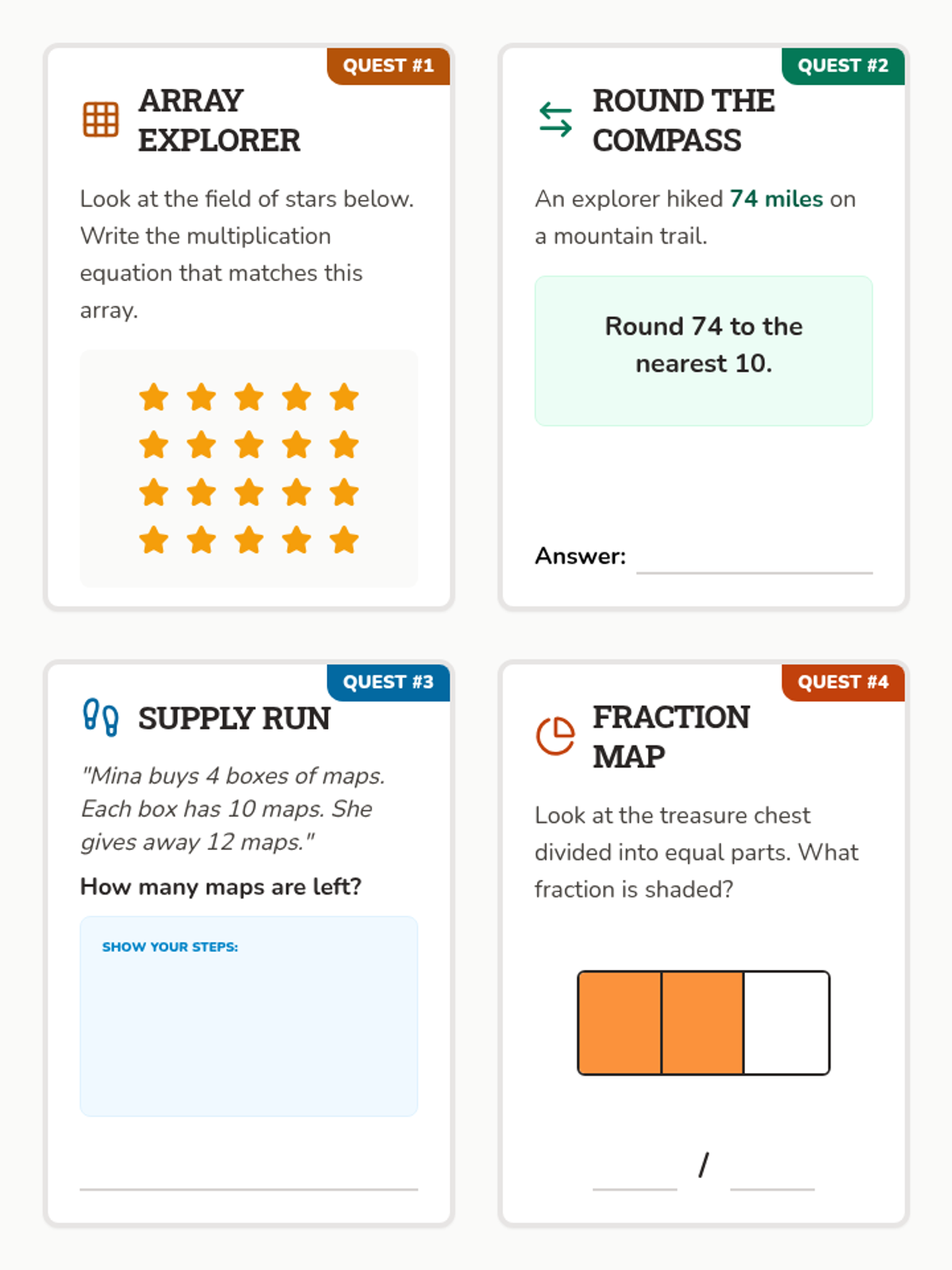
Session 7 slides focusing on estimating whether the quotient of a fraction division problem will be greater than or less than 1.
Session 6 Lab Sheet. Students practice converting fractions to a common denominator before dividing the numerators.
Session 6 slides teaching students how to use equivalent fractions to apply the common denominator strategy to problems with unlike denominators.
Session 5 Lab Sheet. Students practice the common denominator strategy, focusing on the conceptual understanding of dividing pieces of the same size.
Session 5 slides introducing the common denominator strategy for dividing fractions with the same denominator.
Session 4 Lab Sheet. Students apply tape diagrams to various fraction division scenarios (whole by unit, unit by whole, and whole by non-unit).
Session 4 slides introducing formal tape diagrams as a consistent tool for fraction division problems.
Session 3 Lab Sheet. Students transition to measurement division with non-unit fractions, using partitioning and grouping strategies.
Session 3 slides focusing on measurement division with non-unit fractions (e.g., 2 divided by 2/3).
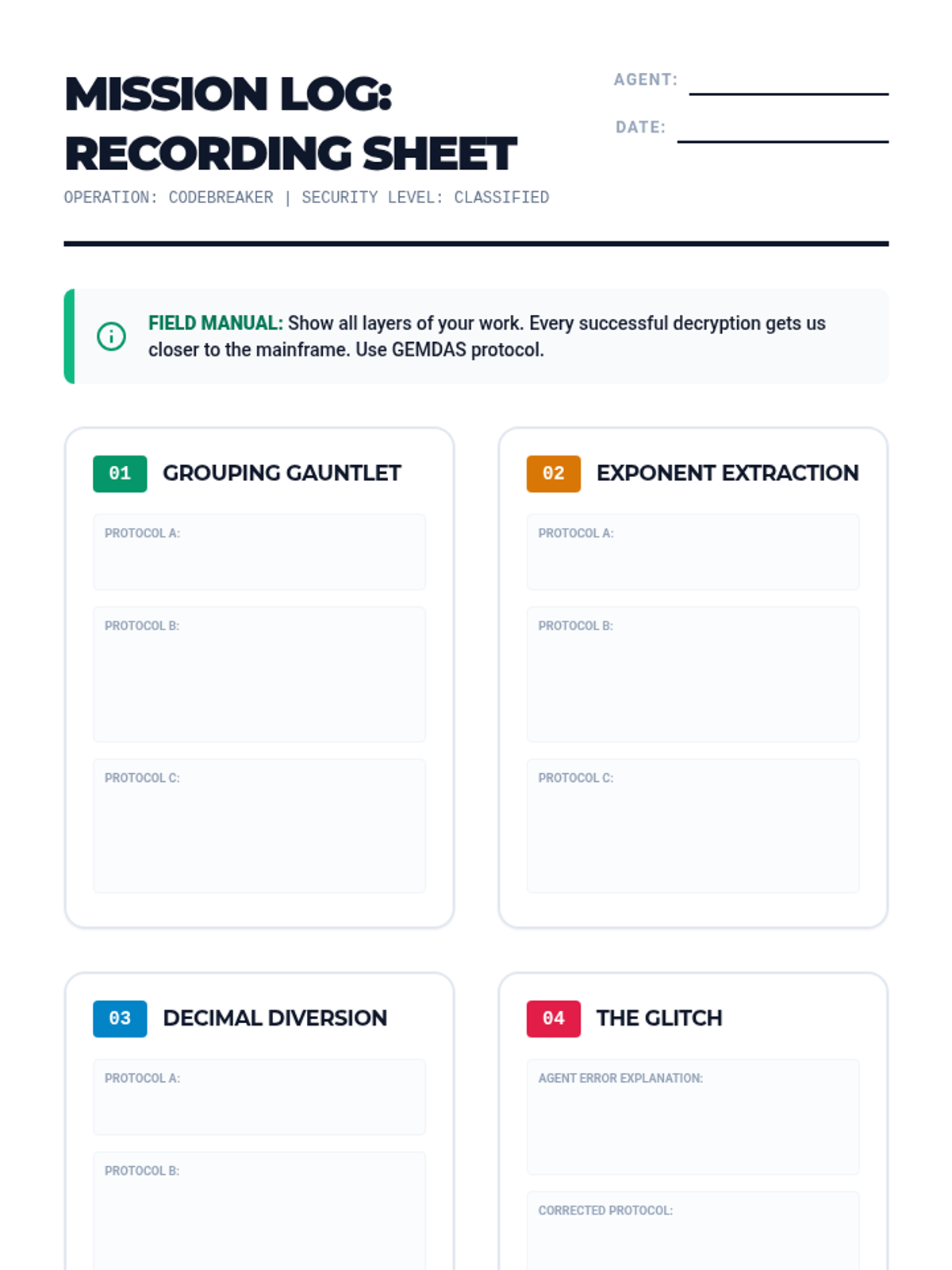
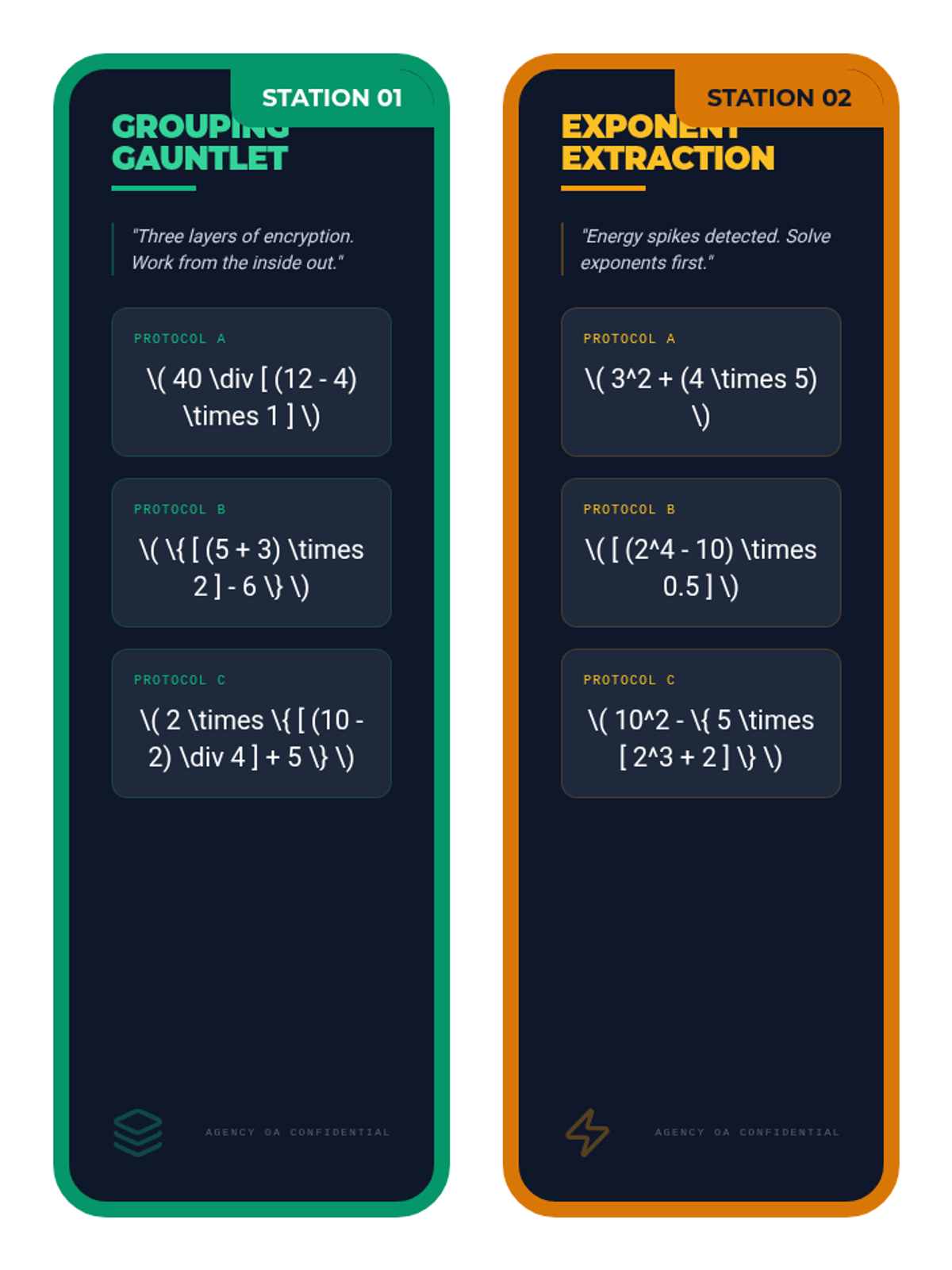
A student worksheet for Lesson 12, the culminating session where students apply flexible thinking to solve multi-step 'Navigator' challenges.
A visual presentation for Lesson 12, the culminating session where students apply flexible thinking to solve multi-step 'Navigator' challenges.
A student worksheet for Lesson 11, introducing the concept of ratios as a comparison of two quantities, built on fractional foundations.
A visual presentation for Lesson 11, introducing the concept of ratios as a comparison of two quantities, built on fractional foundations.
A student worksheet for Lesson 10, focusing on comparing and ordering fractions, decimals, and percents in a "race" format.
A visual presentation for Lesson 10, synthesizing understanding by comparing fractions, decimals, and percents in real-world contexts.
A student worksheet for Lesson 9, practicing fraction multiplication with visual area models and the numerator/denominator rule.
A visual presentation for Lesson 9, understanding fraction multiplication as 'taking a part of a part' through visual area models.
A student worksheet for Lesson 8, bridging the gap between fractions and decimals by exploring 'Power of 10' denominators (1/10, 1/100).
A visual presentation for Lesson 8, bridging the gap between fractions and decimals by exploring 'Power of 10' denominators (1/10, 1/100).
A student worksheet for Lesson 7, practicing addition and subtraction of fractions with unlike denominators using common denominators and visual models.
A visual presentation for Lesson 7, using benchmark fractions and visual models to add and subtract fractions with unlike denominators.
A student worksheet for Lesson 6, practicing finding common denominators by 'partitioning' visual models, moving from concrete to abstract.
A visual presentation for Lesson 6, teaching how to find common denominators by 'partitioning' visual models, moving from concrete to abstract.
A student worksheet for Lesson 5, practicing identifying and creating equivalent fractions using area models and the multiplier/divisor rule.
A visual presentation for Lesson 5, visualizing fractional equivalence using area models and the multiplier rule.
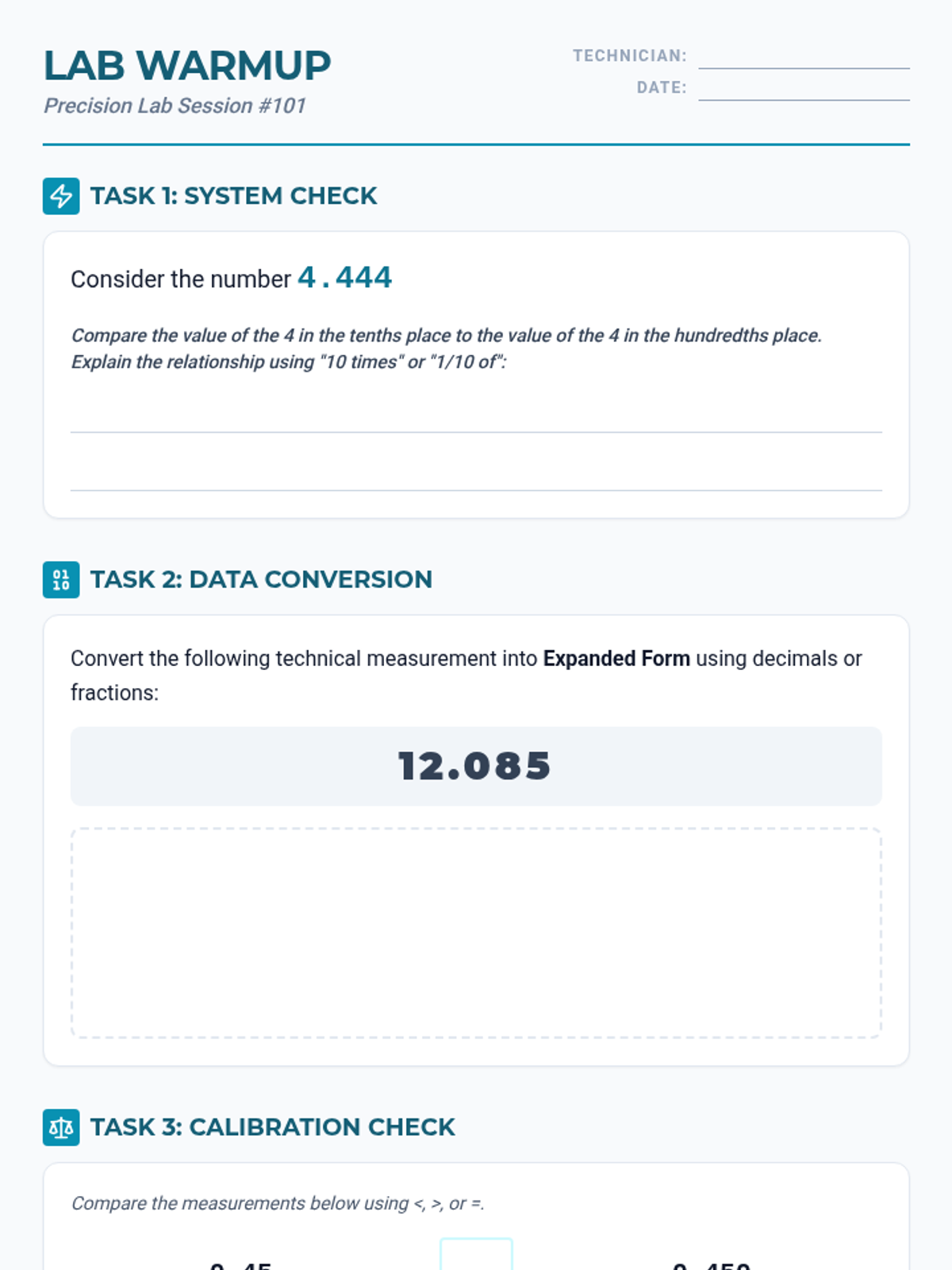
A student worksheet for Lesson 4, practicing flexible decomposition of decimals into tenths and hundredths.
A visual presentation for Lesson 4, demonstrating flexible decomposition of decimals (e.g., 1.5 is 15 tenths) using place value visualizations and 'trading' analogies.
A student worksheet for Lesson 3, focusing on practicing comparing and ordering decimals using place value alignment and placeholder zeros.
A visual presentation for Lesson 3, introducing strategies for comparing decimals by lining up decimal points, comparing place values from left to right, and using placeholder zeros.
Student Lab Sheet for Shape Shifters: A structured workspace for comparing shapes, sorting quadrilaterals, and solving geometric property riddles.
Teacher Facilitation Guide for Shape Shifters: Provides instructional scripts and pedagogical strategies for classifying polygons based on properties.
Shape Shifters Slide Deck: An interactive presentation focused on geometric properties, polygon classification, and visual reasoning using 'Geometry Talks'.
Student Lab Sheet for Data Detectives: A structured investigative worksheet for matching stories to graphs, sketching qualitative trends, and selecting appropriate measurement units.
Teacher Facilitation Guide for Data Detectives: Provides instructional strategies for connecting qualitative graph trends to real-world scenarios.
Data Detectives Slide Deck: An interactive presentation developed for 6th-grade math intervention, focusing on the "Story of a Graph" strategy to build data literacy and unit conversion skills.
Student Lab Sheet for Balance Beam: A guided practice sheet for testing equation truth, finding balanced values using patterns, and defining equality.
Teacher Facilitation Guide for Balance Beam: Provides instructional scripts and strategies for teaching the equals sign as a balance using True/False equations.
Balance Beam Slide Deck: An interactive presentation focused on the conceptual meaning of the equals sign and solving balanced equations using True/False tasks.
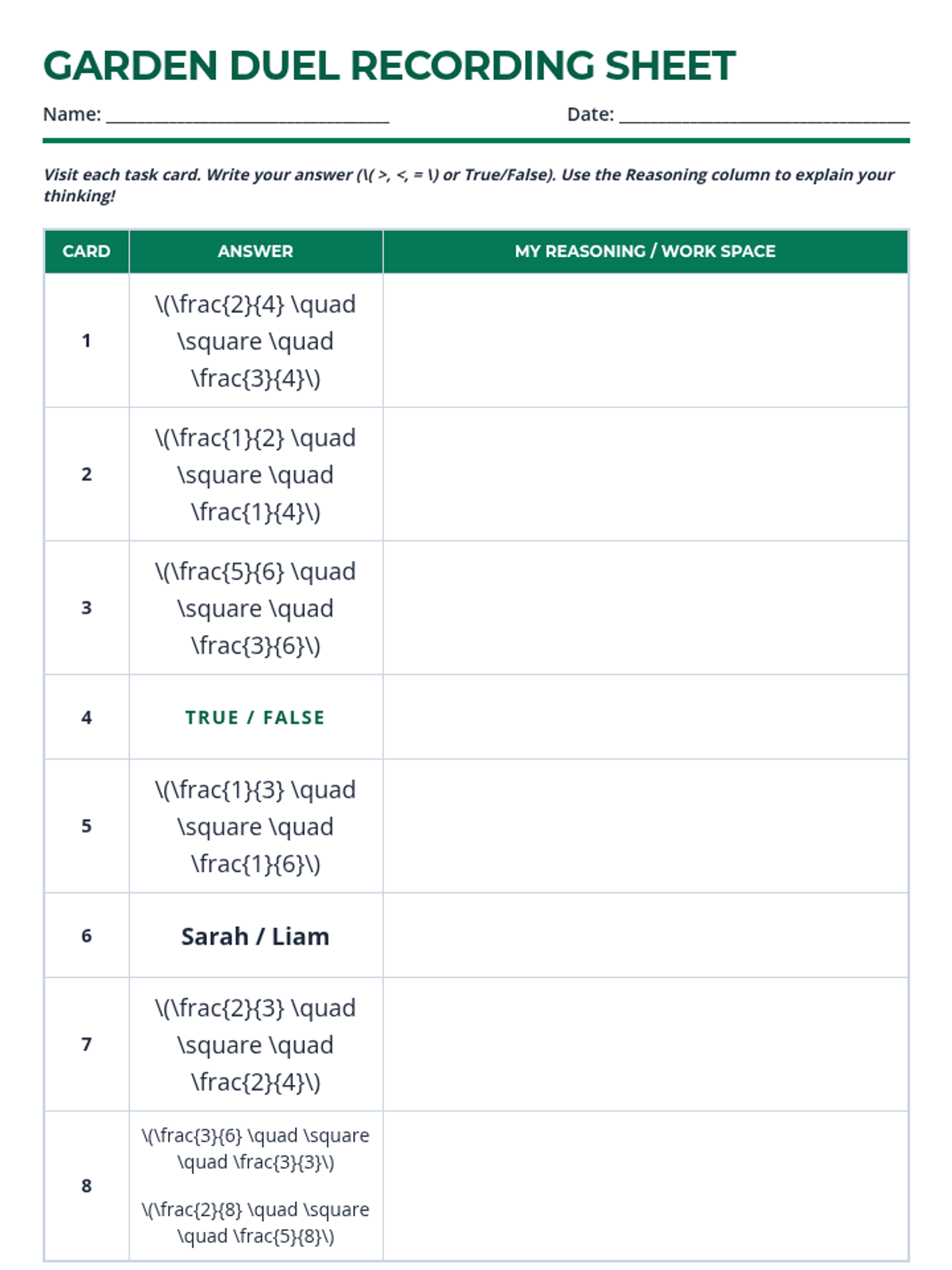
Student Lab Sheet for Fraction Flash: A structured workspace for students to record Quick Image sketches, number line placements, and comparison observations.
Teacher Facilitation Guide for Fraction Flash: Provides instructional scripts, common misconceptions, and differentiation strategies for 6th-grade math intervention.
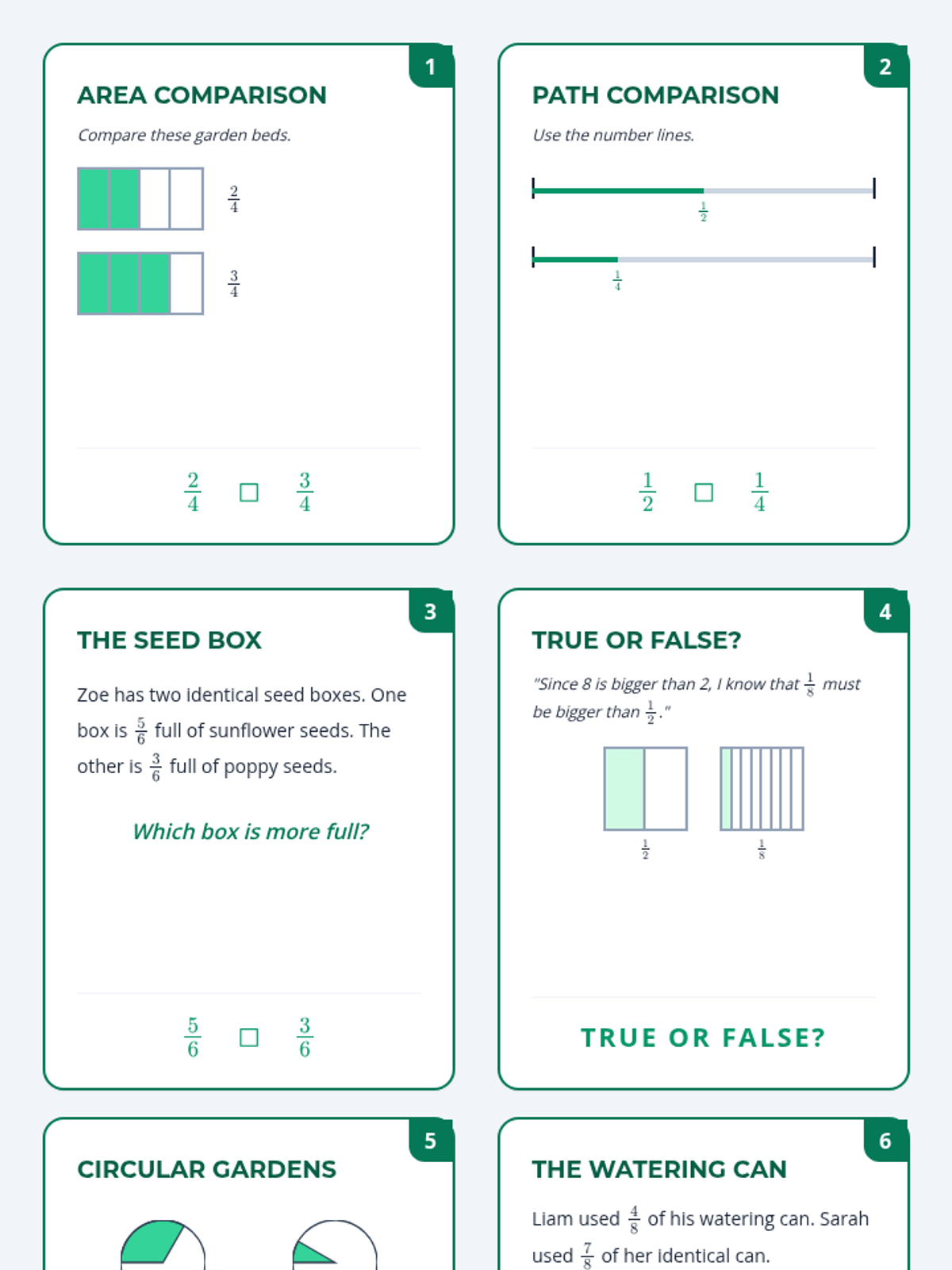
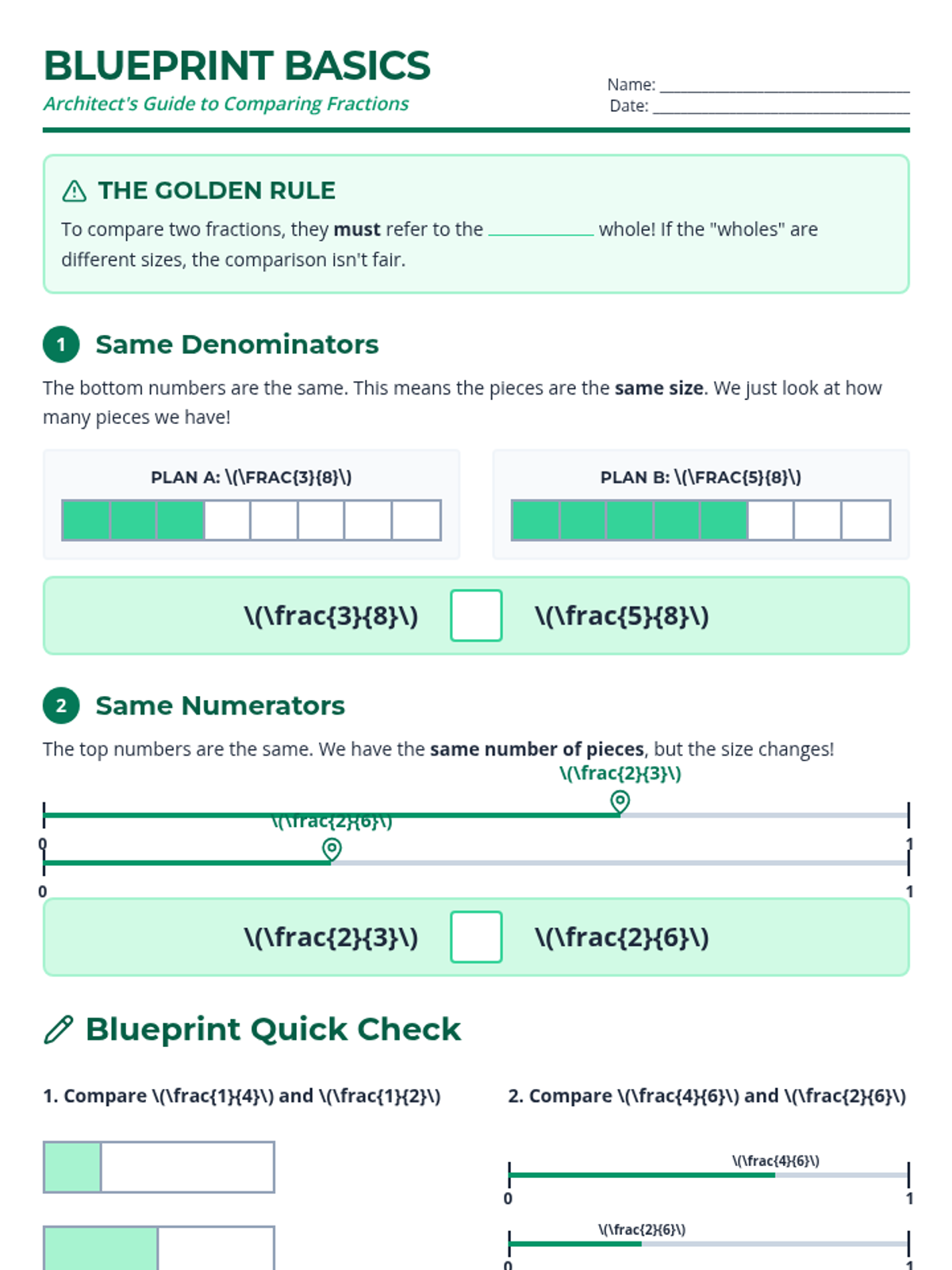
Fraction Flash Slide Deck: An interactive visual presentation for 6th-grade math intervention. Focuses on 'Quick Images' and number line concepts to build fraction fluency and conceptual understanding.
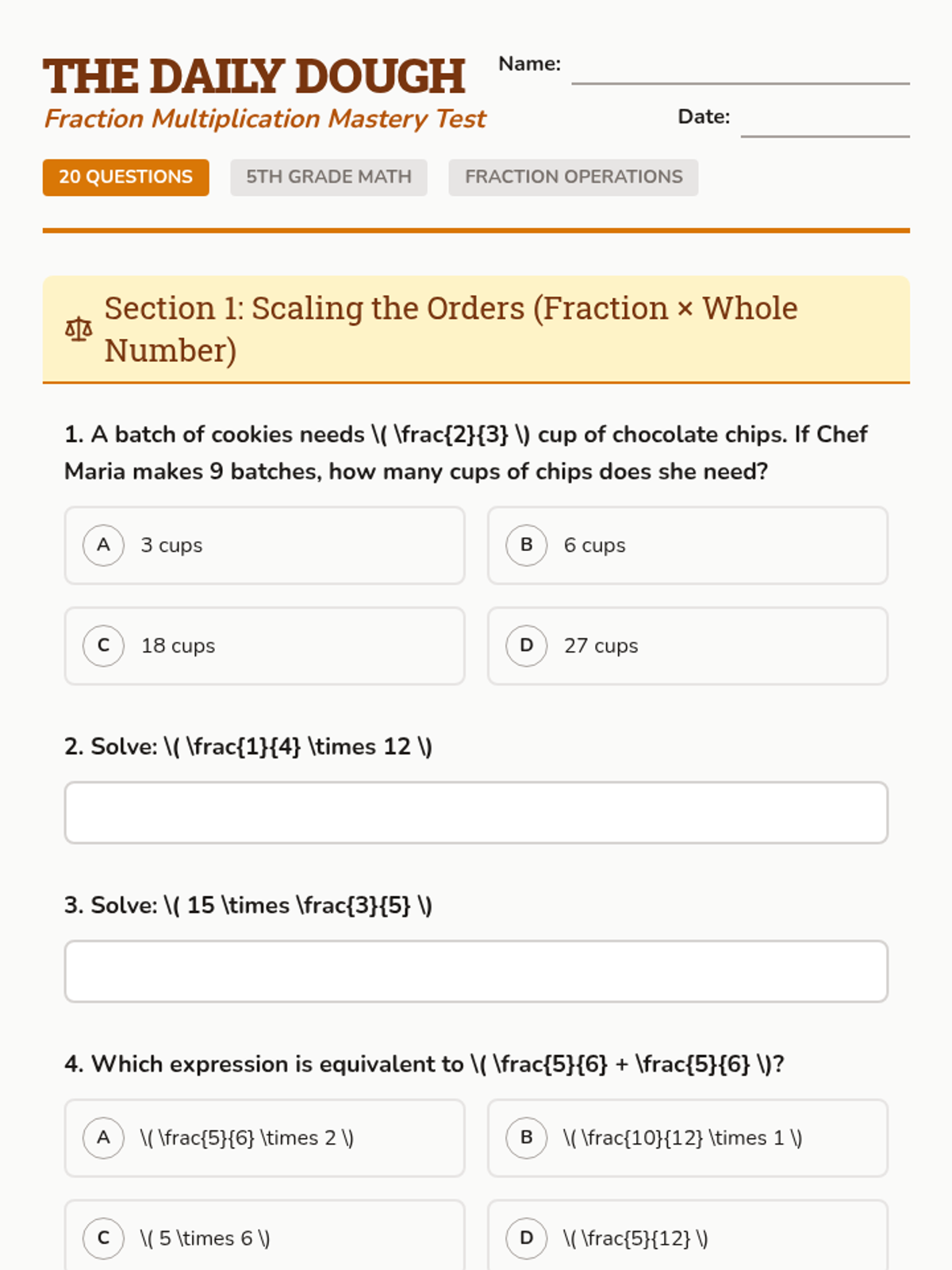
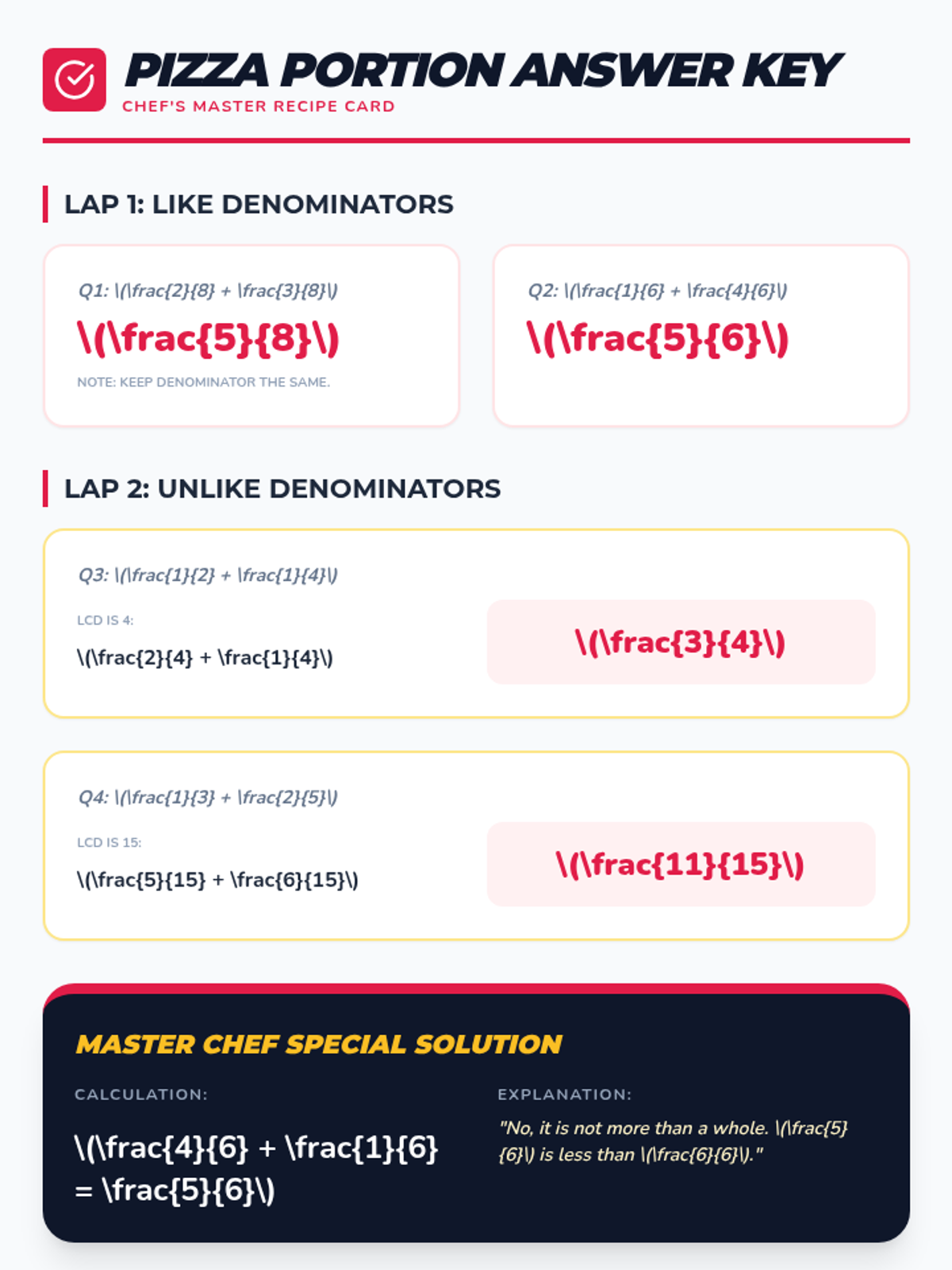
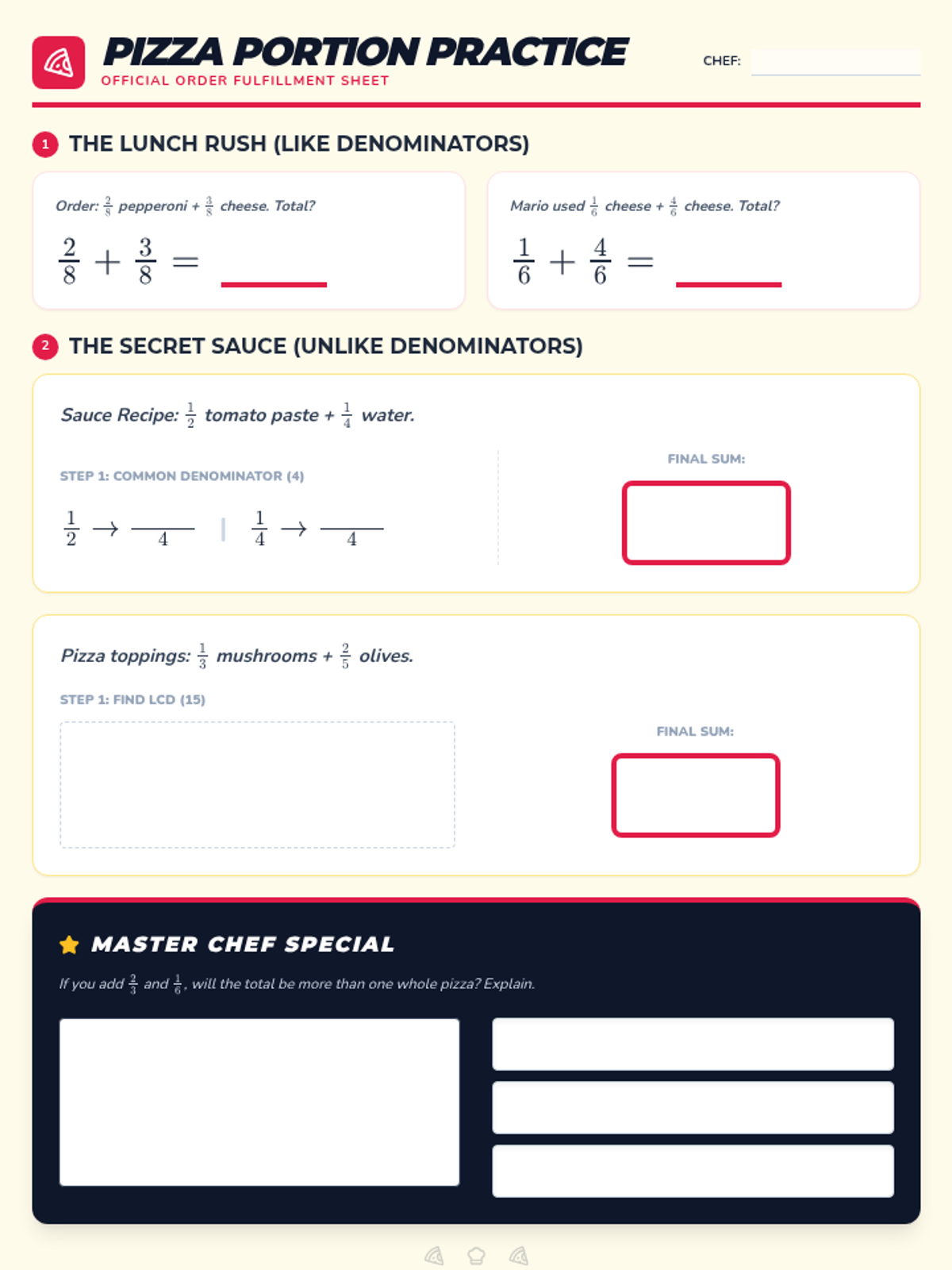
A comprehensive worksheet for 5th graders to practice equivalent fractions, comparing fractions, and adding/subtracting fractions with like denominators through word problems.
A hands-on activity where students act as chefs, using cut-out fraction circles to fill customer orders involving equivalent fractions and operations.
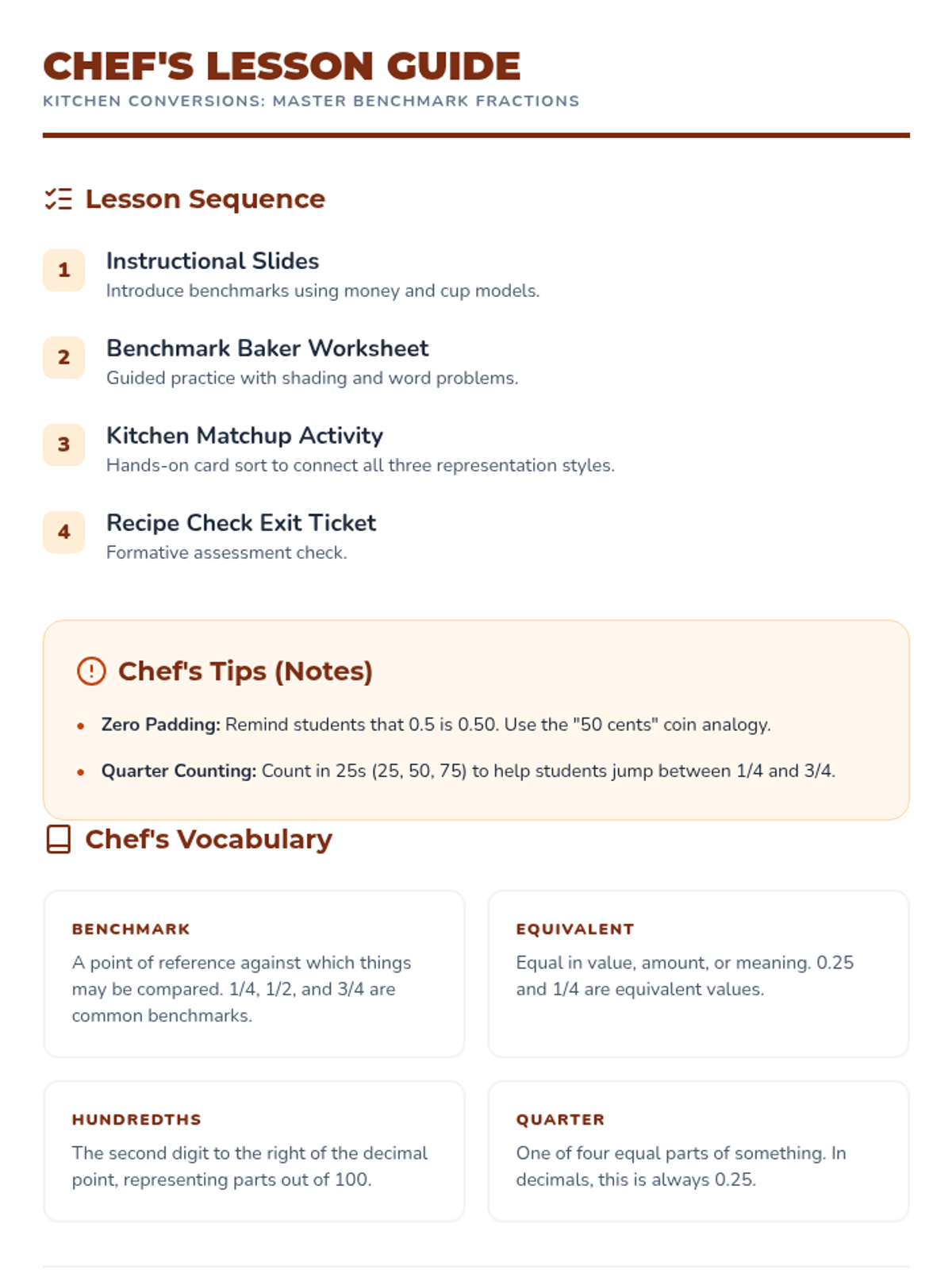
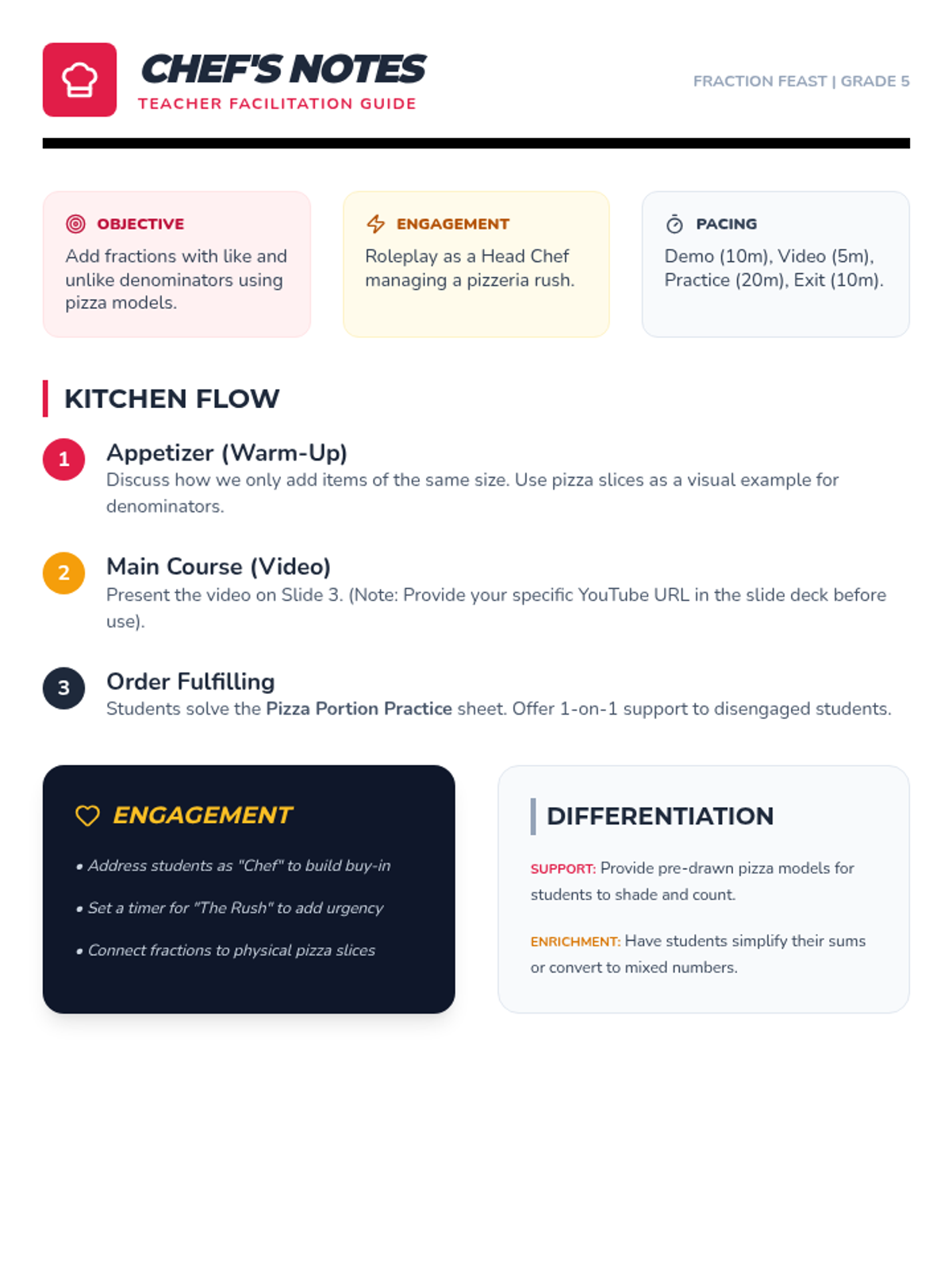
A detailed lesson plan for teachers, outlining the instructional flow, materials, and differentiation strategies for the Fraction Feast lesson.
A visual presentation for teaching 5th graders about fractions using food sharing. Includes equivalent fractions, comparing fractions with like denominators, and adding/subtracting fractions.
A visual reference guide or anchor chart explaining how to identify and plot fractions on a number line using the 'Pathfinder' theme.
The teacher answer key for the Line Leader Worksheet, featuring all solutions in a distinct red style for easy grading.
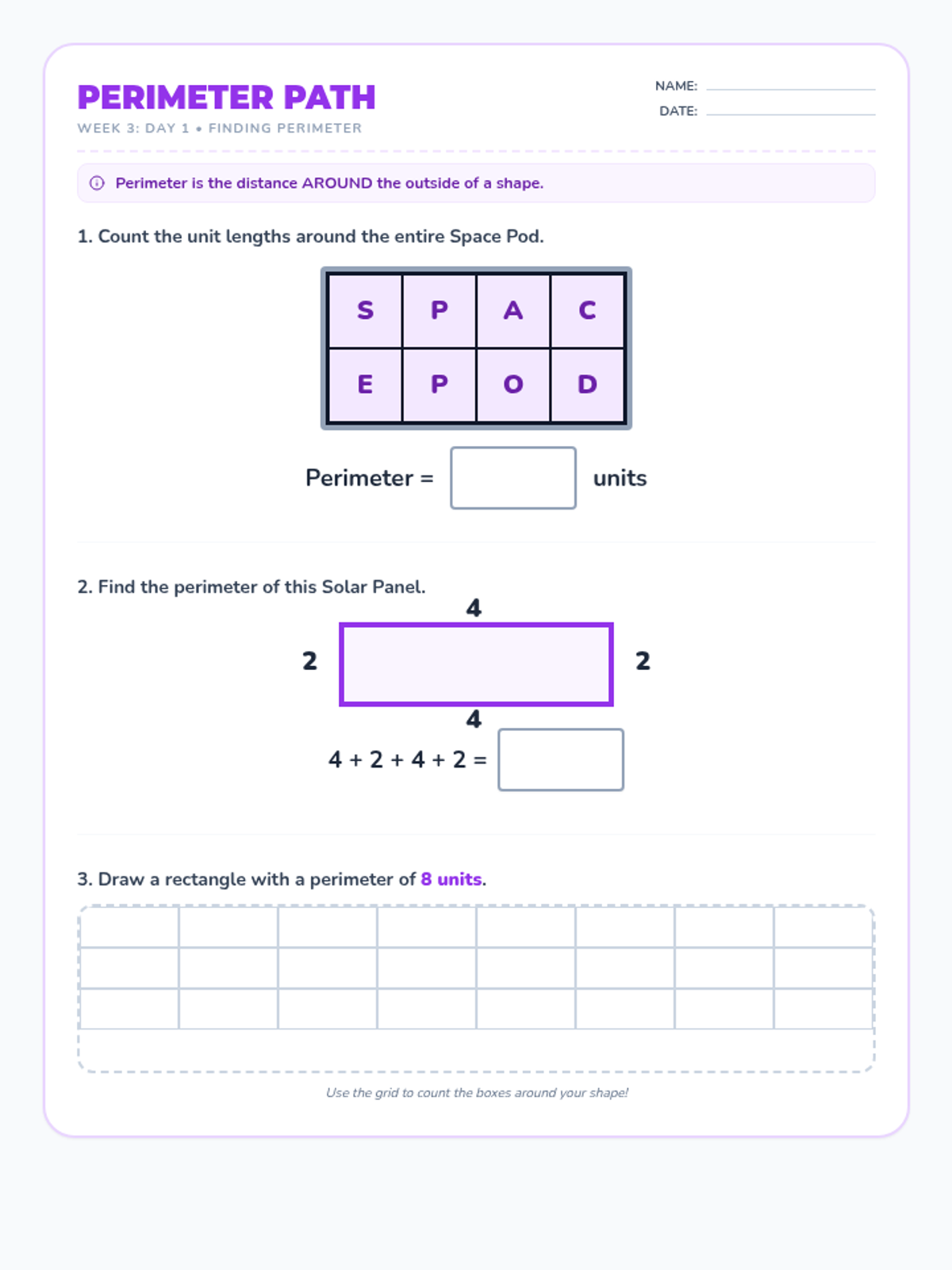
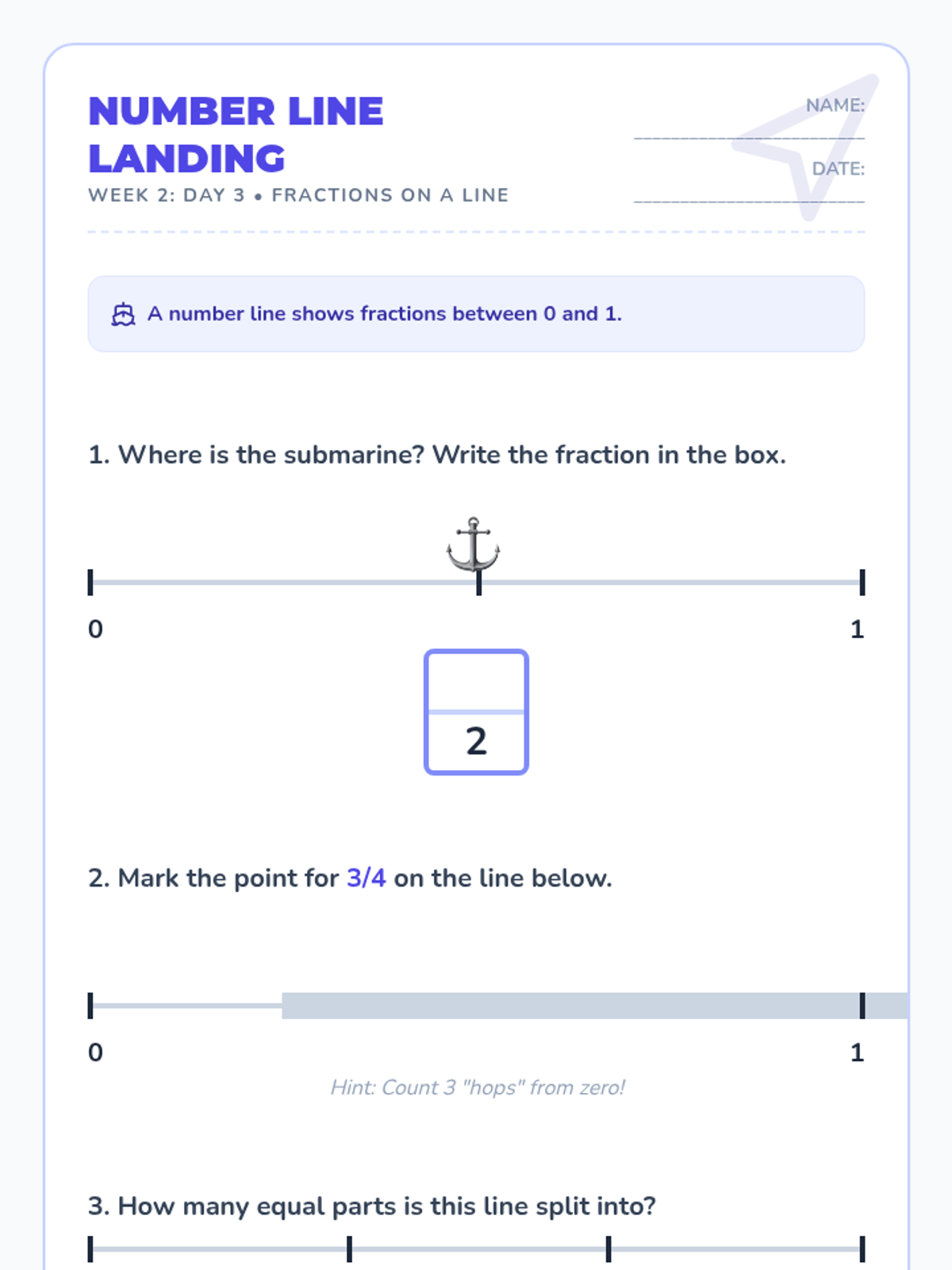
A print-ready student worksheet for practicing partitioning, labeling, and plotting fractions on number lines.
An instructional slide deck introducing fractions as distances on a number line, including partitioning and labeling steps.
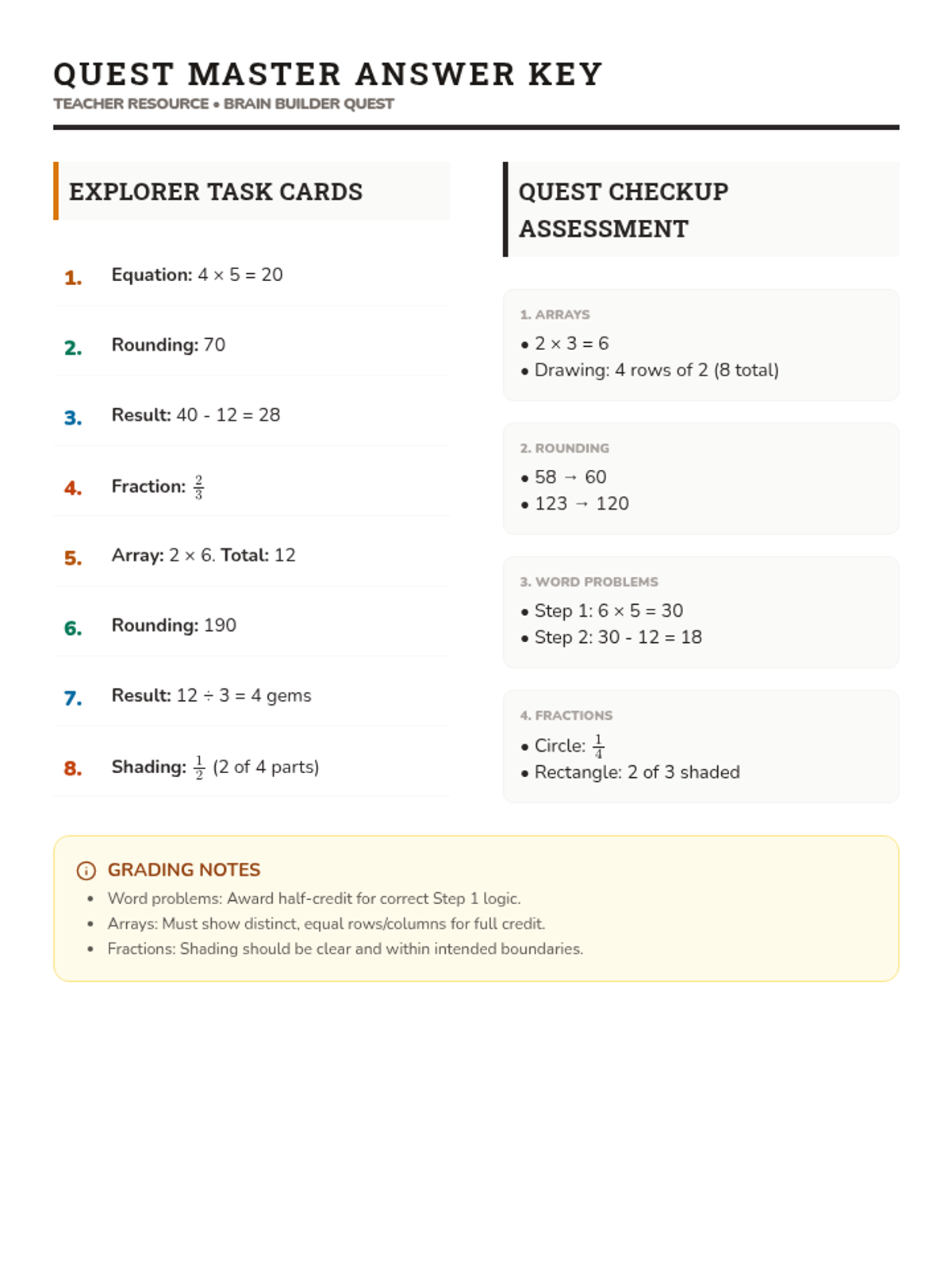
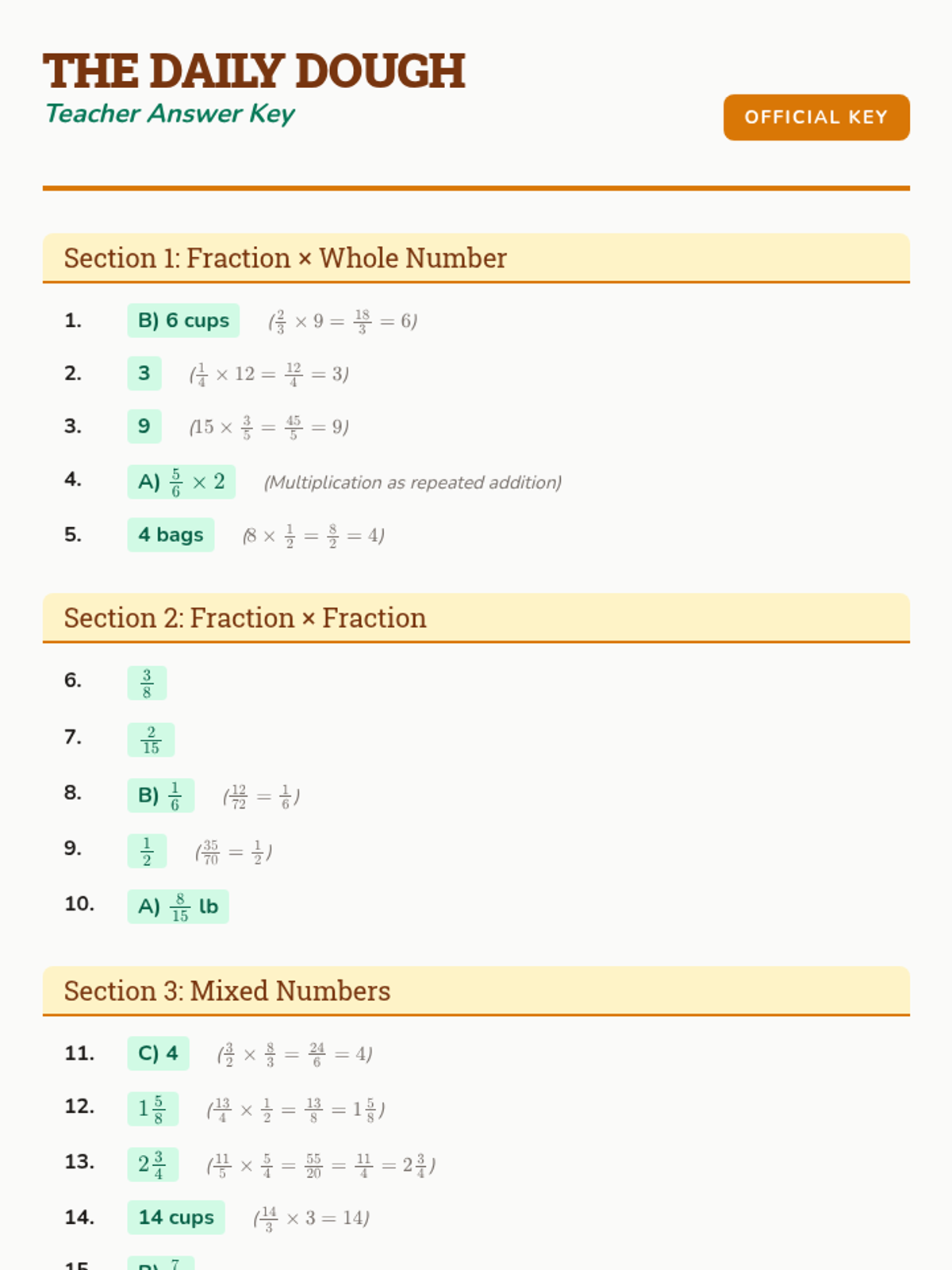
A combined teacher answer key for the Treasure Hunter Practice Sheet and the Deep Dive Quiz, featuring clear solutions and grading notes.
An ocean-themed short quiz to assess student understanding of converting halves, quarters, and tenths into decimals.
An ocean-themed student practice worksheet for converting tenths, quarters, and halves into decimals.
A visually engaging anchor chart titled "Diver's Signal Map" that explains how to convert halves, quarters, and tenths into decimals using marine-themed visual models.
A detailed lesson plan for teaching fraction-to-decimal conversions using a "Deep Sea Decimals" theme, featuring instructional steps, differentiation strategies, and common misconceptions.
A comprehensive teacher answer key for the Fraction Matchups Quiz, providing correct answers, mathematical reasoning, and expectations for visual models and explanations.
An instructional slide deck for 4th graders introducing equivalent fractions using a bakery theme. Includes visual models, the multiplication rule, and a whole-class discussion challenge.
A 4th-grade bakery-themed quiz on equivalent fractions featuring multiple-choice word problems and open-ended calculation tasks. Includes space for visual modeling and written explanations.
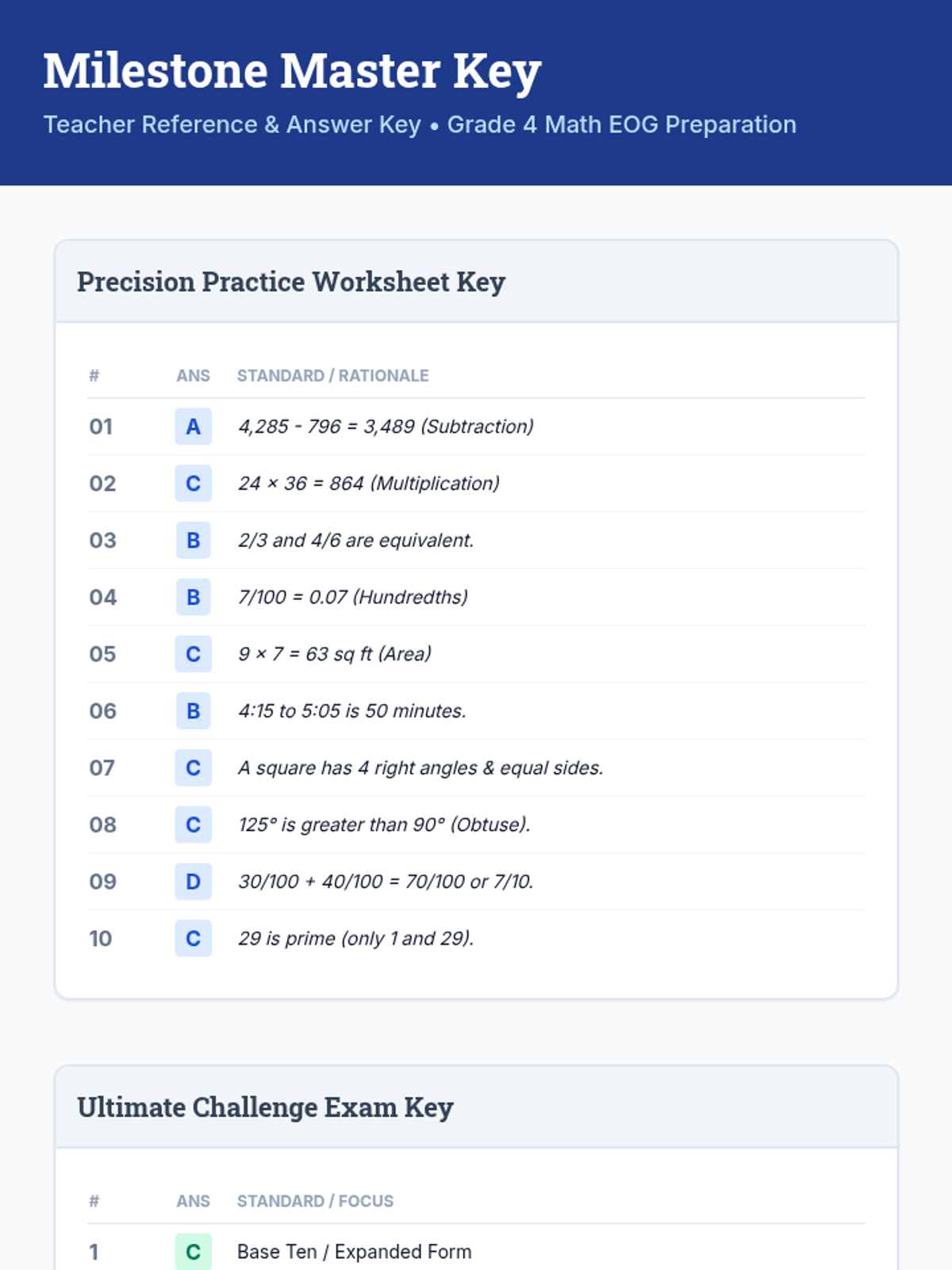
A teacher answer key for the 'Final Inspection Quiz', providing correct answers for the multiple-choice questions and step-by-step solutions for the performance tasks.
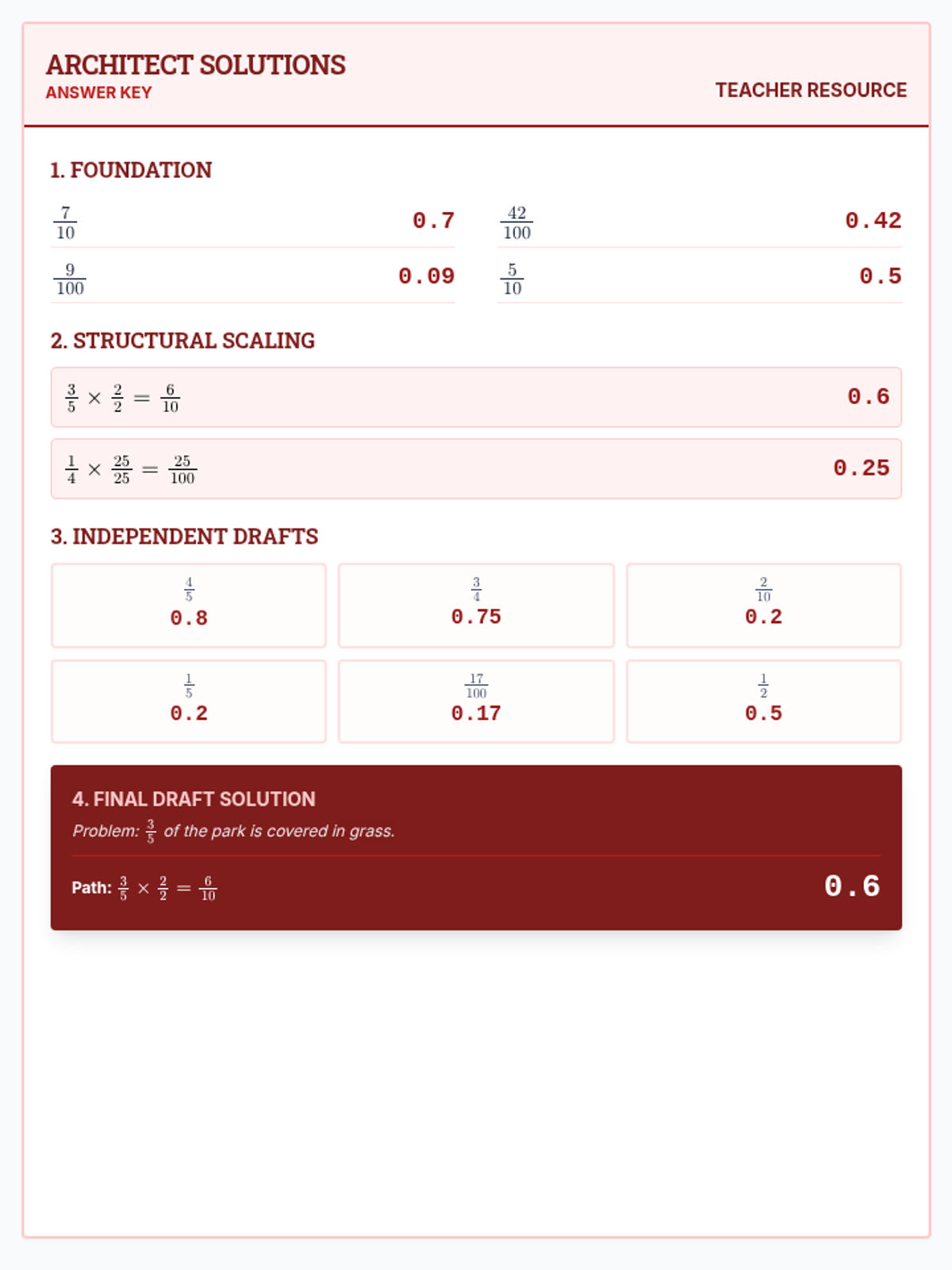
A teacher answer key for the 'Construction Zone Worksheet', providing completed equivalent fractions and final decimal answers for all eight practice problems.
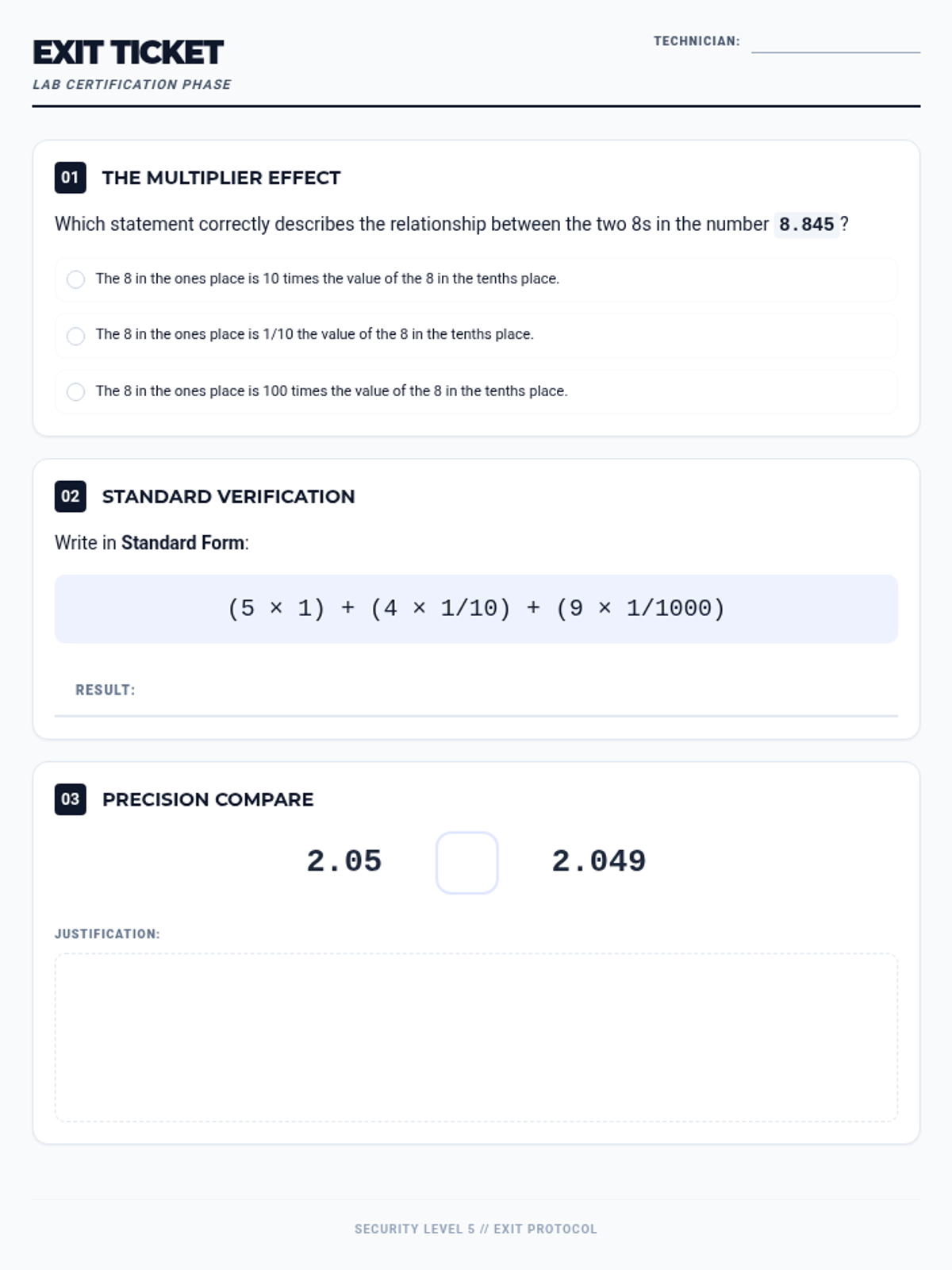
A short assessment quiz to check for mastery in converting fractions to terminating decimals. Includes multiple-choice concept questions and performance tasks requiring students to show their work.
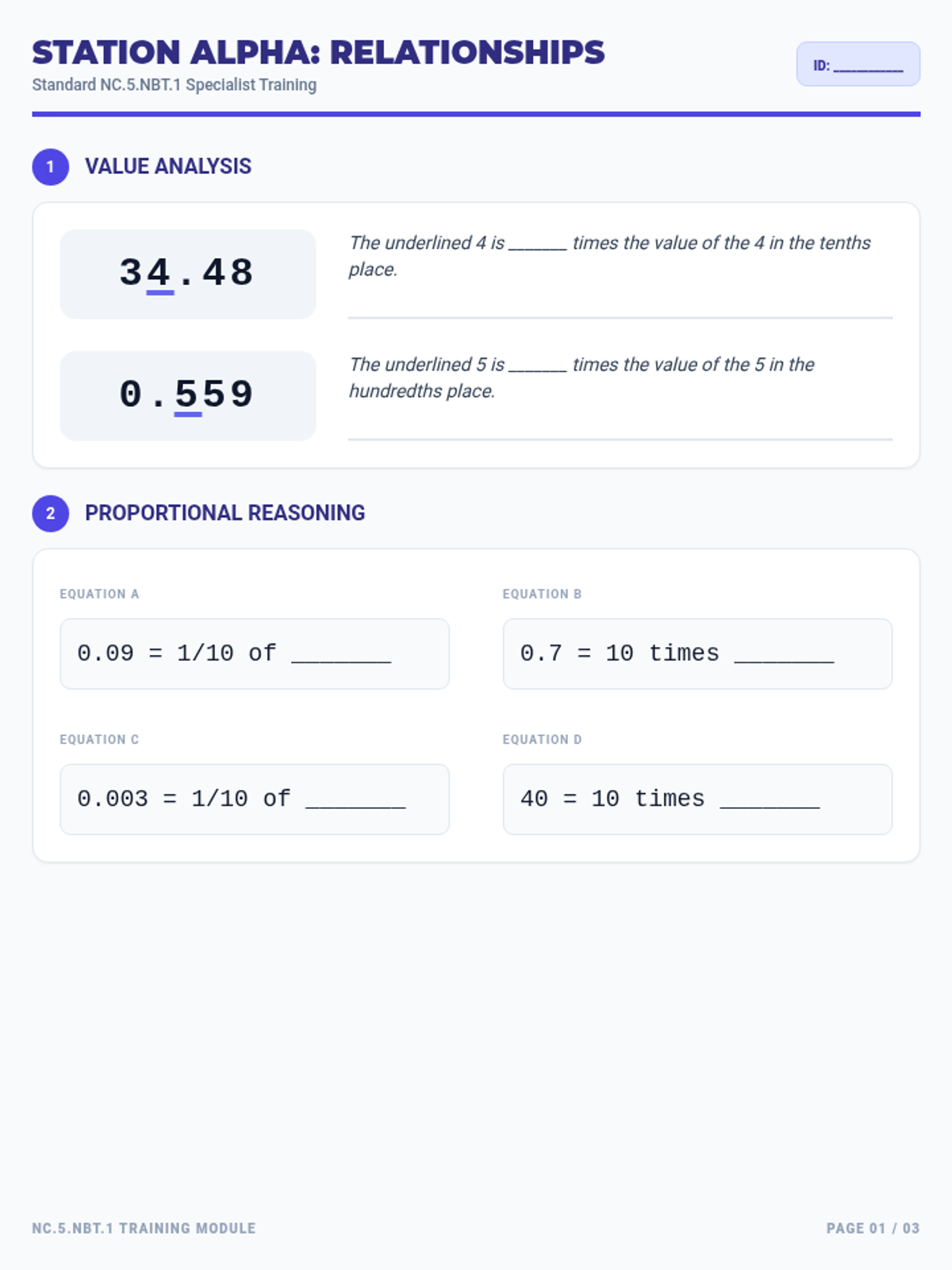
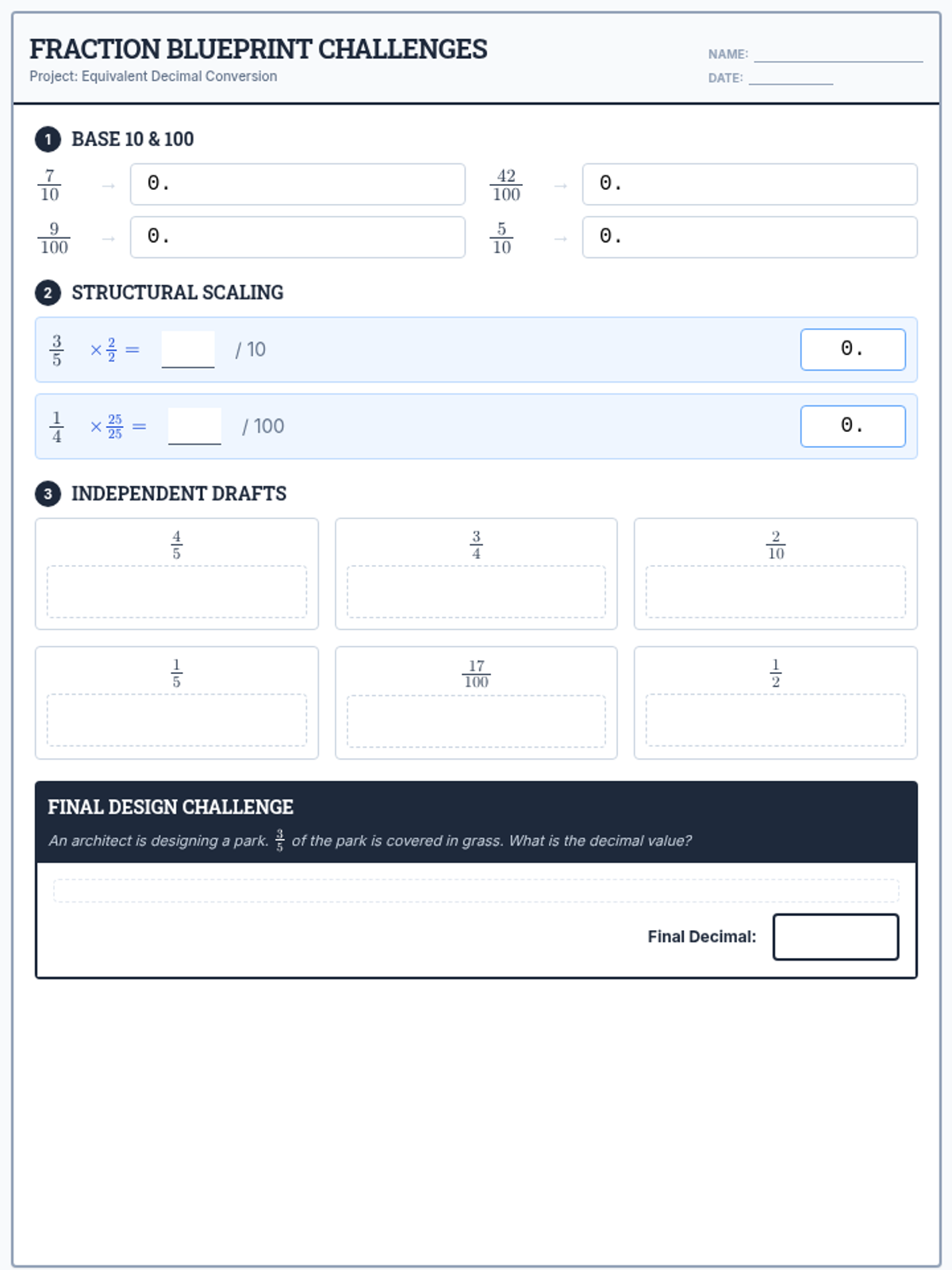
A student practice worksheet with two distinct phases: 'The Base Ten Build' for using equivalent fractions, and 'The Division Hammer' for using long division. Includes grid-lined work areas for division precision.
An instructional slide deck for teaching fraction-to-decimal conversion. Features a 'Decimal Architect' theme, step-by-step methods (Base Ten Build and Long Division Hammer), and guided practice problems.
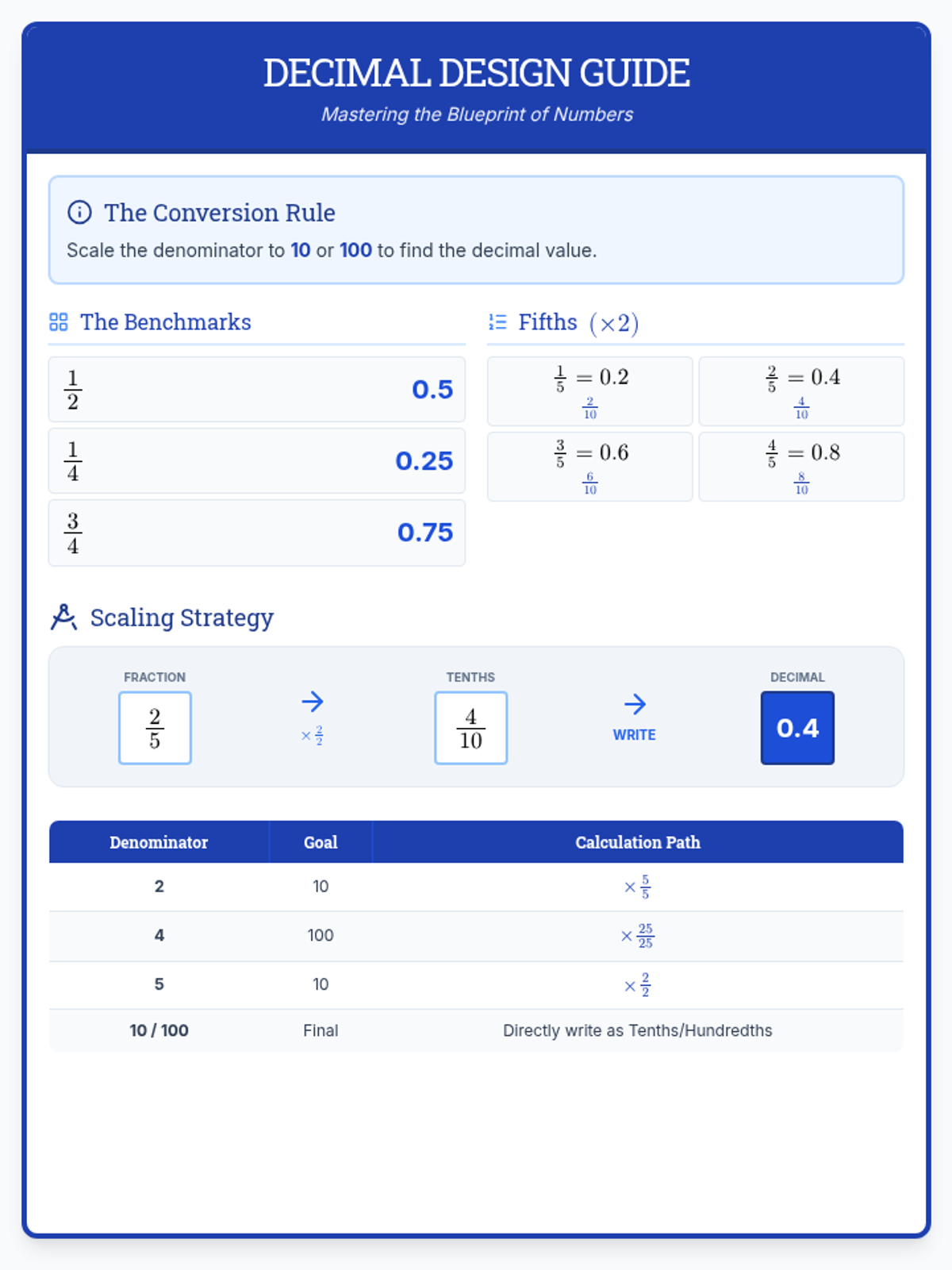
An educational anchor chart illustrating the two primary methods for converting fractions to decimals: the 'Base Ten Build' (using equivalent fractions) and the 'Long Division Hammer'. Includes visual steps and helpful tips.
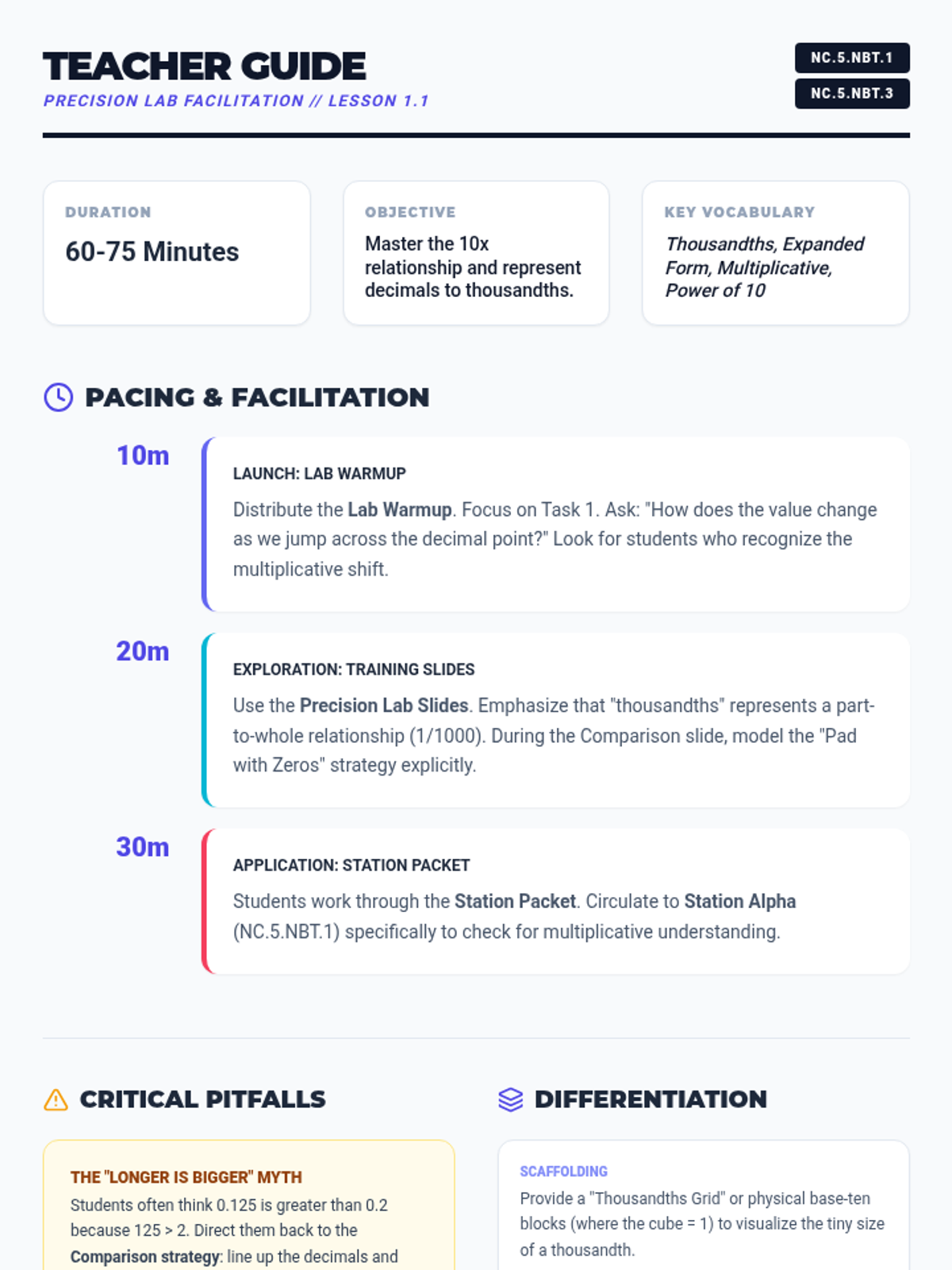
A detailed teacher guide for the 'Decimal Blueprint' lesson, featuring learning objectives, a step-by-step instructional sequence, common misconceptions, and differentiation strategies for teaching fraction-to-decimal conversion.
A visual anchor chart and reference sheet for students, explaining place value, ghost zeros, and the tenths place comparison rule with galactic-themed diagrams.
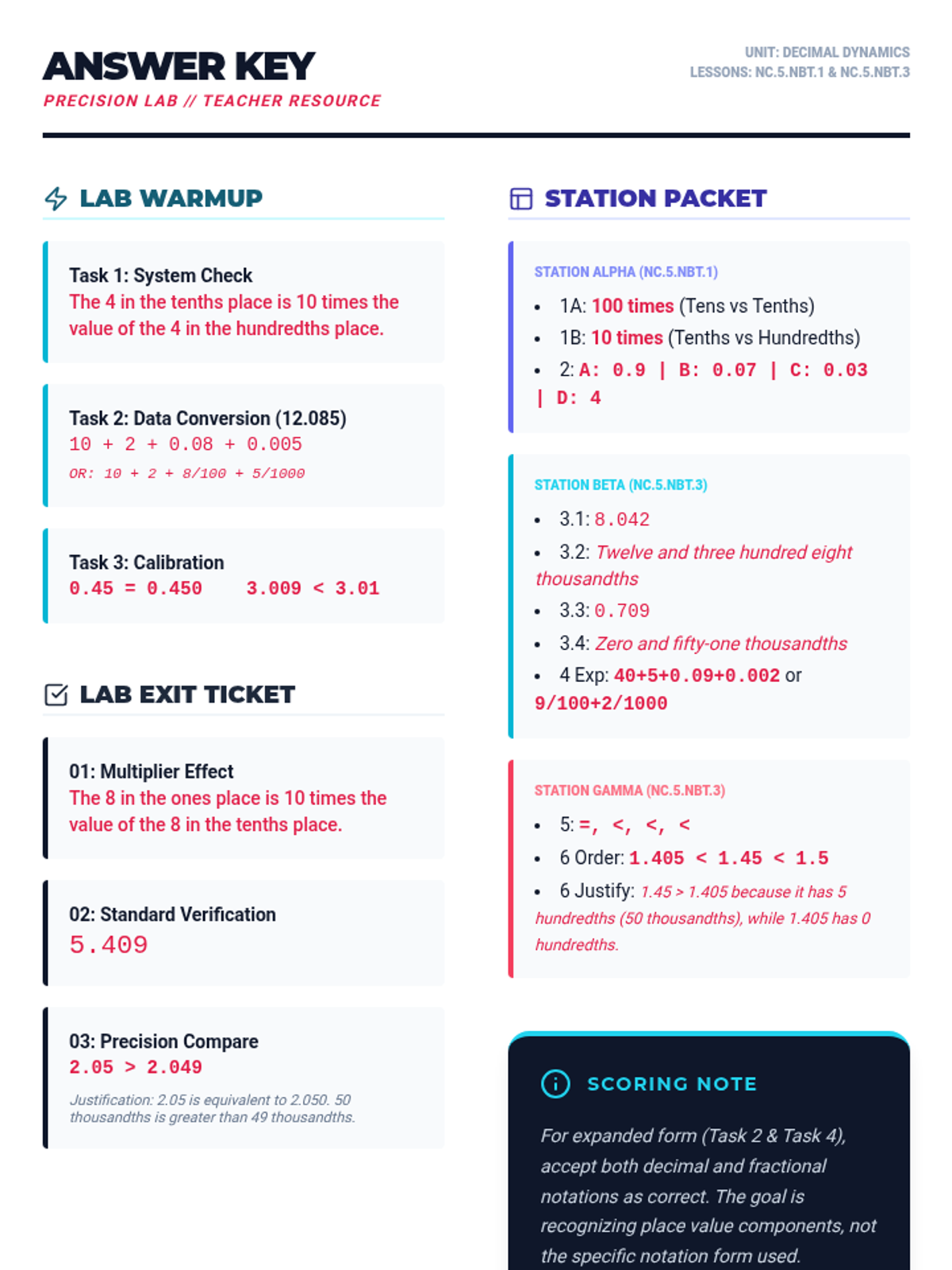
Answer key for the Decimal Precision Worksheet, provided with clear visual indicators for correct answers and reasoning for the error analysis section.
A minimal, punchy worksheet with high contrast, white backgrounds, and bold cyan and yellow accents for decimal comparison practice.
Redesigned high-impact slides with a minimal, white-background aesthetic. Uses bold typography, punchy cyan and yellow accents, and clean Lucide icons to maintain engagement without dark themes.
Student practice worksheet for the final lesson. Includes conversion exercises, ordering mixed sets (fractions, decimals, and percents), and true/false comparison duels.
Instructional slides for the final lesson. Teaches the "Decimal Standard" strategy for comparing mixed formats (fractions, decimals, and percents) and provides a step-by-step example.
Teacher guide for the final lesson of the Number Navigator series. Focuses on the strategy of converting mixed rational number types (fractions, decimals, percents) to a single decimal format for comparison and ordering.
Student practice worksheet for Lesson 4. Includes decimal-to-percent pivots, an equivalent trio table, and a 100-grid shading challenge.
Teacher guide for Lesson 12: Division Finale. Provides a framework for celebrating student growth and a review routine for summarizing the sequence's key strategies.
Student practice page for Lesson 12: Division Finale. Serves as a cumulative assessment and reflection on the strategies learned throughout the Division Workshop.
Slide deck for Lesson 12: Division Finale. Reviews all strategies from the sequence (Area Models, Big 7, Scaling, Decimal Shifting) and celebrates student progress.
Teacher guide for Lesson 11: Story Solvers. Details the "Two Rooms" metaphor for problem-solving and provides annotation strategies for Tier 2 intervention.
Student practice page for Lesson 11: Story Solvers. Exercises focus on breaking down multi-step real-world problems into discrete operations.
Slide deck for Lesson 11: Story Solvers. Focuses on multi-step word problems involving division, using a "Two Rooms" framework to identify operations.
Teacher guide for Lesson 10: Decimal Dash. Focuses on equivalent expressions and the balanced shift logic for dividing decimals by decimals.
Student practice page for Lesson 10: Decimal Dash. Exercises focus on transforming decimal-by-decimal problems into equivalent whole-number problems.
Slide deck for Lesson 10: Decimal Dash. Focuses on creating equivalent expressions by multiplying both the dividend and divisor by powers of 10 to divide by a whole number.
Teacher guide for Lesson 9: Point Move. Details the money connection and spatial scaffolding techniques for dividing decimals.
Student practice page for Lesson 9: Point Move. Exercises include money-based decimal division and a guided Decimal Big 7 framework.
Slide deck for Lesson 9: Point Move. Introduces dividing decimals by whole numbers, connecting the concept back to place value and whole number division.
Teacher guide for Lesson 8: Remainder Rules. Focuses on the "Decision Tree" for interpreting remainders and provides physical scaffolding tips for Tier 2 intervention.
Student practice page for Lesson 8: Remainder Rules. Includes practice calculating remainders and choosing how to interpret them in real-world scenarios.
Slide deck for Lesson 8: Remainder Rules. Covers how to interpret remainders in real-world contexts (round up, ignore, or split) and how they appear in the Big 7 framework.
Teacher guide for Lesson 7: Double Divisor. Synthesizes the full division process and provides specific "Tier 2" strategies for managing cognitive load during 2-digit divisor problems.
Student practice page for Lesson 7: Double Divisor. Provides a scaffolded workspace for 2-digit divisor problems including a "Menu" setup and independent Big 7 practice.
Slide deck for Lesson 7: Double Divisor. Synthesizes rounding, menu-making, and Big 7 chunking to tackle division with two-digit divisors.
Teacher guide for Lesson 6: Guess Best. Explains the Round-Guess-Check loop and how to support students who struggle with two-digit multiplication.
Student practice page for Lesson 6: Guess Best. Focuses on rounding divisors and using those rounded numbers to select an appropriate first partial quotient.
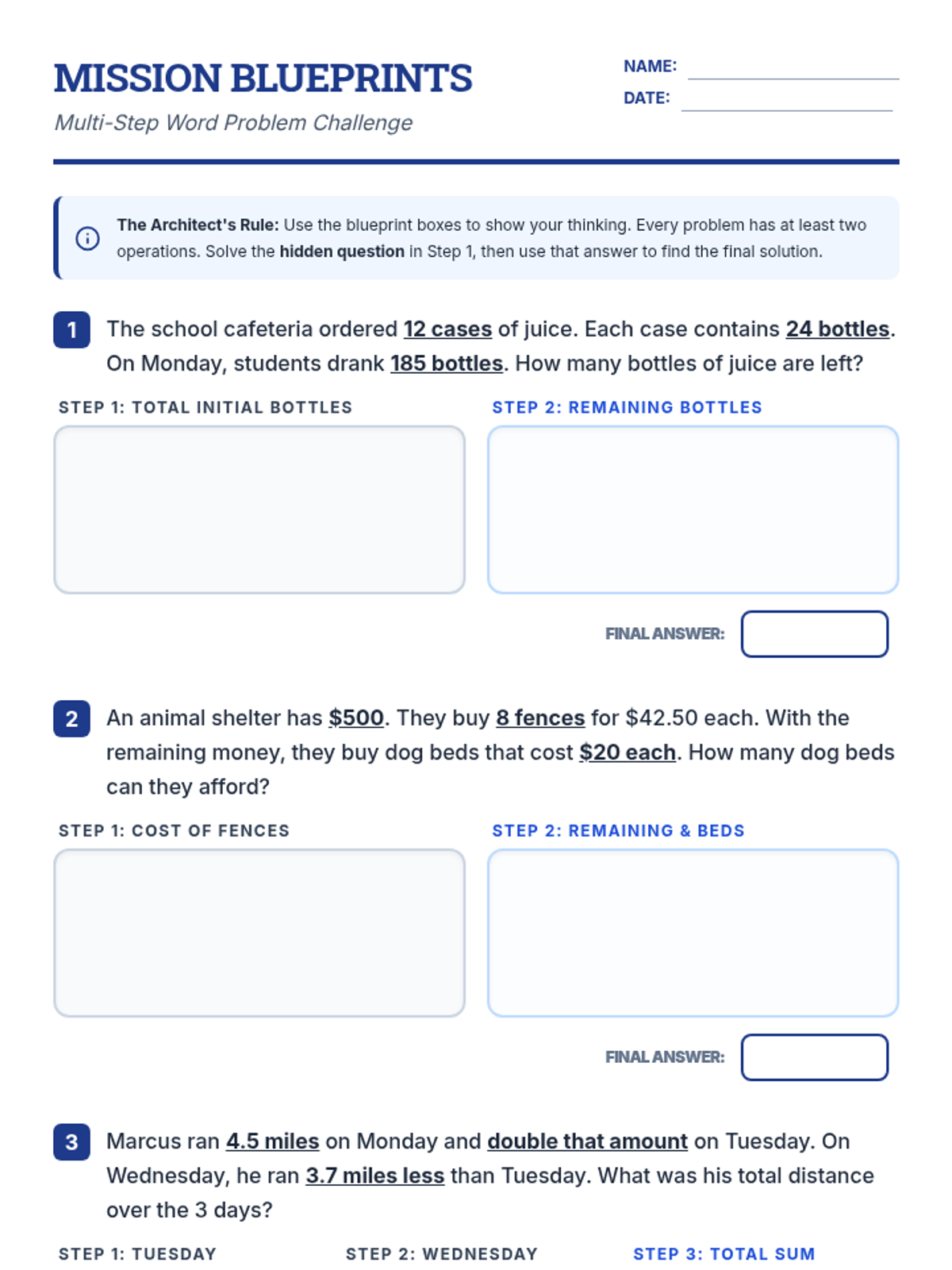
A comprehensive geometry slide deck for high school students, themed as an architectural blueprint. It covers the Pythagorean Theorem and the step-by-step process of expressing solutions as simplified radicals through structural examples and field problems.
The teacher's answer key for the Blueprint Bounds Worksheet, providing step-by-step solutions and final answers expressed as simplified radicals, now updated with the new word problems.
A high school geometry worksheet focusing on the Pythagorean Theorem, themed as an architectural blueprint. Students must solve for missing sides and provide answers as simplified radicals, now including several word problems.
A reference sheet for the paper chain activity, including the color-to-digit key and the first 200 digits of Pi in a readable grid format.
A reference guide for students on how to use the Pi button on a scientific calculator and the difference between typing 3.14 versus using the dedicated Pi key.
A student worksheet for the Pi Day video, featuring a fact checklist, a space to record digits, and basic circumference word problems based on the song's narrative.
A conceptual exit ticket comparing the precision needs of a carpenter versus a NASA scientist to assess student understanding of Pi's application.
A visual presentation for the Pi Day celebration, including intro hooks, mental math challenges, video integration, and the color key for the Pi Chain activity.
A student activity worksheet designed to accompany the Circumference Song, asking students to calculate exact and approximate circumferences for objects seen in the video.
A visual presentation for the 'Perfectly Pi' lesson, featuring video embedding, Cowboy character themes, and clear visual distinctions between exact and approximate circumference answers.
A detailed lesson plan and teacher facilitation guide for the Pi Day celebration, including timing, materials, and discussion anchors for the video and chain activity.
A comprehensive teacher guide for the 'Perfectly Pi' lesson, including pacing, whiteboard prompts, and teaching tips for 7th-grade math instruction.
An answer key for the Radical Shortcut Lab, providing solutions for the warm-up, video reflection, and composite figure problems.
A teacher reference sheet containing answer keys for the warm-up, discovery table, and Rapid Fire worksheet, along with facilitation tips for the video viewing.
A student-facing activity sheet for the Radical Shortcut Lab, featuring a radical approximation warm-up, video reflection notes, three composite geometry problems, and a cheat sheet exit ticket. Revised for better page fitting.
A concise exit ticket for the 45-45-90 triangle lesson, asking students to apply the side ratio rule to a triangle with legs of 20 and explain their reasoning. Designed for two-per-page printing.
A fast-paced practice worksheet featuring 10 isosceles right triangles designed to help students master the x : x : x√2 ratio with integer legs.
A high-impact presentation slide deck for SAT/ACT geometry prep, focusing on 45-45-90 triangle shortcuts, video applications, and mental math strategies.
A comprehensive slide deck for teaching 45-45-90 triangles, featuring a warm-up, discovery activity, embedded instructional video, and a 'Rapid Fire' fluency drill.
A comprehensive teacher lesson plan for a high-intensity SAT/ACT geometry session focusing on special right triangle shortcuts and composite figures.
A student worksheet for calculating distances between points with common coordinates and solving coordinate-based geometry problems. Features an explorer theme.
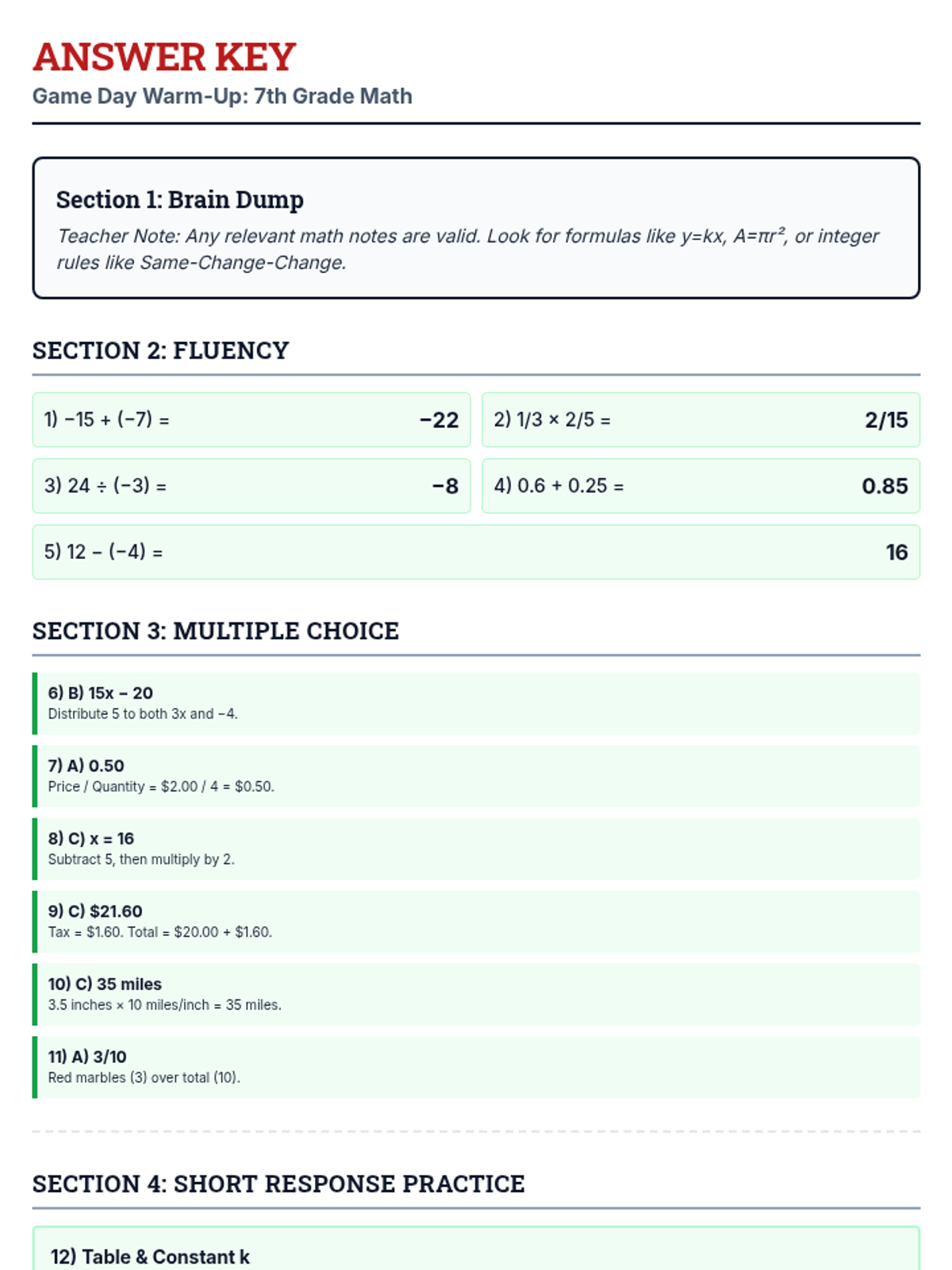
A comprehensive student assessment covering decimal operations, rational number lines, absolute value, and coordinate plane reflections/distance.
A comprehensive review slide deck for the final lesson of the Number Navigator sequence. Summarizes decimal operations, rational number properties, and coordinate plane navigation.
An instructional slide deck for Lesson 11 on using coordinates for real-world distances and geometry. Explains how to find distance between points with common coordinates.
A student worksheet for identifying reflections across axes in the coordinate plane. Includes a coordinate table, plotting practice, and a conceptual logic puzzle about multi-step reflections.
An instructional slide deck for Lesson 10 on reflections in the coordinate plane. Explains how signs change when reflecting across the x-axis and y-axis.
A student worksheet for identifying and plotting points in all four quadrants of the coordinate plane. Includes prediction tasks, point identification, and a scenario-based word problem.
An instructional slide deck for Lesson 9 on the four-quadrant coordinate plane. Features a "Quest" theme and explains the x and y axes, origin, and the sign patterns of each quadrant.
A student worksheet for ordering rational numbers and writing inequality statements. Includes pair comparisons, set ordering, and real-world application problems.
Facilitation guide for teachers for the Symmetry Scouts lesson. Includes instructional flow, ALN alignment, common misconceptions, and a full answer key.
An instructional slide deck for Lesson 8 on ordering rational numbers. Features a "Global Scale" theme and explains comparison symbols and ordering sets involving negative values.
A student worksheet for the Symmetry Scouts lesson focusing on reflections across axes in the coordinate plane and identifying patterns in ordered pairs.
A student worksheet for practicing absolute value calculations and comparisons. Includes basic absolute value problems, magnitude comparisons, and real-world scenarios involving debt and depth.