Lenny LearningLenny
Create
Explore
Workspace
LoginSign up
MathEnglish Language ArtsScience & EngineeringSocial StudiesGlobal LanguagesHealth & Physical EducationSpecial EducationCounseling & Life SkillsArts & CreativityESL
Lenny LearningLenny
Lenny Learning
About
Training
Pricing
Support
Contact
© 2026 Lenny Learning Inc.
MathNumbers & CountingCounting ObjectsNumber NamesComparing NumbersNumber OperationsCounting SequenceNumbers 0-10Place Value Understanding and SystemAdd and Subtract Within 20Addition and Subtraction ConceptsAddition and Subtraction EquationsAddition and Subtraction ProblemsFoundations for MultiplicationMultiplication and Division PropertiesMultiply and Divide Within 100Multiplication and Division ProblemsFactors and MultiplesProperties of OperationsPatterns and RelationshipsGenerate and Analyze PatternsMulti-Digit ArithmeticPlace Value OperationsMulti-Digit and Decimal OperationsNumerical ExpressionsFour Operations and PatternsFour Operations Problem SolvingMeasurement & DataMeasurable AttributesMeasuring LengthsMeasure and Estimate Lengths in Standard UnitsRelate Addition and Subtraction to LengthClassifying and Counting ObjectsTime and MoneyArea Concepts and MeasurementPerimeter and Area MeasuresAngle Concepts and MeasurementTime, Volume, and MassMeasurement Unit ConversionsGeometryIdentifying ShapesShapes and AttributesShape Attributes and ReasoningShapes and CompositionClassifying 2D FiguresGeometric Figures and RelationshipsLines, Angles, and ShapesAngle, Area, and VolumeGeometric MeasurementVolume of 3D ShapesCoordinate Plane ApplicationsTransformations in the PlaneCongruence and SimilarityUnderstand congruence in terms of rigid motionsSimilarity and TransformationsProve Theorems Involving SimilarityPythagorean TheoremTrigonometry for General TrianglesMake Geometric ConstructionsProve Geometric TheoremsTheorems About CirclesFind Arc Lengths And Areas of Sectors of CirclesVolume FormulasRelationships Between Two-Dimensional and Three-Dimensional ObjectsProve Simple Geometric Theorems AlgebraicallyTranslate Between Geometric Description and Equation for Conic SectionApply Geometric Concepts in Modeling SituationsFractions & DecimalsFractions as NumbersBuilding FractionsFraction Equivalence and OrderingAdding and Subtracting FractionsMultiplying and Dividing FractionsDividing FractionsDecimal FractionsMulti-Digit Computation and FactorsAdd, Subtract, Multiply, and Divide Rational NumbersRational Number SystemIrrational Numbers and ApproximationsRatiosRatios and ProportionsProportional RelationshipsUnit RateAlgebraAlgebraic ExpressionsGenerate Equivalent ExpressionsQuantitative RelationshipsProportional Relationships and Linear EquationsEquations and InequalitiesEquation Solving and ReasoningLinear Equations and SystemsGraph Equations and InequalitiesSystems of EquationsReal-World Algebraic ProblemsQuantitative Reasoning with UnitsExpression StructureEquivalent Expression FormsRadicals and Integer ExponentsRational ExponentsRational and Irrational NumbersPolynomial OperationsPolynomial IdentitiesPolynomial Zeros and FactorsRational ExpressionsComplex Number OperationsComplex Numbers in PolynomialsComplex Numbers on PlaneStatistics & ProbabilityRepresent and Interpret DataData DistributionsStatistical VariabilityProbability ModelsCompound Event ProbabilitiesStatistical SamplingInterpret Categorical and Quantitative DataBivariate Data PatternsInterpret Linear ModelsComparing Two PopulationsRandom Processes in StatisticsIndependence and Conditional ProbabilityExpected ValuesProbability-Based Decision MakingStatistical Inference and ConclusionsFunctionsFunction Concepts and NotationDefine and Compare FunctionsInterpret Functions in ContextAnalyze Function RepresentationsModel Relationships with FunctionsIdentify Linear vs Exponential GrowthDistinguish Between Function TypesCompare Growth RatesInterpret Function ExpressionsBuild Functions from RelationshipsConstruct and Model FunctionsTransform and Combine FunctionsModel Comparison and SelectionSolve Exponential EquationsTrigonometryTrigonometric Ratios Involving Right TrianglesTrigonometric Functions and Unit CircleModel with Trigonometric FunctionsTrigonometric IdentitiesVectors & MatricesIntroduction to Vectors and MatricesVector QuantitiesVector OperationsMatrix OperationsCalculusLimits and ContinuityDerivative Concepts and NotationDerivative Rules and TechniquesApplications of DerivativesOptimization ProblemsRelated RatesCurve Sketching and AnalysisIntegration Concepts and NotationAntiderivatives and Indefinite IntegralsDefinite Integrals and AreaFundamental Theorem of CalculusIntegration TechniquesApplications of IntegrationDifferential EquationsSequences and SeriesParametric and Polar FunctionsVector-Valued Functions

Vectors & Matrices

SequencesLessonsMaterialsVideos
  1. Math

Vectors & Matrices

SequencesLessonsMaterialsVideos

Vector properties, magnitudes, and algebraic operations including addition and scalar multiplication. Introduces matrix representations, arithmetic, and computational techniques for solving linear systems.

Introduction to Vectors and MatricesVector addition, scalar multiplication, and matrix operations including multiplication and determinants. Introduces linear transformations and system modeling through matrix equations.
Vector QuantitiesMathematical and physical quantities defined by both magnitude and direction. Emphasizes vector addition, component resolution, and applications in force and motion.
Vector OperationsCalculation of vector sums, differences, and products in two and three dimensions. Examines magnitude, direction, and the application of dot and cross products to solve geometric and physical problems.
Matrix OperationsAddition, subtraction, and multiplication of matrices alongside techniques for calculating determinants and inverses. Supports solving systems of linear equations and modeling multi-dimensional data transformations.
Video
Applying Vectors to Navigation, Business, and Physics

Applying Vectors to Navigation, Business, and Physics

This educational video provides a comprehensive overview of how vectors are applied in real-world scenarios across business, navigation, and physics. Moving beyond simple two-dimensional geometry, the lesson introduces vectors in three dimensions and n-dimensions, showing how they can model complex datasets like catering orders where lists of quantities and prices are treated as vectors. The video demonstrates how the dot product can be used to efficiently calculate total costs in such business contexts. The content delves deeply into navigation problems, illustrating how to combine velocity vectors to determine an airplane's ground speed and bearing when affected by wind. It breaks down the process of converting real-world conditions (like wind from the southeast) into vector components, performing vector addition, and interpreting the resultant vector's magnitude and direction. Special attention is paid to the concept of bearings versus standard mathematical angles. Finally, the video applies vectors to physics concepts of force and work. Using a towing example, it guides viewers through calculating the work done by a force applied at an angle. It introduces unit vectors to define direction and uses the dot product to compute work as the product of force and displacement vectors. This video is an excellent resource for connecting abstract vector mathematics to concrete, practical problem-solving in STEM fields.

Miacademy & MiaPrep Learning ChannelMiacademy & MiaPrep Learning Channel

18mins 46s

Video
Understanding Vectors in the Coordinate Plane

Understanding Vectors in the Coordinate Plane

This video serves as a comprehensive introduction to vectors in the coordinate plane, specifically tailored for a precalculus curriculum. The lesson begins with a relatable skit about giving directions, illustrating why both distance and direction are necessary to reach a destination, which naturally leads into the definition of a vector. The video then transitions into formal mathematical definitions, explaining vectors as directed line segments with an initial and terminal point. It covers essential concepts such as component form, position vectors, magnitude, and direction, using visual graphs and clear animations to demonstrate how these properties are calculated and represented.

Miacademy & MiaPrep Learning ChannelMiacademy & MiaPrep Learning Channel

16mins 22s

Video
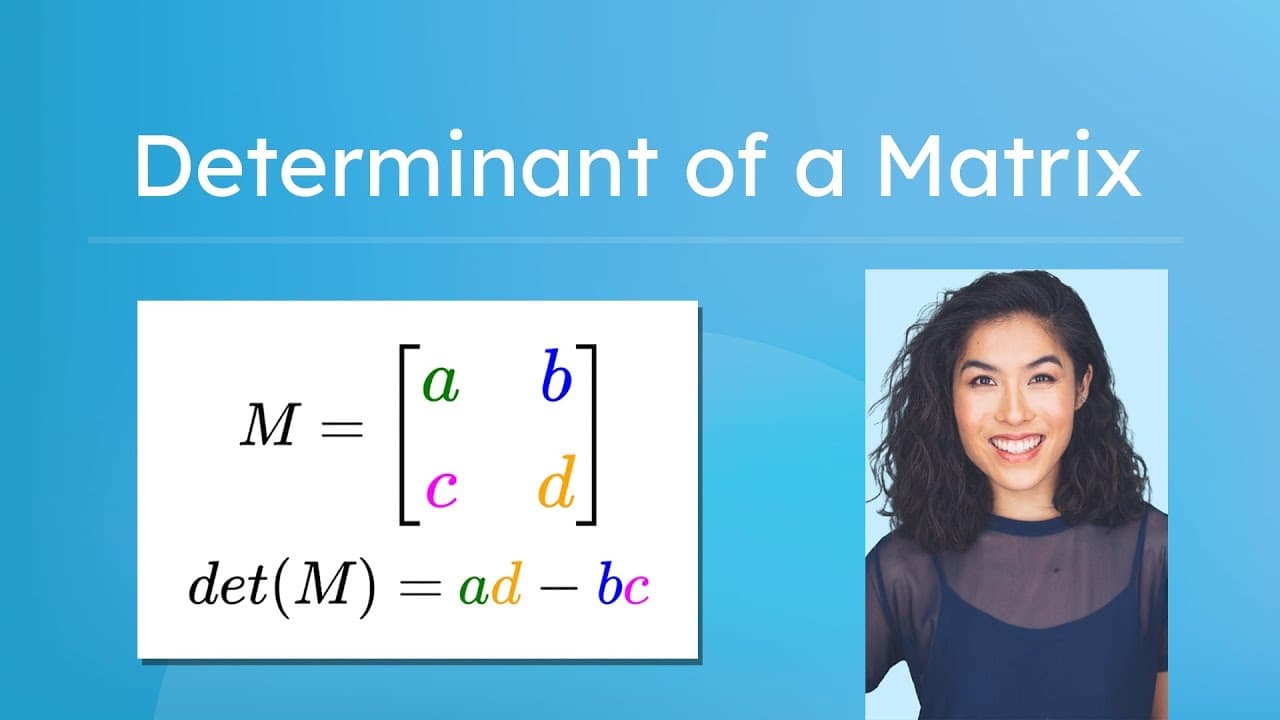
How to Calculate Matrix Determinants and Find Area

How to Calculate Matrix Determinants and Find Area

This comprehensive math lesson introduces students to the concept of the determinant of a matrix, a fundamental tool in linear algebra and precalculus. The video begins by defining what a determinant is—a scalar value calculated from a square matrix—and explains its significance in understanding matrix properties like invertibility and spatial transformations. It progresses step-by-step through the calculation methods for 2x2 matrices using the standard "ad-bc" formula, ensuring students grasp the basics before moving to more complex concepts. The lesson then advances to 3x3 matrices, demonstrating two distinct methods for calculation: the formal Cofactor Expansion method (using minor matrices and checkerboard signs) and the visual "Shortcut" method (often known as the Rule of Sarrus) involving diagonal multiplication. Clear, color-coded animations help visualize these algorithmic processes, making abstract calculations accessible and easier to memorize. Detailed examples are worked through for each method to reinforce understanding. Finally, the video bridges abstract algebra with geometry by applying determinants to find the area of polygons in the coordinate plane. It demonstrates how to interpret vectors from vertices and use the determinant to calculate the area of parallelograms and triangles. This application connects algebraic computation with geometric properties, providing a practical context for why determinants are a powerful mathematical tool.

Miacademy & MiaPrep Learning ChannelMiacademy & MiaPrep Learning Channel

21mins 51s

Video
Understanding Vectors in the Coordinate Plane

Understanding Vectors in the Coordinate Plane

This video serves as a comprehensive introduction to vectors in the coordinate plane, specifically tailored for a precalculus curriculum. The lesson begins with a relatable skit about giving directions, illustrating why both distance and direction are necessary to reach a destination, which naturally leads into the definition of a vector. The video then transitions into formal mathematical definitions, explaining vectors as directed line segments with an initial and terminal point. It covers essential concepts such as component form, position vectors, magnitude, and direction, using visual graphs and clear animations to demonstrate how these properties are calculated and represented.

Miacademy & MiaPrep Learning ChannelMiacademy & MiaPrep Learning Channel

16mins 22s

Video
How to Calculate Matrix Determinants and Find Area

How to Calculate Matrix Determinants and Find Area

This comprehensive math lesson introduces students to the concept of the determinant of a matrix, a fundamental tool in linear algebra and precalculus. The video begins by defining what a determinant is—a scalar value calculated from a square matrix—and explains its significance in understanding matrix properties like invertibility and spatial transformations. It progresses step-by-step through the calculation methods for 2x2 matrices using the standard "ad-bc" formula, ensuring students grasp the basics before moving to more complex concepts. The lesson then advances to 3x3 matrices, demonstrating two distinct methods for calculation: the formal Cofactor Expansion method (using minor matrices and checkerboard signs) and the visual "Shortcut" method (often known as the Rule of Sarrus) involving diagonal multiplication. Clear, color-coded animations help visualize these algorithmic processes, making abstract calculations accessible and easier to memorize. Detailed examples are worked through for each method to reinforce understanding. Finally, the video bridges abstract algebra with geometry by applying determinants to find the area of polygons in the coordinate plane. It demonstrates how to interpret vectors from vertices and use the determinant to calculate the area of parallelograms and triangles. This application connects algebraic computation with geometric properties, providing a practical context for why determinants are a powerful mathematical tool.

Miacademy & MiaPrep Learning ChannelMiacademy & MiaPrep Learning Channel

21mins 51s

Video
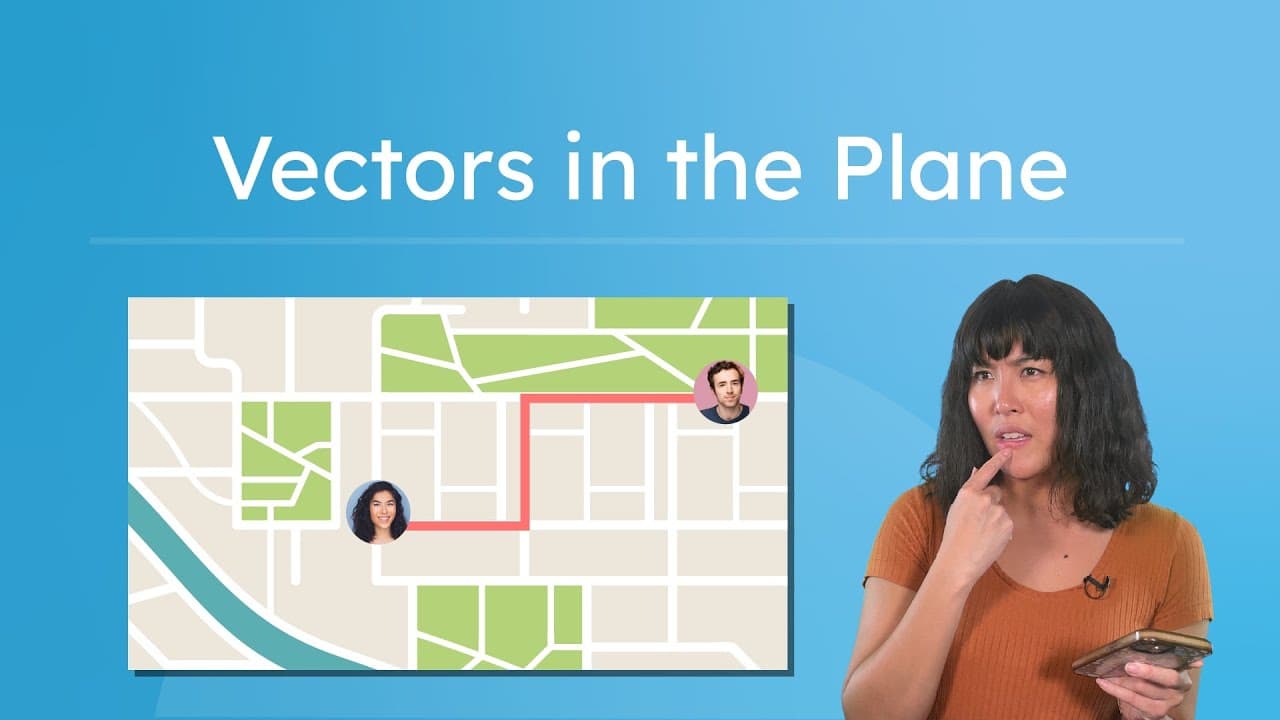
Applying Vectors to Navigation, Business, and Physics

Applying Vectors to Navigation, Business, and Physics

This educational video provides a comprehensive overview of how vectors are applied in real-world scenarios across business, navigation, and physics. Moving beyond simple two-dimensional geometry, the lesson introduces vectors in three dimensions and n-dimensions, showing how they can model complex datasets like catering orders where lists of quantities and prices are treated as vectors. The video demonstrates how the dot product can be used to efficiently calculate total costs in such business contexts. The content delves deeply into navigation problems, illustrating how to combine velocity vectors to determine an airplane's ground speed and bearing when affected by wind. It breaks down the process of converting real-world conditions (like wind from the southeast) into vector components, performing vector addition, and interpreting the resultant vector's magnitude and direction. Special attention is paid to the concept of bearings versus standard mathematical angles. Finally, the video applies vectors to physics concepts of force and work. Using a towing example, it guides viewers through calculating the work done by a force applied at an angle. It introduces unit vectors to define direction and uses the dot product to compute work as the product of force and displacement vectors. This video is an excellent resource for connecting abstract vector mathematics to concrete, practical problem-solving in STEM fields.
Miacademy & MiaPrep Learning ChannelMiacademy & MiaPrep Learning Channel

18mins 46s