Lenny LearningLenny
Create
Explore
Workspace
LoginSign up
MathEnglish Language ArtsScience & EngineeringSocial StudiesGlobal LanguagesHealth & Physical EducationSpecial EducationCounseling & Life SkillsArts & CreativityESL
Lenny LearningLenny
Lenny Learning
About
Training
Pricing
Support
Contact
© 2026 Lenny Learning Inc.

Calculus

SequencesLessonsMaterialsVideos
  1. Math

Calculus

SequencesLessonsMaterialsVideos

Fundamental concepts of limits, derivatives, and integrals for modeling change and motion. Examines techniques for differentiation and integration alongside applications in optimization, area calculation, and differential equations.

Limits and ContinuityFundamental concepts of limits, including one-sided and infinite limits, to analyze function behavior. Establishes formal criteria for continuity at points and across intervals as the basis for differentiation.
Derivative Concepts and NotationInstantaneous rates of change, slopes of tangent lines, and the formal limit definition. Introduces Leibniz and Lagrange notation for representing derivatives across different mathematical contexts.
Derivative Rules and TechniquesPower, product, quotient, and chain rules for differentiating algebraic and transcendental functions. Strengthens skills in implicit differentiation and trigonometric derivatives for modeling rates of change.
Applications of DerivativesOptimization, related rates, and curve sketching via first and second derivatives. Addresses real-world scenarios in physics and economics using the Mean Value Theorem and L'Hôpital's Rule.
Optimization ProblemsApplication of derivatives to identify absolute extrema within constrained systems. Addresses problems in surface area maximization, cost minimization, and physical efficiency.
Related RatesDifferentiation of interdependent variables with respect to time using the chain rule. Connects geometric formulas with algebraic manipulation to solve problems involving moving objects, fluid flow, and changing dimensions.
Curve Sketching and AnalysisAnalysis of function behavior using first and second derivatives to identify extrema, concavity, and points of inflection. Integrates limits, asymptotes, and intercepts to accurately visualize complex algebraic expressions graphically.
Integration Concepts and NotationFundamental principles of definite and indefinite integrals, Riemann sums, and the Fundamental Theorem of Calculus. Establishes proficiency in standard integration notation and area calculations under curves.
Antiderivatives and Indefinite IntegralsFundamental techniques for reversing differentiation using the power rule, substitution, and basic transcendental functions. Emphasizes the relationship between derivatives and indefinite integrals including the constant of integration.
Definite Integrals and AreaEvaluates the Fundamental Theorem of Calculus to determine the exact area under a curve and between multiple functions. Connects accumulation concepts to Riemann sums and definite integration techniques.
Fundamental Theorem of CalculusFormal connection between differentiation and integration through the evaluation of definite integrals using antiderivatives. Addresses both parts of the theorem to solve area problems and calculate rates of change.
Integration TechniquesSubstitution, integration by parts, partial fractions, and trigonometric substitution methods for evaluating complex integrals. Connects foundational calculus concepts to advanced applications in area, volume, and physics.
Applications of IntegrationCalculation of area between curves and volumes of solids using disk, washer, and shell methods. Connects integral calculus to physical applications like work, arc length, and centroids.
Differential EquationsExamines first-order and higher-order linear equations using techniques like separation of variables, Laplace transforms, and power series. Connects mathematical models to physical systems such as population growth, fluid dynamics, and electrical circuits.
Sequences and SeriesArithmetic and geometric progressions, summation notation, and convergence tests for infinite series. Connects patterns in numbers to limits and foundational calculus concepts.
Parametric and Polar FunctionsDifferentiation and integration techniques for curves defined by independent parameters and polar coordinates. Targets area calculations, arc length, and coordinate conversions for non-Cartesian systems.
Vector-Valued FunctionsMaps scalar inputs to vectors to define curves in two and three-dimensional space. Calculates derivatives and integrals to analyze velocity, acceleration, arc length, and curvature.
No videos found
There are no videos available for this topic yet.
No videos found
There are no videos available for this topic yet.
No videos found
There are no videos available for this topic yet.
No videos found
There are no videos available for this topic yet.
Video
Finding the Slope of a Tangent Line Using Limits

Finding the Slope of a Tangent Line Using Limits

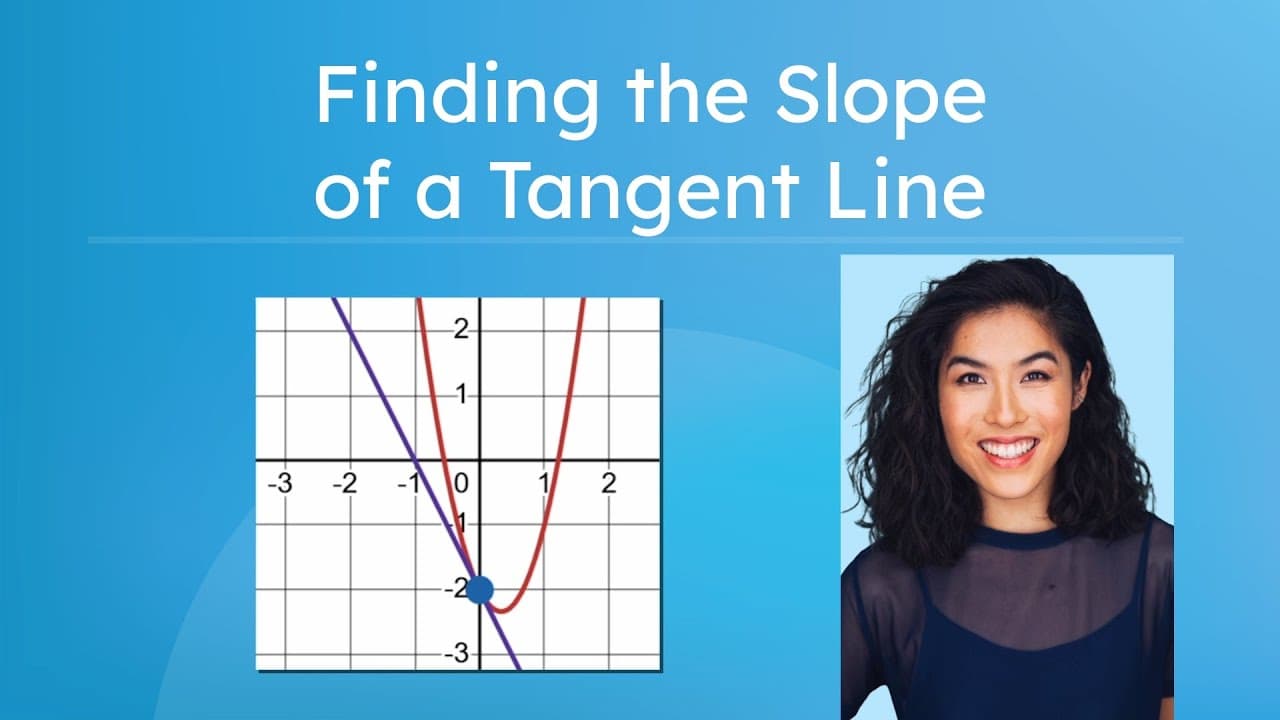
This educational video introduces the fundamental calculus concept of finding the slope of a tangent line using limits. It bridges the gap between algebra and calculus by demonstrating how the slope formula, which typically requires two points, can be adapted to find the slope at a single point on a curve. The video uses visual animations of secant lines approaching a tangent line to make this abstract concept concrete and understandable.

Miacademy & MiaPrep Learning ChannelMiacademy & MiaPrep Learning Channel

9mins 42s

Video
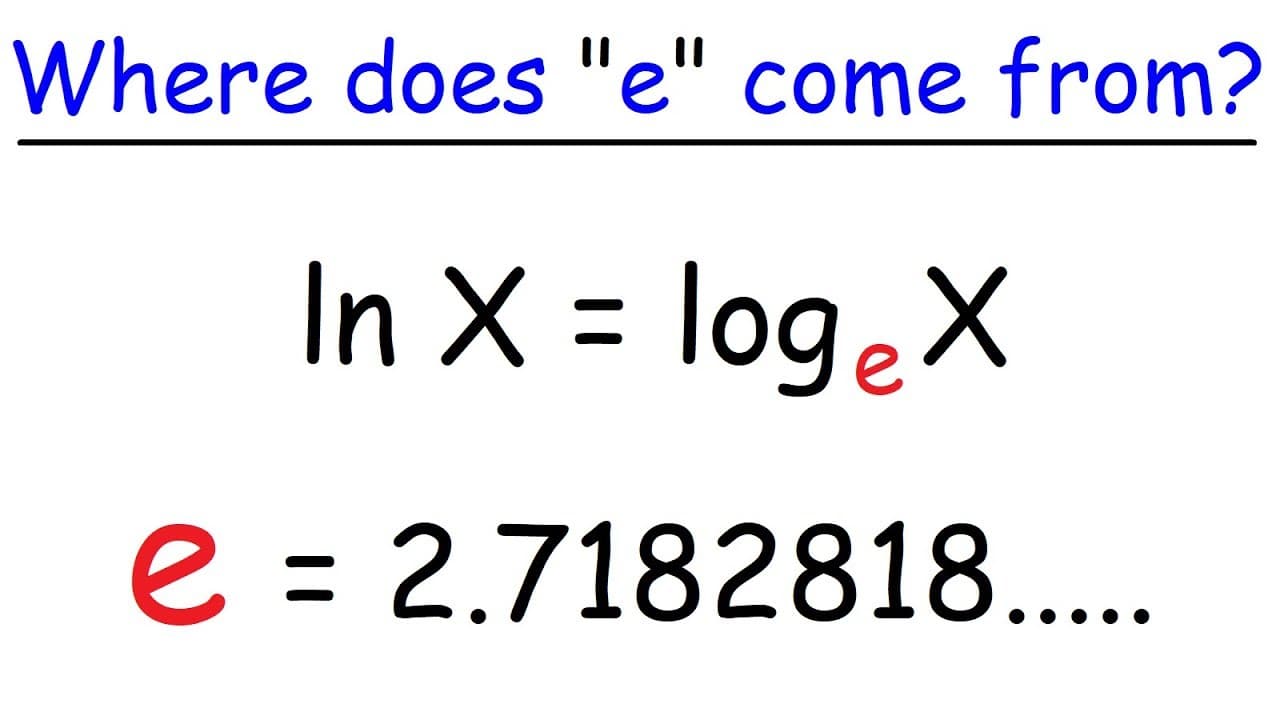
What Is the Number e and How Do We Calculate It?

What Is the Number e and How Do We Calculate It?

This educational video provides a comprehensive overview of the mathematical constant e, also known as Euler's number. It begins by defining e as an irrational number approximately equal to 2.718, commonly found in exponential functions and logarithms. The narrator then explores the origins of e through three distinct mathematical approaches: the formula for compound interest as the compounding frequency approaches infinity, the limit of (1 + n)^(1/n) as n approaches zero, and the infinite series of the reciprocals of factorials. Key themes include the relationship between discrete and continuous growth, the concept of limits and infinity in mathematics, and the unique properties of exponential functions in calculus. The video bridges the gap between algebraic financial formulas and advanced calculus concepts, demonstrating how a simple question about interest rates leads to the discovery of a fundamental constant of the universe. For educators, this video serves as an excellent bridge between Algebra II, Pre-Calculus, and Calculus. It visualizes abstract definitions, provides concrete numerical evidence for limits, and introduces the profound calculus properties of e^x—specifically that its slope and the area under its curve are equal to its value. This makes it a versatile tool for introducing the constant to beginners or deepening the understanding of advanced students studying derivatives and integrals.

The Organic Chemistry TutorThe Organic Chemistry Tutor

12mins 11s

Video
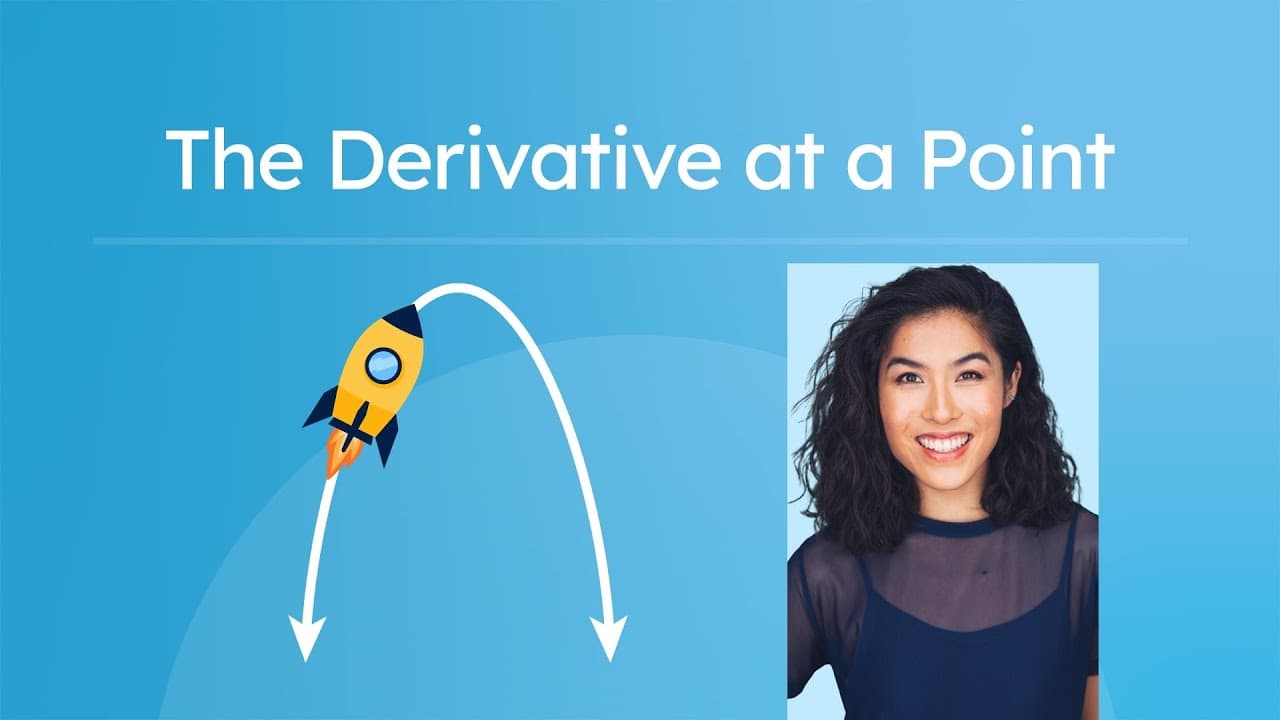
Calculating the Derivative at a Specific Point

Calculating the Derivative at a Specific Point

This educational video introduces the concept of the derivative at a specific point, bridging the gap between average rates of change and instantaneous rates of change. It begins by connecting the slope of a tangent line to the limit definition of a derivative, deriving the standard formula using 'h' to represent the distance between x-values. The narrator explains the notation $f'(a)$ and demonstrates how to calculate it algebraically through direct substitution and simplification limits. The video covers several key mathematical themes, including the definition of a derivative, evaluating limits, expanding binomials, and rationalizing numerators. It provides step-by-step worked examples ranging from polynomial functions to rational functions involving square roots. A significant portion of the video is dedicated to a real-world application problem involving projectile motion, where students learn to interpret the derivative as velocity (instantaneous rate of change) in the context of a rocket launch. For educators, this video serves as an excellent core lesson for Precalculus or Calculus I units on derivatives. It offers built-in pause points for student practice, addresses algebraic complexities like expanding powers and handling negative signs, and explicitly connects abstract mathematical calculations to physical interpretations like speed and direction. The visual graphs accompanying the algebraic work help students verify their calculations against geometric intuition.

Miacademy & MiaPrep Learning ChannelMiacademy & MiaPrep Learning Channel

12mins 45s

Video
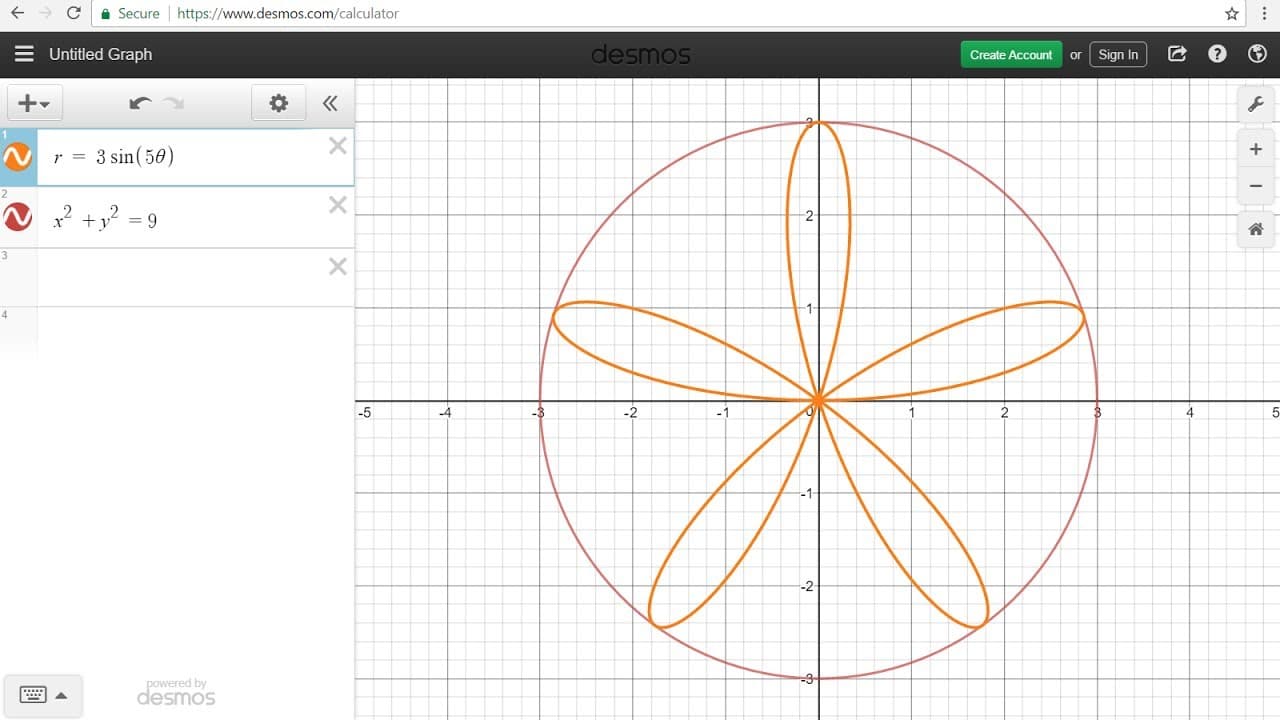
Mastering Math with the Desmos Online Graphing Calculator

Mastering Math with the Desmos Online Graphing Calculator

This comprehensive tutorial introduces students and educators to the Desmos online graphing calculator, a powerful and free tool for visualizing mathematics. The video begins with the basics of accessing the site and graphing simple functions like lines and parabolas, then progressively moves to more advanced topics including trigonometry, polar coordinates, and calculus operations. The narrator demonstrates not just how to plot graphs, but how to use the tool to solve equations, factor quadratics, and visualize systems of inequalities. Key mathematical themes include function families (linear, quadratic, cubic, absolute value, exponential, logarithmic), systems of equations and inequalities, trigonometry (degrees vs. radians), and statistical analysis (mean, standard deviation). The video also highlights the calculator's computational abilities, such as evaluating definite integrals, summations, and permutations, making it a versatile utility for various levels of math. For the classroom, this video serves as an excellent training resource for students transitioning from handheld calculators to computer-based tools. It allows teachers to show students how to verify their algebraic work visually, such as checking factors by looking at x-intercepts or solving systems by finding intersection points. The visual nature of the tool helps bridge the gap between abstract algebraic manipulation and concrete graphical understanding.

The Organic Chemistry TutorThe Organic Chemistry Tutor

13mins 58s

Video
Finding the Slope of a Tangent Line Using Limits

Finding the Slope of a Tangent Line Using Limits

This educational video introduces the fundamental calculus concept of finding the slope of a tangent line using limits. It bridges the gap between algebra and calculus by demonstrating how the slope formula, which typically requires two points, can be adapted to find the slope at a single point on a curve. The video uses visual animations of secant lines approaching a tangent line to make this abstract concept concrete and understandable.

Miacademy & MiaPrep Learning ChannelMiacademy & MiaPrep Learning Channel

9mins 42s

Video
What Is the Number e and How Do We Calculate It?

What Is the Number e and How Do We Calculate It?

This educational video provides a comprehensive overview of the mathematical constant e, also known as Euler's number. It begins by defining e as an irrational number approximately equal to 2.718, commonly found in exponential functions and logarithms. The narrator then explores the origins of e through three distinct mathematical approaches: the formula for compound interest as the compounding frequency approaches infinity, the limit of (1 + n)^(1/n) as n approaches zero, and the infinite series of the reciprocals of factorials. Key themes include the relationship between discrete and continuous growth, the concept of limits and infinity in mathematics, and the unique properties of exponential functions in calculus. The video bridges the gap between algebraic financial formulas and advanced calculus concepts, demonstrating how a simple question about interest rates leads to the discovery of a fundamental constant of the universe. For educators, this video serves as an excellent bridge between Algebra II, Pre-Calculus, and Calculus. It visualizes abstract definitions, provides concrete numerical evidence for limits, and introduces the profound calculus properties of e^x—specifically that its slope and the area under its curve are equal to its value. This makes it a versatile tool for introducing the constant to beginners or deepening the understanding of advanced students studying derivatives and integrals.

The Organic Chemistry TutorThe Organic Chemistry Tutor

12mins 11s

Video
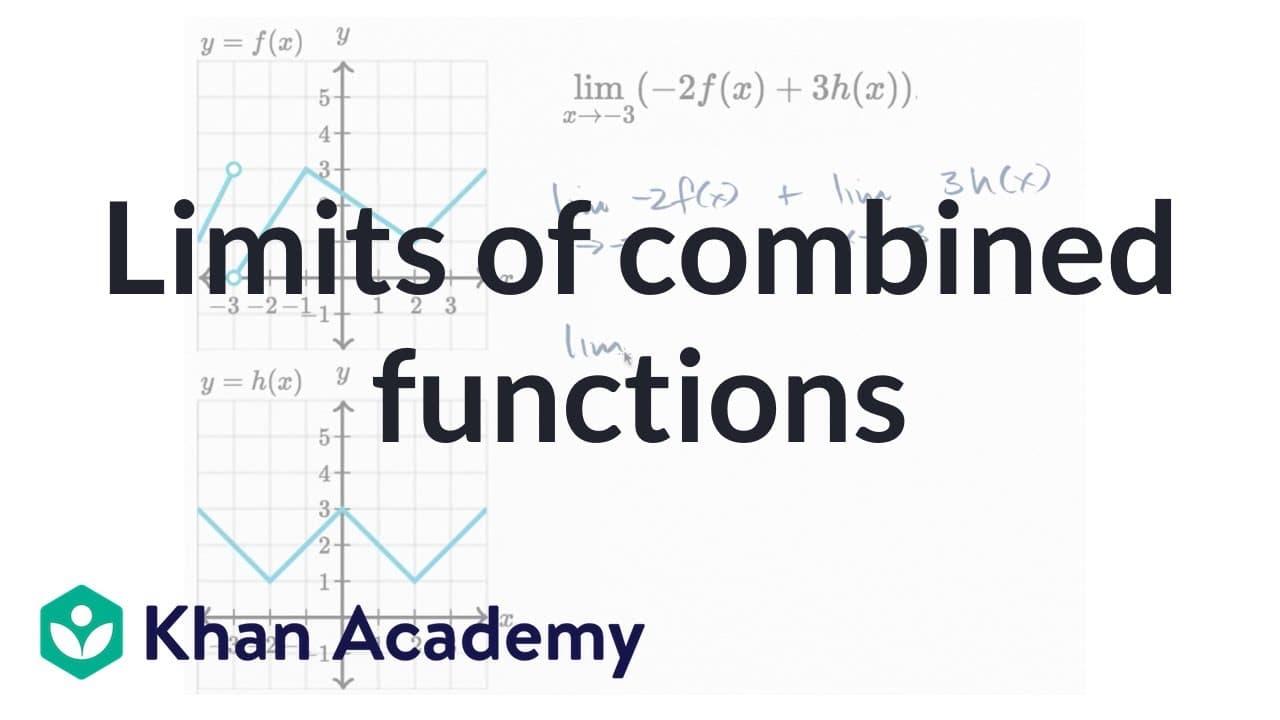
Evaluating Limits of Function Products and Quotients Graphically

Evaluating Limits of Function Products and Quotients Graphically

This video provides a clear, step-by-step tutorial on evaluating limits for combined functions using graphical data. The narrator guides viewers through two distinct examples: the limit of a product of functions and the limit of a quotient of functions. By applying fundamental limit properties, the video demonstrates how to break down complex expressions into simpler components that can be evaluated visually from provided graphs. The content explores key calculus themes including the product and quotient laws for limits, the distinction between a function's value and its limit, one-sided limits (left-hand vs. right-hand), and continuity. It specifically addresses the scenario where a limit does not exist due to division by zero, helping students recognize this critical mathematical condition. For educators, this video serves as an excellent bridge between algebraic limit laws and graphical interpretation. It is particularly useful for helping students develop visual intuition for calculus concepts. Teachers can use this resource to reinforce how to read function behavior near specific points and to spark discussions about why limits might exist even when a function is undefined at a point, or conversely, why they might fail to exist.

Khan AcademyKhan Academy

4mins 9s

Video
Introduction to Calculus Limits with Puzzles and Graphs

Introduction to Calculus Limits with Puzzles and Graphs

This video provides an accessible and intuitive introduction to the calculus concept of limits, designed specifically for Pre-Calculus or introductory Calculus students. It begins by using a relatable jigsaw puzzle analogy to explain how we can determine the shape of a missing piece by examining the surrounding pieces. This metaphor is then seamlessly translated into mathematical terms, demonstrating how to determine the value of a function at an undefined point by analyzing the function's behavior at nearby values.

Miacademy & MiaPrep Learning ChannelMiacademy & MiaPrep Learning Channel

12mins 12s

Video
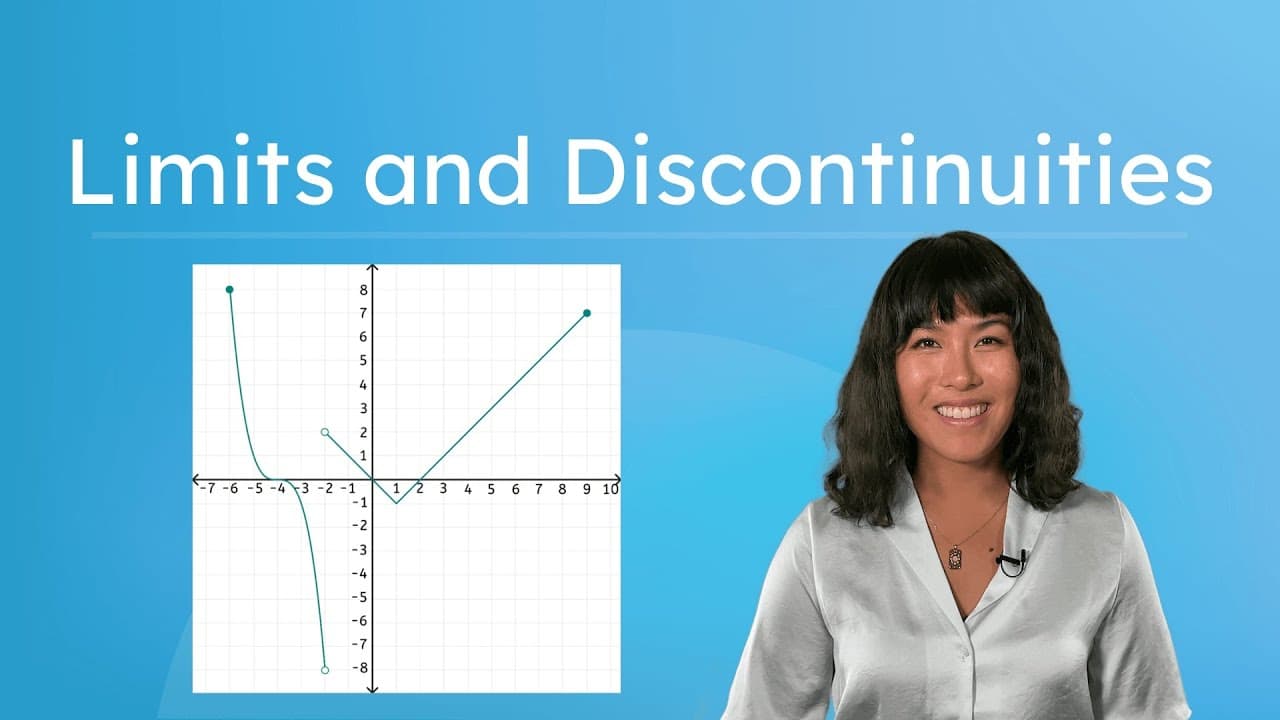
Understanding Limits, Continuity, and Discontinuities

Understanding Limits, Continuity, and Discontinuities

This video provides a comprehensive overview of limits and continuity in precalculus, moving beyond one-sided limits to the full definition of an overall limit. It explains that for an overall limit to exist, the left-hand and right-hand limits must be equal. The lesson uses visual graphs to introduce the concept of continuity informally as tracing a curve without lifting a pencil, and then categorizes different types of discontinuities: removable (holes), jump, infinite (asymptotes), and oscillating.

Miacademy & MiaPrep Learning ChannelMiacademy & MiaPrep Learning Channel

14mins 28s

Video
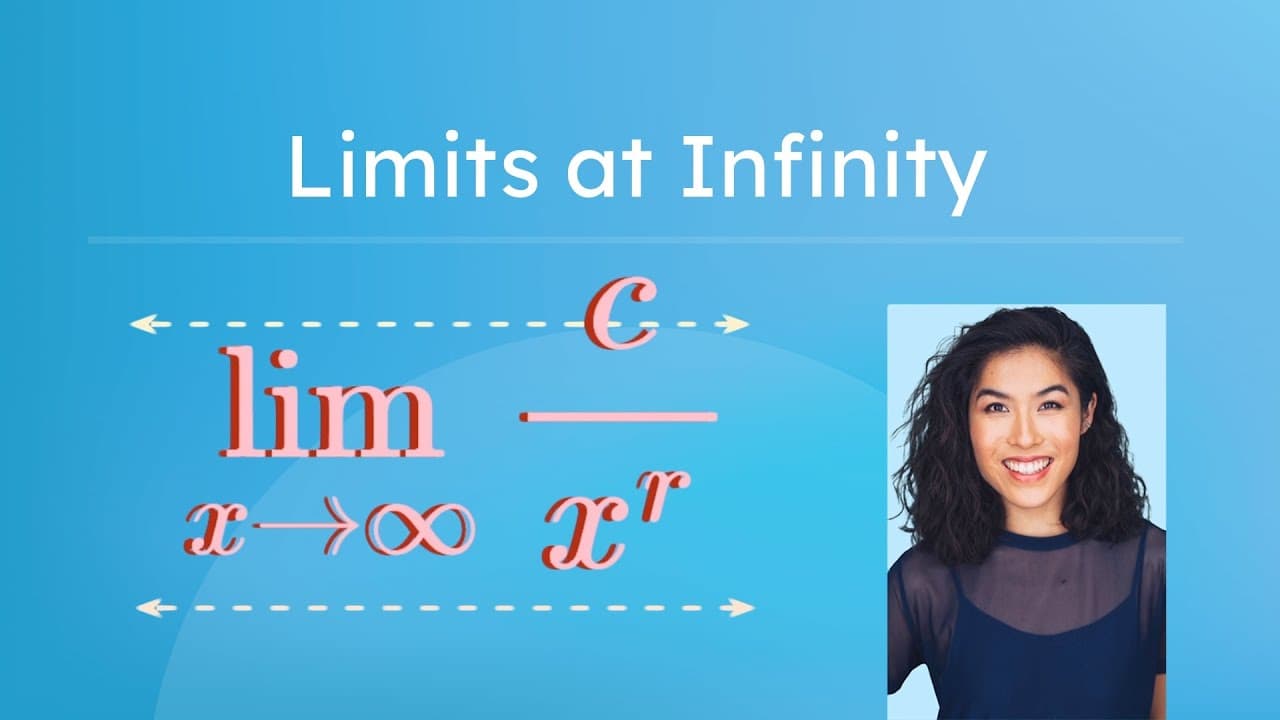
Mastering Limits at Infinity and Horizontal Asymptotes

Mastering Limits at Infinity and Horizontal Asymptotes

This educational video provides a comprehensive guide to understanding limits at infinity, a fundamental concept in Precalculus and Calculus. It bridges the gap between graphical intuition and algebraic rigor by connecting limits at infinity directly to the concept of horizontal asymptotes. The video progresses from visual inspection of rational function graphs to formal definitions using limit notation, and finally to analytic methods for evaluating limits without graphing calculators. The content explores key themes such as end behavior, rational functions, and the algebraic manipulation required to solving limits. It specifically addresses how the degrees of the numerator and denominator influence the limit, covering three main cases: when the denominator's degree is higher (limit is 0), when degrees are equal (limit is the ratio of leading coefficients), and when the numerator's degree is higher (limit is infinite or DNE). It also touches upon special cases involving oscillating trigonometric functions and exponential functions. For educators, this video is an excellent resource for introducing or reinforcing the concept of end behavior in a rigorous way. It moves beyond simple memorization of rules by explaining the "why" behind them through the technique of dividing by the highest power of x. The clear step-by-step examples make it suitable for flipped classrooms, review sessions, or as a primary instructional tool for introducing the analytic evaluation of limits.

Miacademy & MiaPrep Learning ChannelMiacademy & MiaPrep Learning Channel

17mins 40s

Video
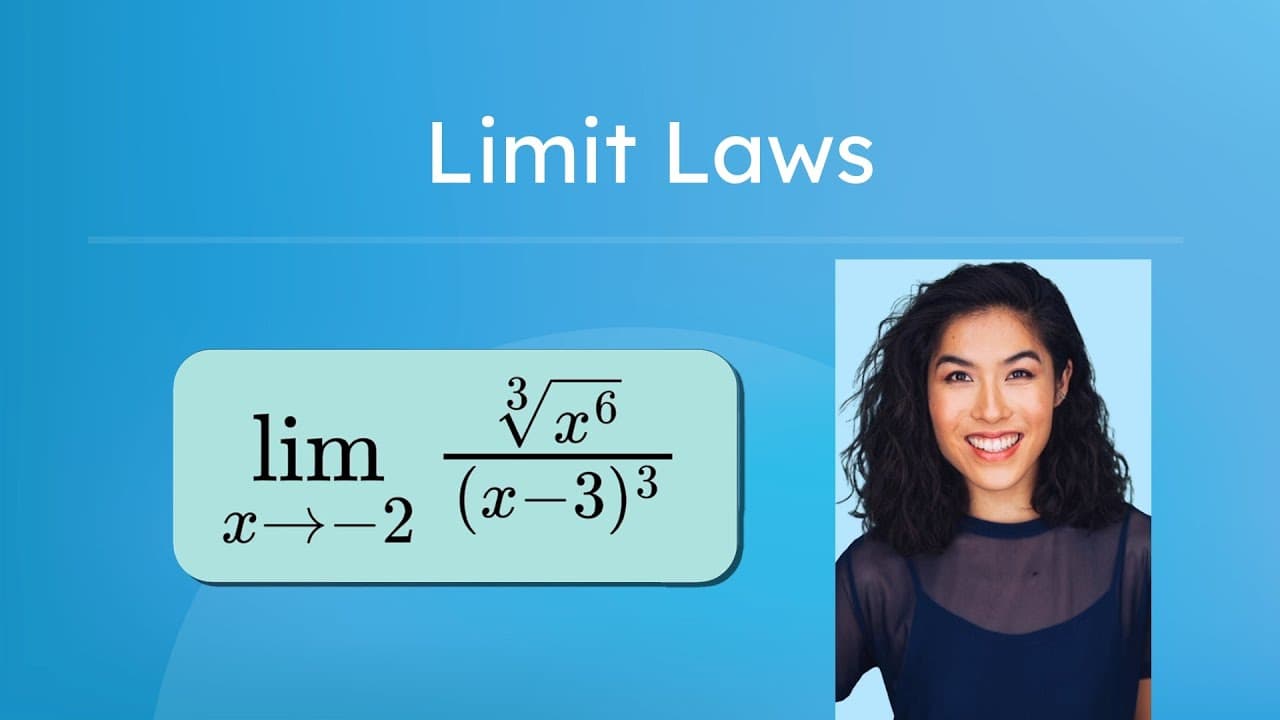
How to Calculate Limits Using Special Limits and Limit Laws

How to Calculate Limits Using Special Limits and Limit Laws

This educational video provides a comprehensive guide to evaluating mathematical limits algebraically using Special Limits and Limit Laws. Moving beyond estimation techniques like graphing and tables, the lesson introduces precise rules that allow students to calculate limits for constants, linear functions, powers, roots, sums, differences, products, and quotients. The video uses a clear, scaffolded approach, starting with basic building blocks and advancing to complex rational functions. The content covers eleven specific rules: four Special Limits (Constant, Identity, Power, and Root) and seven Limit Laws (Sum, Difference, Constant Multiple, Product, Quotient, Power of a Function, and Root of a Function). Detailed examples demonstrate how to break down complex expressions into simpler parts to apply these rules. The video also addresses critical constraints, such as ensuring denominators are not zero when applying the Quotient Law. Ideal for Pre-Calculus and Calculus classrooms, this video bridges the gap between conceptual understanding of limits and algebraic mastery. It features guided practice problems where students are encouraged to pause and solve, followed by step-by-step walkthroughs of the solutions. The lesson culminates in a mixed practice session, reinforcing the ability to identify and apply the correct laws to various types of functions.
Miacademy & MiaPrep Learning ChannelMiacademy & MiaPrep Learning Channel

13mins 48s

Video
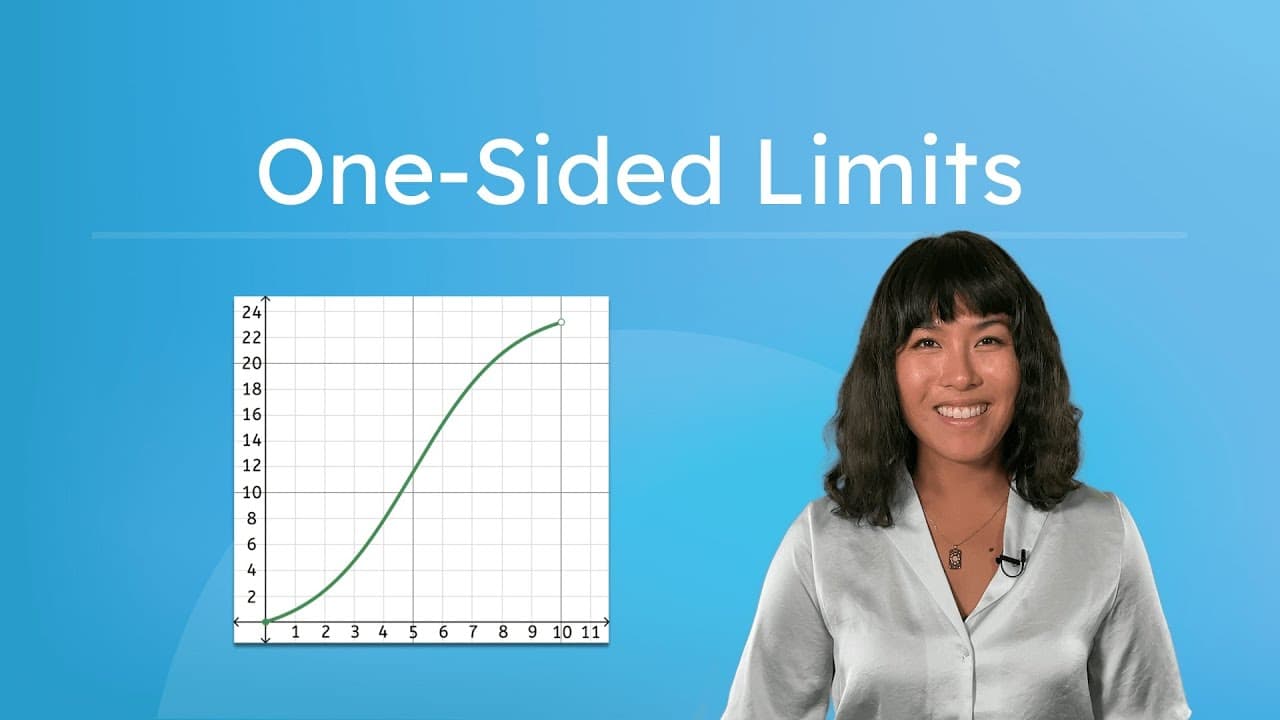
Understanding One-Sided Limits with Graphs and Piecewise Functions

Understanding One-Sided Limits with Graphs and Piecewise Functions

This educational video provides a comprehensive introduction to one-sided limits, a foundational concept in pre-calculus and calculus. Using a relatable analogy of filling a water balloon until it bursts, the video explains why analyzing a function from only one direction is often necessary. It transitions from this conceptual framework into the formal mathematical notation for left-hand and right-hand limits, explicitly clarifying the difference between the sign of the limit direction and the sign of the number itself.

Miacademy & MiaPrep Learning ChannelMiacademy & MiaPrep Learning Channel

16mins 9s

Video
What Is the Number e and How Do We Calculate It?

What Is the Number e and How Do We Calculate It?

This educational video provides a comprehensive overview of the mathematical constant e, also known as Euler's number. It begins by defining e as an irrational number approximately equal to 2.718, commonly found in exponential functions and logarithms. The narrator then explores the origins of e through three distinct mathematical approaches: the formula for compound interest as the compounding frequency approaches infinity, the limit of (1 + n)^(1/n) as n approaches zero, and the infinite series of the reciprocals of factorials. Key themes include the relationship between discrete and continuous growth, the concept of limits and infinity in mathematics, and the unique properties of exponential functions in calculus. The video bridges the gap between algebraic financial formulas and advanced calculus concepts, demonstrating how a simple question about interest rates leads to the discovery of a fundamental constant of the universe. For educators, this video serves as an excellent bridge between Algebra II, Pre-Calculus, and Calculus. It visualizes abstract definitions, provides concrete numerical evidence for limits, and introduces the profound calculus properties of e^x—specifically that its slope and the area under its curve are equal to its value. This makes it a versatile tool for introducing the constant to beginners or deepening the understanding of advanced students studying derivatives and integrals.

The Organic Chemistry TutorThe Organic Chemistry Tutor

12mins 11s

Video
What Is the Number e and How Do We Calculate It?

What Is the Number e and How Do We Calculate It?

This educational video provides a comprehensive overview of the mathematical constant e, also known as Euler's number. It begins by defining e as an irrational number approximately equal to 2.718, commonly found in exponential functions and logarithms. The narrator then explores the origins of e through three distinct mathematical approaches: the formula for compound interest as the compounding frequency approaches infinity, the limit of (1 + n)^(1/n) as n approaches zero, and the infinite series of the reciprocals of factorials. Key themes include the relationship between discrete and continuous growth, the concept of limits and infinity in mathematics, and the unique properties of exponential functions in calculus. The video bridges the gap between algebraic financial formulas and advanced calculus concepts, demonstrating how a simple question about interest rates leads to the discovery of a fundamental constant of the universe. For educators, this video serves as an excellent bridge between Algebra II, Pre-Calculus, and Calculus. It visualizes abstract definitions, provides concrete numerical evidence for limits, and introduces the profound calculus properties of e^x—specifically that its slope and the area under its curve are equal to its value. This makes it a versatile tool for introducing the constant to beginners or deepening the understanding of advanced students studying derivatives and integrals.

The Organic Chemistry TutorThe Organic Chemistry Tutor

12mins 11s

No videos found
There are no videos available for this topic yet.
No videos found
There are no videos available for this topic yet.
No videos found
There are no videos available for this topic yet.
No videos found
There are no videos available for this topic yet.
No videos found
There are no videos available for this topic yet.
Video
Mastering Math with the Desmos Online Graphing Calculator

Mastering Math with the Desmos Online Graphing Calculator

This comprehensive tutorial introduces students and educators to the Desmos online graphing calculator, a powerful and free tool for visualizing mathematics. The video begins with the basics of accessing the site and graphing simple functions like lines and parabolas, then progressively moves to more advanced topics including trigonometry, polar coordinates, and calculus operations. The narrator demonstrates not just how to plot graphs, but how to use the tool to solve equations, factor quadratics, and visualize systems of inequalities. Key mathematical themes include function families (linear, quadratic, cubic, absolute value, exponential, logarithmic), systems of equations and inequalities, trigonometry (degrees vs. radians), and statistical analysis (mean, standard deviation). The video also highlights the calculator's computational abilities, such as evaluating definite integrals, summations, and permutations, making it a versatile utility for various levels of math. For the classroom, this video serves as an excellent training resource for students transitioning from handheld calculators to computer-based tools. It allows teachers to show students how to verify their algebraic work visually, such as checking factors by looking at x-intercepts or solving systems by finding intersection points. The visual nature of the tool helps bridge the gap between abstract algebraic manipulation and concrete graphical understanding.

The Organic Chemistry TutorThe Organic Chemistry Tutor

13mins 58s

Video
Mastering Math with the Desmos Online Graphing Calculator

Mastering Math with the Desmos Online Graphing Calculator

This comprehensive tutorial introduces students and educators to the Desmos online graphing calculator, a powerful and free tool for visualizing mathematics. The video begins with the basics of accessing the site and graphing simple functions like lines and parabolas, then progressively moves to more advanced topics including trigonometry, polar coordinates, and calculus operations. The narrator demonstrates not just how to plot graphs, but how to use the tool to solve equations, factor quadratics, and visualize systems of inequalities. Key mathematical themes include function families (linear, quadratic, cubic, absolute value, exponential, logarithmic), systems of equations and inequalities, trigonometry (degrees vs. radians), and statistical analysis (mean, standard deviation). The video also highlights the calculator's computational abilities, such as evaluating definite integrals, summations, and permutations, making it a versatile utility for various levels of math. For the classroom, this video serves as an excellent training resource for students transitioning from handheld calculators to computer-based tools. It allows teachers to show students how to verify their algebraic work visually, such as checking factors by looking at x-intercepts or solving systems by finding intersection points. The visual nature of the tool helps bridge the gap between abstract algebraic manipulation and concrete graphical understanding.

The Organic Chemistry TutorThe Organic Chemistry Tutor

13mins 58s

MathNumbers & CountingCounting ObjectsNumber NamesComparing NumbersNumber OperationsCounting SequenceNumbers 0-10Place Value Understanding and SystemAdd and Subtract Within 20Addition and Subtraction ConceptsAddition and Subtraction EquationsAddition and Subtraction ProblemsFoundations for MultiplicationMultiplication and Division PropertiesMultiply and Divide Within 100Multiplication and Division ProblemsFactors and MultiplesProperties of OperationsPatterns and RelationshipsGenerate and Analyze PatternsMulti-Digit ArithmeticPlace Value OperationsMulti-Digit and Decimal OperationsNumerical ExpressionsFour Operations and PatternsFour Operations Problem SolvingMeasurement & DataMeasurable AttributesMeasuring LengthsMeasure and Estimate Lengths in Standard UnitsRelate Addition and Subtraction to LengthClassifying and Counting ObjectsTime and MoneyArea Concepts and MeasurementPerimeter and Area MeasuresAngle Concepts and MeasurementTime, Volume, and MassMeasurement Unit ConversionsGeometryIdentifying ShapesShapes and AttributesShape Attributes and ReasoningShapes and CompositionClassifying 2D FiguresGeometric Figures and RelationshipsLines, Angles, and ShapesAngle, Area, and VolumeGeometric MeasurementVolume of 3D ShapesCoordinate Plane ApplicationsTransformations in the PlaneCongruence and SimilarityUnderstand congruence in terms of rigid motionsSimilarity and TransformationsProve Theorems Involving SimilarityPythagorean TheoremTrigonometry for General TrianglesMake Geometric ConstructionsProve Geometric TheoremsTheorems About CirclesFind Arc Lengths And Areas of Sectors of CirclesVolume FormulasRelationships Between Two-Dimensional and Three-Dimensional ObjectsProve Simple Geometric Theorems AlgebraicallyTranslate Between Geometric Description and Equation for Conic SectionApply Geometric Concepts in Modeling SituationsFractions & DecimalsFractions as NumbersBuilding FractionsFraction Equivalence and OrderingAdding and Subtracting FractionsMultiplying and Dividing FractionsDividing FractionsDecimal FractionsMulti-Digit Computation and FactorsAdd, Subtract, Multiply, and Divide Rational NumbersRational Number SystemIrrational Numbers and ApproximationsRatiosRatios and ProportionsProportional RelationshipsUnit RateAlgebraAlgebraic ExpressionsGenerate Equivalent ExpressionsQuantitative RelationshipsProportional Relationships and Linear EquationsEquations and InequalitiesEquation Solving and ReasoningLinear Equations and SystemsGraph Equations and InequalitiesSystems of EquationsReal-World Algebraic ProblemsQuantitative Reasoning with UnitsExpression StructureEquivalent Expression FormsRadicals and Integer ExponentsRational ExponentsRational and Irrational NumbersPolynomial OperationsPolynomial IdentitiesPolynomial Zeros and FactorsRational ExpressionsComplex Number OperationsComplex Numbers in PolynomialsComplex Numbers on PlaneStatistics & ProbabilityRepresent and Interpret DataData DistributionsStatistical VariabilityProbability ModelsCompound Event ProbabilitiesStatistical SamplingInterpret Categorical and Quantitative DataBivariate Data PatternsInterpret Linear ModelsComparing Two PopulationsRandom Processes in StatisticsIndependence and Conditional ProbabilityExpected ValuesProbability-Based Decision MakingStatistical Inference and ConclusionsFunctionsFunction Concepts and NotationDefine and Compare FunctionsInterpret Functions in ContextAnalyze Function RepresentationsModel Relationships with FunctionsIdentify Linear vs Exponential GrowthDistinguish Between Function TypesCompare Growth RatesInterpret Function ExpressionsBuild Functions from RelationshipsConstruct and Model FunctionsTransform and Combine FunctionsModel Comparison and SelectionSolve Exponential EquationsTrigonometryTrigonometric Ratios Involving Right TrianglesTrigonometric Functions and Unit CircleModel with Trigonometric FunctionsTrigonometric IdentitiesVectors & MatricesIntroduction to Vectors and MatricesVector QuantitiesVector OperationsMatrix OperationsCalculusLimits and ContinuityDerivative Concepts and NotationDerivative Rules and TechniquesApplications of DerivativesOptimization ProblemsRelated RatesCurve Sketching and AnalysisIntegration Concepts and NotationAntiderivatives and Indefinite IntegralsDefinite Integrals and AreaFundamental Theorem of CalculusIntegration TechniquesApplications of IntegrationDifferential EquationsSequences and SeriesParametric and Polar FunctionsVector-Valued Functions
Video
Mastering Math with the Desmos Online Graphing Calculator

Mastering Math with the Desmos Online Graphing Calculator

This comprehensive tutorial introduces students and educators to the Desmos online graphing calculator, a powerful and free tool for visualizing mathematics. The video begins with the basics of accessing the site and graphing simple functions like lines and parabolas, then progressively moves to more advanced topics including trigonometry, polar coordinates, and calculus operations. The narrator demonstrates not just how to plot graphs, but how to use the tool to solve equations, factor quadratics, and visualize systems of inequalities. Key mathematical themes include function families (linear, quadratic, cubic, absolute value, exponential, logarithmic), systems of equations and inequalities, trigonometry (degrees vs. radians), and statistical analysis (mean, standard deviation). The video also highlights the calculator's computational abilities, such as evaluating definite integrals, summations, and permutations, making it a versatile utility for various levels of math. For the classroom, this video serves as an excellent training resource for students transitioning from handheld calculators to computer-based tools. It allows teachers to show students how to verify their algebraic work visually, such as checking factors by looking at x-intercepts or solving systems by finding intersection points. The visual nature of the tool helps bridge the gap between abstract algebraic manipulation and concrete graphical understanding.

The Organic Chemistry TutorThe Organic Chemistry Tutor

13mins 58s

Video
What Is the Number e and How Do We Calculate It?

What Is the Number e and How Do We Calculate It?

This educational video provides a comprehensive overview of the mathematical constant e, also known as Euler's number. It begins by defining e as an irrational number approximately equal to 2.718, commonly found in exponential functions and logarithms. The narrator then explores the origins of e through three distinct mathematical approaches: the formula for compound interest as the compounding frequency approaches infinity, the limit of (1 + n)^(1/n) as n approaches zero, and the infinite series of the reciprocals of factorials. Key themes include the relationship between discrete and continuous growth, the concept of limits and infinity in mathematics, and the unique properties of exponential functions in calculus. The video bridges the gap between algebraic financial formulas and advanced calculus concepts, demonstrating how a simple question about interest rates leads to the discovery of a fundamental constant of the universe. For educators, this video serves as an excellent bridge between Algebra II, Pre-Calculus, and Calculus. It visualizes abstract definitions, provides concrete numerical evidence for limits, and introduces the profound calculus properties of e^x—specifically that its slope and the area under its curve are equal to its value. This makes it a versatile tool for introducing the constant to beginners or deepening the understanding of advanced students studying derivatives and integrals.

The Organic Chemistry TutorThe Organic Chemistry Tutor

12mins 11s