Visual presentation for Lesson 5, introducing the coordinate plane and demonstrating how to find distances between points to determine side lengths for area calculations.
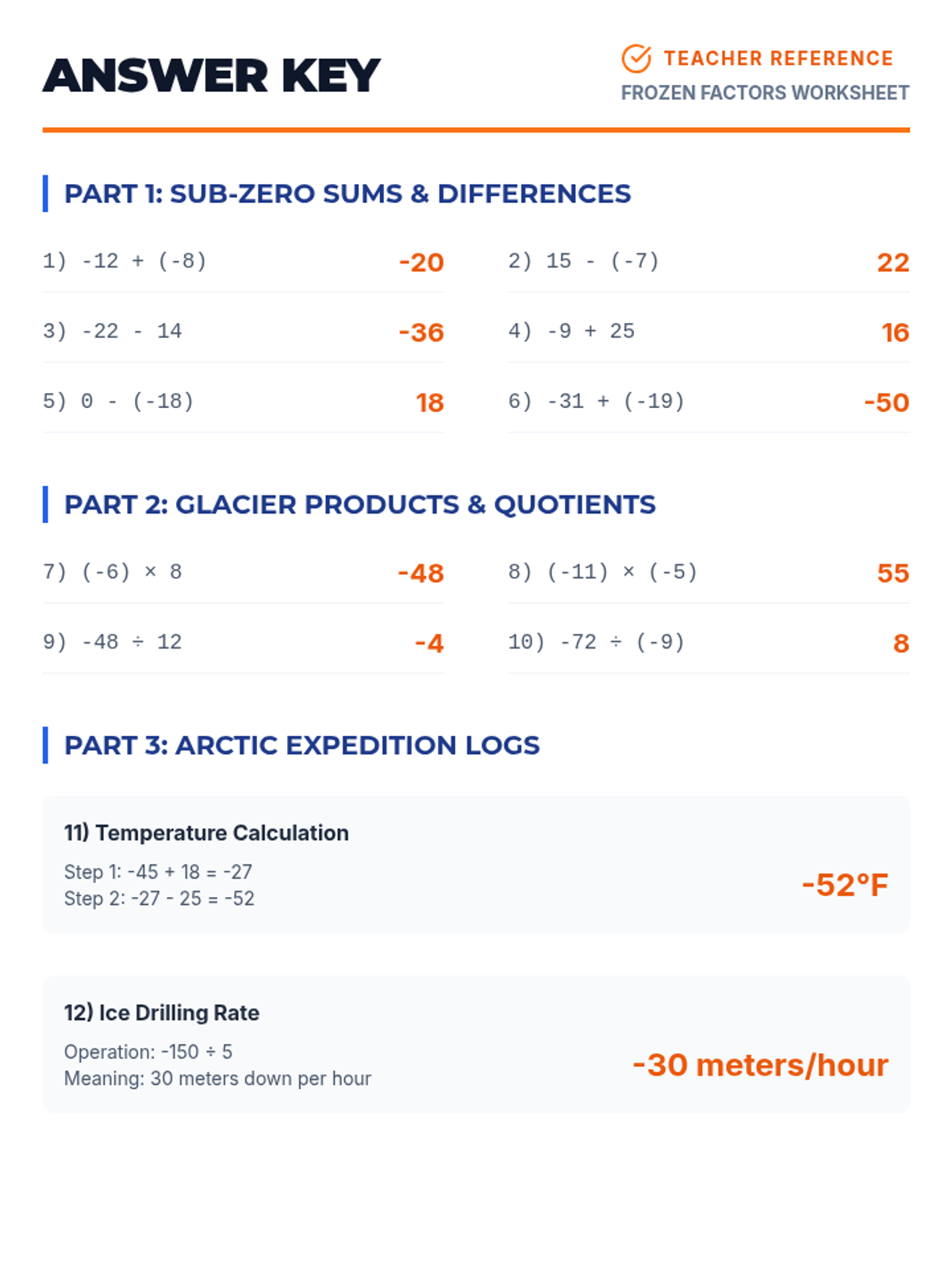
A teacher answer key for the 'Final Inspection Quiz', providing correct answers for the multiple-choice questions and step-by-step solutions for the performance tasks.
A teacher answer key for the 'Construction Zone Worksheet', providing completed equivalent fractions and final decimal answers for all eight practice problems.
A short assessment quiz to check for mastery in converting fractions to terminating decimals. Includes multiple-choice concept questions and performance tasks requiring students to show their work.
A student practice worksheet with two distinct phases: 'The Base Ten Build' for using equivalent fractions, and 'The Division Hammer' for using long division. Includes grid-lined work areas for division precision.
An instructional slide deck for teaching fraction-to-decimal conversion. Features a 'Decimal Architect' theme, step-by-step methods (Base Ten Build and Long Division Hammer), and guided practice problems.
An educational anchor chart illustrating the two primary methods for converting fractions to decimals: the 'Base Ten Build' (using equivalent fractions) and the 'Long Division Hammer'. Includes visual steps and helpful tips.
A detailed teacher guide for the 'Decimal Blueprint' lesson, featuring learning objectives, a step-by-step instructional sequence, common misconceptions, and differentiation strategies for teaching fraction-to-decimal conversion.
Final challenge worksheet for Lesson 12: Master Builders. Integrates skills for addition equations, multiplication equations, and inequality graphing.
Visual slide deck for Lesson 12: Master Builders. A culminating review and challenge presentation.
Teacher facilitation guide for Lesson 12: Master Builders, a culminating challenge integrating all skills from the unit. Includes ALN Launch, Task, and Summary.
Student drafting sheet for Lesson 11: Safety Zones. Focuses on writing inequalities for real-world constraints like speed, budget, and capacity.
Visual slide deck for Lesson 11: Safety Zones. Focuses on writing inequalities for real-world constraints like speed, budget, and capacity.
Teacher facilitation guide for Lesson 11: Safety Zones, focusing on writing inequalities for real-world constraints like speed, budget, and capacity. Includes ALN Launch, Task, and Summary.
Student drafting sheet for Lesson 10: Infinite Pathways. Focuses on representing inequalities on number lines.
Visual slide deck for Lesson 10: Infinite Pathways. Focuses on representing inequalities on number lines, understanding the meaning of open vs. closed circles and 'infinitely many' solutions.
Teacher facilitation guide for Lesson 10: Infinite Pathways, focusing on representing inequalities on number lines. Includes ALN Launch, Task, and Summary.
Student drafting sheet for Lesson 9: Beyond Equality. Introduces inequality symbols and the concept of constraints.
Visual slide deck for Lesson 9: Beyond Equality. Introduces inequality symbols and the concept of constraints, helping students recognize that some problems have a range of solutions.
Teacher facilitation guide for Lesson 9: Beyond Equality, introducing inequality symbols and the concept of constraints. Includes ALN Launch, Task, and Summary.
Student drafting sheet for Lesson 8: Story Structures. Focuses on mixed one-step equation solving in real-world contexts by identifying the appropriate inverse operation.
Visual slide deck for Lesson 8: Story Structures. Focuses on mixed one-step equation solving in real-world contexts by identifying the appropriate inverse operation.
Teacher facilitation guide for Lesson 8: Story Structures, focusing on mixed one-step equation solving in real-world contexts. Includes ALN Launch, Task, and Summary.
Student drafting sheet for Lesson 7: Fair Shares. Focuses on solving division equations using visual models and multiplication.
Visual slide deck for Lesson 7: Fair Shares. Focuses on solving division equations using visual models and the concept of multiplication as the inverse operation.
Teacher facilitation guide for Lesson 7: Fair Shares, focusing on solving division equations using visual models and multiplication. Includes ALN Launch, Task, and Summary.
Student drafting sheet for Lesson 6: Product Blueprints. Focuses on solving multiplication equations using tape diagrams and division.
Visual slide deck for Lesson 6: Product Blueprints. Focuses on solving multiplication equations using tape diagrams and the concept of division as the inverse operation.
Teacher facilitation guide for Lesson 6: Product Blueprints, focusing on solving multiplication equations using tape diagrams and division. Includes ALN Launch, Task, and Summary.
Student excavation log for Lesson 5: Reverse Engineering. Focuses on solving subtraction equations by visualizing the relationship on a number line and using addition as the inverse operation.
Visual slide deck for Lesson 5: Reverse Engineering. Focuses on solving subtraction equations by visualizing the relationship on a number line and using addition as the inverse operation.
Teacher facilitation guide for Lesson 5: Reverse Engineering, focusing on solving subtraction equations by 'restoring' the total through addition. Includes ALN Launch, Task, and Summary.
Student drafting sheet for Lesson 4: Additive Architects. Focuses on solving addition equations using bar models and inverse operations.
Visual slide deck for Lesson 4: Additive Architects. Introduces solving addition equations using visual bar models and the concept of inverse operations.
Teacher facilitation guide for Lesson 4: Additive Architects, focusing on solving addition equations using bar models and inverse operations. Includes ALN Launch, Task, and Summary.
Student scenario blueprint for Lesson 3: Unknown Identity. Focuses on translating verbal descriptions into algebraic expressions using variables.
Visual slide deck for Lesson 3: Unknown Identity. Introduces the concept of variables through a mystery bag and client request scenarios.
Teacher facilitation guide for Lesson 3: Unknown Identity, introducing variables as representations of unknown numbers in scenarios. Includes ALN Launch, Task, and Summary.
Student verification log for Lesson 2: Truth Seekers. Provides structured space for testing potential solutions (substitution) for a vault door challenge.
Visual slide deck for Lesson 2: Truth Seekers. Explores the concept of substitution using a 'Vault Door' theme to find which value makes an equation true.
Teacher facilitation guide for Lesson 2: Truth Seekers, focusing on using substitution to determine if a value is a solution to an equation. Includes Launch, Task, and Summary.
Student drafting sheet for Lesson 1: Balancing Act. Provides space for the WODB launch, a grid-based workspace for the balance riddle, and a summary section for the definition of equality.
Visual slide deck for Lesson 1: Balancing Act. Includes a 'Which One Doesn't Belong?' launch, the primary balance riddle task, and a summary slide defining the equal sign.
Teacher facilitation guide for Lesson 1: Balancing Act, including ALN Launch, Task, and Summary components. Focuses on the conceptual understanding of equality using a balance scale model.
Teacher guide for Lesson 12: Division Finale. Provides a framework for celebrating student growth and a review routine for summarizing the sequence's key strategies.
Student practice page for Lesson 12: Division Finale. Serves as a cumulative assessment and reflection on the strategies learned throughout the Division Workshop.
Slide deck for Lesson 12: Division Finale. Reviews all strategies from the sequence (Area Models, Big 7, Scaling, Decimal Shifting) and celebrates student progress.
Teacher guide for Lesson 11: Story Solvers. Details the "Two Rooms" metaphor for problem-solving and provides annotation strategies for Tier 2 intervention.
Student practice page for Lesson 11: Story Solvers. Exercises focus on breaking down multi-step real-world problems into discrete operations.
Slide deck for Lesson 11: Story Solvers. Focuses on multi-step word problems involving division, using a "Two Rooms" framework to identify operations.

Teacher guide for Lesson 10: Decimal Dash. Focuses on equivalent expressions and the balanced shift logic for dividing decimals by decimals.