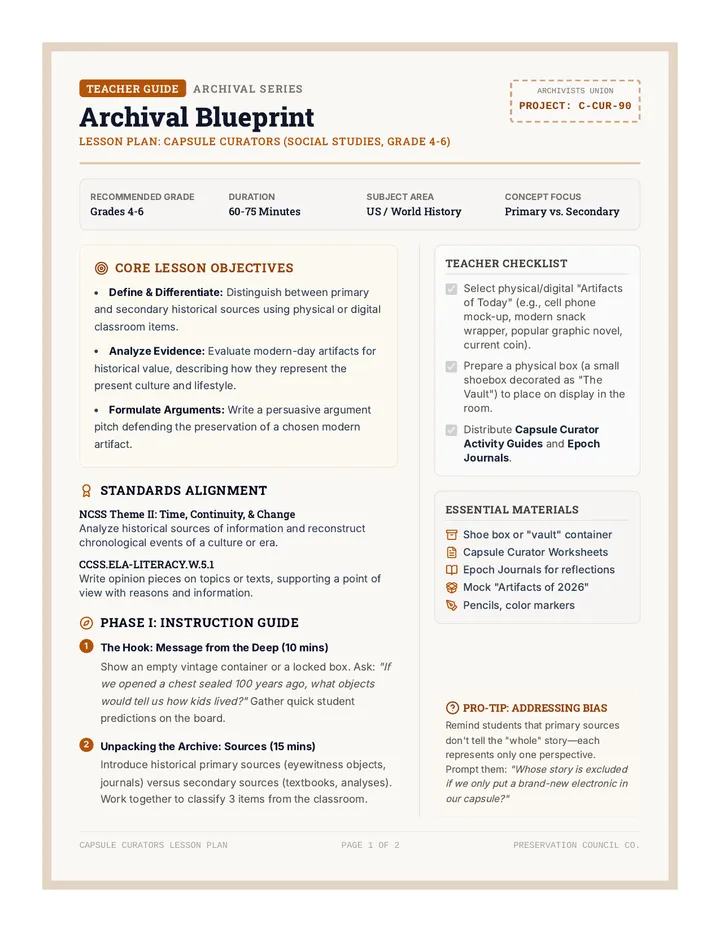
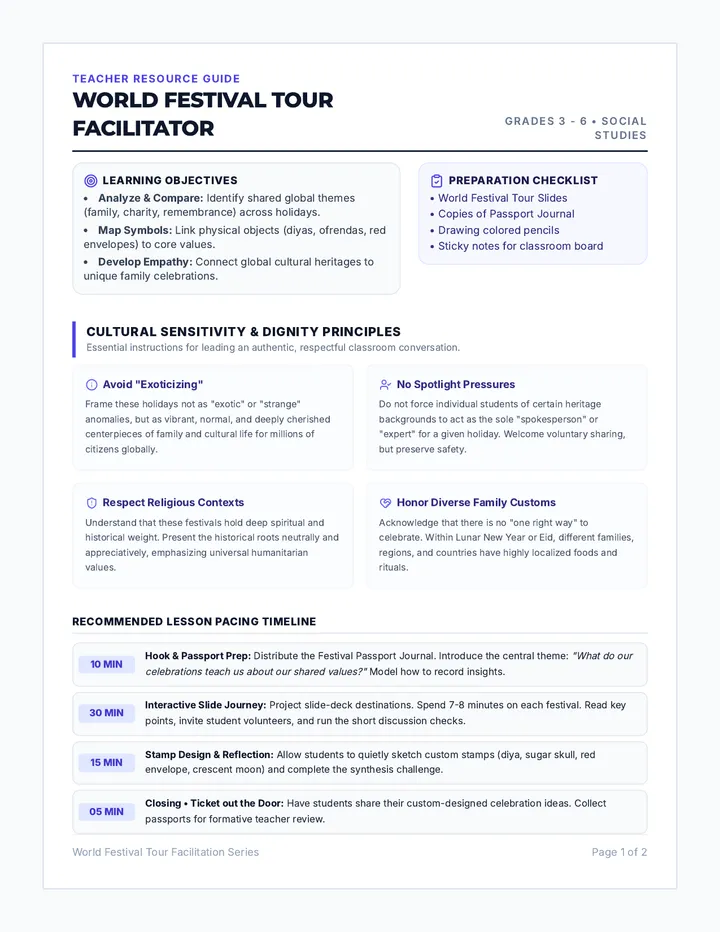
A teacher facilitation guide for the "Visionary Voice" lesson. Includes learning objectives, a detailed pacing guide, discussion prompts, and an answer key for the student worksheet.
A matching worksheet where students link state names to their official nicknames. Focuses on states with distinct nicknames or recognizable geography. Revised layout and header.
A printable set of flashcards featuring Alabama, Alaska, Arizona, Arkansas, California, and Colorado. Includes capitals, nicknames, and fun facts. Revised with fixed layout.
A large-print tracing worksheet for learning the names and capital cities of Northeastern states. Features wide spacing for handwriting practice and refined layout. Revised instructions and contrast.
A cut-and-paste activity focusing on state identification through symbols for the Northeast and Southeast regions. Includes a dedicated symbol cut-out sheet. Revised layout for easier cutting.
A colorful introductory slide deck overviewing the 50 US States, their regions, symbols, and fun facts. Revised with a complete 50-state master list and improved contrast.
An 11-slide presentation that introduces famous figures from Ohio using a mystery format. The title and opening slides keep the state a surprise, showing high-quality images of legends across history, science, and sports before revealing their shared Buckeye State heritage.
Teacher facilitation guide and answer key for the Alexander the Great debate lesson, including a lesson sequence and discussion prompts.
A Pro/Con T-chart worksheet for students to categorize evidence from the reading passage to decide if Alexander the Great was a hero or a villain.
A guided reading passage for 4th-5th graders exploring the life, conquests, and complex legacy of Alexander the Great. Includes reading comprehension questions with ruled writing lines for student responses.
A teacher-facing facilitation guide for the "Road to Disunion" lesson. Includes instructional steps, essential questions, and a grading rubric for the student newspaper project.
A creative reporting template designed as a 19th-century newspaper front page. Students apply their research to write headlines, articles, and analyze sectional sentiments regarding a cause of the Civil War.
A structured research organizer for 5th-grade students to collect facts, identifying symbols, and historical figures related to a specific cause of the Civil War. Features a "top secret" archive aesthetic.
A visually engaging slide deck covering the primary causes of the American Civil War, including slavery, sectionalism, states' rights, and the 1860 election. Designed with a historical archive aesthetic to immerse 5th-grade students in the era.
A supplemental teacher guide specifically for the simplified version of the Creole Revolution lesson. Includes a modified facilitation script, strategies for sensory engagement, and a breakdown of the simplifications made for IEP students.
A highly simplified version of the "Freedom Files" worksheet for IEP students. Features binary choices (circle one), a reduced word bank with 6 essential terms, larger visual areas, and clear icons to minimize cognitive load.
A teacher guide providing instructional support, IEP-specific scaffolding strategies, and discussion prompts for the Creole Revolution journal activity.
Visual cut-out icons for the "Freedom Files" activity, contrasting life before and after the Creole Revolutions with clear symbols and labels.
A scaffolded journal worksheet for IEP students exploring the changes after the Creole Revolutions. Includes a word bank, sentence starters, and designated areas for cut-and-paste visuals.