Students contrast mathematical expected value with expected utility to explain decision-making under uncertainty, analyzing different utility functions to model risk-averse behavior.
A professional development suite for school leaders focused on increasing math instructional intentionality. This lesson provides tools for auditing schedules, coaching lesson internalization, and refining small-group instruction to foster student agency.
A high-energy, Valentine's-themed 'Price is Right' game designed to last up to 120 minutes, covering item pricing, logic, and estimation.
A quick, functional introduction to interpreting bar and pie charts using real-world life skills scenarios like budgeting and time management.
Introduction à la distribution normale, au calcul des scores Z et à l'utilisation de la table de probabilités pour l'inférence.
Apprendre à choisir le bon graphique pour le bon type de données : histogrammes, boîtes à moustaches et diagrammes de dispersion.
Calculer et interpréter la moyenne, la médiane et le mode, ainsi que la variance et l'écart-type pour décrire la forme d'une distribution.
Comprendre la nature des données : variables qualitatives vs quantitatives, échelles de mesure (nominale, ordinale, intervalle, rapport) et introduction à l'échantillonnage.
A comprehensive 60-minute introductory lesson on basic arithmetic operations (addition, subtraction, multiplication, and division) tailored for GED preparation, focusing on both computation and word problem translation.
Master essential math conversions for everyday adult life. This lesson covers length, time, currency, and temperature transformations through practical reference tools and real-world exercises.
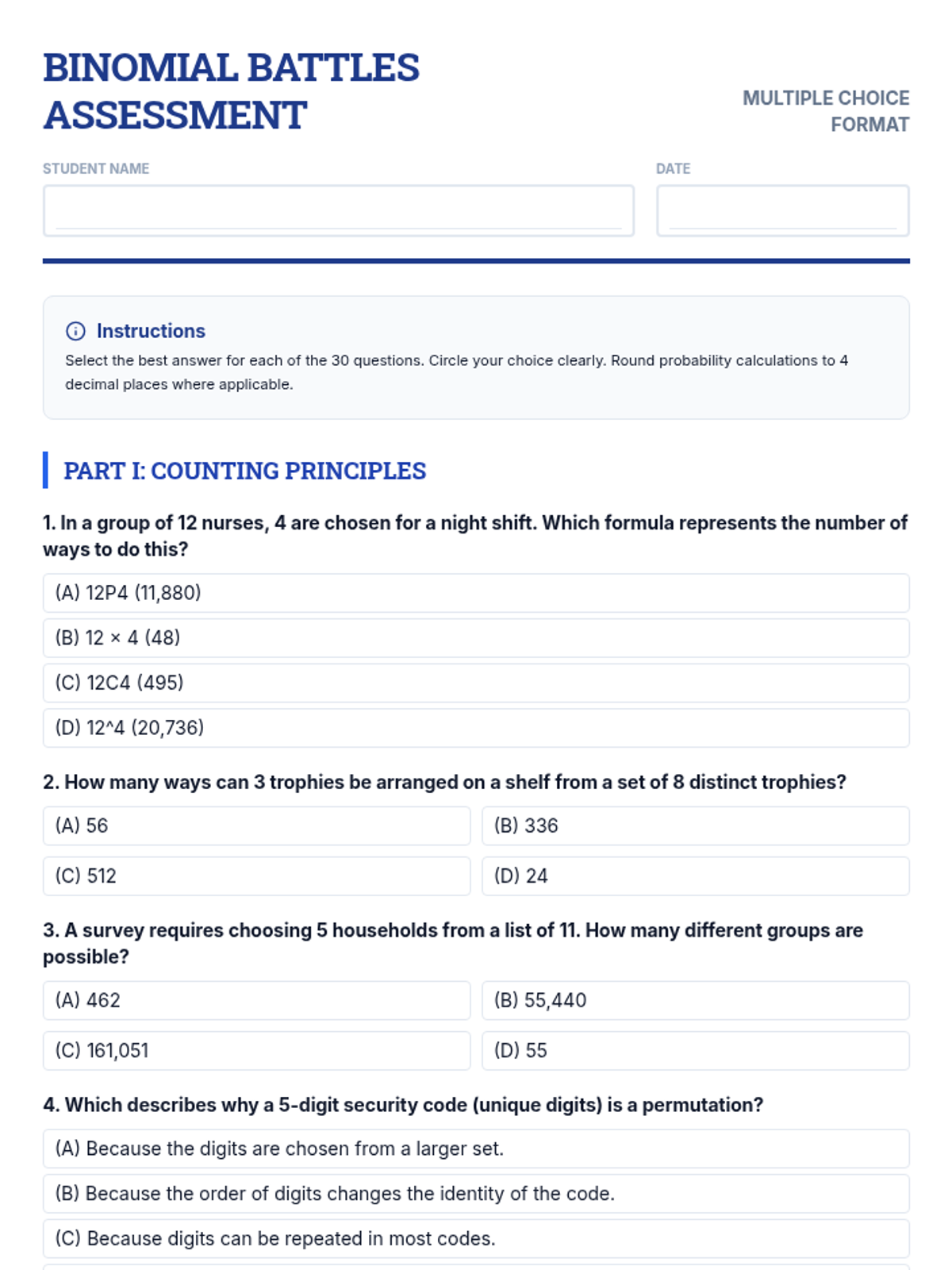
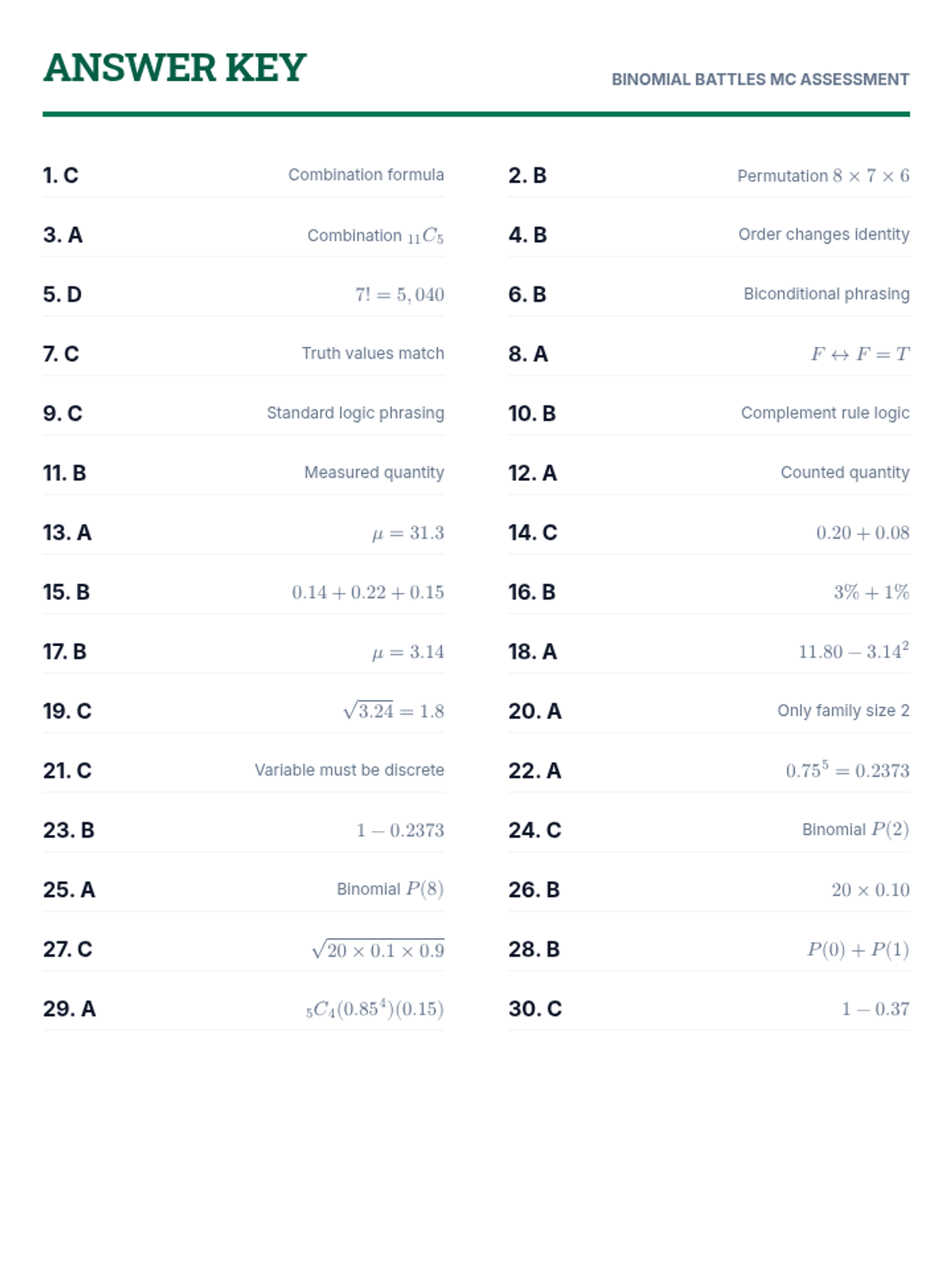
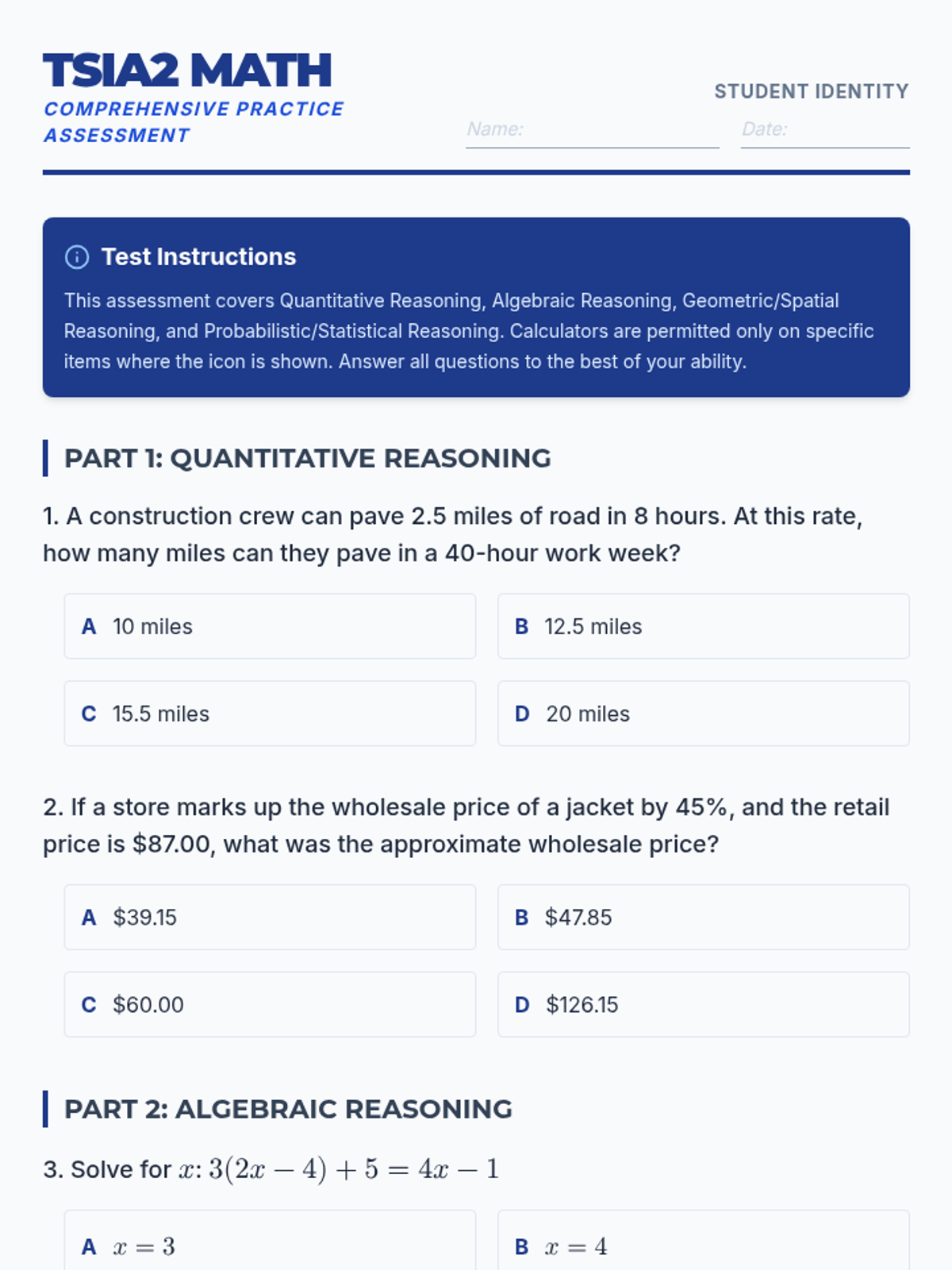
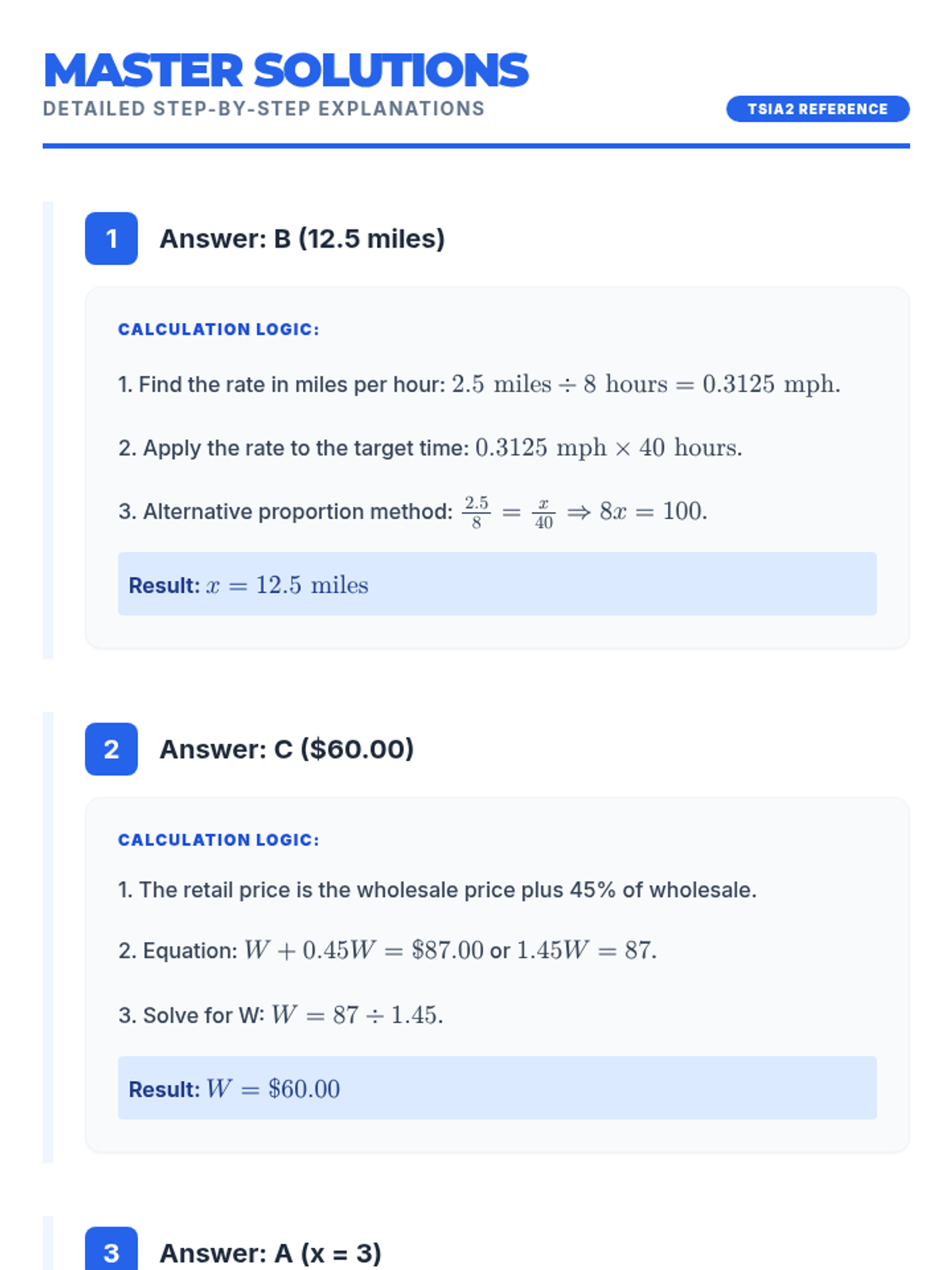
A comprehensive 20-question practice test and answer key designed to prepare students for the TSIA2 Mathematics assessment, focusing on algebraic, geometric, and statistical reasoning.
A workshop designed for parents of 5th graders to bridge the gap between traditional 'invert and multiply' methods and modern conceptual understanding of fraction division. Parents explore visual bar models and learn how to support their children's homework through guided questioning.
This lesson empowers parents to support their children's algebra homework by teaching them modern strategies, specific vocabulary, and the "Golden Rules" of solving equations with variables on both sides. It focuses on transitioning from "doing the work" for students to "coaching through guiding questions."
A 30-minute workshop designed to bridge the gap between school methods and home support, focusing on rounding and estimating decimal sums using visual strategies. Parents will practice the 'look next door' method to build their children's number sense rather than just focusing on exact answers.
A workshop designed for parents to understand modern 5th-grade math notation, specifically writing expressions, to better support their children's homework.
An undergraduate-level introduction to visualizing vectors as multi-dimensional data containers. Students explore real-world applications from catering costs to nutritional data, shifting the perspective of vectors from geometric arrows to abstract data structures.
A professional development workshop for High School Geometry teachers focused on the 'Concrete to Abstract' scaffolding model for geometric proofs and formula derivations. Teachers analyze a video case study and design their own lesson plans for complex derivations like the Quadratic or Distance formulas.
A specialized support lesson designed to bridge the gap between 'old school' math methods and modern conceptual teaching. Parents will learn the 4-step framework for adding fractions with unlike denominators using Mr. J's video as a guide.
A comprehensive workshop for parents and educators to master the Singapore Math bar modeling method, bridging the gap between reading word problems and solving equations.