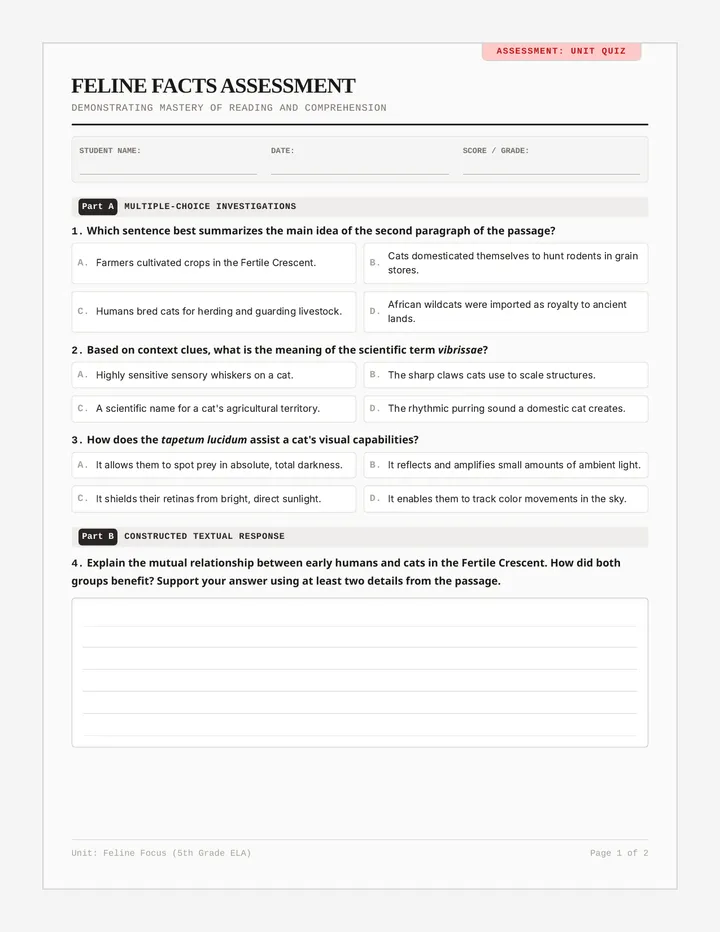
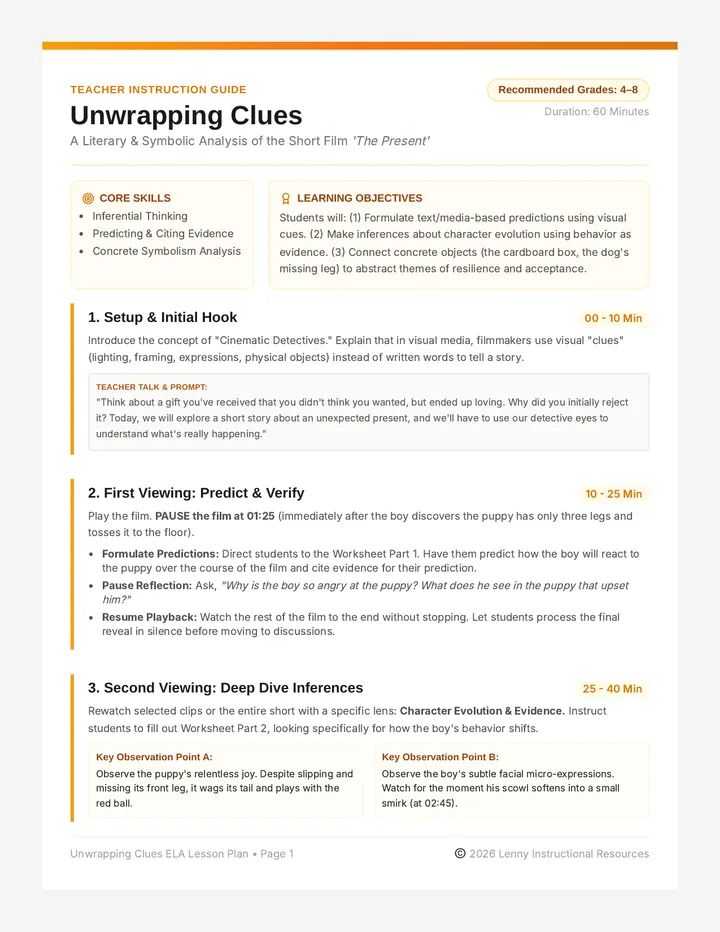
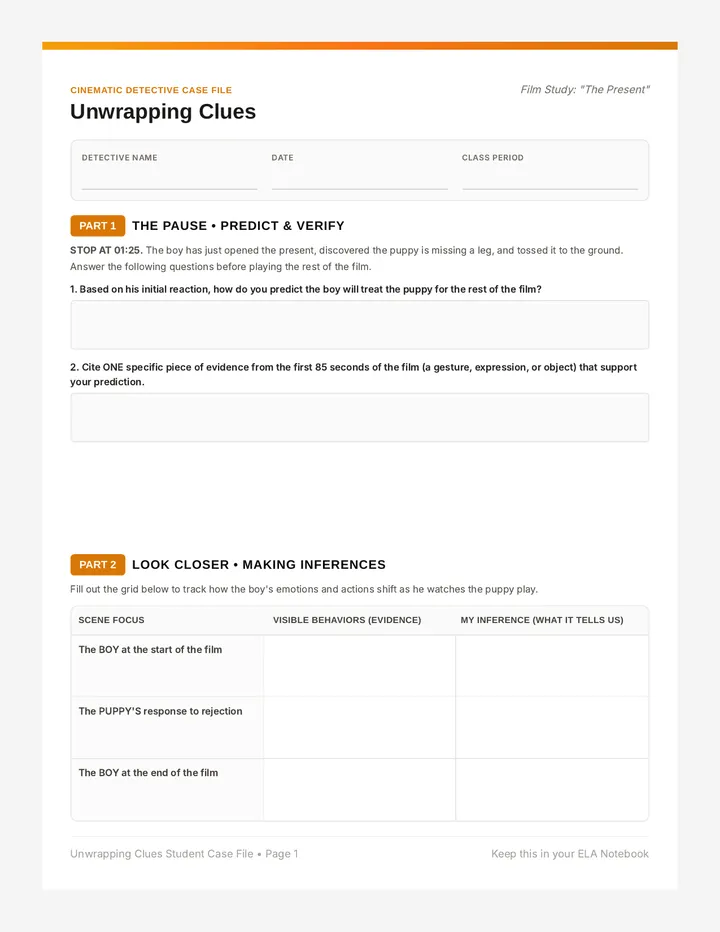
Covers example and contrast context clues to determine word meaning. Students practice making logical predictions about plot outcomes based on foreshadowing and environmental clues in the text.
A resource kit for teachers to track and support student progress across three distinct tiers of mastery, specifically tailored for Narrative Writing skills.

A comprehensive 3-night homework sequence based on 'Ollie's Nightly Adventures'. Each grade level (K, 2, 4) has three distinct assignments focusing on character/setting, sequencing, and inference/summarization using the same story text for the week.
A deep dive into the Ceremony of Twelve, focusing on themes of individuality, community control, and the mysterious role of the Receiver of Memory in chapters 6 through 8 of The Giver.
A comprehensive lesson exploring the Latin root 'man/manu' (hand) through visual slides and practical word-building activities.
A mini-lesson focused on identifying the author's purpose and controlling idea using the article 'Photo and Video Manipulation: Tricks or Treats'. Students will analyze text structure and evidence to decode the author's intent and central message.
The culmination of the sequence. Students use all the 'Building Block' skills to write a complete, structured paragraph on a topic of their choice with minimal scaffolding.
Focuses on the final part of the paragraph: the conclusion. Students learn to 'seal' their writing by restating their main idea in a new way and providing a final thought that protects the whole structure.
Focuses on the 'bridge' of the paragraph: the explanation. Students learn to explain why their evidence supports their main idea, using sentence frames like 'This shows that...' to build deeper meaning.
Focuses on the 'bricks' of a paragraph: evidence and supporting details. Students learn how to select relevant information and introduce it using formal evidence frames.
Focuses on the logical sequence of a paragraph. Students learn to use transition words to connect their foundation to their supporting details, ensuring the 'building' has clear paths and structure.
Focuses on the foundation of a paragraph: the topic sentence. Students learn to identify main ideas and craft clear, focused opening statements using sentence frames and expansion techniques.
The capstone of the intervention where students integrate all context clue types and focus on selecting the 'strongest' evidence to support complex inferences. Includes a final 'case' to solve.
Teaches students how to use synonyms and antonyms as context clues while inferring character traits and emotions from dialogue and actions. Practices focus on identifying 'clues' in a character's behavior.