A focused review lesson covering the core concepts of body systems, photosynthesis, and cellular respiration based on Grade 8 interim assessment standards.
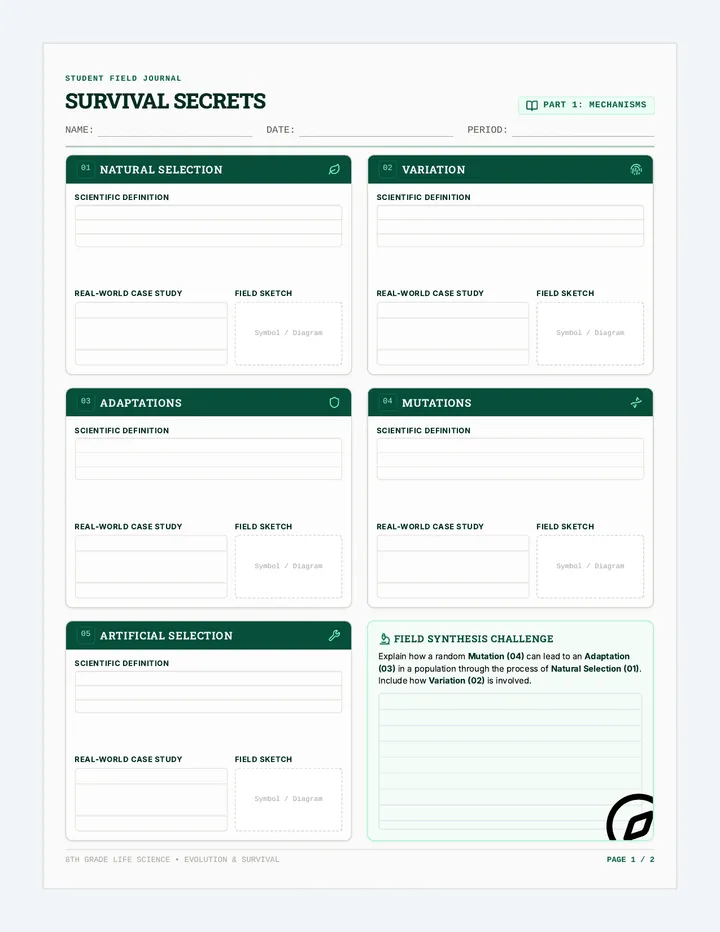
A comprehensive review lesson focusing on cell energy processes (photosynthesis and respiration), the hierarchy of biological organization, and the collaborative function of human body systems to maintain homeostasis.
A comprehensive review of middle school biology concepts including cell structure, energy processes, body systems, and homeostasis based on the Grade 8 Science Interim Assessment.
Une analyse critique de la sécurité ferroviaire à travers un scénario d'urgence. Cette leçon aborde les phases successives de MRUV et MRU, l'importance du temps de réaction et le calcul des distances d'arrêt de sécurité.
Une application concrète de la cinématique et du calcul vectoriel à travers le parcours d'un randonneur égaré. Cette leçon permet de manipuler les projections de vecteurs, la trigonométrie et la distinction entre distance parcourue et déplacement.
Une exploration de la cinématique à vitesse constante à travers un duel iconique entre l'homme le plus rapide du monde et un cheval. Cette leçon aborde les conversions d'unités, les équations horaires de position et la résolution de systèmes linéaires pour déterminer un point de rencontre.
Une étude approfondie de la cinématique d'un tramway en milieu urbain, abordant les mouvements uniformément variés avec et sans contraintes de vitesse. Cette leçon permet d'appliquer les principes fondamentaux de la dynamique aux transports ferroviaires réels.
Students synthesize their knowledge to participate in a structured debate about the future of wildlife restoration.
Students analyze the differing viewpoints of ranchers, environmentalists, and local communities regarding predator reintroduction.
Students explore the scientific history of wolf reintroduction in Yellowstone and investigate the concept of trophic cascades and ecosystem engineering.
An exploration of the rock cycle's dynamic processes, from the fiery birth of igneous rocks to the transformative heat and pressure of metamorphism. Students will learn how Earth constantly recycles its crust through physical and chemical changes.
Students identify various landforms and apply their knowledge of geological processes to design their own island ecosystem in a culminating project.
A deep dive into the forces of weathering and erosion using mechanical simulations to observe how rocks break down and move over time.
Students explore the three main types of rocks and the processes that transform them through a hands-on simulation using crayons to represent the rock cycle.
Explore how ecosystems respond to disturbances through primary and secondary succession, and analyze the relationship between biodiversity and ecosystem stability.
Students act as 'Marine Bio-Engineers' to design and build artificial reef structures that support a healthy ecosystem on Mystery Island's coast, focusing on biotic and abiotic interactions.
Students design and build 'Food Web Restoration' models to visualize and explain the flow of energy from producers to multiple consumers on Mystery Island.
Students design and build 'Weather Shields' to protect a model plant from extreme temperature and precipitation changes on Mystery Island, exploring how environmental factors affect organisms.
Students act as 'Botanical Engineers' to design and build seed models that can travel through the air to reach new parts of Mystery Island, focusing on seed dispersal methods.