Students master the art of professional public speaking as they prepare for a high-stakes press conference, focusing on body language, vocal delivery, and audience engagement.
An introductory lesson for 6th grade students to explore the concept of extraordinary people, focusing on the unit's essential question and core academic vocabulary. Students will analyze what defines greatness and master the terminology needed for the unit.
Students take the stage as professional journalists to launch their digital magazine. This lesson guides them through the final live presentation, fielding audience questions, and demonstrating professional communication skills.
In this 45-minute lesson, 6th-grade students step into the role of professional editors to master house style and factual accuracy. They will learn foundational AP style rules and apply fact-checking strategies to polish their articles to a professional standard.
A lesson for 6th graders on the editorial process, focusing on improving clarity and identifying bias in peer-written articles. Students learn to provide constructive feedback to help their peers polish their work for publication.
Students explore the hierarchy and responsibilities of a professional newsroom, assigning roles and establishing communication norms for their own publication project.
A 6th-grade journalism lesson focused on enhancing digital articles with images, hyperlinks, and multimedia to improve reader engagement and storytelling depth.
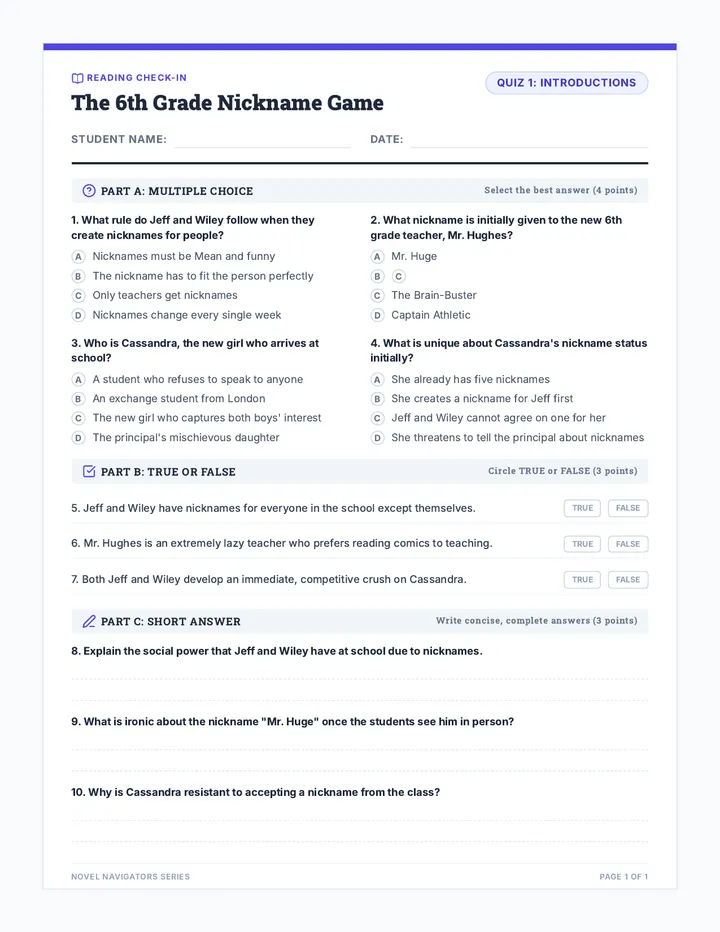
In this lesson, students transition from editors to publishers as they perform a final quality check on their beat reporting articles and navigate the pressure of a real newsroom deadline. They will evaluate their work against a rubric, ensure professional formatting, and submit their final pieces before reflecting on their growth as journalists.
A 45-minute workshop where students step into the role of news editors to provide constructive feedback on peer articles, focusing on structural integrity and narrative clarity.
In this 45-minute workshop, 6th-grade students synthesize their beat interview notes into a cohesive news article draft, focusing on structural elements like the lead and nut graph.
A 45-minute lesson for 6th grade students on the ethical and technical aspects of using direct quotes in journalism. Students learn formatting rules, the importance of journalistic integrity, and how to select impactful quotes for their news articles.
A journalism-focused lesson for 6th graders to master the art of lead writing. Students learn to pack the 5 Ws and H into a concise, compelling opening paragraph to hook their readers immediately.
In this journalism lesson, 6th-grade students learn the Inverted Pyramid structure to organize information. They will analyze real-world news articles and practice prioritizing facts to write effective, front-loaded stories.
A 6th-grade journalism-themed lesson focused on the power of open-ended questions. Students learn to pivot away from 'yes/no' dead ends and draft high-impact questions for a beat interview.
A comprehensive ELA review game designed to help students master MCAS standards through a competitive and engaging bingo format. The lesson covers vocabulary, literary elements, text structures, and grammar.
A comprehensive series of worksheets exploring nine essential literary devices through reading passages, identification tasks, and creative writing exercises.
Analyze direct and indirect comparisons to understand how they deepen meaning in creative writing.
Focus on the sounds of language through alliteration and onomatopoeia in descriptive storytelling.
Delve into the world of contradictions and unexpected outcomes with passages featuring irony and paradox.
Explore how authors use exaggeration and human traits to bring stories to life through reading and analysis.
A comprehensive recording sheet for students to document their practice and creative work from all figurative language lessons in one central location.
Focusing on hyperbole and sound devices like onomatopoeia and alliteration. Includes introductory slides and a practice worksheet.
Focusing on personification: giving human traits to non-human things. Includes introductory slides and a practice worksheet.
Focusing on metaphors: direct comparisons. Includes introductory slides and a practice worksheet.
Focusing on similes: comparisons using 'like' or 'as'. Includes introductory slides and a practice worksheet.
An introductory lesson covering the primary types of figurative language with integrated reading passages and creative writing exercises.
Students will identify overused, 'tired' words in a narrative passage and learn how to replace them with precise synonyms to improve descriptive writing through a detective-themed investigation.
A lesson focused on distinguishing between effective and ineffective paraphrasing and summarizing techniques using the context of the Maya, Aztec, and Inca civilizations. Students will read a short passage and categorize various examples into 'good' or 'bad' buckets.
A problem-solving workshop for B2+ students based on social media flash mobs. Students act as a city's 'Digital Response Team' to design innovative solutions for urban chaos triggered by viral trends.
An introductory lesson exploring various types of figurative language through clear examples and integrated practice questions.
This lesson introduces nine key figurative language devices through interactive slides and practice. Students identify definitions, analyze examples, and create their own original phrases while reviewing previous concepts.
A comprehensive lesson targeting 12 pairs/trios of commonly confused words through a "Grammar Lab" theme. Students will identify, define, and correctly apply homophones and tricky word pairs through direct instruction and a hands-on sorting game.
A deep dive into Edgar Allan Poe's 'The Tell-Tale Heart', focusing on the mechanics of suspense, the psychology of the unreliable narrator, and the sharp edge of gothic irony.
The final summative assessment for the Decoding Blueprints unit, covering all 6 syllable types and 4 division patterns.
Final review and team building activity before the summative project.
Combines all syllable types and division patterns into complex mixed-practice word challenges.
Introduces the 'Schwa' sound in unstressed syllables and how to identify it during structural inspections.
Focuses on compound words and how to divide them as the simplest multisyllabic structure.
A review of lessons 21-24 with a formal progress monitoring assessment on vowel teams, diphthongs, C-le, and V/V patterns.
Covers the rare V/V division pattern where two vowels that do not form a team must be split.
Introduces the Final Stable Syllable (Consonant -le) and the rule for dividing before the consonant.
Focuses on diphthongs (OI, OY, OU, OW, AU, AW) in multisyllabic words and their unique sounds.
Explores vowel team syllables in multisyllabic words, focusing on how they function as single structural units.