An undergraduate-level introduction to the Federal Reserve's primary tool for monetary policy: Open Market Operations. Students learn to record transactions on T-accounts and analyze how the Fed's purchase of securities expands the money supply.
A self-paced study guide exploring the diverse economic landscapes of Asia, focusing on the relationship between economic systems, GDP, and quality of life across major nations.
Focuses on the critical turning points of World War II, exploring the strategic shifts and human stories that defined the conflict's outcome.
A comprehensive research project exploring the 1960s-80s social movements, focusing on the roles of protest, advocacy, and citizen participation in shaping civil rights for diverse communities.
This lesson explores the pivotal events and figures of the early Civil Rights Movement during the 1950s, aligned with HMH Module 21. Students will analyze the legal battles against segregation and the rise of grassroots activism.
An overview of the domestic life, economic prosperity, and cultural shifts of the 1950s. This lesson covers the GI Bill, the rise of suburbia, the baby boom, and the tension between conformity and the emerging counterculture.
A comprehensive lesson exploring the historical context, legal arguments, and social impact of the Brown v. Board of Education Supreme Court decision. Students analyze the transition from Plessy v. Ferguson to the civil rights era through primary source excerpts and critical thinking questions.
A high-impact 40-minute exploration of the Spanish-American War, focusing on the rise of Teddy Roosevelt, the Treaty of Paris, and the emergence of the United States as a global power.
An inquiry-based lesson exploring the cultural syncretism of European, Indigenous, and African influences in colonial Latin America, with a focus on language and religion.
Students will apply their knowledge of bonding, attachment, and child development to create an informative brochure for parents of preschoolers.
A deep dive into social psychology research exploring how guilt functions as a targeted social mechanism rather than a broad emotional state. Students will analyze academic text, define complex vocabulary, and evaluate the specific behavioral consequences of guilt.
This lesson covers the fundamental building blocks of Units 1 and 2 for AP Economics, including the Production Possibilities Curve, Comparative Advantage, Supply and Demand, and basic macroeconomic indicators like CPI and GDP.
An exploration of Book 5 of the Odyssey, focusing on the complex character of Calypso, her divine isolation, and the conflict between mortal desire and immortal will.
A deep dive into Albert Camus' 'The Myth of Sisyphus', exploring the philosophical concepts of the Absurd, revolt, and the search for meaning in a silent universe through a structured Socratic Seminar.
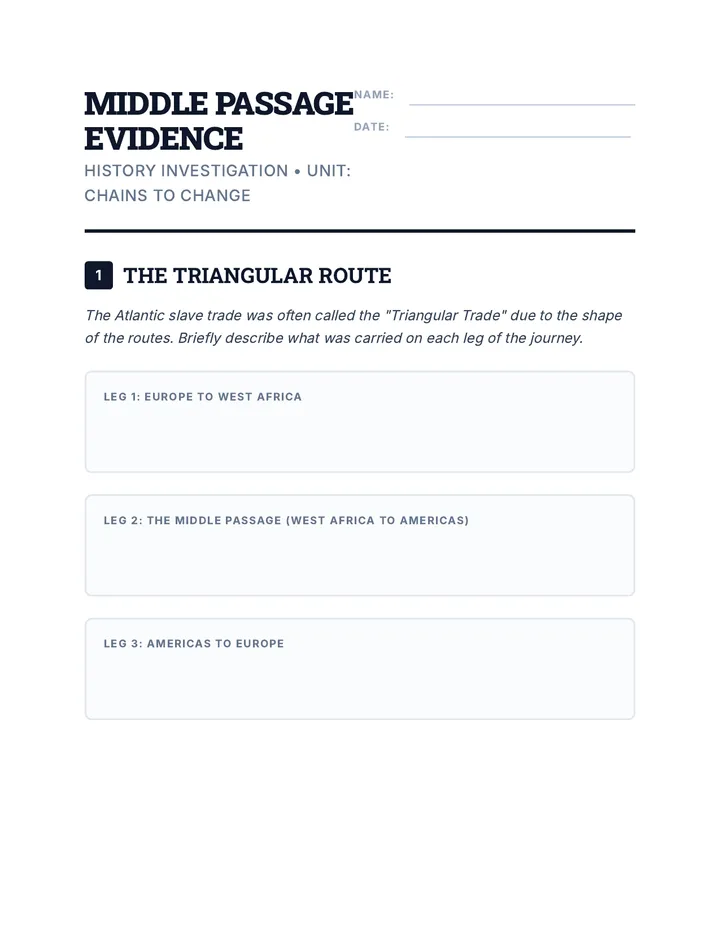
An in-depth exploration of the Jim Crow era, focusing on the legal landscape of segregation and the timeline of events leading from Reconstruction to the Civil Rights Movement.
A deep dive into Martin Luther King Jr.'s 'Letter from Birmingham Jail,' focusing on identifying his central claims, analyzing his unique point of view, and evaluating the reliability of his arguments within the historical context of the Civil Rights Movement.
Synthesizes the arguments of both leaders through comparative analysis and a summative writing assessment.
Examines W.E.B. Du Bois's critique of Washington, his emphasis on the 'Talented Tenth,' and his demand for immediate political and social equality.
Explores Booker T. Washington's philosophy of industrial education, economic self-reliance, and racial accommodation as outlined in his 1895 Atlanta Compromise speech.
Explore the origins, legends, and cultural significance of Mexican mole. This lesson covers the indigenous roots of 'mulli', the colonial legends of Puebla, and the modern recognition of mole as a global cultural heritage through a reading passage and assessment.
A review of sensation and perception modules, focusing on Gestalt principles in design and real-world scenarios.
A reading comprehension lesson focused on Italy's decision to delay coal plant shutdowns. Students analyze the intersection of global geopolitics, energy security, and environmental policy while developing academic English skills.
A comprehensive review of sensation and perception concepts, featuring scenario-based application, definition matching, and visual demonstrations of perceptual illusions.
A three-day exploration of partisan gerrymandering using the documentary 'Slay the Dragon'. Students will examine the REDMAP strategy, the Flint water crisis connection, and the grassroots activism of Katie Fahey and Voters Not Politicians.
A fast-paced investigation into the 18th Amendment, exploring how Prohibition fueled organized crime and transformed American culture before its ultimate repeal.
A lesson evaluating the democratic merits of First-Past-The-Post, Single Transferable Vote, and Proportional Representation through comparative analysis.
An introductory exploration of Albert Camus's philosophy of Absurdism through the lens of the Myth of Sisyphus, focusing on the metaphor of the eternal boulder and the human search for meaning.
A comprehensive overview of the diverse civil rights movements in the United States from the 1960s through the 1990s, highlighting key leaders, turning points, and legislative victories.
A lesson exploring the historical reality of Duncan and Macbeth compared to their fictionalized counterparts in Shakespeare's tragedy. Students will analyze a historical text to identify discrepancies in timeline, character traits, and political motivations.
A high-stakes, 60-minute project-based learning experience where students act as economic advisors. They must master both fiscal and monetary policy tools—including the Fed's interest rates, open market operations, and reserve requirements—to stabilize a national economy in crisis.