A 4th-grade grammar lesson focusing on identifying and using reflexive pronouns through a 'mirror' analogy, featuring a Khan Academy video and an interactive movement-based matching activity.
Covers the climax and resolution, final character evolution, and a cumulative synthesis of the book's message.
Focuses on synthesizing themes of resilience and fragility as the community reacts to Winslow.
Explores Nora's character, Winslow's growth, and practices summarizing key plot events from the middle of the book.
Focuses on the introduction of Winslow and Louie, establishing the setting, and initial character analysis of Louie's motivations.
Students read the final story 'Concrete Gardens' and complete a final performance task that requires summarizing, character analysis, and theme synthesis.
Students read 'The Subway Song' and practice synthesizing information by comparing the themes and settings of the stories read so far.
Students read 'The Midnight Mural' and focus on inferring character traits and providing specific text evidence to support their claims.
Students read 'The Empty Bench' and focus on building vocabulary through context clues and mastering the 'Somebody-Wanted-But-So-Then' summary framework.
Students synthesize information from multiple texts to create a comprehensive comparison and write a final evidentiary paragraph.
Students learn about hurricanes and practice organizing information into a structured paragraph with a clear topic sentence, supporting details, and a conclusion.
Students explore the science of tornadoes while focusing on identifying key details and mastering domain-specific vocabulary.
A culminating project where students apply their understanding of Melody's experience to create an Inclusion Campaign for their own school, advocating for accessibility and understanding.
Covers the Whiz Kids competition, the heartbreak of being left behind, and the eventual resolution and growth of Melody and her peers, covering chapters 23 through 33. Activities focus on summarizing complex emotional events and synthesizing the book's final themes.
Explores the pivotal moment of Melody receiving her Medi-Talker, her academic growth, and the shift in how others perceive her brilliance, covering chapters 12 through 22. Activities emphasize synthesizing new information and understanding the impact of technology on communication.
Focuses on the introduction of Melody, her internal voice, her family life, and the initial barriers she faces in school, covering chapters 1 through 11. Activities focus on summarizing her unique perspective and identifying core vocabulary related to her sensory experiences.
A final culmination of the book club unit, where students synthesize the entire novel through creative projects and thematic reflections.
The emotional climax and resolution of the story as the tiger is released and Rob finally opens his suitcase, covering chapters twenty-one through thirty.
Exploring the developing friendship between Rob and Sistine and the growing pressure of the tiger's presence, covering chapters eleven through twenty.
An introduction to the Lister Motel and Rob Horton's 'suitcase', covering the first ten chapters of the novel.
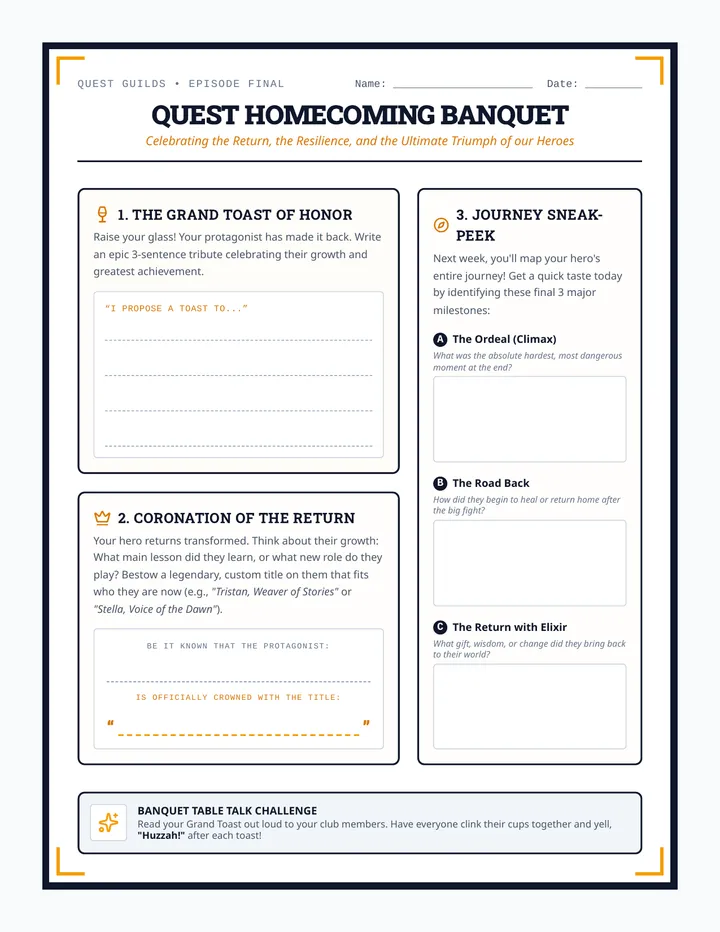
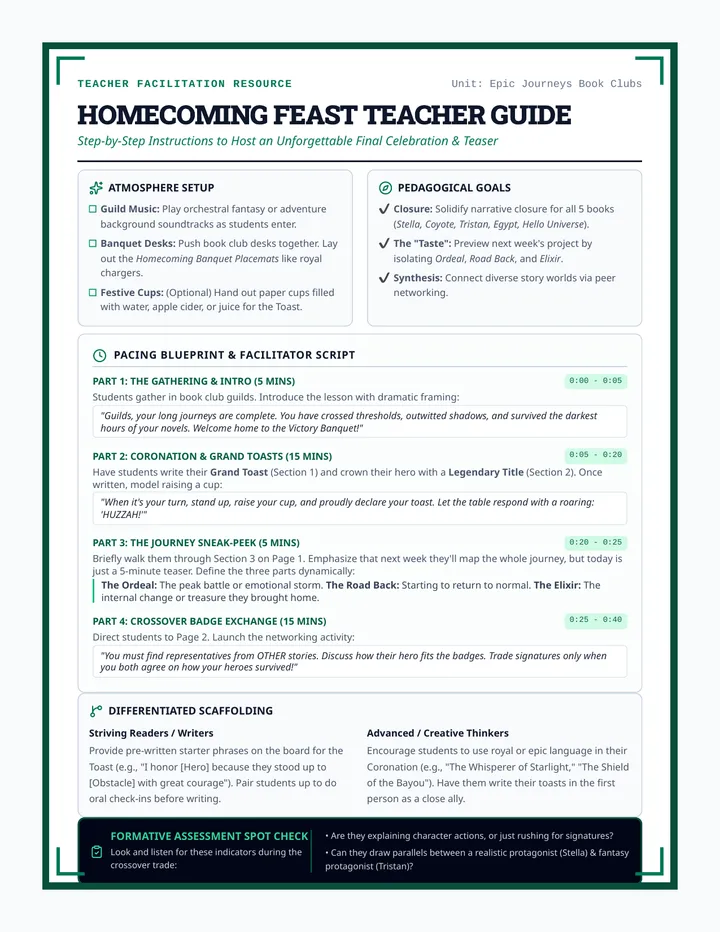
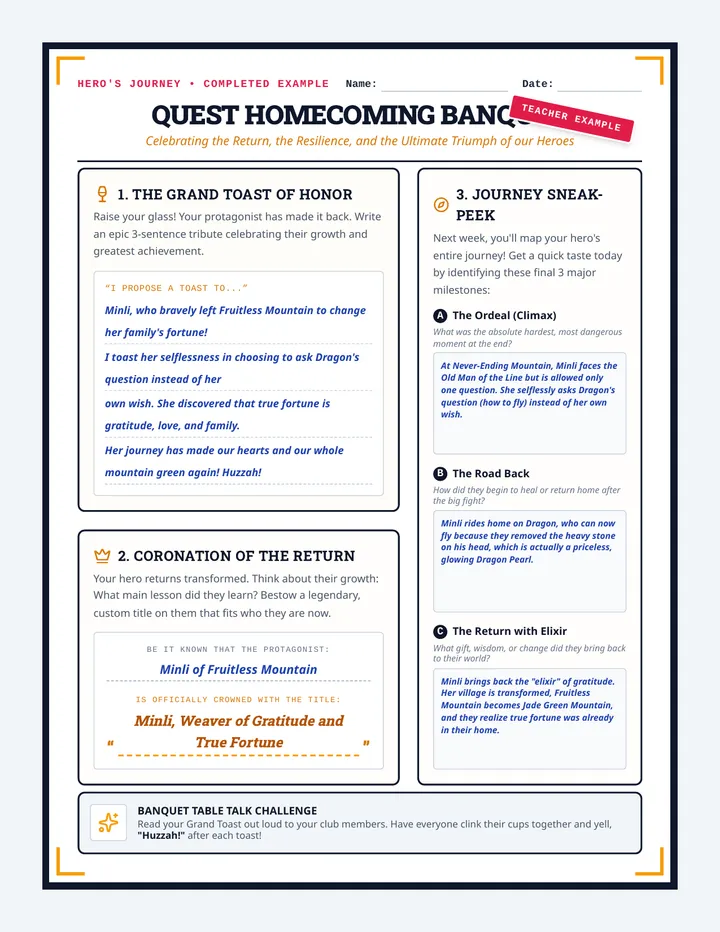
Book club celebration with discussion and a creative 'Carving' activity.
Exploring the symbolism of Sistine's name and her character growth.
Reading Chapter 30, focusing on the resolution and the sun coming out.
Reading Chapters 20-21, analyzing the encounter with the tiger and vocabulary.
Reading Chapters 10-11, focusing on the wood-carving imagery and vocabulary.
Deep dive into summarizing the entire narrative arc using a 'Story Suitcase' organizer.
Final vocabulary review with a comprehensive matching and sentence challenge.
Reading Chapters 2-3, focusing on Rob's character and the introduction of Sistine.
Introduction to the book club, building background knowledge about the setting and the tiger, and reading Chapter 1.
A comprehensive practice session for English 1 EOC revising and editing, featuring a medical-themed approach to 'curing' common writing ailments like poor sentence structure, tense issues, and punctuation errors.
This lesson prepares students for the English 1 EOC exam by analyzing a poem and an informational text about nature and ecosystems. It includes test-style questions, a short constructed response, and a collaborative speaking activity.
A collection of short stories designed for verbal story retell, featuring story grammar elements and inferencing questions. Includes stories with kids, animals, and fantasy creatures at two different complexity levels.
A comprehensive review of all spelling patterns covered in the unit, including sh, th, ch, wh, fr, ou, ea, and gh. Students will demonstrate mastery through identification and application activities.
Students investigate spelling patterns for the vowel digraphs 'ou' and 'ea', and the consonant pattern 'gh' (both as /f/ and silent/hard 'g').
A focused study on 4th-grade spelling words featuring common digraphs (sh, th, ch, wh) and the consonant blend 'fr'. Students will identify, sort, and use these words in context.
A comprehensive lesson on narrative sentence variation focusing on varied beginnings, sentence combining, length modulation, and descriptive clauses. Students move from identifying monotone rhythms to crafting dynamic, flowing prose.
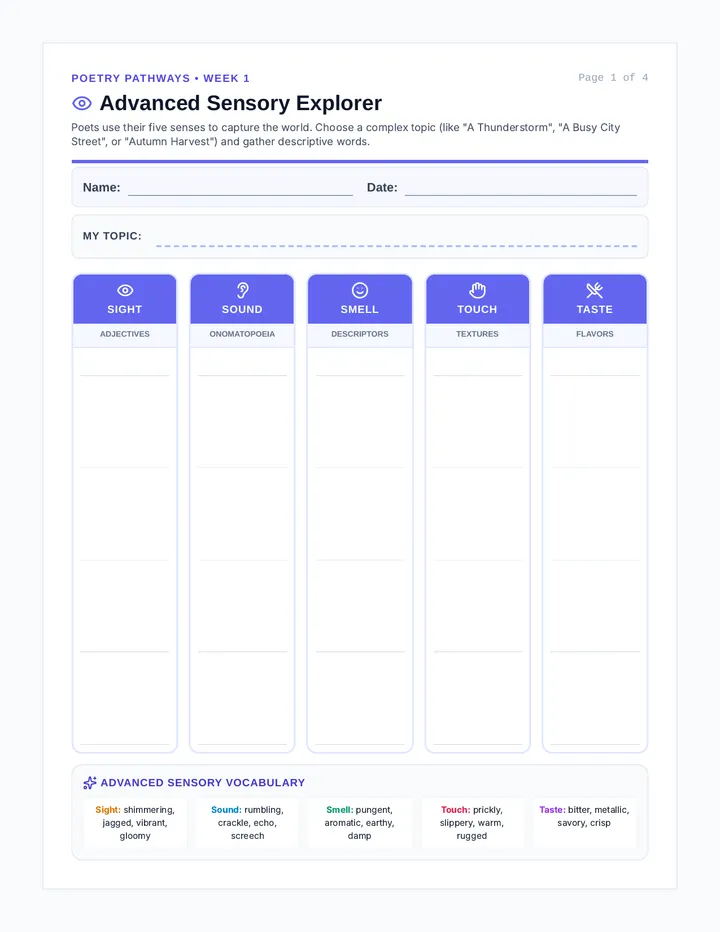
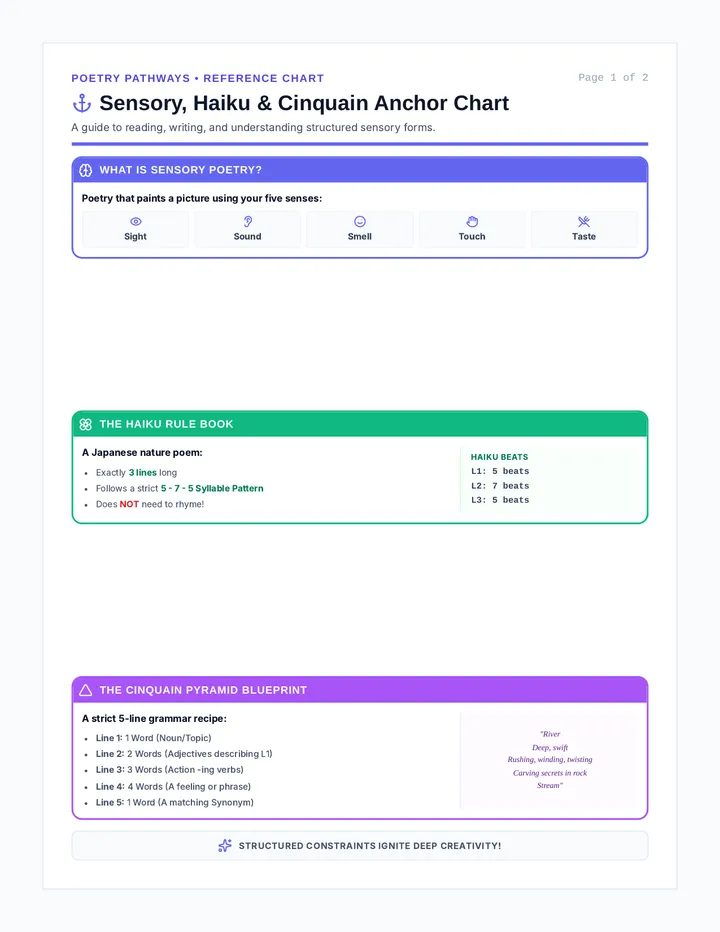
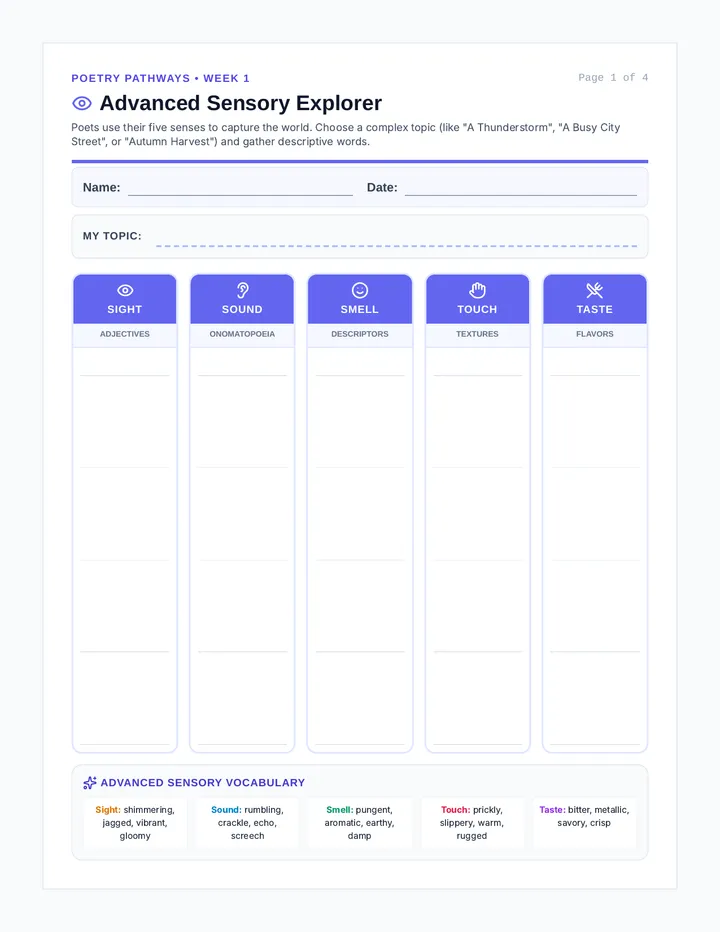
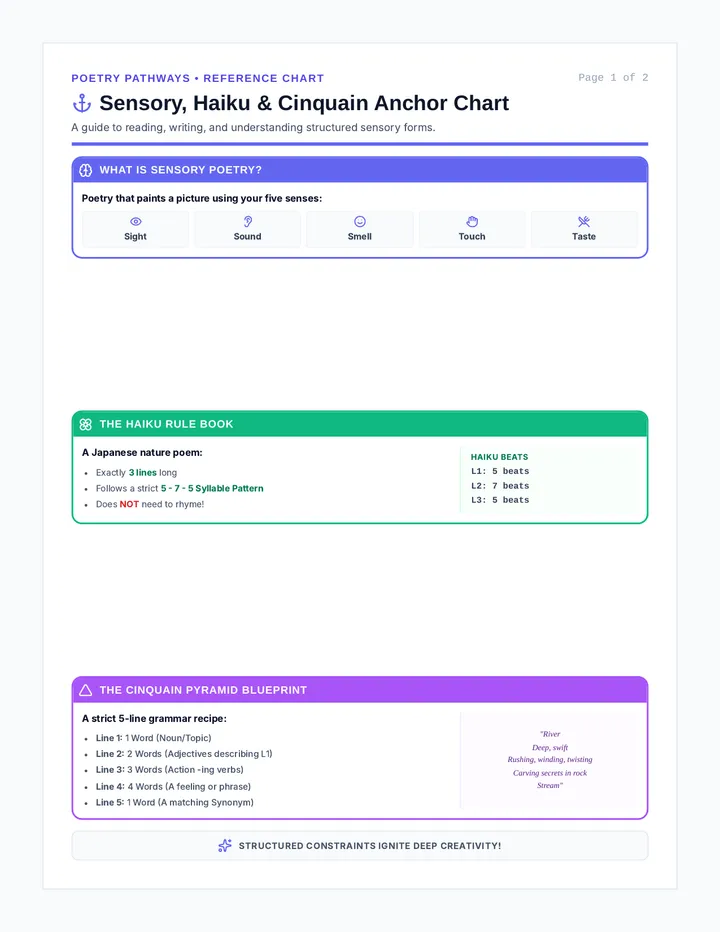
A comprehensive lesson designed to help students master the use of the five senses in their narrative writing, moving from simple descriptions to immersive storytelling.
A series of three ELA homework assignments based on the story 'Oakley’s Azure Acorn,' focusing on phonics, vocabulary, comprehension, and grammar.
Synthesizing the relationship between point of view and plot. Students use their annotations to respond to a short constructed response prompt about how the omniscient perspective impacts the selection's development.
Diving deeper into figurative language including metaphors, personification, and situational irony. Students finish the story and evaluate the symbolic significance of the 'open window' and 'heart trouble'.
Introduction to 3rd person omniscient point of view and sensory imagery. Students begin reading the text and analyze how Chopin uses the setting outside the open window to reflect Louise Mallard's internal shift.
A 20-minute mini-lesson introducing students to the basic structure of a simple sentence, focusing on identifying the subject (who or what) and the predicate (what is happening).
A comprehensive set of materials for a high school Open House, including a presentation and a parent/guardian support handout for the Reading and Learning Center English class.
A lesson focused on decoding and dividing multisyllabic words with closed syllables through a hands-on cut-and-paste activity.