A multi-year performance analysis of Grade 3 MCAS Mathematics data from 2023-2025. It identifies strong procedural fluency in multiplication/division and significant conceptual hurdles in Fractions and Geometry.
A comprehensive review of 3rd-grade fraction standards (3.NF.A.1, 3.NF.A.2, 3.NF.A.3), covering unit fractions, number lines, and equivalency.
A 4th-grade math lesson using the Building Thinking Classrooms (BTC) framework to teach plotting mixed numbers on a number line within a botanist-themed greenhouse setting.
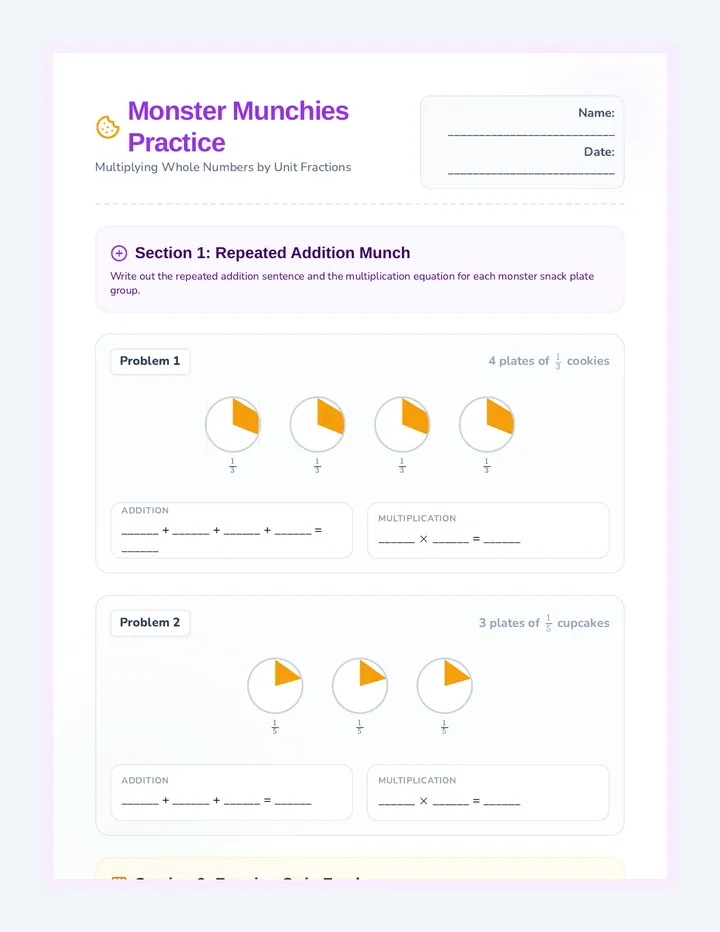
A collection of six high-energy rotation activities covering 3rd-grade Arizona math standards for fractions (NF.1, NF.2, and NF.3). Students engage with partitioning, number lines, equivalence, and comparison through worksheets, task cards, and hands-on sorting.
A high-energy math center rotation based on fraction standards NF.1, NF.2, and NF.3, themed around a car racing championship. Students navigate through color-coded 'Speed Zones' to practice equivalence, number lines, and comparison.
A comprehensive 90-minute lesson on transforming linear equations into slope-intercept form ($y = mx + b$), designed for Algebra I students and easy delivery by non-math teachers. Includes visual slides, a detailed facilitator guide, and extensive practice with error analysis.
A comprehensive 90-minute review of graphing linear inequalities (TEKS A.3D) designed for non-math teachers to facilitate. Students will practice identifying line types, shading regions, and graphing by hand without technology.
A lesson focused on interpreting line plots and performing subtraction with fractional data points, themed around a backyard nature study.
A focused 15-minute measurement practice focusing on real-world word problems involving time, mass, volume, and distance. Students apply the four operations to solve logistics-themed measurement challenges.
A core lesson introducing the concept of 'Friends of 10' through interactive slides and a variety of quick, 10-minute manipulative-based games.
A fast-paced, collaborative lesson where students use a pizza parlor theme to master comparing fractions with either the same numerator or the same denominator. Students will visualize 'slices' to understand why a larger denominator actually means smaller pieces.