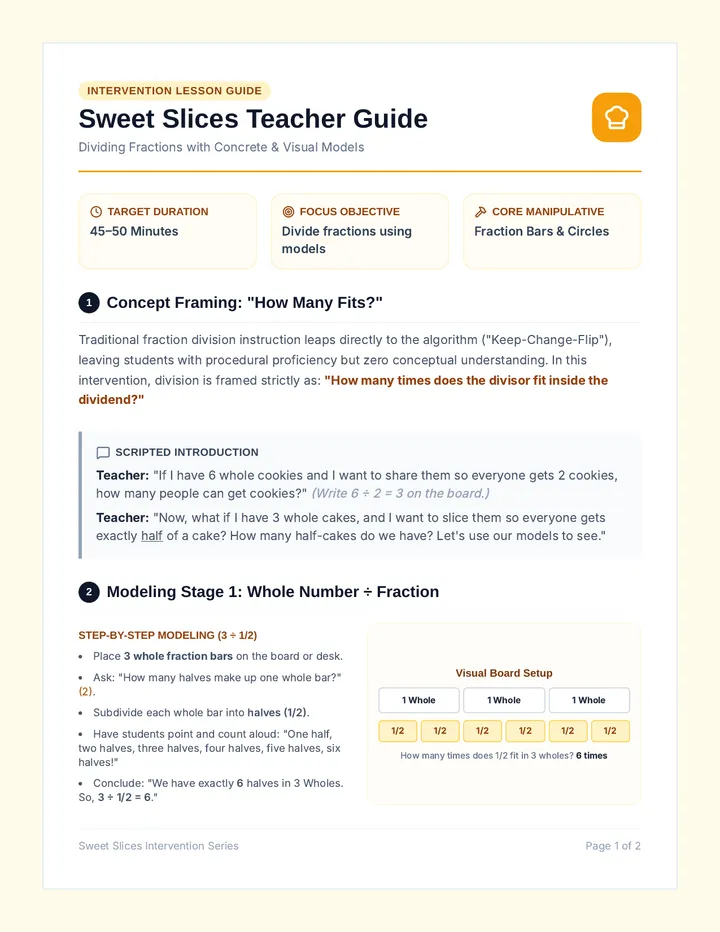
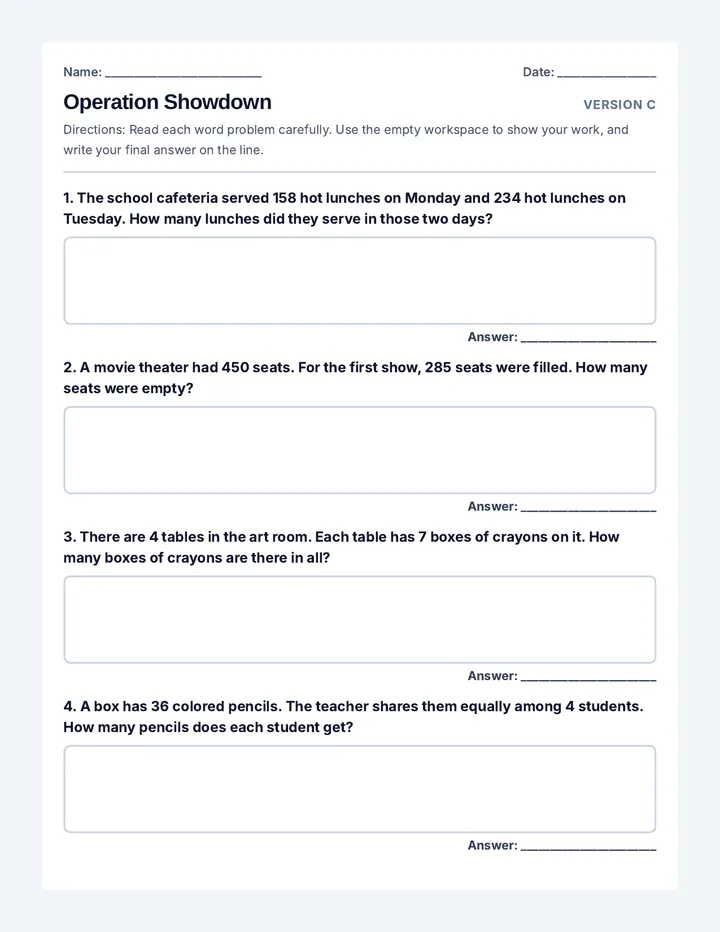
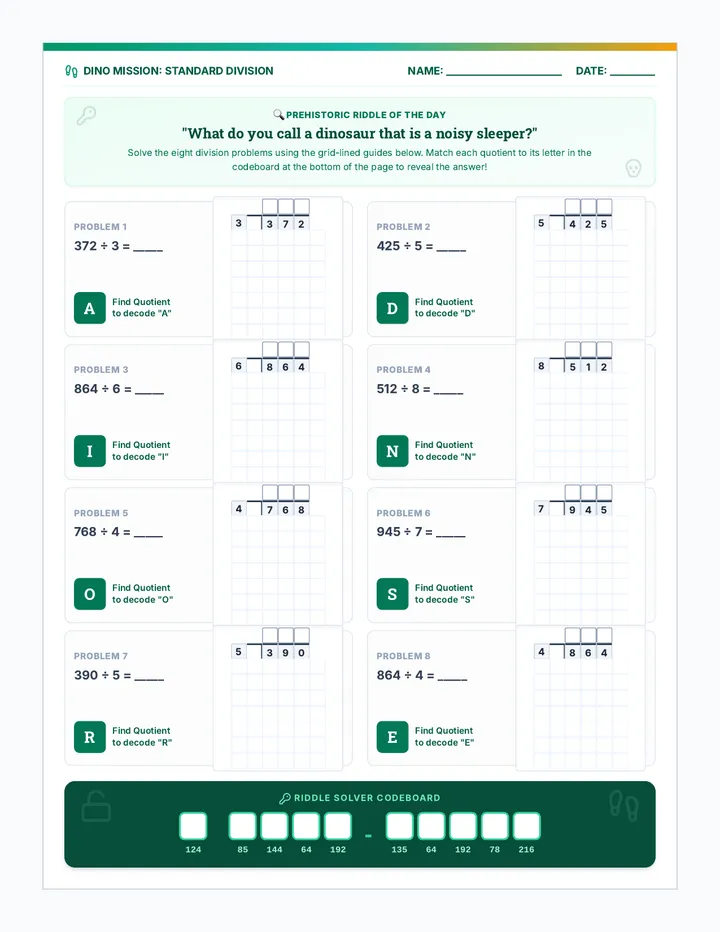
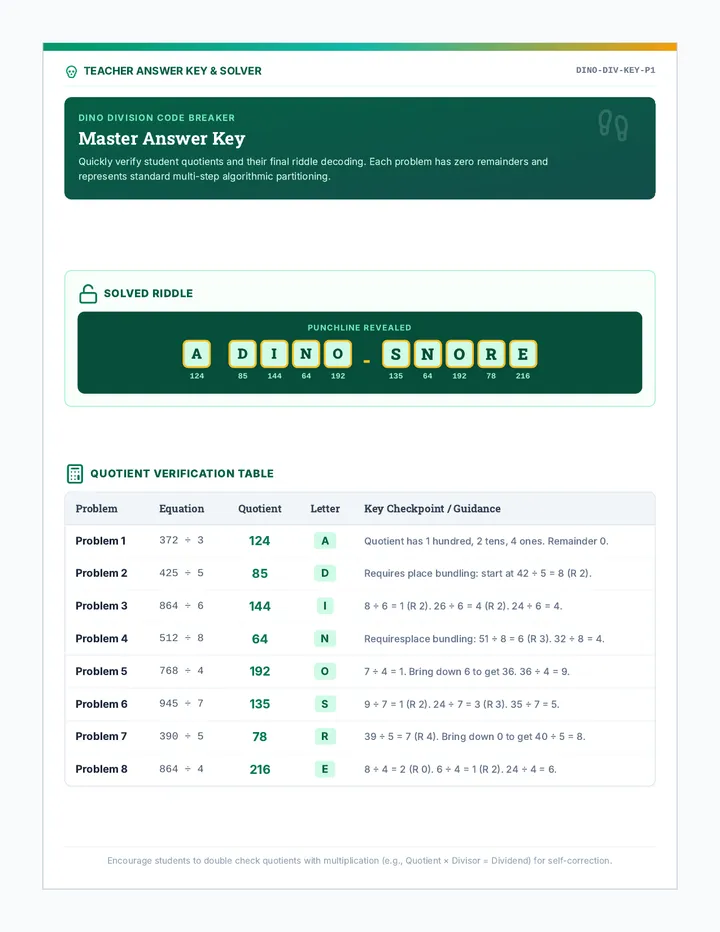
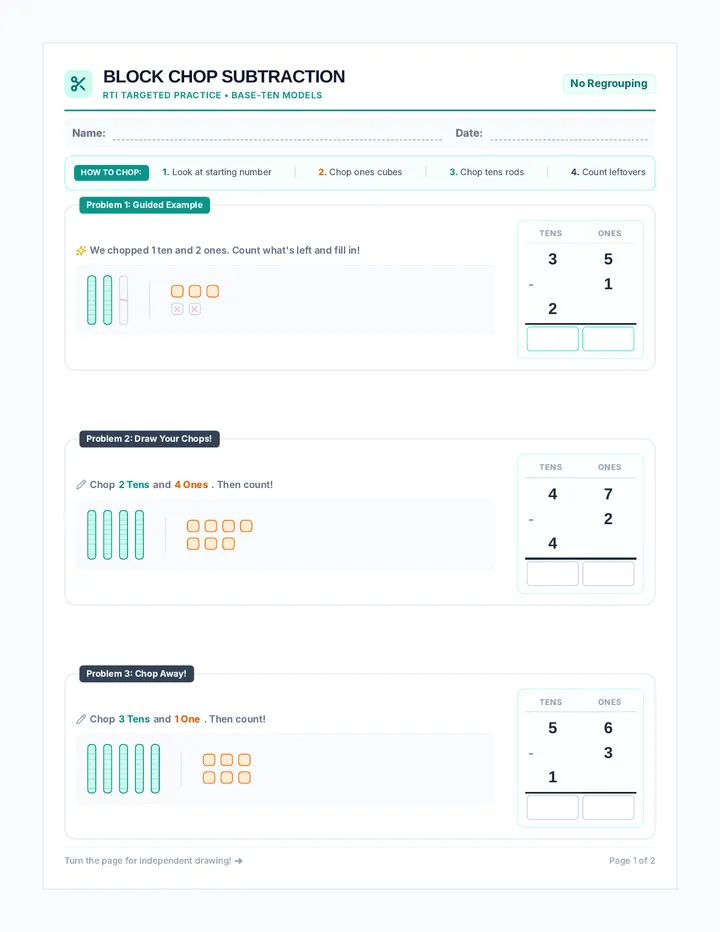
An introductory lesson on division focusing on equal sharing. Students learn the definition of division and practice identifying division situations from word problems.
A collection of five high-impact posters illustrating key multiplication strategies using a consistent example to facilitate conceptual understanding.
A comprehensive lesson on multiplying fractions by whole numbers using visual area models, aligned with CCSS 4.NF.B.4. Students will explore how multiplication is repeated addition of fractional parts and use 'blueprints' to build their understanding.
A practice-focused lesson on partitioning shapes and number lines to represent fractions, with a specific focus on understanding the roles of the numerator and denominator.
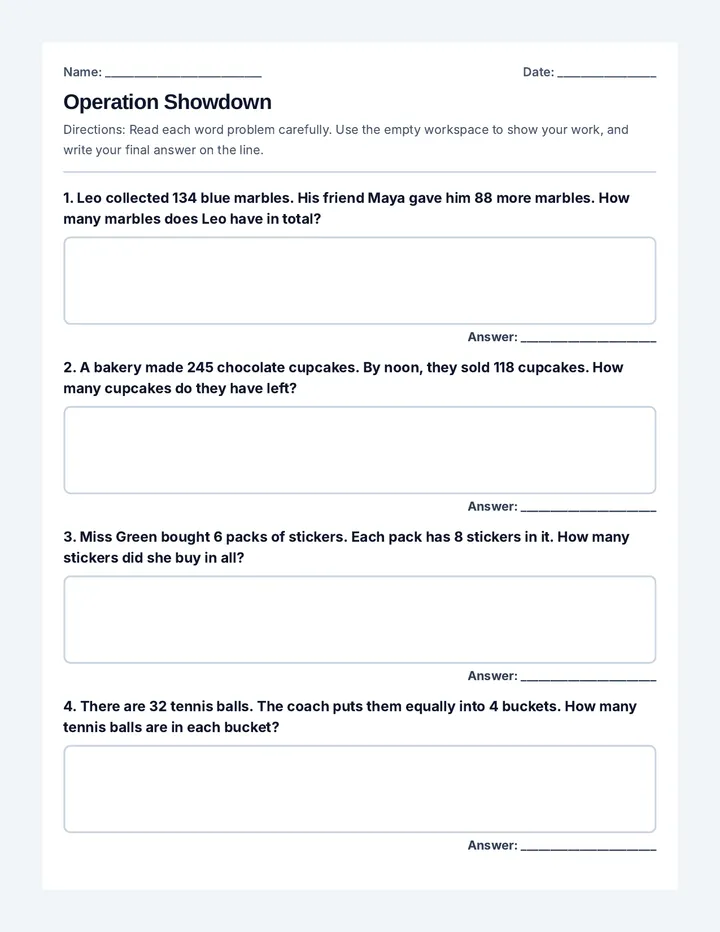
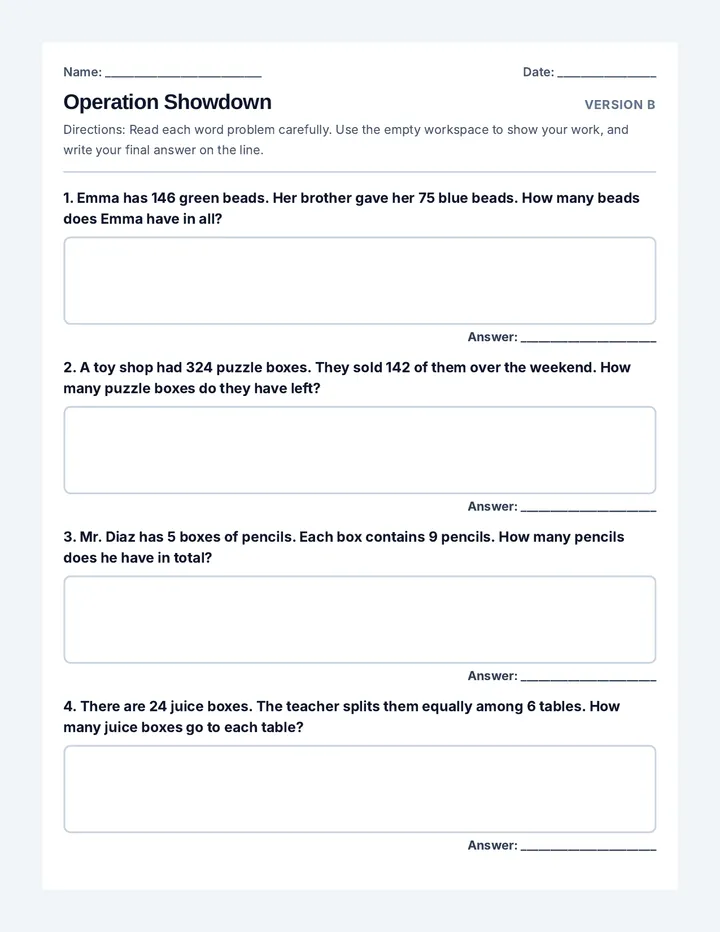
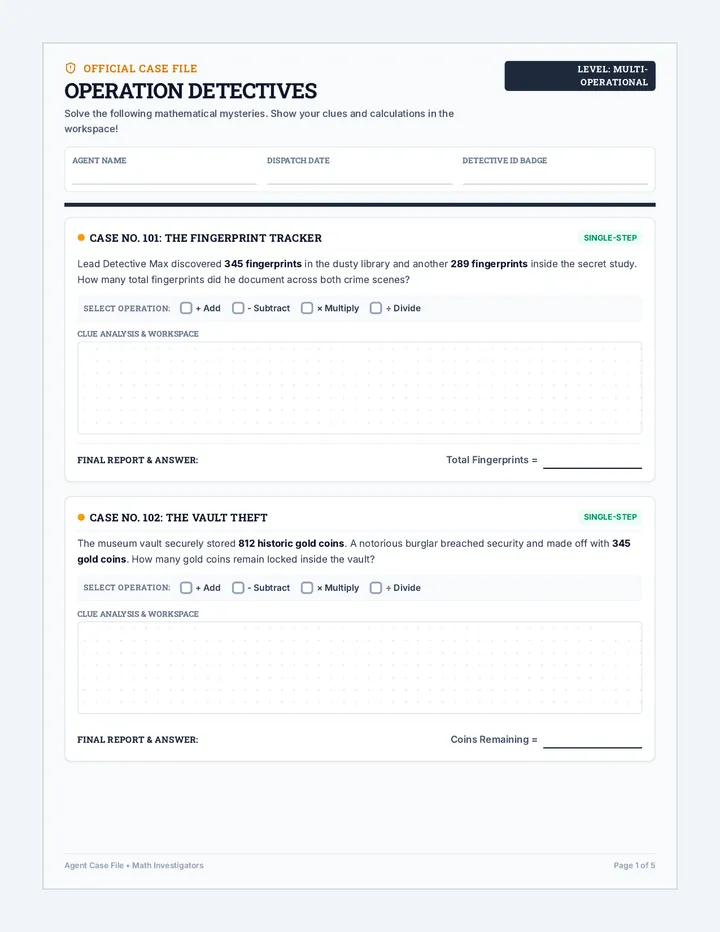
Students solve multi-digit word problems involving addition, subtraction, multiplication, and division, all centered around spring-themed activities like gardening, migration, and the weather.
A comprehensive introduction to functions, focusing on the definition of a function, the vertical line test, and mastering function notation \(f(x)\). Students will learn to identify functions from various representations and evaluate linear and quadratic functions.
Students solve word problems involving multi-digit multiplication, addition, subtraction, and division, all centered around the ecology and exploration of coral reefs.
In this lesson, students explore the mathematical relationships within the coral reef ecosystem, focusing on multiplication and division fact families through engaging word problems.
Students participate in a hands-on 'Candy Lab' to collect, organize, and interpret data using frequency tables and line plots. They identify patterns, outliers, and distributions in their candy sets.
A post-assessment celebration lesson designed to help students transition from the stress of a math test to a positive, growth-oriented mindset by creating personalized 'Math Hero' trophies.
An introduction to random variables, distinguishing between discrete and continuous types, graphing probability distributions, and calculating mean and standard deviation.
A math lesson focused on double-digit multiplication using the standard US algorithm, featuring an engineering blueprint theme.
A focused lesson on mastering the standard algorithm for multiplying two-digit by two-digit numbers, emphasizing column alignment and regrouping.
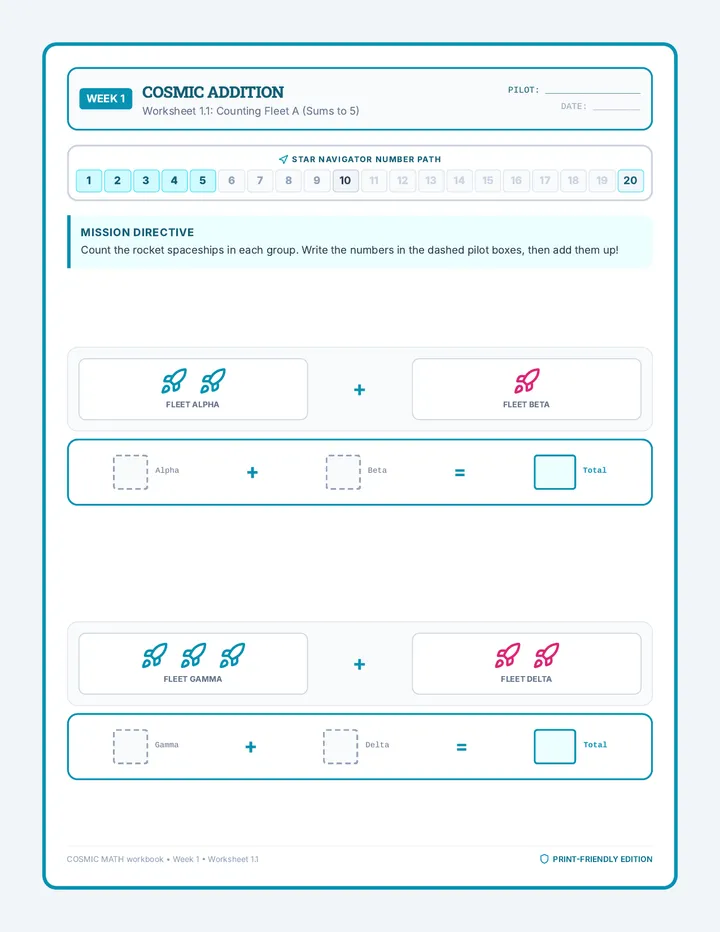
A fun, food-themed lesson focused on solving simple addition word problems by combining two amounts within 10. Students will use drawing and equations to represent and solve the problems.
A hands-on exploration of patterns in nature, art, and the environment. Students move beyond simple repetition to discover growing patterns and symmetry using loose parts and detective-style observation.
A lesson on reading digital clocks to the hour and half-hour through interactive matching activities.
An introductory lesson on the distributive property using whole numbers, featuring a 'Number Ninja' theme to help students visualize splitting and sharing numbers to simplify multiplication.
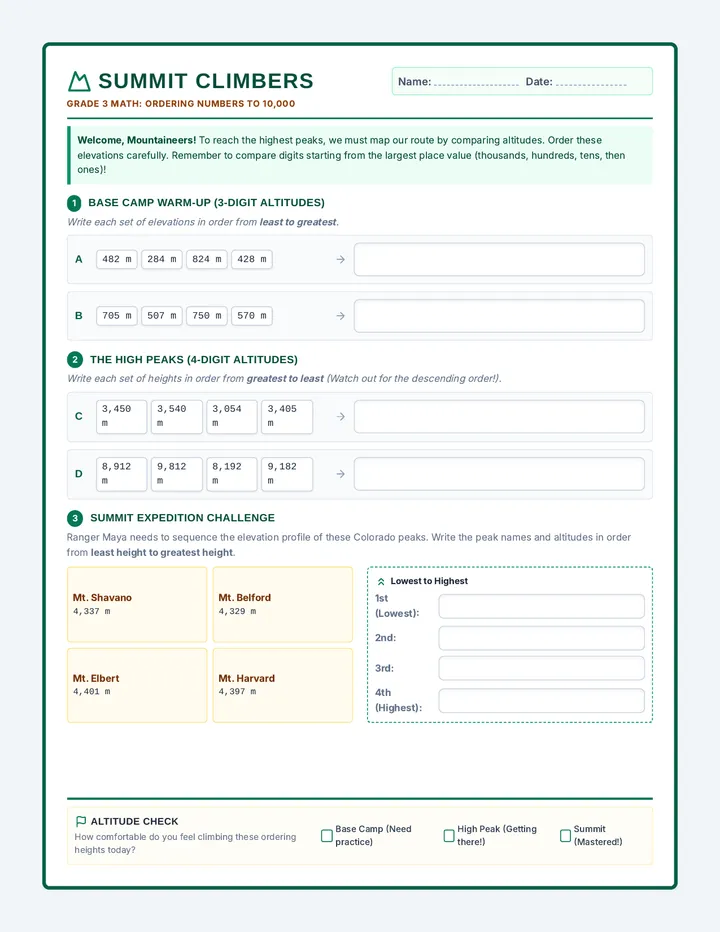
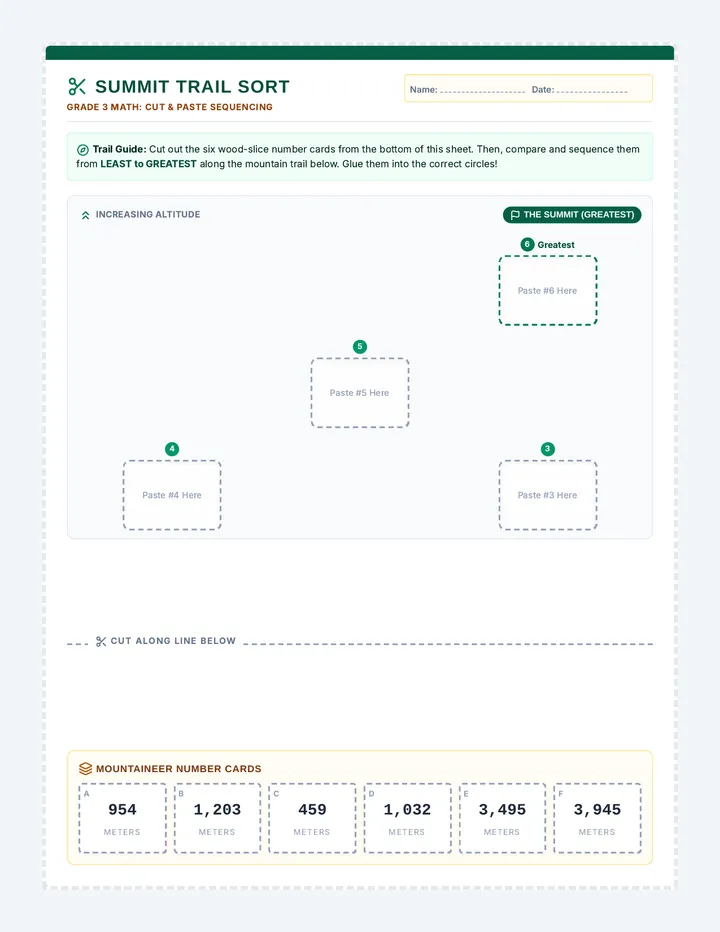
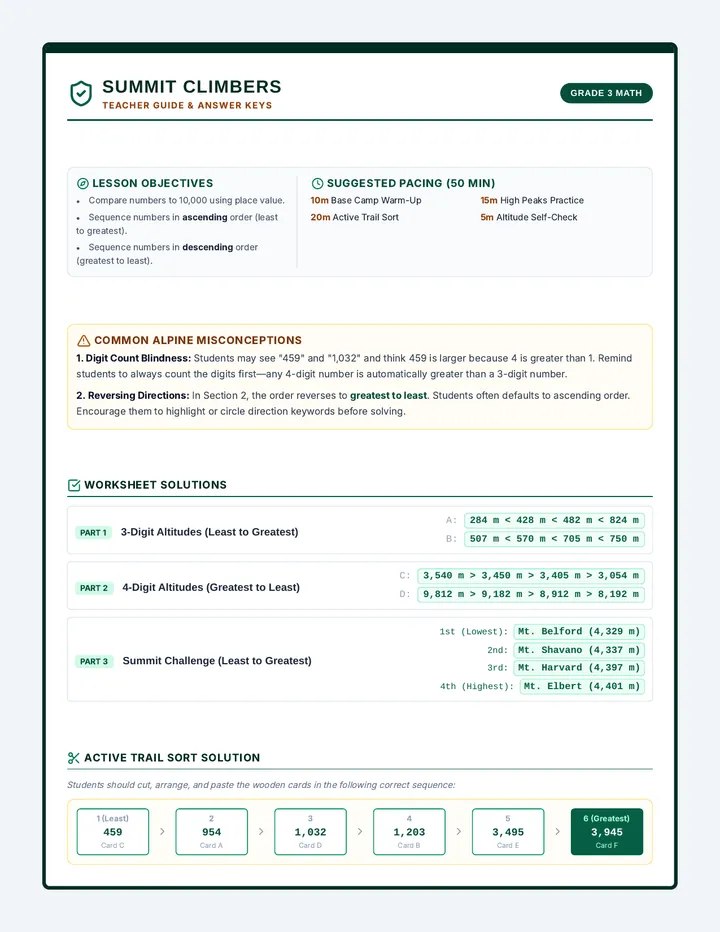
Conquering four-digit numbers up to 10,000, focusing on place value logic for large-scale comparisons.
Expanding to three-digit numbers up to 1,000, introducing expanded form and more complex comparison strategies.
Mastering numbers up to 100 with a focus on tens and ones, using visual models to compare magnitude.
A lesson focused on reading digital time in various fonts and styles, covering every hour and half-hour. Students practice identifying digits across different typefaces to build fluency in reading digital displays.
Réinvestir les connaissances à travers des défis mathématiques et des jeux pour consolider la maîtrise des fractions décimales.
Évaluer les acquis des élèves et proposer des activités de remédiation ciblées pour ceux qui rencontrent des difficultés.
Placer des fractions décimales sur une droite graduée, les comparer et comprendre les équivalences simples.
Comprendre la subdivision des dixièmes en centièmes à l'aide d'un quadrillage unité. Visualiser le rapport entre 1, 1/10 et 1/100.
Découvrir la notion de dixième à partir du partage d'une unité de longueur. Passer de la fraction simple à la fraction décimale.