An introductory exploration of cybersecurity fundamentals for middle and high school students, covering the CIA triad, common threats, and defensive strategies through hands-on projects and conceptual mapping.
This lesson explores the complex business ecosystem of the Super Bowl, focusing on advertising costs, consumer behavior, brand strategy, and economic impact. Students will analyze how the biggest sporting event in the U.S. functions as a multi-billion dollar marketing machine.
A comprehensive introduction to the fundamental behaviors of sound and light waves, focusing on key phenomena like reflection, refraction, and interference.
A comprehensive 45-minute lesson exploring the mechanics of earthquakes, tectonic plate movements, and the build-up of seismic energy. Students engage in a hands-on simulation to visualize how stress and friction lead to sudden crustal shifts.
Students explore the intersection of physical electronics and digital audio by building interactive sound installations. They will learn about conductivity, circuit logic, and basic programming to transform everyday objects into musical instruments.
This lesson explores how natural selection drives population changes and evaluates the evidence for common ancestry. It features a hands-on jigsaw activity and STAAR-aligned practice questions to master TEKS 7C.
Students become geological detectives to investigate how rocks change over time through heat, pressure, and erosion, culminating in a mystery-solving identification challenge.
A comprehensive review lesson on the digestive system and enzyme function, focusing on the path of food, mechanical vs. chemical digestion, and enzyme specificity through interactive activities and guided notes.
A 30-minute PLC session designed to analyze Grade 5 and 8 MCAS Science results, identifying cross-curricular opportunities for improvement through data-driven discussion and actionable teaching strategies.
A movement-based scavenger hunt where students solve 'planetary mysteries' covering Earth's spheres, internal layers, and the rock cycle. This lesson includes task cards and a structured recording sheet for 6th grade science review.
A lesson focusing on the quantitative analysis of energy flow and matter cycling within ecosystems, emphasizing the 10% rule, productivity, and human impact.
This lesson explores how living and nonliving components interact within an ecosystem, focusing on energy flow and population dynamics.
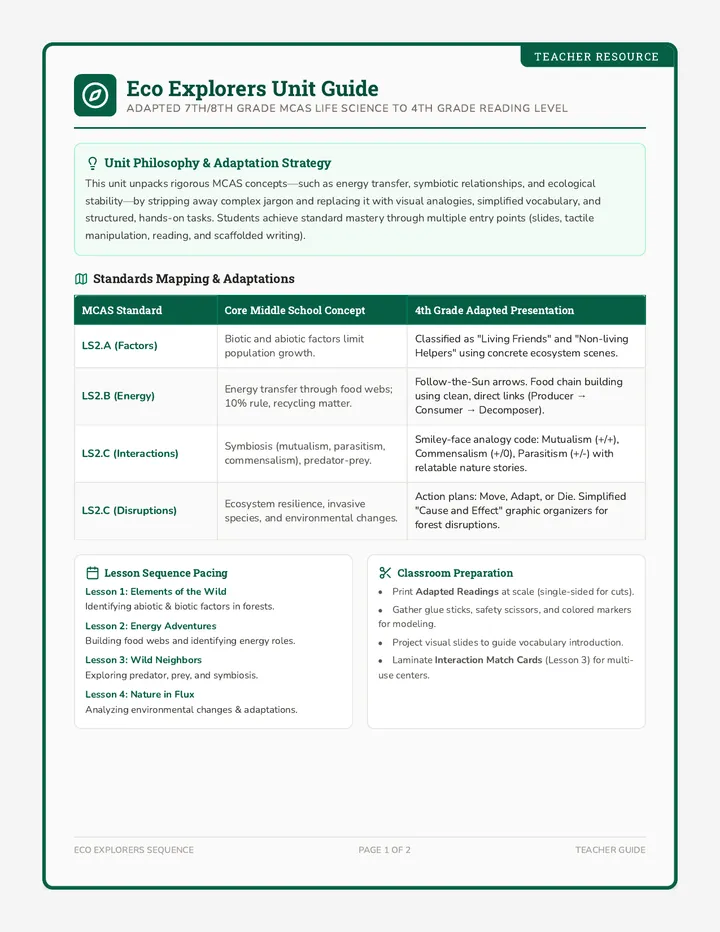
A foundational introduction to ecosystems, biomes, and the roles living things play in their environments. Students explore biotic and abiotic factors and the simple energy paths within food chains and webs.
A 45-minute introductory lesson on macroinvertebrates and their role as bioindicators, preparing students for a leaf pack study. Students will learn key ecosystem vocabulary and identification techniques across grades 5-9.
An ecology-themed mystery where students analyze plant biology, photosynthesis rates, and soil chemistry to find who sabotaged the lab's carbon-offset project.
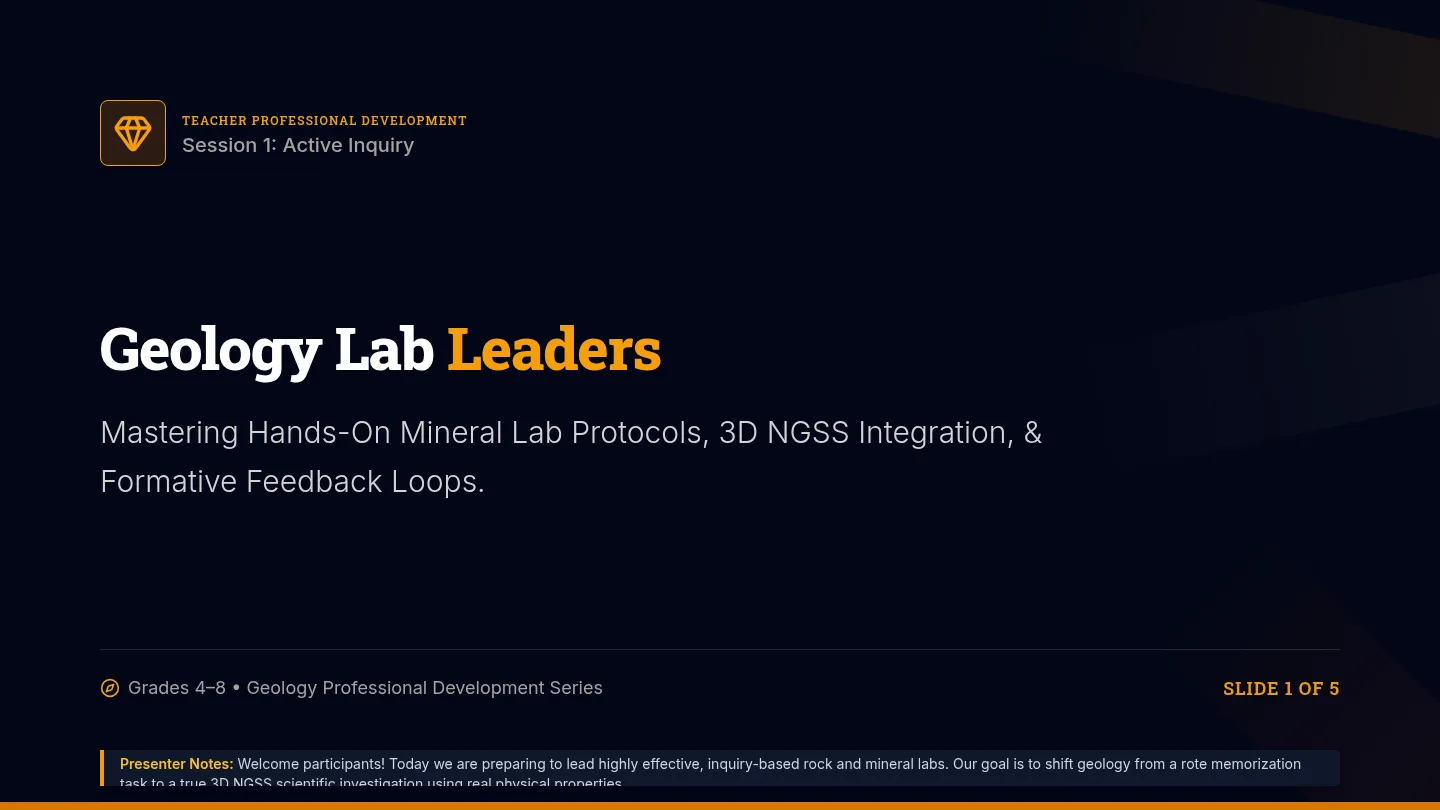
A geology-themed mystery where students analyze mineral properties like hardness, luster, and density to find out who stole a rare lunar meteor sample.
A chemistry-themed mystery where students analyze flame tests, atomic mass, and chemical reactivity to find out who stole a sample of a rare heavy metal.
A physics-themed mystery where students analyze electrical circuits, resistance, and conductivity to find out who short-circuited the lab's main power grid.
A microbiology-themed mystery where students analyze bacterial traits, Gram stains, and antibiotic resistance to find who contaminated a bio-engineered enzyme.
A fast-paced science mystery where students use 8 scientific clues to identify who sabotaged a high-stakes experiment. Students analyze pH, density, chromatography, and more to eliminate suspects.
A series of visual anchor charts designed for reference during laboratory investigations into plant vascular systems, photosynthesis, and transpiration.
A high-energy, movement-based review activity where students solve 'medical cases' by identifying body systems and their functions. This lesson includes task cards for a classroom scavenger hunt and a structured recording sheet for students.
A two-block exploration of animal systems, focusing on homeostasis, nutrient absorption, reproduction, and defense mechanisms.
A two-block investigation into plant tissue systems, vascular transport, reproductive adaptations, and environmental responses.
A lesson exploring the symbiotic relationship between humans and gut bacteria, focusing on the gut-brain connection and the impact of nutrition on mood. Students create metaphors for their microbiome and identify ways to support beneficial bacteria.
Students analyze the relationship between chemical structure, mode of delivery, and addiction potential using the 'Speed of Delivery' concept. The lesson features a comparative analysis of substances like heroin vs. morphine and vaping vs. nicotine patches to understand the biological 'why' behind addiction.
This lesson connects behavioral symptoms of schizoaffective disorder to neurotransmitter imbalances and explores the pharmacological mechanisms of antipsychotics and mood stabilizers through research and diagramming.
A middle school science lesson exploring neuroplasticity through medical recovery case studies. Students investigate how the brain 'reroutes' neural pathways after injury using adaptation and recovery strategies.
A 6th-8th grade science and health lesson exploring neuroplasticity through a hands-on yarn simulation and a video-based discussion. Students learn how neural pathways strengthen through use and dissolve through neglect.
This lesson explores the dual approach to treating the five major anxiety disorders, focusing on the physiological mechanisms of medications (SSRIs, Benzos, Beta-blockers) and the cognitive-behavioral shifts of psychotherapy. Students will analyze the 'tandem' treatment model to understand why biological and psychological interventions are often used together for optimal patient outcomes.
Students investigate the intersection of neurobiology and external substances, analyzing how drugs and hormones alter neurotransmitter function to change a person's perception of reality.
A comprehensive biology lesson for 9th-10th grade students exploring the biological feedback loops between the endocrine and nervous systems during stress, focusing on the role of corticosteroids, the amygdala, and the prefrontal cortex in memory.
Bilan des acquis à travers une évaluation sommative permettant de vérifier la compréhension de l'énoncé du principe d'inertie et sa mise en œuvre dans des situations variées.
Application du principe d'inertie et de sa réciproque pour prédire ou expliquer le mouvement d'objets du quotidien. Consolidation via des exercices de synthèse.
Utilisation d'un simulateur numérique pour explorer l'effet de forces compensées ou non sur le mouvement d'un système. Introduction de la notion de forces qui se compensent.
Introduction historique au principe d'inertie à travers l'opposition entre Aristote et Galilée/Newton. Les élèves découvrent que le mouvement ne nécessite pas forcément une force pour être maintenu.
A lesson for 7th-8th grade science focusing on the biological and genetic foundations of autism. Students debunk common myths, analyze brain development through video, and research how the brain interacts with other body systems in co-occurring conditions.
A high-level genetics lesson exploring how environmental factors like maternal care and stress trigger epigenetic modifications that influence gene expression across generations. Students analyze the classic Meaney rat study to understand the molecular mechanisms beyond DNA sequences.
A high school psychology lesson exploring the physiological impact of chronic stress on brain structures like the amygdala, hippocampus, and prefrontal cortex, featuring a video analysis and case study application.
A high school biology lesson exploring the endocrine system's stress response via the HPA axis, the physiological role of cortisol, and the impact of chronic stress on brain structure and homeostasis. Students analyze feedback loops and the brain's neuroplasticity through video analysis and diagramming.
A comprehensive lesson exploring the evolution of hunting from ancient survival to modern conservation, including economic impacts and ethical debates surrounding biodiversity.
Explore how plants and other organisms capture solar energy to build life-sustaining sugars while comparing the process to cellular respiration.
A lesson exploring the characteristics, classification, and social behavior of prehistoric Sabertooth cats.
This lesson explores the technical differences between Class A and Class B fire alarm circuits, focusing on wiring topology, fault tolerance, and industry standards like NFPA 72. Students will analyze diagrams and compare the reliability and cost-effectiveness of each system configuration.
Focuses on reading security logs, understanding time formats (24h vs 12h), and using logic to follow a suspect's movement through keycard data.
Focuses on descriptive language, memory reliability, and the 'mugshot' process. Students learn to describe suspects and identify inconsistencies in witness stories.
A simplified murder mystery investigation. Students use a detective dossier with B1-level text to solve the crime of Professor Thorne. Includes sentence frames for final accusations.