Break down the compound interest formula to understand how changing variables like frequency (n) and rate (r) affect the structural meaning of the expression.
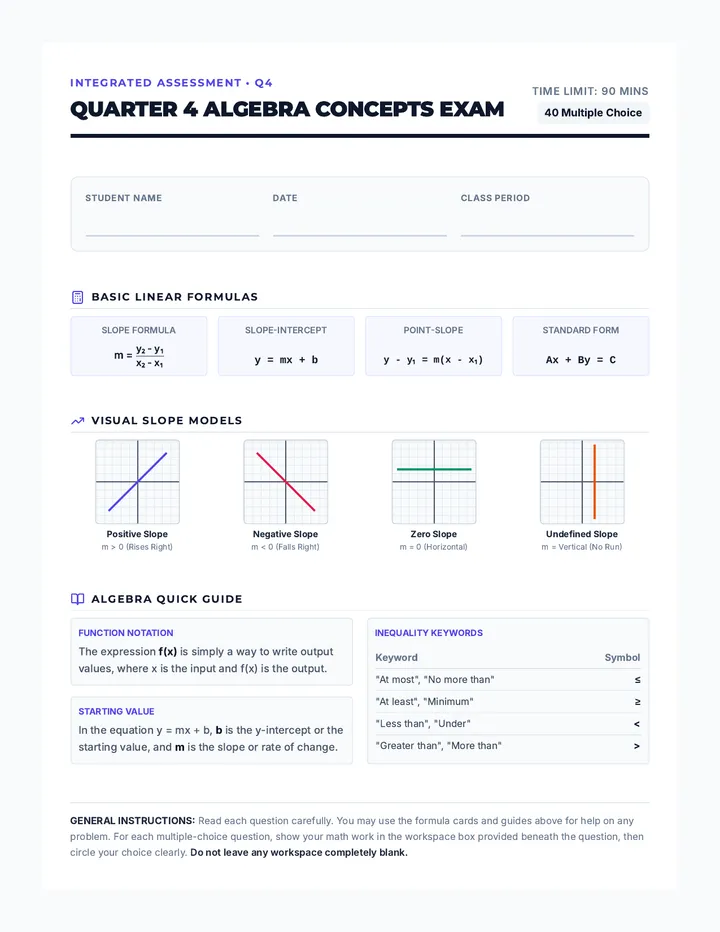
A lesson focused on the geometric and algebraic relationships of parallel and perpendicular lines, teaching students how to identify slopes and write new equations using a technical blueprint aesthetic.
Une évaluation complète sur les équations et inéquations du premier degré pour les élèves de seconde professionnelle, incluant les exercices de base et des problèmes contextualisés.
Leçon focalisée sur les bases des statistiques à une variable : du recueil de données brutes à leur analyse graphique, avec un focus sur l'utilisation de LibreOffice Calc.
Une leçon complète sur les statistiques à une variable, couvrant la collecte de données, l'organisation en tableaux et la représentation graphique à travers divers exercices pratiques et activités d'introduction.

A comprehensive lesson covering geometric transformations (translations, reflections, rotations, and dilations) and the fundamentals of geometric proofs, including logical reasoning and triangle congruence.

A comprehensive review of exponential and logarithmic functions, focusing on graphing attributes, transformations, inverse relationships, solving equations, and data modeling based on Texas Algebra 2 standards.
A quick assessment focusing on solving quadratic equations that result in complex solutions using the Quadratic Formula and Completing the Square.
A lesson focusing on the practical application of the Distance Formula and the logical structure of SAS and ASA congruence proofs.
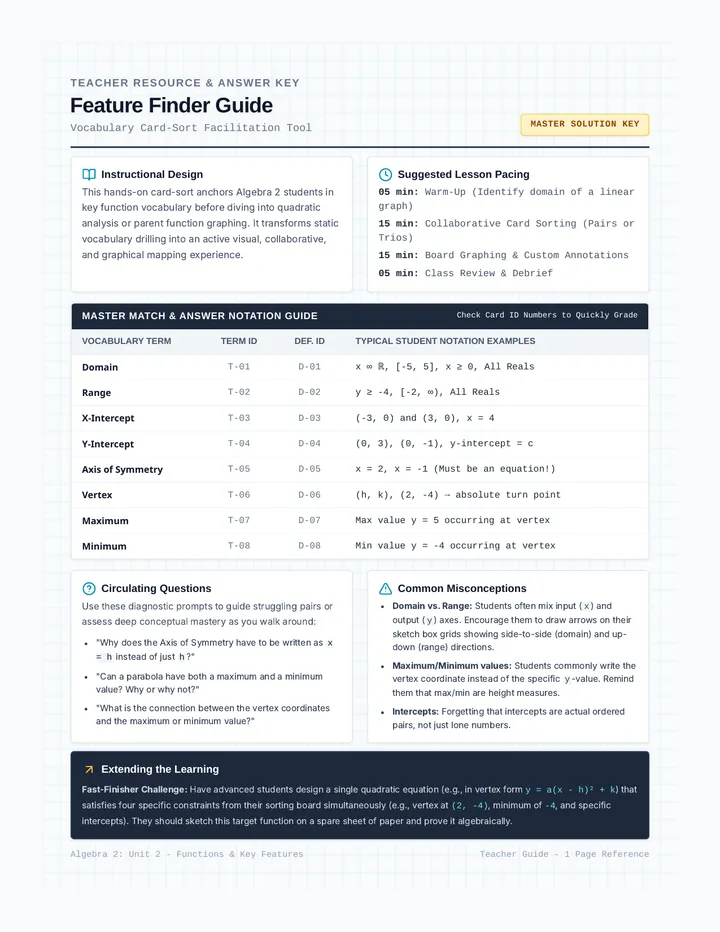
A comprehensive 35-minute lesson on graphing quadratic functions in standard form, covering vertex, axis of symmetry, end behavior, and zeros.
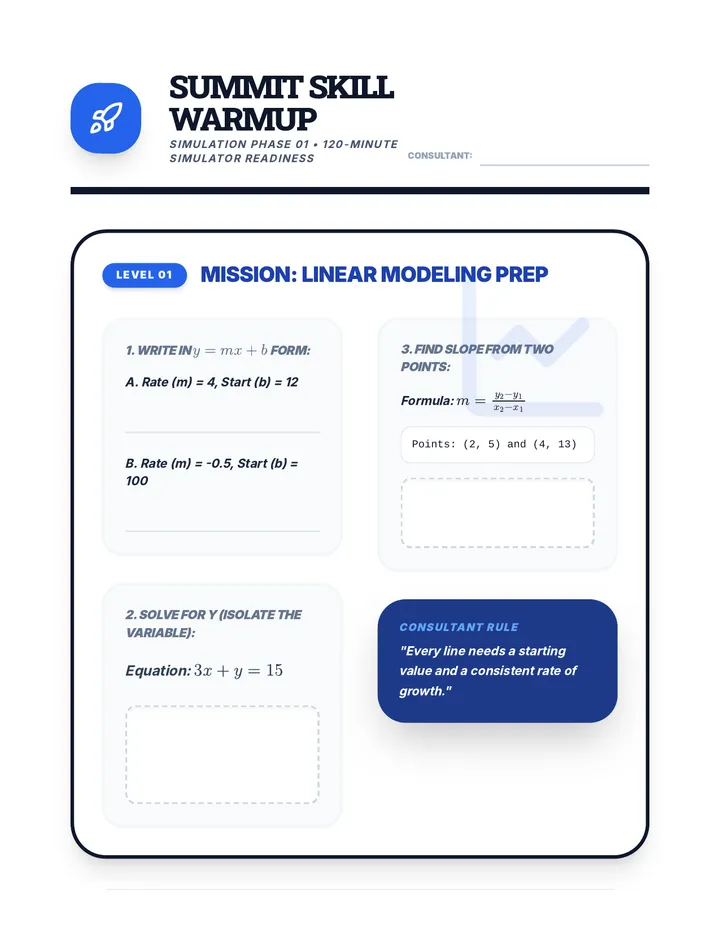
Review and assessment of literal equation mastery through multi-step problems.
A stations-based exploration of physics formulas like force, velocity, and Ohm's law.
Applying formula manipulation to geometric formulas for area, perimeter, and volume.
Introduction to literal equations by connecting the logic of solving standard equations to rearranging variables.