A high school Pre-Calculus lesson that synthesizes vectors and complex numbers, highlighting their structural similarities in the coordinate and complex planes.
A modified geometry lesson focused exclusively on translations, featuring visual aids, simplified language, and scaffolded practice for high school students.
A high-energy, Valentine's-themed 'Price is Right' game designed to last up to 120 minutes, covering item pricing, logic, and estimation.
A 45-minute investigation into the world of data manipulation, covering misleading graphs, correlation vs. causation, and source credibility.
A quick, functional introduction to interpreting bar and pie charts using real-world life skills scenarios like budgeting and time management.
A collection of 10 distinct data analysis work samples featuring bar and circle graphs, designed for MCAS Alt portfolio evidence. Each sample focuses on identifying key information, making comparisons, and calculating totals.
A comprehensive ACT Math preparation module focusing on core concepts, time management strategies, and targeted practice across all test categories.

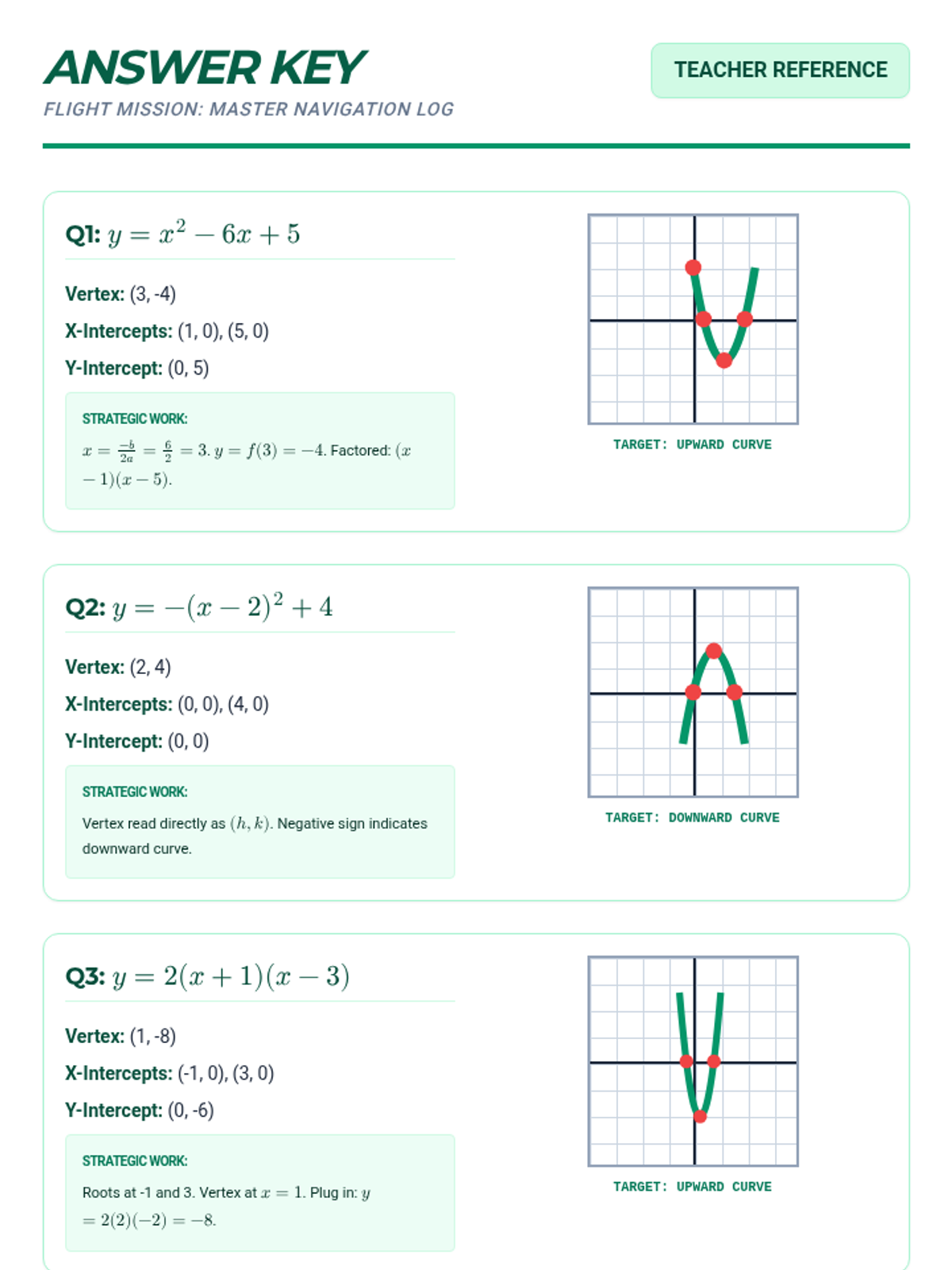
A lesson focused on solving quadratic equations using various factoring techniques, from basic trinomials to complex cases with leading coefficients greater than one.
A comprehensive Algebra 2 lesson on adding polynomials, aligned with TEKS 2A.7(B). Students will learn to combine like terms using both horizontal and vertical methods within an architectural blueprint theme.
A comprehensive lesson on graphing Sine and Cosine functions, featuring guided notes, instructional slides, and a detailed answer key. Students will learn to identify amplitude, period, midline, and phase shifts to accurately sketch periodic graphs.
A comprehensive introduction to parent functions and their transformations, designed for Algebraic Reasoning students to master shifts, stretches, and reflections.

A lesson designed to help English learners practice TELPAS speaking skills while comparing the solutions and characteristics of quadratic functions.
A lesson designed to help English Learners master the academic English required for reading and writing about linear equations, specifically aligned with TELPAS standards.
A lesson introducing factoring polynomials specifically through the method of grouping four-term expressions, designed for Algebra 2 students focusing on low to medium complexity.
A lesson focused on finding the real and complex zeros of polynomial functions using various algebraic methods like factoring and synthetic division.
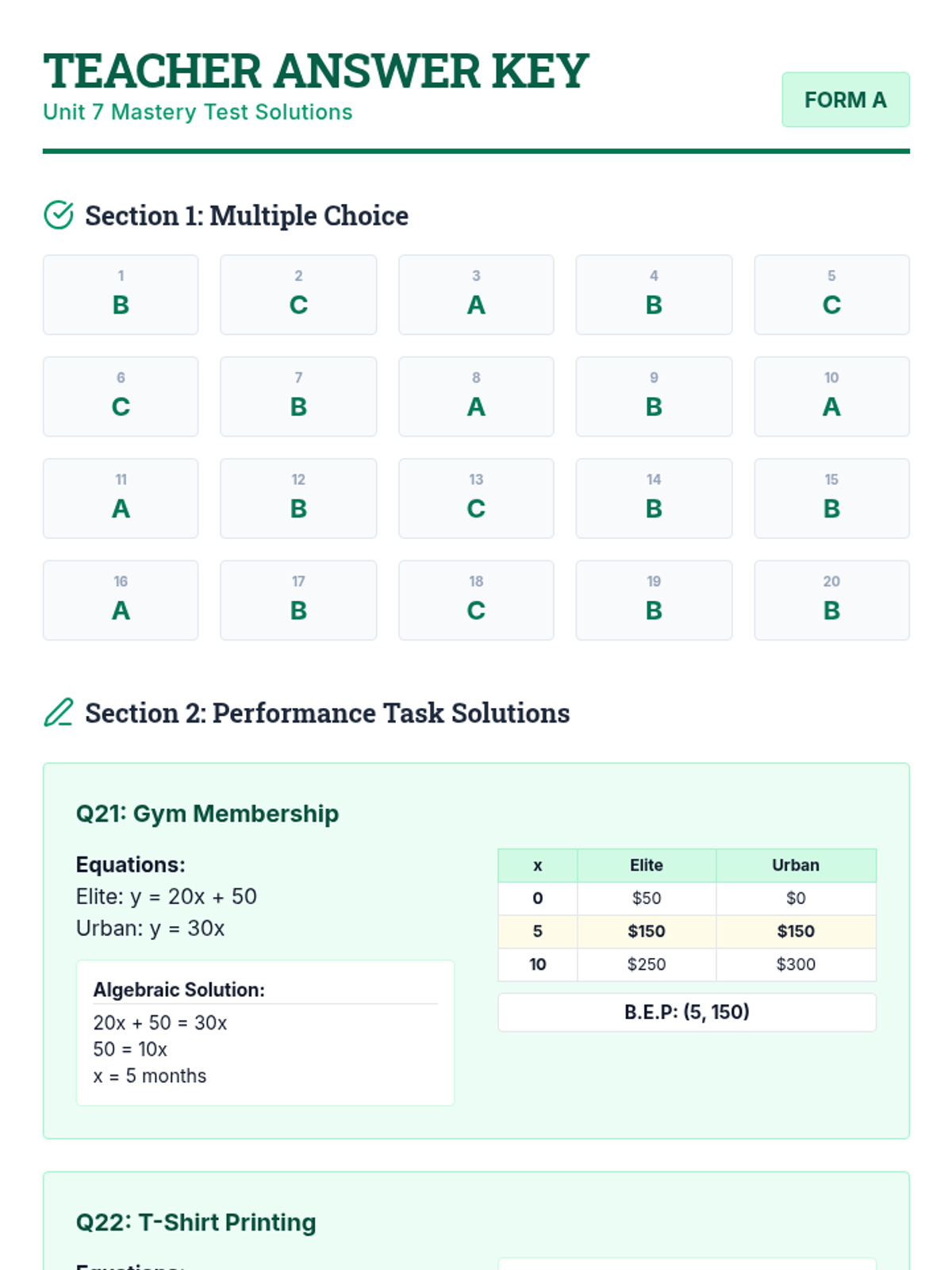
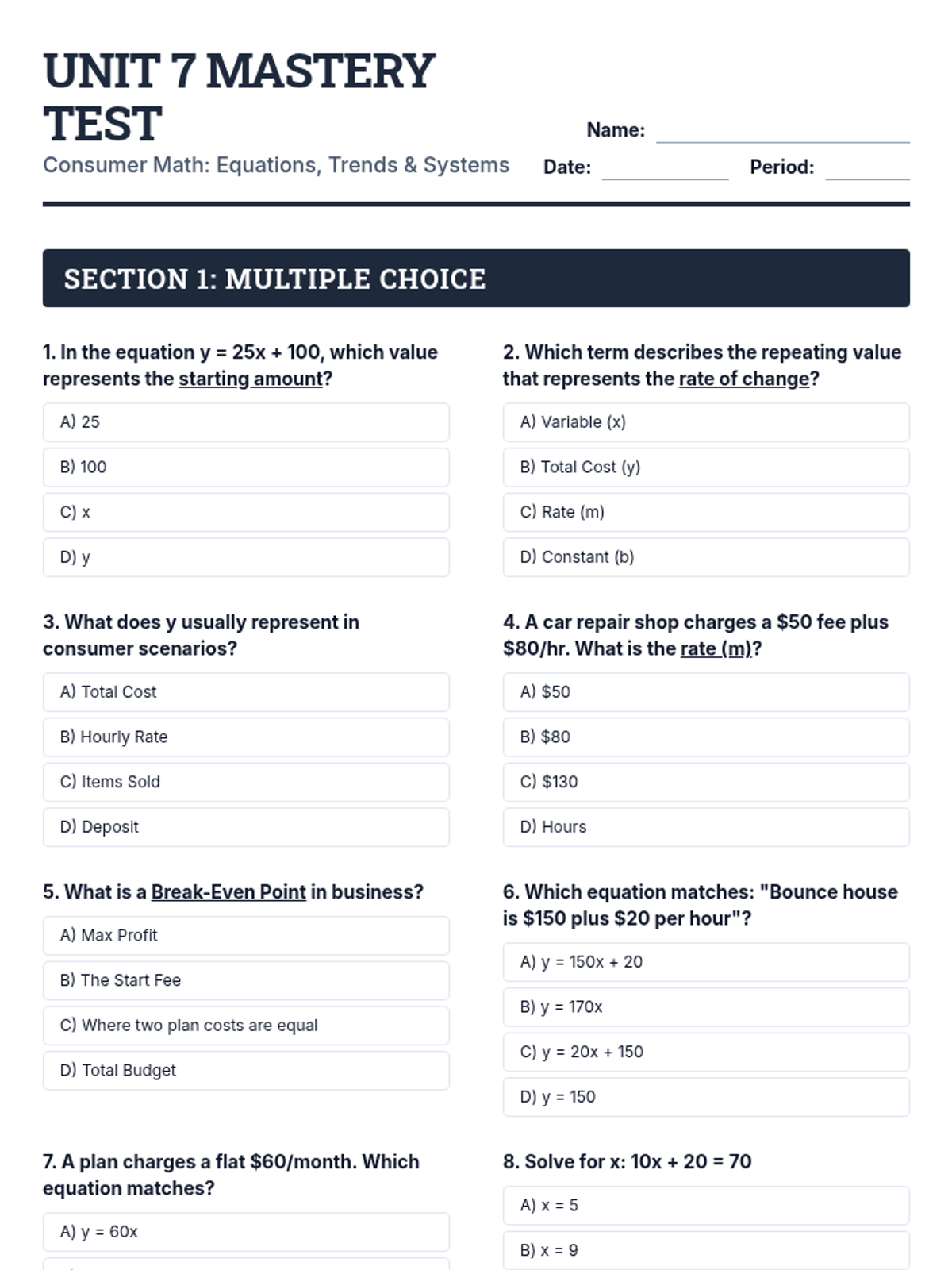
A comprehensive 20-question practice test and answer key designed to prepare students for the TSIA2 Mathematics assessment, focusing on algebraic, geometric, and statistical reasoning.
A cross-curricular lesson combining 8th-grade math and civics. Students use 2020 Census data to calculate representation ratios in the House of Representatives, identifying mathematical disparities in voting power across different states.
A high school statistics lesson focused on identifying and creating biased polls to understand sampling error and selection bias in political contexts.
A high school statistics and math lesson that uses data from the War on Drugs to explore disproportionate impact, ratio disparities, and data visualization. Students calculate and visualize significant statistical gaps in drug-related arrests, sentencing, and global incarceration rates.
Students will learn to solve systems of linear equations by finding the equilibrium point between supply and demand curves. This lesson bridges algebra and economics through graphical and algebraic methods using the 'FrostBite' game console context.
Students apply ratios and percentages to analyze electoral fairness. They will learn to identify 'packing' and 'cracking' strategies and calculate a simplified efficiency gap to mathematically prove gerrymandering in a hypothetical state.
A math and statistics lesson where students interpret campaign spending data from a Crash Course video, visualize the scale of billions, and create comparative graphs against consumer spending habits.
This lesson explores the application of fractional exponents and roots in the context of Kepler's Third Law, using orbital mechanics to solve for distance and time. Students watch a guided video on geosynchronous satellites and then work in pairs to solve orbital equations.
Students investigate the mathematical 'paradox' of gravity, learning how to manipulate literal equations and isolate variables in a physics context. By deriving the formula for gravitational acceleration, students see the power of algebraic cancellation before substituting numerical values.