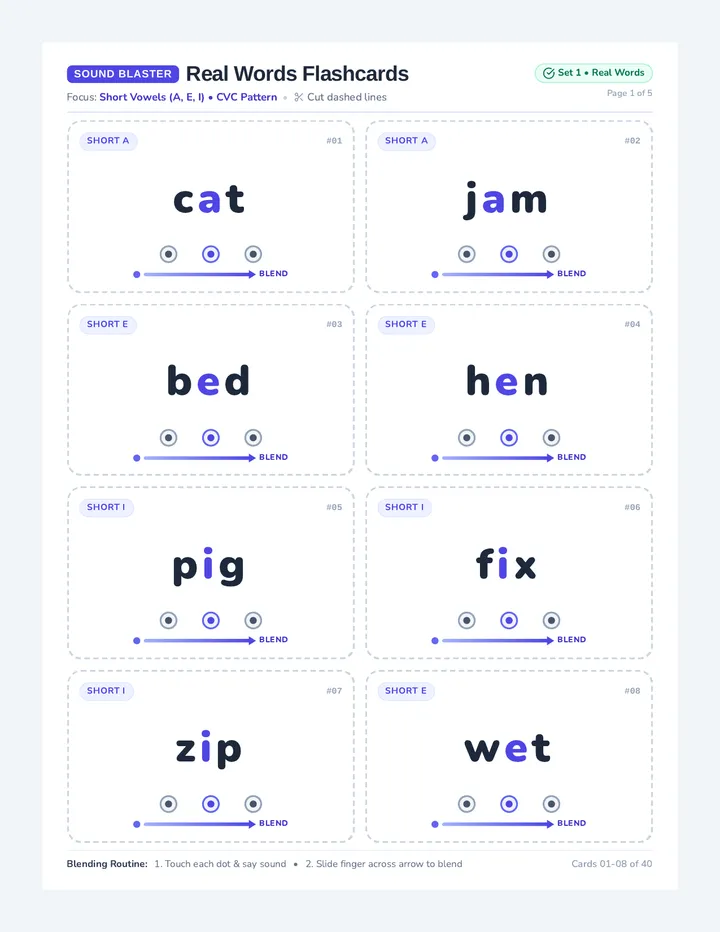
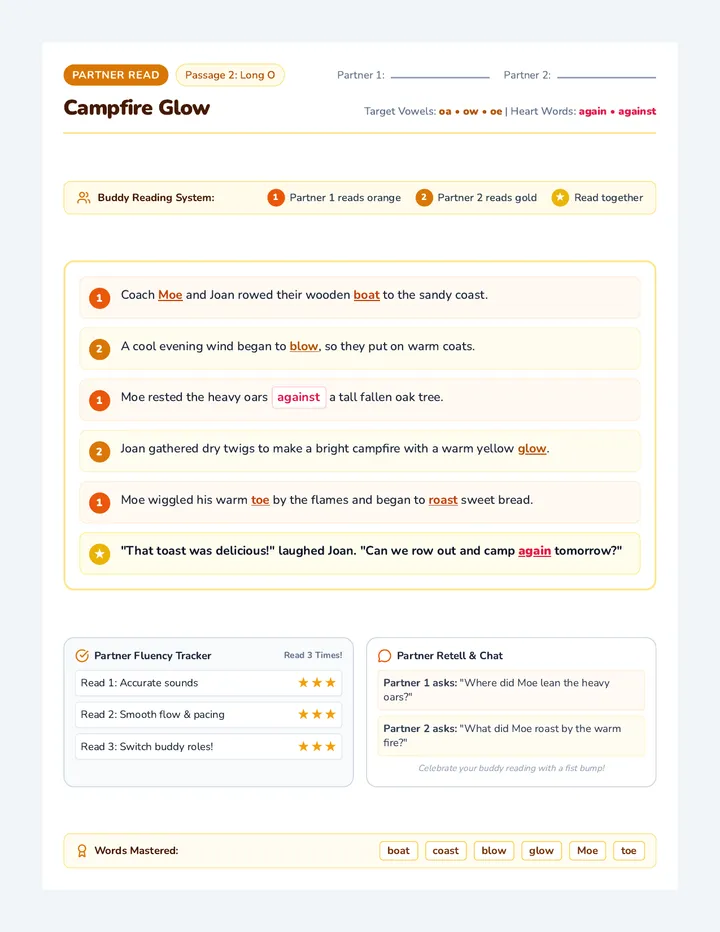
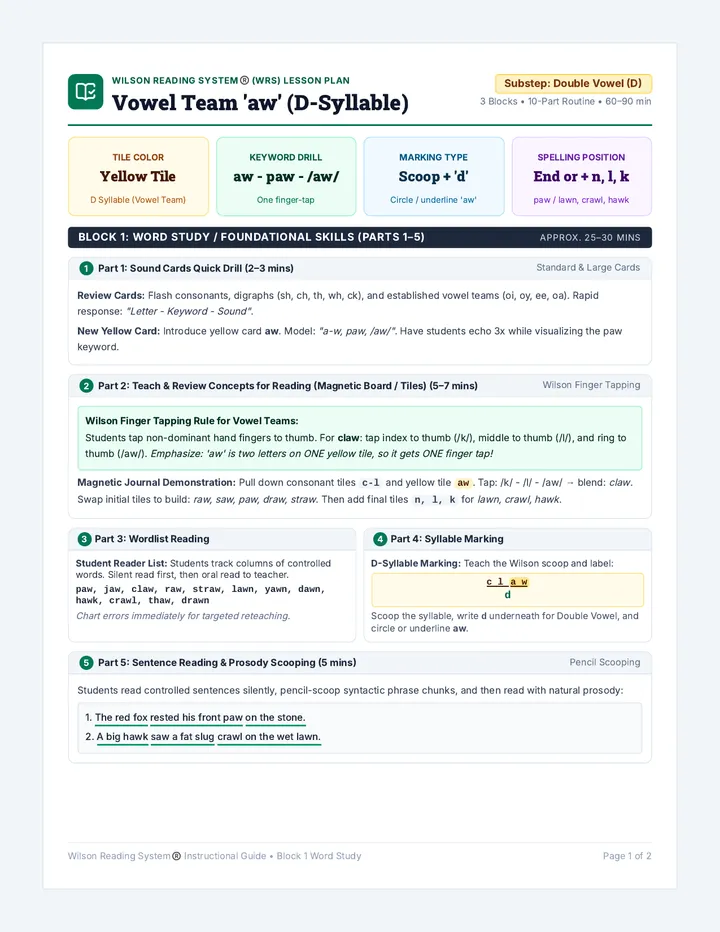
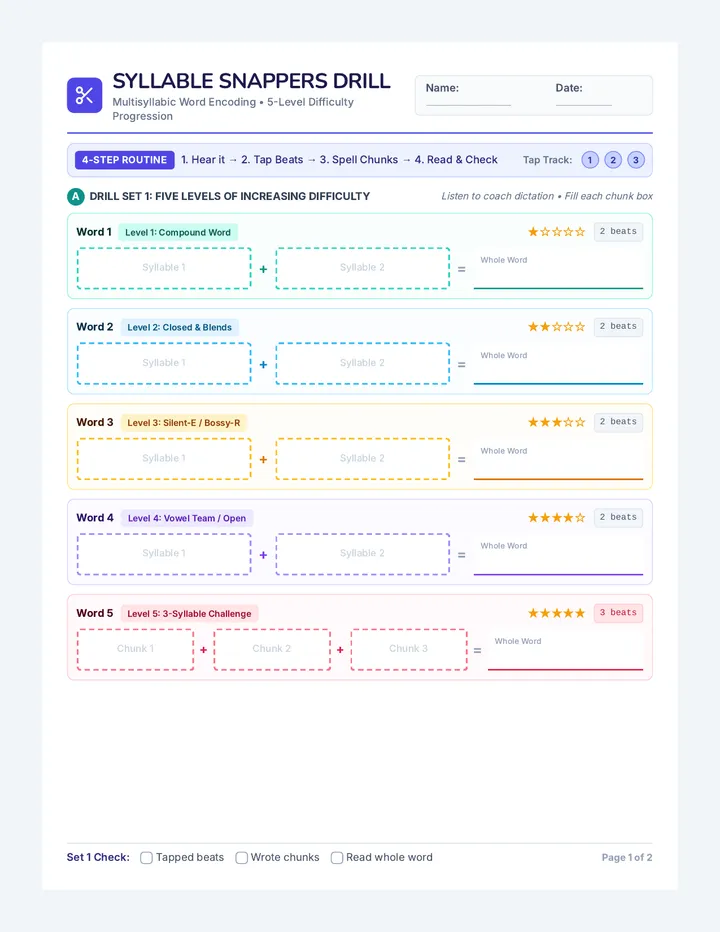
Prefix Suffix Sleuths Slides Case File #001
PREFIX & SUFFIX
SLEUTHS
Unlocking Multisyllabic Mysteries
DETECTIVE ACADEMY
The Growth Mystery
Look at this tiny base word:
STRUCT
Meaning: To build
MISSION:
How many branches can you grow on this tree? What happens when you add parts to the beginning or end?
Re____
____ion
Con____
____ure
IDENTIFYING THE SUSPECTS
Prefixes
Meaning-parts added to the front of a base word.
un- means "not"
re- means "again"
pre- means "before"
Suffixes
Meaning-parts added to the end of a base word.
-ing action/process
-ly characteristic
-ment state/result
Investigation Tool
THE "PEEL AWAY" METHOD
1
Box the prefix at the start.
2
Box the suffix at the end.
3
Underline the base word that's left.
un help ful
CRACKED!
EVIDENCE RECOVERY
Identify the base word by boxing the affixes. Can you decode them?
REPLAYED
DISAGREEABLE
UNFREAKABLE
PREMEASUREMENT
Detective Tip: If you remove the "clothing" (affixes), the "person" (base word) is easier to recognize!
Prefix Suffix Sleuths Teacher Guide Prefix Suffix Sleuths
Case File: #001 | 5th Grade Phonics
Estimated Time
60 MINS
OBJECTIVES
Identify common prefixes and suffixes in multisyllabic words.
Apply the "Box and Underline" strategy to isolate base words.
Accurately decode words by blending morphemes.
MATERIALS
Prefix Suffix Sleuths Slides
Sleuth Case File (Worksheet)
Highlighters/Colored Pencils
Small magnifying glasses (optional)
The Hook: The Word Tree (10 mins)
Start with the root word "STRUCT" on the board. Explain that roots are like seeds that grow into huge trees when we add branches.
Teacher Script: "Detectives, we have a cold case. This word 'struct' means to build, but it's just a seedling. If we add 're-' to the front, we get 'restructure'. What if we add '-ion' to the end? Help me grow this tree!"
Direct Instruction (15 mins)
1
Define Affixes: Introduce prefixes (front) and suffixes (end) as meaningful chunks.
2
The Box Strategy: Model boxing prefixes/suffixes. Emphasize that isolating them often reveals a simple, 1-2 syllable base word that students already know.
Guided Sleuthing (15 mins)
Use the slides to practice as a class. Call students up to "box" the affixes on the board. Focus on blending the chunks smoothly.
UN-HELP-FUL
DIS-CONNECT-ED
PRE-PAY-MENT
RE-US-ABLE
Independent Investigation (20 mins)
Students complete the Sleuth Case File . They must identify affixes, underline base words, and use the word in a sentence to prove they "cracked the code" of its meaning.
Investigation Guide (Answer Key)
Target Word Affixes (Boxes) Base Word (Underline) Disagreement [dis], [-ment] agree Unkindly [un], [-ly] kind Prehistoric [pre], [-ic] history Replacement [re], [-ment] place
COMMON MISCONCEPTIONS
The "Fake Chunk": Students might see a letter combination that looks like an affix but isn't (e.g., the 're' in 'real' is not a prefix). Teach them to check if the remaining part is a real base word.
Spelling Changes: Remind students that when suffixes are added, the base word might drop an 'e' or change 'y' to 'i' (e.g., happiness). This makes the "underlining" slightly trickier!
DIFFERENTIATION
Scaffolding: Provide a "Cheat Sheet" of common affixes with their meanings for students who struggle with memory.
Extension: Have students find "Triple-Affix Words" (e.g., UN-RE-CONSTRUCT-ED) and try to use them in a story.
Prefix Suffix Sleuths Worksheet Classified Information
Sleuth Case File
Assignment: Decoding Multisyllabic Evidence
Agent:
Date:
Mission Instructions
Detectives, several multisyllabic words have been found in the field. To crack their meaning, you must box the affixes (prefixes/suffixes) and underline the base word. Then, show you've cracked the code by writing the word's meaning in your own words.
01
UNREADABLE
Cracked Meaning (In your own words)
02
REARRANGEMENT
Cracked Meaning (In your own words)
03
DISRESPECTFUL
Cracked Meaning (In your own words)
04
PREVIEWING
Cracked Meaning (In your own words)
05
NONJUDGMENTAL
Cracked Meaning (In your own words)
Triple Threat Challenge
This word has THREE affixes. Can you peel them all away to find the core?
UNRELIABILITY
Identify the 3 affixes and the root:
Evidence Verification
APPROVED BY DECODING BUREAU
"Words are only as strong as their parts."
Latin Root Laboratory Slides Case File #002
LATIN ROOT
LABORATORY
Cracking the Academic Core
LAB STATUS: ACTIVE
The Meaning Core
If prefixes and suffixes are the clothing, the root is the person inside.
"A root is a word part that contains the primary meaning. It cannot usually stand alone, but it powers every word it's in."
VIS → Vision, Visible, Invisible
SCRIB → Scribble, Inscribe, Describe
Laboratory Subject #1
PORT
Latin Meaning: to carry
Portable : Able to be carried
Transport : Carry across
Export : Carry out
THE DECODING PROCEDURE
1
PEEL
Box any prefixes or suffixes you recognize first.
2
ISOLATE
Circle the Latin root in the center of the word.
3
BLEND
Put the parts back together to pronounce and understand.
IN - VIS - IBLE
ENCRYPTED CASE
MISSION CLOCK: 05:00
"The explorer had to TRANS-PORT the ancient MANU-SCRIPT across the sea. It was IN-VIS-IBLE to most, but the SUPER-VIS-OR knew its true value."
What was the explorer carrying?
Why was it hard to find?
Latin Root Laboratory Teacher Guide Latin Root Laboratory
Case File: #002 | 5th Grade Phonics & Morphology
Subject Area
LATIN ROOTS
VERSION 2.1.0
ESSENTIAL ROOTS
VIS/VID
Meaning: To see
SCRIB/SCRIPT
Meaning: To write
PORT
Meaning: To carry
LESSON FLOW
1. The Gibberish Challenge (Hook): Read a short passage where nouns are replaced with Latin roots. Challenge students to "decode" the context based on root meanings.
2. Root Investigation: Introduce the three target roots. Use the "Case File" slides to model breaking down words like transportation or description .
3. The Root Wall (Activity): Create a classroom wall. Give each pair of students a "Root Brick" (index card). They must find 3 academic words containing that root and present how the root powers the meaning.
4. Lab Report: Independent practice decoding and defining words in a scientific/academic context.
The Detective's Secret
Remind students that Latin roots are often the "stable core" of a word. Even if the pronunciation shifts slightly between words (like describe vs. description ), the spelling of the root usually stays very similar, giving us a massive hint about the word's family.
Lab Results (Answer Key)
WORD ROOT MEANING HYPOTHESIS Supervisor VIS (see) One who sees over or manages others. Inscription SCRIPT (write) Words written into or on something (like a trophy). Importer PORT (carry) One who carries in goods from another country. Vivid VID (see) Clear enough to be seen easily; bright.
Support Strategies
Visual Aids: Use images of a port (harbor), a script (document), and a visor to ground the root meanings in concrete objects.Blending Support: If a student struggles with portability , cover everything but port . Reveal port-able , then port-abil-ity .
Extension Prompts
The Synonym Swop: "If a manuscript is something written by hand, what would you call something written by light?" (Introduce Latin Root Laboratory Worksheet Root Lab Report
DEPARTMENT OF MORPHOLOGICAL STUDIES
Investigator:
Case Status: Open
1 Target Root Identification
VIS / VID
Meaning: To See
PORT
Meaning: To Carry
SCRIB / SCRIPT
Meaning: To Write
2 Word Dissection
Instructions: Circle the Latin Root in each word. Then, use the root's meaning to predict what the whole word means.
TRANSPORT
Meaning Prediction:
In a sentence:
REVISION
Meaning Prediction:
In a sentence:
DESCRIBE
Meaning Prediction:
In a sentence:
The "New Word" Experiment
If you were an inventor, how would you use these roots to name a new product? Choose one root and combine it with a prefix or suffix to name your invention.
Invention Name:
What does it do?
Sketch your invention here
VERIFIED LATIN COMPONENT ANALYSIS
CASE FILE 002-STUDENT
Greek Form Fusion Slides Case File #003
GREEK FORM
FUSION
The Science of Word Bricks
FUSION STATUS: STABLE
The Building Bricks
TELEPHONE
MICROSCOPE
THERMOMETER
"What is the hidden code that links these inventions? They are built with Greek Combining Forms."
THE CORE COMPONENTS
BIO
Meaning: LIFE
Biology : Study of life
Biography : Writing about life
GRAPH
Meaning: WRITE/DRAW
Autograph : Self-writing
Graphic : Related to drawing
METER
Meaning: MEASURE
Speedometer : Measures speed
Metric : Related to measuring
PHON
Meaning: SOUND
Phonics : Study of sounds
Symphony : Sounds together
Brick Fusion
GEO
Earth
GRAPH
Draw/Write
GEOGRAPHY
Earth-Writing
"Greek forms often snap together side-by-side. There is no 'main' base word—every part is a meaning brick!"
CONSTRUCTION CHALLENGE
What happens when you fuse these bricks? Can you define the result?
TELE GRAPH
MICRO PHON
PHOTO GRAPH
CHRONO METER
Greek words are most common in Science & Math!
Greek Form Fusion Teacher Guide Greek Form Fusion
Teacher Facilitation Guide | Case #003
Lesson Type
STEM VOCAB
THE WORD BRICK CONCEPT
Unlike Lesson 1 (Prefix/Suffix) where there is a clear "base word," Greek combining forms often snap together with equal weight. For example, biology is 50% "life" and 50% "study of."
Teach students to look for the "seam" between the bricks where the words fuse together (often with a connecting vowel like 'o').
Target Forms
BIO- (Life)
GRAPH- (Write)
METER- (Measure)
PHON- (Sound)
Instructional Steps
1
The Invention Connection (Hook)
Show students everyday inventions (telephone, thermometer, telescope). Ask: "If 'tele' means far away, and 'phone' means sound, what is the 'far-away sound' machine?"
2
Modeling the Fusion
Use the slides to show how forms snap together. Use the term "Fusion Vowel" to explain the 'o' often found in the middle (e.g., Bi-O-graphy).
3
The Greek Grid Challenge
Have students build their own "Impossible Inventions" by combining random forms from the Greek Grid worksheet.
Blueprint Key
FUSED WORD COMPONENT 1 COMPONENT 2 MEANING Telegraph Tele (Far) Graph (Write) Writing sent over a long distance. Microphone Micro (Small) Phon (Sound) Device that makes small sounds louder. Photograph Photo (Light) Graph (Draw) Drawing with light. Chronometer Chrono (Time) Meter (Measure) Instrument for measuring time accurately.
Misconception Alert
Students might confuse Greek forms with Latin roots. Remind them that Greek forms are like compound words (LEGO bricks) while Latin roots usually rely more on affixes (person with clothes).
Science Link
Invite the science teacher to collaborate! Students can hunt for these forms in their science lab manuals to see morphology in the "real world."
Greek Form Fusion Worksheet Case #003 Approved
Greek Grid Blueprint
Mission: Construct & Deconstruct Academic Words
Engineer:
Date:
Phase 1: The Brick Yard
BIO Life
GRAPH Write/Draw
PHON Sound
METER Measure
TELE Far Away
MICRO Small
PHOTO Light
GEO Earth
Phase 2: Blueprint Analysis
Split these fused words into their component bricks. Then, write the literal meaning.
GEOLOGY
Literal Meaning
BIOGRAPHY
Literal Meaning
TELESCOPE
Literal Meaning
Final Mission: Impossible Invention
Choose two "bricks" from the yard to create an invention that doesn't exist yet. Draw it and explain what it does.
Invention Name:
BUILD HERE...
Function (What does it do?):
Blueprint Drawing Area
Monster Word Deconstruction Slides Extreme Decoding Required
MONSTER WORD
DECONSTRUCTION
Handling High-Risk Vocabulary
DANGER: 5+ SYLLABLES
Identifying the Beast
A MONSTER WORD is a word with multiple layers. It might have:
A Prefix + A Root + TWO Suffixes
Shifting Syllable Stress
Case Example:
UN-CONVEN-TION-AL-LY
6 Syllables High Risk
THE STRESS SHIFT!
Adding a suffix doesn't just add meaning—it can change the sound of the base word.
BI-OL-O-GY
Stress on "OL"
BI-O-LOG-I-CAL
Stress shifts to "LOG"
DEFUSAL PROCEDURE
Follow these steps to safely decode any monster word:
1
Clip the Ends: Box the outermost affixes first.
2
Find the Core: Identify the root or base word.
3
Reassemble: Blend the parts, adjusting the stress.
DE- CONSTRUCT -ION
WORD BOMB BLITZ
Defuse in 60s!
INDISCERNIBLE
ORGANIZATIONAL
Don't let the syllables win!
Monster Word Teacher Guide Monster Word Deconstruction
Case File: #004 | The Stress Shift Specialist
Danger Level
EXTREME
WORKSHOP OBJECTIVES
Deconstruct words with a prefix, root, and multiple suffixes.
Recognize and accurately pronounce shifting syllable stress in word families (e.g., photograph vs. photographer ).
Apply the "Peel Away" strategy to words with 5+ syllables.
The Challenge List
• Un-convention-al-ly
• Multi-plication-al
• Bi-o-de-grad-able
• Re-organ-iz-ation
Instructional Blueprint
1. The Word Bomb Hook
Present a "Monster Word" on the board (e.g., indiscernible ). Tell students it is a "word bomb" that will explode if we don't safely remove the "wires" (affixes) in the right order.
2. Stress Shift Demonstration
Stress shift is the hardest part of Lesson 4. Use the "Clap and Snap" method. Students clap for the stressed syllable and snap for the unstressed ones.
Word A
PHO-to-graph
Word B
pho-TOG-ra-pher
The Defusal Guide (Answer Key)
MONSTER WORD AFFIXES (WIRES) CORE ROOT STRESSED SYLLABLE BIODEGRADABLE Bio-, De-, -able GRADE GRAD UNCONDITIONALLY Un-, -tion, -al, -ly DITION DISH REORGANIZATION Re-, -iz, -ation ORGAN ZAY PREFERENTIALLY Pre-, -ent, -ial, -ly FER REN
SYLLABLE STRESS RULE
Many monster words ending in -tion , -sion , or -ity place the primary stress on the syllable immediately preceding the suffix. Use this as a "cheat code" for students during the Word Bomb game!
DIFFERENTIATION
Scaffold: Provide color-coded "word part" cards for students to physically manipulate and assemble.Extend: Have students research the origin of the "Monster Words"—are they Latin-heavy or Greek-heavy? Monster Word Worksheet Deconstruction Plan
SQUAD: MONSTER WORD RESPONSE TEAM
Technician:
! Phase 1: Component Removal
Instructions: For each Monster Word, identify all the "wires" (affixes) and isolate the core root. Then, count the total syllables.
Word Subject:
BIODEGRADABLE
Affixes Found:
Core Root:
Syllables:
__
Word Subject:
DISCONTINUATION
Affixes Found:
Core Root:
Syllables:
__
! Phase 2: Stress Calibration
Instructions: Read each word family aloud. Identify which syllable is "clapped" (stressed). Write the stressed syllable in the box.
REORGANIZE
REORGANIZATION
PHOTOGRAPH
PHOTOGRAPHER
Final Defusal: Field Usage
Can you use the word UNCONDITIONALLY correctly in a sentence? Show that you know its meaning by using it in context.
Structural Integrity Verified
CASE FILE 004-STUDENT
Field Report Application Slides FINAL MISSION
FIELD REPORT
APPLICATION
Unlocking the Professional World
CASE STATUS: FINAL REVIEW
The Mission Briefing
Detectives, you've mastered the parts. Now it's time to master the whole.
"In the real world, multisyllabic words aren't just in lists. They are inside articles, manuals, and books."
YOUR OBJECTIVE:
Apply morphology keys to unlock the meaning of professional jargon in a field report.
ANNOTATION CODE
Box
The Affixes
Search the text for beginnings and endings that look familiar.
Root
The Meaning Core
Spot the Latin or Greek roots powering the word's logic.
Def
The Field Note
Write a quick "decoder" note in the margin about the word's meaning.
Subject Text
Report: The New Solar Bridge
"The bridge's TRANSPORTATION system is truly REVOLUTIONARY. Using PHOTO-VOLTAIC cells, it captures light to power its own lighting, which is AUTOMATICALLY managed."
1. Transportation
Port = Carry | Trans = Across
2. Photovoltaic
Photo = Light | Voltaic = Electricity
CASE CLOSED?
"The ultimate power of morphology is that it makes unknown words knowable. You are now a permanent member of the Word Detective Bureau."
Get Your Field Report
Start Annotation
Field Report Teacher Guide Field Report Application
Case File: #005 | The Capstone Investigation
Lesson Level
APPLICATION
FINAL RELEASE
CAPSTONE GOALS
In this final lesson, students shift from analyzing isolated words to analyzing words in the "wild." The goal is for them to use morphology as a tool for comprehension of complex informational texts.
Highlight unknown multisyllabic words in a text.
Annotate words using the morphology keys (boxes, roots, notes).
Synthesize meanings to explain the main idea of a complex paragraph.
Field Texts Provided
The Great Barrier Reef (Biology Focus)
The Voyager Probes (Space/Latin Focus)
Renewable Energy (Mixed Morphology)
Investigation Procedure
1
The "Professional Jargon" Hook
Give students a short, dense paragraph from a real medical or legal document. Ask: "Who can read this?" Most won't. Then ask: "Who can find a part they know?" Suddenly, subcutaneous becomes "under-skin" and disability becomes "not-able-state."
2
Guided Annotation
Model how to annotate on the board. Don't just circle the word; write the "translation" in the margin. Show how this helps when reading the next sentence.
3
Final Field Report Activity
Students work independently on the Field Report Worksheet . They must find 5 "Case Words" in the provided text and fully deconstruct them.
Evaluation Criteria
Level 3: Expert
Consistently identifies prefixes, suffixes, and roots. Explanations of word meaning are accurate and connect to the sentence context.
Level 2: Apprentice
Identifies affixes correctly but may struggle with obscure Latin/Greek roots. Definitions are close but lack full context.
Level 1: Novice
Relies on guessing or whole-word recognition. Struggles to break words into constituent morphemes without teacher support.
BEYOND THE CLASSROOM
Encourage students to keep a "Field Notebook" at home for words they see on cereal boxes, street signs, or in TV shows. Morphology is everywhere! For the high-flyers, introduce the concept of Etymology (the history of words) to explain why some words have "monster" spellings.
Field Report Worksheet Official Field Report
Case Study: Deep Sea Exploration
Mission: Morphology in Authentic Texts
Investigator:
ID No:
Field Data Transcript
The Abyss investigation
"Marine BIOLOGISTS are currently exploring the deepest parts of the Atlantic Ocean. Because these areas are INACCESSIBLE to humans, they use SUBMERSIBLE robots. These machines are EQUIPPED with PHOTOGRAPHIC sensors to record the EXTRAORDINARY creatures that live in total darkness. The data they TRANSMIT back to the surface is UNBELIEVABLY detailed."
Morphology Key Evidence
Choose 4 highlighted words from the text above. Break them down and prove their meaning.
Word Found:
Prefix/Suffix:
Root:
Field Definition:
Word Found:
Prefix/Suffix:
Root:
Field Definition:
Word Found:
Prefix/Suffix:
Root:
Field Definition:
Word Found:
Prefix/Suffix:
Root:
Field Definition:
Executive Summary
Using what you've decoded, summarize the mission of the deep-sea investigators in 2-3 sentences.