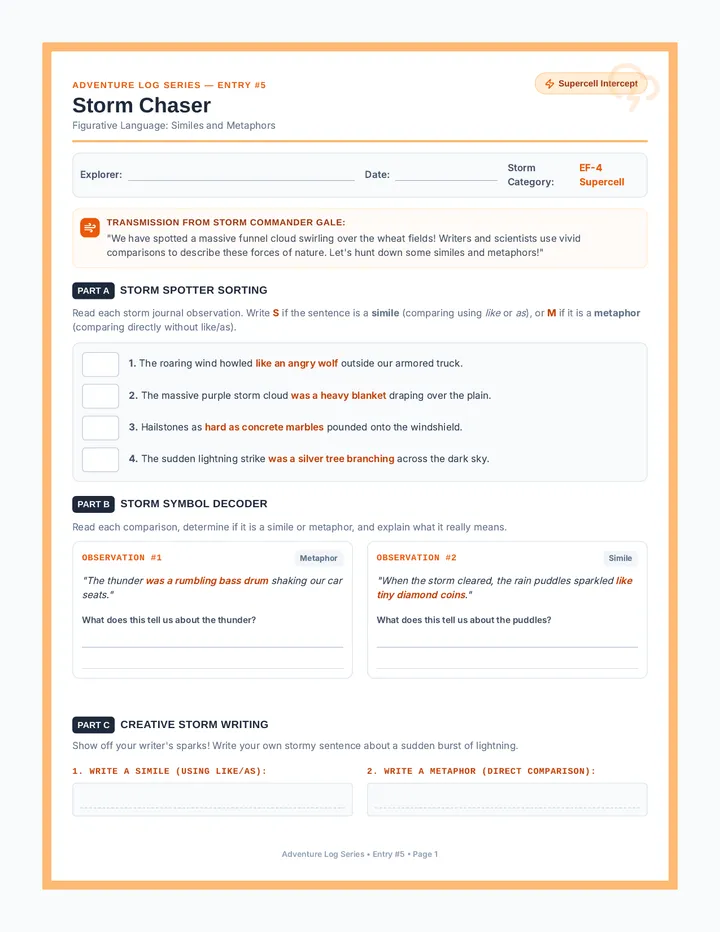
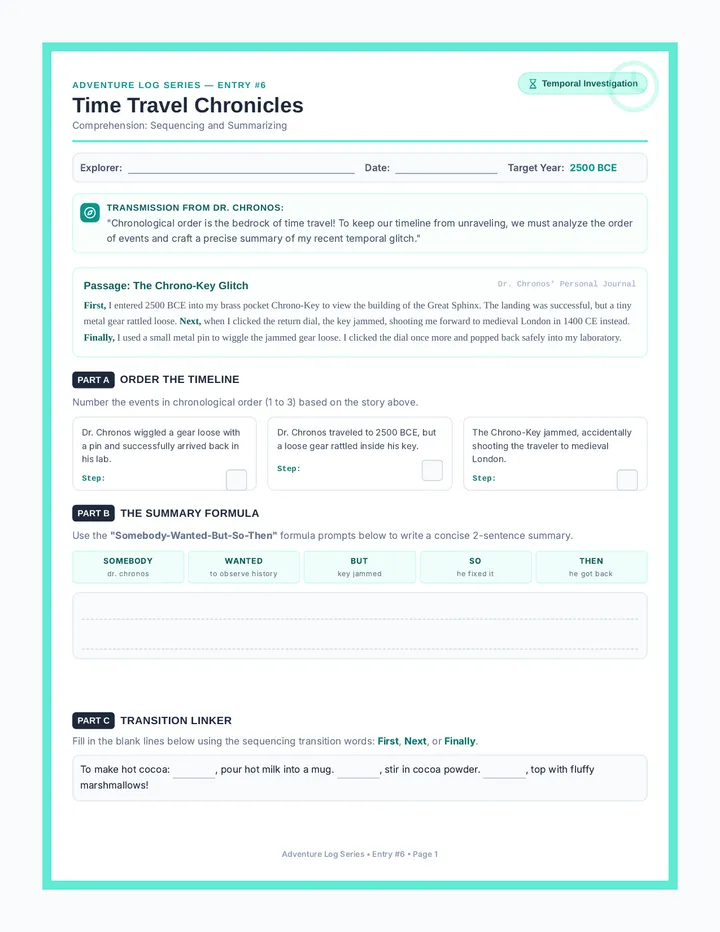
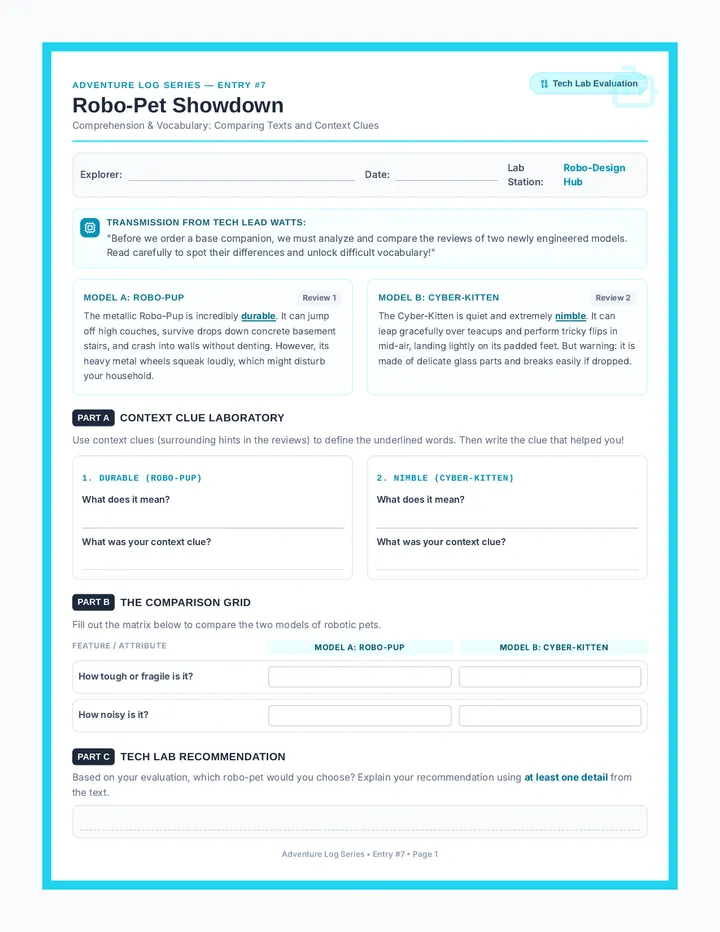
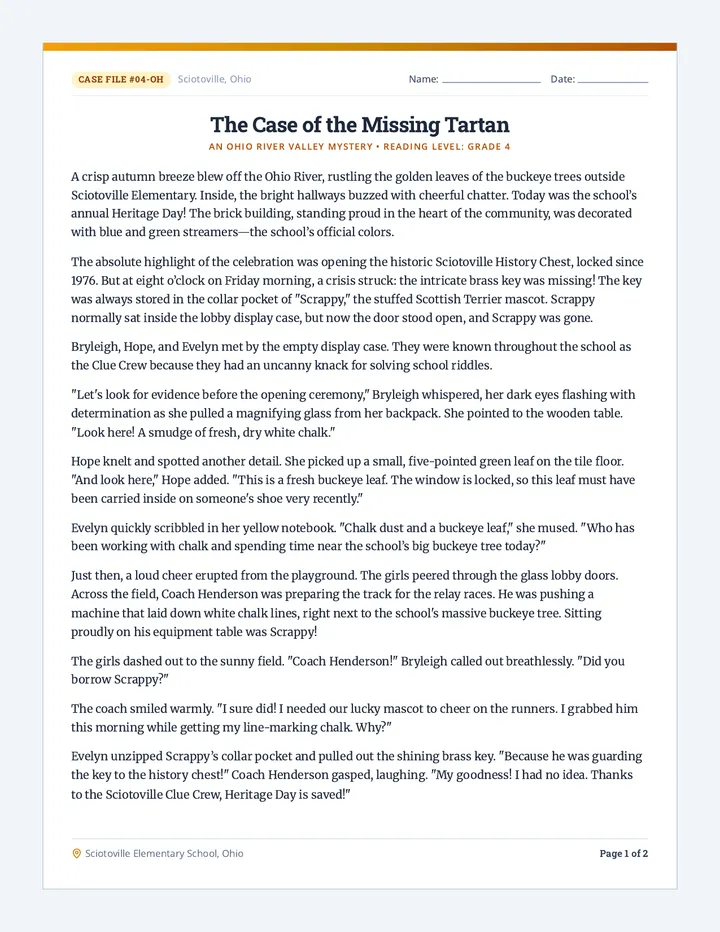
Eye vs Ear Challenge Worksheet Eye vs Ear Challenge
Detective Training: Level 1
Agent Name
1
The Eye Test
Mission: Read the paragraph below with your eyes only . Circle any mistakes you find. Time yourself for 1 minute!
The quick brown fox jumps over the the lazy dog. It was a sunny day in the the forest. All of the the animals were happy to see the sunshine. The birds sang in the trees while the the squirrels gathered nuts for for the winter. It was a truly beautiful beautiful morning.
Mistakes Found _____ / 7
Eyes Feeling
2
The Ear Test
Mission: Use your Text-to-Speech (TTS) tool to listen to the same paragraph. Put a ★ over every mistake you hear.
The quick brown fox jumps over the the lazy dog. It was a sunny day in the the forest. All of the the animals were happy to see the sunshine. The birds sang in the trees while the the squirrels gathered nuts for for the winter. It was a truly beautiful beautiful morning.
Mistakes Found _____ / 7
Ears Feeling
Detective Reflection
Why do you think it was easier (or harder) to catch the mistakes when you heard them?
Write your thoughts here...
Ear Detectives Intro Slides Ear Detectives
Lesson 1: The Ear vs. The Eye
Mission: Catching mistakes your eyes miss!
The Brain's Secret
Your Eyes
Your brain is so smart that it skips over small mistakes to make sense of what you read.
"I know what that says, so I'll just move on!"
Your Ears
Your ears only hear what is actually there. They don't fill in the gaps!
"Wait... that sounded weird!"
Listen Closely...
"The quick brown fox jumps over the the lazy dog."
0:00 Reading aloud... 0:08
Did you hear the "the the"? It's much easier to hear than to see!
Text-to-Speech (TTS)
Highlight
Pick the words you want to hear.
Play
Listen as the computer reads them back.
Fix
Change anything that sounds wrong.
Ready to try your first mission?
Detective Training Facilitation Guide Detective Training Guide
Lesson 1: The Ear vs. The Eye
45-60 MINUTES
Learning Objective
Students will compare visual and auditory proofreading methods to identify repeated word errors in a sample text.
Required Tools
TTS Software (Read&Write, Immersive Reader, etc.)
Eye vs Ear Challenge Worksheet
Headphones for each student
The Mission Plan
1
The Hook (10 mins)
Start with a challenge: "I have a paragraph that is hiding secrets. I bet your eyes will miss half of them, but your ears will catch every single one."
Tip: Project the "Intro Slides" and discuss how the brain "fills in" information when we read visually.
2
The Eye Test (10 mins)
Hand out the worksheet. Students have 60 seconds to find all the mistakes using only their eyes. No talking!
Most students will miss at least 2-3 of the repeated "the" words.
3
The Ear Test (15 mins)
Students put on headphones and use their TTS tool to listen to the paragraph. Instruct them to listen for "stutters" or "echoes."
Scaffolding: For students who struggle with focus, encourage them to follow along with their finger as the computer reads.
4
Debrief & Reflect (10 mins)
Reveal the answer key. Discuss: Why did our eyes skip the words? (Brain focuses on meaning, not syntax). How did the robot voice sound when it hit a double word?
Worksheet Answer Key (7 Mistakes)
1. jumps over the the lazy dog.
2. day in the the forest.
3. All of the the animals...
4. while the the squirrels...
5. gathered nuts for for the winter.
6. truly beautiful beautiful morning.
Catching Missing Words Slides Mind the Gap
Lesson 2: Catching Missing Words
Mission: Stop the robot before it makes a mistake!
The "Invisibles"
Small Words
the a to is of in
These are the most common words we forget to write!
Why they matter?
Without these small words, your sentences sound "stale" or "robotic."
"I went park play."
vs.
"I went TO THE park TO play."
The Freeze-Frame
"The cat sat ____ the mat."
STOP!
Strategy: Listen for the Gaps
When the sentence sounds "choppy," pause the TTS and find the missing word.
Game Time: Spot the Gap
Which word is missing in this sentence?
"I really like ____ eat pizza for dinner."
A) a
B) to
C) the
Mind the Gap Worksheet Mind the Gap
Detective Training: Level 2
Agent Name
Mission Briefing
Sometimes we write so fast that our fingers skip small words like the, a, is, to, or in. Your eyes might "fill them in," but your TTS tool will sound very silly without them!
!
Identify & Fix
Listen to each sentence using your TTS tool. When you hear a "gap" or something that sounds wrong, pause the tool and write the missing word in the blank.
Sentence #1
Yesterday, I went ________ store to buy some milk.
MISSING WORD:
Sentence #2
My dog is very good ________ catching the ball.
MISSING WORD:
Sentence #3
I love to play outside ________ the park with friends.
MISSING WORD:
Sentence #4
Please put your books back ________ the shelf.
MISSING WORD:
★
Final Boss: The Choppy Story
Today was best day ever! I woke up early eat breakfast. Then, I went school. My teacher gave me gold star for being great student. I felt so happy that I wanted jump for joy!
Rewrite the story with the missing words: Mind the Gap Key Resource Answer Key
Mind the Gap Worksheet
Part 1: Individual Sentences
1
Yesterday, I went TO THE store to buy some milk.
2
My dog is very good AT catching the ball.
3
I love to play outside AT the park with friends. (or IN )
4
Please put your books back ON the shelf.
Part 2: The Choppy Story
Corrected version (missing words in caps):
Today was THE best day ever! I woke up early TO eat breakfast. Then, I went TO school. My teacher gave me A gold star for being A great student. I felt so happy that I wanted TO jump for joy!
Teacher Tip
When reviewing this with students, have them listen to the incorrect version first, then the correct version. Ask them: "Which one sounds like a real person talking, and which one sounds like a broken robot?"
Robot Breath Slides Robot Breath
Lesson 3: Listening for Punctuation
Mission: Give your writing room to breathe!
The Run-On Marathon
Imagine talking like this...
"I went to the store and I bought some candy then I ate it all and my stomach hurt so I had to lay down and take a nap."
OUT OF BREATH!
The Sound of Punctuation
.
The Period
The Full Stop
The computer voice drops in pitch and takes a long breath.
?
The Question
The Lift
The computer voice goes UP at the end.
Ear Training Challenge
"Where is the library"
.
?
!
"I love eating apples"
.
?
!
"LOOK OUT FOR THAT CAR"
.
?
!
Listen for how the TTS voice changes for each one!
Punctuation Power-Up Worksheet Punctuation Power-Up
Detective Training: Level 3
Agent Name
.
Full Stop
Long Pause
,
Comma
Short Pause
?
Question
Voice Goes UP
1
Run-On Rescue
Listen to this sentence with your TTS tool. It has NO punctuation. Draw a vertical line | where you think the computer should take a breath.
the sun was shining brightly in the sky I decided to go for a long walk in the woods I saw a tiny green frog sitting on a rock near the stream did you see it too it was so small
Now, rewrite it with periods and capitals:
2
The Intonation Game
Listen carefully to the pitch of the robot's voice. Circle the correct punctuation mark for each sentence.
What time is the pizza party
.
?
My favorite color is green
.
?
Do you want to play tag
.
?
Ear Detective Checklist
Does the voice sound like it's running out of breath? (Add a period!)
Does the voice go up at the end? (Add a question mark!)
Punctuation Intonation Teacher Guide Punctuation Intonation Guide
Teacher Cheat Sheet
How TTS "Sees" Punctuation
. Period
Pitch drop + 500ms - 800ms pause.
The most important signal for students to hear the end of a thought.
, Comma
Slight pitch lift + 200ms - 300ms pause.
Helps students hear where to "take a quick breath" in a long sentence.
? Question Mark
Significant upward glissando at the end.
The most recognizable intonation change for students.
Common Misconceptions
Exclamation Points!
Most TTS tools do NOT change pitch for exclamation points. They treat them exactly like periods. Tell students that (!) is for the reader , but the (.) is for the robot .
Pacing is Key
If the TTS speed is set too fast, students won't hear the pauses. Recommendation: Set speed to 0.8x or "Medium-Slow" for punctuation lessons.
The "Robot Breath" Test
Ask students: "Could you hold your breath that long?" If the robot reads a whole paragraph without pausing, the student needs to add a period.
Quick Diagnostic Script
"Close your eyes and listen to this sentence. Does it sound like a list, a question, or a statement?"
Master Editors Lab Slides The Master Editor's Lab
Lesson 4: Workflow Integration
Mission: Listen digitally, mark physically!
The Hybrid Workflow
On the Screen
The Text-to-Speech tool reads the words aloud.
On the Paper
You use your pencil to circle and fix mistakes.
Why? Because it's easier to see the big picture on paper!
The Editor's Secret Code
⭕
Circle
Repeated words or "stutters"
^
Caret
Missing words or "gaps"
/
Slash
Missing periods or "robot breath"
Challenge Accepted?
"I am going to fix the Messy Story using my Ears and my Pencil."
Messy Story Practice Draft The Messy Story
Practice Draft for Revision
Master Editor
Your Editing Mission
Listen to this story using your TTS tool. Use your pencil to circle mistakes, add missing words, and fix punctuation. There are 10 mistakes in total!
last week my family went to the the zoo we saw big big elephants and tall giraffes. I really like watch the monkeys play they were very funny.
my brother shouted look at that lion it was sleeping under a tree. the lion looked so peaceful. we had great day at zoo and i want go back soon
do you like zoo it is my favorite place in the whole whole world.
Repeated Words _____ / 3
Missing Words _____ / 4
Punctuation _____ / 3
Messy Story Answer Key Resource Answer Key: The Messy Story
LEVEL 4
Last week my family went to the zoo. We saw big elephants and tall giraffes. I really like TO watch the monkeys play. They were very funny.
My brother shouted, "Look at that lion!" It was sleeping under a tree. The lion looked so peaceful. We had A great day at THE zoo and I want TO go back soon.
Do you like THE zoo? It is my favorite place in the whole world.
Repeated (3)
the the
big big
whole whole
Missing (4+)
like TO watch
had A great day
at THE zoo
want TO go
like THE zoo
Punctuation (3+)
play. They
lion! It
soon.
zoo? It
Teacher Note:
Students should focus on the "auditory signal." For example, when they hear the robot say "monkeys play they were very funny," they should notice the lack of a pause and mark the spot between "play" and "they."
Final Review Slides The Final Review
Lesson 5: Polishing Personal Writing
Mission: Make your voice heard exactly as you meant it!
The Last 5%
Even professional authors use people (and technology!) to read their work aloud. It's the only way to be 100% sure your reader understands your story.
"If it sounds wrong when I hear it, it will feel wrong when they read it."
Your Self-Check Process
1
Slow Down
Set the TTS speed to 0.8x.
2
Focus
Highlight one paragraph at a time.
3
Listen
Follow the words with your eyes/finger.
4
Fix
Stop immediately if it sounds "weird."
You Are a Master Editor!
Today, you will use your new skills to polish your own writing piece.
Start Final Mission
Self Correction Studio Checklist Self-Correction Studio
Final Auditory Review Checklist
Master Editor
The Auditory Checklist
The "Echo" Check
Did I hear any words twice? (Example: "the the")
The "Stumble" Check
Did the robot skip a small word like 'to', 'is', or 'the'?
The "Robot Breath" Check
Does the voice run out of breath? I need a period!
The "Question Lift" Check
Does my question sound like a question at the end?
Notes & Fixes
Write down any specific mistakes your ears caught during your review today.
My Ears Caught This:
How I Fixed It:
Final Verification
"I have listened to my entire draft from start to finish."
Initials:
Auditory Revision Assessment Rubric Auditory Revision Rubric
Teacher Assessment Tool
Lesson 5: Mastery
Skill Area Emerging Developing Proficient Tool Usage Requires teacher help to navigate TTS features. Can start/stop TTS but struggles with speed or highlighting. Independently manages speed and selection of text. Error Detection Notices errors only when pointed out by others. Catches obvious repeated words but misses missing words. Identifies "gaps," "stutters," and punctuation issues by ear. Correction Workflow Listens to the whole text without stopping to fix. Pauses occasionally but forgets where the error was located. Uses "Pause-and-Fix" strategy effectively during listening. Final Polish Draft remains largely uncorrected after TTS review. Makes 1-2 minor changes based on auditory feedback. Draft shows significant evidence of self-correction.
Observational Notes
Differentiation Tip
For students who are still "Emerging," consider doing a Dual-Review . The student listens with headphones while you point to the words on the screen. Encourage them to say "STOP" when they hear something odd.