A comprehensive teacher's guide for the Sun Spark lesson, including lesson flow, timing, materials checklist, and specific discussion prompts for Kindergarten students.
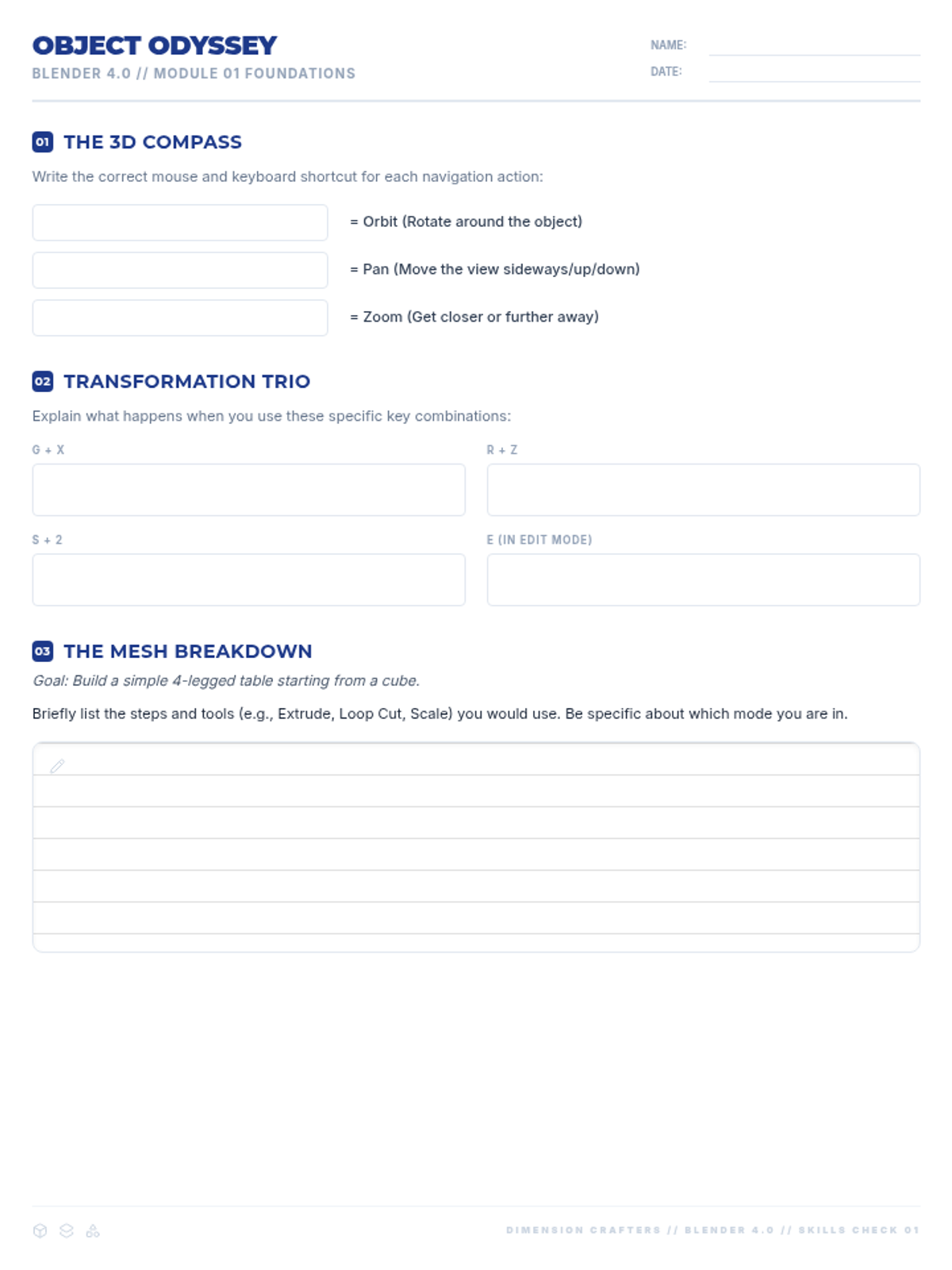
A student practice worksheet to assess understanding of Blender 4.0 navigation, transformation shortcuts, and conceptual modeling steps for a simple object.
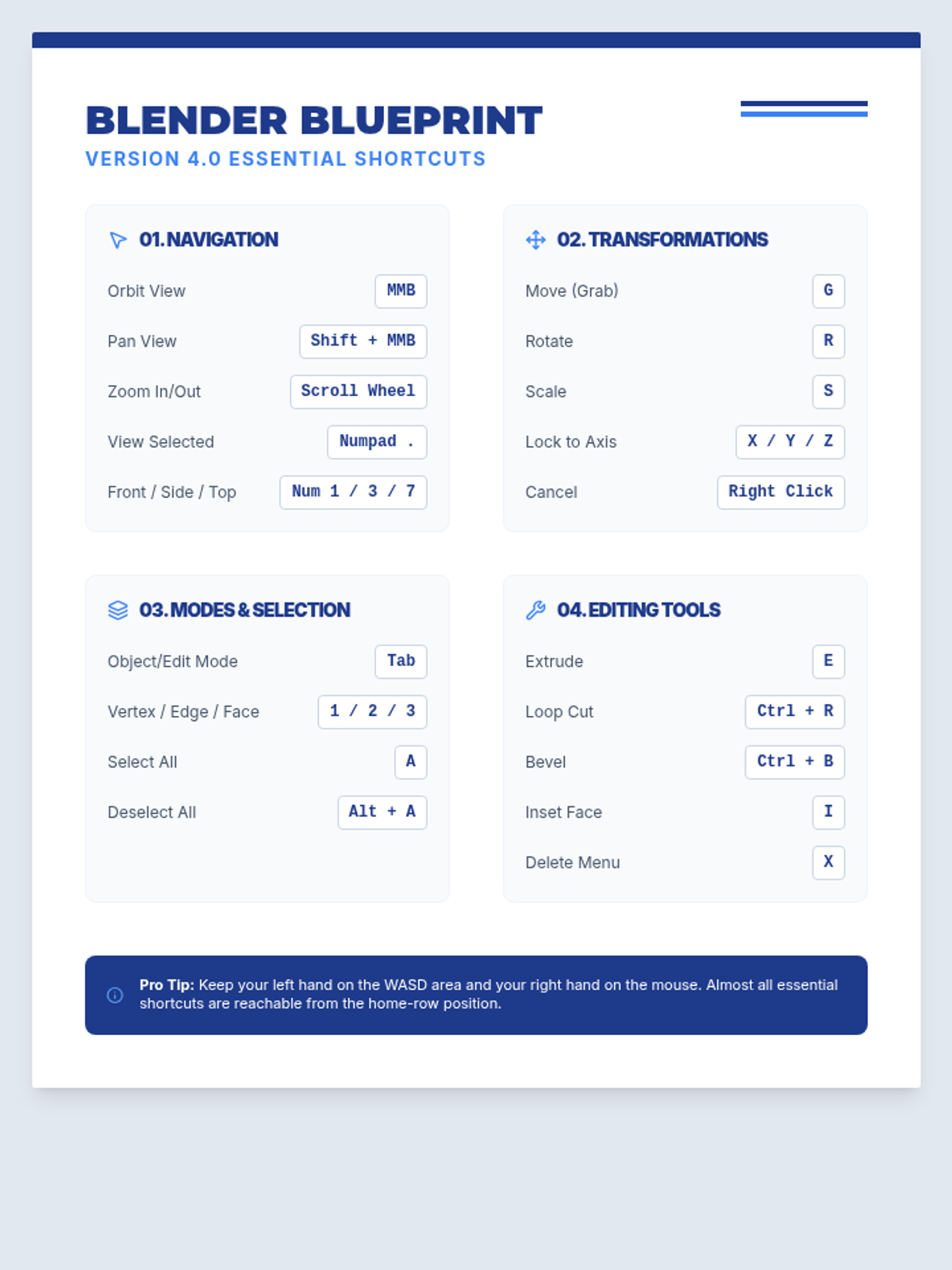
A clean, blueprint-styled shortcut reference sheet for Blender 4.0, categorized by navigation, transformations, modes, and editing tools.
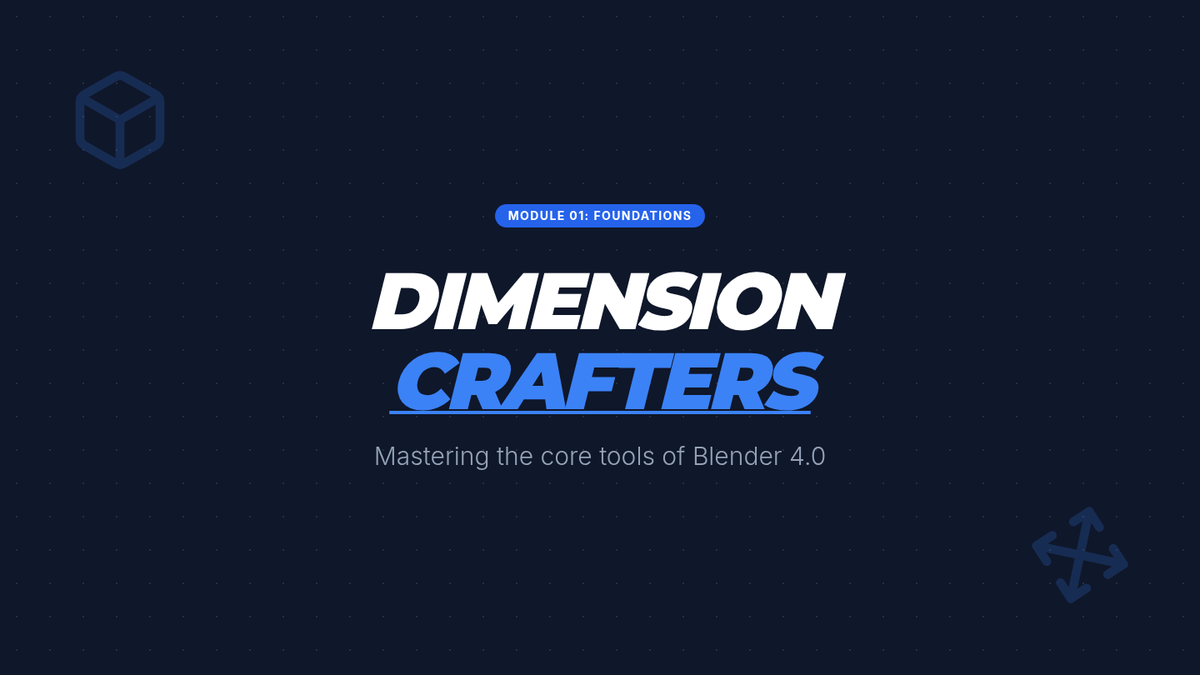
A 6-slide presentation covering Blender 4.0 navigation, object mode transformations (G,R,S), and essential edit mode tools (Extrude, Loop Cut) with high-contrast visuals and clear shortcut keys.
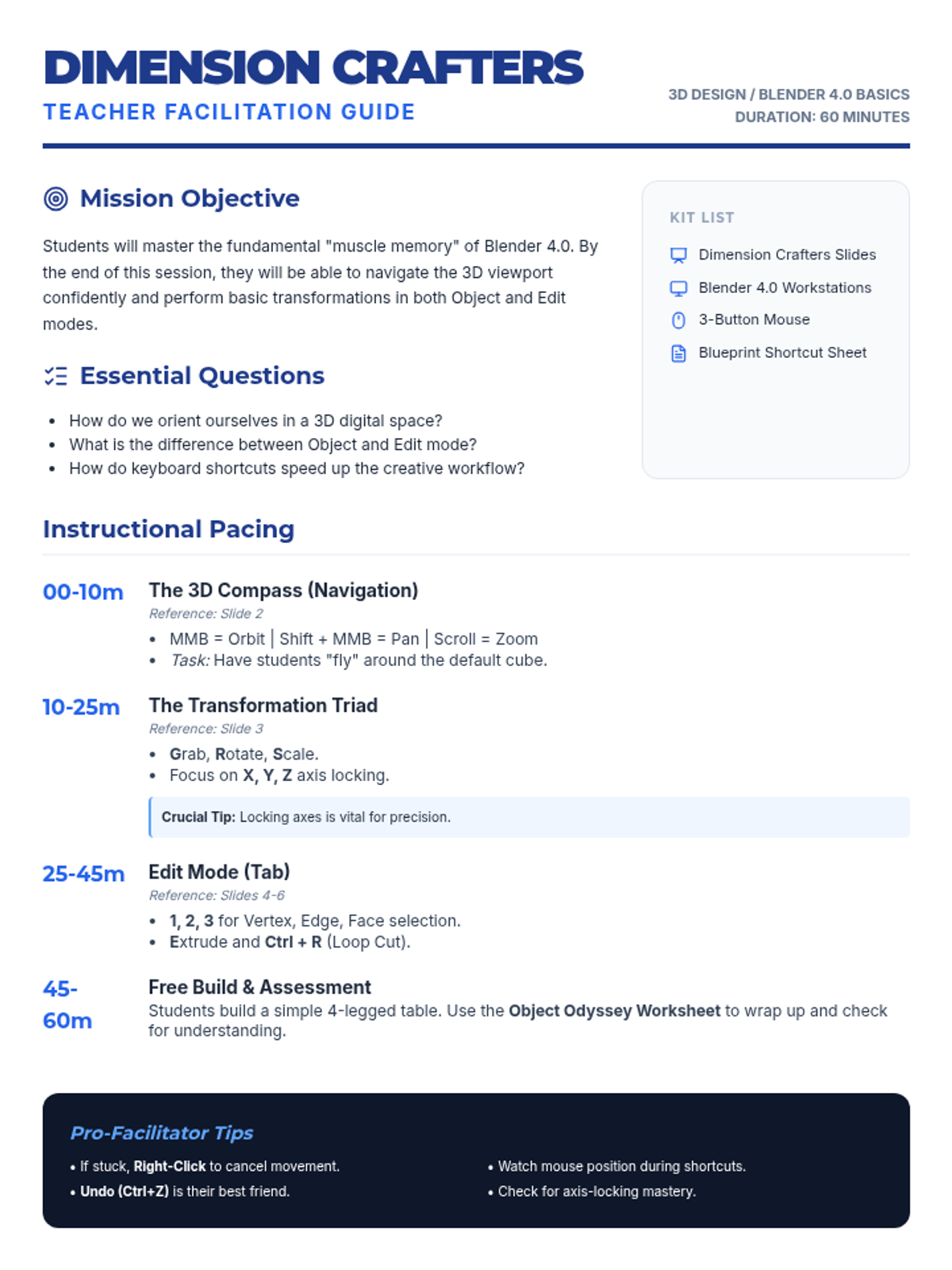
A comprehensive teacher's guide for the Dimension Crafters lesson, including learning objectives, a kit list, and a 60-minute instructional timeline for Blender 4.0 basics.
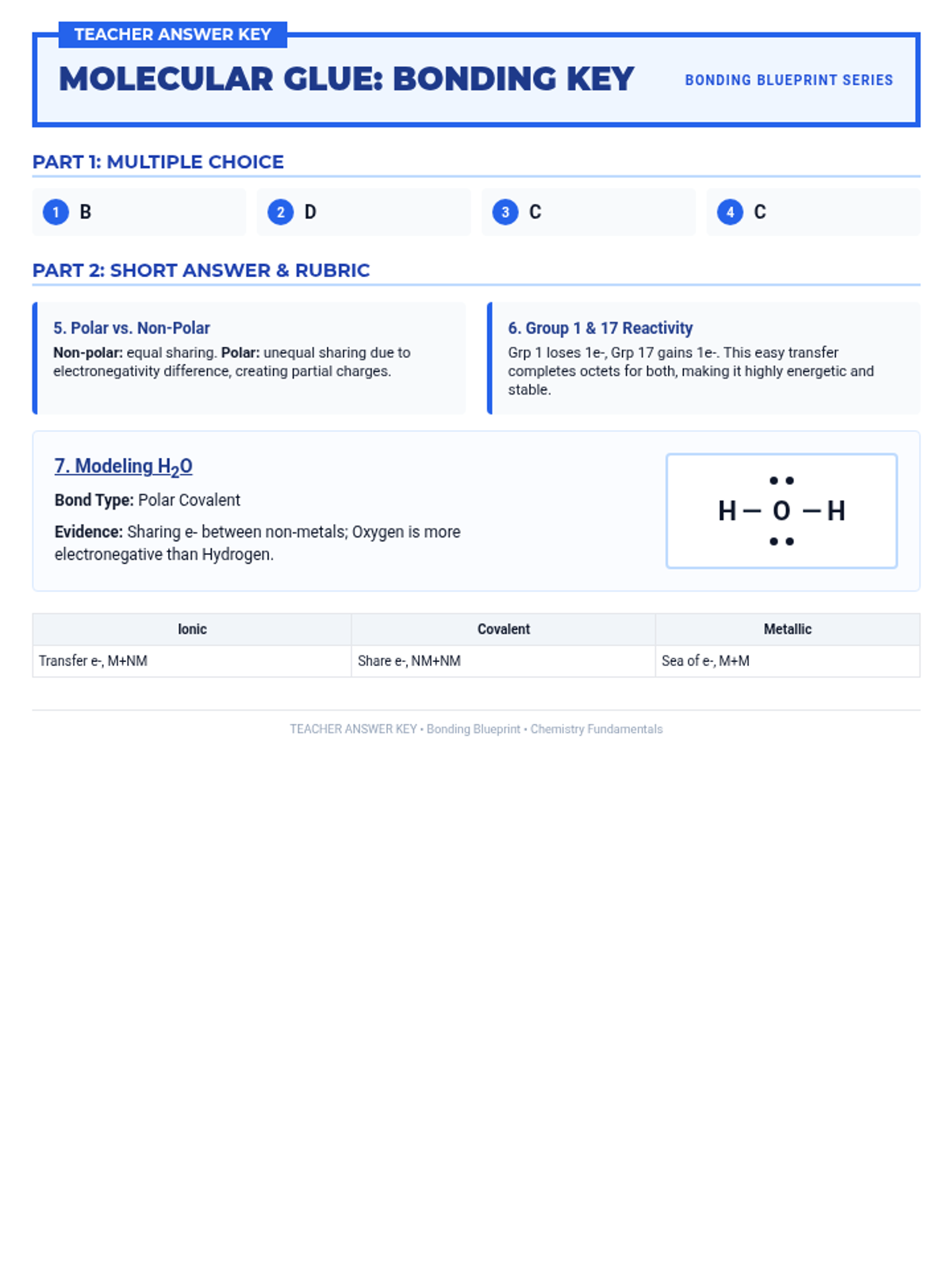
The teacher's answer key for the Molecular Glue Worksheet, including correct multiple-choice selections and suggested responses for short-answer questions. High-density layout optimized for single-page printing.
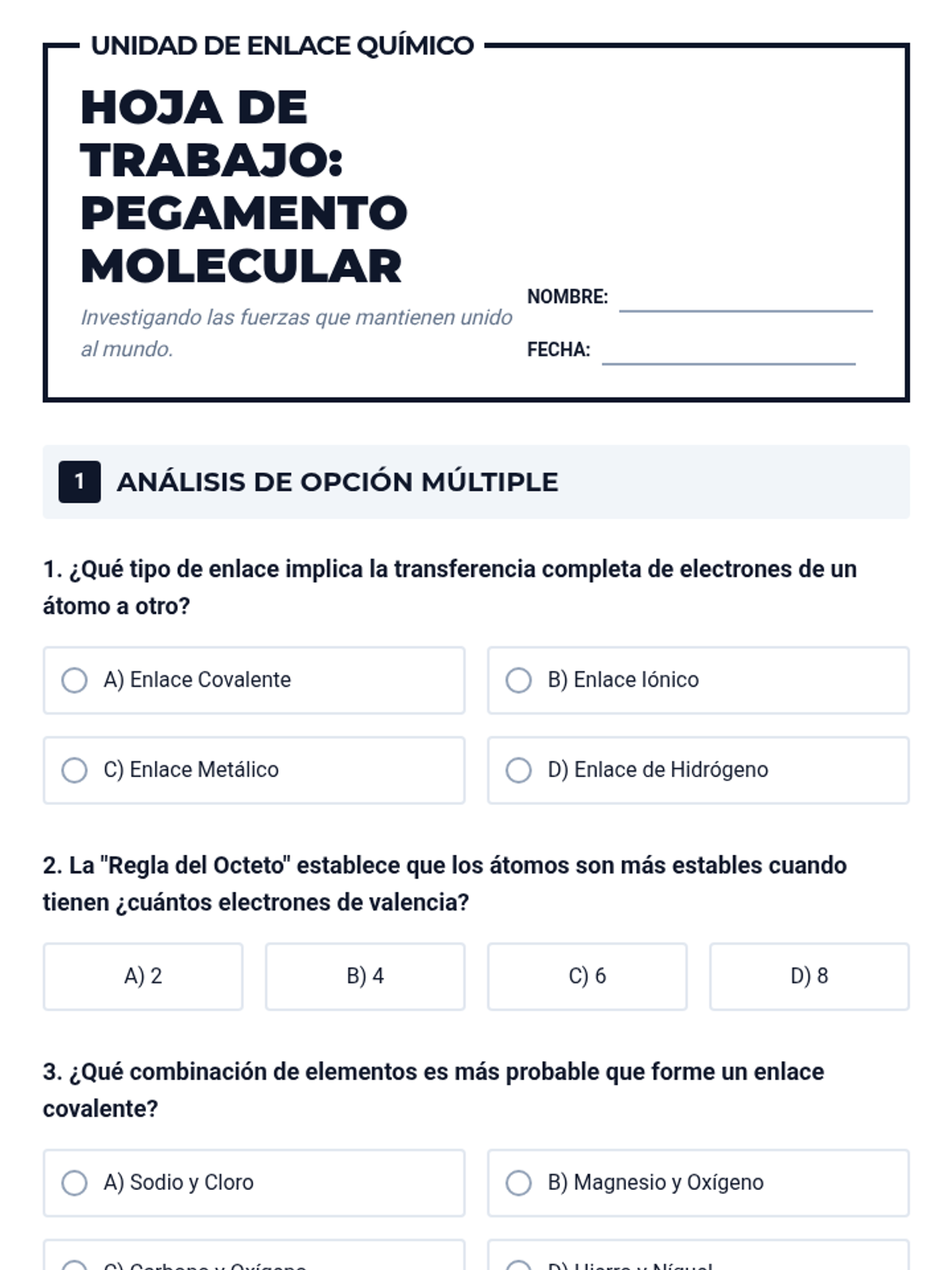
A practice worksheet for students covering chemical bonding, featuring multiple-choice questions and short-answer prompts to test understanding of ionic, covalent, and metallic bonds.
A set of instructional slides covering the fundamentals of chemical bonding, including ionic, covalent, and metallic bonds, the octet rule, and electron behavior. High-visibility instructional content.
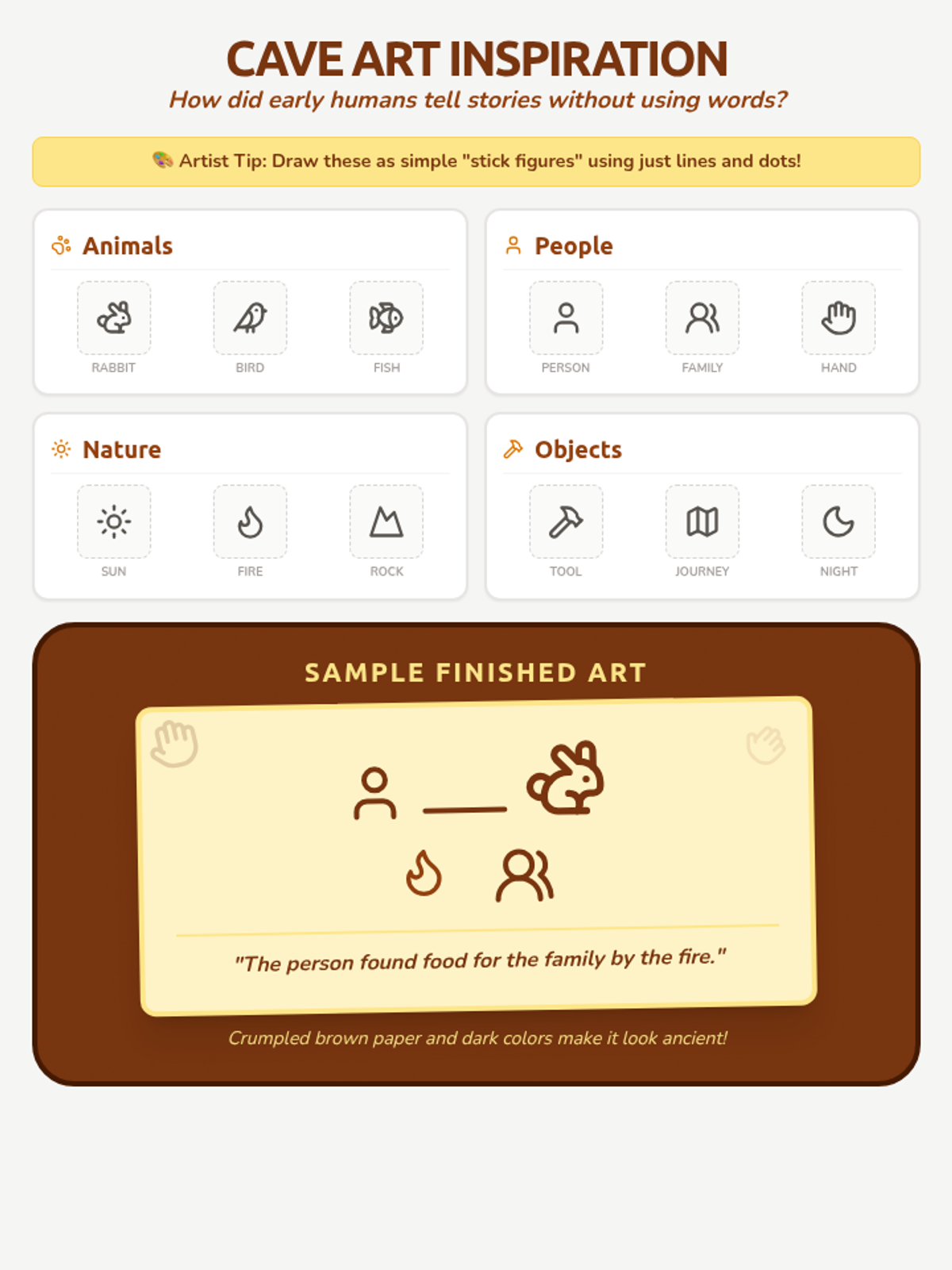
A visual inspiration sheet for the Cave Art Creators activity, providing Grade 2 students with symbolic examples of animals, people, and nature, along with a finished sample of cave-style art.
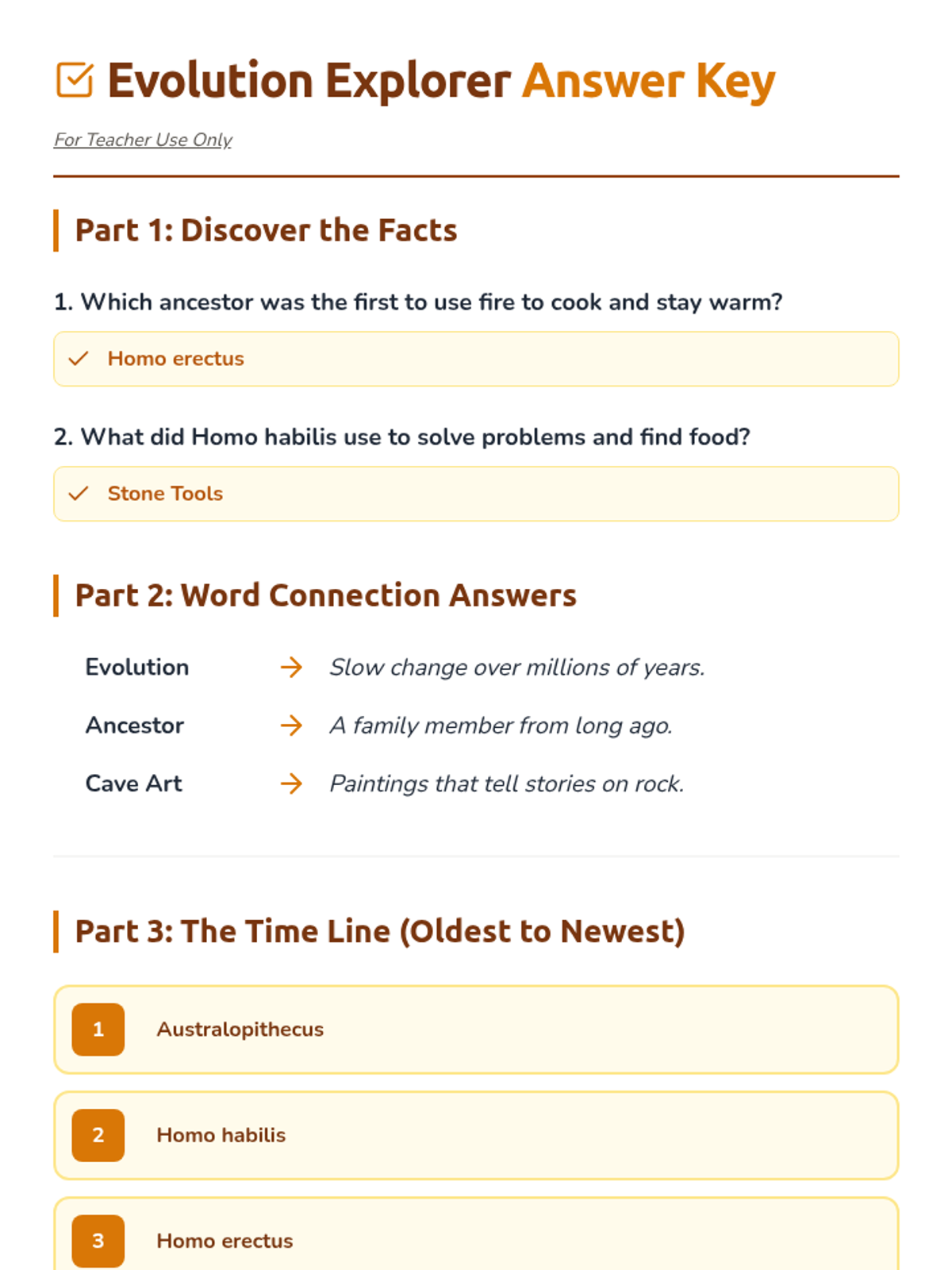
An answer key for the Evolution Explorer Worksheet, providing correct multiple-choice answers and the chronological sequence of human ancestors.
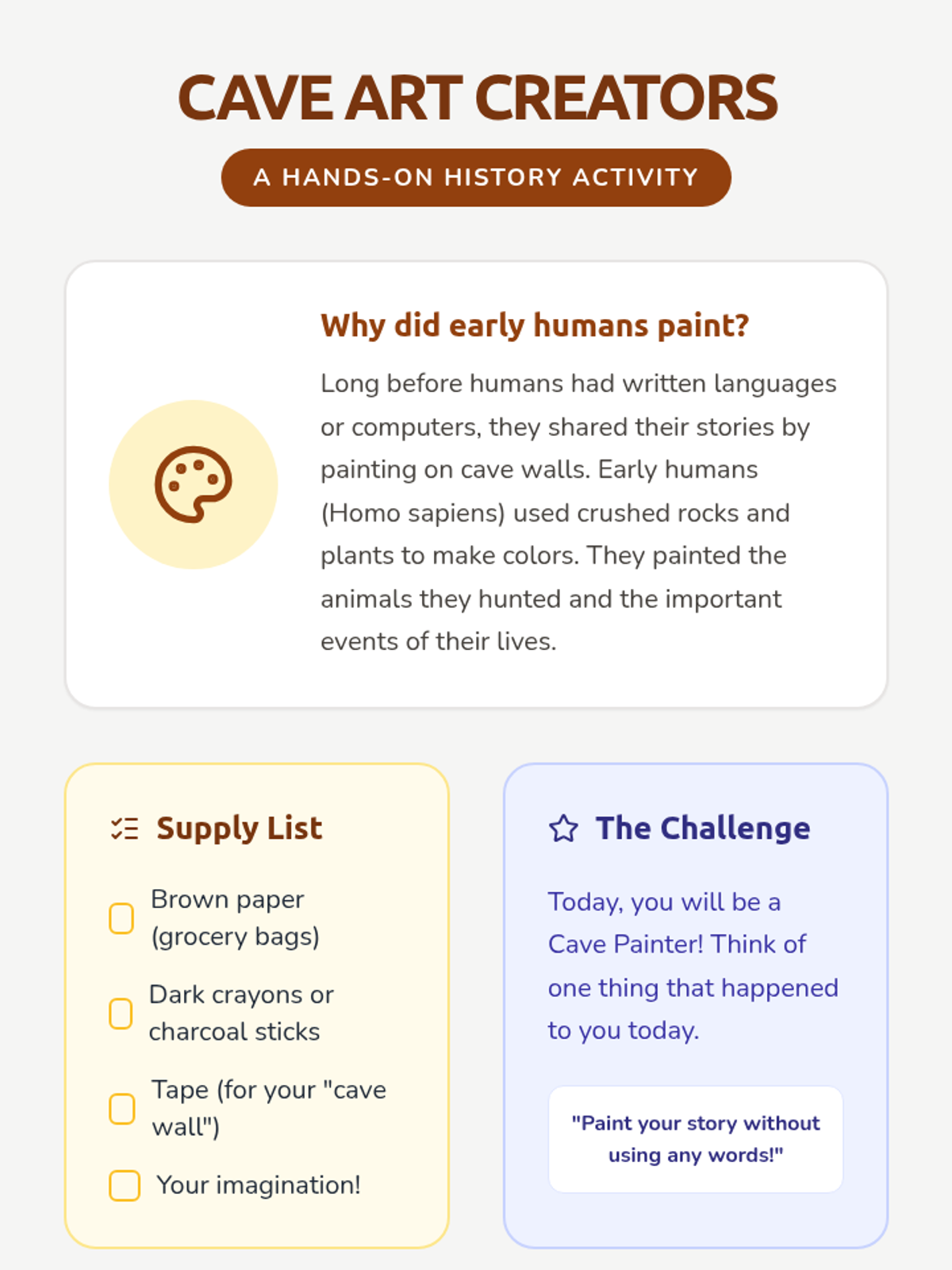
A hands-on activity guide for Grade 2 students to create their own "cave art," exploring how early Homo sapiens used visual storytelling before written language.
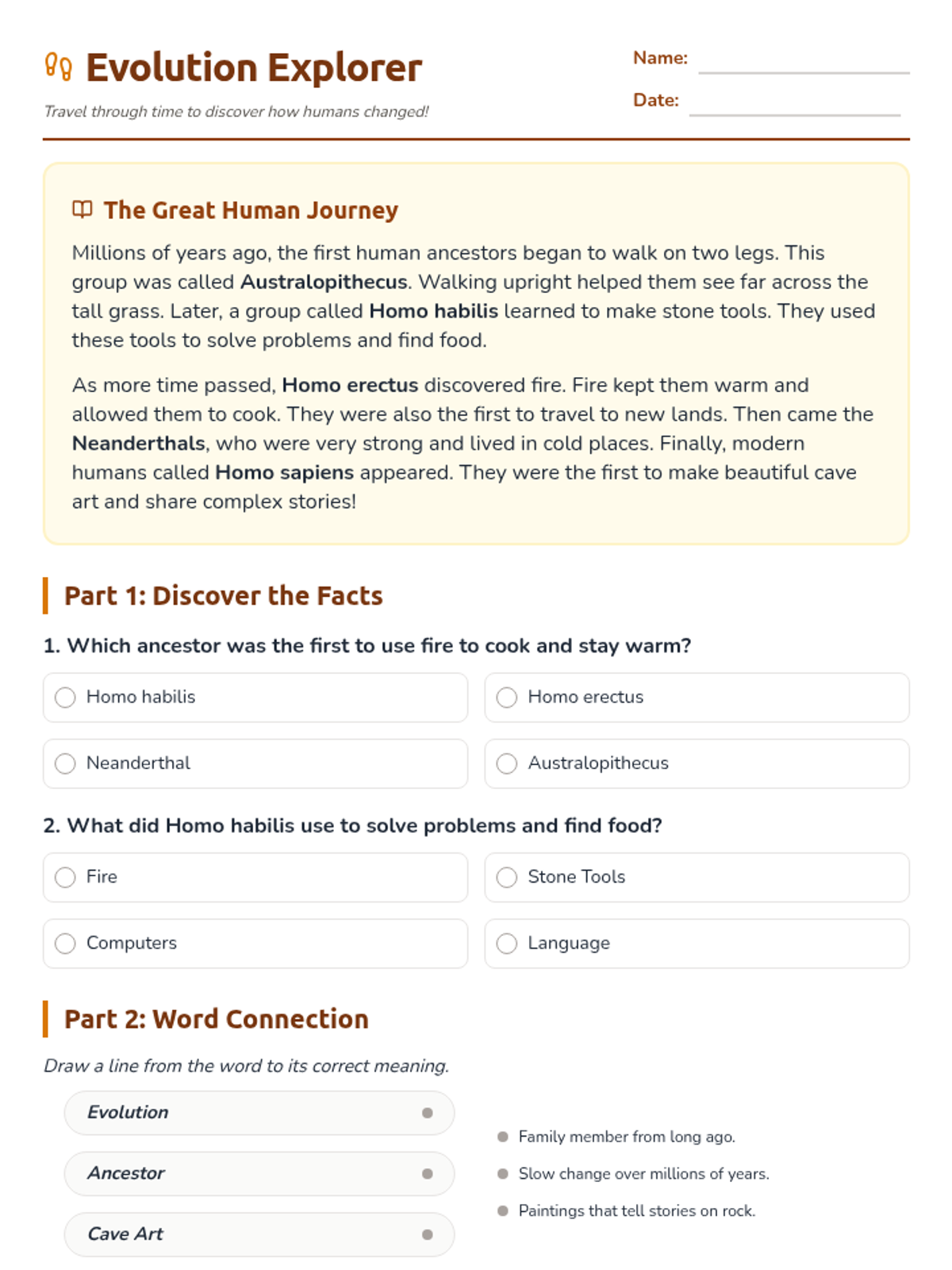
A polished 3-page student worksheet for Grade 2 on human evolution. It includes reading comprehension, vocabulary matching, a chronological timeline, short-response questions, and a large drawing space, all with optimized layout for physical printing.
An enhanced 9-slide presentation for Grade 2 detailing the stages of human evolution with extensive visual aids, fact files for each ancestor, and a section on how archaeologists discover the past. All text is sized for classroom visibility.
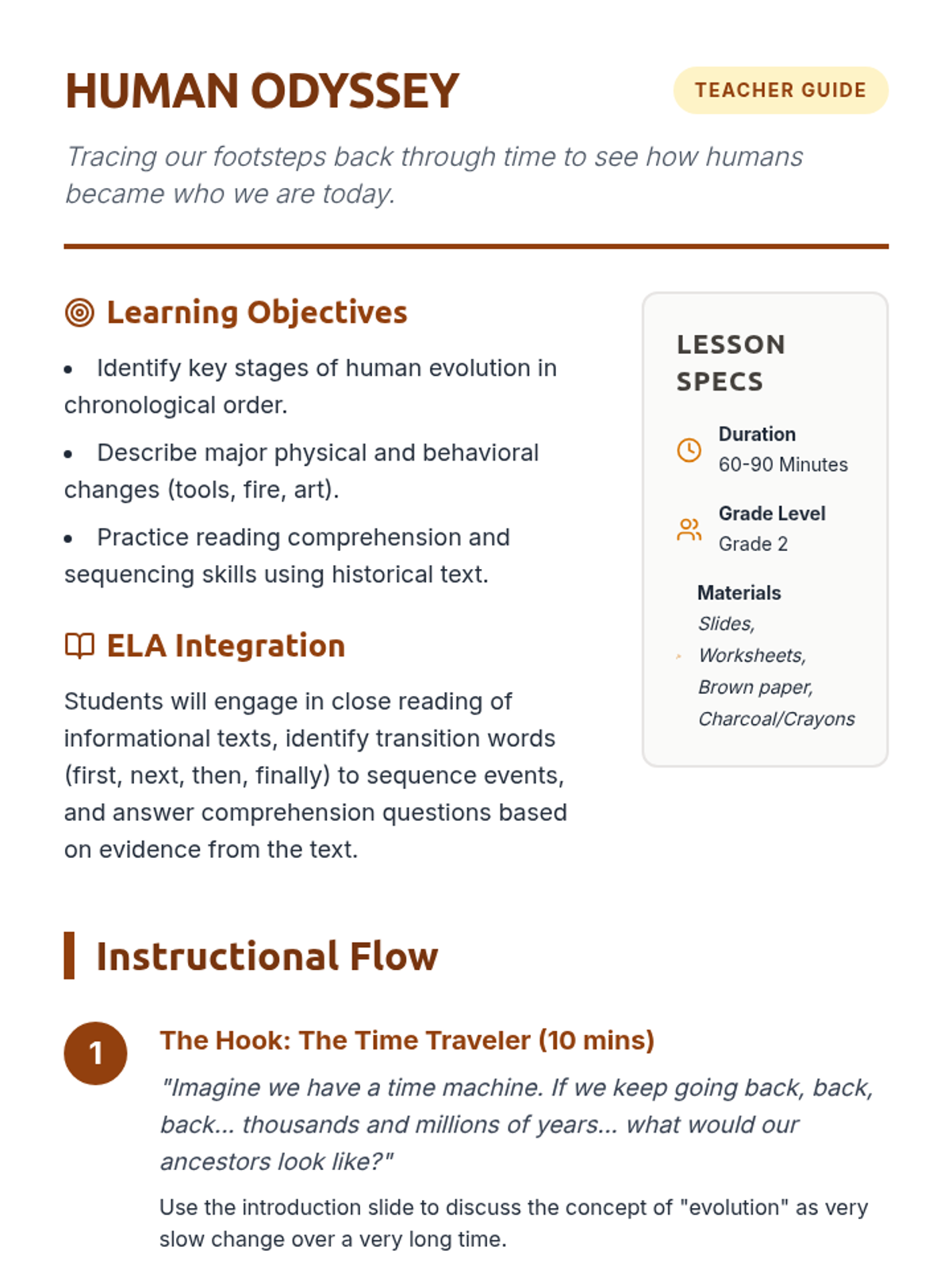
A comprehensive teacher guide for a Grade 2 lesson on human evolution, including learning objectives, ELA integration strategies, a step-by-step instructional flow, and key vocabulary.
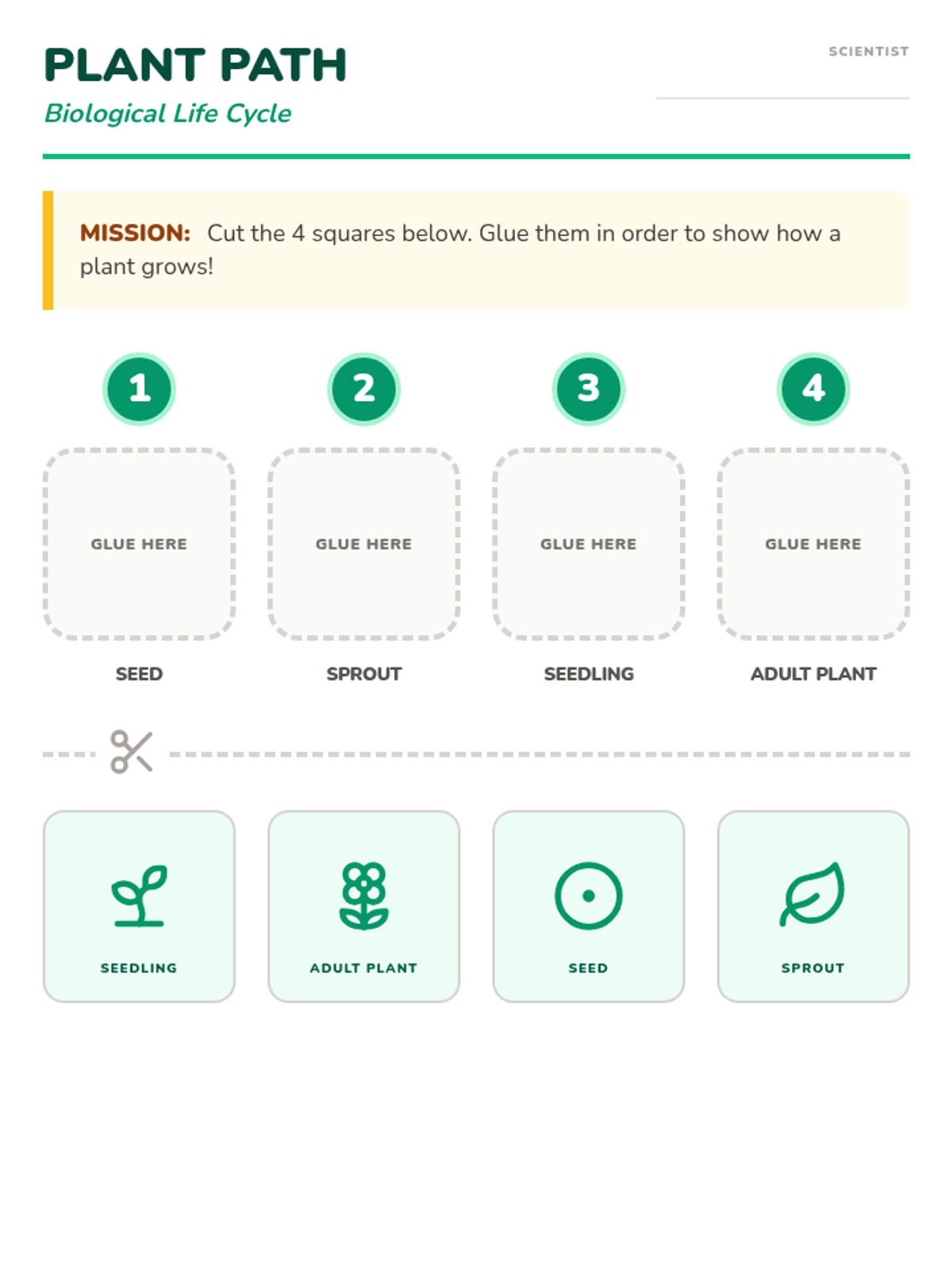
A cut-and-paste sequencing worksheet for plant life cycles. Revised with biologically appropriate icons, higher contrast, and improved sizing for K-3 students.
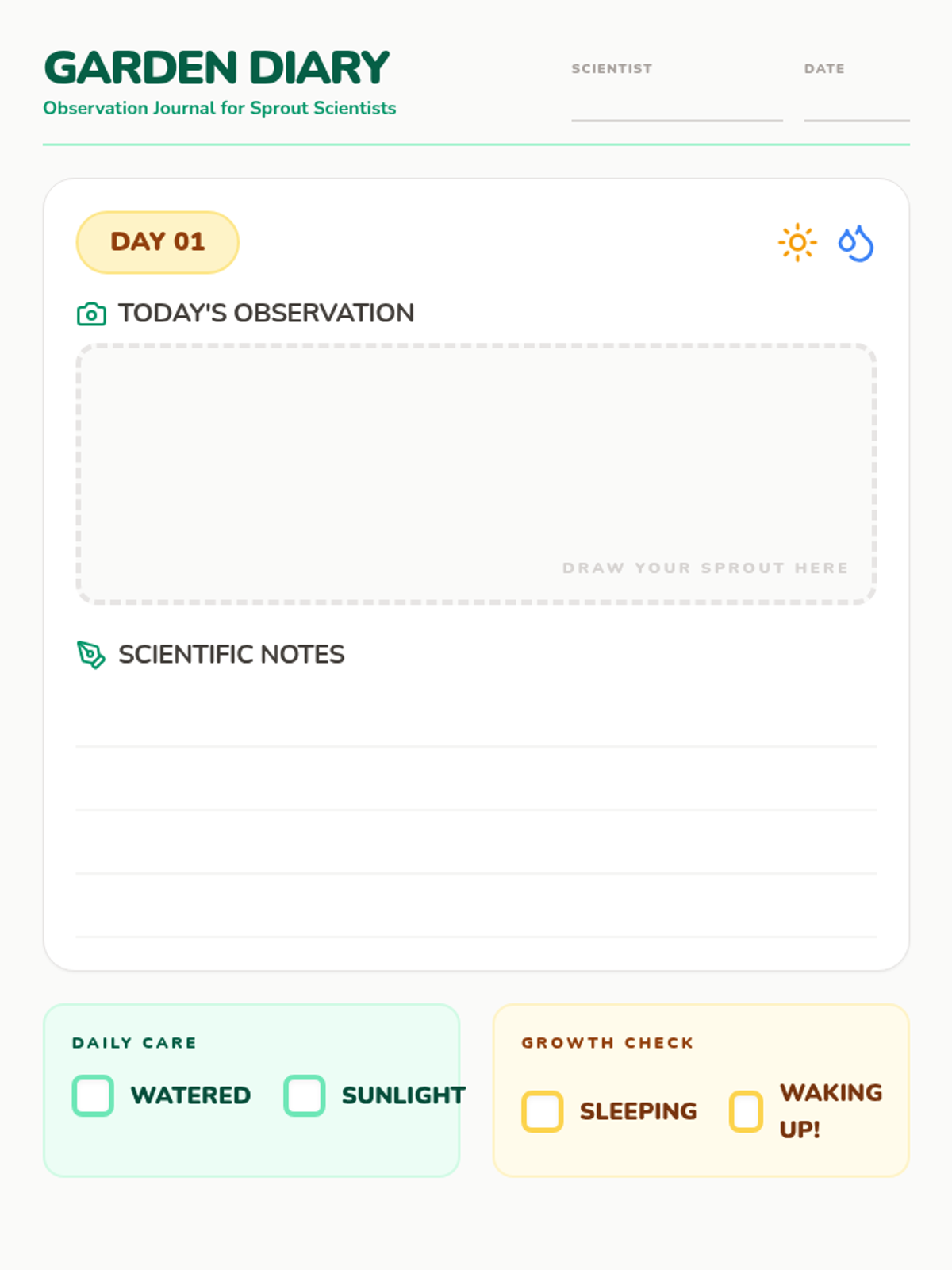
An observation journal template for students to record their sprout's growth. Revised to ensure a single-page layout with more space for scientific notes.
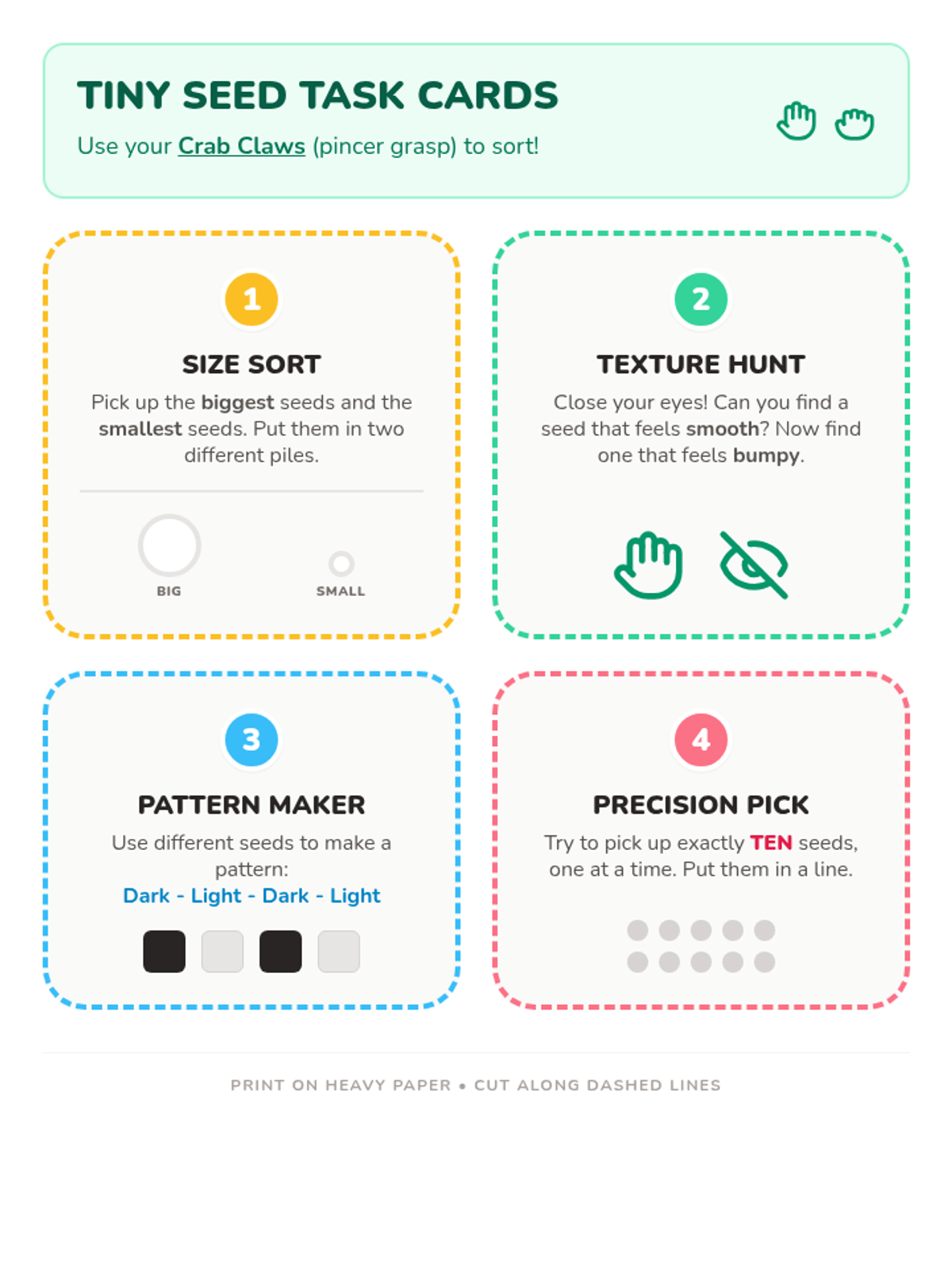
Tactile task cards for seed sorting activities. Revised to ensure all cards fit on one page and improve visibility of icons and labels.
Visual slides for the Sprout Secrets presentation, covering the parts of a seed, the planting process, and the stages of plant growth. Revised with improved contrast and visual consistency.
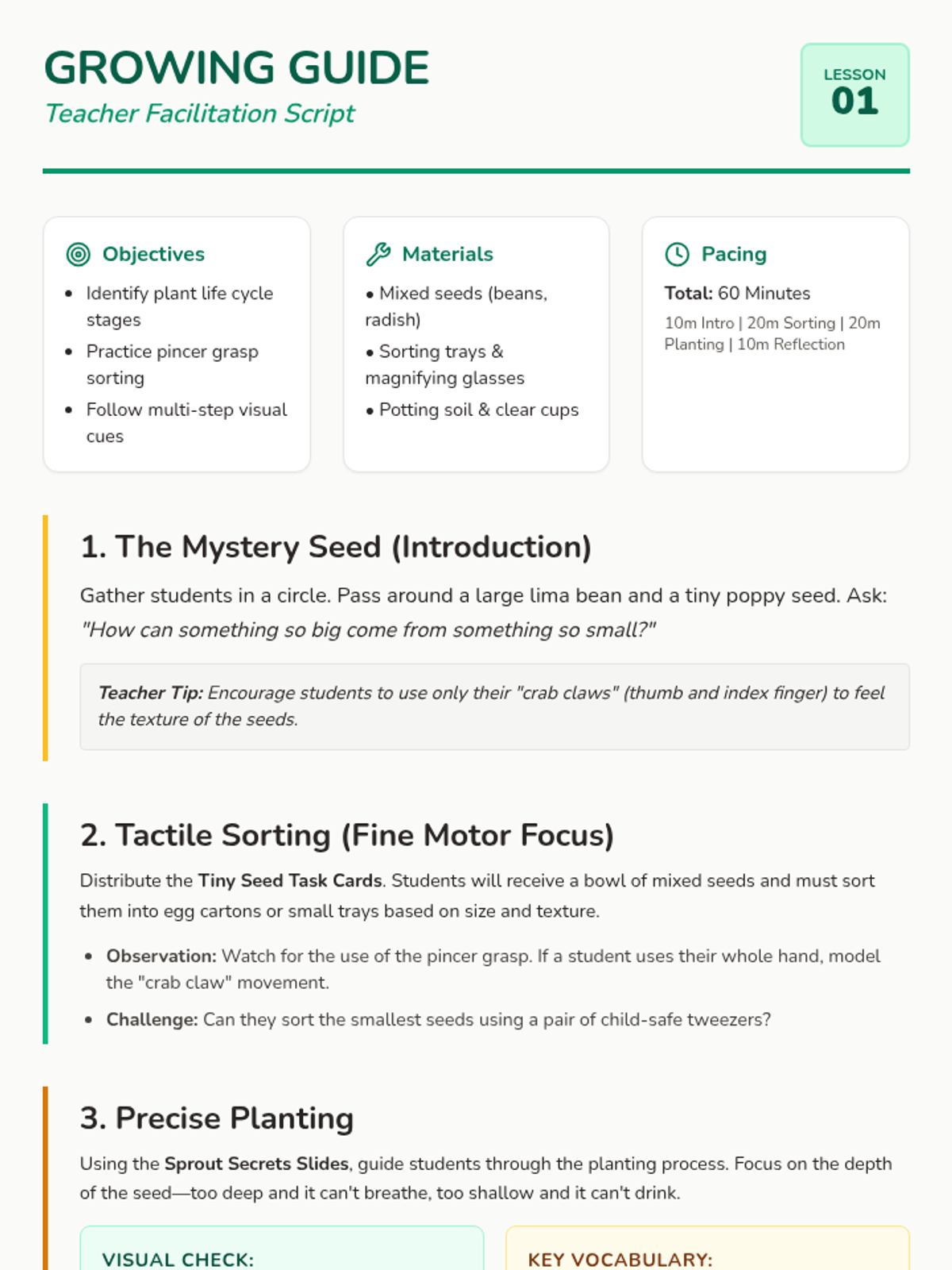
A comprehensive facilitator's guide for the Seed to Sprout lesson, detailing instructional steps, fine motor focus areas, and differentiation strategies for K-3 students. Revised for better layout and text contrast.
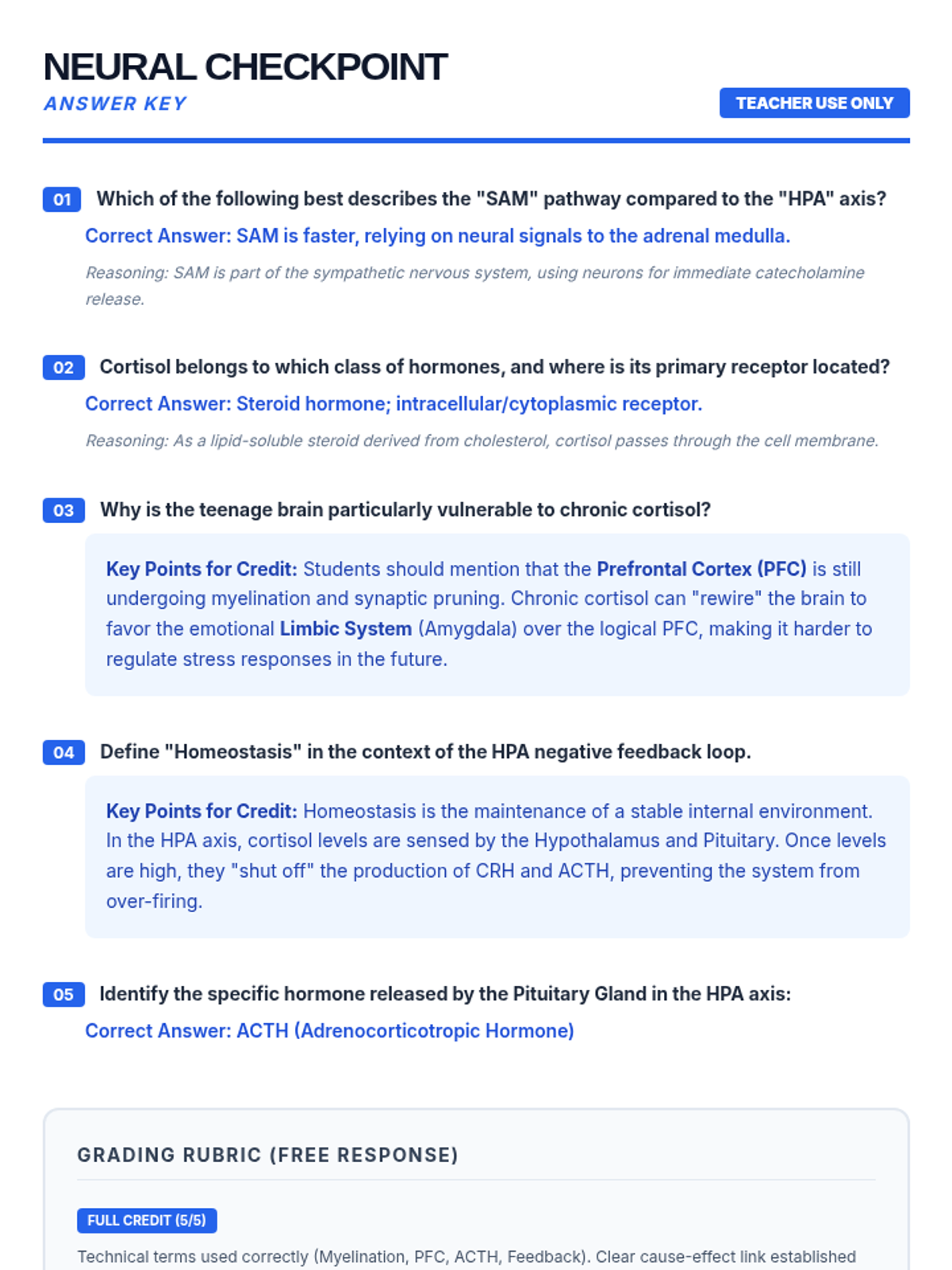
A teacher's answer key for the Neural Checkpoint Quiz. Revised with larger rubric text, improved page flow, and enhanced visibility of teacher-only labels.
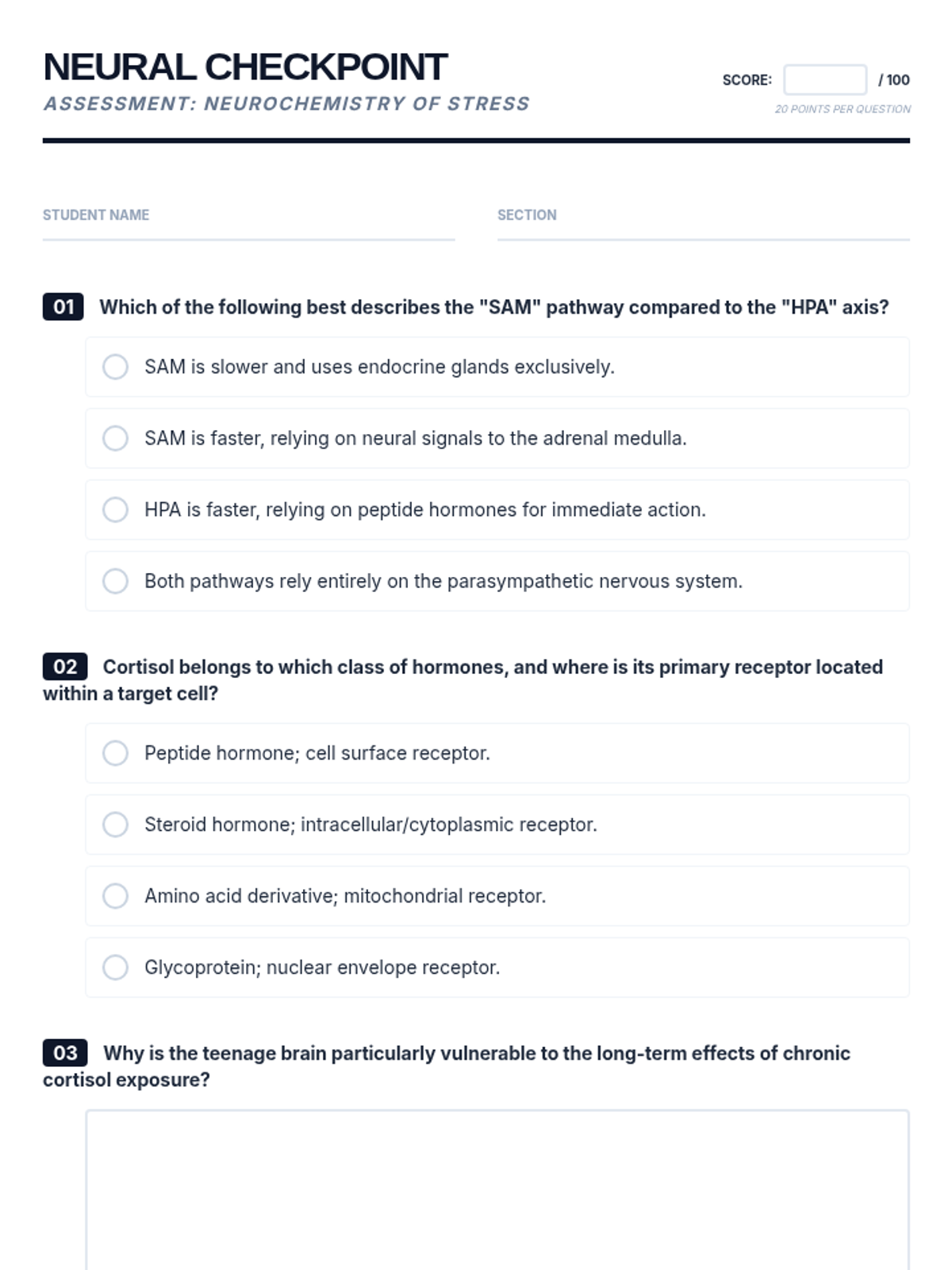
A formal quiz for students assessing understanding of stress neurochemistry. Revised with standardized answer choice styling, improved page flow, and clarified point values.
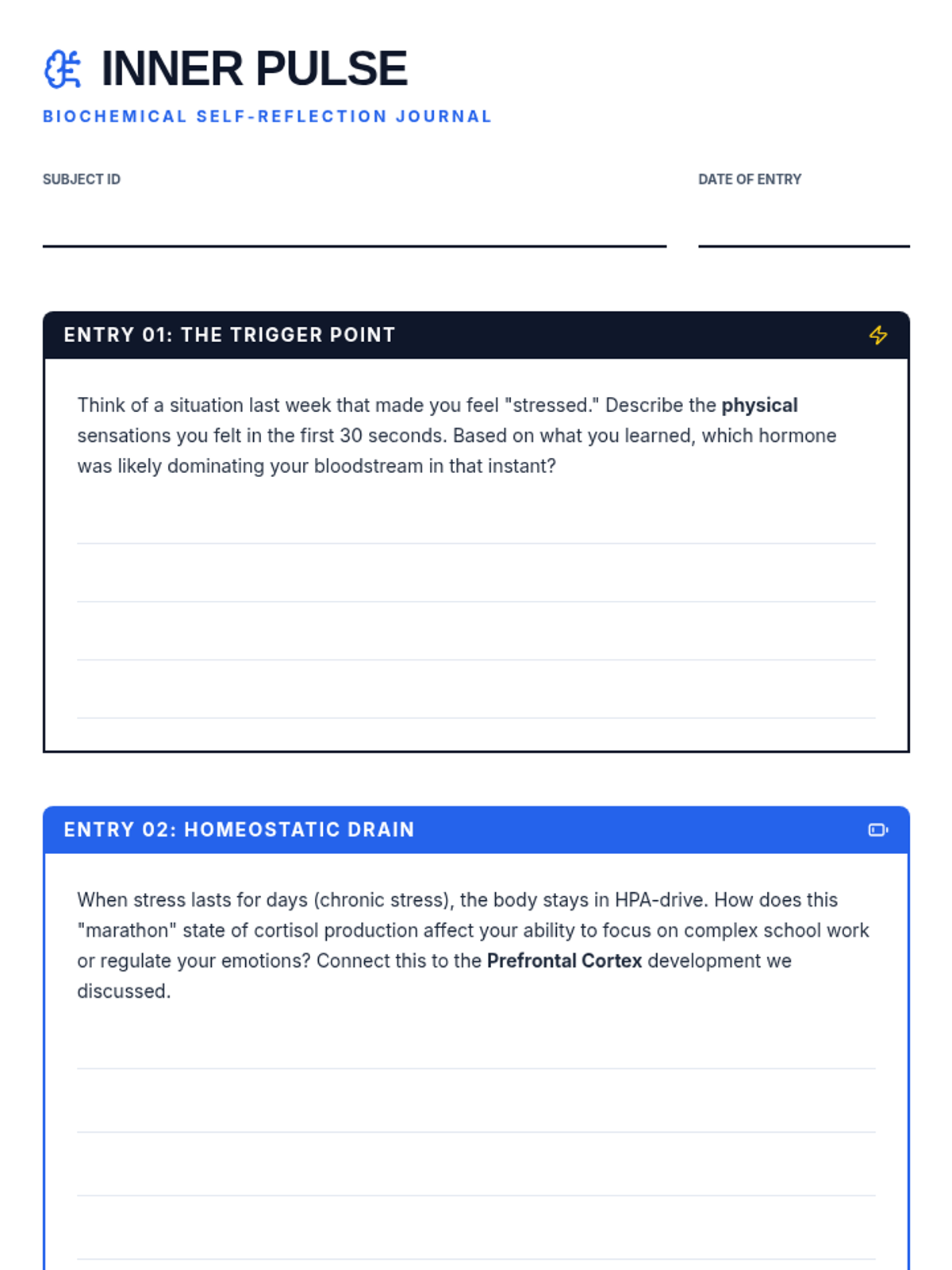
A reflective journal document focusing on the physiological experiences of stress. Revised with corrected footer positioning, higher contrast labels, and improved page flow for writing sections.
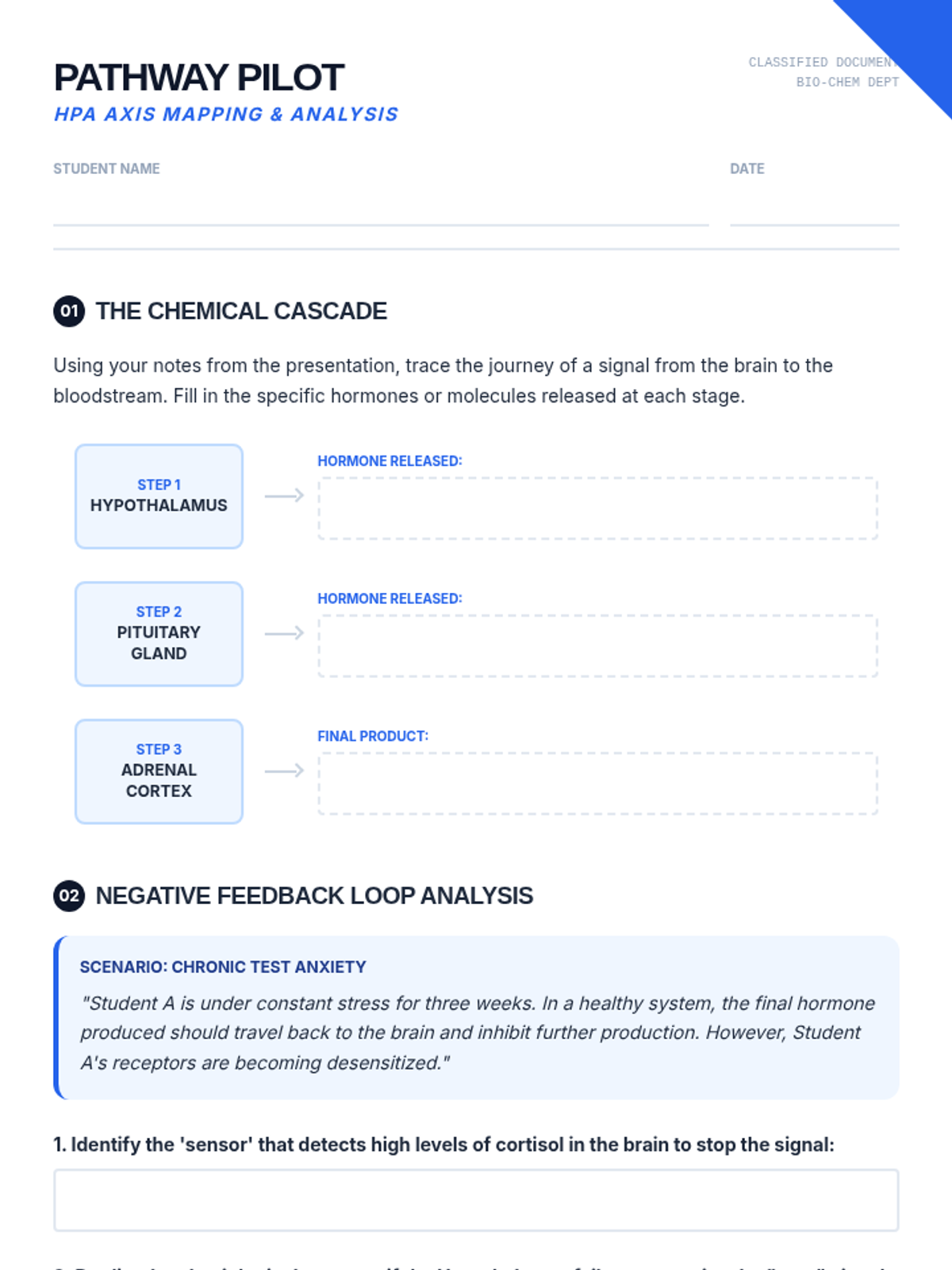
A student mapping activity where they trace the chemical pathways of the HPA axis, analyze a feedback loop failure case study, and compare the SAM and HPA systems. Revised with improved page breaks, manual arrow rendering, and larger workspace boxes.
A modern, high-impact slide deck for classroom presentation. It visualizes the SAM and HPA pathways, the biochemistry of cortisol, and the specific structural differences between teen and adult brains during stress responses.
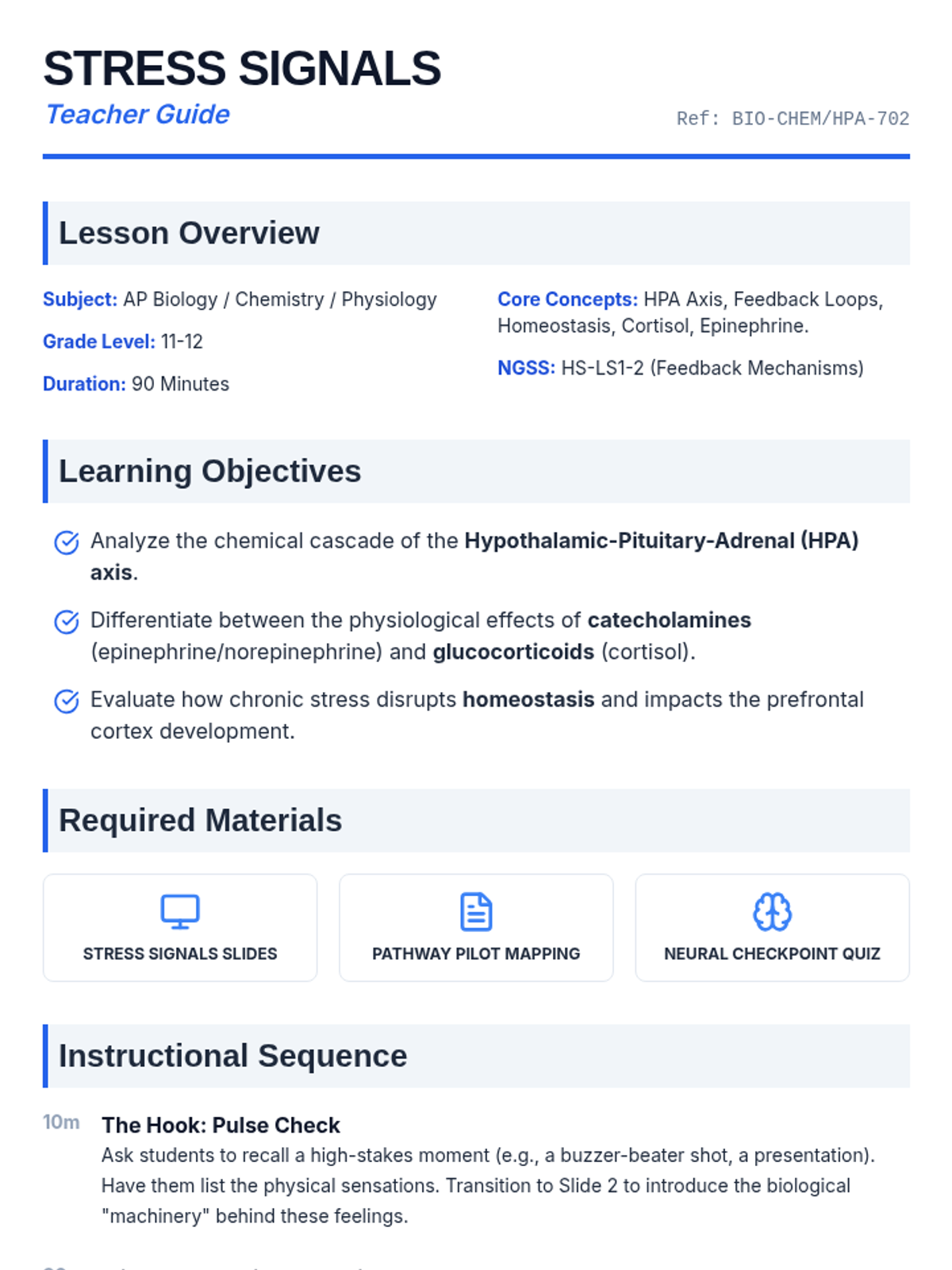
A comprehensive lesson plan for teachers, outlining the instructional sequence, learning objectives, and required materials for teaching the neurochemistry of stress.
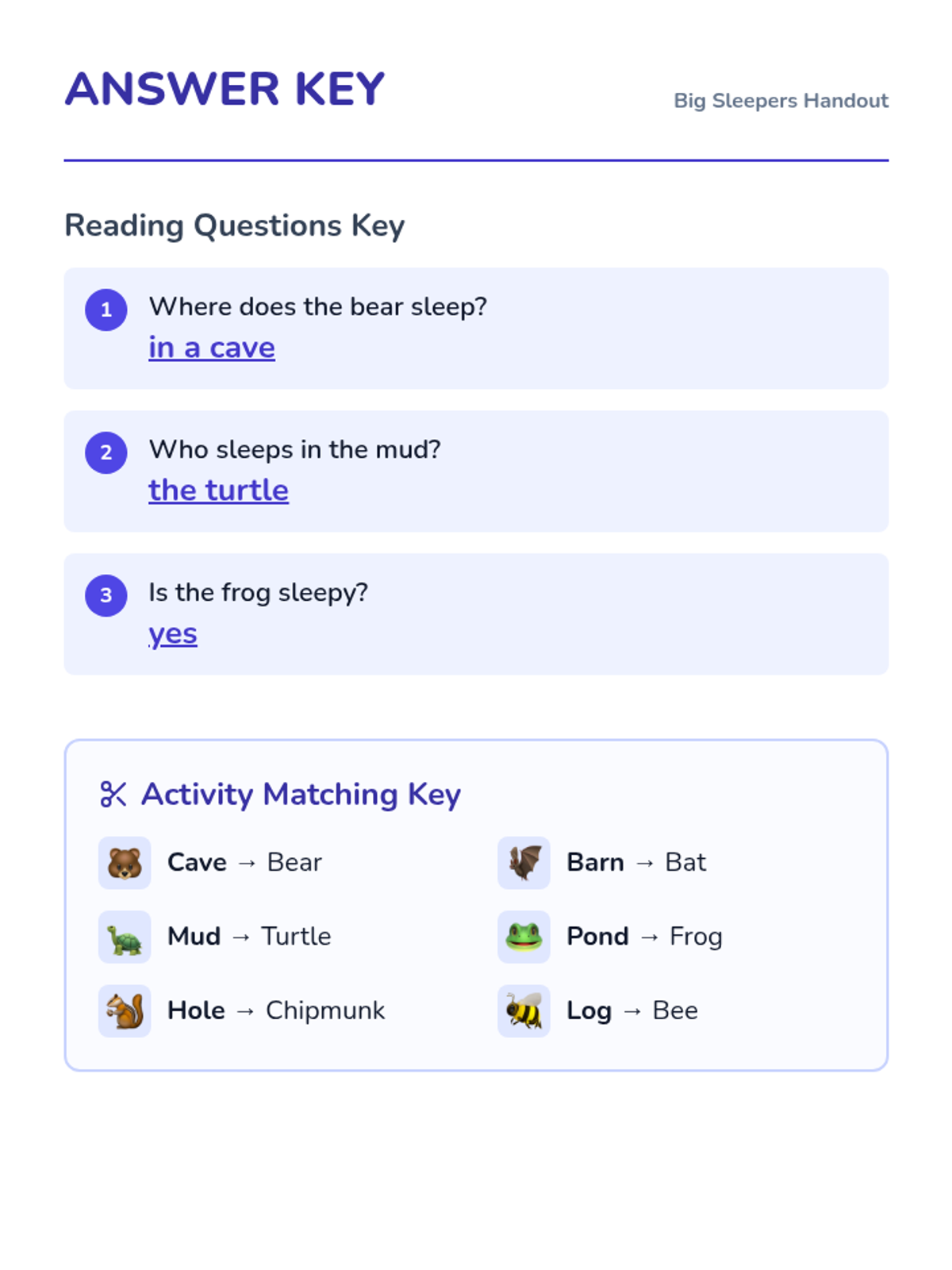
Teacher answer key for the Big Sleepers handout and hibernation activity.
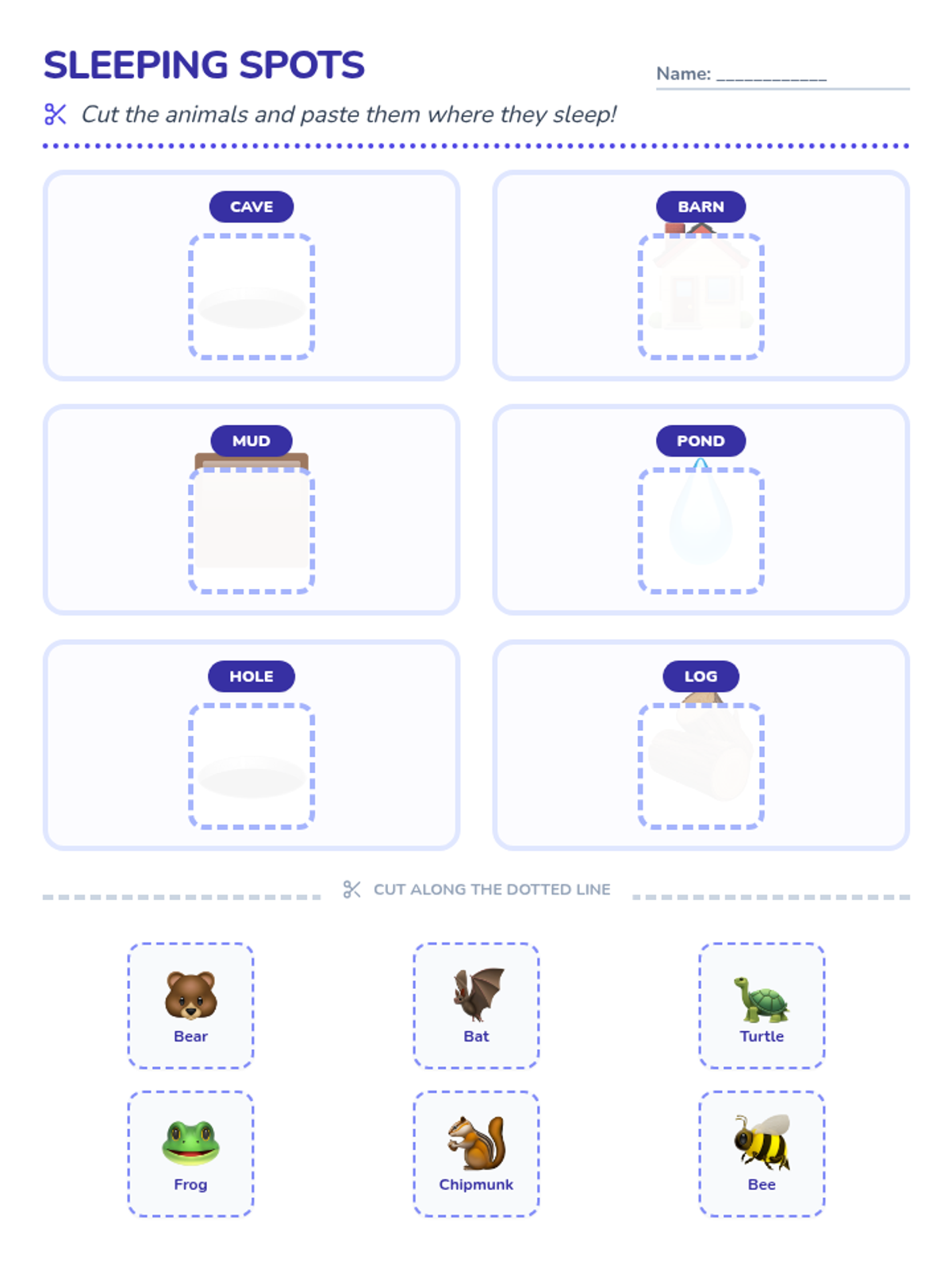
A cut-and-paste activity for kindergarten students to match hibernating animals to their sleeping spots (Cave, Barn, Mud, Pond, Hole, Log). Fits on one page.
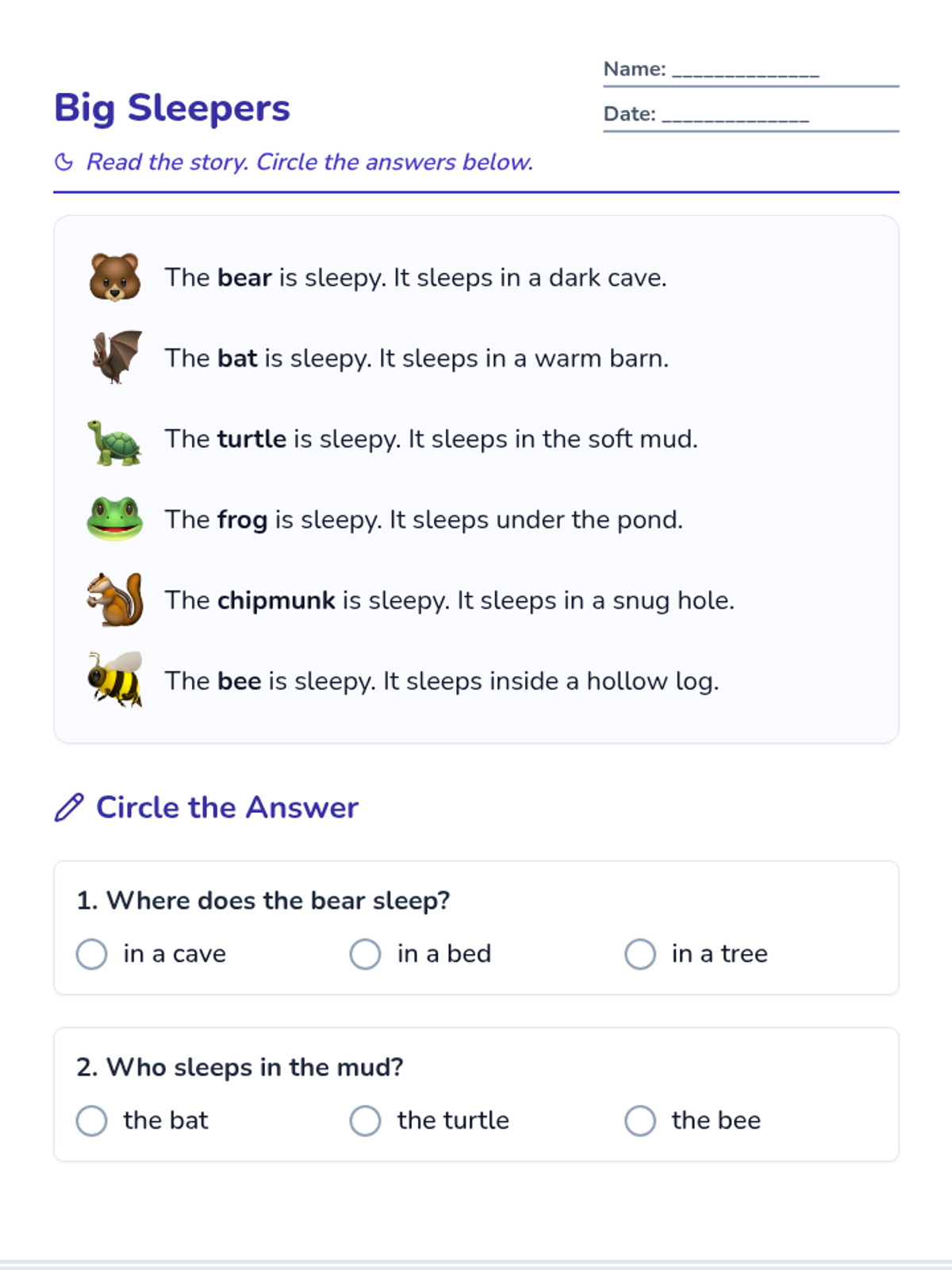
A kindergarten reading passage about hibernation with repetitive text, simple comprehension questions, and a matching cut-and-paste activity. Fits on 2 pages. Revised to fix page breaks and opacity.
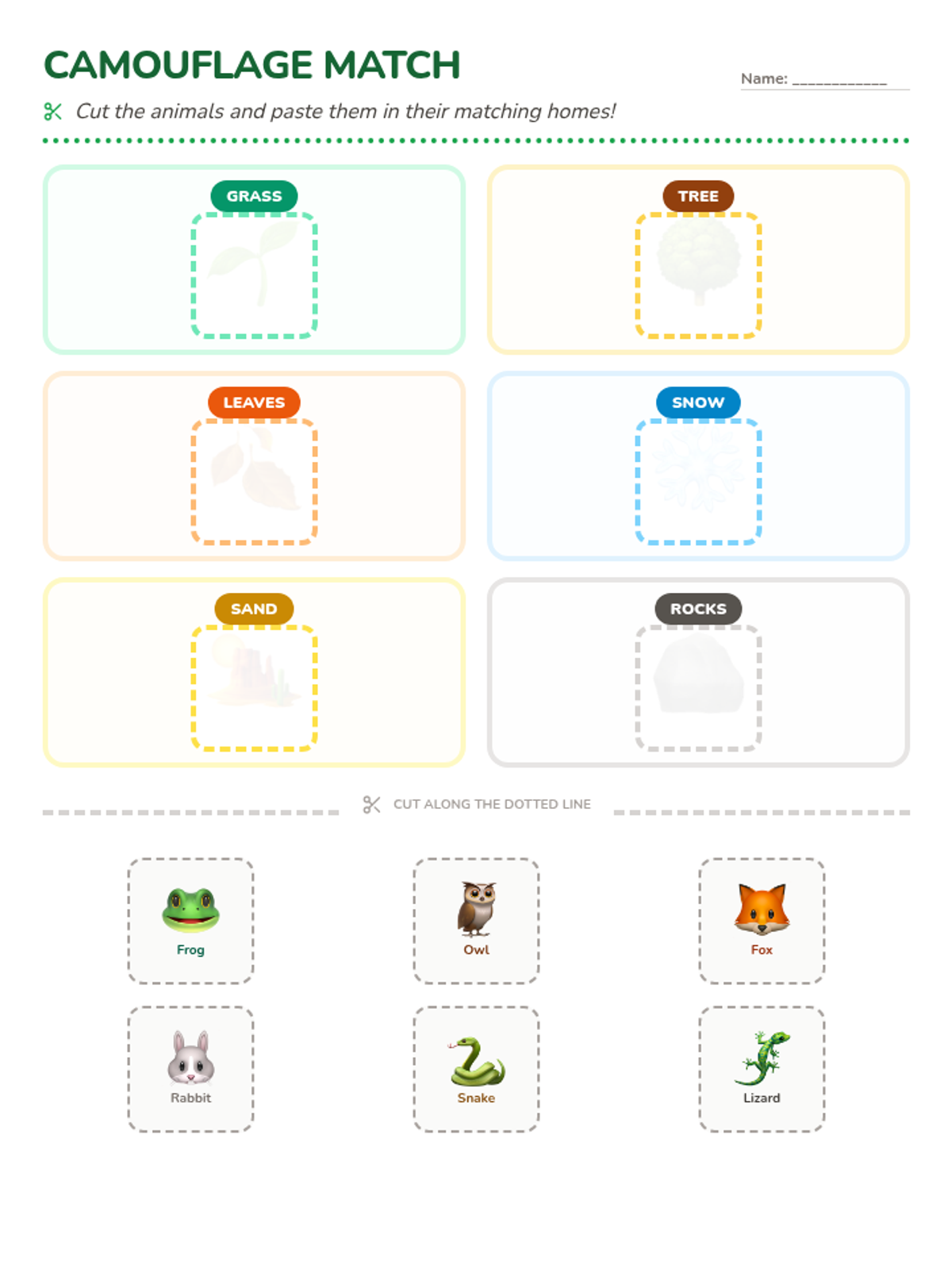
A cut-and-paste activity for kindergarten students to match animals to their camouflaged habitats. Expanded to 6 matches (Grass, Tree, Leaves, Snow, Sand, Rocks). Layout condensed to fit one page.
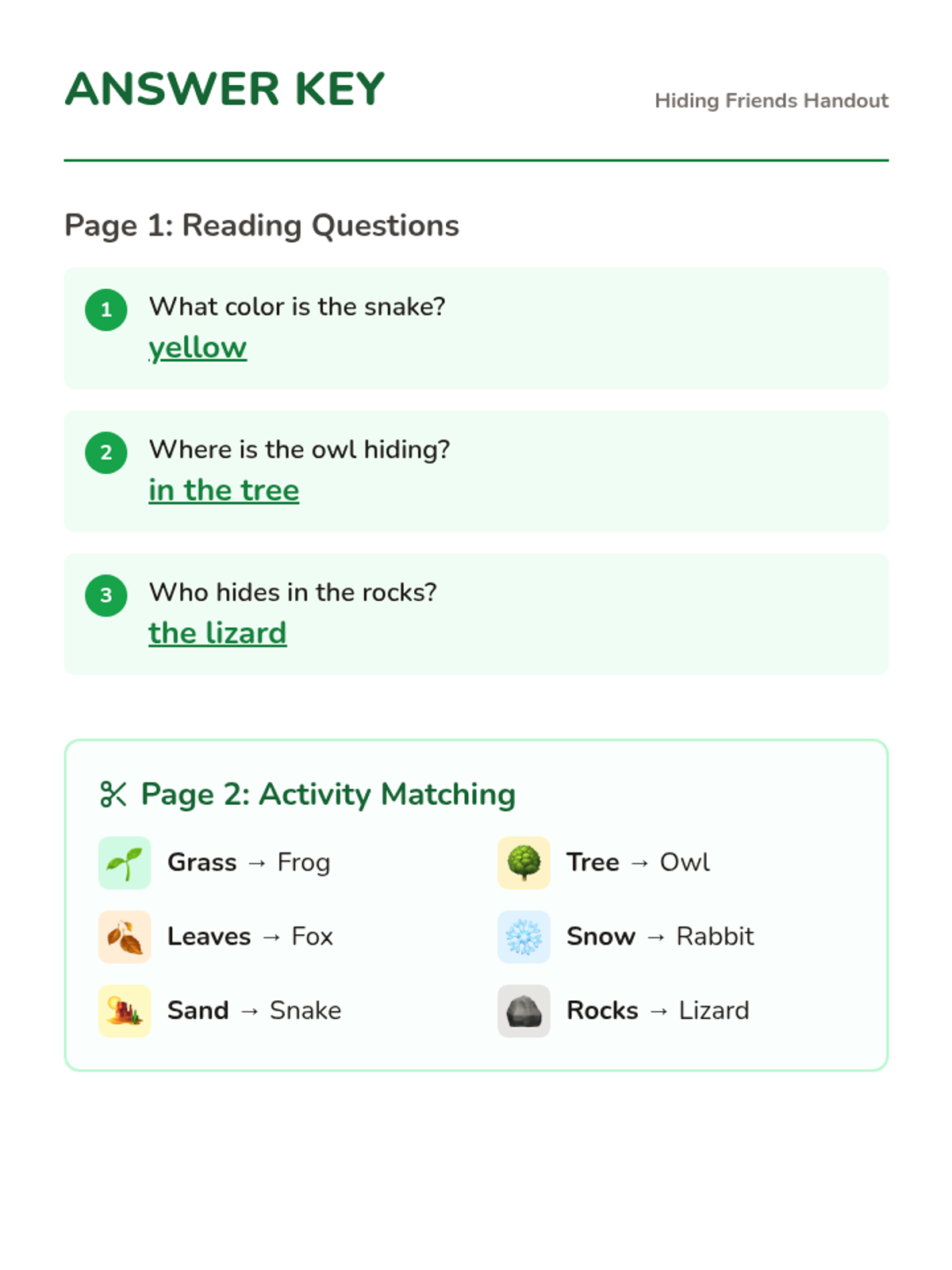
Updated teacher answer key for the Hiding Friends handout and activity, including 6 animal matches.
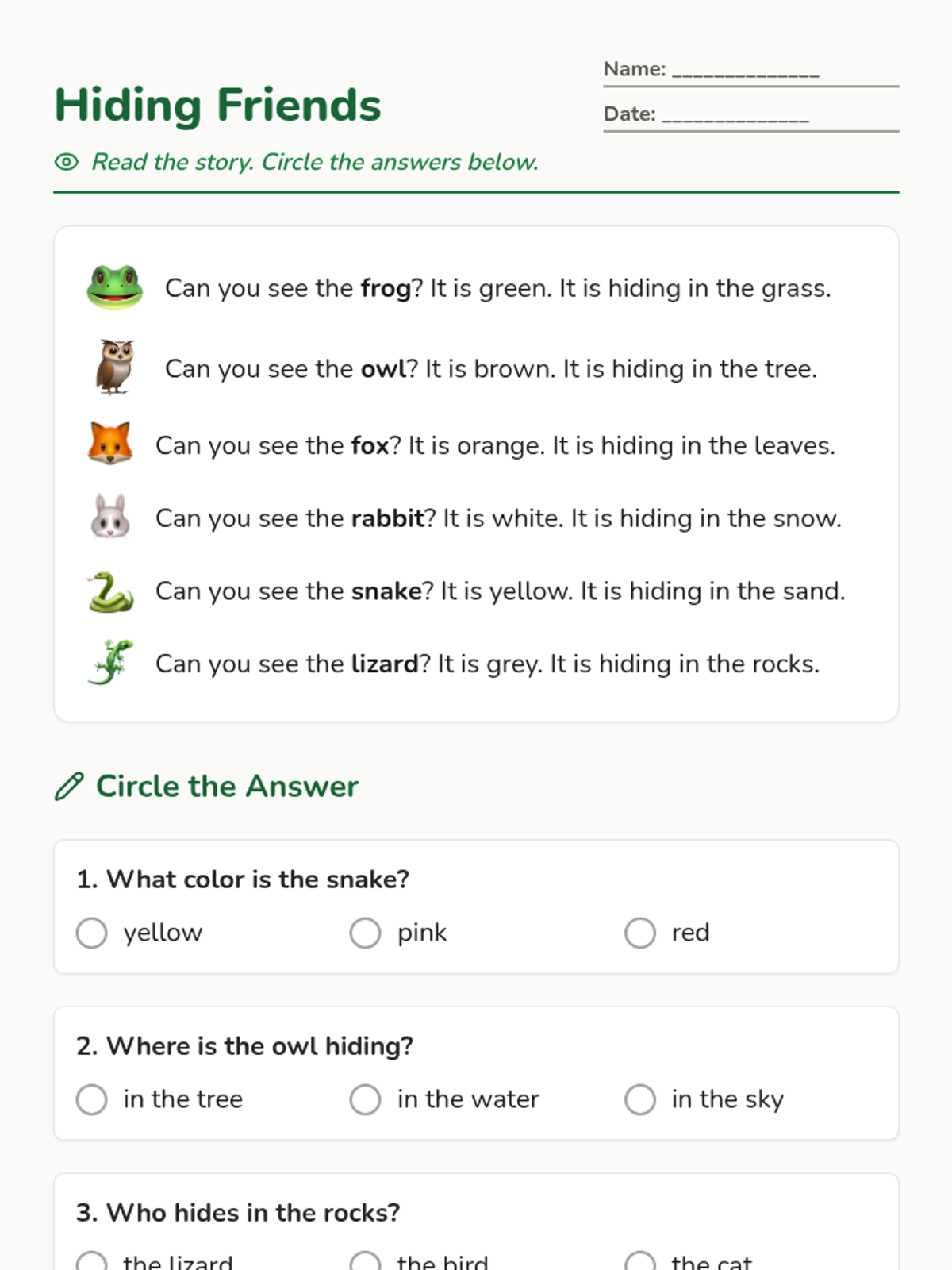
A kindergarten reading passage about camouflage with comprehension questions and a matching cut-and-paste activity. Expanded with 6 animals (Frog, Owl, Fox, Rabbit, Snake, Lizard). Fits on a single page. Capitalization and style fixed for consistency.
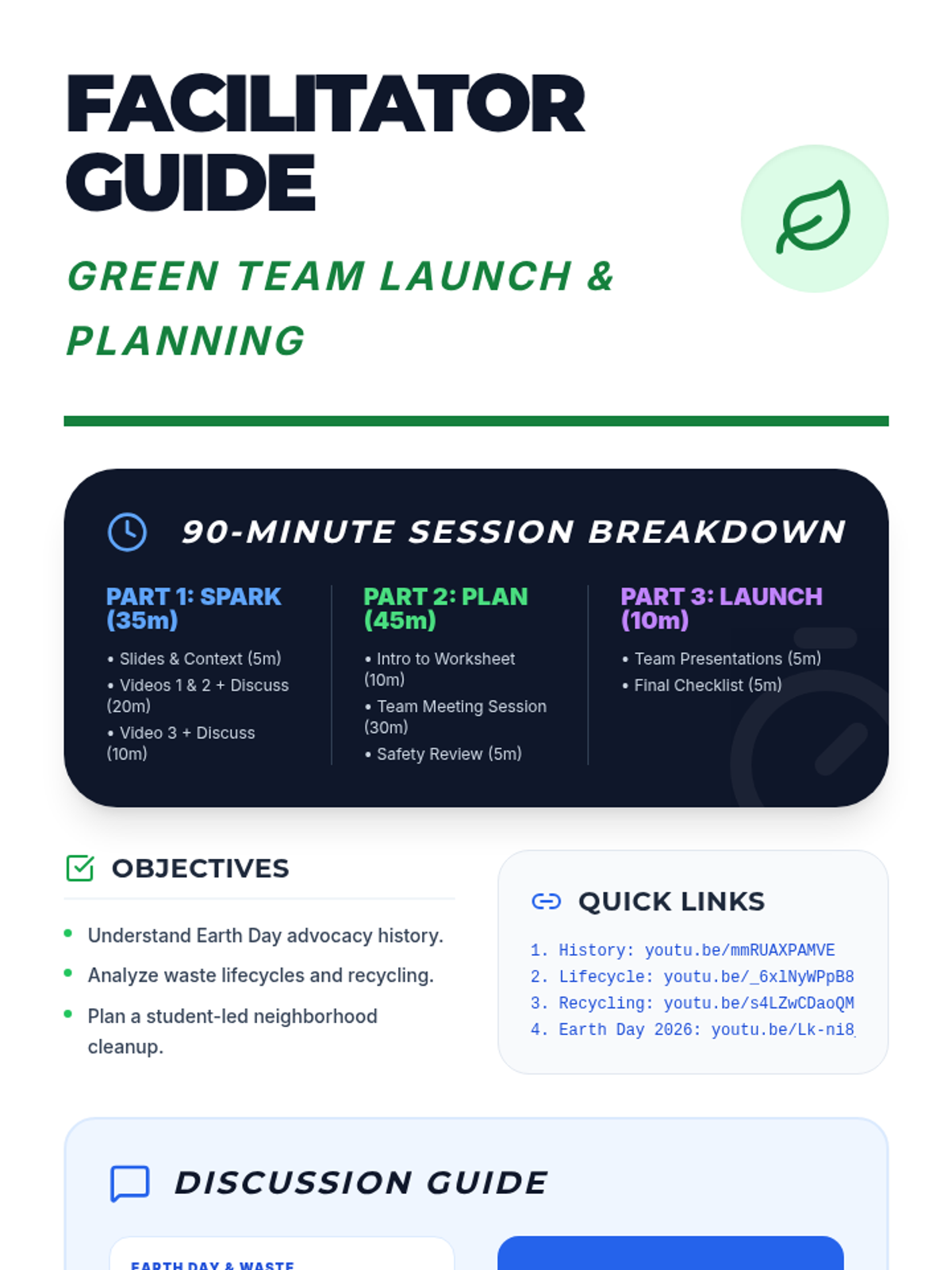
A comprehensive facilitator guide for teachers to lead the Earth Day cleanup project. Includes a 90-minute session breakdown, objectives, video discussion prompts, safety protocols, and team meeting tips.
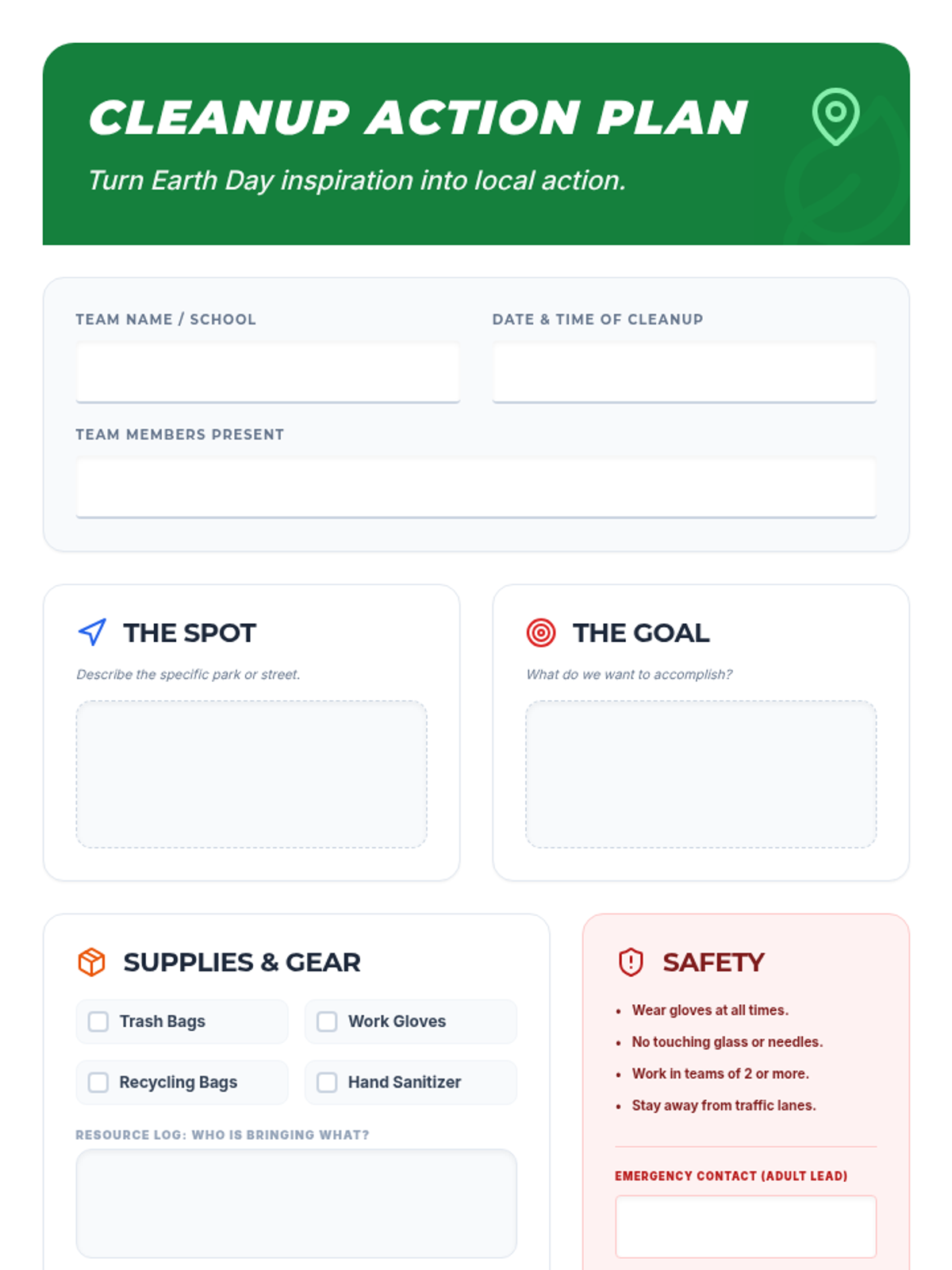
A practical meeting guide for students to organize their community cleanup. Includes sections for team goal-setting, role assignment, supply checklists, safety protocols, and recruitment strategies.
A visually engaging slide deck covering Earth Day history, the impact of plastic waste, recycling processes, and a guide for organizing a community cleanup. Includes four embedded educational videos.
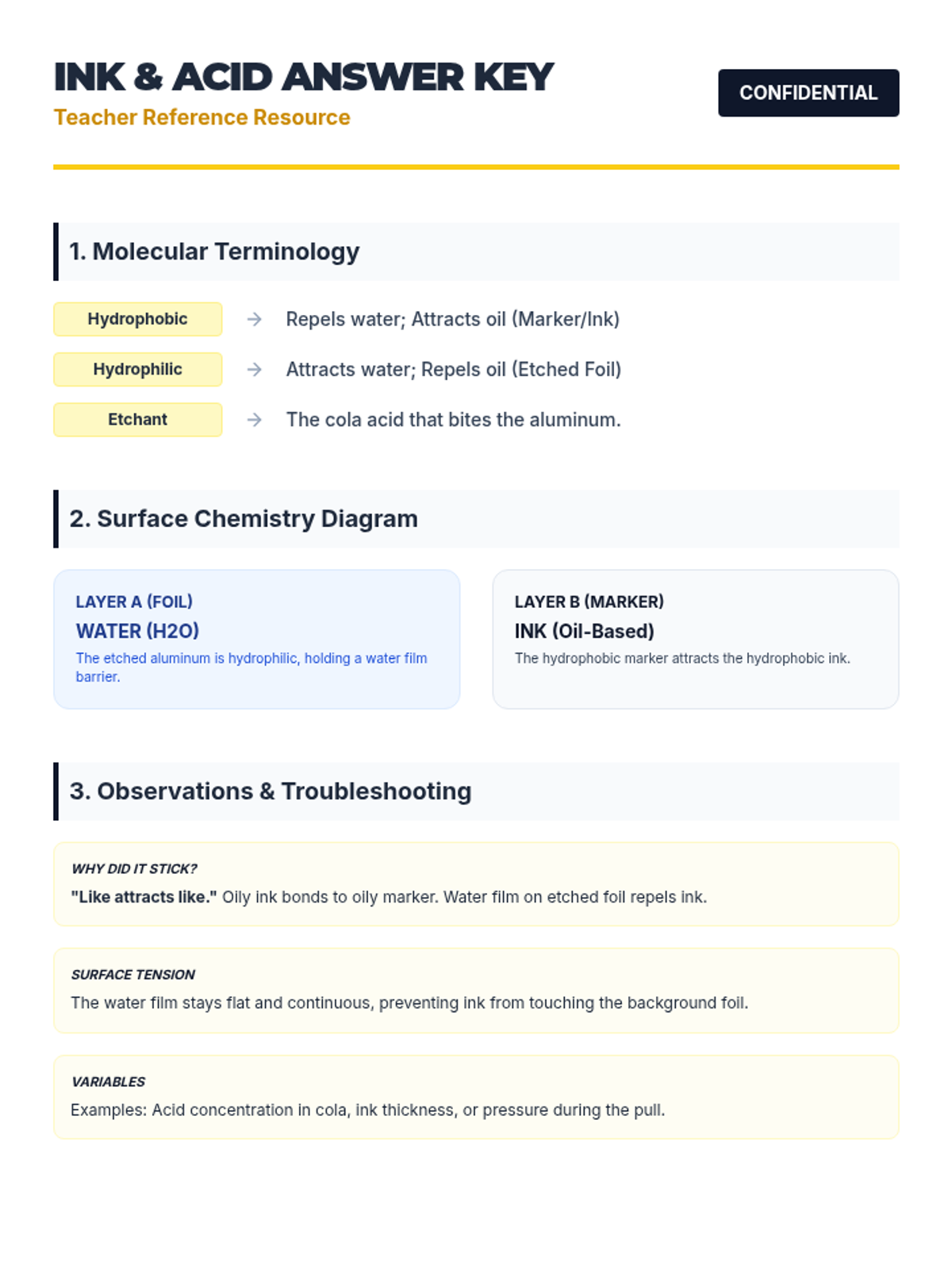
The teacher's answer key for the Ink and Acid Worksheet, providing correct scientific terminology, diagram labels, and sample high-quality reflection responses.
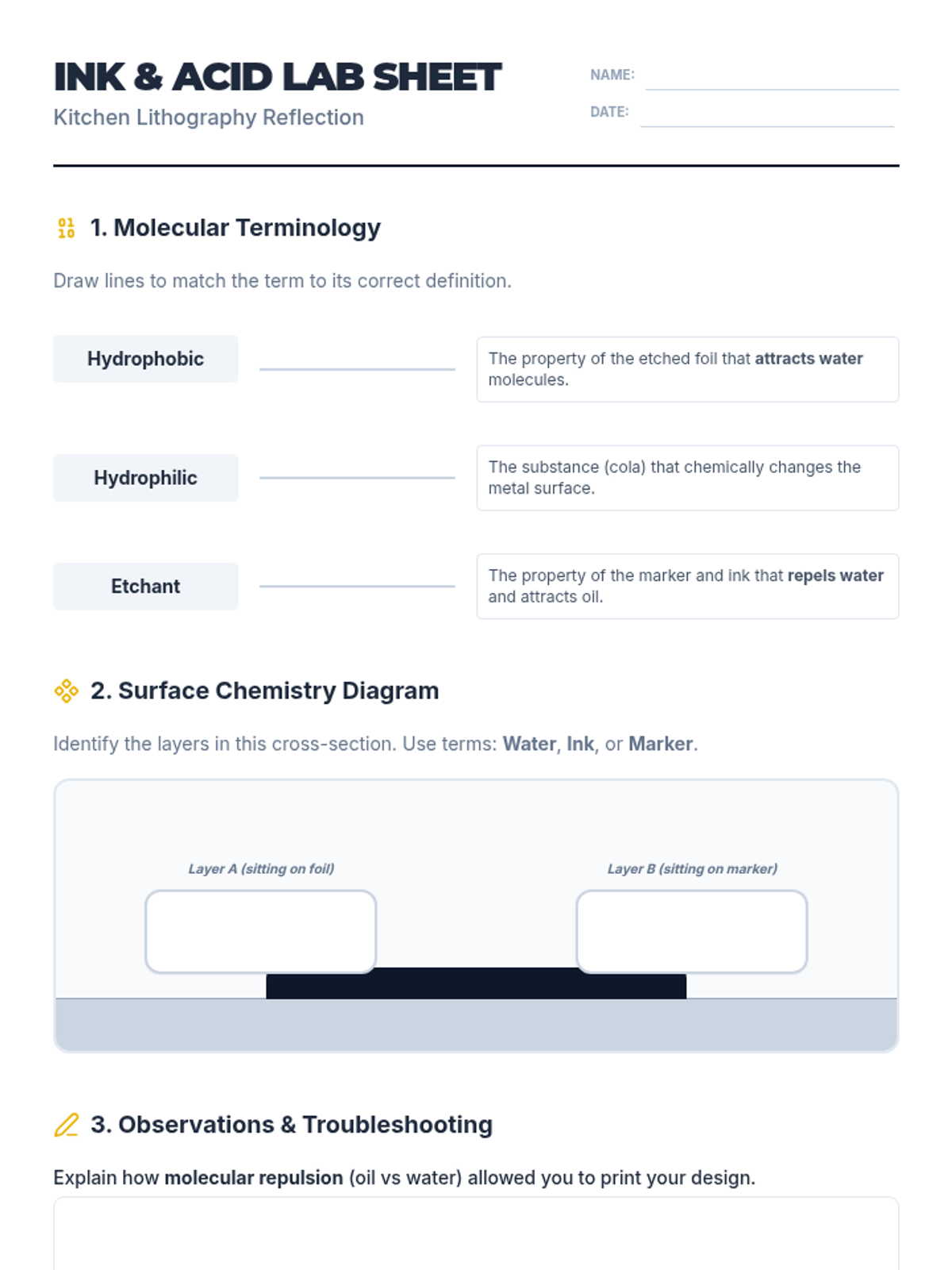
A student worksheet focusing on the chemistry of kitchen lithography. Features vocabulary matching, a cross-section diagram analysis of surface layers, and reflection questions on hydrophobia and process improvement.
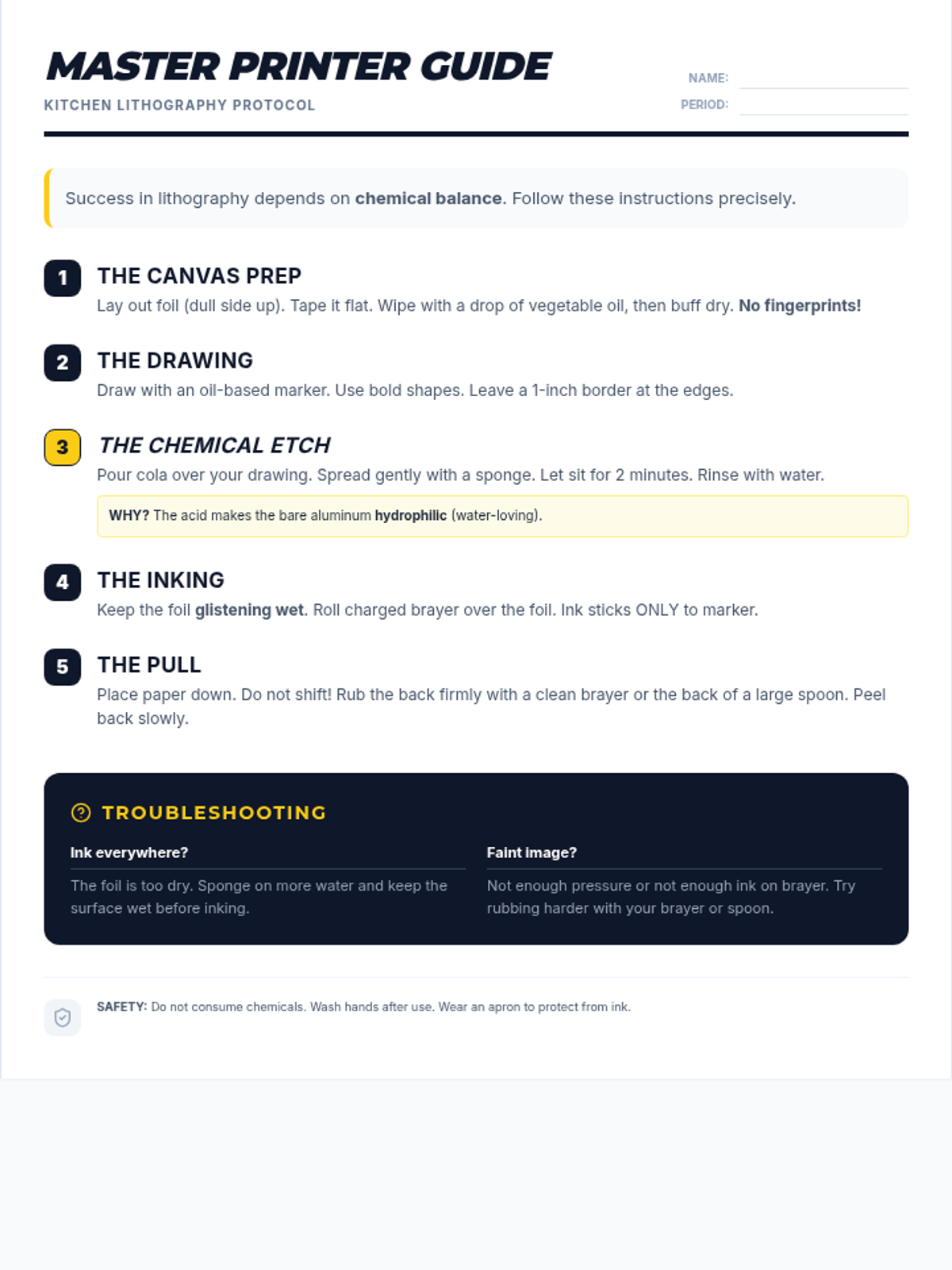
A step-by-step student activity guide for the kitchen lithography process. Includes visual cues, "pro tips," and chemical explanations for each stage of preparing, etching, and printing.
A visually engaging instructional slide deck for students covering the history of lithography, the chemistry of hydrophobia/hydrophilia, and the specific role of cola in etching aluminum foil.
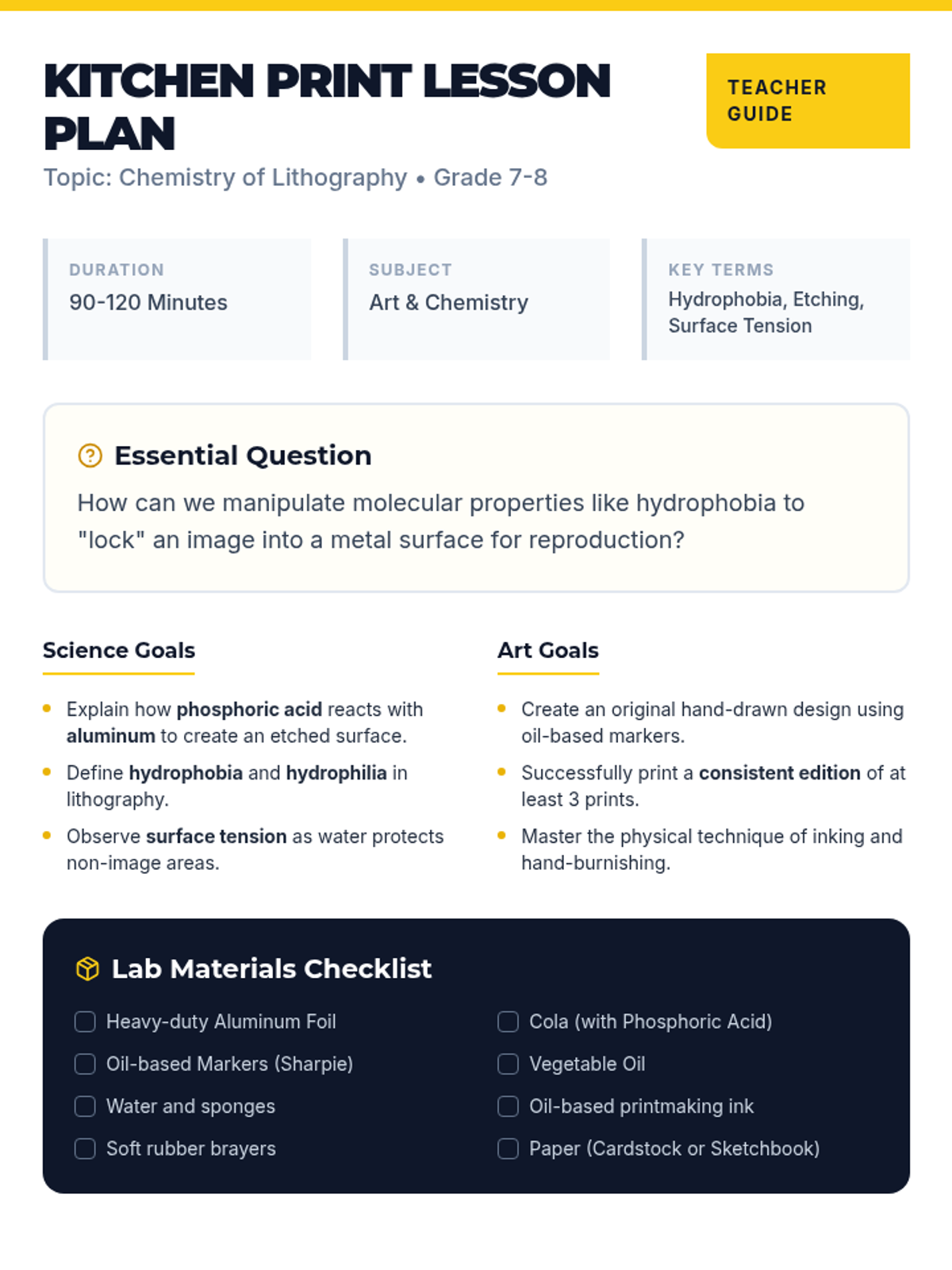
A comprehensive lesson plan for teachers detailing the chemistry and artistic process of kitchen lithography. Includes learning objectives, materials checklists, step-by-step instructional sequence, and troubleshooting tips.
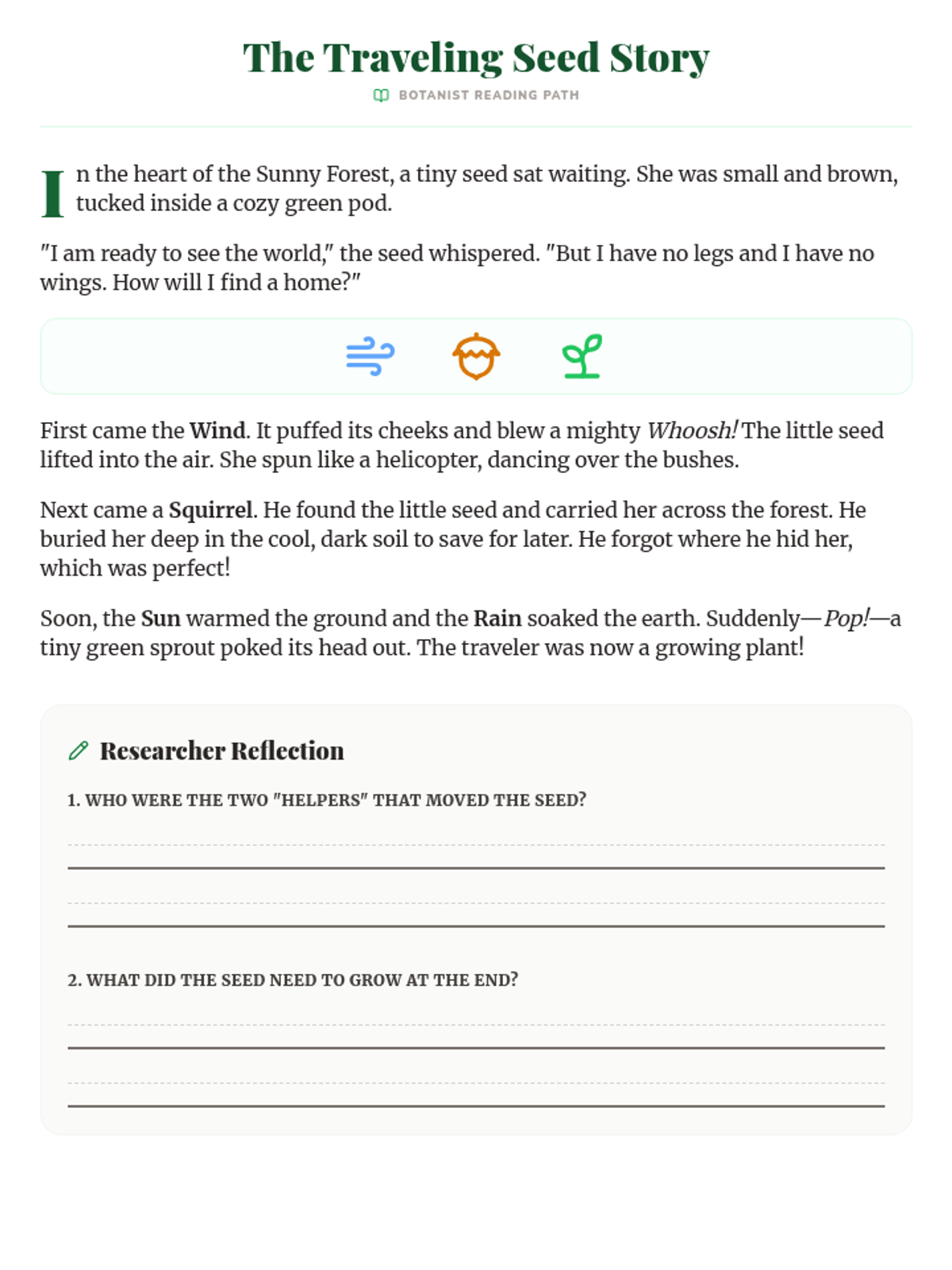
A reading passage about a seed's journey. Revised to fit a single page, provide massive handwriting spaces for young learners, and use clean Lucide icons.
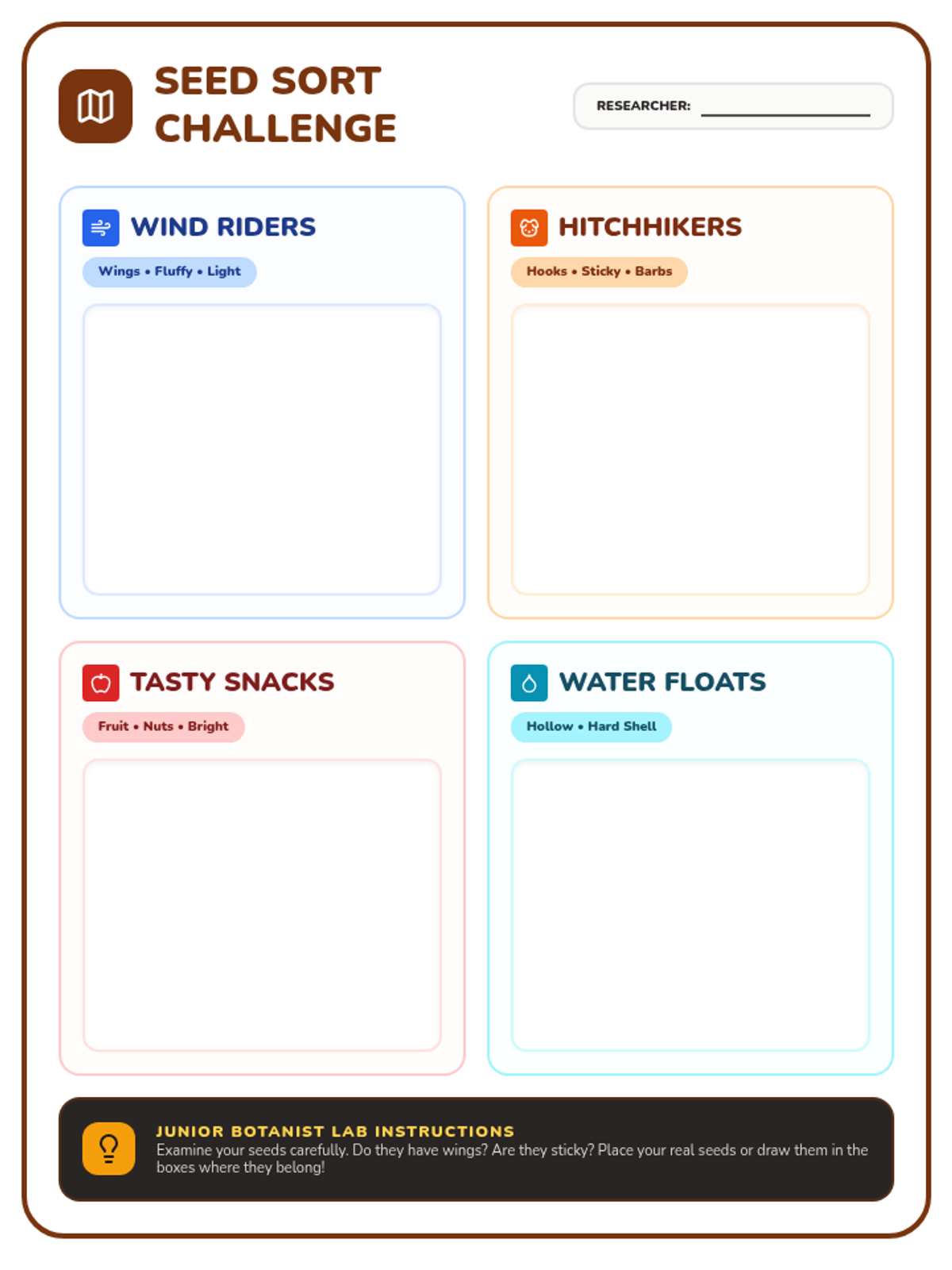
A hands-on sorting mat for students to categorize seeds. Revised for single-page print optimization, improved text contrast, and consistent work areas.
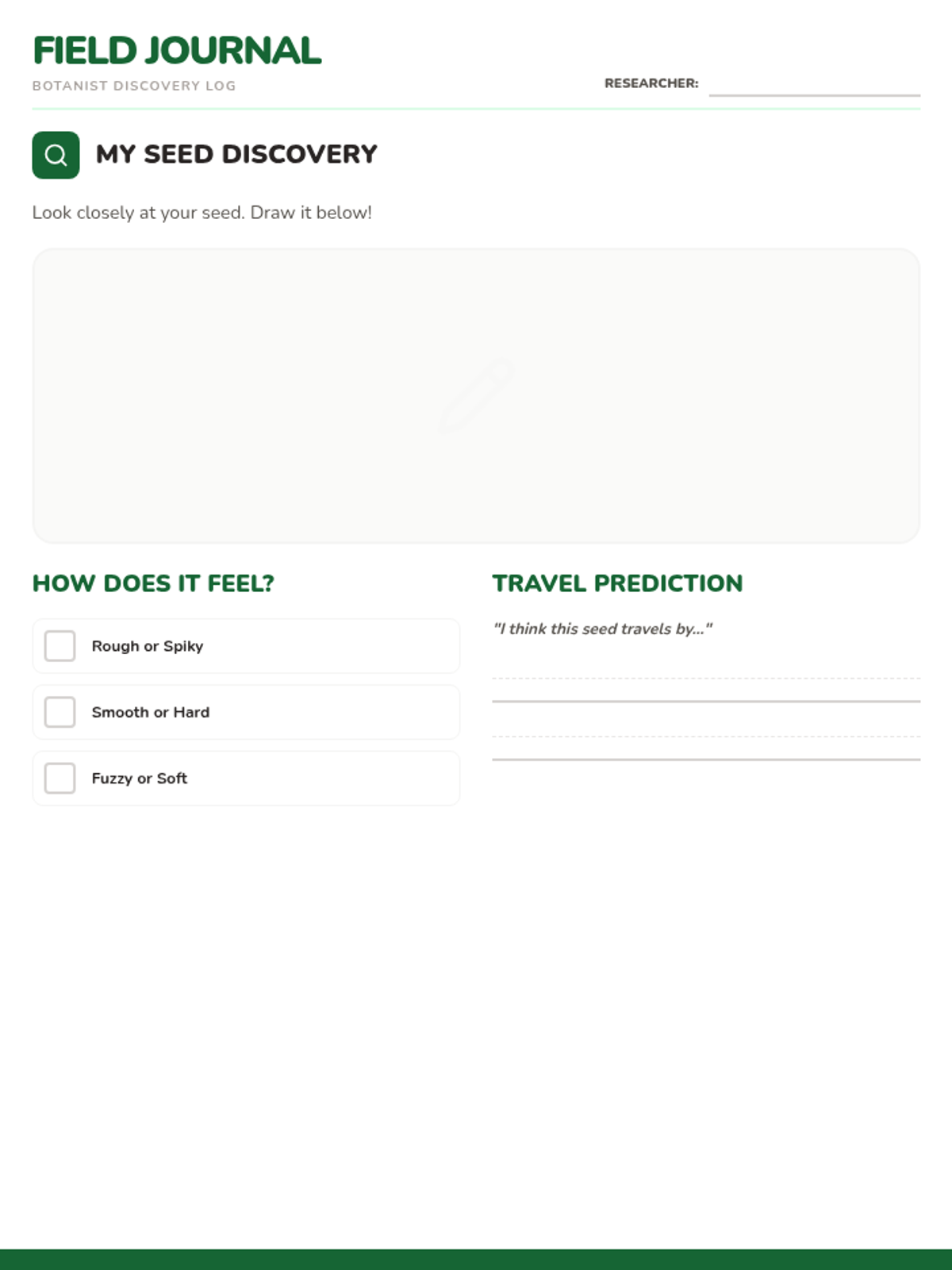
A student-facing field journal for recording seed observations and growth predictions. Revised with optimized printable layout, larger writing areas, and improved legibility for young students.
A visual presentation for students that explains the different ways seeds travel (wind, animals, snacks) and identifies the three essential conditions for plant growth (sun, water, soil). Revised with larger visuals and improved legibility.
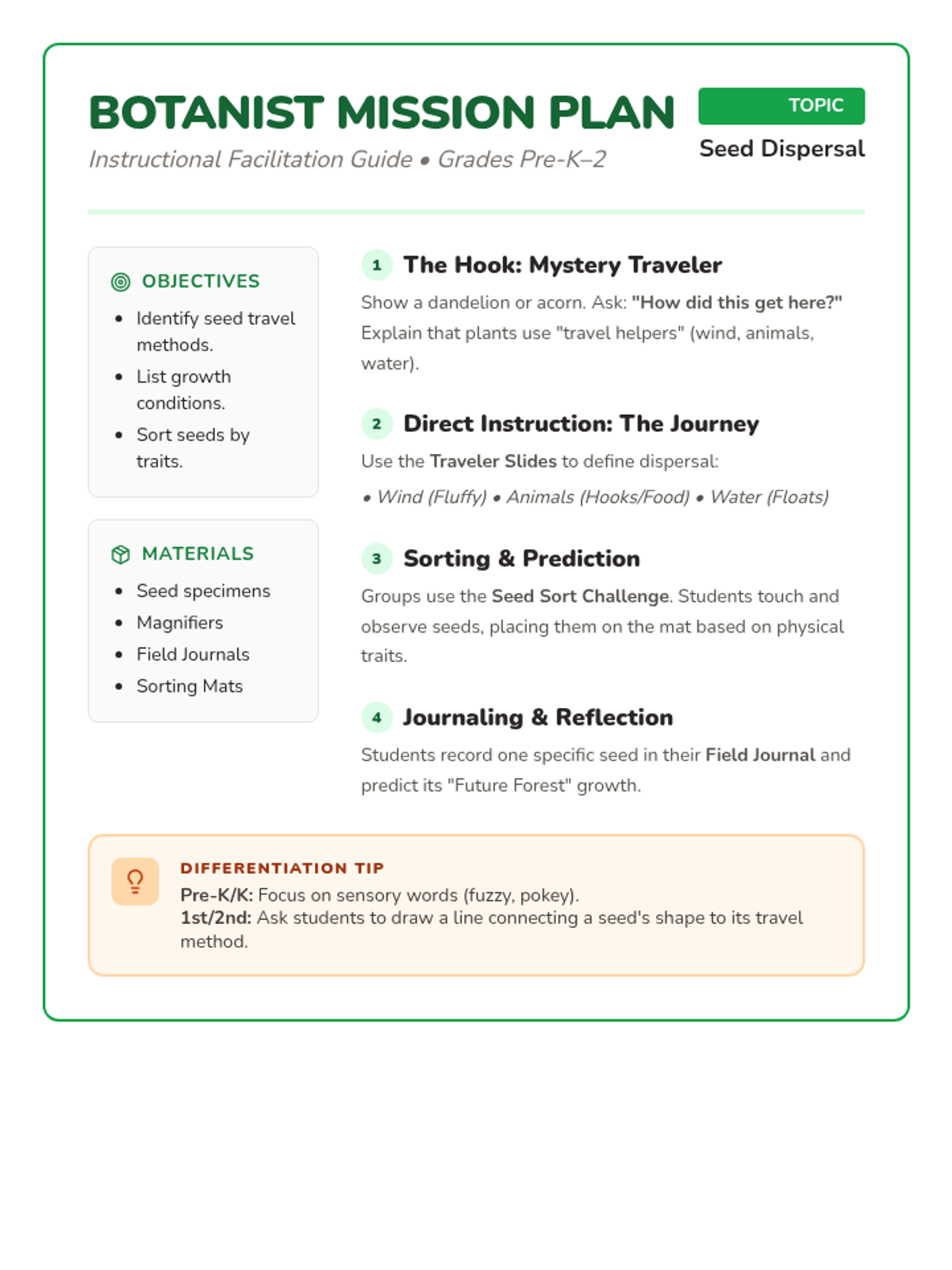
A comprehensive teacher's guide for 'The Great Seed Journey' lesson, including learning objectives, material lists, and a step-by-step instructional flow for exploring seed dispersal and plant growth. Revised for single-page layout.
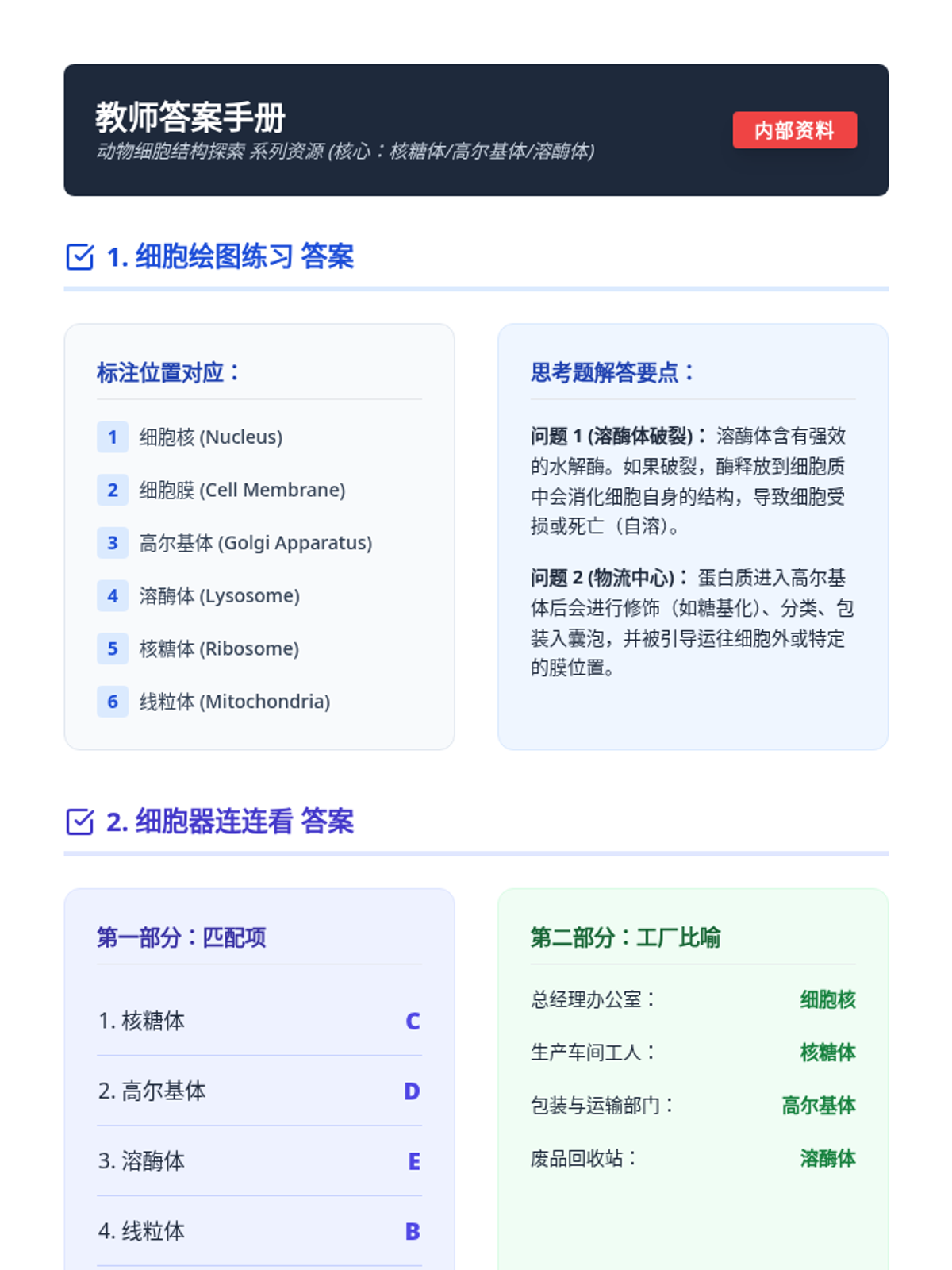
为教师提供的完整答案手册,包含所有练习的正确答案和解析,以及针对教学过程的额外建议。
一个匹配练习,旨在强化学生对细胞器功能的理解。通过将结构与功能匹配,以及使用工厂比喻来加深记忆。包含核糖体、高尔基体、溶酶体等核心内容。单页精简版。
一份学生练习纸,包含动物细胞结构的标注活动。学生需要根据示意图填入正确的细胞器名称,并回答有关溶酶体和高尔基体功能的思考题。设计简洁专业,适合打印。词库直接附于练习下方。
一套精美的教学幻灯片,介绍了动物细胞的基本结构,特别深入地讲解了核糖体、高尔基体和溶酶体。内容专业且生动,适合中学阶段使用。采用1440x810比例设计。覆盖了核心细胞器的功能与外观。