A comprehensive teacher facilitation guide for the Shape City Architects lesson, including a materials list, detailed procedure with timestamps, and discussion prompts.
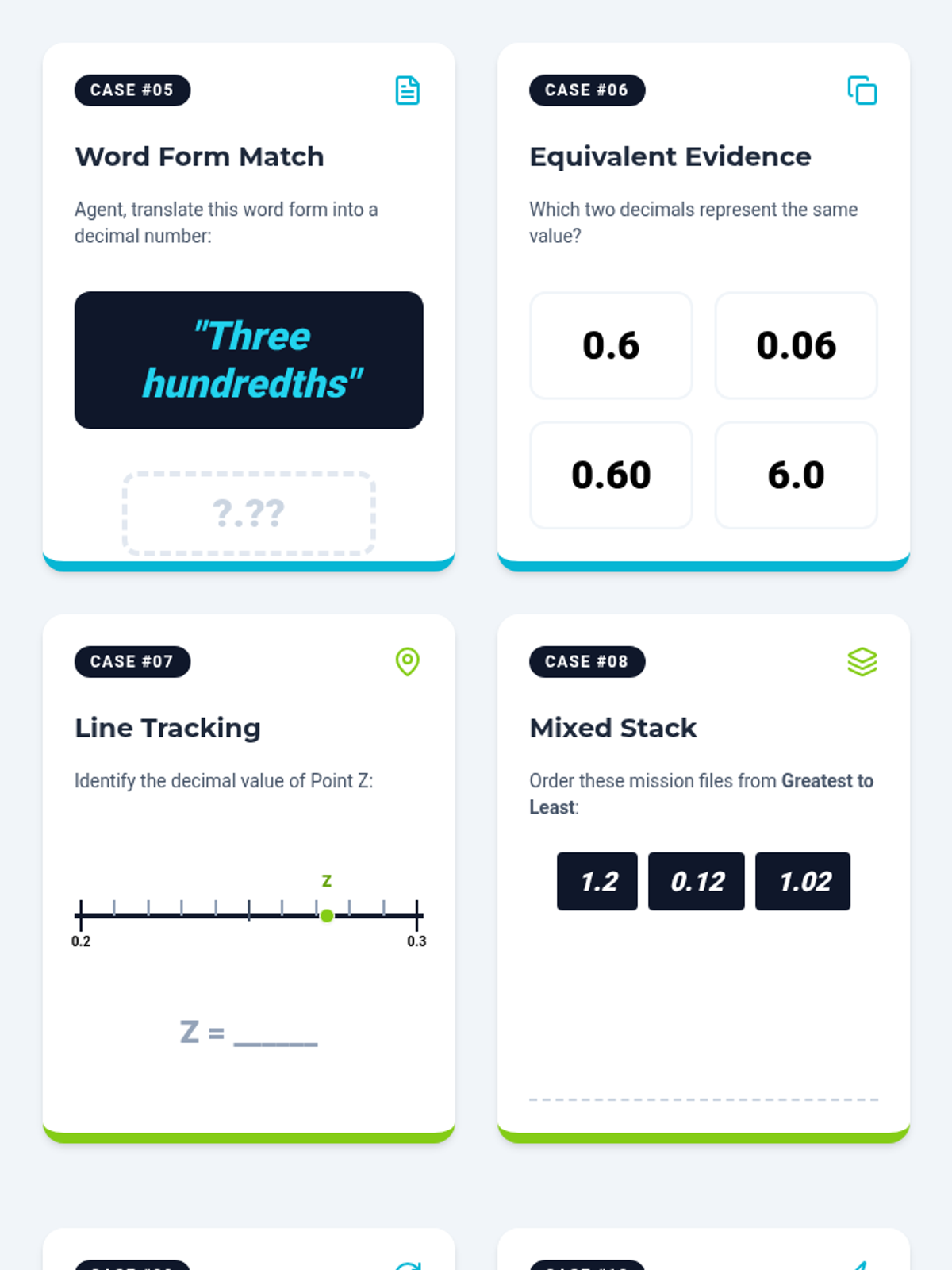
An expansion set of 8 additional task cards for the Point Patrol decimals unit, covering word form, equivalent decimals, number lines, place value, and ordering. Revised for better layout and student workspace.
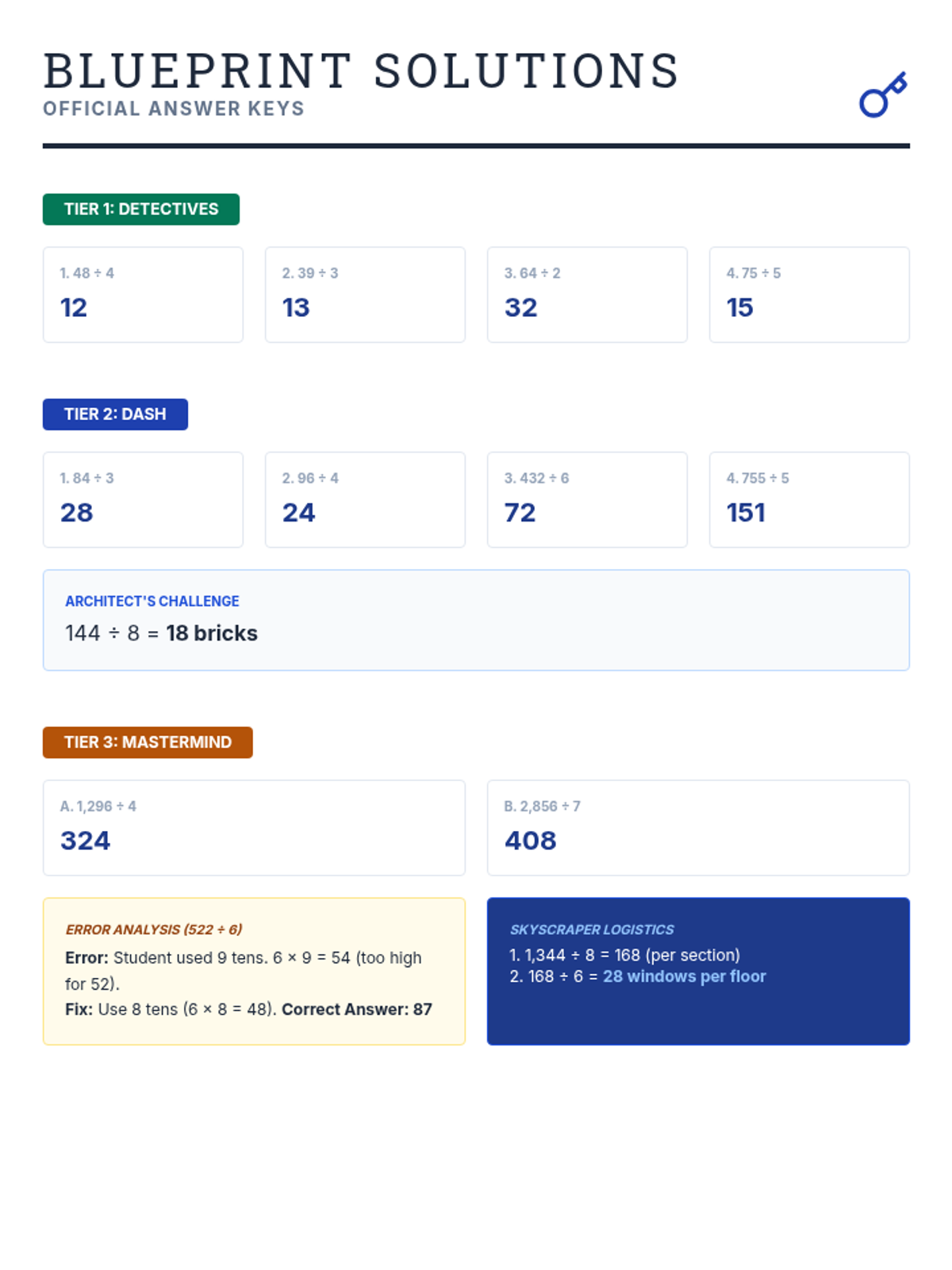
A comprehensive answer key for all three tiers of division worksheets. Includes final answers, error analysis explanations, and step-by-step solutions for multi-step word problems.
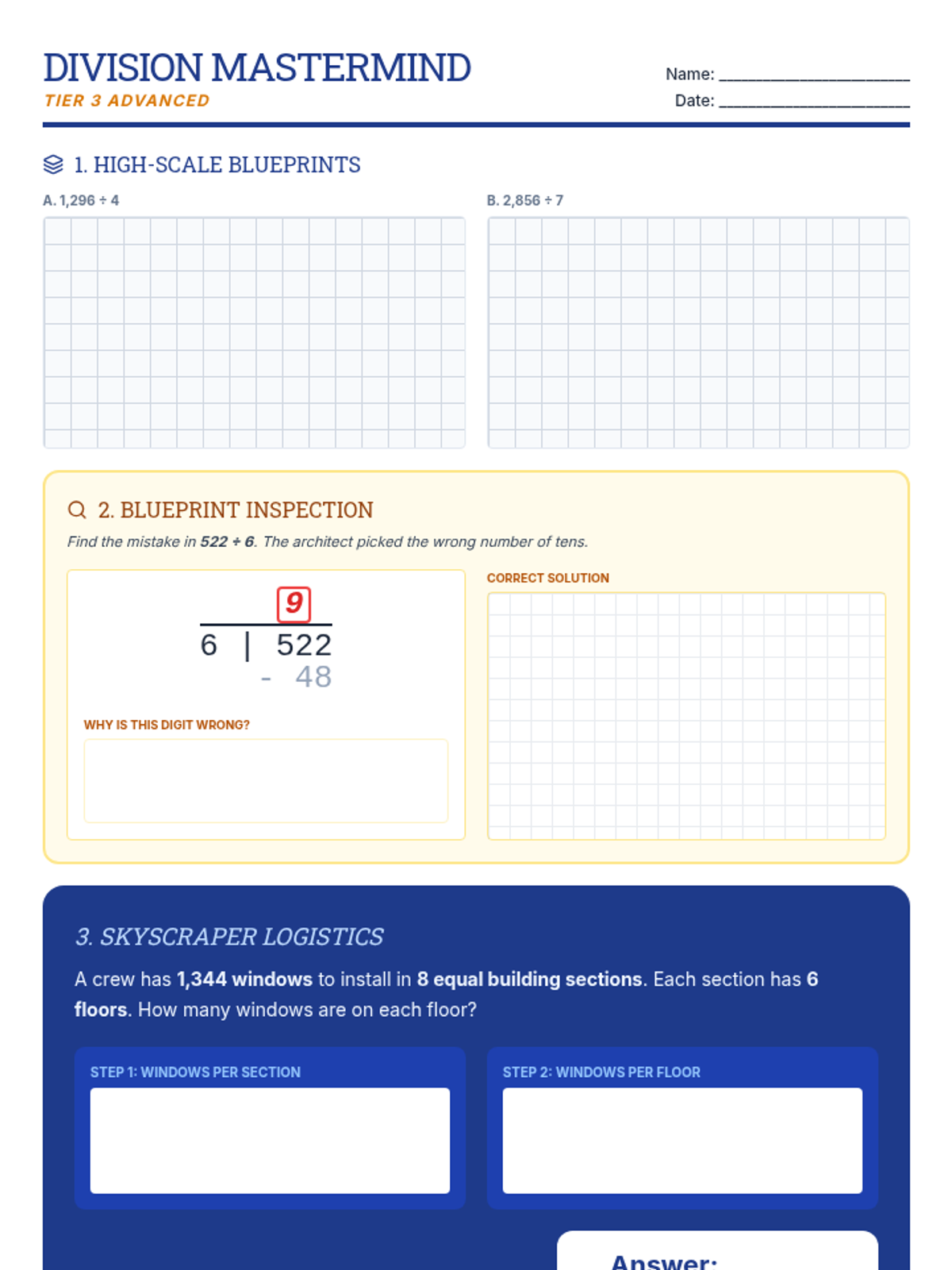
An advanced extension worksheet (Tier 3) for long division. Features 4-digit dividends, error analysis tasks where students must identify and correct structural mistakes, and multi-step word problems requiring logical reasoning and sequential division.
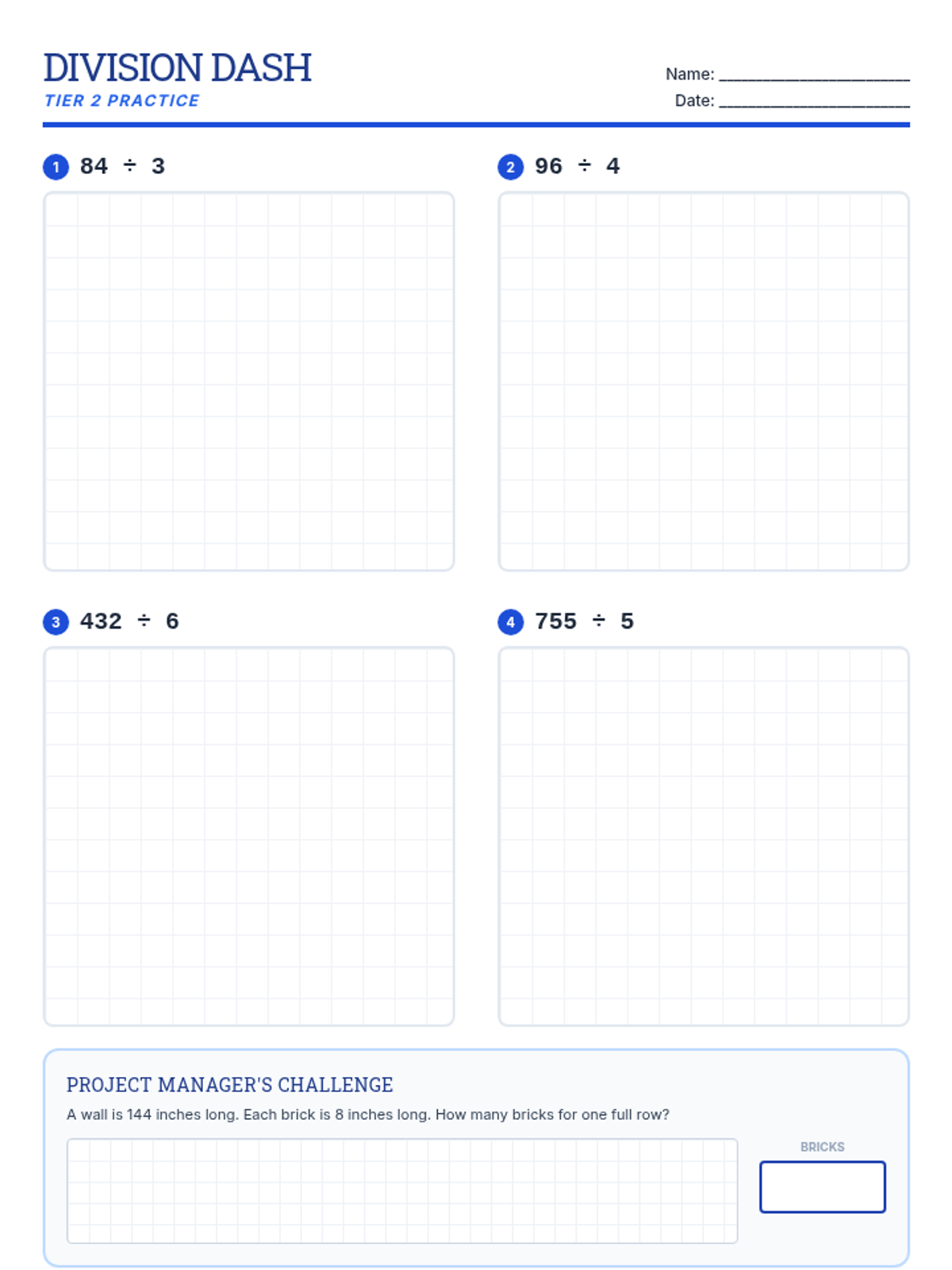
A standard practice worksheet (Tier 2) for long division. Includes problems ranging from 2-digit to 3-digit dividends with 1-digit divisors, utilizing grid-lined work areas for alignment and a real-world word problem application.
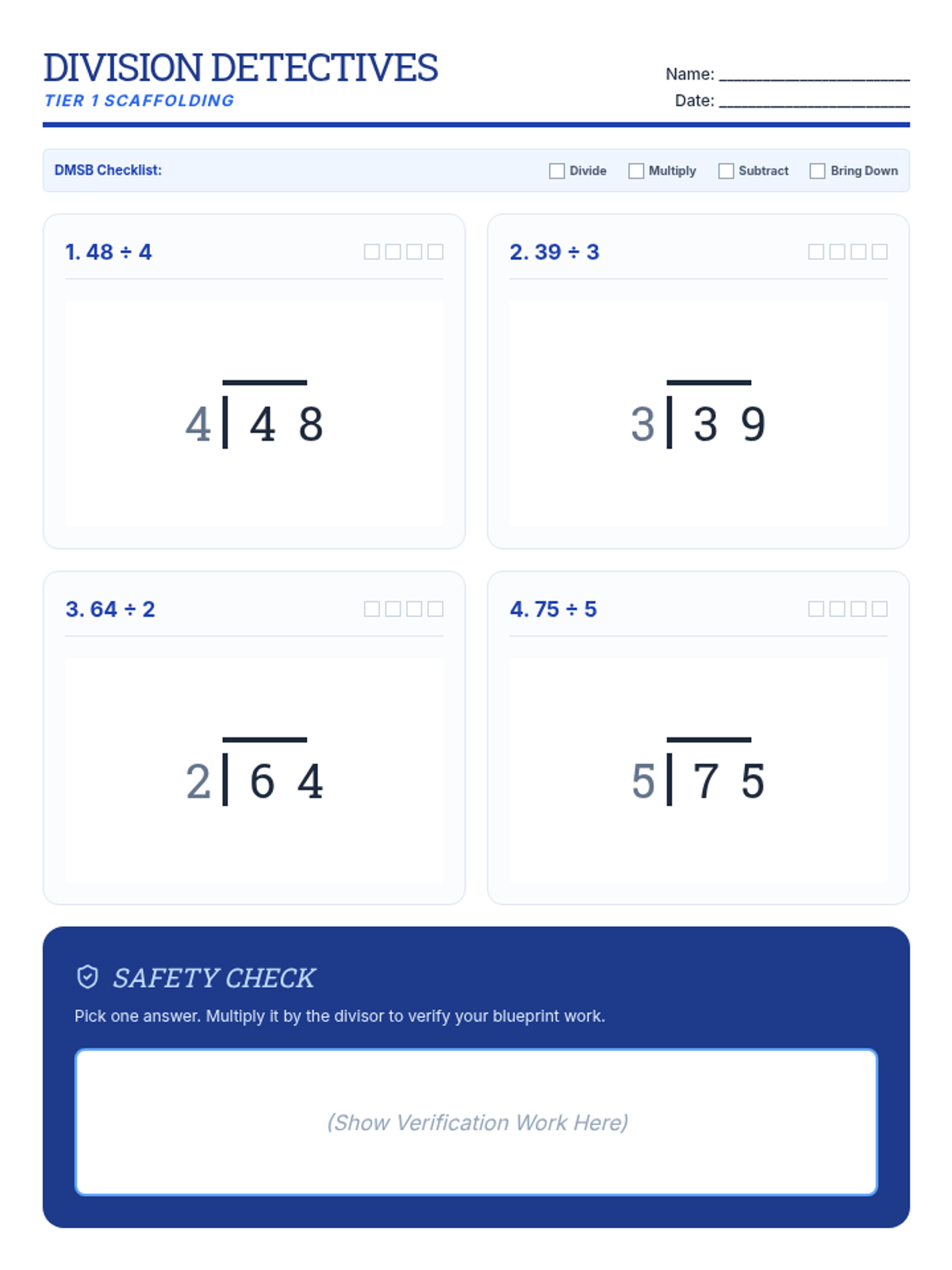
A scaffolded worksheet (Tier 1) for students emerging in their understanding of long division. Includes pre-drawn steps, tracking checklists for the DMSB algorithm, and visual guides to support 2-digit by 1-digit division.
A visual slide deck for teaching the long division algorithm (DMSB). Features high-contrast blueprint-themed visuals, a step-by-step walkthrough of 72÷3, and vocabulary definitions for dividend, divisor, and quotient.
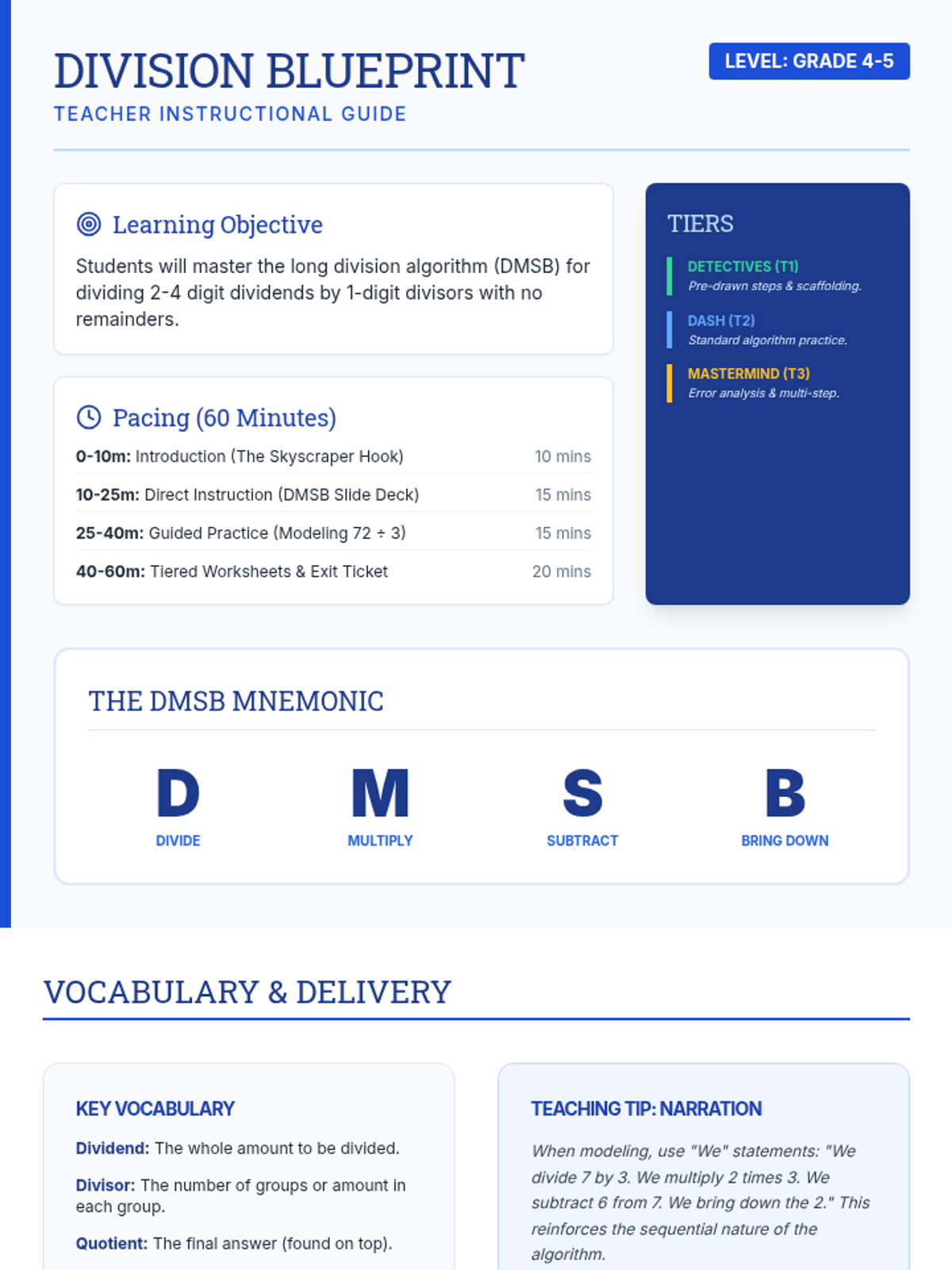
A comprehensive instructional guide for teachers, featuring a blueprint-themed lesson plan for long division. Includes pacing, differentiation strategies, key vocabulary, and a scripted walkthrough of the DMSB method.
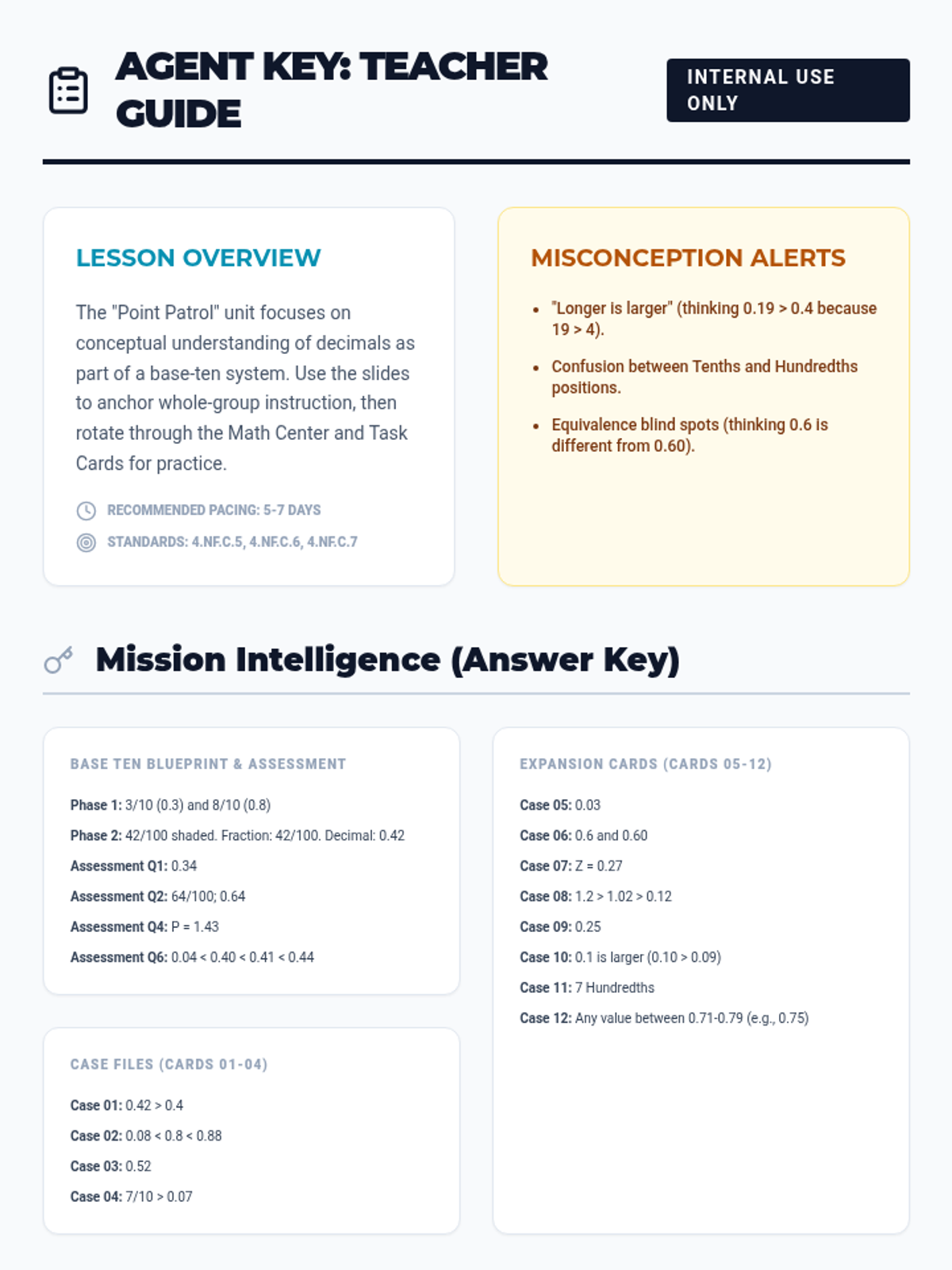
A comprehensive teacher guide containing answer keys, teaching tips, common misconceptions, and differentiation strategies. Revised to include the expansion task card key.
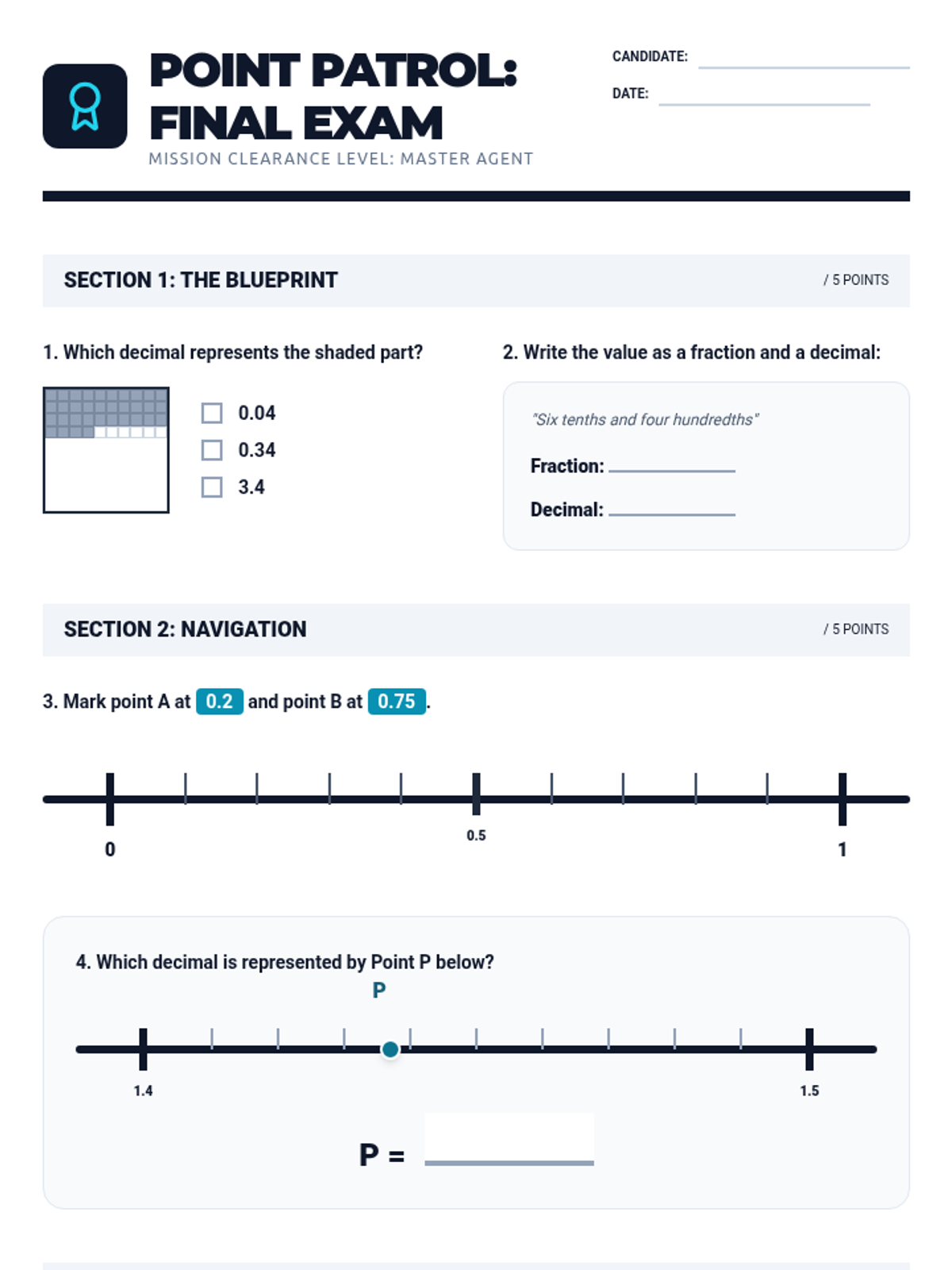
A comprehensive 2-page assessment for 4th-grade decimals. Revised with high-contrast text, optimized spacing to prevent orphaned elements, and clear student work areas.
A set of 4 quick assessment exit tickets covering each key decimal concept. Revised with better writing spaces and visibility.
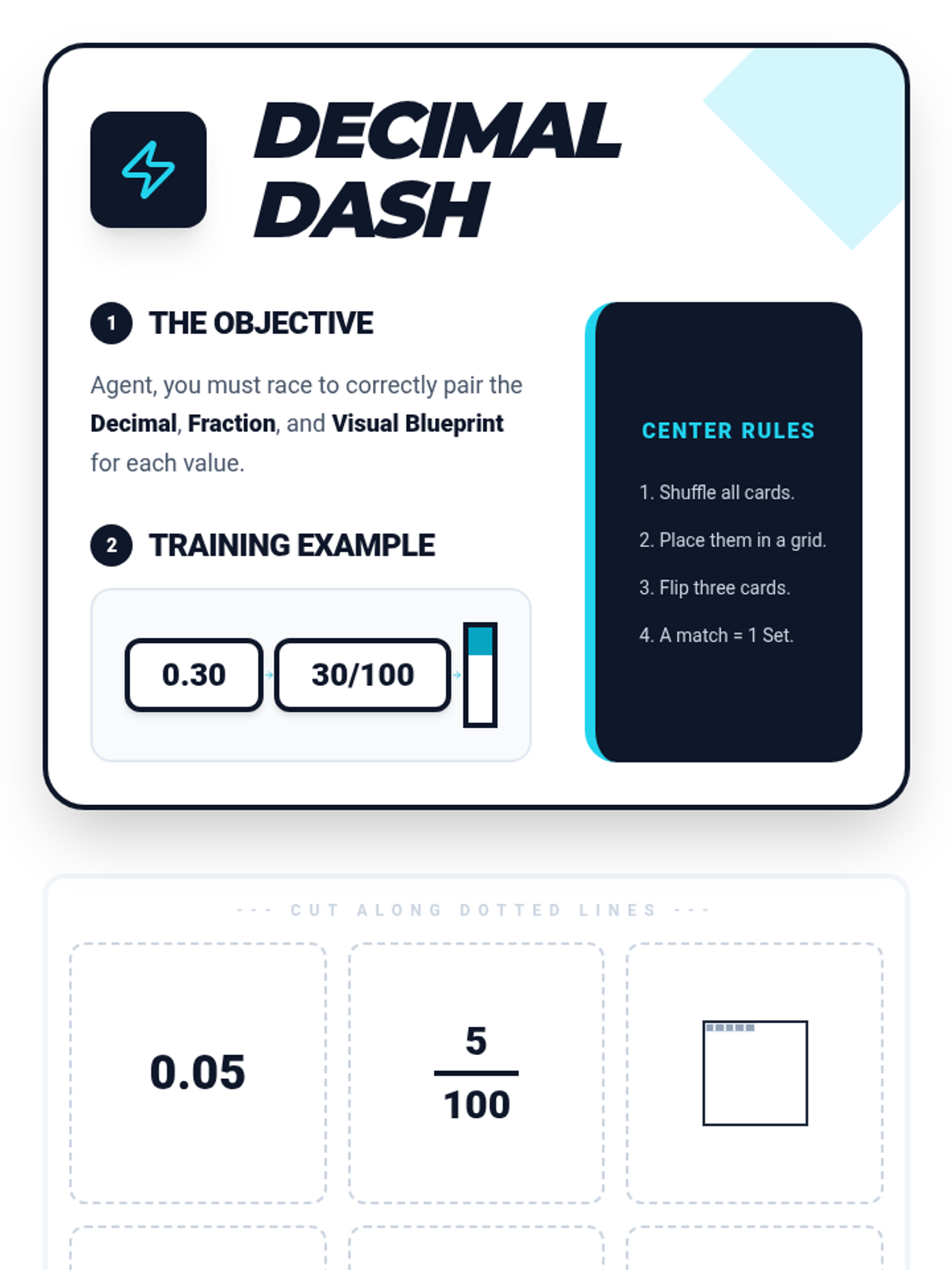
A hands-on matching center activity where students pair decimals, fractions, and word/model representations. Revised with ink-saving design and accurate models.
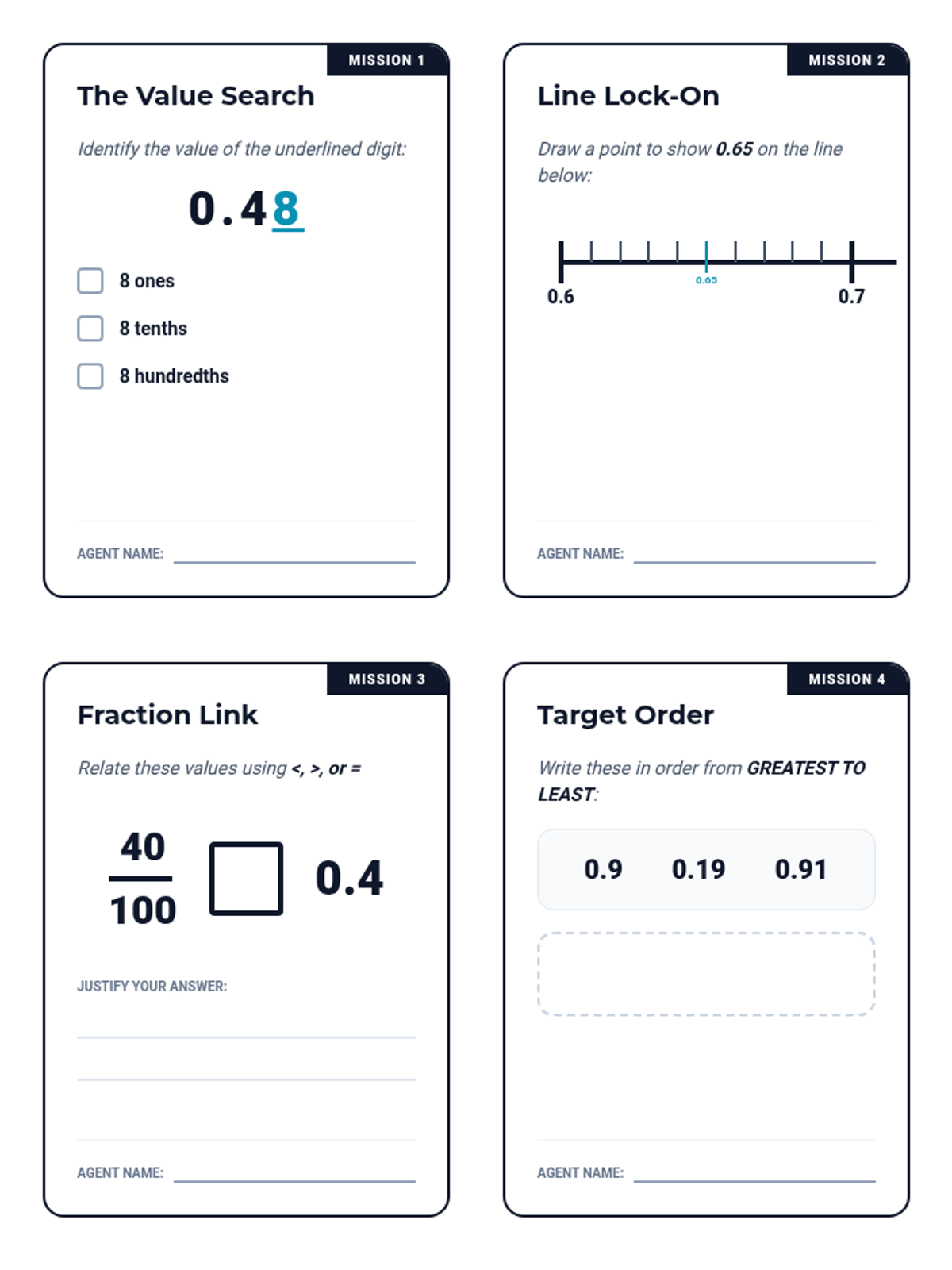
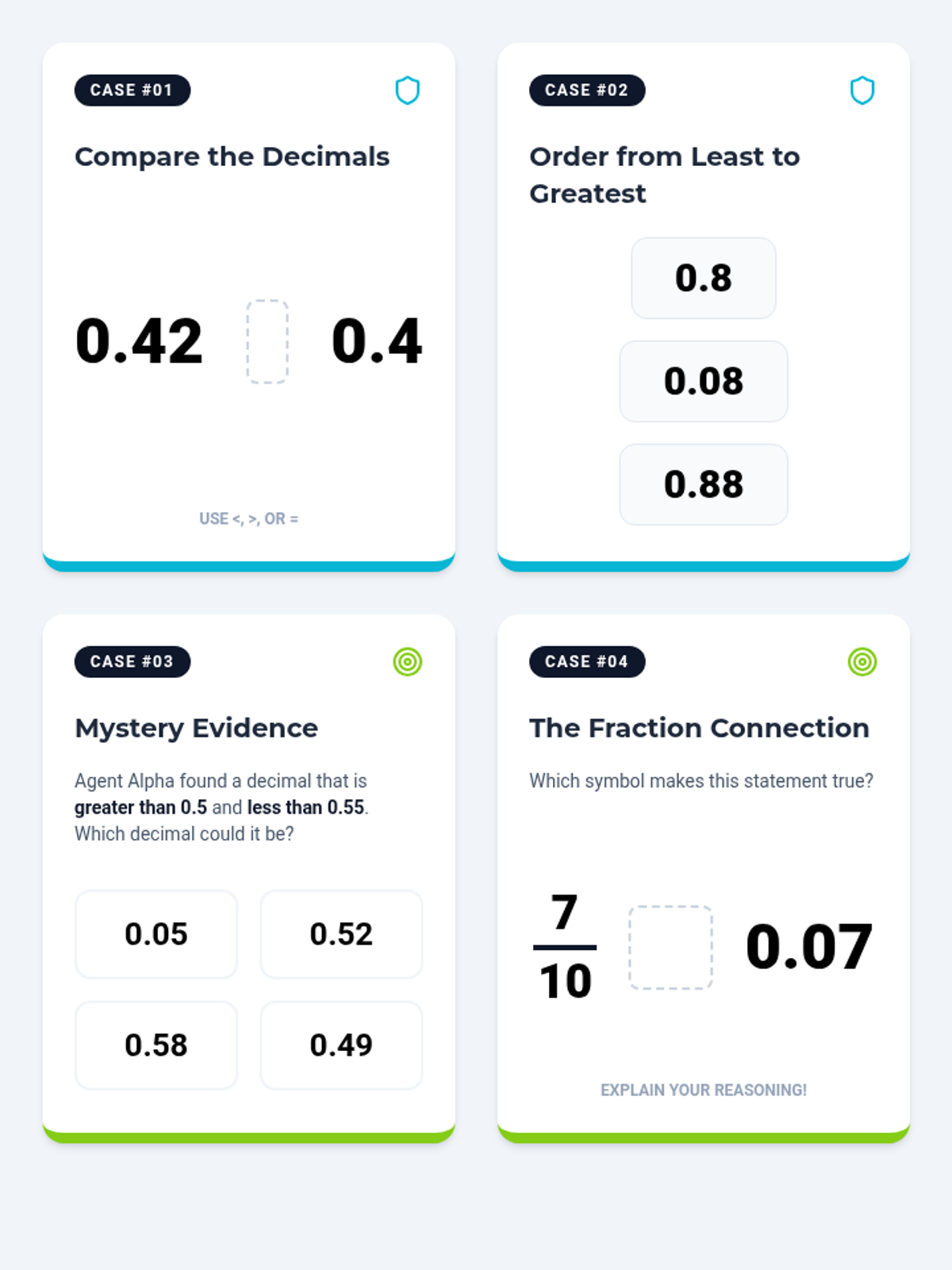
A set of 4 task cards for comparing and ordering decimals, plus connecting fractions to decimals, featuring high-contrast agent-themed designs.
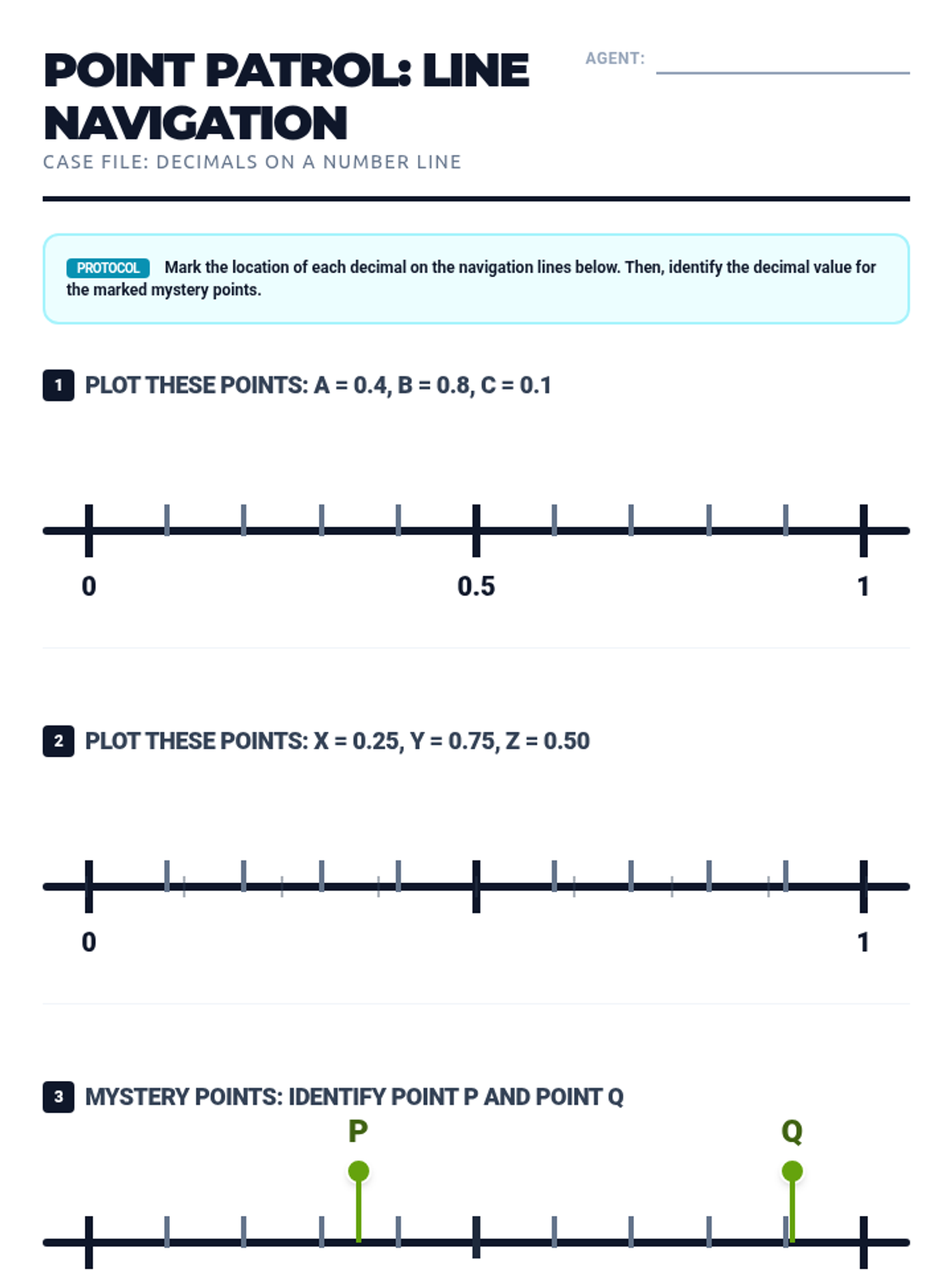
A practice worksheet for locating and identifying decimals on a number line, including tenths, hundredths, and mixed numbers. Revised with precise alignment, high-contrast ticks, and a consolidated one-page layout.
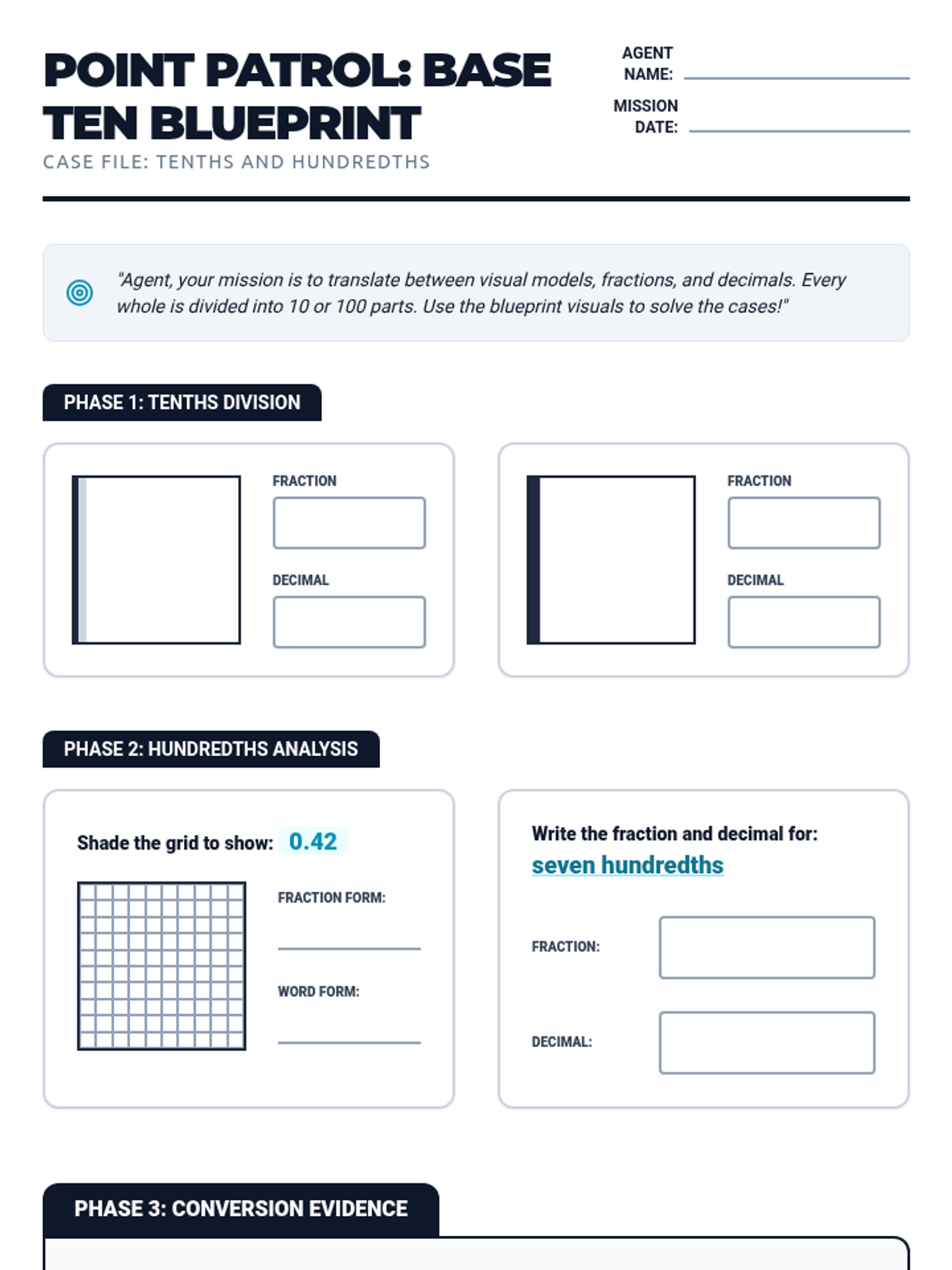
An independent practice worksheet focused on place value to hundredths and the relationship between fractions and decimals, designed with a detective blueprint theme. Revised with high-contrast models and improved layout.
A comprehensive 10-slide presentation introducing 4th graders to decimals, place value, number lines, fraction connections, and ordering strategies using a 'Point Patrol' agent theme. Extended with new content for deeper understanding. Revised for visual model accuracy and improved layout.
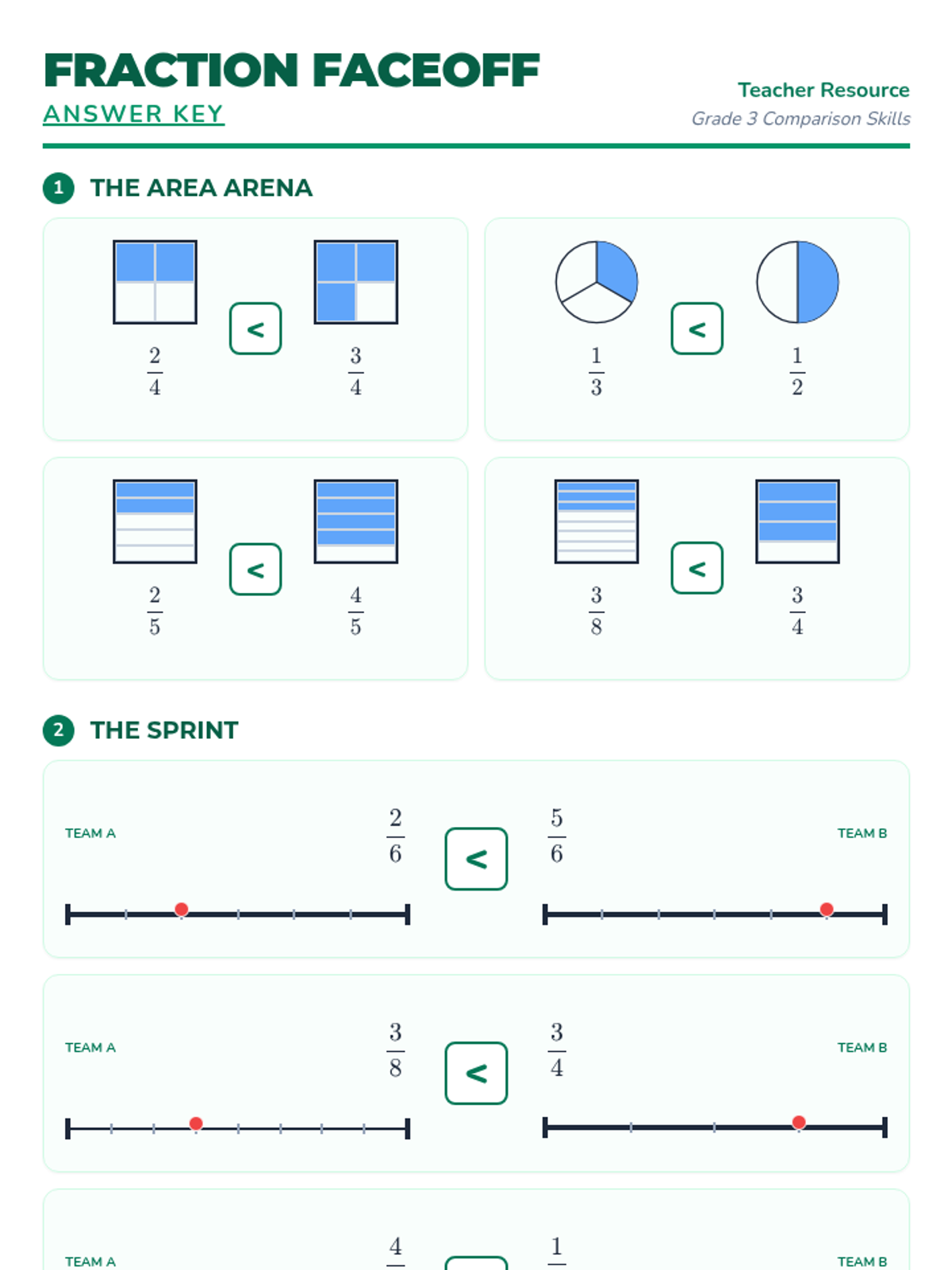
An answer key for the Fraction Faceoff worksheet, featuring completed visual models and comparison reasoning. Revised to match worksheet layout and formatting.
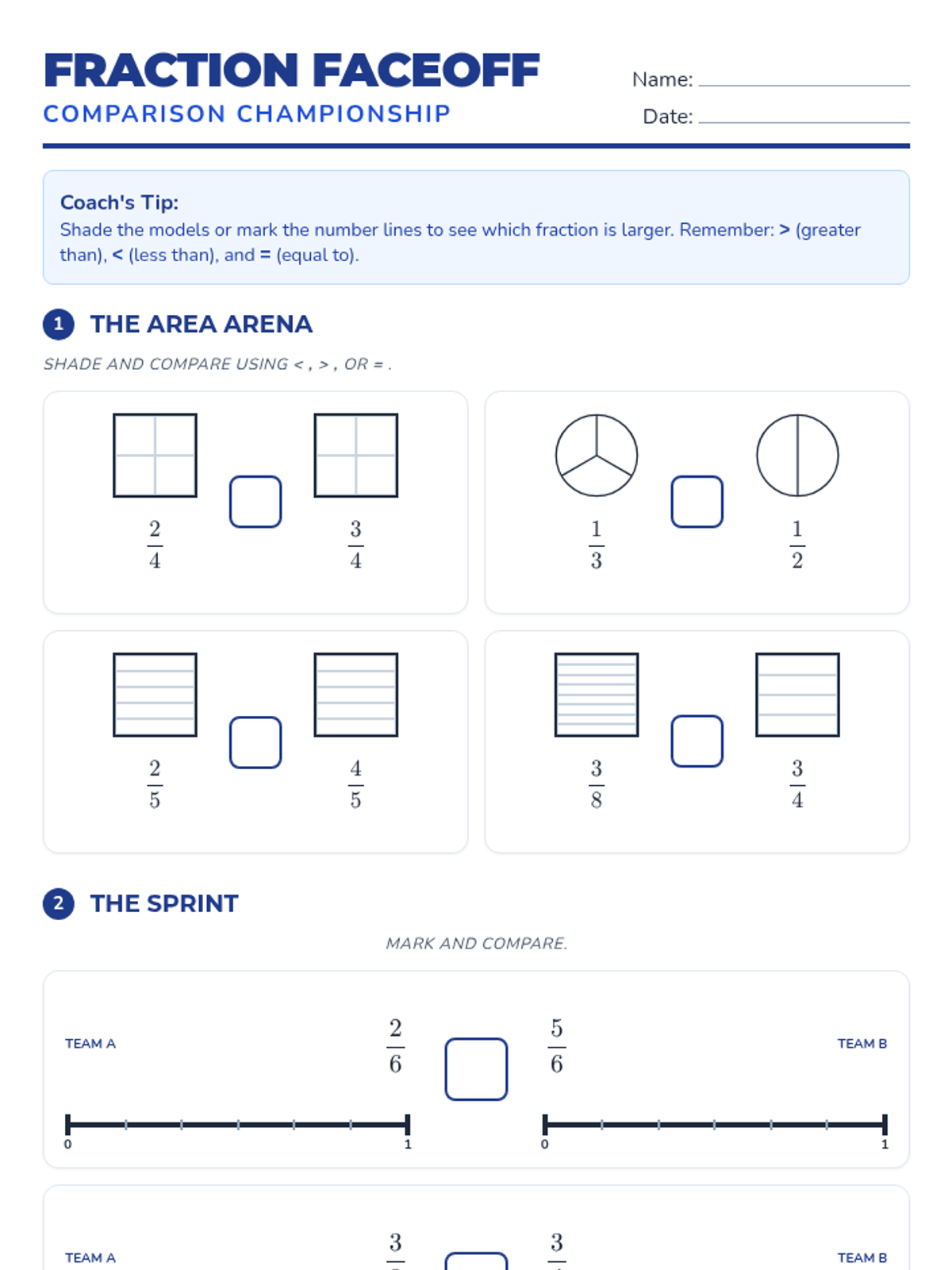
A student worksheet for comparing fractions using area models and number lines with a sports championship theme. Expanded with 4 additional problems and improved layout. Reduced padding and consolidated to minimize page count.
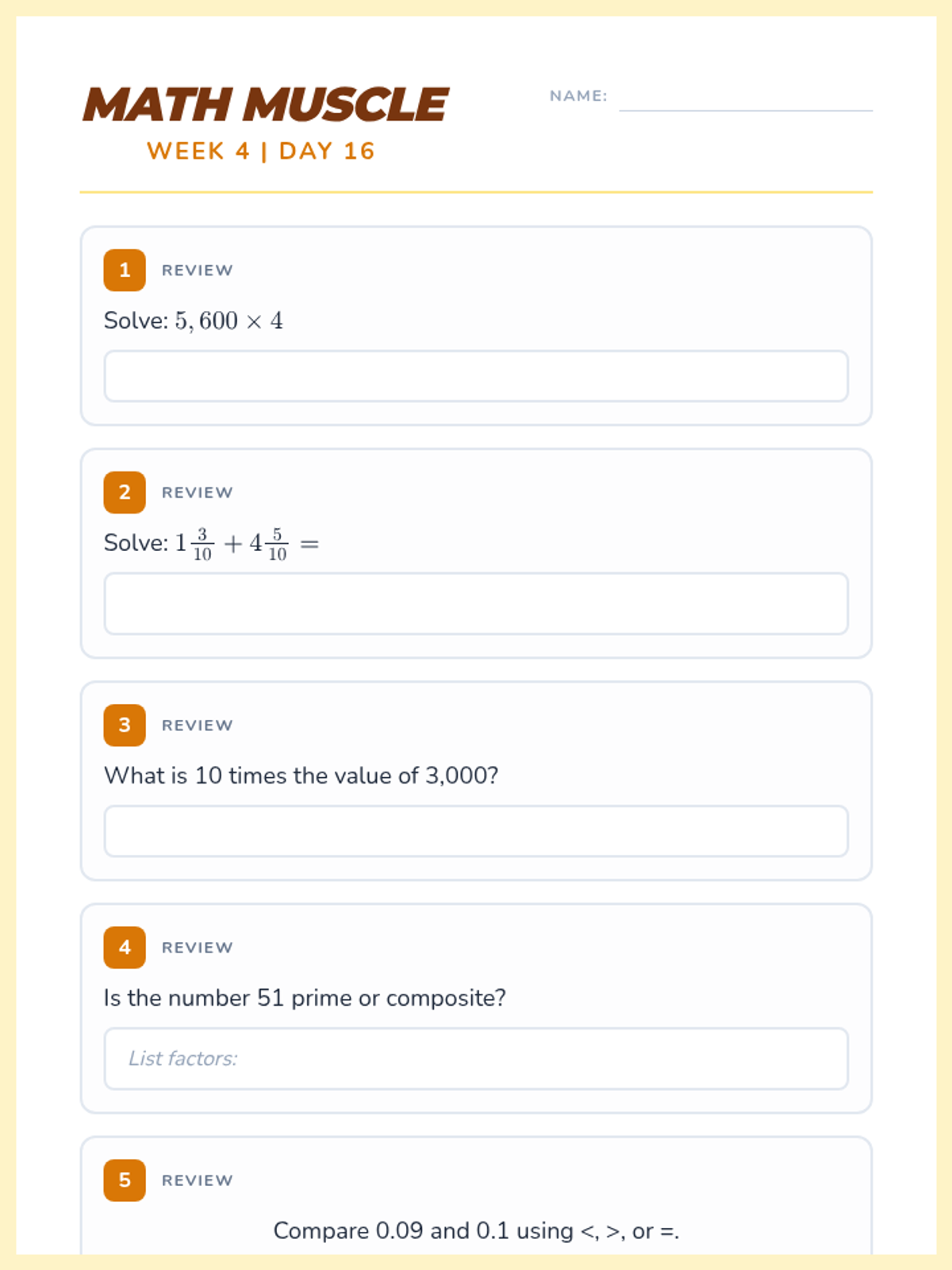
Week 4 Student Packet for Math Muscle Month, containing review problems for Days 16-20. Final comprehensive review of 4th grade math domains.
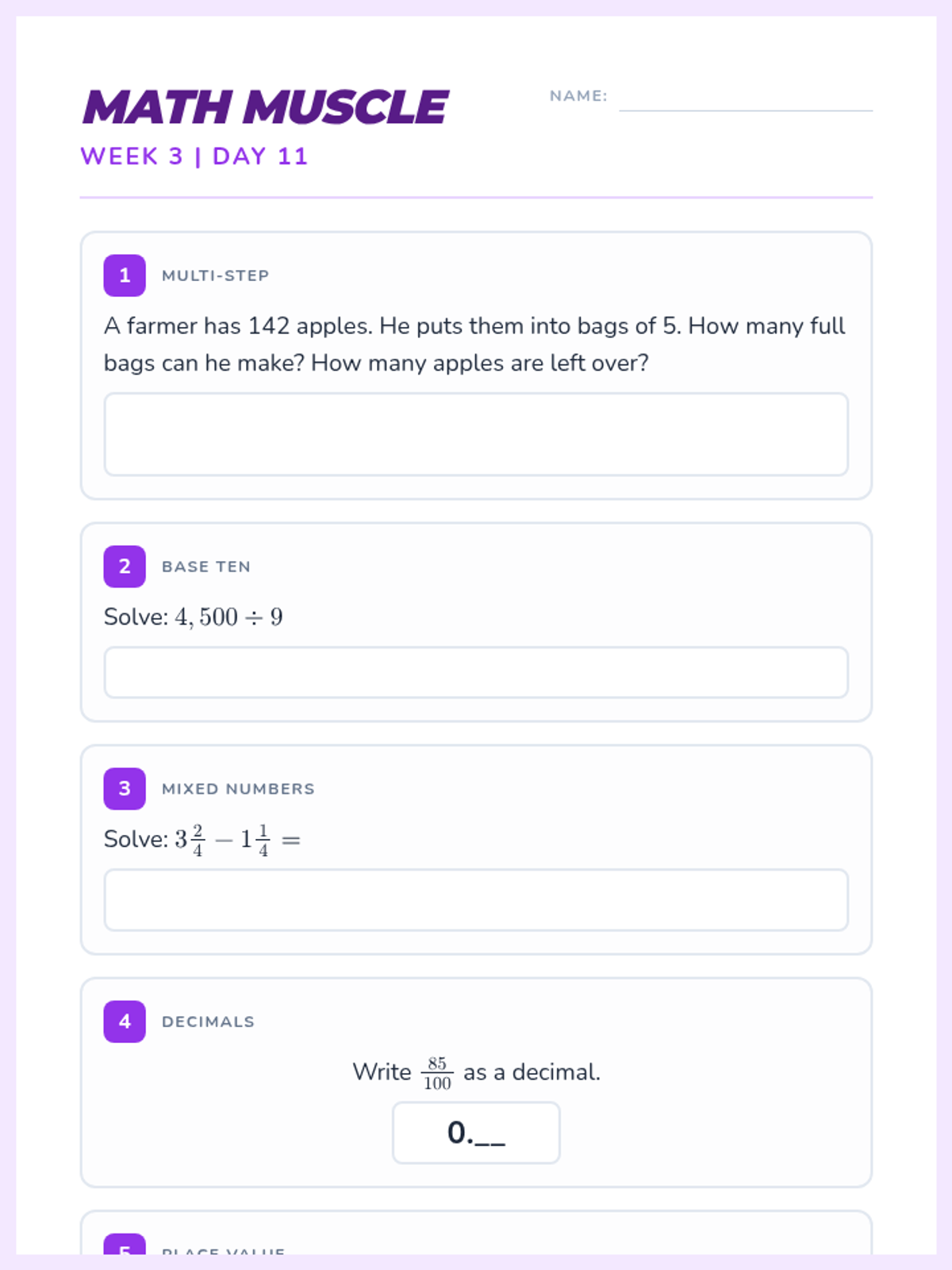
Week 3 Student Packet for Math Muscle Month, containing problems for Days 11-15. Focuses on long division, mixed numbers, and decimal notation.
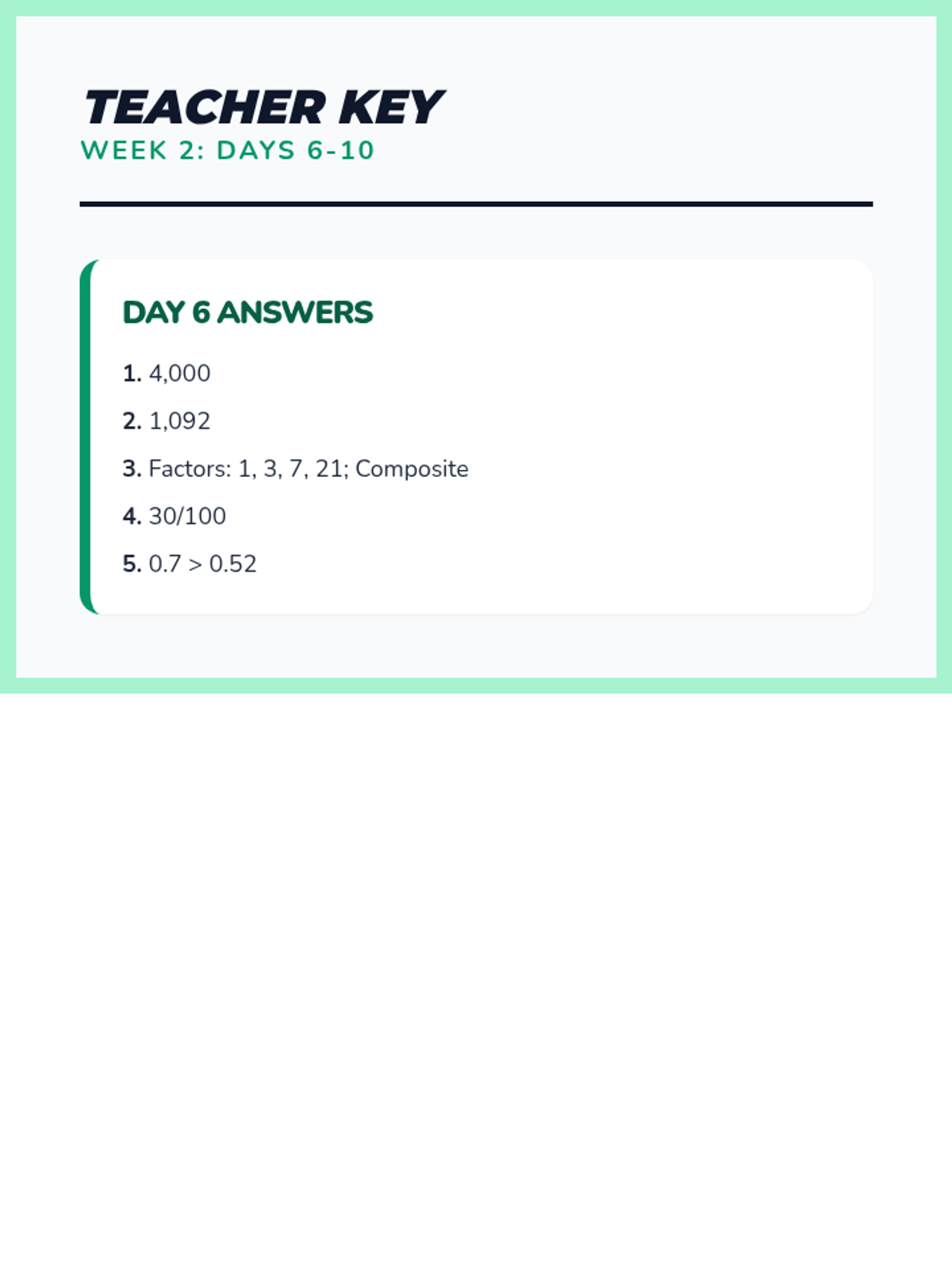
Teacher answer key for Week 2 math warmups, covering Days 6-10. Optimized for printing with clear sectioning.
A complete slide deck for Week 2 of math warmups. High visibility text and high-contrast color scheme for classroom display. Consistency in numbering and layout.
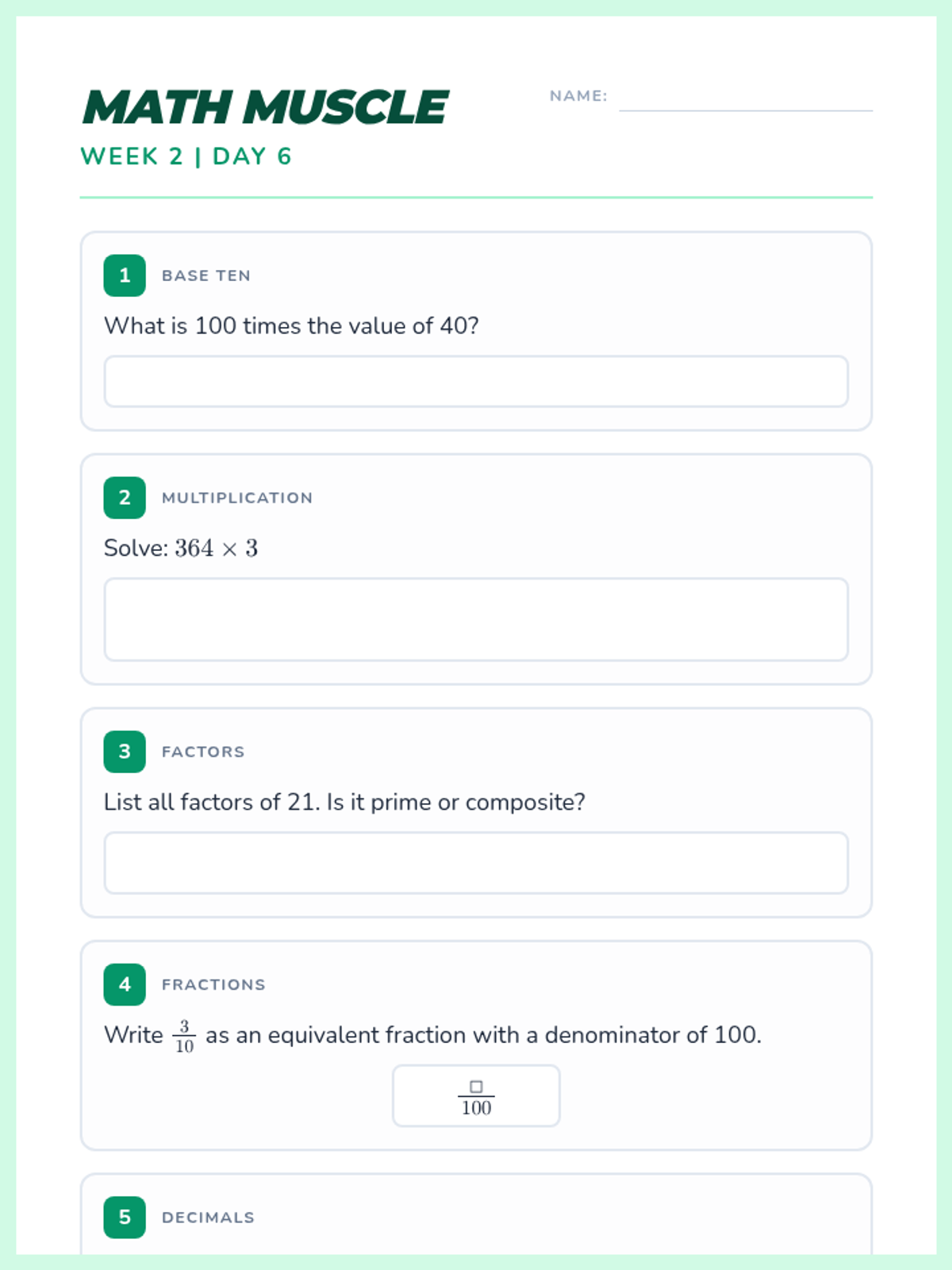
Week 2 Student Packet for Math Muscle Month, containing all 25 problems for Days 6-10. Features robust page-break prevention and clear student work areas.
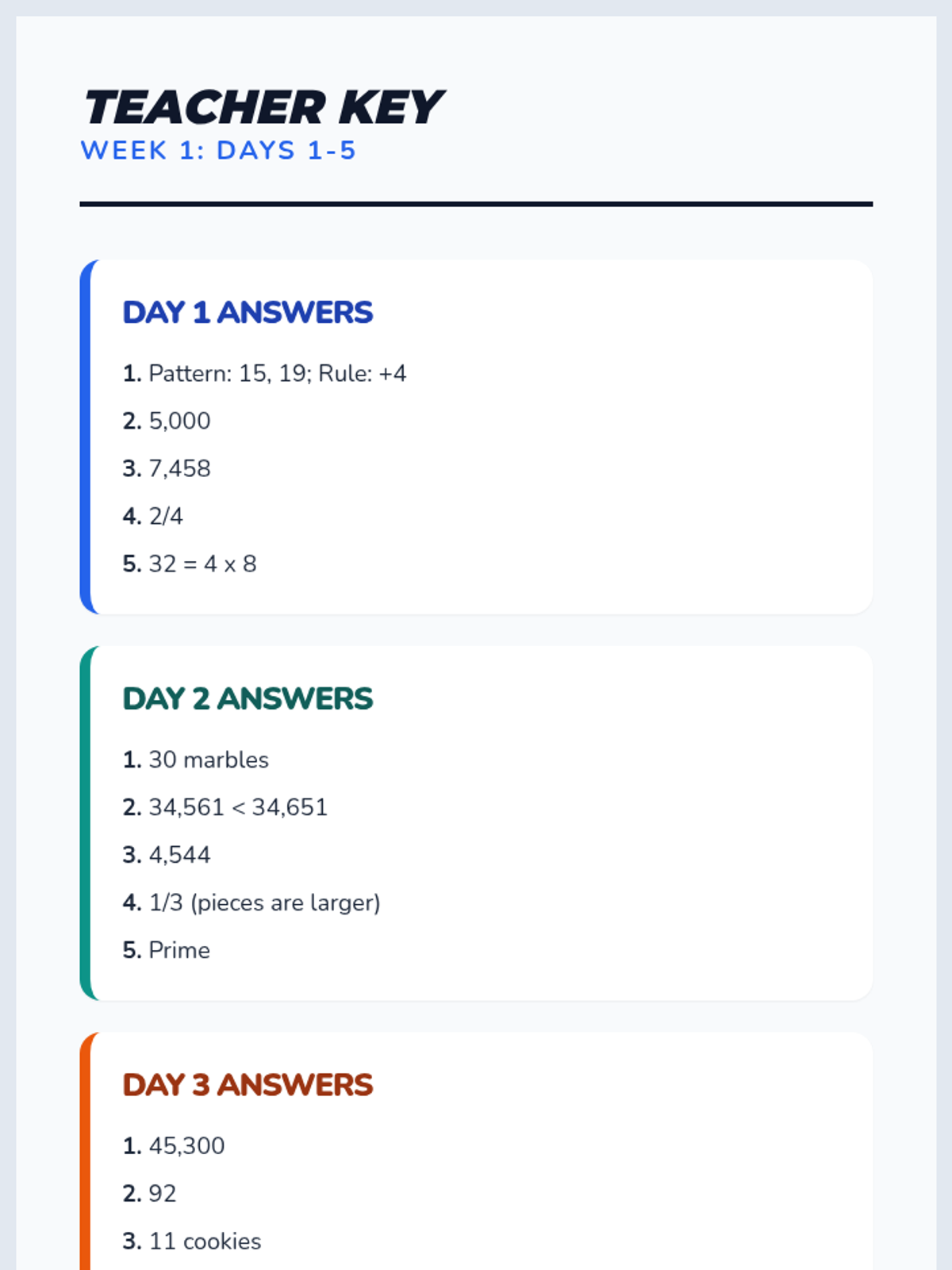
A single-page teacher answer key for the first week of math warmups. Optimized with page-break-avoid logic to keep answer blocks together.
A complete 6-slide presentation for the first week of math warmups. Fixed numbering and alignment consistency across all slides. Includes high-visibility math text.
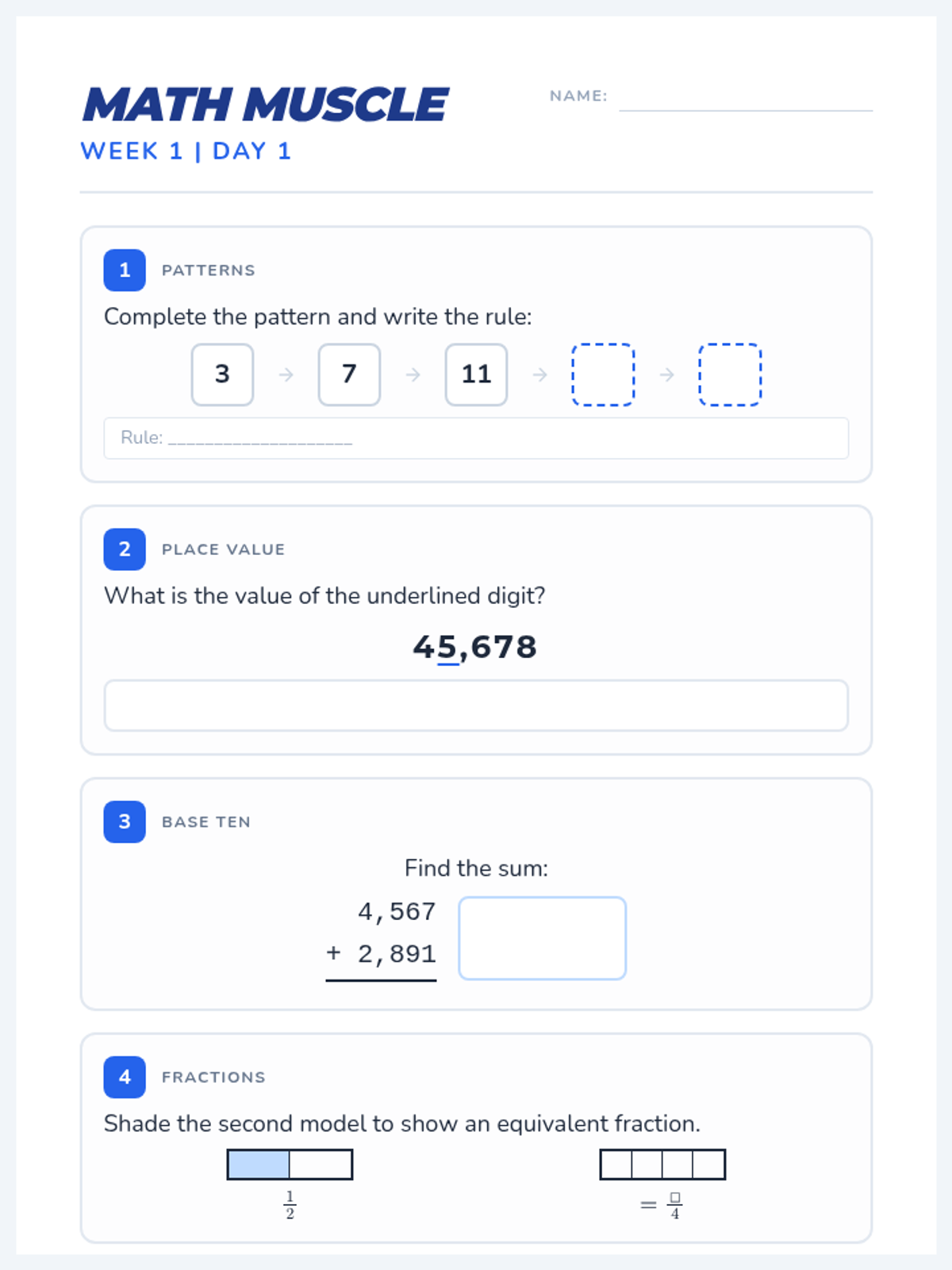
A 5-page printable student packet for the first week of math warmups, featuring daily sets of 5 problems across major 4th-grade math domains. Fixed page breaks and student work area alignment.
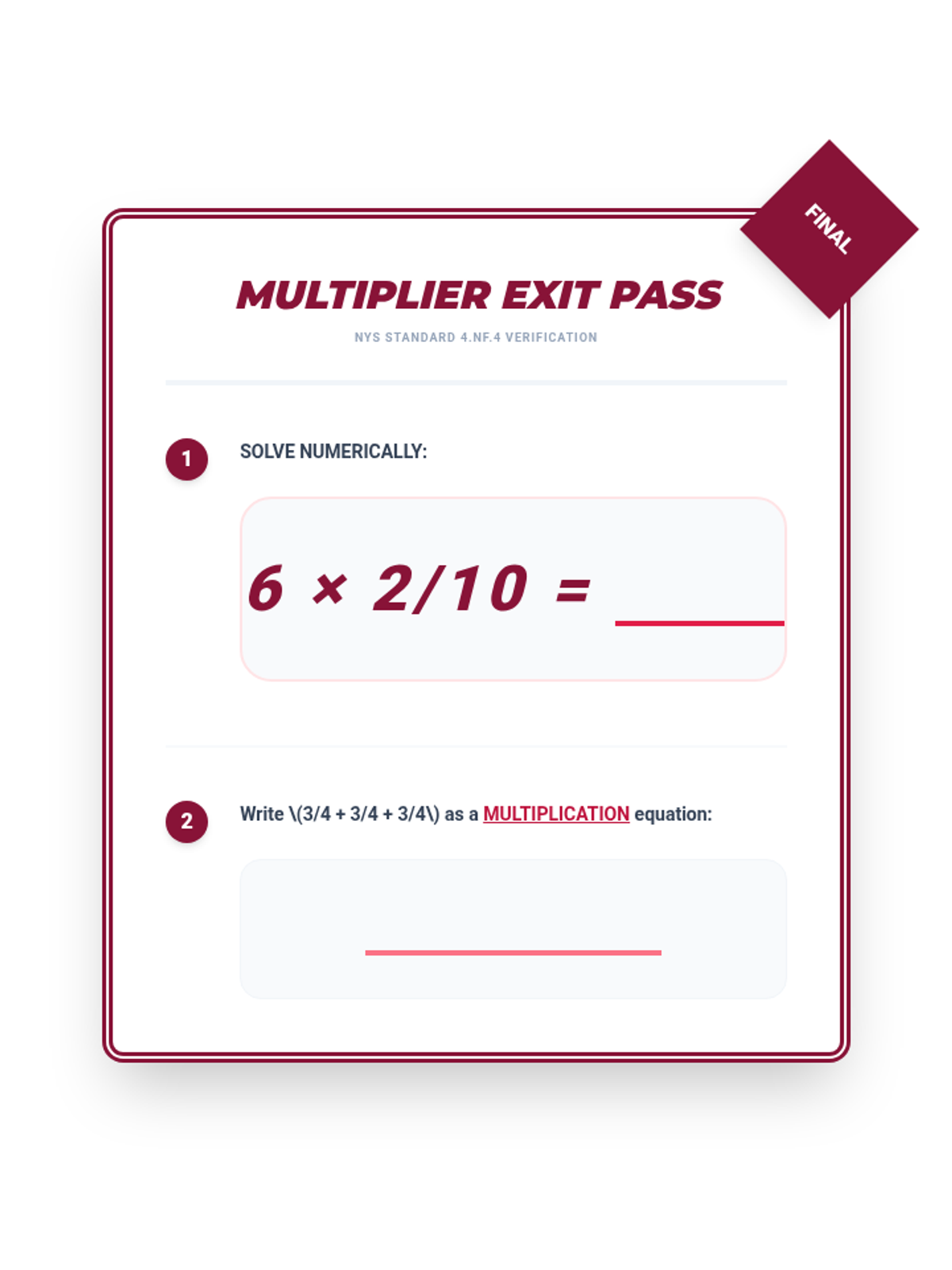
Quick assessment for 4.NF.4, requiring students to solve a numerical fraction multiplication problem and convert repeated addition into a multiplication equation.
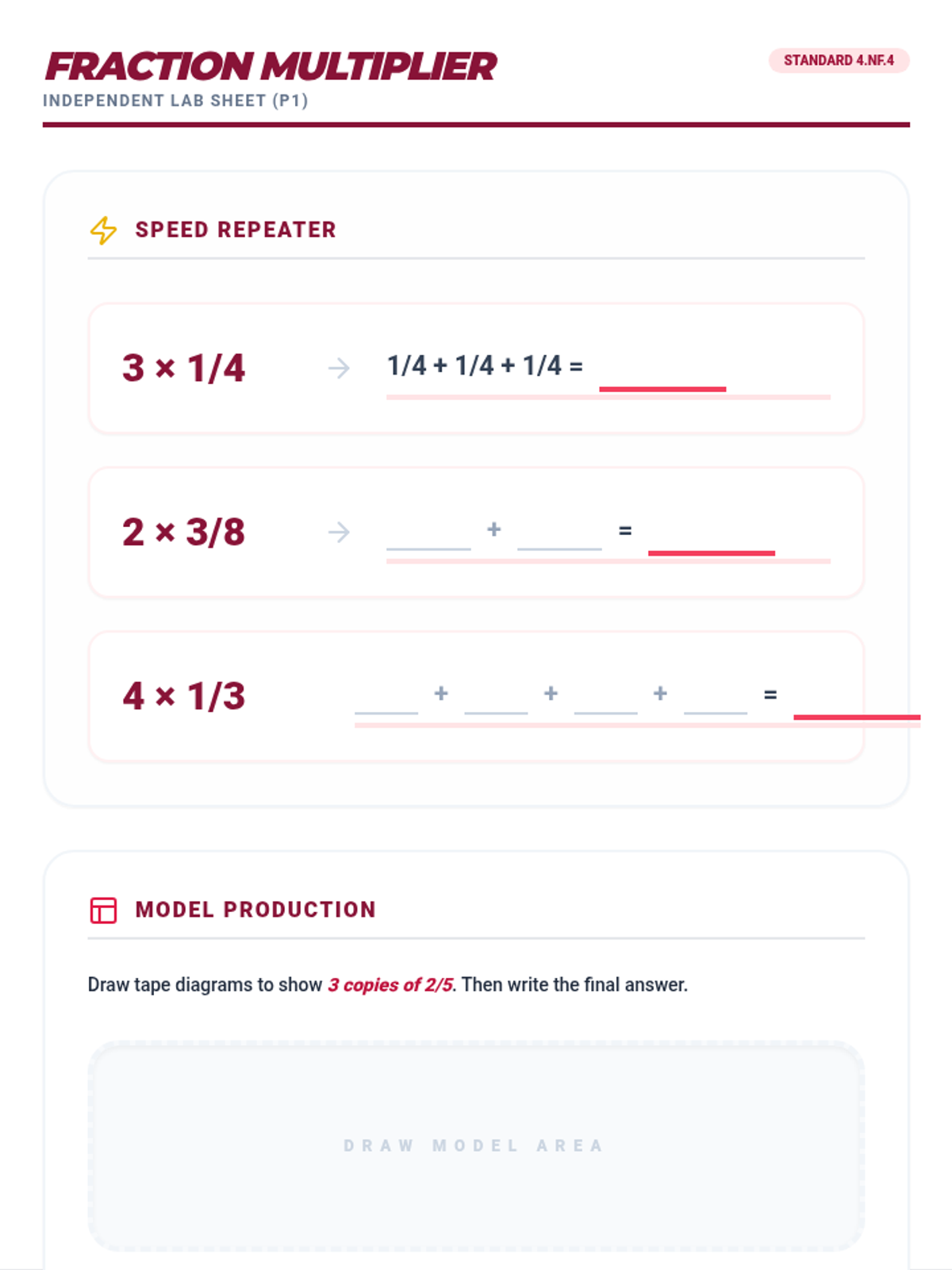
Independent practice for 4.NF.4, covering repeated addition strategies, visual tape diagrams for fraction multiplication, and real-world distance word problems. Improved work area contrast, layout alignment, and units.
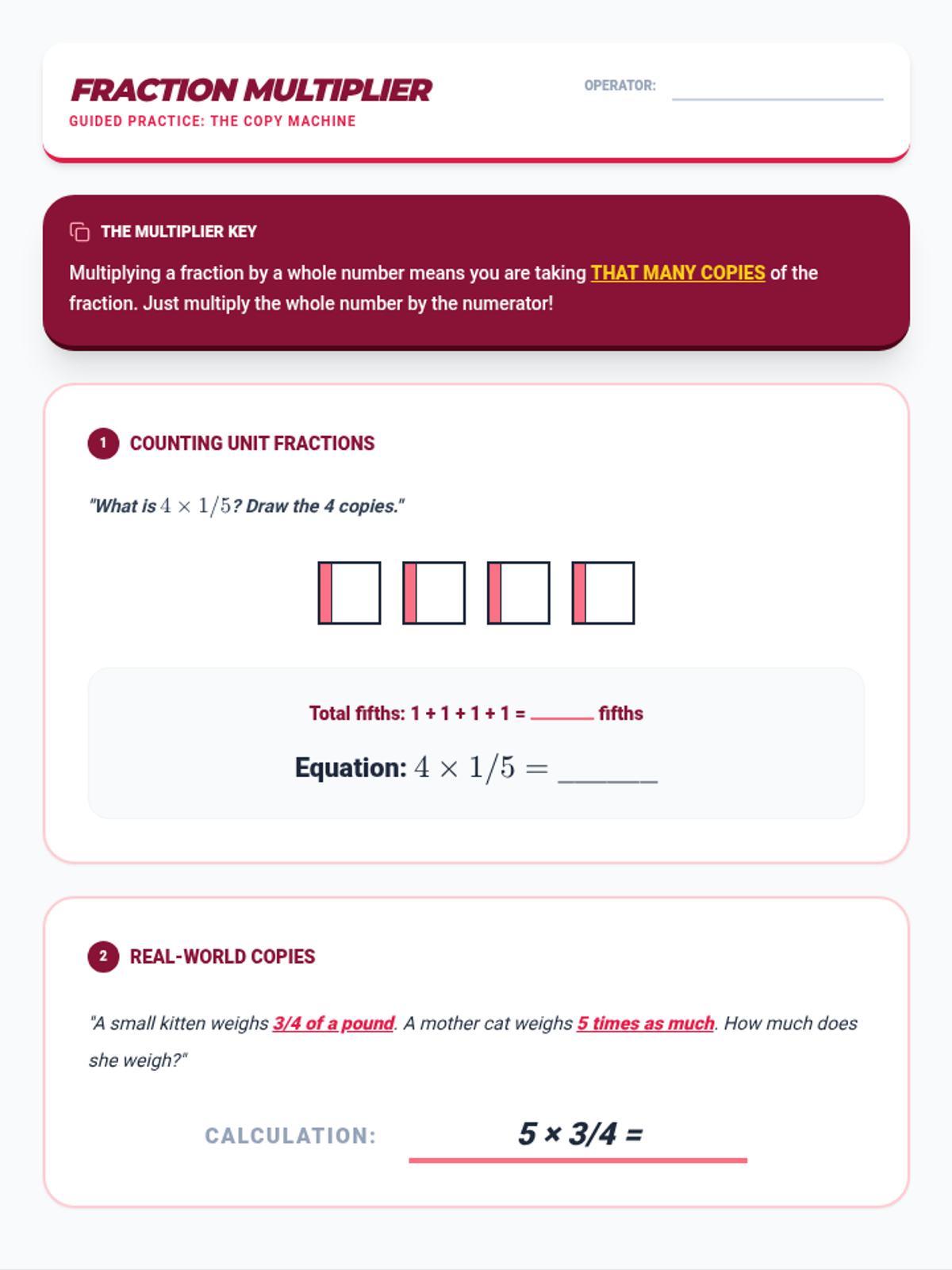
Guided practice for 4.NF.4, demonstrating fraction multiplication as counting multiple copies of a fraction unit, with both unit and non-unit fractions.
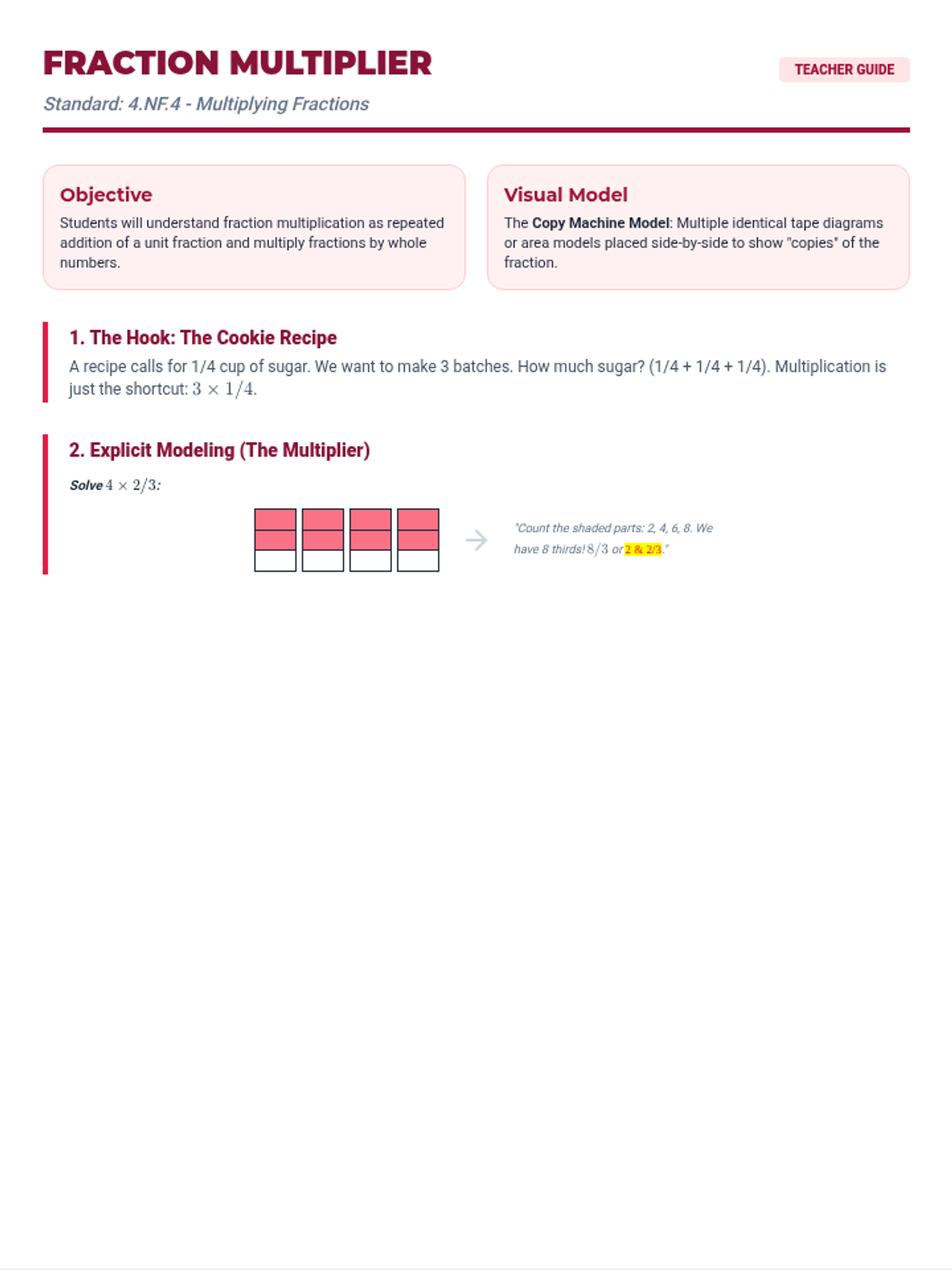
Teacher guide for 4.NF.4, explaining fraction multiplication as repeated addition of a unit fraction using "copy machine" models.
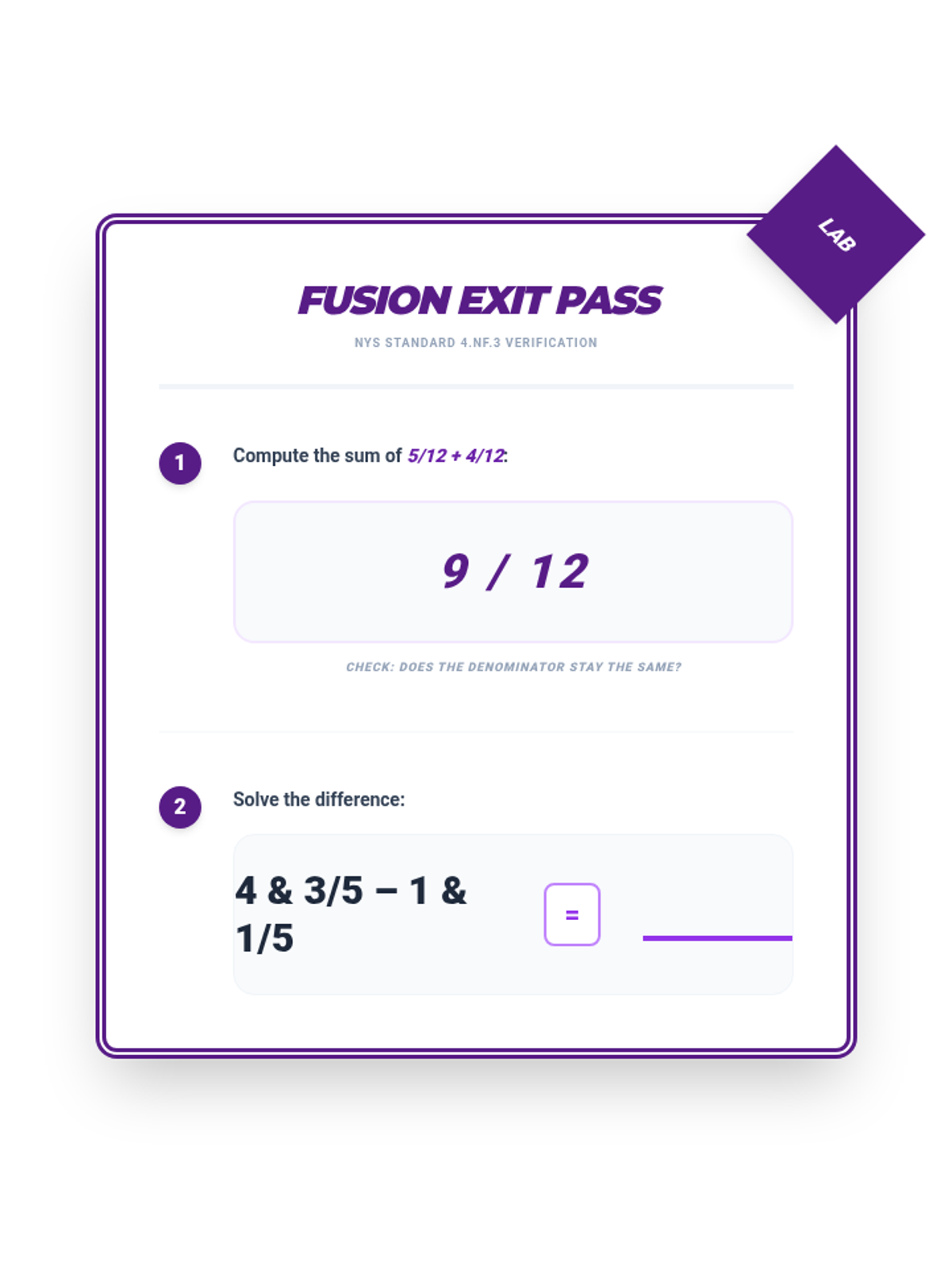
Quick assessment for 4.NF.3, testing fraction addition with like denominators and mixed number subtraction.
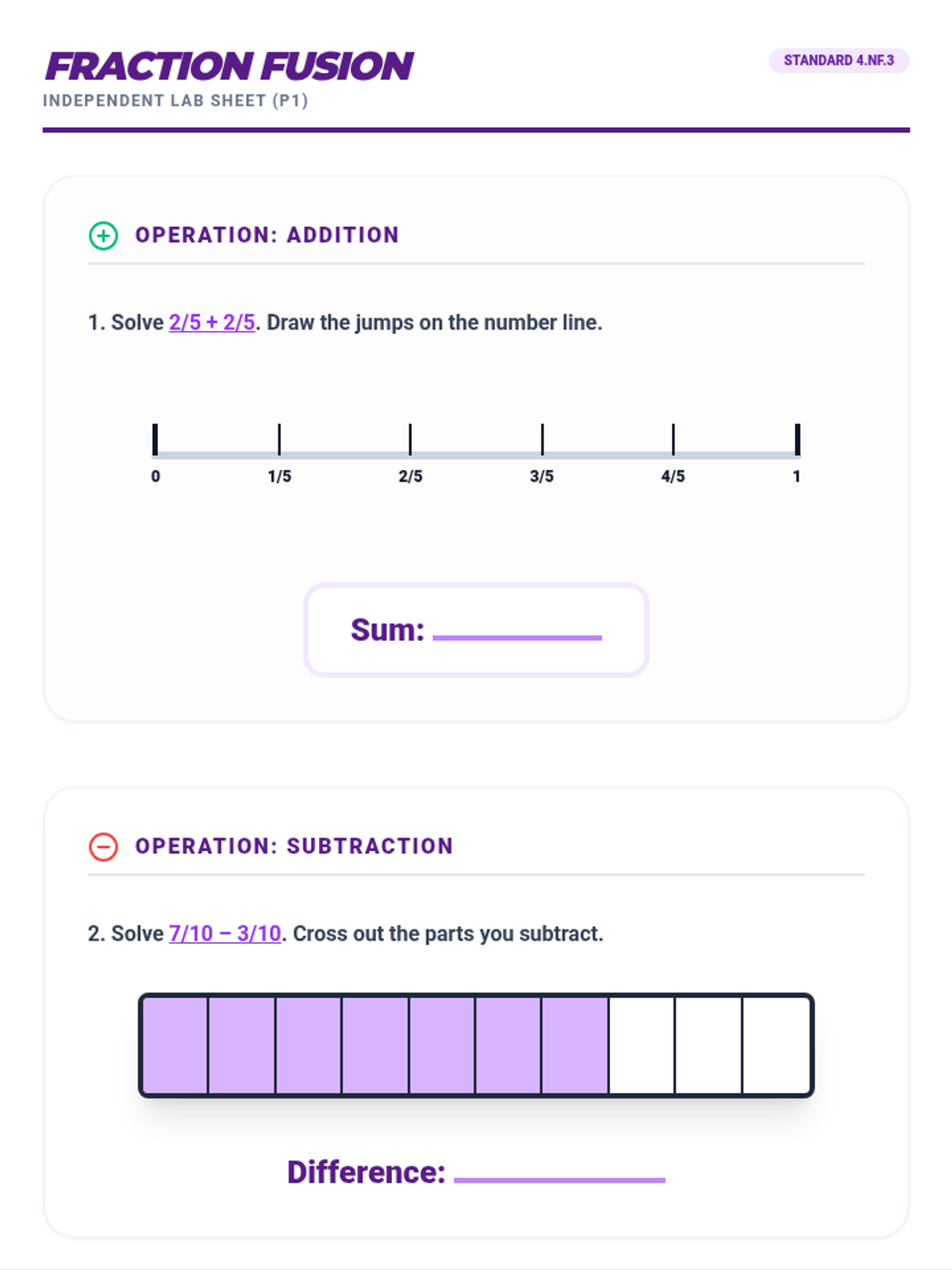
Independent practice for 4.NF.3, featuring fraction addition on number lines, subtraction using area models, fraction decomposition, and a mixed number word problem. Improved math rendering, contrast, and page layout.
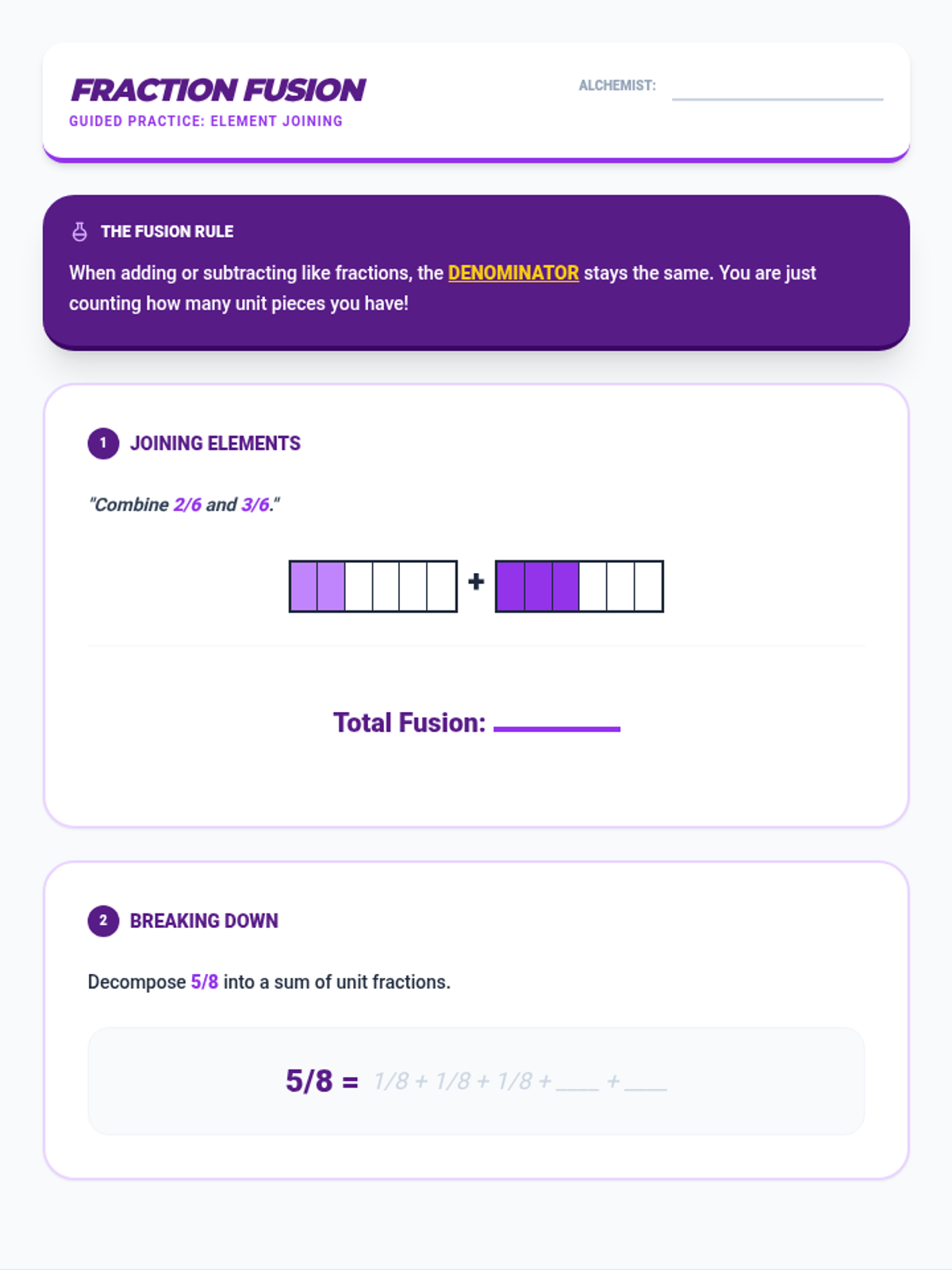
Guided practice for 4.NF.3, using visual area models to join fractions and demonstrating the decomposition of fractions into unit fraction sums.
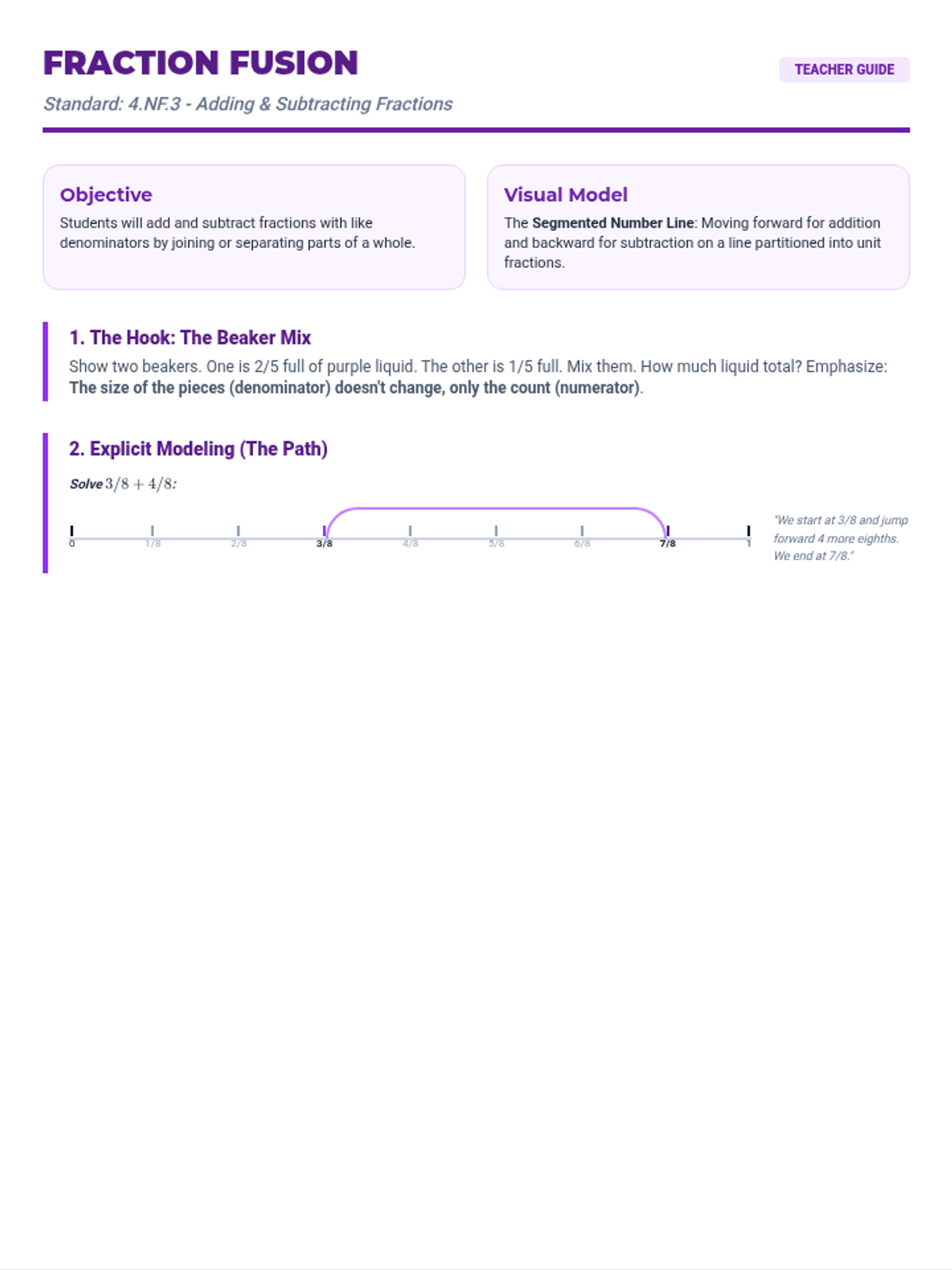
Teacher guide for 4.NF.3, focusing on addition and subtraction of fractions with like denominators using beaker mixing and number line models.
An engaging slide deck to introduce 4th-grade division concepts, featuring visual representations of sharing and strategies for solving larger division problems using basic facts.
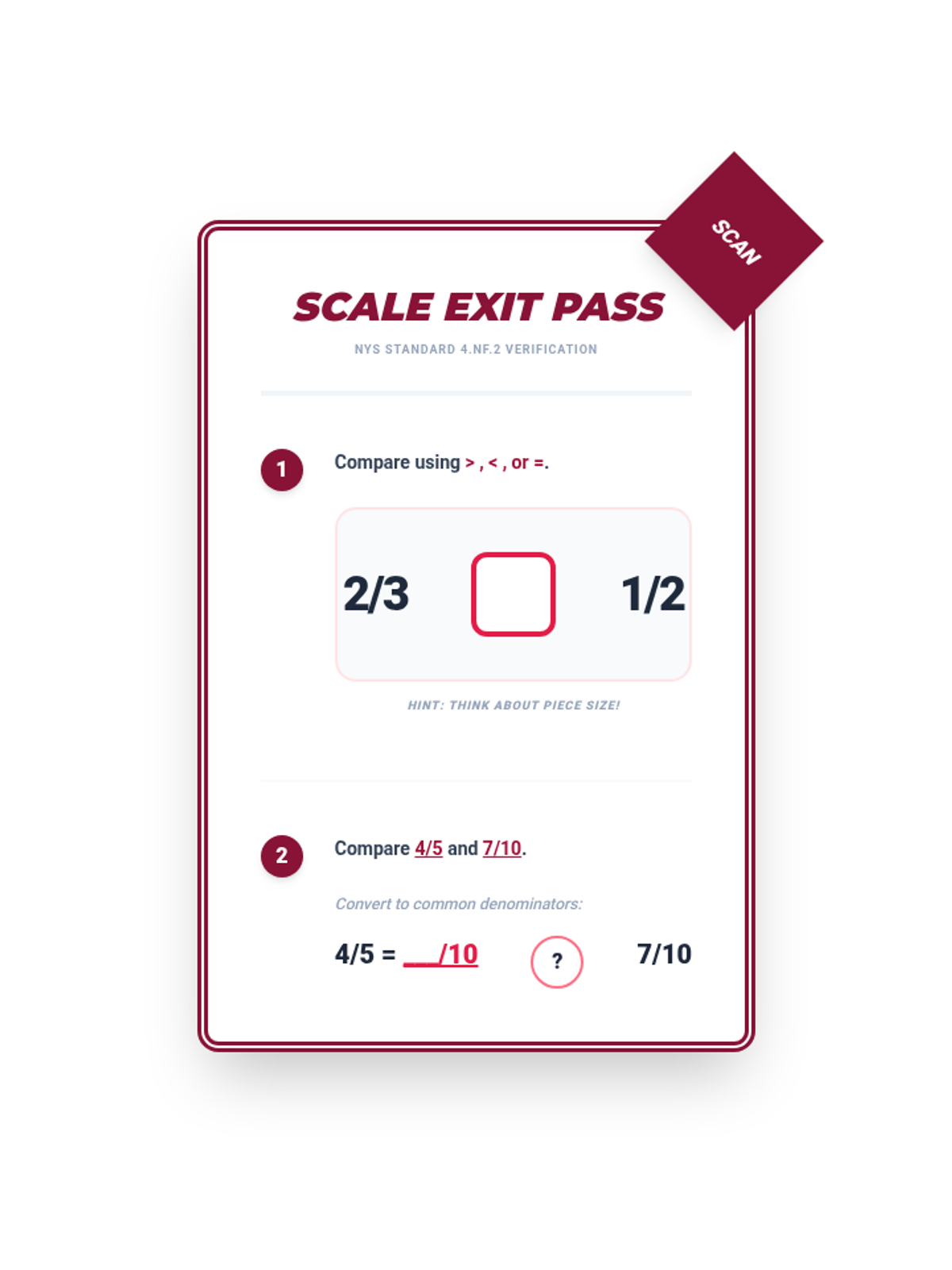
Quick assessment for 4.NF.2, testing student understanding of benchmark fraction comparison (1/2) and conversion to common denominators.
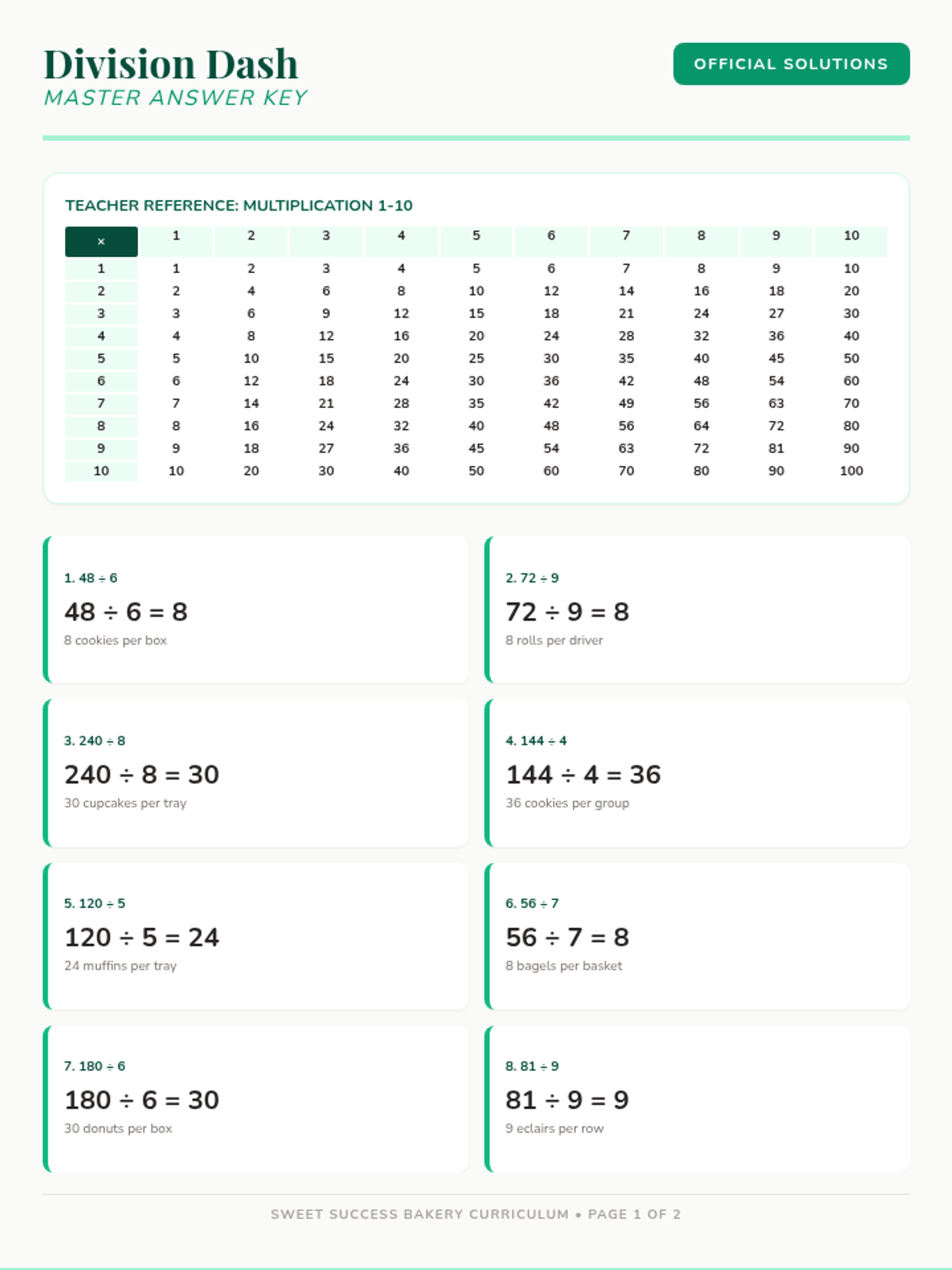
A comprehensive answer key for the 14 division word problems, formatted for standard 8.5x11 inch printing with teaching strategies and a full multiplication chart for reference.
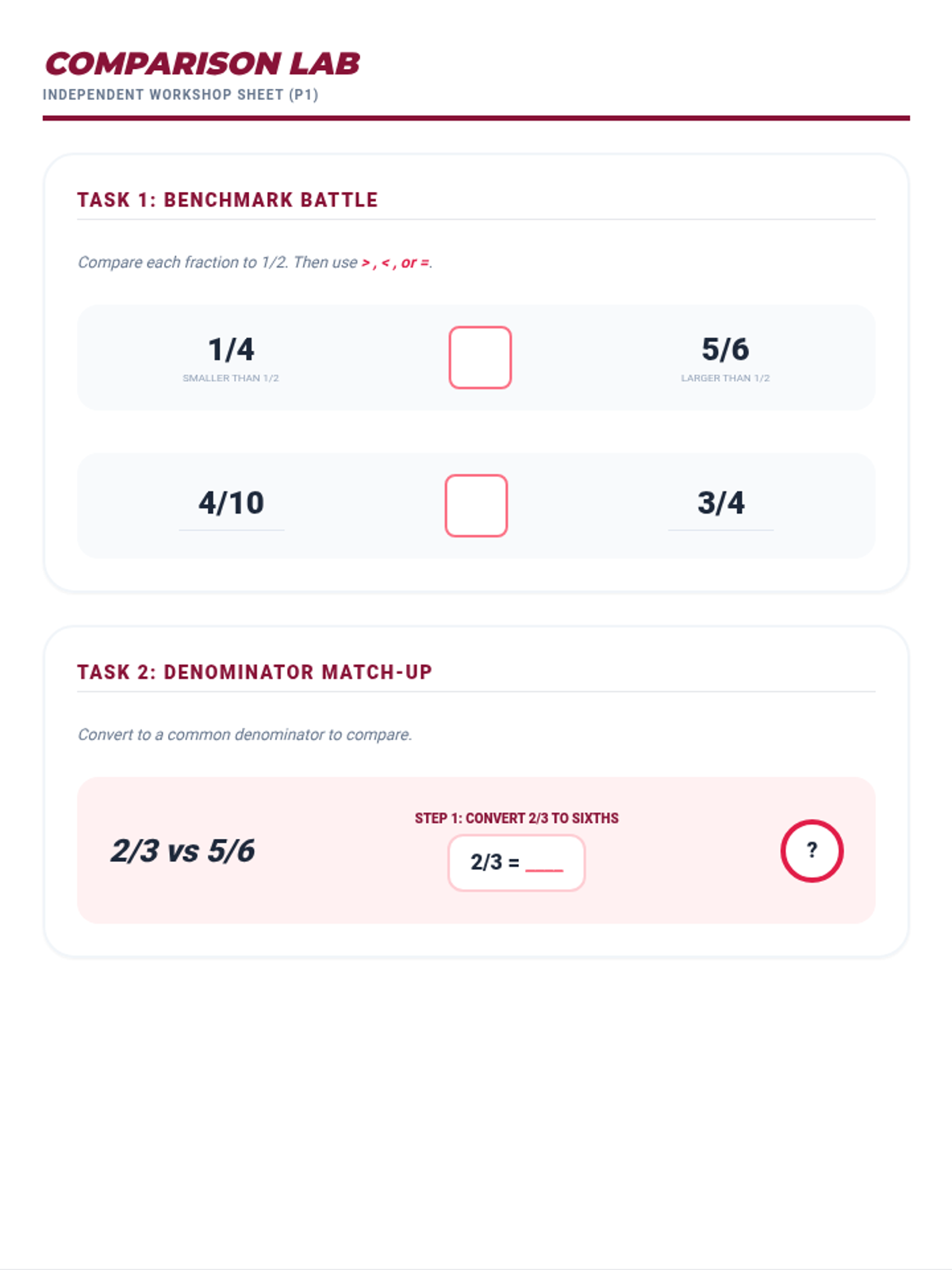
Independent practice for 4.NF.2, including benchmark comparisons, common denominator conversions, and a logical word problem about liquid volume.
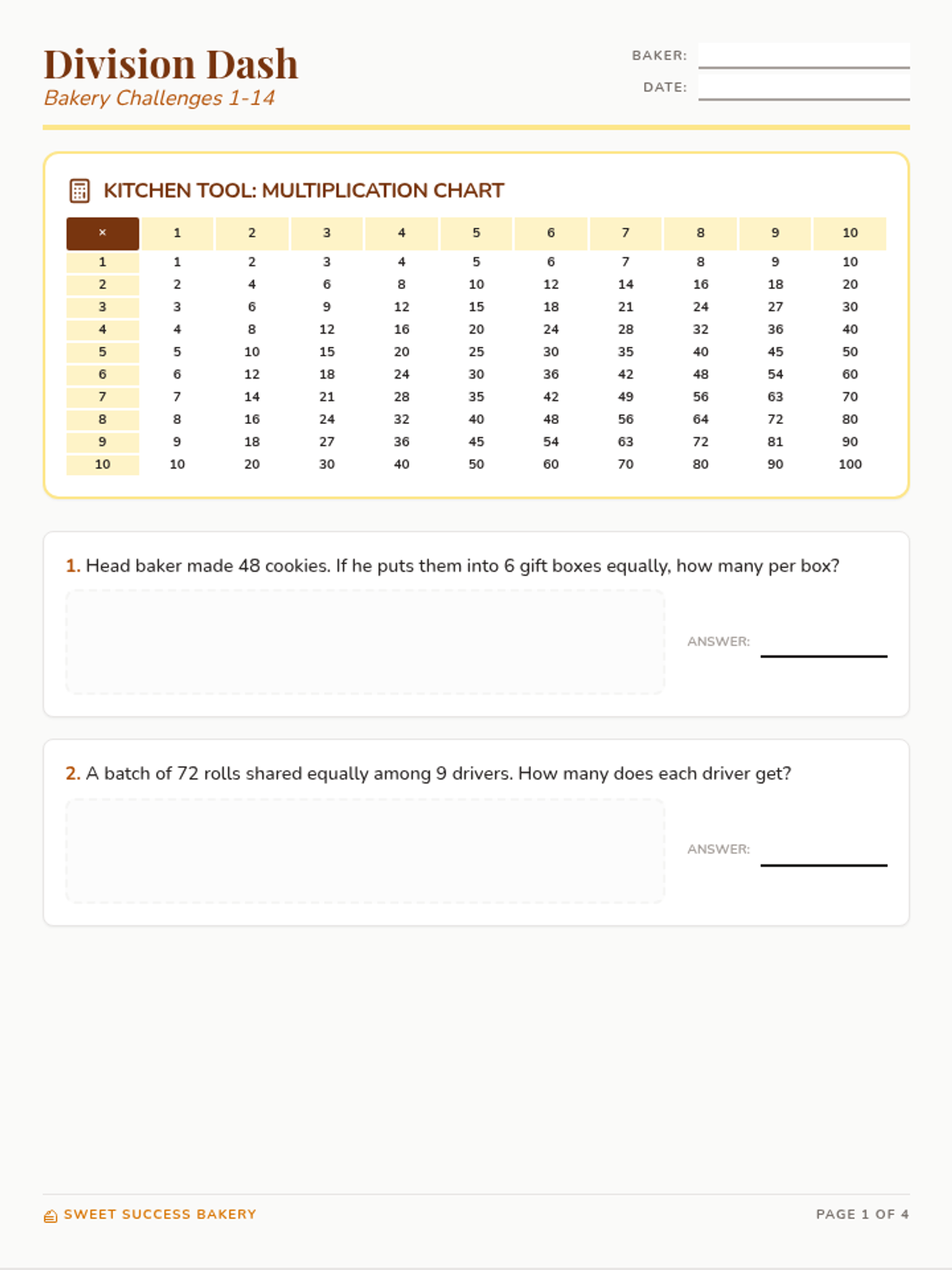
An expanded bakery-themed worksheet now featuring 14 division word problems ranging from basic facts to multi-digit numbers, formatted for standard 8.5x11 inch printing with a full multiplication chart for reference.
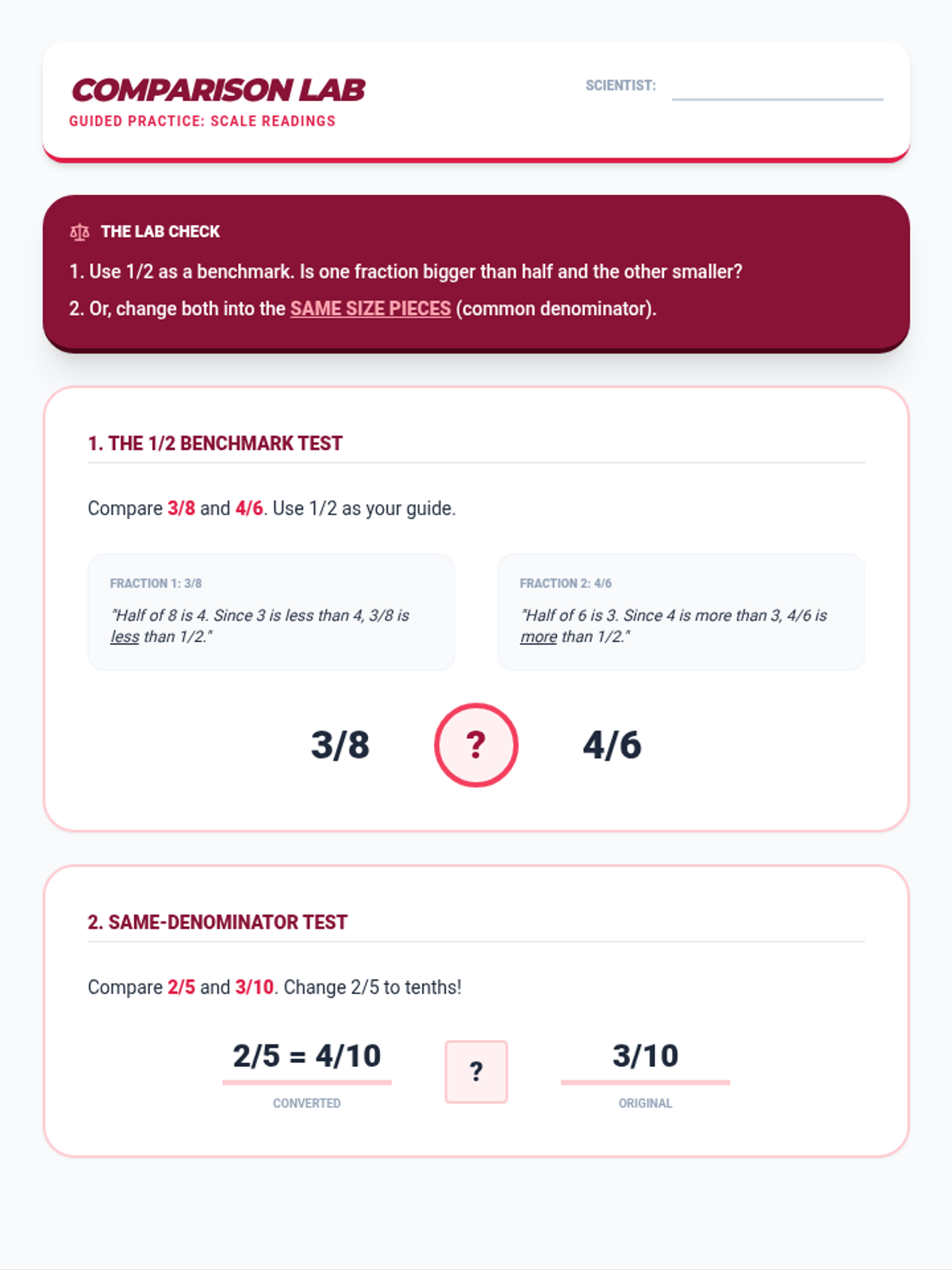
Guided practice for 4.NF.2, walking students through benchmark fraction reasoning (1/2) and common denominator conversion for comparison.
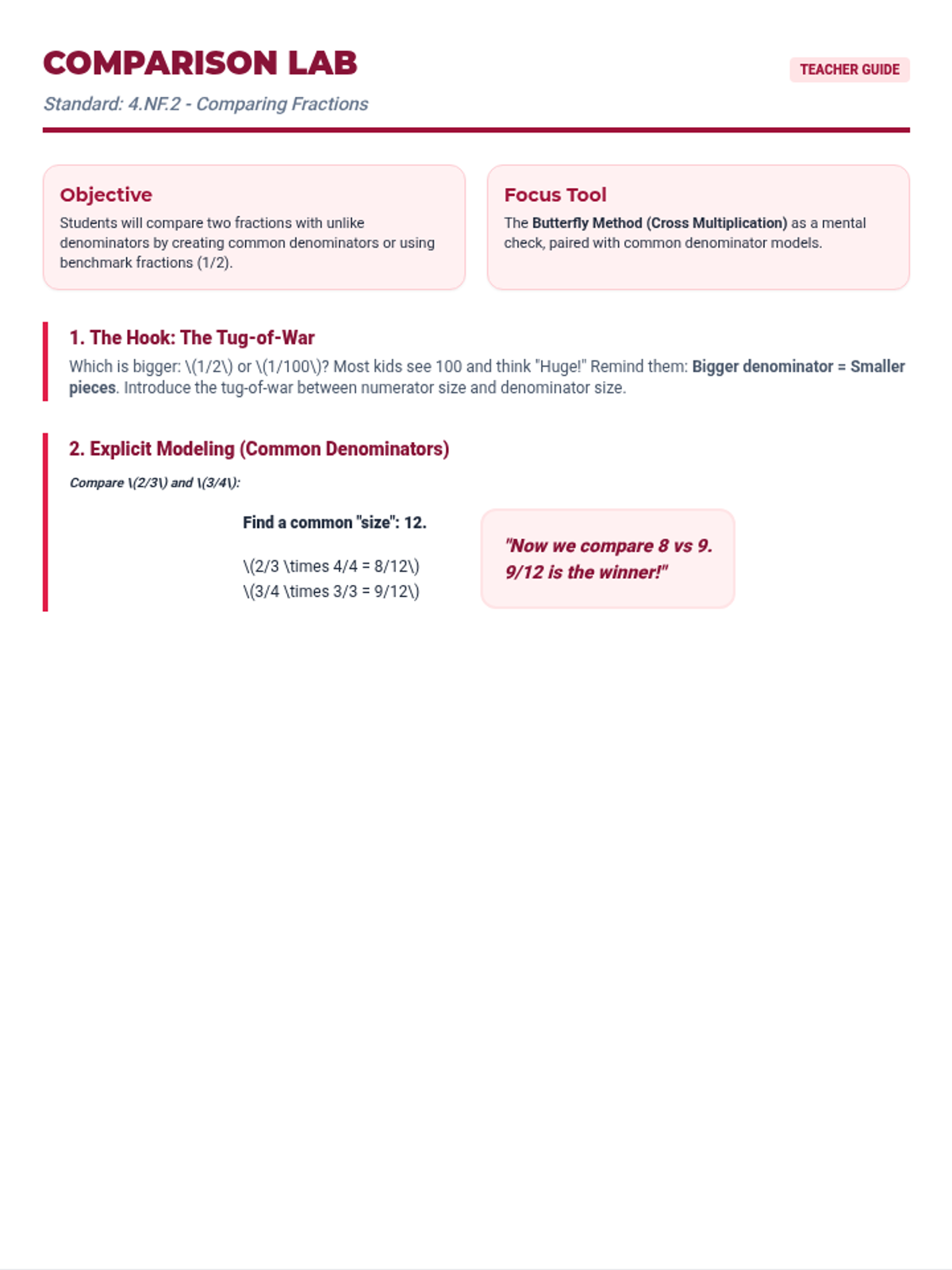
Teacher guide for 4.NF.2, covering strategies for comparing unlike fractions using common denominators and benchmark reasoning.
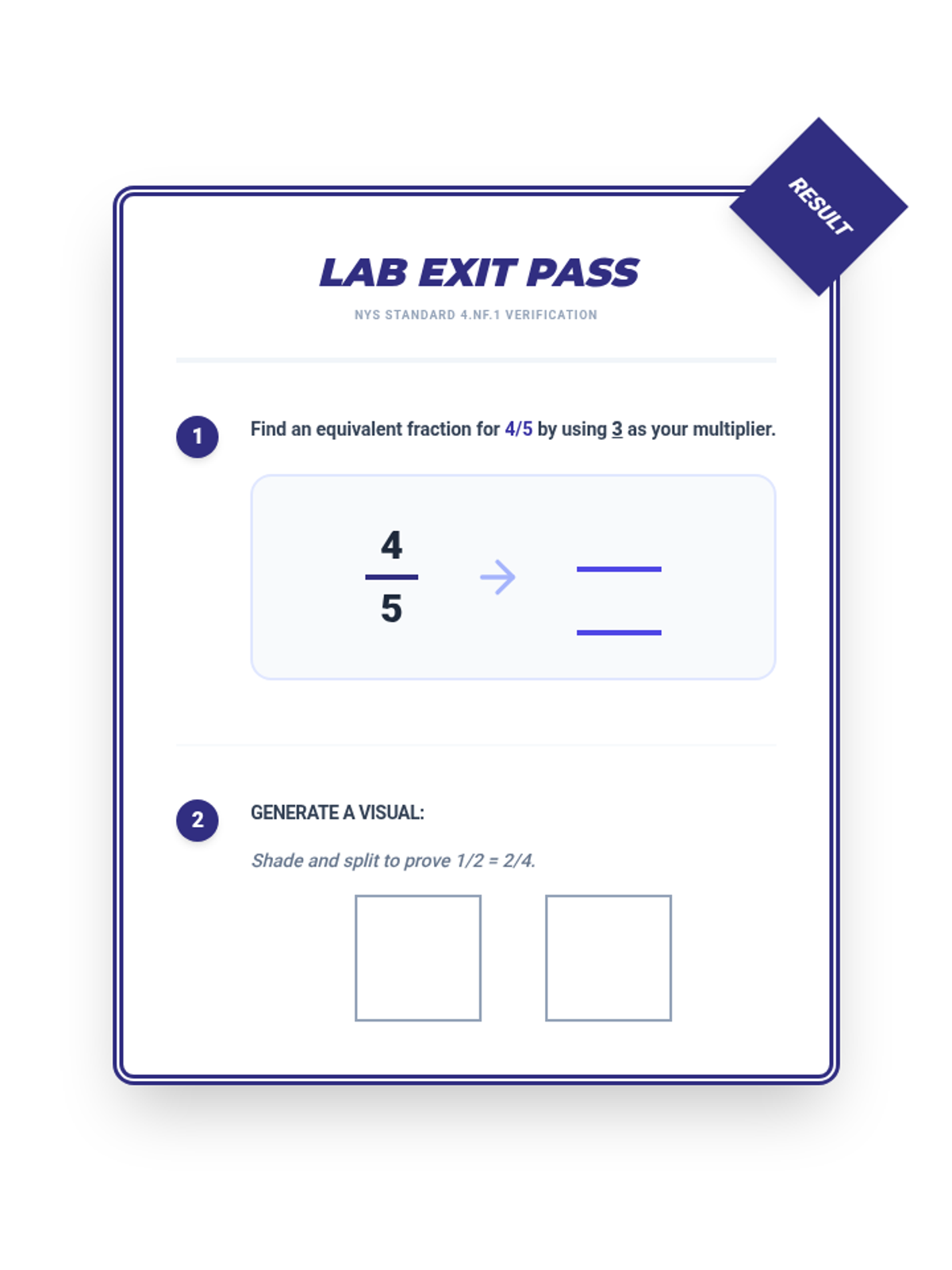
Quick assessment for 4.NF.1, requiring students to generate an equivalent fraction numerically and prove equivalence using a visual area model.
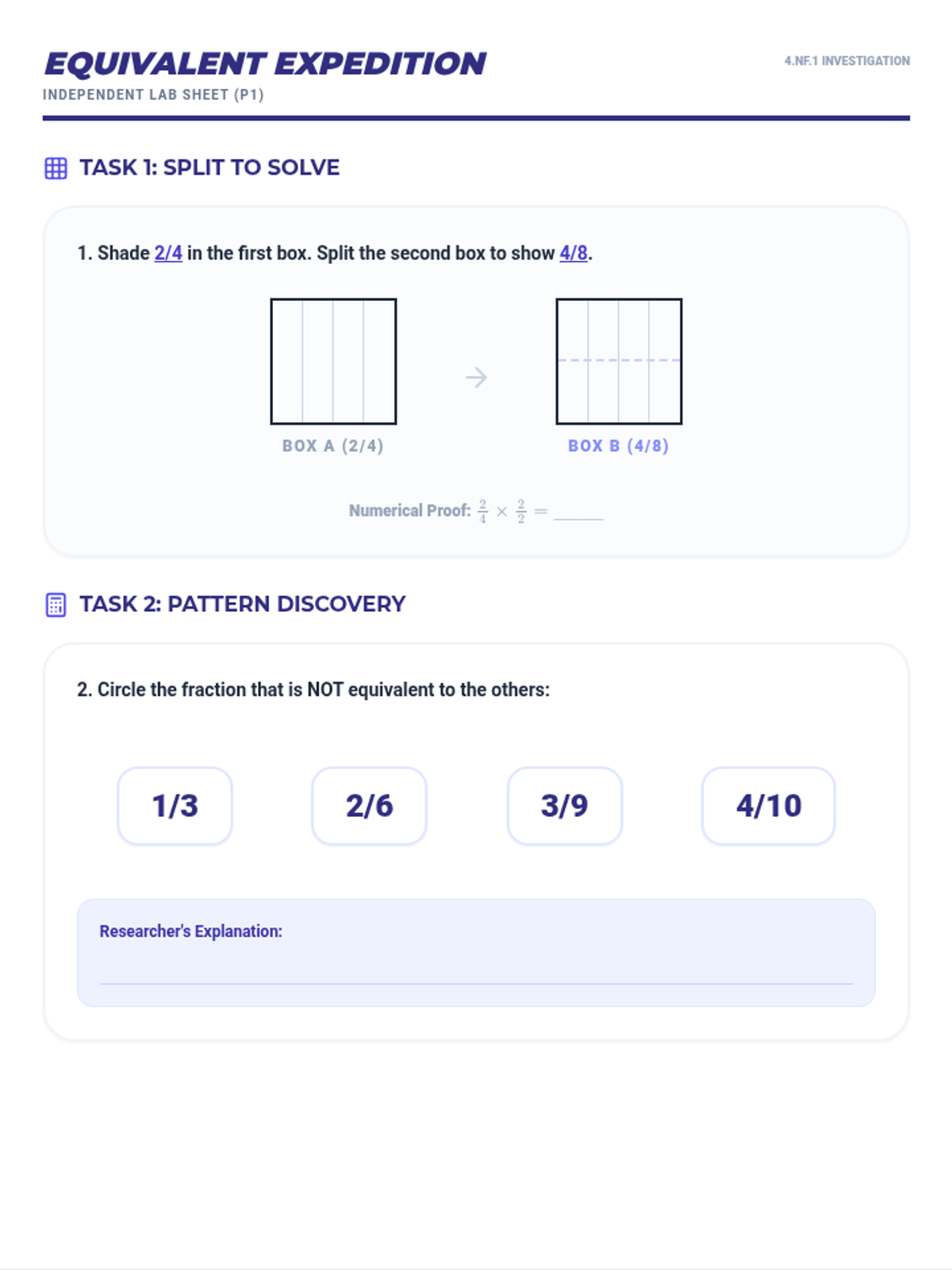
Independent practice for 4.NF.1, featuring area model splitting, identifying non-equivalent fractions, and error analysis of a common multiplication mistake.
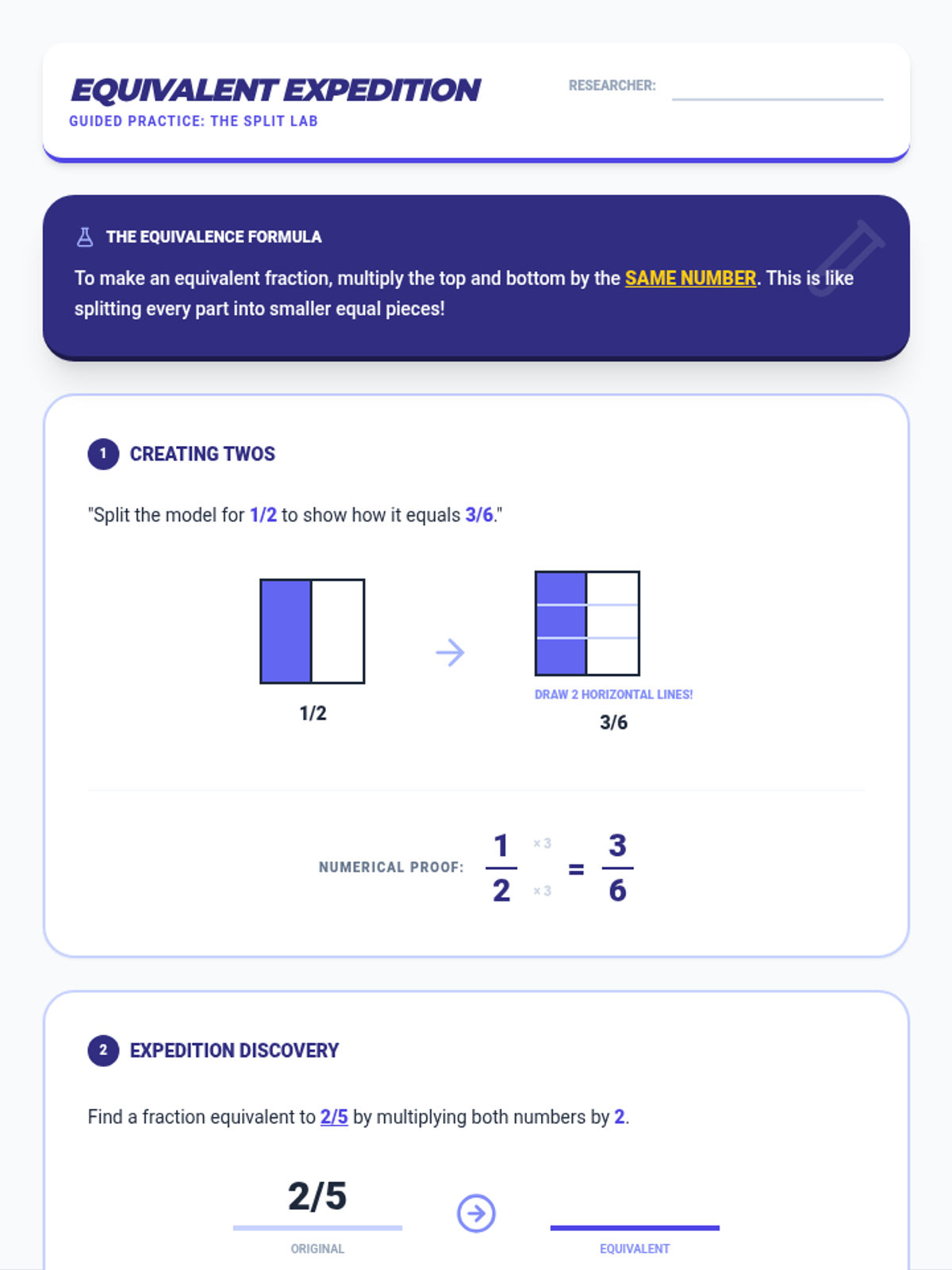
Guided practice for 4.NF.1, using the area model splitting technique to demonstrate fraction equivalence and introducing the numerical multiplication rule.
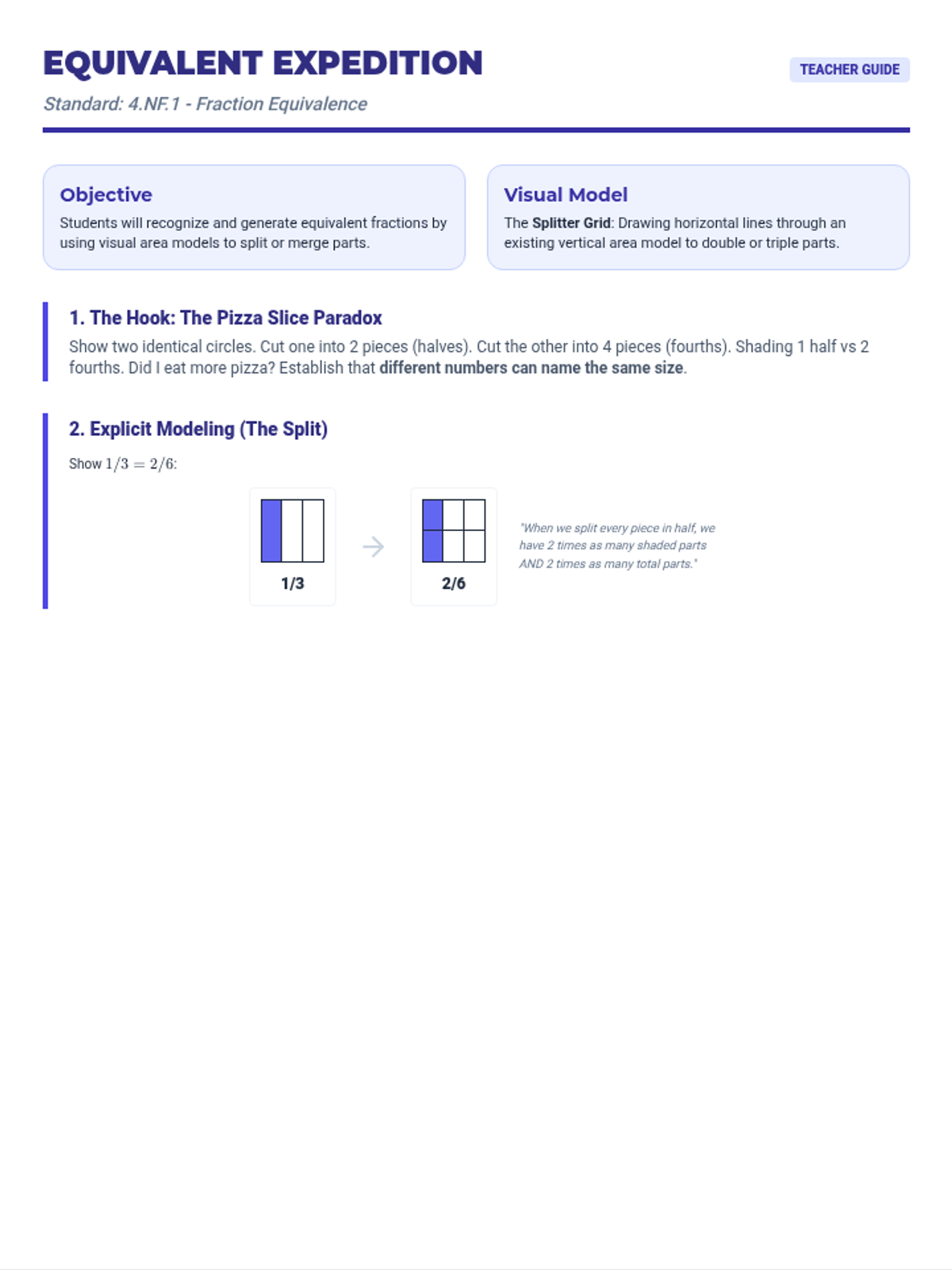
Teacher guide for 4.NF.1, focusing on using area models to visualize fraction equivalence through the "splitting" strategy.
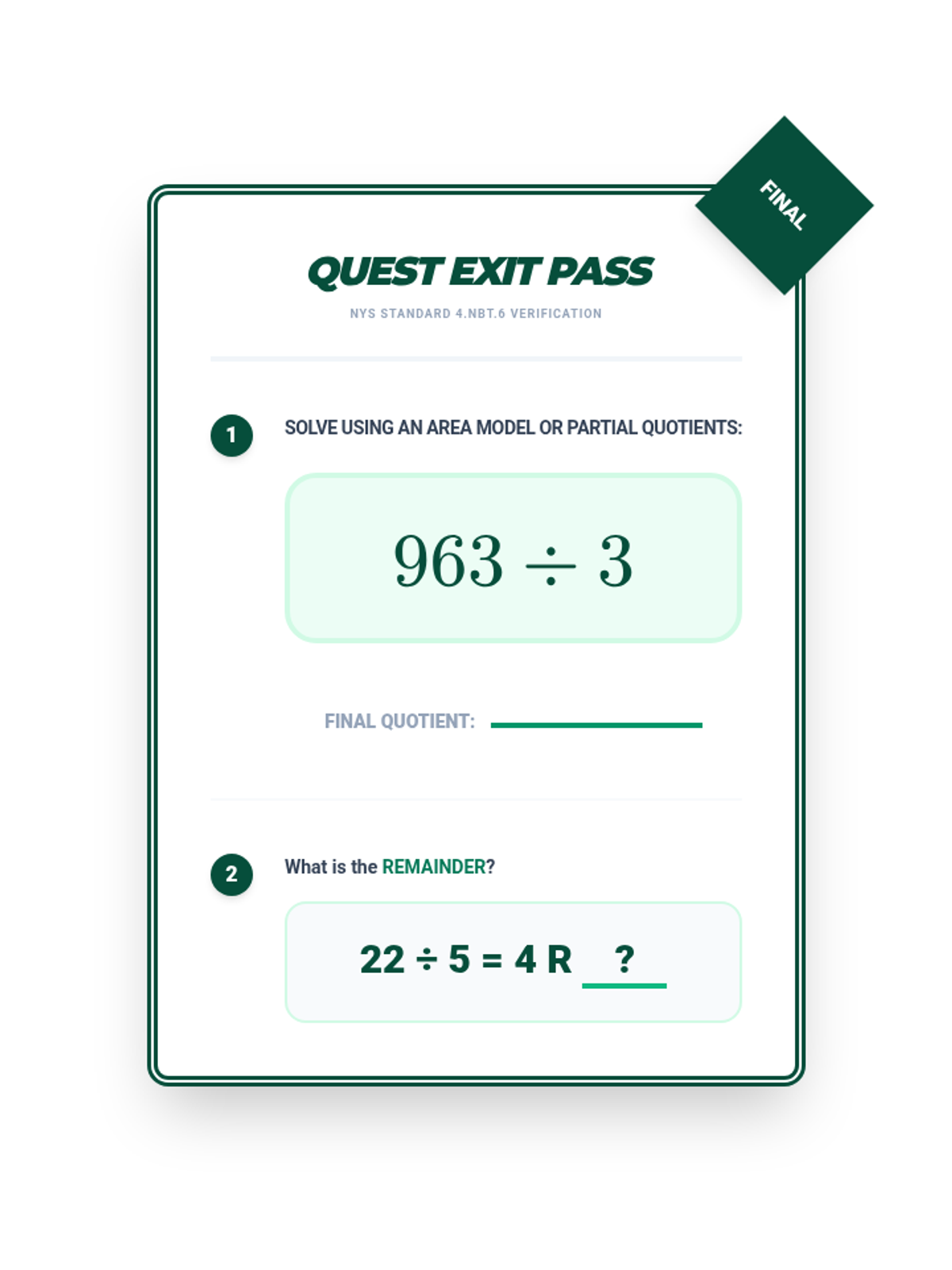
Quick assessment for 4.NBT.6, requiring students to solve a 3-digit division problem and identify a remainder in a provided equation.
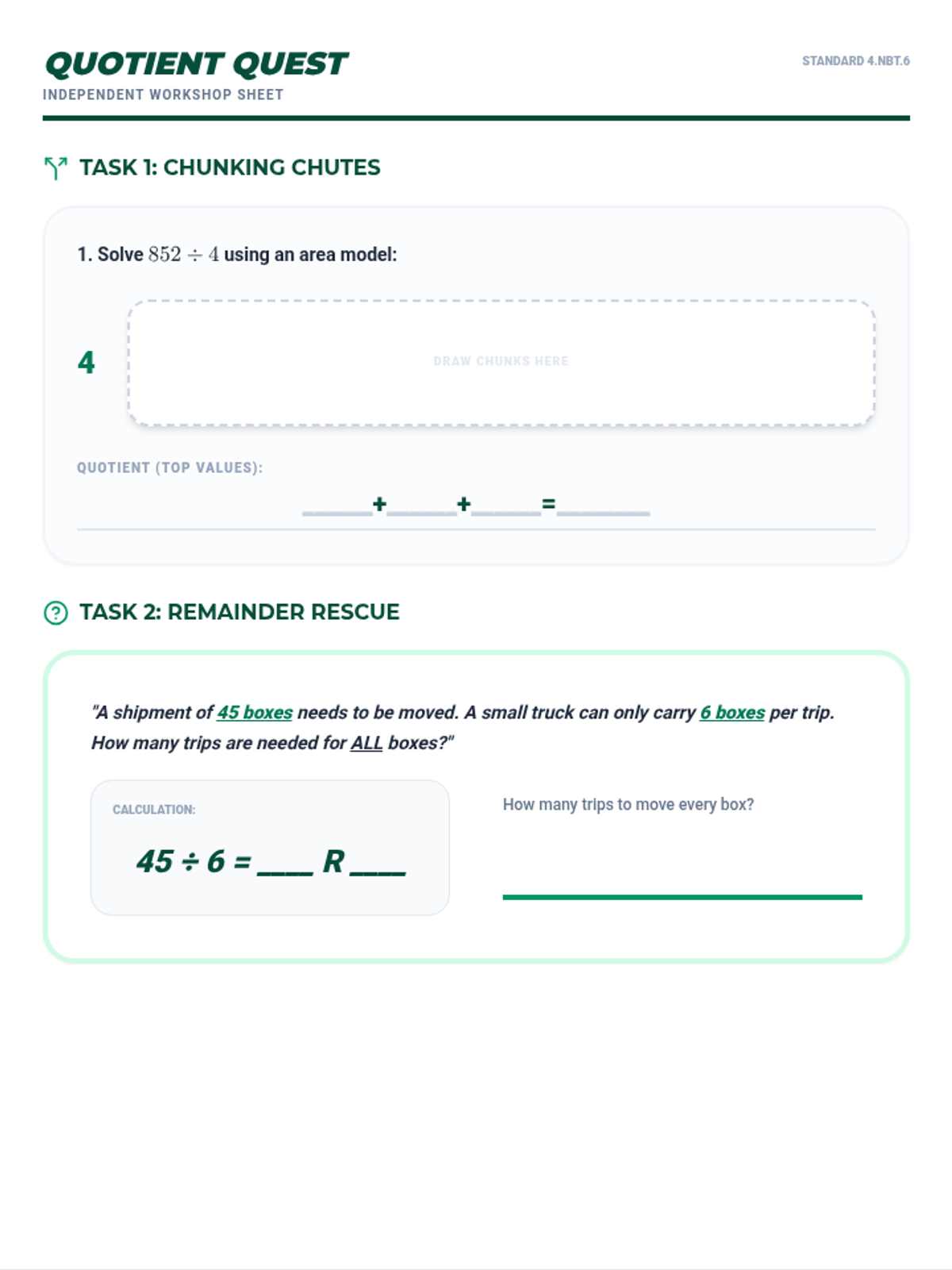
Independent practice for 4.NBT.6, using chunking and area models for division. Includes a multi-step 4-digit division problem and a real-world trip-planning remainder problem.
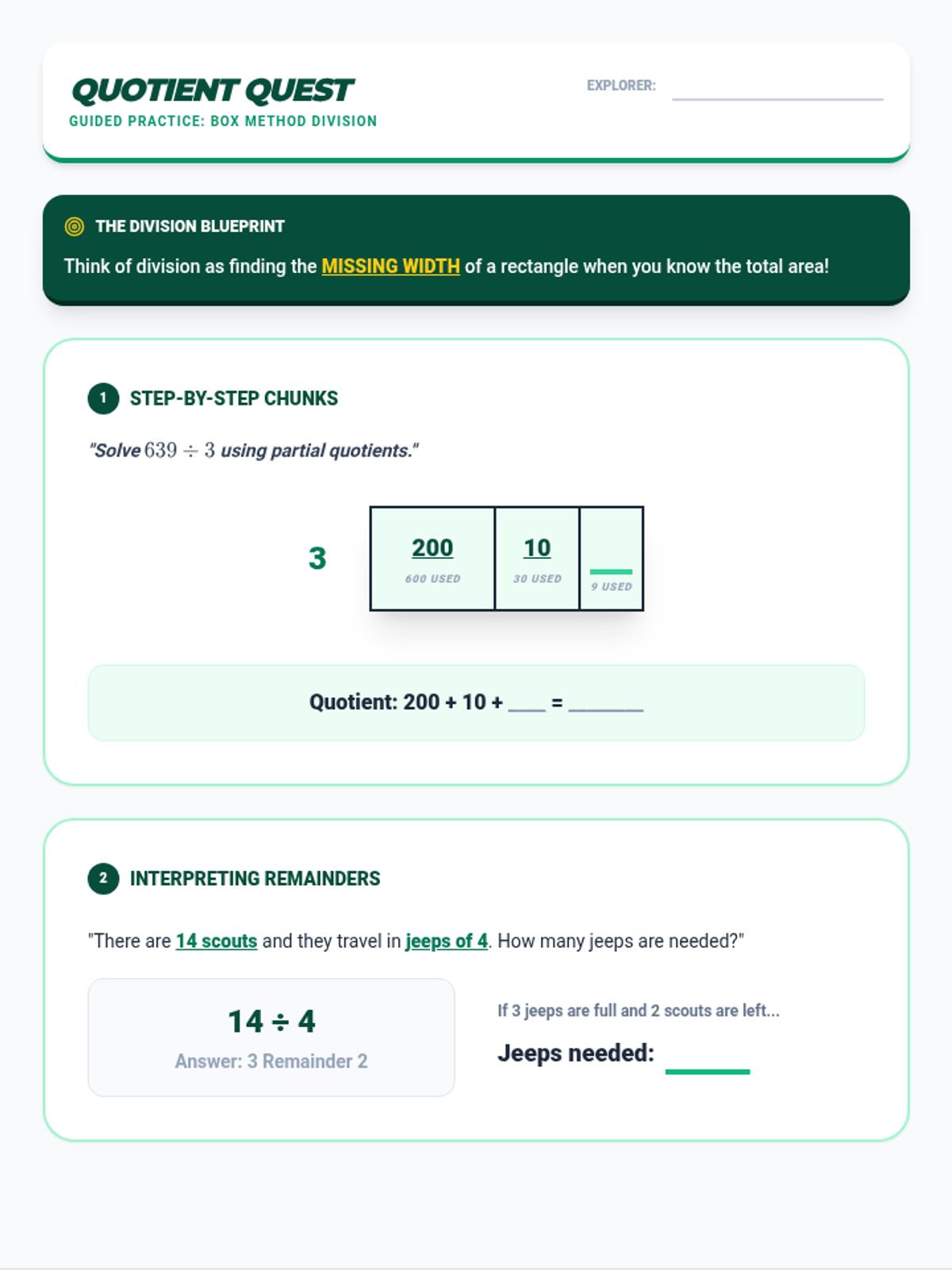
Guided practice for 4.NBT.6, providing visual scaffolding for division using the box method. Includes a remainder interpretation scenario.
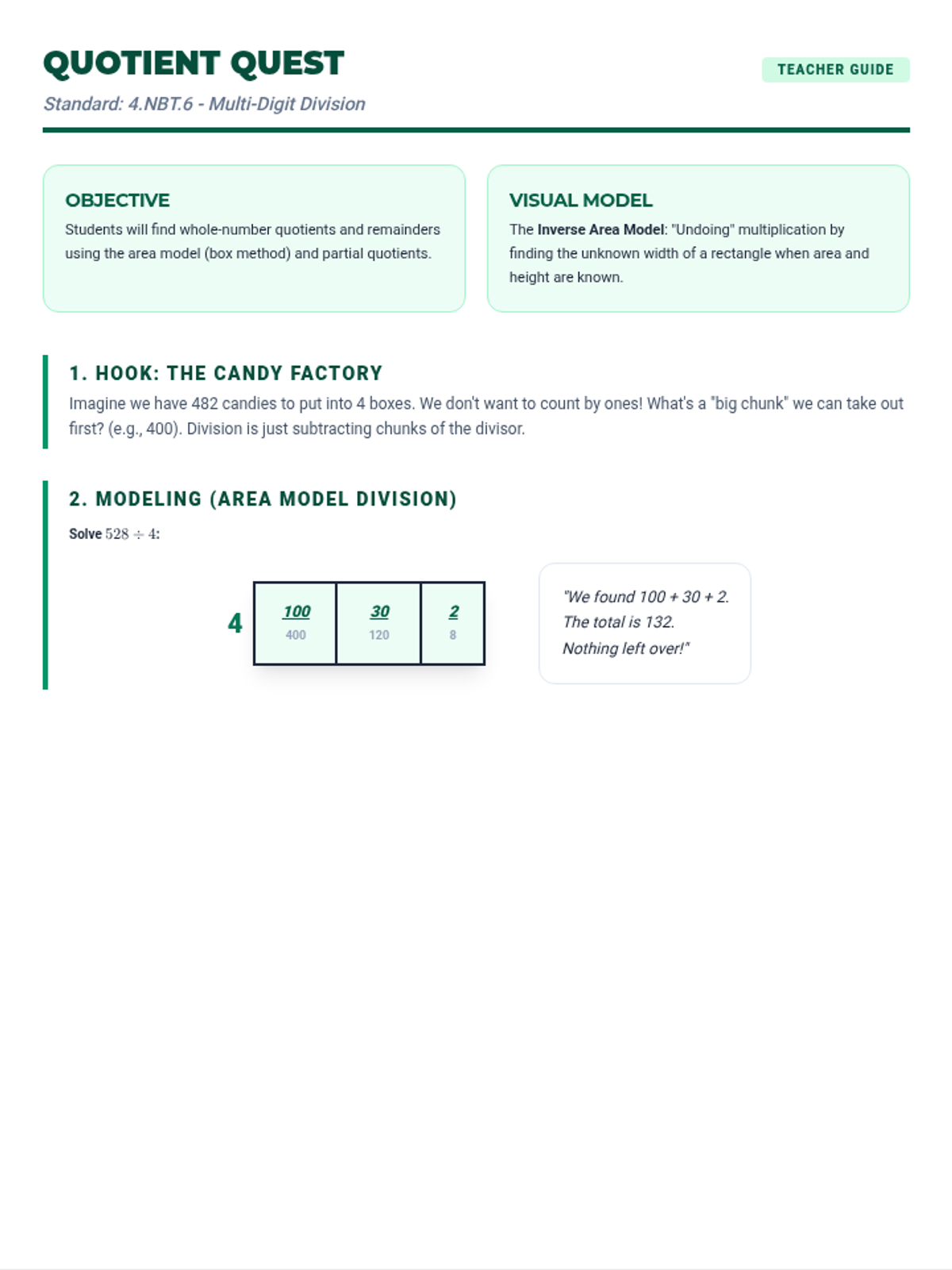
Teacher guide for 4.NBT.6, using the "Inverse Area Model" (box method) for division. Focuses on taking "big chunks" (partial quotients) and handling remainders.
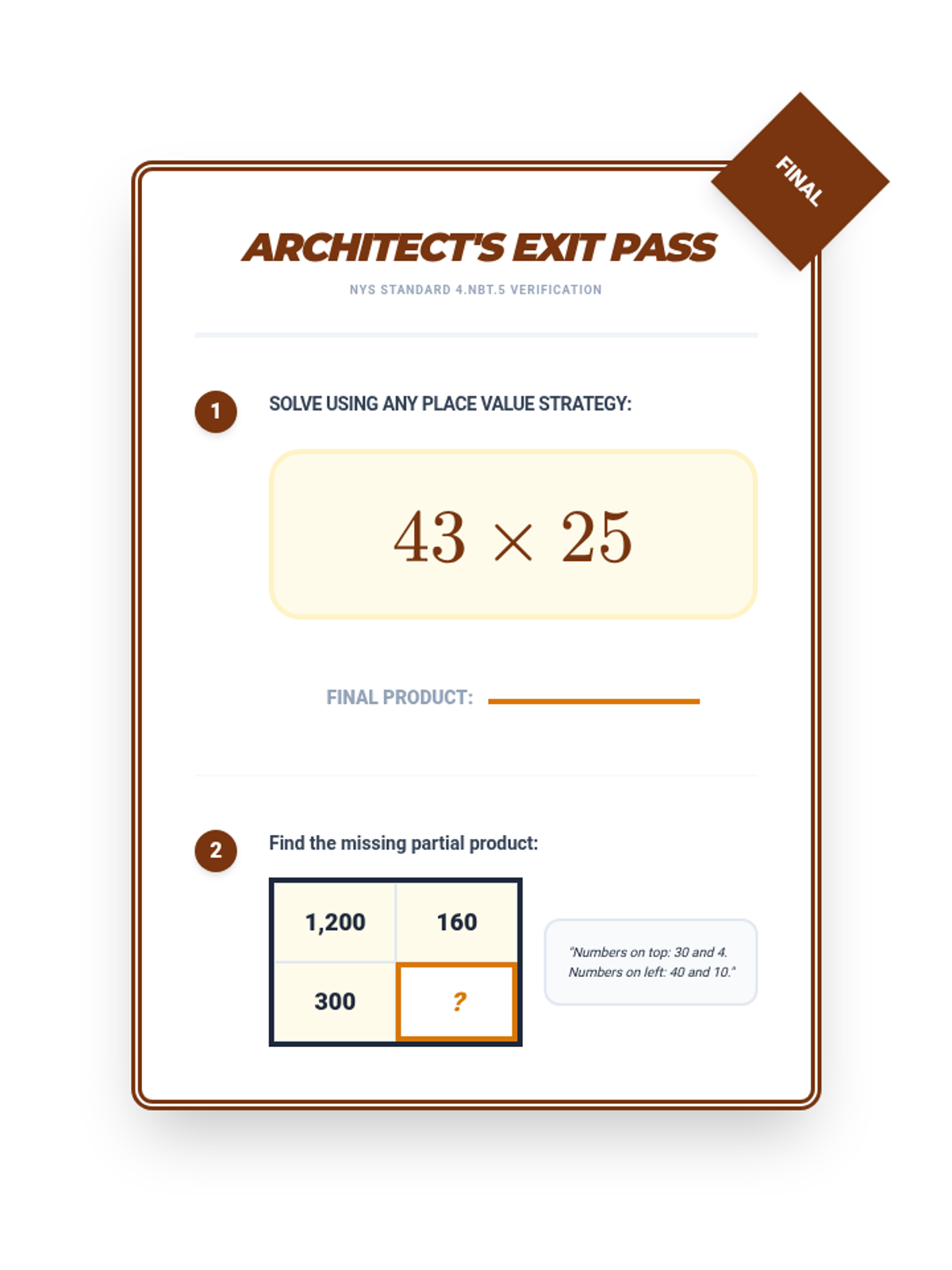
Quick assessment for 4.NBT.5, requiring students to solve a 2x2 multiplication problem and identify a missing partial product in a provided area model.
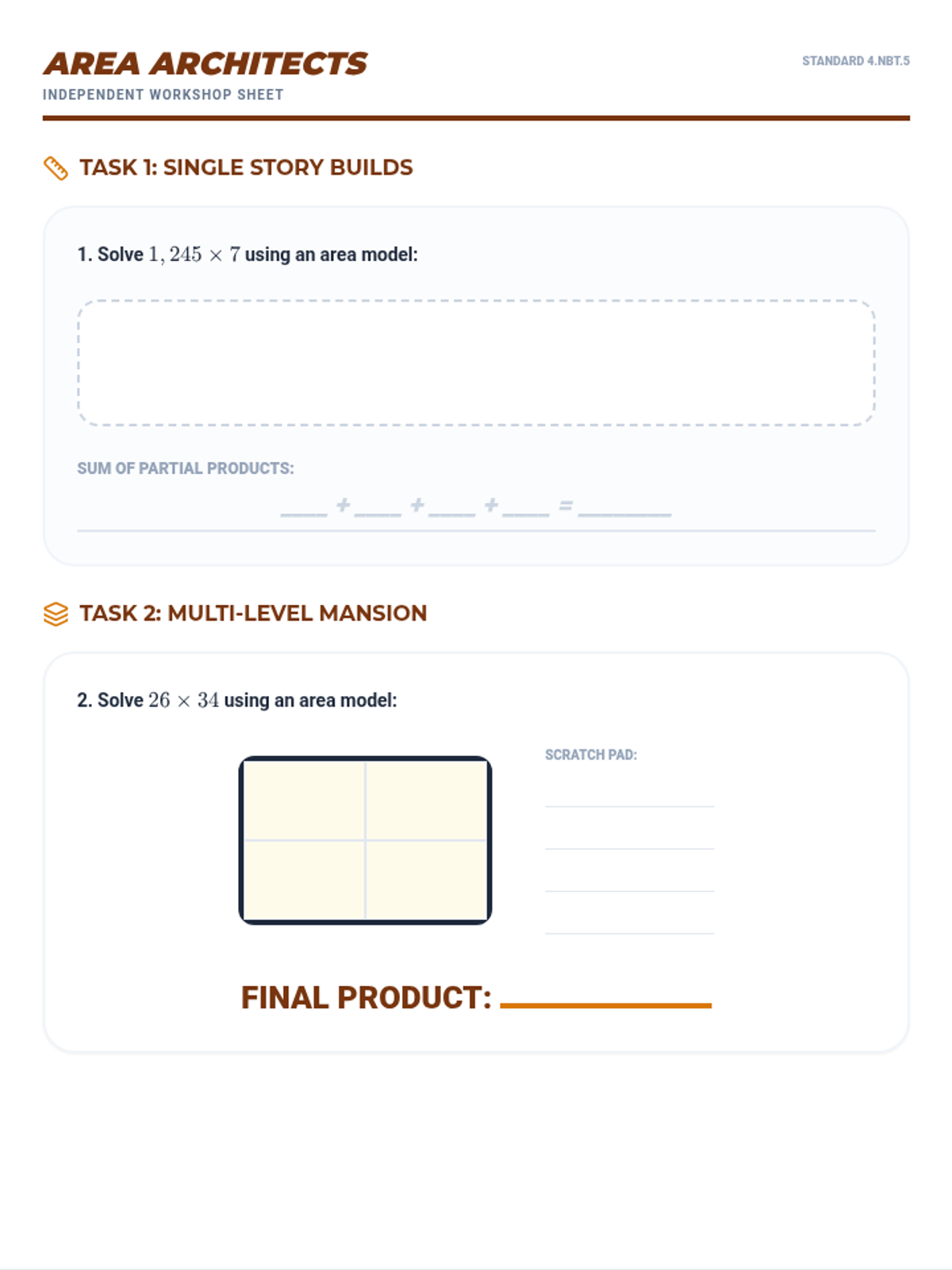
Independent practice for 4.NBT.5, featuring multi-digit multiplication via area models. Includes 4x1 and 2x2 problems, error analysis, and a real-world seating capacity word problem.