A comprehensive rubric for assessing the 'Chef Scientists Cookbook' project, evaluating students on their identification of physical and chemical changes and use of scientific evidence.
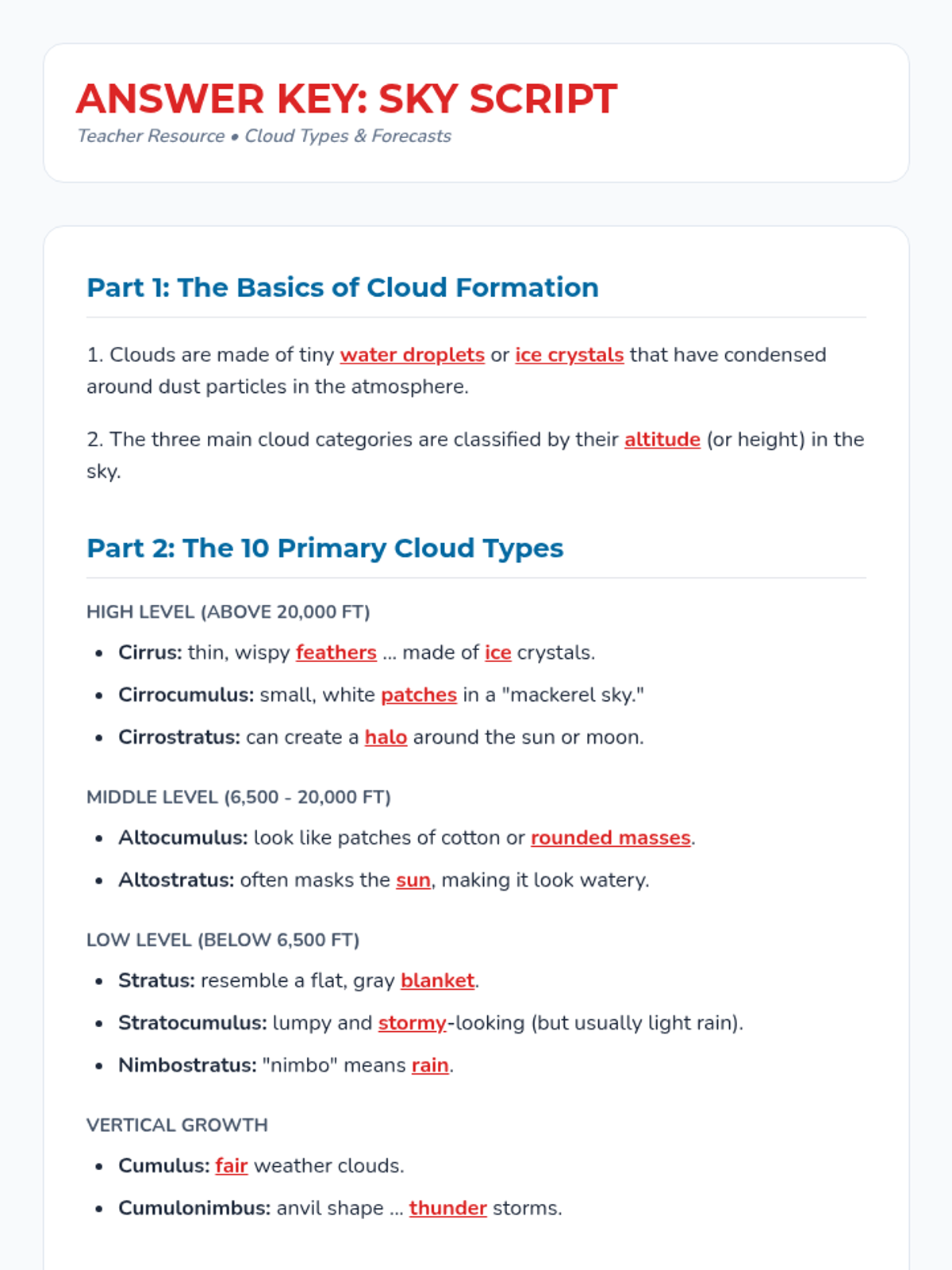
A teacher's answer key for the Sky Script Guided Notes, including suggested answers for fill-in-the-blank sections and the reflection question.
A visual presentation introducing the ten primary cloud types with a focus on their classification by altitude and weather effects. Includes a National Geographic video embed and improved slide contrast.
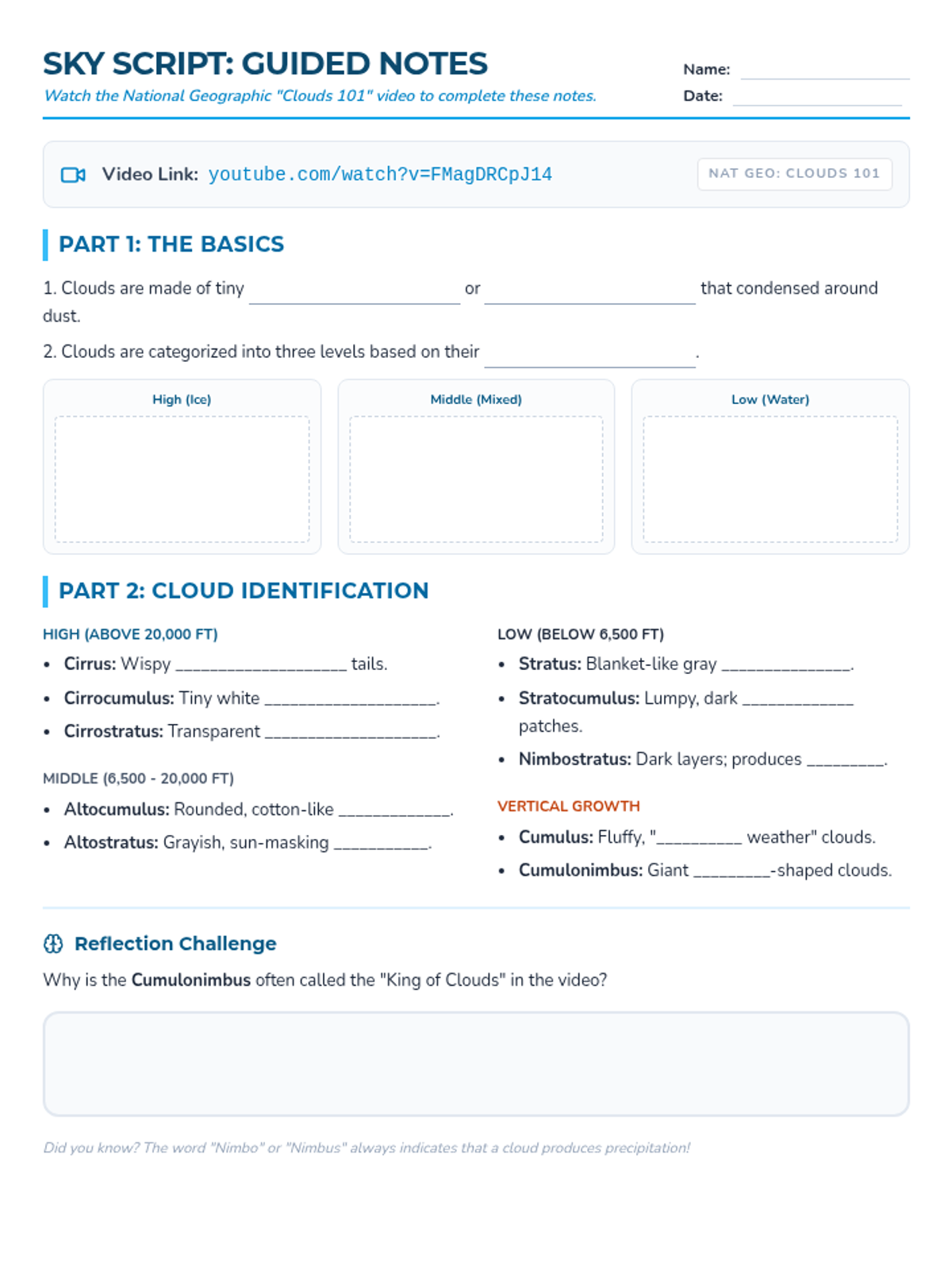
A student worksheet with fill-in-the-blank notes designed to be completed while watching the National Geographic "Clouds 101" video. Includes larger drawing areas and clear video references. Condensed to fit on a single page.
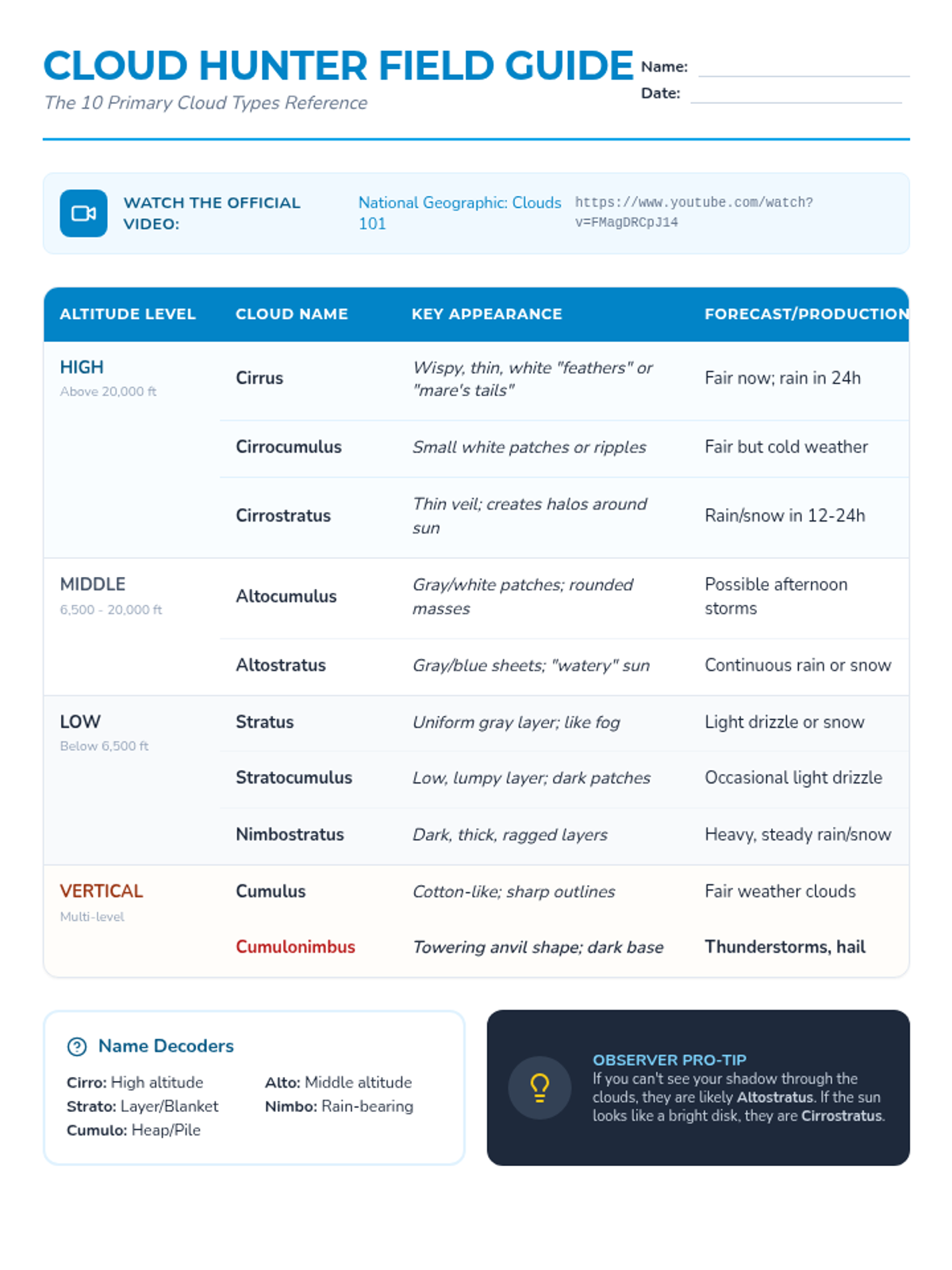
A visually organized reference sheet for students detailing the 10 primary cloud types, their appearances, altitudes, and weather predictions. Condened to fit on a single page for quick reference.
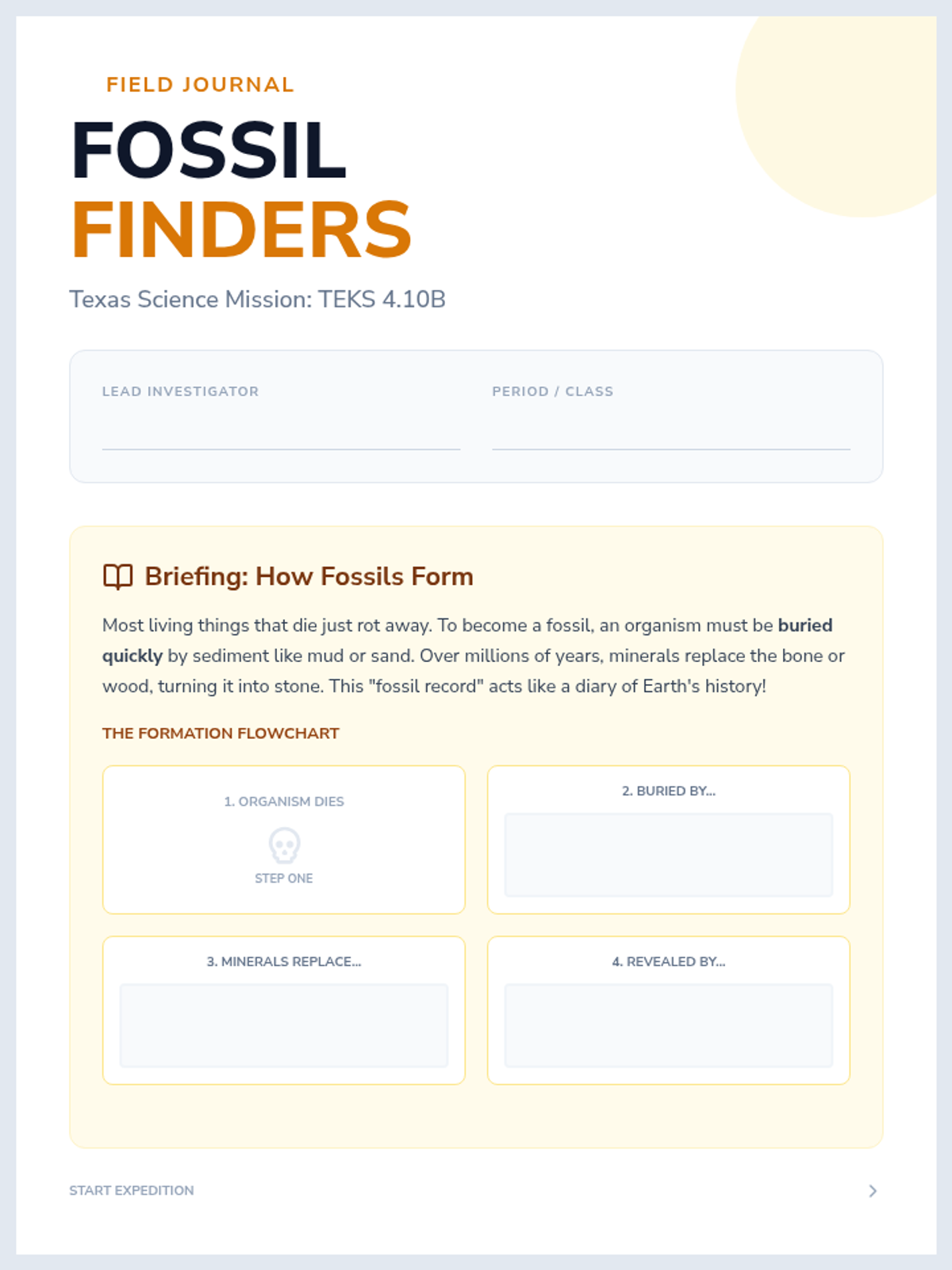
A revised 3-page student field journal for 4th-grade science, focusing on fossil formation, environmental evidence, and extinct species (TEKS 4.10B). Designed to be completed in one 60-minute period. Features enlarged student work areas, a built-in word bank, and more detailed reading passages to support independent work. Layout adjusted to ensure all content fits on 3 pages.
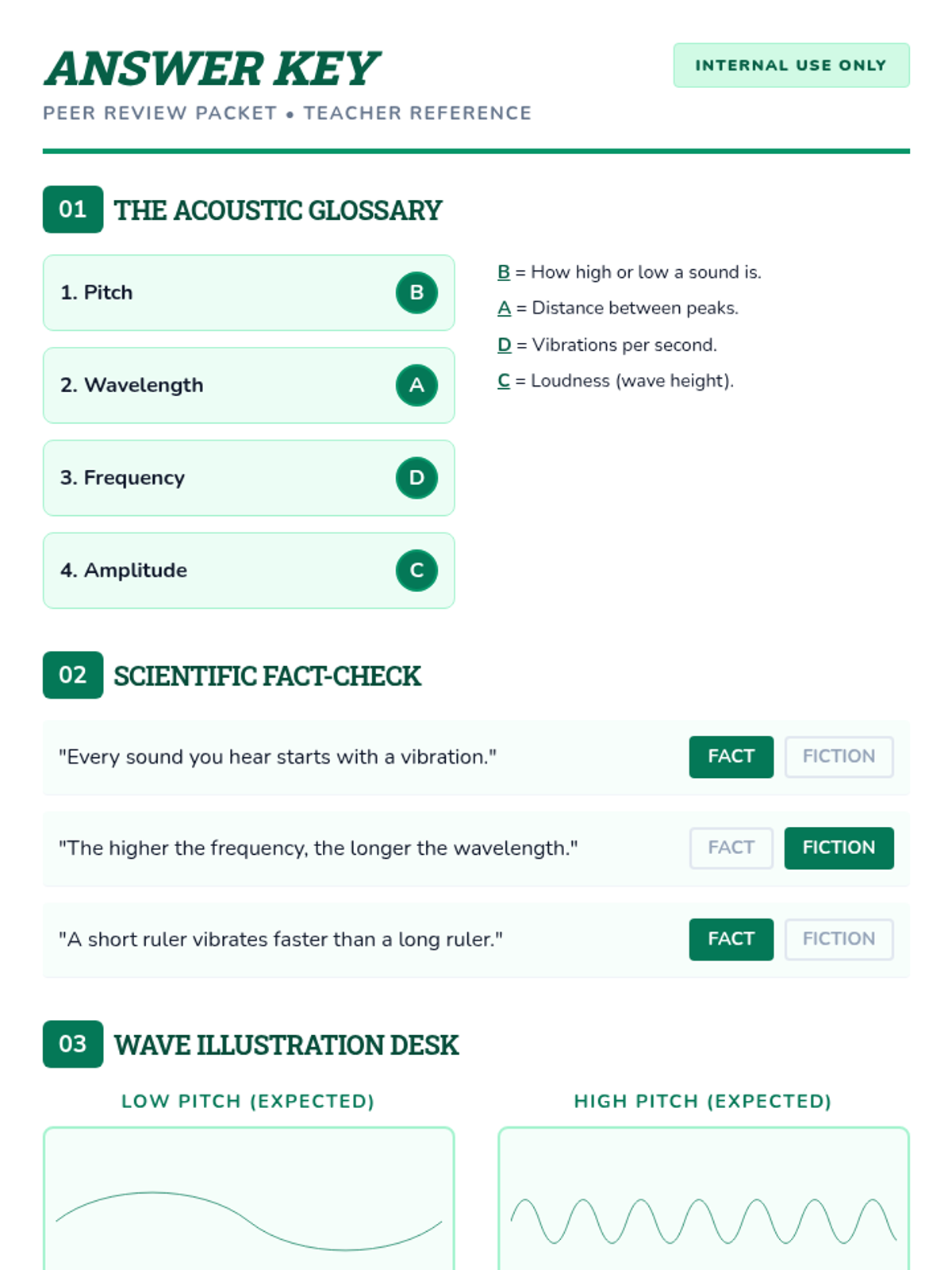
An answer key for the Peer Review Packet Worksheet, providing correct matches for vocabulary, fact-check responses, exemplar wave drawings, and a model explanation for the ruler experiment analysis.
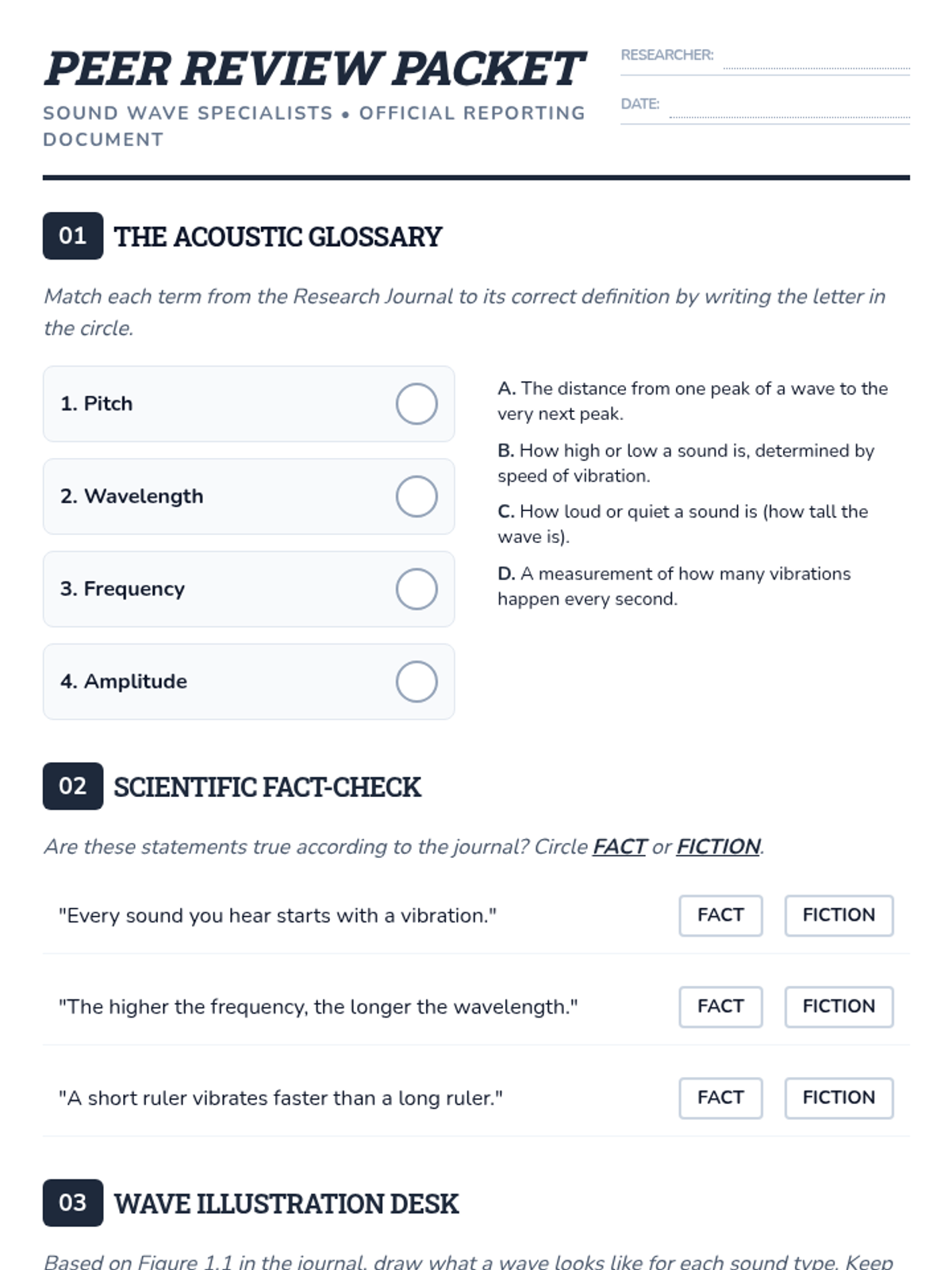
A comprehensive student worksheet based on the Acoustic Research Journal. Includes vocabulary matching, fact-checking, wave diagram drawing, and a critical thinking lab analysis section, all designed with a professional peer-review aesthetic.
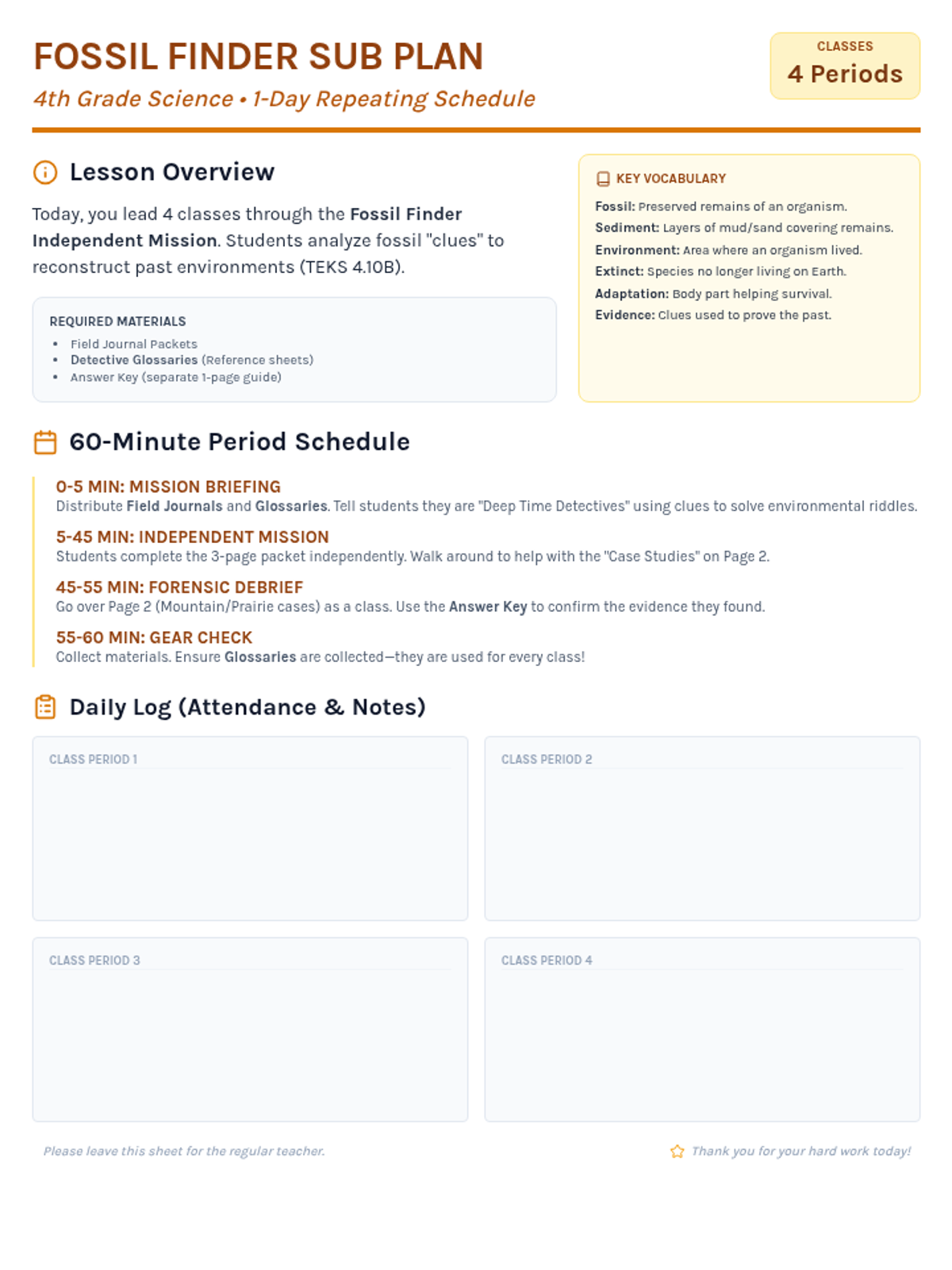
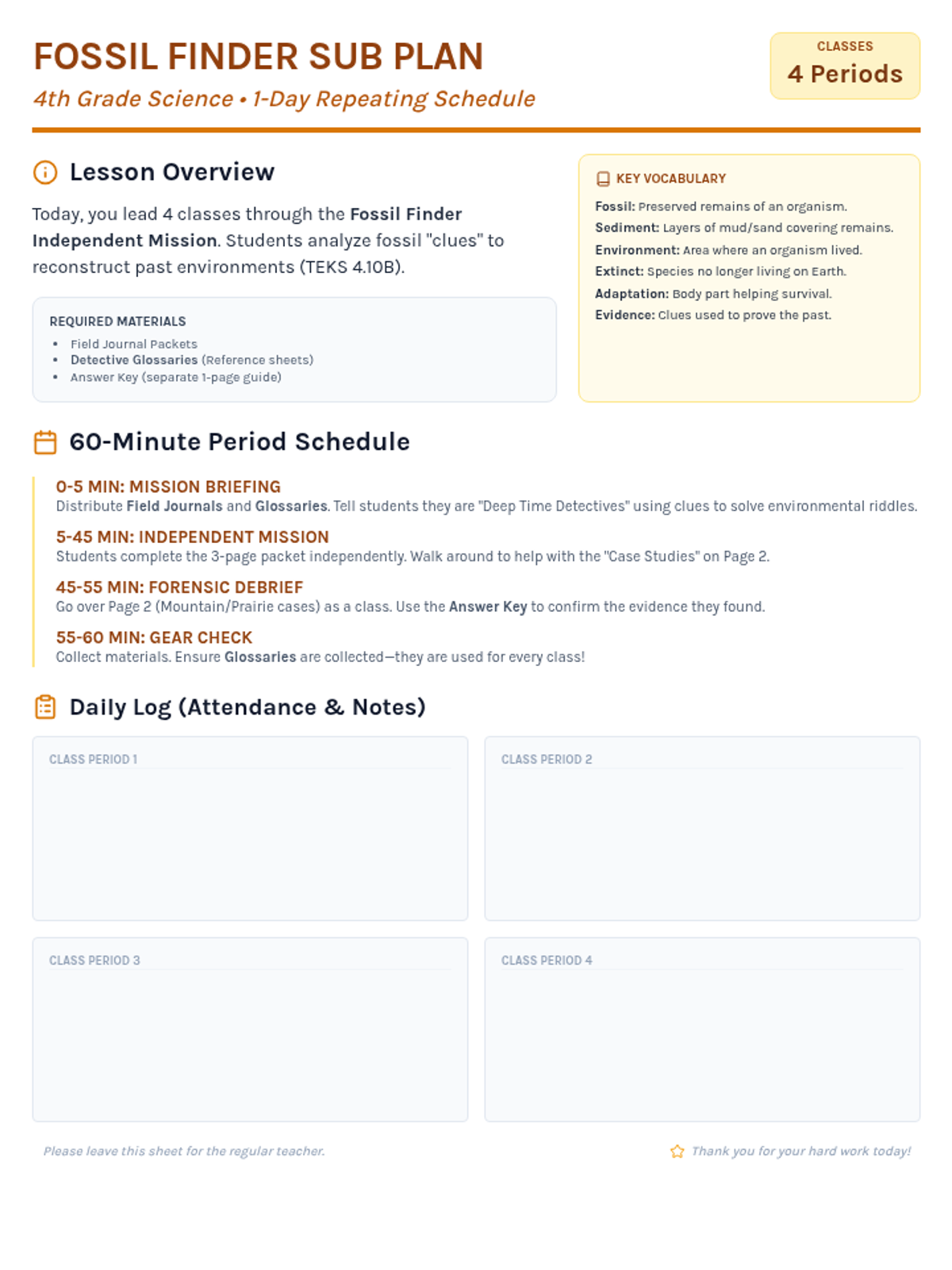
A comprehensive 1-page instructional guide for a substitute teacher, outlining a repeating 1-hour schedule for 4 different 4th-grade science classes in Texas, now including a vocabulary reference and larger classroom note areas.
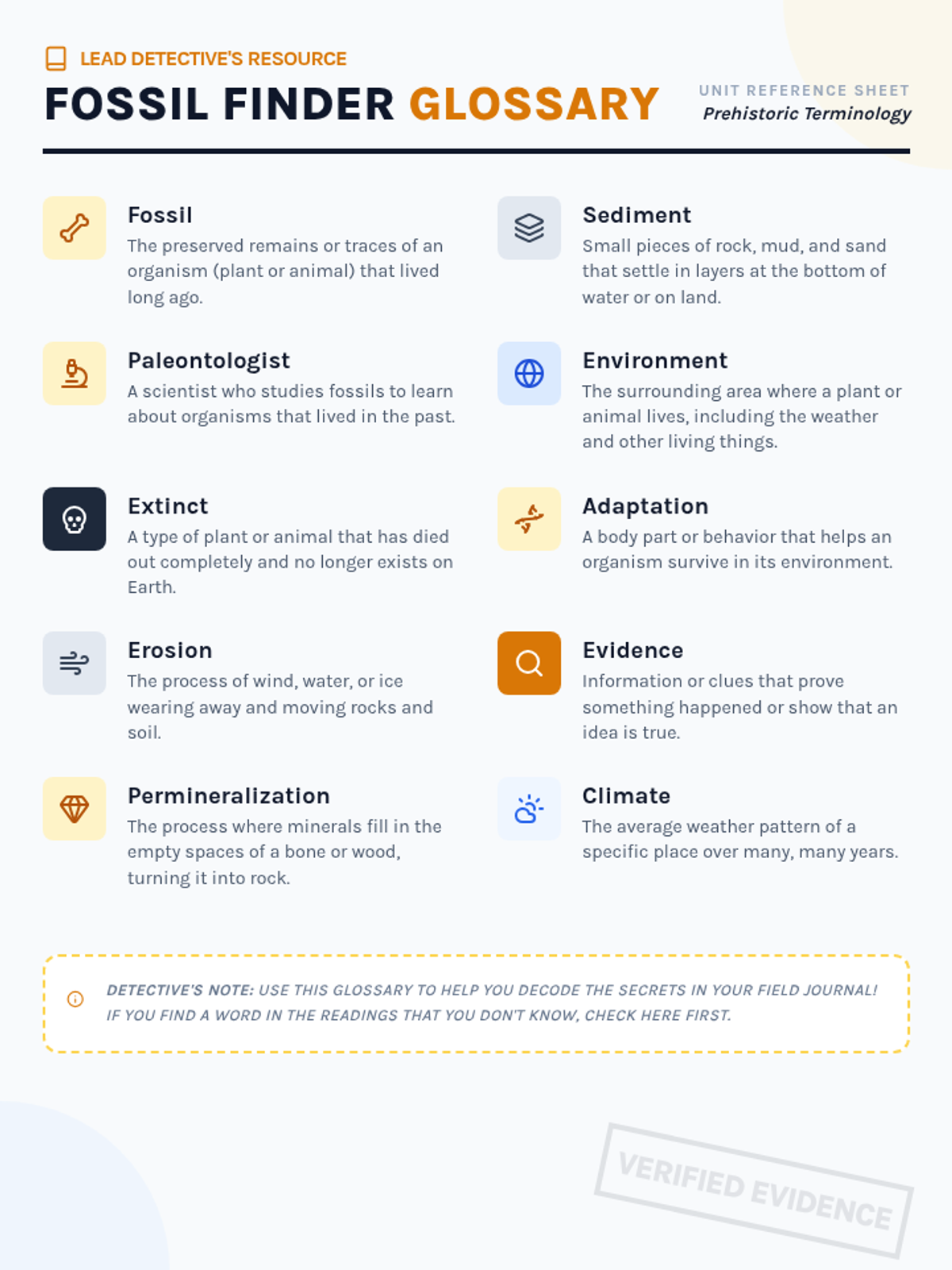
A clear and engaging vocabulary reference sheet for 4th-grade students, featuring key terms related to fossils, past environments, and geological processes.
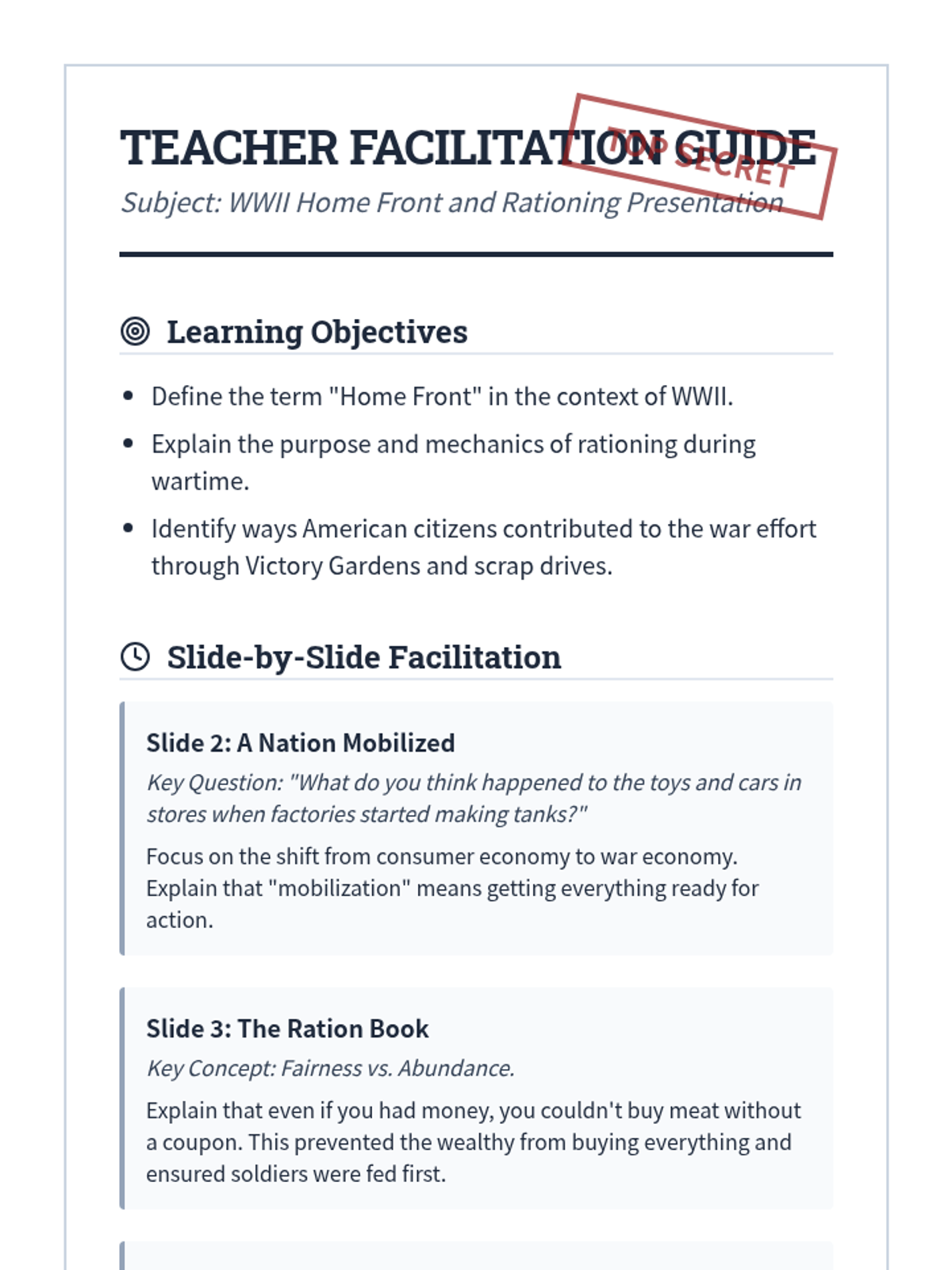
A teacher facilitation guide for the WWII Home Front slides, providing pacing notes, discussion prompts, and historical background information on rationing and mobilization.
A slide presentation layout for WWII Home Front and Rationing, featuring a vintage newspaper aesthetic, key concepts of mobilization, rationing mechanics, and community efforts like Victory Gardens.
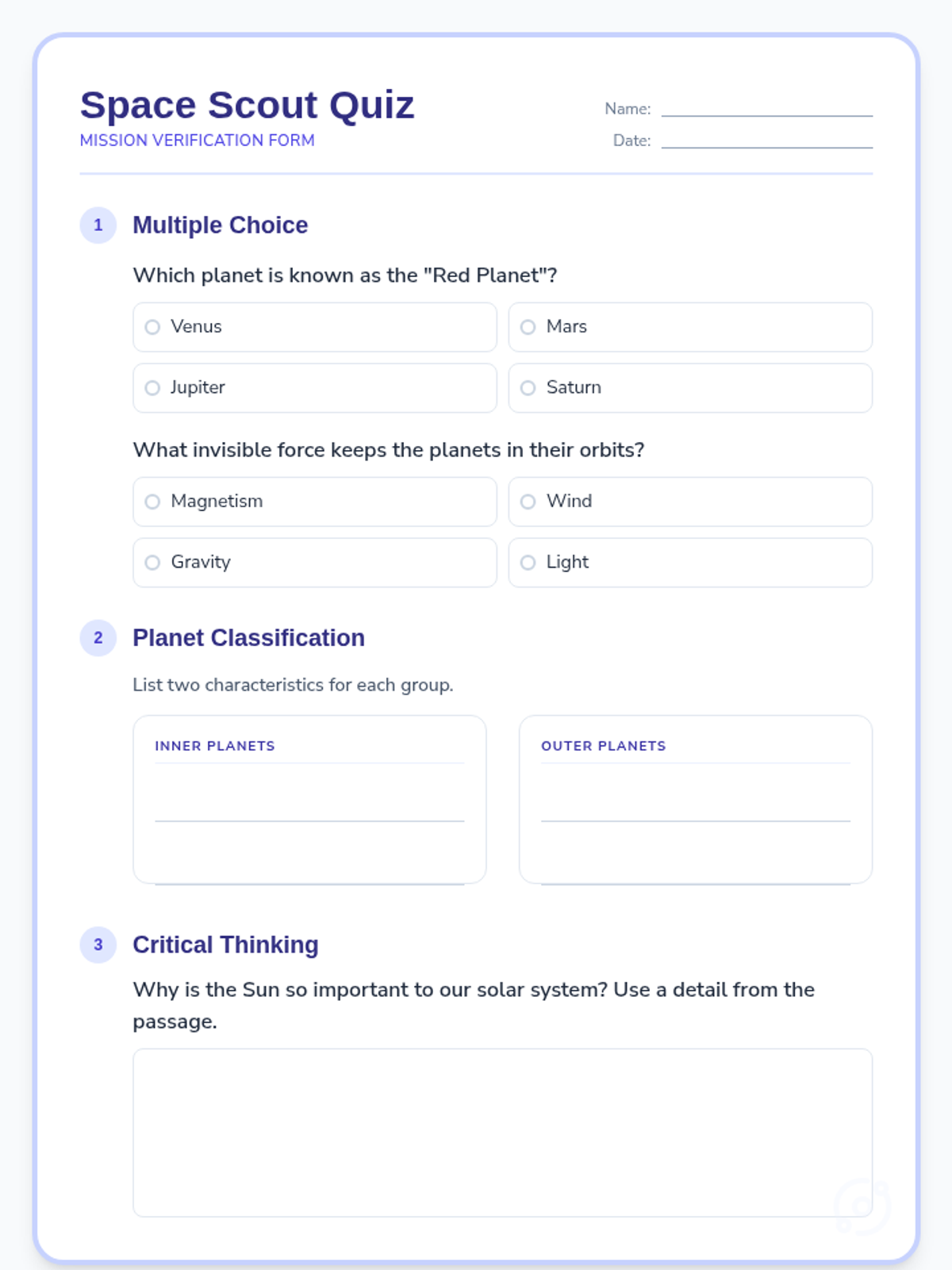
A comprehension worksheet for the Planet Scout passage, including multiple-choice questions, a comparison grid for inner and outer planets, and a short-answer reflection.
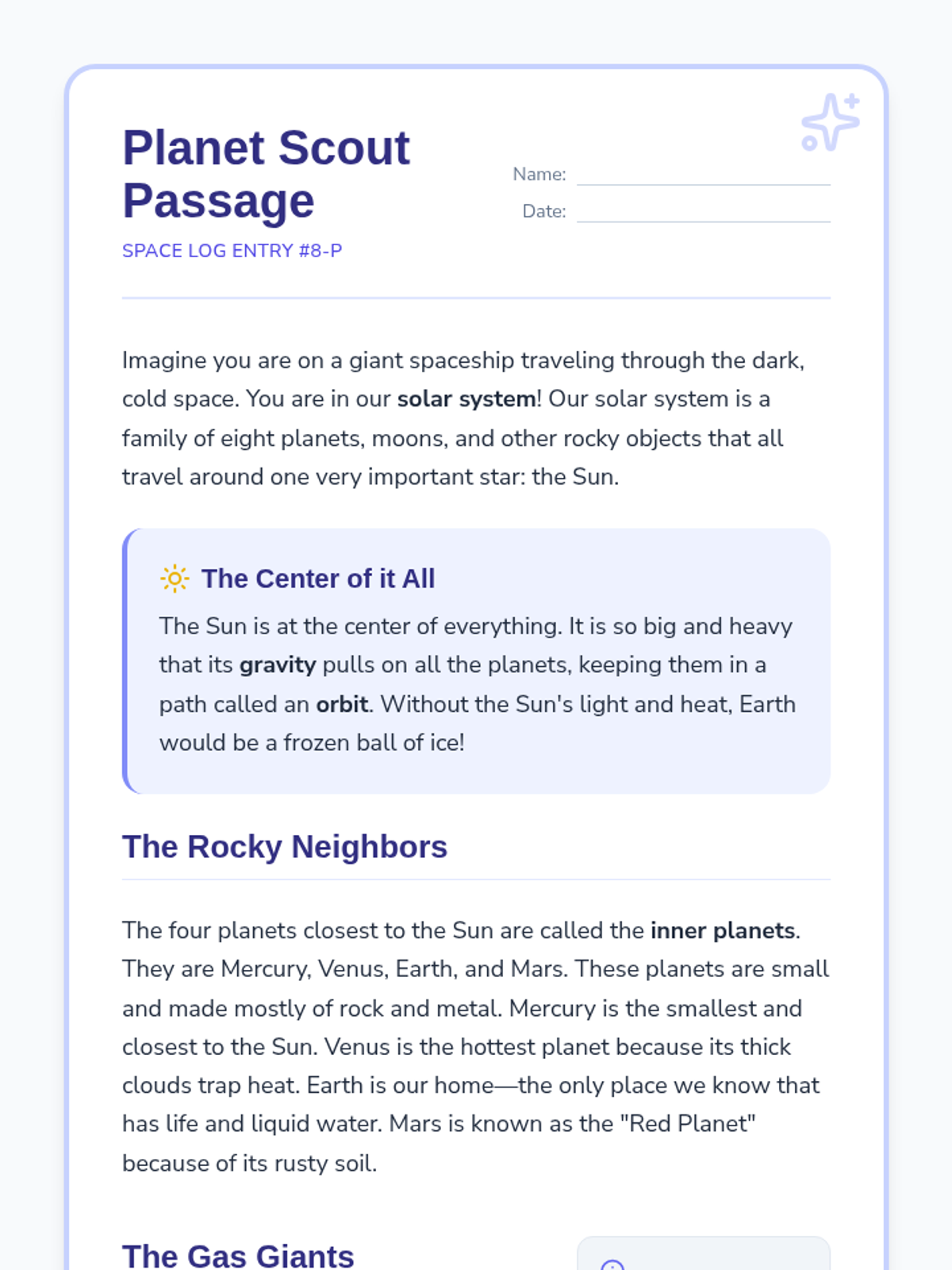
A 3rd-grade reading passage introducing the solar system, featuring descriptions of the Sun, inner rocky planets, and outer gas giants with a clean, space-themed design.
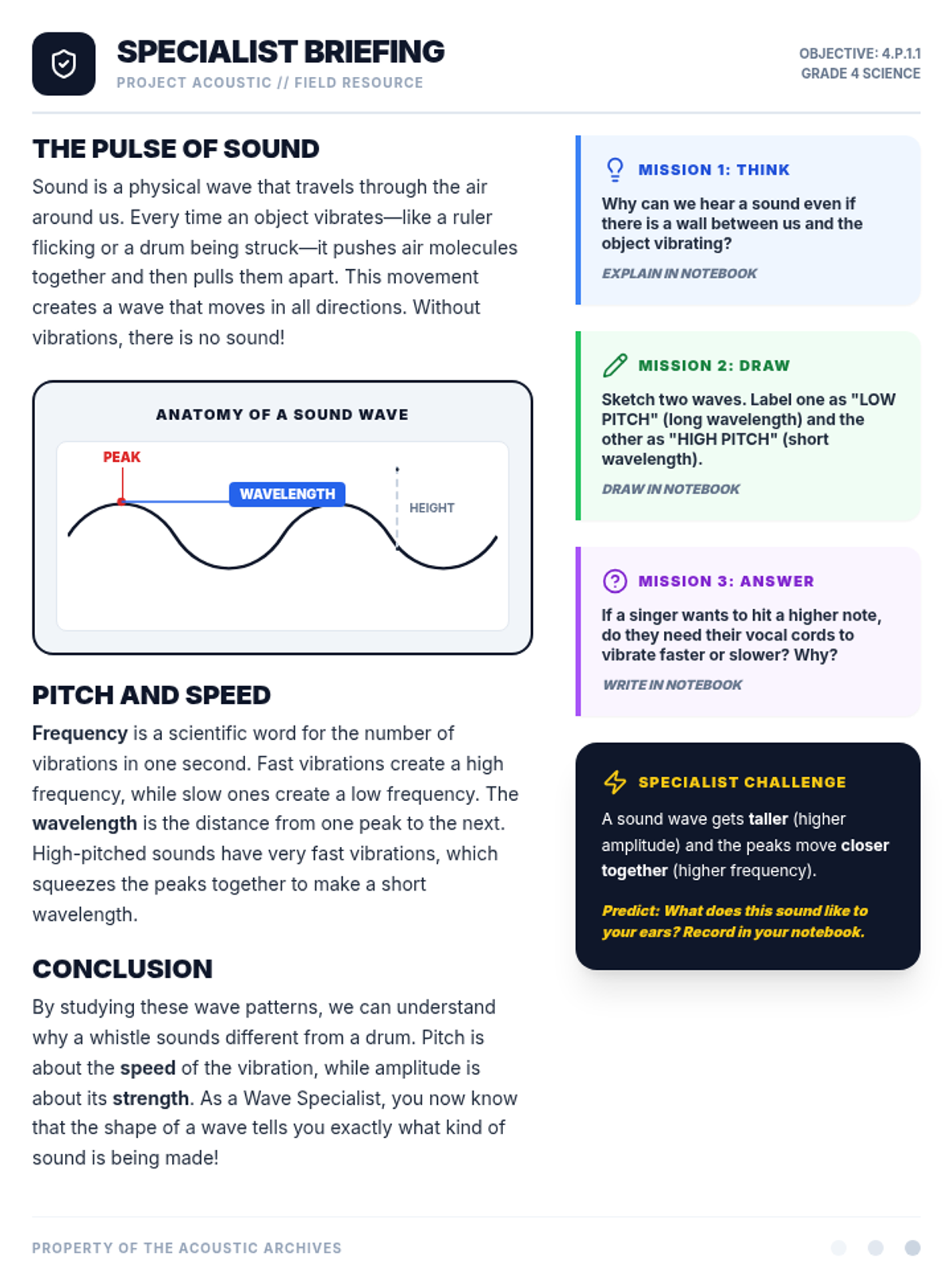
A student-friendly instructional article about pitch, wavelength, and frequency. Features "Notebook Missions" interspersed throughout the text, prompting students to think, draw, and answer questions directly in their science notebooks. Includes a clear, improved wave anatomy diagram.
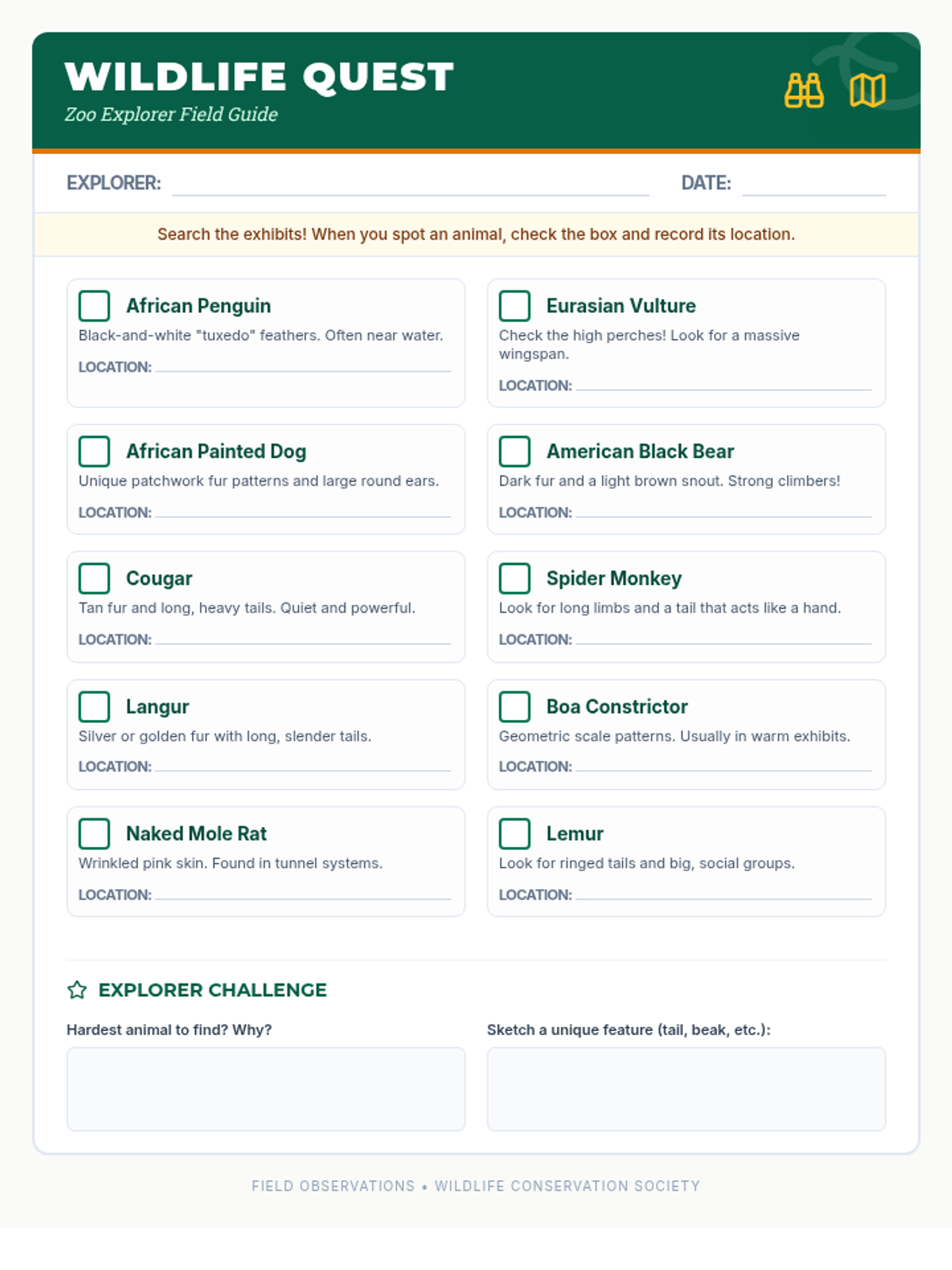
A compact, single-page wildlife scavenger hunt checklist featuring 10 specific animals. Each entry includes a checkbox, a short identification clue, and a dedicated location line. The bottom includes an 'Explorer Challenge' for reflection and sketching.
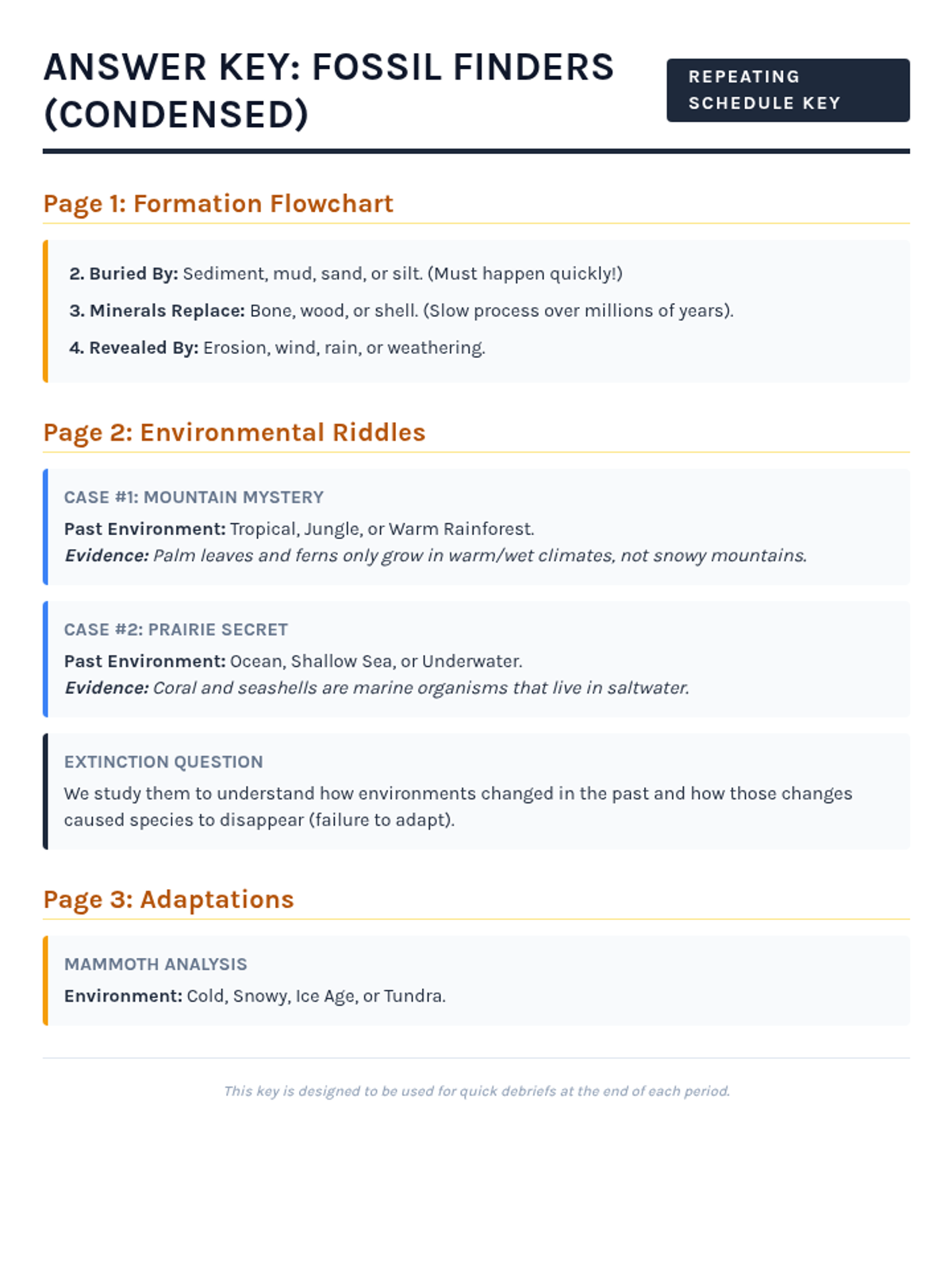
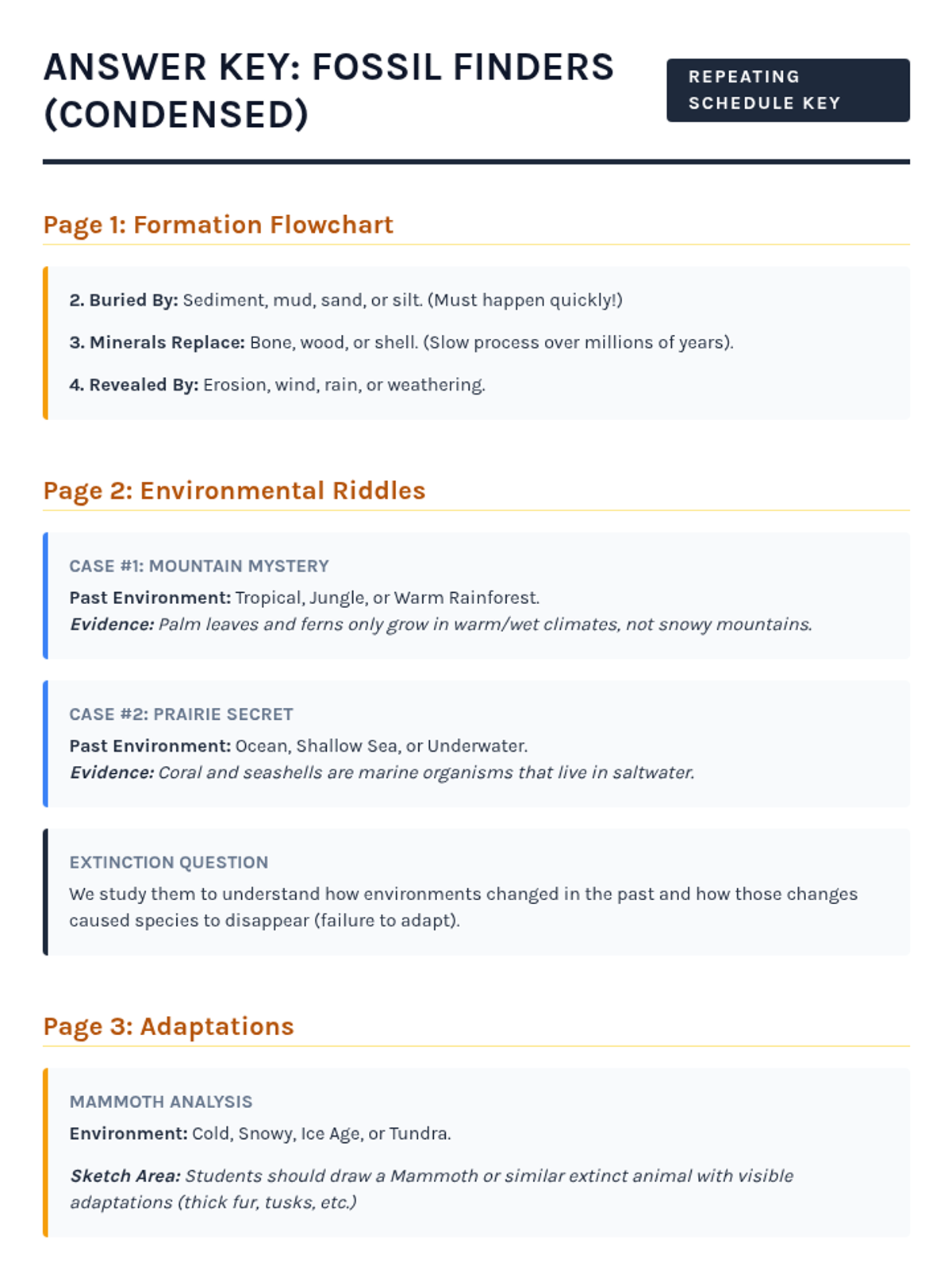
A concise 1-page answer key for the condensed Fossil Finder Student Packet, designed for quick teacher reference across multiple class periods. Ensured to fit on a single page.
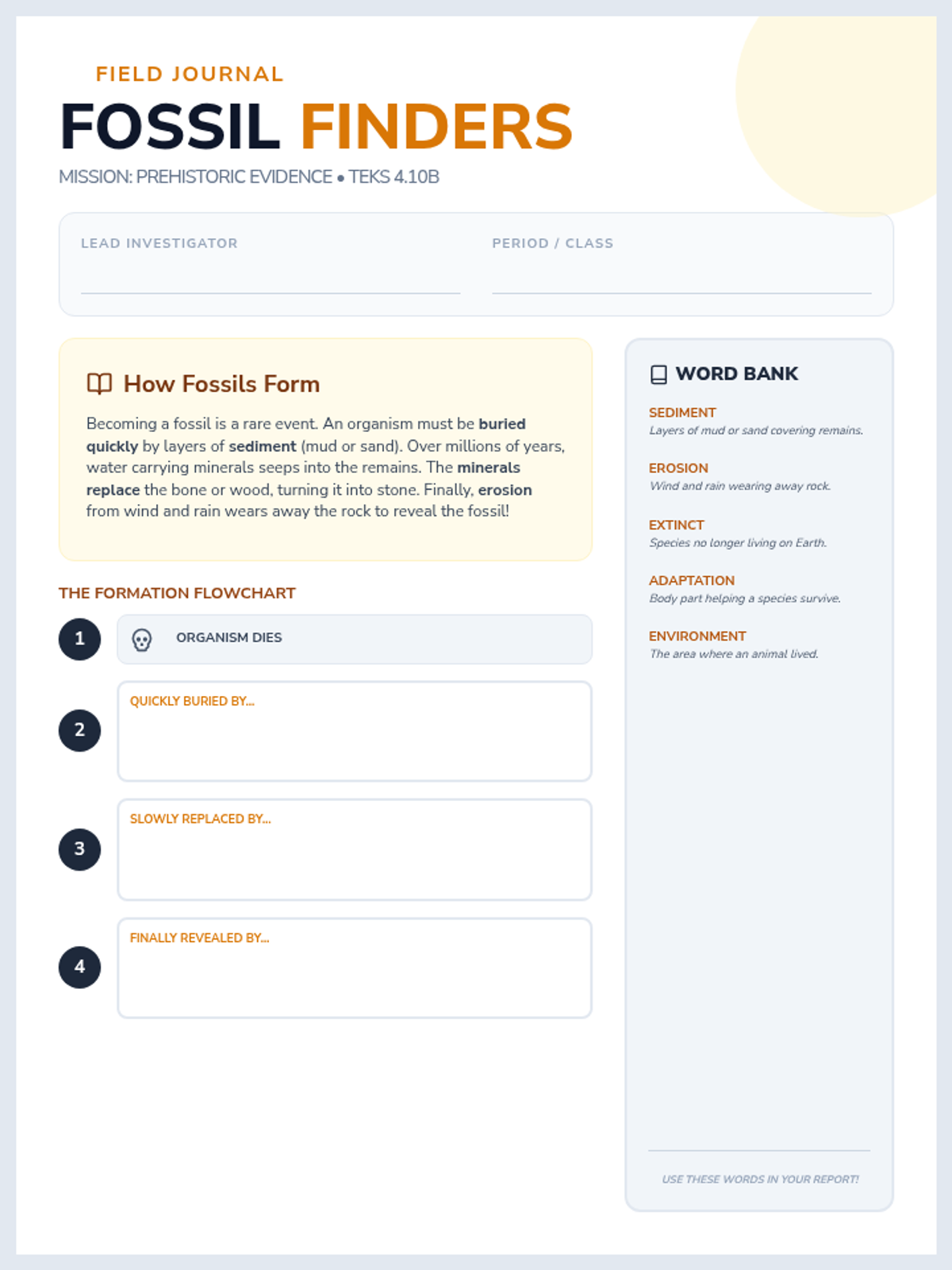
A condensed 3-page student field journal for 4th-grade science, focusing on fossil formation, environmental evidence, and extinct species (TEKS 4.10B). Designed to be completed in one 60-minute period. Features enlarged student work areas and lightened backgrounds for maximum handwriting legibility.
A revised answer key for the condensed 1-hour Fossil Finder Student Packet, supporting a repeating 4-period daily schedule.
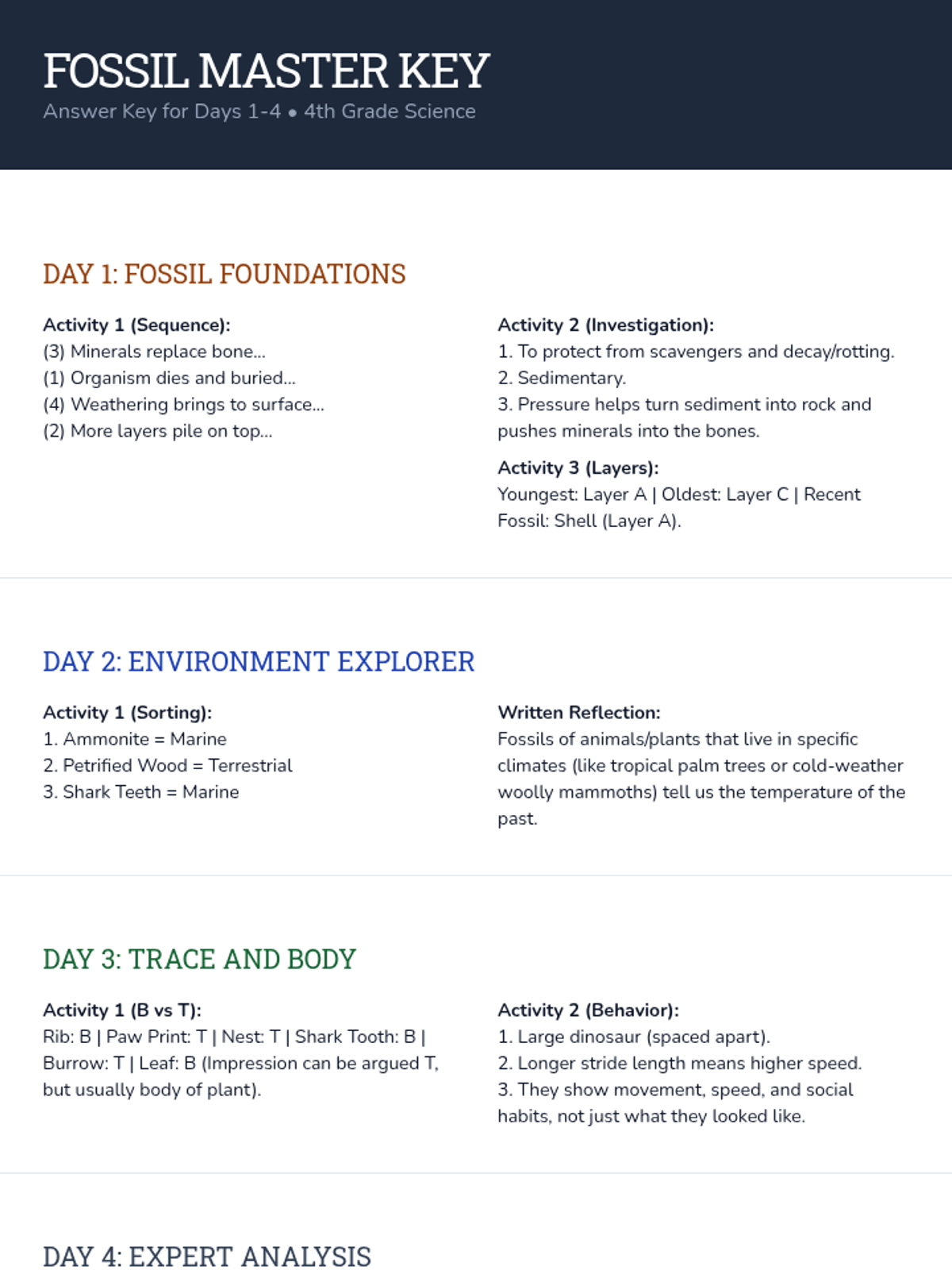
Complete answer key for all four days of the fossils and past environments unit, covering formation, environmental indicators, fossil types, and final analysis.
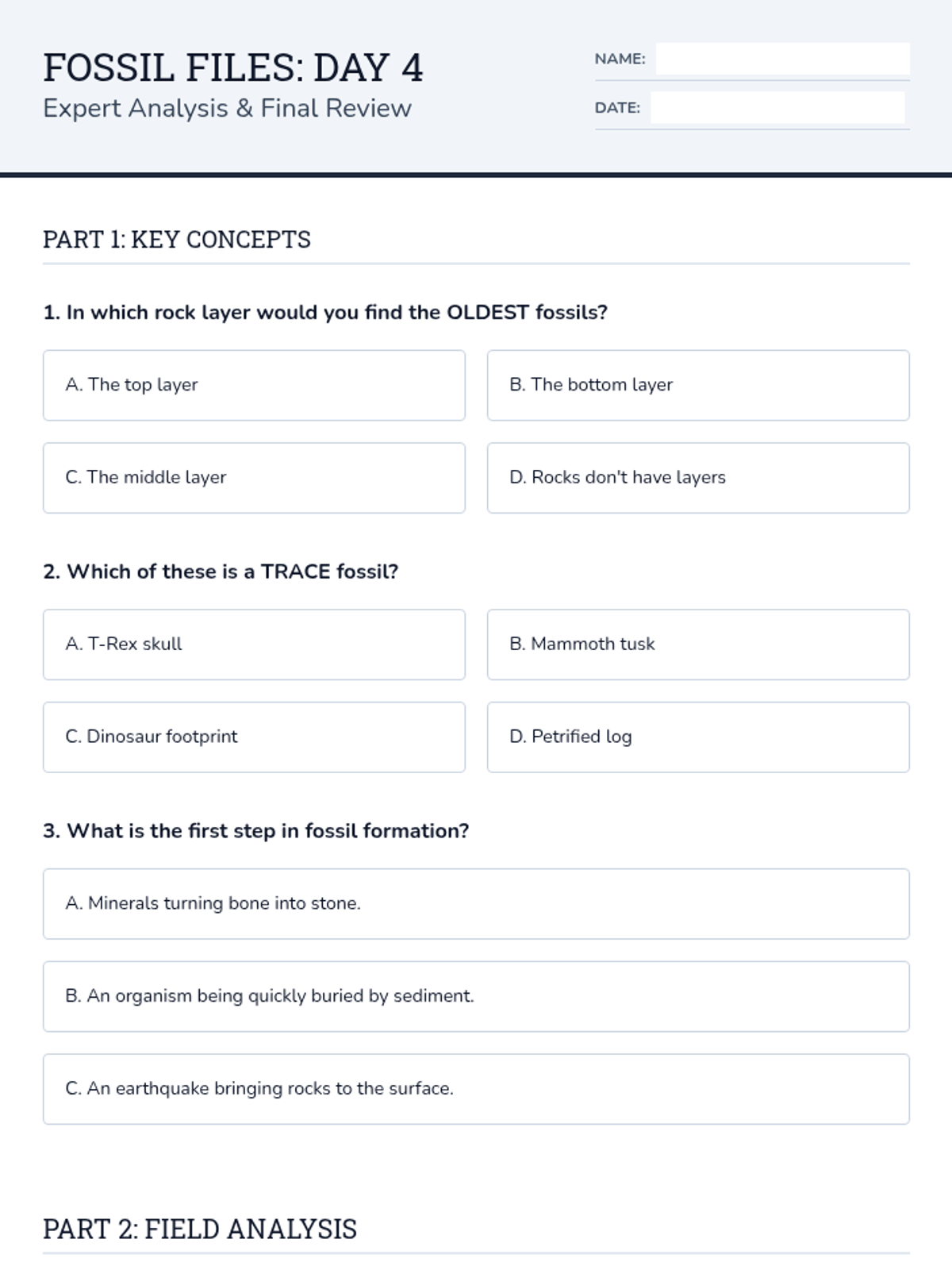
Day 4 final assessment packet for the fossils unit. Includes multiple-choice questions, evidence-based environmental analysis, and a creative "new fossil" synthesis activity.
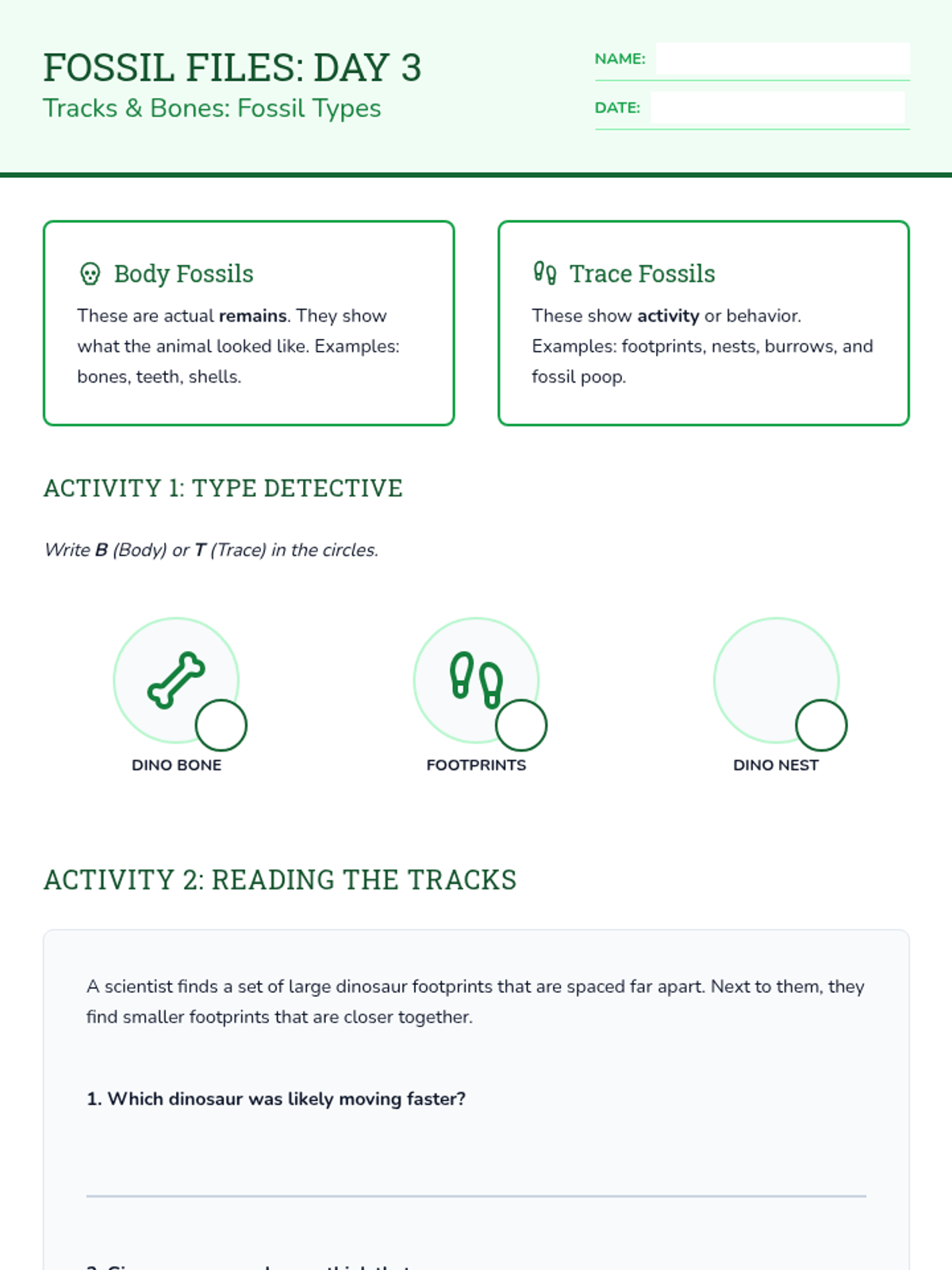
Day 3 independent student packet focusing on the distinction between body fossils and trace fossils. Includes a classification activity and behavior analysis scenarios.
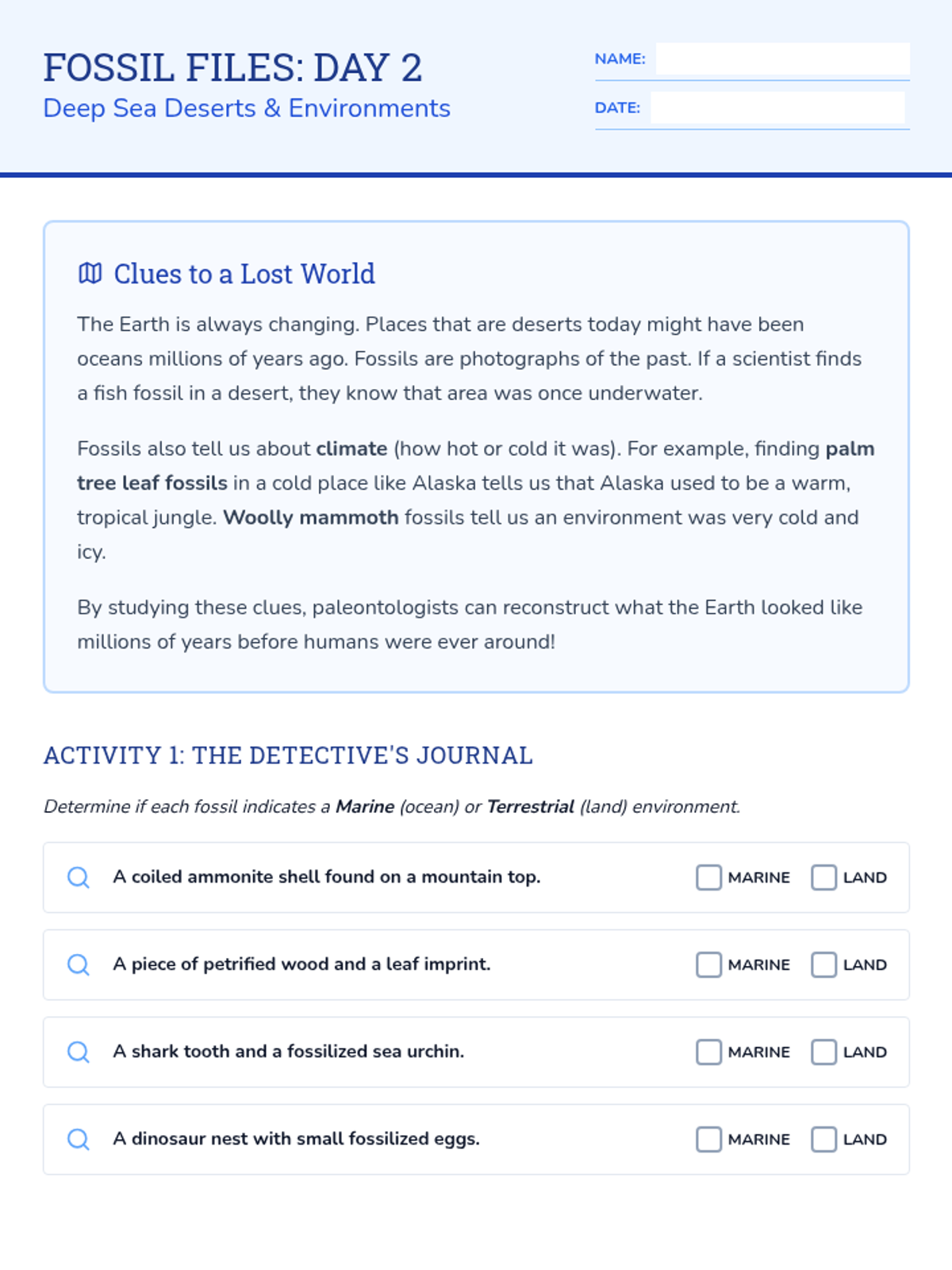
Day 2 independent student packet focusing on using fossils as evidence of past environments (marine vs. terrestrial). Includes deductive reasoning tasks and a visual reconstruction activity.
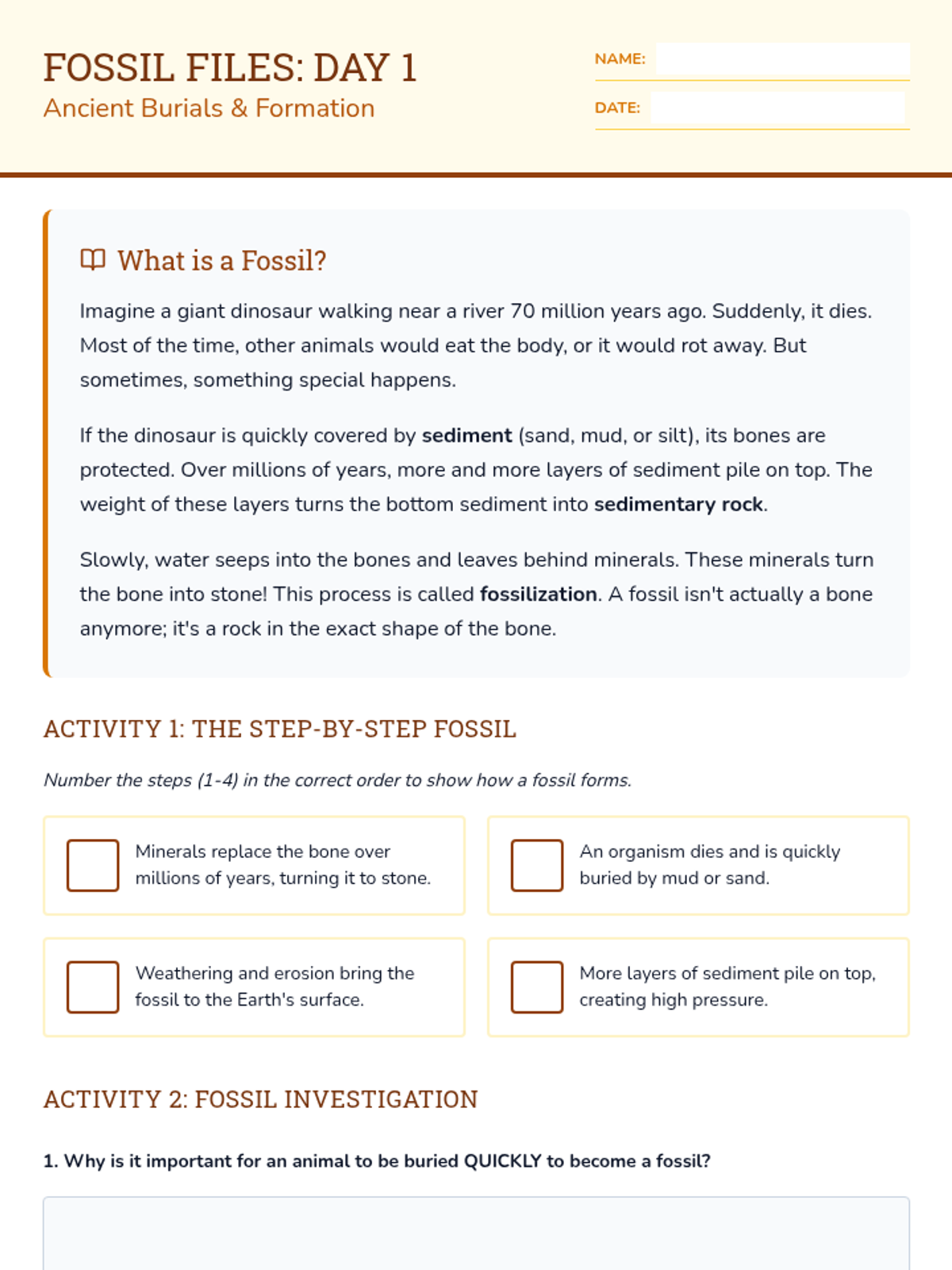
Day 1 independent student packet focusing on fossil formation processes and the Law of Superposition. Includes reading, sequencing, and diagram labeling activities.
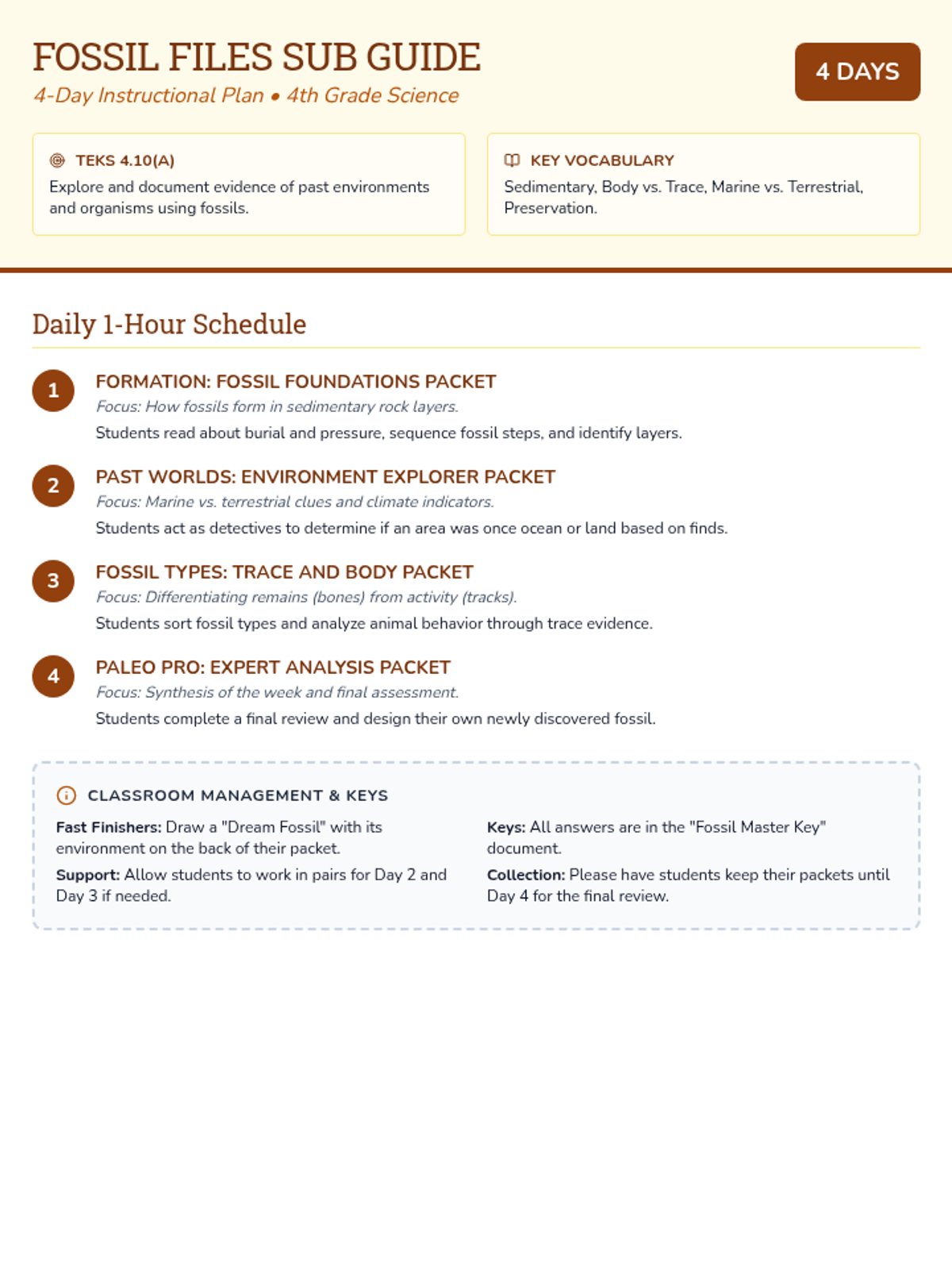
A comprehensive teacher/substitute guide detailing a 4-day instructional plan for fossils and past environments, including daily objectives, schedules, and tips.
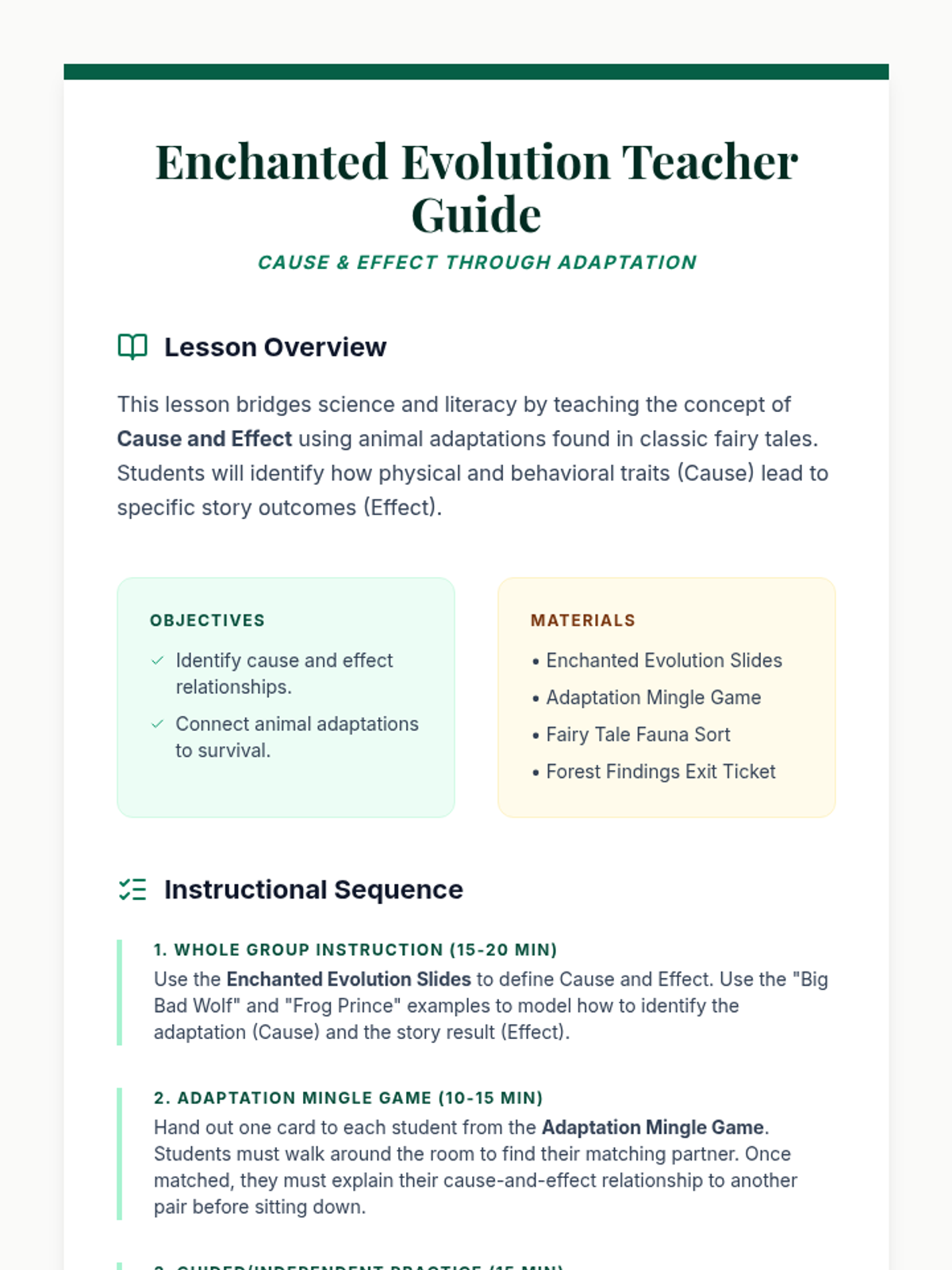
A facilitation guide for teachers including lesson objectives, instructional sequence, and answer keys for all materials in the Enchanted Evolution lesson.
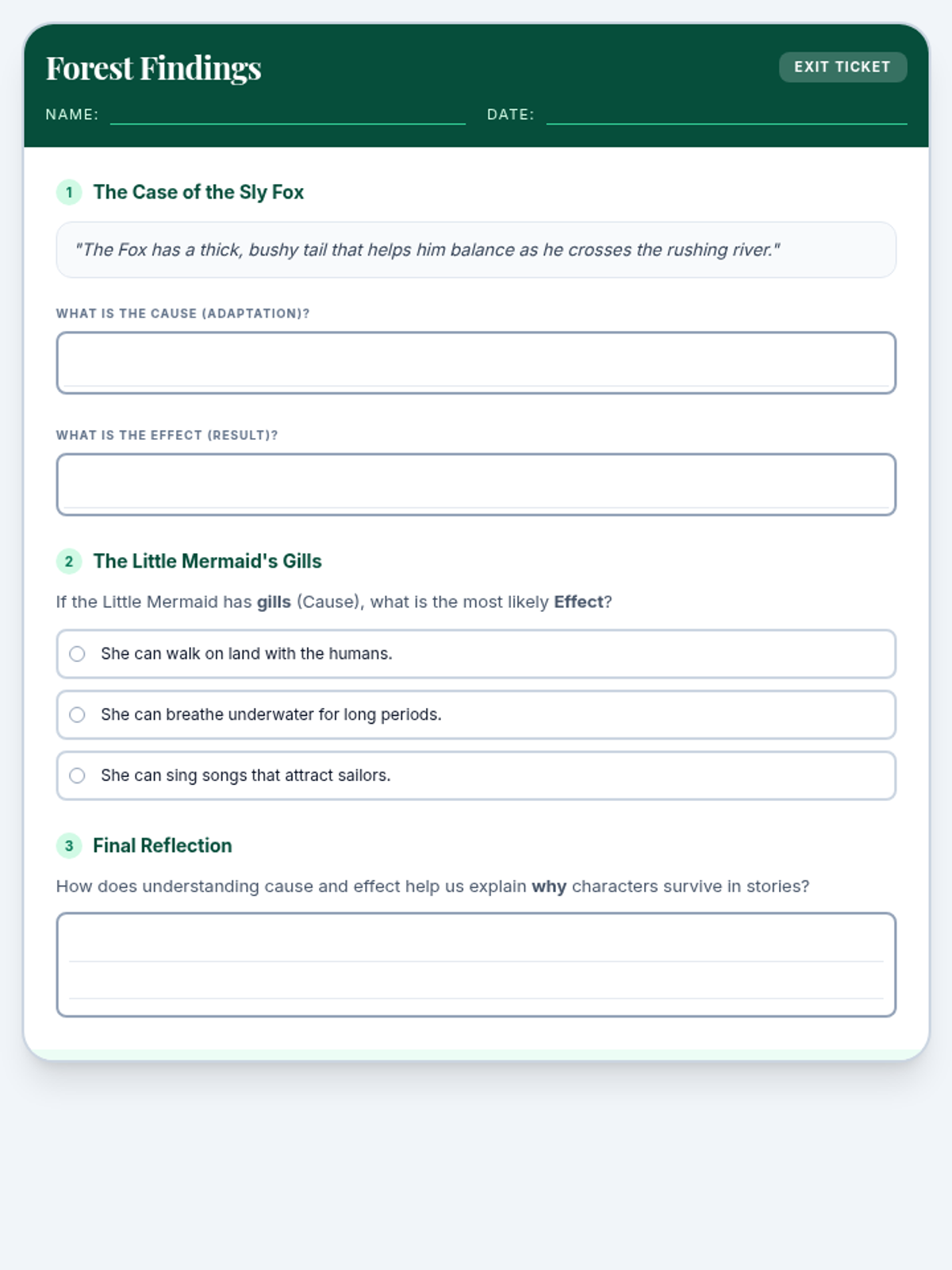
An assessment sheet to evaluate student understanding of cause and effect by analyzing scenarios involving the Gingerbread Man and the Little Mermaid.
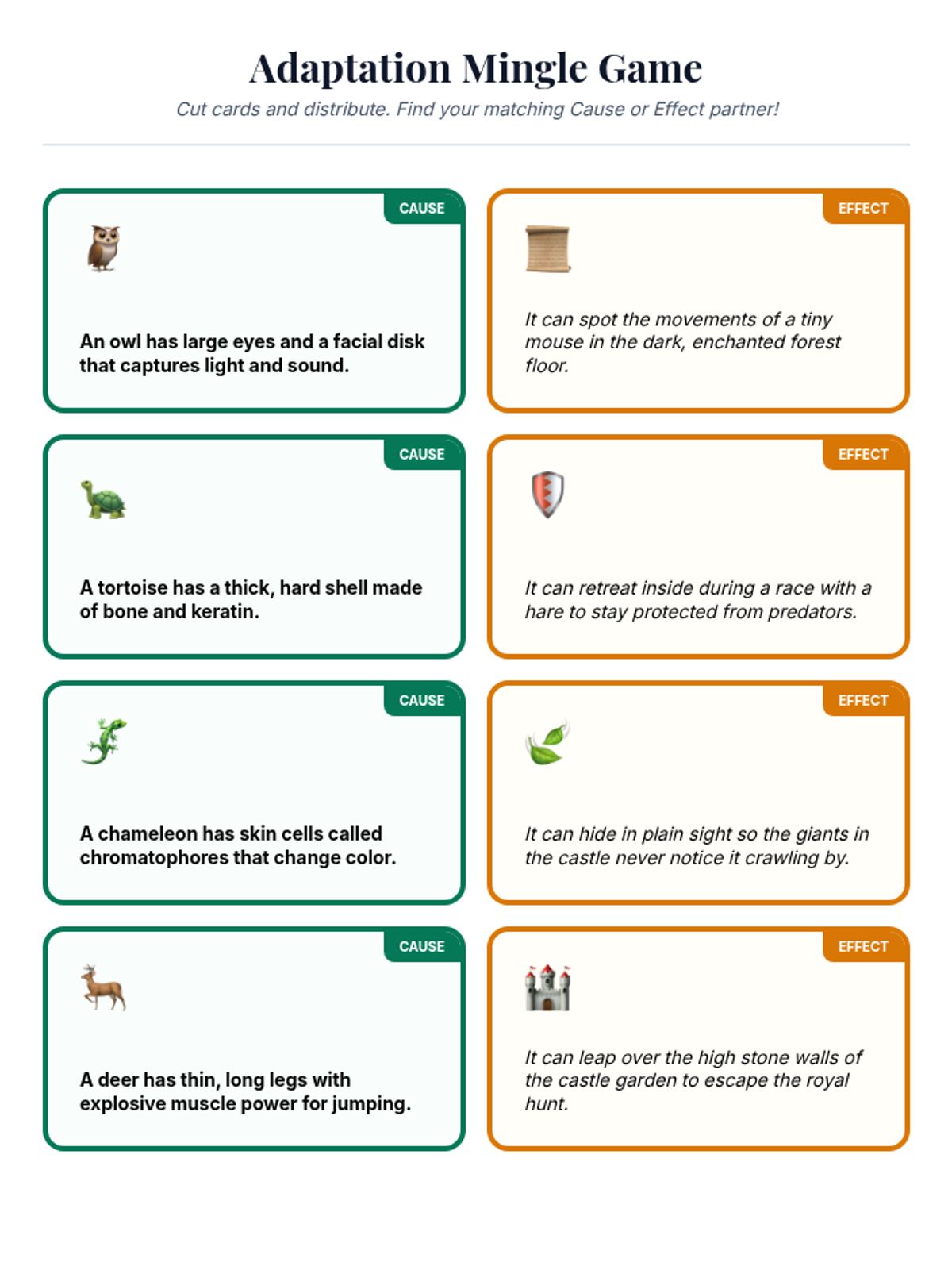
A set of matching cards for a 'Mingle' game where students find their cause (adaptation) or effect (story outcome) partner.
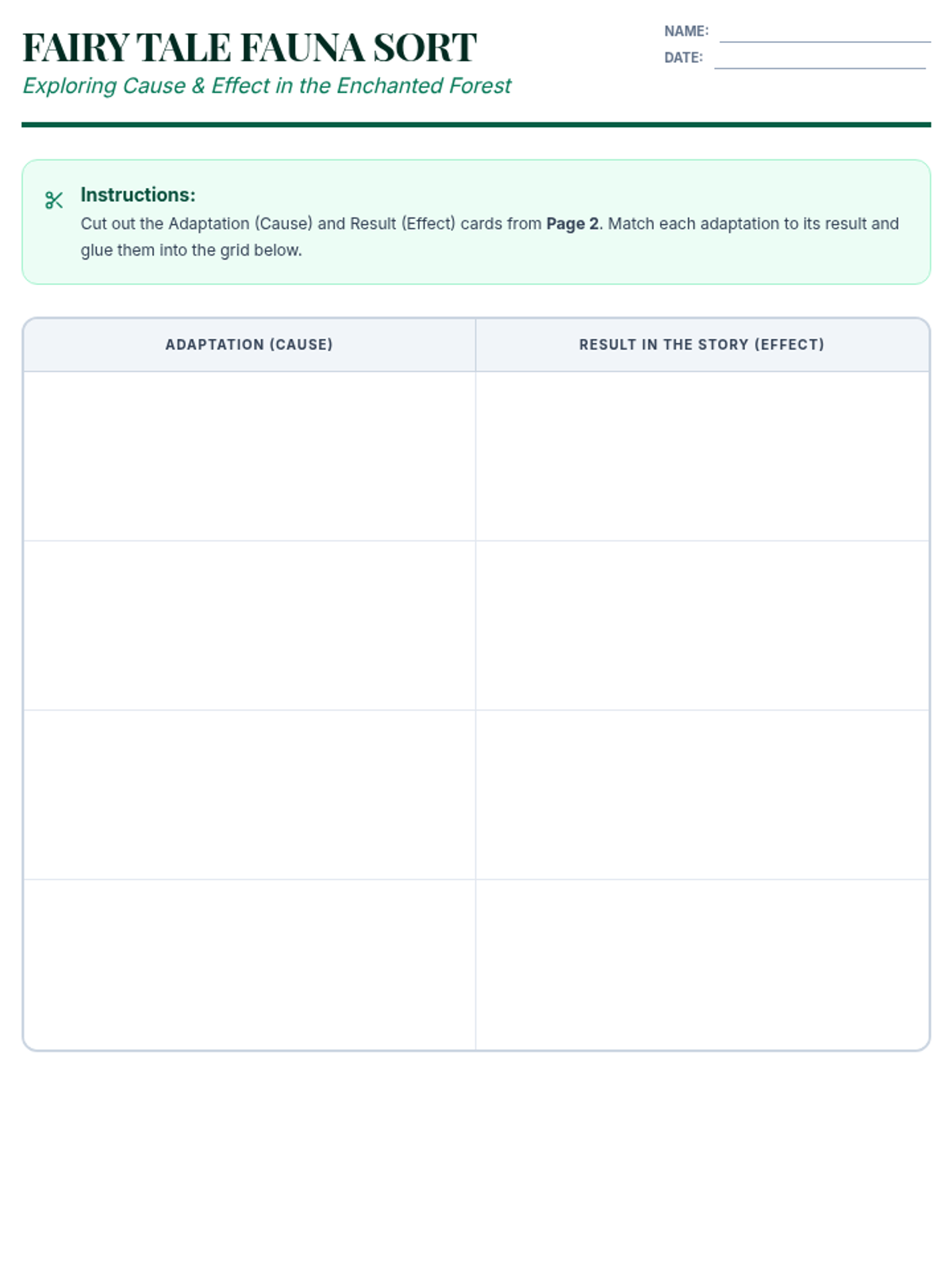
A hands-on cut-and-paste activity where students match animal adaptations (cause) to their specific survival benefits in fairy tale scenarios (effect).
A comprehensive slide deck teaching cause and effect through animal adaptations in fairy tales, featuring interactive case studies of the Three Little Pigs, the Frog Prince, and Little Red Riding Hood.
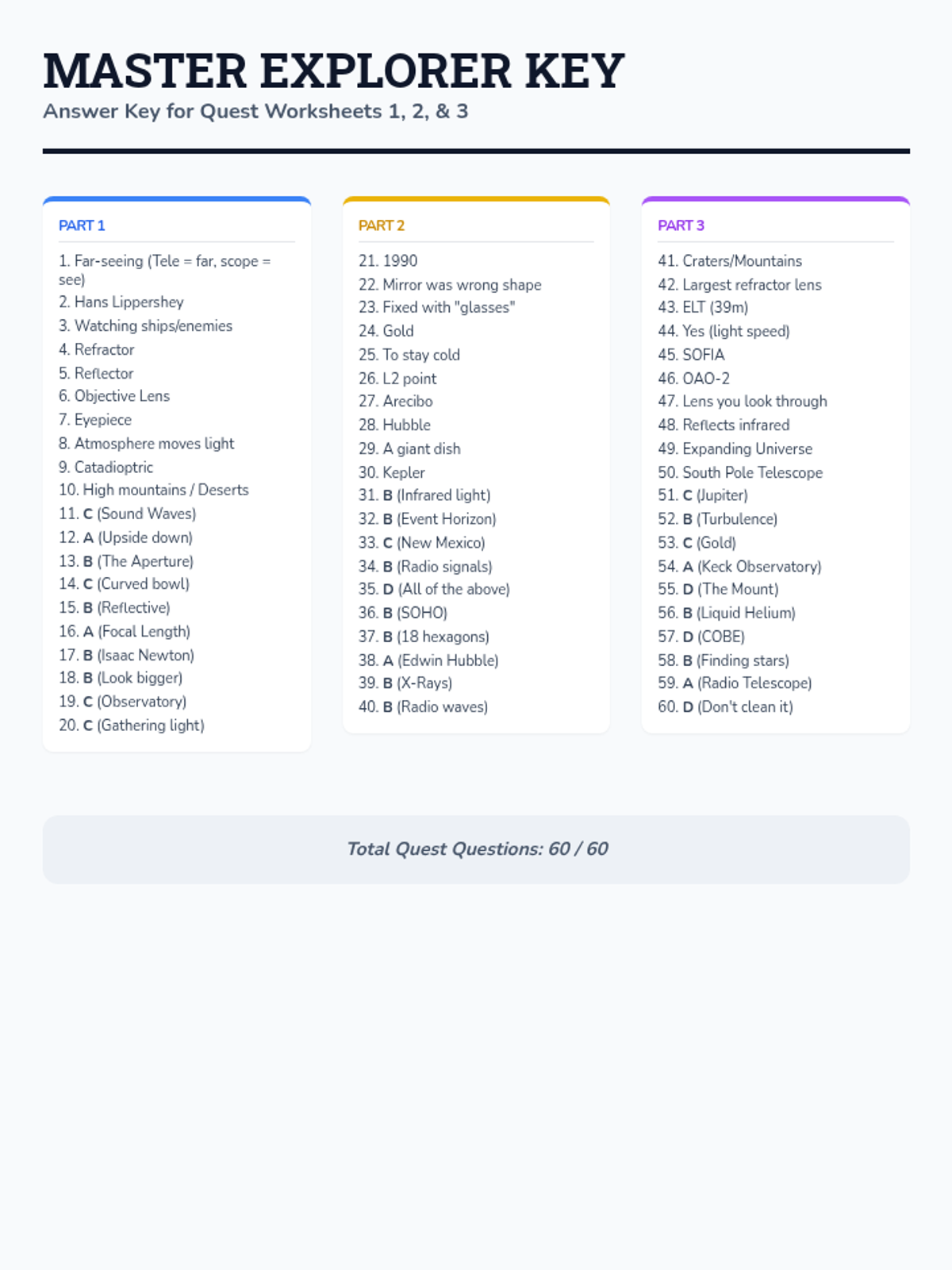
Full answer key for all 60 quest questions across all three worksheets. Revised to fit onto a single page and improve layout for better organization.
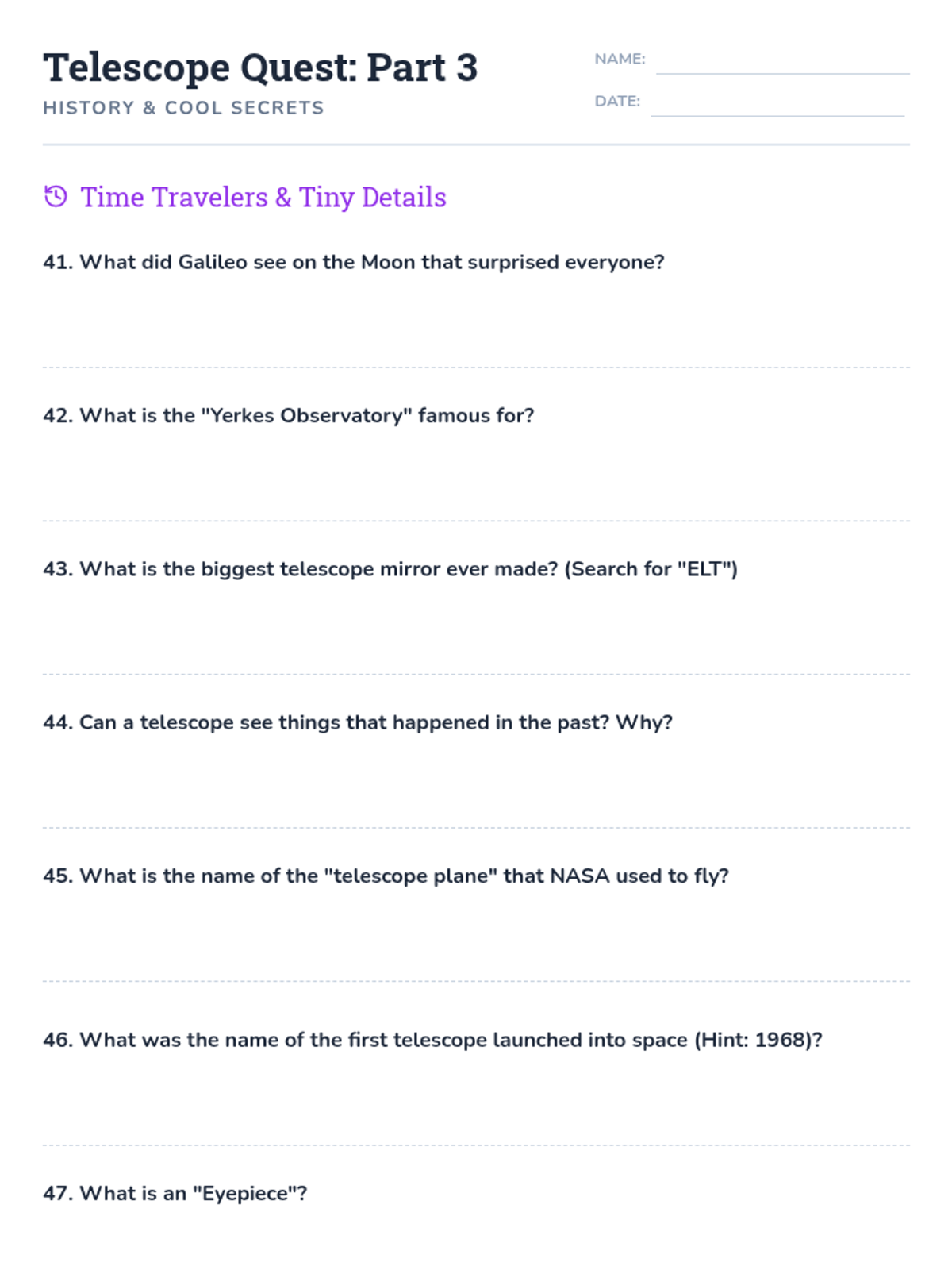
The final part of the telescope quest. Revised with expanded writing areas and fixed page breaks to ensure student questions are not split.
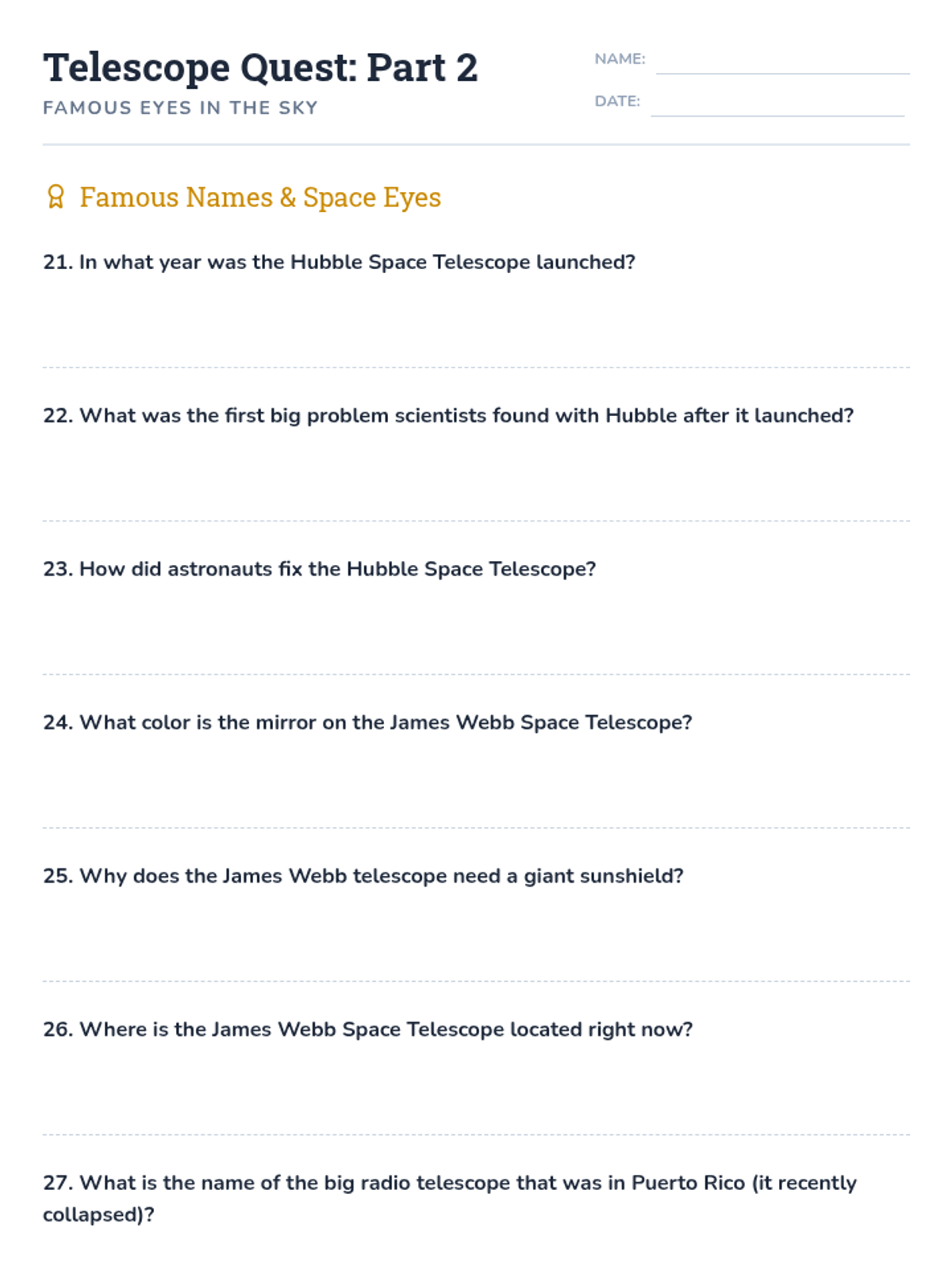
Second part of the telescope quest. Revised to fix spacing, re-balance the layout, and ensure the writing line for Q27 is properly placed.
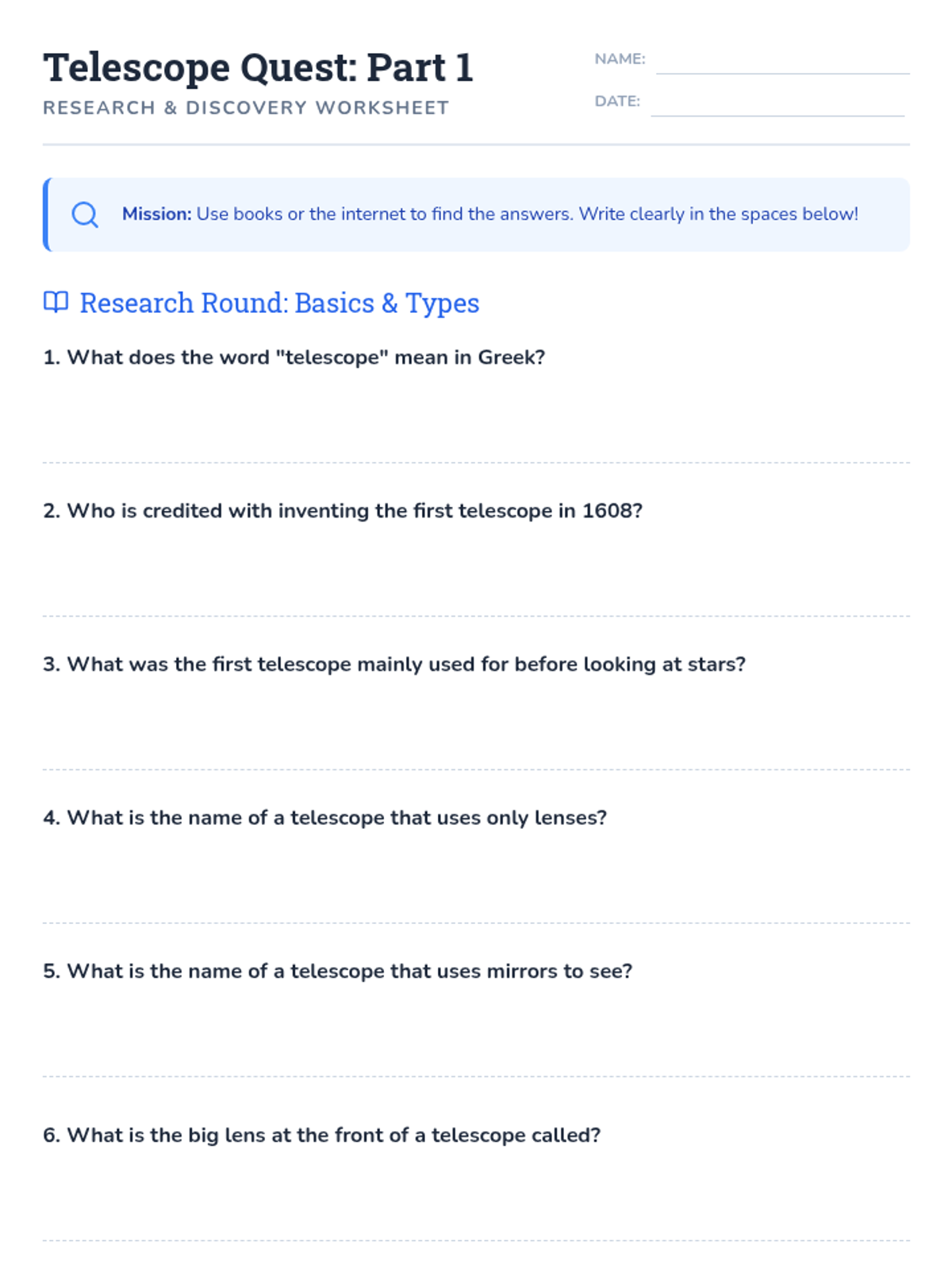
First part of the telescope quest covering basics, types, and terminology. Revised to remove placeholder text and ensure consistent blank writing areas.
Introductory slide deck for 3rd graders explaining what telescopes are, how refractors and reflectors differ, and key historical figures like Galileo and Newton. Revised with improved diagrams and contrast.
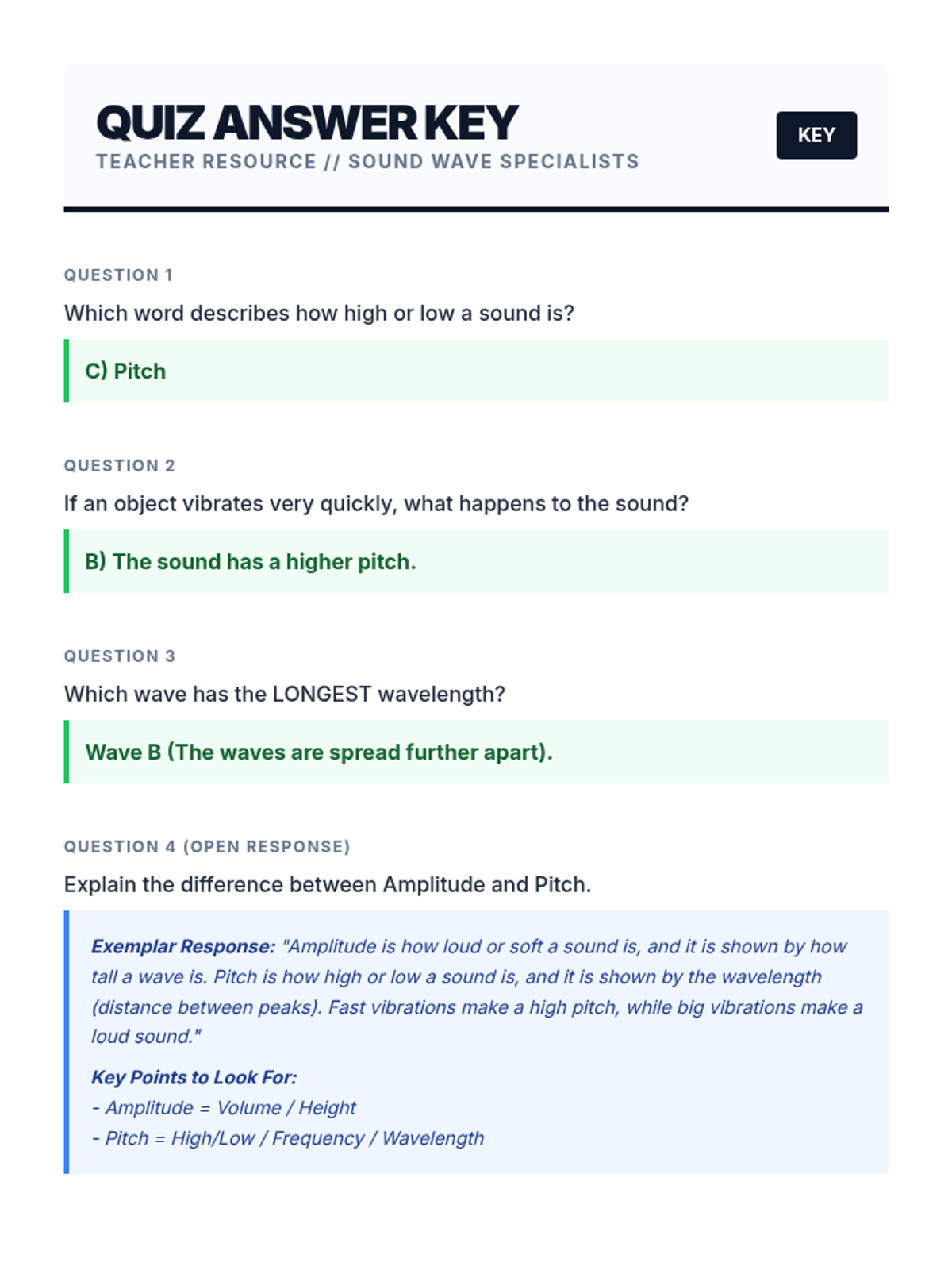
An answer key for the Wave Specialist Quiz, providing correct answers for multiple choice questions and an exemplar response for the open-ended comparison.
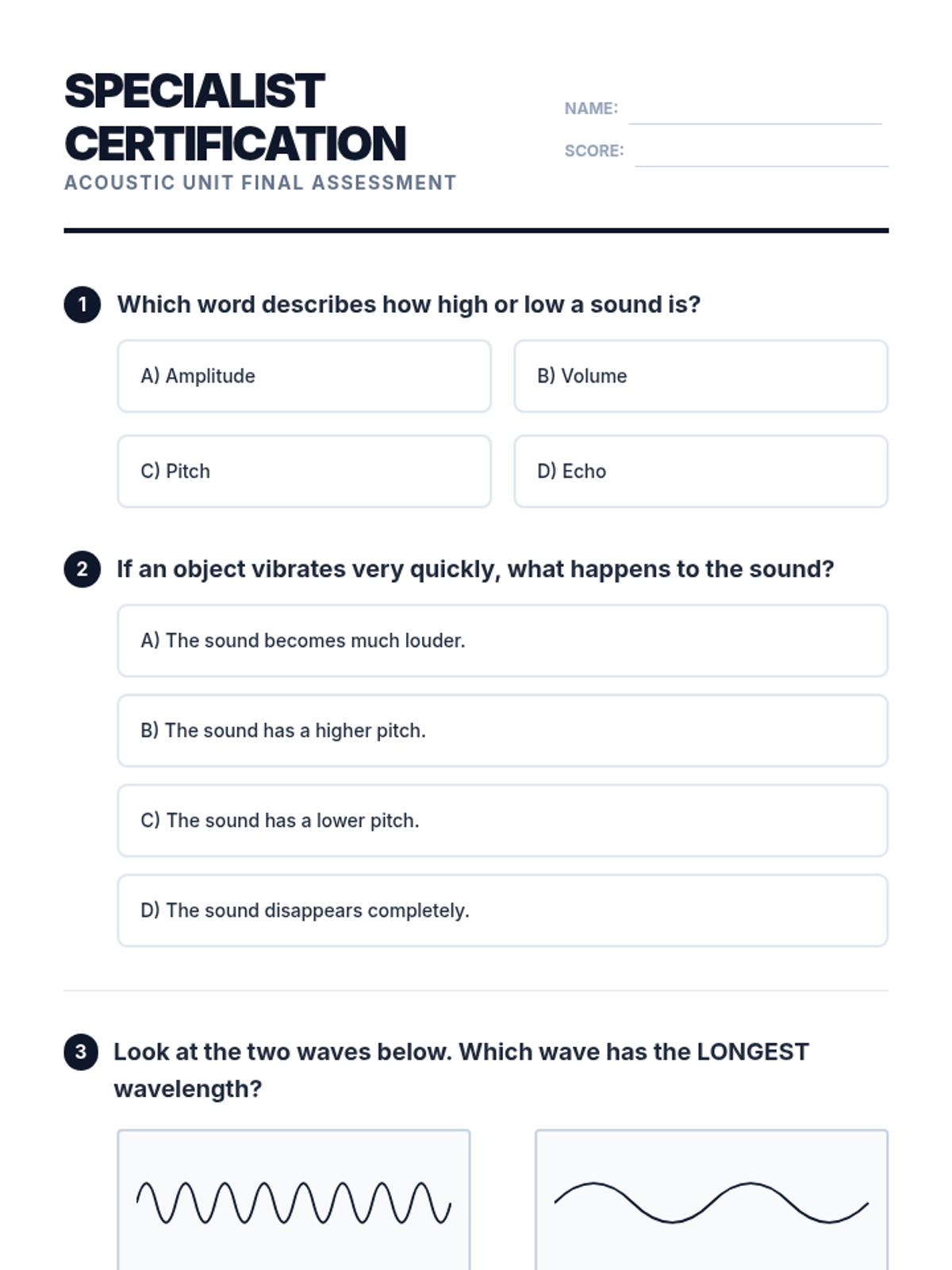
A short assessment for the Sound Wave Specialists unit, covering pitch, wavelength, and frequency, as well as a comparison to amplitude. Features large, high-contrast wave diagrams for easy viewing.
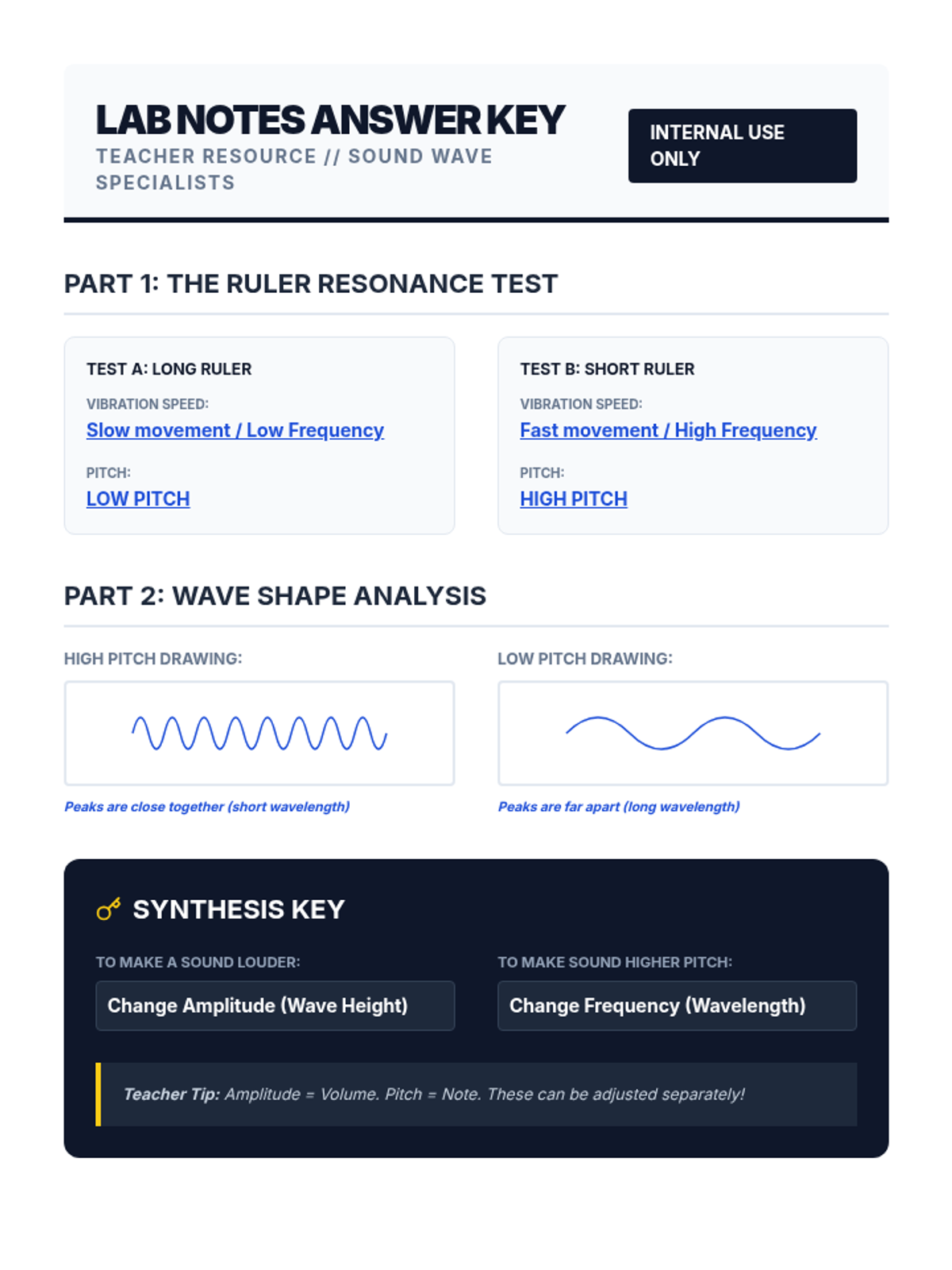
An answer key for the Sound Wave Lab Notes, providing expected observations for the ruler resonance experiment and correct wave diagrams for pitch and amplitude comparisons.
A 5-slide instructional presentation for the Sound Wave Specialists unit. Features high-contrast visuals, wave comparisons, lab instructions, and a hook for each day of the lesson sequence.
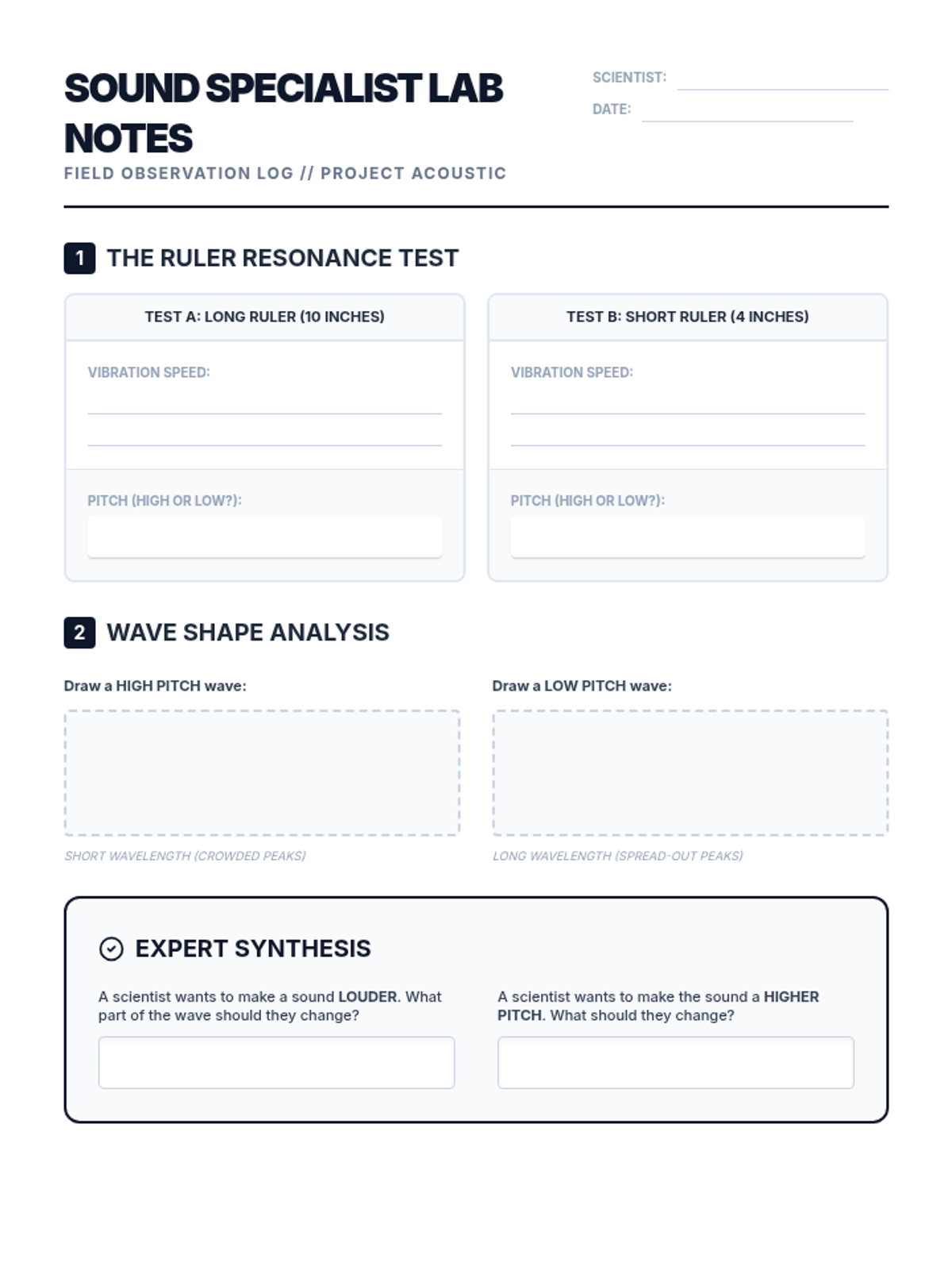
A student observation sheet for the Sound Wave Specialists unit. Includes a data recording area for the ruler resonance demonstration, wave drawing sections, and synthesis questions comparing pitch and amplitude.
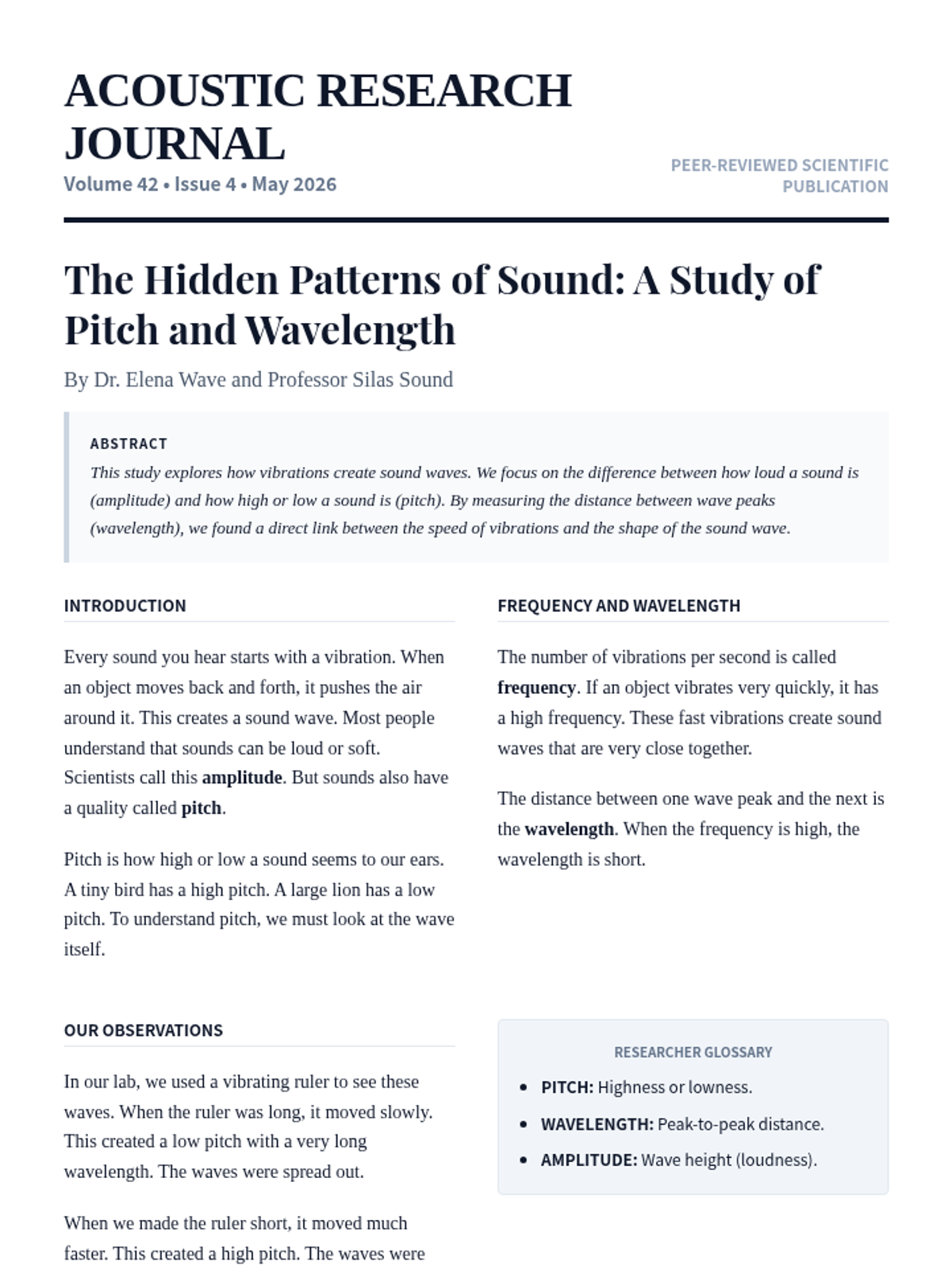
A one-page scientific journal article simplified for 4th-grade readers. Features clear sections on vibrations, wavelength, and frequency, including a ruler experiment methodology and a conclusion. Labeled diagrams compare high and low pitch waves.

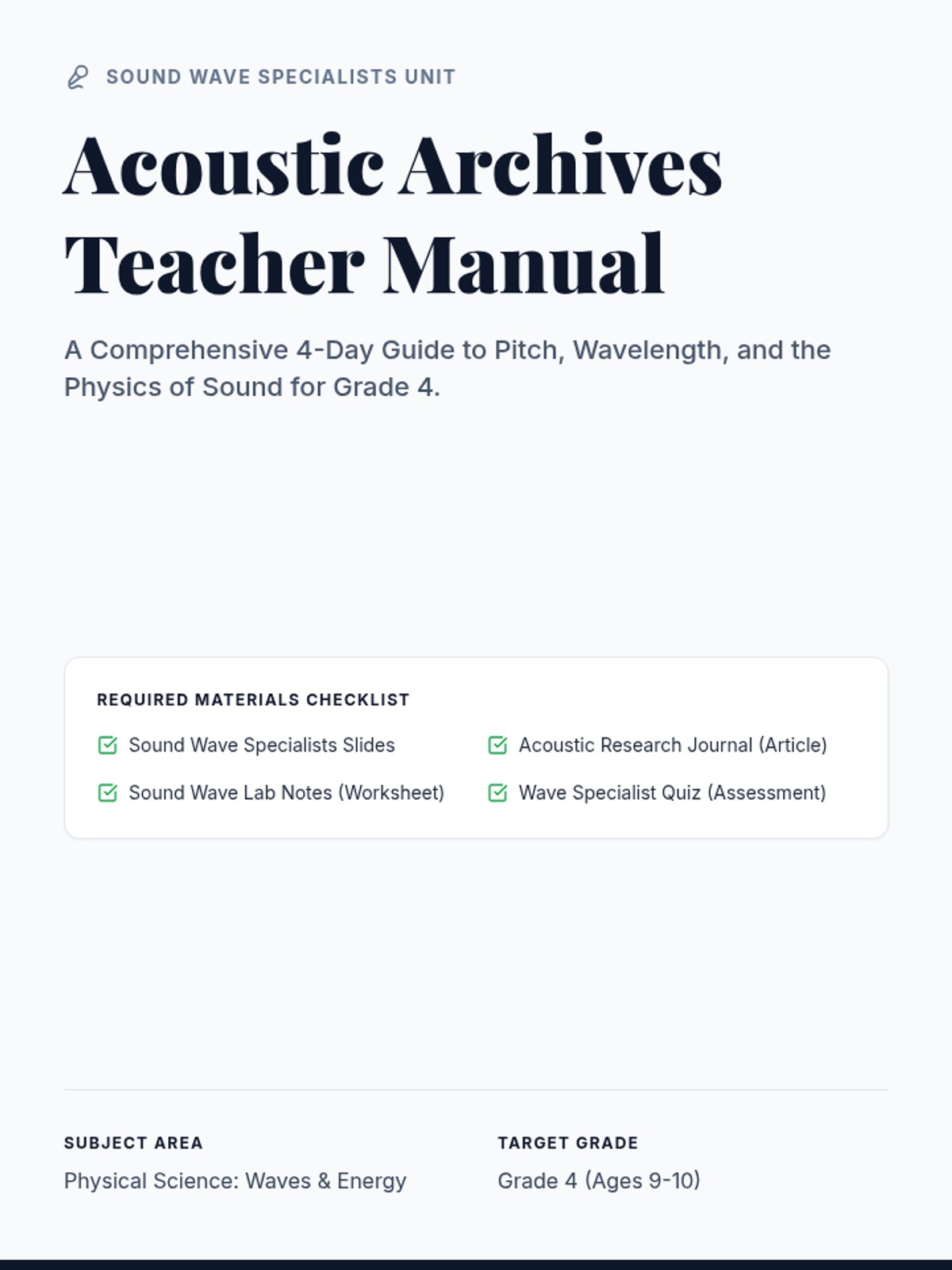
A comprehensive teacher manual for the Sound Wave Specialists unit, containing a 4-day instructional roadmap, detailed teacher scripts, hooks for engagement, and a step-by-step guide for the ruler resonance demonstration.
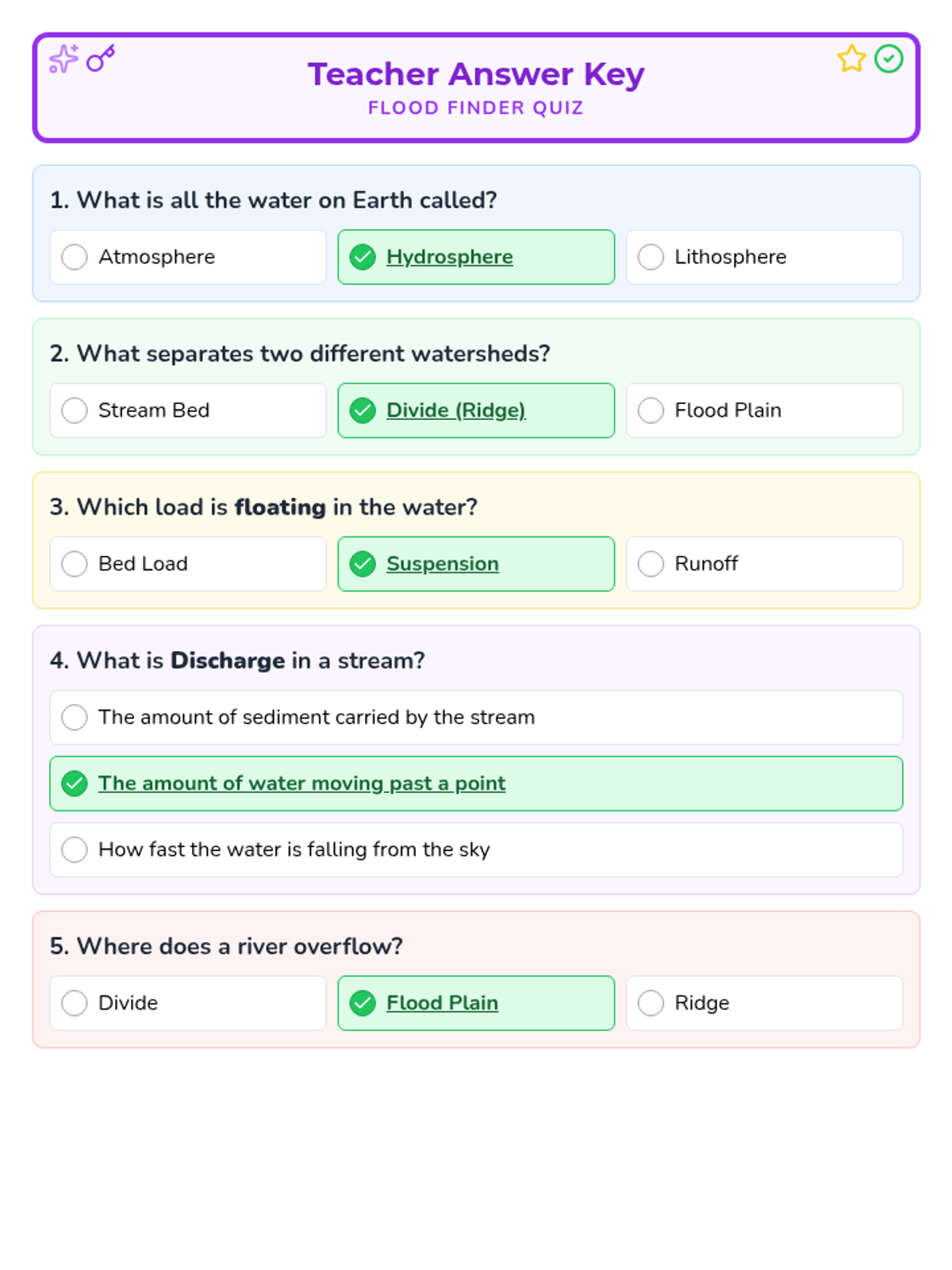
A teacher answer key for the Flood Finder Quiz, clearly indicating the correct answers for each multiple-choice question. Optimized for a single page.
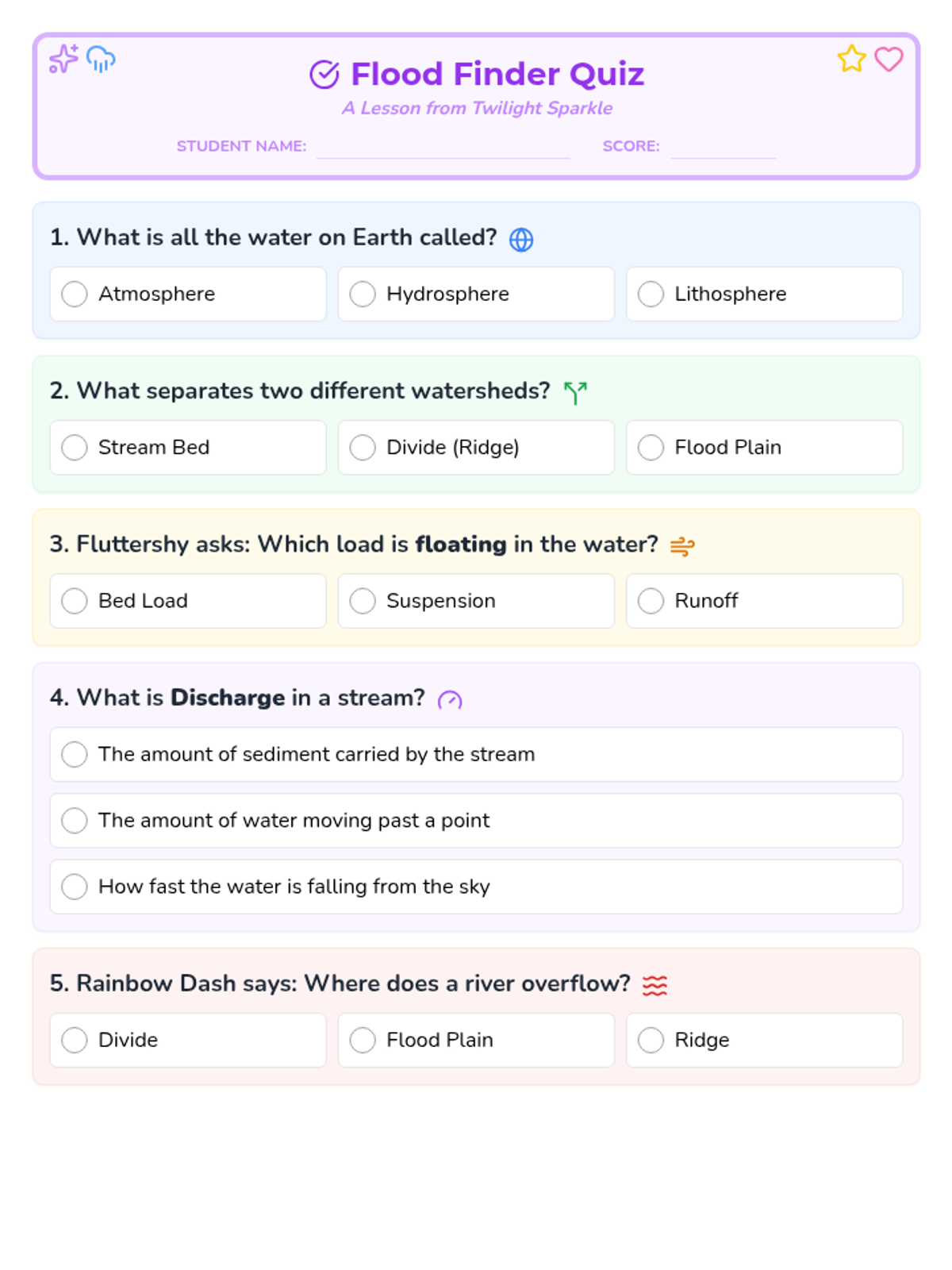
An updated 5-question simplified quiz on surface water movement with symbol support and increased difficulty. Includes three-choice questions covering hydrosphere, divides, stream loads, discharge, and flood plains. Optimized for a single page.
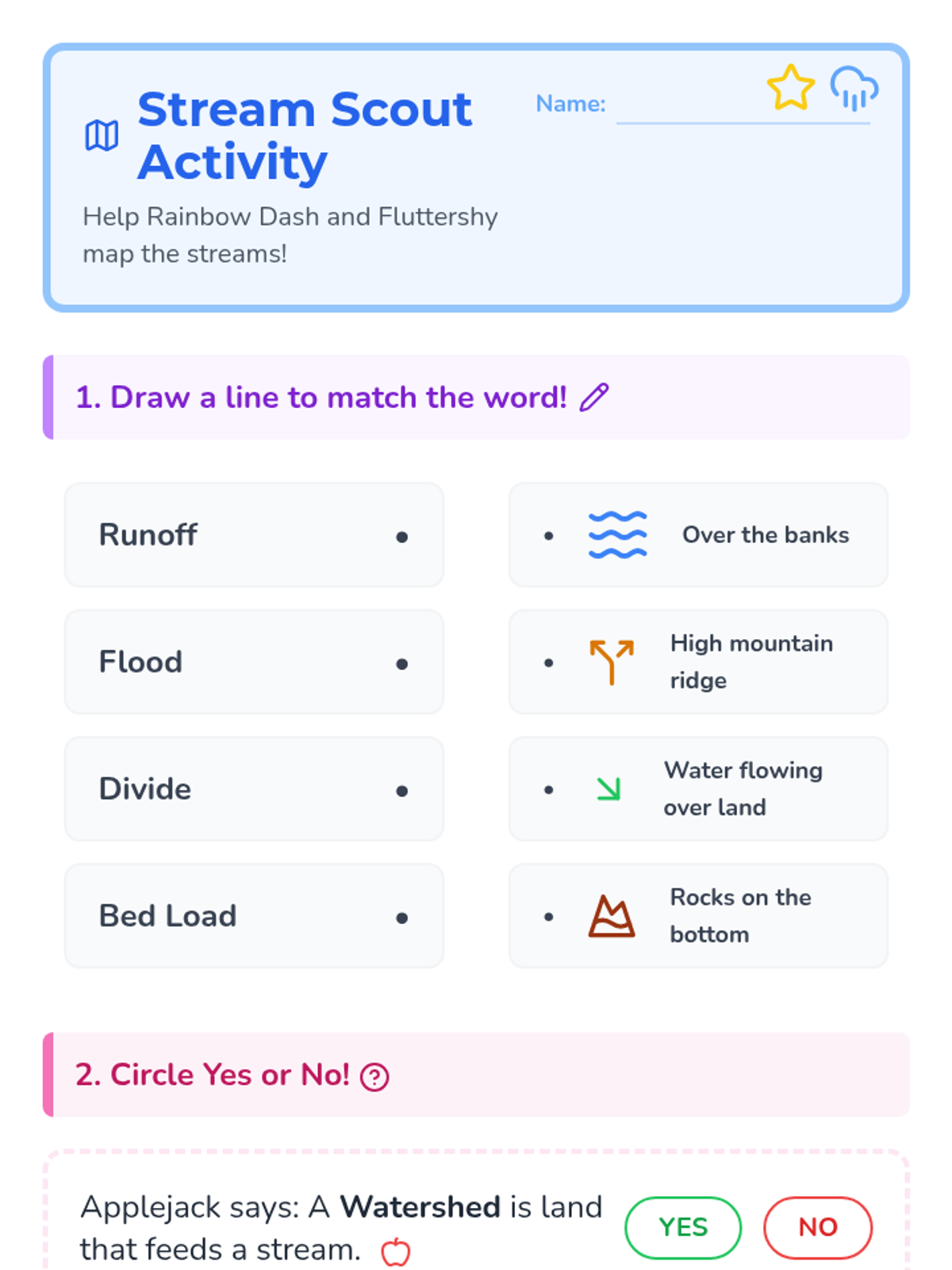
A practice worksheet for students to match surface water movement vocabulary to symbols, answer simplified true/false questions, and complete a drawing activity with enhanced My Little Pony theme integration.
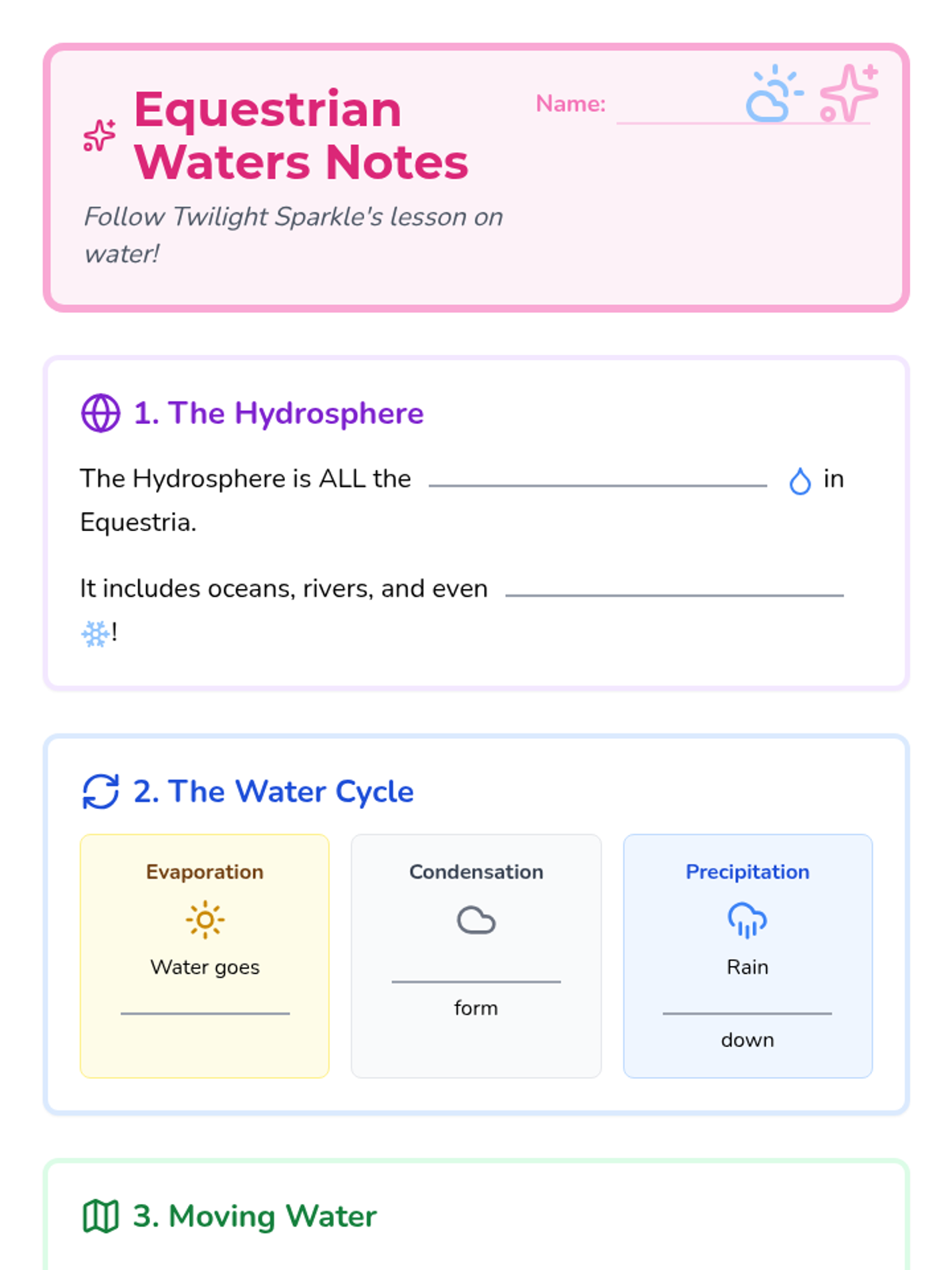
A simplified, symbol-supported guided notes document to accompany the Equestrian Waters Slides. Includes fill-in-the-blank sections with visual icons and enhanced My Little Pony theme integration.
A 9-slide presentation on surface water movement with simplified, symbol-supported text and a My Little Pony theme. Covers the hydrosphere, water cycle, watersheds, stream loads, and flood safety.
The final polished answer key for the Eco Web Chronicles lesson, featuring a corrected vocabulary matching guide and answers for the expanded analysis questions. Balanced layout for printing.
A quick formative assessment exit ticket for the ecosystems lesson. Updated with larger drawing areas and polished visuals.
A vocabulary worksheet featuring matching and application exercises for key terms related to ecosystems and energy flow. Updated to fit on one page.