A coloring-themed writing worksheet focusing on verbal description and sentence building. Includes art-related vocabulary, a 7-word sentence scramble, and tracing space.
Student workbook page for Lesson 6 (The Synthesizing Secret). Features a "Thinking Evolution Log" to track changes in understanding at 0%, 50%, and 100% of the text. Includes a synthesis challenge. Revised for contrast, larger text, and single-page fit.
Slides for Lesson 6 (The Synthesizing Secret). Explains synthesis through baking and puzzle metaphors. Revised for contrast and visibility. Added high-contrast labels and improved math symbols.
Teacher guide for Lesson 6 (The Synthesizing Secret). Teaches students how to track thinking changes and synthesize new information as they read. Includes metaphors like puzzles and nesting dolls.
Student workbook page for Lesson 5 (The Questioning Quest). Features a "Quest Map" for tracking questions before and during reading, categorization of Thick vs. Thin, and a reasoning challenge. Revised for alignment, readability, and fit on one page.
Slides for Lesson 5 (The Questioning Quest). Introduces Thick and Thin questions through the metaphor of a search quest and a map. Includes practice examples.
Teacher guide for Lesson 5 (The Questioning Quest). Introduces the concept of Thick vs. Thin questions and teaches students how to actively engage with text through self-generated inquiry.
Student workbook page for Lesson 4 (Mental Movie Marathon). Includes a storyboard drawing area, sensory checklists, and a deductive reasoning challenge based on sensory text clues. Revised for answer choice uniformity, larger writing areas, and readability.
Slides for Lesson 4 (Mental Movie Marathon). Uses movie production metaphors (Mind Camera, lenses, blockbusters) to explain visualization and sensory details.
Teacher guide for Lesson 4 (Mental Movie Marathon). Focuses on teaching visualization through a sensory lens, using storyboards and movie metaphors to ground abstract comprehension.
Student workbook page for Lesson 3 (Inference Investigation). Features the E+S=I equation, practice cases with specific text evidence, and a reasoning check to distinguish between inferences and wild guesses. Includes strategy clues.
Teacher guide for Lesson 3 focusing on Inferences. Introduces the formula 'Evidence + Schema = Inference' and uses Reading Detective techniques to teach students how to read between the lines.
A student workbook page for Lesson 2 (Schema Suitcase). Features a 'Packing List' for activating prior knowledge before reading and space for adding new information. Includes strategy clues and pattern recognition prompts.
A teacher guide for Lesson 2 focusing on Schema. Uses the 'Schema Suitcase' concrete metaphor from Comprehension Connections to help students activate prior knowledge before reading.
A student activity journal page for Lesson 1. Includes a 'Thinking Voice Log', a 'Catch a Thought' visual section, and a deductive reasoning puzzle. Features strategy clues to support learners.
A visually engaging slide deck introducing metacognition ('Brain Power') to students. Uses the metaphor of a 'Thinking Voice' vs. a 'Reading Robot' to make abstract thinking concepts concrete.
A teacher guide for the first lesson in the Mind Detective series, focusing on introducing metacognition and the 'thinking voice' to elementary students. Includes differentiation for K-6.
Answer key for the 50-mark Word Power Mastery Test, featuring 5 secret dictation words and clear answers for morphemes, AI/AY completion, broad vowels, and plural forms.
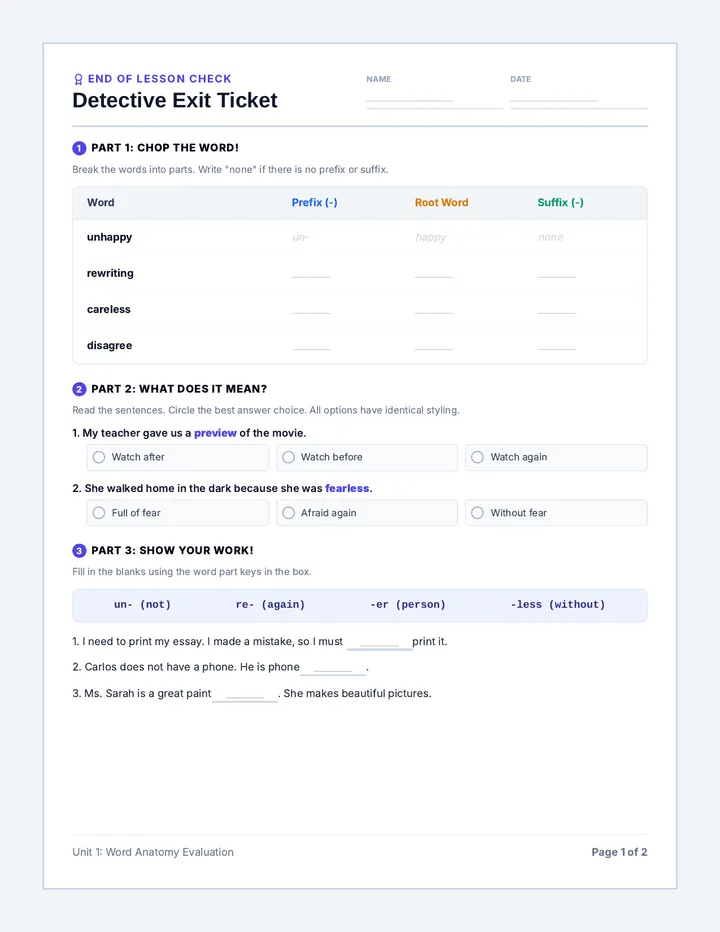
A 50-mark Grade 2 literacy test with a 5-word dictation section (10 marks), followed by morpheme matching, AI/AY completion, broad vowel identification, and plural power. Optimized for student handwriting and print.
Updated 100-mark Answer Key for the Word Power Mastery Test with corrected duplicate items and increased font size for improved teacher readability.
Expanded 100-mark Grade 2 literacy test featuring 10 dictation words, 10 morpheme matches, 20 AI/AY words, 20 broad vowel identifications (mix of A, O, U), and 20 plural transformations. Corrected duplicate items in the vowel hunt.