A visual presentation introducing Valence Bond Theory and the concept of orbital overlap. It compares Lewis structures with the quantum mechanical model and highlights the mismatch between p-orbital geometry and molecular bond angles.
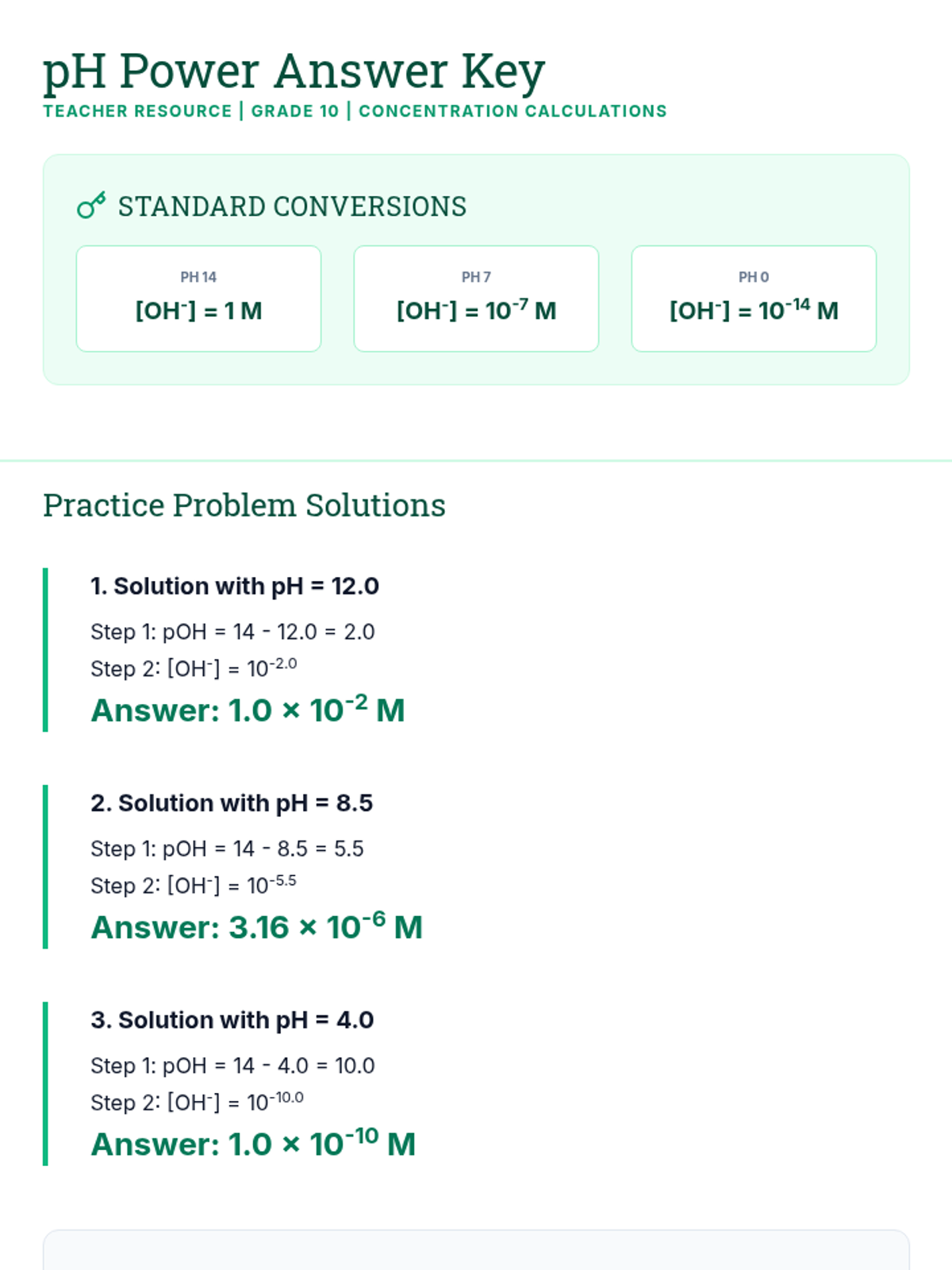
An answer key for the pH Power Worksheet, providing detailed step-by-step solutions and a quick reference guide for teachers. (Revised for rendering, layout, and scientific accuracy)
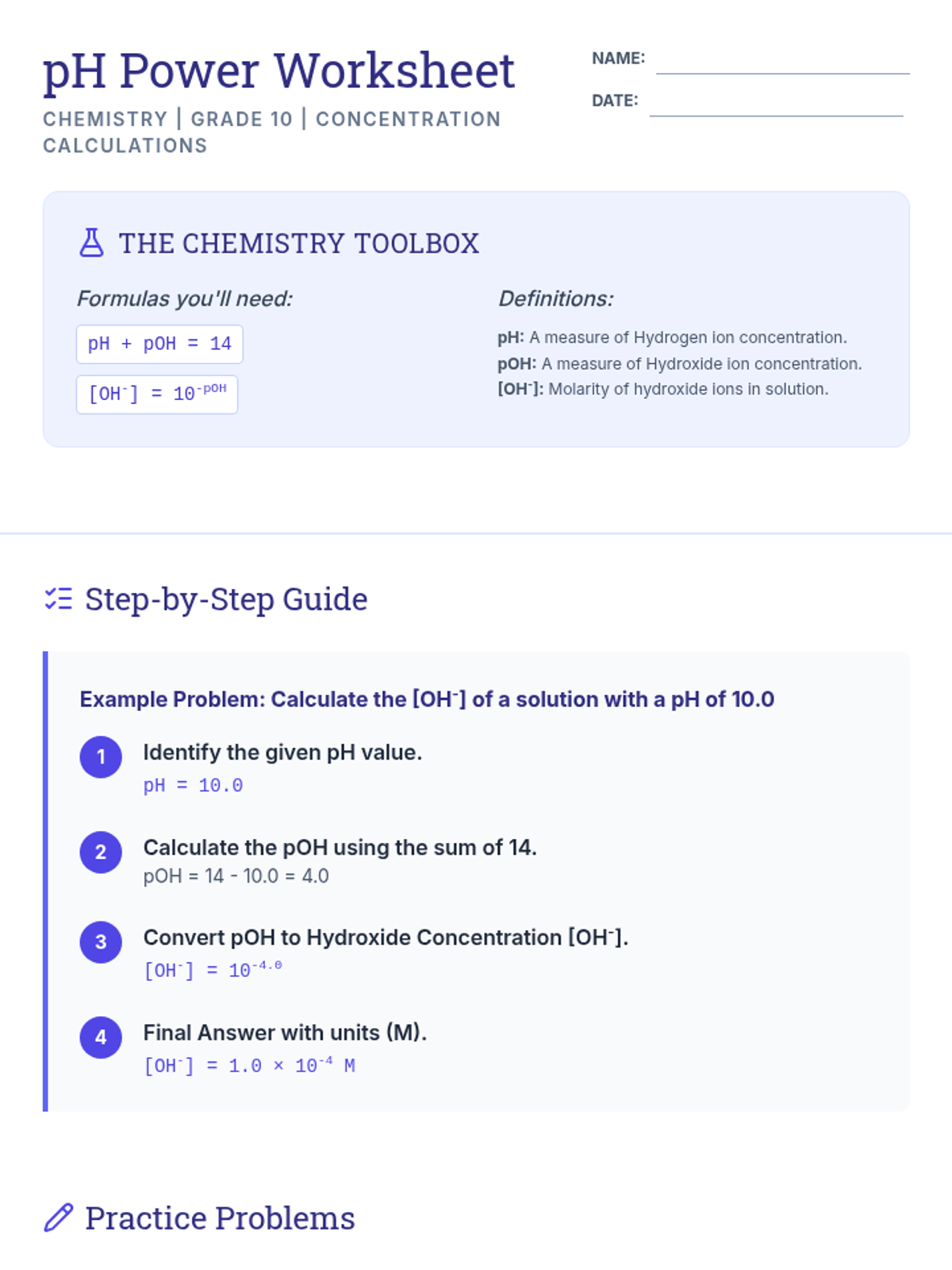
A step-by-step worksheet guiding students through the process of calculating hydroxide ion concentration from pH values, featuring clear formulas and practice problems. (Revised for rendering and layout)
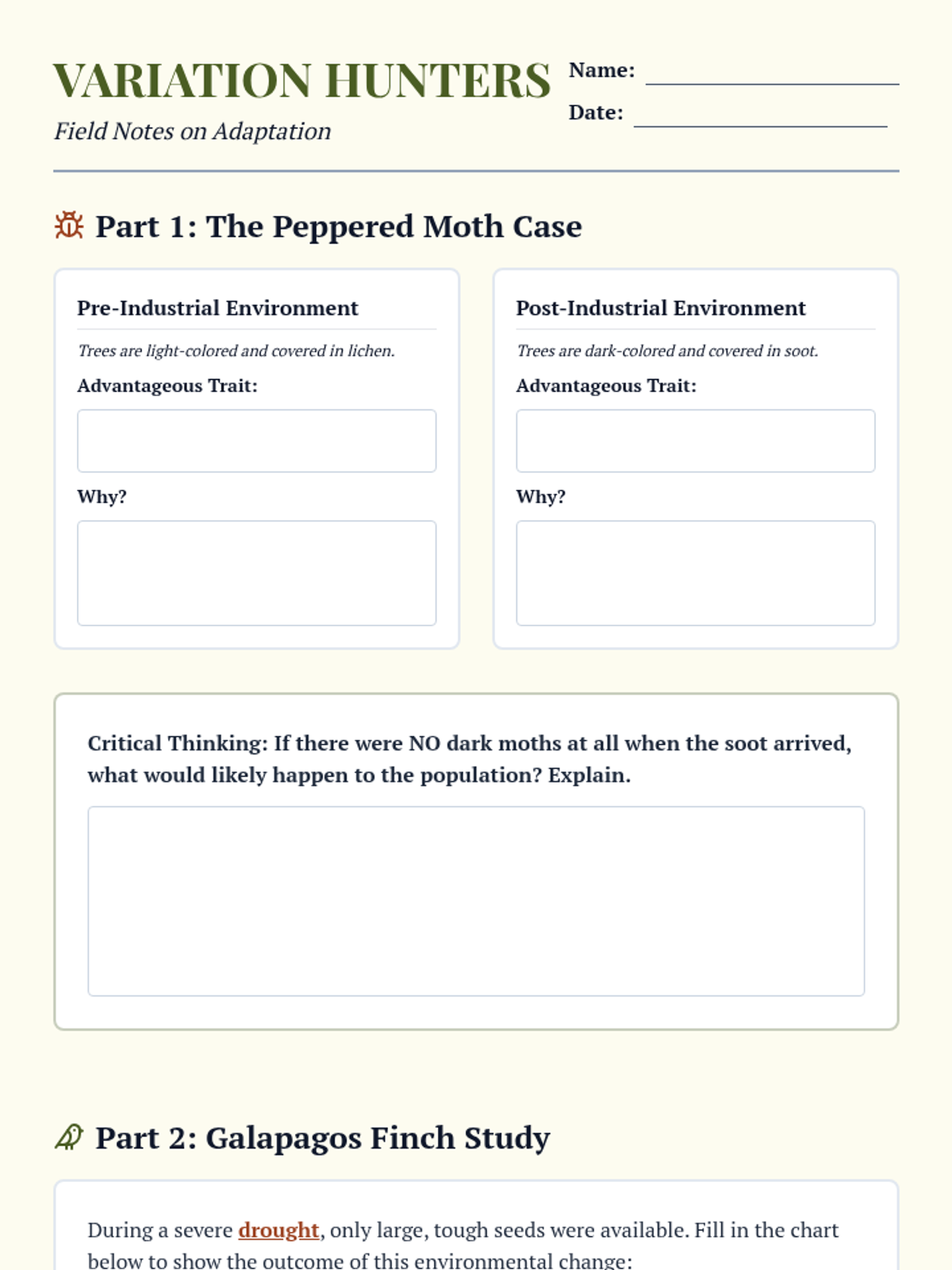
A student worksheet for tracking variations in peppered moths and Galapagos finches. Includes sections for recording advantageous traits and a long-form reflection on why variation prevents extinction.
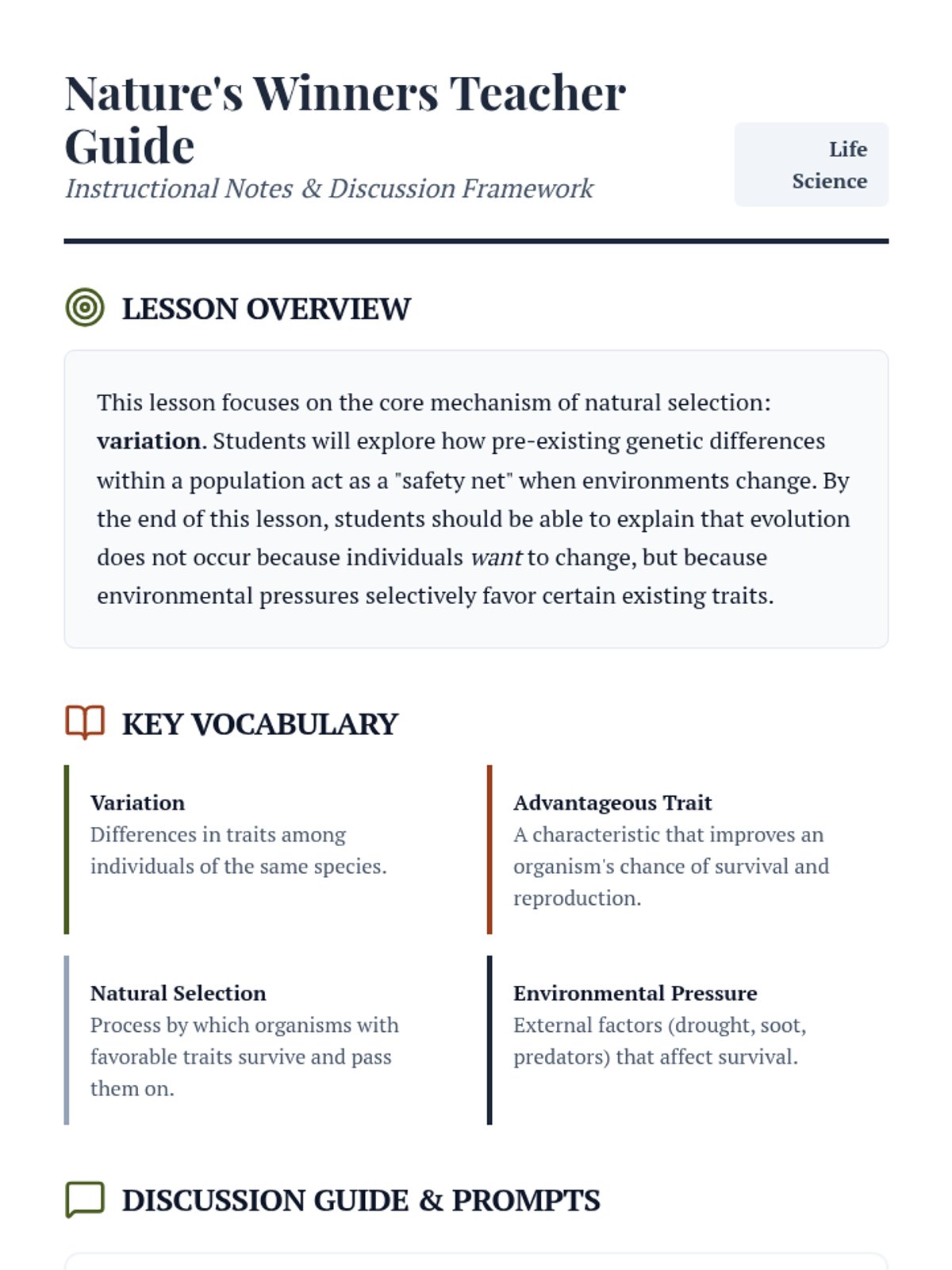
A comprehensive teacher guide for the 'Adapt or Fade' lesson, including instructional goals, discussion prompts for moth and finch case studies, clarification of common misconceptions, and an extension activity.
A 10-slide presentation exploring how genetic variation within a population provides advantages or disadvantages during environmental changes, featuring peppered moths and bird beak case studies. Includes speaker notes and an explorer's sketchbook aesthetic.

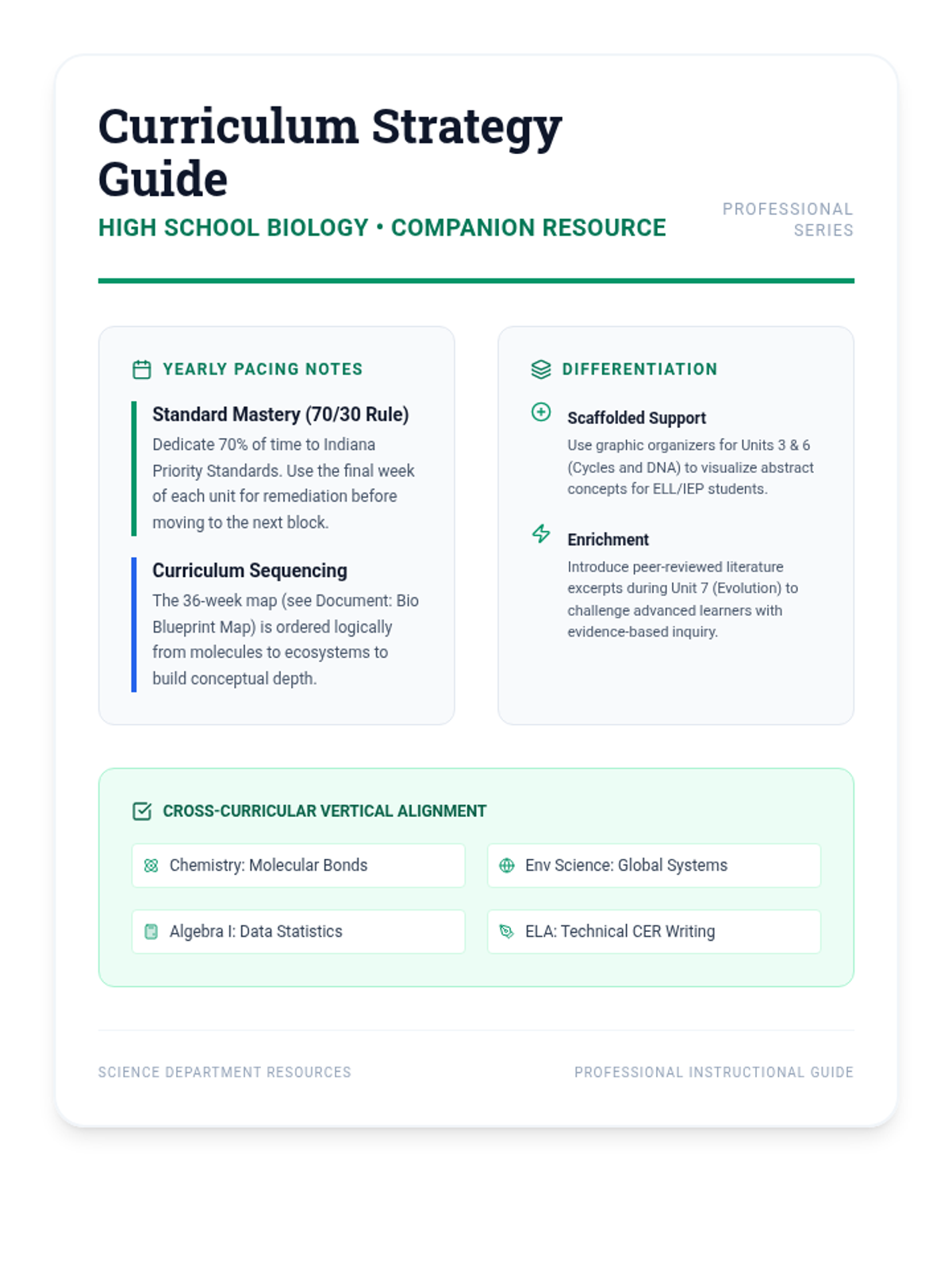
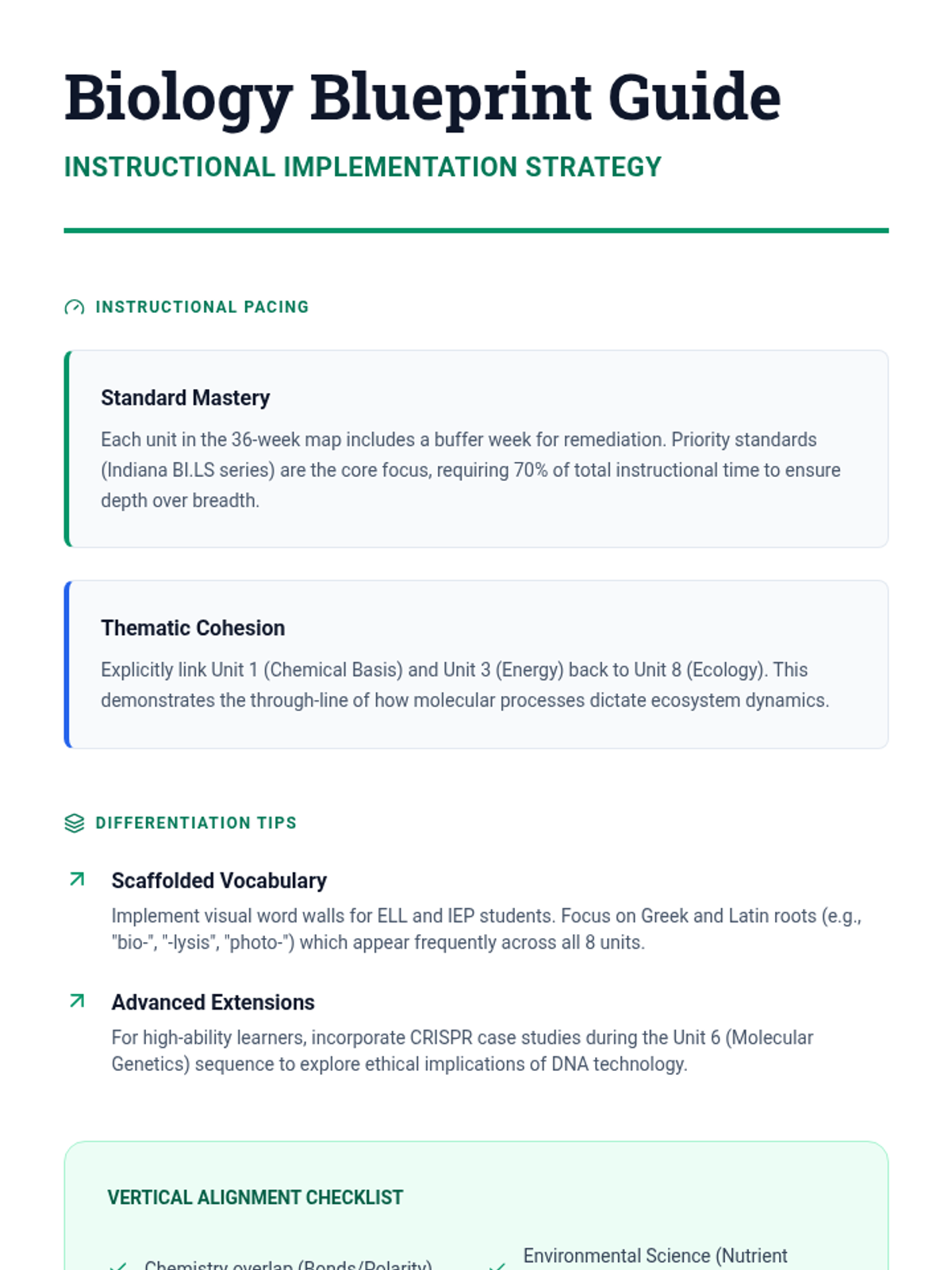
A professional, single-page implementation guide for biology teachers, providing pacing tips, differentiation strategies, and vertical alignment goals to support the 36-week curriculum map.
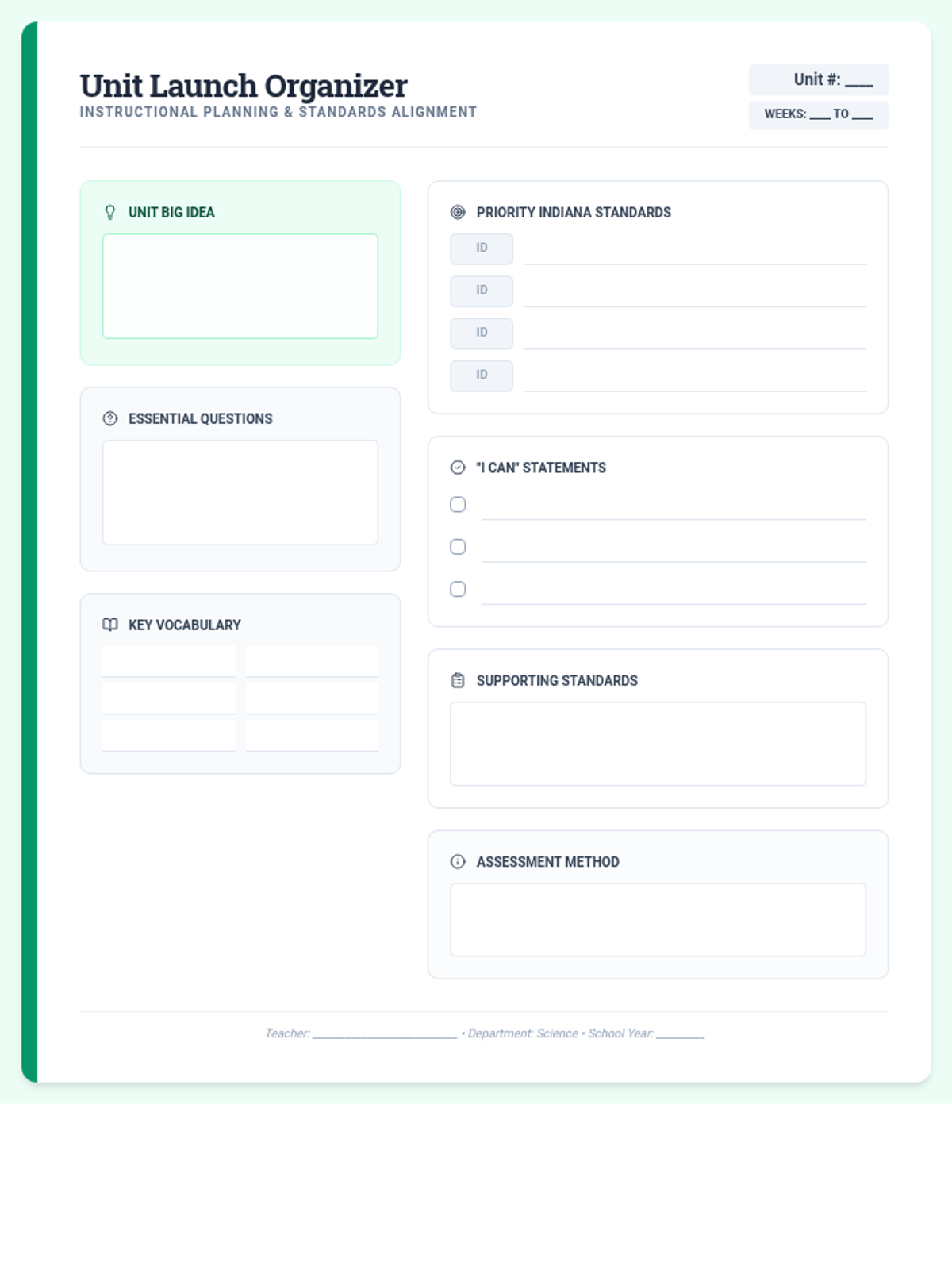
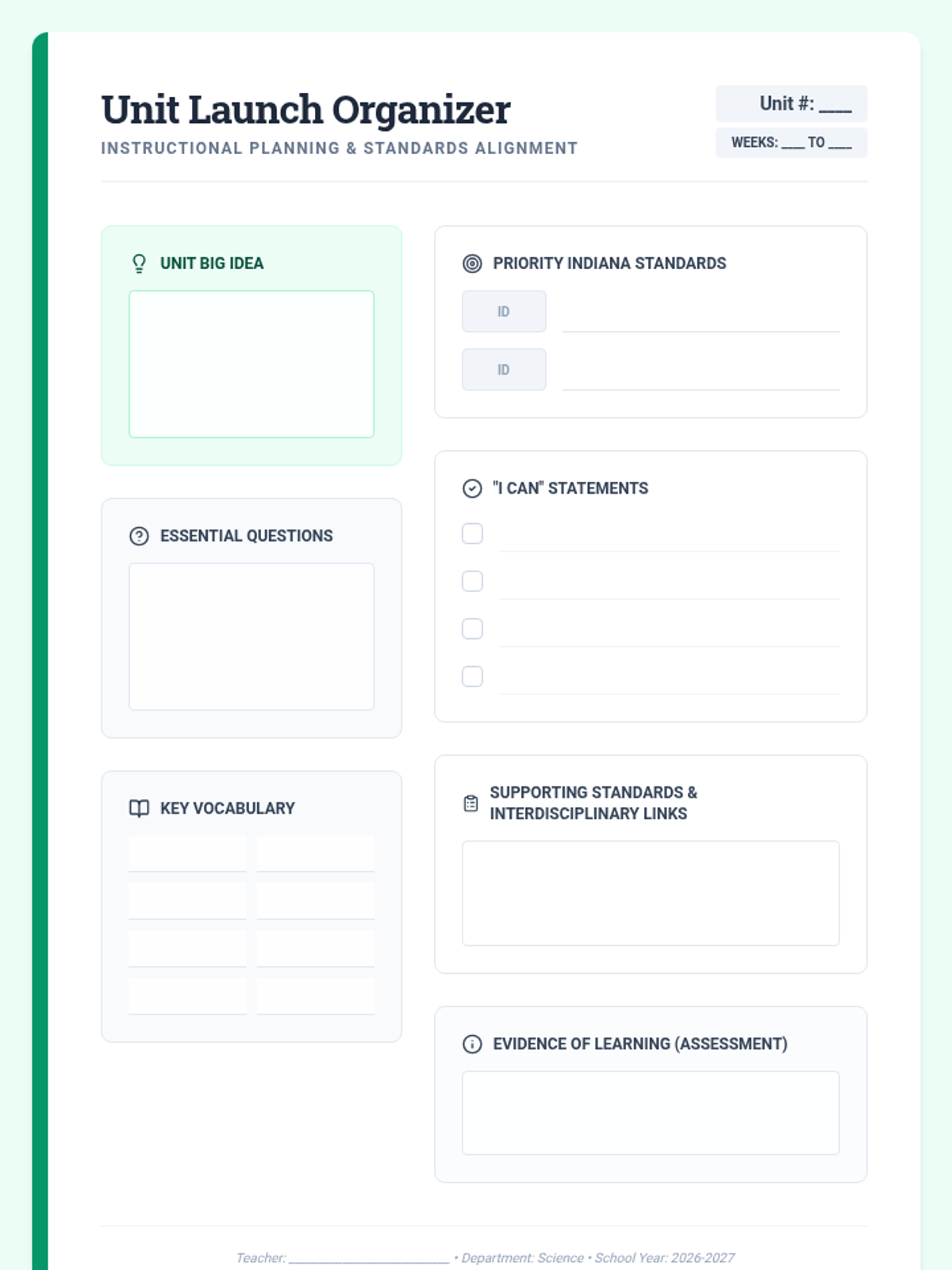
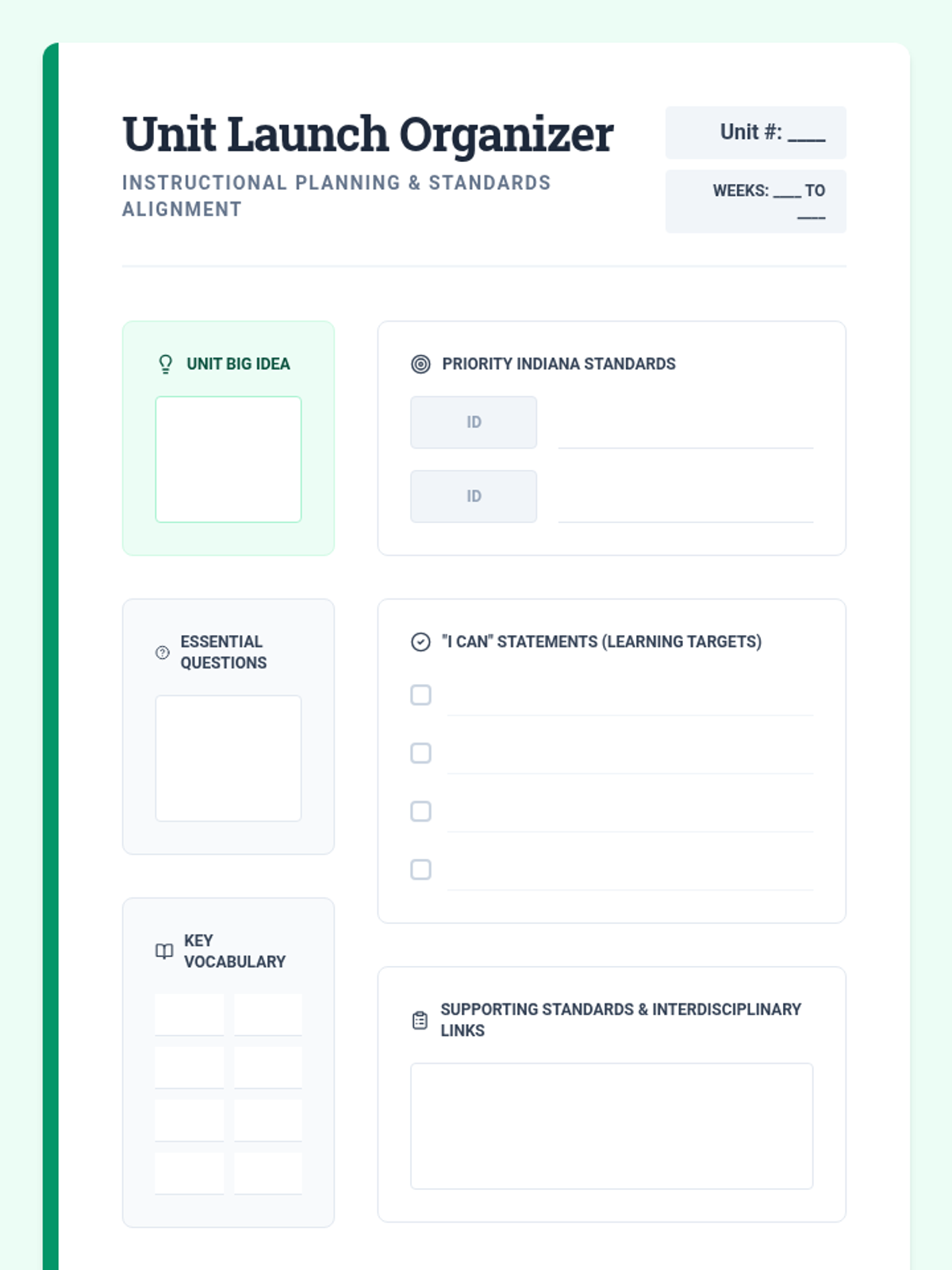
A teacher-facing unit launch template designed for zooming into specific biology units, featuring work areas for standards, essential questions, "I Can" statements, and vocabulary. Optimized for single-page printing.
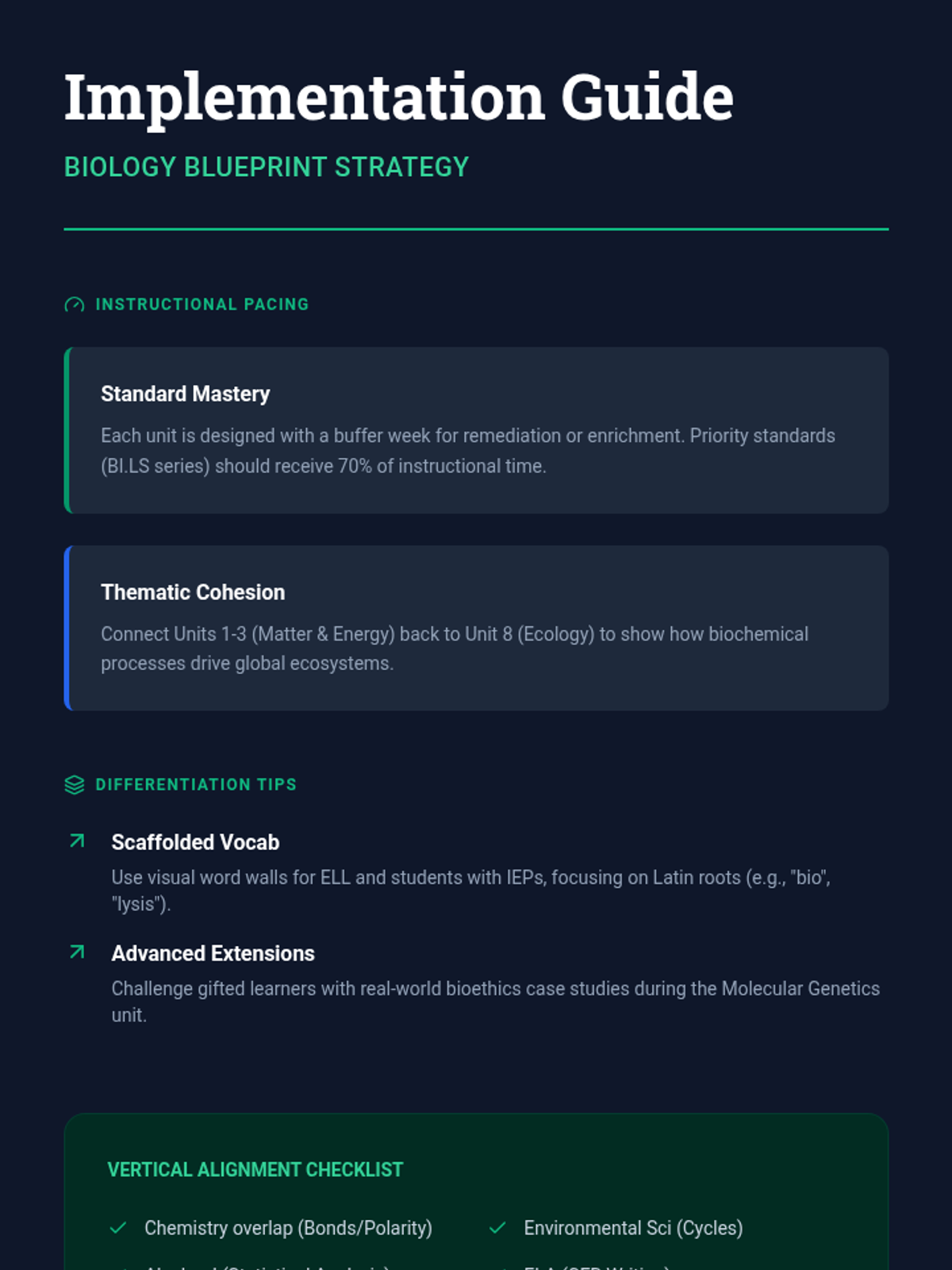
A high-contrast, print-friendly instructional guide for biology teachers, providing pacing strategies, differentiation tips, and alignment checklists for the year-long curriculum.
A professional instructional guide for high school biology teachers, providing pacing strategies, differentiation tips, and vertical alignment checklists for the 36-week curriculum.
A teacher-facing unit launch template designed for zooming into specific biology units, featuring work areas for standards, essential questions, "I Can" statements, and vocabulary.
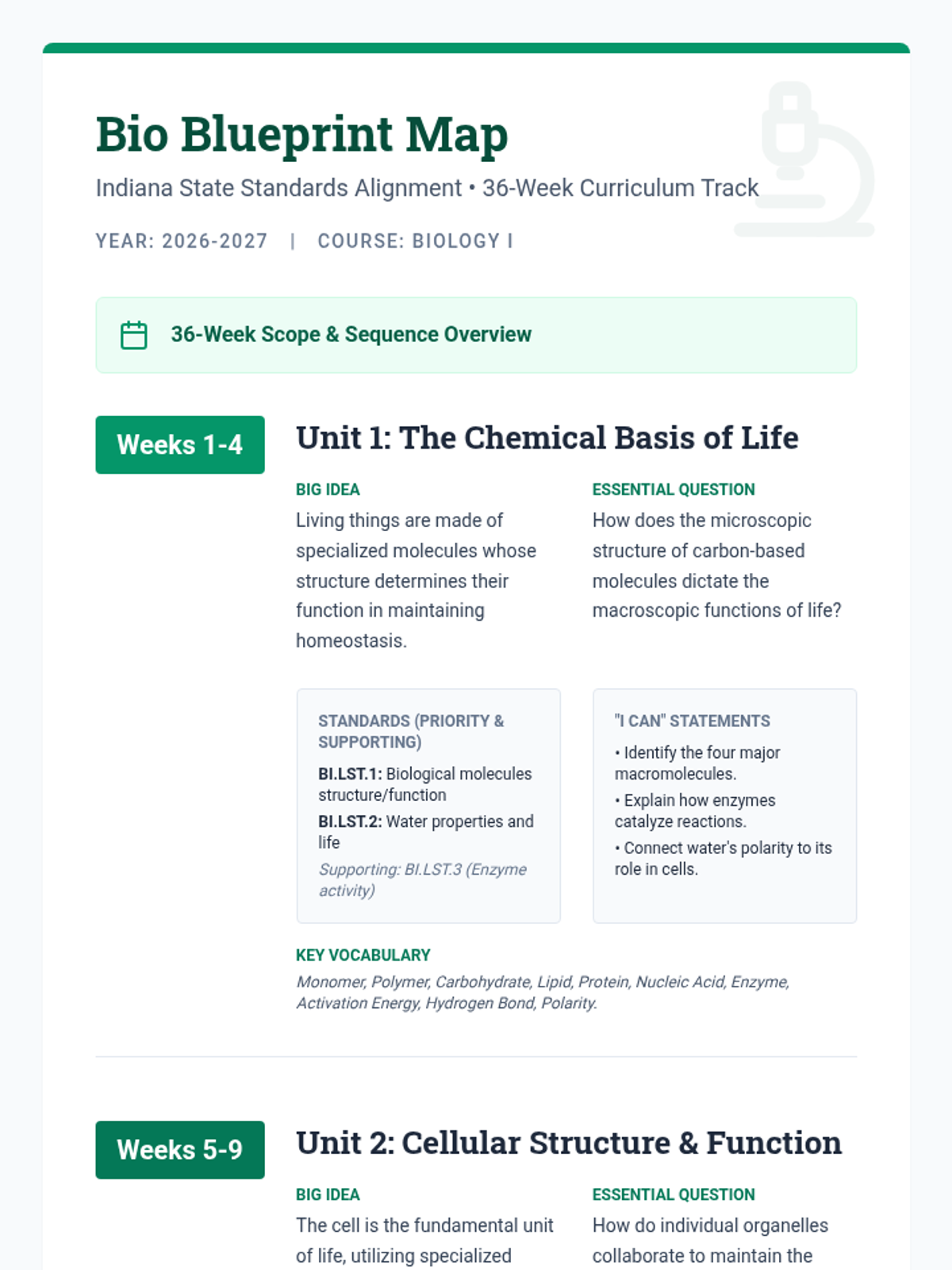
A comprehensive 36-week high school biology curriculum map aligned with Indiana State Standards, featuring units, big ideas, essential questions, priority standards, "I Can" statements, and key vocabulary. Corrected for page-breaks and content.
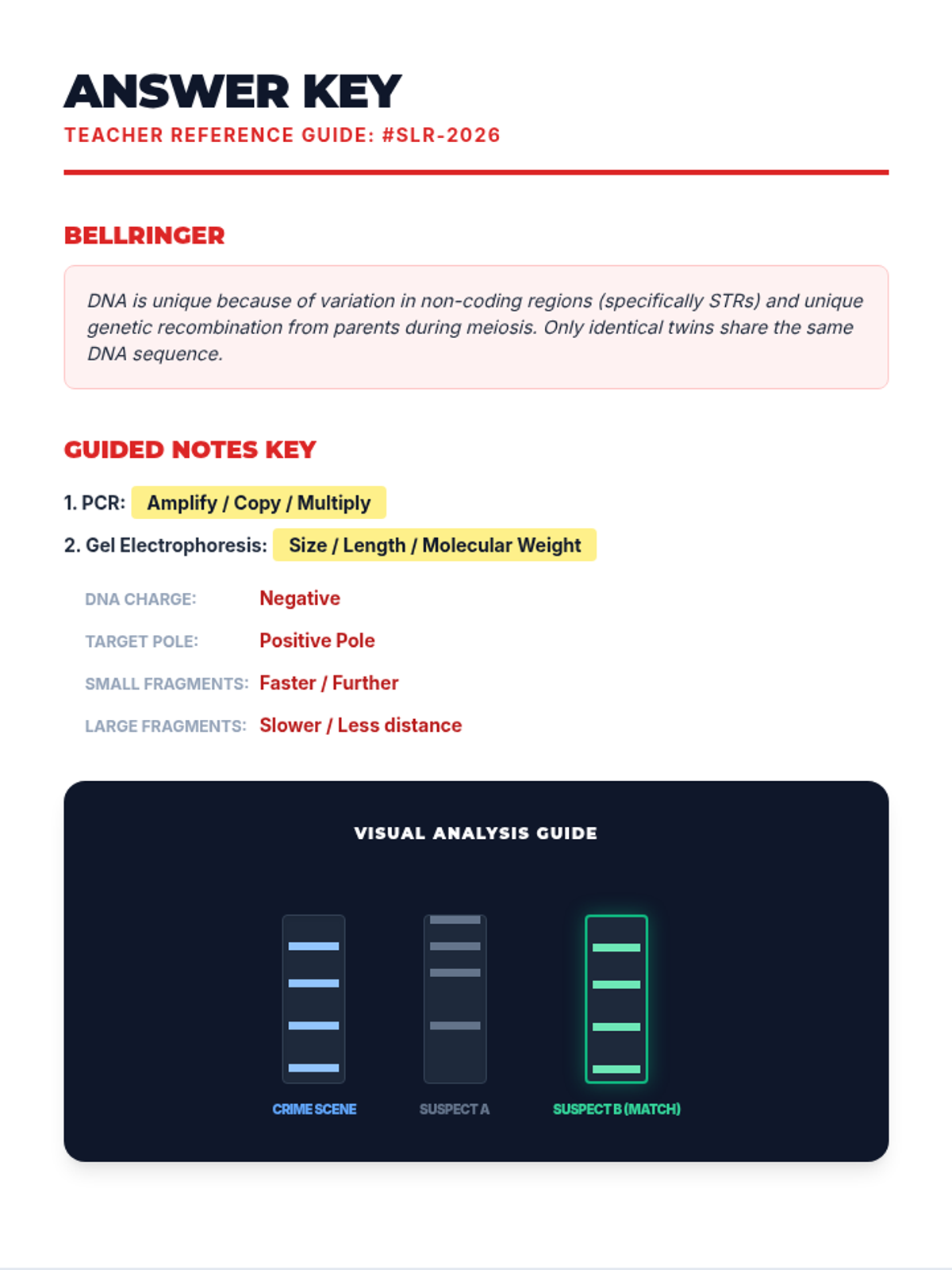
A 2-page answer key for the Biotech Detectives lesson. Provides correct answers for the bellringer, guided notes, suspect DNA comparison, independent practice questions, and a model CER response.
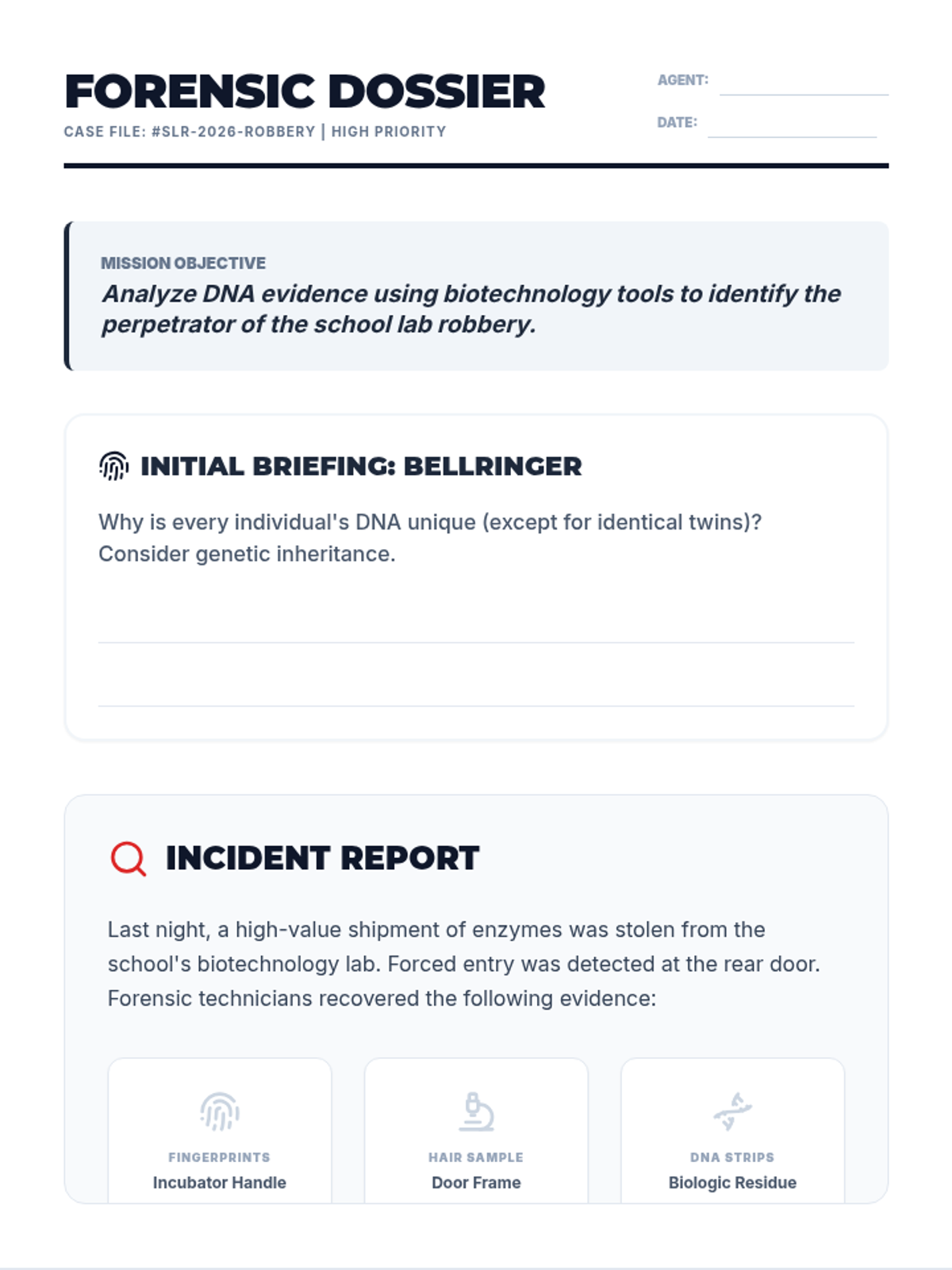
A 4-page student packet for a DNA technology and forensics lesson. Includes a case briefing, guided notes on PCR and gel electrophoresis, a parabolic movement graphing activity, a suspect DNA comparison, independent practice questions, and a CER final verdict section.
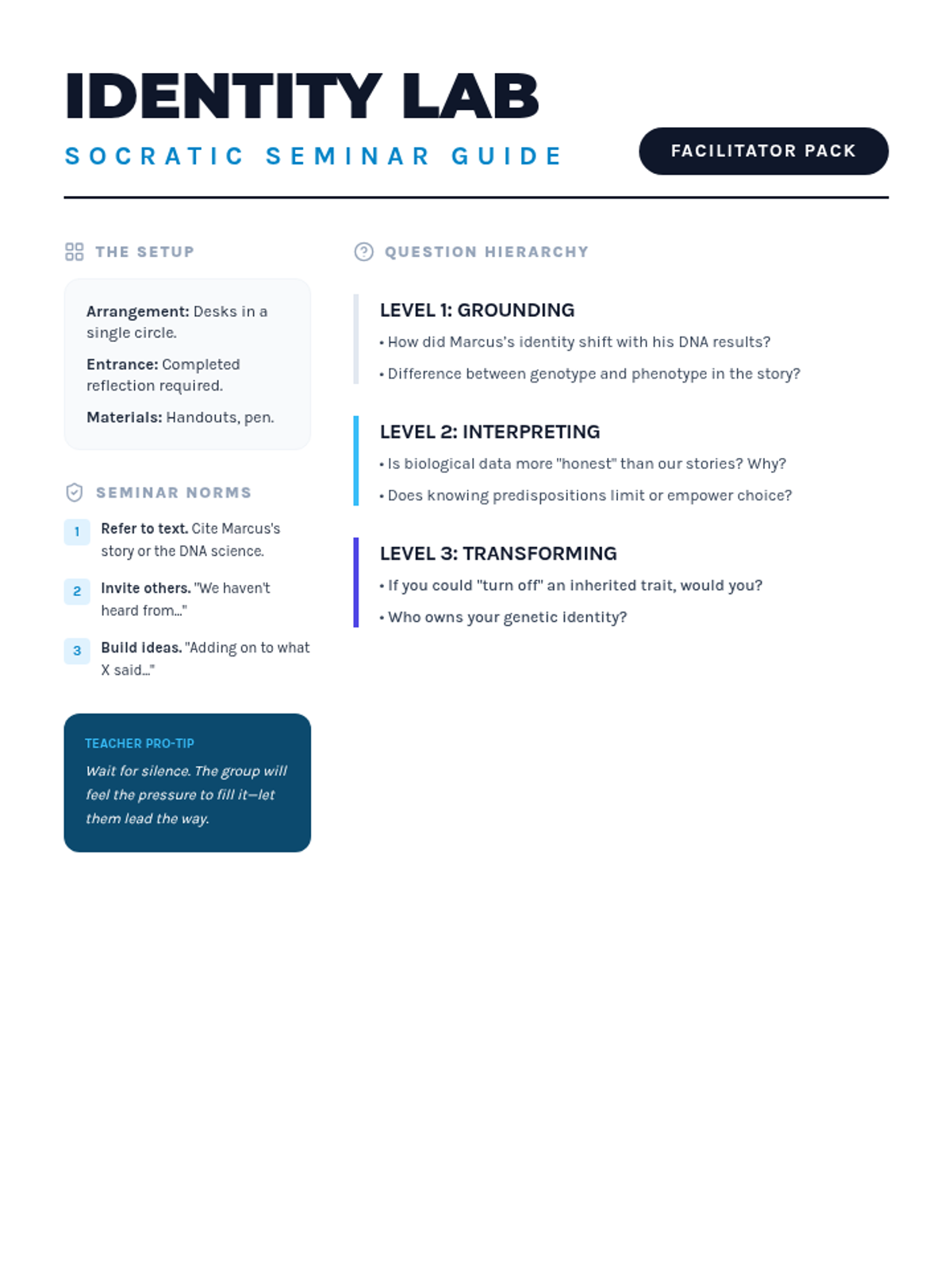
A teacher facilitation guide for a Socratic seminar focusing on DNA and Identity. Revised to fix page breaks, consolidate content, and expand the observation tracker to 25 student rows. Layout highly optimized for single-page use.
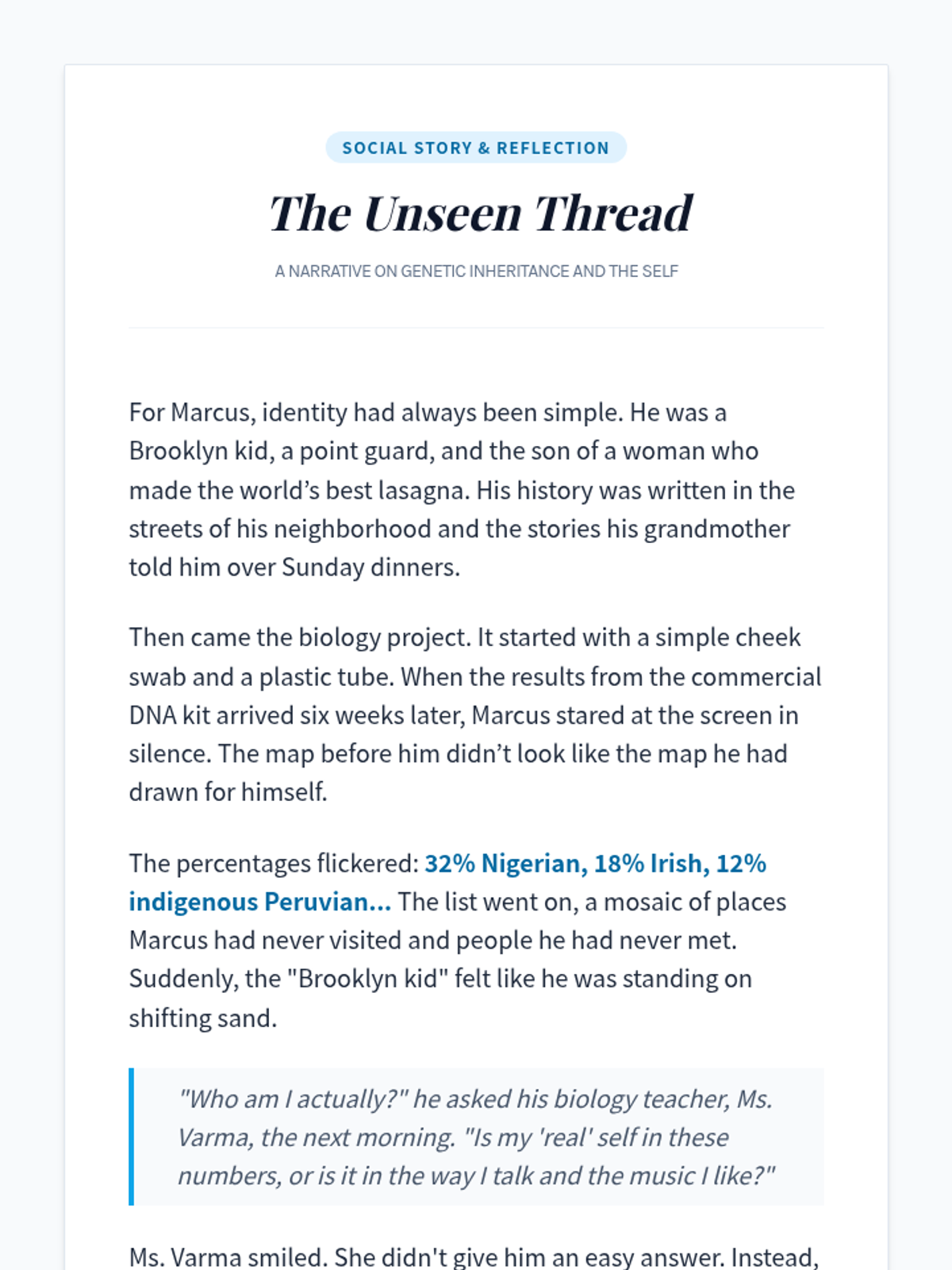
A reflective social story about a student discovering their genetic ancestry and grappling with the meaning of identity. Revised to fix page breaks, increase student work space, and improve label accessibility.
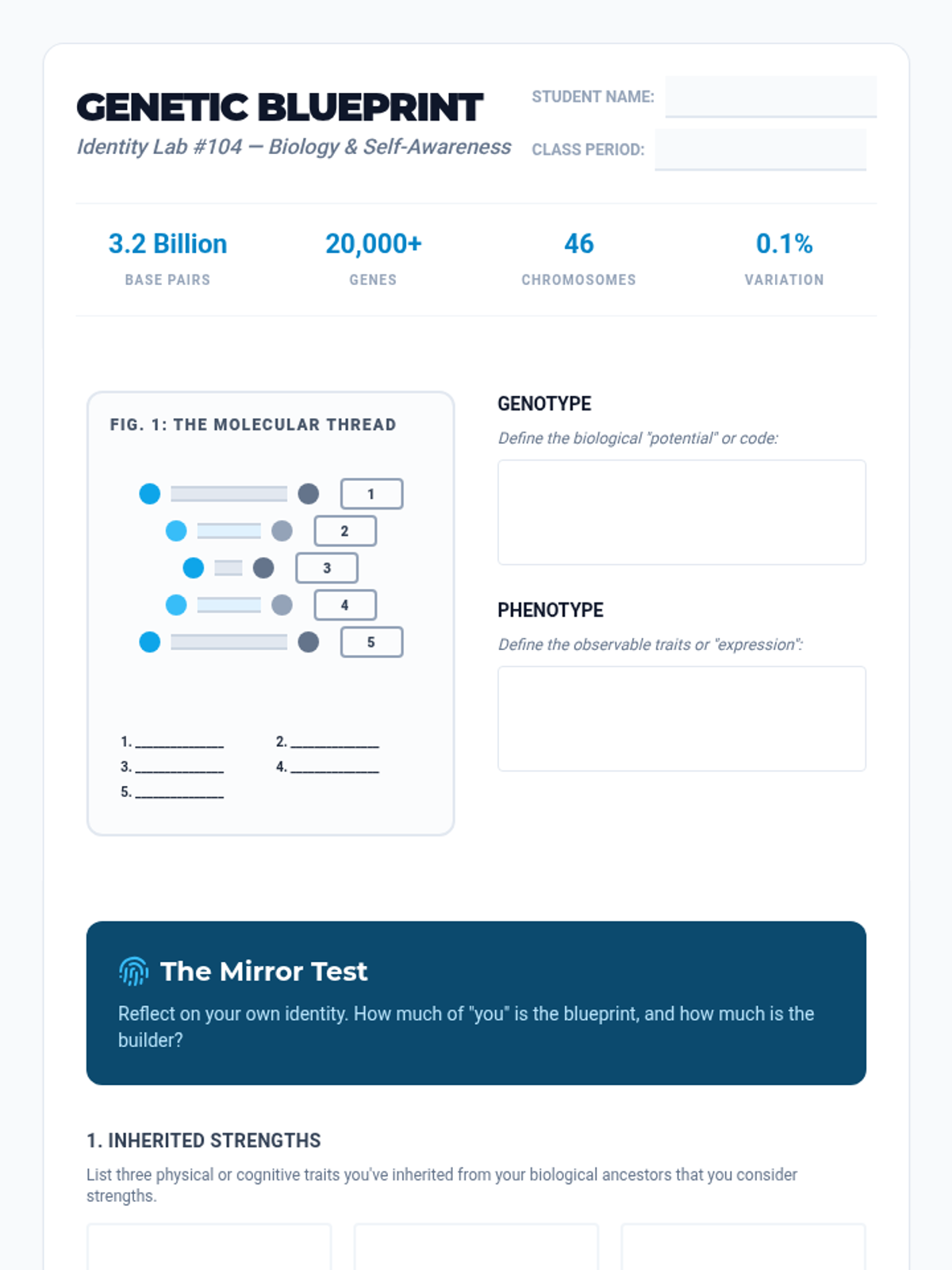
A visual guided notes worksheet that balances scientific diagrams of DNA with SEL reflection questions. Students label the structure of DNA while analyzing their own inherited and environmental traits. Revised with improved diagram, 5-label key, and white work areas.
A high-impact slide deck for teaching DNA through the lens of identity. Features visuals on genomic similarity, epigenetics, and the 'Bio-Mirror' reflection prompt. Includes guidelines for the Socratic seminar.
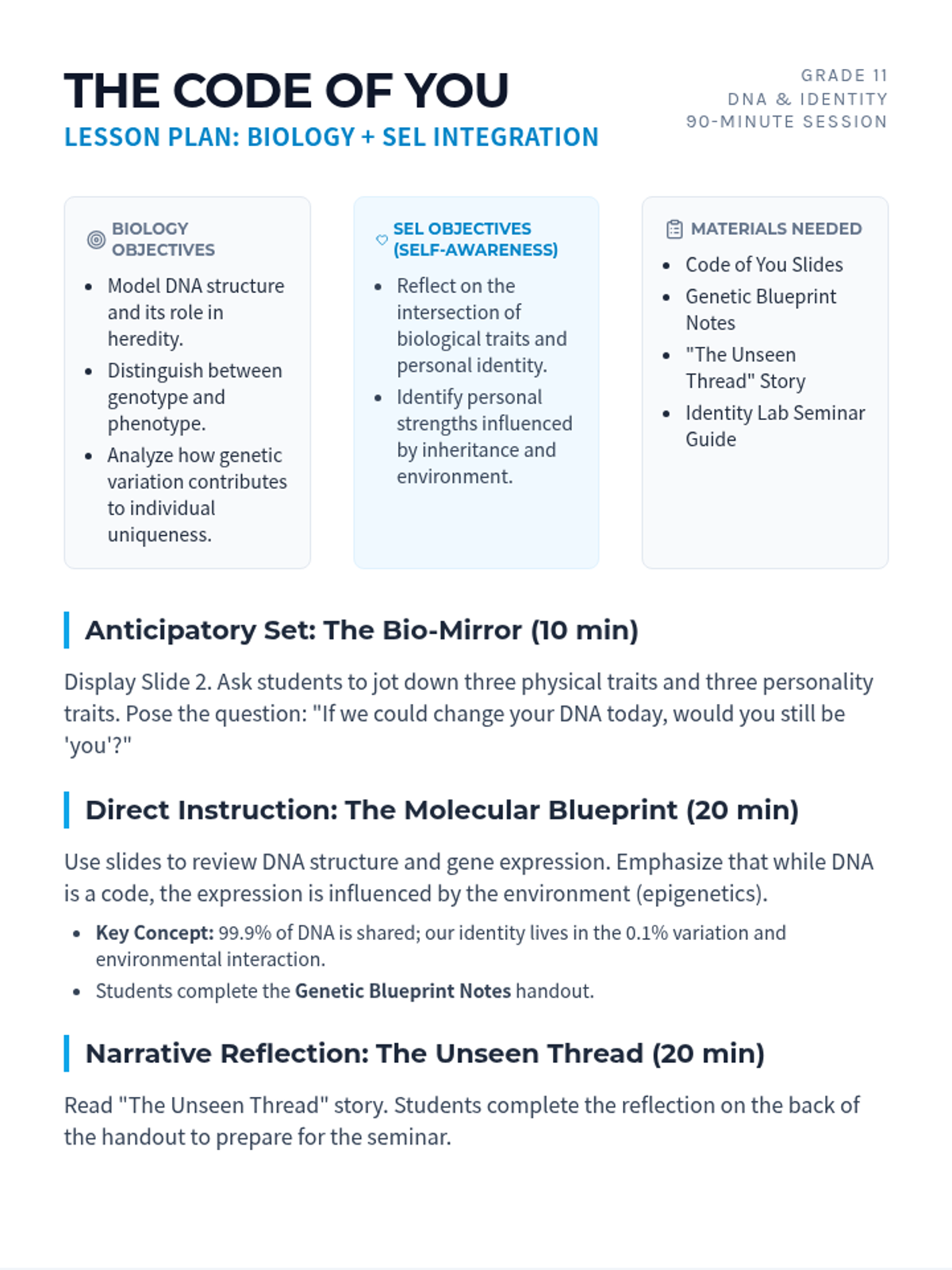
A comprehensive 90-minute lesson plan integrating Biology (DNA structure/heredity) and SEL (Self-Awareness/Identity). Revised to fix page breaks and include Exit Ticket work area. Content condensed to fit on 2 pages.
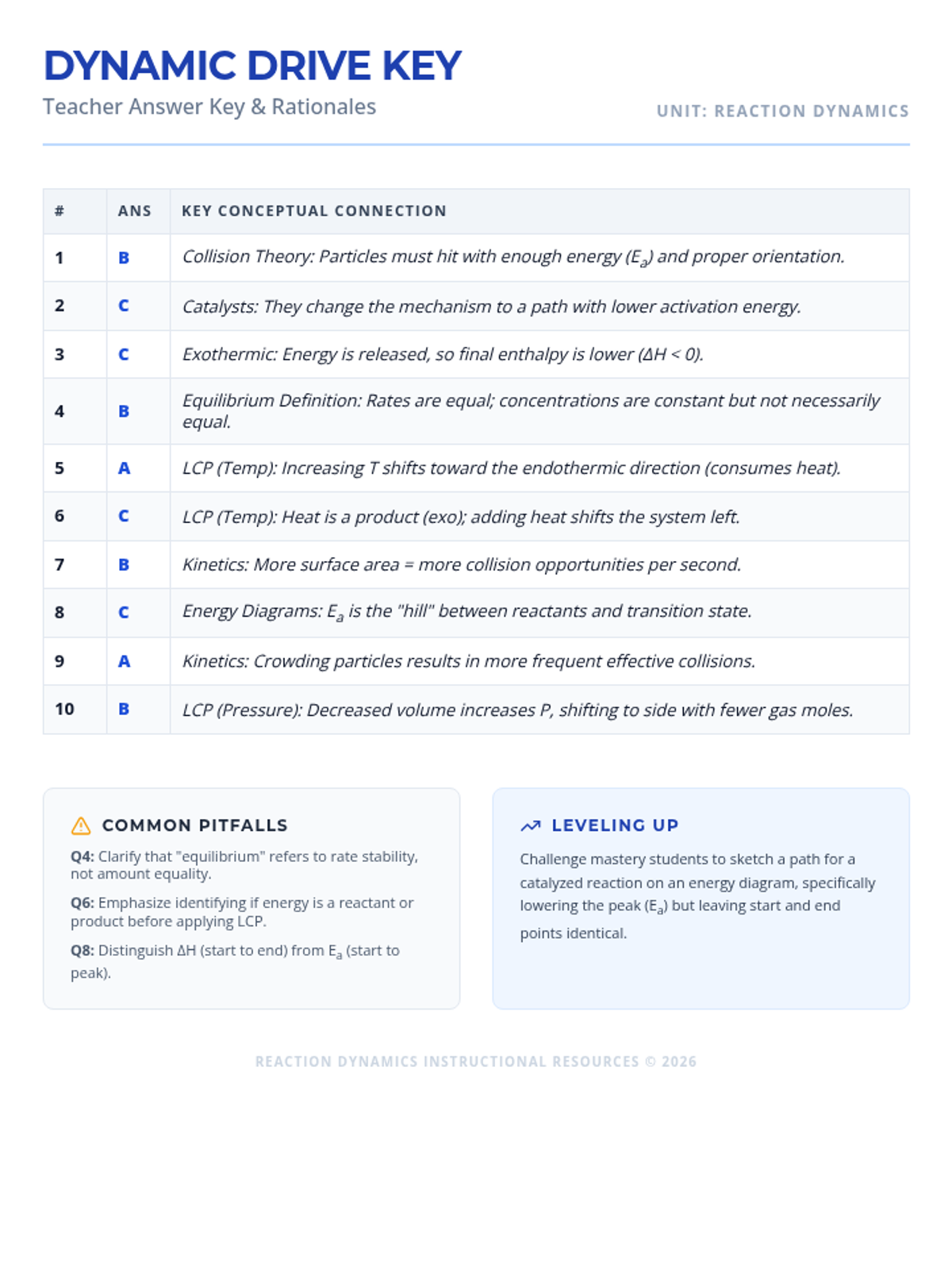
A teacher answer key for the Dynamic Drive MCQs. It provides the correct answers, conceptual rationales for each question, and a guide to common student misconceptions for classroom debriefing. Revised for better page breaks and math rendering.
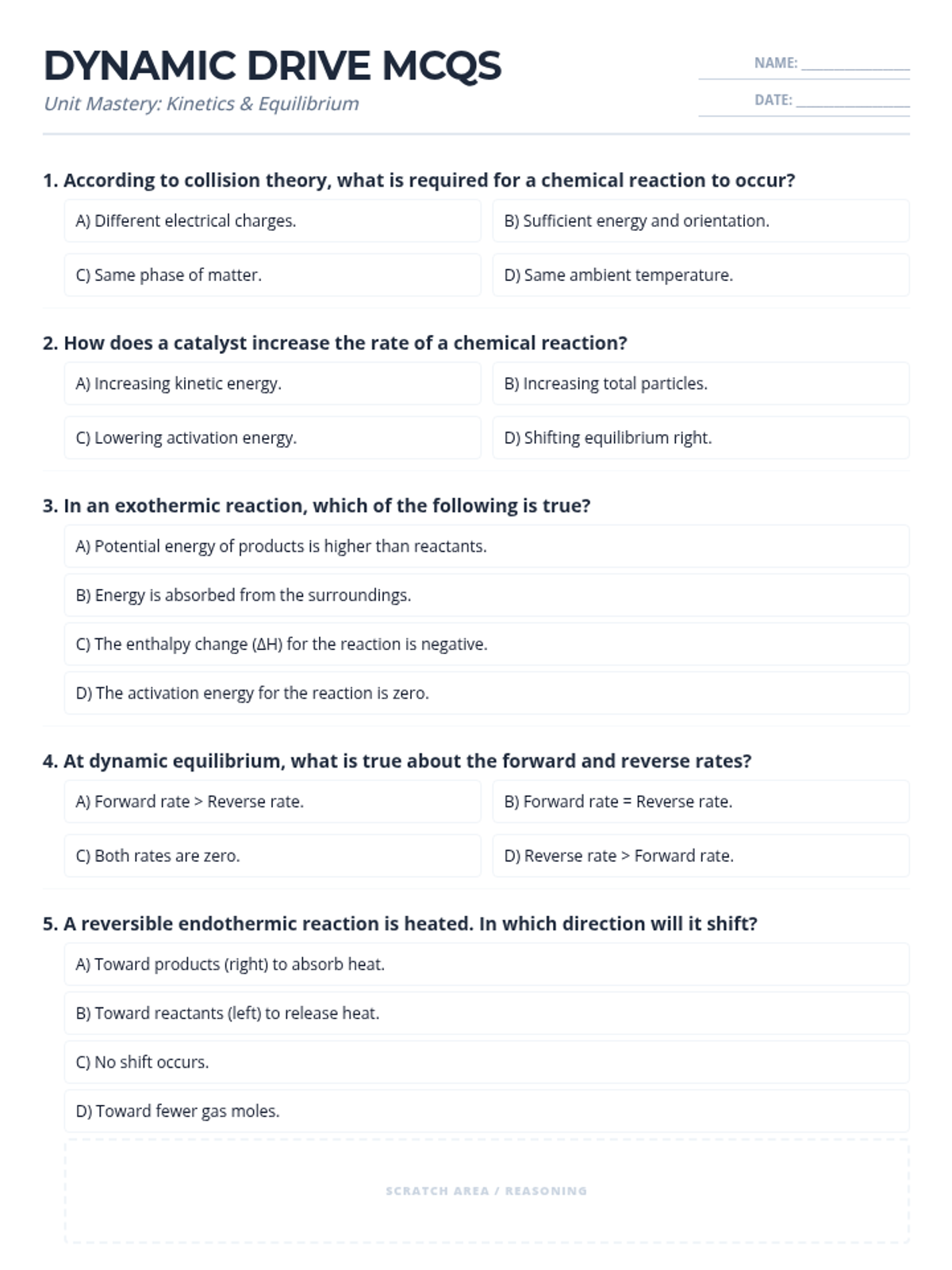
A student assessment consisting of 10 multiple-choice questions covering the key concepts of the Reaction Dynamics unit, including kinetics, energy pathways, and equilibrium shifts. Features uniform answer styling for unbiased testing. Revised for better page breaks, legibility, and technical rendering.
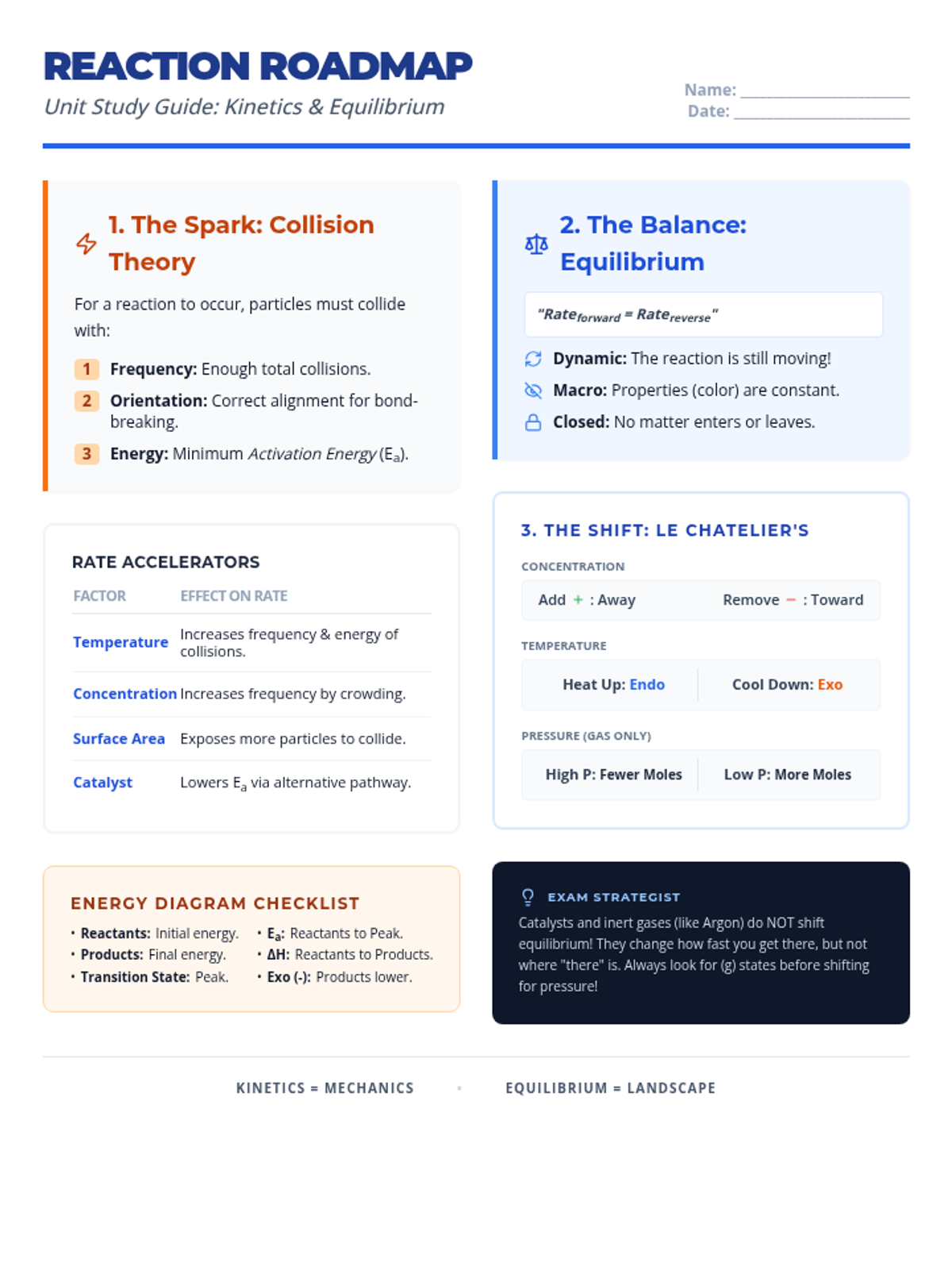
A comprehensive one-page study guide for the Reaction Dynamics unit. It summarizes collision theory, reaction rate factors, energy diagram components, the dynamic nature of equilibrium, and Le Chatelier's Principle shift rules in a visually organized, technical layout. Revised for better page fitting, legibility, and technical rendering.
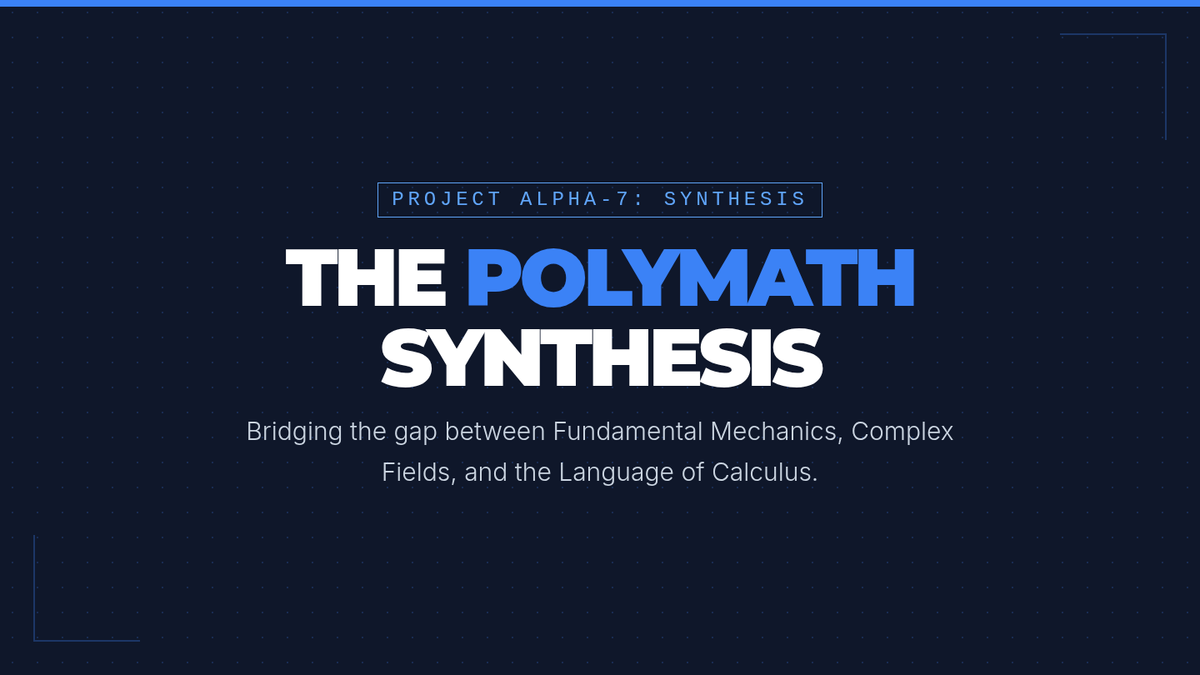
An introductory slide deck for the Polymath Synthesis project, outlining the requirements for integrating AP Physics 1, AP Physics 2, and AP Calculus BC. It features a technical blueprint aesthetic and provides visual layout guidance for scientific posters.
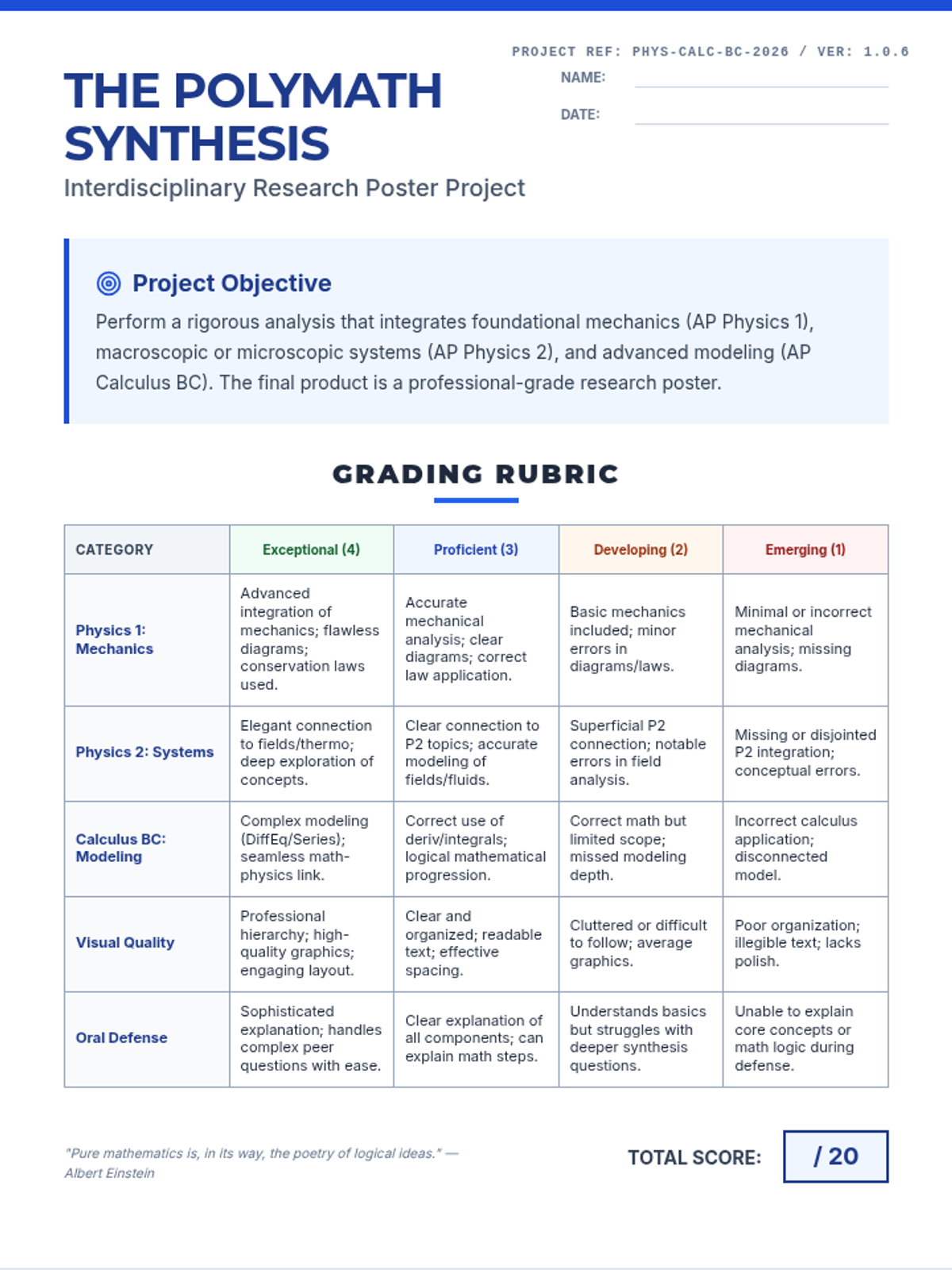
A comprehensive grading rubric and project planner for the Polymath Synthesis poster project. It includes specific criteria for AP Physics 1, AP Physics 2, and AP Calculus BC integration, along with topic inspiration and a structured planning workspace for students.
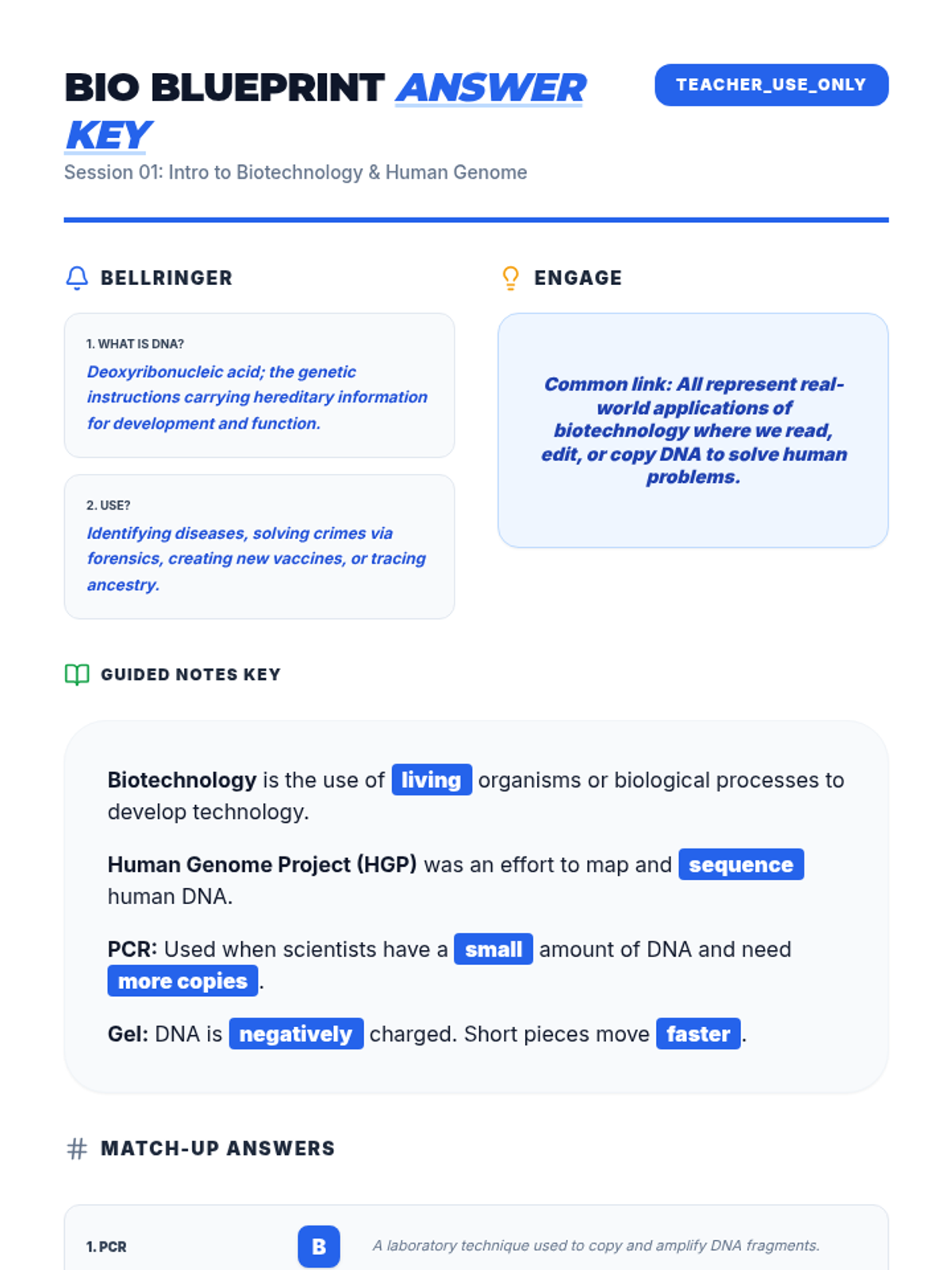
A comprehensive answer key for the Bio Blueprint worksheet, featuring filled-in guided notes, correct vocabulary matches, a completed timeline, and exemplar responses, now with a light-themed exit ticket for consistency. Vertical alignment and page utilization improved.
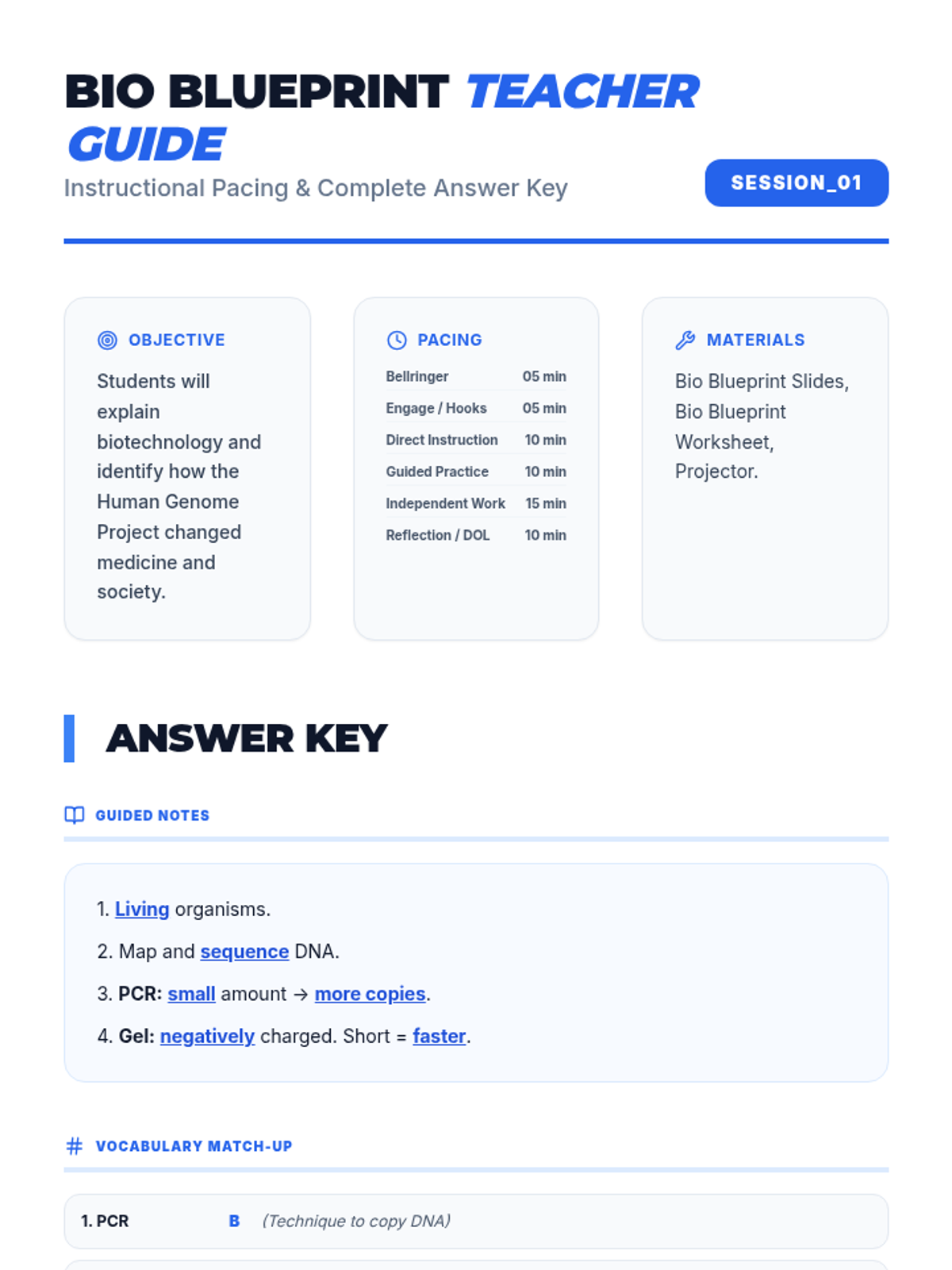
A teacher resource providing instructional pacing, facilitation tips, and a complete answer key for the Bio Blueprint lesson.
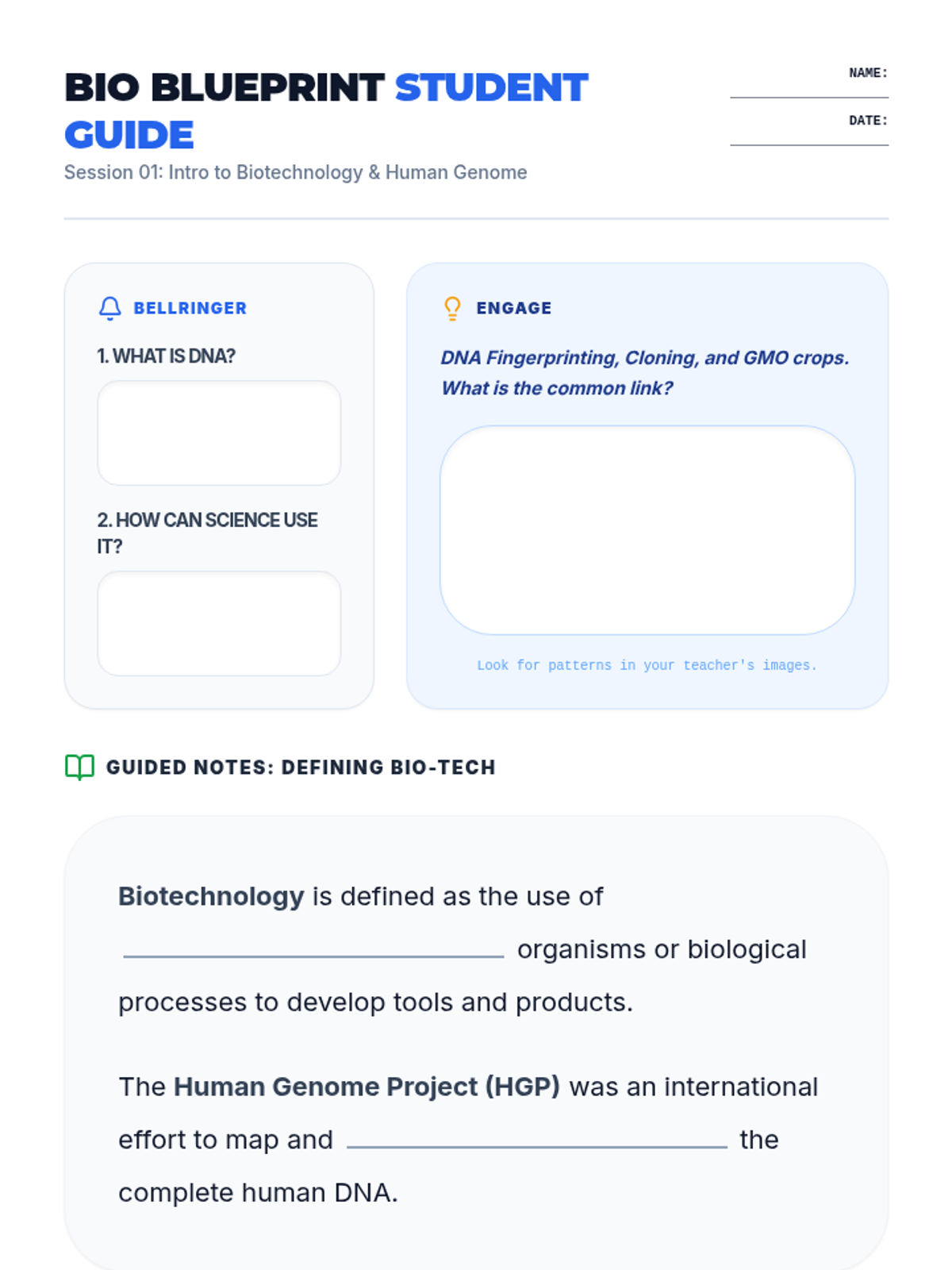
A comprehensive student worksheet featuring guided notes with diagrams, a vocabulary match-up activity, a biotechnology timeline, and a light-themed exit ticket for improved legibility. Includes enlarged work areas and better page utilization. Base font size increased for accessibility.
A revised light-themed slide deck introducing biotechnology concepts, the Human Genome Project, and key laboratory tools like PCR and gel electrophoresis. Replaced all dark backgrounds with clear, bright alternatives for better classroom visibility and adjusted layout to prevent element overlap. Added session clarity notes for worksheet pairing.
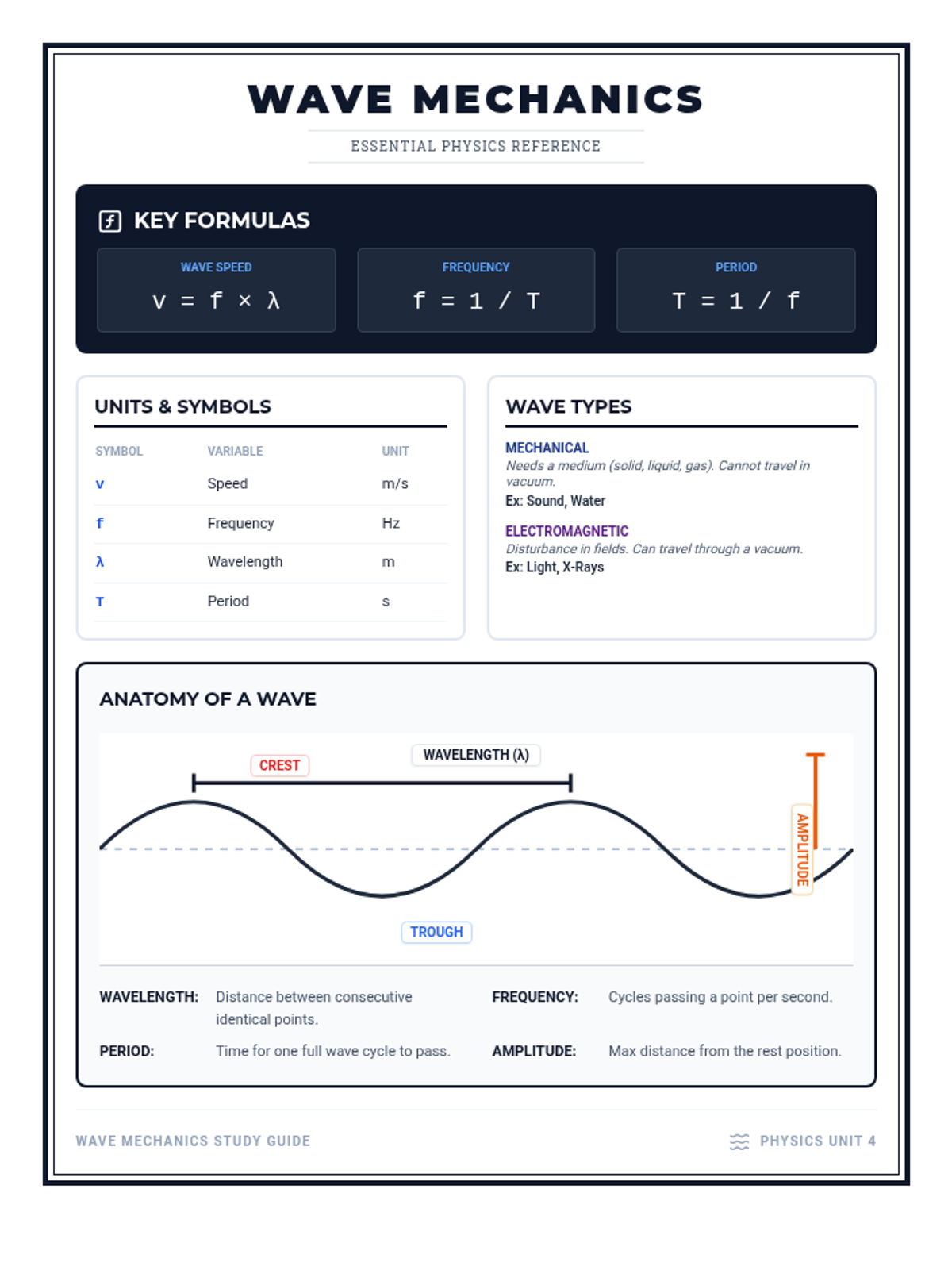
A one-page reference sheet for students summarizing wave formulas, units, definitions of mechanical/EM waves, and basic wave anatomy.
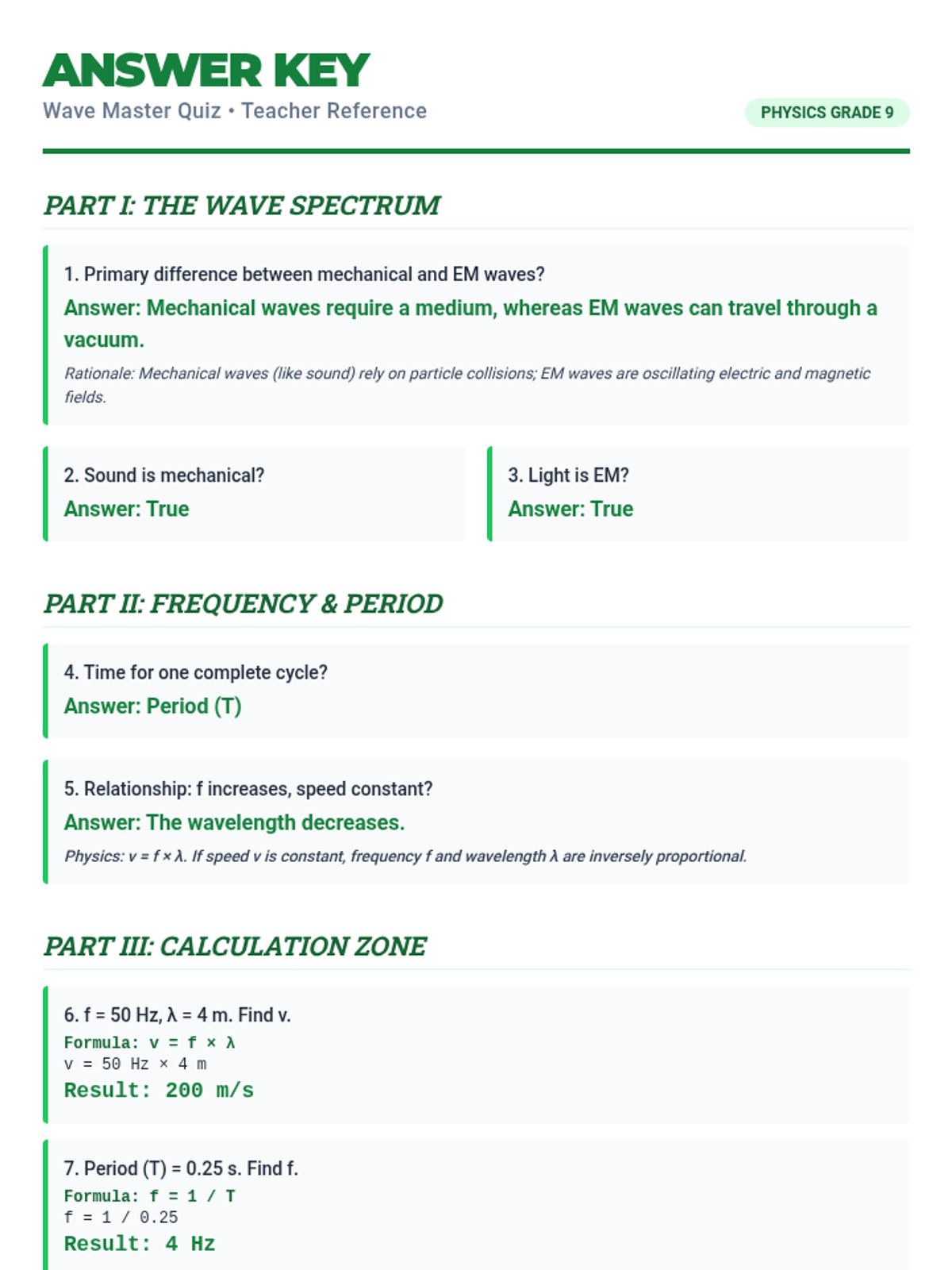
An answer key for the Wave Master Quiz with detailed solutions, formulas, and rationales for all questions including the bonus challenge.
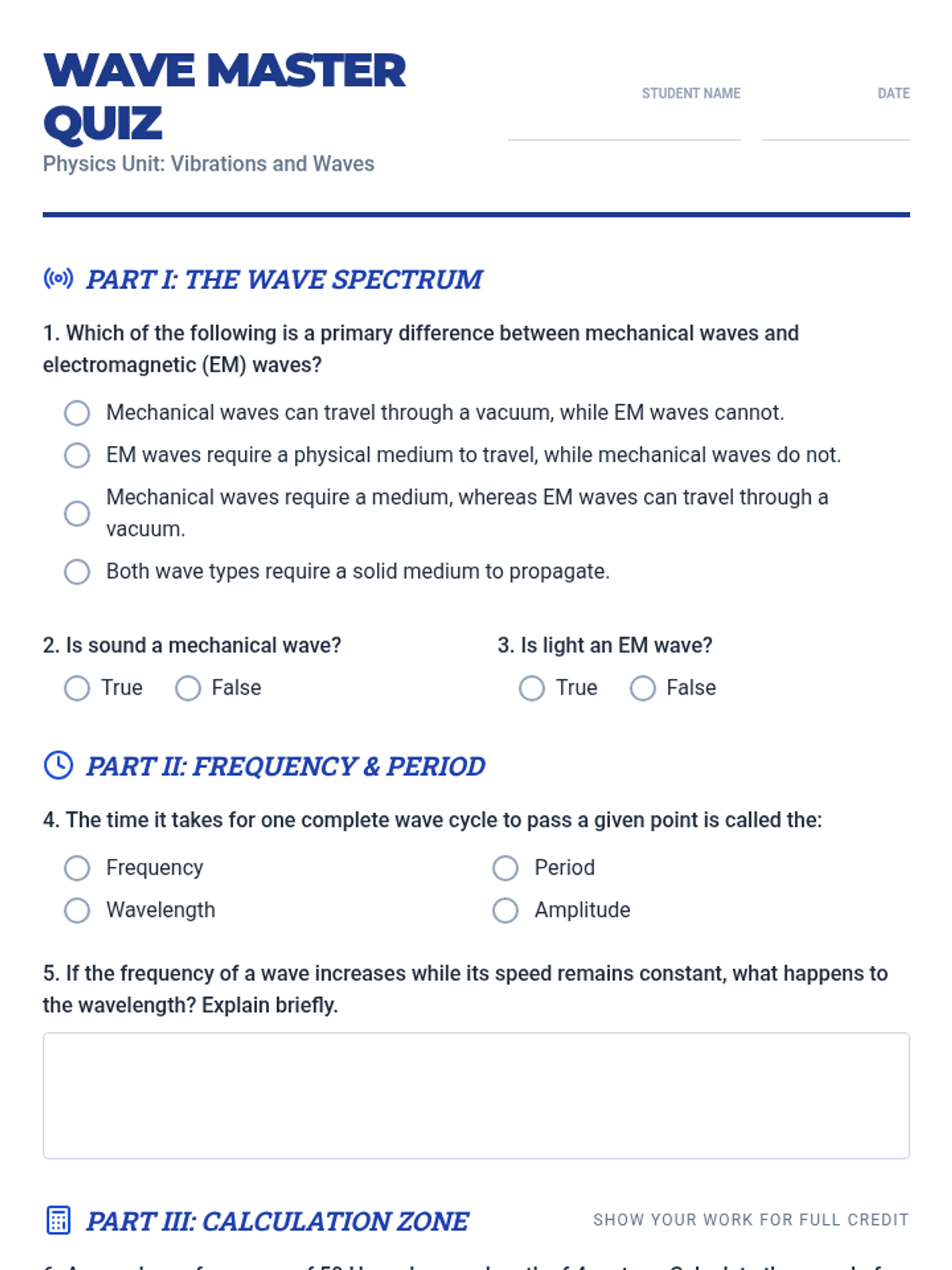
A grade 9 physics quiz focusing on wave types (Mechanical vs. EM) and wave mathematics (Frequency, Period, Speed). It includes multiple-choice, true/false, and calculation-based questions.
A visual presentation covering the fundamentals of wave motion, distinguishing between transverse and longitudinal waves, and explaining the wave equation and period-frequency relationship.
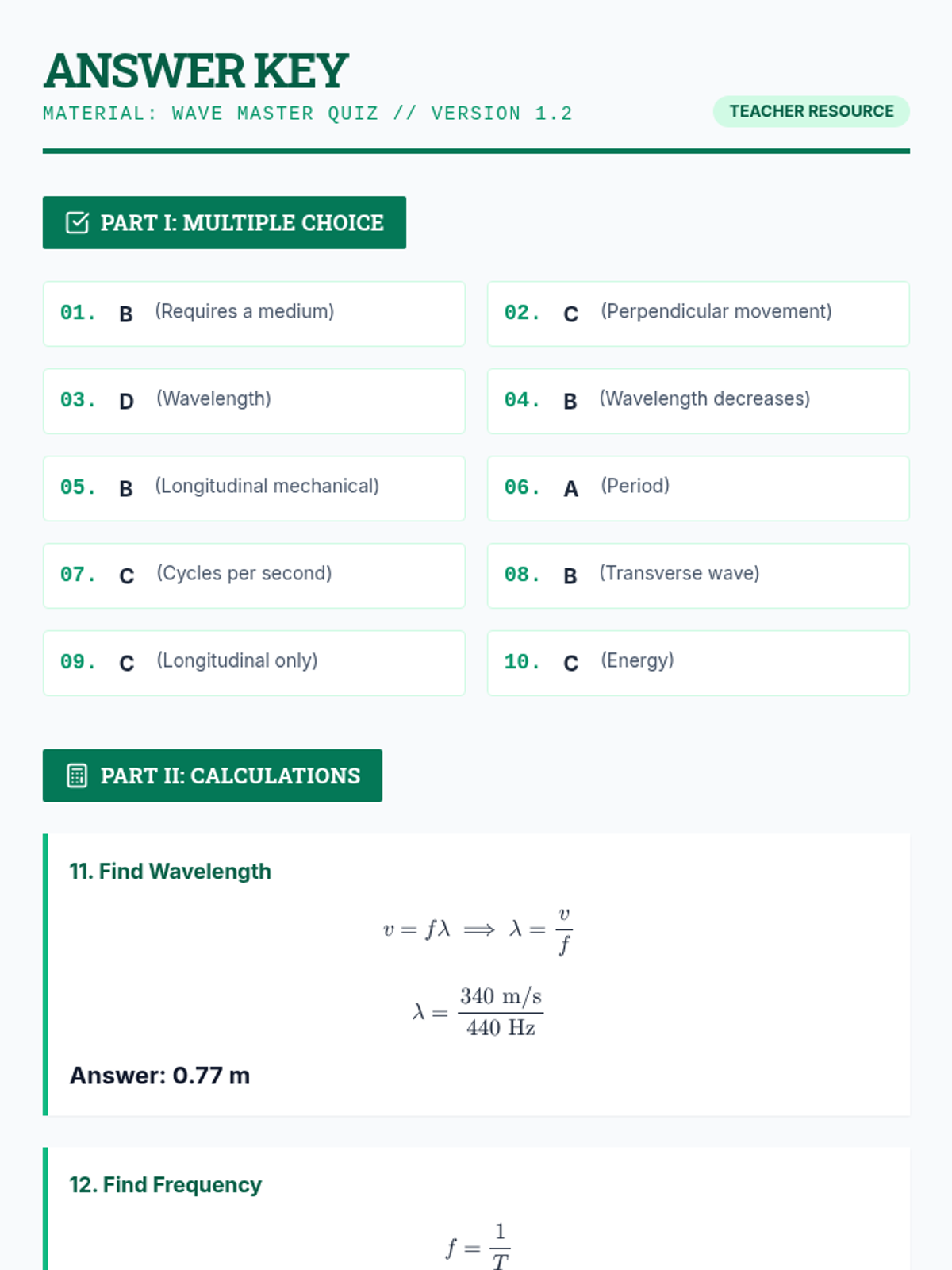
The answer key for the Wave Master Quiz, providing correct options for multiple-choice questions and step-by-step solutions for calculation problems.
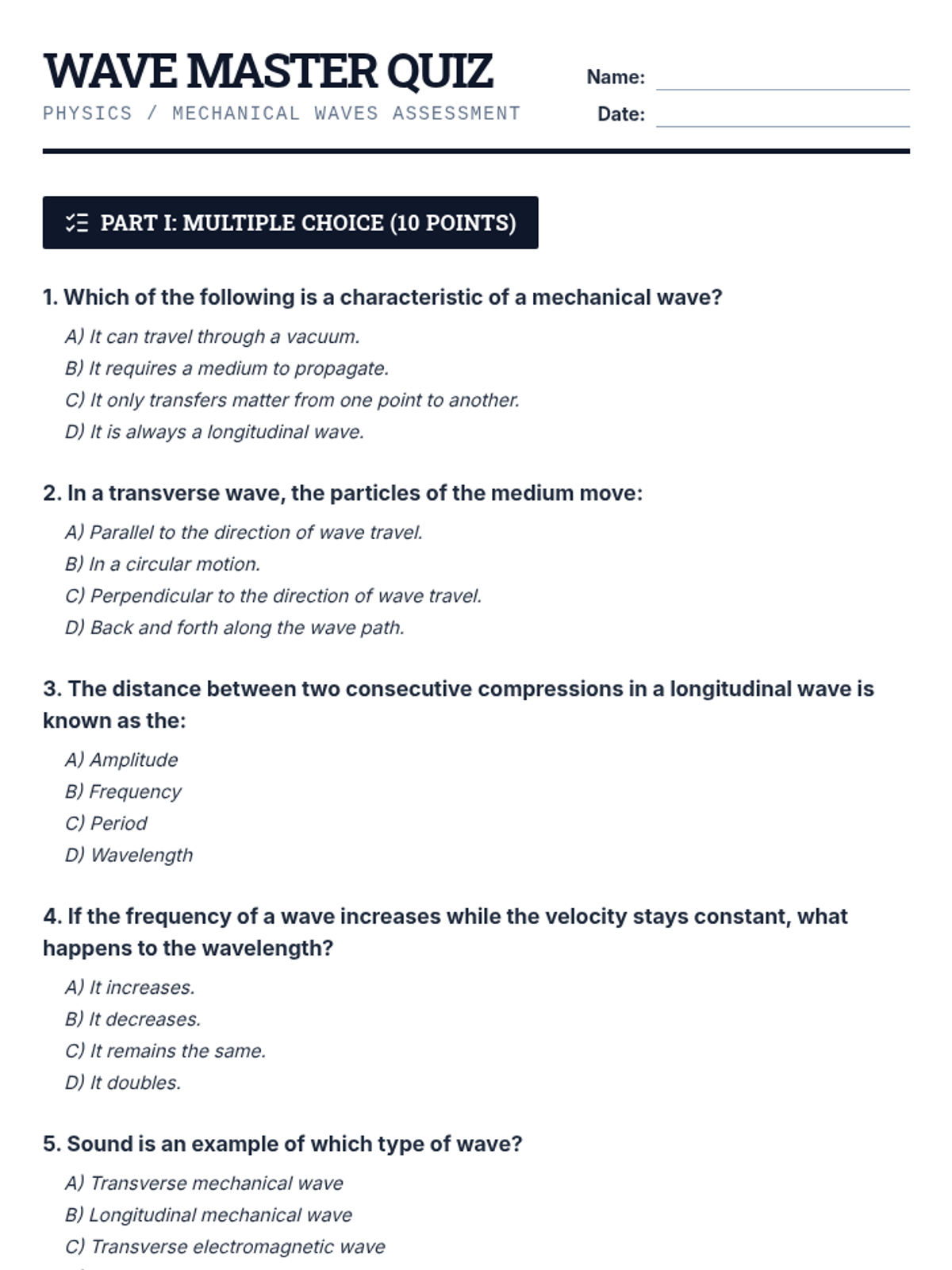
A comprehensive 15-question quiz on wave mechanics, including 10 multiple-choice questions on wave types and properties, and 5 calculation problems focusing on velocity, frequency, and period.
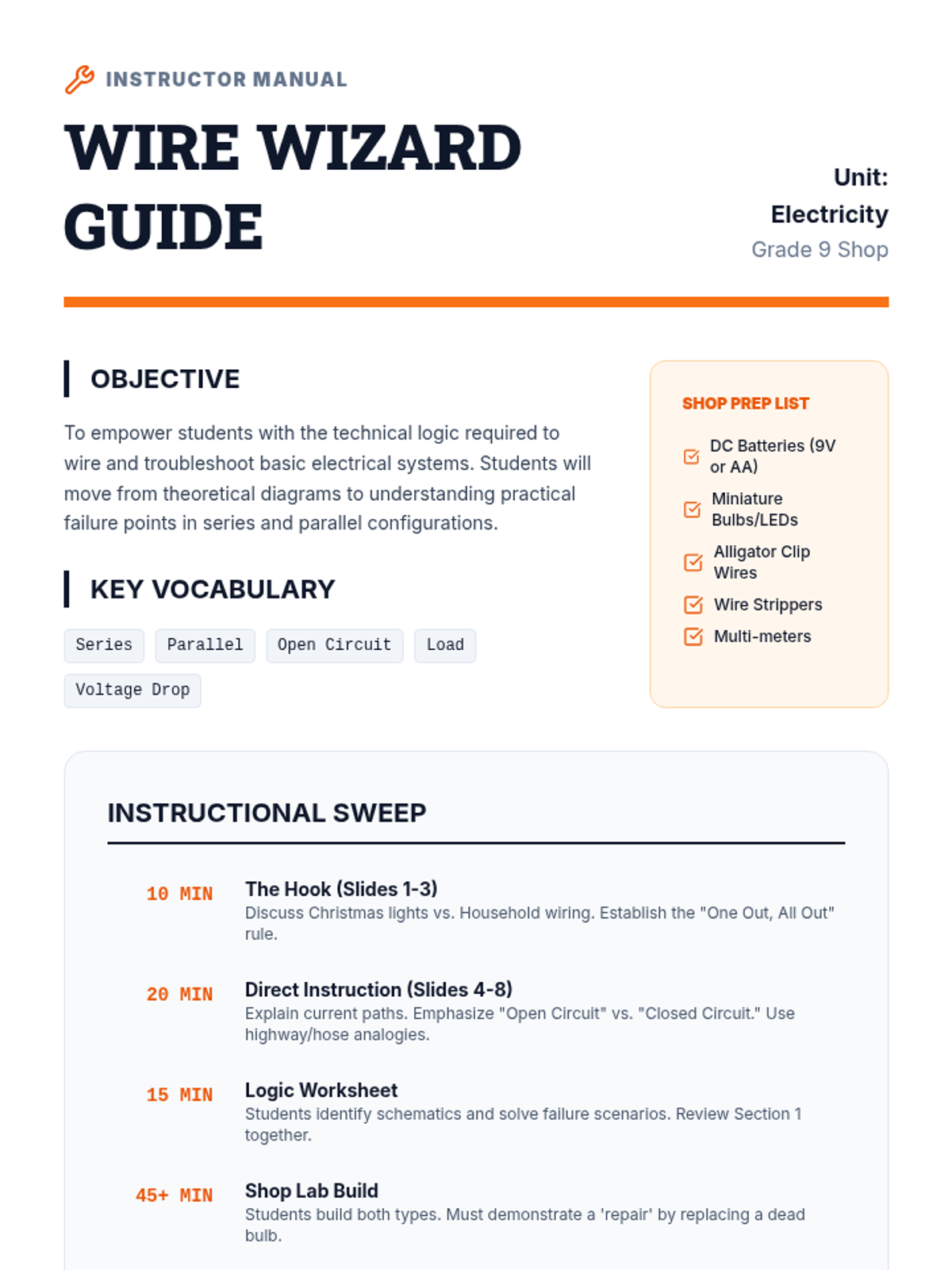
A comprehensive teacher's guide for the Power Paths lesson, including a pacing guide, shop equipment list, discussion prompts, and troubleshooting tips for teaching electrical circuits.
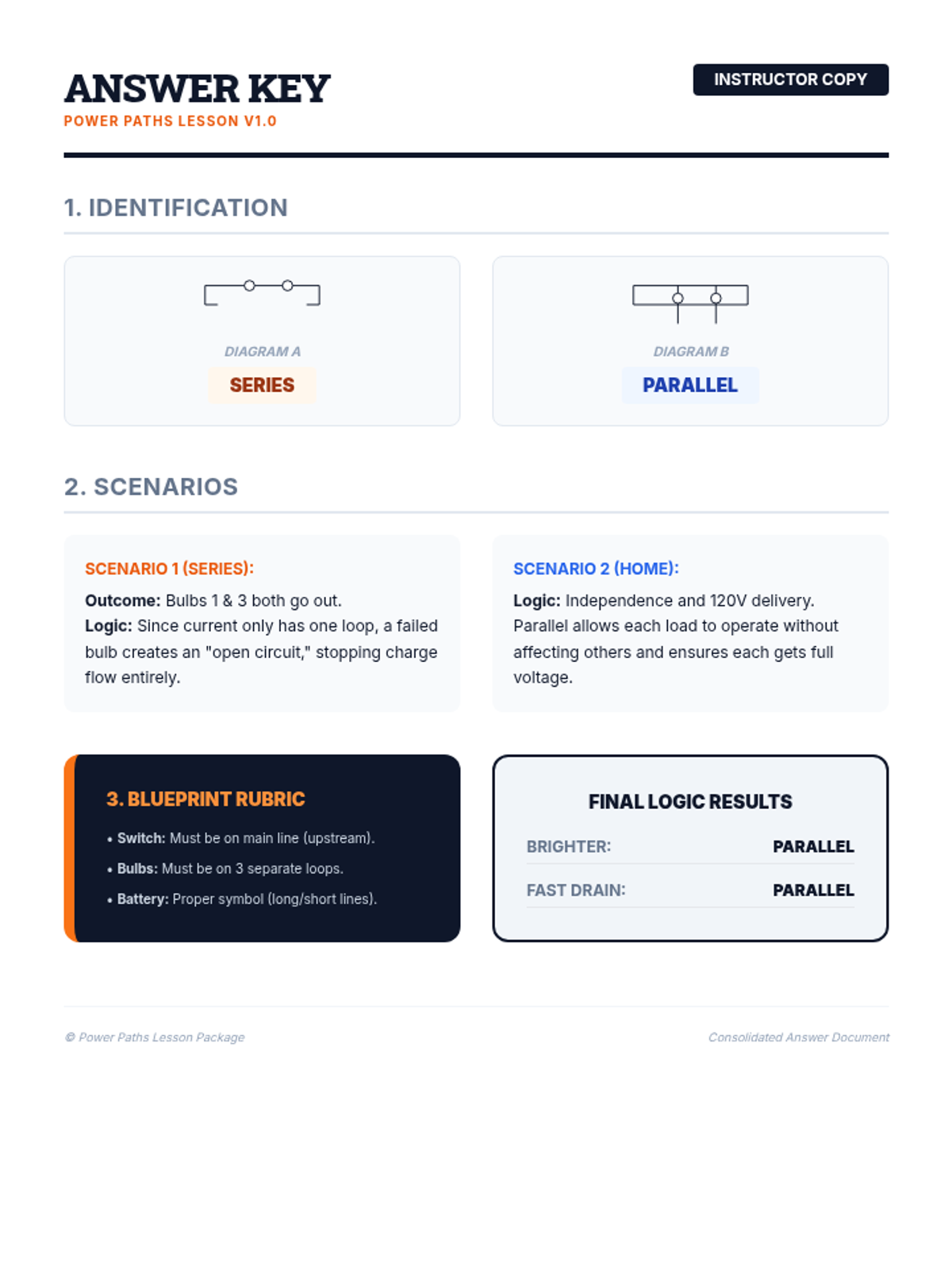
Answer key and grading guide for the Circuit Logic Worksheet, including expected diagram features and conceptual explanations.
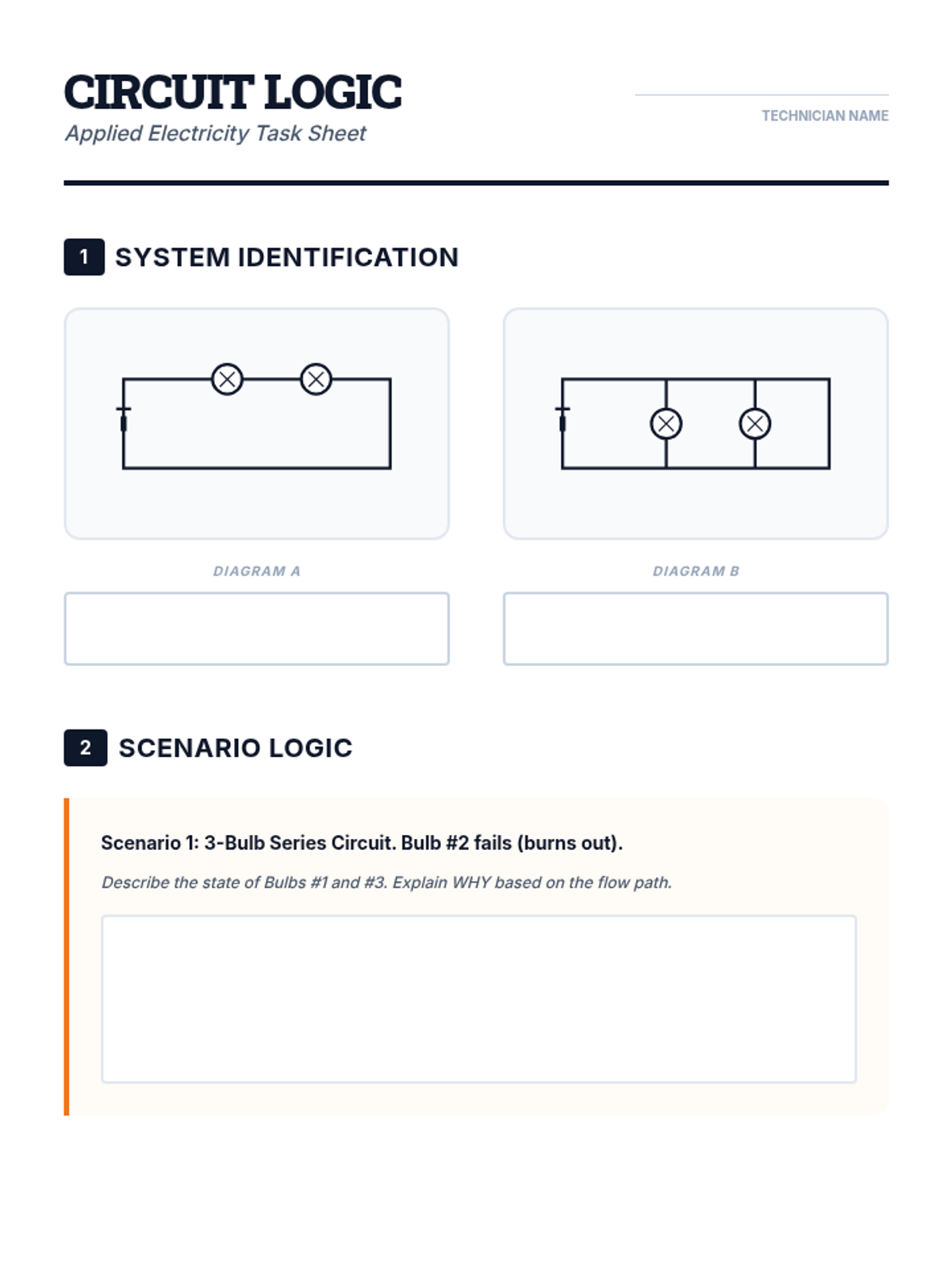
A practical worksheet for grade 9 shop students to identify circuit types, troubleshoot failure scenarios, and practice drawing basic electrical schematics.
A visually engaging slide deck for shop students explaining the differences between series and parallel circuits, including a deep dive into failure points and real-world logic.
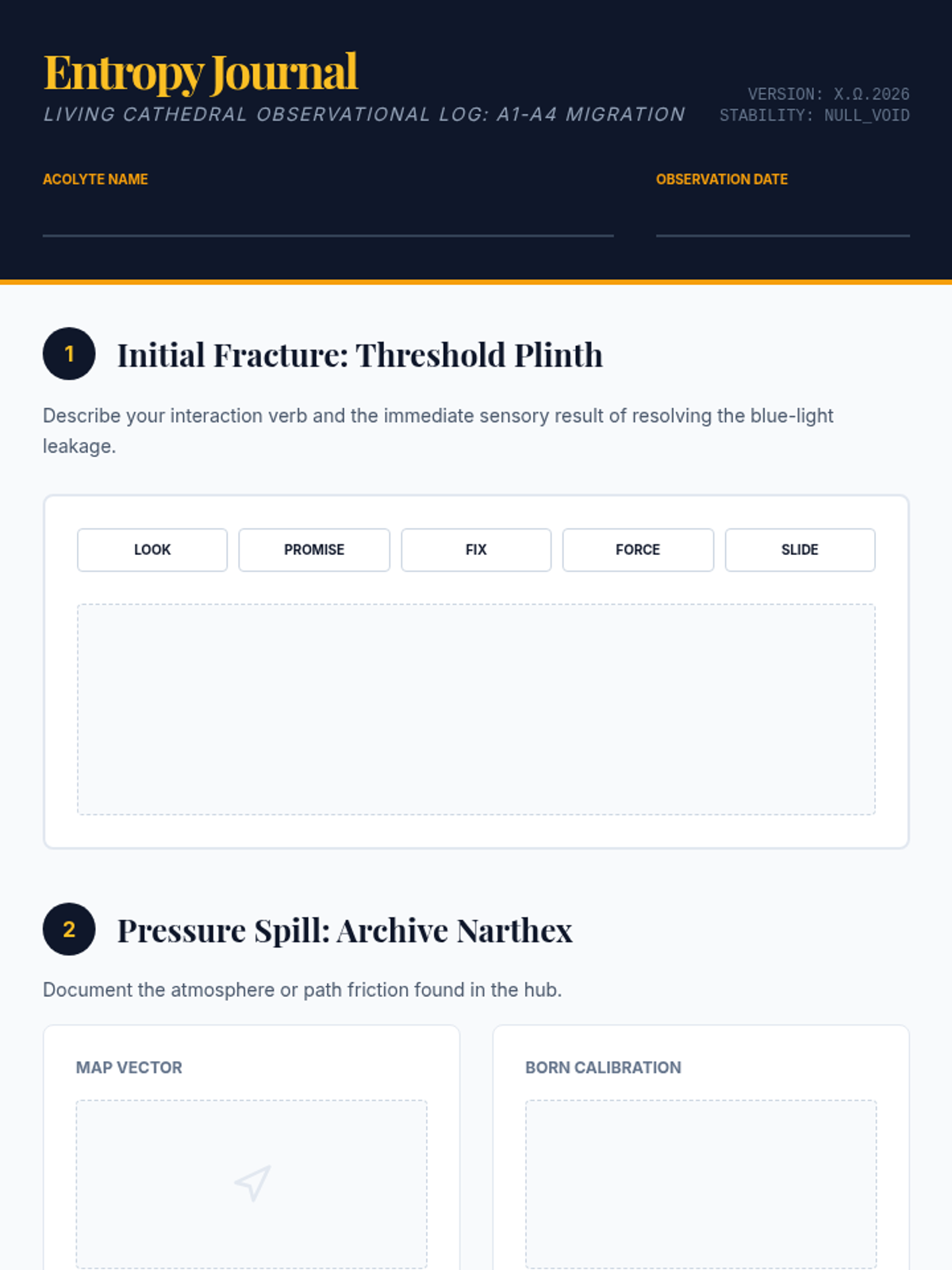
A student-facing journal for documenting player choices and consequences during the Pressure Propagation Loop. It includes sections for tracking verb usage, sketching UI map distortions, and reflecting on the systemic anticipation of the Cathedral architecture.
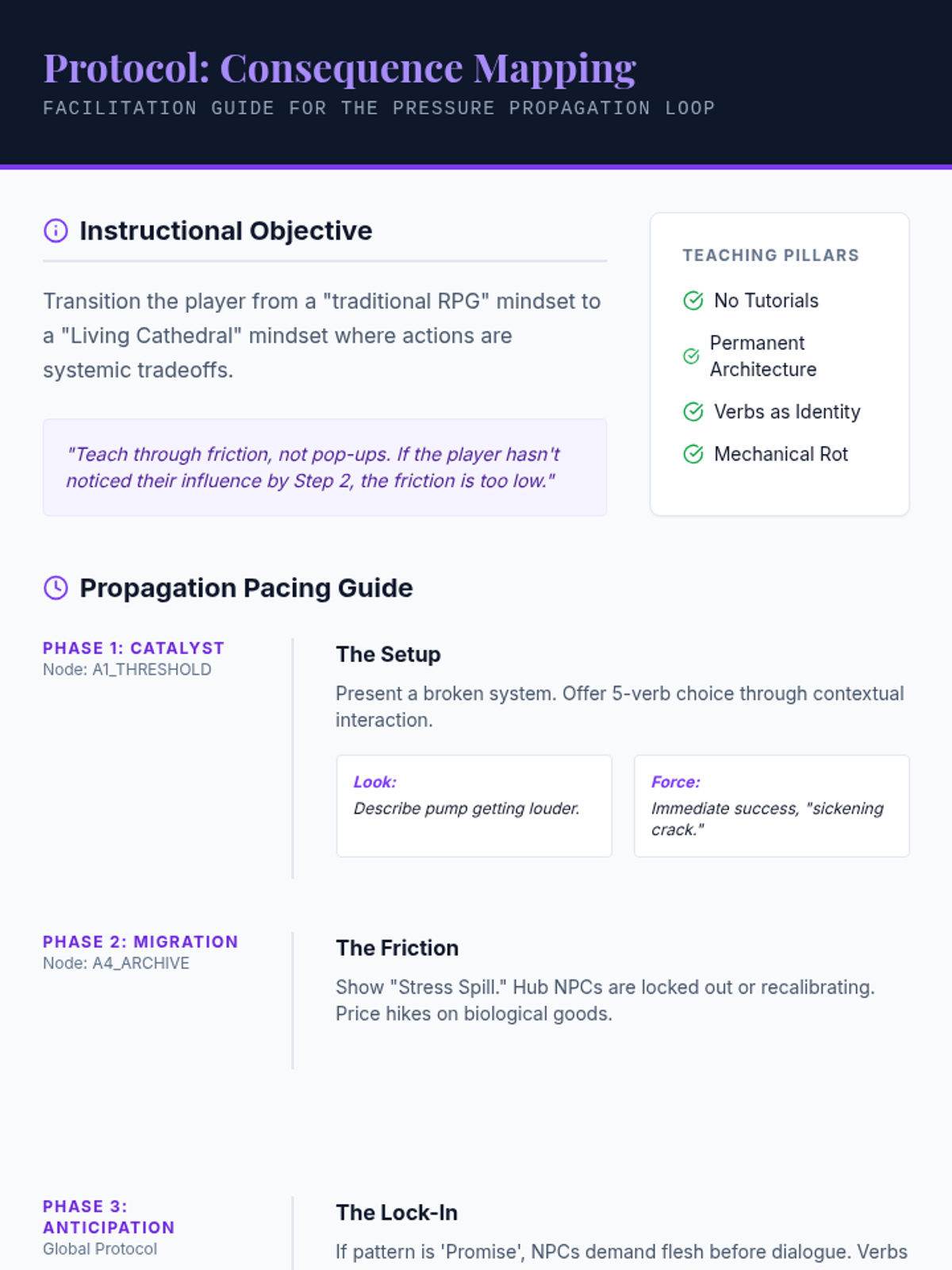
A facilitation guide for educators or lead designers to implement the Pressure Propagation Loop. It provides pacing instructions for the three phases of consequence, instructional objectives for teaching 'invisible friction,' and an observational rubric for tracking player behavioral shifts.
A slide presentation for the Pressure Propagation Loop. It covers the core axiom of 'No Clean Wins,' defines the five verbs used for tracking consequence, and visualizes the three-step sequence from Catalyst to Systemic Anticipation within the Temple UI aesthetic.
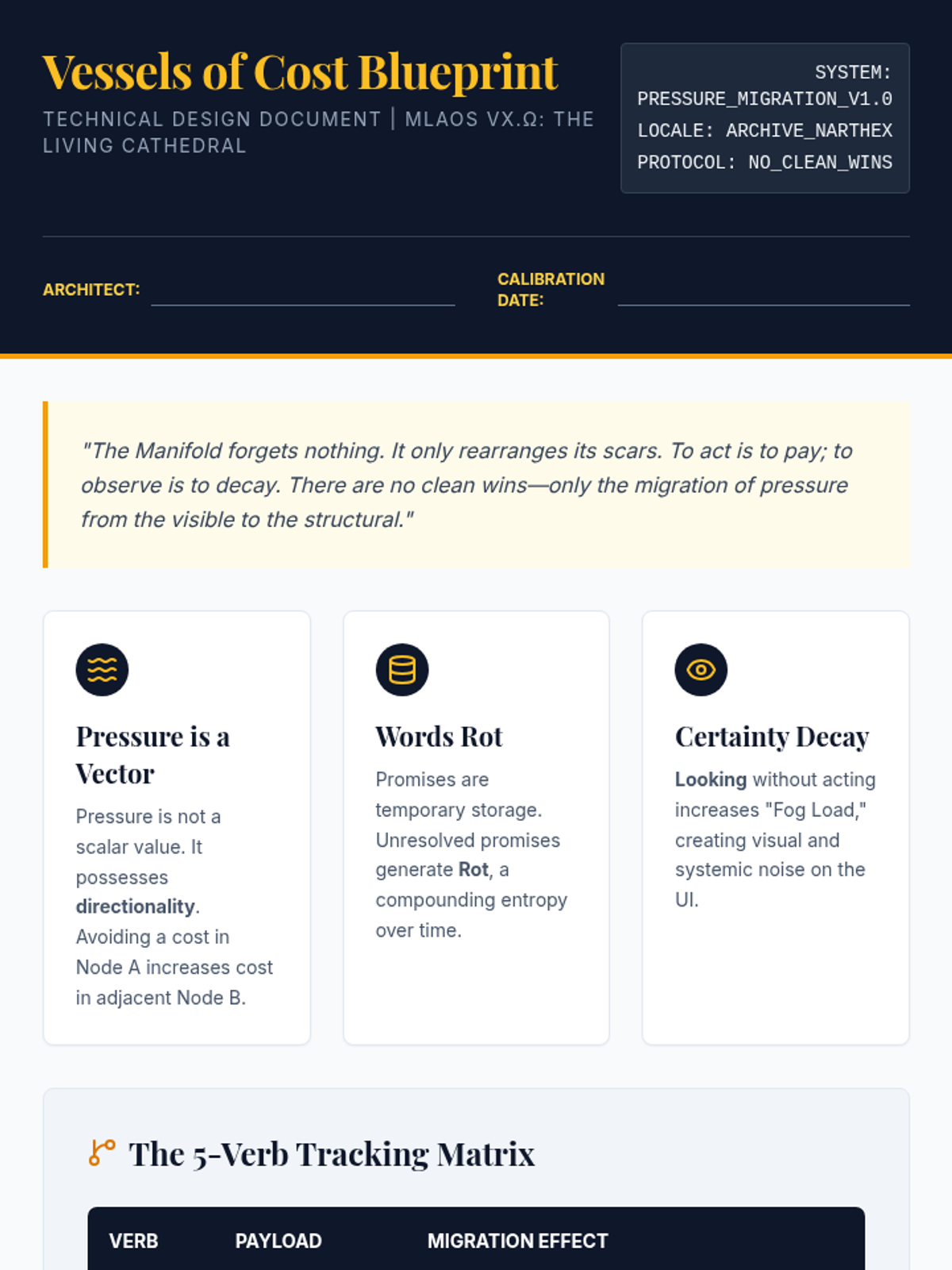
A technical design document outlining the 'Pressure Migration' logic for the MLAOS vX.Ω prototype. It includes tracking matrices for the five core verbs, TypeScript interfaces for state management, and an integration worksheet for developers to define systemic consequences.
A visually striking slide deck for presenting AI engineering vocational skills. Revised to fix title spacing, command wrapping, and to better align with the "cards" concept.
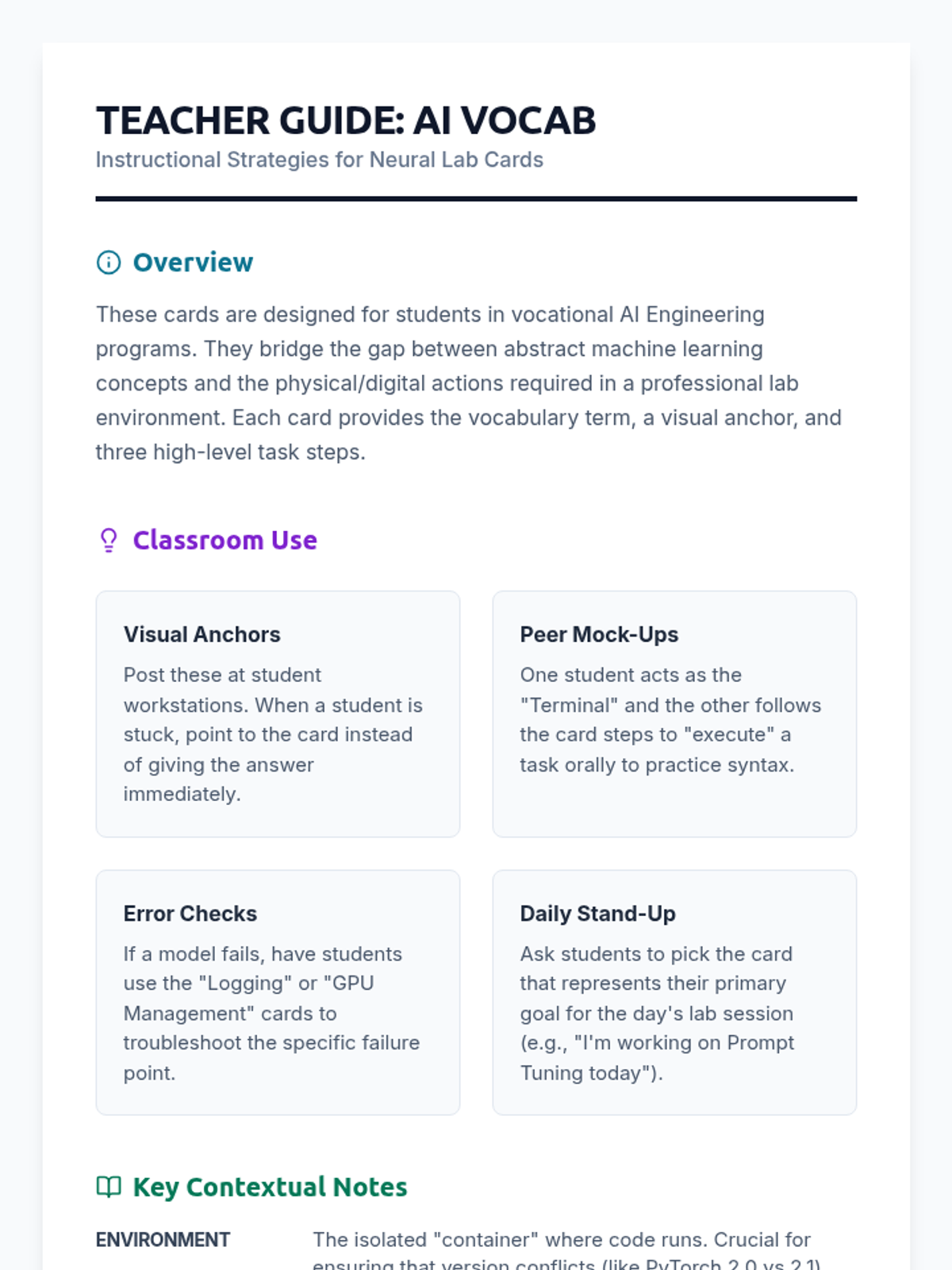
A teacher resource providing instructional strategies, activity ideas, and technical context for AI engineering vocab cards. Revised to fix page break issues and improve content density.
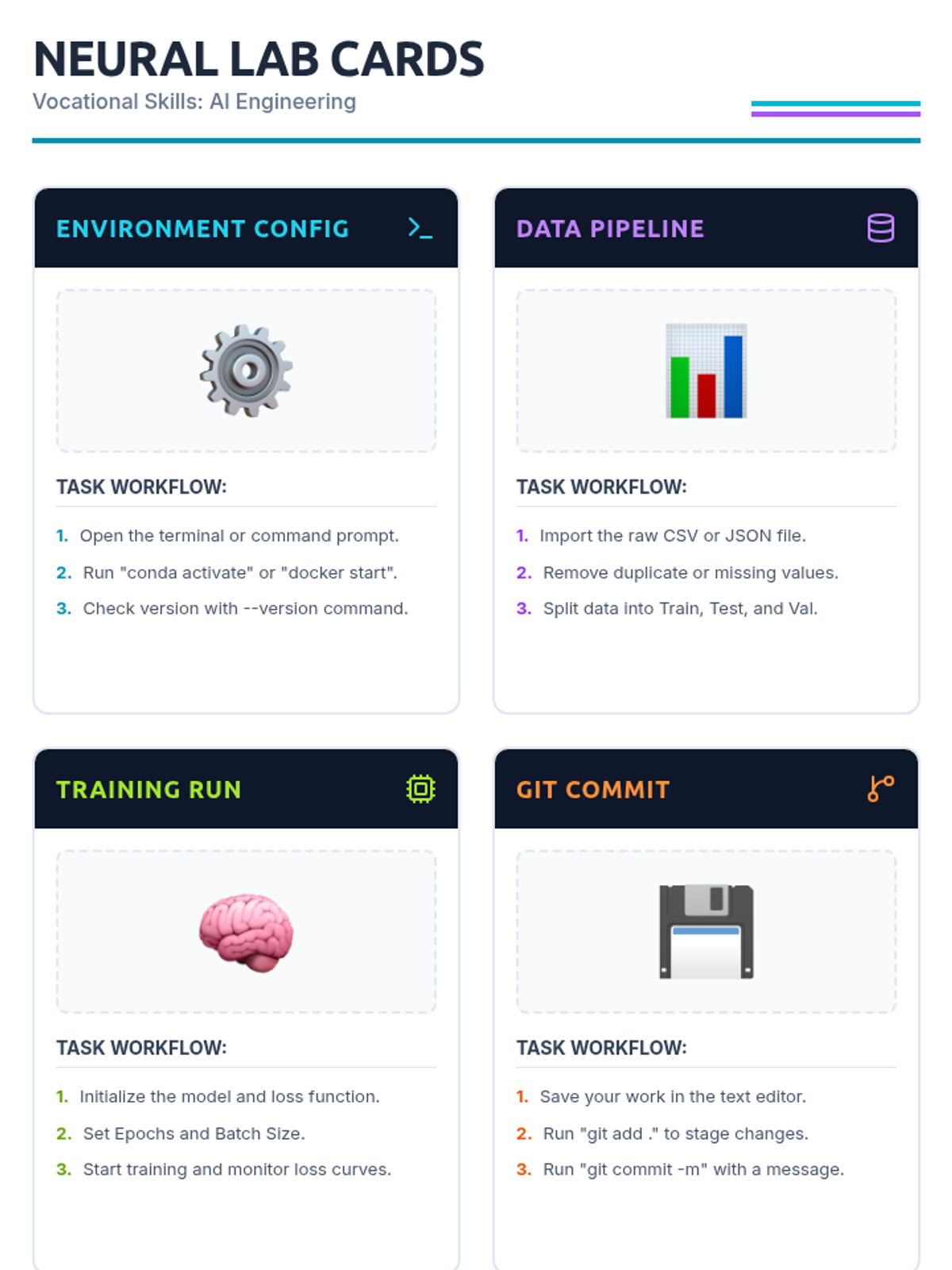
A set of 8 visual vocabulary cards for AI Engineering students, featuring technical terms, emoji-based visual aids, and clear step-by-step task instructions. Revised for consistent emoji style and better page-break handling.