A printable template for a "Munch Monster" hand puppet. Students can color, cut, and paste this onto a paper bag to create a puppet that "eats" the letters removed during the contraction surgery activity.
An answer key and evaluation guide for the 'Story Blueprint' worksheet, providing example sentences and teaching tips for Grade 2 ESL narration.
A short assessment for students to demonstrate their understanding of narrative signal words and basic sentence construction at the end of the 'Story Lab' lesson.
A set of visual vocabulary cards featuring sequential signal words and action verbs to support Grade 2 ESL students in building narrative sentences.
A student worksheet for drafting a narrative sequence about 'Making a Sandwich'. Includes a word bank of action verbs and dedicated spaces for students to draw and write using sequential signal words.
A high-impact slide deck for teaching narration to Grade 2 ESL students, focusing on sequential signal words and academic story structure through visual prompts and collaborative discussion.
A teacher facilitation guide for the 'Story Lab' narration lesson, featuring WIDA-aligned instructional steps, language objectives, and differentiation strategies for Grade 2 ESL students.
A unified answer key for all worksheets and the final assessment in the Lexicon Labs unit.
Revised final assessment: Fixed page break issues splitting sections, changed the dark background of the mastery challenge to a printable light gray/white, and increased the writing space for student responses.
Revised Lesson 2 exit ticket: Fixed the page break that cut off the footer, improved contrast for better legibility on the dark footer background, and added subtle handwriting guides.
Revised Lesson 2 worksheet: Fixed a page break splitting the final question of the first section and added guided handwriting lines to the replacement lab work area.
Revised Session 2 slides: Added explicit component labels to the entry anatomy slide and ensured uniform styling for answer choices on the lab trial slide to avoid telegraphing the correct answer.
Revised Lesson 2 plan: Consolidated the layout to fit on a single page, improved contrast in the header, and integrated the "Common Pitfalls" section into the main body.
Revised Lesson 1 worksheet: Fixed a page break splitting Challenge 2, corrected the briefing count, and optimized font sizes to provide more space for student work.
Revised Session 1 slides: Corrected the alphabetical range logic on Slide 4, added a preview slide for multiple definitions, and improved visual hierarchy on the guide words explanation.
Revised Lesson 1 plan: Added a preview of multiple definitions, improved layout to fit on one page, and refined typography for better readability.
A comprehensive 5-page answer key packet for teachers, providing correct responses for all daily case worksheets and the final unit exit ticket in the 'Word Detectives' series.
A consolidated 7-page student packet for the 'Word Detectives' unit. Includes a themed cover page, four daily case worksheets (Definition, Example, Synonym, Antonym), a visual mini-glossary reference, and a final exit ticket. Fixes page breaks and layout overlaps. Fixes cover layout and guide word lines. Standardized icons.
Final assessment exit ticket for the 'Word Detectives' unit, evaluating students' ability to combine context clue strategies with reference tool verification. Includes built-in reference panel and reflection. Fixes page breaks and layout. Improves handwriting areas and alignment.
Updated student worksheet for Day 4, requiring students to identify antonyms and then select the most appropriate dictionary definition from multiple options. Fixes layout and fits everything on one page. Standardized visual supports and fixed tracking.
Updated slides for Day 4 of 'Word Detectives', teaching students how to select the best definition from a dictionary when words have multiple meanings. Fixes spacing and contrast. Fixes Slide 4 footer cutoff and text contrast.
Updated solved case slide for Day 4 with improved text contrast and corrected layout to prevent cutoff.
Updated student worksheet for Day 3, focusing on verifying synonym (word twin) relationships using a dictionary. Fits everything on one page and improves handwriting areas. Fixes instruction mismatch by removing underlines from target words.
Updated slides for Day 3 of 'Word Detectives', showing how to use dictionary synonym sections to verify word meanings found in context. Fixes typos, punctuation, and container spacing. Fixes letter spacing in dictionary box and footer contrast.
Updated student worksheet for Day 2, adding dictionary guide word identification and entry verification to the example context clue investigation. Fixes spacing and height issues. Fits everything on one page.
Updated slides for Day 2 of 'Word Detectives', incorporating dictionary guide word skills into the example context clue strategy. Fixes Slide 5 dead space and Slide 4 metadata legibility. Fixes lime emoji and dictionary icon.
Updated practice slide for Day 2 with corrected lime emoji and improved visual support for dictionary guide words.
Dictionary Protocol slide for Day 2, reinforcing the steps for finding words in a dictionary.
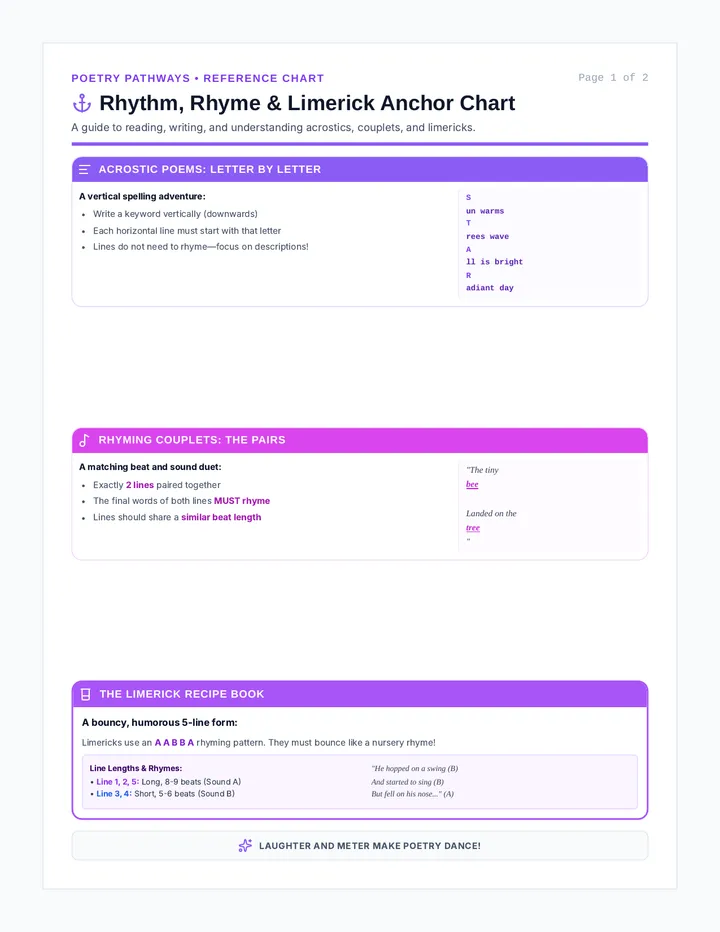
A student reference glossary for the 'Word Detectives' unit, now featuring illustrations and example sentences for every word to support vocabulary acquisition. Fixes layout and markdown artifacts. Standardized icons.
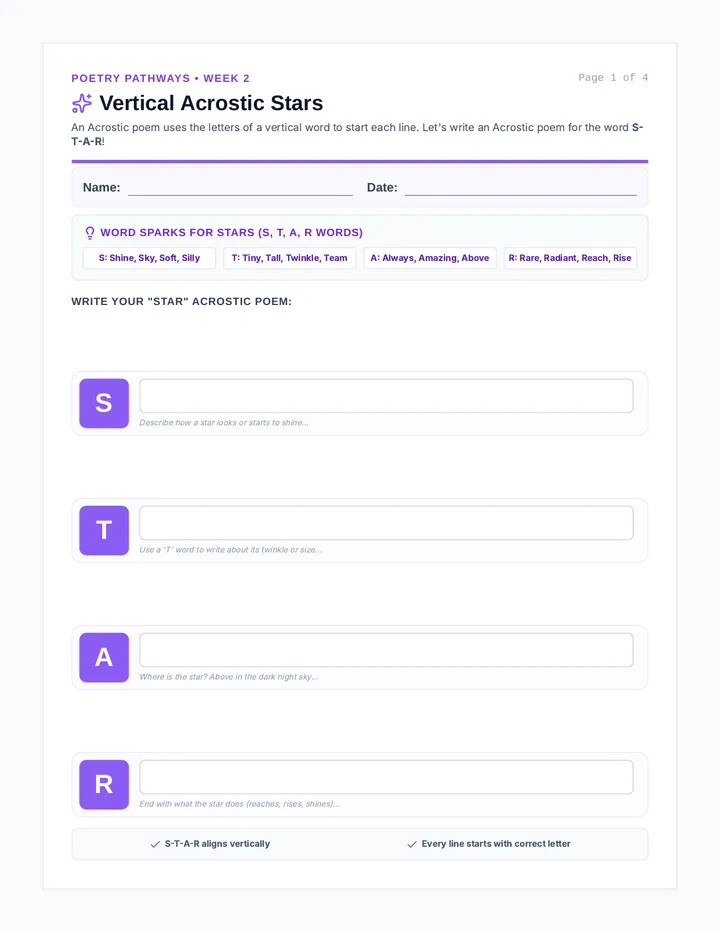
A one-page worksheet for writing a biographical paragraph about architect Frank Lloyd Wright. It features large sentence starters for key life facts and a final writing space with 8 extra-large lines (48px height) for students who need more space.
A one-page worksheet designed to help students write a biographical paragraph about Claude Monet using structured sentence starters based on a provided mind map. It includes large guided completion areas and a final writing space with 8 extra-large lines (48px height) for students who need more space.
Final assessment exit ticket for the 'Word Detectives' unit, evaluating students' ability to combine context clue strategies with reference tool verification. Includes built-in reference panel and reflection. Fixes page breaks and layout.
Updated student worksheet for Day 4, requiring students to identify antonyms and then select the most appropriate dictionary definition from multiple options. Fixes layout and fits everything on one page. Fixes Question 3 consistency.
Updated slides for Day 4 of 'Word Detectives', teaching students how to select the best definition from a dictionary when words have multiple meanings. Fixes spacing and contrast.
Updated student worksheet for Day 3, focusing on verifying synonym (word twin) relationships using a dictionary. Fits everything on one page and improves handwriting areas. Fixes instruction logic.
Updated slides for Day 3 of 'Word Detectives', showing how to use dictionary synonym sections to verify word meanings found in context. Fixes typos, punctuation, and container spacing.
Updated student worksheet for Day 2, adding dictionary guide word identification and entry verification to the example context clue investigation. Fixes spacing and height issues.
Updated slides for Day 2 of 'Word Detectives', incorporating dictionary guide word skills into the example context clue strategy. Fixes Slide 5 dead space and Slide 4 metadata legibility.
Updated student worksheet for Day 1, integrating glossary lookup tasks to verify definitions found through context clues. Fits everything on one page and fixes typos. Fixes background issues and adds per-word tool checks.
Updated slides for Day 1 of 'Word Detectives', adding glossary search skills to the definition context clue strategy. Fixes text contrast and adds aquarium illustration. Fixes inconsistent terminology.
Updated teacher facilitation guide for the 'Word Detectives' unit, now incorporating dictionary and glossary usage alongside context clues for a comprehensive vocabulary strategy. Fixes markdown artifacts and pacing plan layout. Fixes spacing and orphans.
A simplified instructional slide deck for teaching narrative sequencing. It uses a clear "Beginning, Middle, End" structure and guides students through solving basic mysteries with explicit logic.
A simplified teacher answer key and guide for the Mystery Mixup Worksheet. It provides the correct numerical sequences and clear logical breakdowns for five elementary-level mystery stories.
A simplified reading comprehension worksheet featuring 5 simple mystery stories, each split into 5 parts. Students must use logic and clear transition clues to determine the correct chronological order. Layout optimized for print efficiency and younger readers.
An answer key and teacher reference sheet for the Story Mechanics lesson, providing sample paraphrases and the correct sequence for story activities.
A cut-and-paste activity where students sequence a short story to practice retelling and then paraphrase one sentence to demonstrate deep comprehension.
Six individual task cards designed for small group practice, each featuring a short fiction sentence for students to paraphrase in their own words.
A blueprint-themed graphic organizer for students to map out the beginning, middle, and end of a story during retelling activities.
A facilitator's guide for the Story Mechanics lesson, including pacing, discussion prompts, and differentiation strategies for small group instruction.
Introductory slides for the Story Mechanics lesson, explaining the difference between retelling and paraphrasing with visual blueprints and workshop-themed examples.
A comprehensive teacher answer key for the Code Breaker Literacy Practice Packet. Includes answers for phonics matching, parts of speech identification, and reading comprehension questions.