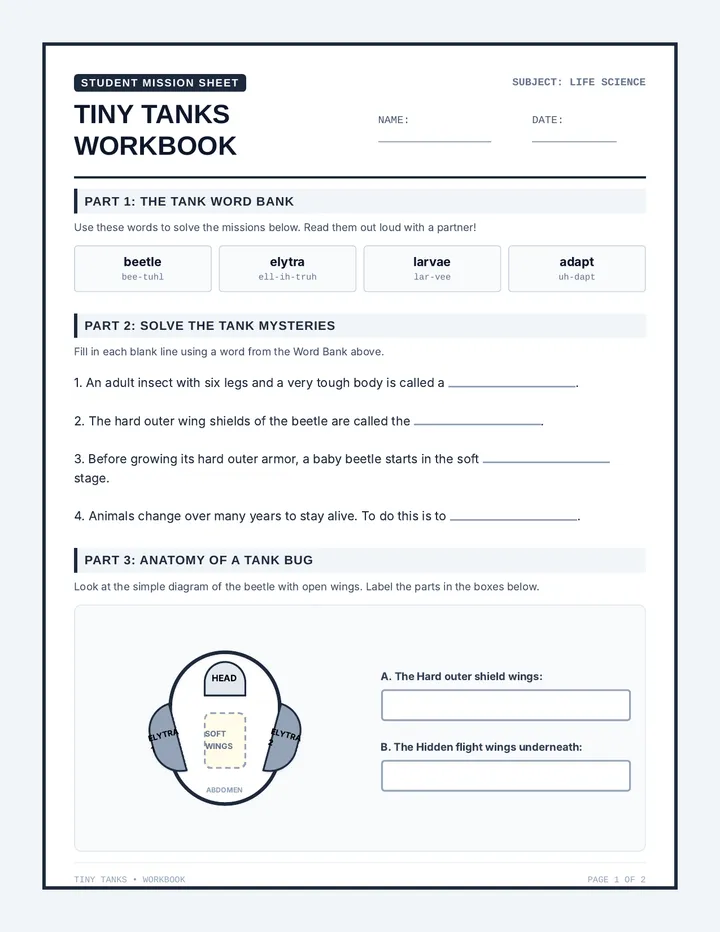
A core student activity sheet for labeling human and canine life cycle stages, identifying mammal characteristics, and comparing the two species. Includes drawing/writing areas for development observations.
A teacher's facilitation guide for the Lunar Lookout lesson, providing discussion prompts, key facts, and an answer key for the student worksheet.
A student worksheet designed to reinforce moon phase identification through matching, short-answer questions, and a drawing exercise based on current observations.
An introductory 7-slide presentation covering the four primary moon phases (New, First Quarter, Full, and Third Quarter) with clear visual diagrams and key characteristics of each.
A student-facing Field Observation Journal for recording scientific inquiries. Includes sections for sketching local Indiana pollinators with detailed labeling, analyzing the symbiotic relationship between plants and animals, and reflecting on conservation efforts.
A student-facing activity sheet for the pollination simulation. It guides students through a hands-on modeling exercise using cheese puffs to visualize pollen transfer, with designated spaces for drawing observations and reflecting on scientific results.
An engaging slide deck for the Pollinator Partners lesson, featuring high-contrast visuals, interactive mystery prompts, and clear explanations of the pollination process in the Indiana ecosystem.
A comprehensive teacher facilitation guide for the Pollinator Partners lesson, including lesson objectives, material checklists, a detailed instructional sequence, and differentiation strategies.
A comprehensive facilitation guide for teachers leading the Hudson River Rangers lesson, featuring learning objectives, a detailed timeline, safety tips, and an answer key for student materials. REVISED: Fixed page breaks, improved rendering robustness, and layout consistency.
A mapping worksheet where students trace the Hudson River's course from the Adirondacks to NYC, labeling key landmarks and reflecting on the meaning of an estuary and human impacts. REVISED: Increased handwriting space and improved watermark visibility.
A hands-on activity guide for a water filtration lab, including background information, a clear materials list, step-by-step instructions, and observation areas for students to record results. REVISED: Fixed untreated water sketch background to white.
Instructional slide deck for the Hudson River Rangers lesson, introducing the river's geography with a detailed SVG map, pollution challenges, and nature-inspired filtration science. REVISED: Fixed SVG overflow issues and improved text contrast.
Teacher's answer key for the Great Heat Thief Resource. Includes correct answers, sample short-answer responses, and pedagogical tips for addressing common student misconceptions about thermal energy.
A comprehensive resource featuring a reading passage about heat transfer and a set of comprehension questions for 4th-5th graders. Covers the scientific process of how ice cools water by absorbing thermal energy.
A comprehensive teacher's guide for the Coded by Clouds lesson, including objectives, materials, a step-by-step instructional sequence, and differentiation strategies. Revised to fix page breaks and formatting.
An answer key and scoring guide for the Cloud Detective Worksheet, providing expected answers and criteria for evaluation. Revised to prevent layout splits and improve contrast.
A 1-page activity worksheet where students identify cloud types from descriptions and create their own sky observation sketch with a matching weather forecast. Revised to fit one page and improve contrast.
A 7-slide presentation covering cloud types (Cirrus, Cumulus, Stratus, Cumulonimbus) and their specific weather messages for forecasting in New England. Revised with improved visuals and text contrast.
A 1-page warm-up worksheet for students to make initial weather predictions based on sky observations, activating prior knowledge about cloud types and weather patterns. Revised to fit one page and include handwriting guides.
A comprehensive teacher facilitation guide for Operation Earth. Includes a mission timeline for document deployment, specific support strategies for bilingual/ELL students, inquiry prompts, and presentation ideas. Simplified language is used for easy educator reference.
A simplified tactical worksheet to help students narrow their research focus. Uses simple language like 'Where?', 'Who?', and 'Why?' to guide bilingual students through picking a specific research target. Light backgrounds are used in all work areas for handwriting legibility.
A mission-themed brainstorming worksheet for Operation Earth with simplified language for bilingual students. Scaffolds inquiry from basic facts to 'hard' questions using a question ladder and a central mind map.
A teacher's resource containing answer keys for the sorting activity and assessment, along with instructional tips and common misconceptions.