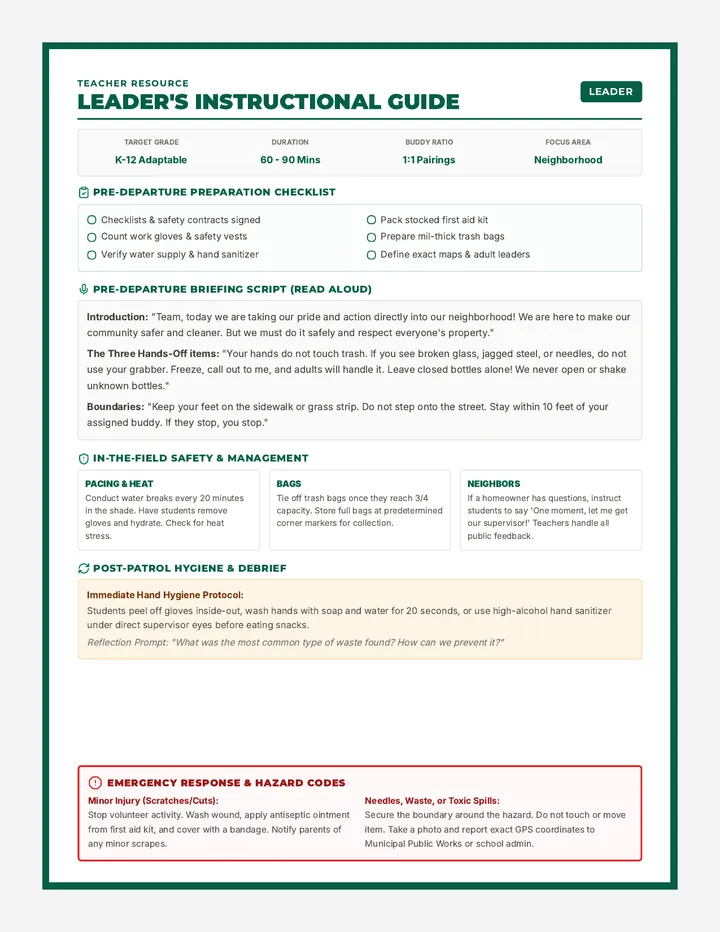
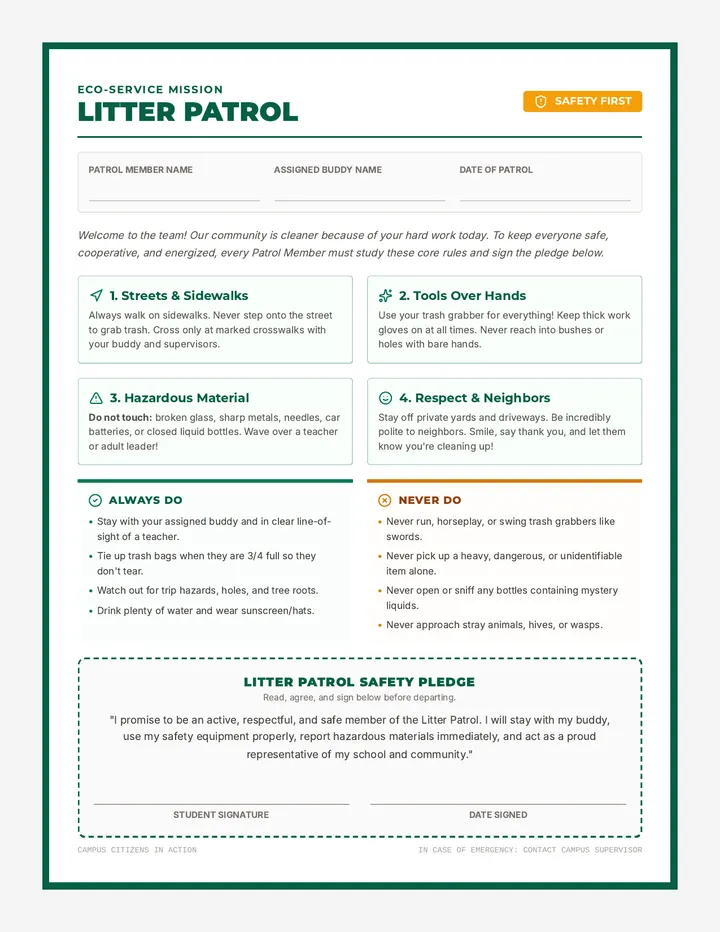
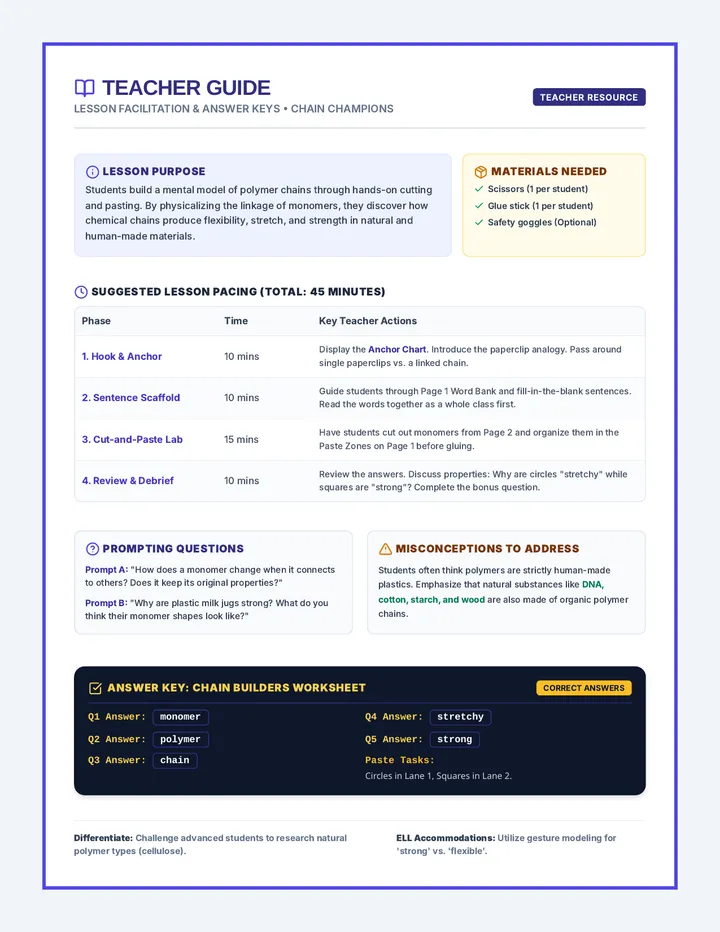
A vibrant and interactive slide deck for the Magnetic Magic lesson. Includes a virtual lab video embed, prediction challenges, and visual step-by-step instructions for the magnetic painting activity.

A comprehensive teacher guide for the 'Seed to Sprout' lesson, including learning objectives, vocabulary, step-by-step instructional procedures, and differentiation tips for Kindergarten students.
A fun and simple sequencing worksheet for Kindergarteners to practice identifying the four main stages of the plant life cycle. Students color, cut, and paste images of a seed, sprout, seedling, and flower in the correct order.
A bright and engaging slide deck designed for Kindergarten students to learn about the plant life cycle and the four essential things plants need to survive. Features large text, friendly icons, and a clear visual progression of plant growth, including an embedded time-lapse video.
Teacher answer key for the Tree Tenant Worksheet, including expected animal names, habitat descriptions, and sample reflection responses.
A visual presentation introducing 8 tree-dwelling animals, their specific habitats (nests, hollows, branches), and why trees are essential for their survival.
A student worksheet for identifying 8 tree-dwelling animals and describing their specific habitats within the tree.
A detailed two-page field guide featuring "notebook-style" observations of 12 subterranean animals, focusing on their scientific observations and underground nesting habits.
A coloring sheet featuring the 12 subterranean animals in a grid format with large labels for coloring and literacy practice.
Updated page of 12 animal cards for cutting out, now including larger den-dwelling and nesting animals like foxes, badgers, and rabbits.
Updated landscape worksheet with 12 spots for animals that live in tunnels, dens, or nests beneath the soil.
A kindergarten-level adaptation of the periodical cicada homework article. It simplifies the language while retaining essential vocabulary (cicada, periodical, reproduce, predators, species, offspring) and mirrors the original document's visual design, including the header, callout box, and student notes sidebar.
A 2-page homework article about periodical cicadas, adapted for a kindergarten reading level. This version removes the dashed borders and page numbers while maintaining the original layout and 6th-grade vocabulary, designed to be printed front and back on standard paper.
A comprehensive teacher guide for facilitating an outdoor nature walk, including discussion prompts, vocabulary, and preparation tips.
A student observation worksheet designed for an outdoor nature walk to record sightings of plant and animal babies.
A visual presentation introducing the concept of life cycles in humans, animals, and plants, preparing students for an outdoor discovery mission.
A set of 12 printable task cards featuring sensory scenarios and questions to encourage discussion and critical thinking about the five senses.
A comprehensive teacher rubric for evaluating student performance on the Sensory Superpowers informational text and quiz, featuring clear criteria and scoring levels.
A comprehensive answer key for both the Sense Explorer Text questions and the Sense Superpowers Quiz, designed for teacher reference.
A visual presentation to introduce the five senses, their corresponding organs, and real-world examples of how they function.
A short assessment featuring matching and open-ended questions to evaluate students' understanding of the five sense organs and their functions.
An informational text for primary students explaining the five sense organs and their functions, accompanied by an expanded set of 8 reading comprehension questions.
A comprehensive teacher facilitation guide for the Plant Power lesson, featuring instructional scripts, movement activities, and classroom management tips for the plant games.
A set of 8 illustrated "Who Am I?" riddle cards designed for kindergarteners to identify plant parts and needs. Each card features a simple rhyme and a clear visual answer.
A vibrant, kindergarten-friendly board game where students move a 'seed' piece along a path. Landing on 'needs' (sun, water, soil) provides a bonus move, reinforcing what plants need to grow.
Teacher answer key for the Skeleton Sketch Worksheet, providing correct labels and matching connections.
A student worksheet for K-2 students featuring a skeletal labeling activity with a word bank and a matching section for the functions of the skull, ribs, and spine.
An updated teacher facilitation guide for the Bone Zone lesson, now streamlined to a 30-minute session by removing the movement activity and focusing on direct instruction and labeling.
A bright, high-contrast slide deck for K-2 students introducing the skeletal system, focusing on major bones like the skull, ribs, and spine, and their functions of protection, support, and movement.
A comprehensive teacher facilitation guide for the Nature Detectives lesson. Includes a timed lesson plan, discussion prompts, vocabulary focus, and differentiation strategies for kindergarten learners.
A hands-on sorting game for kindergarteners. Includes a 'Living vs. Non-Living' sorting mat and a sheet of 12 colorful evidence cards featuring animals, plants, and objects for students to cut and categorize.
An engaging slide presentation designed for kindergarteners to learn the differences between living and non-living things using 'detective clues'. Includes interactive challenge slides and large, clear visuals.
A visual reference sheet and individual desk cards featuring icons for the characteristics of living and non-living things (growing, eating, drinking, and breathing).
A visual presentation to introduce the 'Life Detective' concept to kindergarteners, featuring the three biological clues and guided practice examples.
A comprehensive teacher guide for the Life Detective sorting activity, featuring the 'Big Four' rules, explanations for tricky items, and sorting keys for 40 cards.
A kindergarten-level sorting activity focusing on living vs. non-living things, including a 'Not Sure Yet' category for critical thinking. The resource features a color-coded sorting mat and 40 visual cards with easy-to-read labels across two sets.
A visual, student-facing worksheet for autistic students to practice identifying states of matter and predicting changes caused by heat, featuring matching activities and drawing areas.
A step-by-step experiment guide for ASD students to observe a "melting snowman" (ice) and its transition between the three states of matter using clear visuals and sensory cues.
A visual-heavy presentation designed for autistic students, explaining the states of matter using Mel the Snowman as a relatable narrative example.
A comprehensive teacher lesson guide for a snowman-themed science lesson on states of matter, featuring visual schedules, differentiation strategies for ASD students, and instructional scripts.
A printable 'Weather Diary' worksheet for Pre-K students to record their daily observations of the sky, temperature, and clothing choices.
A set of printable matching cards for the 'Dress the Scout' game, featuring weather conditions and corresponding clothing items for active Pre-K learning.
A printable Weather Wheel activity for Pre-K students to color, assemble, and use to track daily weather patterns.
Engaging and highly visual slides for Pre-K students to identify and act out different weather patterns, featuring clear icons and simple vocabulary.

A comprehensive teacher's guide for the Weather Watchers lesson, featuring circle time routines, visual discovery steps, and hands-on activities for Pre-K students.
An updated student worksheet for designing and describing an original insect, featuring a drawing area, sentence starters, and a vocabulary-aligned checklist for 200 Lexile level.
An updated reading passage about bugs at a 200 Lexile level, featuring expanded vocabulary like thorax and abdomen alongside a visual word bank.