A pre-reading scavenger hunt worksheet for 'Two Roads' featuring a scaffolded student recording sheet and Polaroid-style artifact cards designed to simulate real photographs for building inferences.
An evaluation rubric for the Design Decoder lesson, assessing students on their rhetorical use of color, typography, visual hierarchy, and the strength of their written justifications.
A planning activity guide for students to design their own Public Service Announcement, requiring them to justify their rhetorical choices in color, typography, and layout.
A structured deconstruction worksheet where students analyze an advertisement's color palette, typography, and layout hierarchy to understand its rhetorical impact.
Instructional slides for the Design Decoder lesson, visually demonstrating color psychology, typography personalities, and layout principles like the Rule of Thirds and white space.
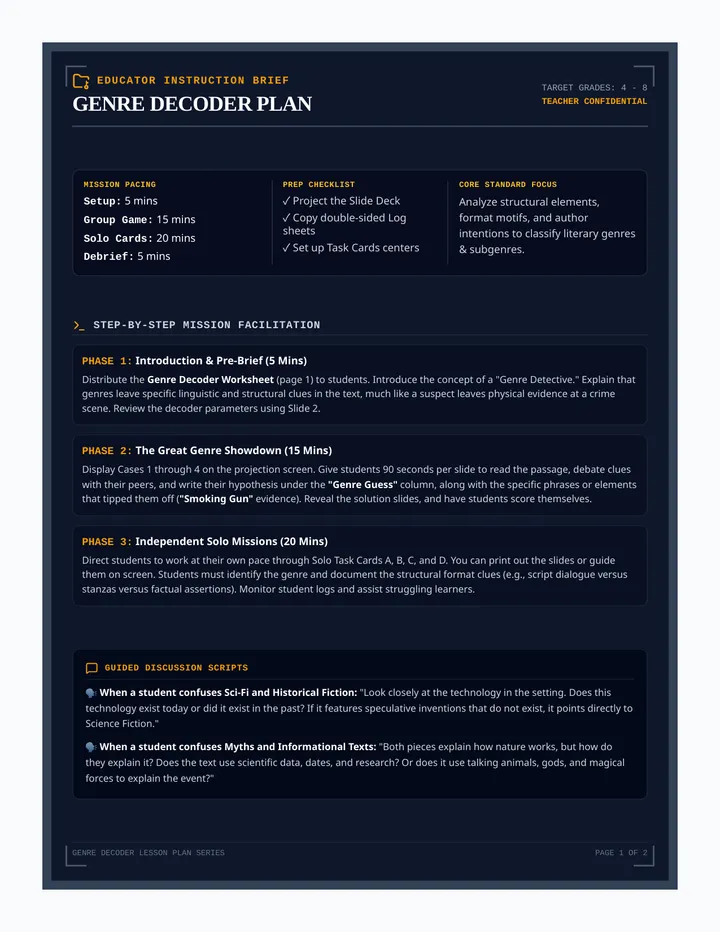
A comprehensive teacher guide for the Design Decoder lesson, outlining learning objectives, materials, and a step-by-step instructional sequence for teaching visual rhetoric to middle schoolers.
A student revision packet for a 7th-grade writing workshop. It includes a mentor text example, a sentence-combining exercise with appositives, and a multi-paragraph revision task where students transform a weak, choppy soccer narrative into a sophisticated piece of writing.
A visual presentation for a 7th-grade writing lesson titled 'Draft Surgeon.' It features instructional slides on using appositives, precise vocabulary, and sentence variety to transform weak writing into engaging prose, specifically using soccer-themed examples.
A teacher guide for a 7th-grade writing lesson, outlining a 60-minute lesson plan focused on improving writing craft through sentence variety, precise vocabulary, and appositives. Includes learning objectives, a detailed timeline, and revision exemplars for teacher reference.
Teacher answer key for the Flapper Style Worksheet, including a breakdown of positive and negative diction, correct multiple choice responses, and a scoring guide for the inference question. Updated to match revised worksheet line numbering and layout.
A 1st-grade reading level worksheet for middle schoolers about 1920s flapper culture. Students identify positive and negative diction in a numbered-line text and answer comprehension and inference questions. Revised for better line alignment and layout.
A visual guide of student-friendly 'I Can' statements and formal teacher objectives for a lesson on character development in 'Wonder'. Designed with the lesson's space theme to be displayed on the board or included in a teacher's portfolio. Revised for better 1-page fit and improved contrast for the teacher section.
A scaffolded exit ticket for students to reflect on Auggie's character development. Includes a thematic 'Mission Success' design and a sentence starter to support writing. Revised for 1-page printing with two tickets per sheet.
A character development graphic organizer focused on Auggie's growth during his first month at Beecher Prep. Includes scaffolding like sentence starters and clear sections for 'The Launch' (start of school) and 'Steady Orbit' (end of September). Revised to fix page breaks and improve writing areas.
A cut-and-paste worksheet for identifying Auggie's character traits based on text evidence from the beginning of the novel. Students match descriptive traits like 'Brave' and 'Strong' to specific actions described in the book. Revised with simpler vocabulary for accessibility.
A visual anchor chart designed for classroom display to help students differentiate between internal/external character traits and understand character development within the context of the novel 'Wonder'. Includes spaces for interactive sticky-note placement. Revised for 1-page fit and better visibility.