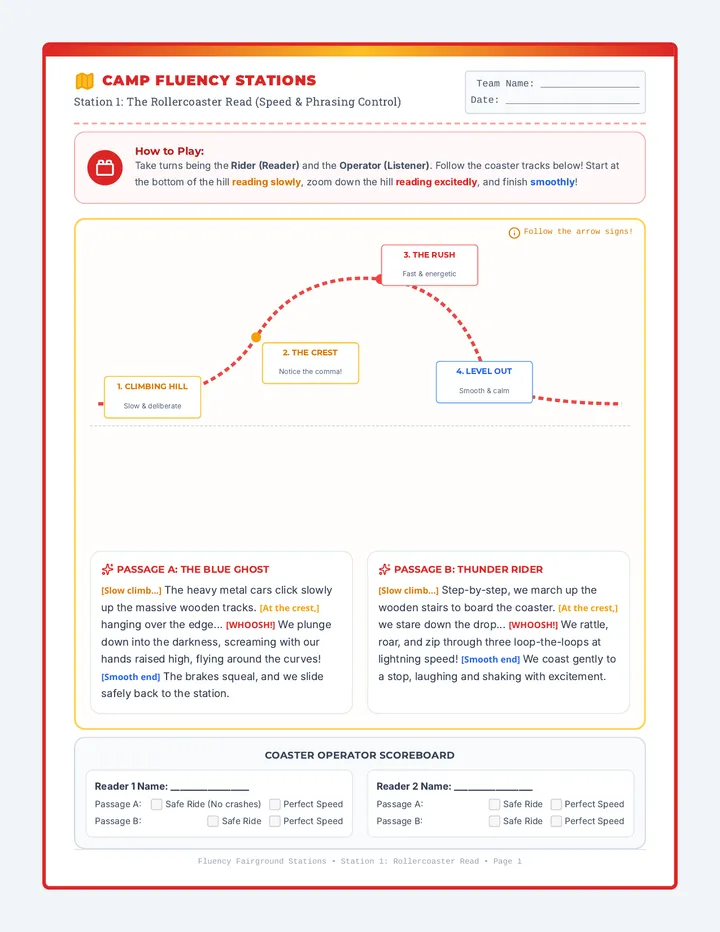
A student activity sheet featuring a 'Mystery/Adventure' script and an 'Emotion Mixer' table for practicing reading with varied prosody and partner feedback.
A comprehensive teacher guide for the 'Legend Library Escape' ELA review. Includes setup instructions, a detailed 120-minute pacing guide, facilitation tips, and the full answer key for all four chambers.
A set of printable task cards for each of the four escape room chambers. Each card contains specific ELA problems (sentence fixing, word sorting, text structure analysis) that students must solve to find their vault code digits.
A student-facing mission log for tracking escape room progress. It provides designated spaces for working through problems in each 'chamber' and recording the digits for the final vault code.
A visually immersive slide deck for 'The Lost Library of Legend' escape room. It includes mission briefings, rules, and chamber overviews with a high-contrast vintage library theme.
A teacher answer key for the Funland Mission worksheet, providing detailed responses for Chapter 13 of 'The Last Kids on Earth and the Nightmare King' and instructional tips.
A student worksheet for Chapter 13 of 'The Last Kids on Earth and the Nightmare King' featuring open-response questions about setting, character teamwork, amusement park rides, and the radio plot point.
Teacher guide and answer key for the Chapter 13 comprehension worksheet, featuring a consolidated answer grid, teaching strategies, and extension activities.
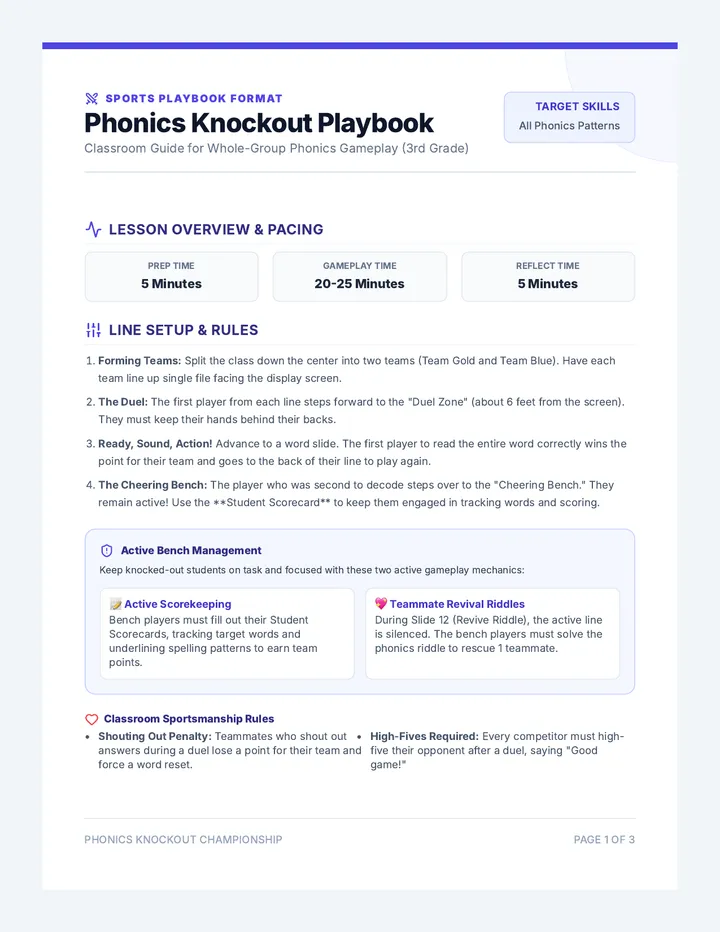
A presentation to introduce Chapter 13 of 'The Nightmare King', focusing on the 5 W's reading strategy and key plot points for Grade 3 students. Includes all 12 comprehension questions.
A reading comprehension worksheet for Chapter 13 of 'The Nightmare King', featuring 12 questions categorized by the 5 W's (Who, What, When, Where, Why) at a Grade 3 reading level. Optimized for print with white background and no split questions.
An answer key for the Vocabulary Map Worksheet, providing suggested synonyms and antonyms for 'tired' and 'hungry'. Features a clean, professional design.
A blank vocabulary map for students to choose their own words and identify synonyms and antonyms. Features a clean, professional layout suitable for any vocabulary lesson.
A basic vocabulary graphic organizer for second graders to identify synonyms and antonyms for 'tired' and 'hungry'. Features a clean layout with simple instructions.
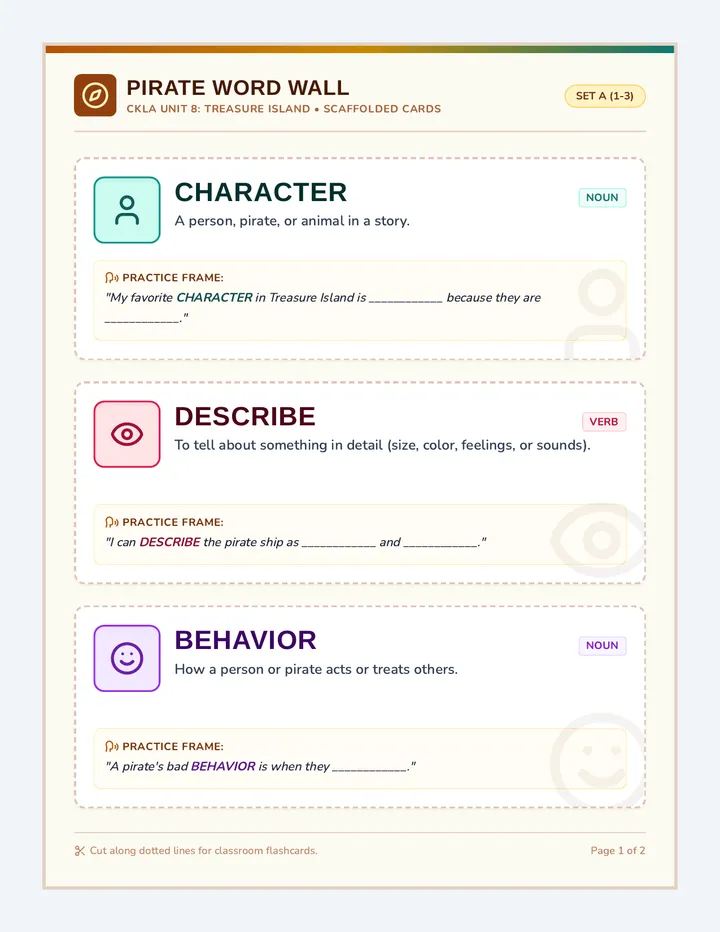
A printable sorting game where students match 'fancy' synonyms to the simple words 'tired', 'hungry', 'excited', 'pretty', 'thirsty', and 'tasty' on themed burrow mats. Includes 18 word cards split across two pages and 6 sorting mats. Designed to be printed on multiple pages to avoid cutoff.
A comprehensive teacher resource containing vocabulary definitions, synonym/antonym banks, and discussion prompts for 'The Wombats Go Wild for Words'. It reflects the story's setting in the Evergreen Forest and the encounter with the duckling. Focuses on Tired and Hungry for the main lesson.
A visually engaging presentation focusing on synonyms and antonyms for 'Tired' and 'Hungry'. It reflects the story's setting in the Evergreen Forest and the encounter with the duckling. Now includes 'Fancy Game Words' and interactive reveal slides.
A comprehensive guide for teachers including the correct narrative sequence, learning objectives, and discussion prompts to deepen student understanding.
A worksheet for students to transcribe their ordered sentences into a cohesive narrative. Includes a reflection question to identify the moral of the story.
A printable set of sentence strips from the story for students to cut out and manually arrange. Encourages tactile engagement and logical sequencing of the narrative events.
A vibrant slide deck to introduce the story of 'The Shepherd Boy' and guide students through the sequencing activity. Features clear, large text and visual cues to support narrative comprehension.
A teacher-facing annotation guide for the 'Maya's Big Splash' story. It highlights and categorizes the setting, characters, problem, attempts to resolve, and the final solution within the text using kid-friendly language for the summary analysis.
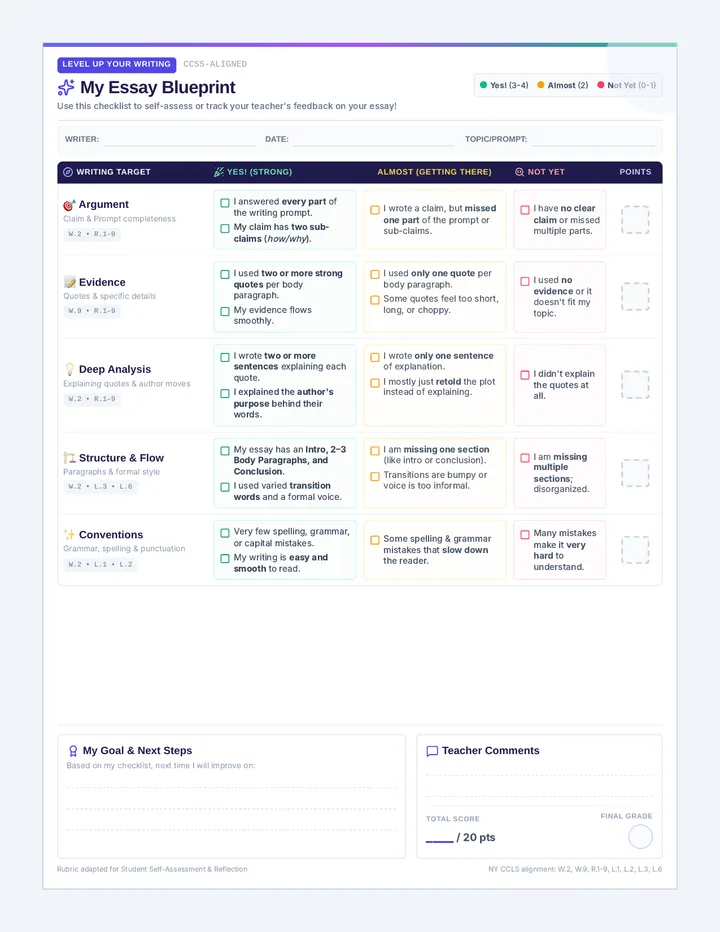
A teacher-facing scoring guide for the writing prompts. Includes the prompt text, a 2-point rubric for character change, and a 4-point rubric for identifying the story's central message. Aligned with NYS ELA standards.
A student-facing writing prompt document with two tasks: a short response about character change and an extended response about the story's central message. Includes structured writing lines and a student self-assessment checklist. Revised to focus on theme analysis and fix formatting.
A teacher-facing answer key for the 'Maya's Big Splash' comprehension worksheet. Revised to include full answer text, improve table legibility, and ensure the entire key fits on a single page.
A student-facing worksheet featuring a narrative passage called 'Maya's Big Splash' and six multiple-choice comprehension questions modeled after the NYS ELA test format. The story explores the theme of overcoming fear and determination. Revised to fit passage on one page and improve page breaks for questions.
An exit ticket for Chapter 13 of The Watsons Go to Birmingham, analyzing Byron's character development after arriving in Alabama, including an evidence bank and sentence starters.
An exit ticket for Chapter 12 of The Watsons Go to Birmingham, focusing on the development of the Birmingham setting with an evidence bank and sentence starters.
A teacher's answer key for the 'Shadows and Summits' worksheet, providing exemplar responses and analysis of the themes in Chapter 10 of 'The Watsons Go to Birmingham'.
A student worksheet featuring text-dependent questions about Chapter 10 of 'The Watsons Go to Birmingham', focusing on the symbolic use of nature and darkness to explore racial tension.
A teacher-facing answer key and scoring rubric for the Storm Chaser Quiz, including specific evidence requirements for each question.
A comprehensive assessment for RI.3.1 where students must answer questions about extreme weather and provide direct textual evidence to support their claims.
A grade-appropriate informational reading passage covering tornadoes, hurricanes, and blizzards, designed for evidence-based questioning practice.
A structured graphic organizer for students to record their questions, answers, and the specific text evidence found during their weather investigation.
A visually engaging anchor chart for RI.3.1 that teaches students the steps to finding textual evidence and the 5 W's of questioning.
A detailed 5-day teacher pacing guide for the Extreme Weather unit, outlining daily goals, instructional focuses, and required materials for teaching RI.3.1.
Answer key for the History Hunter Weekly Worksheet, providing specific text-based answers for each historical biography question. Polished layout with consistent branding and improved page breaks.
A week-long series of 3rd grade reading warm-ups (Do Nows) based on historical biographies, focusing on RI.3.1 standards for EOG test preparation. Now with improved page breaks, standardized formatting, and better student work areas.
An answer key and evaluation guide for the 'Story Blueprint' worksheet, providing example sentences and teaching tips for Grade 2 ESL narration.
A short assessment for students to demonstrate their understanding of narrative signal words and basic sentence construction at the end of the 'Story Lab' lesson.
A set of visual vocabulary cards featuring sequential signal words and action verbs to support Grade 2 ESL students in building narrative sentences.
A student worksheet for drafting a narrative sequence about 'Making a Sandwich'. Includes a word bank of action verbs and dedicated spaces for students to draw and write using sequential signal words.
A high-impact slide deck for teaching narration to Grade 2 ESL students, focusing on sequential signal words and academic story structure through visual prompts and collaborative discussion.
A teacher facilitation guide for the 'Story Lab' narration lesson, featuring WIDA-aligned instructional steps, language objectives, and differentiation strategies for Grade 2 ESL students.
A unified answer key for all worksheets and the final assessment in the Lexicon Labs unit.
Revised final assessment: Fixed page break issues splitting sections, changed the dark background of the mastery challenge to a printable light gray/white, and increased the writing space for student responses.
Revised Lesson 2 exit ticket: Fixed the page break that cut off the footer, improved contrast for better legibility on the dark footer background, and added subtle handwriting guides.
Revised Lesson 2 worksheet: Fixed a page break splitting the final question of the first section and added guided handwriting lines to the replacement lab work area.
Revised Session 2 slides: Added explicit component labels to the entry anatomy slide and ensured uniform styling for answer choices on the lab trial slide to avoid telegraphing the correct answer.
Revised Lesson 2 plan: Consolidated the layout to fit on a single page, improved contrast in the header, and integrated the "Common Pitfalls" section into the main body.
Revised Lesson 1 worksheet: Fixed a page break splitting Challenge 2, corrected the briefing count, and optimized font sizes to provide more space for student work.
Revised Session 1 slides: Corrected the alphabetical range logic on Slide 4, added a preview slide for multiple definitions, and improved visual hierarchy on the guide words explanation.