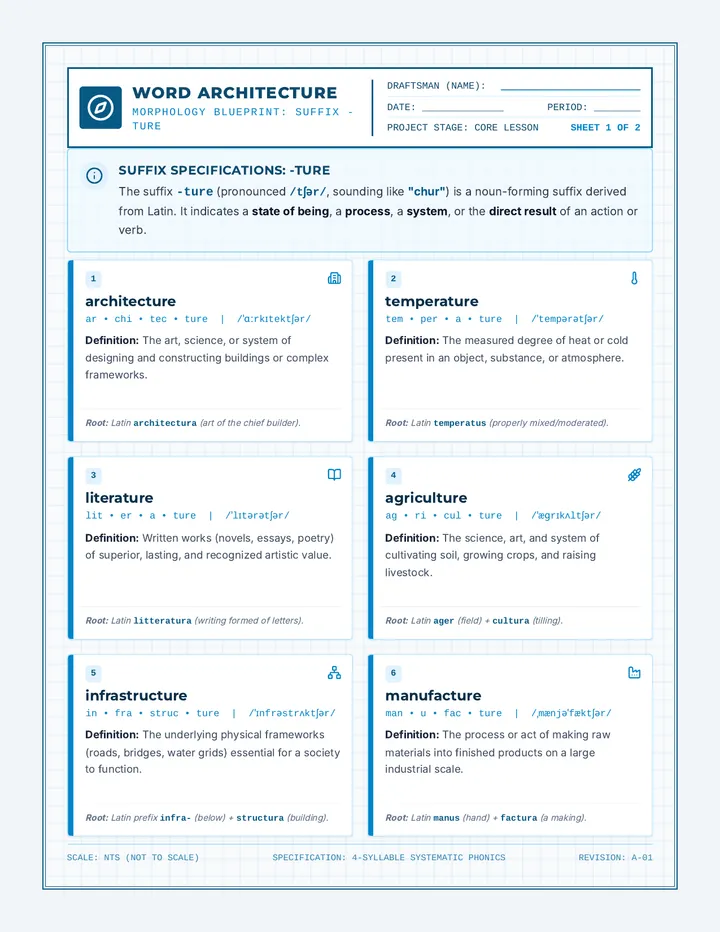
Slide deck for Lesson 4, explaining how to write a formal dictionary entry and the role of suffixes in determining parts of speech.
A visual presentation for teaching Chapters 14 and 15 of *The Watsons Go to Birmingham—1963*, focusing on sensory analysis, character motivation, and the R.A.C.E. strategy.
A teacher's answer key and guide for the Chapter 14 and 15 analysis of *The Watsons Go to Birmingham—1963*, featuring exemplary R.A.C.E. responses and discussion prompts.
An exit ticket for Chapter 15 of *The Watsons Go to Birmingham—1963*, requiring students to explain Kenny's motivation for hiding in the Pet Hotel using the R.A.C.E. strategy.
An exit ticket for Chapter 14 of *The Watsons Go to Birmingham—1963*, prompting students to analyze the use of sound and silence to create mood using the R.A.C.E. strategy.
Answer key for the 'Foggy Harbor Story' featuring detailed examples for all five r-controlled vowel patterns and clear answer models.
Answer key for the 'Runaway Bot Story' providing specific examples of syllable types and sample student responses for comprehension questions.
A decodable story titled 'The Foggy Harbor' focusing on doubling rules, consonant-le, open syllables, and all five r-controlled vowel patterns. Includes student response sections.
A decodable story titled 'The Runaway Bot' featuring words with doubling rules, consonant-le, open syllables, r-controlled vowels, and VCe patterns. Includes comprehension questions and a phonics focus guide.
Instructional slides explaining the concept of theme, the difference between plot and theme, and setting up the student investigation activity.
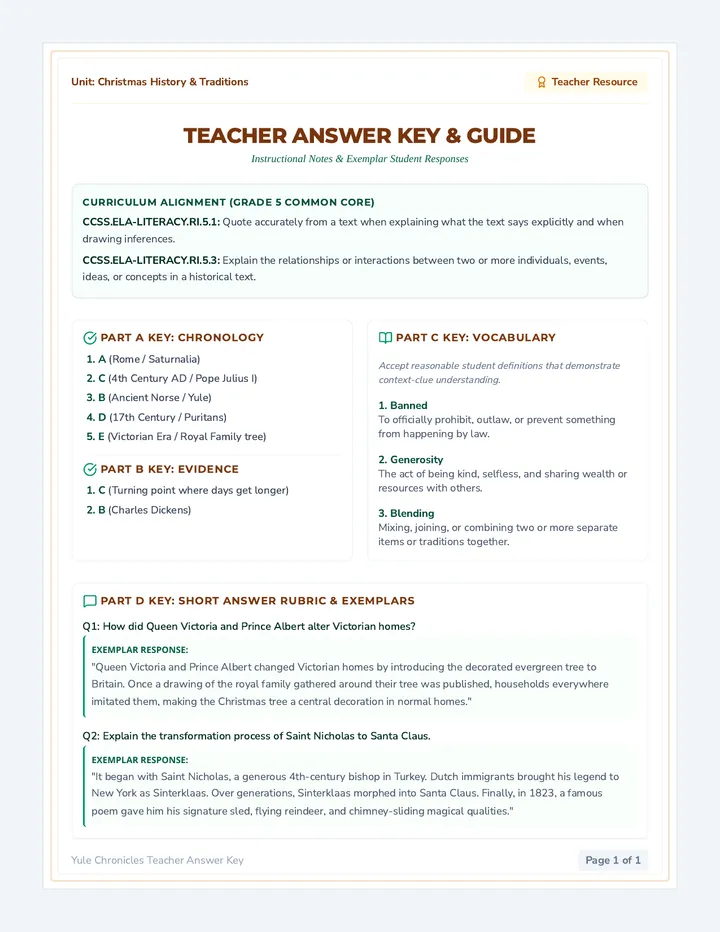
Teacher answer key for the Storybook Secrets worksheet, providing sample answers for themes and text evidence.
A two-page worksheet where students read four classic fairy tales and identify their themes using guided questions and text evidence. Spacing optimized for clear student work areas.
A multi-disciplinary extension project for AIG students that offers three pathways (Policy, Campaigning, or Ecology) to deepen their understanding of conservation. Optimized for a 2-page layout.
A comprehensive teacher lesson plan for the Possession Precision lesson, outlining objectives, materials, procedures, and differentiation strategies.
A detective-themed exit ticket for a quick end-of-lesson assessment of singular possessive noun rules.
Teacher answer key for the 'Ghost Peaks' assessment with standard alignments and brief explanations for correct answers.
A complete student document containing both the 'Ghost of the Peaks' reading passage and a 12-question rigorous assessment covering RI.5.1, RI.5.2, L.5.4, and L.5.5 standards. Optimized for a 3-page layout.
An answer key for the Possession Practice Worksheet and Lost and Found Task Cards, including teaching tips for identifying owners.
Eight detective-themed task cards for possessive noun practice, including rewriting phrases, identifying errors, and creative writing.
A high-contrast, visually engaging anchor chart poster that explains the rule for singular possessive nouns and warns against plural confusion.
A practice worksheet where students rewrite phrases into possessive forms and correct errors involving plural vs. possessive nouns.
A detective-themed slide deck that teaches students how to use 's to show possession, including common pitfalls like plural vs. possessive nouns.
A detailed teacher answer key for the Sentence Blueprint worksheet, providing model complex and compound sentences using science and history themes.
A 3-step guided practice worksheet with a construction theme, designed to help students combine fragments and simple sentences into compound and complex sentences within science and social studies contexts.
Large, visually striking cut-outs for a "Wild Intel" bulletin board. Includes a main "Wild Intel Research Station" title, "Central Idea" and "Evidence" category headers, and decorative animal-themed icons like footprints and binoculars.
A student-facing worksheet designed as a "Field Report" dossier. Students identify an animal's central idea and three supporting details, including space for a field sketch. The entire dossier is designed as an "easy cut out" for bulletin board display.
A teacher's guide for setting up the "Wild Intel" bulletin board, including preparation steps, assembly instructions, teaching tips for scaffolding central idea identification, and example answer keys.
An instructional slide deck for teaching central idea and supporting details using an animal research theme. Includes a case study on honey bees and a clear visual metaphor for structural understanding.
A comprehensive answer key and teacher guidance document for the Contraction Lab Fusion lesson. Includes common misconceptions, extensions, and clear answers with high-contrast text.
A set of cut-and-match cards for hands-on practice. Students match base word pairs to their corresponding contractions. All cards share uniform backgrounds to ensure the matching task requires reading.
An interactive activity page designed as a scientific lab report. Students identify errors in failed fusions and match contractions to their base words. Sized correctly for single-page printing with optimized student work areas.