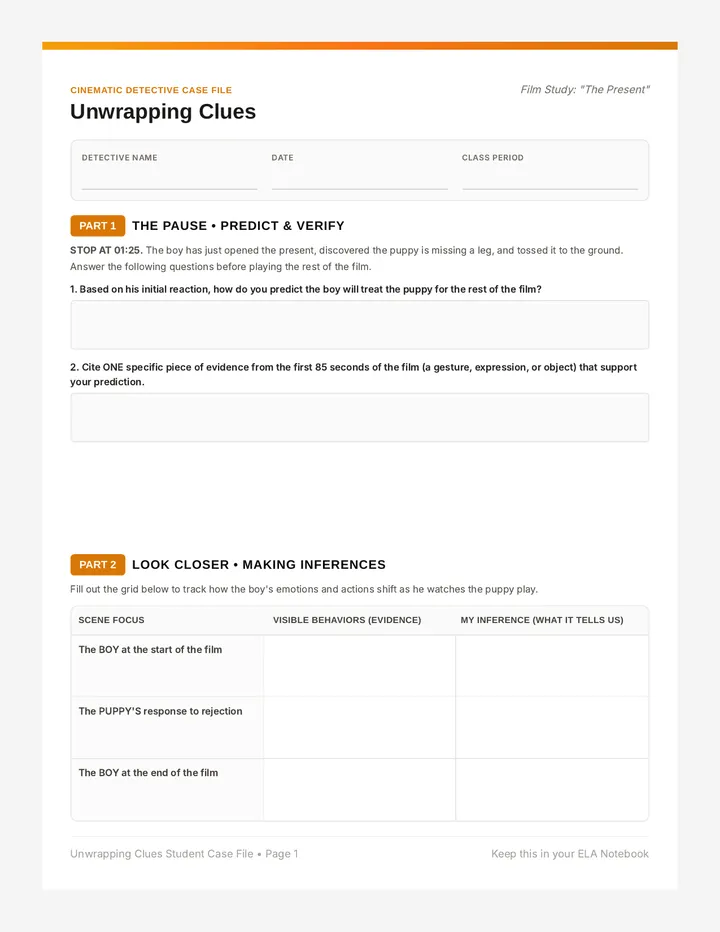
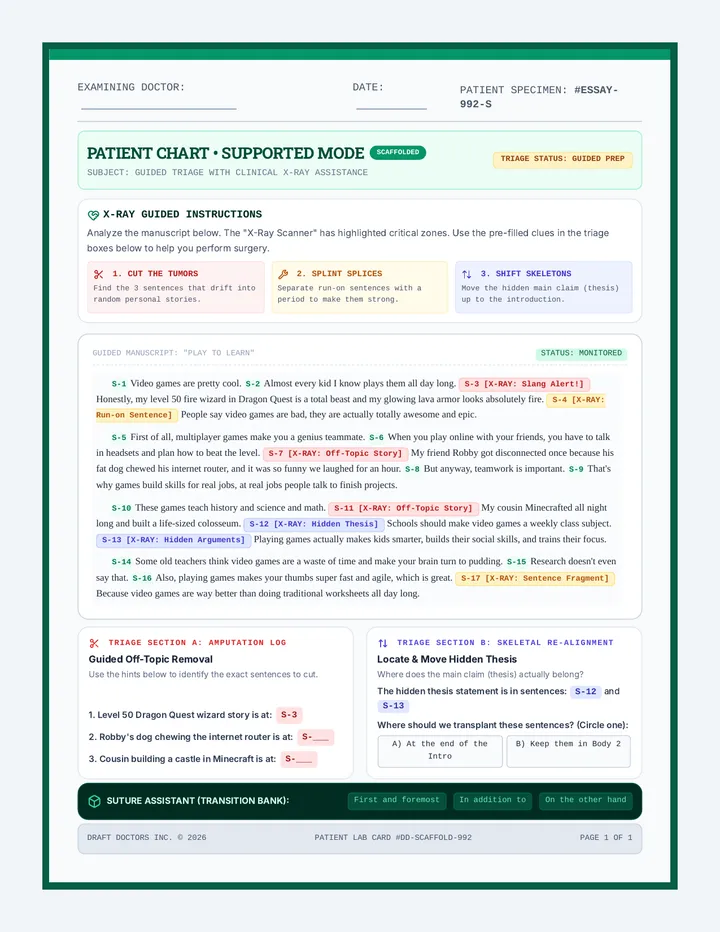
A 'Detective Log' worksheet for students to record their investigation. It includes structured sections for identifying fallacies (Weak Links), mapping out a deductive reasoning chain (Ironclad Chain), and writing a final justified conclusion.
Comprehensive Answer Key for the Spotlight Series biographies. Covering RI.7.3, 7.L.4, and 7.L.5. Condensed to a single page with a clear 2-column grid.
A biography of Taylor Swift with 10 questions focused on RI.7.3, 7.L.4, and 7.L.5. Optimized for 3 pages. Varied vocabulary to avoid repetition.
A biography of Dwayne Johnson with 10 questions focused on RI.7.3, 7.L.4, and 7.L.5. Optimized for 3 pages. Varying vocabulary to avoid repetition.
A biography of Zendaya with 10 questions focused on RI.7.3, 7.L.4, and 7.L.5. Optimized for 3 pages. Now includes "teen idol" in the text.
A biography of Lin-Manuel Miranda with 10 questions focused on RI.7.3, 7.L.4, and 7.L.5. Optimized for 3 pages.
A biography of Simone Biles with 10 questions focused on RI.7.3, 7.L.4, and 7.L.5. Optimized for 3 pages with improved layout and legibility.
An exit ticket for Chapter 13 of The Watsons Go to Birmingham, analyzing Byron's character development after arriving in Alabama, including an evidence bank and sentence starters.
An exit ticket for Chapter 12 of The Watsons Go to Birmingham, focusing on the development of the Birmingham setting with an evidence bank and sentence starters.
A teacher's answer key for the 'Shadows and Summits' worksheet, providing exemplar responses and analysis of the themes in Chapter 10 of 'The Watsons Go to Birmingham'.
A student worksheet featuring text-dependent questions about Chapter 10 of 'The Watsons Go to Birmingham', focusing on the symbolic use of nature and darkness to explore racial tension.
An evaluation rubric for the Design Decoder lesson, assessing students on their rhetorical use of color, typography, visual hierarchy, and the strength of their written justifications.
A planning activity guide for students to design their own Public Service Announcement, requiring them to justify their rhetorical choices in color, typography, and layout.
A structured deconstruction worksheet where students analyze an advertisement's color palette, typography, and layout hierarchy to understand its rhetorical impact.
Instructional slides for the Design Decoder lesson, visually demonstrating color psychology, typography personalities, and layout principles like the Rule of Thirds and white space.
A comprehensive teacher guide for the Design Decoder lesson, outlining learning objectives, materials, and a step-by-step instructional sequence for teaching visual rhetoric to middle schoolers.
A student revision packet for a 7th-grade writing workshop. It includes a mentor text example, a sentence-combining exercise with appositives, and a multi-paragraph revision task where students transform a weak, choppy soccer narrative into a sophisticated piece of writing.
A visual presentation for a 7th-grade writing lesson titled 'Draft Surgeon.' It features instructional slides on using appositives, precise vocabulary, and sentence variety to transform weak writing into engaging prose, specifically using soccer-themed examples.
A teacher guide for a 7th-grade writing lesson, outlining a 60-minute lesson plan focused on improving writing craft through sentence variety, precise vocabulary, and appositives. Includes learning objectives, a detailed timeline, and revision exemplars for teacher reference.
Teacher answer key for the Flapper Style Worksheet, including a breakdown of positive and negative diction, correct multiple choice responses, and a scoring guide for the inference question. Updated to match revised worksheet line numbering and layout.
A 1st-grade reading level worksheet for middle schoolers about 1920s flapper culture. Students identify positive and negative diction in a numbered-line text and answer comprehension and inference questions. Revised for better line alignment and layout.
A visual guide of student-friendly 'I Can' statements and formal teacher objectives for a lesson on character development in 'Wonder'. Designed with the lesson's space theme to be displayed on the board or included in a teacher's portfolio. Revised for better 1-page fit and improved contrast for the teacher section.
A scaffolded exit ticket for students to reflect on Auggie's character development. Includes a thematic 'Mission Success' design and a sentence starter to support writing. Revised for 1-page printing with two tickets per sheet.
A character development graphic organizer focused on Auggie's growth during his first month at Beecher Prep. Includes scaffolding like sentence starters and clear sections for 'The Launch' (start of school) and 'Steady Orbit' (end of September). Revised to fix page breaks and improve writing areas.
A cut-and-paste worksheet for identifying Auggie's character traits based on text evidence from the beginning of the novel. Students match descriptive traits like 'Brave' and 'Strong' to specific actions described in the book. Revised with simpler vocabulary for accessibility.
A visual anchor chart designed for classroom display to help students differentiate between internal/external character traits and understand character development within the context of the novel 'Wonder'. Includes spaces for interactive sticky-note placement. Revised for 1-page fit and better visibility.
A teacher-facing answer key and evaluation guide for the Wonder mini-lesson materials. It includes correct answers for the reading guide and quiz, as well as grading guidance for the graphic organizer and exit ticket. Revised for better page breaks.
A 5-slide presentation for the Wonder mini-lesson, introducing the concept of precepts, exploring Mr. Browne's "Choose Kind" rule, and defining character perspective using examples from the text. Revised for better typography.
A creative exit ticket for the Wonder mini-lesson, asking students to reflect on the core theme of kindness and identify a shift in character perspective. Revised with larger work areas and handwriting guides.
A short quiz for the novel Wonder, assessing comprehension of the first 50 pages, understanding of Mr. Browne's precept, and key vocabulary terms. Revised for improved page breaks and writing area support.
A guided reading worksheet for the chapter "Wake Me Up When September Ends" in Wonder. It includes four scaffolded comprehension and analysis questions focused on Auggie's perspective and the theme of kindness. Revised for better page breaks and larger writing areas.
A graphic organizer designed to help students analyze and compare character perspectives in Wonder. Students select an event and record how Auggie versus another character (Jack, Summer, or Julian) experiences it, including textual evidence. Revised for better layout and student work space.
A set of four vocabulary cards for the novel Wonder, featuring key words like petrified, precept, anomaly, and aversion. Each card includes a simplified phonetic guide, definition, and contextual example. Fixed for rendering and includes cutting guides.
An anchor chart for the classroom that defines precepts and explores Mr. Browne's first precept from Wonder: "Choose Kind." It includes examples of character kindness and key vocabulary definitions. Fixed to fit on a single page.
A teacher-facing answer key and evaluation guide for the Wonder mini-lesson materials. It includes correct answers for the reading guide and quiz, as well as grading guidance for the graphic organizer and exit ticket.
A 5-slide presentation for the Wonder mini-lesson, introducing the concept of precepts, exploring Mr. Browne's "Choose Kind" rule, and defining character perspective using examples from the text. Visually engaging with a sky-blue and space theme.
A creative exit ticket for the Wonder mini-lesson, asking students to reflect on the core theme of kindness and identify a shift in character perspective from the reading. Designed with a clean, engaging layout for 6th graders.
A short quiz for the novel Wonder, assessing comprehension of the first 50 pages, understanding of Mr. Browne's precept, and key vocabulary terms. It includes multiple-choice, matching, and a short-answer question on character perspective.
A guided reading worksheet for the chapter "Wake Me Up When September Ends" in Wonder. It includes four scaffolded comprehension and analysis questions focused on Auggie's perspective and the theme of kindness.
A graphic organizer designed to help students analyze and compare character perspectives in Wonder. Students select an event and record how Auggie versus another character (Jack, Summer, or Julian) experiences it, including textual evidence.
A set of four vocabulary cards for the novel Wonder, featuring key words like petrified, precept, anomaly, and aversion. Each card includes the definition, part of speech, and an example of how the word is used in the text.