A detailed instructional guide for teachers, outlining the 65-minute lesson structure, learning objectives, and differentiation strategies for teaching data organization and plotting.
A detailed teacher's answer key for the Chance Champions Pre-test, including skill mapping, step-by-step explanations, and visual references.
A 10-question probability pre-test covering qualitative likelihood, theoretical probability (fractions, decimals, percentages), predictions, sample spaces, and experimental probability. Includes dedicated workspace and visuals for tables, dice, coins, and tree diagrams.
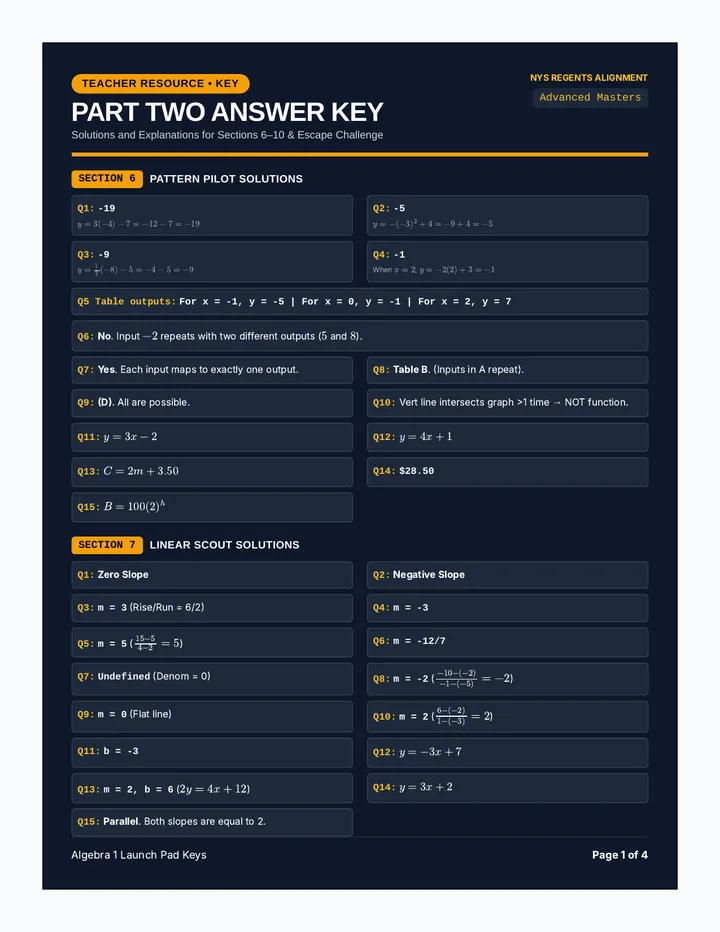
A teacher-facing answer key and instructional guide for the Regents Roadmap Study Guide. Includes worked-out solutions for Regents-aligned problems and pedagogical tips for supporting special education students with algebraic concepts.
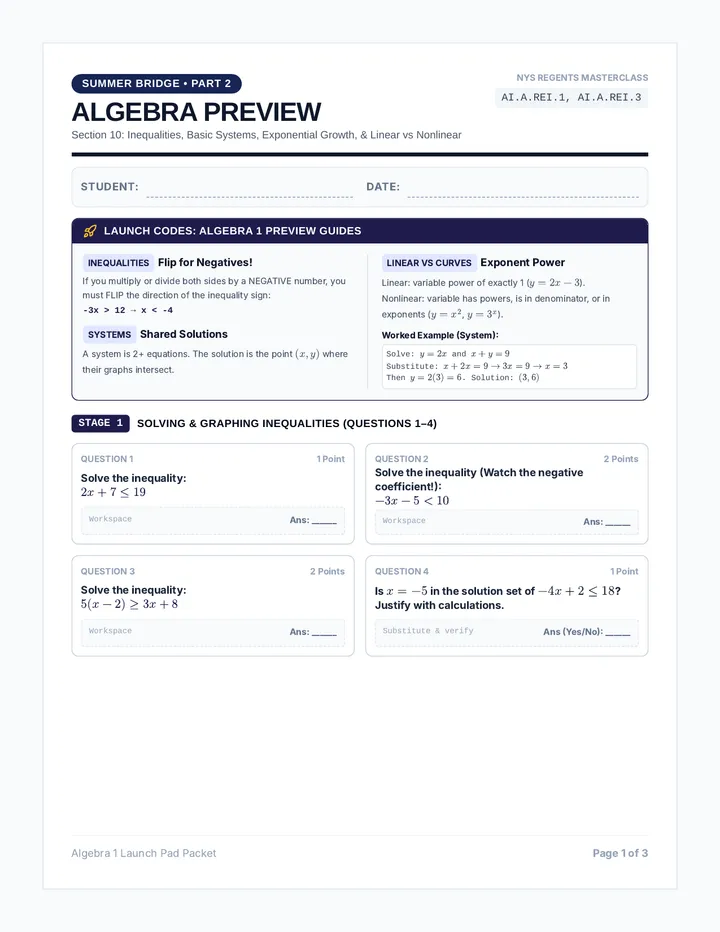
A student-facing study guide for Algebra I Regents prep, featuring visual scaffolds, step-by-step solving guides, and annotated examples for linear equations, inequalities, systems, and data interpretation. Designed with special education needs in mind, using simplified vocabulary and ample workspace.
A comprehensive blueprint and skills analysis of the 2025 Probability Test, mapping each question to specific learning objectives and quantifying question distribution.
A quick assessment tool where students translate data from a dot plot into a five-number summary and a box-and-whisker plot.
A professional-grade statistics worksheet where students analyze basketball scores by creating ordered lists, 5-number summaries, and dual data visualizations.
An essential teacher reference guide providing answer keys for all student activities and worksheets, along with grading rubrics and discussion prompts for specific mathematical pitfalls.
A quick assessment tool for the end of the lesson, checking students' ability to compare medians and IQRs, identify skewness, and apply the concept of consistency in a real-world context.
A quick assessment tool for the end of the lesson, featuring three questions to check for understanding of positive and negative correlation trends.
A concise exit ticket to assess student understanding of trend lines and the difference between interpolation and extrapolation at the end of the lesson.
A class-wide data collection and visualization activity where students survey each other on screen time and collectively build statistical models.
An independent practice worksheet containing two real-world scenarios (phone battery life and commute times) requiring students to analyze and compare multiple box plots. Focuses on consistency, variation, and data-driven decision making.
An independent practice worksheet where students apply their knowledge of trend lines to make specific data predictions, identifying and performing both interpolation and extrapolation.
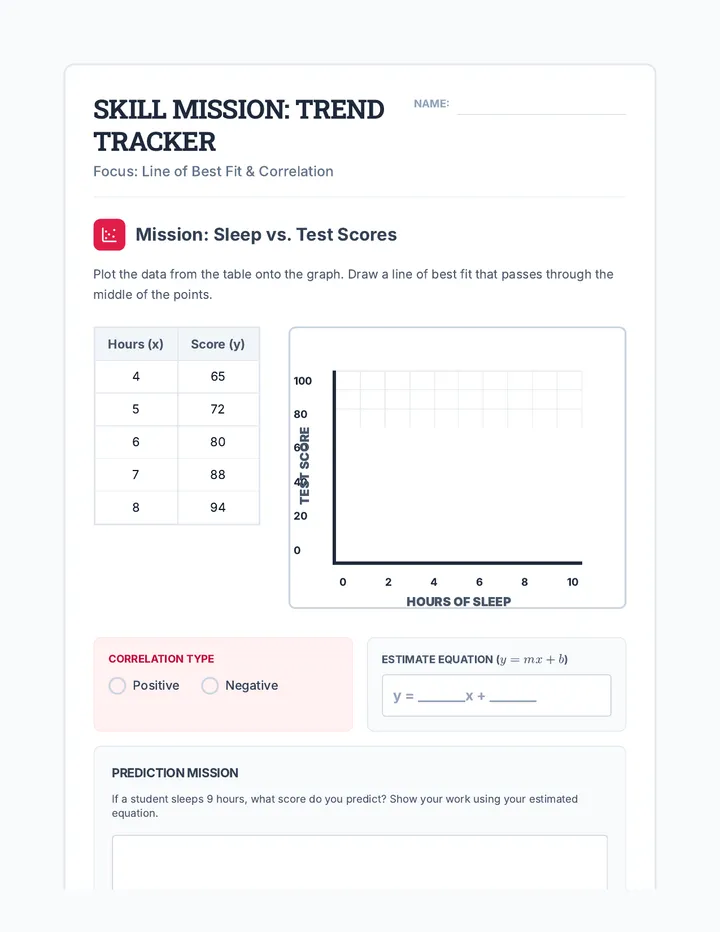
An independent practice worksheet where students plot real-world data points on coordinate planes, identify correlation types, and write conclusion statements based on their findings.
A sleek, dark-themed presentation for the assessment lesson, including an instructional arc, a warm-up activity, and testing protocols.