A 10-question probability pre-test with accurate visuals for an 8-section spinner, 6-sided die, and coin. Covers qualitative likelihood, theoretical probability, predictions, sample spaces, and experimental probability.
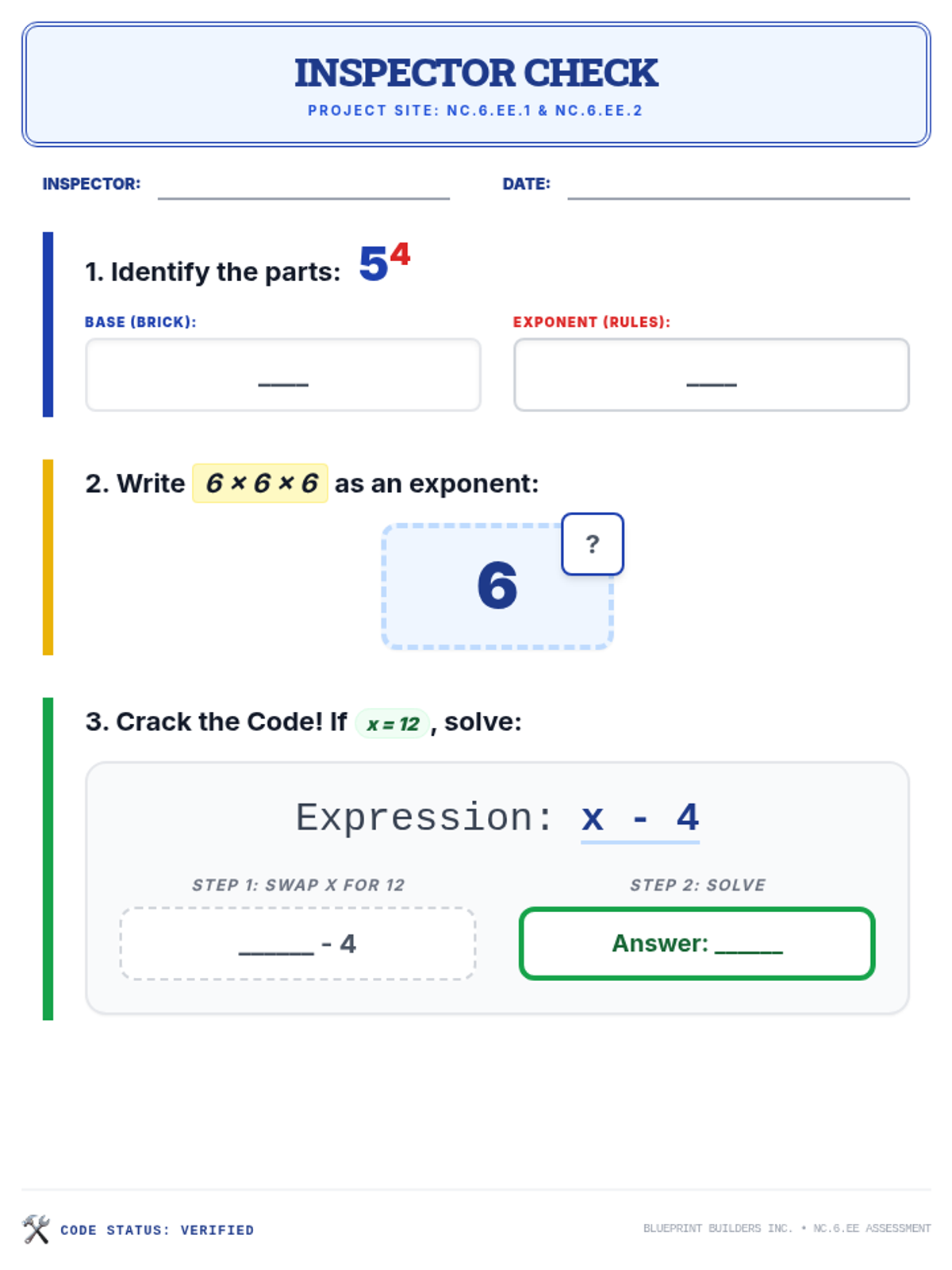
Revised exit ticket for NC.6.EE.1-2 with improved legibility for student handwriting by using white backgrounds for work areas. Step instructions have been enlarged for better accessibility, and the layout has been tightened to ensure a clean, one-page printout. Scaffolding remains optimized for students with IEPs.
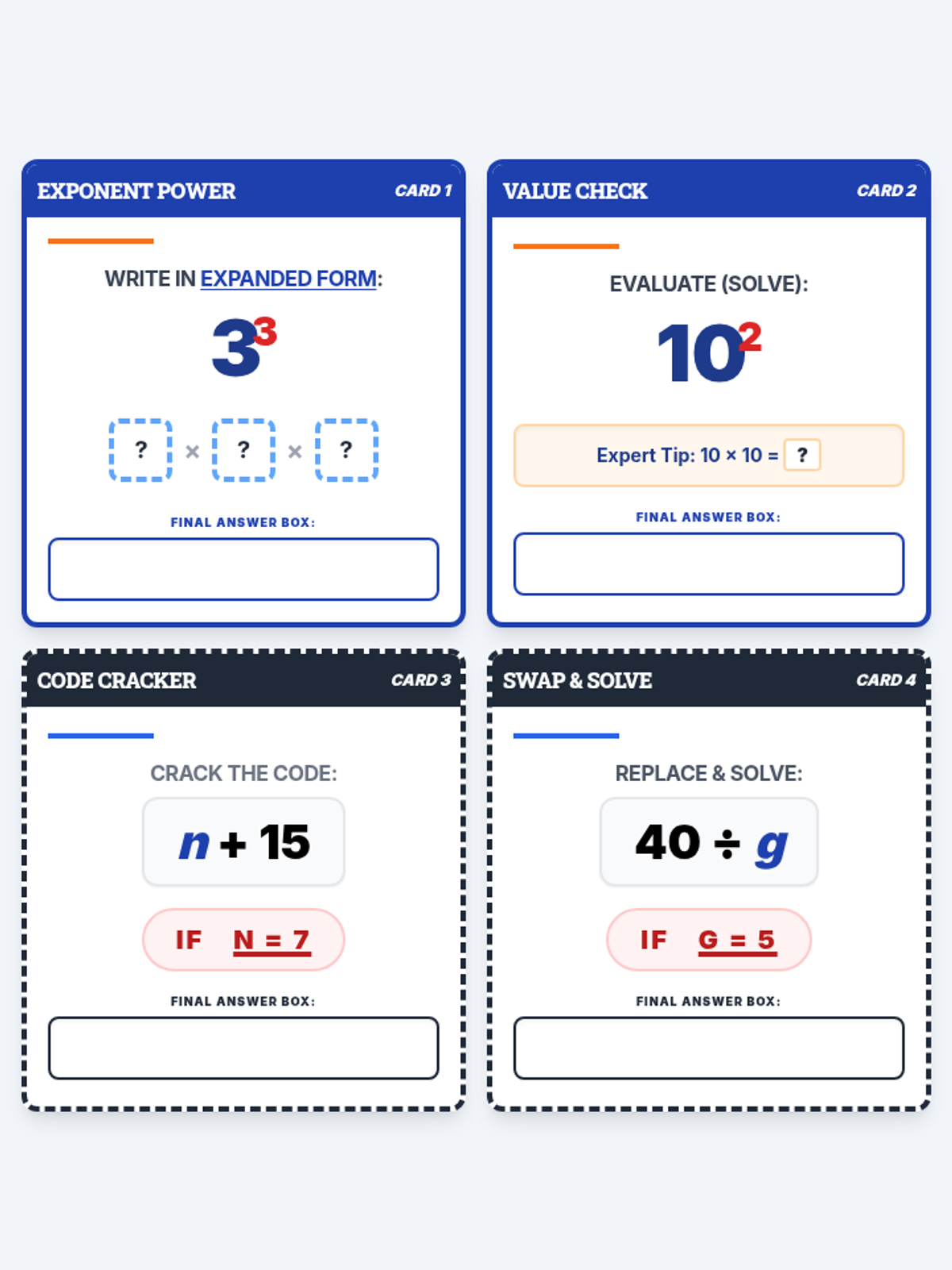
Final task cards for NC.6.EE.1-2 with optimized layout to ensure all four cards fit on a single page. Card headers have been redesigned for clarity, answer boxes are now clearly marked, and all scaffolded input areas feature high-contrast text and borders for reliable printing. Variable casing has been standardized (lowercase n and g) to prevent student confusion.
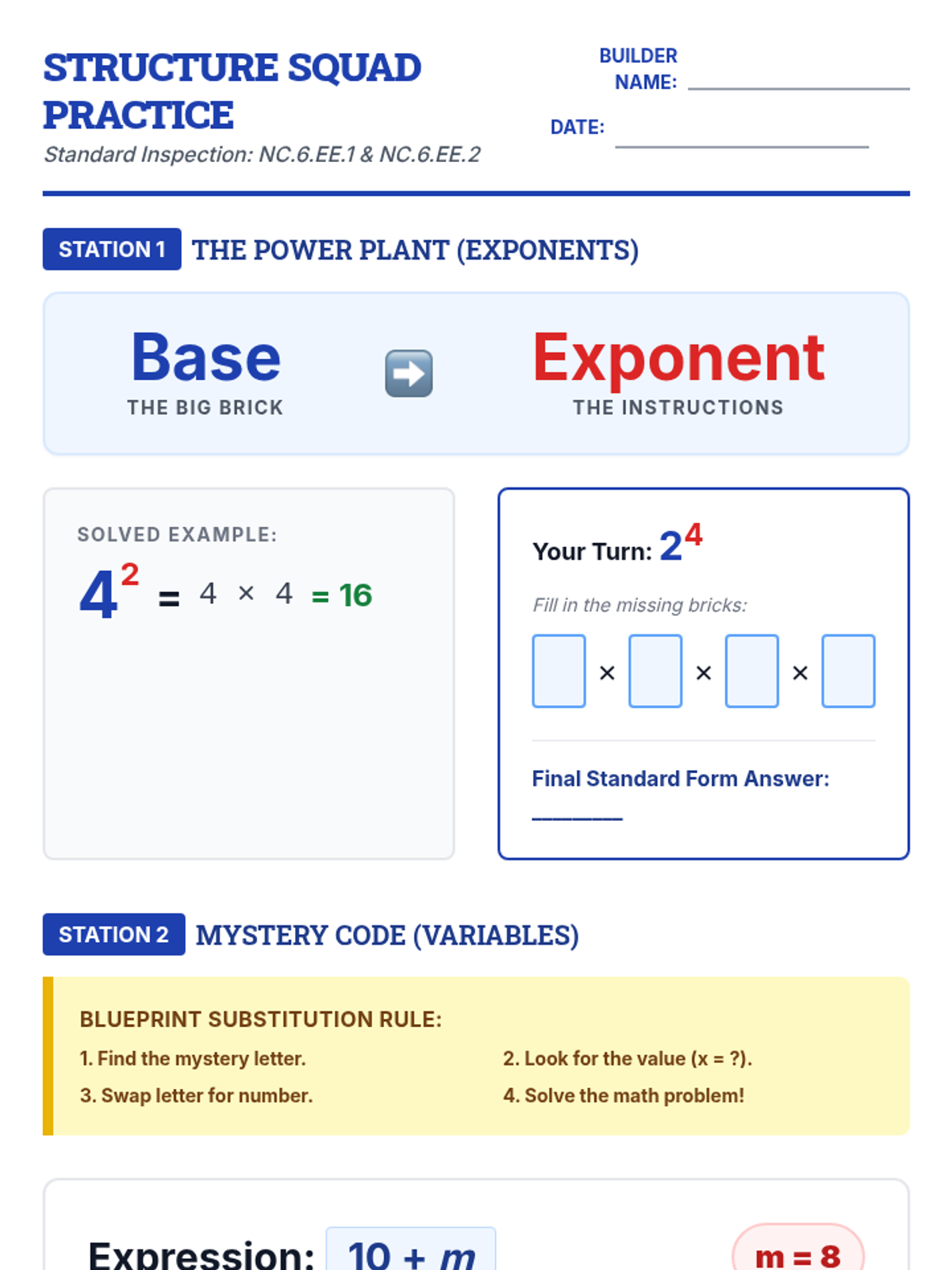
Revised worksheet for NC.6.EE.1-2 with fixed step numbering (1-4) in the substitution rule, improved superscript alignment in the example, and high-contrast text for student work areas. Problems are kept together on one page using break-inside-avoid.
Revised slide deck for NC.6.EE.1-2 with corrected exponent rendering, removed video placeholder in favor of a detailed visual comparison slide, and adjusted layouts to prevent overflow. All text is 24px or larger.
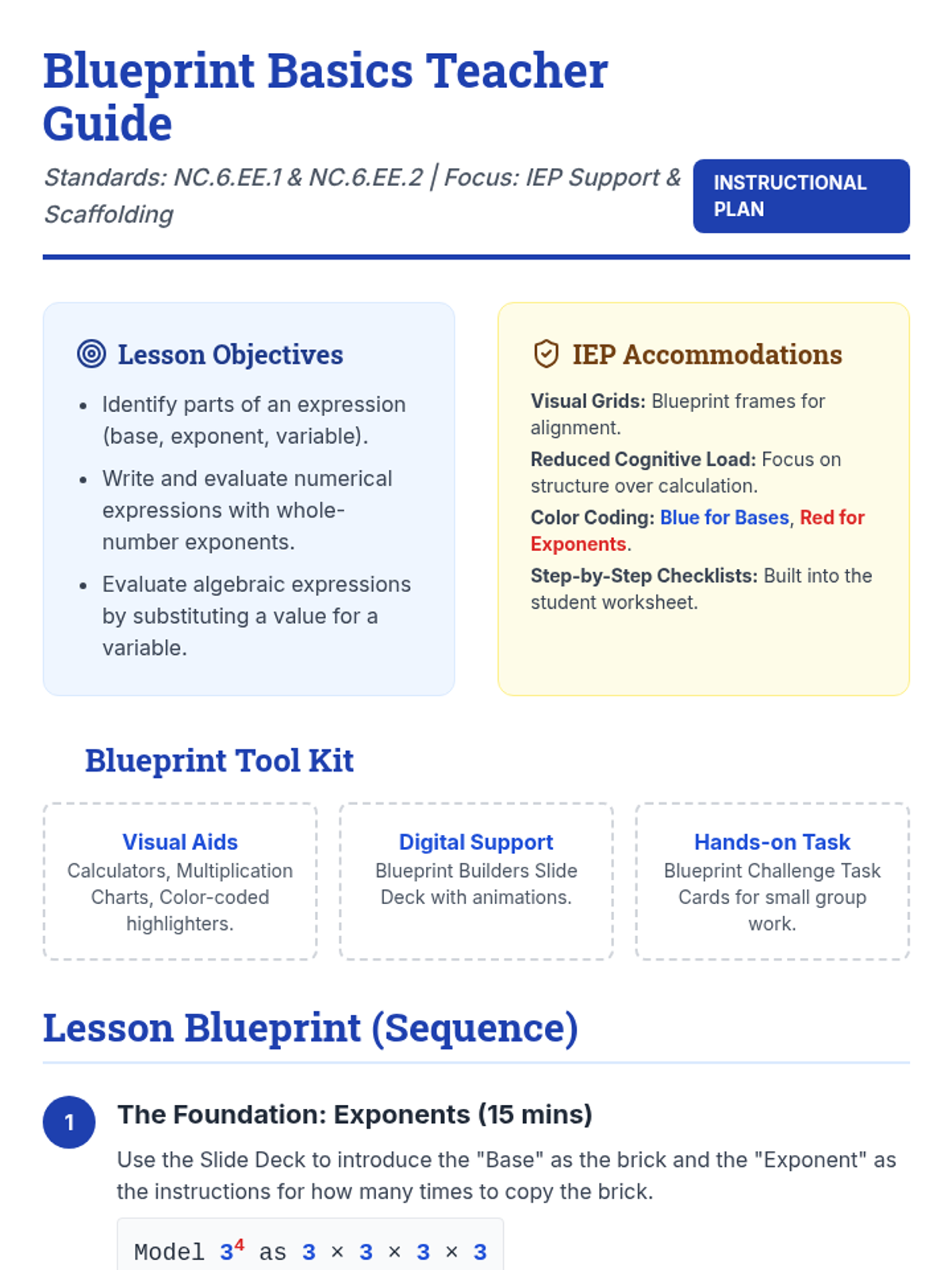
A revised teacher guide for a lesson on NC.6.EE.1 and NC.6.EE.2. Fixed LaTeX rendering issues, improved page breaks, and added color-coding for bases and exponents to match instructional strategies.
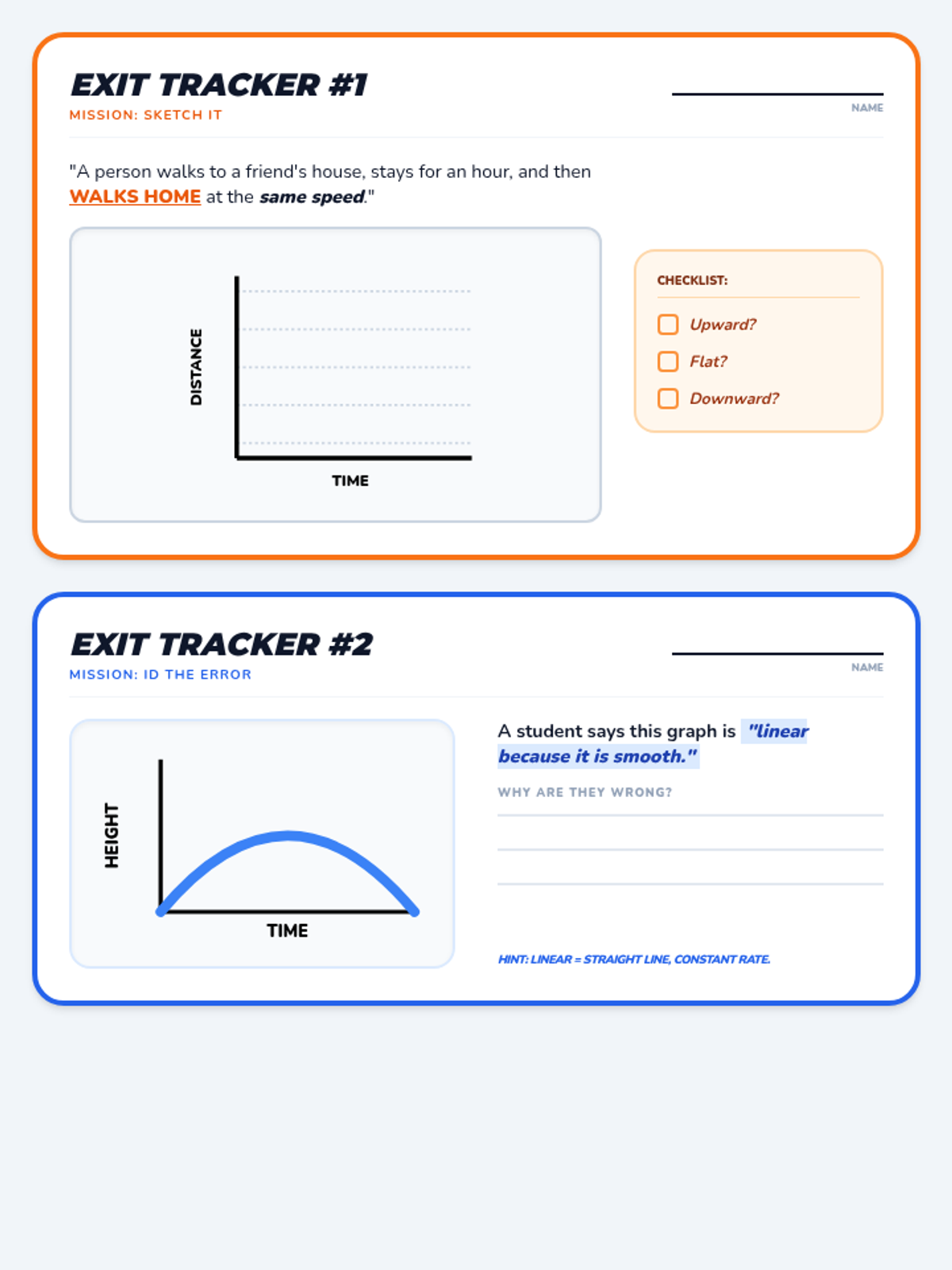
Two quick exit tickets for formative assessment: one focusing on sketching a distance-time graph and another on identifying misconceptions about linear vs. nonlinear functions. Standardized to fit on one page.
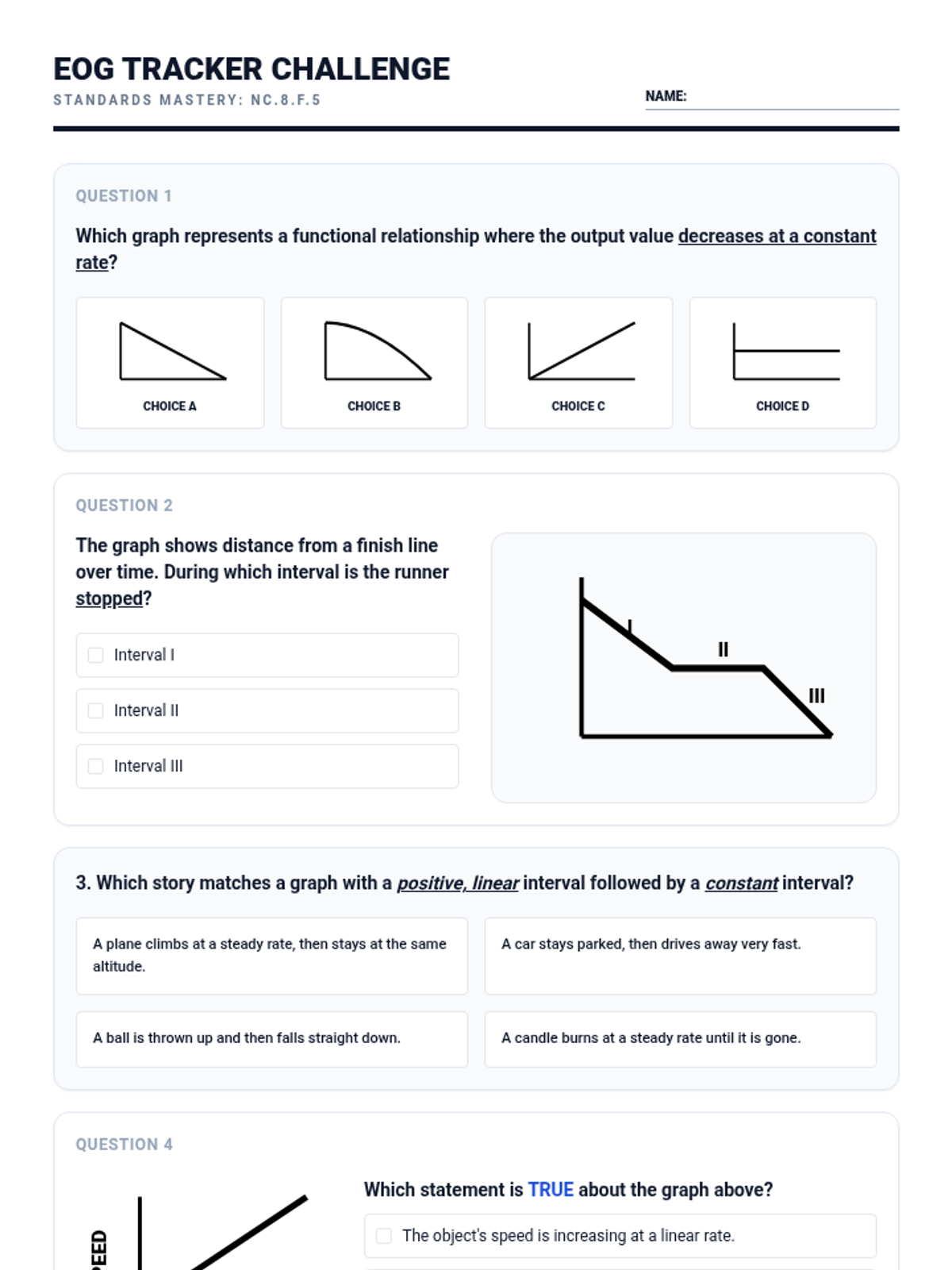
A complete 10-item EOG-style assessment for NC.8.F.5. Features standardized multiple-choice layouts, clear visual intervals, and qualitative analysis items. Standardized across two pages with consistent styling.
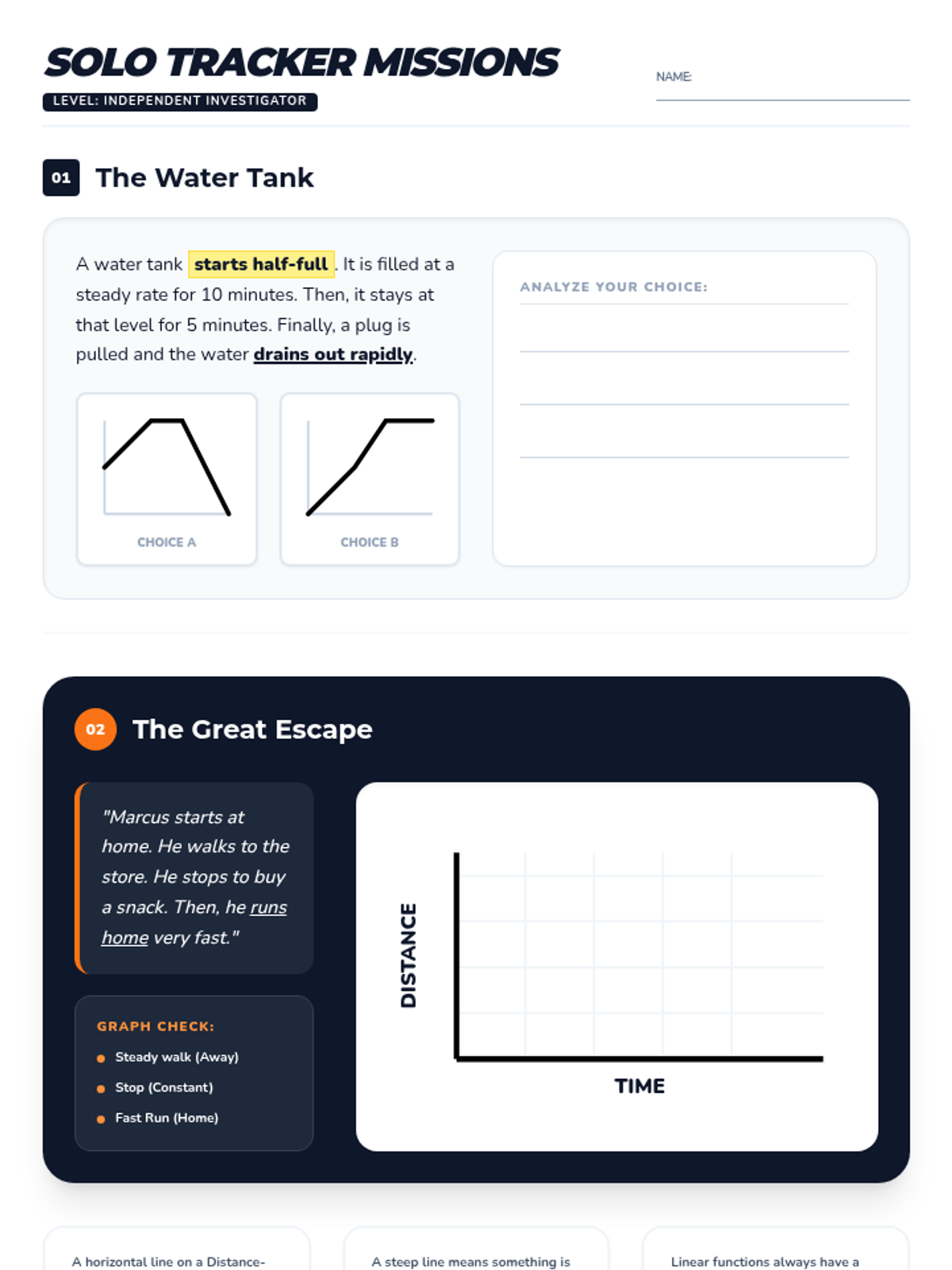
An individual practice worksheet for students to apply their knowledge of functional relationships. Features an improved layout for Mission 2 on a single page and corrected graph behaviors.
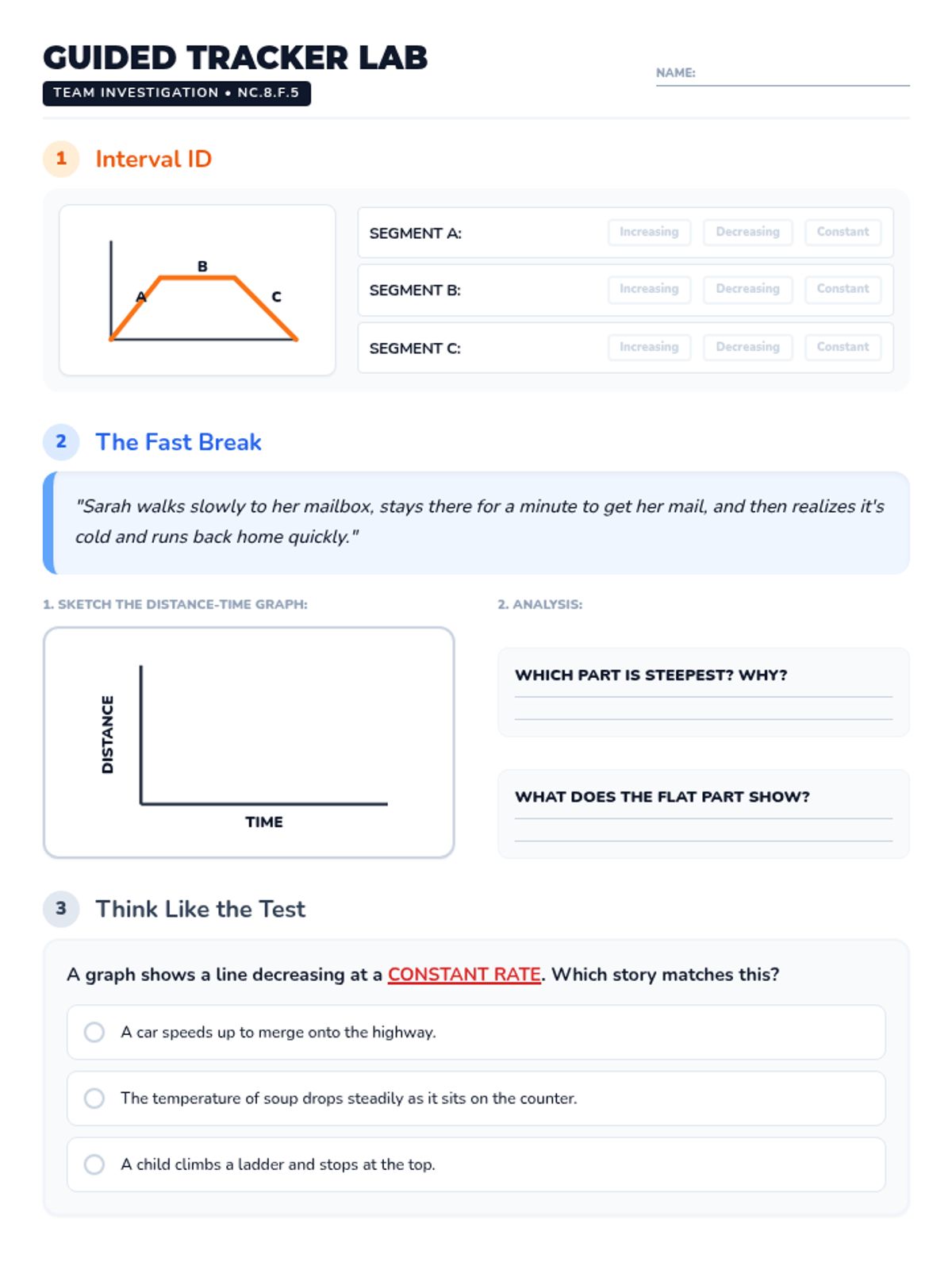
A scaffolded guided practice worksheet for students to identify intervals, sketch graphs from stories, and analyze functional relationships. Standardized to fit on a single page.
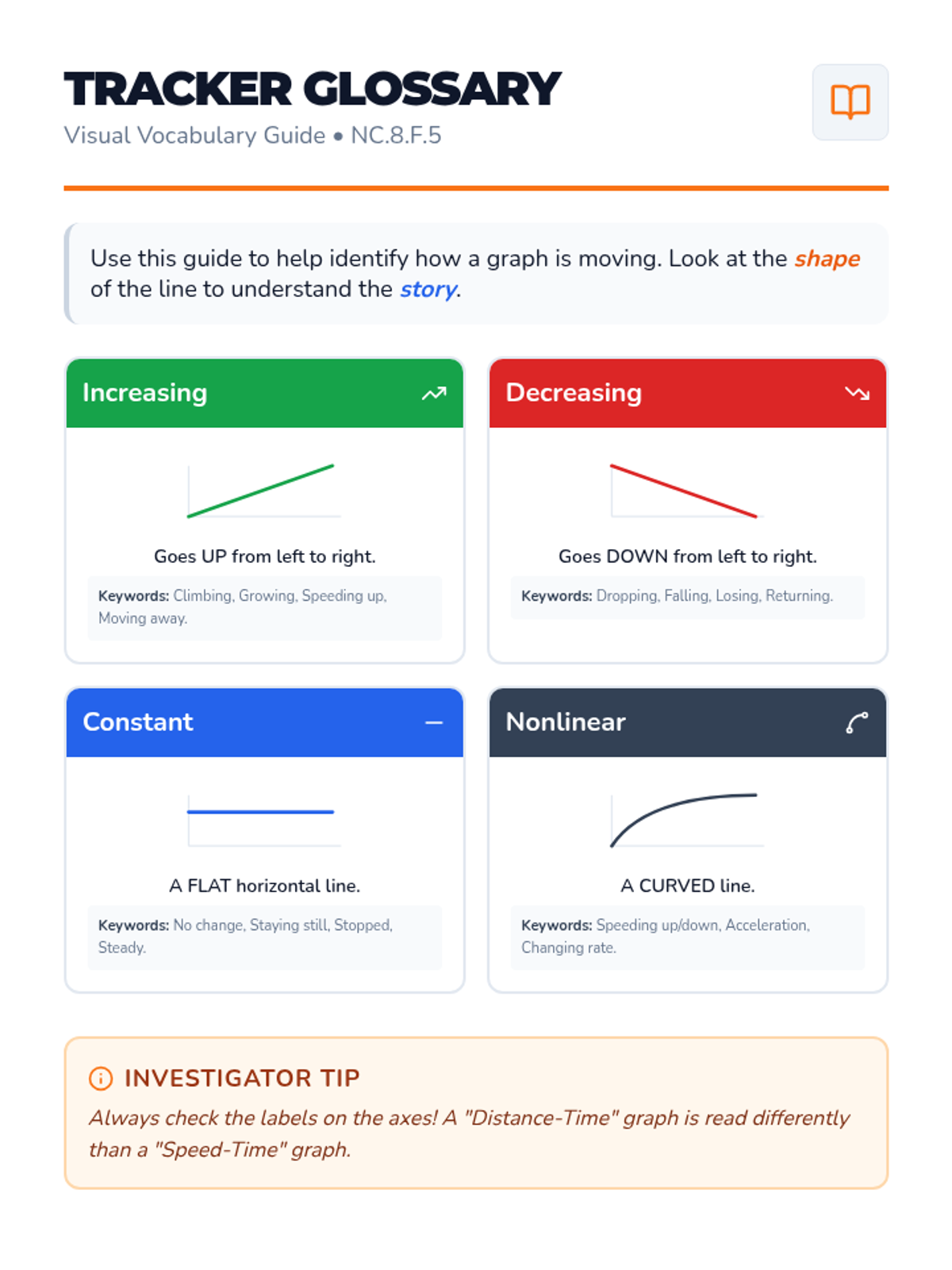
A visual vocabulary reference sheet for students, explaining increasing, decreasing, constant, and nonlinear functional relationships with keywords and graph examples. Standardized on one page.
Instructional slides for NC.8.F.5 focusing on qualitative graph analysis, including increasing/decreasing intervals, constant functions, and matching stories to motion. Includes guided practice slides.
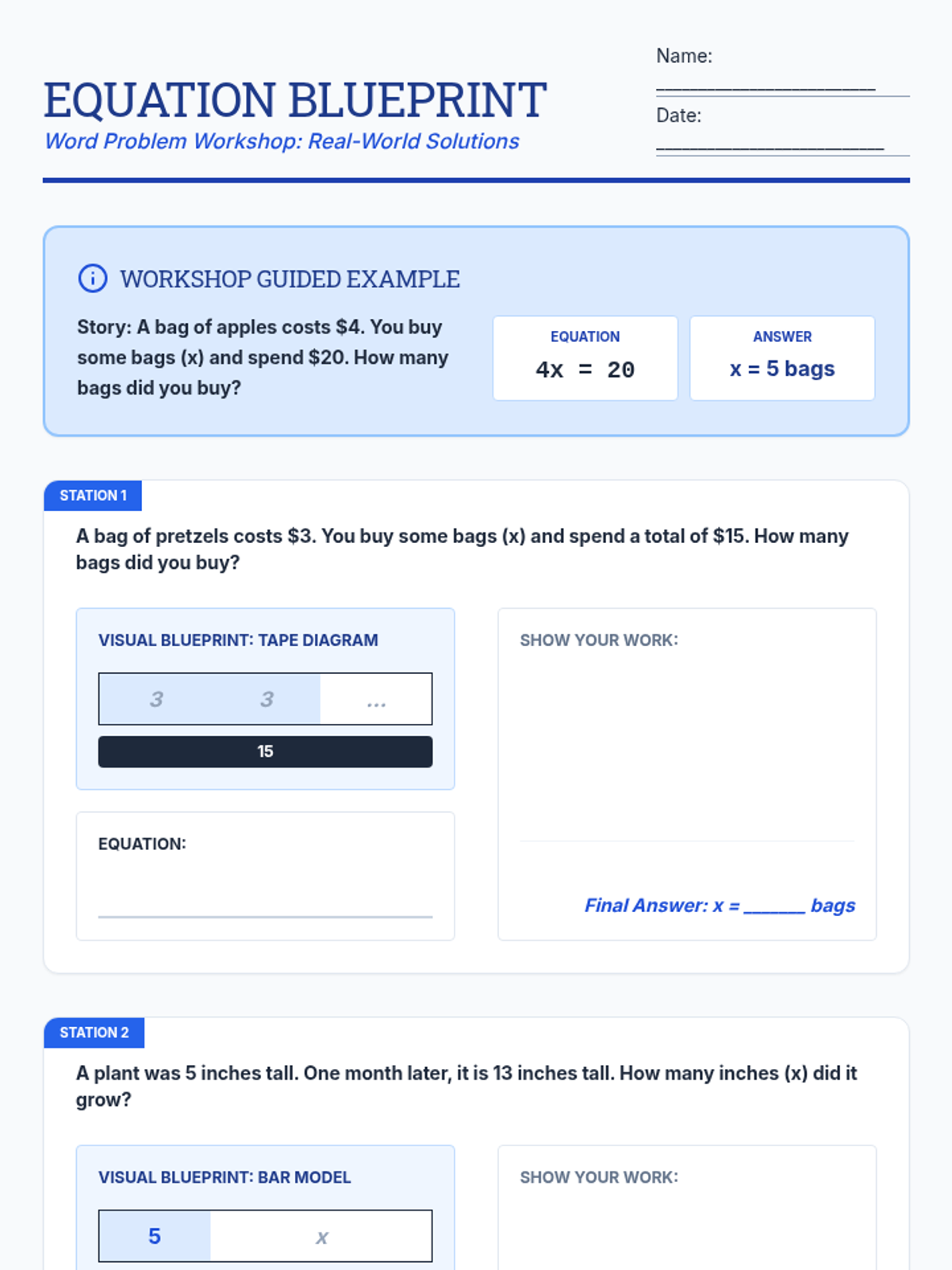
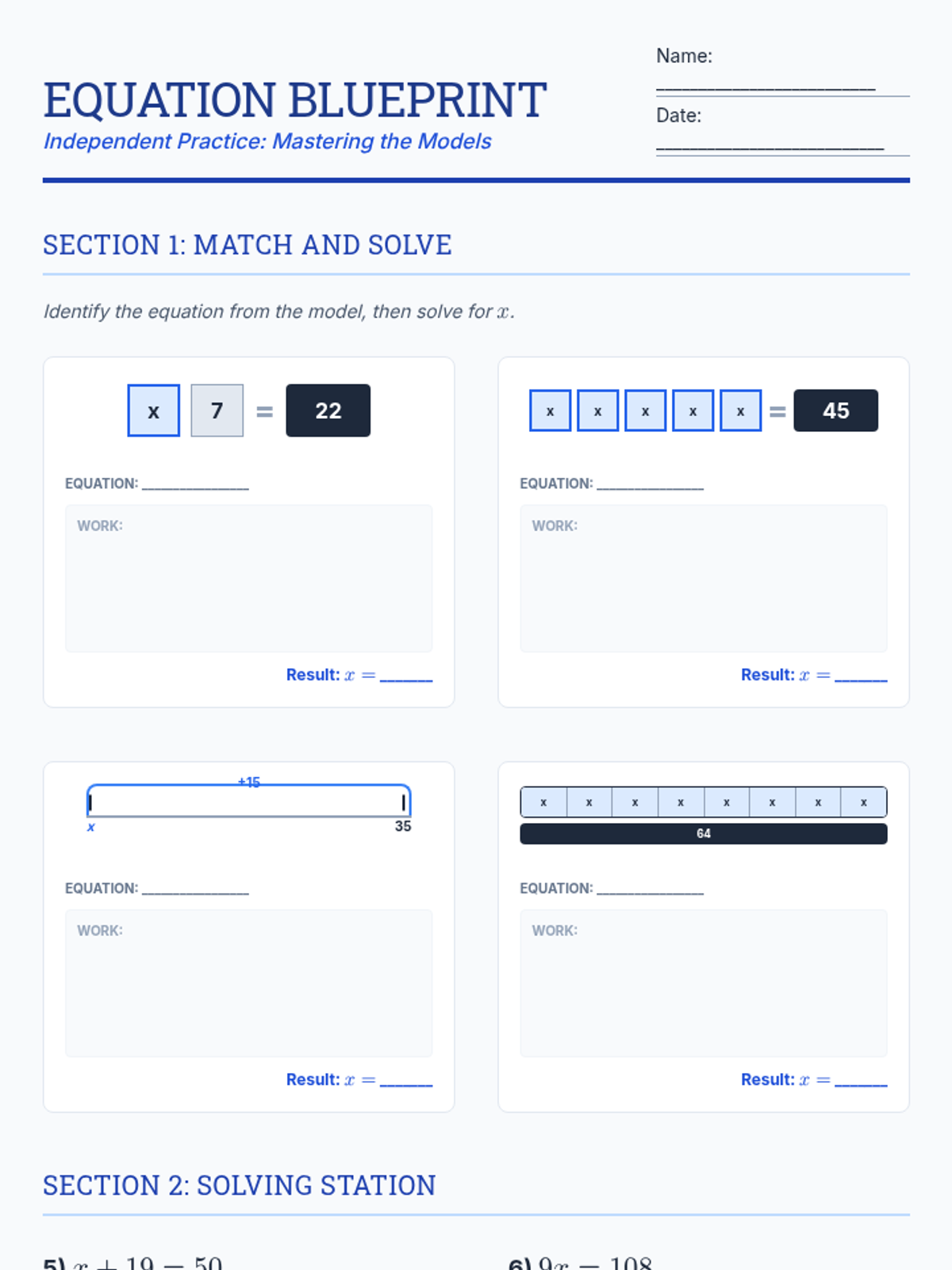
A dedicated word problem workshop for solving one-step equations in real-world contexts. Features scaffolded "Station" layouts with guided examples, visual blueprints (tape diagrams, bar models), and large work areas for student handwriting.
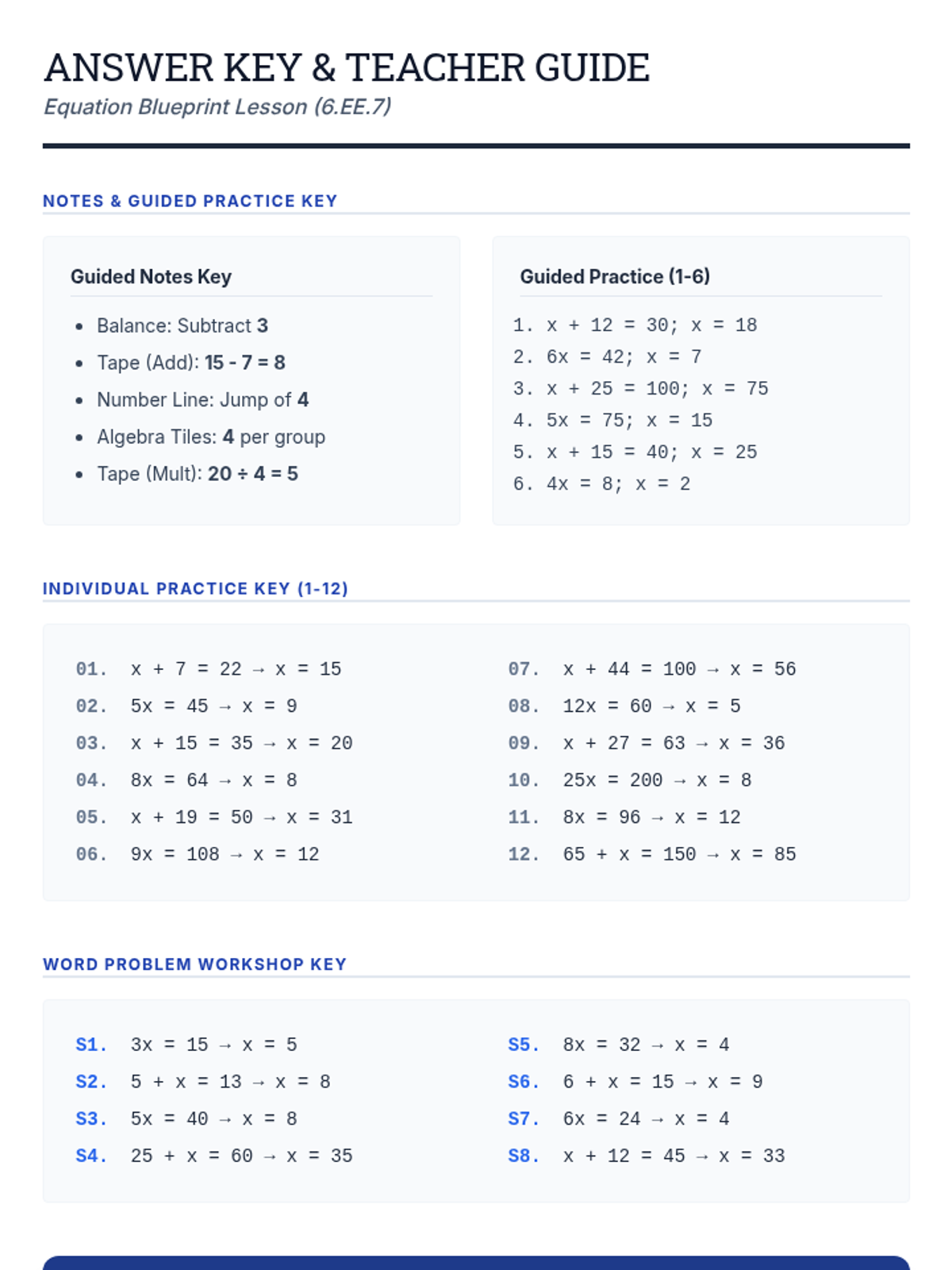
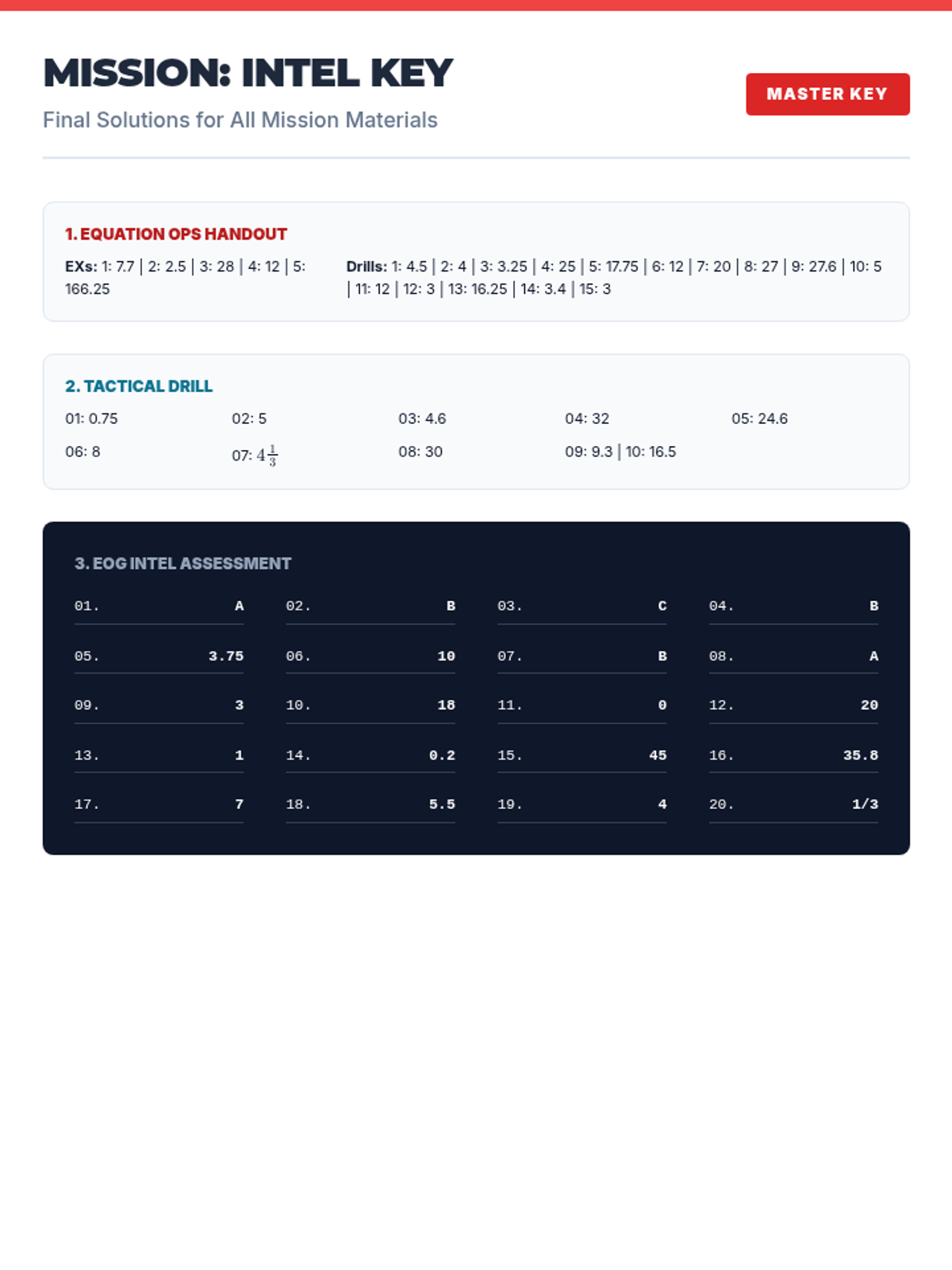
A comprehensive teacher resource containing answer keys for all lesson materials and instructional strategies specifically for supporting struggling learners. Fixed rendering issues with variables and improved section layout.
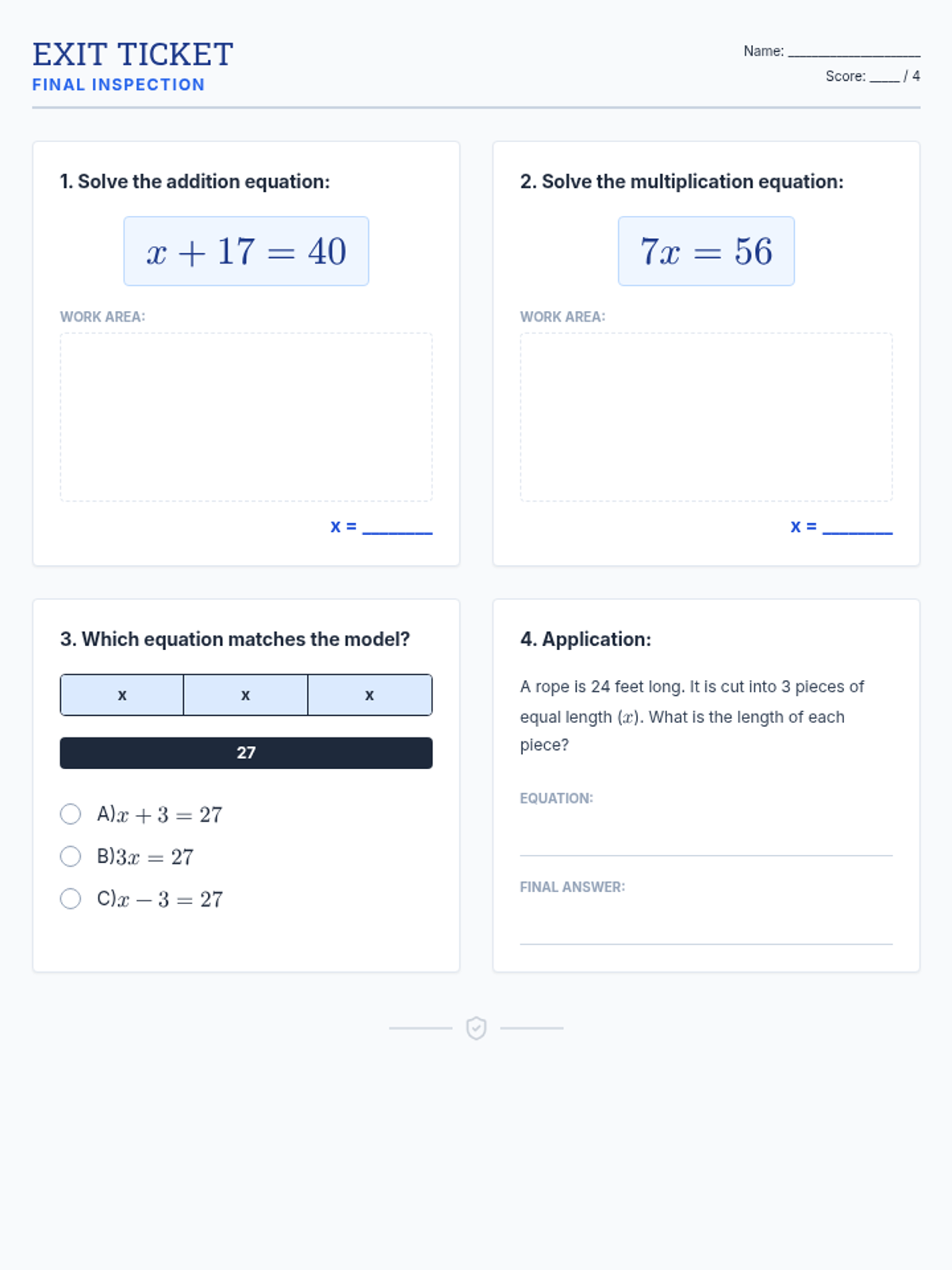
A 4-question exit ticket to assess student understanding of solving one-step addition and multiplication equations using computations, models, and real-world applications.
A scaffolded individual practice worksheet with 12 problems. Includes visual model identification, computational fluency with inverse operations, and real-world word problem applications for one-step equations.
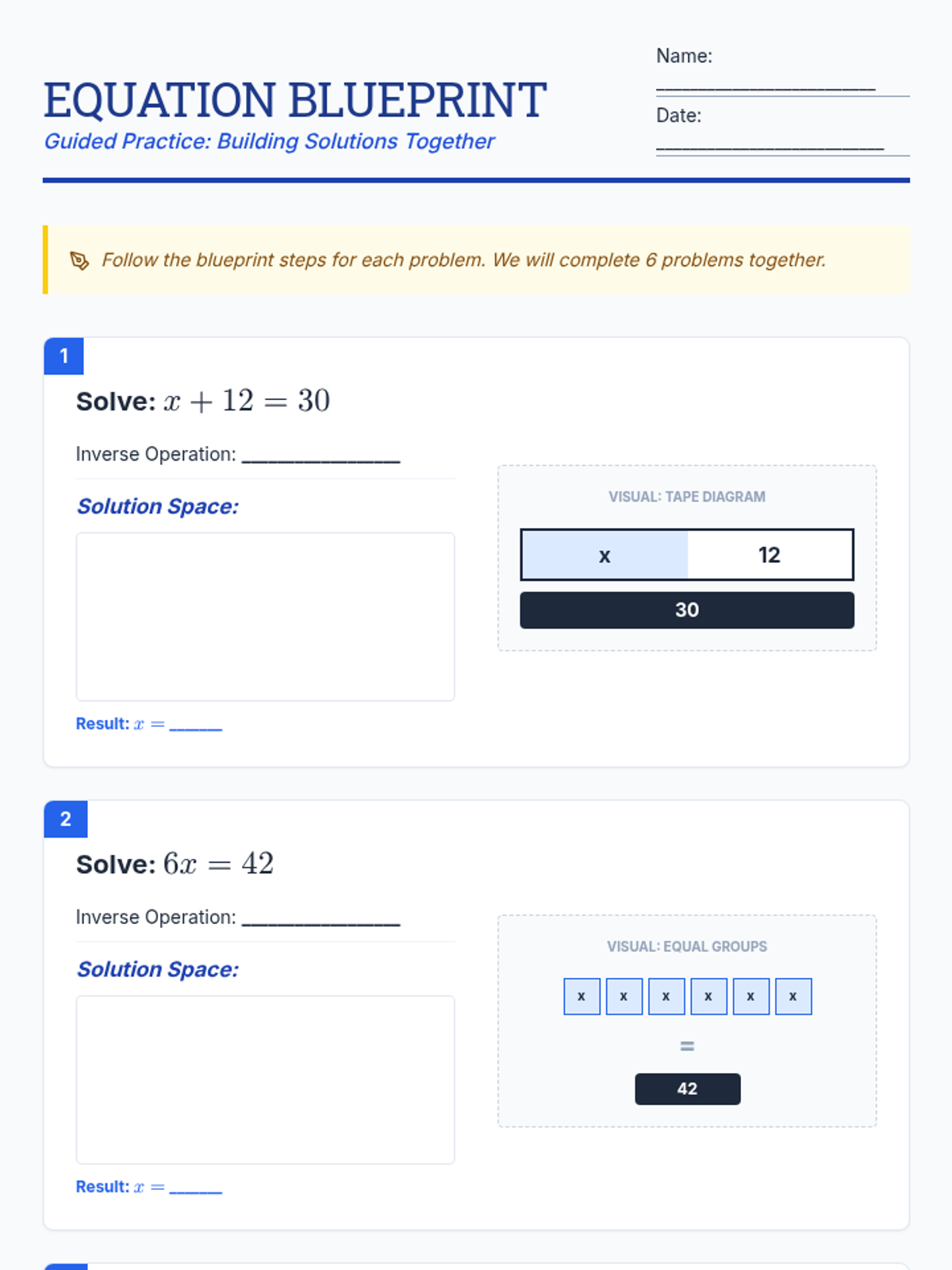
A guided practice worksheet focusing on solving equations using step-by-step prompts and visual models like tape diagrams and equal groups. Includes a real-world scenario to connect equations to practical applications.
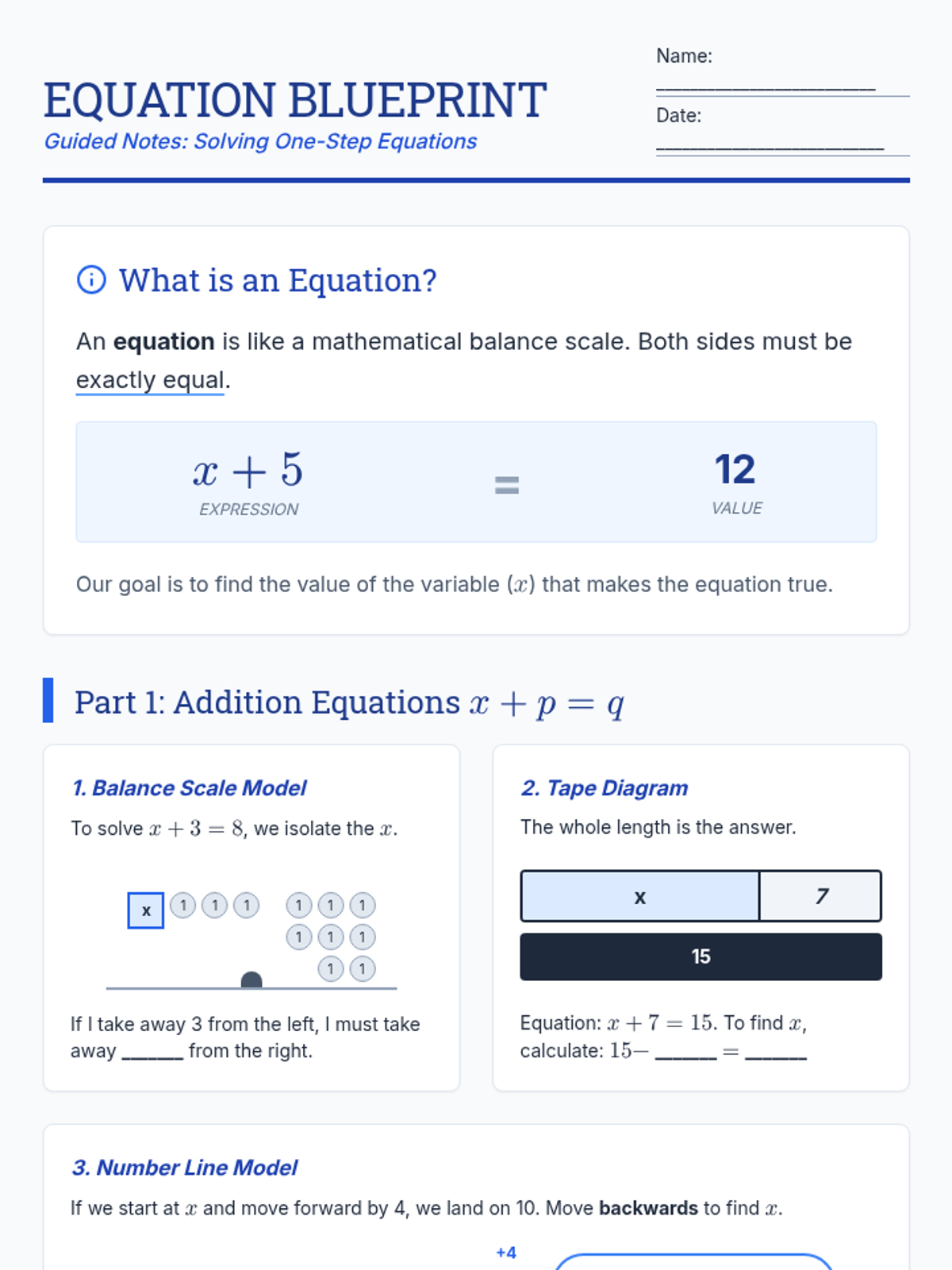
Guided notes for solving one-step addition and multiplication equations, featuring balance scales, tape diagrams, and algebra tiles. Designed for students to learn the concept of inverse operations through visual modeling.
A comprehensive answer key for all materials in the Equation Operations lesson. Revised to ensure mathematical variables render correctly, page breaks keep headers with content, and includes step-by-step logic for word problems. Now features sequential numbering for the assessment.
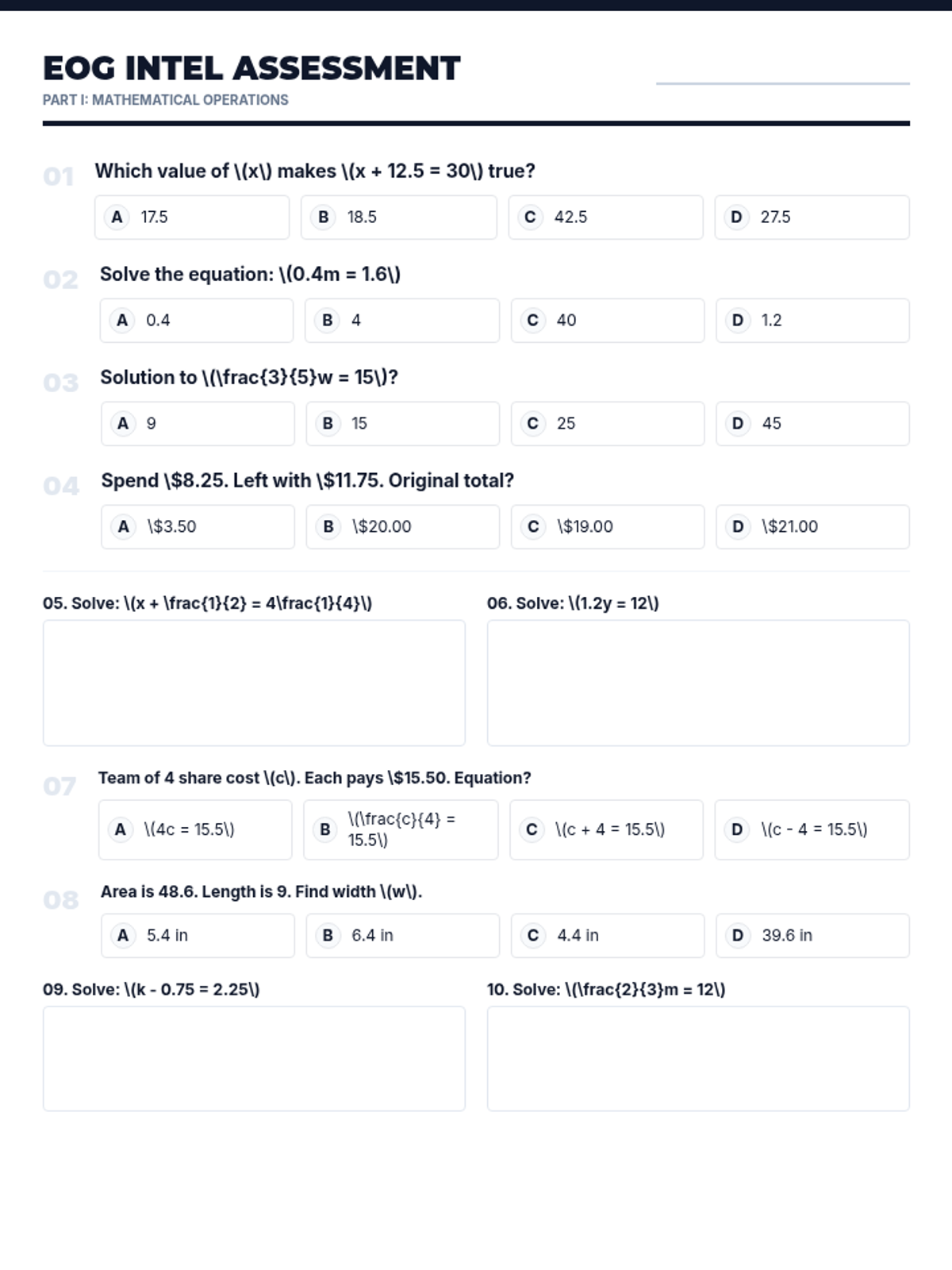
A rigorous EOG-style assessment for NC 6.EE.7. Revised to standardized multiple choice styling, ensure logical page breaks, and provide larger student work areas for all questions. Optimized for clear 10-question distribution per page.
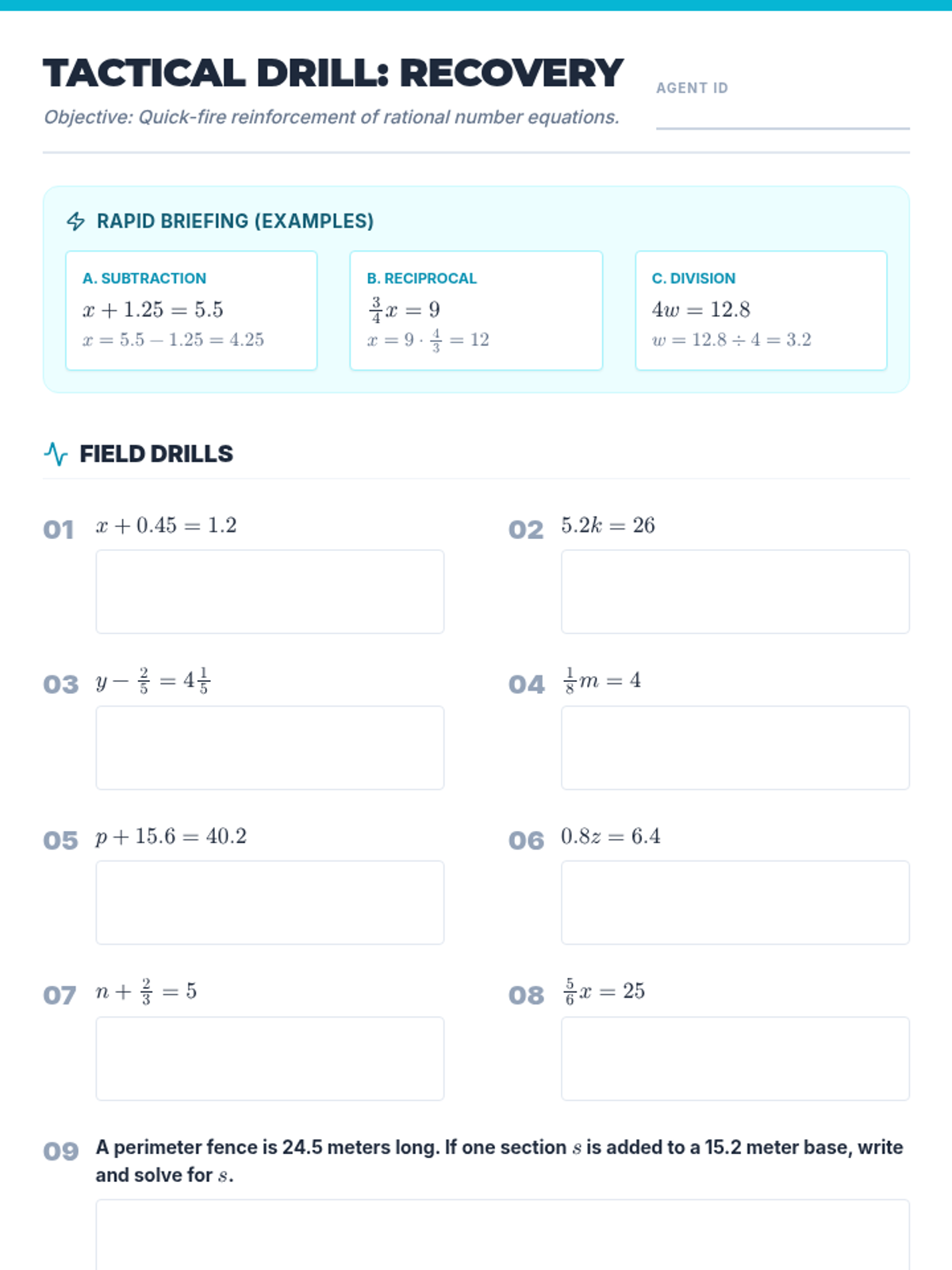
A supplementary recovery drill worksheet featuring 3 worked examples and 10 field practice questions. Revised to fit all content on a single page with improved legibility and larger work areas for word problems. Now features larger text and standardized boxes.
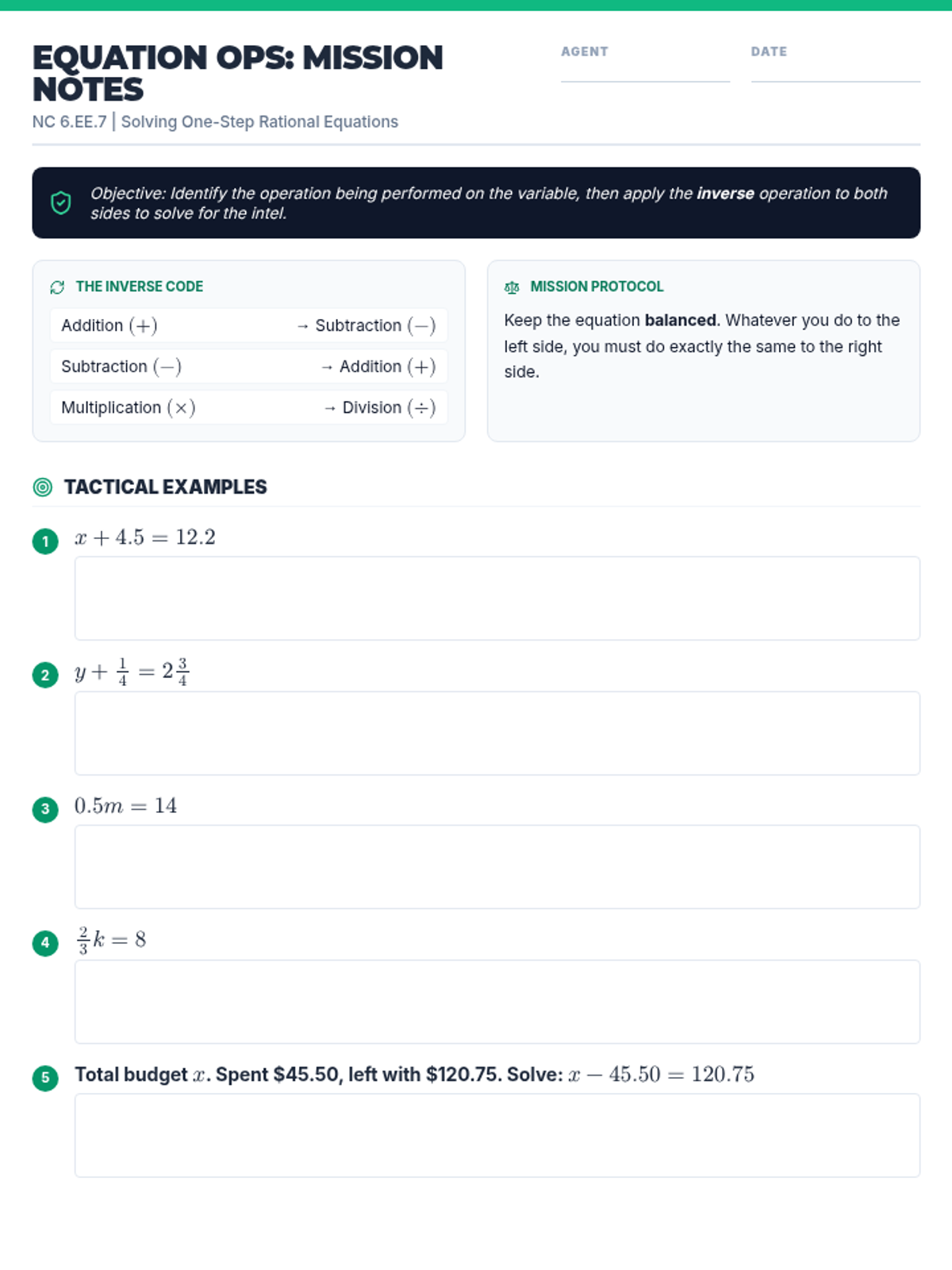
A comprehensive mission-themed lesson handout for NC 6.EE.7. Includes guided notes on inverse operations, 5 tactical examples, and 15 field practice drills covering decimal and fraction equations. Revised for better page flow and work space.
A vibrant presentation for direct instruction on fraction equivalence. It introduces the "Golden Rule" of scaling and the "Butterfly Method" for cross-multiplication with clear, large-scale visuals and practice cases.
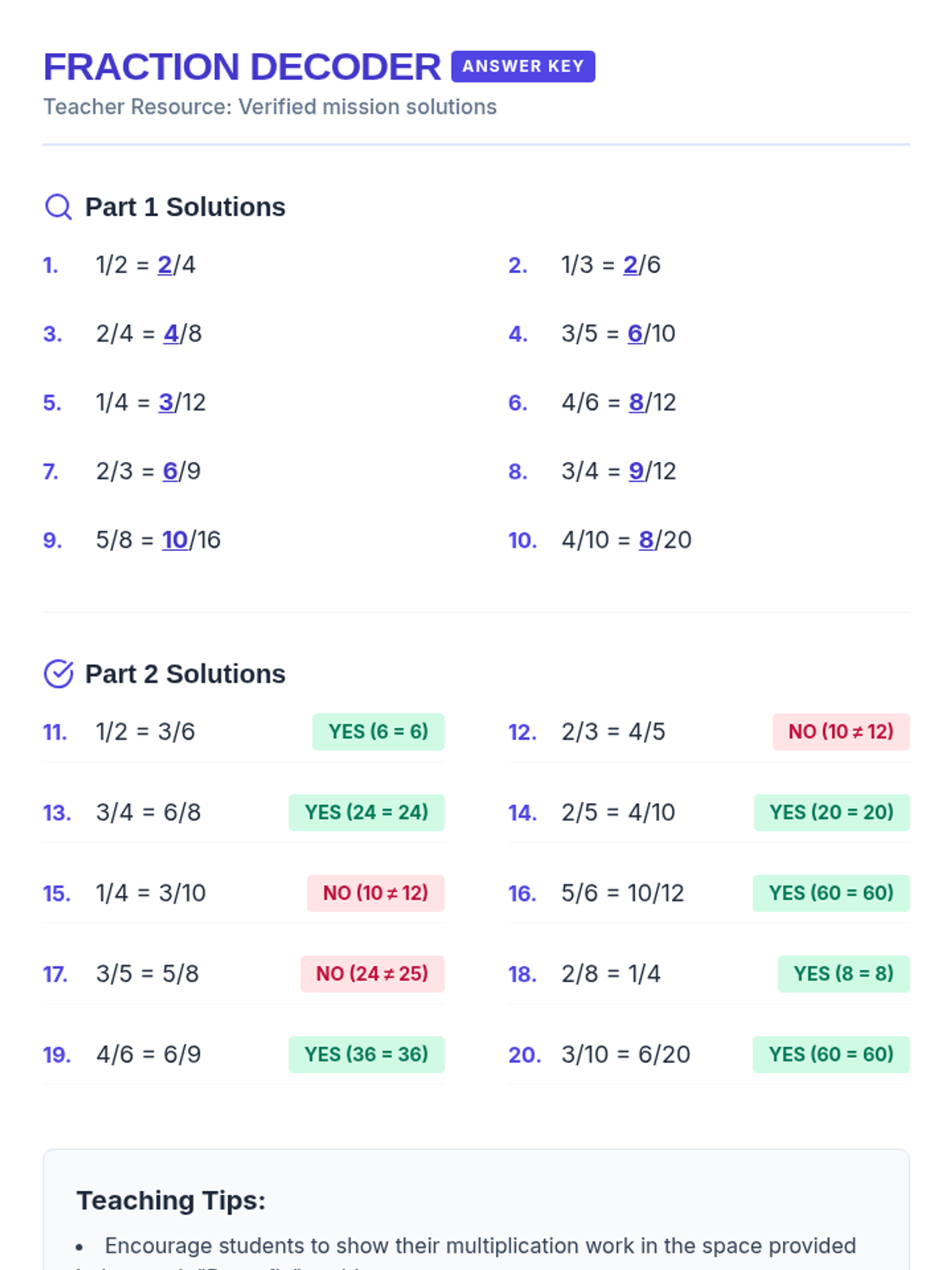
A teacher answer key for the Fraction Decoder worksheet, providing solved values for the missing numerators and the cross-multiplication results (with logic) for the equivalence checks. Includes brief teaching tips for facilitating the lesson.
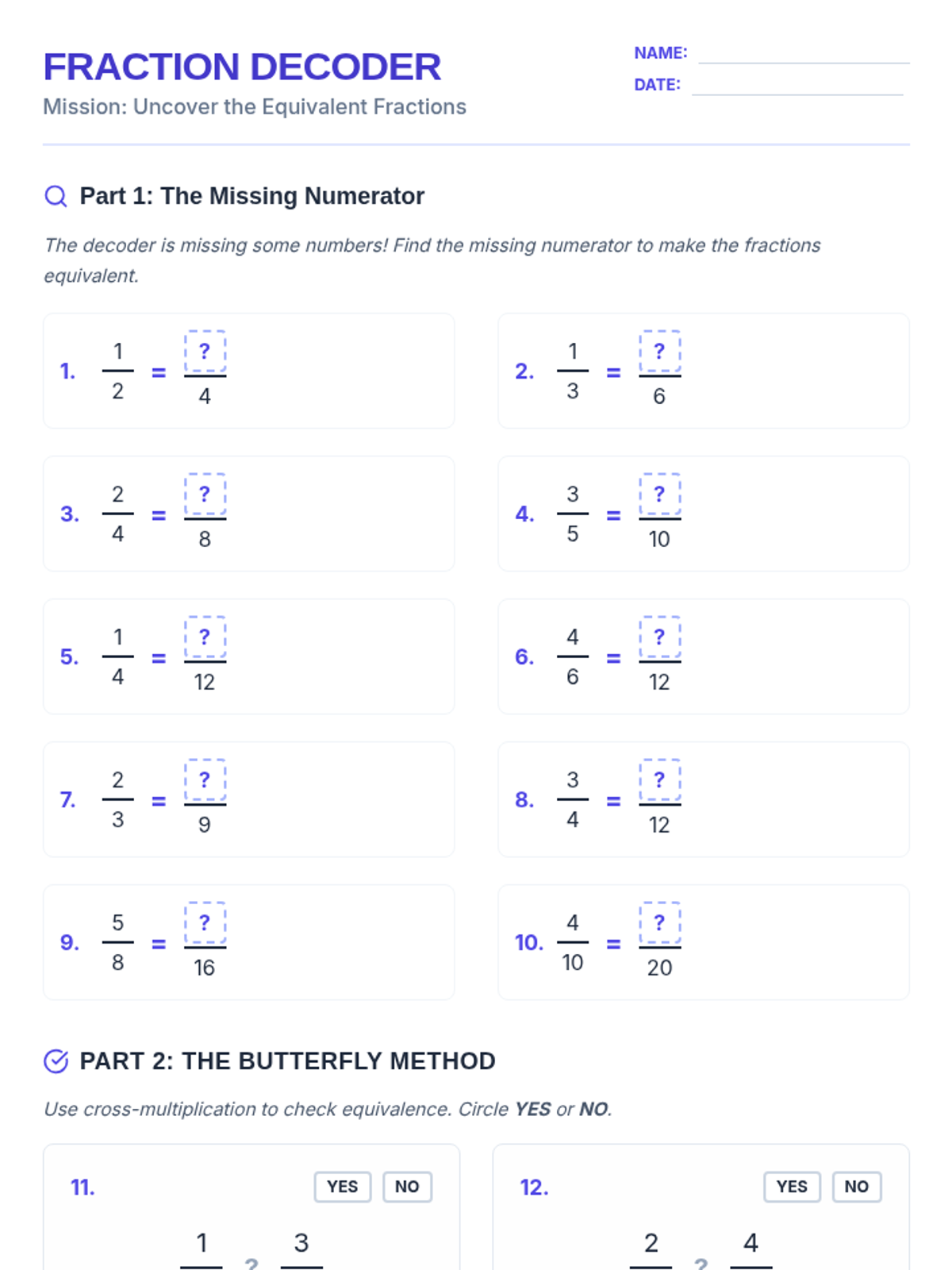
A 20-question review worksheet for 3rd-grade students to practice finding missing numerators for equivalent fractions and verifying fraction equivalence using cross-multiplication. The layout features clear student work areas and a consistent "Fraction Decoder" theme.
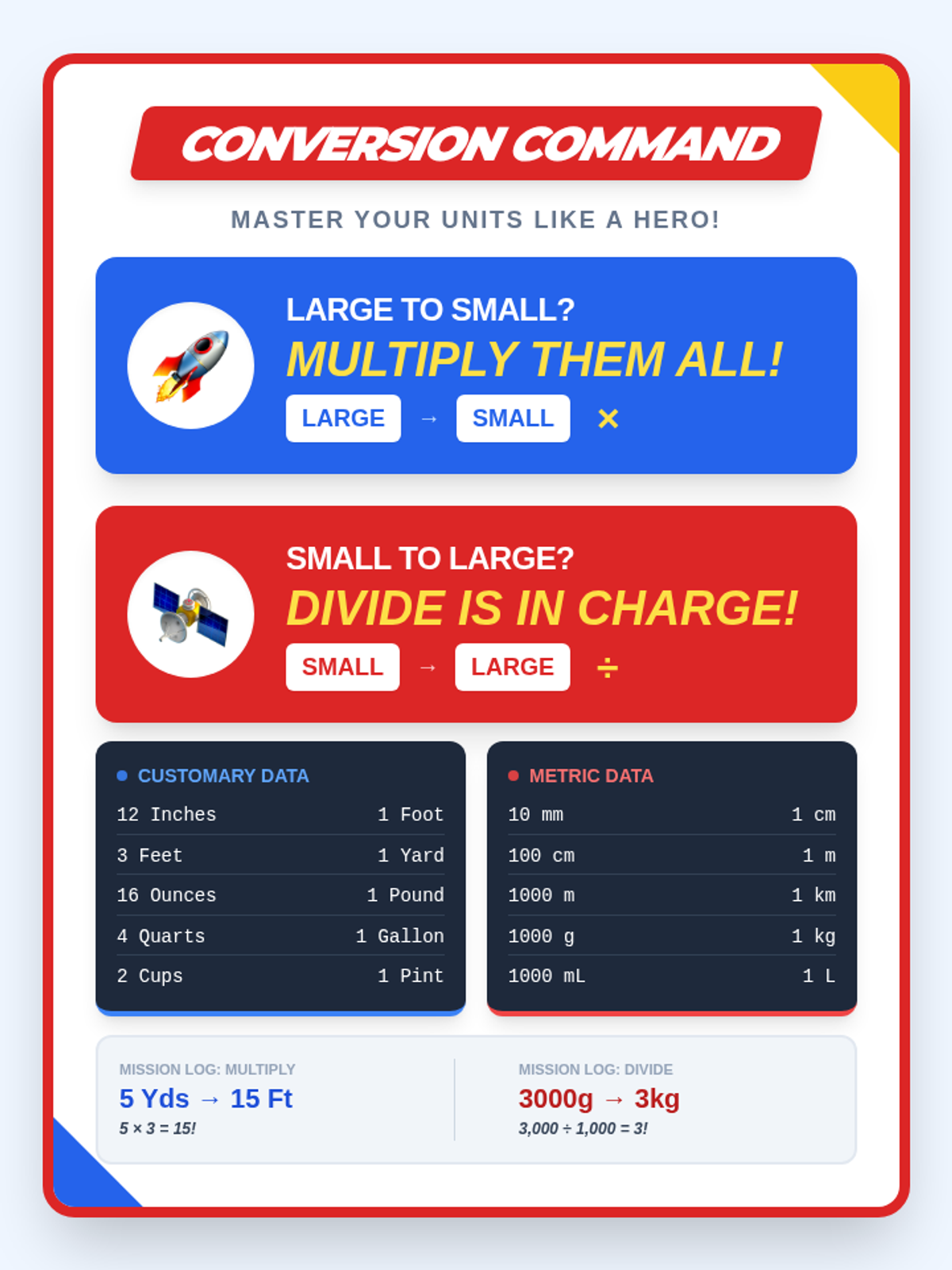
A superhero-themed unit conversion poster featuring the 'Large to Small, Multiply them all! / Small to Large, Divide is in Charge!' analogy. Includes reference charts for both Metric and Customary systems with a high-energy comic book aesthetic.
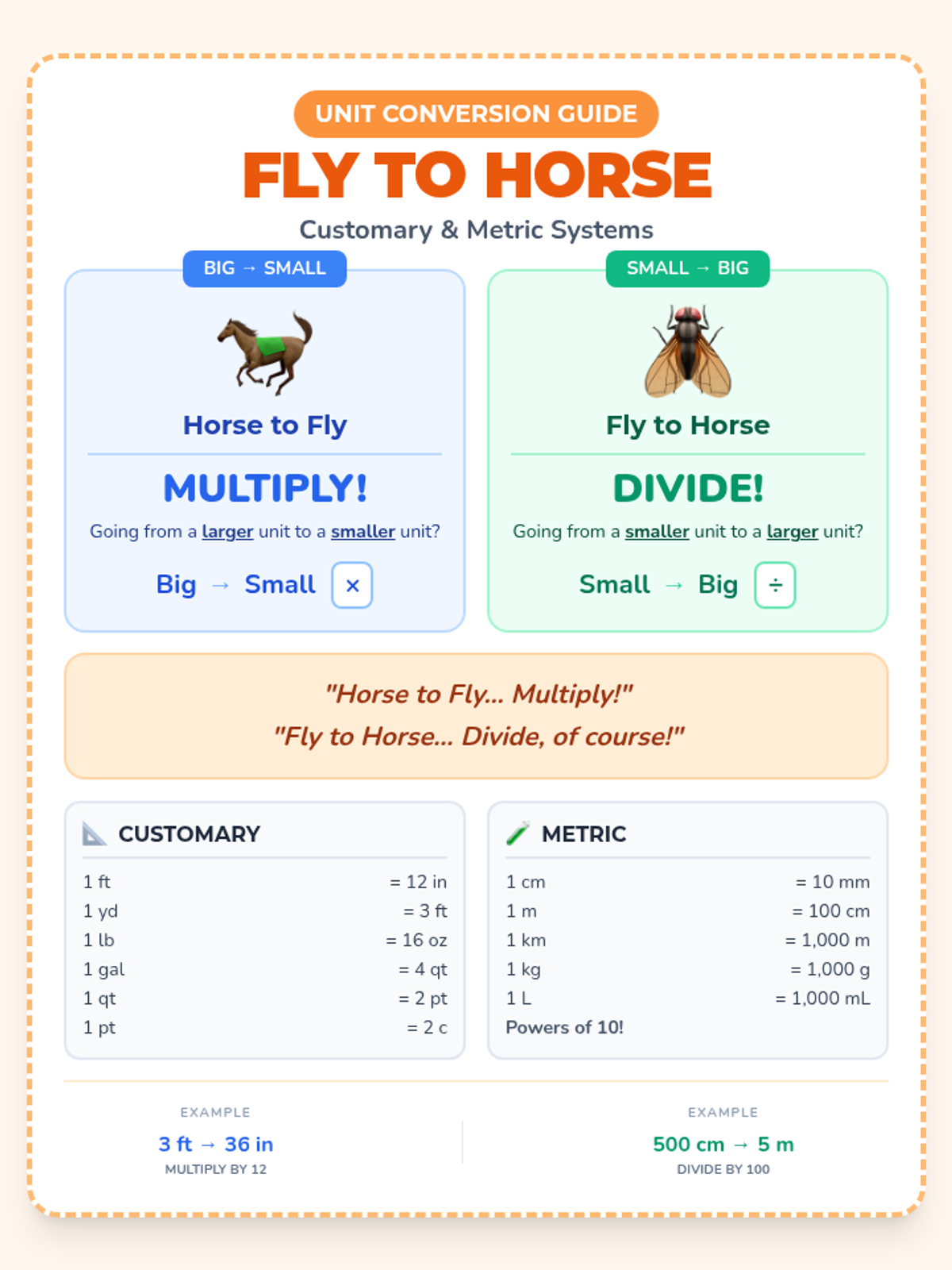
A vibrant, classroom-ready anchor chart teaching the 'Fly to Horse' unit conversion strategy for both Customary and Metric systems. It features clear visual cues, a catchy mnemonic rhyme, and quick-reference conversion tables.
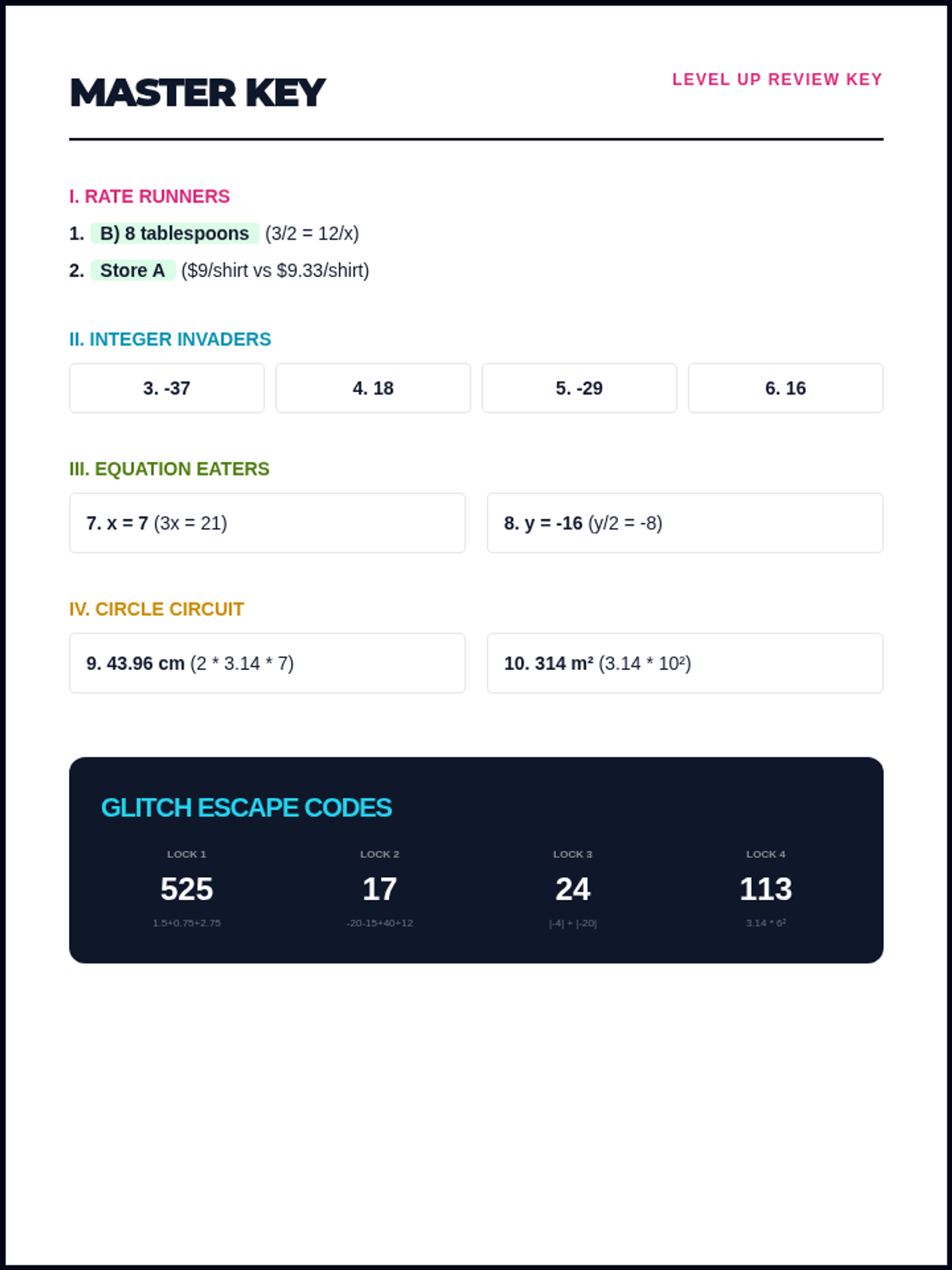
A complete answer key and teacher reference guide for the Level Up Quiz and the Glitch Escape Activity. Revised to correct Lock 2 logic, improve legibility, and remove internal scratchpad text.
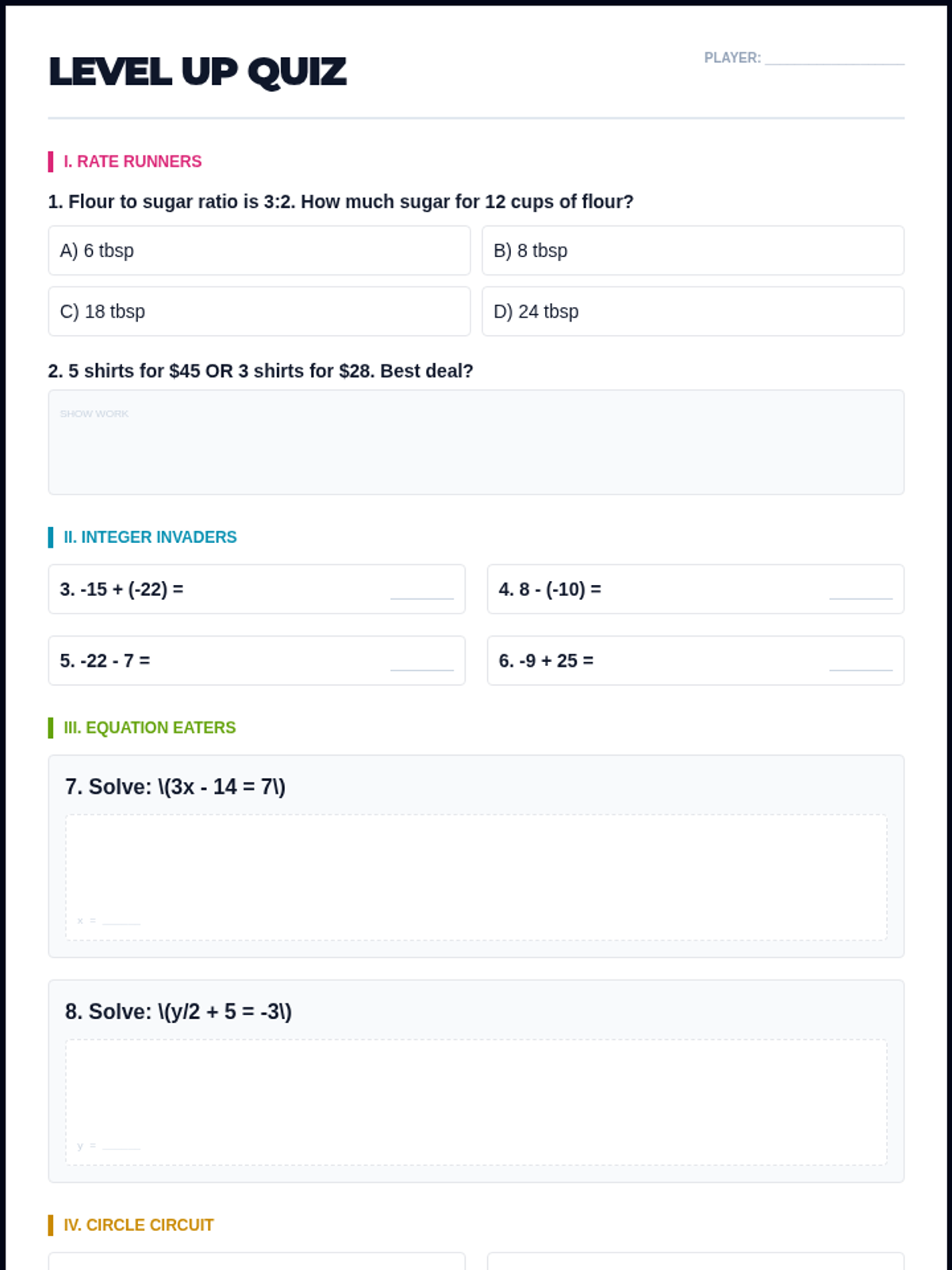
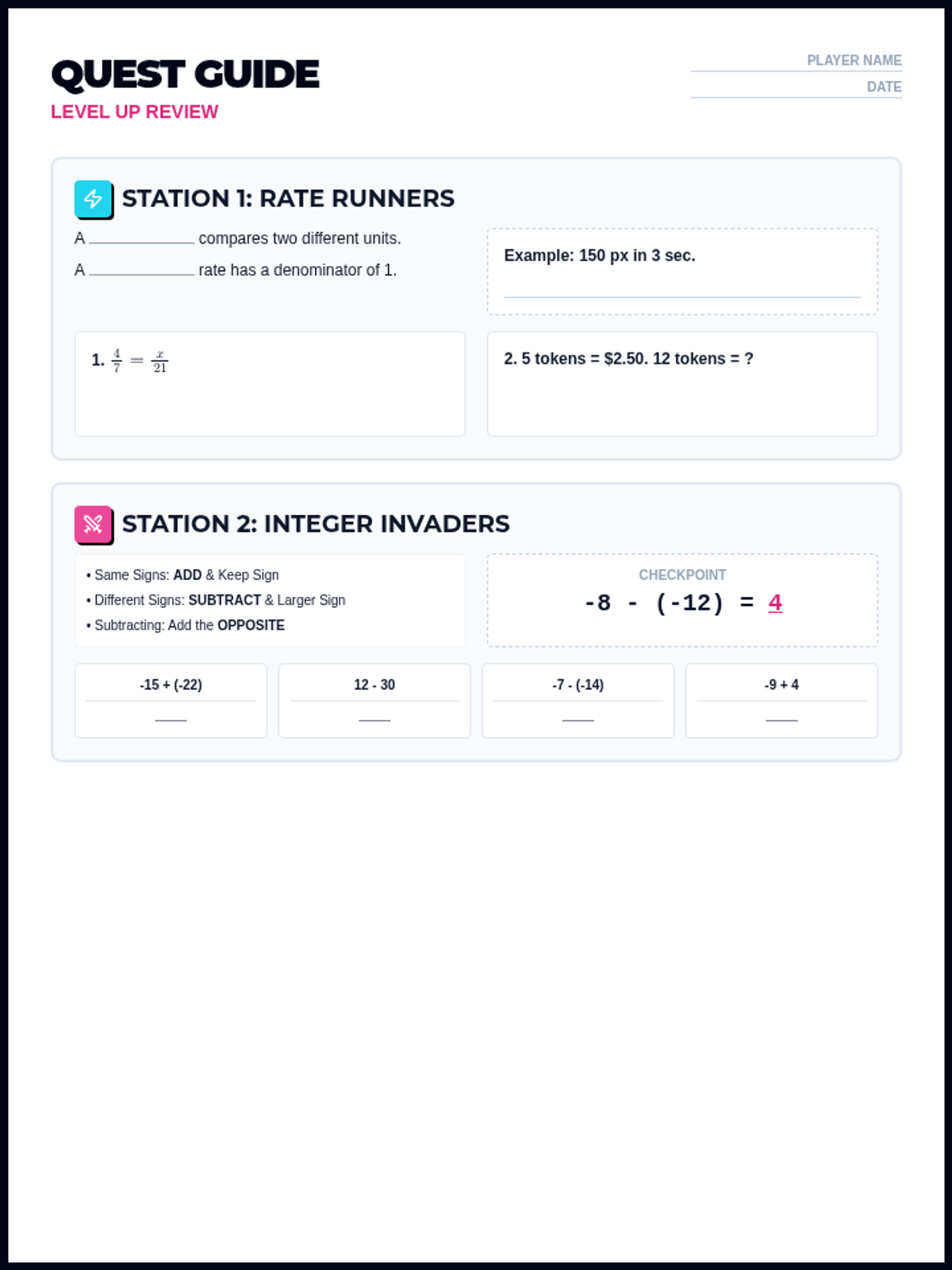
A 10-question unit quiz covering proportions, integers, equations, and circles. Revised for improved page flow, robust math rendering, and larger show-your-work areas.
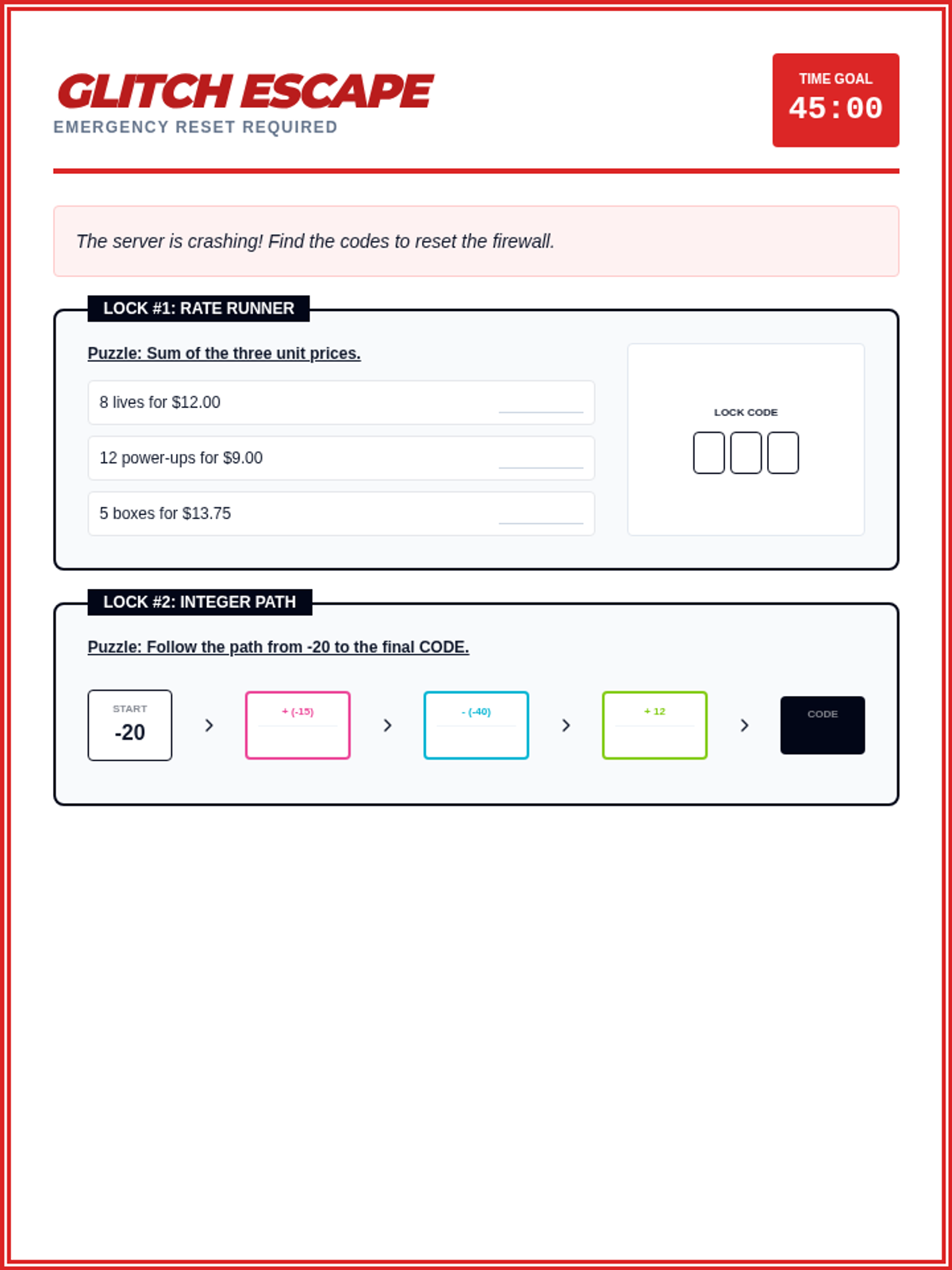
An immersive 7th-grade math escape room activity themed around a system glitch in a retro arcade. Challenges students to solve unit rates, integer paths, absolute value equations, and circle area to "unlock" the server. Revised for better page breaks and layout.
A vibrant, retro-arcade themed slide presentation reviewing unit rates, integers, two-step equations, and circle geometry. Revised for better slide transitions, improved contrast, and integrated examples.
A dual-page guided notes and practice worksheet for 7th-grade math topics, featuring a retro arcade theme. Includes sections for unit rates, integer operations, equations, and geometry. Revised for better page breaks and larger student work areas.
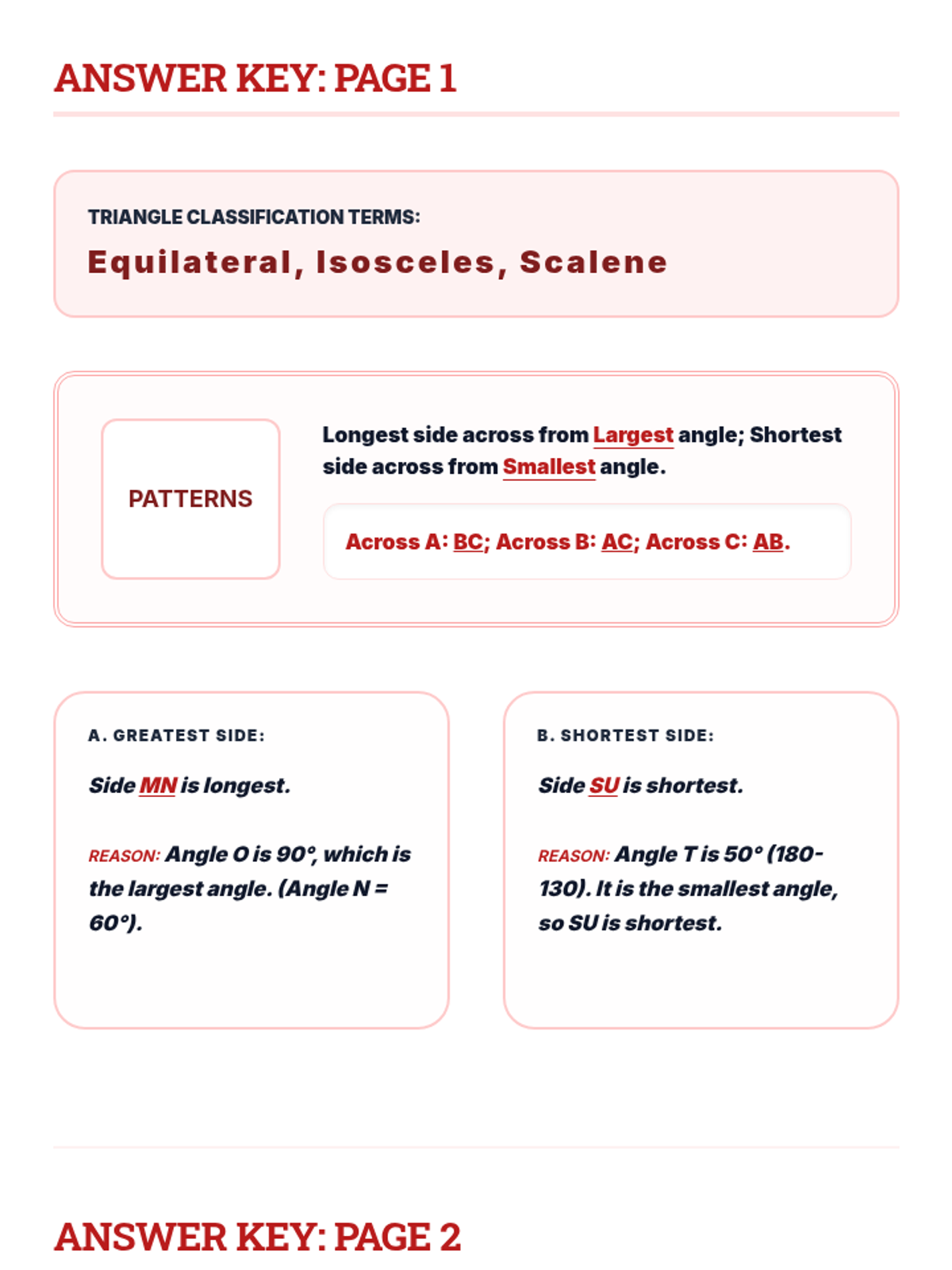
Answer key for the Bridge Builder Handout, mirroring the original PDF's two-page layout. Includes numerical answers, explanation logic, and measurement values for lines A-F. Consolidated for teacher use.
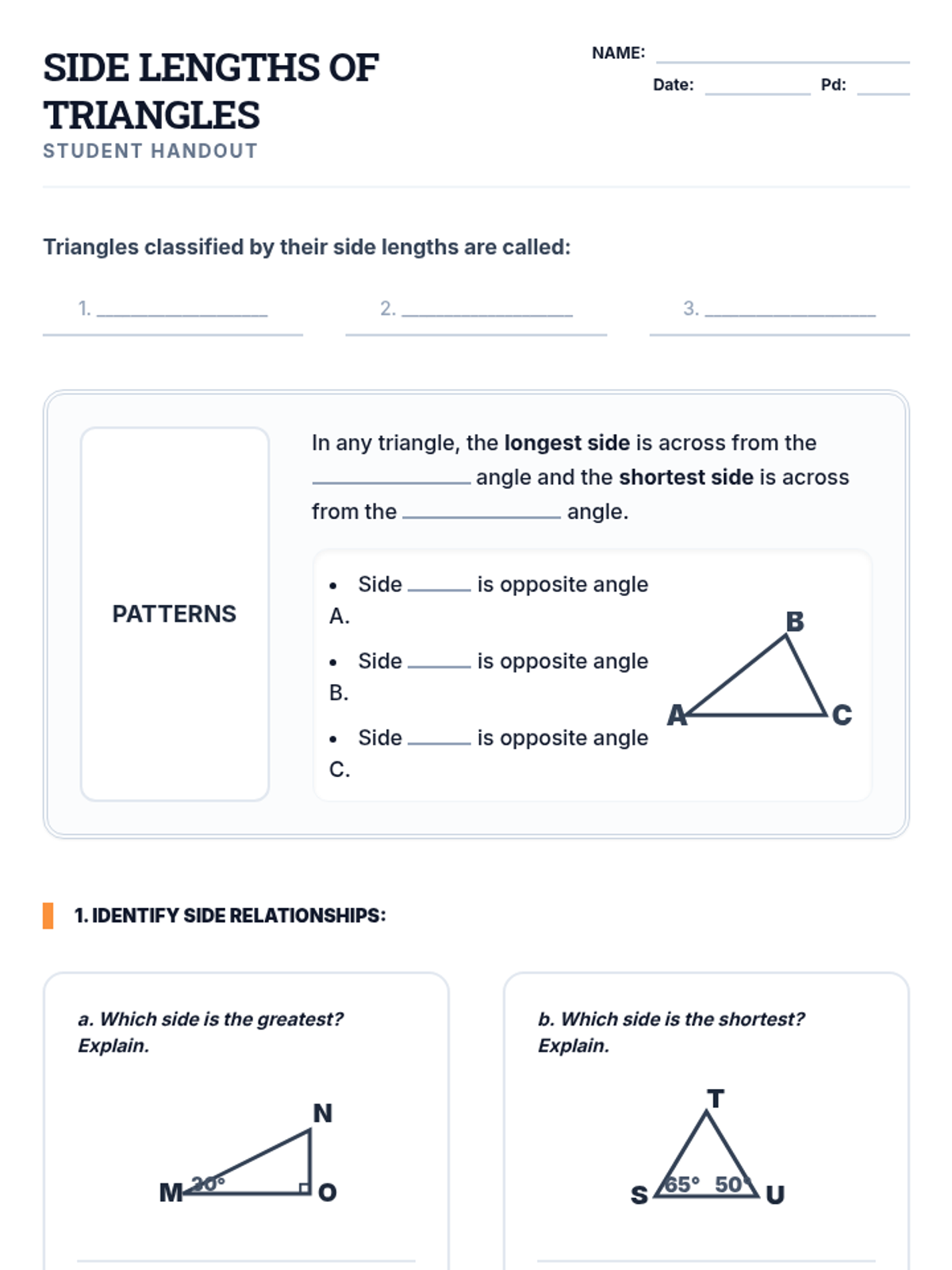
A two-page student handout mirroring the original PDF layout. Covers triangle classification, the relationship between side lengths and opposite angles, and the Triangle Inequality Theorem. Includes measurement practice and whole-number math problems. Optimized for single-page printing per section.
A 14-slide presentation for the 'Triangle Side Truths' lesson, maintaining the blueprint geometry theme. Covers classification of triangles (equilateral, isosceles, scalene) and the Triangle Inequality Theorem with clear visual examples, reliable formula rendering, and a dedicated practice answer key. Revised to fix layout artifacts and label alignment.
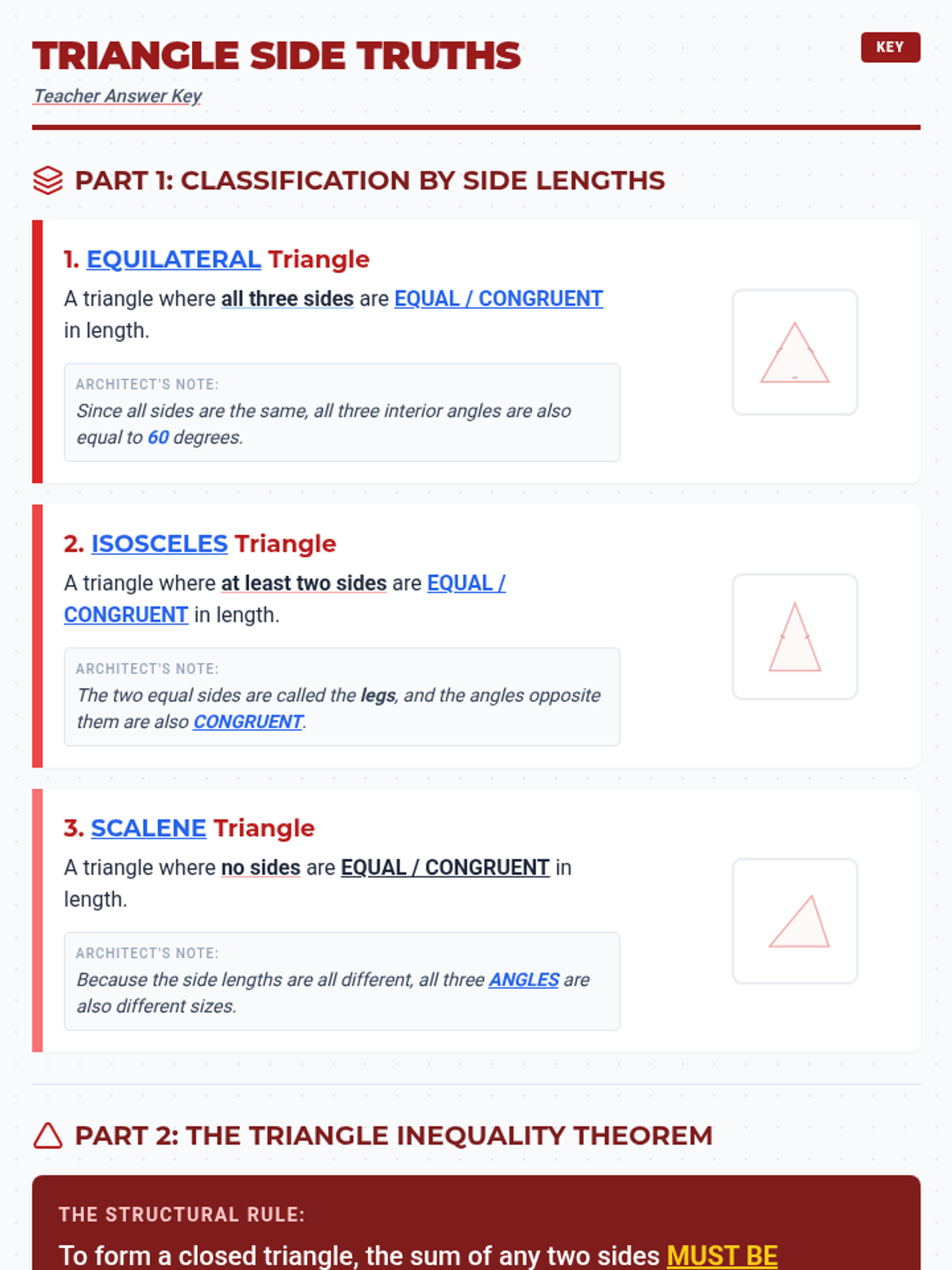
The teacher's answer key for the Triangle Side Truths Notes, with all blanks filled in and clearly marked in a distinct blue font for easy checking. Revised to match the updated student notes layout.
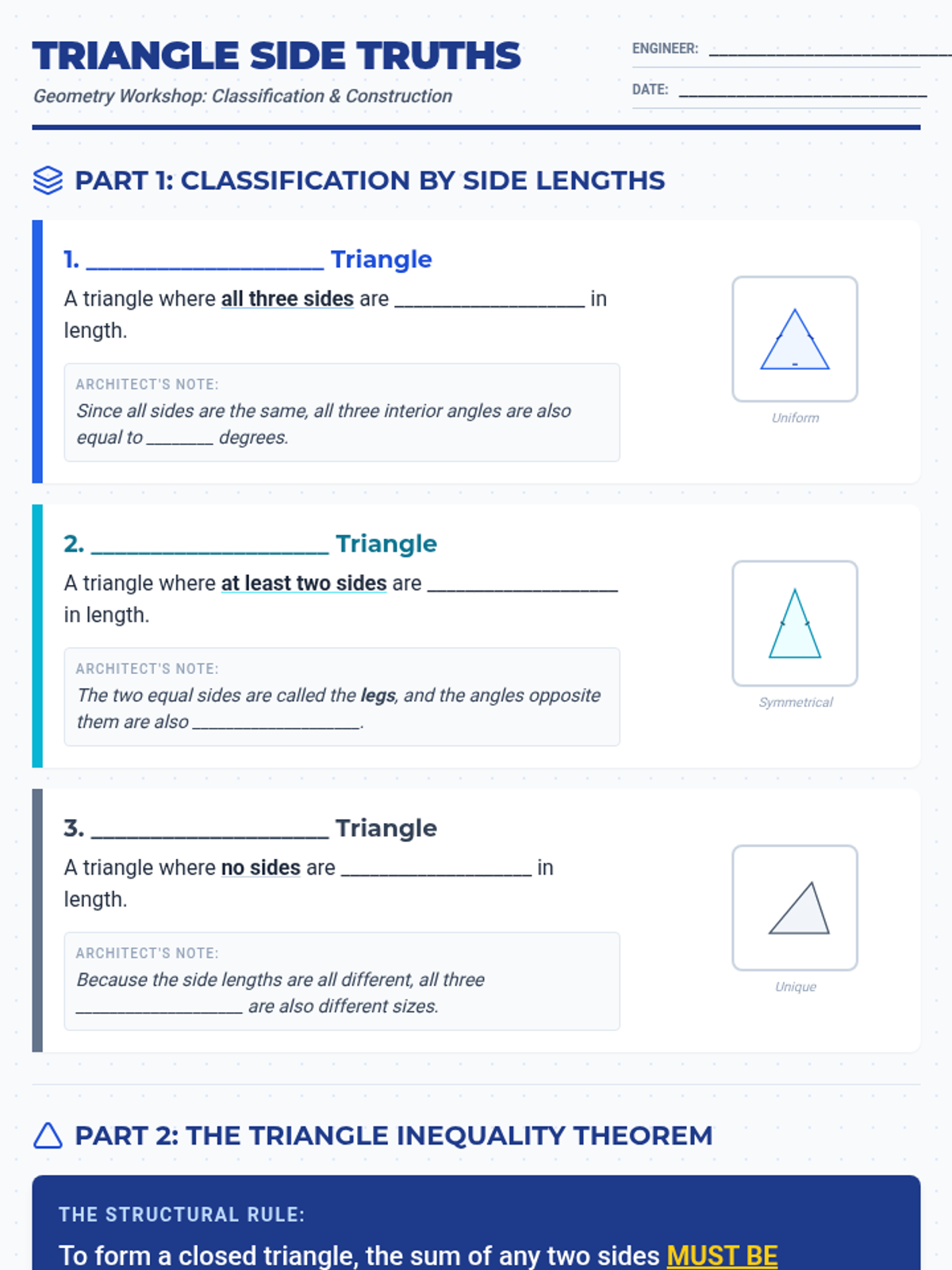
A comprehensive guided notes sheet for geometry students focusing on triangle classification by side length and the Triangle Inequality Theorem. It features technical 'blueprint' aesthetics with diagrams, fill-in-the-blank definitions, and scaffolded practice tables. Revised to fix page breaks and increase student work space.
Thematic introductory slides for the 'Unknown Undercovers' lesson. Covers inverse operations for equations, inequality keywords/graphing rules, and coordinate plane navigation (6.EE.7, 6.EE.8, 6.NS.6).
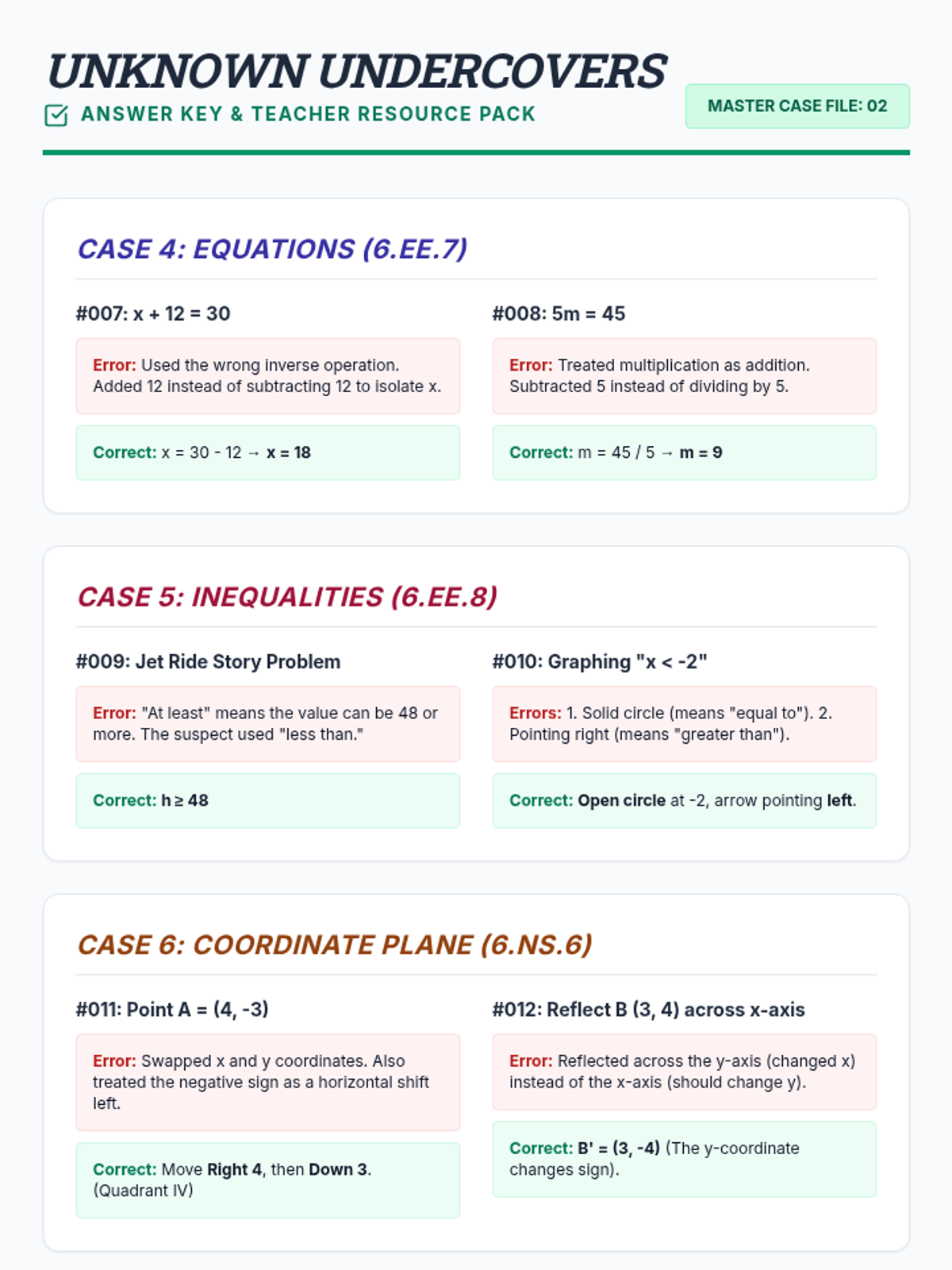
Comprehensive answer key for the Unknown Undercovers lesson. Includes specific error identification and correct solutions for equations, inequalities, and coordinate plane problems.
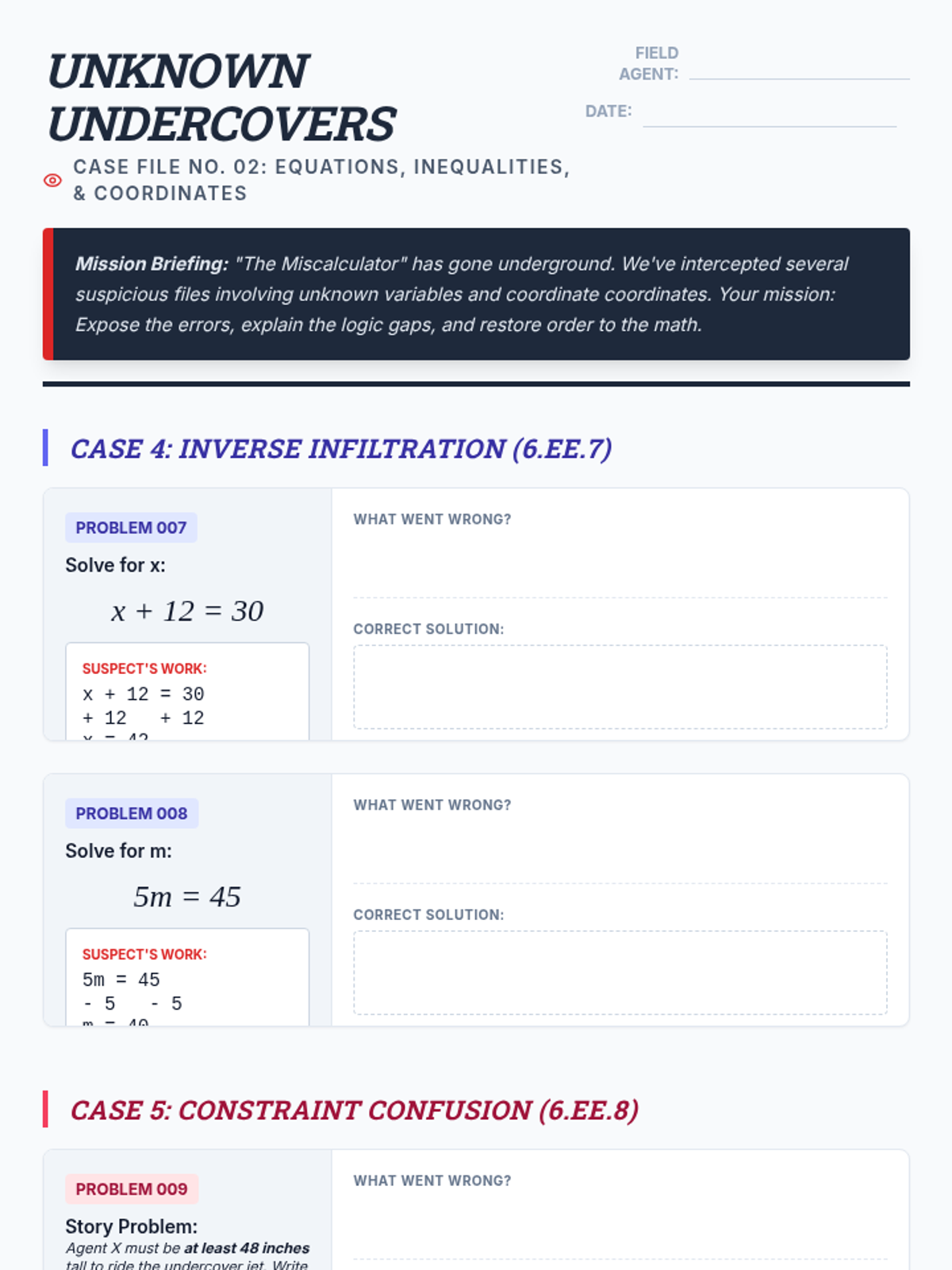
A detective-themed error analysis worksheet for 6th grade math focusing on one-step equations, inequalities, and coordinate planes. Students identify and correct common misconceptions in standards 6.EE.7, 6.EE.8, and 6.NS.6. Problem 5 features a story problem context.
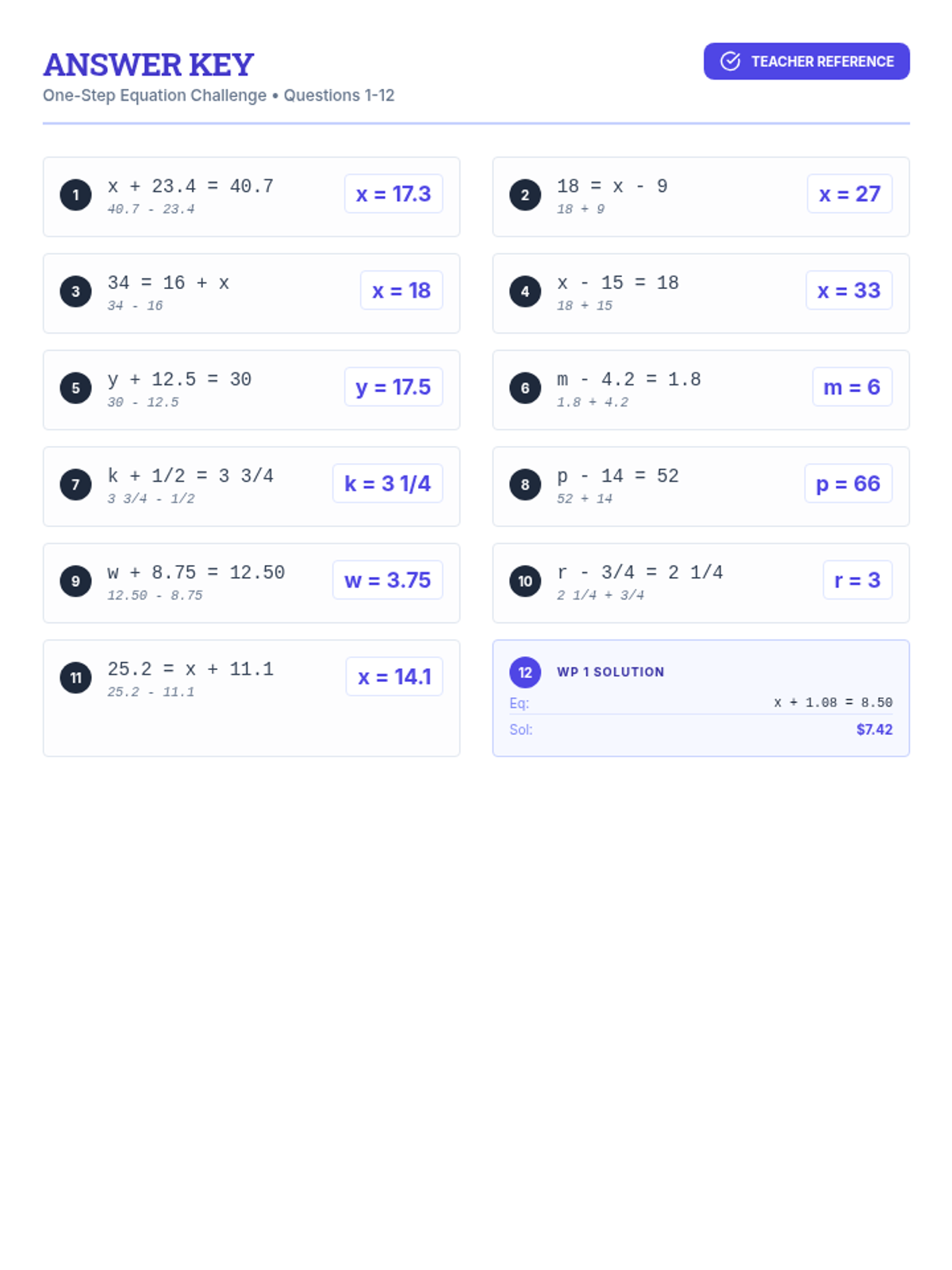
A complete 2-page answer key for the One-Step Equation Challenge Worksheet, featuring 24 solutions with inverse operations shown. Updated for layout precision and improved contrast.
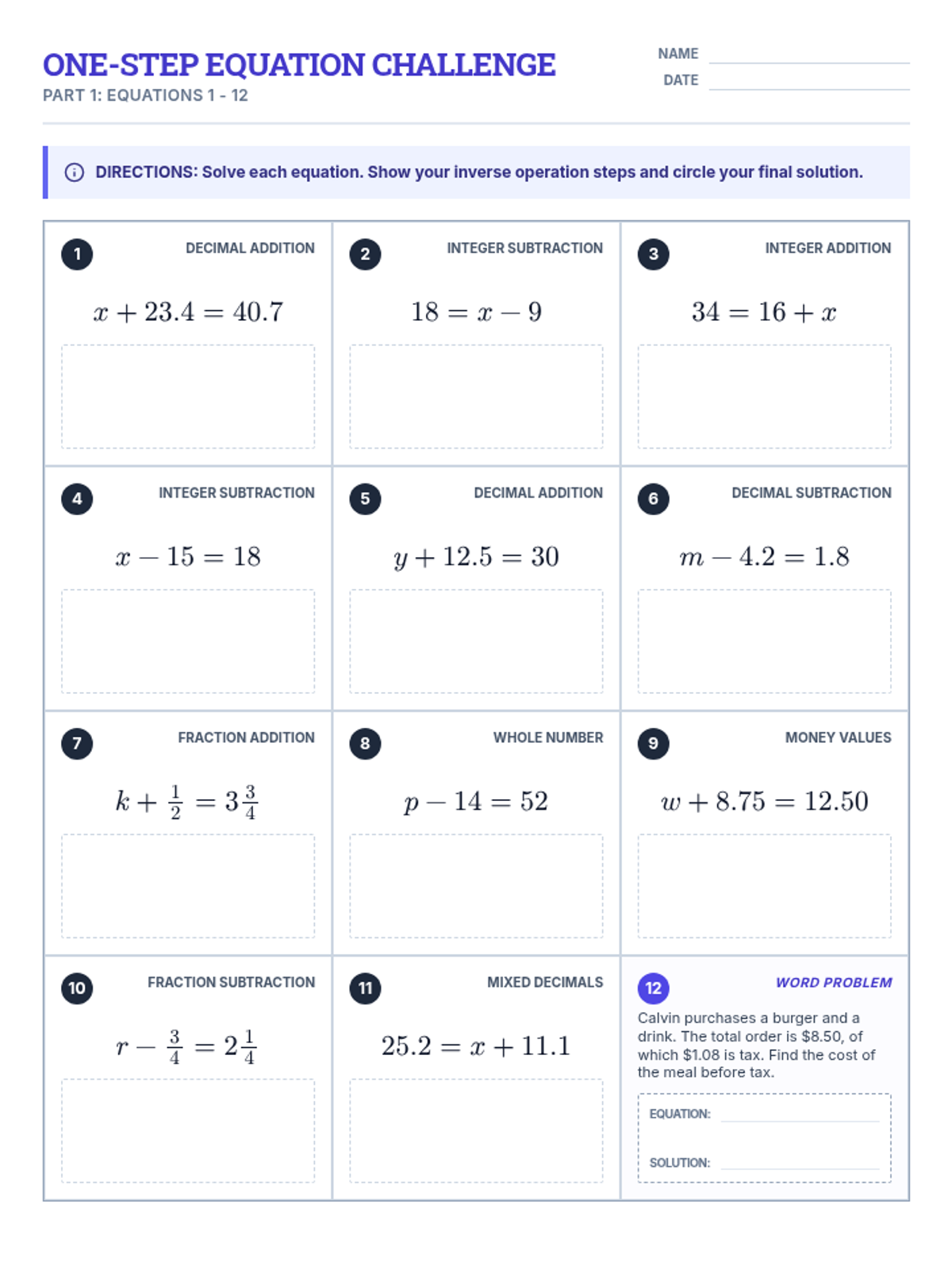
A comprehensive 24-question worksheet (spanning two pages) covering one-step addition and subtraction equations with whole numbers, decimals, and fractions. Includes two contextual word problems. Updated for layout precision and MathJax rendering.
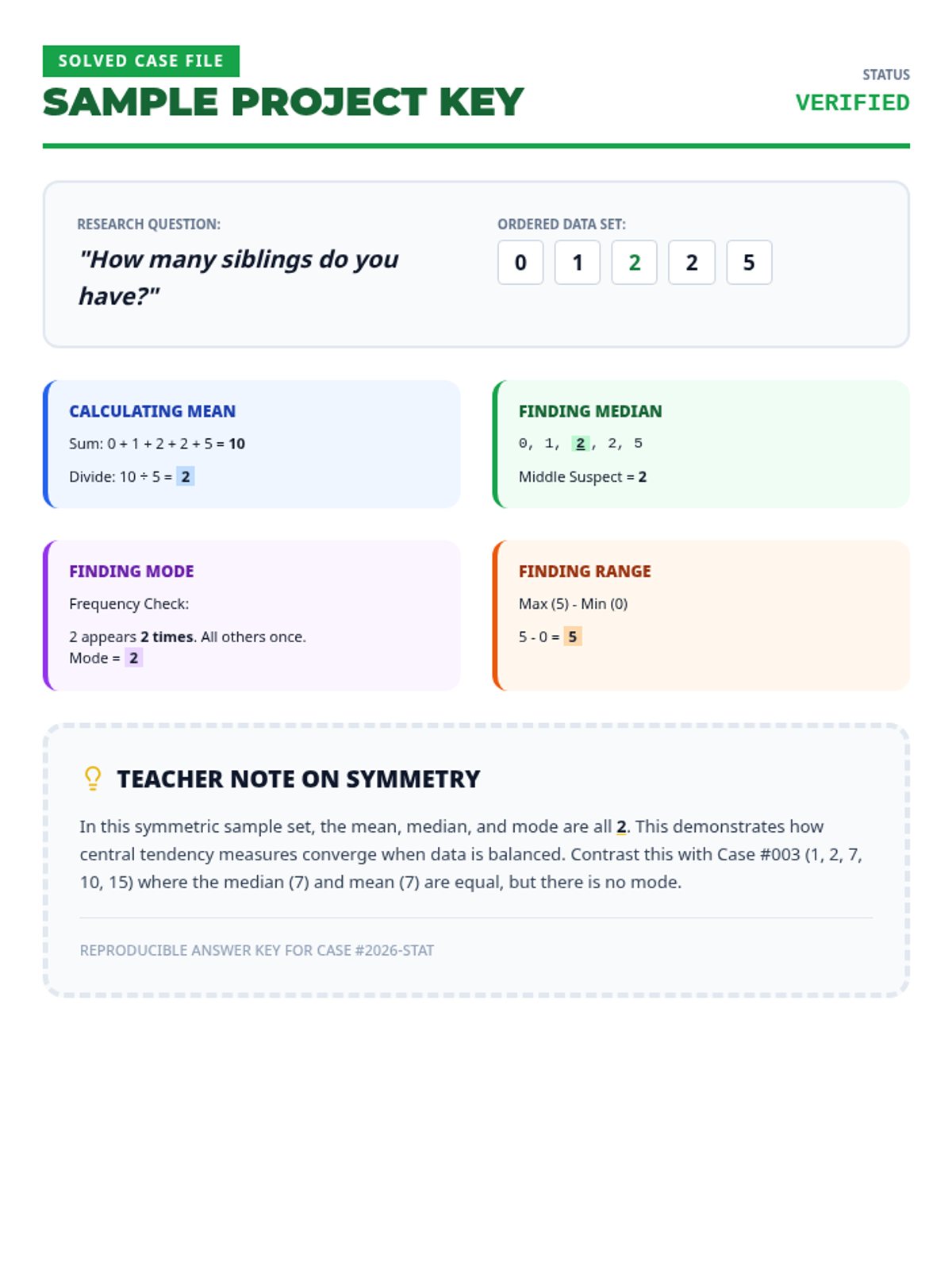
A sample answer key and example project overview showing calculations for Mean, Median, Mode, and Range based on a set of 5 numbers ('siblings' survey). Includes step-by-step reasoning for teacher reference. Unified on one page.
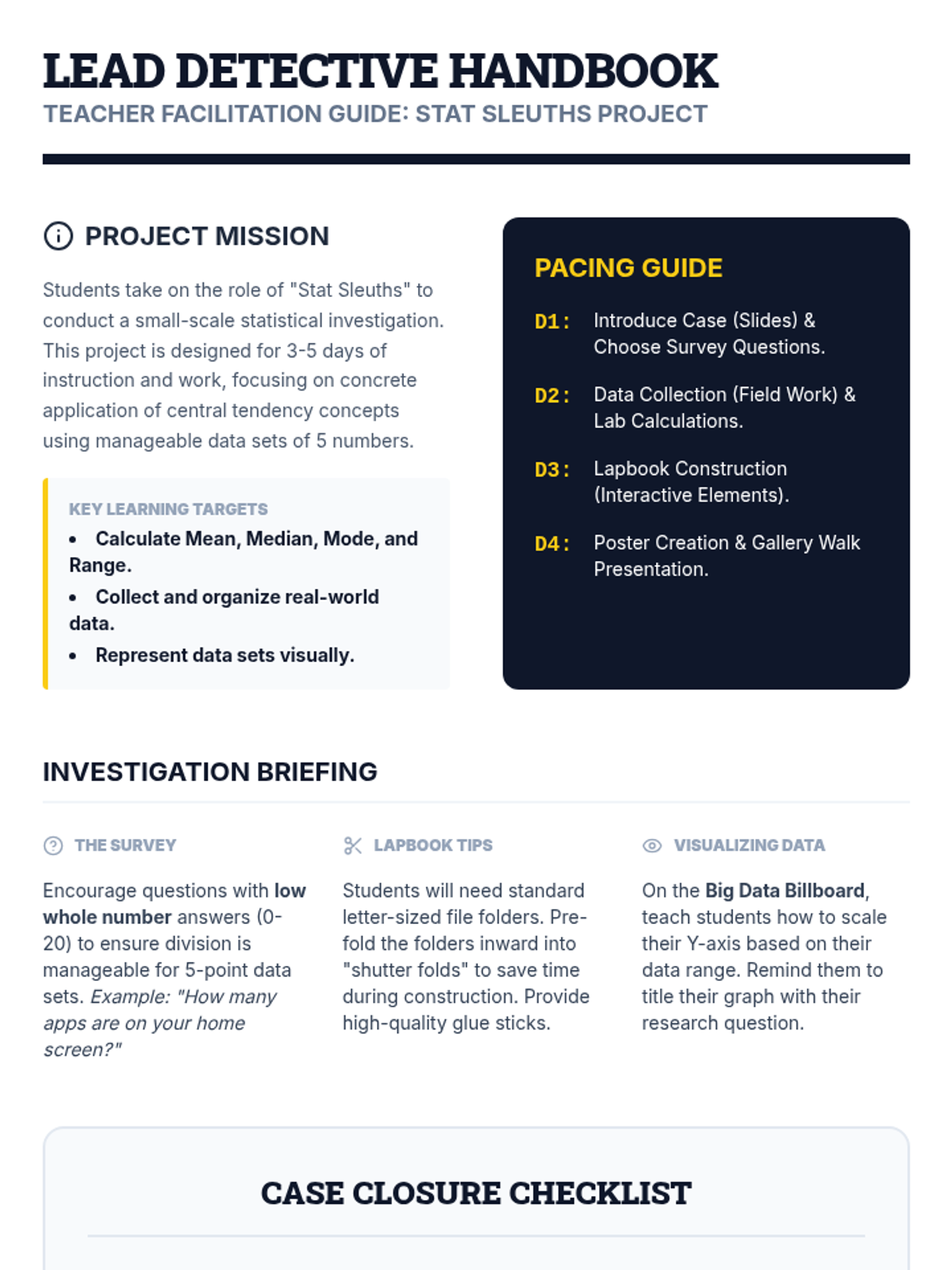
Teacher guide for the Stat Sleuths project, including pacing suggestions, implementation tips for the lapbook and poster, and an assessment checklist for evaluating student work.
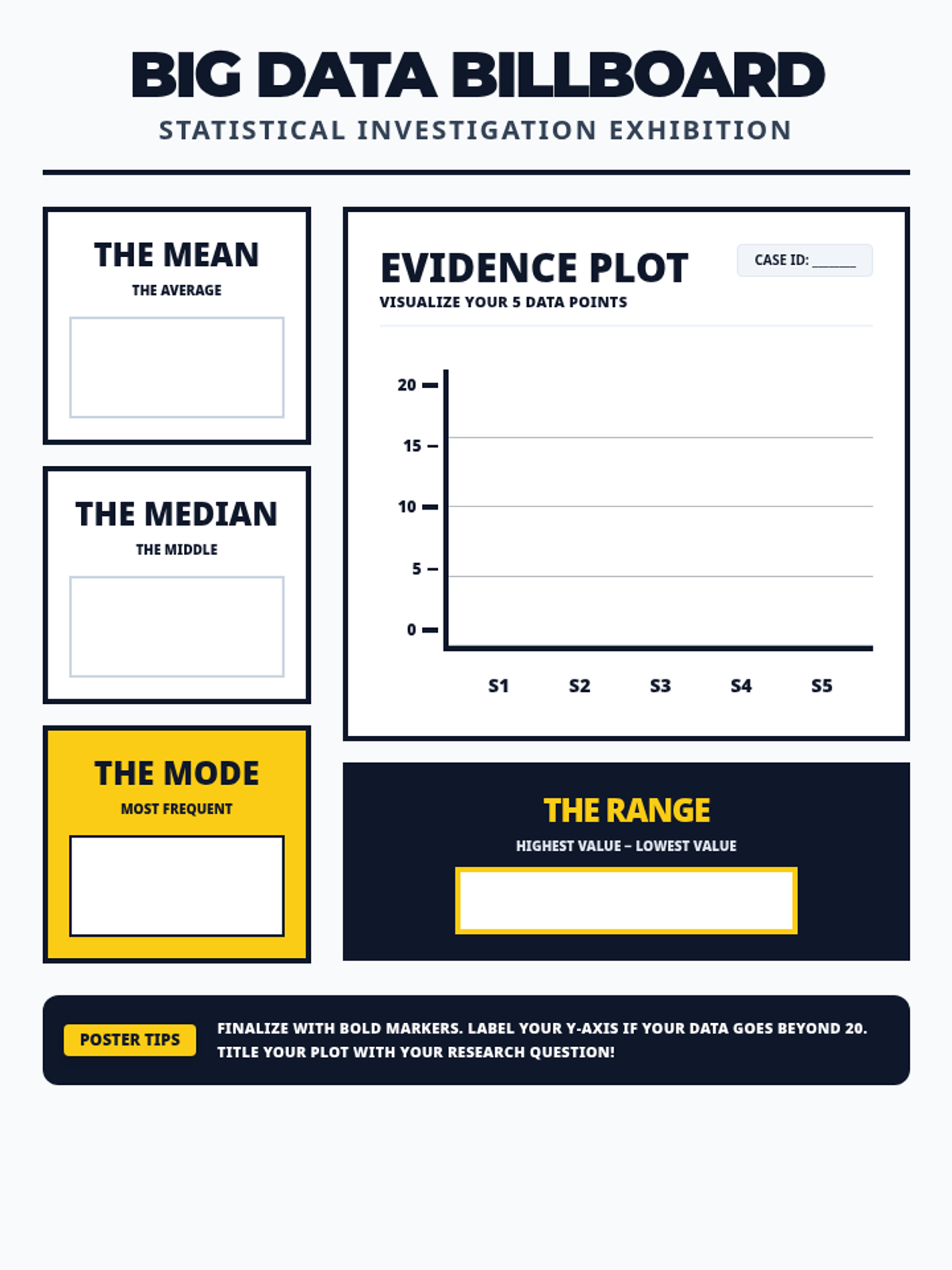
A large-scale visual template for a data collection poster. Includes dedicated zones for the central tendency calculations (Mean, Median, Mode, Range) and a visualization area for a dot plot or bar graph of the 5 data points. y-axis includes tick marks for scale.
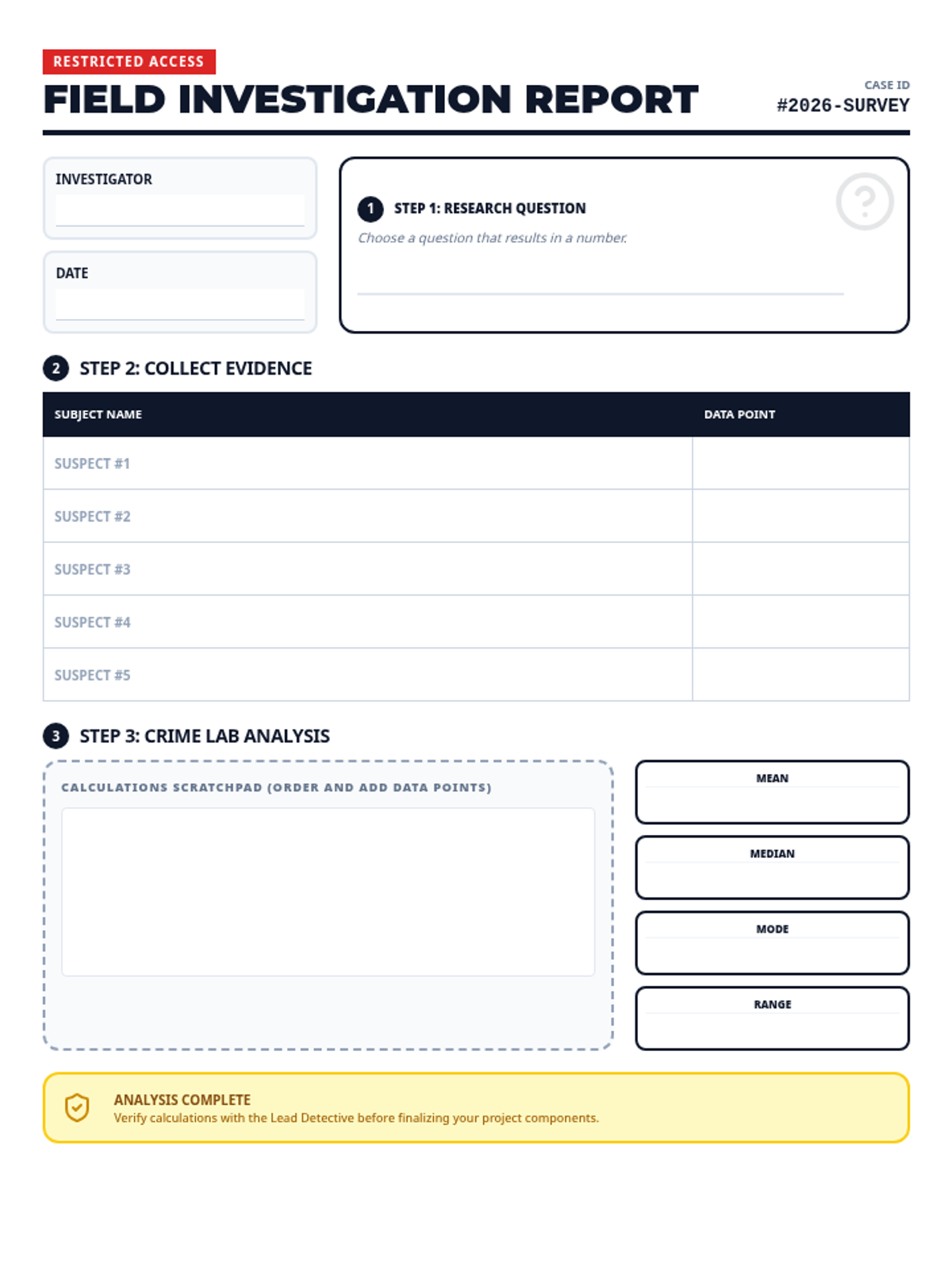
A survey recording sheet and analysis guide for a real-world statistical investigation. Students choose a question, collect 5 data points, and calculate the mean, median, mode, and range. Includes a calculation scratchpad for organizing data.
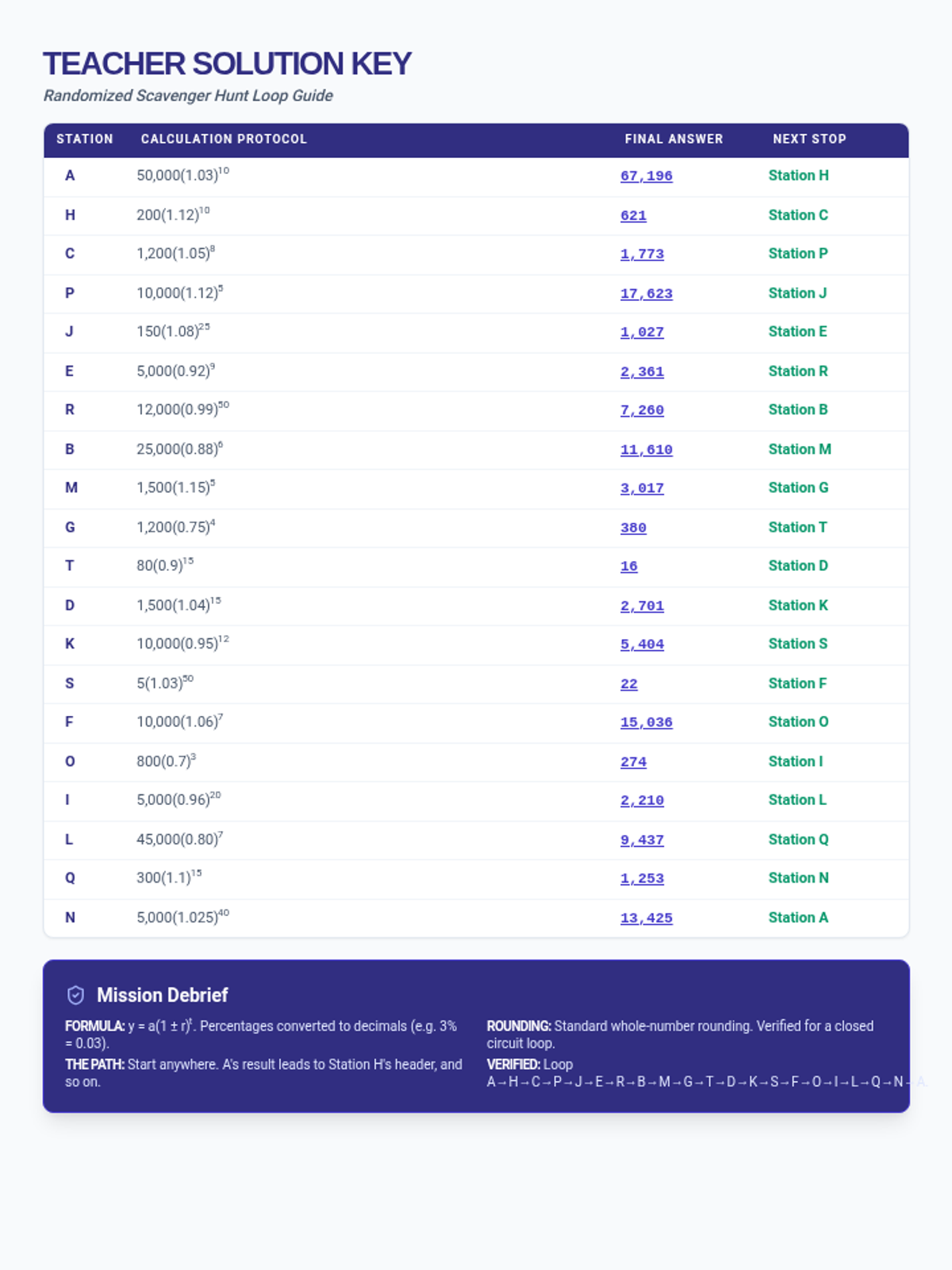
Complete teacher answer key for the Exponential Lab scavenger hunt. Provides the formula and calculation for every station using annual growth and decay models, the correct randomized loop sequence, and final answers. Fixed superscript alignment and table layout.