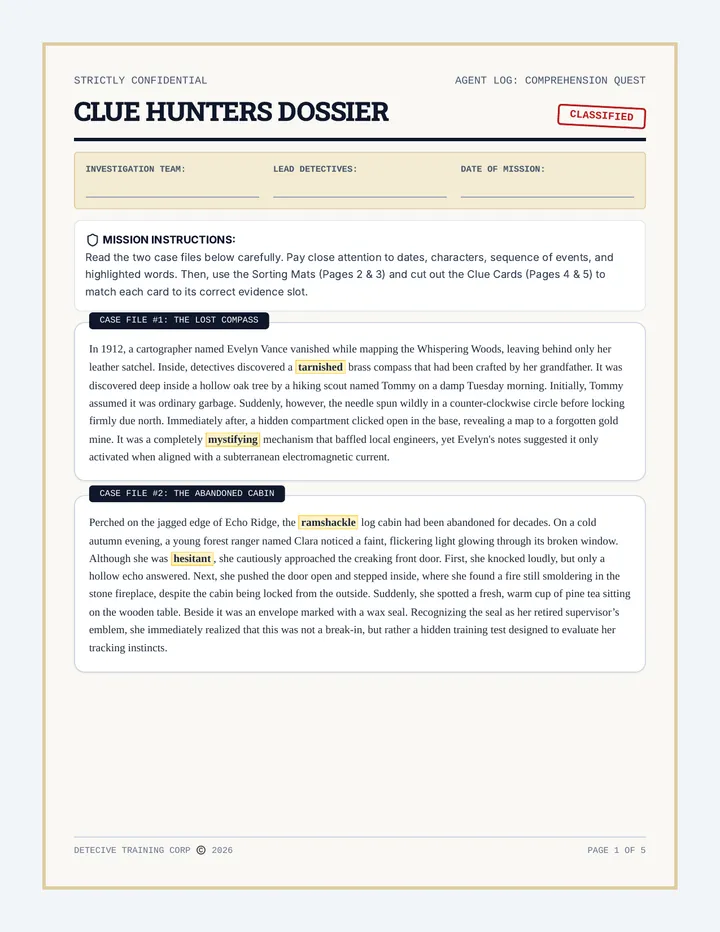
Visual anchor charts for classroom display focusing on the anatomy of prepositional phrases and their functions as adjective and adverb modifiers.
An answer key for the Southern Soul Inferences Worksheet, providing suggested answers and explanations for the inference-based questions.
A comprehensive 3-page packet including a 2-page inference worksheet for 5th graders based on 'Their Eyes Were Watching God' and a full teacher answer key. It features an adapted reading passage, structured inference questions, and a clue-hunting evidence table.
A creative writing worksheet where students act as a sports reporter, writing a news report about the Celtics game using vocabulary words. Includes a word checklist and headline space. Revised for better layout and clarity.
A basketball-themed spelling worksheet where students practice word construction, syllable sorting, and proofreading using the Celtics-themed vocabulary. Revised for better layout and clarity.
A teacher-facing answer key for the Root Raiders Worksheet, featuring completed matching, word definitions, and sample answers for open-ended questions.
A two-page printable worksheet for 6th-grade students to practice Greek and Latin roots. Features root matching, word decomposition, sentence completion, and a creative word-generation challenge.
A visually engaging slide deck that introduces 6th-grade students to common Greek and Latin roots using an archaeology 'Root Raiders' theme. Includes root definitions, examples, and interactive check-for-understanding challenges.
An early 4th-grade level reading passage about a Celtics game, creatively integrating 15 vocabulary words from the Westward Expansion slide deck. Includes comprehension questions and a morphology-focused activity. Revised for better page flow and legibility.
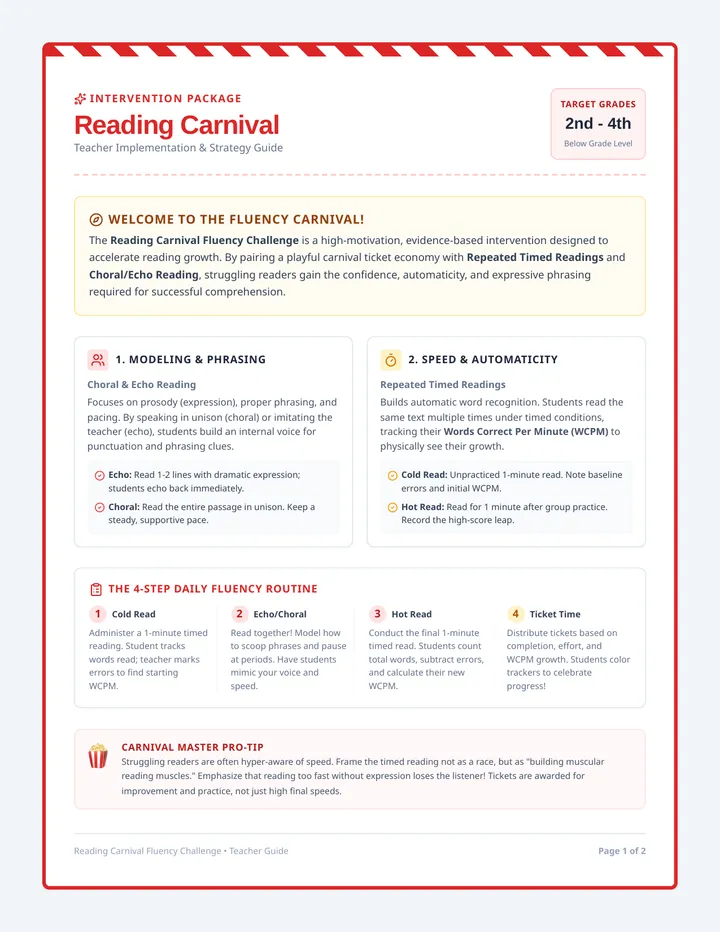
A teacher guide providing instructional strategies and implementation tips for helping a 9th-grade student with a 6th-grade writing level expand their essay details. It includes specific scaffolding techniques and a walkthrough of the accompanying materials.
A reference 'cheat sheet' for students to help them improve word choice and sentence structure. It includes synonym swaps, sentence starters for examples, and techniques like adding 'because', adjectives, or context ('when/where') to expand simple sentences.
A brainstorming worksheet designed to help students expand basic ideas from a graphic organizer into detailed paragraphs. It uses a structured three-step 'Stretch' process: identifying the main point, adding sensory details, and explaining the significance.
A slide deck designed to teach 9th-grade students with IEP goals how to add detail to their writing. It covers techniques like 'Show, Don't Tell', sensory details, and the 'So What?' factor to help transition from 6th-grade level writing to more descriptive high school work.
An updated answer key for the expanded Chapters 9 and 10 Hatchet worksheet, including all 10 new and existing questions.
An expanded student worksheet for Chapters 9 and 10 of Hatchet, now featuring 10 targeted questions covering recall, inference, and conflict, plus a reflection, with clear handwriting lines for students.
A two-page guided worksheet for students to brainstorm spring-themed grammar and figurative language, then craft a structured poem.
Facilitator script for Lesson 6 of the Thinking Readers Program. Aligned with Bloom's Taxonomy (Remember, Analyze, Evaluate, Create). Focuses on Synthesis (Thinking Evolution). Includes character shift modeling and explicit Bloom's checks. Revised for branding and layout.
Facilitator script for Lesson 5 of the Thinking Readers Program. Aligned with Bloom's Taxonomy (Understand, Analyze, Evaluate). Teaches the Curiosity Compass strategy for generated questioning. Revised for branding and layout.
Facilitator script for Lesson 4 of the Thinking Readers Program. Aligned with Bloom's Taxonomy (Remember, Apply, Create). Focuses on Visualization (The Sensory Cinema). Includes explicit strategy modeling for 4D sensory reading.
Facilitator script for Lesson 3 of the Thinking Readers Program. Aligned with Bloom's Taxonomy (Understand, Apply, Analyze, Evaluate). Teaches the 'Clue Equation' strategy for inferencing. Includes explicit Bloom's check for evaluation.
Facilitator script for Lesson 2 of the Thinking Readers Program. Aligned with Bloom's Taxonomy (Remember, Understand, Analyze, Create). Focuses on activating background knowledge (The Knowledge Vault). Revised for branding and taxonomy labels.
Facilitator script for Lesson 1 of the Thinking Readers Program. Explicitly aligned with Bloom's Taxonomy (Remember, Apply, Analyze, Evaluate). Includes the specific 'Brain Choice' prompt and modeling for metacognition.
Student workbook page for Lesson 6 of the Thinking Readers Program. Features a 'Thinking Evolution Log' to track shifts at 0%, 50%, and 100%. Revised for page fit, high-contrast writing areas, and larger response boxes. Added evolution clues for better guidance. Aligned with Bloom's Taxonomy.
Student workbook page for Lesson 5 of the Thinking Readers Program. Features a 'Quest Map' for Thick and Thin questions. Includes Strategy Clues for vocabulary help and a high-contrast integrated Brain Choice section. Revised for contrast and page fit. Added specific quest clues for distinguishing question types.
Student workbook page for Lesson 4 of the Thinking Readers Program. Features a storyboard frame for multi-sensory visualization. Includes Strategy Clues for vocabulary help and a print-friendly high-contrast layout. Revised for page fit and larger writing areas. Added specific director clues.
Student workbook page for Lesson 3 of the Thinking Readers Program. Centers on the 'Clue Equation' (Inference). Features Strategy Clues for vocabulary support and a print-friendly high-contrast Brain Choice section. Revised for alignment, writing space, and contrast. Added specific equation clues.
Student workbook page for Lesson 2 of the Thinking Readers Program. Focuses on Schema activation (The Knowledge Vault). Includes optimized writing areas for item sorting and a print-friendly Deductive Dilemma section. Revised for contrast, vocabulary support, and answer choice uniformity.
Student workbook page for Lesson 1 of the Thinking Readers Program. Features tally and writing areas with Strategy Clues for metacognition. Includes the updated Brain Choice Moment section with print-friendly high contrast and larger writing areas. Revised for contrast and label size.
A Japanese educational slide deck covering the fundamentals of English sentence structure, including subjects, predicates, fragments, and run-on sentences. It provides all instructional content and explanations in Japanese while maintaining English example sentences for analysis.
Student workbook page for Lesson 6 of the Thinking Readers Program. Features a 'Thinking Evolution Log' to track shifts at 0%, 50%, and 100%. Revised for page fit, high-contrast writing areas, and larger response boxes.
Student workbook page for Lesson 5 of the Thinking Readers Program. Features a 'Quest Map' for Thick and Thin questions. Includes Strategy Clues for vocabulary help and a high-contrast integrated Brain Choice section. Revised for contrast and page fit.
Student workbook page for Lesson 4 of the Thinking Readers Program. Features a storyboard frame for multi-sensory visualization. Includes Strategy Clues for vocabulary help and a print-friendly high-contrast layout. Revised for page fit and larger writing areas.
Final capstone workbook page for Lesson 12 of the Thinking Readers Program. Includes an integrated mystery case. Revised for single-page fit, larger response areas, high-contrast belt labels, and branding. Added Master's clues for final challenge.
Facilitator script for Lesson 12 (Capstone) of the Thinking Readers Program. Students apply all strategies to solve a complex 'Maze'. Includes graduation speech. Revised for branding and layout.
Student workbook page for Lesson 11 of the Thinking Readers Program. Features a 'Selection Lab' for matching tools to text challenges. Revised for branding, page fit, contrast, and writing space. Added strategy clues for selection.
Facilitator script for Lesson 11 of the Thinking Readers Program. Teaches Strategy Selection (The Strategy Toolbox). Includes specific modeling for matching tools to text types. Revised for branding and layout.
Student workbook page for Lesson 10 of the Thinking Readers Program. Features a Click or Clunk monitoring log and fix-up report. Revised for single-page fit, larger writing areas, and uniform fix-up tool choices. Added monitoring clues.
Facilitator script for Lesson 10 of the Thinking Readers Program. Teaches Monitoring (The Click Clunk Check). Includes fix-up tool modeling and a mission checklist for self-monitoring mastery. Revised for branding and layout.
Student workbook page for Lesson 9 of the Thinking Readers Program. Features Structural Mapping for sequence and cause/effect. Revised for page fit, contrast, and branding. Includes larger writing spaces.
Facilitator script for Lesson 9 of the Thinking Readers Program. Teaches Text Structure (The Brain Blueprint). Includes signal word identification and pattern mapping prompts. Revised for branding and layout.
Student workbook page for Lesson 8 of the Thinking Readers Program. Features a logic puzzle for suspect elimination. Revised for answer choice uniformity, page fit, and contrast.