A set of 8 colorful task cards for Scratch Jr. creative coding projects, featuring engaging challenges like dance parties, space races, and magic shows. Each card includes a primary goal, specific block suggestions, and a bonus challenge.
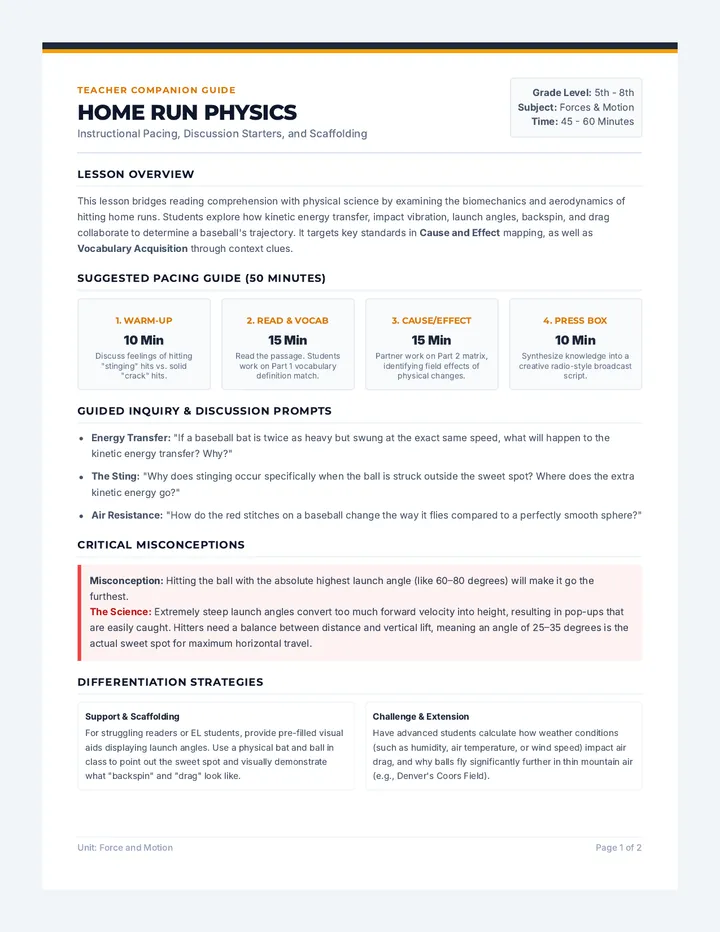
A visually engaging reference sheet for 5th grade students. Spacing and padding have been significantly reduced to ensure the 'Property Checklist' and other content fit comfortably on a single page without being cut off.
A 4-page teacher's answer key for the Molecular Mashup Booklet, providing correct answers, sample student explanations, and grading guidance. Formatted with explicit page breaks to match the student booklet perfectly.
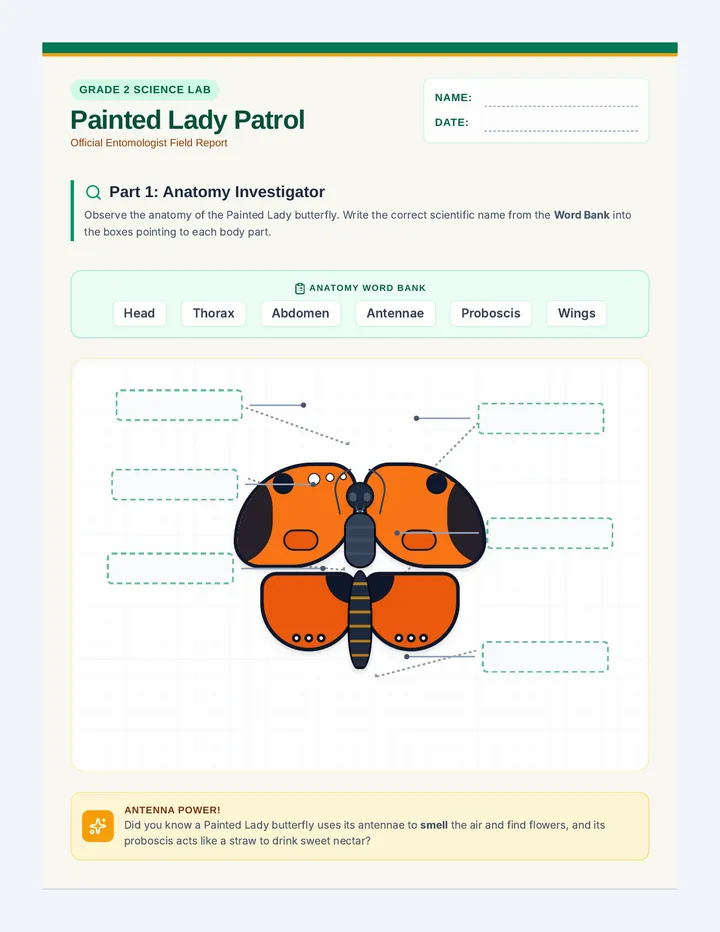
A 4-page student activity booklet featuring four 'Lab Zones'. Layout adjusted to be more compact on Page 4 to prevent printing cut-offs. Explicit page breaks remain for clean output.
A teacher facilitation guide for the 'Spring Sprouts' lesson, featuring learning objectives, slide-by-slide discussion prompts, a hands-on 'Cup Garden' activity guide, and an answer key for the student worksheet.
A student activity sheet featuring a plant life cycle sequencing task, a 'recipe' ingredient identification section for photosynthesis, and a creative drawing area for a spring garden.
A vibrant and engaging 7-slide presentation for early elementary students introducing spring weather, the plant life cycle, and the basic concept of photosynthesis using simple 'chef' analogies and clear diagrams.
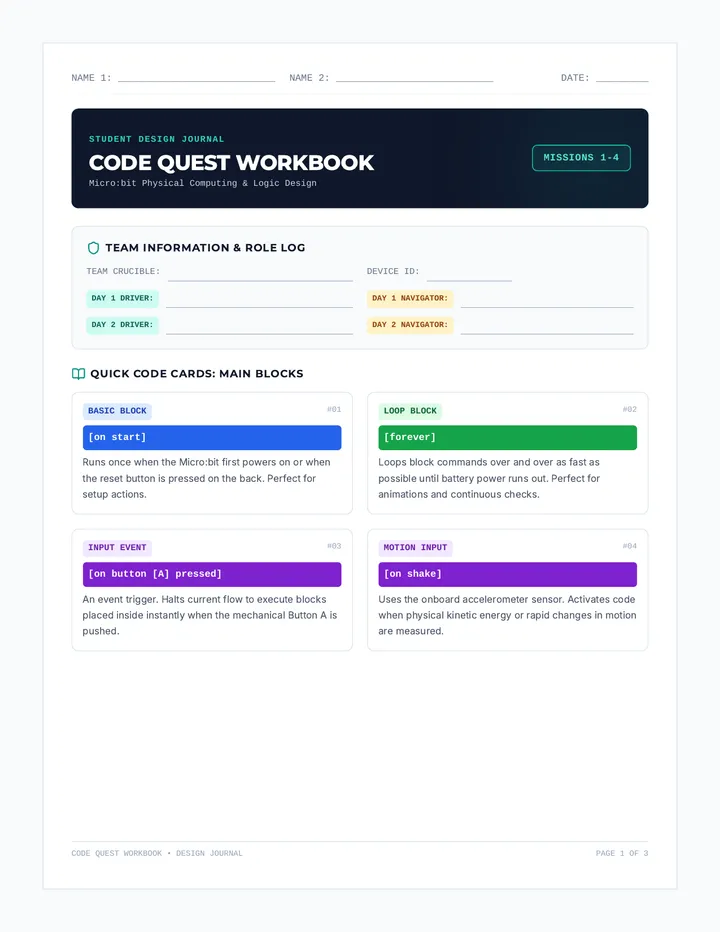
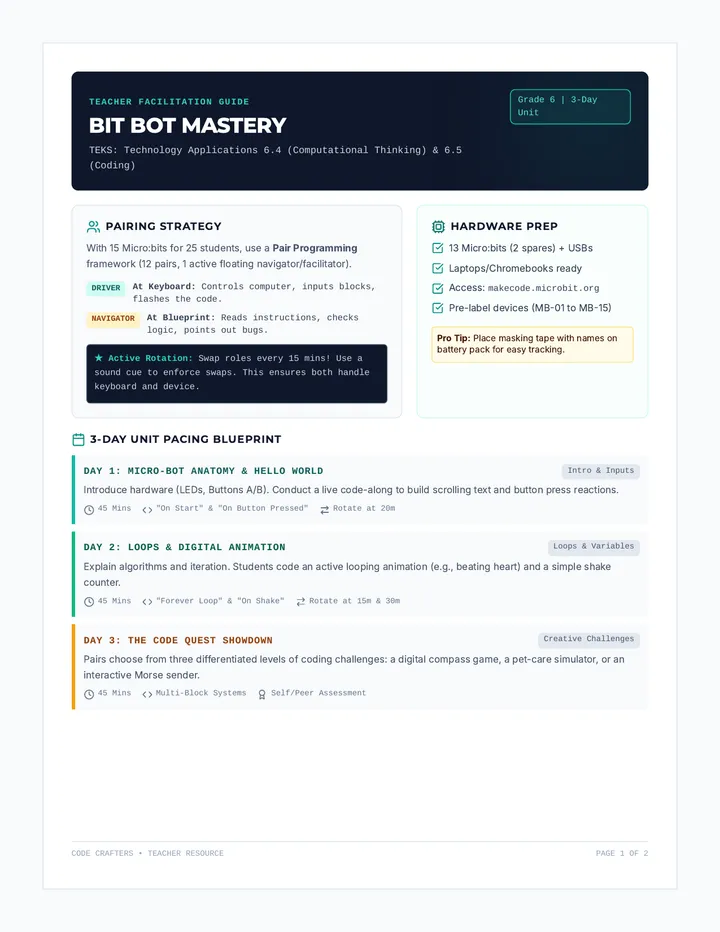
A teacher resource guide for setting up and managing a Scratch Jr. coding center, including troubleshooting tips, pacing suggestions, and differentiation strategies.
A visual reference guide for students explaining the function of each color-coded block category in Scratch Jr. to support independent problem-solving.
A teacher's answer key for the Nature's Rhythm Test, providing clear answers and grading guidance for the 10 short answer questions.
A 10-question short answer test for 2nd grade students covering the rotation of the Earth, orbit, and the reasons for the seasons. Designed with clear handwriting lines and a space-themed aesthetic.
A student reflection and progress tracking sheet where learners can check off completed Scratch Jr. adventure cards and draw/write about their favorite project.
The teacher answer key for the bird anatomy labeling activities, showing the correct placement of all five body parts.
A cut-and-paste labeling activity where students cut out five body part names and glue them into the correct spots on a bird diagram.
A handwriting worksheet where students use a word bank to label five bird body parts (eye, beak, wing, feathers, and claws) using primary writing lines.
A traceable labeling worksheet where students trace the names of five bird body parts (eye, beak, wing, feathers, and claws) to complete a bird diagram.
A bright and engaging slide deck introducing students to five key bird body parts: eye, beak, wing, feathers, and claws, featuring large icons and fun facts.
A teacher's guide for the Bird Buddies lesson, containing answer keys for student worksheets, instructional tips for read-alouds, and extension activities.
A set of three tracing and coloring pages featuring an owl, a duck, and a robin, with simple sentences for handwriting practice.
A simplified Yes/No comprehension worksheet with visual cues to test student understanding of bird characteristics and behaviors.
A labeling worksheet for first-grade students to identify key parts of a bird (beak, wing, tail, eye, leg) using a provided word bank.
A set of 8 visual vocabulary cards featuring key bird concepts like beak, nest, owl, and robin, designed for cutting and classroom use.
A visual presentation for a classroom read-along about bird anatomy, habitats, and different bird species, designed with high contrast and large text for accessibility.
A comprehensive teacher guide for the "Full Steam Ahead" lesson, including learning objectives, a lesson timeline, teaching tips, and answer keys.
A creative "Junior Engineer" notebook page for students to label engine parts, track energy flow, and design their own steam-powered machine.
An informational slide presentation explaining the mechanics, history, and modern uses of steam power, designed for a 3rd-grade classroom setting.
A 3rd-grade reading passage about steam engines, covering their basic mechanics, historical context, and key vocabulary, followed by comprehension questions.
The answer key for the Cosmic Codes student materials, providing correct syllable divisions and comprehension question responses.
A space-themed newspaper article (approx. 140 words) designed for reading practice, featuring highlighted VCV words and comprehension questions.
A student worksheet for VCV syllable practice, featuring word division exercises, sentence reading with VCV underlining, and a creative drawing prompt.
Engaging slides for teaching the VCV syllable division patterns, using a space theme to explain open and closed syllable rules with visual examples.
A comprehensive teacher guide for the Cosmic Codes lesson, featuring word lists, instructional strategies, and differentiation tips for VCV syllable patterns.
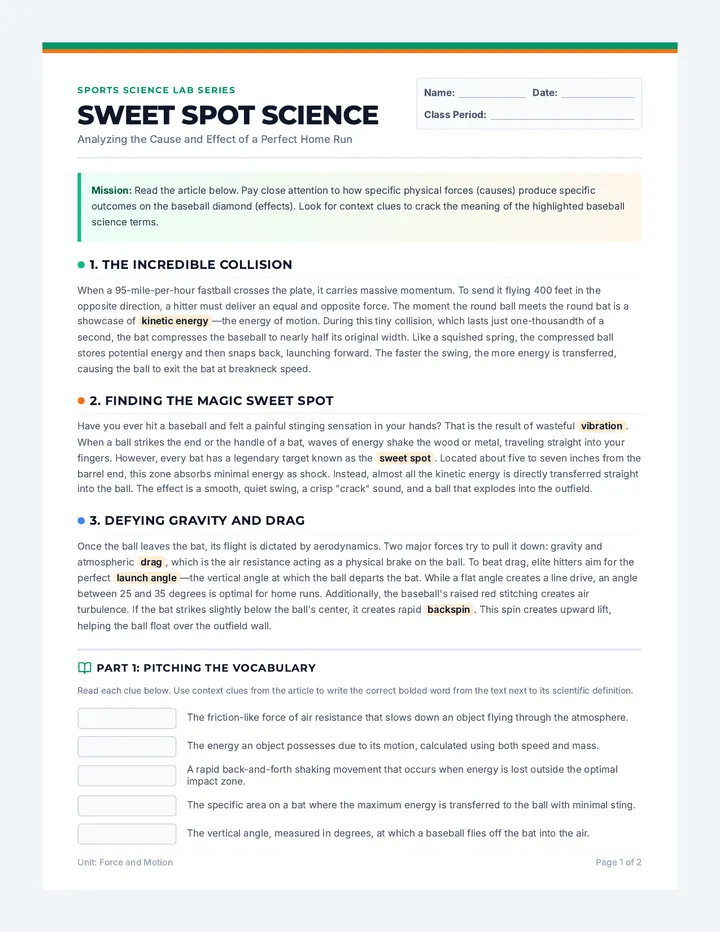
A visually engaging slide deck for 6th-8th graders introducing vocabulary like momentum and cushioning, and explaining Newton's First Law and the life of Sir Isaac Newton.
A comprehensive answer key for the Motion Master Quiz, providing correct vocabulary matches and formal scientific explanations for Newton's First Law.
A vocabulary and conceptual quiz for 6th-8th grade students covering key motion terms and Newton's First Law. Features a professional lab-manual style layout.
Teacher answer key for the Rock Density Virtual Lab. Provides the expected mass, volume, and density values for Granite and Basalt, along with model answers for the analysis questions regarding crustal composition.
A modified rock density lab worksheet for absent students. It features virtual measurement stations with visual representations of digital scales, graduated cylinders, and the rock samples themselves (Granite and Basalt) to allow students to gather data without physical materials.
A teacher answer key for the Resource Rangers Worksheet, providing correct answers for the vocabulary fill-in-the-blank and guidance for creative responses.
An updated teacher facilitation guide that includes instructions for using the vocabulary sentence frames during oral practice.