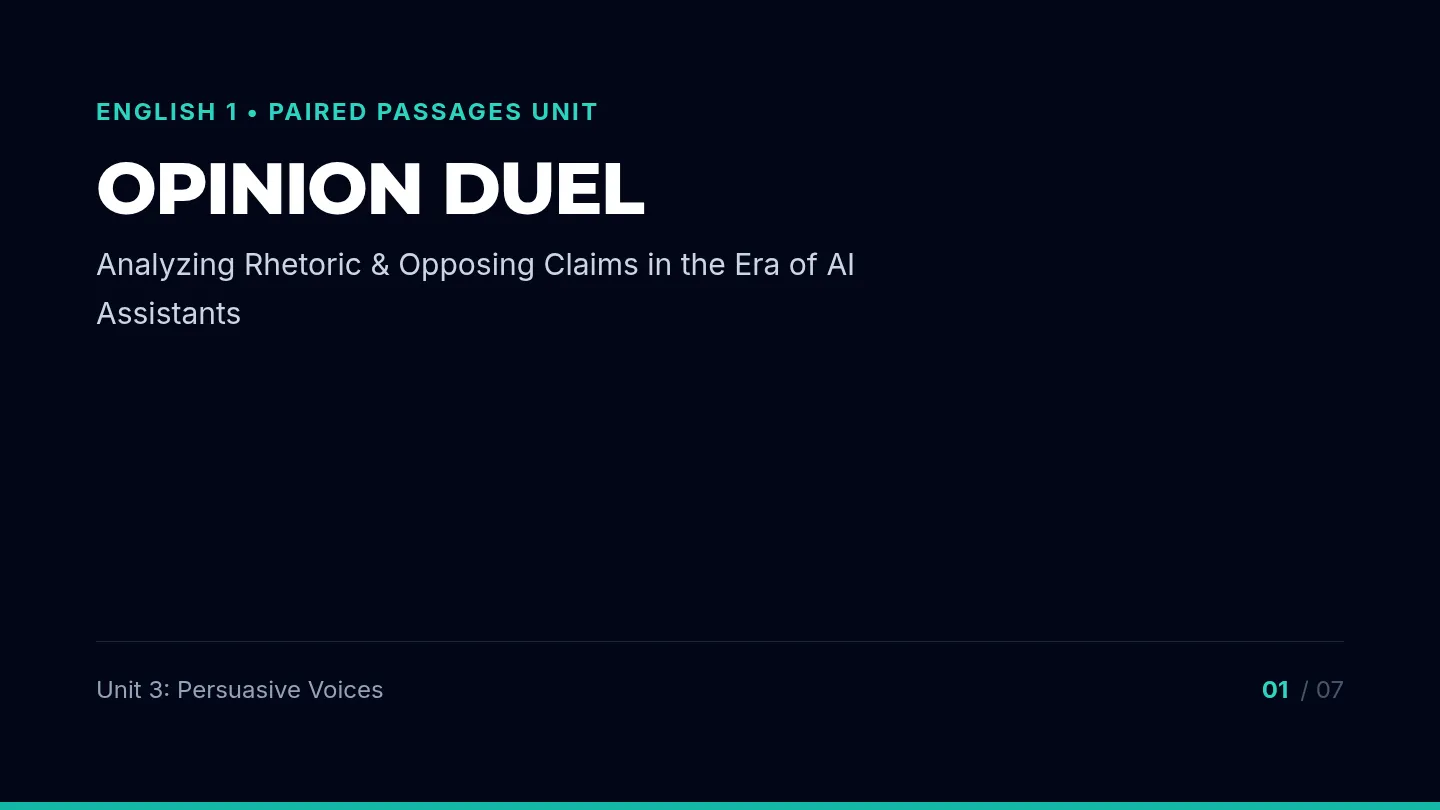
A visual presentation for instruction on active reading strategies, focusing on annotating, questioning, and summarizing. It includes teacher notes and clear examples.
Combined assessment and exit ticket for Lesson 1, updated to ensure all student content fits on page one and all teacher content fits on page two. Features a print-friendly design and rubric.
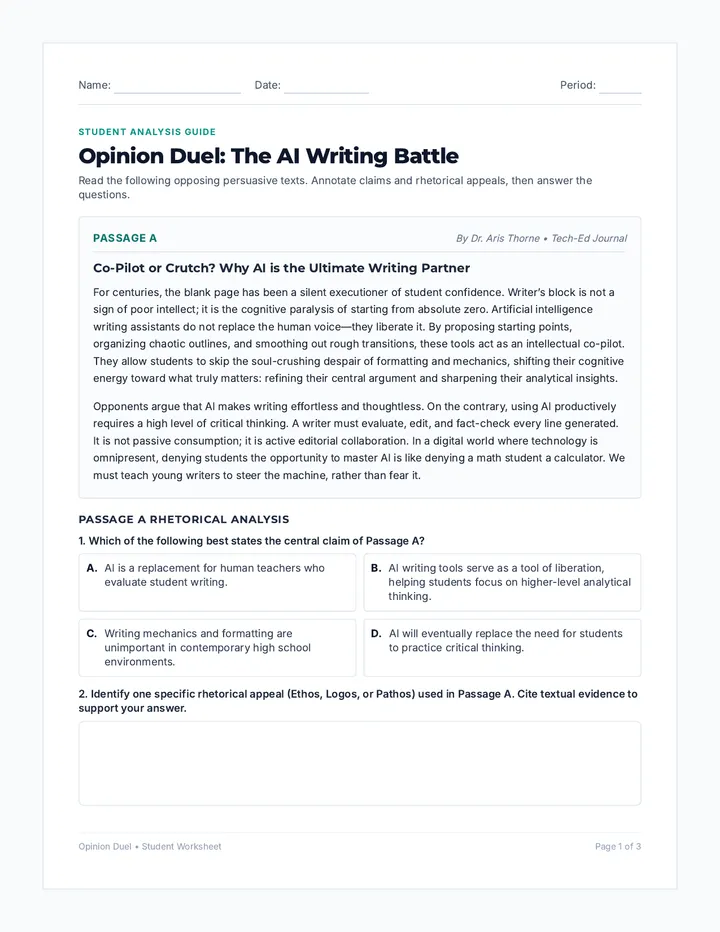
Student worksheet for Lesson 1, updated to ensure all content fits on a single page. Includes vocabulary, matching, and short response areas with optimized spacing. Character counts in fill-in-the-blanks corrected.
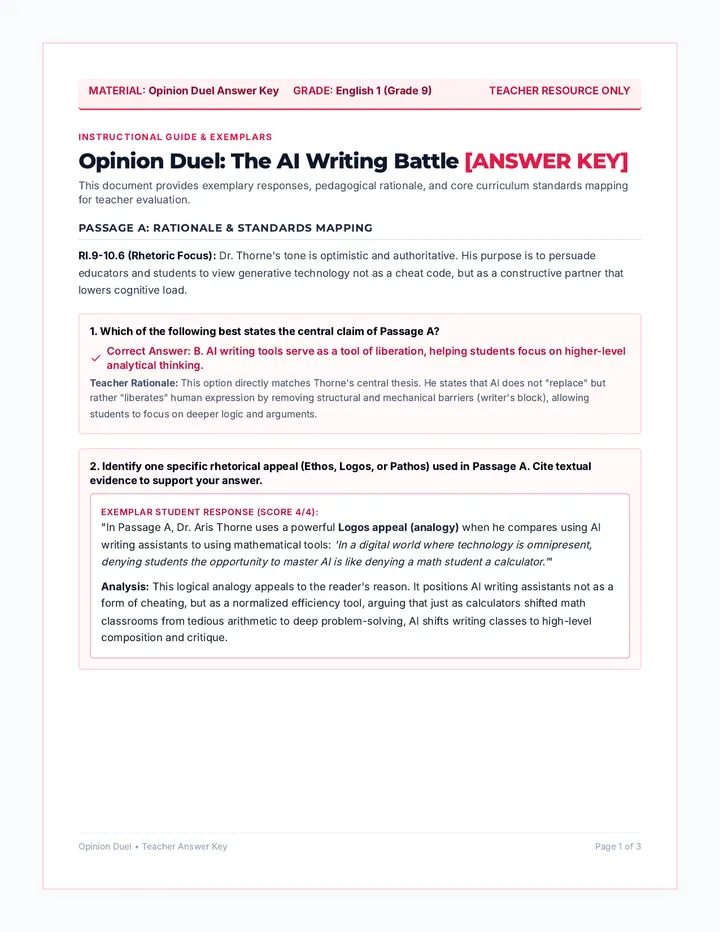
Comprehensive teacher guide and script for Lesson 1, updated to fix page breaks and ensure consistent facilitation labeling. Covers timing, alignment, and specific prompts.
Introductory slide deck for Grade 9 information literacy, focusing on distinguishing between different types of information resources within the ecosystem. Updated for better student prompts and visual clarity.
A comprehensive final assessment for 'The Crucible' including multiple choice questions, quote identification, and extended response prompts focusing on integrity and societal themes.
A final slide deck summarizing Act 4 of 'The Crucible', highlighting John Proctor's moral dilemma, the theme of personal integrity, and the resolution of the Salem witch trials.
A worksheet focused on Acts 2 and 3 of 'The Crucible', asking students to analyze character relationships, dramatic irony, and the shifting power dynamics within Salem.
A slide deck covering Acts 2 and 3 of 'The Crucible', focusing on the Proctor household tensions, the poppet evidence, and the climactic courtroom scene.
A student worksheet for Act 1 of 'The Crucible', featuring historical context questions, character identification, and analysis of the plot's inciting incidents.
An introductory slide deck for 'The Crucible' Act 1, covering the historical context of Puritanism and McCarthyism, key characters, and the initial plot developments.
A scaffolded analysis worksheet providing pre-filled paraphrasing for 'Still I Rise', visual connotation mapping spaces for 'Hope is the thing with feathers', and a guided 'Your Turn' section for independent practice. Corrected layout issues and writing space.
A teacher's reference guide for the CEA Writing lesson. It provides session goals, instructional strategies for academic writing, answer keys for practice activities, and solutions for common student writing misconceptions.
A student-facing checklist for constructing arguments using the Claim-Evidence-Analysis (CEA) framework. It includes specific criteria for each component and a modeled academic example about high school lunch periods.
A 9-slide presentation deck explaining the Claim-Evidence-Analysis (CEA) writing framework for 8th-grade students. It includes session goals, clear definitions, a simplified modeled paragraph on high school lunch breaks, and an interactive practice case.
A comprehensive teacher's answer key for the 10 poems in the Poetry Gallery Walk, providing a detailed TPCASTT analysis for each poem in the requested table format.
A teacher reference guide providing summaries and key TPCASTT analysis details for the 10 poems featured in the Gallery Walk activity.