Students compare the structures of IRA-established tribal governments with the U.S. Federal government, analyzing the shift from traditional consensus models to majority-rule systems.
A comprehensive classroom simulation and analysis lesson about the assassination of Julius Caesar. Students examine historical perspectives, engage with primary sources, and debate civic duty through a mock trial and a three-page investigative document.
A grade 11 history and SEL lesson examining global trade, local labor, and economic interdependence. Students analyze complex global scenarios using multi-perspective lenses and cultural competence.
An exploration of early human migration, the transition from hunter-gatherers to agrarian societies, and the rise of the first river valley civilizations in Mesopotamia and ancient Egypt.
A comprehensive 5-day history unit exploring the Age of Exploration, cultural exchanges, technological innovations in navigation, the Transatlantic Slave Trade, and encounters with East Asian empires.
An in-depth exploration of the factors that drove European powers to seek new trade routes, introducing the GREASES framework for historical analysis of global expansion.
A comprehensive study bundle designed for high school students preparing for the Iowa-required civics exam. The materials use chunked information, visual aids, and scaffolded structures to support rote memorization, quick recall, and structured independent study of the official 100 citizenship questions.
A deep dive into the structural principles of the U.S. Constitution, focusing on separation of powers, checks and balances, and federalism, culminating in a standards-aligned unit assessment.
A close analytical reading of the Declaration of Independence and the original United States Constitution, detailing the historical grievances and the structural compromises of early American nation-building.
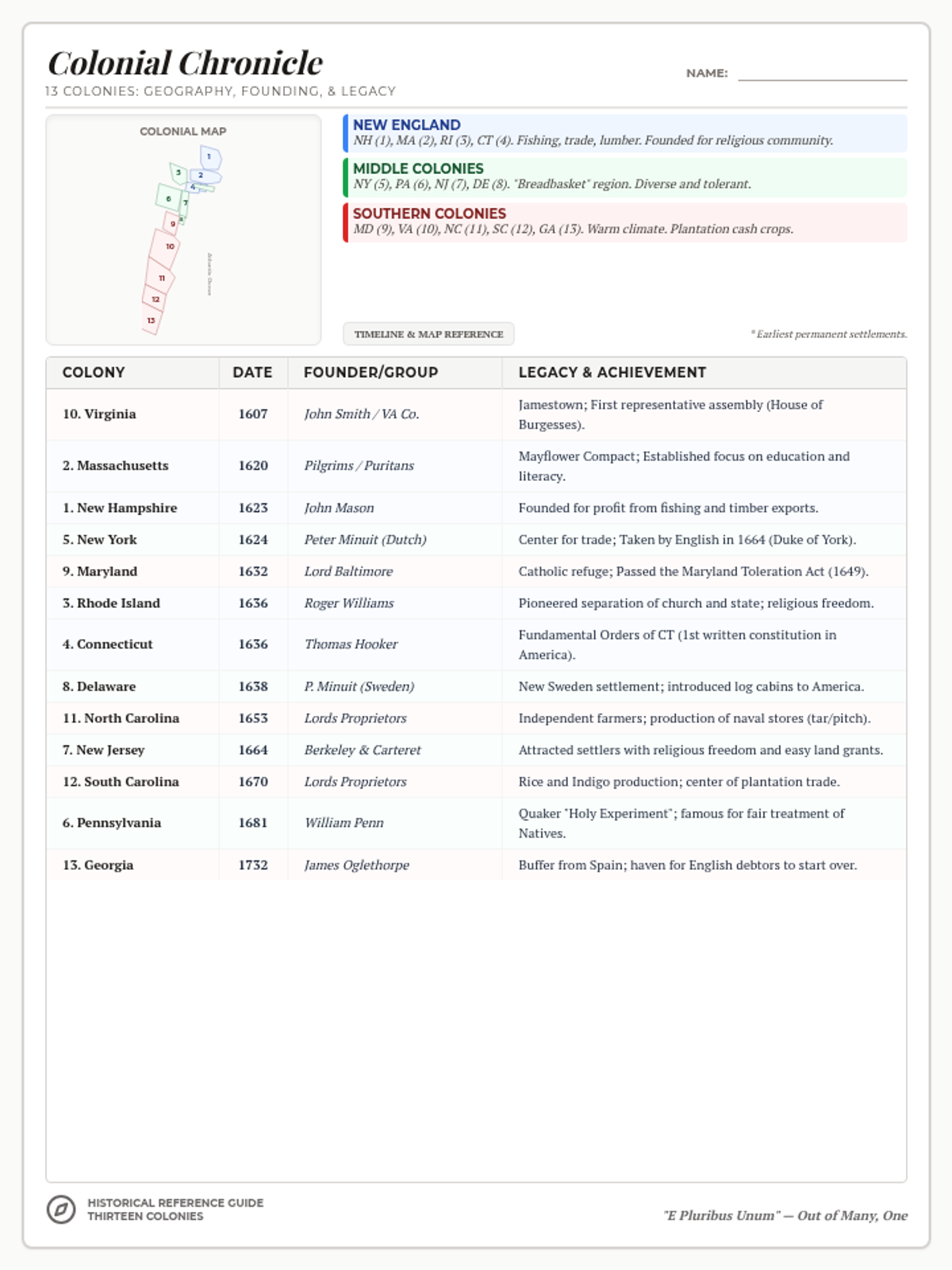
An analysis of early American regional geography, resource distribution, and economic systems, investigating how physical geography shaped the development of distinct Northern, Middle, and Southern colonial societies.
An exploration of how European Enlightenment thinkers like John Locke and Baron de Montesquieu, along with historic English documents like the Magna Carta, shaped early American beliefs about government and individual liberty.
A comprehensive lesson investigating redistricting, packing, and cracking to evaluate if legislative branches truly represent the will of the people. Includes a slide deck, a structured DBQ worksheet, a professional teacher guide, and an interactive exit ticket.
A service-learning and community activism lesson localized for Southern Oregon. Students explore the spectrum of community impact, brainstorm local issues, and research a self-selected cause using guided organizers.
Students synthesize their knowledge across all four civilizations, completing a DBQ, writing an argumentative essay on success, and formulating a civic project for Surprise, AZ.
Students explore the Inca civilization, studying their steep mountain terracing, Qhapaq Ñan roads, and rigid Ayllu community hierarchy.