A collaborative storytelling lesson where students use visual prompts to navigate through the elements of a story, focusing on sequencing and descriptive language.
A focused lesson on identifying nouns, verbs, and adverbs using classroom-themed sentences. Students practice identifying parts of speech through circling and underlining activities.
A phonics lesson focusing on the silent 'e' rule. Students will learn how the addition of an 'e' at the end of a word changes a short vowel sound into a long vowel sound through instructional slides and a cut-and-paste sorting activity.
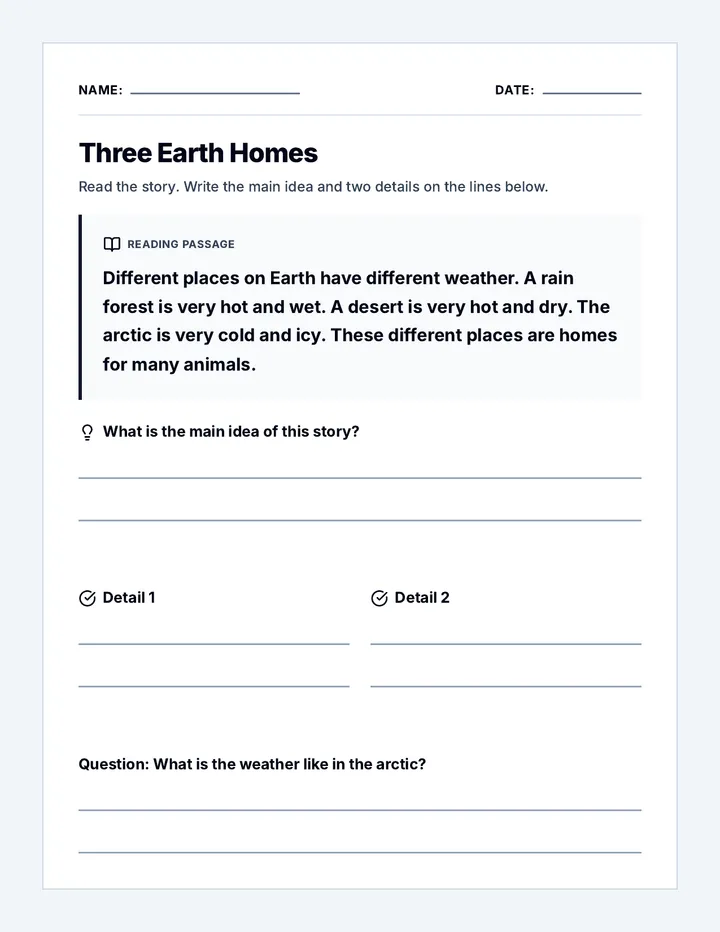
A collection of Level E reading passages and comprehension questions focused on foundational topics like school, farm life, and community roles.
Mastering number prefixes for four, five, and one hundred: quad-, quint-, pent-, and cent-.
Introduction to number prefixes: mono-, uni-, bi-, and tri-, indicating one, two, and three.
In this sort, related words may have multiple sounds that change. Listen for shifts in both the vowel and the consonant sounds (e.g., produce to production).
Focusing on vowel alternations where adding the suffix -ion shifts the sound from long or short to a schwa.
Introduction to vowel alternations where vowel sounds shift from long or short to the quiet schwa sound as the stress of the word moves.
Introduction to vowel alternations where vowel sounds shift between long, short, and schwa sounds (e.g., nature becomes natural).
Focusing on vowel alternations where a long vowel sound shifts to a short vowel or a schwa sound (the "uh" sound) when a suffix is added.
Introduction to vowel alternations where a long vowel sound shifts to a short vowel sound when a suffix is added (e.g., please becomes pleasant).
Focusing on consonant sound changes when a suffix is added (e.g., magic becomes magician).
Introduction to multi-syllable suffixes -ation, -cation, and -ition used to create complex nouns.
A small group lesson focusing on the 'Show, Don't Tell' technique for character emotions, using Peter Pan as a mentor text. Students will learn to replace flat emotional statements with descriptive actions and sensory details.
In this sort, we continue to look at words where adding -ion requires dropping the e or changing other final letters.