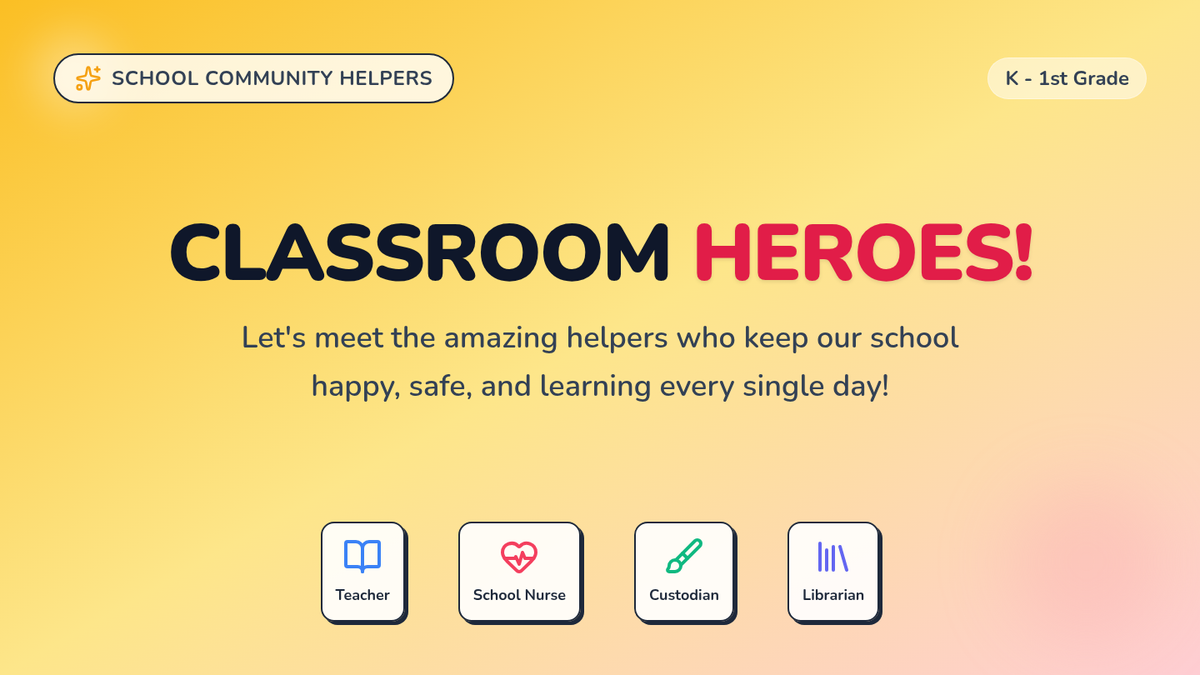
The unit concludes with students creating a 'Belonging Banner' to share their roles with the school community.
No materials in this lesson yet.
A lesson for kindergarten students introducing the concept of voting, fairness, and the historical struggle for voting rights through the story of Rosa Parks.
Master the essential terminology of Ancient Rome through visual and descriptive flashcards.
Solve complex multiplication word problems using multiple strategies including arrays and area models.
Track and reflect on daily reading progress with differentiated logs for various ability levels.
Analyze the key figures, events, and documents of the American Civil Rights Movement.
Explore how plants transform sunlight into energy through the process of photosynthesis.
A lesson investigating the political instability that led to the Fall of Rome, featuring differentiated evidence files for diverse reading levels. Students work collaboratively to diagnose the empire's 'political sickness.'
A lesson designed to help kindergarten students understand the concept of community by identifying and reflecting on the groups they belong to through drawing and early writing.
A comprehensive lesson on the colonial bread-making process, featuring the roles of millers and bakers, bartering practices, and sequencing the steps from grain to loaf.
Foundational literacy activities focusing on CVC word families through tactile sorting and visual identification.
An in-depth exploration of Ancient Egyptian civilization for sixth-grade students. This lesson covers geography, social structures, religious practices, and daily life, utilizing visual slides and interactive guided notes.
A collection of coloring pages featuring influential women from history and modern times, designed to inspire students through art and reflection.
An entirely unplugged introduction to logic and algorithms. Students explore step-by-step traditions and secret codes using physical patterns and movement games.
Celebrating cultural heritage through physical artifacts and oral histories. Students learn to analyze primary sources and explore informational text features like Table of Contents and Glossaries.
Reflecting on a year of learning, reviewing library organization (Dewey Decimal), and preparing for summer reading adventures.